He Carried His Friend’s Daughter Home Inside a Photograph for Forty-Six Years
Chapter 1: The Photograph Beneath Raymond’s Winter Coat
Rachel caught him opening his coat again before the bus had even reached the state line.
“Grandpa.”
Raymond Wilson’s fingers stopped beneath the worn brown wool, halfway to the inside pocket. He looked up as though she had said something much louder than his name.
“What?”
“That’s the fourth time in an hour.”
“It’s a long ride.”
“It is a photograph.” She leaned across the aisle and lowered her voice. “It cannot run away.”
For a moment, the hard line of his mouth eased. Then he looked toward the rain-blurred window, where headlights slid past in pale streaks, and tucked his hand back beneath the coat.
“It has waited a long time,” he said.
Rachel sat back. She had learned, since her mother died, that there were sentences Raymond used to close doors. It’s nothing. Don’t fuss. I’m fine. This one was newer, but it had the same weight.
It has waited a long time.
The bus groaned over uneven pavement. Raymond’s bad hip shifted beneath the thin blanket the driver had handed out after midnight. He had refused to complain, though Rachel had seen his jaw tighten whenever the bus lurched. His cap rested on his knees. Its brim was faded nearly gray, and beside it lay his wristwatch, face up, the cracked glass catching the dim overhead light.
He checked the watch now.
“We’ll be there at seven,” Rachel said.
He nodded.
“You’ve checked that too.”
“I like knowing.”
“You like worrying.”
He looked at her then. His eyes were tired but steady. “Those are not the same thing.”
Rachel let the words sit between them. She wanted to argue. She wanted to ask why he had waited until she found that old newspaper clipping in his desk before admitting he needed to go anywhere at all. She wanted to ask why he had let her spend three weeks saving tips from the café for bus tickets when he had clearly been carrying this place in his mind for years.
Instead, she reached over and pulled the blanket higher over his knees.
He did not thank her. That was not how Raymond thanked people. He simply left the blanket where she put it.
Near dawn, when most of the passengers had fallen asleep in crooked positions, Rachel saw him take the photograph out.
He did it carefully. First the handkerchief, yellowed and soft at the edges. Then the wax paper. Then the small silver frame, dulled nearly black in its corners.
The baby inside was bundled in a knitted blanket. One tiny fist rested near her cheek. Her eyes were wide, looking at nothing and everything.
Rachel had seen it once before, when she was twelve. Raymond had caught her holding it and had taken it from her without anger, only with a look that had made her feel as though she had wandered into a room where someone was dying.
Now she watched him trace the frame with his thumb.
“Was she family?” she asked.
His hand paused.
“No.”
“Then whose baby is she?”
Raymond turned the photograph over before she could see the writing on the back.
“Someone’s daughter.”
“That’s not an answer.”
“It’s the one I have.”
Rachel pressed her lips together. The bus rattled through the dark.
An hour later, the driver announced the final stop. Raymond rose too quickly, caught himself on the seat in front of him, and pretended nothing had happened. Rachel grabbed the bag before he could reach for it.
“I’ve got it.”
“I can carry my own bag.”
“You can carry your cap.”
He almost smiled at that, but his attention had already gone to the window.
Outside, the town looked smaller than Rachel had imagined from the map. Bare trees lined the street. A diner sign buzzed across from the bus station, and a few cars moved slowly through the wet morning. Raymond stood at the curb with his coat buttoned high, his shoulders slightly bent against the cold.
The cemetery was less than a mile away.
He did not ask for a taxi. He walked.
By the time they reached the gate, Rachel had stopped trying to tell him to slow down. His pace was stubborn rather than fast. Every few minutes he touched the inside of his coat, then the watch on his wrist.
The cemetery sat on a low rise behind a stone wall. Its office was a square building of pale brick, and beyond it stood an old memorial wall darkened by years of rain. Metal barriers had been stacked along the path. A temporary sign had been bolted near the entrance.
Rachel read it before Raymond could.
RESTORATION WORK BEGINS TODAY.
EAST MEMORIAL SECTION CLOSED AFTER 1:00 P.M.
Her stomach dropped.
“Today?” she said.
Raymond stopped beside her.
The sign fluttered lightly in the wind. He stared at it without blinking.
“You knew this?” Rachel asked.
He did not answer.
“Grandpa.”
His hand went into his coat. Not for the photograph this time. He pulled out a folded newspaper clipping, worn white at the creases. Rachel recognized it from the desk drawer. The headline was months old.
Historic Cemetery Wall To Be Removed During Redevelopment.
“You knew for months,” she said.
“I knew there was talk.”
“Three months ago, this was more than talk.”
He folded the clipping again, slowly. “Your grandmother was sick then.”
“She’s been gone two years.”
His face changed—not anger, exactly. Something quieter, more dangerous. Rachel wished the sentence back the moment it left her.
“I know,” he said.
She looked away.
For a while neither of them spoke. A grounds worker pushed a cart between the rows of stones. Somewhere beyond the office, metal struck stone with a dull, repeated sound.
Rachel took a breath. “Why didn’t you tell me?”
Raymond looked toward the memorial wall.
“I was going to try.”
“That isn’t the same as telling me.”
“No.”
The honesty of it caught her off guard.
He moved past the sign, then stopped again. The wall was still partly hidden behind the office, but he could see enough of it: old bronze plaques set into cold stone, a section at the far end covered by a tarp.
His shoulders lowered.
Rachel watched him take off his cap. His white hair was flattened beneath it. He held the cap against his chest, and for the first time since they had left home, she saw not only how tired he was but how frightened.
Not of the walk. Not of the cold.
Of being late.
“Who is Daniel?” she asked softly.
Raymond did not turn toward her.
The wind moved through the branches above the cemetery gate. His thumb pressed against the hidden photograph beneath his coat.
“Daniel,” he said, so quietly she nearly missed it, “I should have come sooner.”
Chapter 2: The Collector Reaches for the Frame
“The east section is closed.”
Samantha Robinson did not say it harshly. She said it with the careful patience of someone who had already given the same answer to too many people that morning.
Raymond stood at the cemetery office counter with his cap in both hands. Behind Samantha, shelves of binders and permit folders climbed almost to the ceiling. A small electric heater clicked in the corner but did little against the cold that followed people in every time the door opened.
“I only need a minute,” Raymond said.
“The restoration crew is setting the barriers now. Once they’re in place, nobody is allowed through.”
“I won’t touch anything.”
“I understand, sir. But the work order is already active.”
Rachel stood beside him, bag still hanging from her shoulder. “He came all the way from—”
Raymond lifted one hand, stopping her.
Samantha glanced at him, then at the old cap, the thin coat, the stiffness in his posture. “Is there a name you’re looking for?”
“Daniel Mercer.”
Her expression shifted, though only slightly. “There are several hundred names on the east wall.”
“I know where his should be.”
Should be.
Rachel heard it. Samantha did too.
Before either could ask what he meant, a door opened behind the office counter. A man stepped out from a back room holding a leather portfolio. He was perhaps in his fifties, clean-shaven, with a dark wool coat that looked too fine for the cemetery. A gold chain glinted briefly at his collar as he bent to pick up a pen from the floor.
“Mercer,” he said. “Military name?”
Samantha’s mouth tightened. “Mr. Bell is here about preservation inventory.”
The man looked at Raymond more closely. “You knew him?”
Raymond did not answer.
Paul Bell came nearer, though not so near that it could be called rude. His eyes settled on the inside pocket of Raymond’s coat with the ease of someone who had spent years noticing what other people carried.
“Old memorials have a way of producing unexpected things,” Paul said. “Letters. Keepsakes. Personal effects that families never claimed.”
“That isn’t why he’s here,” Rachel said.
Paul smiled at her politely. “Of course not.”
Raymond’s fingers went to his coat.
Paul saw the movement.
“May I ask,” he said, “whether you brought something connected to Mr. Mercer?”
“No,” Raymond said.
The answer came too quickly.
Samantha returned to her permits. “Mr. Wilson, if you have documentation that Daniel Mercer’s name appears on a record, I can check it. But I cannot open a closed area based only on a personal request.”
Raymond looked through the office window. Across the cemetery, a worker was stretching yellow tape between two posts.
“My documentation is that I was there,” he said.
Samantha looked up.
The room grew still.
Paul tipped his head, interested now rather than merely courteous. “There?”
Raymond’s face gave nothing away. “A long time ago.”
Rachel felt the old irritation rise again. He had told her almost nothing on the bus. He had told her less than nothing at home. Yet here, in front of strangers, he was willing to let words slip out that she could not catch hold of.
Paul nodded toward Raymond’s coat. “Sometimes personal evidence has real historical value. If you have a photograph, for instance, or a field letter, there are organizations that can preserve it correctly.”
“It is preserved correctly,” Raymond said.
“You may think so.” Paul’s tone stayed mild. “But paper degrades. Silver tarnishes. Stories disappear when objects remain in private hands.”
Raymond’s gaze sharpened.
“Stories disappear when people decide they belong to whoever can pay for them.”
Paul’s smile faded a little.
Rachel held her breath.
Samantha said, “Mr. Bell.”
But Paul only raised his palms. “I’m not trying to offend anyone. I’m saying that if there is something connected to the wall, we should make sure it is protected before this project begins.”
Raymond stood still for so long that Rachel wondered whether he would leave. Then he reached into his coat.
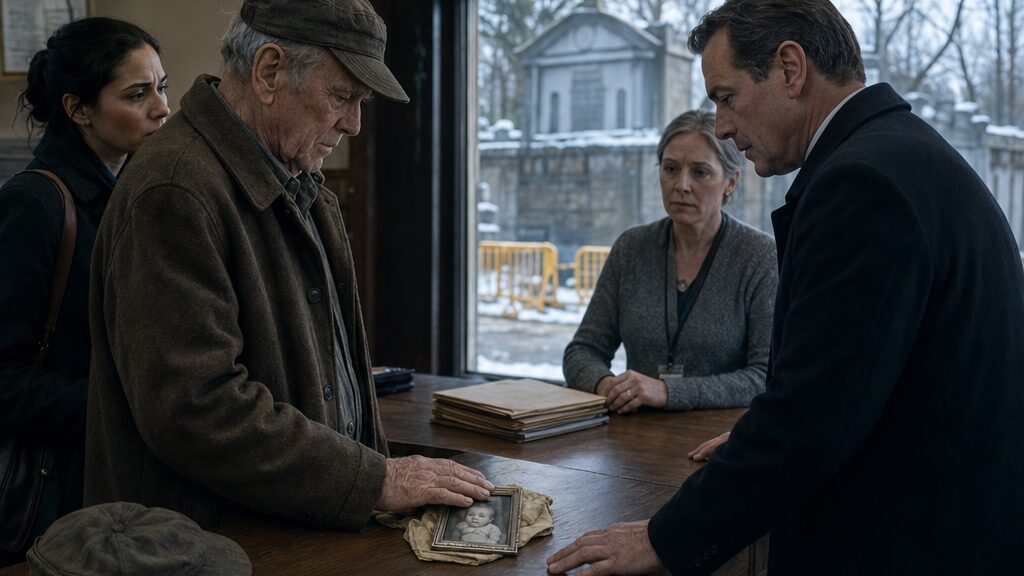
The handkerchief came first. He unfolded it on the counter with both hands. The wax paper made a faint dry sound. When he placed the small framed photograph on the wood, the room seemed to contract around it.
The baby looked as she had on the bus: round-cheeked, wrapped in a knitted blanket, one small fist raised beside her face.
Paul leaned forward.
The silver frame caught his eye. Rachel saw it happen.
“That’s older than I expected,” he said. “Original backing, perhaps. The frame alone—”
His hand moved toward it.
Raymond placed his weathered hand over the photograph before Paul could touch it.
The gesture was not sudden. It was not dramatic.
It was final.
“Sir,” Paul said, withdrawing his hand, “that photograph is worth more in a display case than it is in your coat pocket.”
Raymond looked at him.
“It isn’t for sale.”
“You came here for a name on an old plaque,” Paul said. “The restoration crew starts today. That promise is too old to matter.”
Rachel saw Raymond check his watch. His fingers shook once against the cracked glass, then became still.
“My friend saved my life,” he said.
Samantha stopped turning pages.
Raymond kept his hand over the frame.
“He gave me this picture before he died. He said his daughter was named Melissa. He said if I ever got home, I was to tell her he talked about her every day.” His voice thinned, but did not break. “He told me to say his name somewhere people would hear it.”
Paul’s face changed for a moment. A flicker of discomfort crossed it. Then he looked down at the photograph again, as though the object might be simpler than the man standing over it.
“That was decades ago,” he said.
“Yes.”
“The family may not even know who he was.”
Raymond’s thumb moved along the worn edge of the frame.
“He knew who they were.”
Samantha came around the counter slowly. “Why didn’t you come sooner?”
Rachel closed her eyes.
The question was not cruel. That made it worse.
Raymond did not answer right away. The office heater clicked once, then went quiet. Outside, the sound of metal barriers being dragged across stone scraped through the glass.
“My wife got sick,” he said at last. “Then I didn’t have the money. Then I thought I’d wait until I had something proper to bring.”
Rachel stared at him.
He had never said it that way before. Not to her.
Samantha’s expression softened. “And after that?”
Raymond’s hand remained over the photograph, protecting it even now.
“After that,” he said, “I was afraid.”
“Afraid of what?” Rachel asked.
He looked through the window toward the covered end of the memorial wall.
“That nobody would believe me,” he said. Then his shoulders sank a fraction. “Or worse—that nobody would care.”
Chapter 3: The Promise He Could Not Afford
Rachel found the envelope when Raymond went outside to catch his breath.
It slid from the inside pocket of his coat as he hung it over the back of the chair near Samantha’s desk. Rachel had only meant to move it away from the heater. The envelope was thin, unsealed, and marked in Raymond’s blocky handwriting.
BUS FARES.
She stared at it for a second, then looked toward the office door. Through the glass, Raymond stood on the bench beneath the bare tree, one hand pressed to his hip, his cap pulled low.
Samantha was in the records room. Paul had stepped out to take a phone call, speaking in a low, impatient voice near the front gate.
Rachel opened the envelope.
Inside were folded pages torn from old notepads. Numbers filled them in uneven columns. Dates. Town names. Prices crossed out and replaced. A bus schedule from twelve years earlier. Two unsent letters, both addressed simply to:
To the family of Daniel Mercer.
Rachel unfolded the first.
She stopped after three lines.
I knew Daniel when we were young. I have something that may belong to you. I should have written before now.
The rest was blank.
The second letter began the same way, with different words.
I do not know whether you would want to hear from me, but I have carried his daughter’s photograph—
It ended there.
Rachel folded the papers quickly when the door opened. Raymond came back in slower than he had gone out. He saw the envelope in her hands.
His face closed.
“You shouldn’t be reading that.”
“You shouldn’t have been hiding it.”
He took off his cap and placed it on the counter. “Rachel.”
“No. You don’t get to say my name like that and make me twelve again.”
Samantha looked up from the doorway of the records room, then quietly withdrew.
Raymond lowered himself into the chair beside the desk. The movement cost him. Rachel saw it in the way he gripped the armrest.
“You were going to write them,” she said. “How many times?”
“I don’t know.”
“You had the address.”
“An old address.”
“You could have tried.”
“I did try.”
The words came out sharper than she expected.
Raymond looked down at his hands.
For a few seconds, Rachel thought he would retreat again. She knew that look. He would lock the story behind his teeth and let her be angry because anger was easier for him to bear than being known.
Then he reached into his coat and brought out the handkerchief.
“My wife gave me this,” he said.
Rachel said nothing.
He unfolded it. The little photograph lay inside, its silver frame dull in the office light.
“She kept it after Daniel gave it to me. Said I’d lose it otherwise.” His thumb brushed the fabric. “When she got sick, every dollar went somewhere. Medicine. Rides. Bills that came even when there wasn’t enough money to pay them.”
Rachel’s anger loosened but did not disappear.
“You could have told me.”
“I didn’t want you carrying it.”
“I was already carrying you.”
He looked up at that.
She regretted it at once, but she did not take it back.
After her mother died, Raymond had become the one who cooked when Rachel worked late, the one who waited up when her car made a strange sound, the one who pretended his pension was enough. And Rachel had become the one who watched his prescriptions, counted groceries, and noticed when he started leaving lights on because his eyes were worse than he admitted.
“You think silence makes things lighter,” she said. “It doesn’t. It just makes everybody else guess.”
Raymond’s gaze moved to the photograph.
“I got close once,” he said.
Rachel sat down.
“What?”
“Twelve years ago. I took a bus to a town one stop from here.” His voice was low. “I had the picture. I had the letter. I got off at the station and thought about walking the rest of the way.”
“What happened?”
He turned the watch over in his hand, inspecting the crack across its face as if the answer might be there.
“I couldn’t breathe.”
Rachel’s chest tightened.
“I kept thinking maybe she’d open the door and tell me I was too late. Maybe she’d say he had been dead to her for years and I had no right to bring him back.” He swallowed. “So I got on the next bus home.”
The shame in his voice was worse than any excuse.
Rachel looked at the baby in the photograph. She had always thought Raymond treated it like a relic. Now it seemed more like a wound he had bandaged badly and carried everywhere.
“You were scared,” she said.
“I was a coward.”
“Both can be true.”
A faint sound came from outside. Paul’s voice, sharper now.
“Yes, I understand the schedule. I’m saying there may be an item that needs to be listed before anyone walks off with it.”
Rachel turned toward the window.
Paul stood near the gate with his phone to his ear. The restoration supervisor, wearing a hard hat, had stopped beside him. They were speaking over the wind.
Raymond heard it too.
His face hardened.
“He’s talking about the picture,” Rachel said.
“I know.”
“Then let Samantha handle it.”
“No.”
“You cannot fight everybody by yourself.”
Raymond folded the handkerchief over the frame.
“I’m not fighting,” he said.
“That’s the problem. You only ever leave.”
The words landed between them.
He looked at her for a long time.
Then, to Rachel’s surprise, he held out the photograph.
She took it carefully.
It was lighter than she expected. The frame was cold. On the back, beneath his thumb, she could see faded blue ink. Raymond shifted his hand before she could read it.
“Not yet,” he said.
Rachel looked at him.
Not never.
Not yet.
Before she could answer, the front door opened.
A woman entered carrying a folder of restoration papers against her chest. Her hair was gray at the temples, pulled back in a neat knot. She took two steps toward Samantha’s desk, then stopped.
Her eyes had fallen on the photograph in Rachel’s hands.
The color drained
Chapter 4: The Daughter Inside the Silver Frame
“That is me.”
The woman did not move closer at first. She stood just inside the office door, clutching the folder to her chest, staring at the photograph in Rachel’s hands as if the room had tilted beneath her.
Rachel looked down at the baby again. The knitted blanket. The raised fist. The serious, dark-eyed face.
“You’re Melissa?” Raymond asked.
The woman’s eyes shifted to him. “Who are you?”
Raymond had risen, but he did not step forward. His hand was braced on the back of the chair, fingers pale against the wood.
“My name is Raymond Wilson.”
“That doesn’t answer my question.”
“No.” He swallowed. “It doesn’t.”
Samantha appeared from the records room and took in the scene quickly. Paul was still outside near the gate, his phone held to his ear. The office seemed suddenly too small for the people in it.
Melissa set her folder down on the counter without looking away from the frame.
“Where did you get that?”
Raymond glanced at Rachel. Rachel held the photograph out toward him, but Melissa reached first.
“Please,” she said.
There was something in the word that made Raymond pause. Then he nodded once.
Rachel placed the photograph carefully in Melissa’s hands.
Melissa did not touch the glass at first. Her fingers hovered above it. When they finally closed around the frame, her breath came out in a shaky sound.
“My mother had one like this,” she said. “Not this exact one. She kept it in a drawer. I used to ask why she never put it out.” Her mouth tightened. “She said it was from before he left.”
Raymond’s eyes closed briefly.
“He didn’t leave,” he said.
Melissa looked at him sharply. “You don’t know that.”
“I do.”
“You knew him?”
“Yes.”
“How?”
Raymond looked down at the cap in his hands. “We served together.”
The answer changed her expression, but not into trust. If anything, it made her more guarded.
“My father served,” she said. “That’s what everyone always said. They said he was a good man, until he wasn’t.”
Samantha’s face softened. “Melissa—”
“No.” Melissa’s voice stayed low, though the force of it stopped the room. “I came here to sign off on measurements for the east wall. I did not come here for someone to tell me a story about a man I never met.”
Raymond took the words without defending himself.
Rachel watched him do it and felt anger rise again—not at Melissa, exactly, but at the way he seemed willing to let every accusation settle on him. As though punishment was the only thing he had traveled here to receive.
“He carried that picture for forty-six years,” Rachel said.
Raymond turned toward her. “Rachel.”
“What? It’s true.”
Melissa’s eyes moved from Rachel to the photograph.
“He carried it?”
“He checked it four times on the bus before sunrise.”
Raymond looked away.
Melissa studied the frame more closely. Its silver had darkened around the corners. There was a faint dent along one edge, as though it had once been struck or dropped.
“My mother told me he chose the army,” Melissa said. “She said he wrote once and then nothing. She said she waited until waiting made her foolish.”
Raymond’s voice was quiet. “Daniel talked about you every day.”
Melissa laughed once. It was not a happy sound.
“You don’t know what that means to someone who grew up hearing the opposite.”
“I know it is not enough.”
“No,” she said. “It isn’t.”
Paul came back inside then, stopping when he saw Melissa with the photograph.
Samantha moved quickly behind the counter, perhaps sensing that this was not a room for his voice. But Paul’s eyes went to the frame and then to Raymond.
“I spoke with the supervisor,” he said. “There are questions about whether any personal items connected to the wall need to be documented before—”
“Not now,” Samantha said.
Paul frowned. “Samantha, I’m trying to prevent a mistake.”
Melissa turned toward him. “What mistake?”
He hesitated. “I only mean that old items of potential historical importance should be handled properly.”
“It is my face,” Melissa said.
Paul’s expression changed. He looked at the baby in the frame, then at Melissa, and for the first time seemed to understand that the photograph had a claim on the room that no inventory form could measure.
“I didn’t realize,” he said.
“No,” Raymond said. “You didn’t.”
Paul said nothing after that.
Melissa had turned the photograph over. Her thumb moved across the backing, over the faded blue ink that Raymond had kept hidden from Rachel.
“For Daniel,” she read softly. “So he knows who he’s coming home to.”
The words seemed to pull the air from the room.
Her fingers tightened.
“He wrote that?”
Raymond nodded. “Your mother did, I think.”
Melissa looked at the back of the frame as though it might change under her gaze. “He never came home.”
“No,” Raymond said.
The word was simple. It still carried the whole distance of a life.
Melissa lifted the frame closer. One corner of the silver backing sat slightly loose. She pressed it by instinct, and it shifted beneath her thumb.
“What is that?”
Raymond leaned forward.
Samantha came around the counter. “Don’t force it.”
“I’m not.” Melissa’s voice had gone thin.
A narrow edge of paper showed through the gap behind the photograph.
Raymond stared at it.
“I never saw that,” he said.
Melissa looked at him. “You never opened it?”
“No.”
“Forty-six years?”
“I thought the photograph was all he gave me.”
Samantha returned with a pair of white gloves from a drawer. Her movements were careful now, stripped of the procedural briskness she had worn earlier.
“Let me,” she said.
Melissa hesitated, then handed over the frame.
Samantha put on the gloves and worked at the loose backing with the tip of a small letter opener. The old metal gave with a faint click. A folded strip of paper, thin and brown at the edges, slipped free.
Nobody spoke.
Even Paul stood still.
Samantha unfolded it once, then again. The handwriting was faint, the ink washed almost gray with time.
Her eyes moved across the first line.
Then she stopped.
Melissa’s hands had begun to shake.
“What does it say?” she asked.
Samantha looked up, and her voice changed when she read.
“Melissa, if you ever see this, I did not leave you.”
Chapter 5: The Name Missing from the Wall
The restoration supervisor came through the office door before Samantha could read the next line.
“I need an answer,” he said, hard hat tucked under one arm. “My crew cannot hold the east section all afternoon because someone found an old photo.”
No one answered him.
Melissa stood with both hands pressed to the counter. Raymond had not moved since Samantha read the note aloud. His face seemed smaller somehow, emptied by the sentence he had waited too long to hear and had never known existed.
The supervisor glanced from Samantha to the paper in her gloved hands.
“What happened?”
Samantha looked at him. “Daniel Mercer’s daughter is here.”
The supervisor’s expression shifted.
“And this?” he asked.
“A note from Daniel Mercer,” Samantha said. “Hidden behind a photograph he gave to Raymond Wilson.”
The supervisor looked toward Raymond, then toward the office window. Outside, the barriers at the east wall had been arranged in a straight yellow line. Two workers stood near the stone, waiting beside a stack of equipment.
“I’m sorry,” he said, and he sounded as though he meant it. “But I still have permits. I have a crew. The wall is being removed in sections. I can’t delay without something official.”
Samantha turned toward the records room.
“Then we find something official.”
She disappeared between the shelves before anyone could stop her.
Paul cleared his throat. “The photograph should still be documented. If it contains a hidden note, there may be questions about custody.”
Melissa looked at him.
“It contains a letter from my father to me.”
“I understand that. But for preservation—”
“It has been preserved,” Raymond said.
His voice was not loud. Yet Paul fell silent.
Raymond reached for the photograph, then stopped. Melissa still held it. The frame looked strangely small in her hands.
“I kept it in my coat,” he said, almost to himself. “Kept it dry. Kept it wrapped. I never let it out of reach.”
Paul’s face tightened. “I am not saying you were careless.”
“You said it belonged in a display case.”
“I said it might be safer.”
Raymond looked at him. “Safe from what?”
Paul did not answer immediately.
“From being lost,” he said at last. “That happens. Families throw things away. Towns tear down walls. Records get wet. Things disappear because people think feeling is enough to protect them.”
His eyes flicked toward the restoration schedules on the counter.
“I have watched too much history get sold off by the pound. I’m not trying to take anything from anyone.”
“But you were,” Rachel said.
Paul looked at her.
“You wanted it before you knew who she was,” Rachel said. “You wanted it because it was old.”
A long silence followed.
Paul adjusted the cuff of his coat. “Old things are often the only proof left.”
Melissa looked down at the frame. “This was proof left for me.”
Samantha returned with two thick binders and a cardboard file box. Dust rose as she set them on the desk.
“East wall replacements,” she said. “Nineteen eighty-two through eighty-four.”
The supervisor checked his watch. “You have limited time.”
Samantha opened the first binder. Pages crackled beneath her gloves.
Raymond stood beside Melissa now, but not close enough to touch her. Rachel watched him look at the paper in Samantha’s hands and then at the photograph, as if he did not know which one might break him first.
Melissa spoke without looking up. “Can you read the rest?”
Samantha held the note carefully.
“‘I did not leave you. I was trying to come home. I keep your picture close. Tell your mother I am sorry I could not send more.’”
Melissa’s mouth opened, but no sound came out.
Raymond gripped the back of the chair again.
“He wrote that?” she asked.
“Yes,” Samantha said.
“My mother said he never wrote.”
Raymond looked down. “Maybe he did. Maybe the letters didn’t reach her. Maybe he gave up trying because he thought—”
“Don’t,” Melissa said.
He stopped.
Her eyes were wet, but she did not wipe them. “Don’t fill in parts you don’t know.”
Raymond nodded once. “You’re right.”
The admission seemed to matter more than any explanation could have.
Samantha turned another page. Then another.
The office clock ticked loudly in the quiet.
Outside, an engine started.
The supervisor stepped to the window. “They’re getting ready.”
“I know,” Samantha said.
Her finger stopped halfway down a faded maintenance report. She leaned closer, then pulled it free.
“What is it?” Rachel asked.
Samantha did not answer at first.
The page was typed, but the ink had blurred in places. A handwritten note ran along the bottom margin.
“Replacement plaque order,” Samantha said. “East wall. Nineteen eighty-three.” She looked at the supervisor. “There was a transcription discrepancy.”
Raymond’s head lifted.
Samantha read more quickly now. “Several names were transferred from the original wall. One was omitted during the final engraving list.” Her finger moved down the page. “Daniel Mercer.”
Melissa stared at her.
“That can’t be right,” Paul said.
Samantha turned the report so he could see it.
The supervisor took it from her. His brows pulled together as he read.
“It says the original record was correct,” Samantha continued. “The name should have appeared on the replacement plaque. It was left off.”
Raymond looked through the window toward the wall.
The blank space he had come to find was no longer only a wound he carried. It had a line in a file. A mistake made by someone who probably never knew the name had weight.
“It was supposed to be there,” Melissa said.
Samantha nodded. “Yes.”
The supervisor exhaled slowly. “This gives me something. Not enough to stop the entire project, but enough to hold that section while I call the office.”
Paul stepped closer to the counter. “And the frame?”
Melissa’s grip tightened.
“It is not part of your inventory,” Samantha said.
“There may still be legal questions.”
Raymond turned to Paul. The stiffness in his hip seemed forgotten now. His voice remained quiet.
“You have a question about a piece of silver. We have a man whose name was erased.”
Paul met his eyes.
For a moment, Rachel thought he might argue again. Then his gaze dropped to the maintenance report.
“I wasn’t asking for his name to be erased,” he said.
“No,” Raymond replied. “But you were willing to let it stay that way.”
The supervisor’s phone rang. He answered it by the window, speaking in low clipped sentences. Samantha gathered the report, the hidden note, and the folders into a careful pile.
Melissa touched the photograph’s glass with one finger.
“My whole life,” she said, “I thought the empty place meant he had never mattered.”
Raymond looked at her, and there was no defense left in him.
“He mattered,” he said. “I should have made sure people knew.”
The supervisor ended the call and turned around.
“I can hold the east section,” he said. “Briefly. The plaque company needs confirmation, and the town office wants a statement from the family.”
He looked at Raymond, then at Melissa.
“But my crew starts in ten minutes.”
Chapter 6: Ten Minutes Before the Stone Disappeared
The workers moved the barrier aside, and the empty space showed itself.
It sat halfway along the east memorial wall, a rectangle of lighter stone where a plaque should have been. The old bronze plates around it were dark with weather, their letters softened by years of rain and cold. The blank place looked almost clean by comparison.
Raymond stopped a few feet away.
For forty-six years, Daniel had lived in his mind with a voice, a crooked grin, a hand gripping the strap of Raymond’s pack while smoke rolled across the road behind them.
Here, Daniel had been reduced to an absence.
The supervisor stood near the equipment cart with his phone in hand. “Ten minutes,” he said again. “That is what I can give you before the crew has to continue. The town office is reviewing the report. The plaque company has been notified.”
Samantha held the maintenance report against her chest. Melissa stood beside her with the photograph in both hands. Rachel stayed close to Raymond, but did not touch him.
Paul lingered near the edge of the path, as if unsure whether he belonged there at all.
Raymond looked at the blank stone.
His fingers went to his watch.
The cracked face showed a little past four.
Ten minutes.
He had spent years counting time in smaller pieces than that. The number of days left until a bill was due. The weeks until a prescription refill. The hours of overtime that might buy a bus ticket. He had measured courage as though it could be saved for later.
Rachel saw his hand trembling.
“Grandpa,” she said.
He did not answer.
The supervisor shifted his weight. “Mr. Wilson, I need to know what you want to do.”
Raymond looked at him as if the question were too large to understand.
“What I want?” he said.
“You asked to see the wall.”
“I asked to say his name.”
“Then say it.”
The words were practical. They should have made it easy.
Instead, Raymond looked down.
Paul spoke from behind them. “With respect, a spoken statement is not the same as proof.”
Rachel turned sharply. “Not now.”
“I’m not trying to be cruel,” Paul said. “But he deserves accuracy. Everyone does. We have one record showing an omission. We have a photograph and a note. We have Mr. Wilson’s memory.” He looked at the blank place in the wall. “Memory changes.”
Raymond’s shoulders tightened.
Paul continued, more carefully now. “If we make this public, it should be because we know what happened, not because grief feels convincing.”
Melissa stared at him.
“He was my father,” she said.
“I know.”
“No, you don’t.” Her voice was quiet, but it cut through the cold air. “You know there is a space on a wall. You know there is a letter. You do not know what it is to have people tell you for fifty years that a person left because you were not worth coming back to.”
Paul looked down.
The supervisor glanced toward the workers. One of them had begun to move a machine closer to the far end of the wall.
Raymond’s eyes followed the motion.
Daniel had been twenty-two when they met. Raymond had been nineteen and too proud to admit he was scared. They had been sent down a broken road under a sky that seemed always gray with smoke. Raymond remembered the weight of his pack, the wet mud around his boots, the sound of someone shouting orders he could not understand.
Then the blast.
Not close enough to kill him. Close enough to throw him into a ditch and leave him unable to stand.
He remembered Daniel crouching beside him.
“Go,” Raymond had said.
Daniel had looked over his shoulder. “Not leaving you.”
“You’ll get caught.”
Daniel had shoved Raymond’s arm over his shoulders. “Then walk faster.”
The memory had no clean ending. Only movement. Daniel half-carrying him toward the trees. Daniel pressing the photograph into his hand later, after darkness had come and the road behind them was no longer safe.
If I don’t make it, he had said, you tell her.
Raymond had said he would.
Then he had survived.
The supervisor’s voice brought him back. “Mr. Wilson?”
Rachel stepped close enough that her shoulder touched his sleeve.
“You don’t have to prove every breath he took,” she said. “You were there.”
Raymond shook his head.
“I was there,” he said. “And then I wasn’t there when I should have been.”
“You came now.”
“Forty-six years late.”
Rachel looked at the photograph in Melissa’s hands. “Maybe Daniel knew you would be scared. Maybe that’s why he gave it to you anyway.”
Raymond turned toward her.
“He trusted you,” she said. “Not because you were perfect. Because you were his friend.”
The words did not erase anything. Raymond knew that. They did not return the years to Melissa or take the old shame from his chest.
But they did something smaller and harder.
They made leaving impossible.
The supervisor checked his phone again. “Five minutes.”
Raymond removed his cap.
The wind touched his gray hair. He did not look at his watch.
Melissa came toward him with the photograph. Her face was pale, but her hands were steady now.
“Will you tell me?” she asked.
Raymond looked at the baby in the frame, then at the woman who had carried an empty place inside her for most of her life.
“What?”
“What he was like.”
Paul shifted behind them, perhaps ready to say something about records or caution or truth. But he did not.
Raymond looked back at the wall.
“He was stubborn,” he said. “Too stubborn for his own good.” A breath left him, almost a laugh but not quite. “He made terrible coffee. Burned it every time. He could not sing, but he did it anyway when he thought no one was listening.”
Melissa’s mouth trembled.
“He kept your picture in his shirt pocket,” Raymond continued. “He showed it to me the first day he had it. Said you had his eyes, though I told him every baby looked like a potato.”
A small sound escaped Melissa then. It might have been a laugh. It might have been grief finding another shape.
Raymond looked at the blank stone.
“He loved you,” he said. “That is what I know.”
The supervisor spoke quietly. “Mr. Wilson. Time.”
Raymond stepped forward.
The workers fell still.
Samantha moved to one side of the path, holding the report. Rachel stood behind Raymond, close enough that he could feel her there. Melissa held the photograph against her coat.
Raymond reached out but did not touch the empty stone.
His hand stayed suspended over the pale rectangle.
Then he lowered it.
He had spent so much of his life believing that a promise had to be completed before it could be spoken. That he had to arrive with proof, with money, with the right words, with a version of himself no one could question.
But Daniel had not asked him for any of that.
He had asked him to say a name.
Raymond lifted his head.
“Daniel Mercer,” he said.
Chapter 7: A Father Returned Through One Sentence
Melissa stood in front of the new bronze plaque without touching it.
The letters were clean and dark against the pale stone.
DANIEL MERCER.
For three days, the town office had made calls, sent copies, checked dates, and argued over whether a correction could be installed before the larger restoration work continued. Samantha had stayed late each evening with the old maintenance report spread across her desk. The plaque company had moved faster than anyone expected, perhaps because the error was plain once someone had bothered to find it.
Raymond had watched the workers set the new plate into the wall that morning.
Now the tools were gone. The barriers had been moved back. The cemetery was quiet except for the scrape of branches overhead.
Melissa had arrived carrying flowers wrapped in plain brown paper. She had placed them at the base of the wall, then taken one step back.
She still had not touched the name.
Rachel stood with Raymond near the path. He had his cap in both hands. The photograph was inside his coat again, wrapped in the handkerchief, though Melissa had held it most of the previous three days whenever they met at the office.
Samantha had found one more thing that morning: a copied service correspondence record, folded into a county archive file and never connected to the cemetery records. It showed that Daniel had requested information about a family address after his unit was moved. There was no letter attached. No proof that he had reached anyone.
Only the request.
Only the attempt.
Melissa looked at the plaque for so long that Rachel began to think she might leave without saying anything.
Then Melissa reached out.
Her fingertips brushed the first letter of Daniel’s name.
“I thought it would feel different,” she said.
Raymond did not move.
“What did you think it would feel like?” Rachel asked quietly.
Melissa gave a small, tired smile without looking back. “Like something had been fixed.”
The wind pushed a strand of hair loose at her temple. She tucked it behind her ear.
“My mother used to keep a box in the closet,” she said. “I was not allowed to touch it. I thought it had his things in it.” Her fingers stayed on the bronze. “When she died, I opened it. There were bills. A few pictures. Nothing from him.”
Raymond’s eyes lowered.
“She told me he chose to stay away,” Melissa continued. “She said he liked the idea of being a father more than the work of it.” Her mouth tightened. “I hated him for making her sad. Then I hated myself because I could not remember his face.”
Rachel looked at Raymond. He seemed to have folded inward, not from his bad hip this time, but from something heavier.
Melissa turned at last.
“A note and a name cannot give me back the father I needed,” she said.
“No,” Raymond answered.
It was not an apology. Not exactly. It was worse than one because he did not try to soften it.
Melissa looked at him steadily. “You knew that before you came here.”
“Yes.”
“Then why come?”
Raymond took a breath. His hand moved toward his coat pocket, then stopped.
“Because I did not want you to keep believing he forgot you.”
Her expression shifted, almost imperceptibly.
“I was afraid you would hate me,” he said. “And I thought perhaps you had a right to.”
“You let me believe it anyway.”
“I did.”
The honesty left no place for either of them to hide.
Rachel watched Melissa look back at the name. For a moment, the older woman’s shoulders shook once. Then she steadied.
Samantha came down the path from the office carrying a manila folder. She handed it to Melissa.
“The county archivist sent this over,” she said. “It is not much. But it confirms the request for your childhood address. The date is six weeks before the notice of his death reached the unit records.”
Melissa opened the folder. Her eyes moved over the copied page.
“He tried,” she whispered.
Raymond said nothing.
Paul stood farther back, near the cemetery gate. He had come each day, though he no longer brought his leather portfolio. He had offered to help pay for preservation copies of the note and report. Samantha had told him the town would handle it. He had accepted that answer without argument.
Now he looked at the plaque, then at Raymond.
“I was wrong about the photograph,” he said.
Raymond did not turn.
Paul continued, quietly. “I saw something rare. I did not see what it had cost to keep it.”
The words hung there.
Raymond gave a small nod, not forgiveness and not refusal. Only acknowledgment.
Paul lowered his eyes and stepped away.
Melissa closed the archive folder. “May I see it?”
Raymond knew what she meant.
He took the photograph from his coat.
The handkerchief opened between his palms. Rachel saw how carefully he held the little frame, as though the metal had become thinner over the years and could no longer bear a careless touch.
Melissa accepted it.
For a while she only looked at the baby.
Then she turned it over, reading the faded writing again.
For Daniel, so he knows who he’s coming home to.
Her thumb rested on the loose corner where the note had been hidden.
“Why did you keep this?” she asked.
Raymond’s hand tightened around his cap.
“I thought it was the last proof he had existed.”
Melissa looked up.
“He existed,” she said. “You remembered him.”
“I remembered him badly,” Raymond said. “I remembered him alone.”
The wind moved through the cemetery. Somewhere beyond the wall, a worker started a truck, then shut it off again.
Melissa held the photograph against her chest.
“That fear kept both of us alone,” she said.
Raymond’s eyes filled, though he blinked before anything fell.
Rachel looked away and gave them the privacy of pretending to study the graves nearby.
When she turned back, Raymond had stepped closer to Melissa.
“No,” he said softly. “It belongs with you.”
He placed the framed photograph in her hands and folded her fingers around it.
Chapter 8: The Promise No Longer Belonged to Him
At the bus stop, Raymond reached inside his coat and found nothing.
His hand stayed there for a moment, pressed against the empty pocket.
Rachel stood beside him with their bag at her feet. Across the street, the diner had just opened. A waitress turned the sign in the window from CLOSED to OPEN, and the first bus of the morning hissed at a red light half a block away.
“You’re looking for it,” Rachel said.
Raymond removed his hand from his coat.
“Habit.”
“You regret giving it to her?”
He looked down the road.
For forty-six years, he had known the shape of that frame against his ribs. He had slept with it under his pillow when his wife was in the hospital. He had carried it in a work glove through rain when the roof leaked. He had checked for it in grocery lines, waiting rooms, and once at his daughter’s funeral, when the world had seemed too broken for another thing to survive.
Now the pocket lay flat.
“No,” he said.
Rachel studied him.
“That was not a very convincing answer.”
Raymond let out a breath that showed white in the cold air.
“I regret keeping it so long,” he said. “That is different.”
The bus rounded the corner.
Rachel bent for the bag, but Raymond reached it first. He lifted it only a few inches before his hip protested. Rachel took it from him without a word.
He did not argue.
They started toward the curb.
Behind them, someone called his name.
“Raymond.”
He turned.
Melissa was coming down the cemetery path with a small bunch of white flowers in one hand. She wore the photograph inside her coat now. Raymond could tell by the way her other hand rested briefly over the front of it.
She stopped in front of him.
“I wanted you to have these,” she said, holding out the flowers.
Raymond looked at them, then at her.
“They should be for Daniel.”
“They are.” Her mouth moved into a faint smile. “I’m taking more back later.”
He accepted the flowers carefully.
For a moment neither of them spoke.
Then Melissa said, “Samantha and I are putting his note and the records into the cemetery file. Not the original note. A copy.” She glanced toward the wall. “There will be a short account beside his name when the restoration is finished. Nothing grand. Just that he served, that his name was omitted, and that it was restored.”
Raymond nodded.
“And your statement,” she said. “If you are willing.”
He looked uneasy at once.
Rachel saw it and nearly smiled. Some things did not disappear in a morning.
“It does not have to be long,” Melissa said. “Just what you told me. That he carried my picture. That he talked about me.”
Raymond looked toward the cemetery, though the wall could not be seen from where they stood.
“I can do that,” he said.
Melissa nodded. Then she lifted one trembling hand to her forehead.
The salute was quiet. Private.
Raymond’s breath caught.
He returned it.
When he lowered his hand, Melissa was crying, but she did not apologize for it. Raymond did not apologize either.
The bus pulled to the curb with a soft sigh.
Rachel picked up the bag. Raymond climbed the steps slowly, one hand on the rail. Before he went inside, he looked back.
Melissa stood beneath the bare trees with the flowers gone from her hand and the photograph close against her heart.
Raymond touched the empty pocket once more.
This time, he did not search it.
He found a seat by the window. Rachel sat beside him. As the bus pulled away, the cemetery gate slipped behind them, then the stone wall, then the town itself.
“You did it,” Rachel said.
Raymond watched the road ahead.
“No,” he said softly.
Rachel waited.
He looked at her, then back toward the place where Daniel’s name now stood in bronze.
“We did.”
The story has ended.