The Blue Stripes Beside Her Brother’s Ramp That the Board Tried to Erase
Chapter 1: The Notice Folded Behind Old Bills
Nicole saw the paper before she saw Robert’s van.
It had been taped to the side door at eye level, held there with a strip of clear packing tape that had already gathered a gray rim of dust. The HOA logo sat at the top in dark green. Beneath it, in bold letters, were the words: NOTICE OF REQUIRED REMOVAL.
The van’s turn signal clicked at the curb.
Nicole stood frozen on the front walk with a grocery bag cutting into her fingers. The afternoon sun flashed against the windshield as Robert eased the van toward the blue-striped parking pad beside the side entrance. He drove carefully now, always with the same cautious pause before the curb cut, as though the concrete itself might move when he was not looking.
A delivery truck was parked half across the pad.
Nicole’s throat tightened.
“Wait,” she called, dropping the grocery bag beside the porch rail.
Robert had already lowered the driver’s window. “What?”
“The truck.”
He looked at it, then at the narrow space left between the bumper and the ramp. The delivery driver was carrying a box toward the house across the street, his back turned.
“It’s fine,” Robert said.
“It isn’t.”
Nicole crossed the driveway before he could open his door. The blue paint of the handicap symbol was warm beneath her shoes. It had faded at the edges over the last two years, but the white stripes still showed clearly, slanting toward the ramp like an arrow pointing home.
The delivery driver came back, saw her face, and stopped.
“I’ll be gone in a second,” he said.
“My brother needs this space to get out.”
“I said I’m leaving.”
Nicole glanced toward Robert. He had one hand on the steering wheel, the other resting too still against his thigh.
The driver got into his truck with the slow, offended movements of someone who had been asked to do more than he believed was reasonable. When he pulled away, Robert parked at the edge of the striped space. He shut off the engine and sat for a moment without moving.
Nicole went to the passenger side, unfolded the wheelchair from the back, and brought it around.
“You don’t have to hover,” he said.
“I know.”
“You are hovering.”
“I’m holding the chair.”
“You can hold the chair without looking like you’re waiting for me to fall.”
Nicole looked down at the wheel locks. “I’m not.”
Robert made a sound that might have been a laugh if it had not ended so quickly. He opened the door and began the transfer.
His arms were strong. They had stayed strong because everything else had required them to. But pain had a way of narrowing the world. Nicole had seen it happen after long therapy days: his jaw set, his breath held, the distance from seat to chair becoming something he had to negotiate with his whole body.
His left foot slipped against the pavement.
Nicole caught his elbow. The wheelchair shifted backward half an inch before she locked it.
Robert went still.
For a second, neither of them spoke.
Then he lowered himself into the chair and looked away.
“You see?” Nicole said softly. “This is why the space has to stay clear.”
He rolled toward the ramp. “I know why it has to stay clear.”
The notice on the door fluttered once in the faint wind from the street.
Nicole waited until he disappeared into the house before she peeled it free.
The paper was thick, official-looking, and colder than it should have been in her hand. It said the concrete parking modification violated community appearance standards. It said the owner must remove the structure within fourteen days. It said failure to comply could result in enforcement measures and charges.
There was no mention of Robert.
No mention of the ramp, the therapist’s recommendation, the wheelchair, the blue disabled-veteran placard mounted beside the rail.
Only “structure.”
Only “appearance.”
Nicole read it twice at the kitchen counter while Robert filled a glass of water behind her.
“What is it?” he asked.
“Nothing.”
He looked over her shoulder. “Nicole.”
She folded the notice once, then again. “The HOA.”
His face changed, not with surprise but with recognition. “About the pad?”
“It’s probably a mistake.”
“Did they say that?”
“They sent a notice.”
He leaned one hand against the counter. “Let me see it.”
Nicole held it closer to herself. “I’ll handle it.”
“That means yes.”
She hated that he knew the meanings of her sentences. She had spent years making things sound smaller than they were: the hospital bill was “a little high,” the roof leak was “a patch,” his bad nights were “rough.” She had believed that naming trouble too clearly gave it more power.
“It says they want it removed,” she admitted.
Robert’s eyes moved toward the side window. Through it, the blue-striped concrete was visible beside the ramp, clean except for a tire mark near the curb. “We have approval.”
“We do.”
“You kept it?”
“Of course.”
He waited.
Nicole looked down at the folded paper. “I just need to find it.”
The kitchen drawer beneath the phone had become the place where documents went when they were too important to lose and too exhausting to deal with. Insurance statements, property tax receipts, contractor warranties, discharge instructions, old board newsletters. Nicole opened it and stared at the uneven stacks.
Robert wheeled closer. “You should tell them that it was approved.”
“I will.”
“You should tell them I need it.”
“I will.”
He watched her for another moment, then backed away from the counter. “Don’t make this about me.”
Nicole looked up.
“It’s your house,” he said. “You don’t have to stand there and explain my body to people who think they own a strip of concrete.”
“I’m not explaining you.”
“Then what are you doing?”
She did not answer.
The truth was that she did not know yet. She only knew that she had a notice in her hand and fourteen days before strangers might come to take something away that Robert needed.
That evening, after he went to his room, Nicole found the contractor invoice first.
It was tucked between a water bill and a receipt for the bathroom grab bars. The contractor had written in block letters across the top: ACCESSIBLE PARKING PAD AND CURB TRANSITION—THERAPIST-RECOMMENDED ENTRY ROUTE.
Nicole felt a small, foolish rush of relief.
There. Evidence. A clean answer.
She scanned the invoice, the medical note, and the notice. Then she opened her laptop and wrote an email to the HOA compliance office.
She kept it brief. She attached everything. She did not mention David Taylor by name, though she knew he chaired the compliance committee now.
Two years earlier, she had stood in a board meeting and asked why the landscaping contract cost more than the neighborhood’s sidewalk repairs. She had not accused anyone of stealing. She had only asked to see invoices.
David had smiled across the folding tables and said, “Some residents mistake suspicion for civic engagement.”
The room had gone quiet. Nicole had sat down with her cheeks burning and told herself she would never speak at another meeting unless she had no choice.
She clicked send just before midnight.
The reply came the next afternoon.
It was not from David. It was from the office administrator, and it contained only two sentences.
Your materials have been received. The deadline remains active pending compliance review.
Nicole read it at the kitchen table while Robert watched a muted news program from the living room.
She typed three different responses, deleted all of them, then wrote: Please confirm that no enforcement action will occur while the review is pending.
She waited.
No answer came that night.
Or the next morning.
On the third day, an envelope appeared in the mailbox with the HOA return address. Nicole carried it inside without opening it. She placed it on top of the kitchen drawer and made dinner. She helped Robert load his medication organizer. She washed the same plate twice because she could not remember whether she had already rinsed it.
After Robert went to bed, she opened the envelope.
The letter inside said the deadline remained unchanged.
At the bottom, beneath the typed signature line, was a short handwritten note in blue ink.
No further extension will be granted.
Chapter 2: The Morning the Machines Arrived
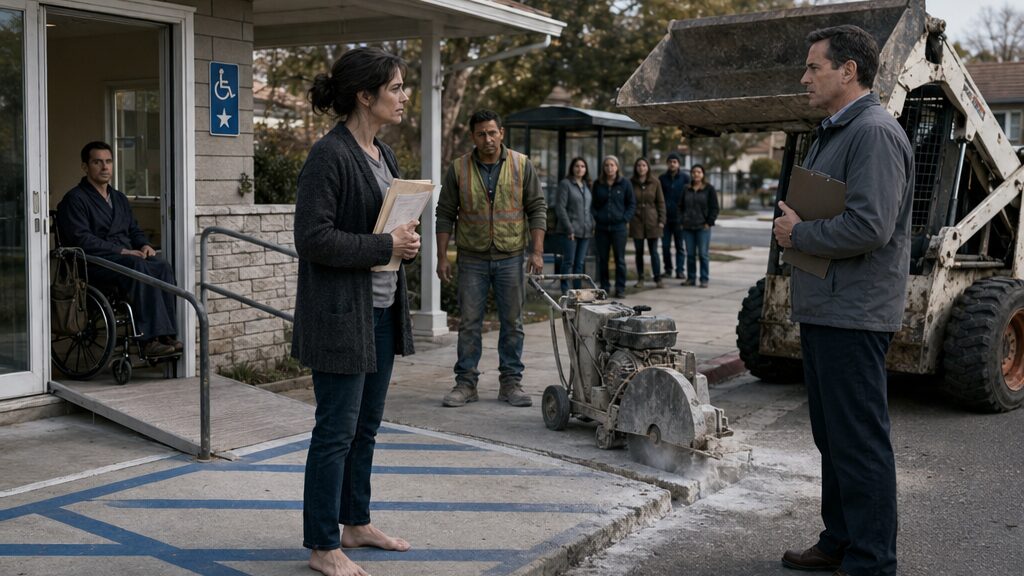
The skid steer was idling beside the parking pad before eight in the morning.
Nicole heard it before she understood what it was. A deep mechanical rumble pushed through the kitchen walls and rattled the spoon in her coffee mug. For one suspended second, she thought it might be a garbage truck.
Then she looked through the side window and saw the raised bucket hanging above the blue-striped concrete.
Her mug slipped from her hand and struck the counter.
“Robert,” she said.
He was in the hallway, still wearing his robe, one hand resting on the wheel of his chair. “What?”
“They’re here.”
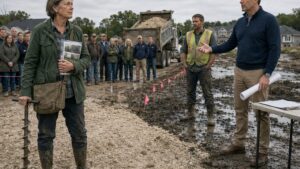
By the time Nicole reached the front door, the landscaping crew had unloaded a concrete saw from the back of a truck. Dusty extension cords lay coiled on the driveway. A younger worker in a reflective vest stood near the ramp rail, staring at the blue disabled-veteran placard as if he had only just noticed it.
David Taylor stood at the curb in a gray windbreaker, holding a clipboard against his chest.
He looked almost neat enough for a photograph.
Nicole stepped outside without shoes. The cold concrete pressed through her socks.
“What are you doing?” she asked.
David glanced toward her. “Good morning, Nicole.”
“What are you doing?”
“You were notified.”
“You said my documents were under review.”
“The board found no active approval on file.”
Nicole looked at the skid steer. “You brought machinery.”
“Because the modification needs to be removed.”
“My brother needs that space.”
David’s expression barely changed. “Your personal circumstances do not override the community’s standards.”
The sentence landed with the flatness of something rehearsed.
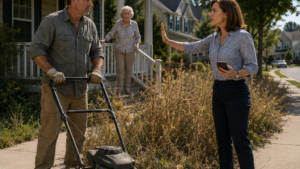
Across the street, children were gathering beneath the bus stop sign. A few parents stood nearby with coffee cups and phones. Jerry Wright, who lived three houses down, leaned against his mailbox and looked toward the concrete pad.
“Finally,” he said to no one in particular. “That thing’s been an eyesore since it went in.”
Nicole felt heat rise to her face.
The crew supervisor, Justin Rivera, stood beside the saw with his hands in his vest pockets. He was broad-shouldered, older than the younger worker by at least twenty years, and looked uncomfortable in the way people did when they had arrived expecting a simple job and found something else waiting.
“Ms. Harris,” he said, “we were told this was unauthorized concrete.”
“It was approved.”
David turned slightly. “She has not supplied a current approval.”
“I sent it.”
“You sent materials after the enforcement deadline.”
“I sent them the same day I got the notice.”
David tapped his clipboard. “The office has no record of an active renewal.”
Nicole stared at him. “There was never a renewal form.”
“That is not the issue this morning.”
“It is exactly the issue.”
Justin looked from Nicole to David. “Do you have a city permit issue here?”
David’s mouth tightened. “This is an association matter.”
“It’s a curb transition,” Justin said. “I’m asking because cutting it changes the slope.”
David’s eyes shifted toward him. “You are under contract to remove unauthorized work.”
Nicole saw the younger worker look again at the placard. Then through the front window, where Robert had rolled into view.
He was behind the glass in his wheelchair, one hand on the rim, his face pale and still.
Nicole turned back to David. “Give me ten minutes.”
“There is nothing to discuss.”
“I have the approval email.”
“Then present it at the next hearing.”
“You’re about to cut the only safe way he gets from the van to the ramp.”
“Do not interfere with the crew,” David said. “Daily fines will begin today if you delay enforcement.”
For a moment Nicole could not breathe.
The saw operator bent to check the blade. The skid steer shifted forward, tires crunching over gravel at the edge of the drive.
Nicole ran inside.
The kitchen drawer stuck when she pulled it. She yanked harder, scattering a stack of envelopes onto the floor. Her hands shook so badly that she dropped Robert’s discharge papers twice before finding the HOA folder.
Behind an old newsletter, folded into quarters and yellowed at the creases, was the email.
Temporary Accessibility Parking Modification Approved.
She read the subject line once, then again, as though the words might vanish if she moved too fast.
Robert had rolled into the kitchen doorway.
“Mara—” he began, then caught himself. “Nicole.”
She looked up.
“Don’t stand in front of it.”
“I’m not going to.”
“You shouldn’t have to fight them because of me.”
Nicole pressed the paper flat against the counter. Outside, the saw started with a sharp, hungry whine.
“This is not because of you,” she said. “This is because they decided not to listen.”
She ran back outside just as the blade lowered toward the outer edge of the concrete.
“Stop!”
Justin raised one hand. The operator hesitated.
David exhaled through his nose. “Nicole, you are making this more difficult than necessary.”
She held out the paper. “Read it.”
He did not take it at first.
“Read it,” she said again.
The children at the bus stop had gone quiet. Jerry had lowered his phone. Even the younger worker had stopped moving.
David took the email between two fingers. His eyes traveled down the page.
“It is from a prior board,” he said.
“It is an approval.”
“It says temporary.”
“It says it remains in place for the duration of medical necessity.”
David pointed to the next line. “Subject to renewal.”
“There was no renewal form.”
“Then you should have requested clarification.”
Nicole laughed once, without humor. “You mean before you sent a demolition crew?”
David’s jaw tightened. “Rules are not personal attacks.”
“No,” she said. “But people use them that way.”
The saw operator shifted his weight. Justin moved closer to the curb cut and crouched beside it, studying the slope. The younger worker looked at Robert behind the glass, then at the ramp rail.
“If we cut this,” he said quietly, “how does he get across?”
David turned toward him. “That is not your concern.”
Justin stood. “It is if we’re changing the grade.”
“I need you to proceed.”
Justin did not answer immediately.
The school bus hissed to a stop behind the small crowd. Its folding door opened. Children climbed aboard, glancing back at the raised bucket, the blue stripes, Nicole standing barefoot with a trembling piece of paper in her hand.
Then someone stepped off the curb.
Virginia Hall was crossing the street with a faded manila envelope held against her chest.
David saw her coming, and for the first time that morning, his face changed.
Virginia stopped beside Nicole.
“I kept these,” she said, looking at David. “Because I thought the board was getting sloppy.”
She opened the envelope.
David’s hand tightened around his clipboard.
“These,” Virginia said, lifting the first printed email, “are papers you will not want anyone to read.”
Chapter 3: The Exceptions Nobody Mentioned
Virginia placed the first page on top of Nicole’s trembling approval email.
The heading was different. It carried the HOA logo, but the language beneath it was plain enough that Nicole understood it before she finished the first paragraph.
Accessibility modification approved until medical need ends.
She looked at Virginia.
“Whose is this?” Nicole asked.
“The house on Willow Bend,” Virginia said. “The one with the widened driveway.”
Nicole knew the house. The resident used oxygen tanks. A ramp ran along the side of the garage, partially hidden by shrubs.
David stepped forward. “Those are unrelated files.”
Virginia did not move her hand from the papers. “No. They are the same kind of files.”
“There are different circumstances.”
“Then explain the difference.”
David’s voice sharpened. “You do not have permission to distribute association communications.”
Virginia gave him a look Nicole had never seen from her before. “You sent them to me.”
Justin stood near the curb cut with the saw operator behind him. The skid steer continued to idle, heavy and impatient. Dust hung in a pale line along the driveway where the tires had crossed.
Nicole read the second page.
It approved a side ramp for a child with cerebral palsy. The third approved a designated accessible parking space for the father of the board treasurer.
All three were signed or copied to David Taylor.
Her eyes stopped on his name.
“You said there were no active approvals on file,” she said.
David looked toward the papers but not at them. “I said there was no active approval for this property.”
“You knew exceptions existed.”
“This is not a courtroom.”
“No,” Nicole said. “It’s my driveway.”
Jerry shifted across the street. His expression had lost its earlier amusement. One of the parents at the bus stop pulled a child closer as the bus doors folded shut.
David turned to Justin. “Resume work.”
Justin did not move.
“You have an order,” David said.
“I have a contract,” Justin replied. “And now I have competing paperwork.”
“There is no competing paperwork. These are old emails.”
“They’re not old enough to disappear,” Virginia said.
David’s eyes flashed toward her. “Mrs. Hall, this is precisely why rules need to be enforced consistently. People begin treating exceptions as permanent privileges.”
Nicole heard something underneath his words then. Not just coldness. Fear. He looked at the gathered neighbors, at Justin, at the papers in Virginia’s hand, and seemed to realize the morning had slipped outside the narrow lines he had drawn for it.
“You asked for consistency,” Nicole said. “Show me where it was.”
David’s mouth tightened.
Justin walked to the skid steer and spoke briefly to the operator. The engine lowered to a rougher idle. Then he came back to the curb cut with his phone in his hand.
“I’m taking pictures,” he said. “Of the grade, the ramp, the placard, all of it.”
David stared at him. “For what purpose?”
“For my records.”
“You are delaying a contracted job.”
“I’m pausing it until somebody confirms this is legal and safe.”
Nicole looked at him. “Thank you.”
Justin gave a small nod, not quite meeting her eyes. “Don’t thank me yet. I just don’t want my crew cutting something we shouldn’t cut.”
It was not kindness exactly. It was caution. But Nicole took it anyway.
David pulled a form from beneath the top sheet on his clipboard. He stepped toward Nicole and held it out.
“This is notice of daily noncompliance fines,” he said. “Effective today.”
Nicole did not take it.
David placed it on the hood of Robert’s van.
“You cannot punish me for stopping your crew.”
“I can assess charges for failure to comply with the order.”
“You never answered my email.”
“The office acknowledged receipt.”
“That is not an answer.”
“Then raise it at the emergency hearing.”
Nicole looked at the form. The amount was printed in a clean black box. It was not impossible money, not yet. That made it worse. It was the kind of amount designed to make a person think maybe silence would cost less.
“What hearing?” Virginia asked.
David glanced at his watch. “Tonight. Seven o’clock. Community room.”
“You scheduled it today?” Nicole said.
“The board needs to address the disruption.”
“The disruption?” she repeated.
The younger worker lowered his eyes.
David gathered the exception papers from the hood, but Virginia caught his wrist before he could take them.
“No,” she said.
His expression hardened. “Do not touch me.”
“Then stop touching everyone else’s life with that clipboard.”
The words hung in the air.
Nicole expected David to snap back. Instead, he slowly pulled his hand away. “Bring whatever documents you believe are relevant tonight,” he said to Nicole. “The board will decide.”
Then he turned and walked toward his car.
The crew remained where it was.
Justin crouched beside the curb cut, taking photographs from different angles. The saw blade had left a shallow gray line near the edge of the blue stripes. It was not deep enough to break the concrete, but Nicole could not stop looking at it.
A scar before the wound had even happened.
By the time the trucks pulled away, the school bus was gone and the street had returned to its ordinary morning shape. Mailboxes. Lawns. A sprinkler ticking somewhere behind a fence.
But nothing felt ordinary inside Nicole’s house.
Virginia sat at the kitchen table with her envelope open between them. Nicole made coffee nobody drank. The exception emails lay in rows beside the faded approval letter, their corners held flat by salt shakers and a ceramic sugar bowl.
“They did this to you too?” Nicole asked.
Virginia looked down at her hands. “Not exactly.”
“What happened?”
“My front railing.” Virginia gave a small, embarrassed smile. “It was old. Loose. I wanted a different style because I was afraid of falling on the steps. David sent a warning that it violated the original design standards.”
“Did you appeal?”
“I called. He told me the board could not make exceptions based on individual preference.”
Nicole waited.
“Then I found out a neighbor around the corner had been allowed to install a railing with a mobility grip.” Virginia touched one of the papers. “I was angry. But I was also tired. So I kept the notices and paid for the standard railing.”
“You kept all of this?”
“I thought someday it might matter.”
Nicole looked at the neat stack of documents. “Why didn’t you say anything sooner?”
Virginia’s eyes lifted. “Why didn’t you?”
The question was not cruel. That made it harder.
Nicole thought of the landscaping meeting two years ago. The room watching her. David’s polished smile. The hot shame of being treated as though asking for invoices was a form of bad manners.
“I thought I could handle it privately,” she said.
Virginia nodded as though she understood too well.
At the far end of the table, Robert sat in his wheelchair, quiet. He had not said much since the crew left. His medical bag hung from one handle, still packed from therapy.
Nicole gathered the papers into a folder. This time she did not shove them into the drawer. She lined them up by date. Her approval. The contractor invoice. The medical note. Virginia’s exception emails. The fine notice.
Evidence, she told herself.
But evidence was only useful if someone was willing to stand in a room and make people look at it.
That evening, as Nicole printed copies for the hearing, Robert wheeled into the kitchen.
“You don’t have to go,” he said.
She kept her eyes on the printer. “I do.”
“You don’t have to fight because of me.”
The page slid out with a dry mechanical whisper.
Nicole looked at him then.
Robert’s face was tired, but it was not pain she saw there. It was something older. Something that had been building in the spaces where he apologized for grocery bags and doctor appointments and rides he could no longer give himself.
“I don’t want you spending your life arguing with people because I need a place to park,” he said.
Nicole set the printed page down.
Outside, through the side window, the blue-striped concrete sat in the fading light. The first cut from the saw crossed one corner like a thin gray mark.
She wanted to tell him she would fix it. That she would make the board listen. That the folder in her hands was enough.
Instead, she heard herself say, “I don’t know how to do this without making it worse.”
Robert looked down at his wheels.
And for the first time since the notice had appeared on the door, Nicole understood that protecting him mig
Chapter 4: The Hearing Where Nicole Finally Spoke
David placed the fine notice in front of Nicole before she had even pulled out her chair.
The paper landed flat on the folding table with a sound too small for the room it made in her chest. Around them, the community room smelled of old carpet, burnt coffee, and the lemon cleaner used on the plastic chairs. A row of residents sat against the back wall. Virginia was there with her envelope. Justin stood near the doorway in his work jacket, his arms folded. Robert had positioned his wheelchair beside Nicole’s chair, close enough that she could feel the quiet steadiness of him without looking.
David remained standing.
“For the record,” he said, “this meeting concerns an unauthorized exterior modification, an interruption of contracted work, and the resident’s appeal of enforcement action.”
Nicole opened her folder.
Her hands were steadier than they had been that morning. Not calm. Just occupied.
Across from her, two board members looked uncomfortable. The third kept shuffling through a printed packet, avoiding everyone’s eyes.
David sat at the end of the table.
“Ms. Harris,” he said, “you may begin.”
Nicole had rehearsed sentences in the car. She had formed them while washing dishes, while sorting medication, while staring at the gray line the saw had left in the blue paint. None of them came out first.
Instead, she slid the contractor invoice across the table.
“My brother uses that parking pad to get from his van to the ramp,” she said. “It was built because his therapist said the overflow area was unsafe. I submitted the approval email, the invoice, and medical documentation before the crew arrived.”
David lifted one page from the pile. “The approval was temporary.”
“It says it remains in place for the duration of medical necessity.”
“It also requires renewal.”
Nicole turned to the board members. “Can you show me the renewal form?”
One of them looked toward David.
He answered for them. “The responsibility to maintain compliance rests with the homeowner.”
“I’m not asking whose responsibility it is. I’m asking where the form is.”
David’s fingers rested on his clipboard. “The association’s standards refer to periodic review.”
“Where?”
Silence moved through the room.
Nicole had expected David to have an answer. She had expected him to find a page, quote a section, turn her own failure into something neat enough to fit in a folder. Instead, he said, “The exact administrative procedure varies according to the nature of the modification.”
Virginia’s chair scraped softly against the floor.
“So there is no form,” Nicole said.
“There are procedures.”
“Were they sent to me?”
David’s face remained composed, but his shoulders changed. A small tightening, barely visible.
“The office records indicate notices were issued.”
“What notices?”
“General compliance notices.”
Nicole leaned forward. “Notices are not instructions. You sent a removal order. You did not send a renewal form, a hearing date, an appeal process, or a warning that demolition would happen while my documents were under review.”
The board member nearest the window picked up the community standards booklet. She flipped through it, stopping at a highlighted page.
“It says accessibility modifications may be subject to periodic review,” she said.
Nicole looked at her.
The woman’s eyes moved down the page. “It does not say how.”
David’s voice sharpened. “That does not erase the need for an owner to keep approvals current.”
“No,” Nicole said. “But it does erase the claim that I ignored a clear process.”
At the back of the room, someone shifted.
Jerry stood slowly from his chair.
Nicole had not expected him to come. He looked less certain than he had at the bus stop that morning. His hands were tucked into the pockets of his jacket.
“Can I say something?” he asked.
David glanced at the board. “Public comment is limited.”
“I know.” Jerry swallowed. “I’ll be quick.”
One of the board members nodded.
Jerry looked at Nicole, then away. “I called it an eyesore.”
Nicole did not answer.
“I didn’t know what it was for,” he continued. “That’s on me. But I also didn’t know the board could send heavy equipment to someone’s house before checking whether the thing they were removing was necessary.”
The room stayed quiet.
David said, “Mr. Wright, the board cannot disclose private medical circumstances to the neighborhood.”
“No,” Jerry said. “But it could have asked one question.”
He sat down.
Nicole felt something loosen in her chest, though it was not relief. It was more like realizing she had been bracing against a door that might not be locked.
Virginia rose next.
She carried the envelope to the table and laid down the exception emails one by one.
“Here is the widened driveway on Willow Bend,” she said. “Here is the side ramp for the child on Birch Lane. Here is the accessible parking exception for the treasurer’s father. Each one says the modification may remain for as long as the medical need continues.”
David looked at the pages without touching them.
“These cases are not identical,” he said.
“No two people are identical,” Virginia replied. “That is why you make a process. Not a trap.”
Justin stepped away from the wall.
“I took photos this morning,” he said. “The curb cut is part of the route to the ramp. If my crew had taken out that section, the slope would have changed. I’m not saying it couldn’t be rebuilt. I’m saying it shouldn’t have been touched until someone verified what it was for.”
David stared at him. “Your contract was not under discussion.”
“It was when you told us to cut something that affected access.”
The board members exchanged looks.
For several minutes, they spoke in low voices while Nicole sat with her folder open in front of her. Robert’s hand found the edge of the table beside hers. He did not touch her. He only placed it there.
Finally, the board member with the booklet cleared her throat.
“The board will vote to suspend demolition enforcement at the Harris property pending a full records review.”
Nicole let out a breath she had not known she was holding.
Then David leaned forward.
“If we suspend enforcement here,” he said, “we need to review all exterior modifications claimed as medical exceptions. Every one. Otherwise we risk creating unequal standards through incomplete records.”
Virginia went still.
Nicole looked at the exception emails spread across the table. The widened driveway. The ramp. The parking space. Not symbols. Homes.
A narrow victory would protect Robert’s blue-striped pad.
It might also send new notices to every person who had already spent years trying to make their own front door reachable.
David gathered his papers.
“We will reconvene after the review,” he said.
Virginia bent toward Nicole as people began to stand.
“I have something else,” she whispered.
Nicole looked at her.
“An old board packet. From before David chaired compliance.” Virginia held the faded envelope closer. “It may show what they were supposed to do when someone needed a renewal.”
Chapter 5: What the Old Minutes Left Out
Virginia opened the archive box as if it might bite her.
It sat on the middle of her dining table beneath a brass chandelier that had probably watched more family arguments than board meetings. The cardboard was soft at the corners and marked in black pen: BOARD CORRESPONDENCE—PRIOR YEARS.
Nicole stood beside her with a mug of coffee gone cold in her hand.
“Where did you get this?” she asked.
“From the old secretary’s son,” Virginia said. “He was clearing out his mother’s garage. He knew I used to keep minutes sometimes.”
“You kept minutes?”
“Only when no one else wanted to.” Virginia pulled back the flaps. “Which was more often than people admit.”
Inside were folders, folded agendas, envelopes with yellowed labels, and several rubber-banded stacks of emails. Nicole felt the familiar pull of paper—the belief that somewhere in a pile of documents, life might become orderly enough to survive.
Virginia lifted a folder marked ACCESSIBILITY REQUESTS.
“Here,” she said.
Nicole took it.
Her own name was on the first page.
For a moment, she could not move.
The original request was there: her note explaining Robert’s spinal injury, the therapist’s recommendation, the sketch showing the parking pad beside the ramp. Behind it was the approval email she already knew. And behind that, clipped to the final page, was a sheet she had never seen.
Annual review reminder process.
Nicole read it once. Then again.
Accessibility modifications approved under medical necessity shall receive a written annual review reminder by certified mail. The reminder shall include renewal instructions, a response deadline, and a scheduled appeal option before enforcement action.
Her throat tightened.
“There was supposed to be a reminder,” she said.
Virginia nodded.
“Certified mail.”
“Yes.”
“I never got it.”
“I know.”
Nicole looked up sharply.
Virginia reached for another stack of papers. “I found a ledger. It lists certified mail tracking numbers. Your property isn’t on it after the first year.”
The words did not feel like comfort. They felt like the floor shifting beneath a weight Nicole had been carrying for too long.
She had told herself she had missed something. Lost a form. Let the notice sit too long. Failed Robert because she had been tired, because she had been working, because she had trusted that a system written down somewhere would behave like a system.
But there had been no reminder.
No form.
No scheduled chance to respond.
Only a removal notice.
Virginia sat down slowly. “I’m sorry I didn’t look sooner.”
Nicole lowered herself into the chair across from her. “You didn’t know.”
“I knew enough to be suspicious.”
“So did I.”
The room went quiet except for the refrigerator humming in the kitchen.
Nicole remembered the first time David had dismissed her at the landscaping meeting. She had gone home furious, then ashamed of being furious. She had kept the meeting notes in the kitchen drawer for months before moving them to a box in the garage. Every time another notice came to a neighbor, every time someone complained about a fence or a paint color, she had told herself it was not her fight.
“I saw things,” she said. “Not this exactly. But things.”
Virginia did not interrupt.
“I thought if I stayed out of it, he’d leave me alone.”
“And did he?”
Nicole gave a short laugh.
Virginia pushed another document toward her.
It was a revised compliance checklist from the year David became chair. The formal policy had not changed. But beside the printed list were handwritten notes in dark ink: renewals to be evaluated case by case; exterior visibility to be weighted; prior exceptions not precedent.
No board vote. No revised rules. Just instructions tucked into an internal checklist.
Nicole traced the edge of the page.
“He made it narrower,” she said.
“Informally,” Virginia replied. “That’s how people do things when they do not want anyone asking whether they are allowed.”
Nicole’s phone buzzed against the table.
A new email.
From David.
She opened it.
The message was brief and polite. It offered an agreement: the HOA would permanently suspend enforcement against Nicole’s parking pad. The fines would be withdrawn. No further removal action would occur.
In return, Nicole would withdraw her complaint, release the association from further claims, and agree not to request a broader review of other accessibility modifications.
Virginia read over her shoulder.
“Oh,” she said quietly.
Nicole stared at the words.
The pad would stay.
Robert could come home from therapy tomorrow without looking at the curb cut as though it might disappear.
She could stop printing documents. Stop sitting in folding chairs. Stop opening the kitchen drawer and feeling her heart race.
All she had to do was close the folder.
“Maybe you should take it,” Virginia said, though she sounded as if she hated herself for saying it.
Nicole looked at her.
Virginia folded her hands. “I’m not telling you what is right. I’m telling you what I would have wanted when I was alone.”
Nicole understood. That was the cruelty of it. The offer was not absurd. It was shaped exactly like relief.
She gathered the old papers and returned home after dark.
The blue-striped pad was visible from the side entrance beneath the porch light. The saw scar cut across one corner, pale against the paint. Robert’s wheel marks ran from the van space to the ramp in two faint arcs.
Inside, he was awake in his room.
Nicole stood in the doorway, settlement email open on her phone.
“They said the pad can stay,” she told him.
Robert looked at her face before he looked at the screen.
“And?”
“They want me to stop asking about everyone else.”
He was silent for a long moment.
Then he said, “That sounds like the kind of thing people offer when they’re afraid of the answer.”
Nicole looked back through the window at the damaged blue stripe.
Her phone buzzed again.
This time it was not an email.
It was a message from David’s office, with the settlement document attached and a deadline beneath it.
Sign by noon tomorrow.
Chapter 6: The Price of a Private Exception
The settlement clause was only one sentence, but Nicole read it until the words blurred.
The resident agrees to withdraw all pending records requests, complaints, and inquiries concerning accessibility modifications at any property other than her own.
Outside the kitchen window, the saw scar lay across the blue-striped concrete like a thin gray seam. Morning light filled the small cut and made it look deeper than it was.
Robert rolled in before Nicole heard him.
“You’re still looking at it,” he said.
She set the phone facedown on the table. “I’m deciding.”
“No, you’re trying to make it hurt less before you decide.”
Nicole looked at him.
He reached for the paper copy she had printed, then stopped halfway. “Can I?”
She slid it across.
He read without speaking. His face changed only when he reached the last paragraph.
“They’ll leave the pad alone,” he said.
“Yes.”
“And you won’t have to keep going to meetings.”
“No.”
“That sounds good.”
“It does.”
Robert folded the paper once, carefully, following the crease David’s office had placed near the signature line.
Nicole watched his fingers.
“I don’t want this to become your whole life,” he said.
“It isn’t.”
“It has been.”
She stood too quickly, pushing her chair back. “I take you to therapy. I manage the house. I answer some emails. That is not—”
“You don’t answer some emails, Nicole.” His voice was quiet. “You stand in the kitchen at midnight pretending you’re not scared because you think I can’t tell.”
The words stopped her.
Robert looked down at the settlement.
“I told you not to fight because I thought you should get your life back,” he said. “But that wasn’t all of it.”
Nicole waited.
“I’m tired of being the reason everything gets harder.”
The room seemed to contract around them.
“You are not the reason,” she said.
“People look at the ramp before they look at the house. They look at the placard before they look at me. And when something goes wrong, you have to explain why I need what I need.” He swallowed. “I know you think you’re protecting me. But sometimes it feels like I turned your life into paperwork.”
Nicole sat again.
For years, she had responded to Robert’s apologies with the same quick denial. Don’t say that. You’re family. It’s nothing. She had believed the words were kind because they ended the conversation.
Now she saw how easily they had allowed him to keep carrying the shame alone.
She placed her hand over the settlement document.
“The pad is not a favor I’m doing for you,” she said. “It’s part of this house.”
Robert looked at her.
“So is the ramp. So are the grab bars. So is the bedroom downstairs.” Her voice shook, but she did not lower it. “You live here. We share this place. It has to work for both of us.”
His eyes moved toward the window.
Nicole followed his gaze to the blue stripes.
“I can’t promise I’ll make every fight easier,” she said. “But I’m not going to sign something that says everyone else has to be alone just so we can be left alone.”
Robert breathed out slowly.
For the first time that morning, his shoulders lowered.
At noon, Nicole carried the unsigned settlement to the community room.
David was waiting outside the executive session hallway. He had no clipboard today. That made him look less official and more tired. The lines around his mouth were deeper than she remembered.
“You received the agreement,” he said.
“I did.”
“And?”
“I’m not signing it.”
His face did not change immediately. “Nicole, this resolves the matter.”
“It resolves my driveway.”
“That is the matter before the board.”
“No. It’s the matter you want before the board.”
David looked toward the closed meeting-room door. “You have no idea what broad review will do. There are homes with incomplete files. People who made changes years ago. Residents who will be frightened by a process they do not understand.”
“Then make a process they can understand.”
“It is not that simple.”
“It was simple enough to send a skid steer.”
For a moment, anger crossed his face. Then it receded.
“You questioned the landscaping contract before,” he said. “You came into that meeting certain something was wrong. You don’t see how much work it takes to keep a neighborhood from becoming a collection of private exceptions.”
Nicole felt the old shame rise—the memory of sitting under fluorescent lights while people looked at her as though she had embarrassed herself.
“I did not say you stole money,” she replied. “I asked to see invoices.”
“You made people suspicious.”
“No. I made them ask questions.”
David looked away.
His phone vibrated. He checked it, then slid it back into his pocket.
“The board will hold a final vote next week,” he said. “If you continue this, you may force legal review. You may trigger reassessments across the neighborhood. Do you want that responsibility?”
Nicole thought of Virginia’s railing. The child’s ramp. The oxygen tanks. Robert’s blue-striped pad.
“I want written reasons,” she said. “Written deadlines. A way for people to appeal before someone arrives with equipment.”
David’s expression hardened again.
“You are making this bigger than it needs to be.”
“No,” Nicole said. “It already was.”
She left him in the hallway.
That evening, Justin’s name appeared on her phone.
She almost let it go to voicemail. Then she answered.
“Nicole,” he said. “I sent you something.”
A message arrived while they were still on the line.
Three photographs.
In the first, the saw blade hovered above the outer edge of the curb cut. In the second, Justin had crouched close to the concrete with a tape measure. In the third, a red line marked the narrow strip between the blade’s intended cut and the slope where Robert’s wheelchair wheels crossed every day.
“Another inch or two,” Justin said, “and the transition would have been broken. Not permanently, maybe. But enough to catch a front wheel or change the angle.”
Nicole stared at the image.
“You should have these for the meeting,” he added. “I’m not trying to tell you what to do. I just think they need to see what they authorized.”
After the call ended, Nicole printed the photographs.
She placed them beside the unsigned settlement agreement, the old approval email, and the new page showing certified-mail reminders had been required all along.
The folder no longer felt like a drawer she could hide inside.
It felt like something she was going to have to carry into the room with both hands.
Chapter 7: The Scar That Stayed in the Concrete
Nicole placed the photograph beside the approval email before anyone had finished settling into their seats.
The picture showed the curb cut from Justin’s angle: the blue-painted edge, the saw blade’s intended path, and the narrow strip of concrete left between it and the slope Robert’s wheelchair crossed every day. Justin had marked the distance in red.
Two inches.
The scarred approval email lay beside it, the paper creased and soft from being unfolded too many times.
David sat across the table with both hands flat in front of him.
The community room was fuller than it had been the week before. Virginia sat near the front, her old board packet on her lap. Jerry was against the wall. Robert was beside Nicole, his chair turned slightly toward the table. Justin stood near the doorway again, but this time he had brought a folder of his own.
Nicole’s throat felt dry.
She had written notes. They were in her folder, neatly numbered. She had spent the previous night reading them aloud in the kitchen after Robert went to bed, stopping whenever her voice began to shake.
Now she did not look at them.
“This is what the crew was authorized to remove,” she said.
She touched the photograph.
“No one verified what the curb cut connected to. No one asked why the parking pad was beside the ramp. No one checked whether the approval process had been followed before deciding it had not.”
David shifted in his chair. “The board acted on the records available at the time.”
“The records available to whom?”
“The compliance office.”
Nicole opened her folder and slid out the page Virginia had found. The annual review reminder process. Certified mail. Renewal instructions. Appeal option before enforcement.
“This says reminders were supposed to be sent by certified mail. They were not sent to me.”
One board member lifted the page. Another leaned closer to read it.
David spoke carefully. “That document is from a prior administrative process. It was not necessarily maintained after the policy changed.”
“Show me where the policy changed,” Nicole said.
He did not answer.
The quiet that followed felt different from the silence at the first hearing. It was no longer a room waiting for Nicole to fail. It was a room waiting for David to explain something he had assumed did not need explaining.
Nicole pulled out the exception emails.
“This driveway was approved until medical need ends. This ramp was approved under the same language. This parking space was approved for the treasurer’s father.” She looked at David. “You were copied on all of them.”
“They involved different facts.”
“Then tell us the facts that made Robert’s access less worthy of protection.”
Robert’s fingers tightened once around the wheel of his chair.
David’s face reddened, but not with the easy irritation Nicole had seen before. He looked tired. Cornered, perhaps. Or simply unable to find the clean sentence he wanted.
“I never said his access was less worthy,” he replied.
“You sent a crew before eight in the morning.”
“There was an unresolved compliance issue.”
“You threatened daily fines while the saw was already running.”
“Because the owner was preventing enforcement.”
“Because I was standing beside the only safe route into my own house.”
The board member with the community standards booklet looked down at the photograph again.
“Mr. Taylor,” she said, “was there independent verification of the prior approval before demolition was scheduled?”
David turned toward her. “The office reviewed the file.”
“That is not what I asked.”
His mouth opened. Closed.
“No,” he said.
The word was quiet.
Justin stepped forward then.
“I can explain the practical part,” he said. “We were told to remove a concrete modification. Once we got there, it was obvious this wasn’t just a slab in a yard. The curb cut tied into the ramp route. If we had finished the cut, we would have changed the transition. It could have been rebuilt, sure. But not that day. Not before the resident got back from therapy. Not without leaving a wheelchair user with a problem.”
He set his folder on the table and opened it to the photographs.
“I stopped the job because I didn’t think the instructions matched what I was looking at.”
David glanced at him. “Your role was to execute the contract.”
“My role was not to pretend I couldn’t see what was in front of me.”
No one spoke for several seconds.
Then Virginia rose.
She did not carry her envelope this time. She carried only the board packet, held against her chest.
“I spent years thinking the board knew what it was doing,” she said. “And when I began to doubt it, I kept quiet because I did not want to be the woman who made trouble about railings and notices.”
Her eyes moved to Nicole.
“Nicole did not make this a public issue. The crew did. The clipboard did. The board did, when it treated a person’s way into her own home like a cosmetic violation.”
David stared at the table.
Virginia continued, “The rules can be strict. But they must be clear. And if exceptions are allowed for some people, they cannot become secret favors for the people who happen to know which door to knock on.”
Jerry cleared his throat.
“I don’t have documents,” he said. “I just have what I saw.”
Nicole turned toward him.
“I saw a machine next to that pad. I saw Robert behind the door. And I thought about the thing I said.” He looked down. “I called it ugly because I didn’t know what it did. That’s not a defense. It’s the problem.”
His voice was low, almost embarrassed. “Nobody should have to put their medical history on a lawn sign just so their neighbors understand why they need to get through a door.”
The board members exchanged another long look.
One of them began reading from a prepared motion. Her voice was formal, but the words landed with a weight Nicole had not expected.
All current enforcement actions involving accessibility modifications would be suspended. Any future denial would require written reasons. Residents would receive a clear appeal timeline. No removal work could begin without independent verification of approvals and medical-necessity documentation. Existing modifications would be reviewed through an outreach process, not punitive notices.
Nicole heard the words, but they did not become real until the vote.
One hand rose.
Then another.
The final hand lifted slowly.
The motion passed.
For a moment, Nicole could not move.
Robert leaned his shoulder lightly against hers. It was the smallest contact, but it steadied her more than applause would have.
David remained seated.
The board member nearest him spoke gently. “David, given the findings about the enforcement process, we need to discuss your position as compliance chair.”
He looked up at her.
Then at Nicole.
She had thought, in some private corner of herself, that he might apologize. Not a grand apology. Just one sentence. Something that recognized the morning outside her house had been wrong.
Instead, David gathered his papers into a single stack.
“I was trying to keep the standards consistent,” he said.
Nicole looked at the exception emails spread between them.
“You kept them consistent for the people you decided to see,” she said.
His jaw tightened.
“I resign,” he said.
He stood, tucked the papers under his arm, and walked out of the room.
The door closed behind him.
Nothing changed in the sound of it. No one clapped. No one followed him. The room simply held the space he left behind.
Later, after the chairs had been folded and the coffee cups thrown away, Nicole returned home with Robert.
The next morning, the therapy van pulled into the blue-striped parking pad.
Nicole stood beside the ramp while Robert lowered himself carefully into his wheelchair. The saw scar was still there, a pale curved line at the edge of the concrete. It had not disappeared because the board had voted. It would likely remain until the paint was redone.
Robert looked down at it.
“So,” he said, “we keeping it?”
Nicole bent and touched the rough edge with two fingers.
“I think so.”
He rolled forward.
His wheels crossed the blue stripes, passed over the damaged line, and moved up the ramp without catching.
At the door, Robert paused and looked back at her.
Nicole stood beside the parking pad, her hand still resting on the scar.
Then he went inside, and the house let him in.
The story has ended.