What Remained Between Them
Part I — The Room After Midnight
Colonel Margaret Hayes came into the room like she had already decided who was guilty.
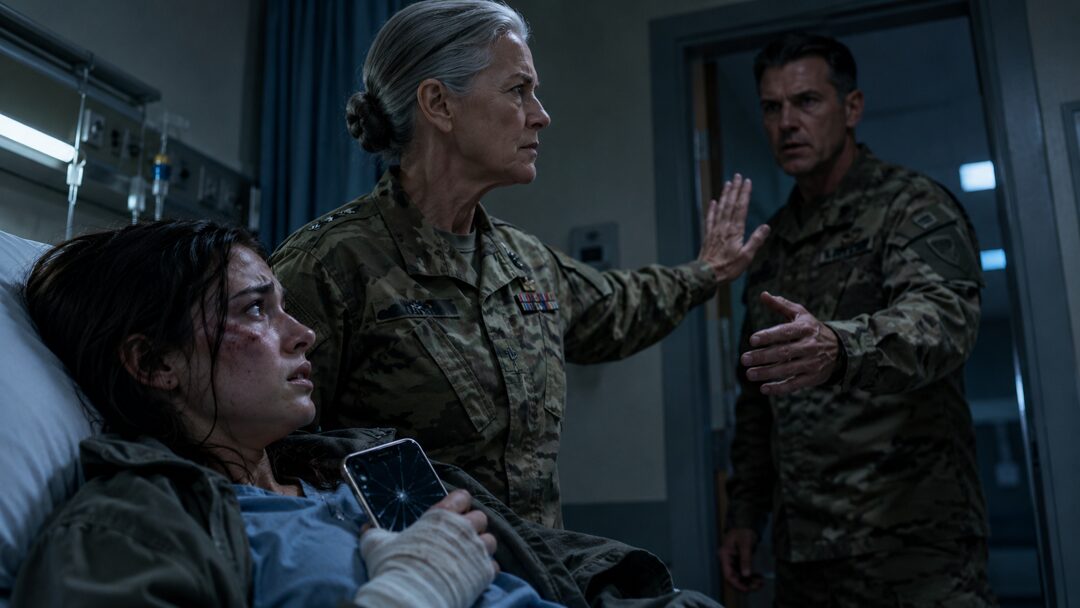
The nurse looked up from the monitor, startled by the uniform, the silver-gray hair pulled tight at the back of Margaret’s head, the ribbon rack sitting perfectly above her heart. Margaret did not raise her voice. She did not need to.
“Leave us.”
The nurse hesitated. “Ma’am, she’s sedated and—”
“She’s awake.”
In the bed, Emily Carter opened her eyes.
The girl was twenty-six, maybe younger in the face now that fear had stripped it bare. One side of her mouth was split. Purple shadows bloomed beneath her left eye. A bandage disappeared beneath the collar of a blue gown. Over the gown, swallowing her shoulders, was a man’s field jacket.
Margaret saw the jacket before she saw the bruises.
She saw the patch stitched inside the collar.
She saw the name that had been inked on the interior tag in block letters: HAYES.
Her fingers closed around the rail of the bed.
The nurse backed out. The door clicked shut. Somewhere beyond the glass, a guard shifted his weight.
Margaret set a cracked phone on Emily’s blanket.
The screen lit up.
Four young men stood in desert sun, their arms thrown over one another’s shoulders. They were dusty, grinning, too young in the way everyone looked too young once there was a chance they would never come home.
The one in the middle had Margaret’s eyes.
“Look at them,” Margaret said.
Emily’s gaze slid toward the phone, then away.
Margaret leaned closer. “Look at them.”
“I don’t know what happened,” Emily whispered.
Margaret’s face did not change, but something inside her pulled tight enough to snap. “You were found three miles from the convoy site wearing my son’s jacket.”
Emily’s breath caught at the word son.
There it was. Not surprise.
Recognition.
Margaret pushed the phone closer until the cracked glass caught the light. “His name is Ryan Hayes. He is twenty-four years old. He called me every Sunday unless he was somewhere he couldn’t. Three days ago, he missed the call.”
Emily stared at the photo now.
Her eyes filled, but no tear fell.
“Tell me where he is.”
Emily’s hands trembled under the blanket. One wrist was wrapped in white gauze, the fingers swollen, nails broken short. She looked at the door. Then the ceiling. Then Margaret’s uniform. Finally, her eyes flicked to the inside of the jacket collar.
To the patch.
Margaret saw it.
“He told me not to tell anyone,” Emily said.
Margaret went still.
“Who did?”
Emily swallowed. Her throat moved with effort. “Ryan.”
The sound of his name in her mouth struck Margaret harder than any refusal could have.
Margaret had spent thirty-two years learning how not to react. How to receive casualty lists. How to stand beside a young widow and not let her own face break first. How to watch a mother fold over a flag and not become a mother herself in that moment.
But Ryan’s name, spoken by this bruised stranger in his jacket, made her grip the bed rail until her knuckles whitened.
“What exactly did my son tell you?”
Emily looked at the door again.
Margaret followed her glance.
The guard outside was not looking in. The hallway was blue with night and fluorescent light.
Emily’s voice fell so low Margaret almost missed it.
“He told me not to tell anyone until I saw the patch.”
Margaret did not move.
The cracked phone glowed between them.
For the first time since entering the room, Margaret was not certain she had come to confront the right enemy.
Part II — The Man at the Door
Margaret opened the door herself.
“Sergeant Miller.”
David Miller was waiting at the end of the hall, hands folded behind his back, uniform clean, boots polished, close-cropped hair silvered at the temples. He had escorted Margaret from the airfield. He had answered every question with the careful steadiness of a man who had already given bad news too many times.
He turned at once. “Ma’am.”
“Come in.”
Emily’s entire body tightened before he crossed the threshold.
It was small. A breath held too fast. A hand curling under the blanket. Her bruised face going gray beneath the swelling.
Margaret noticed.
David noticed Margaret noticing.
His expression softened into concern. “Miss Carter shouldn’t be pushed right now. Medical said her memory is fragmented.”
Emily stared at the wall.
Margaret stepped aside, leaving David with a clear view of the bed. “You know her.”
“I was on the recovery detail.”
“That isn’t what I asked.”
David’s mouth tightened, then relaxed. He was good at that. “I know of her. Civilian intelligence support. Attached for route verification. She shouldn’t have been on that convoy.”
Emily whispered, “Neither should they.”
David looked at her. “Ma’am, this is exactly what I mean. She’s been repeating fragments since they brought her in. Some of it doesn’t line up.”
Margaret watched Emily’s fingers move beneath Ryan’s jacket. Not toward the phone. Toward the seam inside the collar.
The patch.
“What doesn’t line up?” Margaret asked.
David took one measured step closer. “The convoy was ordered along Corridor Six. She claims it was rerouted. There’s no record of that. She says the radios went dead before the checkpoint. No one else has confirmed it.”
“No one else has been found,” Emily said.
Her voice was weak, but the room changed when she spoke.
David’s gaze sharpened. “Two bodies were recovered from the vehicles. Four are missing. We don’t yet know whether they evaded, were taken, or—”
“Stop,” Margaret said.
David stopped.
Margaret turned back to Emily. “Tell me the sequence.”
Emily shut her eyes.
“No,” Margaret said. “Look at me when you say it.”
Emily opened them again.
For a second, Margaret saw what Ryan must have seen: not a coward, not a liar, but someone holding herself together by a thread because someone had told her the thread mattered.
“We left before sunrise,” Emily said. “Ryan was in the second vehicle. James was in the first. I was in the third.”
Margaret’s eyes flicked to the phone. Four young men. Ryan in the middle. James on the left, broad smile, one hand lifted like he was mid-joke.
“Who changed the route?”
“I don’t know.”
David exhaled quietly. Too quietly.
Emily flinched.
Margaret turned her head. “Sergeant.”
David lifted both hands slightly. “I didn’t say anything.”
“You didn’t have to.”
His jaw worked once.
Emily continued, faster now, as if the words would leave her if she slowed down. “We were supposed to pass the dried riverbed. Then the lead vehicle turned east. Ryan shouted over comms that it was wrong. Nobody answered. The radios were full of static.”
“Static happens,” David said. “In that terrain—”
Margaret did not look at him. “Let her finish.”
Emily’s eyes stayed on Margaret. “There was a checkpoint.”
Margaret felt the temperature of the room drop inside her. “An authorized one?”
Emily shook her head.
“Uniforms?”
“Some. Mixed. Old gear. New rifles. I don’t—” She pressed her bandaged hand to her forehead and winced. “Ryan saw it first. He said, ‘No, no, no, that’s not ours.’ Then the first vehicle stopped.”
The monitor beside the bed began to tick faster.
“James got out,” Emily said. “He was smiling. Like he could talk anybody down.”
David’s voice cut in. “That is enough.”
Emily’s eyes snapped to him.
Margaret stepped between David and the bed without thinking. “I decide that.”
David looked at her shoulder, then her face. “Ma’am, with respect, you’re emotionally compromised.”
Margaret almost smiled.
It would have been the ugliest expression in the room.
“With respect,” she said, “I outrank you even when I’m grieving.”
David went silent.
Emily breathed once, hard.
“What happened after James got out?” Margaret asked.
Emily stared at the photo.
“He raised his hands,” she said. “He told them we were turning around. Then the radios came back for one second. Just one.”
Margaret leaned closer.
“What did you hear?”
Emily’s lips parted.
Nothing came out.
David stepped forward. “Ma’am, we need to move her before—”
Emily said, “Clean corridor.”
David stopped.
Margaret looked at him.
Emily looked at him too, but with confusion instead of certainty, as if the phrase had come from somewhere deep and dark and she had not yet understood why it mattered.
“What does that mean?” Margaret asked.
David answered before Emily could.
“It’s common language,” he said. “Could mean anything.”
But his hands had moved.
Not much. Just from behind his back to his sides.
Margaret saw that too.
Part III — The Voice Inside the Glass
The cracked phone had belonged to Ryan, but Margaret had never seen this case before.
Black rubber. Dust ground into the edges. One corner split open. On the back, near the camera, someone had scratched a tiny cross into the material. Not decorative. Not careful. A mark made in haste with a blade or a key or the edge of something harder than fear.
Margaret held the phone while David watched.
“Do you know the passcode?” he asked.
“No,” Margaret said.
That was a lie.
She knew Ryan.
She knew he changed passwords every few months because she had once told him it was careless not to. She knew he pretended to ignore her advice and then followed it later where she could not see. She knew he used dates he claimed not to care about.
Her thumb hovered.
Emily watched from the bed. David watched from the foot of it.
Margaret entered six digits.
The day Ryan enlisted.
Not his birthday. Not hers. The day he had stood in the kitchen at nineteen, enlistment papers folded in his back pocket, trying to sound like a man and looking like the boy who had once slept with a flashlight after his father died.
You don’t have to prove anything to me, she had told him.
I’m not, he had said.
The phone unlocked.
David’s face did not change, but his silence sharpened.
The home screen was fractured by lines of broken glass. Ryan’s last battery life blinked red. No signal. No service. Only stored things remained.
Photos. Notes. Maps. One unsent audio file.
Margaret saw the timestamp.
Three days ago.
Her thumb paused above it.
For the first time that night, she did not want an answer.
Because an answer had a shape. An answer could cut. An answer could leave no room for the impossible hope she had carried through every corridor: that Ryan was injured but breathing, hidden but alive, unable to call but trying.
Emily whispered, “Don’t play it in front of him.”
The room froze.
David’s eyes moved to Emily. Slowly.
“What did you say?” he asked.
Emily shrank back into the pillow.
Margaret closed her hand around the phone. “Sergeant Miller, wait outside.”
“Ma’am—”
“That was not a request.”
He looked at the phone. Then at Margaret. Then at Emily.
For one second, the concern left his face.
What remained was not guilt exactly.
It was calculation.
Then it was gone.
“Yes, ma’am.”
He left.
Margaret waited until the door clicked shut. Then she waited longer. She crossed to the wall panel and pressed the privacy switch. A soft tone sounded. The glass dimmed.
Emily’s eyes widened. “Is that enough?”
“No,” Margaret said. “But it’s something.”
She played the file.
Ryan’s voice filled the room.
Not clear. Not steady. Wind scraped against the microphone. Something thudded in the distance. Someone shouted a name.
“Mom.”
Margaret’s breath stopped.
It was not Colonel. Not ma’am. Not Mother, the way he teased her when she inspected his apartment and found expired milk.
Mom.
“If this gets to you, don’t trust the first story.”
The recording crackled.
Emily turned her face toward the wall.
Ryan coughed. When he spoke again, his voice was lower, urgent, close to the phone.
“Miller sold the route.”
Margaret closed her eyes.
There were moments in a life when grief did not arrive as sobbing.
Sometimes it arrived as stillness so complete the body forgot how to be human.
“But tell her last,” Ryan said. “Get the others out first. She’ll want to burn the whole world down. Don’t let her. Tell her I said command first. Tell her—”
A burst of static swallowed the next words.
Then Ryan again, strained and almost laughing.
“Tell her I finally listened.”
The recording ended.
No one moved.
The monitor kept time because hearts did what they were trained to do until they were told they could stop.
Margaret lowered the phone.
Her son had known her exactly.
He had known her rage would be fast. He had known her grief would look for a target. He had known the woman in the bed might have to survive Margaret before she could survive anyone else.
Emily whispered, “I’m sorry.”
Margaret looked at her then.
Not at the bruises. Not at the jacket. At the girl herself.
“How many are alive?”
Emily’s face twisted.
“I don’t know.”
Margaret’s fingers tightened around the phone.
Emily forced the next words out. “Ryan was. When he gave me the phone.”
Margaret did not let herself move.
“And the others?”
“Two. Maybe.” Emily’s voice shook. “Ryan said villagers would hide them past the border until somebody came with the right route. He gave me the map. But he said not to say it out loud. Not to anyone. Not until I saw the patch.”
Margaret looked at the jacket.
The name inside. The unit patch. The private signal of a son who had understood both his mother’s rank and her heart.
“I thought you were accusing me,” Emily said.
“I was.”
Emily absorbed that without flinching. Maybe she was too tired.
Margaret set the phone on the bed between them.
Not close to Emily’s face now.
Between them.
“Then I was wrong.”
Emily’s eyes filled again.
This time, one tear slipped sideways into her hair.
Margaret did not apologize further. The room had no space for words that made the speaker feel cleaner.
Instead, she pulled the blanket higher over Emily’s bandaged wrist.
Emily looked down at the gesture as if it hurt more than the questions.
Part IV — The Phrase That Came Back
David returned eleven minutes later with two officers and a folder.
That was too fast.
Margaret saw the folder first. Saw the signature page clipped to the front. Saw the calm on David’s face, polished back into place.
“Ma’am,” he said, “orders came through. Miss Carter is being transferred for debrief.”
“At this hour?”
“Urgency was requested.”
“By whom?”
“Command office.”
Margaret let the silence sit.
Emily’s breathing changed.
The two officers at David’s back did not look comfortable. They were young. Too young to know what kind of room they had stepped into. One avoided looking at Emily. The other looked at Margaret and realized, too late, that the order in David’s hand had entered a room where rank did not mean what he thought it did.
Margaret held out her hand. “Let me see.”
David gave her the folder.
His confidence was almost perfect.
Almost.
The order named Emily Carter as unstable, potentially compromised, and necessary for immediate secured transport. It used clean language. That was how institutions made fear sound reasonable. Secure. Transfer. Preserve integrity. Prevent contamination.
Margaret read it twice.
Emily whispered, “Clean corridor.”
Everyone looked at her.
David’s face went still.
Margaret lowered the folder. “What did you say?”
Emily’s eyes were not on Margaret now.
They were on David.
“That’s what you said.” Her voice was thin, but it had changed. It had found the edge of something. “Before the checkpoint.”
David gave a small, patient sigh. “Miss Carter, we discussed this. You suffered head trauma.”
Emily shook her head. “No. I didn’t see your face. I heard you.”
David took a step toward the bed. “You heard radio chatter.”
“You said, ‘Clean corridor confirmed.’ Then the lead vehicle turned.”
The room narrowed.
The young officers shifted.
David spoke carefully. “That phrase is operationally common.”
Emily’s bruised mouth trembled. “Then why did Ryan say your name?”
David’s eyes flicked to Margaret.
There it was.
Not fear.
A calculation losing time.
Margaret closed the folder and handed it back to him. “No transfer.”
“Ma’am, with all respect, this order—”
“Is paused pending verification.”
“You don’t have authority to—”
Margaret stepped closer. “Finish that sentence.”
David did not.
Emily’s monitor ticked faster.
Margaret turned to the nurse call panel and pressed the button. When the nurse answered through the speaker, Margaret said, “Patient Carter’s vitals are unstable. I need medical response and military police to this room.”
David’s eyes narrowed.
“Vitals look stable to me,” he said softly.
Margaret looked at Emily.
Emily understood before Margaret spoke.
Her breath quickened. The monitor followed. Not faked. Not entirely. Fear did most of the work.
“Pain,” Emily gasped. “My chest—”
The hallway moved.
David looked toward the door, then back at Margaret.
For the first time, he seemed unsure which version of her he was facing: the grieving mother, or the officer her son had trusted to come second.
Margaret leaned near Emily, blocking her mouth from the room.
“The location,” she said.
Emily’s eyes went to the ceiling.
“No out loud,” she whispered.
“Then show me.”
Margaret picked up Ryan’s phone and opened the maps. The screen flickered. Cracks cut through the terrain like dried riverbeds. Emily lifted her bandaged hand and hissed through her teeth.
“Other hand,” Margaret said.
Emily shook her head. “Can’t. It’s numb.”
So Margaret held the phone steady.
Emily touched the screen with two swollen fingers.
The map moved in jerks. South from the convoy route. East across a blank stretch. Past an unnamed road. Beyond the marked border. Into a cluster of pale squares no official map had bothered to name.
“There,” Emily breathed.
Margaret saw nothing.
Emily tapped the back of the phone instead.
The tiny cross scratched into the case.
“Ryan marked it after the map froze. Chapel. White door. Blue roof.” She swallowed hard. “He said if his mom saw it, she’d know a mark wasn’t decoration.”
Margaret looked at the scratch.
A small cross. Uneven. Desperate.
Ryan had made a map out of damage.
The door opened behind them.
David came in alone.
No nurse yet. No military police yet.
Just David, the folder gone from his hand.
His eyes landed on the phone.
“Colonel,” he said, and the softness had left his voice. “Give that to me.”
Margaret stood.
Emily pulled the phone back against her chest.
David’s gaze flicked to her. “You have no idea what you’re carrying.”
Emily’s voice shook. “I know exactly what I’m carrying.”
David’s face hardened.
Margaret stepped between them.
“No,” she said. “You don’t get to talk to her anymore.”
Part V — The Line He Crossed
David looked almost sad when he reached for the phone.
That was the worst part.
Not rage. Not panic. Something closer to disappointment, as if Margaret had failed to understand the practical shape of the world.
“You think this starts and ends with me?” he said. “You think I woke up one morning and decided to ruin four good men?”
Margaret kept her body between him and Emily. “I think you are trying to remove the only witness from this room.”
“I am trying to stop a compromised civilian from turning a bad incident into a command crisis.”
Emily made a small sound behind Margaret.
Bad incident.
Two words could erase a whole convoy if spoken by the right man.
Margaret reached to the bedside phone and pressed the hospital line. A tone sounded.
David saw the red recording light near the base.
His mouth tightened.
Margaret said, “Repeat the transfer order.”
“Don’t do this.”
“Repeat it.”
“Colonel.”
“That is my rank. Use it correctly.”
For a second, something old and tired moved across his face.
“They were going to cut us loose,” David said quietly. “You know how it works. We hold the corridor, they deny the corridor mattered. We lose men, they call it weather, terrain, bad timing. You sit in rooms with polished tables and call it sacrifice.”
Margaret’s expression did not change.
But the line landed.
Because there was truth in the wound, even if there was rot in what he had done with it.
David saw that she heard him and pressed harder.
“I made one arrangement. One. A pass-through. No contact. Nobody was supposed to get touched.”
Emily said, “James raised his hands.”
David’s eyes snapped to her.
Emily pushed herself higher against the pillow, face white with pain. “He raised his hands for you.”
David took a step.
Margaret played Ryan’s voice memo.
Ryan’s voice filled the room again.
“Miller sold the route.”
David stopped as if the sound had struck bone.
The recording kept going.
“But tell her last. Get the others out first.”
The young officers appeared in the doorway behind him with the nurse and two military police.
No one spoke.
Ryan’s voice, broken by static, said, “Tell her I finally listened.”
The file ended.
David moved.
Not toward Margaret.
Toward Emily.
It was fast, ugly, desperate, and human. He lunged for the phone because the phone had become more dangerous than any weapon in the room.
Margaret caught his arm, but he was stronger than she expected. He shoved past her shoulder.
Emily’s eyes widened.
Then she did the only thing her body could still do.
She kicked the IV stand.
The metal pole crashed sideways into David’s shins. The bag swung, tubing ripping loose. Emily cried out as the tape pulled at her wrist. David stumbled hard against the bed rail.
Margaret did not yell.
She took his wrist, turned it, and drove him down against the floor with the clean economy of training older than grief.
“Sergeant David Miller,” she said, breathing hard, “you will stand down.”
He laughed once, bitterly, cheek pressed to the tile.
“You still think standing down saves anyone?”
Margaret looked at the military police entering the room.
“No,” she said. “But it stops you from choosing who disappears next.”
They took him.
He did not fight them after that.
He only looked at Emily as they pulled him up.
She held Ryan’s phone against her chest with both hands.
For a moment, David’s face changed. The calculation was gone. The polished concern was gone too.
What remained looked almost like shame.
Then the door closed behind him, and he was only footsteps leaving down the hall.
Margaret turned back to Emily.
Blood had seeped beneath the loosened tape on her wrist. Her breath came in sharp, shallow pulls. The nurse rushed to her side, but Emily would not let go of the phone.
Margaret knelt beside the bed.
Not because she had to.
Because standing over Emily suddenly felt unbearable.
“You did enough,” Margaret said.
Emily shook her head. “No.”
Her fingers opened.
The cracked phone lay in her palm.
“Send them.”
Margaret took it.
This time, Emily gave it to her.
Part VI — What He Got Home
By dawn, the room was quieter than it had any right to be.
The privacy glass had been cleared. The hallway beyond was full of people pretending not to look in. Reports moved. Orders moved. Aircraft moved. Somewhere far beyond the room, men with better maps and heavier voices used the tiny cross on Ryan’s phone to find a chapel with a white door and a blue roof.
Margaret stayed beside Emily’s bed.
Not at the rail.
In the chair.
Emily slept for twenty minutes at a time, then woke with a start, asking the same question without always saying it.
Margaret did not tell her to rest.
People said that when they had nothing useful to offer.
At 7:13 a.m., a captain entered the room and stopped just inside the door.
Margaret rose.
Emily woke instantly.
The captain’s eyes moved from Margaret to Emily and back again.
“They found the chapel,” he said.
Emily’s fingers twisted in the blanket.
Margaret felt every part of herself become quiet.
“Two recovered alive,” the captain continued. “Dehydrated. Injured. Conscious.”
Emily made a sound that was almost a sob and almost a laugh.
Margaret closed her eyes for half a second.
Two.
Two mothers would get calls that began with alive.
Two names would move from missing to breathing.
“And Ryan?” Emily asked.
The captain looked at Margaret.
That was answer enough before he spoke.
“Not recovered at the site.”
Emily’s joy collapsed in on itself.
Margaret remained standing.
The captain held out a sealed evidence pouch. Inside were dog tags, dusty and scratched, looped around a folded piece of paper.
“They found these wrapped in cloth behind the altar,” he said. “With the phone mark copied on the outside.”
Margaret took the pouch.
Her hand did not shake until the captain left.
Emily watched her from the bed, face hollow with guilt she had no right to carry and could not put down.
Margaret opened the pouch.
The dog tags slid into her palm.
Ryan Hayes.
The name lay there in stamped metal, ordinary and impossible.
The paper was folded twice. Margaret opened it carefully, as if roughness could reach backward and hurt him.
The note was short.
Mom,
If this reaches you, Emily did her part. Believe her before you believe the room.
Don’t let them bury the truth in better language.
Get them home.
I love you.
R.
Margaret read it once.
Then again.
On the third time, the words blurred.
Emily turned her face away. “I should’ve stayed with him.”
Margaret did not answer at once.
She could have said no. She could have said Ryan chose. She could have said survival was not betrayal. All true. All too clean.
Instead, she sat back down beside the bed.
The same bed she had gripped hours earlier like a place to force a confession.
She placed the cracked phone on Emily’s blanket.
Emily looked at it, confused.
Margaret said, “He trusted you with it.”
Emily’s mouth trembled. “He trusted you more.”
Margaret looked at the phone.
The screen was dark now. The cracks were still there. They would always be there. But the phone had done what Ryan needed it to do. It had carried his voice through static, his map through damage, his warning through the wrong hands, his faith through his mother’s grief.
Emily touched the corner of it with two fingers.
“Is he dead?” she asked.
The room held the question carefully.
Margaret looked through the window at the waking light in the hallway. Nurses moved past. Boots passed. Somewhere, a young man who had been found alive was probably asking who else made it. Somewhere, another mother was about to fall to her knees for a reason that was not sorrow.
Margaret closed her hand around Ryan’s dog tags.
“I don’t know,” she said.
Emily’s eyes filled.
Margaret let the silence stand.
Then she looked at Emily, not as a witness, not as a suspect, not as the girl wearing her son’s jacket, but as the person Ryan had chosen when choosing still mattered.
“But he got them home.”
Emily covered her face with her good hand.
Margaret did not reach for her.
Not yet.
She sat beside her, close enough that the phone lay between them like something broken that had still refused to fail.
Outside the room, the day began without permission.
Inside it, neither woman moved away.