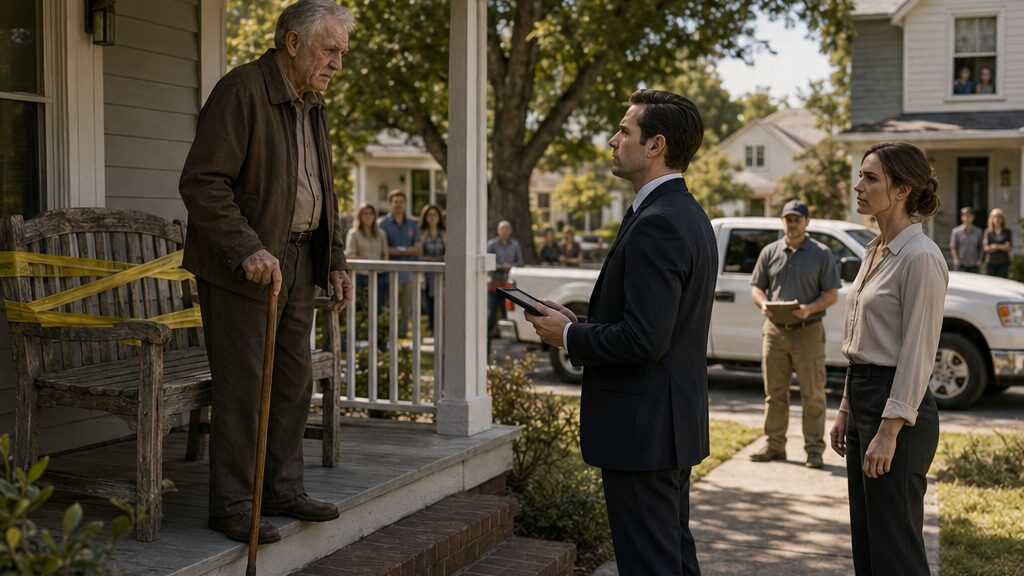
The HOA Told Ronald To Remove The Porch Bench His Wife Was Still Waiting On
Chapter 1: The Blue Light On The Counter
Ronald Bennett had folded the notice three times before leaving his house, once along the printed deadline, once through the photo of his porch, and once through the line that said removal authorized if not corrected.
By the time he reached the HOA management office, the paper had softened at the creases. He kept it inside his coat pocket with the old access card he had been carrying since the subdivision still had open fields behind the back lots and one stop sign at the entrance.
The office did not look like a place where neighbors settled things. It looked like a hotel lobby someone had forgotten to put beds behind. Marble counter. Warm lights tucked into the ceiling. Glass doors polished so clean Ronald could see his own reflection before he walked in: gray hair combed flat, brown jacket buttoned wrong at the middle, left hand closed around the handle of his cane.
There were already people inside.
A woman near the seating area glanced up from her phone. Two younger residents stood by the coffee machine, both in running clothes, both watching without turning their heads fully. Behind the counter, the receptionist paused with one hand over a keyboard. Ronald felt the eyes before anyone spoke.
“Mr. Bennett?” the receptionist asked.
Ronald nodded.
“Mr. Carter can see you now.”
Anthony Carter came from the office behind the counter in a dark suit that fit him too cleanly. He was younger than Ronald expected, with neat hair and a narrow face made narrower by concentration. A tablet was tucked under one arm. A phone sat in his other hand. He did not offer to come around the counter.
“Mr. Bennett,” Anthony said. “I understand you’re here about a compliance matter.”
Ronald took the notice from his pocket and placed it on the marble. His fingers rested on it a second longer than necessary. The paper looked smaller there than it had looked at his kitchen table.
“The bench,” Ronald said.
Anthony glanced down, then tapped his tablet. “Yes. Front porch furniture. Weathered wood, visible deterioration, nonconforming exterior item. You were notified twice.”
“It is a bench.”
“It’s listed as an exterior furnishing.”
“It was there before the list.”
Anthony’s expression did not change, but something in the receptionist’s face tightened. The two residents near the coffee machine stopped pretending not to listen.
Anthony set the tablet on the counter and turned it toward Ronald. A color photo filled the screen. Ronald’s porch. His white railing with the chipped inside corner. The clay pot Kathleen had used for basil, empty now except for rainwater and three dead stems. And the bench.
It sat beneath the porch window, facing the street, its back slats darkened with age. One arm had a split near the front. The legs were sturdy, though the right rear foot had worn uneven from years of weather. In the photo, it looked lonelier than it did in real life.
“Do you dispute that this is your property?” Anthony asked.
Ronald looked at the photo. “No.”
“Do you dispute that this item remains in view from the street?”
“No.”
“Then the violation stands.”
Ronald drew in a careful breath through his nose. The office smelled of lemon cleaner, coffee, and something electrical from the small device at Anthony’s elbow. A scanner, maybe. A black rectangle with a blue light running along the side. It pulsed softly, patiently, as if waiting to decide something.
“I came to ask for more time,” Ronald said.
“You were given thirty days.”
“I was given thirty days to remove it.”
“That is the correction required.”
“I did not say I would remove it.”
Anthony’s gaze lifted from the tablet. The first trace of irritation appeared, not enough for anyone else to call it that, but enough for Ronald to see. He had worked with wood most of his life. He knew when pressure began beneath a polished surface.
“Mr. Bennett,” Anthony said, lowering his voice in a way that made the room listen harder, “we have to apply standards uniformly. If one resident keeps a deteriorated item on the porch, others will expect the same exception.”
Ronald nodded once. “Uniformly.”
“Yes.”
“That means same to everyone.”
“That’s the goal.”
Ronald reached into his coat again. The old access card came out first, its plastic dulled around the edges, the subdivision logo faded to a shadow. He placed it beside the notice.
Anthony looked at it as if Ronald had set down a grocery coupon. “What is that?”
“My resident card.”
“We don’t use those anymore.”
“I know.”
“Then I’m not sure why—”
“You asked if the bench was my property. I’m asking if the porch is still mine.”
The two younger residents exchanged a look. The receptionist’s fingers went still above the keyboard.
Anthony took the card, perhaps only to move the conversation along. “Ownership is not the issue.”
“It feels like the issue.”
“It isn’t. The issue is compliance.”
He passed the card over the scanner. The blue light brightened, then blinked twice. The device gave a soft chirp that sounded too cheerful for the room.
Anthony frowned. He tapped his tablet, then scanned the card again.
The blue light flashed longer this time.
Ronald watched Anthony’s face, not the device. At first there was only mild annoyance, then confusion. Anthony tapped the screen again. A crease appeared between his brows. He leaned closer to the tablet.
“Is there a problem?” Ronald asked.
Anthony did not answer right away.
Behind him, the door to the inner office opened. John Harris stepped out with a phone in his hand and reading glasses low on his nose. Ronald recognized him before John seemed to recognize Ronald. John had lived three streets over since the second phase of the subdivision opened. He had been younger then, broad-shouldered, always moving fast. Now his hair was silver and his suit hung a little loose at the neck.
Anthony looked over his shoulder. “John, can you come here a second?”
John came to the counter. His eyes moved from the tablet to the card to Ronald’s face.
“Ronald,” he said quietly.
“John.”
Anthony’s posture changed. “You know Mr. Bennett?”
John did not answer immediately. He picked up the card, turned it over, then looked at the screen. “Original resident file,” he said.
“I can see that,” Anthony replied.
“No. I mean original. Lot seven. Phase one.”
The office seemed to shift around the words. Not loudly. No gasp, no dramatic stir. Just the subtle rearranging of attention. The two residents near the coffee machine straightened. The receptionist looked at Ronald differently, as if the old jacket had become less plain.
Anthony’s jaw worked once. “That doesn’t affect current exterior standards.”
Ronald picked up the folded notice and smoothed it with his thumb. “I didn’t think it would.”
“Then why bring the card?”
“Because you all send letters saying ‘community standards’ like this place began when the letters did.”
John lowered his eyes.
Anthony looked caught between embarrassment and procedure. “Mr. Bennett, I’m not trying to disrespect your history here.”
“No,” Ronald said. “You’re trying not to see it.”
The words landed harder than Ronald intended. He had promised himself he would not come angry. Anger made people dismiss old men faster. Anger gave them something easier to remove than a bench.
Anthony’s face colored faintly. “The removal is scheduled for Friday if the violation isn’t corrected.”
Ronald reached into the inside pocket of his jacket.
This time he took out the slat.
It was no longer than his forearm, smooth on one side and rough on the other where old screws had been backed out years ago. The wood had darkened to honey brown from age and touch. At one end, two initials were carved small and uneven: K.B.
He laid it on the marble between the notice and the scanner.
Anthony looked at it. John looked away.
“It came from the bench,” Ronald said.
“Mr. Bennett,” Anthony began, softer now, “if there is a sentimental concern, the board may allow you to move the item to the backyard or an enclosed area.”
Ronald placed two fingers on the slat. The wood felt warmer than the stone beneath it.
“You can mark the bench,” he said. “You cannot tell me it never belonged there.”
No one spoke.
The blue light on the scanner kept pulsing. It painted the edge of the old wood in a cold color that had nothing to do with trees, or hands, or afternoons when Kathleen sat with her tea and waved at people she barely knew until they became neighbors.
Anthony cleared his throat. “The system still shows removal approved.”
Ronald looked at him, then at John, then at the notice.
“Then your system is not finished listening,” he said.
He picked up his card and the slat, folded the notice along the same tired lines, and turned toward the glass doors with his cane clicking once against the polished floor before each step.
No one stopped him.
But as he reached the door, he heard Anthony say behind him, lower than before, “Pull the original property file.”
Ronald did not turn around.
Outside, the morning sun hit the glass so brightly that for a moment he could not see his own reflection at all.
Chapter 2: The Empty Porch Everyone Could See
The bench was waiting for him when he came home.
Ronald noticed it before he noticed the truck parked two houses down, before the neighbor’s sprinkler clicking in bright arcs over the sidewalk, before the envelope clipped to his mailbox with a plastic HOA tag. From the street, the bench looked smaller than it felt in his mind. A narrow thing under the front window. Old wood. Straight back. Two arms. Nothing that should have made a grown man stand at the end of his driveway unable to move.
He stayed there long enough for the sprinkler to reach his shoes.
Then he walked up the path.
The house had been painted pale gray three years ago because Kathleen had always hated beige and because Ronald had not been ready to choose a color without her. Gray was safe. Gray did not ask him questions. He had done the porch railing himself one slow Saturday, sanding with his right hand and holding the rail with his left whenever his balance shifted. The bench he had left alone except for tightening screws and rubbing linseed oil into the seat every spring.
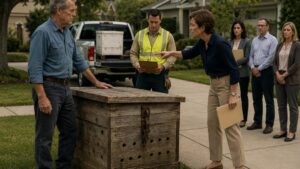
Now yellow contractor tape crossed the arms.
It had been wound from the left porch post to the right, passing directly across the bench as if the whole porch were a small crime scene. A paper tag hung from the tape.
PENDING REMOVAL.
Ronald stood on the bottom step and read it twice.
A breeze moved through the young maple near the sidewalk. The tape trembled and made a dry plastic whisper against the wood.
For a moment, he saw Kathleen’s hand there instead.
Not as a ghost. Ronald did not believe in making the dead perform for the living. He saw memory the way he saw grain inside wood—something already present, revealed only when light struck at the right angle. Kathleen’s hand had rested on the left arm of the bench so often that the finish there wore smoother than everywhere else. She would sit with one ankle tucked behind the other, a cup of coffee balanced on the right arm, calling out greetings to neighbors with a certainty Ronald never had.
“You wave like you’re running for mayor,” he had once told her.
“I wave like I live here,” she had answered.
That had been before her breath shortened. Before the portable oxygen tank. Before he learned the difference between a good day and a day she was pretending for him. Even then, she had wanted the front porch, not the back patio.
“I don’t want to be hidden just because I’m sick,” she had said.
Ronald climbed the steps slowly. His cane tapped wood, not marble now. The sound settled him.
He reached toward the tape, then stopped.
Cutting it would feel good for one minute. It would also give Anthony Carter exactly the kind of violation he knew how to handle. Interference. Noncompliance. Escalation. Ronald had spent enough years shaping warped boards to know force was not always strength. Sometimes it just split what might have bent.
He lowered his hand.
The paper tag swung again.
“Ronald?”
Rebecca Miller stood at the foot of the path with a clipboard held against her chest. She wore a neat white blouse, dark slacks, and the careful expression of someone approaching a dog she had been told might bite. Ronald knew her in the way neighbors knew each other now: by mailbox, by car, by occasional nod. She lived on the corner in one of the remodeled houses with black-framed windows and square planters.
“Rebecca,” Ronald said.
“I was hoping to catch you before dinner.”
“It’s early.”
“I know.” Her eyes flicked to the tape. “I wanted to make sure the contractor left the notice properly.”
“He left it.”
She came halfway up the path but did not step onto the porch. “I know this is upsetting.”
Ronald looked at the bench. “Do you?”
Rebecca pressed her lips together. “I mean, I understand that change is difficult.”
“That’s not the same thing.”
Color rose in her face, but she kept her voice even. “The board has received several complaints.”
“About that bench.”
“About visible deterioration. About inconsistent enforcement. One resident had to remove a broken planter last month. Another repainted a mailbox. People are asking why some properties are cited and others are ignored.”
Ronald nodded toward the tape. “So you tied up my porch to prove you don’t ignore me.”
“That is not what this is.”
“What is it?”
“A process.”
He almost laughed at that. Not because it was funny, but because the word had followed him home from the office. Compliance. Process. Standards. Words built to hold no fingerprints.
Rebecca took a breath. “Mr. Carter told me you came by today.”
“Did he tell you he scanned a card older than he is?”
“He told me there may be original-resident considerations.”
Ronald sat on the top step instead of the bench. The tape blocked the place his body would have gone. The step was lower, harder. His knees protested, but he did not let it show.
“Original-resident considerations,” he repeated.
“I’m not trying to be cold,” Rebecca said. “But the board has to think about precedent.”
Ronald looked down the street. A delivery van passed slowly. The driver glanced at the tape as he went by. Across the road, a curtain shifted in a front window.
Everyone could see it.
That was the point, he realized. Not cruelty, not exactly. Visibility. The tape announced that the neighborhood was handling him. It turned his porch into an example.
Rebecca followed his gaze. Something like discomfort crossed her face.
“I can ask them to remove the tape until the inspection,” she said.
“Can you ask them to remove the order?”
“No. Not by myself.”
“Then leave the tape. It says what you all mean.”
She hugged the clipboard closer. “There will be an in-person inspection tomorrow. I’ll be there. Anthony will be there. Maybe John. We’ll document the condition and decide whether the appeal goes to the full board.”
Ronald’s eyes returned to the bench.
There was a dark ring on the right arm where Kathleen’s coffee cup had sat for years. He had tried to sand it once while she was still alive. She caught him and slapped his hand lightly with a dish towel.
“Don’t you dare erase my evidence,” she had said.
“Evidence of what?”
“That I know how to sit still, occasionally.”
He had left the ring.
Now the tape crossed just above it.
Rebecca shifted her weight. “Is there a reason the bench can’t be moved to the back? You’d still have it.”
Ronald ran his thumb along the cane handle. “Do you have anything in your house that would become something else if someone told you where to put it?”
Rebecca’s mouth opened, then closed.
He looked at her then, really looked. She was not smirking. She was not enjoying this. She seemed tired in a familiar way, the way people looked when they had chosen rules because people were harder.
“I have a mother in assisted living,” she said quietly. “She keeps boxes of things nobody needs.”
Ronald nodded. “And do you throw them away?”
“Sometimes I want to.”
“But do you?”
Rebecca looked toward the bench. “No.”
The answer softened the air between them for one brief second.
Then she looked back down at her clipboard and became a board member again.
“Tomorrow at ten,” she said. “Please don’t remove the tape before then. It may complicate the appeal.”
Ronald almost told her the appeal was already complicated. Instead he said, “I’ll be here.”
She turned to leave, then stopped. “Mr. Bennett?”
He waited.
“Whose initials are on the piece you brought to the office?”
His hand tightened around the cane.
The breeze lifted the tape again, and for one second the bench seemed to breathe beneath it.
“My wife’s,” he said.
Rebecca’s face changed, but Ronald did not give her more. Not yet. The name stayed behind his teeth, where it had lived too often since the funeral.
Rebecca nodded once, almost apologetically, and walked back down the path.
Ronald remained on the step after she left. Cars came and went. A child’s bicycle bell rang somewhere around the corner. The sun moved lower, touching the bench in strips through the porch railing. The tape glowed gold where the light hit it, almost beautiful if he did not know what it meant.
He waited until the street quieted.
Then he reached under the tape, careful not to disturb it, and placed his palm flat on the bench seat.
The wood was warm.
“I didn’t cut it,” he said.
The empty porch gave no answer.
Inside, the phone began to ring.
Ronald let it ring three times before pushing himself up. As he opened the door, he looked back once.
The tape was still there.
So was the bench.
For now.
Chapter 3: A Rule Written After The Life Was Built
The community room had once been a sales office.
Ronald remembered when the walls were covered with maps of lots that did not yet have grass, when young couples came in holding brochures and pretending not to worry about mortgage rates. Kathleen had liked the model kitchen display they kept in the corner. She said it was foolish to display cabinets no one could open. Ronald told her that was half of sales—making people want what they were not allowed to touch yet.
Now the same room had gray acoustic panels, stackable chairs, a long table for the board, and a screen pulled down over the wall where the subdivision map used to hang.
On the screen was his bench.
Someone had taken another photograph that afternoon, closer than the one in Anthony’s file. The split in the arm looked wider under the projector light. The worn right foot cast a shadow like a crack in the porch itself. The coffee ring did not show, nor the smooth place where Kathleen’s hand had rested, nor the way the bench caught the morning sun for twenty minutes before the roof shade covered it.
Only damage showed clearly.
Ronald sat in the second row with his cane upright between his knees. He could have taken the front row, but that would have made the room feel like a hearing. He could have taken the back, but that would have made it feel like surrender.
Anthony stood near the screen, tablet in hand. Rebecca sat at the board table with two other members whose names Ronald knew only from envelopes and meeting notices. John Harris sat at the far end, glasses folded in front of him, silent.
There were more residents than Ronald expected. Not many, but enough. The woman who walked the small white dog every morning. A man from the newer section with a golf shirt and crossed arms. A younger couple who had repainted their garage door after a citation and seemed interested in whether Ronald would be made to obey what they had obeyed.
Anthony began with language clean enough to slide off any one person.
“The board is reviewing an exterior compliance matter involving front-facing property standards, visible deterioration, and enforcement consistency.”
Ronald looked at the photograph and felt strangely sorry for the bench. It had never asked to be evidence.
Anthony continued. “The item in question is a wooden porch bench located at lot seven, owned by Mr. Ronald Bennett. The bench has been cited under section four, paragraph twelve, regarding deteriorated exterior items visible from common streets.”
Rebecca leaned toward her microphone. “This is not a final removal vote tonight. It is a review to determine whether the appeal should proceed to formal board consideration.”
The man in the golf shirt raised a hand before she finished. “With respect, some of us already complied with these letters. If this becomes optional, that’s a problem.”
A murmur of agreement moved through the room.
Ronald kept his eyes on the cane handle. The wood there had darkened from his palm over the years. Things changed when held long enough. That did not mean they were ruined.
Rebecca nodded. “That is part of the concern.”
The woman with the white dog spoke next. “I don’t want to be unkind, but the neighborhood has standards. We all bought into that.”
Ronald looked up. “Not all of us.”
The room turned toward him.
His voice had not been loud. That was why it carried.
Rebecca said carefully, “Mr. Bennett?”
“Some of us bought before there was an ‘into that.’”
Anthony’s expression tightened. “The HOA covenants apply to all current owners.”
“I know they do.”
“Then original purchase date cannot exempt every exterior issue.”
“I didn’t ask for every issue.”
“No,” said the man in the golf shirt. “Just yours.”
That brought a few uncomfortable laughs. Not many. Enough.
Ronald felt heat move up his neck. He could answer sharply. He could mention the man’s decorative boulders that had appeared without approval last summer. He could say a dozen things. Kathleen would have found one that made the room laugh with her instead of at him.
Ronald only looked at the screen.
Anthony seemed relieved by the silence. “The board is not questioning Mr. Bennett’s history here. But the current visual condition of the bench does not meet the adopted standard.”
“When was it adopted?” Ronald asked.
Anthony checked his tablet. “The updated exterior uniformity standards were approved in March two years ago.”
Ronald nodded. “And the bench?”
“Mr. Bennett—”
“When was the bench put there?”
Anthony did not answer.
John Harris stirred at the far end of the table.
Rebecca looked toward him. “John?”
John unfolded his glasses, then folded them again. “I don’t have the exact year in front of me.”
Ronald said, “I do.”
For the first time that evening, he reached into the folder he had brought. He did not take out the slat. He took out a photograph.
It was faded along the edges, the colors softened by time. In it, the street outside his house was unfinished, the trees no taller than broom handles. Ronald stood on the porch in a work shirt, younger, straighter, his arm around Kathleen, who sat on the bench with a paintbrush in one hand and a grin too large for the camera.
He handed the photograph to Rebecca, not Anthony.
Rebecca looked at it, then passed it to John. John stared longer than necessary.
“That was the first summer,” Ronald said. “Before the second phase. Before the pool. Before this room had chairs for meetings.”
The room quieted, but not with surrender. More like recalculation.
Anthony’s tone gentled without giving ground. “That may support historic presence, but it doesn’t resolve the condition.”
“I didn’t say it did.”
“Then what are you asking for?”
Ronald looked at the projected bench, then at the people waiting for him either to become unreasonable or to make the problem easy for them.
“I am asking you to know what you are removing before you vote to remove it.”
The words cost more than he expected. He felt the room pull toward the opening he had made, hungry for explanation. Whose bench? Why matter? What story? What private thing could make public rules bend?
He closed the opening before anyone could step through it.
Rebecca studied him. “Would you be willing to repair it?”
Ronald hesitated.
That hesitation hurt him more than the question. Because the truth was, he had noticed the split growing. He had noticed the wobble. He had noticed the way rainwater sat too long in the seam near the back. He had told himself he would fix it when the weather cooled, when his hands were steadier, when mornings stopped surprising him with how quiet they could be.
“The board would need specifics,” Anthony said. “Materials, timeline, appearance.”
The man in the golf shirt muttered, “So now we negotiate furniture.”
John finally spoke. “That bench was there before half these houses had roofs.”
The room shifted again. John’s voice was not dramatic. It was tired. That made it harder to dismiss.
Anthony looked at him. “History doesn’t remove liability.”
“No,” John said. “But it ought to slow down a truck.”
A few residents looked away.
Rebecca tapped her pen once against the table. “We can schedule a full board vote Friday. Until then, no removal.”
Anthony’s eyes moved quickly to her. “The work order is already set.”
“Then pause it.”
“It may create enforcement issues.”
Rebecca looked at the projected photo. “So will dragging a bench off a widower’s porch while his appeal is active.”
The word widower moved through the room more quietly than gossip and more sharply than fact.
Ronald did not look at anyone. He had not said that word. He did not know whether Rebecca had guessed, or whether Anthony had told her about the initials, or whether grief showed on him now the way age did.
The woman with the white dog lowered her eyes.
The man in the golf shirt leaned back and said nothing.
Rebecca gathered the papers in front of her. “Friday evening. Emergency review. Mr. Bennett, please bring any repair proposal you want considered.”
Ronald stood slowly. His knees protested. John half rose, then seemed to think better of helping him in front of the room.
As Ronald reached the aisle, John stepped close enough to speak without the microphone.
“Ronald,” he said. “I should have said more this morning.”
Ronald looked at him.
John’s face held apology, but also fear—the old civic kind, the kind that came from years of keeping peace until peace became silence.
Ronald nodded once, neither forgiving nor refusing.
At the door, he turned back.
The photograph of the bench still filled the screen. Enlarged that way, every flaw showed. But so did its shape. The curve of the arms. The plain back. The proportions Ronald had cut by hand because Kathleen said store-bought benches always looked like they were waiting outside a doctor’s office.
Anthony stood beneath the image, tablet against his side, looking smaller than he had at the counter.
Ronald walked out into the evening.
Behind him, he heard John say to someone, very softly, “That bench was there when we still borrowed sugar from each other.”
Ronald kept walking, but the sentence followed him into the parking lot and stayed with him all the way home.
Chapter 4: Kathleen Never Wanted A Museum
The house was quiet in the way it became after people stopped asking to come in.
Ronald put the photograph back in the kitchen drawer where he kept things that had no proper category: rubber bands, spare keys, expired batteries, the church bulletin from Kathleen’s service, two cabinet hinges he might still use if his hands were better on a patient day. The photograph did not belong there, but neither did grief. It went where there was space.
He stood at the sink and looked through the small kitchen window toward the porch. From that angle, he could see only the back of the bench and the yellow tape stretched across it. It cut the view into pieces.
The phone rang twice that morning.
The first call was from the HOA office, a message left by the receptionist confirming the Friday review and reminding him that no exterior changes should be made before the inspection. Ronald listened to it once, then deleted it.
The second was a wrong number.
He made coffee after that, though he let it sit too long in the pot. Kathleen had always said coffee became rude after twenty minutes. He drank half a cup anyway, standing by the counter because sitting at the kitchen table made the empty chair across from him too deliberate.
On the refrigerator, under a magnet shaped like a peach, there was a grocery list in Kathleen’s handwriting. Not the last list. Ronald had thrown that one away by accident and spent an hour searching the trash before admitting what he had done. This one was older, saved because she had written “peaches if they smell like peaches” at the bottom. He had never known what to do with that sentence except keep it.
He touched the edge of the paper, then drew his hand back.
Outside, a car slowed in front of the house.
Ronald waited until it moved on.
By ten, the sun had reached the porch. He opened the front door but did not step out. The bench sat behind the tape like something held for evidence. Its right arm, where Kathleen’s cup had rested, caught the light.
He remembered the day she made him build it.
Not asked. Made.
They had been in the first year of the house, when every weekend had a project and every project had an argument hiding inside it. Kathleen wanted a bench for the front porch. Ronald said they could buy one. She said bought benches had no patience. He told her wood did not have patience either. She said his did.
He had used leftover cedar from the subdivision welcome sign, boards stacked behind the sales office because the contractor had ordered too much. John Harris had helped him haul them in a borrowed truck. The wood smelled sharp and clean when Ronald cut it. Kathleen sat on an overturned bucket in the garage and supervised with lemonade in a measuring cup because the glasses were still packed.
“Not too fancy,” she told him.
“I don’t build fancy.”
“You do when you’re nervous.”
“I’m not nervous.”
“You measured that arm three times.”
He had measured it a fourth when she went inside.
The initials were her idea too. K.B. under the left arm, where no one would see unless they knew to look. He carved them with a pocketknife after she complained the bench looked like it belonged to the house and not to them.
Years later, when the oxygen tank came, Ronald offered to move the bench to the back patio for privacy. Kathleen had looked at him as though he had suggested putting her in the garage.
“I’m not going to disappear politely,” she said.
“I didn’t say disappear.”
“You said back patio.”
“The street’s busy.”
“The street is alive.”
He had no answer for that. She had been thin then, her wrists too visible, her hair tucked under scarves she pretended were a fashion choice. But on the porch, she was still Kathleen. She asked after dogs by name. She knew who had a new grandbaby and who needed soup without being asked. She kept a dish of wrapped peppermints beside her and gave them to children who wandered up the path on Halloween, Easter, summer afternoons, any time they could invent a reason.
When the end came close enough that both of them stopped pretending not to see it, she had made him sit beside her on the bench one evening after rain. The porch boards were damp at the edges. The air smelled of wet mulch and cut grass.
“Promise me something,” she said.
Ronald had hated that. Promises at the end were traps built from love.
“Depends what it is.”
She smiled at the street. “Don’t let this porch look empty while you’re still in the house.”
“Kathleen.”
“I mean it.”
“I can’t sit out here waving at people like you.”
“No one could.”
That had made him laugh, though he did not want to.
She put her hand on the bench arm. The coffee ring was already there. The finish had begun to wear under her fingers. “This is where people know we’re home.”
After she died, he did not sit on the bench for six months.
He oiled it. Tightened the screws. Swept leaves from beneath it. Once, in a hard freeze, he covered it with an old blanket because the thought of ice settling into the seams bothered him. But he did not sit.
Then one morning the neighbor with the white dog waved at him from the sidewalk, and Ronald, holding a mug he did not remember pouring, sat down. He lifted his hand. The neighbor smiled with relief so plain it embarrassed them both.
After that, he sat there sometimes. Not every day. Never when anyone might make too much of it. He sat because the porch should not look empty.
Now, in the kitchen, Ronald took a legal pad from the drawer and wrote REPAIR PROPOSAL at the top.
He stared at the words.
Under them, he listed what he knew: replace right rear foot; stabilize left arm split; sand loose grain; seal against rain; preserve original back and arms if sound.
His handwriting leaned more than it used to. The letters looked tired. He crossed out if sound and wrote where possible.
Then he opened the drawer beneath the oven and took out a small tape measure. The metal casing was dented. He had used it for nearly forty years, long enough that the numbers were more familiar than some faces. He carried it to the porch.
The tape across the bench made measuring awkward. He worked around it, careful not to disturb the knot at the post. He measured the seat depth, the back height, the length of each arm. His fingers found the split by touch. It was worse than he had admitted. The old cedar had opened along the grain, and rain had darkened the inside.
Ronald stood very still.
The bench was not only weathered. It was failing.
He felt a sudden, unreasonable anger at Kathleen. Not because she had died. He had passed through that anger years ago and still found pieces of it sometimes in corners. This was smaller and meaner: anger that she had left him to decide how much change a promise could survive.
A truck door shut down the street.
Ronald looked up sharply.
For one second he thought it was the removal crew, early, coming to take the decision from him.
But it was only a landscaper stepping out near another house, lifting a blower from the back of a trailer.
Ronald let out the breath he had held.
He sat on the top step and looked at the bench through the tape.
“Kathleen,” he said, and stopped.
Her name sounded strange in daylight. He said it often enough inside his head, but aloud it changed the room around him. It made the porch listen.
He touched the left arm of the bench with two fingers.
“You never wanted a museum.”
The sentence surprised him. It had been waiting somewhere beneath the anger.
Kathleen had hated dust. She had given away clothes when closets filled, thrown out chipped dishes, scolded him for keeping bent nails in jars. She kept memories, yes, but not rot. Not neglect dressed up as loyalty.
Ronald looked at the repair list.
For the first time since the notice arrived, shame moved through him without anyone else placing it there. Not the shame Anthony offered, neat and procedural. Not the shame of being watched. This was private. He had let the bench decline while telling himself he was preserving it. He had mistaken not changing anything for keeping faith.
A shadow crossed the walkway.
Ronald looked up to see John Harris at the bottom of the steps, holding his glasses in one hand and a folder in the other.
“I knocked,” John said. “You didn’t hear.”
Ronald folded the repair list in half. “I heard enough yesterday.”
John accepted that with a nod. “I brought copies from the old files. The welcome sign invoice. The original phase photos. It shows the cedar batch.”
“You think paper will fix this?”
“No.”
“Good.”
John looked at the bench. The yellow tape reflected faintly in his glasses. “I think paper might slow them long enough for you to say what needs saying.”
Ronald’s fingers tightened around the legal pad.
A white truck turned onto the street.
Both men looked toward it.
It was not moving fast. It came with a ladder rack, a flatbed trailer, and the black logo of the contractor the HOA used for common-area repairs.
Ronald stood before he felt himself decide to.
John looked at him. “They said Friday.”
The truck rolled closer, slowing in front of Ronald’s house.
Ronald picked up his cane from where it leaned against the rail.
“Apparently,” he said, “they changed their mind.”
Chapter 5: The Tape Around The Arms
The contractor parked with two wheels against the curb and left the engine running.
Ronald stood on the porch while the driver stepped out, checked the address on a clipboard, and looked from the house number to the yellow tape. Another worker remained in the passenger seat, drinking from a paper cup and avoiding Ronald’s eyes.
John stayed at the foot of the steps, folder under one arm. He seemed unsure whether to stand beside Ronald or between Ronald and the truck. In the end he did neither. He remained where he was, looking like a man who had arrived late to a thing he should have prevented.
The contractor walked up the path. “Mr. Bennett?”
Ronald did not answer.
“I’m here on a work order from the association.”
“What does it say?”
The contractor glanced at the clipboard. “Removal and disposal of noncompliant exterior furniture. Front porch bench.”
“Today?”
“That’s what they sent me.”
“Who sent it?”
The contractor shifted. “Office did.”
Ronald looked past him.
Anthony Carter’s car pulled to the curb behind the truck.
For a moment, no one moved. Then Anthony got out with his tablet in hand, jacket unbuttoned, face already tight with the look of a person intending to explain something before being accused of it.
“Mr. Bennett,” he called.
Ronald rested both hands on his cane. “You said Friday.”
Anthony came up the path, stopping beside the contractor. “The work order was generated before last night’s review. It should have been paused.”
“But it wasn’t.”
“I’m here now to clarify.”
“With a truck.”
Anthony glanced at the truck, then back at Ronald. “I didn’t bring the truck. I came because the contractor called from the street and asked whether to proceed.”
“And what did you say?”
Anthony did not answer quickly enough.
John stepped forward. “Anthony.”
“I told him to wait,” Anthony said.
“After he parked.”
“Mr. Bennett, I’m trying to manage a process that has several moving parts.”
Ronald looked at the tape stretched across the bench arms. The morning sun had warmed it until the yellow seemed almost cheerful.
“Processes always move faster than people,” he said.
The contractor cleared his throat. “I can come back.”
Anthony looked irritated, though not entirely at him. “Please stay for a moment.”
A curtain moved in the house across the street. Then another. The woman with the white dog slowed on the sidewalk and shortened the leash. A delivery driver at the corner paused longer than needed over a package scanner. Ronald felt the neighborhood gathering without gathering.
Rebecca’s car arrived next.
She parked crookedly, half a tire on the gutter, and stepped out with no clipboard this time. Her hair was pulled back, but a strand had come loose near her cheek.
“I told the office to pause this,” she said before reaching the path.
Anthony’s mouth tightened. “The dispatch had already gone out.”
“Then the dispatch should have been canceled.”
“I said I’m handling it.”
“No,” Rebecca said, looking at the porch. “You’re standing in front of a removal crew at a house with an active appeal.”
The contractor took one step back.
Ronald watched them with a strange detachment. They were arguing over procedure again. Not the bench. Not Kathleen. Not the porch. Procedure had many rooms, and grief could get lost in all of them.
He moved down one step.
Anthony noticed immediately. “Mr. Bennett, please don’t interfere with the marked area.”
Ronald stopped. His cane was on the step below him, his right hand on the rail. He looked at the tape, then at Anthony.
“Interfere,” he repeated.
“I mean for safety and documentation.”
Ronald lifted his cane and laid it horizontally across the porch step.
The movement was slow. No drama. No raised voice. Just the wooden cane resting from rail post to rail post, a line no wider than his wrist. It did not block anyone who truly wished to step over it. That was why everyone understood it.
“This is my porch,” Ronald said.
The contractor looked at Anthony.
Anthony’s face reddened. “No one is disputing that.”
“You are. You just use longer words.”
Rebecca walked closer, stopping beside John. “Ronald, no one wants this to become harder.”
“It became harder when you tied tape around a place my wife used to put her hand.”
The words came out before he could decide against them.
Silence opened.
The woman with the white dog stopped walking entirely.
Rebecca’s face changed first. Not surprise; she already knew enough to suspect. But hearing it on the porch, with the tape touching the bench, made knowing insufficient.
Anthony lowered his tablet slightly.
Ronald regretted saying it, then did not. Kathleen had not wanted to be hidden. He could still choose not to make a performance of her.
He stepped down to where his cane lay and placed one hand on the rail.
“I will not have it hauled away,” he said. “I will not have it thrown into a truck with broken fence panels and dead shrubs. I will repair it.”
Anthony found his voice. “Repair may be considered, but the item currently violates—”
“No.”
The word was not loud. It stopped him anyway.
Ronald looked at the contractor. “You remove old boards?”
The contractor blinked. “Yes, sir.”
“You know the difference between rot and weather?”
“Yes, sir.”
“You know when a thing can be fixed?”
“Usually.”
Ronald nodded toward the bench. “Could it be fixed?”
The contractor looked at Anthony, then Rebecca, then at the bench. A working man’s assessment replaced his discomfort. He stepped closer but did not cross the cane. He leaned, squinted at the arm, the legs, the back slats.
“Right rear foot needs replacing,” he said. “Arm split can be stabilized if the inside’s not gone. Seat might need two boards swapped or reinforced from underneath. Needs sanding and sealing.”
“But could it be fixed?”
The contractor nodded. “Yes, sir. If you’re not trying to make it look new.”
Ronald almost smiled. “I am not.”
Anthony pressed his fingers against the edge of the tablet. “The standard requires uniform appearance.”
John said, “The standard requires good condition. It doesn’t require amnesia.”
Anthony looked at him sharply.
Rebecca stepped between the argument and the porch, not physically blocking anyone, but changing where the attention went. “Friday’s meeting will decide whether a repaired version can remain visible. Until then, no removal.”
Anthony looked at her. “You can’t unilaterally—”
“As a board member, I can request emergency suspension pending appeal.”
“That requires confirmation.”
“Then call for it.”
The younger residents from the coffee-machine lobby were not there, but Ronald thought of them suddenly. Their sideways glances. The room waiting to see if he would be made small. He felt that same attention now from curtains and sidewalks, except this time he stood on wood he had painted himself.
Anthony made the call.
He walked toward the curb, phone to his ear, speaking in clipped phrases. Ronald could hear only pieces. Active appeal. Contractor on site. Board member request. Liability. Optics. He did not like that last word, but he understood it. Sometimes a poor reason could still slow a wrong action.
The contractor returned to the truck and said something to the passenger. The engine shut off. The sudden quiet made the birds audible.
Rebecca looked up at Ronald. “I’m sorry.”
Ronald did not answer.
“I don’t mean for everything,” she said. “I mean for the tape.”
He looked at the yellow strip across the arms. “You didn’t put it there.”
“I voted for the rule that made it easy.”
That was closer to honesty than apology. Ronald could respect it.
John came up one step and handed Ronald the folder. “The old invoice is in there. Cedar from the welcome sign. It won’t solve the condition question, but it matters.”
Ronald took the folder. “You knew?”
“I knew where the wood came from.”
“No,” Ronald said. “You knew Kathleen.”
John looked down.
“She brought soup when my first wife was sick,” John said. “I never returned the dish.”
Ronald remembered the dish. Blue flowers around the rim. Kathleen had said people needed time before they could return what kindness came in.
Anthony came back from the curb. “The removal is suspended until Friday evening.”
The contractor looked relieved. He began winding up nothing, because nothing had been unwound, and yet everyone behaved as though a job had been partly done.
Ronald picked up his cane from the step. The line disappeared, but what it had meant remained.
Anthony approached the porch again, slower now. “Mr. Bennett, I need to be clear. Suspension is not approval. If the board rejects repair as a remedy, removal may still proceed.”
Ronald nodded. “I heard you.”
“You’ll need a written proposal.”
“I have one.”
Anthony looked surprised.
“It needs work,” Ronald added.
Rebecca said, “Bring it Friday. We’ll review it.”
Ronald turned to the bench. He slipped two fingers beneath the tape, not moving it, only touching the left arm where Kathleen’s hand had worn the finish smooth.
“I’ll bring more than a proposal,” he said.
Anthony’s eyes went to the folder, then to Ronald’s face.
“What does that mean?”
Ronald did not answer. Not because he wanted mystery. Because the answer was still forming, and he did not trust words that came too quickly.
The contractor climbed into his truck. The engine started. This time, when it pulled away, the bench remained behind.
Neighbors began to move again. Curtains fell back into place. The woman with the white dog continued down the sidewalk, but when she passed the porch she lifted her hand, not high, not dramatically.
Ronald lifted his in return.
After everyone left, he stood alone with the tape still around the arms and the folder held against his side.
The bench had not been saved.
But for the first time since the notice arrived, it had not been waiting alone.
Chapter 6: The Vote No One Wanted To Own
By Friday evening, Ronald had rewritten the repair proposal three times.
The first version sounded like a man begging.
The second sounded like a man accusing.
The third fit on one sheet and said what needed saying. He folded it once, placed it inside John’s folder with the old invoice, the phase-one photograph, and a small envelope he had not opened in years. The carved slat went into his coat pocket.
He did not wear his best jacket. Kathleen would have told him to, then pretended not to notice when he chose the brown one anyway. He wore the brown one because it knew the shape of his shoulders and because the inside pocket held the slat without pressing it against his ribs.
The HOA meeting room was fuller than it had been Tuesday.
Not crowded, but full enough that the air felt used. The man in the golf shirt sat in the back row. The woman with the white dog sat near the aisle, hands folded over her purse. A few younger residents stood along the wall. Someone had brought coffee in a cardboard carrier and left it untouched on the side table.
At the board table, Anthony sat beside Rebecca rather than near the screen. John sat at the far end again, but this time he had papers arranged in front of him.
Ronald took the same second-row seat.
The bench appeared on the screen again.
This time, the image showed the yellow tape around it.
Rebecca called the meeting to order. Her voice was steady, but she did not look entirely comfortable with the room’s attention. Ronald respected that too. Comfort was overrated in rooms where something true needed doing.
“We’re here to review an appeal regarding the exterior violation at lot seven,” she said. “The question before the board is whether removal is the only acceptable remedy, or whether repair and conditional approval may satisfy the standard.”
Anthony spoke next. He kept his tone professional, but Ronald noticed the missing edge. “The management office maintains that the bench, in its current condition, does not meet exterior standards. However, additional historical documentation has been provided, and the board may consider a limited remedy if it does not undermine enforcement.”
The man in the golf shirt raised his hand. Rebecca recognized him.
“So if something is old enough, it gets a pass?”
Ronald looked at the floor. There it was, the cleanest version of what many of them feared.
Rebecca answered carefully. “Not a pass. Possibly a process for legacy items.”
“Which means every rusty chair becomes a legacy item.”
“No,” Anthony said.
The room turned to him.
He looked slightly surprised at himself, then continued. “A legacy item would need documented history, structural repair, and board approval. It would not apply to ordinary neglected property.”
The man leaned back, unconvinced.
Rebecca looked at Ronald. “Mr. Bennett, would you like to speak?”
Ronald stood with his folder.
His knee caught once, a small betrayal. He steadied himself with the cane and walked to the table at the front. No podium had been set out. That helped. Podiums made people perform.
He placed the folder on the table, then the carved slat beside it.
The room’s attention moved to the old piece of wood.
Ronald took out the photograph first. “This is the bench the first summer my wife and I lived here.”
He passed it to Rebecca, who passed it along the board table.
“This is the invoice for the cedar,” he said. “Left over from the original welcome sign at the entrance. I built the bench with that wood because my wife said a neighborhood should have places where people could stop without needing an appointment.”
A small sound moved through the room. Not agreement, not yet. Recognition, maybe.
Ronald kept his eyes on the papers. Looking directly at people made them want more than he could give.
“My wife’s name was Kathleen.”
Rebecca lowered her gaze.
“She sat on that bench when she was well. She sat there when she was sick. She knew more of you than you think. Some of you were children then. Some of you came later and still got waved at.”
The woman with the white dog wiped beneath one eye quickly, as if irritated by dust.
Ronald touched the carved slat.
“These are her initials. They were under the arm, where nobody saw them unless they had reason to look. I brought this piece to the office because I thought maybe if Mr. Carter saw it, he would understand the bench was not porch furniture to me.”
Anthony looked down at his hands.
“But that was not fair,” Ronald said.
Anthony looked up.
Ronald heard the room still.
“It is not his job to understand what I will not say. It is not the board’s job to guess which old things are loved and which are only neglected. And it is not my right to let something rot in front of the street and call that memory.”
The words scraped him as they came out. He kept going before he could turn away from them.
“The bench needs repair. I know that. I knew it before the notice. I did not do it because every time I thought of changing it, I thought I was losing more of her.”
He opened the final sheet and laid it flat.
“So this is what I ask. Let the bench stay where it is. Let me replace what is unsound. Let me sand and seal it. Let the original back and arms remain where they can. Let one original slat stay underneath, with her initials, where it has always been private. Inspect it when it’s done. If I don’t do the work, then cite me again.”
No one spoke.
Ronald looked at Rebecca, then Anthony, then the other board members. “I am not asking you to keep a broken bench. I am asking you not to make hiding it the price of fixing it.”
John removed his glasses.
The board secretary, who had been taking notes without looking up, stopped writing.
Anthony cleared his throat. “Mr. Bennett, would you accept a visible plaque? That may help identify it as an approved legacy feature.”
Ronald shook his head. “No.”
Anthony seemed startled.
“I don’t want her name used to make people comfortable with an exception,” Ronald said. “The initials stay underneath. The approval can be in your files.”
Rebecca studied him for a long moment. “You don’t want the neighborhood to know?”
“I want the neighborhood to stop needing to know everything before it decides to be careful.”
That landed differently from the rest. Ronald could feel it.
The man in the golf shirt looked away first.
Rebecca turned to the board. “I move that the association suspend removal, approve repair under a conditional legacy exterior feature exception, require completion within thirty days, and direct management to draft a narrow policy for long-standing resident-attached features with documented history and repair standards.”
Another board member seconded.
Anthony watched the table. John watched Ronald.
Discussion followed, though less than Ronald expected. The fears came as expected: enforcement, fairness, property values, aesthetics. Rebecca answered some. Anthony answered others. John spoke only once, to confirm the cedar from the welcome sign and the bench’s presence in the earliest phase photos.
Ronald did not speak again.
He had said enough. More would turn Kathleen into an argument, and he would not do that to her.
The vote came one member at a time.
Yes.
Yes.
No.
John said yes.
Rebecca paused last. Not for drama, Ronald thought, but because she understood that changing a rule was easier than owning why it had needed changing.
“Yes,” she said.
The motion passed.
A few people exhaled at once. The woman with the white dog pressed her purse against her lap. The man in the golf shirt stood as if to leave, then stopped by Ronald’s row.
“I still think rules need to be rules,” he said.
Ronald looked at him. “So do I.”
The man nodded once, dissatisfied but not hostile, and walked out.
Anthony approached while Ronald was gathering his papers.
“I mishandled the work order,” Anthony said.
Ronald slid the photograph back into the folder. “Yes.”
Anthony accepted the word without defense. “I also made an assumption.”
Ronald looked at him then.
“I thought you were refusing because the rule bothered you,” Anthony said. “Not because the remedy did.”
“The rule bothered me too.”
A brief, tired smile touched Anthony’s mouth. “Fair.”
Ronald picked up the carved slat.
Anthony glanced at it. “For what it’s worth, I’m glad you didn’t agree to the backyard.”
Ronald put the slat in his pocket. “I almost did.”
Across the room, Rebecca was speaking with John. John nodded toward Ronald, then toward the old photograph still visible at the edge of the folder.
Ronald understood before John said anything. There would be paperwork. Inspections. Conditions. The bench had not escaped change; it had earned a chance to survive it.
Outside, the evening air had cooled.
Ronald stood for a moment under the community room lights, looking toward the dark line of houses beyond the parking lot. Somewhere in that row was his porch, his bench still tied in yellow tape, waiting for him to decide what part of the past could be rebuilt without being betrayed.
He slipped his hand into his pocket and closed his fingers around the slat.
For the first time, he did not hold it like evidence.
He held it like wood.
Chapter 7: What Remained On The Porch
The repair took longer than Ronald expected because he kept stopping.
Not because his hands failed, though they did often enough. Not because the work was difficult, though bending low to remove the rear foot made his back tighten and his knees complain. He stopped because every piece asked him a question before it let him touch it.
The contractor had offered to do the whole job after the vote. Anthony had arranged an estimate and sent it by email, then printed a copy and left it in Ronald’s mailbox when Ronald did not respond online. Rebecca had written a note on the bottom in blue ink.
Only if you want help.
Ronald had set the estimate on the kitchen table and looked at it through breakfast, lunch, and a dinner he did not finish.
Only if you want help.
That had been the part that made it hard to throw away.
In the end, he called the contractor and asked him to replace only what needed another pair of hands. The right rear foot. The two underside braces. The rest Ronald would do himself, slowly, under the porch shade, with the yellow tape removed and folded into a neat square on the railing like a thing that had lost its authority.
The contractor came the following Monday. He worked quietly, measuring twice and asking before cutting. Ronald stood nearby with his cane, irritating them both until the contractor handed him a pencil and said, “Mark the line, then.”
So Ronald marked it.
The new cedar was lighter than the old, almost too clean. Ronald disliked it at first. It looked like a replacement. It looked like proof something had been lost. But when he held the cut piece against the old frame, he saw how the colors might meet after sun and weather had their say.
“Wood catches up,” the contractor said, as if hearing the thought.
Ronald grunted. “If people let it.”
The contractor smiled but did not answer.
By Wednesday, the bench stood firm again.
By Thursday, Ronald began sanding.
He worked in short stretches. Ten minutes, then rest. Fifteen, then water. He used folded sandpaper instead of the electric sander because the sound of the machine felt too harsh for the porch. Dust gathered on his sleeves and in the creases of his fingers. The old gray surface lightened under his hand, not becoming new, exactly, but becoming visible.
That surprised him.
He had thought repair would erase. Instead, it uncovered.
The coffee ring stayed. Fainter, but there. The smooth place on the left arm stayed too. He sanded around it with care, blending the edges, refusing to polish away what Kathleen’s hand had made.
On Friday morning, Anthony came for the inspection.
He arrived without a suit jacket, wearing a dress shirt with the sleeves rolled once at the wrist. He carried the same tablet. Ronald noticed the blue reflection of the screen before he noticed Anthony’s expression.
“Mr. Bennett,” Anthony said from the walkway.
Ronald was sitting on the top step, rubbing sealant into the underside of one of the old slats with a cloth. “You’re early.”
“I can come back.”
“You’re already here.”
Anthony came no farther than the bottom step. That, Ronald appreciated.
“The board asked for progress documentation,” Anthony said. “Not final approval yet.”
Ronald pointed the cloth toward the bench. “Document.”
Anthony lifted the tablet and took photos from the walkway, then from the side, then closer after Ronald nodded permission. He did not touch the bench. He looked at the new foot, the braces, the arm repair, the sanded back. He paused at the underside.
“Is that the original slat?” he asked.
Ronald set the cloth down.
Under the bench, set just behind the front rail where no passerby would see it, one old piece remained, cleaned and sealed but not replaced. Kathleen’s initials were still there, small and uneven. K.B. The cuts had darkened over the years, holding the letters like shadow.
“Yes,” Ronald said.
Anthony crouched, careful of his trousers. “You kept it underneath.”
“That’s where it was.”
“I thought you might put it somewhere visible.”
“No.”
Anthony nodded. “You said that.”
A car passed. Neither man looked toward it.
After a moment, Anthony stood. “I owe you more than an apology for the work order.”
Ronald reached for his cane and used it to stand. “You already apologized.”
“I apologized for the process.”
“That’s the part you knew how to apologize for.”
Anthony looked toward the street. “I grew up in an apartment. We moved every year or two when rent changed. Everything we owned had to fit in boxes. When I started doing this job, I thought rules made people feel secure. Same paint ranges, same mailbox heights, same clean porches. No surprises. No one person making things harder for everyone else.”
Ronald wiped his hands on the cloth. “Rules can do that.”
“I still think they can.”
“So do I.”
Anthony looked at him then, something like relief passing across his face. “But I didn’t understand that sameness can be another kind of removal.”
Ronald did not answer. He did not need to. Some sentences were better left standing on their own.
Anthony tapped something into the tablet. The screen gave off its clean blue light, the same color that had washed over the slat at the counter. Ronald watched it, remembering the marble, the eyes of strangers, the way the device had seemed to hold a verdict.
“What are you entering?” Ronald asked.
“Progress inspection. Conditional legacy feature. Repair underway.” Anthony hesitated, then turned the screen so Ronald could see. “No removal action pending.”
The words sat in neat lines on the screen.
Ronald read them twice.
They did not bring Kathleen back. They did not undo the tape or the room or the look on people’s faces when the bench had been made into a problem. They were only words in a system.
But systems had caused harm. It mattered when one stopped.
Anthony lowered the tablet. “The approval sticker won’t go on the bench. It stays in the file.”
“Good.”
“I thought so.”
After he left, Ronald stood for a while with the cloth in his hand. Then he went inside and opened the kitchen drawer.
The folded yellow tape was there. He had not known what to do with it. Throwing it away seemed too easy. Keeping it seemed foolish.
He took it out, carried it to the trash, and dropped it in.
The lid closed softly.
Two weeks after the vote, the bench was finished.
Not perfect. Ronald would not have trusted perfect. The repaired foot was still lighter. The sealed wood caught light differently in patches. The split in the left arm had been stabilized with two narrow bow-tie inlays that Ronald cut himself after three failed attempts. They showed if a person looked closely. He wanted them to show. A hidden repair was sometimes necessary; a visible one could be honest.
The HOA file was closed on a Thursday.
Rebecca came by that afternoon with the printed confirmation. She did not bring a clipboard. She wore jeans and a blue sweater and carried the paper in one hand like something she did not want to make too official.
“It’s approved,” she said.
Ronald took the paper but did not read it immediately.
“Anthony entered it this morning,” she continued. “The board also approved the draft language for legacy exterior features. Narrowly.”
“That means someone voted no.”
“One person.”
“Golf shirt?”
Rebecca smiled despite herself. “Golf shirt.”
Ronald folded the paper once. “Rules need someone to worry over them.”
“They do.” She looked at the bench. “May I?”
Ronald stepped aside.
Rebecca climbed the porch steps and ran her hand along the back of the bench without sitting. “It looks cared for.”
“That was the idea.”
“She would have liked it?”
The question was gentle, but Ronald still felt the old reflex to close the door.
He looked at the bench, at the arm where Kathleen’s hand had rested, at the new cedar beginning its long work of catching up. He thought of her dish towels, her porch peppermints, her refusal to be moved to the back where sickness would not bother the street.
“She would have said I took too long,” he said.
Rebecca laughed quietly. “That sounds like a yes.”
“It is.”
Rebecca set one hand on the porch rail. “My mother has boxes in her room. I went through one with her yesterday instead of asking her why she still needed it.”
Ronald looked over.
“She remembered where every button came from,” Rebecca said. “I didn’t know people kept buttons like records.”
“Kathleen did.”
“Of course she did.”
They stood in companionable silence, the kind that did not require either person to repair it.
When Rebecca left, she paused at the walkway. “Mr. Bennett?”
“Ronald.”
She nodded. “Ronald. I’m glad it stayed out front.”
He looked at the bench. “So am I.”
That evening, Ronald made coffee even though it was too late for coffee. He poured one cup, then after a moment took down a second mug and left it empty on the counter. He looked at it, shook his head at himself, and put it back.
Not every emptiness needed filling.
He carried his mug to the porch.
The bench held his weight without complaint.
For a while, he sat stiffly, hands around the mug, cane leaning against the arm. Across the street, the neighbor with the white dog came along the sidewalk. The dog stopped to sniff at the base of the mailbox. The woman looked up and saw him.
She lifted her hand.
Ronald lifted his.
The gesture settled over the street like a small lamp being turned on.
A car rolled by. A child on a bicycle followed, helmet crooked, wheels clicking over the seam in the pavement. From somewhere down the block came the buzz of a trimmer, then the smell of cut grass. The porch light above Ronald flickered once before holding steady.
He leaned forward and reached beneath the bench.
His fingers found the original slat, sealed smooth now, tucked where it had always been private. He traced the initials with one finger. K.B. Not displayed. Not hidden. Kept.
“You were right,” he said softly.
The street went on being alive.
After a while, the woman with the white dog returned from the end of the block. This time, she slowed at the path.
“Evening,” she said.
“Evening.”
She looked at the bench, then at him. “It turned out nice.”
Ronald nodded. “It’ll darken.”
“Most things do.”
He almost smiled. “Some things warm.”
She considered that, then smiled for both of them. “Mind if I sit a minute? The dog thinks every walk is longer than it is.”
Ronald looked at the empty space beside him.
For a second, it was not empty. Or rather, it was empty in the way a place can hold the shape of who had been there. Kathleen’s cup ring beneath his hand. Kathleen’s laugh in the old boards. Kathleen telling him the porch was where people knew they were home.
Then the space became only space.
Room, not wound.
Ronald moved his cane to the other side.
“Sit,” he said.
The woman climbed the steps carefully, the little dog snuffling behind her, and sat at the far end of the bench. The wood gave a quiet creak, not weak, just awake.
They did not talk much. That helped.
The evening gathered slowly. Porch lights came on one by one down the street, some bright white, some yellow, one flickering blue from a television behind curtains. The repaired bench held. The new cedar met the old cedar in the dark without needing to match yet.
Ronald rested his hand on the left arm.
The smooth place was still there.
The porch did not look empty.
The bench was not hidden.
And for the first time in a long while, Ronald sat there without waiting for the past to come back and prove he had kept his promise. He could feel it beneath him, changed and steady, carrying what remained.
The story has ended.