They Threatened Her Paid-Off Home Over Ninety Dollars, Then She Asked for Three Years of Records
Chapter 1: The Ninety-Dollar Threat Against a Paid-Off Home
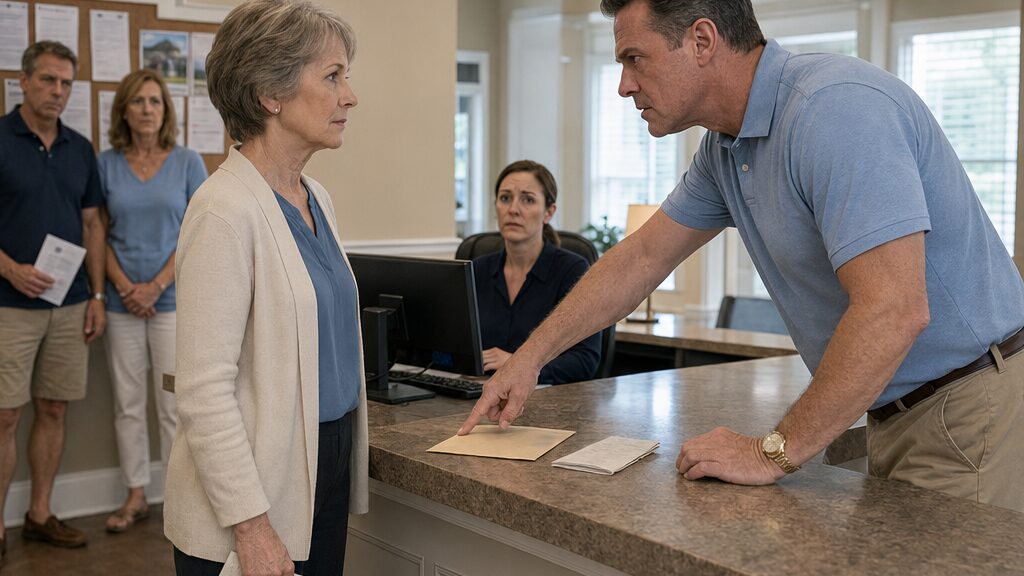
Paul Harris planted one finger on the cream-colored envelope and pushed it across the clubhouse counter as if he were serving a court order.
“Pay it, Cynthia, or we ruin your credit.”
The front-desk coordinator stopped typing.
Two residents waiting near the bulletin board turned their heads. Paul did not lower his voice. He stood over Cynthia in pressed khakis and a pale blue polo, his gold watch catching the fluorescent light each time he moved his hand.
Cynthia looked at the envelope beneath his finger. The embossed association seal had been pressed too deeply into the paper, leaving a faint ridge around the crest. Certified mail. Ten days to pay. Ninety dollars for “supplemental landscape restoration.” Failure to comply could result in late penalties, collection fees, credit reporting, and a lien against her property.
Her brick colonial had been paid off for twelve years.
“Show me the vote,” she said.
Paul’s finger remained on the envelope. “Excuse me?”
“The board vote authorizing the surcharge.”
A tiny pause. Less than a second, but Cynthia had spent most of her career watching what people did inside pauses.
Paul withdrew his hand. “The board has authority to manage common-area maintenance.”
“That was not my question.”
One of the residents near the bulletin board pretended to read a pool-hours notice.
Paul smiled. It was the same smile he used at neighborhood cookouts when discussing resale value. “You received the notice. Everyone did.”
“Did everyone receive the same amount?”
His smile held, but the muscles beside his mouth tightened.
Cynthia opened her handbag and removed a folded sheet of yellow legal paper. Four items were written on it in blue ink.
“I’d also like the current reserve study, the approved annual budget, and contractor invoices for the last three fiscal years.”
The front-desk coordinator looked down at her keyboard.
Paul gave a short laugh. “You’re being difficult.”
“I’m being thorough. There is a difference.”
The resident by the bulletin board coughed into his hand.
Paul straightened. He had expected argument, perhaps tears, perhaps a complaint about living on retirement income. Cynthia could see him recalculating. He glanced at the list but did not touch it.
“You can put in a request,” he said.
“I am putting in a request.”
“Not verbally.”
“I brought two copies.”
She placed them on the counter. One was addressed to the board. The other had a blank receipt line at the bottom.
Paul looked at the coordinator. “We don’t sign personal paperwork at the desk.”
“It is an association records request.”
“We have a process.”
“Then provide it.”
His face lost some of its polish. “You have ten days from the date of the notice. After that, late fees begin automatically.”
“How much?”
“Twenty-five dollars.”
“Authorized by which provision?”
Paul leaned closer. “You seem to think this is a debate.”
Cynthia did not move. “I think it is an assessment. Assessments require authority. Authority leaves records.”
For the first time, the room became completely quiet.
Paul picked up the cream envelope and tapped it once against the counter. “The board will respond as appropriate.”
“Please stamp my copy received.”
“No.”
“Then I’ll send it certified.”
“You’re free to waste postage.”
He slid the envelope back toward her and turned away, dismissing her with the movement. The front-desk coordinator kept her eyes lowered, but Cynthia noticed the woman’s fingers had stopped above the keys.
Cynthia folded the yellow sheet carefully and returned it to her bag.
Outside, the clubhouse parking lot shimmered with late-morning heat. A landscaping truck idled beside the curb. Two workers unloaded flats of red begonias while a third man leaned against the tailgate scrolling through his phone. The company name painted on the truck door was unfamiliar to her.
Harris Landscape Solutions.
She stood still long enough to read the smaller lettering beneath it.
Locally owned. Family operated.
Paul emerged from the clubhouse behind her.
“Cynthia.”
She turned.
His public smile had returned, but there was no audience now.
“You’ve lived here a long time,” he said. “You know how much work it takes to keep this neighborhood desirable.”
“I know how much work it takes to keep roses alive through a wet spring.”
“That isn’t what I mean.”
“No. It usually isn’t.”
His jaw shifted. “Property values depend on cooperation.”
“So does trust.”
He lowered his voice. “Don’t turn ninety dollars into something bigger than it is.”
Cynthia glanced toward the landscaping truck.
“That depends on what it is.”
She walked to her car before he could answer.
At home, her cul-de-sac looked exactly as it had when she left: clipped lawns, brick mailboxes, a child’s bicycle lying in one driveway, and the curved bed of roses along her front walk. The pale pink blooms nearest the porch had opened that morning. She removed one brown leaf before going inside.
The envelope remained in her hand.
She set it on the dining-room table, made black coffee, and read every line twice.
The notice cited no meeting date. No resolution number. No budget category. The payment address was the association’s ordinary post-office box, but the detachable remittance slip used a different processing code from the regular dues notices.
Small things. None conclusive.
Together, they were untidy.
Cynthia carried the envelope down the hallway to the room she still called the study, though she had not studied anything there in years. A wooden filing cabinet stood beneath the window. Its brass lock had darkened with age.
She opened the top desk drawer and found the key beneath a box of unused paper clips.
For a moment, she held it without moving.
Then she unlocked the cabinet.
Inside were three rows of gray federal case binders, each spine numbered in her own precise hand.
Chapter 2: The Files She Promised Never to Open Again
The badge was still wrapped inside the retirement letter she had never opened.
Cynthia found it in the second drawer, beneath a stack of index tabs and a narrow black notebook. The envelope from the Treasury Department had yellowed slightly at the corners. Someone had written her name across the front in blue fountain pen.
She did not unfold the letter.
The badge lay in its cloth sleeve beside it, heavier than she remembered.
Twenty-six years tracing pension fraud had taught Cynthia that most financial harm did not begin with dramatic theft. It began with language no one questioned, numbers too small to challenge, and signatures collected from people who assumed someone else had checked.
She placed the cream HOA notice on her desk.
At the top of a fresh folder, she wrote:
EXHIBIT ONE — LANDSCAPE SURCHARGE NOTICE.
By noon, she had mailed a formal records request by certified mail. She cited the association’s governing documents and requested inspection of the authorizing vote, current reserve study, annual budget, general ledger, bank statements, and contractor invoices for three fiscal years.
She gave the board seven business days.
Nothing arrived.
On the eighth day, Cynthia sent a second request.
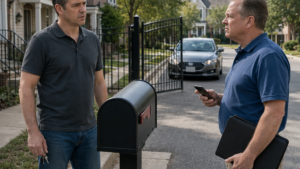
That afternoon, she walked to the neighborhood mail kiosk and found Benjamin Scott standing with one hand braced against the open metal compartment. He was seventy-one, narrow-shouldered, and still wore the dark work trousers he had favored during his years as a school custodian. Since his wife died, he had developed the habit of reading every piece of mail before leaving the kiosk.
He folded something quickly when he saw Cynthia.
“Afternoon,” he said.
“Benjamin.”
“You pruning today?”
“Later.”
He slipped the folded paper into his back pocket.
Cynthia opened her box. Grocery circular. Electric bill. A postcard from a garden supply company.
No response from the HOA.
She closed the compartment. “Did you receive a landscaping surcharge?”
Benjamin looked toward the end of the street.
“Everybody did, didn’t they?”
“That is what Paul said.”
He rubbed his thumb along the edge of his mailbox key. “Then yes.”
“How much?”
He gave a strained little smile. “Ninety dollars.”
“May I see the notice?”
“It’s paid.”
“That was not what I asked.”
His smile disappeared.
After a moment, he pulled the folded paper from his pocket. It was the same cream stock, the same embossed seal, the same ten-day warning.
But the amount was one hundred forty dollars.
Cynthia read it again.
“Why did you say ninety?”
“Because that’s what you said.”
“Benjamin.”
He looked embarrassed. “Mine included a drainage adjustment.”
“There is no drainage adjustment listed in the current budget.”
“I paid it anyway.”
“Why?”
He folded the notice along its existing crease. “Because I own the house free and clear, and I intend to keep it that way.”
“You could have disputed it.”
“And have them add legal fees? I’ve seen what those letters say.”
Cynthia held out her hand. “Will you sign a statement saying what you received and what you paid?”
His expression changed at once.
“No.”
“It would remain private unless needed.”
“No, Cynthia.”
“The amounts are inconsistent.”
“I don’t care if mine was ten dollars more or fifty. I paid it.”
“One hundred forty is not ninety.”
“It is cheaper than a lawyer.”
He took the notice back.
His wife had once brought Cynthia a cutting from a yellow rose that had survived three moves and twenty winters. The plant still grew beside Cynthia’s porch. Benjamin had never mentioned it after the funeral.
Now he lowered his voice.
“Paul knows I’m on a fixed income. If I make trouble, he’ll find something else. Fence stain. Roof streaks. The old maple roots.”
“That is precisely why—”
“I said no.”
The firmness surprised her.
Benjamin put the notice in his pocket and walked away without checking the rest of his mail.
Cynthia stood beside the kiosk, watching him go.
Back in her study, she entered both surcharge amounts into a spreadsheet. Ninety dollars. One hundred forty. Same notice date. Different description. No cited vote.
She added a column labeled Recipient Response.
Under her own name, she typed: Disputed.
Under Benjamin’s, she hesitated before typing: Paid under perceived threat.
She deleted the phrase.
Paid, she wrote instead.
Facts first.
By Friday, the second records deadline had also passed without response. Cynthia had drafted a complaint outline, a vendor-search list, and a chronology. She had not told another neighbor. She told herself that premature alarm would contaminate recollections and encourage rumors.
It was the same justification she had used for years.
On Monday morning, a certified-mail carrier rang her doorbell.
The third cream envelope was thinner than the first.
NOTICE OF EXTERIOR LANDSCAPE NONCOMPLIANCE.
The letter claimed her front rose bed obstructed the visual uniformity of the community and required professional correction within fourteen days. An enforcement inspection fee of seventy-five dollars had already been added to her account.
Cynthia walked outside with the notice in hand.
The roses stood in orderly arcs along the brick path, tied where needed, deadheaded, mulched, and clear of the sidewalk. A pale pink petal fell near her shoe.
At the bottom of the letter was a line the first notice had not contained.
Continued noncompliance may result in escalating daily fines.
Chapter 3: Three Addresses That Should Not Have Matched
Pamela Davis turned her computer monitor toward Cynthia and tapped the screen with the capped end of a pen.
“These two are not the same address,” she said. “Not officially.”
Cynthia leaned closer.
One filing listed a post-office box on Hendersonville Road. The other listed Suite 214 at a commercial mail center six blocks away.
Pamela opened a scanned registration form.
“Look at the forwarding authorization.”
The same handwritten street address appeared on both.
Cynthia copied it into her notebook.
The county records office occupied the ground floor of a brick government building downtown. The room smelled faintly of toner and old paper. Behind Pamela, shelves held plat maps, property transfers, assumed-name certificates, and contractor filings in mismatched binders.
Pamela folded her hands.
“I can show you public records,” she said. “I cannot tell you what they mean.”
“I would not ask you to.”
“You would be surprised.”
“I rarely am anymore.”
That earned the beginning of a smile.
The landscaping company on the clubhouse truck, Harris Landscape Solutions, had been registered eighteen months earlier. Its listed manager shared Paul Harris’s home address until a corrected filing replaced it with the commercial mail suite.
The manager was Paul’s brother-in-law.
The pool-maintenance company was less direct. Its registration named an unrelated manager, but the mailing authorization used the same post-office box as Lisa Green’s spouse had used for a small bookkeeping service.
Neither connection proved overbilling. Neither made the contracts illegal by itself.
Together, they should have appeared in conflict disclosures.
Cynthia requested certified copies.
“Those take twenty minutes,” Pamela said.
“I brought coffee.”
“I noticed.”
While the clerk prepared the documents, Cynthia searched state business records from a public terminal. She worked company by company, recording formation dates, managers, addresses, dissolutions, and amendments.
Some records existed only as images. Others referred to older filings stored under shortened names. One contractor had changed its registered agent three times in two years. Another had allowed its insurance certificate to lapse for six weeks during the previous summer.
Fragmented did not mean fraudulent.
Messy did not mean criminal.
Cynthia repeated both facts to herself.
By early afternoon, she had confirmed two related-party connections and found no board minutes disclosing either one. The absence was meaningful, but still incomplete. She needed the association’s ledger.
Paul had not provided it.
At home, she spread the certified copies across the dining-room table. The original cream envelope served as a temporary holder for receipts until she could file them. Its embossed seal peeked from beneath the county stamps.
She began with vendor payments visible in the annual summary mailed to all homeowners. The report grouped expenses broadly: landscaping, pool operations, storm response, legal administration, reserve transfer.
No vendor names.
She compared those totals with numbers mentioned in old meeting newsletters. Most differed slightly. A few differed substantially.
At 6:40 that evening, Cynthia found the first number that did not fit.
Eighty-four thousand dollars had left the reserve account under the notation EMERGENCY SLOPE STABILIZATION. The transfer appeared in a quarterly summary, but the recipient name had been abbreviated to BRS Project Services.
She searched the state database.
No exact match.
She tried punctuation variations, initials, plural forms, and assumed-name indexes.
Nothing.
The next morning, she returned to Pamela’s desk.
“Could it be an out-of-state vendor?” Pamela asked.
“It could.”
“A temporary joint venture?”
“It could.”
“A project account rather than a company?”
“That too.”
Pamela studied Cynthia for a moment. “You sound disappointed that there are innocent explanations.”
“I’m listing them so I don’t become attached to the other kind.”
Pamela searched the county’s assumed-name records. No BRS Project Services.
They checked contractor permits. No BRS.
Property liens. No BRS.
Tax registrations available to the public. No BRS.
“What year?” Pamela asked.
Cynthia gave her the quarter.
Pamela opened a scanned packet of emergency work authorizations from that period. Most documents were routine: tree removal, culvert clearing, erosion control. Near the bottom was a one-page payment memorandum with no attached invoice.
BRS PROJECT SERVICES — $84,000.
Cynthia’s pulse changed, though her hands did not.
“Can you enlarge the memo line?”
Pamela zoomed in.
The project description had been typed in a narrow field and cut off after forty characters.
Cynthia read the visible portion.
Slope stabilization and rear-access protect—
“Print it,” she said.
Pamela did not move. “Certified?”
“Yes.”
The printout arrived with a raised county seal. Cynthia placed it beside the two vendor-address records.
The connections now formed a shape, but not yet a conclusion. Paul’s relative had the landscaping contract. Lisa’s household shared a mailing link with pool maintenance. A reserve payment had gone to an entity Cynthia could not locate.
She still had no proof that Paul had personally received money.
No proof that the work had not been performed.
No proof the surcharge funded any of it.
She returned home before dusk and built a master index. Every document received a number. Every uncertain claim went into a separate column marked UNVERIFIED.
By nine, the dining table had disappeared beneath folders, maps, certified copies, old newsletters, and handwritten cross-references.
Cynthia studied the eighty-four-thousand-dollar memo again.
This time, she noticed a code in the lower corner.
RA-7.
It was not a bank reference. It matched the HOA’s internal abbreviation style used in old maintenance maps.
She pulled a folded community site plan from a drawer and searched the rear-access labels.
RA-1 bordered the clubhouse.
RA-3 ran behind the pool.
RA-7 curved along the wooded slope at the back of the cul-de-sac.
The line passed directly behind Benjamin Scott’s house.
Chapter 4: The Missing Company Built Something Real
The retaining wall was twenty feet below the rear access path, hidden behind wet brush and a line of young poplars.
Cynthia almost missed it.
She had followed the RA-7 marking from the community site plan, expecting perhaps a drainage trench or an abandoned service road. Instead, the ground dropped sharply behind Benjamin’s property. At the bottom of the slope stood a long reinforced wall of poured concrete and stacked stone, its surface dark with moisture.
A galvanized drainage pipe projected through one end. Fresh aggregate still showed beneath the leaf litter.
Cynthia stopped on the muddy path.
The wall was real.
She took photographs from three angles, then moved closer, testing each step before placing her weight. The slope had softened after several days of rain. Mud climbed the sides of her shoes and stained the bottom edge of the field folder tucked beneath her arm. Inside it, the original cream envelope held her certified-record receipts.
A metal inspection tag had been fixed near the center of the wall. The contractor name was partly scratched away, but the project date matched the eighty-four-thousand-dollar transfer.
She photographed the tag.
Behind her, a branch snapped.
Benjamin stood at the top of the path in an old canvas jacket.
“You planning to break your neck?” he called.
“I was planning to avoid it.”
“That hill doesn’t care what you planned.”
He made his way down slowly, using a fallen limb as a walking stick. When he reached her, he looked at the wall without surprise.
“You knew this was here,” Cynthia said.
“I knew they did work back here.”
“When?”
“Two summers ago. After that storm that washed half the mulch into the street.”
“This was more than mulch.”
Benjamin looked uphill toward the backs of the houses. “There was a crack behind my shed. Paul said the bank could move if another storm hit.”
“Did the board meet?”
“Not that I knew of.”
“Did you receive notice?”
“He knocked on the door himself.”
Cynthia waited.
Benjamin rubbed dried mud from the toe of his boot. “He said engineers had looked at it. Said we had maybe forty-eight hours before the next rain came through. Trucks showed up that night.”
“How many?”
“Enough to keep everybody awake.”
“Did the wall stop movement?”
Benjamin pointed toward a thick oak near the property line. Its roots had been exposed on the downhill side, but the trunk stood straight.
“My back steps stopped pulling away from the house.”
Cynthia looked again at the wall.
The evidence did not excuse the missing authorization or the concealed vendor. But it changed the shape of the eighty-four thousand dollars. Money had not simply vanished. Something substantial had been built, and it may have protected four homes.
“Why didn’t you tell me?” she asked.
“You didn’t ask about a wall.”
“I asked whether you knew why a payment was tied to this street.”
“You asked like you already knew the answer.”
The words landed cleanly.
Cynthia closed the field folder.
Benjamin looked at her shoes. “You’ve got mud on your paperwork.”
“The paperwork will survive.”
“Good. The rest of us might, too.”
He turned uphill. Cynthia followed more slowly, glancing back once at the wall. The emergency explanation was plausible. Perhaps even necessary.
But necessity did not explain why the recipient company did not exist.
That afternoon, Cynthia requested access to the HOA’s archived maintenance room during posted inspection hours. Paul did not appear. The front-desk coordinator led her to a narrow room behind the clubhouse kitchen and unlocked a gray cabinet.
“You have thirty minutes,” the coordinator said.
“The records request did not impose thirty minutes.”
“That is what I was told.”
Cynthia set her bag on the table. “Then please note that the association limited inspection time.”
The coordinator’s mouth tightened, but she remained in the doorway.
The files were incomplete. Storm photographs appeared without invoices. A structural estimate lacked the engineer’s final page. A typed emergency authorization listed Paul’s signature and two blank board-signature lines.
Cynthia found no payment approval.
She did find photographs of the slope taken before the wall was built. One showed a deep split in the earth behind Benjamin’s shed. Another showed the foundation corner of the neighboring house with a visible gap beneath a concrete step.
The danger had been real.
The door opened before her thirty minutes ended.
Paul entered carrying a slim folder.
“I hear you were trespassing behind private lots.”
“I used the association’s rear access path.”
“You climbed into a restricted maintenance area.”
“There was no restriction sign.”
“There will be.”
He placed the folder on the table and opened it to a glossy set of photographs. The same damaged slope. The same exposed roots. A child’s plastic playhouse tilted near the edge of a cracked yard.
“Four homes were at risk,” he said. “The engineering consultant told us another major rainfall could bring the bank down.”
“Where is the consultant’s final report?”
“We acted before paperwork became more important than people.”
“Who was BRS Project Services?”
“A project-management entity.”
“Registered where?”
“You think a secretary-of-state search tells you how emergency construction works?”
“I think eighty-four thousand dollars should identify a legal recipient.”
Paul’s expression hardened. “You came in here claiming money disappeared. It built that wall.”
“I have made no public claim.”
“Not yet.”
He closed the folder.
“Do you know what happens if residents start believing the retaining system is questionable? Insurance companies ask questions. Buyers walk. People like Benjamin lose value they cannot recover.”
“If the work is sound, records will show that.”
“You spent your career with federal budgets. Out here, decisions happen before committees finish talking.”
Cynthia looked at the blank signature lines.
“An emergency can explain the first decision,” she said. “It does not explain missing records two years later.”
Paul lifted the folder. “You want a scandal because you’re angry about ninety dollars.”
“I want an answer because you threatened my home over ninety dollars.”
The next morning, every homeowner received an email from the association.
The subject line read: IMPORTANT CLARIFICATION REGARDING SAFETY EXPENDITURES.
Attached were photographs of the damaged slope and completed wall. The message stated that a resident had begun questioning emergency work that had protected multiple homes and warned that “reckless allegations” could increase insurance costs and damage property values.
Cynthia’s name was not included.
It did not need to be.
By noon, two neighbors had passed her without returning her greeting. Someone posted a printed copy of the email on the mail kiosk.
That evening, Cynthia stood at the edge of her rose bed, cutting away a stem damaged by wind. She had just closed the pruning shears when Lisa Green’s car stopped across the street.
Lisa did not get out immediately.
When she finally approached, she kept glancing toward the neighboring houses.
“The wall is real,” Cynthia said.
“I know.”
“And the danger was real.”
Lisa nodded.
“Then tell me what BRS was.”
Lisa’s face tightened. “Not here.”
“Where?”
Lisa looked toward Cynthia’s front door, then lowered her voice.
“The wall is not the part he is afraid you will find.”
Chapter 5: The Treasurer Who Signed Minutes She Never Read
Lisa arrived after dark carrying a paper grocery bag against her chest.
The bottom had begun to sag.
Cynthia opened the door wider, but Lisa remained on the porch.
“If I come inside, I was never here.”
“That is not a condition I can promise.”
Lisa stared at her.
“I can promise not to misrepresent it,” Cynthia said.
After a moment, Lisa stepped inside.
The bag contained unopened board packets, cream enforcement notices, contractor summaries, handwritten meeting notes, and copies of checks folded into ordinary household envelopes. Lisa placed everything on the dining-room table but kept one hand resting on the bag, as if she might still take it back.
“Why do you have these?” Cynthia asked.
“Because Paul told me to destroy duplicate working copies after the annual review.”
“And you did not.”
“I kept forgetting.”
Cynthia looked at her.
Lisa sat down. “Fine. I did not forget.”
Cynthia separated the packets by date. Several had never been opened. The association seal remained unbroken on three envelopes.
“You signed meeting minutes during these months,” Cynthia said.
“I signed what Paul brought me.”
“Without reading the packets?”
“I read the summaries.”
“That is not what I asked.”
Lisa pushed her chair back slightly. “Do not talk to me like I am one of your suspects.”
“You signed financial records.”
“I know what I signed.”
“No. You know where your signature is.”
The words came out sharper than Cynthia intended.
Lisa’s face changed. Not anger first. Shame.
Cynthia sat across from her.
“Why?” she asked.
Lisa looked down at her hands. “The slope failed three weeks after my husband’s hours were cut. The engineer said the emergency work could mean a special assessment of nearly two thousand dollars per house.”
“That amount never appeared in the homeowner notices.”
“Because Paul said he could bridge it through the reserve account and recover the money slowly.”
“Through landscaping surcharges?”
“Through several categories.”
Cynthia opened one of the packets. A board resolution inside had been dated six days before the emergency work, but the typeface differed from the minutes surrounding it.
“Was this vote held?”
Lisa did not answer.
“Lisa.”
“No.”
The room seemed to narrow.
“Who prepared the minutes?”
“Paul’s office.”
“And you signed them.”
“Yes.”
“Why?”
“Because the wall was already built. Because the houses were safe. Because if the board admitted there had been no vote, the association attorney said the contract might be challenged and the insurer might refuse part of the claim.”
“That explains fear. It does not explain your signature.”
Lisa met her eyes.
“I could not afford two thousand dollars.”
There it was. Not innocence. Not greed. A choice made under pressure and hidden beneath procedure.
Cynthia turned to the next packet.
The emergency vendor agreement had an initial six-week term. Three amendments extended it for landscaping coordination, erosion monitoring, and pool-deck drainage. Each extension cited emergency authority.
The dates continued for eighteen months.
“BRS did not end when the wall was completed,” Cynthia said.
“No.”
“Who controlled it?”
“I never saw incorporation papers.”
“Who received the payments?”
“Paul said it was a project account managed through his brother-in-law’s company.”
Cynthia stopped sorting.
“His brother-in-law’s landscaping company?”
Lisa nodded.
The later invoices were not all large. Twelve thousand for erosion inspections. Nine thousand for soil replacement. Seven thousand for “administrative mobilization.” Small enough to disappear inside annual categories.
Large enough to matter.
“Were all the services false?”
“I do not know.”
“Did you ever inspect the work?”
“No.”
“Did anyone?”
“Paul brought photographs.”
Cynthia leaned back. The same mechanism repeated: emergency first, documentation later, photographs standing in for verification.
Lisa pulled a cream envelope from the grocery bag.
“This came last month.”
It was a draft assessment notice. The amount line was blank. A paragraph authorized the association to recover legal expenses incurred in responding to “burdensome or hostile records demands.”
Cynthia read it twice.
“My requests,” she said.
“He asked the attorney to review every letter you sent. Those charges are being billed to the association.”
“And then distributed to residents.”
Lisa nodded. “He wants people to blame you for the increase.”
“Did the board approve that?”
“Not yet.”
“But the notice is drafted.”
“Yes.”
Cynthia arranged the documents into a timeline: emergency wall, reserve transfer, backdated resolution, vendor extension, related landscaping payments, legal-cost recovery, enforcement notices.
The pattern was no longer a single missing company. It was a structure built to make every later decision look like part of the first emergency.
“Will you provide a statement?” Cynthia asked.
Lisa stood.
“I brought documents.”
“That is not the same.”
“It is all I can do.”
“You authenticated some of these with your signature.”
“I know.”
“Then your explanation matters.”
Lisa gripped the back of the chair. “If I testify against Paul, I admit I signed false minutes.”
“Yes.”
“You say that as though admitting it makes the consequences smaller.”
“It makes the record accurate.”
“I have a mortgage. I have a job that requires financial responsibility. I cannot afford to become the person everyone points to.”
“You already participated.”
Lisa flinched.
Cynthia regretted the cruelty of the sentence but not its truth.
Lisa gathered her purse. “Keep the copies. Not the originals.”
“Lisa—”
“I did not come here to be forgiven.”
She left the grocery bag and walked out.
The next morning, Cynthia carried the packets into the rose garden, where the light was better. She sat at the small iron table and compared the drafted legal-expense notice with language from old association correspondence.
One phrase felt familiar.
Delayed disclosure is necessary to preserve administrative integrity.
She had read nearly the same sentence years before.
Cynthia went inside and opened the lowest drawer of the federal cabinet. The final pension case sat in a gray binder she had not touched since retirement.
Near the back was an internal memorandum she had written herself.
Delayed beneficiary notification is necessary to preserve investigative integrity.
Her own words.
Her own justification.
While her team spent eight additional months perfecting the case, pension payments had been frozen. Guilty administrators were eventually charged, but ordinary retirees had missed rent, postponed medical care, and borrowed money they never recovered.
Cynthia sat with the two documents side by side.
Different institutions. Different stakes.
The same belief that people could wait while experts built the perfect record.
Chapter 6: When Perfect Evidence Becomes Another Kind of Delay
Benjamin’s lien hearing was scheduled four days before his next pension deposit.
He laid the notice on his porch table beside two others delivered to nearby homes. Three cream envelopes. Three different balances. Three hearing times printed in the same narrow black type.
Cynthia stood across from him with her folder closed.
“How much do they say you owe now?” she asked.
“Four hundred eighty-five.”
“For a one-hundred-forty-dollar charge.”
“Late fees. Administrative review. Attorney correspondence.”
“You never received attorney correspondence.”
Benjamin gave a humorless smile. “Maybe they charged me for not receiving it.”
Cynthia opened her folder, then stopped.
She had spent the previous night identifying gaps. She still needed original bank statements. She needed proof of who controlled BRS. She needed independent confirmation that later services had been inflated. Without those, Paul could argue that every irregularity was poor administration rather than self-dealing.
Another week would help.
Benjamin did not have another week.
“I can request a postponement,” she said.
“Will they grant it?”
“Possibly.”
“That means no.”
“It means there is a process.”
He tapped the envelope. “This is their process.”
Across the street, a neighbor pulled into a driveway and remained in the car, watching them.
Cynthia lowered her voice. “I am not ready to present the full case.”
Benjamin looked at her for a long time.
“Then present the part that is ready.”
“That can be dangerous.”
“To who?”
The question irritated her because it was fair.
“If I overstate one claim,” she said, “Paul will use it to discredit everything.”
“And if you wait?”
She looked toward the three envelopes.
Benjamin folded his hands on the table. “You know, my wife used to say you pruned roses like you were punishing them.”
Cynthia glanced at him.
“She admired them,” he added. “But she said you never let a branch grow where you had not planned.”
“That is how pruning works.”
“No. That is how control works.”
She almost left.
Instead, she sat in the other porch chair.
“My last federal case involved a pension system,” she said. “We knew administrators were diverting funds. We also knew some of the first evidence could be interpreted more than one way.”
Benjamin listened without interrupting.
“We delayed notifying beneficiaries because we wanted a case no one could challenge. During those months, payments were frozen. People lost apartments. One woman postponed surgery.”
“Did you cause the theft?”
“No.”
“Did you freeze the payments?”
“Not personally.”
“That is not what I asked.”
Cynthia looked at the row of envelopes.
“My memorandum supported the delay.”
Benjamin rubbed a thumb over the printed hearing date. “And you think if you make one mistake now, you become the same person again.”
“I think mistakes have costs.”
“So does waiting.”
A screen door closed somewhere down the street.
Cynthia removed the original ninety-dollar notice from its protective sleeve. The paper had softened slightly at the folds. Until now, she had handled it as evidence—gloved in habit if not in fact, protected from dirt, separated from everything personal.
She placed it beside Benjamin’s notice.
“I can prove the surcharge was not supported by any disclosed vote,” she said. “I can prove vendor conflicts were not disclosed. I can prove the emergency contract continued long after the emergency.”
“Can you prove the wall was needed?”
“Yes.”
“Then say that, too.”
She looked at him.
“I will speak at the meeting,” Benjamin said. “But you do not get to speak for me.”
“What will you say?”
“That I paid because I was afraid.”
“That may expose your financial situation.”
“It is my situation.”
The distinction was simple. Cynthia had spent years believing protection meant controlling when other people received painful information. Benjamin was asking for something else: the right to decide what his own fear meant.
“I understand,” she said.
“No, you don’t.”
“Not fully.”
“That is better.”
By afternoon, Cynthia had prepared two binders. One contained independently verified records. The other contained Lisa’s copies and private statements, marked not for use without permission.
At three twelve, Lisa called.
“You cannot use what I told you,” she said without greeting.
“The documents?”
“The conversation. My explanation. Any statement about the minutes.”
“The minutes are contradicted by dated records.”
“You can say that. You cannot say I admitted it.”
“Did Paul contact you?”
Silence.
“Lisa.”
“He reminded me that board members can be held personally liable.”
“That is true in some circumstances.”
“You are not helping.”
“I will not use your private statement.”
Lisa exhaled.
“But I will use public records and independently authenticated documents.”
“You will make it obvious.”
“The facts may make it obvious.”
Lisa ended the call.
Cynthia closed the private binder. Without Lisa, the case would be harder. Not impossible, but narrower. She could establish concealment and improper procedure. Proving intent would require an audit.
That evening, she met Benjamin at the clubhouse notice board. A special meeting agenda had been posted behind glass.
Residents gathered in twos and threes, reading the new items.
Emergency vendor review.
Legal-cost recovery assessment.
Delinquency enforcement actions.
At the bottom, under New Business, someone had added a final line in bold type.
Motion to Authorize Lien Proceedings Against Cynthia Taylor.
Benjamin read it twice.
“He put you first,” he said.
“No. He put me last so people would stay.”
Cynthia studied the agenda, then the reflection of the gathered homeowners in the glass.
Her own face appeared among theirs.
For the first time since the first envelope arrived, she did not go home to revise the evidence alone.
Chapter 7: She Corrected Her Own Accusation Before Exposing His
Paul opened the special meeting with Cynthia’s lien.
He did not begin with the emergency vendor review or the legal-cost assessment. He adjusted the microphone, waited until the room settled, and read the motion in a steady voice.
“Authorization to commence lien proceedings against Lot Forty-Two, owned by Cynthia Taylor, for unpaid assessments, enforcement fees, and associated legal expenses.”
The clubhouse was fuller than Cynthia had ever seen it. Folding chairs filled the center aisle. Residents stood along the back wall and crowded the doorway. On the front table, Paul had arranged the storm photographs in clear plastic sleeves.
Cynthia sat beside Benjamin with two binders at her feet.
The original cream envelope rested on top.
Paul looked toward her. “Before we vote, the homeowner may make a brief statement limited to the account balance.”
“Point of order,” Cynthia said.
He tightened his grip on the microphone. “You do not have the floor.”
“The agenda also includes vendor review. The alleged balance depends on whether the underlying assessment was authorized.”
“The chair has ruled.”
One board member shifted in his seat. The other stared at the printed agenda.
Benjamin stood.
Paul’s eyes moved to him. “Mr. Scott, sit down.”
“No.”
The word was quiet, but the room heard it.
Benjamin held up his own cream notice. “You charged me one hundred forty dollars for what you charged her ninety.”
Murmurs spread through the chairs.
Paul raised one hand. “Individual accounts contain different maintenance factors.”
“Then show us the factors,” Benjamin said.
The association attorney leaned toward Paul and whispered something.
Paul’s face changed slightly.
“Five minutes,” he said to Cynthia. “Restricted to verifiable documents.”
Cynthia carried her binders to the front table. She placed the cream envelope beside Paul’s storm photographs, then laid out the certified vendor filings, the reserve transfer memorandum, the emergency contract, and the later amendments.
She did not open Lisa’s private binder.
Paul folded his arms.
Cynthia faced the room.
“I need to correct something first.”
The murmuring stopped.
Paul’s expression sharpened, as if he sensed an opening.
“When I found the eighty-four-thousand-dollar transfer to BRS Project Services, I believed the payment may have been entirely unsupported by actual work.”
Paul leaned toward the microphone. “Which is what I have been telling—”
“I was wrong about that.”
The admission landed harder than an accusation.
Cynthia placed photographs of the retaining wall on the table.
“The wall exists. The slope damage was real. The work appears to have protected several homes, including Mr. Scott’s.”
Paul gave a small, satisfied nod.
A woman in the second row frowned at Cynthia. Someone near the door whispered, “Then what is this about?”
Cynthia continued.
“The question is not whether an emergency existed. It did. The question is whether emergency authority became permanent authority.”
She lifted the initial contract.
“This agreement lasted six weeks.”
Then the first amendment.
“This extension continued the project account for landscaping coordination.”
The second.
“This one added erosion monitoring.”
The third.
“This one added pool-deck drainage eighteen months after the slope was stabilized.”
Paul reached for the microphone. “All of those services protected association property.”
“Perhaps. But they were paid through an entity with no ordinary state registration, managed through the landscaping company controlled by your brother-in-law.”
The room changed.
Not loudly. Chairs creaked. Heads turned toward Paul.
He said, “Family relationship does not invalidate a contract.”
“No. Failure to disclose it may.”
Cynthia laid down the certified filing.
“The pool contractor’s mailing authorization also connects to the treasurer’s household. I am not claiming every invoice is false. I am saying the board failed to disclose related-party relationships while using emergency authority to avoid ordinary approval.”
Paul’s voice hardened. “You are presenting clerical imperfections as corruption.”
“I am presenting dates.”
She opened the indexed binder.
“The board minutes show approval six days before the retaining-wall emergency. County records show the slope failure was reported three days after that supposed vote. The signed resolution could not have authorized an emergency that had not occurred.”
One of the board members pulled the minutes toward him.
Paul said, “Minutes are summaries. They are not transcripts.”
“They are also not predictions.”
A few residents laughed, then stopped when Cynthia did not.
She placed the drafted legal-expense notice beside the records requests.
“My requests were used to justify charging legal costs to all homeowners before the board voted on those costs. My rose garden was cited only after I requested records. Mr. Scott’s one-hundred-forty-dollar charge was described differently from my ninety-dollar charge, though both were presented as mandatory landscape assessments.”
Paul stepped away from the microphone.
“You have no evidence I received a dollar.”
“I have not said you did.”
“You keep implying theft.”
“I am asking for an independent audit.”
“The association cannot afford one.”
“The association paid twelve thousand dollars for erosion inspections without producing an inspection report.”
Paul looked toward the attorney.
The attorney did not speak.
Paul picked up the storm photographs. “Four homes were in danger. I made a decision while everyone else was waiting for procedure. If I had waited, people could have lost foundations.”
Cynthia met his eyes.
“You may have been right to act that night.”
The room went still again.
“But being right once did not give you the right to conceal every decision afterward.”
For the first time, Paul looked tired rather than angry.
“You think homeowners want every emergency debated for three weeks?” he asked. “They want the grass cut, the pool open, and their houses worth more next year than this year. They complain about dues, then blame the board when something fails.”
“That pressure is real,” Cynthia said.
“So is liability.”
“Yes.”
“And you would rather make every invoice public and let people who know nothing tear it apart.”
“I would rather they know what they are paying for.”
“That is not management.”
“No,” Cynthia said. “It is consent.”
Paul turned to the board. “Call the vote.”
The first board member looked down at the documents. “I move to postpone all lien actions pending legal review.”
Paul stared at him.
The second board member hesitated.
Then Lisa stood from the last row.
She had entered without Cynthia noticing.
Her face was pale, and her hands were empty.
“As treasurer,” she said, “I second the motion.”
Paul’s expression closed.
Lisa walked to the front table. She did not look at Cynthia.
“I also move that the association engage an independent auditor to review emergency contracting, related-party disclosures, reserve transfers, and enforcement charges.”
“You cannot make two motions at once,” Paul said.
“Then finish the first.”
The vote to postpone the liens passed two to one.
Paul voted against it.
Lisa waited until the result was recorded.
“Now I move for the audit.”
The first board member seconded.
Paul leaned toward her. “Think carefully.”
“I have.”
“You signed the minutes.”
“Yes.”
The single word moved through the room like a dropped glass.
Lisa looked at the residents.
“I signed minutes I had not fully reviewed. I accepted explanations I should have verified. I will cooperate with the audit, and I will step aside as treasurer while it is conducted.”
No one applauded.
Benjamin lowered his notice to his lap.
The audit motion passed.
Paul remained behind the front table, surrounded by the photographs that proved his first decision had helped save four homes and the documents suggesting he had used that decision to escape accountability ever since.
Cynthia gathered her papers.
She left the original cream envelope on the table until the independent auditor arrived.
Chapter 8: The Next Notice Explained Where Every Dollar Would Go
Four months later, another certified envelope arrived at Cynthia’s door.
She held it for several seconds before opening it.
The paper was cream-colored, but the resemblance ended there. Beneath the association seal was a plain heading:
NOTICE OF SPECIAL ASSESSMENT AND FINANCIAL RECOVERY PLAN.
The first page listed the amount, the board vote date, the budget category, the appeal procedure, and a link to supporting records. The second page explained where every dollar would go.
Cynthia read it at the dining-room table.
The independent audit had confirmed that the retaining wall was necessary and reasonably priced. It had also found that later contracts were extended without proper approval, three invoices were inflated, related-party relationships were not disclosed, minutes had been backdated, and enforcement charges had been applied inconsistently.
The improper lien threats were withdrawn.
Paul had resigned before the final report was issued. A civil settlement required him and the related vendors to repay part of the inflated charges over time. The amount recovered did not make the association whole.
There was still a budget shortfall.
That was the part no one celebrated.
At an open workshop in the clubhouse, residents sat around folding tables with calculators, printed summaries, and coffee in paper cups. Benjamin stood beside a projected spreadsheet explaining why the new assessment could not simply disappear.
“The wall was real,” he said. “The extra billing was real, too. We have to separate those things.”
He spoke slowly, occasionally losing his place and finding it again. No one hurried him.
Lisa sat near the back. She was no longer treasurer, but she had submitted records, answered the auditor’s questions, and accepted a formal censure from the board. When the workshop ended, she helped stack chairs.
The interim board asked Cynthia to stay.
“We need a permanent treasurer,” one member said. “Someone who understands the records.”
Cynthia looked at the binders arranged on the table.
Months earlier, the request would have felt like vindication. Now it felt like a test.
“No,” she said.
The board member blinked. “No?”
“I will not replace one system of unquestioned control with another.”
“You would be elected.”
“And most residents would stop reading because they trusted me.”
Benjamin, standing near the doorway, smiled slightly.
Cynthia proposed a rotating review group instead: four homeowners serving staggered terms, monthly summaries written in plain language, vendor relationships disclosed before votes, and records posted before major assessments.
“I’ll train the first group,” she said. “Then someone else trains the next.”
The plan was slower than appointing her.
That was part of its value.
By early autumn, the new review group met at the clubhouse on the first Tuesday of each month. Residents still argued. Some thought every expense was too high. Others wanted the board to act faster. Transparency did not produce harmony.
It produced visible disagreement instead of hidden decisions.
At home, Cynthia returned to her roses.
The enforcement fee had been removed, but one section of the garden had suffered during the months she neglected it. Several branches had crossed. Black spot marked the lower leaves. She pruned less severely than she once would have.
Benjamin watched from the sidewalk.
“You missed one,” he said.
“I left it.”
“On purpose?”
“It may bloom.”
He considered that. “Dangerous habit.”
“So I am told.”
A breeze shook loose several pale petals. They landed on the brick path beside the old cream envelope—the first one, preserved through every meeting and audit.
Cynthia opened it and used the folded paper to gather the fallen petals.
Then she carried them into the study.
The federal case cabinet stood unlocked.
She placed the original notice inside the closed HOA file, laid the petals on top for a moment, and removed them before shutting the drawer.
Outside, voices carried from the sidewalk as neighbors headed toward the monthly review meeting.
Cynthia took her notebook and joined them.
The story has ended.