They Cut Down His Grandfather’s Oak, Then His Audit Exposed What the HOA Had Buried
Chapter 1: The Chainsaws Arrived Before Anyone Could Object
The first cut came through Kevin Miller’s bedroom wall before dawn.
Not the blade itself, but the sound—metal teeth striking dense wood, catching, then climbing into a hard mechanical scream. Kevin sat upright before he was fully awake. For half a second, he thought the noise belonged to a road crew somewhere beyond the subdivision.
Then the floor trembled.
He crossed the hallway barefoot and pulled open the front door.
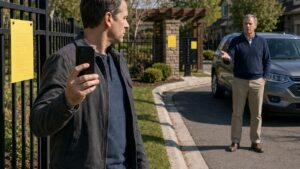
A bucket truck blocked half the street. Three men in reflective vests stood beneath the oak at the edge of his lawn. One held a chainsaw against a notch already cut into the trunk. Another was feeding a rope through a pulley fixed high in the canopy. Fresh sawdust covered the grass like pale snow.
“Stop!” Kevin shouted.
The saw continued for two more seconds before the operator eased off the throttle.
The tree-removal foreman turned. “You the owner?”
“Yes.”
Kevin stepped onto the lawn. The morning air smelled of gasoline and raw wood. A wedge-shaped opening had been cut nearly halfway through the oak’s western side.
“Who authorized this?”
The foreman glanced toward the truck. “Association work order.”
“Show me.”
“We’re already behind.”
“Show me the work order.”
The man exhaled through his nose, removed one glove, and pulled a folded sheet from the cab. Kevin reached for it, but the foreman kept hold of one corner.
The header carried the name of the homeowners’ association. Beneath it, in a box marked PRIORITY, someone had typed URGENT OBSTRUCTION. The location line listed Kevin’s address, followed by a reference to Lot 208.
There was no board resolution attached. No arborist finding. No signature from Kevin.
“This isn’t authorization to enter my property.”
“The association president signed off.”
“Margaret White?”
The foreman did not answer. He folded the page.
Kevin took out his phone and began photographing the truck, the men, the cut in the trunk, and the work-order number painted on a clipboard near the cab.
“You need to leave.”
“We’ve already destabilized it.”
“You cut into it before confirming ownership.”
“We were told the association controlled the setback.”
“It doesn’t.”
The foreman looked up into the branches. “Sir, if we walk away now and that comes down on your house, that’s on you.”
Kevin stared at the widening notch. The oak leaned slightly toward the roof over his mother’s old sewing room.
It was not an accident. The first cuts had made stopping dangerous.
He called the association management line. An automated message announced that the office opened at eight. He called Margaret. It went to voicemail.
Behind him, the foreman said, “We need a decision.”
Kevin turned slowly. “Section it down. Nothing gets hauled away until I inspect it.”
The foreman studied him, perhaps deciding whether that instruction created more liability than ignoring it. Then he signaled to the crew.
The saw started again.
Kevin stood ten yards away as the oak came apart.
The high limbs went first, lowered by ropes and dropped onto the lawn. Each impact shook loose leaves that had not yet turned for fall. Then the upper trunk was cut into lengths. By seven-thirty, the tree that had shaded the front of the house for most of a century had become a stack of wet sections and tangled branches.
Kevin said almost nothing.
He documented every cut.
When the main trunk lay horizontal, the crew marked it into pieces with orange chalk. One of the workers rolled a section to position the saw.
Kevin saw the carving before the blade touched it.
“Wait.”
The worker paused.
Kevin crossed the lawn and crouched beside the bark. The initials were weather-softened but still visible: T.S. Beneath them, the numbers 1952 had stretched as the tree grew, the grooves wider than a finger.
His grandfather had carved them when he was seventeen.
Christine had shown Kevin the mark when he was a child. She had placed his hand against it and told him that trees kept things people forgot.
During her final month, when Kevin had finally returned to the house, she had asked him whether the oak was healthy. He had said yes, though he had not inspected it. She had closed her eyes and told him to look after it.
He had remembered that sentence more clearly than anything she said afterward.
“This section stays,” Kevin said.
The foreman glanced at it. “We’re contracted to remove all debris.”
“It is not debris.”
“We can leave a round if you sign a waiver.”
“Leave this one.”
Kevin watched while two workers rolled the heavy section onto a furniture dolly and moved it into the garage. Sawdust clung to the carved numbers. He brushed it away with his palm.
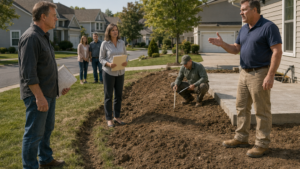
When he returned outside, Margaret White was standing near the curb.
She wore pressed gray slacks and a navy jacket despite the early heat. A thick association binder rested against one hip.
“You authorized this?” Kevin asked.
Margaret looked at the stump rather than at him. “The tree was identified as an obstruction affecting an adjacent property.”
“By whom?”
“The board acted within its maintenance authority.”
“My deed line is six feet beyond that stump.”
“There are easement provisions.”
“For utilities. Not for improving somebody’s view.”
Margaret’s mouth tightened. “You should direct formal questions to management.”
“I called. They’re closed.”
“That doesn’t change the proper process.”
Kevin gestured toward the torn lawn and severed branches. “This was your process.”
For the first time, Margaret met his eyes. Her expression was not triumphant. It was controlled, almost impatient, as if his grief had arrived at an inconvenient point in a schedule.
“The board had to act before the pending transaction was affected.”
“What transaction?”
She adjusted the binder under her arm. “Lot 208.”
The number landed differently now.
Lot 208 was the empty parcel behind Jennifer Brown’s house, a narrow buildable lot that had belonged to her father. It had been listed for months.
Kevin looked across the gap where the oak had stood. Through it, beyond Jennifer’s roofline, the eastern edge of the lot was visible.
Margaret turned toward her car.
“Was there a vote?” Kevin asked.
She stopped but did not turn around. “Rules are rules, Kevin. You’ll receive the documentation.”
By late afternoon, the crew was gone. The lawn was scarred with tire tracks, the stump raw and bright against the darker grass. Sunlight entered the front windows at an angle Kevin had never seen before.
He carried the carved section from the garage into his home office. It was heavier than he expected. He set it beside the desk, where it left a crescent of sawdust on the floor.
Only then did he notice the pink sheet taped to his front door.
NOTICE OF ASSESSMENT.
The amount due was $3,200.
Under the reason, someone had written: Emergency removal of obstructing tree. Owner responsibility pursuant to community standards.
Kevin read the paragraph twice. Then he looked at the reference line at the bottom.
LOT 208 VIEW CORRIDOR.
They had cut down his family’s tree.
Now they wanted him to pay for clearing someone else’s view.
Chapter 2: The View Behind the Empty Lot
Three evenings later, Kevin stood on Lot 208 and watched the sun lower into the exact space where the oak had been.
The sightline was almost too perfect.
From the survey marker near the center of the parcel, the western sky opened between two rooftops. Nothing interrupted the orange light except the dark oval of Kevin’s new stump. On the real-estate listing, the same angle had been photographed from several feet higher, probably from a ladder or raised platform. The caption described an unobstructed sunset view.
The listing had been posted two weeks before the removal.
Kevin saved screenshots on his phone.
A car door closed behind him. Jennifer Brown crossed the dry grass from her driveway, carrying a set of keys.
“You’re trespassing,” she said.
Her tone was tired rather than angry.
“So did a chainsaw crew.”
“This isn’t your property.”
“My tree was.”
Jennifer stopped several feet away. Her father’s house stood behind her with its blinds drawn. A small real-estate sign leaned near the road.
“I heard what happened,” she said.
“You heard it while it was happening.”
“I wasn’t home.”
“You knew the tree was being called an obstruction.”
Her eyes shifted toward the empty horizon.
That was enough.
Kevin held up his phone. “The listing promised this view before the tree came down.”
“The agent wrote that.”
“Based on what?”
“Based on the property.”
“The property had an oak in front of it.”
“Not on this parcel.”
“That is not an answer.”
Jennifer pressed the keys into her palm. “What do you want me to say?”
“The truth would be useful.”
She looked toward his house. From this distance, the missing tree made the front elevation appear exposed and unfinished.
“Margaret told me there could be a problem with the sale,” Jennifer said. “She said a buyer had complained that the lot didn’t match the photographs.”
“And you asked her to remove the tree.”
“No.”
“You benefited from it.”
“That isn’t the same thing.”
Kevin gave a small, humorless laugh. “It feels similar from my yard.”
Jennifer’s face tightened. “I didn’t sign anything.”
“Show me.”
“What?”
“The request. The emails. Whatever communication you had with Margaret.”
“I don’t have to show you private correspondence.”
“No. You don’t.”
He slipped the phone into his pocket and walked toward the road.
“Kevin.”
He stopped.
Jennifer unlocked her car, set her purse inside, then took out her phone. She scrolled through several messages before holding the screen toward him.
The email chain began with the real-estate agent asking whether the association maintained view corridors. Jennifer had forwarded the question to Margaret. Margaret replied that vegetation affecting marketability could be reviewed under community appearance provisions.
Jennifer’s next message was cautious: I don’t want trouble with Kevin. The tree has always been there.
Margaret answered: Leave enforcement to the board.
There was no request for removal.
No approval.
No statement that Jennifer wanted the oak cut.
Kevin read the chain again.
“You knew she was treating it as an enforcement issue,” he said.
“I thought she would send you a notice.”
“You didn’t warn me.”
Jennifer lowered the phone. “The lot has been listed nine months. I’m paying taxes, maintenance, and insurance on a place I don’t want. The first serious buyer said the view was the reason they were interested.”
“So you said nothing.”
“I told myself Margaret would follow the rules.”
The phrase made Kevin look at her.
Jennifer’s voice dropped. “That was convenient. I know.”
A breeze moved through the weeds around them. Without the oak, there was no leaf sound from Kevin’s yard, only the faint electric hum of air-conditioning units.
“Did the sale go through?” he asked.
“No. The buyer backed out the morning after the tree came down.”
“Why?”
“They heard there might be a dispute.”
The first satisfaction Kevin had felt in three days arrived sharp and mean. He disliked himself for it.
Jennifer seemed to see it anyway.
“My father bought that parcel because he thought one of us would build there,” she said. “None of us did. After he died, every month I kept it felt like another decision I had failed to make.”
“That doesn’t make the tree yours.”
“I know.”
Her answer removed the argument he had prepared.
Kevin looked back at the sunset. Jennifer had benefited. She had also hesitated, remained silent, and allowed Margaret to act. But she had not ordered the removal.
The explanation was becoming less simple, not more.
The next morning, Kevin went to the county records office.
The clerk behind the counter searched the permit database and found a vegetation-removal filing submitted two business days before the crew arrived. The applicant was the homeowners’ association. The reason was marked sight obstruction and potential hazard.
“Where’s the hazard report?” Kevin asked.
The clerk opened the digital attachment list. “There isn’t one.”
“Was an arborist letter required?”
“Not for a private removal unless it’s a protected species or within the municipal right-of-way.”
“It was on my parcel.”
“That’s a civil ownership issue.”
“Who signed the application?”
The clerk rotated the screen.
The electronic authorization belonged to Margaret White.
The contractor line listed White Property Services.
Kevin felt a small change in his breathing.
“Can you print the contractor registration?”
The clerk searched again. The business address matched a light-industrial unit near the highway. The registered owner was Joshua White.
Kevin knew the name. Margaret had mentioned a brother who operated a landscaping company, though she usually described him as a regional contractor.
The permit showed no competitive bids and no conflict disclosure. The attached invoice was only an estimate, but it was higher than the charge taped to Kevin’s door.
He paid the copying fee and carried the papers to his car.
The carved oak section sat across the back seat, wrapped in an old moving blanket because Kevin had intended to take it to a woodworker for preservation. One corner of the blanket had slipped, exposing the numbers.
Kevin placed the permit beside it.
Margaret had not simply approved the removal. She had directed the job to her brother’s company and described Kevin’s tree as a hazard without supporting evidence.
His phone rang before he started the engine.
It was the association management office.
The manager informed him that his $3,200 assessment remained due and would begin accruing late fees if not paid within fifteen days.
“I dispute the charge,” Kevin said.
“Then you may present your dispute at the next board meeting.”
“Send me the minutes authorizing the removal.”
“You’ll need to submit a records request.”
“I’m requesting them now.”
“There’s a form.”
“Send it.”
The manager hesitated. “Mrs. White also asked me to remind you that interference with approved contractors can result in additional enforcement.”
Kevin looked at the permit bearing Joshua White’s company name.
“Tell Mrs. White I’ll attend the meeting.”
He ended the call and placed the phone facedown on the passenger seat.
The oak had opened a view for Lot 208.
It had also opened something Margaret apparently believed no homeowner would examine closely.
Chapter 3: Rules Are Rules Until the Questions Begin
Kevin’s name appeared on the clubhouse screen beneath the words DELINQUENT ENFORCEMENT MATTERS.
He saw it before he found a chair.
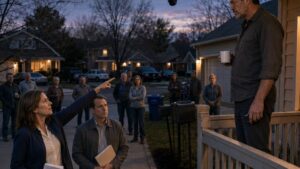
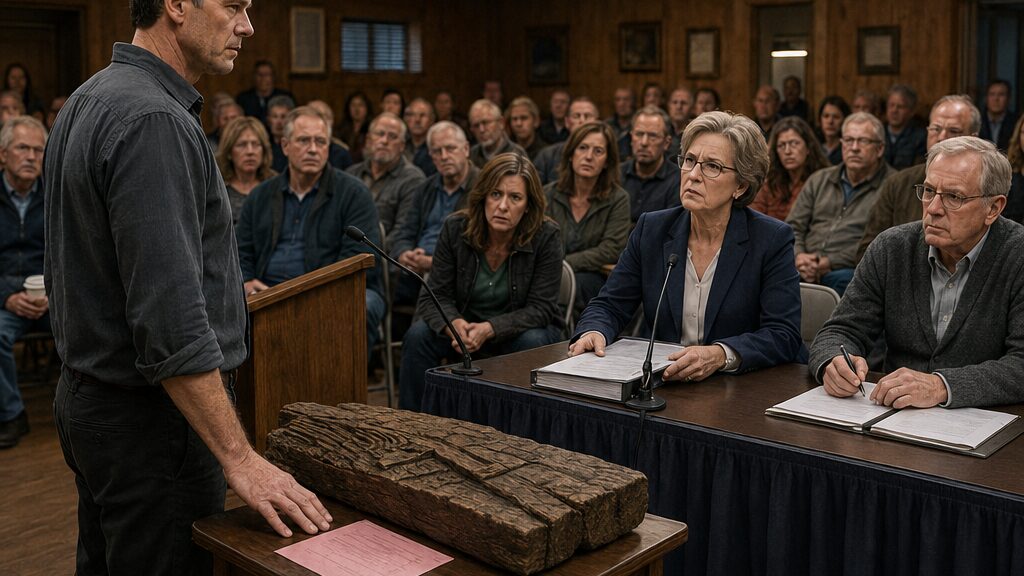
The meeting room was fuller than usual. Folding seats had been added along the back wall, and residents stood near the coffee station whispering over paper cups. Margaret sat at the center of the board table with the association binder open in front of her. James Thompson, the treasurer, occupied the seat at her right.
On a side table, Kevin placed the carved oak section.
The wood was too heavy to carry discreetly. Several people watched him set it down. The weathered initials faced the room, with 1952 visible beneath them. Beside it, he laid the pink assessment notice.
Margaret tapped the microphone.
“We have a full agenda,” she said. “Comments will be limited to three minutes.”
Routine business moved slowly. Landscaping complaints. Pool access. A motion concerning delivery vehicles. Kevin listened while Margaret redirected questions into committees and deferred expenses into later review.
When his name was called, the room changed.
Margaret adjusted her glasses. “Mr. Miller is disputing an emergency tree-removal assessment of three thousand two hundred dollars. The account is now past due.”
Kevin approached the lectern with a binder of his own.
One of the skeptical homeowners near the aisle folded his arms. “We’ve heard about the tree for six weeks.”
Kevin looked at him. “Then three minutes should be enough.”
A few people shifted in their chairs.
Margaret’s expression remained composed. “Please address the board.”
Kevin opened his binder.
“I’m not asking the board to decide tonight what the tree meant to my family.”
Margaret glanced toward the carved wood, perhaps expecting him to begin there.
Instead, Kevin held up the permit.
“I’m asking three narrow questions.”
“Your time has begun,” she said.
“First: on what date did the board vote to authorize entry onto my property and remove the oak?”
Margaret turned one page in her binder. “The association has maintenance authority under Article Seven.”
“That wasn’t my question.”
“The action was reviewed by the appropriate officers.”
“Which meeting?”
“Our attorney has advised that privileged discussions—”
“A board vote is not privileged.”
The room became quieter.
Kevin continued. “Second: where is the conflict-of-interest disclosure showing that the contractor, White Property Services, is owned by your brother?”
Someone near the back said, “Her brother?”
Margaret’s fingers stopped on the page.
“Vendor selection is an administrative matter,” she said.
“Related-party transactions require disclosure under the association’s own procurement policy.”
“You are not the association’s attorney.”
“No. I read the policy.”
A sound came from the coffee station—a cup being placed down too hard.
Margaret leaned toward the microphone. “Mr. Miller, this meeting will not become a personal attack.”
Kevin rested both hands on the lectern. “Then answer the third question.”
He took out the latest annual newsletter and held it up.
“This reports fourteen-point-two million dollars in reserves. Please provide the bank statement supporting that figure.”
James Thompson’s pen slipped from his hand.
It struck the table and rolled onto the floor.
Kevin watched him bend to retrieve it. James’s face had lost color.
Margaret did not look at him.
“The association’s financial position is reviewed annually,” she said.
“That statement is seven months old.”
“And certified.”
“By whom?”
“The reserve information was prepared using accepted projections.”
“That is not a bank balance.”
The skeptical homeowner lowered his arms.
Another resident asked, “Do we have fourteen million or not?”
Margaret tapped the microphone again. “Public comment is not a cross-examination.”
Kevin turned a page in his binder. “The governing documents require current reserve records to be available for inspection. The contractor policy requires disclosure. The meeting rules require authorization for nonemergency expenditures above twenty-five hundred dollars. I have requested all three records. None has been produced.”
Margaret’s control thinned, though her voice stayed level.
“The tree presented a time-sensitive obstruction affecting a pending property transaction.”
Jennifer sat near the back wall. Kevin had not noticed her enter.
She stood.
“I did not request that tree be removed.”
Every head turned.
Margaret’s eyes narrowed. “Ms. Brown, this is not your agenda item.”
“It is my lot you keep referring to.”
“The board acted to protect the marketability of community property.”
“My property,” Jennifer said. “And I didn’t authorize you to use it as a reason.”
The room broke into overlapping questions.
Margaret switched off the public microphone and spoke sharply to the board members. Kevin could not hear the words, but James stared down at the table.
After several seconds, Margaret restored the microphone.
“This discussion is becoming disorderly. Mr. Miller’s assessment remains valid unless reversed through the established process. If payment is not received, the association may pursue collection remedies, including a lien.”
There it was: not an answer, but a threat made official.
Kevin closed his binder.
Margaret seemed to read the movement as surrender.
“You would understand the board’s position,” she said, “if you read the governing documents more carefully.”
Kevin looked at the carved oak section. Saw marks crossed one side where the crew had nearly cut through the initials. He had spent six weeks thinking about how to make Margaret understand what she had destroyed.
Now he saw that she already understood.
She simply believed the rules belonged to her.
Kevin faced the board again.
“I have read them.”
His voice was quiet enough that the room settled to hear it.
“The bylaws give owners the right to inspect contracts, invoices, meeting records, bank statements, reserve schedules, and conflict disclosures. State law requires production within ten business days of a proper written demand.”
Margaret’s expression changed by less than a fraction, but James looked up.
Kevin removed a prepared envelope from his binder.
“This is that demand.”
He placed it on the table in front of the association manager.
“I am requesting the removal authorization, every contract with White Property Services for the last four years, current reserve statements, vendor-payment ledgers, and the records supporting the fourteen-point-two-million-dollar figure published to homeowners.”
Margaret stared at the envelope.
The room no longer seemed interested in the $3,200 charge.
James picked up his pen but did not write.
Kevin lifted the carved section from the side table. Before carrying it away, he turned the initials toward Margaret.
She looked at the wood, then at him.
“Rules are rules,” Kevin said.
The next morning, he sent the same demand by certified mail.
The ten-day clock began when the receipt was signed at 9:14 a.m.
Chapter 4: Twenty-Two Days of Missing Answers
The tenth business day ended at five o’clock with Kevin’s inbox empty.
At 5:03, he refreshed it again.
At 5:07, he checked the association portal.
At 5:12, he opened the certified-mail receipt and confirmed what he already knew: the demand had been signed for at 9:14 a.m. ten business days earlier.
Nothing had arrived except an automated reminder that his $3,200 assessment was now subject to a late fee.
Kevin printed the reminder and placed it beneath the carved oak section on his desk. The weight of the wood held the page flat. Fine sawdust still worked loose from one cut edge whenever he moved it.
He entered the missed deadline into a spreadsheet.
Date demanded.
Date received.
Statutory due date.
No response.
The columns calmed him. They reduced Margaret’s silence to something countable.
By the twelfth day, the management office sent him a message saying the records request was “under review.” It did not identify an attorney, a production date, or any reason for delay.
Kevin replied with three sentences and attached the receipt.
By the fourteenth day, a second late fee appeared on his account.
By the sixteenth, two neighbors stopped talking when he passed them near the mailbox cluster. One of them gave him a tight smile and said, “Some of us are trying to keep property values from becoming a public spectacle.”
Kevin asked, “Who told you I was making anything public?”
The neighbor looked away. “People talk.”
Margaret had begun shaping the story before Kevin had even received the documents.
He told himself that was useful. Pressure created mistakes.
At home, he arranged the materials he did have across the dining table: the permit, the contractor registration, the annual newsletter, Jennifer’s email chain, the pink assessment notice, and the association’s governing documents.
The annual newsletter praised “strong reserves of $14.2 million protecting long-term community assets.” The number appeared twice—once in Margaret’s letter and once in a summary attributed to the treasurer.
Kevin circled both references.
He searched prior newsletters online. The reserve figure had risen smoothly each year, even during the year the clubhouse roof had been replaced and the entrance road resurfaced.
Too smoothly.
Real reserve accounts moved. Contributions entered monthly. Expenses came out in irregular blocks. Interest accrued. Projects shifted balances. Yet the public summaries looked polished into a steady climb.
On the nineteenth day, the management office called.
“We have a partial production available,” the manager said.
“How partial?”
“Current contracts and selected ledger pages.”
“Selected by whom?”
“The association.”
Kevin looked at the oak section. “I’ll pick them up today.”
The packet waiting at the management office was less than half an inch thick.
The manager slid it across the counter but kept one hand resting on top.
“These records are confidential association property.”
“They belong to the association’s members.”
“You may review them. You may not misuse them.”
“What would misuse look like?”
She removed her hand. “You know what I mean.”
Kevin did not. Or rather, he understood that the phrase had been chosen precisely because it meant whatever Margaret later needed it to mean.
He checked the packet before leaving.
There were no bank statements.
No board minutes authorizing the oak removal.
No conflict disclosures.
The vendor ledger contained dates, payees, and amounts, but the description column had been removed from the photocopies.
White Property Services appeared eleven times in eighteen months.
Tree maintenance.
Drainage clearing.
Clubhouse grounds.
Emergency debris removal.
Several payments fell just below the $25,000 threshold requiring a formal board vote. Two occurred only nine days apart.
Kevin photographed every page.
“Where are the bank statements?” he asked.
“Still being compiled.”
“The deadline passed nine days ago.”
“The board disagrees with your interpretation.”
“The statute is not interpretive.”
The manager’s expression hardened. “You should speak to the association attorney.”
“Have the attorney put the board’s position in writing.”
She looked past him toward the next empty chair in the waiting area. “Is there anything else?”
Kevin left with the packet.
At a bank branch near his office, he asked to speak with a compliance officer. He knew the bank could not release association statements to him without authority, but he wanted to confirm the mechanics printed on a deposit slip included in the partial packet.
The account number had been redacted except for four digits. The routing information belonged to the same bank.
The compliance officer studied the deposit slip and the association newsletter Kevin showed him.
“I can’t confirm balances,” the officer said.
“I’m not asking you to.”
“What are you asking?”
“Whether a reserve account presented as a single fund could be spread across controlled accounts, receivables, or certificates and still be described this way.”
The officer read the wording again.
“Could be,” he said carefully. “But a bank balance and a reserve-study projection are not the same thing.”
“Would the bank certify a projected reserve as cash?”
“No.”
Kevin thanked him.
At home, he entered the partial ledger into a new workbook. He grouped payments by vendor, date, and approval threshold. White Property Services rose immediately to the top.
The pattern did not prove theft. It proved only that Margaret’s brother received repeated association work, often through payments structured below formal-review limits.
Kevin opened a blank email to Jennifer.
He considered attaching the ledger.
Residents should know, he thought.
Then he imagined the pages circulating without context. One number would become a rumor. A rumor would become an accusation. Margaret would call the evidence incomplete, and she would be right.
He saved the draft but did not send it.
Three more days passed.
On the twenty-second day, the association delivered a second packet by courier. It included additional ledgers, vendor invoices, and a reserve summary prepared by management.
Still no original bank statements.
The summary claimed $14.2 million in “total reserve resources,” but the categories beneath it included future assessments, anticipated insurance recoveries, and five years of projected contributions.
Kevin read the page twice.
They had taken money that did not yet exist and printed it beside money already in the bank.
He should have felt satisfaction. Instead, the neatness of the manipulation made him uneasy. This was not a mistaken total entered once. Someone had designed the presentation to reassure people who would never read past the headline.
His phone rang. Jennifer’s name appeared.
“Margaret is telling people you’re trying to bankrupt the association,” she said.
“I haven’t filed anything.”
“She says your demands could trigger legal expenses and a special assessment.”
“Did you tell her we spoke?”
“No.”
“Why not?”
A pause.
“Because every time I think about doing the right thing,” Jennifer said, “I calculate what it will cost me first.”
The honesty disarmed him more than an apology would have.
Kevin looked at the unsent email on his screen.
“I’m still reviewing the records,” he said.
“So you found something.”
“I didn’t say that.”
“You didn’t have to.”
After the call, he deleted the draft to Jennifer.
He told himself he was protecting the evidence.
What he was really protecting was control.
At 9:38 that night, the doorbell rang.
No one stood on the porch when Kevin opened the door. A large brown envelope rested against the threshold.
There was no return address.
Inside were six bank statements, each covering the same months as records the association had produced.
The balances were far lower than the reserve summary suggested.
A yellow note had been folded around them.
I kept copies because I knew they would change the numbers again.
At the bottom, in a hand Kevin recognized from the meeting sign-in sheets, were two initials.
J.T.
James Thompson had preserved the statements he had publicly pretended not to have.
Chapter 5: The Number Printed for Everyone to Trust
The association had produced two different statements for the same month.
Kevin placed them side by side beneath his desk lamp.
The first, included in the official packet, was a management summary showing “reserve resources” of $13.8 million.
The second, left by James, was an actual bank statement showing liquid reserves of $2,641,318.
The dates matched.
The account references matched.
The reality did not.
Kevin moved the carved oak section to make room, and a small spill of sawdust fell across both pages. It settled over the printed totals, pale against black ink.
He brushed it away from the bank statement but left it on the summary.
At seven the next morning, he called James.
No answer.
He sent a message: We need to talk before the board realizes what is missing.
James replied eleven minutes later with an address and a time.
His garage was open when Kevin arrived that afternoon. Shelves of labeled storage bins lined the walls. An old workbench stood beneath fluorescent lights, cleared except for a calculator, a legal pad, and two mugs of untouched coffee.
James closed the garage door after Kevin entered.
“You shouldn’t have contacted me from your phone,” he said.
“You left documents on my porch.”
“I left nothing.”
Kevin set the yellow note on the workbench.
James stared at it.
“Then someone writes exactly like you.”
The older man sat down heavily. “You don’t understand what Margaret will do.”
“She’ll issue another fine?”
“She’ll make this mine.”
James’s voice cracked on the final word. He looked embarrassed and angry at himself for allowing it.
Kevin remained standing. “Your signature is on the annual summary.”
“I know.”
“Did you know the number was false?”
James rubbed both hands over his face. “Not false the first time. Not exactly.”
Kevin waited.
James had spent most of his career managing warehouse operations. He had the manner of a man accustomed to solving problems by placing them into the correct sequence. Now every sentence seemed to require permission from a part of him that wanted silence.
“Six years ago,” he said, “the reserve study recommended a special assessment. Roofs, storm drains, retaining walls. Almost four million over three years.”
“And the board adopted it?”
“The owners rejected it. Twice.”
“The board can impose assessments under the declaration.”
“Margaret said forcing one would destroy resale values. People were already furious about insurance increases.”
“So you changed the reserve number.”
“No.” James looked up. “We changed the way we presented it.”
Kevin said nothing.
James continued. “The first summary included receivables. Dues expected but not yet collected. Margaret called them committed resources. Then she added certificates that hadn’t matured.”
“That still wouldn’t reach fourteen million.”
“No.”
“What else?”
“Projected contributions.”
“How many years?”
“Five.”
Kevin looked toward the closed garage door. “You reported five years of future homeowner payments as current reserves.”
James’s mouth tightened. “Margaret said the newsletter was educational, not audited financial reporting.”
“And you signed it.”
“I argued.”
“But you signed.”
“Yes.”
The word stayed between them.
Kevin opened his folder and placed copies of the vendor ledger on the bench.
“White Property Services received repeated payments below the review threshold.”
James barely glanced down. “Margaret said emergency work was exempt.”
“Eleven emergencies?”
“She split projects.”
“Why?”
“To keep them moving.”
“To keep them from being voted on.”
James took off his glasses. “Joshua’s company was struggling. He had equipment. He could mobilize quickly. At first, the prices weren’t bad.”
“At first.”
“The drainage work came after storms. The board was afraid of claims. The clubhouse roof kept leaking. Owners complained about everything and approved nothing.”
“That explains pressure. It doesn’t explain duplicate billing.”
James looked at him sharply. “You found that?”
“I found two clubhouse payments with the same project code.”
“One was supposed to be reversed.”
“Was it?”
James looked away.
Kevin sat across from him.
“This is the point where you decide whether you’re helping me understand what happened or preparing a defense for yourself.”
“I’m not a thief.”
“I didn’t call you one.”
“You think it.”
“I think you signed numbers you knew were misleading.”
James stood and walked to a metal cabinet. From the top drawer he removed a folder thick with reserve-study pages.
“The engineer updated this last winter,” he said. “The clubhouse roof is near failure. The east drainage line has collapsed in two sections. There’s soil movement behind the retaining wall near the common green.”
Kevin opened the report.
Estimated immediate needs: $3.1 million.
Five-year needs: more than $8 million.
“Why wasn’t this in the records production?”
“Margaret called it preliminary.”
“It is stamped final.”
“She said releasing it would trigger panic.”
“She was right about one thing. The association is in trouble.”
James leaned against the cabinet. “That’s what you don’t understand. If everyone sees the real number, they’ll demand somebody make it disappear. There is no somebody. It’s them.”
“The homeowners.”
“Yes. The same people who voted down every assessment and then complained when the potholes came back.”
Kevin turned another page. The association did not merely have less cash than advertised. It had obligations larger than the cash it actually held.
The gap was not simply missing money. Part of it was fictional presentation. Part was deferred spending. Part might be improper billing.
That distinction mattered.
It would not matter to an angry room shown only two numbers.
Fourteen-point-two million.
Two-point-six million.
Kevin understood how easily those figures could become a weapon.
“You kept the statements because you expected Margaret to alter the summaries again,” he said.
James nodded.
“Why give them to me now?”
“Because she told the association attorney that I prepared every reserve number without board direction.”
Kevin watched him.
“She’s going to blame you.”
“She already has.”
James lowered his voice. “My wife and I have most of our retirement in the house. If they sue me personally—”
“You signed the reports.”
“I know what I did.”
“Then why deny having the statements at the meeting?”
James looked toward the shelves of carefully labeled bins.
“Because I spent six years telling myself the next budget would fix the last one.”
There was no defense in his voice. Only recognition.
That was the first surprise Kevin had not found in a document.
James was not hiding because he believed the numbers were defensible. He was hiding because he had waited so long to tell the truth that truth now looked like self-destruction.
Kevin gathered the papers.
“I need every invoice tied to Joshua.”
“I don’t have all of them.”
“Give me what you have.”
James hesitated, then opened another drawer.
For two hours, they compared project codes against payments. Some work was real. Photographs showed repaired drains, cleared storm debris, replanted common areas. Other invoices lacked bids or completion records.
One resurfacing invoice stopped Kevin.
White Property Services had billed the association $88,000 for road preparation and seal coating. Attached behind it was a subcontractor estimate for $19,000.
“Did Joshua perform additional work?” Kevin asked.
“Margaret said he coordinated the project.”
“Sixty-nine thousand dollars’ worth of coordination?”
James said nothing.
At the bottom of the approval page was an electronic code assigned to Joshua.
Vendor approval should have come from a board officer, not the vendor receiving payment.
Kevin looked at James.
“Who gave him access?”
James swallowed.
“Margaret.”
The inflated invoice was not proof of where every dollar had gone.
But it showed how money could leave the account without meaningful review—and how Margaret’s brother had been permitted to approve the path himself.
Chapter 6: The Report That Could Hurt Everyone
The report reached sixty-three pages at 2:17 in the morning.
Kevin typed the final footnote, saved the file, and stared at the title page.
Independent Review of Reserve Representations, Related-Party Transactions, and Procurement Irregularities.
No mention of the oak.
No photograph of the stump.
No statement about Christine.
He had included the removal invoice because it established the related-party relationship, but he had stripped the emotional origin from the document until the case looked as if it might have begun anywhere.
On the shelf behind him, the carved section leaned against a row of binders.
Kevin lifted his phone and photographed the initials.
T.S. 1952.
For several minutes, he considered placing the image in the introduction.
Then he deleted it.
The wood explained why he had started. It did not prove what the board had done.
By morning, the report contained bank statements, reserve summaries, vendor registrations, payment ledgers, duplicated project codes, missing approvals, and the resurfacing invoice. It did not accuse Margaret of stealing $11.6 million. The evidence did not support that conclusion.
Instead, it showed something harder to summarize and easier to defend:
The association had represented future contributions and uncertain receivables as if they were present reserves.
It had concealed urgent obligations.
It had routed repeated contracts to a board president’s relative.
It had paid unsupported markups.
It had failed to produce records within the required period.
And it had allowed the same vendor to participate in approving his own invoice.
Kevin sent the draft to no one.
He printed one copy and placed it in a locked case.
That afternoon, Jennifer asked him to come to her father’s house.
The kitchen had been emptied except for a table, two chairs, and a cardboard box marked DONATE. Through the back window, Lot 208 lay exposed beneath the open sky.
Jennifer poured coffee but did not sit.
“I heard James has been talking to you,” she said.
“Who told you?”
“Margaret.”
That meant Margaret knew.
Kevin kept his face still.
Jennifer placed a folder on the table. “The association postponed the drainage work.”
“When?”
“Yesterday.”
“Why?”
“They said cash management.”
Kevin opened the folder. Jennifer had printed an email sent to owners near the east boundary. It referred to standing water, soil saturation, and delayed contractor scheduling.
“This area flooded last year,” she said. “An elderly neighbor had water against her foundation.”
“The reserve study identifies the drainage line as urgent.”
“So you know.”
“I know the board concealed it.”
“And what are you going to do?”
Kevin closed the folder. “Seek independent control of the funds before more money is moved.”
“All the funds?”
“The reserve accounts.”
Jennifer sat across from him. “Then how do they repair the drain?”
“An independent administrator can authorize legitimate expenses.”
“After a hearing? After bids? After lawyers argue?”
“That is safer than leaving Margaret in control.”
“For whom?”
Kevin looked at her.
Jennifer pressed both palms against the table. “I’m not defending her. I should have warned you about the tree. I know that. But if you lock everything because you’re angry, the people at the bottom of that hill don’t get to stand on principle while water enters their houses.”
“This is not about anger.”
Her eyes moved toward his hands.
Kevin had clenched them without noticing.
“It started with your mother’s tree,” Jennifer said quietly. “You haven’t told anyone that part, but everyone knows.”
“It was my grandfather’s carving.”
“And your mother’s house.”
Kevin stood.
Jennifer did not retreat. “Margaret turned people’s fear into permission. Don’t do the same thing with your grief.”
He left without finishing the coffee.
At home, he reopened the petition requesting temporary judicial restriction of the reserve accounts.
There was a section for known urgent obligations.
Kevin entered the clubhouse roof.
He entered retaining-wall monitoring.
He stared at the blank line beneath them.
Then he closed the document.
The next retention beat arrived by accident.
While sorting audio files James had copied from an old board phone, Kevin found a voicemail dated eight months earlier. Margaret’s voice came through over restaurant noise.
“James, stop worrying about the footnotes. Homeowners read the big number and move on. They don’t want details. They want to know their house is safe.”
A man laughed in the background.
Margaret continued.
“We give them confidence now, and we solve the shortage later. That’s what leadership is.”
The recording ended.
Kevin replayed it.
It was not an admission of theft. It was an admission of deliberate deception and contempt for the people whose money the board controlled.
He added the file to the evidence index.
By then, his decision felt inevitable.
At the civil courthouse two days later, Kevin filed the report under seal with a petition for temporary restriction, independent accounting, and preservation of records. The association attorney argued that the request was disproportionate and would interfere with essential maintenance.
The judge asked, “Are there urgent expenditures pending?”
The attorney mentioned general repairs but did not identify the drainage line.
Kevin was invited to respond.
He could have supplied the reserve-study pages. He could have asked for a narrow exception.
Instead, he said, “The association has repeatedly used the label ‘urgent’ to avoid oversight. Any exception should require independent verification.”
The statement was accurate.
It was also incomplete.
The judge reviewed the invoice structure, the conflicting reserve representations, and the missed disclosure deadline. She asked whether the association would consent to an independent monitor.
Margaret, seated behind counsel, whispered sharply.
The attorney said no.
The hearing lasted less than an hour.
When the judge returned, she granted a temporary restriction on transfers and nonroutine disbursements from the reserve accounts. Essential payments could be released only through documented application and court approval.
The order would remain in effect for forty-seven days, pending an independent review.
Outside the courtroom, Margaret approached Kevin.
For the first time since the tree removal, she looked tired.
“You think you saved this community,” she said.
“I think I stopped you from moving more money.”
“You stopped everything.”
“Essential expenses can be approved.”
“By people who don’t live there.”
“Because the people who do live there were misled.”
Margaret’s face hardened, but there was fear beneath it now.
“Those residents will learn exactly what your version of justice costs.”
She walked away with the association attorney.
Kevin remained on the courthouse steps, holding the sealed copy of the order.
He had obtained what he asked for.
Yet the line he had left blank in the petition seemed more visible than any sentence he had written.
The east drainage project was urgent.
He had known that before the judge signed the forty-seven-day restriction.
Chapter 7: Forty-Seven Days Under One Decision
Water entered the elderly neighbor’s ceiling on the ninth day of the restriction.
Kevin saw the stain before he saw the woman.
It spread across the living-room plaster in a widening brown ring, directly beneath the roofline that had been listed as urgent in the reserve study. A plastic storage bin sat on the carpet catching a slow, steady drip.
The elderly neighbor stood beside it holding a bath towel.
“The management office says the contractor can’t begin until the court releases the funds,” she said.
Kevin looked up at the ceiling.
“That isn’t entirely true.”
“It is what they told me.”
A second drop struck the bottom of the bin.
The restriction did not prohibit emergency work. It required documented application and independent approval. But the association attorney had submitted no application for the roof. Margaret had instead sent residents a notice saying that Kevin’s legal action had frozen essential repairs.
The distinction existed on paper.
It did not exist in this room.
Kevin helped move a chair away from the damp wall. When he left, the neighbor did not thank him.
Outside, rainwater ran along the curb and collected near the storm drain at the east end of the street. The grate was clear, but the water beneath it barely moved.
By the twelfth day, photographs of flooded lawns appeared on the neighborhood message board. Residents posted copies of the court order beside accusations that Kevin had endangered their homes over “one old tree.”
By the fifteenth, someone taped a photocopy of the $3,200 assessment to his mailbox with the words PAY YOUR OWN BILL written across it.
Kevin removed the paper and photographed it.
His first instinct was to add it to the file.
He stopped before doing so.
Not everything was evidence.
Some things were consequences.
At the next court status conference, the association attorney argued that the restriction had produced an administrative crisis. The independent accountant had approved insurance, utilities, and ordinary maintenance but had refused the drainage contract because the supporting bid package contained Joshua’s company as project coordinator.
“The delay is self-created,” Kevin said.
Margaret sat across the table in the mediation room, a closed board binder before her. “The contractor was already mobilized.”
“Your brother’s company was already positioned to collect another coordination fee.”
“He has equipment and local crews.”
“He also approved his own resurfacing invoice.”
Margaret’s jaw tightened.
The civil mediator raised one hand. “We are not resolving every disputed invoice today. We are identifying what must happen before water enters more homes.”
Photographs of the elderly neighbor’s ceiling lay beside images of standing water around the common green. One photograph showed the stump in Kevin’s yard surrounded by a shallow pool.
The mediator turned to Kevin. “Would you consent to a limited release for independently bid emergency work?”
“Yes, if the original vendors are excluded and payments are controlled.”
Margaret opened the binder. “You have already made normal governance impossible.”
“Normal governance produced two reserve balances.”
“Normal governance kept this neighborhood functioning for years.”
“By printing money that did not exist.”
Several residents attending the session shifted in their chairs.
Margaret looked toward them rather than at Kevin.
“You all remember the assessment vote,” she said. “You remember what people said when the engineer recommended four million dollars. Retirees said they would have to sell. Young families said they could not absorb another payment. Owners threatened to replace the entire board.”
Her voice remained controlled, but the polish had begun to crack.
“I was asked to solve it without raising dues,” she continued. “Every meeting, that was the instruction. Keep the roads clean. Keep the roof sound. Keep the entrances attractive. Do not lower property values. Do not increase assessments.”
Kevin said, “So you changed the numbers.”
“I changed the presentation.”
James, seated near the association attorney, closed his eyes.
Margaret saw him.
“The first summary was not theft,” she said. “We counted committed assessments and projected contributions because they were part of the funding plan.”
“Then you counted them again the next year,” Kevin said.
“We expected the gap to close.”
“It widened.”
“Because owners rejected the assessment again.”
“And Joshua’s invoices?”
Her expression hardened. “My brother kept crews available when other contractors would not.”
“At a markup.”
“He coordinated multiple subcontractors.”
“He approved his own payment.”
“That should not have happened.”
It was the first direct concession Kevin had heard from her.
The room quieted.
Margaret placed both hands on the closed binder.
“I did not wake up one morning and decide to steal from my neighbors,” she said. “I made one number look safer because I thought we would fix it before the next report. Then the roof failed sooner. Insurance rose. The drainage line collapsed. Every honest version of the budget required telling people their homes would cost more than they could afford.”
“And every dishonest version made the next honest one worse,” Kevin said.
“Yes.”
The answer came without hesitation.
For a moment, Kevin saw not the woman who had ordered the oak removed, but the point at which fear had turned into habit. She had believed the neighborhood wanted reassurance more than truth. Perhaps, at first, it had.
Then she had protected the lie with her brother’s contracts, withheld records, and used the bylaws against anyone who questioned her.
Pressure explained the first choice.
It did not erase the choices after it.
The association attorney slid a document toward the mediator.
It was Kevin’s petition.
One section had been highlighted.
Known urgent obligations.
The line for east drainage was blank.
Margaret looked at him. “You had the reserve study.”
Kevin did not answer.
“You knew,” she said.
The residents behind him began murmuring.
Jennifer sat near the wall. She stared at the highlighted page, then at Kevin.
The mediator asked, “Mr. Miller, were you aware of the drainage classification when you filed?”
“Yes.”
“Why was it omitted?”
Kevin could have said the association attorney also failed to identify it. He could have argued that the board had abused the word urgent when removing the tree. Both were true.
Neither answered the question.
“I believed a broad restriction would force complete disclosure,” he said.
“And the immediate risk?”
“I decided independent review could address it afterward.”
The elderly neighbor’s leaking ceiling came back to him: the towel in her hands, the plastic bin, the absence of gratitude.
Margaret leaned back. “You wanted leverage.”
Kevin met her eyes. “Yes.”
The admission settled over the room more heavily than denial would have.
He had wanted the funds protected.
He had also wanted Margaret to experience a door closing before she could object.
The mediator removed the highlighted petition from the center of the table.
“Then both sides have used procedure to transfer risk to people who were not making the decisions,” she said. “That ends today.”
Kevin looked at the photographs. The board binder sat beside the image of the stump, its pages squared and orderly. In the photograph, rainwater had gathered in the torn roots.
He turned toward the residents.
“I should have disclosed the drainage risk in the petition,” he said. “I believed withholding it would prevent the board from using emergency language to preserve the same vendor arrangement. That was not my decision to make alone.”
No one applauded.
The skeptical homeowner from the earlier meeting asked, “Are you withdrawing the case?”
“No.”
“Then what changes?”
Kevin faced the mediator.
“I will consent to an immediate release limited to the roof and drainage work, provided an independent administrator controls the account, obtains new bids, excludes White Property Services, and publishes every payment to the owners.”
Margaret shook her head. “That will cost more.”
“It will cost what the work actually costs.”
“And the remainder of the reserve?”
“Restricted until the audit is complete.”
The mediator looked to the association attorney.
After a quiet exchange with Margaret, the attorney requested a recess.
During the break, Jennifer approached Kevin.
“You could have told us,” she said.
“I thought the evidence would speak clearly enough.”
“It did. You were the part that didn’t.”
He looked at the rain streaking the windows.
“My mother used to say the oak kept the house from feeling exposed.”
Jennifer waited.
“I thought if I controlled what happened next, I could undo that feeling.”
“Did it work?”
“No.”
The association returned twenty minutes later.
Margaret agreed to the limited release, independent bidding, and payment supervision. She did not agree to resign. Not yet.
The mediator prepared the amended order.
Before signing, Kevin requested one additional condition: every owner would receive the real liquid balance, the urgent-liability schedule, and a plain-language explanation of how the published figure had been constructed.
Margaret looked at him with exhausted anger.
“You know what that will do.”
“Yes.”
“People will panic.”
“Some will.”
“Some will sell.”
“Maybe.”
She lowered her gaze to the binder.
Kevin said, “They still have the right to decide with the real numbers.”
The forty-seven-day restriction would remain in place, but essential work could begin under independent control.
The neighborhood would receive the truth before the next assessment vote.
For the first time, the cost could no longer be hidden inside a reassuring number.
Chapter 8: What the Oak Could Not Leave Behind
Six months later, Kevin carried the carved oak section out of his office.
He had moved it only twice since the removal: once to the clubhouse meeting and once to the woodworker who sealed the cut edges without sanding away the old marks.
Now the section rested in both arms, heavy against his chest, as he crossed the common green.
The reopened lawn no longer flooded after rain. New drainage lines ran beneath it, and the clubhouse roof had been replaced under independent supervision. The work had cost less than the board’s original contracts but more than residents had hoped.
There had been no painless version.
Owners approved a three-year special assessment after two meetings that lasted past midnight. Several households arranged payment plans. Two properties went on the market. The numbers were published in full.
Margaret resigned before the final audit report was released.
She accepted civil responsibility for the undisclosed related-party contracts and inaccurate reserve representations but continued to insist that she had acted to protect the neighborhood from decisions it refused to make.
Joshua lost every association contract. His company repaid part of the unsupported resurfacing markup through a settlement spread over five years.
James resigned as treasurer and signed a statement acknowledging that he had approved summaries he knew could mislead owners. He did not escape responsibility, but his preserved records reduced the association’s legal costs and helped separate actual losses from projected money that had never existed.
No one had gone to jail.
No missing $11.6 million had been found in a secret account.
The truth was less dramatic and more expensive: inflated invoices, concealed obligations, duplicate payments, false presentation, weak oversight, and years of homeowners preferring low dues to accurate warnings.
Kevin’s $3,200 charge was voided. The association and Joshua’s insurer paid restitution for the unauthorized tree removal.
The check could not purchase seventy-five years.
Kevin directed part of it toward the new grove.
Six young shade trees stood along the edge of the common green, spaced far enough apart to grow without competing. Beside them, a low stone base waited for the carved section.
Jennifer was already there with a shovel resting against one shoulder.
“I brought something,” she said.
She handed Kevin an envelope containing a contribution receipt.
He looked at the amount. “This is too much.”
“No. It’s what I should have risked losing before I stayed quiet.”
“You didn’t order the removal.”
“I knew Margaret was using the lot as pressure. I let myself believe that warning you would ruin the sale.”
“The sale was ruined anyway.”
“Yes.”
Jennifer looked toward Lot 208, where a different buyer had begun building a modest house. The plans preserved the new grove’s sightline without promising an unobstructed view.
“My father used to say property makes people honest,” she said. “I think he meant it shows what they value.”
Kevin folded the receipt and returned it to her.
“Keep this. The association already accepted your contribution.”
She took it back. “Then let me help set the wood.”
Together they lifted the oak section onto the stone base. The sealed bark caught the afternoon light. T.S. and 1952 faced the walking path.
A small metal plaque beneath it carried no account of the dispute and no names of board members. It said only that the grove had been planted for the families who had cared for the community before and for those responsible for caring for it next.
Kevin had written the first draft alone. It had been twice as long.
The final wording came from a note Christine had left in an old kitchen drawer, found while he was sorting her papers after the audit ended.
He had remembered her asking him to protect the oak.
He had forgotten the sentence beneath it.
Don’t keep the house so carefully that no one can live with you in it.
For years, Kevin had treated the first request as a promise and the second as something said under medication.
Now he understood that he had chosen the easier instruction.
Protecting an object required vigilance.
Remaining connected required surrendering control.
Residents gathered without ceremony. Some had supported Kevin from the beginning. Others still blamed him for the repair delays or the assessments. Most carried both gratitude and resentment in proportions that shifted depending on the bill in front of them.
Margaret did not attend.
She sent no apology.
Kevin found that he no longer needed one to confirm what had happened.
The association had adopted new procurement rules, published monthly reserve balances, and appointed an outside financial manager. Owners could see the cost of every contract and the unfunded portion of every future repair.
The rules had not disappeared.
They had become visible in both directions.
An elderly neighbor approached Kevin after the grove was opened.
“My ceiling is dry,” she said.
“I’m glad.”
She studied the carving. “Your grandfather did that?”
“My mother’s father.”
“Did he live here?”
“Before there was an association.”
She nodded as if that explained something.
A child came running from the line of watering cans arranged near the youngest tree. He slowed when he reached the carved wood and traced one finger along the stretched numbers.
“Is this tree dead?” he asked.
Kevin looked at the six saplings moving in the breeze.
“This part is,” he said.
The child considered that, then pointed toward the grove. “Are those its babies?”
“No. They’re different trees.”
The answer seemed to disappoint him.
Kevin crouched beside the stone base.
“But they’re here because it was here.”
The child touched the initials once more, then picked up a green watering can. It was too full, and water spilled over his shoes as he carried it toward the smallest sapling.
Kevin started to reach for the handle.
Then he let the child carry it.
The story has ended.