My Neighbor Said My Shed Was “Basically Empty”—Then the HOA Had to Explain Why Their Tools Were Inside
Chapter 1: The Tools That Should Not Have Been There
The shed door was open two inches.
Mark Harris stopped halfway across the backyard with a paper grocery bag tucked against his ribs and stared at the thin black line between the door and the frame.
He never left it open.
The shed sat beyond the patio, past a strip of grass that sloped toward the cedar fence separating his property from Edward Brown’s. It was nothing special—painted gray, one small window, a narrow workbench inside—but when Mark bought the house nine months earlier, the shed had been one of the things he liked most. It was dry, square, and unquestionably his.
He set the grocery bag on the patio table and walked toward it.
The latch hung crooked.
Not broken exactly. One screw had pulled slightly away from the wood, leaving a pale crescent where the metal plate had shifted. The brass padlock was still attached, but the door had somehow opened enough to move.
Mark touched the latch with one finger.
“That’s new.”
He unlocked the padlock and pulled the door toward him.
The first thing he noticed was the smell of damp soil.
The second was a red power drill sitting on the workbench.
Mark stood still.
He did not own a red drill.
His drill was black and yellow, and it was in the garage.
He stepped inside.
Two orange extension cords were looped over a wall hook he had never used. A dented five-gallon bucket sat beneath them. Along the back wall, where Mark had left open floor space, an old wheelbarrow leaned sideways against a stack of plastic edging.
He stared at it.
Rust flaked along the metal tray. One wooden handle had been wrapped with black tape.
Mark had never seen it before.
He turned slowly, taking in the rest.
A hedge trimmer. A small hand spreader. Two shovels. A bag of grass seed. Several short sections of irrigation tubing.
For a few seconds, his first assumption was almost generous.
Maybe a delivery had been put in the wrong place.
Then he looked again at the wheelbarrow.
No delivery driver carried an old wheelbarrow into somebody’s locked shed.
Mark backed outside and looked toward the fence.
Edward Brown’s house sat twenty yards away on the other side. Edward’s garage door was closed. No one was in the yard.
Mark returned to the shed and took out his phone.
He photographed everything before touching anything.
Years earlier, when he worked in commercial property management, he had learned that people remembered objects differently once an argument started. A chair was suddenly never there. A dent had always existed. A door had definitely been locked.
Pictures were quieter.
They did not need to argue.
He photographed the damaged latch, the drill, the cords, the wheelbarrow, then the wider interior.
Only after that did he pull the door shut.
The lock clicked.
But the sound did not reassure him.
Mark went inside the house and opened the camera app connected to the small security unit above his back door.
He had installed it after moving in, mostly because packages were occasionally left along the side walkway. The camera faced the yard at an angle. It did not point directly at the shed, but it captured most of the path leading to it.
He scrolled backward.
Friday showed nothing unusual.
Thursday afternoon, a landscaper crossed the far corner of the frame.
Wednesday, rain.
Tuesday—
Mark stopped.
At 6:14 p.m., Edward Brown appeared at the edge of the recording.
Edward wore jeans and a faded green T-shirt. He pushed the old wheelbarrow in front of him.
Mark leaned closer to the screen.
Edward did not hesitate at the property line.
He came through the side gate, crossed Mark’s grass, and walked directly toward the shed as if he had done it a hundred times.
The camera lost him for nine seconds.
Then he returned without the wheelbarrow.
Mark replayed it.
Once.
Twice.
The third time, he watched Edward’s hands.
There was no fumbling.
No checking whether anyone was home.
Edward moved with routine confidence.
Mark scrolled farther back.
Sunday morning.
Edward again.
This time carrying the orange extension cords over one shoulder.
Six days earlier, he carried in the hedge trimmer.
The week before that, he crossed the yard with the red drill and a plastic toolbox.
Mark sat back in his chair.
This was not a mistake.
It was not a one-time favor somebody had forgotten to mention.
Edward had been using the shed.
Mark kept scrolling.
Three weeks earlier, at 7:03 on a Saturday morning, Edward approached empty-handed. The camera angle showed him pause beside the shed door.
He lifted something small.
Metal flashed briefly between his fingers.
Mark froze the frame.
He enlarged it.
The image pixelated, but the shape remained obvious enough.
A key.
Edward slipped it toward the old padlock.
Mark stood up.
The chair rolled backward and struck the cabinet behind him.
His first reaction was anger, sharp and immediate.
His second was worse.
It was humiliation.
He had waved to Edward over the fence. Talked to him about sprinkler schedules. Accepted a recommendation for a plumber. Once, when Mark was traveling, Edward had rolled his trash bin back from the curb.
All that time, Edward apparently possessed a key to Mark’s shed.
And had been using it.
Mark returned outside.
The late-afternoon sun lay across the grass in long bands. Everything looked ordinary enough to make the situation feel more intrusive.
He crouched by the latch.
Up close, the misalignment made sense now. Someone had been opening and shutting the door often enough that the loose screw had worked farther out of the old wood.
Mark inserted his own key into the brass padlock.
It turned smoothly.
He held it in his palm after removing it.
When he had bought the house, the former owner had handed him a small ring with three keys: back door, mailbox, shed.
Mark had assumed those were the only copies that mattered.
He looked toward Edward’s house again.
A garage light came on behind the frosted windows.
Someone was home.
Mark could have crossed the yard immediately.
He could already hear the confrontation he wanted.
Why do you have a key?
Why are your things in my shed?
What made you think you could just walk onto my property?
But he had spent too many years watching angry people make clean situations messy.
So he went back inside.
He copied the recordings.
He saved the still frames.
He placed the photographs of the shed contents into a folder on his laptop.
Then he made one short list.
Red drill.
Two extension cords.
Wheelbarrow.
Hedge trimmer.
Spreader.
Shovels.
Irrigation tubing.
Unknown items.
At the bottom, he typed:
Edward entering repeatedly.
Then:
Edward appears to possess key.
Mark sat looking at that last sentence.
Not “broke in.”
Not “stole access.”
Not yet.
He knew enough to separate what he could prove from what he suspected.
Still, when he looked once more at the frozen image of Edward standing beside the shed with the small metal object between his fingers, the question became impossible to ignore.
Edward had a key to a lock on Mark’s property.
And Mark had no idea who had given it to him.
Chapter 2: He Said I Would Never Notice
Edward did not deny any of it.
Mark had barely finished saying, “I found your wheelbarrow in my shed,” before Edward folded his arms across his chest and said, “Yeah.”
That single word stopped Mark more effectively than an argument would have.
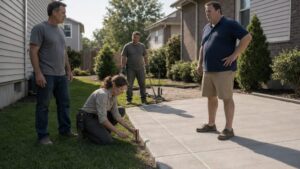
They stood on Edward’s front walk just after six that evening. Donna Brown was somewhere inside; Mark could hear dishes moving in the kitchen through the open screen door.
“You’ve been putting things in there?”
Edward frowned as if Mark had asked whether the sky was blue.
“Some things.”
“Without asking me.”
Edward’s expression changed then—not to guilt, but irritation.
“Andrew let me use that shed for years.”
Mark felt the name land.
Andrew Moore. The man who had sold him the house.
“For years?”
“Sure.”
Edward pointed past the side of his house, toward the fence line.
“He hardly kept anything in there. We stored maintenance stuff. Tools. Whatever needed to stay dry.”
“We?”
Edward shrugged.
“Me. Sometimes association stuff.”
Mark held that phrase for a moment.
“Association stuff?”
“Things we use around the common areas.”
“You mean HOA property?”
“Some of it.”
Mark watched him.
This was already becoming something other than the simple explanation he had expected.
“Andrew told you that you could keep HOA equipment in his shed?”
Edward gave a short laugh.
“Andrew didn’t make everything complicated.”
Mark’s jaw tightened.
“I’m not Andrew.”
“I noticed.”
The answer was casual enough to be almost dismissive.
Mark reminded himself not to rise to it.
“When I bought the house, nobody told me the shed was being used by anyone else.”
“Because it’s not a big deal.”
“It is to me.”
Edward looked past Mark toward the street, then back again.
“Look, you weren’t using half the space. I figured you wouldn’t even notice.”
There it was.
Not an apology.
Not even a misunderstanding.
A calculation.
Mark looked at Edward for several seconds.
“You figured I wouldn’t notice people coming into my yard and putting things inside my building.”
Edward exhaled through his nose.
“Listen to how dramatic that sounds.”
“How should it sound?”
“Like neighbors helping maintain a neighborhood.”
“You have a key to my lock.”
Edward’s eyes shifted.
Only slightly.
But Mark saw it.
“The old key,” Edward said.
“What does that mean?”
“The key Andrew gave me.”
“Andrew gave you a duplicate?”
“Years ago.”
“And you kept it after he sold the house?”
Edward’s arms uncrossed.
“Why wouldn’t I?”
The question was so sincere that Mark almost laughed.
Instead, he said, “Because the property stopped belonging to Andrew.”
Edward shook his head.
“You moved into a neighborhood where certain things were already working. Not everything has to restart because a deed changes hands.”
Mark stared at him.
That sentence bothered him more than the tools.
“Certain things,” Mark repeated.
“The shed was useful. I do maintenance. I helped with the irrigation beds, the entrance signs, the landscaping before the contractor took over most of it. Andrew didn’t care. Nobody cared.”
“I care.”
The kitchen noise inside stopped.
Donna appeared briefly behind the screen door. She looked from Mark to Edward, then stepped away again.
Mark continued.
“You have forty-eight hours to remove everything that belongs to you from my shed.”
Edward let out a dry laugh.
“Forty-eight hours.”
“Yes.”
“You changing the locks too?”
“If I need to.”
Edward looked at him more carefully then.
“What exactly are you threatening?”
“I’m not threatening anything. I’m telling you not to use my property without permission.”
Edward stepped down one stair from the porch.
“You know, people move in here and sometimes they think the HOA is just dues and lawn rules. A lot of the things around here got done because people volunteered. Me included.”
“I didn’t ask you to volunteer inside my shed.”
“No, you just showed up after everybody else did the work.”
That hit closer than Mark wanted it to.
He had moved into the neighborhood because he wanted less complication, not more. After years of managing commercial properties—tenants, vendors, access disputes, repair authorizations, complaints written like legal briefs—he had wanted a house where the walls were his and the decisions inside them belonged to him.
Maybe Edward heard the silence as weakness.
He gestured toward Mark’s property.
“It’s an empty shed, Mark.”
“It isn’t yours.”
“No one said it was.”
“You’re using it like it is.”
Edward rubbed his jaw.
“Fine. I’ll deal with it.”
“By Monday evening.”
Edward turned toward the door.
Mark said, “And don’t use the key again.”
Edward stopped with one hand on the screen door.
For a moment Mark thought he might finally acknowledge the point.
Instead he said, “You know, Andrew never cared.”
Then he went inside.
The door closed.
Mark remained on the walk another few seconds.
He hated the fact that Edward’s last sentence stayed with him.
Not because it changed anything.
Because Edward had meant it as a standard Mark had somehow failed to meet.
By Sunday afternoon, nothing had moved.
Mark checked the shed without opening it. The brass lock remained in place. Through the small window, the wheelbarrow still leaned against the wall.
On Monday morning, he found another security notification.
Edward crossed Mark’s yard at 7:42.
He stopped in front of the shed.
This time he noticed the camera.
For half a second he looked directly toward the house.
Then he tried his key.
Mark watched the recording twice.
The old lock opened.
Edward went inside.
Seven minutes later, he came out carrying a pair of pruning shears. He locked the door again and walked home.
Mark sat at the kitchen table, staring at the screen.
The deadline had not expired yet.
Edward could have been removing something.
But that was not what bothered Mark.
It was the ease of it.
The unchanged assumption.
My key still works, therefore I still belong there.
Monday evening arrived.
The wheelbarrow remained.
So did the drill, cords, spreader, tubing, and most of the other equipment.
At 6:30, Mark crossed the yard carrying a new hardened-steel padlock in its plastic packaging.
He had bought it on the way home.
He removed the old brass one.
The metal was warm from the day’s heat.
For a second he held both locks at once—the old brass lock in one hand, the heavy dark replacement in the other.
The old lock felt suddenly less like security than a shared misunderstanding.
Mark threaded the new shackle through the latch.
It snapped closed with a hard metallic click.
He tested the door.
Secure.
Then he slipped the new key into his pocket.
Across the fence, Edward’s back door opened.
Mark heard footsteps on the patio but did not turn around.
He picked up the old brass padlock instead.
For the first time since he had found the shed open, the door could no longer be opened by a key Edward possessed.
Mark should have felt relieved.
Instead, as he walked back toward the house, one thought followed him.
He had finally changed the lock.
Now he had to decide what he intended to do with everything still trapped behind it.
Chapter 3: The Lock Turned a Dispute Into a Hearing
The first object that made Mark hesitate was not Edward’s drill.
It was a green plastic spreader with a faded white sticker on the handle.
Mark had opened the shed Tuesday morning to finish the inventory. He wanted exact photographs, serial numbers where possible, and enough detail that Edward could never claim something had been damaged or gone missing while Mark controlled access.
He turned the spreader toward the light.
The sticker carried three block letters.
HOA.
Mark frowned.
He set it aside.
The irrigation tubing had the same marking.
So did a long-handled edging tool buried behind the wheelbarrow.
Mark stared at the growing cluster.
Edward had said some of the equipment belonged to the association, but until then Mark had treated that as part of Edward’s explanation rather than a fact with consequences.
If the HOA owned the equipment, locking the shed had changed the dispute.
Mark photographed each item separately.
He kept Edward’s apparent personal property on one side of the shed and the association-marked equipment on the other.
The old wheelbarrow went in neither pile.
There was no name or sticker anywhere on it.
By noon, Mark had created a spreadsheet.
Item. Description. Condition. Apparent owner. Photo number.
It felt familiar.
Too familiar.
Years earlier, he had built inventories like this after tenant abandonments, water losses, unauthorized storage disputes, and contractor arguments. He knew how quickly emotions changed when objects became line items.
That knowledge steadied him.
It also fed something less useful.
Confidence.
By Tuesday evening, Mark had drafted a notice to Edward.
Unauthorized storage.
Unauthorized access after change of ownership.
Forty-eight-hour removal request ignored.
New lock installed.
Controlled retrieval available by appointment.
Then he added a fee schedule.
Thirty dollars for the drill.
Fifteen dollars each for the extension cords.
Forty-five for the wheelbarrow.
Ten dollars per day for continued storage after notice.
He stared at the numbers.
They were not copied from any HOA rule.
They were not based on a written agreement.
They were amounts Mark considered reasonable compensation for the inconvenience and unauthorized use.
That distinction should have slowed him down.
Instead, Edward’s sentence returned.
You wouldn’t even notice.
Mark printed the notice.
The next morning, he sent a copy by certified mail and another by email.
Then he forwarded it to an attorney he had worked with years earlier and asked one narrow question: whether he could insist that retrieval be scheduled so he could document removal.
The attorney’s reply came back later that afternoon.
Yes, reasonable controlled access was sensible.
But the message included another sentence.
Be careful about conditioning return of property on fees unless you have a clear contractual or statutory basis.
Mark read that sentence twice.
Then minimized the email.
He told himself the fees were pressure, not ransom.
He told himself Edward could end them simply by removing the items.
He told himself enough things that the discomfort became manageable.
It lasted until Thursday morning.
An email from the HOA property manager appeared in his inbox at 8:17.
Subject: Formal Complaint Regarding Association Property.
Mark opened it.
Edward had filed a complaint.
The letter stated that association maintenance equipment was being held inside Mark’s locked shed and that access had been denied following a neighbor dispute. It requested that Mark preserve all property, refrain from disposal, and make the association’s items available.
Mark sat motionless.
He read the paragraph again.
Held inside Mark’s locked shed.
The sentence made him sound like the intruder.
A second attachment contained Edward’s written statement.
Edward described the shed as “a longstanding maintenance storage location used with prior owner permission.” He stated that Mark had changed the lock after a disagreement and had “demanded payment to retrieve equipment belonging to both me and the association.”
Mark’s face grew hot.
There was no mention of the repeated unauthorized entries.
No mention of Mark’s deadline.
No mention of the fact that Edward had continued using an old key months after the property changed hands.
Mark opened his photo folder.
Every image was timestamped.
So were the security clips.
He attached copies to a reply and wrote carefully.
The shed is located entirely on my deeded property. I did not authorize Edward Brown or the HOA to access or use it. I have preserved all items and will not dispose of anything. I am available to coordinate documented retrieval upon clarification of ownership and authority.
He paused before sending.
Then added:
Please identify any current agreement, easement, license, lease, governing-document provision, or owner authorization granting the association storage rights in the shed.
That line made him feel better.
It sounded like the version of himself he trusted.
Measured.
Specific.
Provable.
The response arrived that afternoon.
Virginia Roberts, the HOA president, had been copied.
Mark knew her only casually. She was the kind of person who stopped to speak at the mailbox cluster but rarely stayed long enough for conversation to become personal.
Her email was brief.
The board considered the matter serious because association property might be inaccessible during the dispute. An on-site inspection would be scheduled. Both parties were expected to cooperate. A formal hearing might follow if the matter could not be resolved.
Mark read the phrase both parties.
It irritated him more than it should have.
He had not walked into Edward’s yard.
He had not borrowed Edward’s key.
He had not filled Edward’s garage with tools.
Yet the HOA had already flattened the situation into a mutual conflict.
That evening, someone knocked on Mark’s front door.
Edward stood outside.
Not angry this time.
Tight-faced.
“You got the email?”
“I did.”
“You really had to turn this into paperwork?”
Mark almost laughed.
“You filed the complaint.”
“Because you’ve got association equipment locked up.”
“You put it there.”
“Some of that stuff has been in that shed longer than you’ve owned the house.”
“That doesn’t make it yours to store there now.”
Edward looked past Mark into the hallway.
“You’re charging me to get my own property back.”
“You ignored the deadline.”
Edward shook his head.
“You know exactly what you’re doing.”
Mark heard accusation in the words, but also something else.
Recognition.
Edward knew Mark was comfortable with documentation.
He just assumed that made Mark manipulative.
“Do you have anything showing the HOA has a right to my shed?” Mark asked.
Edward’s expression hardened.
“There was an arrangement.”
“With Andrew.”
“With the property.”
“No. Those are different things.”
“You don’t know that.”
Mark leaned against the doorframe.
“Then show me.”
Edward said nothing.
That silence should have been satisfying.
Instead, Mark remembered the attorney’s warning about the fee schedule.
Be careful.
Edward stepped backward.
“Virginia’s going to want this handled.”
“So do I.”
“Then unlock the shed.”
“Not until we document what belongs to whom and why it was there.”
Edward gave him a long look.
“This could have been simple.”
Mark thought of the open door, the damaged latch, the old key.
“It was simple.”
Edward turned and walked away.
The formal inspection notice arrived Friday morning.
Day six.
It named a time for the following afternoon and stated that the property manager would inspect the shed contents with Mark and Edward present.
At the bottom was a second notice.
A hearing had been scheduled for the following week.
Mark scrolled back to the first page.
One sentence caught his attention.
The Association has reason to believe maintenance equipment belonging to the community is stored in a location historically designated for Association use.
Historically designated.
Mark read it again.
Not temporarily permitted.
Not informally stored.
Designated.
He printed the notice and carried it into the kitchen.
For the first time since finding the red drill, he felt something other than anger or certainty.
If the association genuinely believed his shed was an authorized storage location, then Edward’s old key might not be the strangest part of the story.
The real question was why an HOA that had never asked Mark for permission believed it had any right to be inside his shed at all.
Chapter 4: Show Me Where I Gave You a Key
Edward arrived ten minutes before the property manager and walked straight toward the shed.
He did not knock on Mark’s door.
By the time Mark stepped onto the patio, Edward was standing beside the dark new padlock with one hand resting on the latch.
“Don’t touch it,” Mark said.
Edward turned.
“I was looking.”
“You can look without putting your hand on it.”
Edward dropped his hand.
The damaged latch made the new lock look almost excessive. The hardened steel shackle was thick and dark against the older brass-colored hardware. Through the small shed window, the rusted wheelbarrow was visible behind the glass.
Edward glanced at Mark’s pocket.
“You have the key?”
“Yes.”
“Good. Then this shouldn’t take long.”
Mark heard a car pull into the driveway.
The HOA property manager came around the side of the house carrying a clipboard and a thick folder. Edward immediately walked toward him.
“The association equipment is inside,” Edward said. “He changed the lock.”
The manager nodded to Mark.
“Mr. Harris. We’re just here to identify association property and arrange removal.”
Mark held up a hand.
“Before anyone opens anything, I want to understand the basis for the association claiming access.”
Edward sighed.
“Here we go.”
The manager kept his voice neutral. “We’re not here to debate ownership of your shed.”
“Good. Because ownership isn’t in dispute.”
“We’re here because association equipment is reportedly inside.”
“Equipment I never authorized anyone to put there.”
Edward stepped closer.
“You’ve said that.”
“And nobody has answered it.”
The manager opened his folder.
“I have the maintenance records Virginia sent over.”
Mark took the new shed key from his pocket.
Edward’s expression changed immediately, as though the appearance of the key meant the argument was over.
Mark held it loosely between two fingers.
“Show me where I gave the HOA permission to use this building.”
The manager looked up.
“We’re trying to retrieve property.”
“And I am willing to arrange that. But first I want the document that says this shed is an association storage location.”
Edward laughed once.
“It’s been used that way for years.”
“That isn’t a document.”
“Andrew agreed.”
“Andrew isn’t standing here.”
The manager raised a calming hand.
“Let’s keep this practical.”
“I am being practical.”
Mark pointed to the folder.
“If there’s an easement, show me. If there’s a lease, show me. If it’s in the covenants, show me. If there is a written owner authorization that transferred with the sale, show me.”
The manager looked at Edward.
Edward said, “There was never some formal lease.”
“Then what exactly are you relying on?” Mark asked.
The manager flipped through the packet.
For the first time, his confidence seemed to loosen.
“There should be a site-use reference.”
He removed several stapled pages.
One showed landscaping zones.
Another showed irrigation valves.
Then he stopped.
A photocopied neighborhood diagram lay beneath them.
Several common areas were marked in faded highlighter. Near the rear boundary of Mark’s lot was a handwritten notation.
Maintenance storage.
Edward leaned over.
“There.”
Mark did not move.
“What is that?”
“The storage location,” Edward said.
“I can read the words. What is the document?”
The manager examined the corner.
There was no signature.
No parcel agreement.
No date beyond an old revision number in the footer.
“This appears to be an internal maintenance map,” he said.
“Internal to whom?”
“The association.”
“Was it recorded with the county?”
“I don’t know.”
“Is it part of my deed?”
“I’d have to verify.”
“Is there an easement number?”
The manager flipped the page over.
Nothing.
Edward’s irritation sharpened.
“You’re pretending this is some mystery. Andrew gave us a key.”
“Andrew gave you a key.”
“Same difference at the time.”
“No,” Mark said. “That’s the entire difference.”
For several seconds, nobody spoke.
A sprinkler clicked on somewhere beyond the fence.
The manager looked again at the map.
“Do you have your closing documents?”
“Yes.”
“Any storage agreement mentioned?”
“No.”
“Association disclosure?”
“No reference to this shed.”
The manager rubbed his thumb along the edge of the paper.
Edward pointed toward the door.
“Can we deal with the tools first?”
Mark looked at him.
“You keep trying to start with the part that makes me look unreasonable.”
Edward’s face reddened.
“You locked up equipment that isn’t yours and sent me a bill.”
“That came after you used my property without permission.”
“And I told you why.”
“You told me Andrew didn’t care.”
“He didn’t.”
Mark took one step toward the latch but did not unlock it.
“What I still haven’t heard is why Andrew’s permission became mine.”
Edward opened his mouth.
Nothing came out.
The manager intervened.
“Mr. Brown, when the property sold, was there any discussion with Mr. Harris about continuing the arrangement?”
“No formal discussion.”
“Any email?”
“No.”
“Text?”
“No.”
“Did the board notify him?”
Edward looked away.
“I wasn’t on the board anymore by then.”
The answer caught Mark’s attention.
“Anymore?”
Edward’s jaw tightened.
“I used to chair maintenance.”
The manager looked at him.
“You didn’t mention that in the complaint.”
“It wasn’t relevant.”
Mark almost smiled.
It was extremely relevant.
“So you weren’t just a neighbor borrowing space.”
“I was doing work for the community.”
“Unpaid work,” Edward said quickly. “Years of it.”
The manager closed the folder halfway.
“That doesn’t establish access rights.”
Edward stared at him.
“You know where that spreader came from? I bought it because the old contractor wouldn’t treat the entrance beds properly. You know who replaced broken irrigation heads for three summers? Me. Half the stuff you’re calling association property exists because somebody had to actually do the work.”
The anger in his voice sounded different now.
Less smug.
More personal.
Mark noticed it, though it did not erase anything.
The manager said, “I understand. But the question is whether the association currently has permission to store equipment here.”
Edward gave a bitter laugh.
“Apparently we’re pretending nothing happened before Mark moved in.”
Mark slipped the key back into his pocket.
“No. I’m asking you to stop pretending everything that happened before me automatically binds me.”
That silenced Edward.
The manager reopened the folder and took photographs of the internal diagram with his phone.
“I’m not going to ask you to unlock the shed today.”
Edward swung toward him.
“What?”
“Not until we establish the access history.”
“You came here to identify the equipment.”
“And we have photographs from Mr. Harris’s inventory.”
“That’s not the same.”
“No, but it’s enough to preserve the issue for forty-eight hours.”
Mark had expected resistance.
He had not expected the manager to back away from the door.
The small victory felt good.
Too good.
He recognized the feeling immediately: the satisfying moment when a dispute moved onto ground he understood.
Documents.
Definitions.
Authority.
His old professional instincts.
The manager asked Mark to forward the complete inventory and the original camera timestamps.
“I already have them organized.”
Edward muttered, “Of course you do.”
Mark heard the contempt but decided not to answer.
The manager turned to him.
“One thing. Your fee demand is going to come up at the hearing.”
“I expected that.”
“I’m not making a judgment now, but you should be prepared to identify the basis for those charges.”
Mark’s satisfaction cooled.
“I will.”
The manager nodded, then looked at Edward.
“And the board needs every record you have regarding prior use of this shed.”
“I don’t keep HOA archives at home.”
“Emails. Old committee files. Anything.”
Edward’s face hardened.
“You’re making this bigger than it is.”
The manager looked at the old diagram again.
“No. I think it may already be bigger than we understood.”
Edward left first.
He crossed the yard without speaking to Mark.
The property manager remained by the shed another minute, studying the loosened latch plate.
“Was that damage there when you bought the house?”
“Not that I remember.”
“Document it.”
“I have.”
The manager almost smiled.
“I assumed you did.”
After he left, Mark stood alone in front of the locked shed.
The new padlock no longer felt merely defensive.
It had forced everyone to stop and ask a question they had apparently avoided for years.
But another thought bothered him.
Edward had been maintenance chair.
The HOA had an internal map identifying Mark’s shed as storage.
That map had somehow survived into current records even though no one could produce a current agreement.
At 4:48 that afternoon, an email from Virginia Roberts reached every person involved.
The subject line read: Records Preservation and Review.
Virginia ordered the manager and board secretary to locate every document, email, budget entry, maintenance record, and prior-owner communication connected to storage at Mark’s address.
Her final sentence was the one Mark reread.
Until this review is completed, no party should assume that historical use establishes current authorization.
For the first time, the HOA was no longer asking why Mark had locked the shed.
It was asking why anyone had believed they could use it.
Chapter 5: The Arrangement Nobody Bothered to End
Andrew Moore answered on the fourth ring and confirmed the one thing Mark had hoped was not true.
“Yes,” Andrew said. “I gave Edward a key.”
Mark leaned against the kitchen counter.
“For the shed.”
“Years ago.”
“How many years?”
There was a pause.
“Four? Maybe five before I sold.”
Mark closed his eyes.
Edward had not invented the history.
“What exactly did you agree to?”
Andrew sighed.
“It wasn’t some big contract, Mark. Edward was doing maintenance stuff for the neighborhood. The HOA had equipment sitting all over the place. My shed was mostly empty, so I told him he could keep a few things dry.”
“A few things.”
“Wheelbarrow. Spreader. Cords. That kind of thing.”
“Did you give the HOA permanent storage rights?”
“No.”
“Did you tell them the arrangement transferred with the house?”
Andrew laughed softly.
“No. Why would I?”
“Did you tell Edward to return the key when you sold?”
Silence.
Then Andrew said, “I probably should have.”
Mark looked out the window toward the shed.
“So nobody ended it.”
“I assumed it ended itself.”
That sentence stayed with him after the call.
Andrew had treated the arrangement as a favor between people.
Edward had treated it as a working system.
The HOA had apparently treated it as infrastructure.
And Mark had bought the property without knowing any of it existed.
Before hanging up, Andrew added, “For what it’s worth, Edward did a lot around there. More than most people knew.”
“That doesn’t give him access now.”
“I didn’t say it did.”
“You sound like you’re defending him.”
“I’m telling you why I let him use the space.”
Mark said nothing.
Andrew continued.
“He could be pushy. But when the entrance irrigation broke at six on a Sunday morning, Edward fixed it. When the landscaper quit midseason, Edward kept things from looking abandoned. People got used to calling him.”
“And he got used to deciding.”
Another pause.
“That’s probably fair too.”
The call gave Mark what he wanted and took away something he had enjoyed.
Edward was still wrong.
But he was no longer easy.
The next afternoon, Mark sat across from Virginia Roberts and the property manager in the small HOA office near the clubhouse.
Virginia placed a stack of printed records on the table.
“We found more than I expected.”
Mark looked at the pile.
“That doesn’t sound encouraging.”
“It depends on what you mean.”
She pulled out an old budget sheet.
Five years earlier, the association had rented a small commercial storage unit.
The next year, the line item disappeared.
“What happened?” Mark asked.
Virginia glanced at the manager.
“The lease ended.”
“And replacement storage?”
“None.”
“Why?”
Virginia hesitated.
“Cost reduction.”
Mark looked at another sheet.
“What did the board think happened to the equipment?”
“That is less clear.”
The manager slid an email chain toward him.
A former board member had written that maintenance equipment could be “kept locally under the existing volunteer arrangement.”
No address appeared.
No formal vote followed.
Another message referenced “Edward’s storage setup.”
Then the internal map.
Maintenance storage.
Mark sat back.
“So the HOA stopped paying for storage.”
Virginia nodded.
“And equipment started living in my shed.”
“Andrew’s shed at the time.”
“Temporarily.”
“Yes.”
“Then Andrew sold.”
“Yes.”
“And nobody restored the storage budget.”
Virginia folded her hands.
“No.”
Mark looked at her.
“Did anyone ask Edward where the equipment was after the sale?”
The manager answered.
“There are maintenance emails indicating he continued handling several items.”
“That’s not what I asked.”
Virginia’s expression tightened.
“No one appears to have required a new written storage arrangement.”
There it was.
Not conspiracy.
Not theft.
Convenience.
The least dramatic explanation, and somehow the one that irritated Mark most.
Nobody had needed to make a bad decision all at once.
They had simply avoided making a good one.
One unpaid volunteer kept solving problems.
One board removed an expense.
One owner sold.
One buyer arrived.
And everyone relied on yesterday’s shortcut until the shortcut crossed somebody who objected.
Virginia pushed another document toward him.
“This is also part of what we need to discuss.”
Mark recognized his own notice.
The fee schedule.
Thirty dollars.
Fifteen dollars.
Forty-five.
Daily storage.
Seeing it on HOA letterhead as an attachment made it look harsher than it had at his kitchen table.
Virginia tapped the page.
“What’s the basis for these amounts?”
Mark felt his professional instincts rise automatically.
“Unauthorized use, administrative time, continued storage after notice—”
“I’m asking what agreement or rule sets these amounts.”
He stopped.
Virginia waited.
The property manager did not look at him.
Mark said, “There isn’t a prior agreement.”
“State statute?”
“Not specifically for these amounts.”
“HOA provision?”
“No.”
Virginia nodded.
“Then this is a problem.”
“Edward had no authorization either.”
“I agree those are separate questions.”
Mark disliked how familiar the phrase sounded.
Separate questions.
He had used it himself hundreds of times.
He looked down at the paper.
Virginia continued.
“The board is not saying you had to allow unrestricted access. You didn’t. But conditioning retrieval of personal or association property on charges you created yourself makes your position harder.”
Mark thought of the attorney’s email.
Be careful.
He had known.
That was the part that stung.
He had not made the mistake from ignorance.
He had made it because anger made a questionable tool feel useful.
“What happens now?” he asked.
“We finish the review. The hearing proceeds. We determine what belongs to whom, who pays for actual damage, and where association equipment goes.”
“And my shed?”
Virginia met his eyes.
“If there is no enforceable access right, your shed is your shed.”
It was what Mark had wanted to hear.
Yet the victory felt smaller than expected.
On his way home, he saw Edward near the community mailbox replacing a loose screw on the wooden notice board.
No one else was around.
Edward had a cordless drill in his hand.
For one irrational second, Mark wondered whether it was the red one trapped in the shed.
It wasn’t.
Edward glanced up.
Neither man spoke.
Mark kept walking.
That evening he reviewed the records Virginia had emailed him.
Work orders.
Volunteer logs.
Old reimbursement requests.
Edward’s name appeared everywhere.
Replacing a broken sprinkler valve.
Meeting a contractor.
Picking up mulch.
Resetting entrance lighting.
Checking drainage after storms.
Most of it unpaid.
Mark began to understand the shape of Edward’s resentment.
The neighborhood had spent years treating his reliability as free infrastructure.
That explained why Edward felt ownership over systems nobody else wanted to handle.
It did not explain why he had ignored Mark.
At 7:26 p.m., Mark closed the laptop.
A soft knock came from the front door.
Donna Brown stood outside alone.
She held nothing in her hands. No papers. No phone.
She looked tired.
“I don’t want Edward to know I came over.”
Mark opened the door wider but did not invite her in.
“What is it?”
Donna looked toward her house.
Then back at him.
“Did Edward tell you I warned him?”
Mark felt the muscles in his shoulders tighten.
“Warned him about what?”
Her mouth pressed into a thin line.
“The shed.”
Mark said nothing.
Donna lowered her voice.
“When Andrew sold the house, I told Edward the old arrangement was over. I told him if he wanted to keep anything there, he needed to ask you.”
Mark stared at her.
“How long ago?”
“Before you even finished moving in.”
The entire dispute shifted again.
Not because Edward had been wrong.
Mark already knew that.
Because Edward had known exactly where the line was before he crossed it.
Chapter 6: Donna Finally Said What Edward Would Not
Donna opened her hand.
A small brass key lay in her palm.
Mark recognized its shape immediately.
The old padlock key.
“Edward’s?” he asked.
She nodded.
“He kept this in the kitchen drawer.”
Mark did not take it.
“How did you get it?”
“He left it on the counter after the inspection. I think he was going through old maintenance things.”
“Does he know you have it?”
“No.”
Mark looked toward the Browns’ house.
“This isn’t something you should be hiding from him.”
Donna’s expression hardened.
“I’ve spent months not saying something because I didn’t want another argument. That hasn’t helped anybody.”
Mark finally picked up the key.
It felt almost weightless.
Yet that little piece of brass had carried more assumptions than any document in Virginia’s files.
“Tell me exactly what happened.”
Donna leaned against the porch railing.
“When Andrew put the house up for sale, I asked Edward what he was going to do with the tools.”
“And?”
“He said nothing needed to change.”
Mark gave a humorless smile.
“That sounds like him.”
“I told him it absolutely changed. New owner, new permission.”
“What did he say?”
“That the HOA equipment still had to go somewhere.”
Mark looked at the key.
“So he understood.”
“Yes.”
“Why didn’t you tell me before?”
Donna looked embarrassed.
“Because I thought he would ask you eventually.”
“He didn’t.”
“I know.”
“And after I confronted him?”
Her eyes moved away.
“He came home angry.”
“At me.”
“At everybody.”
Donna folded her arms.
“He said the board had spent years expecting him to fix things, then got rid of the storage unit to save money, and now everyone was acting like he created the problem.”
“That part isn’t entirely false.”
“No.”
The answer surprised Mark.
Donna looked directly at him.
“That’s why this has gone on so long. Edward isn’t wrong about everything.”
Mark waited.
“But when he’s right about half of something,” she continued, “he starts acting like the other half doesn’t matter.”
The sentence landed with uncomfortable precision.
Mark thought of his own fee schedule.
Donna did not know about his attorney’s warning.
She did not need to.
“He thought asking you would give you a chance to say no,” she said.
Mark’s jaw tightened.
“So he decided not to ask.”
“Yes.”
There was the deeper truth.
Edward had not misunderstood the transfer.
He had avoided the conversation because he disliked the possible answer.
Donna exhaled.
“He’s spent years being the person everybody calls. I think somewhere along the way, he started believing that if he was the one keeping everything running, he got to decide how it ran.”
Mark closed his fingers around the old key.
“And you let him.”
Donna flinched.
The words came out harsher than Mark intended.
He could have withdrawn them.
He did not.
For a moment, Donna’s face went cold.
Then she said, “Yes.”
The simple admission stripped the satisfaction from Mark’s accusation.
“I did,” she continued. “Because living with someone who thinks every disagreement means you don’t appreciate him gets exhausting.”
Mark looked down.
Donna stepped away from the railing.
“I should’ve said something sooner. But don’t turn me into evidence just so you can beat him.”
Mark looked up.
“I’m not trying to beat him.”
She glanced at the key in his hand.
“Aren’t you?”
Then she walked home.
Mark remained on the porch long after she crossed the neighboring driveway.
Her last question followed him inside.
The hearing was scheduled for Thursday evening.
Before leaving for it, Mark laid his documents across the kitchen table.
Photographs.
Camera stills.
Inventory.
Andrew’s statement.
HOA records.
Repair estimate for the latch.
His fee notice.
The last page looked different now.
Not because the numbers had changed.
Because Mark had.
He remembered the years before he left property management: meetings where people arrived furious and left convinced they had won because somebody else had lost more.
He had hated those meetings.
Eventually, he had hated the version of himself who knew exactly which clause or process could corner someone.
The fee schedule had come from that version.
It was precise.
Documented.
And weak.
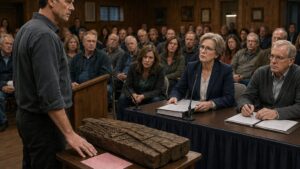
At the HOA office, Virginia sat at the center of the conference table. The property manager occupied one side. Edward sat opposite Mark.
Donna had come too, but she chose a chair slightly behind Edward rather than beside him.
The meeting began with procedure.
Virginia summarized the records review.
Andrew’s limited permission was acknowledged.
The lack of transfer documentation was acknowledged.
The association’s historic reliance on the shed was acknowledged.
Then Edward spoke.
“This whole thing could have been handled without locking anything up.”
Mark looked at him.
“It could have been handled by asking me before you used it.”
Edward’s face tightened.
“You knew there was community equipment inside and still locked the door.”
“I knew after I started documenting it.”
“You sent me charges.”
“Yes.”
Virginia lifted a hand.
“We’re going to address that.”
Mark opened his folder.
“I’ll address it now.”
Edward stopped.
Mark took out the fee notice.
The room went quiet.
“I withdraw the storage and retrieval charges.”
The property manager looked up sharply.
Even Virginia appeared surprised.
Edward stared at him.
“What?”
“The fees. I’m withdrawing them.”
Edward leaned back.
“So you admit you were wrong.”
Mark felt the old reflex rise.
Defend.
Qualify.
Win the wording.
He let it pass.
“I admit I didn’t have a strong enough basis for the amounts I demanded.”
Edward opened his mouth.
Mark continued.
“That does not give you permission to use my shed.”
Edward’s mouth closed.
Mark slid the fee notice aside.
“I don’t want invented leverage. I want the actual problem fixed.”
Virginia folded her hands.
“What are you requesting?”
Mark had written the list earlier.
Now he did not need to read it.
“All association property removed on a documented schedule. Edward’s personal property removed at the same time. Reimbursement for the actual latch repair and any documented cleanup directly related to the storage. Written confirmation that the shed is private property and not an HOA storage location. And a replacement storage plan that doesn’t depend on somebody’s personal property unless that owner agrees in writing.”
No daily fees.
No punishment.
No humiliation.
Edward looked almost more unsettled than when Mark had demanded money.
Virginia said, “Those requests are substantially different.”
“They’re the ones I can defend.”
The property manager nodded slowly.
Edward tapped a finger against the table.
“So I do all that work for years and now I’m the bad guy.”
Donna shifted behind him.
Mark looked at Edward.
“No.”
Edward seemed surprised.
“No?”
“The HOA benefited from letting an informal arrangement continue. Andrew should’ve asked for his duplicate key back. The board should’ve arranged storage after the sale.”
Mark paused.
“And I shouldn’t have made up charges because I was angry.”
Edward’s eyes narrowed, waiting for the rest.
“But you knew I hadn’t given you permission.”
Edward looked toward Donna.
That glance told Mark everything.
Donna spoke before Edward could.
“I told him.”
Virginia turned.
“Told him what?”
Donna sat straighter.
“When Andrew sold the house, I told Edward the shed arrangement was finished unless Mark agreed to continue it.”
Edward closed his eyes briefly.
“Donna.”
“No.”
Her voice remained quiet.
That made it stronger.
“You’ve been saying this happened because nobody understood the arrangement. You understood.”
Edward’s face flushed.
“I understood the equipment had nowhere to go.”
“That’s not the same thing.”
“You know how much work—”
“Yes,” Donna said. “I know exactly how much work you did. That still didn’t make it your shed.”
No document had produced that moment.
No camera.
No archived email.
Just the person who knew Edward best refusing to protect the version of the story he preferred.
Edward looked down at the table.
For the first time since Mark had confronted him, he had nothing ready to say.
Virginia let the silence remain.
Then she turned to Mark.
“If the association approves your requested resolution, you’ll provide scheduled access for removal?”
“Yes.”
“Without the withdrawn fees?”
“Yes.”
“And you’ll allow the association to verify its inventory?”
“Yes.”
Virginia nodded.
“We’ll put the proposed terms to the board.”
Edward looked at Mark.
There was resentment in his face.
But something else had replaced the old certainty.
Limits.
Mark placed the brass key on the table between them.
“I believe this is yours.”
Edward stared at it.
Donna stared at Mark.
Edward did not reach for it.
After a few seconds, Mark picked it up again.
“No,” he said quietly. “Actually, we’ll deal with this after the decision.”
He slipped the obsolete key into his folder.
For weeks, the key had represented everything that angered him: access taken for granted, permission assumed, ownership blurred.
Now it represented something else.
An arrangement everyone had found convenient because nobody had been willing to end it clearly.
Mark had given up his most aggressive demand before the board could force him to.
The question left in the room was simpler now.
Without the fees to argue about, would the HOA finally admit whose door the old key had been opening?
Chapter 7: The Shed Became Private Again
Mark began the final hearing by giving up the one thing Edward had spent two weeks fighting.
“The fees are gone,” he said.
Virginia Roberts looked up from the packet in front of her. The property manager stopped writing. Edward, seated across the table, stared at Mark as if he expected another sentence to reverse the first one.
Mark placed the original fee notice on the table.
“I withdrew them at the last meeting, and I’m withdrawing them from every part of my request today. I’m not asking the association to enforce them. I’m not asking Edward to pay them.”
Edward leaned back.
“So what are we doing here?”
Mark looked at him.
“Fixing what actually happened.”
That answer changed the room.
Without the storage charges, Edward could no longer make the dispute primarily about Mark holding property for money. Without the charges, Mark could no longer hide behind the satisfying idea that every day of disrespect should have a price attached to it.
What remained was less dramatic.
And harder to argue with.
Virginia opened a folder.
“The board completed the records review this morning.”
She turned one page toward Mark and another toward Edward.
“The association found no deed restriction, easement, lease, license, covenant provision, or current owner agreement granting storage rights in Mr. Harris’s shed.”
Edward’s jaw tightened.
Virginia continued.
“The historical use came from Andrew Moore’s informal permission. That permission was never documented as transferable, and nothing in the closing or association records extended it after the property changed ownership.”
Edward tapped a finger against the table.
“You’re making it sound like I invented the whole thing.”
“No,” Virginia said. “We’re saying the arrangement existed and then ended.”
Edward looked at the property manager.
“And the equipment was supposed to go where?”
The manager answered this time.
“That is the association’s responsibility.”
Edward laughed under his breath.
“Now it is.”
Mark heard the bitterness but did not interrupt.
Virginia did.
“You’re right about one part of this, Edward. The association benefited from an informal storage arrangement for too long.”
Edward’s expression shifted.
Not relief.
Recognition.
Virginia went on.
“When the commercial storage lease ended, the board saved money by relying on volunteer arrangements. After Andrew sold the property, nobody established replacement storage. That was poor administration.”
Edward glanced toward Mark as if to say, There.
Mark understood.
This was the thing Edward had wanted someone to admit.
The neighborhood had used him.
Not maliciously.
Comfortably.
Every time he solved a problem for free, it became easier to assume he would solve the next one too.
Virginia folded her hands.
“But that does not mean a volunteer can continue using private property after permission ends.”
Edward’s face closed again.
Donna sat beside the wall, quiet.
Mark noticed she did not look at her husband.
Virginia turned to Mark.
“The board is prepared to approve the following resolution. Association-owned equipment will be removed from your shed on a scheduled date with an inventory signed by both parties. The association will reimburse documented repair costs for the damaged latch and reasonable cleanup directly related to the stored equipment.”
Mark nodded.
“The association will also enter a written notation into the property and maintenance records that your shed is privately owned and is not an association storage location.”
Edward’s hand stopped tapping.
Virginia continued.
“And the board approved rental of a dedicated off-site storage unit beginning next month.”
For several seconds, nobody spoke.
Mark had expected that decision to feel larger.
Instead it felt almost ordinary.
A rented storage unit.
A repaired latch.
A corrected record.
No dramatic penalty.
No public embarrassment.
Just the things that should have existed before anyone had needed to argue.
Edward looked at Mark.
“So you get everything you wanted.”
Mark shook his head.
“No.”
Edward frowned.
“I wanted you to pay because I was angry.”
Virginia glanced at him.
Mark continued before he could reconsider saying it.
“That wasn’t the same as wanting the problem fixed.”
Edward gave a short, humorless smile.
“Convenient realization.”
“Late realization.”
The answer seemed to surprise him.
Mark did not defend himself further.
He had spent years in property management learning how to make every sentence airtight. It had taken this dispute to remind him that a technically strong position could still be driven by the wrong appetite.
Virginia slid the resolution forward.
“Assuming the inventory is completed without further dispute, this closes the association matter.”
Edward stared at the paper.
“And my personal tools?”
Mark answered.
“You can remove them at the same appointment.”
“No fee?”
“No fee.”
“No conditions?”
“One condition.”
Edward’s eyes narrowed.
“You remove only what belongs to you.”
The property manager almost smiled.
Edward did not.
But after a few seconds, he nodded.
Three days later, Mark unlocked the shed.
The dark padlock came away cleanly.
Edward stood a few feet behind him with work gloves tucked into his back pocket. The property manager held the inventory sheet. Donna waited near the fence.
Mark opened the door.
For the first time in weeks, the shed did not feel like evidence.
It looked small again.
The red drill sat on the workbench. The extension cords hung from the hook. The wheelbarrow leaned against the back wall where Mark had first found it.
The property manager began with the association-marked items.
Spreader.
Edging tool.
Irrigation tubing.
Two shovels.
Each was checked against Mark’s photographs and carried to the association’s vehicle.
No one argued.
Then Edward went inside for his belongings.
He brought out the drill first.
Then the cords.
A toolbox.
The hedge trimmer.
He worked without speaking.
When only the wheelbarrow remained, Edward stopped beside it.
Mark stood in the doorway.
“That yours?” Mark asked.
Edward rested one hand on the taped wooden handle.
“Mostly.”
Mark raised an eyebrow.
Edward sighed.
“I bought it years ago. The association reimbursed me for one tire.”
Mark looked at the property manager.
The manager looked down at his sheet.
“Take it,” he said.
Edward almost laughed.
It was the first moment in the entire dispute that came close to humor.
He tipped the wheelbarrow upright.
The old wheel squeaked.
Then he pushed it through the shed door.
The image struck Mark with uncomfortable clarity.
Two weeks earlier, Edward had treated the building like a place whose owner barely mattered.
Now he was carrying the last of his things out under an open door Mark had chosen to unlock.
No crowd watched.
No neighbor filmed it.
No one applauded.
Mark was grateful for that.
Edward rolled the wheelbarrow halfway across the grass and stopped.
He reached into his pocket.
When he returned, he held the old brass duplicate key.
The one Donna had shown Mark.
Edward turned it between his fingers.
“Andrew gave me this when the irrigation controller failed the first summer,” he said.
Mark waited.
“I used to come over at six in the morning because the shed had the tools and nobody wanted calls before work.”
There was no excuse in his voice now.
Only history.
Edward looked toward the association vehicle.
“They got used to me taking care of things.”
“I can see that.”
“I got used to it too.”
Mark said nothing.
Edward rubbed his thumb across the edge of the key.
“I should’ve asked you.”
It was not a grand apology.
Mark trusted it more because of that.
“Yes,” he said.
Edward nodded once.
Then he placed the key in Mark’s palm.
The metal was warm from his hand.
Mark closed his fingers around it.
“I shouldn’t have sent those fees.”
Edward looked at him.
“No.”
Mark almost smiled.
“Glad we agree on something.”
Edward’s mouth moved slightly, not quite a smile.
Then he returned to the wheelbarrow and pushed it toward his house.
Donna followed a few steps behind him.
Before reaching the fence, Edward stopped.
He looked back at the shed.
“You know that latch was already getting loose.”
Mark looked at the new screws and repaired plate.
“Probably.”
“I didn’t help it.”
“No.”
Edward nodded.
Then he left.
The property manager signed the final inventory and handed Mark a copy.
By the following week, the damaged latch had been repaired at the association’s expense. The maintenance diagram was replaced. The new record identified the shed only by parcel location, with a note that it was privately owned and excluded from association use.
A storage unit appeared as a line item in the next board budget.
Nothing else about the neighborhood changed.
The entrance beds still needed trimming.
Sprinklers still broke.
People still complained about dues.
Edward still sometimes worked on small maintenance projects, though Mark noticed the property manager now sent written requests instead of assuming he would handle them.
One Saturday morning, Mark carried two folding chairs into the shed.
There was finally room for them.
He placed them where the wheelbarrow had stood.
Before closing the door, he looked at the old brass key resting on the workbench beside the new one.
For weeks, the old key had seemed like proof that someone had taken something from him.
Now it looked different.
It was proof of what happened when a favor lasted so long that people forgot it had ever required permission.
Mark picked it up.
He considered throwing it away.
Instead, he placed it in the back of a drawer.
Then he stepped outside and closed the shed.
He threaded the dark padlock through the repaired latch and turned his own key once.
The lock clicked.
This time the sound did not feel like punishment.
It felt like a boundary everyone finally understood.
The story has ended.