The Lawyer Brought Fake Deeds, but Virginia Parked Iron Across Her Family’s Last Road
Chapter 1: The Blade Stopped Inches from Her Tractor
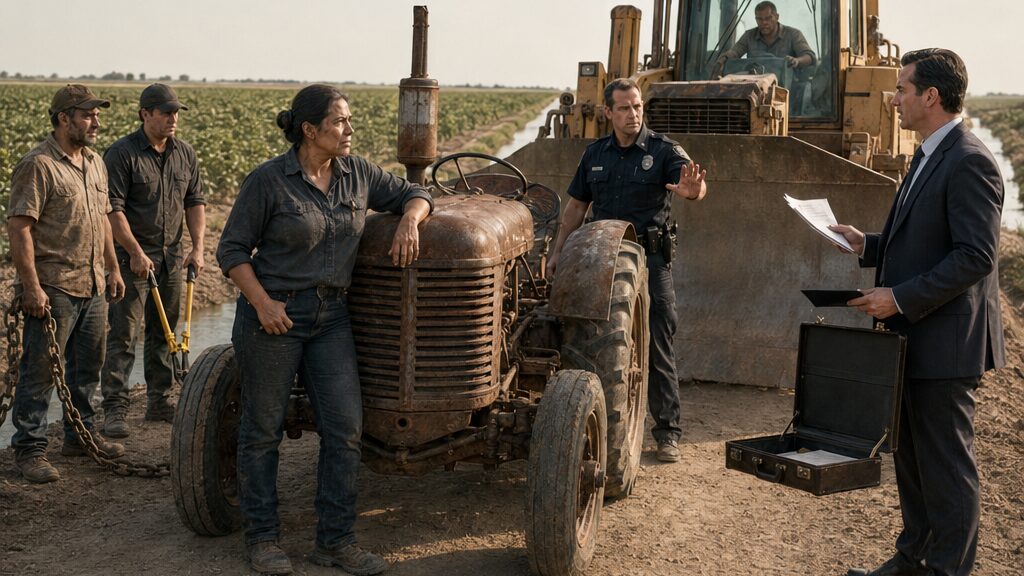
The bulldozer blade stopped so close to the tractor’s grill that rust flakes trembled loose and fell into the dust.
Virginia Torres did not move.
Both hands rested on the antique tractor’s steering wheel. The engine idled beneath her with the uneven, dependable pulse she had known since childhood. Ahead, the bulldozer filled the narrow road from ditch bank to ditch bank, its yellow blade scarred by old stone and fresh enough at the edges to cut through the tractor’s tires.
Behind Virginia, the dirt road ran straight into the crop fields. On either side, irrigation water slid through deep channels her father had dug before she was born.
There was no other entrance wide enough for heavy machinery.
The bulldozer operator looked past his blade toward Mark Davis.
Mark stood beside a black vehicle in shoes already powdered with dust, one hand holding a leather briefcase and the other raised as if conducting traffic. His white shirt remained crisp beneath his jacket despite the heat rising from the road.
“Another six inches, Robert.”
The operator’s face tightened behind the glass.
Virginia felt the bulldozer’s engine deepen. Its blade crept forward.
She could have reached out and touched it with the toe of her boot.
A police officer stepped between the machines, one palm lifted.
“That is close enough.”
The bulldozer stopped again.
Mark lowered his hand. “Officer Clark, my client has legal possession. Every minute she blocks access adds to the damages.”
Ryan Clark glanced at Virginia, then at the court papers Mark had spread across the hood of his vehicle. He was younger than Virginia by at least fifteen years, but the lines around his eyes belonged to someone who had spent too much time standing between people who believed the law belonged entirely to them.
“Ms. Torres,” he said, “I need you to shut the tractor down and step off.”
Virginia looked at the badge, then at the papers.
“Has anyone from the court verified those since sunrise?”
“The order carries a valid seal.”
“That was not my question.”
Mark gave a dry laugh. “This is why we brought law enforcement. She has been served repeatedly and refuses to accept reality.”
He lifted one sheet high enough for Virginia to see the embossed seal near the bottom.
The paper looked clean. Too clean for the road, the farm, or anything that had ever required work.
“The property entered default months ago,” Mark said. “The response period expired. Possession has transferred. We are here to secure the access corridor and confirm the new boundaries.”
Virginia turned the tractor key.
The old engine coughed once and fell silent.
The sudden quiet exposed the running water in the ditches and the soft metallic ticking of the tractor cooling beneath her.
She pulled the key free and slipped it into the breast pocket of her charcoal work shirt.
Mark’s smile faded.
Ryan noticed the movement. “Ms. Torres.”
“You asked me to shut it down.”
“I also asked you to step off.”
Virginia climbed carefully from the seat. Her boots struck the road beside the tractor’s left rear tire. She stayed between the machine and the ditch, one shoulder against the warm iron fender.
Mark looked at the key-shaped bulge in her pocket.
“This performance changes nothing.”
“It changed your road.”
“It is not your road anymore.”
A contractor moved toward the tractor carrying a loop of chain. Ryan stopped him with an arm.
“Nobody touches anything until I finish speaking to both sides.”
Mark exhaled through his nose. “The order authorizes entry.”
“The order does not authorize you to start a collision.”
Robert, still inside the bulldozer, stared straight ahead.
Virginia could see what he had already calculated. If the tractor slid sideways, its right wheels would drop into the eastern ditch. The tractor might roll. The irrigation wall would collapse. The bulldozer would follow farther than its driver intended.
Mark knew it too. He simply believed the danger belonged to other people.
He approached Virginia with the papers in hand.
“Your father nearly lost this farm once before, didn’t he?”
Her fingers tightened against the fender.
Mark saw it and continued.
“He borrowed against land that could no longer support the debt. He delayed the inevitable. Your family was fortunate then. You are not fortunate now.”
Virginia remembered her father at the kitchen table, turning bills facedown whenever she entered. She remembered the smell of machine grease on his sleeves and the thinness in his face during his last winter.
She had promised him no one would ever remove them through papers they did not understand.
She had never told anyone how often that promise frightened her.
Mark held the order toward her as if offering a final kindness.
“Move the tractor voluntarily. You may preserve some dignity.”
Virginia took the document.
His surprise lasted less than a second.
She did not read the paragraphs. She studied the attached survey.
A thick boundary line cut diagonally across the entrance, passed through the western ditch, and continued toward the first crop rows. Small coordinate marks identified a newer parcel description. The paper claimed the access corridor had been separated from the farm during a refinancing transaction.
Virginia followed the printed line with one dirty fingernail.
“When was this boundary recorded?”
“Everything you need is stated there.”
“Say it.”
Mark glanced at Ryan. “Eight years ago.”
Virginia looked toward the western ditch. Water moved beneath a steel gate mottled with mineral stains. Her father had installed that gate with salvaged hinges when Virginia was twelve.
She turned the survey so Ryan could see it.
“This line puts the boundary in the middle of that channel.”
Ryan studied the page. “And?”
“That ditch was dug forty-three years ago. County agricultural maps have shown it in the same place ever since.”
Mark’s voice hardened. “Old landmarks do not supersede recorded coordinates.”
“No. But your description says the parcel was created around a marker on the west bank.”
She pointed toward the flowing water.
“There has never been a west bank at those coordinates. Your marker would be six feet inside the ditch.”
Ryan looked from the page to the channel.
Mark reached for the survey. Virginia kept hold of it.
“You are interpreting technical material you are not qualified to interpret,” he said.
“I have repaired that ditch after every flood since your shoes were new.”
Mark pulled the paper from her hand.
Ryan stepped closer to the western bank, eyes narrowing as he compared the survey to the ground.
The tractor remained silent behind Virginia, blocking every inch of usable road.
Mark folded the document once, sharply.
“A mapping discrepancy does not invalidate a foreclosure.”
“Maybe not,” Virginia said. “But it means you should find out what else is wrong before you drive steel onto my land.”
The water continued beneath the gate, carrying a small curl of straw through a boundary that existed only on paper.
Chapter 2: The Survey Line That Crossed Running Water
The contractor drove the first tripod leg into the western ditch bank before Virginia could reach him.
The aluminum point sank through the dry crust with almost no resistance.
“Pull it out,” she said.
He glanced toward Mark instead.
Mark stood beside the road with his briefcase open, sorting papers across its divided compartments. “Establish the coordinate. Officer Clark can observe.”
“The bank is hollow underneath.”
The contractor extended the second leg and stamped it down.
Virginia heard the faint crumble before anyone else did.
Water had eaten a channel beneath the outer lip during the last irrigation cycle. The surface looked firm, but the packed soil under the tripod was no thicker than a shovel blade.
Larry Adams came running from the direction of the livestock pens, two massive guardian dogs moving beside him until he ordered them back with a sharp gesture. They stopped near the fence line, alert and silent.
“What are they doing?” he called.
“Measuring land they do not own,” Virginia said.
Larry slowed when he saw the bulldozer, the police vehicle, and the chain lying near the tractor. His gaze found Virginia’s face.
“You knew they were coming?”
She looked away too late.
The contractor mounted the digital transit on the tripod and switched it on. A red laser point appeared on the tractor’s iron wheel, jumped to the ditch gate, then trembled over the wet bank.
Mark gestured impatiently. “Take the reading.”
Virginia stepped forward.
Ryan caught her elbow. “Do not interfere with the equipment.”
“Then tell him to move it.”
“On what basis?”
“Because in five seconds it will be in the ditch.”
The contractor bent toward the transit’s screen.
The bank collapsed.
One tripod leg dropped nearly two feet. The expensive instrument tipped toward the moving water.
Virginia tore free of Ryan’s hand and lunged.
She caught the transit beneath its housing just before the lens struck the ditch wall. Its weight drove her knee into the mud. The aluminum legs twisted around her boots while brown water splashed her jeans.
Mark seized her upper arm.
“Let go of that.”
Virginia shoved the instrument upward toward the contractor. “Take it.”
He grabbed it with both hands.
Mark’s fingers tightened. “You deliberately damaged the site.”
Virginia looked down at the broken shelf of soil. Water rushed through the cavity where the tripod had stood.
“I told you it was hollow.”
Ryan removed Mark’s hand from her arm.
“That is enough,” he said.
Mark stared at him. “She crossed into an active survey operation.”
“She stopped your equipment from going underwater.”
“I want that noted.”
“I am noting that she warned you first.”
Ryan pointed at the contractors. “No more survey work until I understand the boundary problem.”
The man holding the transit carried it back toward the vehicles, mud dripping from its legs.
For the first time since the convoy arrived, Mark’s control slipped visibly. He checked his watch, then looked toward the road beyond the bulldozer as if expecting someone who had failed to appear.
Larry stepped beside Virginia.
“What notices?” he asked quietly.
She scraped mud from one boot against the other. “Not now.”
“You told me the bank issue was closed.”
“It was.”
“Then why is there a lawyer here with a bulldozer?”
Mark answered for her.
“Because Ms. Torres ignored four notices of default, two opportunities to cure, and a final possession warning.”
He removed a packet from his briefcase and handed it to Ryan.
Virginia felt Larry turn toward her.
Ryan read the first page. “These show certified delivery attempts.”
“I received them,” Virginia said.
Larry’s jaw shifted.
Mark smiled without warmth. “At last.”
“The account number was wrong.”
“An administrative variation.”
“It belonged to my father.”
Ryan looked up. “Your father is deceased?”
“Eleven years.”
Mark spoke quickly. “The debt attached to the property, not the borrower.”
Virginia pointed toward the packet. “That loan was discharged before he died.”
“Do you have proof?”
“Yes.”
“Here?”
Virginia hesitated.
It was slight, but everyone saw it.
Mark closed one side of his briefcase. “Of course not.”
Larry took the top notice from Ryan and examined it. His hands were rough and square, permanently marked by fencing wire and engine work. He had been on the farm for nine years. He knew where spare bearings were stored, which gate dragged after rain, and how much water the north field required in August.
He had not known about the letters.
“You got four of these?” he asked.
Virginia wiped mud from her palm onto her jeans. “They started in winter.”
“And you said nothing.”
“I called the bank’s headquarters.”
“When?”
“After the second notice.”
Mark gave a dismissive shake of his head. “An unverified phone call does not suspend lawful proceedings.”
“They opened an investigation.”
“According to whom?”
Virginia looked at the fields beyond the tractor. The crop rows were straight and green, their leaves barely moving. All winter she had kept the envelopes beneath a stack of manuals in the tractor shed, as if grease-stained covers could contain the threat.
“The headquarters office sent me a certified letter,” she said.
Larry stared at her. “You have a letter?”
“I do.”
“Then why are we standing here arguing?”
“Because I wanted them to finish before anybody local knew.”
Mark’s expression changed.
It was not fear exactly. It was the alert stillness of someone hearing a sound he had hoped would remain distant.
Ryan noticed.
“What did the letter say?”
“That the default record contained irregularities and no transfer should proceed until their review was complete.”
Mark recovered first. “Then produce it.”
Virginia did not answer.
Larry looked toward the tractor shed.
“You kept it with the manuals.”
She said nothing.
He turned back to the notice in his hand. His eyes moved across the lines more slowly now.
“I remember this number,” he said.
Virginia felt a deeper unease than the bulldozer had caused.
Larry tapped the account line with one blackened fingernail.
“Your father had it written on the old fuel ledger. You showed it to me when we cleared the office cabinet.”
Mark reached for the notice. Larry pulled it away.
“That loan was paid,” Larry said. “You told me the release papers were in the farm records.”
“They are.”
Ryan held out his hand for the notice again. “Then we need those records.”
Mark glanced at the tractor, the shed, and the road clocking away beneath the sun.
“You have an enforceable order in front of you,” he told Ryan. “You do not suspend it because a farmhand recognizes some digits.”
Larry stepped close enough that Mark had to lift his chin.
“I recognize them because her father wrote them on everything until the day the bank stamped that debt closed.”
Virginia watched the paper tremble once in Larry’s grip.
Not from fear.
From anger at her.
Chapter 3: The Notices She Hid Beneath the Manuals
The chain struck the tractor’s rear axle the moment Virginia stepped toward the shed.
Metal rang against iron.
She spun around.
One contractor had already dropped to a knee beside the rear wheel, feeding the hook beneath the axle housing. Mark stood ten feet away, one hand raised toward the bulldozer.
“She abandoned the blockade,” he said. “Secure the equipment.”
“I took three steps.”
“You left the vehicle unattended.”
Larry reached the contractor first. He planted one boot on the loose chain and pinned it to the road.
The contractor pulled. The links tightened beneath Larry’s sole.
“Move,” the man said.
“No.”
Ryan came between them. “Both of you back away.”
Mark pointed toward Virginia. “Officer, she cannot delay enforcement indefinitely by claiming she has papers somewhere on the property.”
“And you cannot attach a chain while I am examining the validity of your documents.”
“The order is valid.”
“Then five minutes will not weaken it.”
Ryan ordered the contractor to remove the hook. After a strained pause, the man obeyed.
“No machinery moves,” Ryan said. “No chains, no survey equipment, no tractor. Temporary standstill until the records are brought here.”
Mark’s mouth became a flat line.
Virginia continued toward the shed. Larry followed without asking permission.
Inside, the temperature dropped only slightly. Dust hung in narrow beams of light between shelves crowded with filters, jars of bolts, grease tubes, and folded belts. The old manuals sat in a metal cabinet beside the workbench.
Larry shut the door behind them.
“How long were you planning to keep this from me?”
Virginia opened the cabinet. “Until I knew what it was.”
“There is a bulldozer at the gate. You know what it is now.”
She lifted a stack of manuals. Beneath them lay four white envelopes, each opened neatly along the top.
Larry stared at them.
“You signed for these?”
“Two. The others were left after delivery attempts.”
“And you never thought I should know someone was trying to take the place where I work?”
“It is my debt.”
“It is not your debt.”
“My name is on the land.”
“My life is on it too.”
The words landed harder than accusation.
Virginia turned back to the cabinet.
She had believed silence protected him. If the notices proved to be a clerical error, there had been no reason to drag him into old family fear. If they were not an error, she had wanted one clean answer before anyone saw how close the past had come again.
Instead, Mark had arrived with chains.
She removed the grease-stained maintenance ledger her father had kept for the tractor. Dates filled the pages in his narrow handwriting. Repairs, fuel use, field hours, replacement parts. After his death, Virginia had continued the entries beneath his.
Larry took the foreclosure packet from his pocket and found the section describing the farm as substantially abandoned during the previous year.
Virginia opened the ledger to the same months.
“Engine overhaul in March,” she said. “North field cultivation in April. Forty-two operating hours in May.”
Larry turned another page. “Irrigation pump repair. Harvest trailer work.”
The tractor had been used every month Mark’s filing claimed the property sat idle.
It did not erase the default notice, but it exposed another lie.
Virginia reached behind the manuals for the thick envelope from bank headquarters.
Her fingers touched bare metal.
She checked the shelf above, then below.
“What?” Larry asked.
“The letter was here.”
They removed every manual. A service catalog fell open on the bench. Loose receipts drifted to the floor.
The envelope from headquarters lay beneath the ledger, but it was empty.
Virginia stared into it as though the folded pages might appear if she held it at the right angle.
“When did you last see the letter?” Larry asked.
“Three nights ago.”
“Did you move it?”
“No.”
“Did anyone come into the shed?”
“Only us.”
Larry’s face closed.
Virginia understood what he thought before he spoke.
“I did not take it,” he said.
“I know.”
“Do you?”
She set the envelope down. “Yes.”
Outside, an engine revved once and settled. Mark was reminding them that time still belonged to him.
Virginia searched the cabinet again, faster now. She checked beneath the workbench, inside the ledger cover, between old invoices. Nothing.
Larry picked up the empty envelope.
A printed return number ran beneath the headquarters address, followed by a case reference in black ink.
“This might still be enough to verify the investigation.”
“Mark will say an empty envelope proves nothing.”
“He will say that about anything.”
Virginia leaned against the bench.
“I should have told you.”
Larry did not soften.
“Yes.”
“I thought if I could settle it before—”
“Before I saw you were scared?”
She looked at him.
The word felt indecent inside the shed, more exposing than any debt.
“I promised my father I would not let this happen again.”
“You promised him to keep the farm.”
“I promised I would understand every paper before it could take anything from us.”
“And when papers came that you did not understand, you hid them under tractor books.”
Virginia lowered her eyes.
There was no defense that did not sound like the same mistake repeated.
“I was frightened,” she said. “And I did not want you carrying it.”
Larry folded the empty envelope once, then stopped himself and flattened it again.
“You do not get to decide what loyalty costs me.”
A shadow crossed the gap beneath the shed door.
They both went still.
Outside, a contractor spoke in a voice too low to carry far.
“Mr. Davis.”
Mark answered sharply. “What?”
“The return number on this envelope.”
Virginia looked at Larry. He had left the envelope on the edge of the workbench nearest the open window.
The contractor continued.
“I have seen federal review numbers before. This one is genuine.”
Silence followed.
Then Mark said, very carefully, “You are being paid to move equipment, not interpret correspondence.”
Virginia stepped close to the window and looked through the dusty glass.
Mark stood with his back to the shed, but one hand had tightened around the handle of his briefcase.
For the first time that morning, he was not looking at the tractor.
He was looking toward the county road.
Chapter 4: The Chain Tightened Around Her Father’s Iron
The first tow chain snapped taut hard enough to lift the tractor’s left rear tire from the dirt.
Virginia heard the axle groan.
She ran from the shed with Larry beside her. The chain stretched from the tractor’s rear frame to the bulldozer’s towing eye, each link quivering under strain. Robert sat rigid behind the bulldozer glass, one hand frozen on the control lever.
“Stop!” Virginia shouted.
The tire dropped with a heavy thud. Dust rolled beneath it.
Ryan turned on Mark. “I ordered a standstill.”
Mark held the court order against his open palm. “You ordered a temporary pause while she produced evidence. She produced an empty envelope.”
“She was still retrieving records.”
“She was concealing them.”
Virginia reached the tractor and examined the chain. The contractor had not looped it around the axle as she first thought. He had passed it beneath the rear housing and hooked it to a heavy iron brace welded across the frame.
Her father’s brace.
The steel was darker than the tractor’s original metal, its surface ridged with old welds. He had built it after the financial crisis, when they could not afford a second machine and the tractor had to pull everything from loaded trailers to a neighbor’s flooded truck.
He had made Virginia hold the work light while he welded.
Never trust the shiny piece, he had told her. Trust the piece that has already carried weight.
Mark walked toward Robert’s cab.
“Apply steady tension. Nothing sudden.”
Ryan stepped into his path. “The machine stays where it is.”
“We have already wasted an hour on a claim she cannot substantiate.”
Larry lifted the grease-stained maintenance ledger. “We can substantiate that this farm was never abandoned.”
“That is irrelevant to the default.”
“It is relevant to your sworn filing.”
Mark’s eyes flicked toward the ledger, then back to Ryan. “A collection of handwritten notes is not a legal record.”
Virginia crouched beside the tractor. The chain had scarred the brace but had not bent it. One hook sat badly, turned against its own throat. If Robert pulled harder, it could shear sideways. The released chain would whip across the road.
She stood.
“Robert, lower the tension.”
Mark answered for him. “Do not.”
Robert looked between them.
Virginia pointed to the twisted hook. “That lets go, it reaches your cab.”
Robert leaned forward to see past the blade.
Mark struck the bulldozer’s metal step with the flat of his hand. “You are insured. Pull.”
Robert’s face changed.
Until then he had looked like a man enduring an unpleasant job. Now he looked at the narrow road, the ditches, and Virginia standing beside a tractor connected to his machine by stressed steel.
“She needs to clear the area first,” he said.
“She refuses.”
“Then I am not pulling.”
Mark lowered his voice. “Your contract requires compliance with site direction.”
“My contract did not say anything about dragging a woman into a ditch.”
The other contractors stopped moving.
Ryan took hold of the chain near the bulldozer and inspected its angle. “Release it.”
Robert eased the control. The links sagged to the road.
The sound was small, but it altered the scene. Mark no longer had one machine facing another. He had a machine operator refusing him in front of the police.
Virginia placed her hand against the welded brace. Heat from the sun had warmed it. Beneath her palm she could feel the rough edge where her father had ground one weld and decided smoothness was unnecessary.
“This crosspiece is not part of the steering system,” she said. “It was built to carry pulling force.”
Mark glanced at it. “Then it makes the tractor easier to tow.”
“It makes your chain the weakest thing here.”
He approached until only the rear tire separated them.
“You believe age makes this machine sacred.”
“No.”
“You believe inheritance makes you immune to debt.”
“No.”
“You believe because your father patched metal onto a dying tractor, every institution must wait while you search for papers you misplaced.”
Virginia studied him.
The speed of his speech had increased. His eyes kept moving toward the county road and then to the briefcase at his feet.
“You knew about the headquarters review,” she said.
Mark’s expression did not change, but his next breath came shallow.
“I know you have shown us nothing.”
“You heard the return number.”
“I heard a contractor speculate outside his qualifications.”
“You are in a hurry because someone might answer the phone.”
Mark bent, opened the briefcase, and removed a pair of heavy bolt cutters.
The handles were bright yellow, the jaws clean except for a smear of oil. He held them out to the contractor who had attached the chain.
“Disable the steering linkage.”
Ryan stepped forward. “Absolutely not.”
“The order authorizes securing movable assets.”
“Not damaging them.”
“We are preventing her from using this machine as a weapon.”
Virginia looked at the tractor. Its front wheels were angled across the narrow road. If the steering rod were cut, the contractors could drag the rear sideways and allow the bulldozer to nose past. The eastern ditch wall would crumble under its tracks. Water would pour into the entrance and cut the field road apart.
The contractor accepted the cutters but did not move.
Mark pointed beneath the tractor. “Cut the linkage.”
Virginia walked toward him.
Ryan held out an arm. “Do not touch him.”
“I am not going to.”
She stopped beside the tractor’s rear wheel.
Mark turned to the contractor. “Proceed.”
The man crouched, uncertain where to place the jaws.
Virginia reached down and took the bolt cutters from his hands.
Mark recoiled a step. “Officer.”
Ryan’s hand moved toward his cuffs. “Set those down, Ms. Torres.”
Virginia opened the handles. The stiff hinge resisted, then gave with a dry squeal.
She positioned the jaws around the thickest exposed edge of her father’s scrap-iron brace.
Mark stared at her. “What exactly do you think you are doing?”
“Showing your men what breaks first.”
She forced the jaws as far open as they would go and wedged them hard against the iron. One handle rested on the dirt. The other rose at an angle beside her knee.
Ryan moved closer. “Virginia, step away from the tool.”
She looked at him.
“You have seen the false ditch line. You have seen the abandoned-property claim contradicted. You heard him order that tractor pulled while I stood beside it.”
“I have also seen no letter.”
“I know.”
The admission cost her more than she let show.
Mark seized on it. “Then arrest her and remove the obstruction.”
Virginia placed one boot on the raised cutter handle.
The guardian dogs barked once from the distant fence line. Larry silenced them with a command.
Virginia kept her gaze on Ryan.
“My father built this brace after the bank nearly took the farm the first time. He did not build it to hurt anyone. He built it because broken equipment leaves people stranded.”
Mark’s voice sharpened. “This has gone far enough.”
Virginia pressed down slightly. The cutters flexed against the iron.
“You are not cutting my steering,” she told him. “You are not dragging this tractor into a ditch. And your equipment is not crossing this entrance.”
Mark’s face hardened.
“Do it,” he ordered the contractors. “Take the tool from her.”
No one moved.
Virginia lifted her heel above the yellow handle.
Chapter 5: When the Bolt Cutters Broke First
Virginia drove her boot down.
The bolt cutters folded against the iron brace. For one strained second, nothing happened.
Then both hinges shattered.
The jaws sprang apart. One handle struck the dirt, and a broken pin spun beneath the tractor. The crack rolled across the entrance louder than the bulldozer’s idle.
Every person on the road went still.
Virginia removed her foot and stepped back. The welded brace showed only a pale scrape.
Mark looked from the ruined cutters to Ryan.
“You witnessed that.”
Ryan moved toward Virginia. “Turn around.”
Larry started forward, but Virginia raised one hand to stop him.
She did not turn.
“I broke a tool they were using to disable my tractor.”
“You took possession of property that was not yours.”
“They put it under my machine.”
Mark pointed at her. “Destruction of commercial equipment. Obstruction. Threatening behavior. There are several grounds for arrest.”
Ryan reached for Virginia’s wrist.
From the bulldozer came the sharp hydraulic hiss of the cab door opening.
Robert climbed down.
“Officer.”
Ryan paused.
Robert descended the metal steps and walked around the blade. His face was gray beneath the dust.
“He told me to push her.”
Mark stared at him. “Choose your words carefully.”
Robert ignored him.
“He told me to keep pressure on the tractor while she was still beside it. The road drops into those ditches. I told him it could roll.”
“That is not what happened,” Mark said.
Robert looked at Ryan. “He said the order covered any damage.”
Ryan released Virginia’s wrist.
Mark stepped between them. “This operator is attempting to avoid contractual liability after failing to perform a lawful assignment.”
“I do not care about the contract,” Ryan said. “Did you instruct him to move a tractor while a person was in the danger area?”
“I instructed him to secure access.”
“That is not an answer.”
Mark’s gaze moved toward the other contractors. None met it.
Virginia saw the shift before Ryan spoke again. The question was no longer whether she alone was dangerous.
Ryan took two steps backward to see the whole entrance: the bulldozer positioned within inches of the tractor, the broken bank where the survey transit had nearly fallen, the chain at the rear brace, and the shattered bolt cutters on the ground.
“No one touches any machine,” he said. “No one removes any document. This entire location is now being treated as a disputed and potentially unsafe scene.”
Mark laughed once, but there was no amusement in it.
“You do not have authority to suspend a civil order because a machine operator has lost his nerve.”
“I have authority to prevent injury and preserve evidence while I request clarification.”
“Evidence of what?”
Ryan looked at the broken cutters.
“That depends on what you knew before you arrived.”
Mark bent quickly toward his briefcase.
Virginia saw his hand close over a stack of folders.
Ryan saw it too.
“Leave that open.”
“These are privileged client materials.”
“Then do not remove them. Nobody is searching the case yet.”
Mark pulled the lid halfway down.
Ryan placed his palm on it. “I said leave it.”
For a moment the two men stood with their hands on opposite sides of the leather case.
Mark released it first.
“This is absurd,” he said. “The development financing closes tomorrow. My client has relied on recorded documents and a signed possession order. If this corridor is not secured today, there are losses none of you are equipped to understand.”
There it was.
Not certainty. A deadline.
Virginia looked toward the fields. The road Mark wanted was more valuable than the rest of the property because it connected the county route to land beyond her southern boundary. Without it, heavy construction equipment would have to cross miles of softer ground.
“You do not want the farm,” she said. “You want the entrance.”
Mark adjusted one cuff. “The property is being transferred as recorded.”
“You need control before tomorrow.”
“That is not your concern.”
“It is the only reason you brought a bulldozer before anyone verified your survey.”
Mark’s mouth tightened.
Ryan stepped away from the briefcase and used his radio to request confirmation of the court order, the bank account, and the federal reference number printed on the empty envelope.
Static answered first. Then dispatch asked him to repeat the number.
Larry had disappeared.
Virginia noticed only after the second exchange. She turned toward the shed, but the doorway stood empty.
A cold unease moved through her. Larry had been angry enough to leave her to face what she had hidden. She could not blame him.
Mark heard dispatch say that bank headquarters had not yet responded.
He straightened.
“There. No verification.”
“Not yet,” Ryan said.
“The order remains valid until overturned.”
“You are still not moving equipment.”
“Then you are exposing the county to damages.”
Ryan’s jaw worked.
Mark knew which pressure to use. A local officer could be made to fear the consequences of hesitation just as easily as Virginia could be made to fear the consequences of resistance.
Mark turned toward the contractors.
“Begin documenting all delay costs. Equipment hours, personnel, lost survey time.”
One contractor looked at the shattered cutters.
“Write down replacement value,” Mark said.
Robert walked back toward the bulldozer but did not climb inside. He leaned against the track with his arms folded.
Virginia crouched to retrieve the broken hinge pin. It rested in the dust beside the tractor tire. The metal had failed along a bright, grainy fracture.
Her father’s brace had carried the force without bending.
She slipped the pin into her pocket beside the tractor key.
Mark watched her. “Collecting trophies?”
“Evidence.”
“Of your own conduct?”
“Of the quality of what you brought.”
The tractor seat creaked.
Everyone turned.
Larry was half inside the cab, one knee on the floorboard and one arm reaching beneath the seat.
Mark’s voice rose. “Officer, he is tampering with the vehicle.”
“It is her vehicle,” Ryan said.
Larry pulled out the thick service manual her father had kept there for decades. Its cloth cover was dark with oil, and several pages had swollen from old rain.
“I remembered something,” he said.
He climbed down and carried the manual to Virginia.
“Your father never trusted the shed roof after that leak. He kept important pages inside whatever machine they belonged to.”
Virginia opened the cover.
Nothing.
Larry turned the manual over and shook it. A folded piece of paper slid halfway from the gap between the binding cloth and the back board.
Virginia’s breath caught.
She eased it free.
It was the certified letter.
She remembered reading it in the tractor cab after checking the irrigation pump three nights earlier. Mark’s first seizure warning had been folded in her pocket. She had placed the headquarters letter inside the manual to keep it flat, then returned the empty envelope to the cabinet.
No one had stolen it.
She had hidden it from herself as effectively as she had hidden everything else.
Larry did not look triumphant.
“You were tired,” he said.
Virginia held the letter but looked at him. “I was afraid.”
This time she did not lower her voice.
Larry nodded once.
Ryan approached. “May I see it?”
Virginia hesitated.
The old instinct returned: keep the paper close, understand it fully, trust no one who arrived with a badge or a seal.
Behind Ryan, Mark closed one hand around the briefcase handle.
Virginia handed Ryan the letter.
Mark stepped forward. “A private communication cannot supersede a court order.”
Ryan unfolded the pages.
“We will find out what it does.”
Chapter 6: The Letter Proved Less Than She Needed
Ryan read the last paragraph twice before looking at Virginia.
“This does not automatically stop a signed order.”
Mark’s relief appeared only in the looseness of his shoulders.
Virginia stood on the opposite side of the police vehicle’s hood. The certified letter lay between them, its paper held flat by the corner of her father’s maintenance ledger. Beside it rested Mark’s glossy survey and the photocopied deed.
“What does it stop?” she asked.
“It states that bank headquarters opened an internal investigation into irregularities associated with the default. It advises that no voluntary transfer should proceed pending review.”
“This is not voluntary.”
“I know. But it does not say the court filing was withdrawn. It does not name Mr. Davis. It does not cancel the possession order.”
Mark placed both hands on the hood.
“Because the internal inquiry has no bearing on my client’s recorded rights.”
Ryan looked at him. “You will stay on your side of the vehicle.”
Mark withdrew his hands.
Dispatch had been trying to reach bank headquarters for nearly twenty minutes. Each attempt produced another transfer, another hold, another request for a department name no one at the roadside knew.
Virginia stared at the letter.
For months she had imagined those pages as a wall strong enough to stand against anything. Now, in full daylight, the wall had gaps.
Larry rested the maintenance ledger beside her.
“The letter proves the account was questioned,” he said.
“It proves someone opened a file,” Mark replied. “Nothing more.”
Virginia looked down at his deed.
A notary stamp sat beneath the transfer description. The date beside it was from the previous autumn. The attached survey carried a timestamp three days earlier.
She turned the survey toward herself.
“Where did this coordinate come from?”
Mark did not answer.
Virginia traced the boundary line from the ditch toward a reference mark identified as an iron pin near the south access.
“We removed that pin four years ago.”
Ryan leaned closer. “Why?”
“It was not a property marker. It held the old pump housing in place.”
Larry opened the ledger and turned pages until he found the irrigation repair section.
Virginia recognized her own handwriting.
South pump replacement. Housing removed. Bent anchor pin discarded.
The date was clear.
She found the matching receipt tucked into the ledger pocket. It listed disposal of the rusted housing and anchor hardware.
Mark shook his head. “You cannot establish that this is the same pin.”
“The survey gives its distance from the western gate.” Virginia pointed toward the ditch. “Measure it. The coordinate lands exactly where the old pump stood.”
Ryan studied both pages.
“The survey is dated last year,” Virginia continued. “It claims the surveyor located an iron pin that had been gone for three years.”
Mark’s eyes moved toward the briefcase.
“The marker could have been replaced.”
“By whom?”
“The surveyor.”
“Then it would not be described as an existing reference.”
Ryan picked up the radio. “Dispatch, add a request for the licensing record and field notes associated with the survey attached to the order.”
Mark stepped away from the hood.
“This has exceeded any reasonable inquiry. You are allowing a property owner to manufacture doubts through handwritten records.”
Ryan placed one hand on the leather briefcase.
“Until I receive confirmation, this case stays here.”
“You cannot seize privileged material.”
“I am not opening it. I am telling you not to remove anything from the scene.”
Mark’s face lost color.
Virginia saw it clearly now. Not irritation. Not professional offense.
Fear.
Mark reached across the hood and snatched the survey sheet.
Ryan caught only the edge. The paper tore free with a sharp rip.
Mark turned and ran three steps toward the bulldozer.
At first Virginia thought he meant to carry the page to Robert. Then she saw the black exhaust housing above the track, vibrating with heat.
Mark rolled the survey into a loose tube and pushed it toward an opening in the metal guard.
Robert lunged from beside the track.
“What are you doing?”
Virginia reached Mark first.
She did not grab him. She struck the rolled paper from his hand with the maintenance ledger.
The survey fell against the hot housing. One corner darkened and curled.
Larry kicked it into the dirt before it caught.
Ryan seized Mark’s arm and pulled him away from the machine.
“Do not move.”
Mark twisted once. “That document is my work product.”
“You just tried to burn it.”
“I was securing it from further interference.”
“In an exhaust housing?”
The contractors stared. Robert stepped between Mark and the bulldozer.
“You are done near my machine,” he said.
Mark looked at him as if seeing an employee he had forgotten could speak.
Virginia crouched beside the singed survey. The heat had browned the margin but left the false coordinate visible.
She had spent the morning trying to prove his papers were wrong.
Now Mark had proved he did not want them examined.
Ryan directed another officer to stand beside the briefcase. Then he collected the certified letter, ledger, receipt, torn survey, and deed on the hood.
“No one leaves,” he said.
Mark’s voice became quiet.
“You are making a career decision based on theatrics.”
Ryan looked at the bulldozer, the chain, and the blackened edge of the survey.
“So are you.”
The radio on his shoulder crackled.
Dispatch called his unit number twice.
Ryan answered.
The voice that followed was clipped and louder than before.
“Federal agents have entered the local branch office. Headquarters confirms an active fraud inquiry involving agricultural defaults and land-transfer records. Preserve all documents at your location. Repeat, preserve every document. Do not permit removal, alteration, or destruction.”
Silence held the entrance.
Water moved through the ditch beside them.
Ryan turned toward Mark’s briefcase.
Mark did not look at Virginia. He looked at the crop fields beyond the tractor, measuring distance.
Chapter 7: The Briefcase Opened Beside the Ditch
Ryan opened the briefcase, and a deed dated for tomorrow slid from the top compartment into the dust.
Mark lunged for it.
Ryan caught him across the chest and drove him back against the police vehicle.
“Stay where you are.”
“That is a draft,” Mark said. “It has no legal effect.”
Virginia bent and lifted the paper by one corner. The transfer date was printed beneath a description of the access corridor. According to the document, the road would pass to the developer at nine the following morning.
The signature block was already filled.
Only the notary line remained blank.
“You came to enforce a transfer that has not happened yet,” Virginia said.
“It is a closing draft.”
“You brought it to my farm with a bulldozer.”
Mark looked toward Ryan. “Privileged transactional material is being handled by an adverse party.”
Ryan took the deed from Virginia and placed it on the hood beside the certified letter.
“You tried to burn one document,” he said. “You are not deciding who handles the rest.”
The other officer stood behind Mark while Ryan removed the folders one by one. Glossy boundary maps. Copies of loan statements. Photographs of the entrance taken from the county road. A contractor schedule listed clearing, surveying, and temporary fencing before the transfer date printed on the deed.
Virginia recognized the dates beside the photographs.
They had been watching the farm for weeks.
Larry moved closer but did not touch anything. “That one.”
A sheet beneath the contractor schedule carried the old loan number. A handwritten note in the margin read: use revived account history—avoid current servicing file.
Mark’s face hardened.
“That annotation is not mine.”
Ryan turned the page.
An email printout beneath it ended with Mark’s name. The message instructed the local branch manager to deliver a default package based on the “legacy agricultural obligation” before the developer’s financing review. Another line warned that a headquarters audit would make the corridor acquisition impossible.
Virginia read it twice.
The words were plain. No complicated boundary language. No embossed seal. Just one man telling another how quickly they had to finish before someone honest looked closely.
“You knew the loan was discharged,” she said.
Mark gave a short shake of his head. “I knew there was disagreement over its status.”
“You called it revived.”
“That language came from the bank.”
“You told them not to use the current file.”
“My firm represents parties in distressed-property transactions. We rely on client records.”
Robert stood near the bulldozer track, listening.
“You relied on them enough to tell me the farm was abandoned,” he said.
Mark looked at him with open contempt. “You were hired to operate equipment, not conduct due diligence.”
Robert’s mouth tightened, but he said nothing more.
The radio on Ryan’s shoulder crackled again.
Dispatch relayed a message from the federal agents at the bank. Files recovered from the branch manager’s office contained the same discharged loan number, the same altered default date, and correspondence concerning accelerated transfer of a rural access corridor.
Ryan picked up the handcuffs he had placed on the hood earlier.
Virginia recognized them. He had reached for those cuffs after she broke the bolt cutters.
He turned away from her and faced Mark.
“Put your hands behind your back.”
Mark stared at him.
“You do not understand the consequences of this.”
“I understand enough.”
“The branch manager created the records. If there are defects, they belong to the bank.”
Ryan held the cuffs open. “You can explain that to the investigators.”
Mark’s eyes moved past him.
The tractor still blocked the road. The bulldozer blocked the route behind the police vehicles. To the west lay the deep irrigation ditch. To the east, the crop rows stretched toward the livestock pens and the far boundary.
Mark raised his hands slowly.
Then he drove his shoulder into the other officer and ran.
He cleared the ditch bank in two stumbling strides and plunged into the first row of crops.
“Stop!” Ryan shouted.
The officers started after him.
Ryan pointed toward the police vehicle. “Get in. We can cut him off at the south side.”
“No,” Virginia said.
Ryan turned. “He is fleeing.”
“You drive through those rows, you will crush irrigation lines.”
“We cannot let him reach the far road.”
“He will not.”
Mark’s jacket flashed between the green leaves. He was moving diagonally, trampling plants rather than following the bare paths. Beyond him, the southern field narrowed toward a dry service track, but the ground between was crossed by buried drip lines and shallow feeder channels invisible from a vehicle.
Ryan opened the driver’s door.
Virginia caught it before he could climb in.
“You came here because of false papers,” she said. “Do not save those papers by destroying what they were meant to steal.”
“He is under arrest.”
“And I know this field.”
Ryan looked toward the rows. Mark had already disappeared from sight.
A heavy bark sounded from near the fence.
The guardian dogs strained forward beside Larry, their broad bodies rigid, their eyes fixed on the broken path Mark had left through the crops.
They were large enough to frighten anyone who did not know them. Virginia knew every difference in their posture: warning, pursuit, protection, attack.
This was not attack.
Not yet.
Ryan followed her gaze. “Keep those dogs restrained.”
Virginia walked to Larry.
“Can they take the irrigation path?”
“They know it.”
“Will they hold at distance?”
Larry looked at her. His anger had not vanished, but something steadier had replaced it.
“If you give the commands.”
Virginia listened.
Mark crashed through another row farther south. A metal riser clanged as he struck it. Water began spraying in a thin arc above the leaves.
The dogs shifted toward the sound.
Virginia pointed to the larger one, then toward the western edge.
“Wide left.”
Larry released his collar.
The dog launched down the bare ditch path, silent after the first pounding strides.
Virginia pointed to the second.
“Wide right. No contact.”
Larry released him.
He vanished between the rows in the opposite direction, moving not toward Mark but around him.
Ryan stared into the field.
“What did you just tell them to do?”
Virginia watched the leaves ripple along two separate lines.
“Bring him back to the road.”
Chapter 8: The Farm Sent Him Back Alive
The first dog appeared ahead of Mark before he reached the southern service track.
Mark stopped so abruptly that he fell against a row of plants. The animal stood across the bare irrigation path, head low, shoulders square, giving no ground.
Mark turned.
The second dog emerged behind him.
Its deep bark rolled through the field.
Virginia moved along the ditch bank with Larry and the officers following on foot. She could not see Mark continuously, but she could read his direction from the plants shaking above him.
“Do not run through the rows,” she called. “Take the bare path.”
Mark answered with a broken shout. “Call them off!”
The dog ahead of him advanced three steps.
Mark backed onto the irrigation path.
The animal stopped.
“He is listening now,” Larry said.
Virginia did not smile.
“Hold,” she called.
Both dogs froze.
Ryan stayed several yards behind her, hand near his holster but no longer reaching for it. “Can you keep them there?”
“As long as he does what they tell him.”
Mark tried to move sideways into another crop row.
The dog behind him lunged forward with a roar, stopping short of his legs.
Mark stumbled and fell onto the dry path.
He rolled onto his back and raised both arms over his face.
The dogs stood beyond biting distance, one at his feet and one near his shoulder. Neither touched him.
For several seconds, the only sounds were Mark’s breathing and the spray of water from the damaged riser.
Virginia stepped into view.
Mark lowered one arm.
“Get them away from me.”
“You ran into their field.”
“They are dangerous.”
“They have shown more restraint than you did.”
Ryan approached with the other officer. “Keep your hands visible.”
Mark looked from the officers to the dogs.
“I was leaving an unlawful detention.”
Ryan pointed toward the dirt. “Turn over.”
Mark did not move.
Virginia gave a low whistle.
The dogs sat.
The obedience frightened Mark more than their barking had. He understood then that they were not wild animals barely held in check. Every step had been chosen.
He rolled onto his stomach.
Ryan pulled his wrists behind him and closed the cuffs.
Virginia recalled the dogs with two short commands. They returned to her, one on each side, their coats streaked with dust and green pollen. She checked their mouths and paws before touching their heads.
No blood. No torn plants clinging to their teeth.
Only work completed.
Larry knelt beside the broken irrigation riser. “He cracked the coupling.”
“Shut the western feed.”
Larry started toward the control gate, then stopped.
“Your ledger.”
He held out the maintenance book, which he had tucked beneath his arm before the pursuit.
Virginia took it.
A loose page protruded from the back binding where the certified letter had been hidden. She pulled gently, expecting an old receipt.
Instead, she found a folded sheet in her father’s handwriting.
The paper was stained at one edge with oil. It listed duplicate locations for deeds, tax receipts, loan releases, and machinery records. Beside Larry’s future tool cabinet—written years before Larry had come to work there—her father had added a note:
Keep one copy where you work and one with someone who will come when you cannot.
Below it, in smaller writing:
Land is too much for one pair of hands. That is why families make promises together.
Virginia read the lines again.
She had remembered his fear at the kitchen table. She had remembered the unpaid bills and the nights he walked the property when he could not sleep. She had built her promise from those memories.
But he had also asked neighbors to help repair the ditch. He had kept release papers with the tractor manual because machines and records both failed if only one person knew where to find them.
Virginia had mistaken his preparation for solitude.
Larry returned after closing the gate. The spray from the broken riser weakened to a drip.
She handed him the note.
He read it without speaking.
“I made the promise smaller than he did,” she said.
Larry folded the page along its old crease. “You can make it bigger again.”
Ryan escorted Mark back toward the entrance. The dogs walked beside Virginia without leashes, calm now that the intrusion had ended.
At the road, federal vehicles waited beyond the bulldozer. Their arrival had been delayed because nothing could pass the antique tractor.
Ryan approached Virginia after placing Mark in the police vehicle.
“The investigators need access to the documents and the field entrance.”
Virginia looked at the tractor.
Hours earlier, the same request would have sounded like surrender. Move the machine. Trust the order. Let someone else decide what happened beyond the gate.
Ryan followed her gaze.
“I will not move it without your permission,” he said.
The admission mattered more than an apology would have.
Virginia removed the key from her pocket. The broken bolt-cutter pin came out with it and fell into her palm. One piece of failed metal beside the key to iron that had held.
She turned to Larry.
“Do you still have the duplicate?”
He looked surprised. “At the house.”
“Bring it tomorrow.”
“For what?”
“For the tractor. And the records cabinet.”
She placed the original key in his hand.
“Today, move it with me.”
Larry closed his fingers around it.
They climbed onto opposite sides of the tractor. Larry settled into the seat while Virginia stood on the step beside him. He inserted the key, waited for the glow plug, and turned it.
The engine coughed twice before catching.
Its steady pulse filled the entrance.
Robert started the bulldozer and reversed first. He backed slowly toward the county road, keeping the blade lowered and his eyes on the ditches. No one directed him. When he reached firm ground, he shut the machine down.
Larry eased the tractor forward, then turned it parallel to the western ditch. The road opened.
Federal vehicles entered at walking speed.
Virginia did not watch Mark leave. She collected the certified letter, her father’s note, and copies of the farm records. Before evening, she placed them in a weatherproof box and gave Larry the spare key.
Then they repaired the broken coupling.
When Larry reopened the western feed, water rushed into the channel, darkening the dry soil along its edges. It passed beneath the steel gate her father had installed and continued toward the fields.
The false survey marker had been removed from the bank.
In its place, Ryan had set a plain evidence flag beside the correct line, far from the running water.
Virginia climbed onto the tractor alone long enough to test the steering. The wheel moved freely. The reinforced brace carried fresh scratches from the chain, but no bend.
She rested one hand on the old iron and watched the ditch fill.
Behind her, Larry closed the weatherproof records box.
Ahead, clean water crossed the place where paper had claimed the land ended and kept flowing into