The Bicycle in the Trunk
The Bicycle in the Trunk
Part I — Blue Lights at the Curb
By the time the patrol car’s lights washed over the cracked edge of the road, Gideon Mercer was already bracing for loss.
He had spent enough years being poor to recognize the shape of trouble before it fully arrived. Sometimes it came as a landlord with a folded notice in his hand. Sometimes as a doctor who stopped using hopeful words halfway through a sentence. And sometimes, like now, it came on four tires with blue lights flashing quietly in the afternoon sun.
Gideon did not turn right away.
He kept pedaling, though “pedaling” was too generous a word for the tired, uneven motion of his legs. The old bicycle lurched more than rolled. Its front wheel had a slight bend that made the handlebars tremble. The chain clicked in a strained rhythm. One of the brake cables was tied with a piece of frayed cord. Rust had crawled over the frame years ago and settled there like a second skin.
He knew what it looked like.
He also knew what it was worth.
Not in dollars. In miles.
Miles to the discount grocery store three neighborhoods over, where bruised fruit sold cheaper near closing time. Miles to the church pantry on Thursdays. Miles to the day labor lot where men still gathered before dawn, hoping somebody with a truck might need an extra pair of hands. Miles to the cemetery where his wife rested beneath a plain stone with her name and a date that still felt impossible.
That bicycle was ugly, loud, unreliable, and one bad hill away from collapse.
It was also the reason he hadn’t disappeared.
A voice came through the open cruiser window behind him.
“Sir.”
Firm. Young. Not yet angry.
Gideon slowed, then finally stopped at the curb near the old bus shelter with its faded green roof. The street was otherwise quiet—just rows of modest houses, clipped lawns, and trees that threw broken shade over the pavement. A dented trash bin sat twenty feet ahead beside the shelter. The whole world looked ordinary enough to be cruel.
He put one foot down carefully and kept both hands on the handlebars.
The officer got out.
He was broad-shouldered, maybe in his thirties, with a face that still held more discipline than wear. His dark uniform was neat despite the heat. His jaw was clean-shaven. His hair was cut short and precise. He moved with the kind of steadiness that suggested he had learned early how to keep his feelings behind his eyes.
Gideon had seen that kind before.
Some were decent. Some were not. Most, in his experience, were dangerous precisely because you never knew which kind stood in front of you until they had already decided what to do with your life.
The officer approached the bicycle first, not Gideon. His gaze dropped to the bent front wheel, the frayed cables, the patchwork fixes that had accumulated over time like apologies.
He took hold of the handlebars.
“You can’t ride this.”
The words struck harder than Gideon expected. Not because they were harsh, but because they were true.
That made them worse.
Gideon tightened his hand on the cracked black seat. “Sir,” he said, and hated how thin his voice sounded. “That’s all I got.”
The officer looked up then, properly looked at him, and something unreadable passed across his face.
Gideon had forgotten what he must look like to other people.
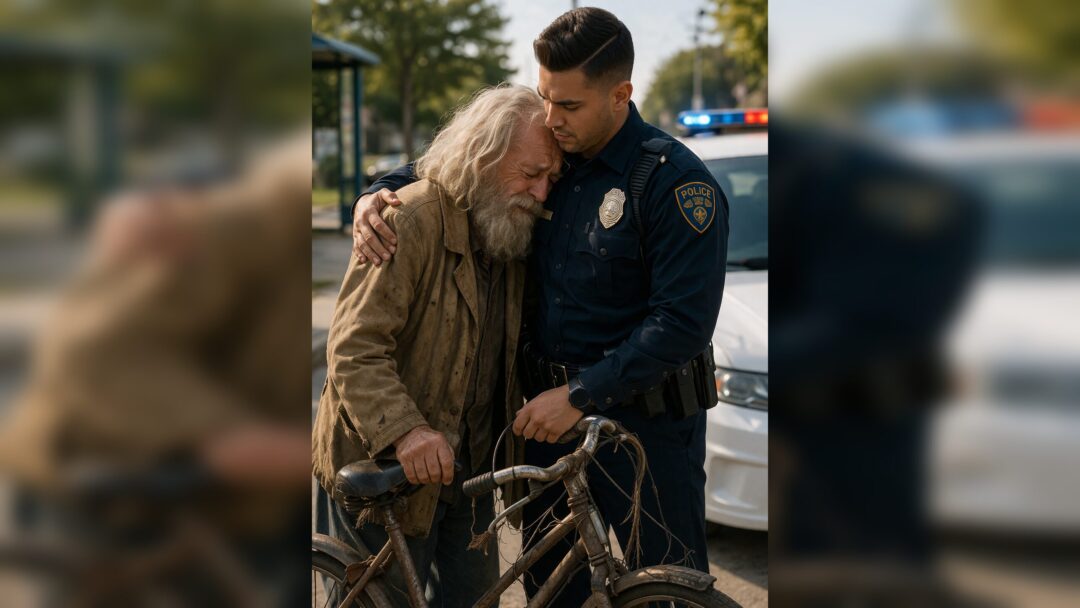
Long white hair hanging in loose, uneven waves around his face. A beard that was fuller than neat. A tan coat stained at the sleeves and darkened in places by old weather. One elbow had been repaired with different fabric. His pants were patched. His shoulders had bowed over the years, not from one injury but from the slow mathematics of grief, labor, and age.
He stood there beside the bicycle like a man holding together the last thing that still belonged to him.
The officer’s expression did not soften.
“It’s not safe anymore,” he said.
Not you’re not safe.
Not let me help you.
Just the bike, as if that should make the difference.
“It gets me where I need to go,” Gideon said.
The officer pulled the bicycle toward himself.
Gideon’s panic came so fast it made him clumsy. He grabbed at the seat harder, then felt the shame of that in the same instant. A grown man—an old man, for God’s sake—tugging over a heap of rust on the side of the road.
“Please,” he said, quieter now. “Don’t take it.”
The officer was stronger. Not rough, but stronger. The bicycle slid from Gideon’s hand.
For a second all Gideon could do was stare.
And in that second, something old and bitter rose in him—not rage, not exactly. Something more familiar. The certainty that the world found it easiest to strip things from people who did not have the strength to fight back.
He thought of the factory closing twelve years earlier.
Of his wife, Lydia, coughing into handkerchiefs she tried to hide from him.
Of the house that had slipped away by inches, then all at once.
Of all the times survival had become smaller and smaller until it fit into a grocery sack, a rented room, a bus token, a secondhand coat, a rusted bicycle.
The officer turned and walked toward the trash bin.
For one stunned moment Gideon could not make sense of what he was seeing. Then the officer lifted the bicycle by the frame.
“No,” Gideon said.
The bicycle hit the inside of the bin with a metal crash so violent it seemed to shake the afternoon itself.
“Please.”
But the word came too late, and too weak.
The sound echoed longer in his chest than in the street.
He sat down hard on the curb because his knees had simply stopped negotiating with him. One hand covered his mouth. The other hung uselessly over his leg. He stared at the bin without blinking, as if the bicycle might somehow roll back out and make everything less humiliating.
There was a pressure behind his eyes he refused, for several seconds, to call tears.
He was too old, too tired, too emptied out for this.
The officer said nothing.
Gideon heard the patrol car door open behind him. He did not turn. He could not bear the possibility of another instruction, another apology, another brisk sentence from a man who would go home tonight with a roof overhead and money in his account and no idea what it meant to lose a thing that was broken and ugly and still necessary.
He lowered his head.
And because grief could be strange in its timing, the first thing he thought of was not himself but Lydia.
She would have touched the back of his neck once, lightly, and said, Breathe, Gideon. Just breathe first.
Instead there was only the quiet street, the heat in his coat, and the humiliating emptiness of his hands.
Then he heard a small metallic click.
A different sound.
Not the sound of something being thrown away.
He looked up.
Part II — What the Old Frame Carried
Months earlier, before the afternoon of blue lights and the curbside humiliation, Gideon had woken in the dark to the sound of rain tapping the window of the room he rented above Mrs. Alvarez’s garage.
The room was barely large enough for the narrow bed, a hot plate, a lamp with a crooked shade, and the small wooden chest that held everything he had not yet been forced to sell. The wallpaper peeled at the corners. In winter the place held cold like a grudge. In summer it collected heat under the low ceiling and refused to let it go.
Still, it was his.
Or close enough.
He had moved there after the bank took the house. Mrs. Alvarez, who had known Lydia from church years before, had heard what happened and charged him less than she could have. Gideon had tried to refuse the kindness, then discovered that pride was a luxury more expensive than rent.
Since then, life had become a pattern of small endurance.
He swept hardware store floors twice a week before opening. He unloaded produce when the grocer’s back gave out. He fixed what he could for neighbors who had more gratitude than cash. He learned which dumpsters behind the bakery sometimes held bagged loaves only a day past freshness. He learned to stretch soup. To patch cuffs. To ignore the sharpness in his joints until it passed or didn’t.
And every morning, no matter the weather, he wheeled out the bicycle.
The frame had once been blue. He knew because traces of it still showed under the rust near the rear fork. He had bought it for twelve dollars at a yard sale fifteen years ago, haggling with money he barely had. Lydia had laughed when he rode it home and told him he looked like a boy who had stolen summer back from old age.
Back then she had still been alive.
Back then she had still stood on the porch with one hand on her hip and sunlight in her hair and enough life in her voice to make a broken bicycle look like the beginning of something.
After she died, the bicycle became more than a bicycle.
It became routine, and routine became survival.
There were mornings he considered staying in bed, letting hunger decide the rest. But the sight of that old frame leaning by the door gave shape to the day. It asked for motion. It asked for stubbornness. Sometimes that was enough.
The trouble had worsened slowly.
First the left brake lost its bite. Then the chain slipped. Then the front wheel took a bad knock when Gideon hit a pothole he hadn’t seen in the rain. He straightened what he could. Tied what he couldn’t. Reused wire, cord, tape, and prayer in roughly equal measure.
Twice neighbors told him he was going to kill himself on it.
Once a cashier at the grocery store said, half-joking, “That thing belongs in a museum.”
Gideon only smiled.
People who had cars did not understand the arrogance in calling a necessity dangerous.
Of course it was dangerous.
So was missing work. So was not eating. So was old age with no savings.
A week before the officer stopped him, the front wheel had begun to shimmy hard on downhill stretches. Gideon started walking the bike on slopes. That cost time. Time cost jobs.
The morning of the stop, he had taken on a small repair job across town. An elderly widow named Ruth Harlan had called through Mrs. Alvarez, asking if he could patch the loose screen door on her porch. It was the sort of work that paid twenty dollars and sometimes a sandwich besides. Gideon left early, before the heat thickened, planning to get there by back streets where traffic moved slower.
He almost turned around twice.
The handlebars had started vibrating even on flat ground. But he needed the money, and there was a dignity in being expected somewhere.
So he rode.
He had just crossed into the quieter residential stretch when the patrol car pulled behind him.
Later, much later, he would learn that Officer Rowan Vale had noticed the wheel before he noticed the rider. A dangerous wobble, a frail man leaning too much weight into a failing frame, a curb not far off. To Rowan it had looked like the sort of small ordinary disaster that turned fatal in a blink.
But Gideon did not know any of that at the curb.
What he knew was that he had watched another piece of his life disappear into a trash bin while a younger man in uniform decided what counted as acceptable risk for somebody else.
So when he lifted his head and saw the officer standing at the open trunk of the patrol car, Gideon was not ready for wonder.
He was barely ready for confusion.
Inside the trunk sat a bicycle.
Not old. Not bent. New.
Bright blue under the afternoon light, the paint clean and deep as water. A red ribbon was tied near the handlebar stem—not gaudy, just enough to make the bike look unreal against the white shell of the cruiser.
For a second Gideon thought his mind had broken under the strain.
The officer reached in and eased the bicycle out carefully, like he was afraid of scratching it.
Gideon rose halfway from the curb, then stopped.
The officer rolled it toward him.
The world tilted.
“For me?” Gideon heard himself say.
The question felt childlike the moment it left him, but he could not help it. There were some kinds of surprise that stripped you back to the simplest possible version of yourself.
The officer nodded once.
“You need a better one.”
No speech. No ceremony. No dramatic smile waiting to be admired.
Just the line. Plain and steady.
And somehow that made it unbearable.
Gideon looked at the blue bicycle, then at the officer, then back again, trying to find the trick in it. Trying to understand where such a thing came from. Men like him did not stand at curbs and receive miracles. They learned to distrust anything that looked too much like one.
“Why?” he asked.
The officer hesitated.
Then he said, “Because that one was going to throw you into traffic.”
There was practical force in the answer, but beneath it Gideon heard something else. Not pity. Something harder to accept.
Concern.
The officer shifted one hand on the handlebars of the new bicycle.
“My dad used to keep junk running longer than it should’ve,” he said. “Said if it still moved, it still counted. One day his truck quit in the middle of an intersection. He laughed about it after. My mother didn’t.”
He glanced toward the trash bin, where the old bicycle had vanished from sight.
“When I saw that wheel,” he said, “I couldn’t leave you on it.”
The words opened something in Gideon that had been locked too long.
Not because they were eloquent.
Because they were simple enough to be true.
The shame of a moment earlier twisted into something else—something softer and deeper and more difficult to hold back. All at once Gideon saw how he must have looked to this stranger: not pathetic, not ridiculous, but vulnerable in a way the world rarely bothered to protect.
He reached out with one trembling hand and touched the blue handlebar.
The metal was cool.
Real.
His throat closed.
“Thank you,” he said, but the phrase was too small. It could not contain the months of fear, the years of narrowing, the humiliation of the curb, or the sudden impossible mercy of being seen.
So he did the only honest thing he could.
He stepped forward and put his arms around the officer.
For half a heartbeat he worried he had overstepped, that the younger man would stiffen and step away. Instead Rowan—because Gideon would later learn his name, but not yet—returned the embrace with the careful awkwardness of someone unaccustomed to gratitude this raw.
Gideon pressed his eyes shut.
He had expected the day to take from him.
Instead it had handed something back.
Not just a bicycle.
Something harder to name.
Part III — The Weight of Kindness
The first thing Gideon noticed when he rode the new bicycle was silence.
No chain rattle. No tortured clicking. No wobble under his hands. The tires hummed over the pavement with a softness that felt almost luxurious. He kept waiting for the familiar shudder of instability, but it never came.
Officer Vale—Rowan, once he had introduced himself in a voice suddenly more ordinary than official—walked beside him for half a block while Gideon tried it out.
“You sure this isn’t somebody else’s?” Gideon asked once, still unable to let go of suspicion entirely.
Rowan almost smiled. “It’s yours.”
It turned out the local community center had run a donation drive months earlier. A few bicycles had been set aside for people who needed transportation for work. One donor had withdrawn before pickup. Another recipient had moved. The blue bike had been sitting unused in storage, and Rowan had known about it because his sister volunteered there on weekends.
“I called on the way over,” he said. “Had to make sure they still had it.”
“You called?”
“When I first saw you riding.” He looked faintly embarrassed now, as though the logistics of kindness were more awkward than the act itself. “I figured I might need an option before I took yours.”
That sentence stayed with Gideon longer than almost anything else.
Before I took yours.
Not because it erased the humiliation. It didn’t. The fear on the curb had been real. The pain had been real. But the thought underneath the action had not been carelessness. It had been preparation. The officer had not destroyed first and wondered later. He had seen danger and gone looking for an answer.
It was, Gideon realized, the kind of distinction that changed stories.
For days after, he found himself telling and retelling the incident in his own head, each time from a slightly different angle.
In one version, it was still a story about terror and relief.
In another, it was about how badly poverty teaches a person to expect humiliation.
In another, it was about how strange kindness can feel when it arrives wearing the clothes of authority.
But the version that kept returning—the one that lodged deepest—was simpler.
A stranger had seen the edge Gideon was standing on and refused to let him fall.
That week the blue bicycle carried him farther than the old one ever had.
He reached Ruth Harlan’s house and fixed the screen door after all, though he arrived late enough that she had come to the porch with worry in her eyes. When he explained what happened, she cried before he did. She packed him a paper sack with tomatoes from her garden, bread, and two slices of pie he tried unsuccessfully to refuse.
At the grocery store, the cashier who once joked about the museum whistled low and said, “Now that’s a ride.”
Mrs. Alvarez stood in the driveway that evening with both hands over her mouth when she saw him pedal in. Then she crossed herself, though whether from gratitude or astonishment Gideon could not tell.
“Who did this?” she asked.
He looked down at the blue frame gleaming in the last of the light.
“A policeman,” he said, and even then it sounded unbelievable.
The story spread in the quiet, sideways way neighborhood stories do. Not through headlines or cameras. Through porches. Through checkout lines. Through church basements and folding chairs and people saying, Did you hear…?
A few days later, someone left a new rain poncho hanging from the handlebar. No note.
The next week, Mrs. Alvarez’s grandson replaced Gideon’s torn coat buttons without asking.
Ruth Harlan called to say the church pantry needed a volunteer who could help deliver groceries to two homebound members. “Now that you’ve got reliable wheels,” she said.
Gideon laughed at that. He could not remember the last time his life had changed direction because of anything as hopeful as wheels.
He said yes.
The bicycle began to alter more than his routes. It changed his posture. He arrived places less winded, less ashamed, less late. He took a steadier job stocking a hardware store on weekday mornings because now he could guarantee he’d be there before dawn. He stopped at the cemetery more often, not because he was sadder, but because movement no longer cost him so much.
One evening, two weeks after the stop, he rode to Lydia’s grave carrying a small bunch of supermarket carnations strapped carefully to the rear rack.
The cemetery sat under a thin gold light. Grass shifted softly in the breeze. Gideon parked the bicycle beside the stone and stood there with one hand on the handlebar, looking from Lydia’s name to the blue frame.
“Well,” he murmured, feeling faintly foolish. “You would’ve liked this one.”
He waited, as if old habit might still answer him.
What came instead was memory.
Lydia in the kitchen, sleeves rolled. Lydia laughing at him for trying to fix things beyond saving. Lydia pressing her palm to his cheek the week before she died and saying, with more force than her body had left, Don’t let the world make you smaller than you are.
He had failed at that, some days.
No—worse than failed. He had accepted it. Letting life narrow him until he no longer expected witness, or help, or interruption from grace.
He set the flowers down.
Then he spoke out loud, because grief after enough years turned private conversations into a kind of ritual honesty.
“A young officer threw my old bicycle in the trash,” he said. “And for one minute I thought the world was being itself again.”
He swallowed.
“But it wasn’t.”
The wind moved through the grass.
He rested both hands on the handlebar and bowed his head, not from defeat this time, but from the weight of surviving long enough to be surprised.
Part IV — The Man Beside the Patrol Car
A month after the stop, Gideon saw Rowan Vale again at the edge of a school crossing.
The officer stood with one hand raised toward traffic while children in oversized backpacks moved through the crosswalk in a noisy cluster. His posture was the same—upright, contained—but now Gideon could see the man inside the uniform more easily. The slight weariness around the eyes. The reserve that felt less like coldness than caution.
Gideon almost rode past.
There was still a part of him embarrassed by how fully he had broken open at the curb that day. Gratitude was easier to feel than to revisit. But Rowan saw him and lifted a hand in recognition.
So Gideon stopped.
The officer stepped over once traffic moved again. His gaze dropped to the bicycle.
“Looks like it fits you better now,” he said.
“It rides like a dream.”
A brief smile appeared and disappeared at the corner of Rowan’s mouth.
Gideon studied him for a moment, then asked, “Do people give you trouble for doing things like that?”
Rowan gave a short breath that might have been amusement. “Doing my job?”
“No,” Gideon said. “Doing more than it.”
That landed.
For a second the younger man said nothing. Children’s voices carried behind them. Somewhere down the block, a dog barked twice.
“Sometimes,” Rowan said at last. “Sometimes people think if you care too much, you stop being useful.”
“And what do you think?”
Rowan looked away toward the street, then back.
“I think a lot of damage gets done by people hiding inside the word professional.”
The answer settled into Gideon with quiet force.
It was not polished. It sounded like something learned the hard way.
They spoke only a few minutes more. Enough for Gideon to learn that Rowan’s father had indeed been the sort of man who ran engines into the ground because replacing them cost money he never had. Enough for Rowan to learn that Gideon now delivered groceries for the church pantry twice a week and had more work than he’d had in years.
When they parted, it was with less ceremony than before. Just a nod, and a brief clasp of hands.
But Gideon rode away feeling as if something unfinished in him had reached a resting place.
Because the truth was, the blue bicycle had not only changed his daily life.
It had changed the story he told himself about the world.
Not entirely. He was too old, too tested, too honest for that.
He still knew what hunger did to people. Still knew systems could grind a man down without ever learning his name. Still knew that kindness was no substitute for justice, and one good officer could not cancel every harm done by men with badges or men in suits or men with pens behind desks.
But he also knew now that cynicism could become its own kind of poverty.
It could strip the future as surely as debt did.
And on one ordinary afternoon beside a bus stop and a trash bin, a younger man had broken that poverty for him—not with speeches, not with pity, but with action.
By winter, Gideon’s life looked different enough to startle him.
He had saved a little money. Not much, but real money folded in an envelope inside the wooden chest. The hardware store owner offered him regular hours through the season. Mrs. Alvarez stopped pretending not to notice when he carried groceries upstairs for her before she asked. Ruth Harlan introduced him to half the congregation as “the man who never says no to work,” and for once the phrase sounded like praise instead of exploitation.
On Sundays, Gideon sometimes rode farther than he needed to.
Not because he had somewhere urgent to be.
Because he could.
There was a deep pleasure in that—wind against his coat, smooth tires under him, the body remembering what ease felt like.
One cold afternoon near Christmas, he passed the old bus stop and saw the trash bin where his ruined bicycle had vanished months before. He slowed without meaning to.
For a moment the whole scene came back with perfect clarity. The fear. The crash of metal. The curb under his knees. The impossible blue frame rising from the open trunk.
He might have ridden on.
Instead he stopped, set one foot down, and looked at the bin as if acknowledging an old witness.
Then he laughed.
Not loudly. Not bitterly.
Just enough to feel the distance between the man he had been at that curb and the man standing here now.
When he reached home, Mrs. Alvarez was hanging lights badly along the garage roof and muttering at the extension cord. Gideon leaned his bicycle by the wall and went to help.
As he climbed the step stool, he glanced once at the blue frame shining softly in the early dusk.
He thought of Lydia.
Of Rowan.
Of the old bicycle that had carried him through the narrowest years of his life, and the new one that had arrived when he had almost forgotten how mercy looked.
The world was still the world. Hard, uneven, careless in all the familiar ways.
But sometimes, against reason and habit and expectation, it opened a trunk in the middle of your worst assumption and revealed something bright.
And sometimes that was enough to keep a man moving for a very long time.