The Will Left Mary Outside The Room Until The Blue Sapphire Made Everyone Look Again
Chapter 1: The Woman Security Would Not Let Into The Reading
The security guard’s palm stopped Mary Walker inches from the glass doors.
It was not a hard shove. That almost made it worse. His hand hovered in front of her cream cardigan, flat and polite, as if she were a confused woman who had wandered into the wrong hotel conference instead of a daughter standing outside her father’s estate reading.
“Ma’am,” he said, keeping his voice low. “This is a private family matter.”
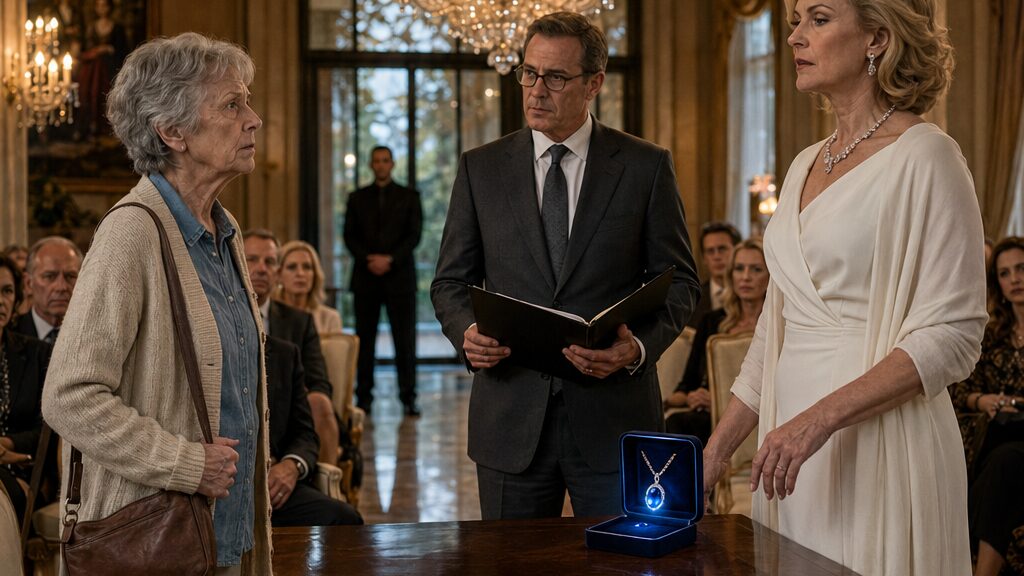
Behind the glass, the Hall parlor glittered under chandeliers Mary had dusted with her own hands twenty years earlier, before Steven Hall had married Cynthia, before the furniture became too delicate for ordinary people to sit on, before the house started treating Mary like a visitor who needed permission.
Rows of cream chairs faced a long walnut table. Relatives and neighbors sat straight-backed in dark suits and pale dresses, whispering into the little silence that came before money changed hands. On the table lay a black leather folder, a silver pen, and a velvet case open just enough for blue light to catch in its hinge.
Mary’s breath tightened.
Cynthia Hall stood near the front row in a white dress, one arm folded beneath a pale fur wrap, the other hand resting over the diamond at her throat. Her blonde hair was arranged in a soft wave that looked untouched by grief. When she saw Mary stopped at the door, she smiled—not wide, not foolishly, but with the controlled amusement of someone watching a servant use the wrong entrance.
“Mary,” Cynthia called, loud enough for the seated people to hear. “This really isn’t necessary.”
The guard did not lower his hand.
Mary looked past him, not at Cynthia, but at the blue glow on the table. Her mother’s sapphire had always done that in low light, not shine exactly, but hold its own weather. Steven used to say it looked like a storm remembered by stone.
“I was told the reading was at ten,” Mary said.
“You were told wrong,” Cynthia replied.
A few heads turned. Mary recognized some faces and failed to place others. People who had eaten birthday cake in her father’s kitchen now watched her as if she had brought something embarrassing with her.
Her brown shoulder bag slipped down her arm. She caught the strap and held it tighter.
The guard said, “Mrs. Hall provided the attendance list.”
“My father provided me,” Mary said.
The words came out quieter than she meant them to, but the parlor changed around them. Not much. Just a few shifts in chairs, a cough swallowed quickly, someone’s bracelet tapping against a glass.
Cynthia’s smile thinned. “Steven’s attorney is about to begin. You can call the office later if there’s anything you need.”
Mary felt heat rise in her face. Need. As if she had come for a handout. As if she had not spent the last three years counting Steven’s pills into plastic trays, washing soup bowls by hand because the dishwasher noise upset him, sitting in the hallway during his bad nights because he hated waking alone.
“I’m coming in,” Mary said.
The guard’s eyes flicked toward Cynthia.
That was the mistake. Mary saw it. He was not protecting a legal proceeding. He was waiting for Cynthia’s permission.
Mary stepped sideways, brushing past his wrist. The glass door opened under her hand before he decided whether to stop her again. The parlor air smelled of lilies and furniture polish. Every chair seemed to face her.
Cynthia moved toward her, heels clicking on the polished floor. “This is exactly what I was trying to avoid.”
Mary kept walking.
“An unnecessary scene,” Cynthia said.
Mary stopped beside the back row. “Then don’t make one.”
Cynthia’s jaw tightened. For a moment, the polished widow slipped and Mary saw the woman who had stood in Steven’s bedroom doorway six months earlier, saying, He gets confused after your visits. You should let him rest.
Mary had let him rest. That was what sat in her chest now, heavy as a stone.
At the front of the room, Ronald Clark cleared his throat. He was a narrow man in a charcoal suit, with reading glasses balanced low on his nose and a stack of papers aligned so neatly they looked untouched by human grief.
“Perhaps,” Ronald said, “we should all take our seats.”
“There isn’t a seat for her,” Cynthia said.
A murmur ran through the parlor.
Mary looked at the rows. Every chair had a printed place card except one at the far side, half hidden near a potted palm, where someone had set a spare program and a water glass. It was not a family seat. It was where extra people were put when no one wanted to admit they had been expected.
Mary walked to the front row instead and stood beside the empty chair nearest the walnut table.
Cynthia’s voice sharpened. “Mary.”
Mary sat.
No one moved for three seconds.
Then Ronald shuffled his documents as if paper could restore order. “We are gathered for the reading of the Last Will and Testament and associated trust summary of Steven Hall, dated November twelfth.”
November twelfth.
The date landed before the rest of the sentence.
Mary’s fingers tightened around the strap of her bag. She had been at the house on November twelfth. She remembered because it was the day Steven had called the television remote “the garage key” and asked twice whether his own father was coming for supper.
Ronald continued, voice flattening into legal cadence. “This instrument revokes all prior wills and codicils. It appoints Cynthia Hall as personal representative and directs the distribution of the Hall residence, primary investment accounts, household property, and personal effects as follows.”
Cynthia stood beside the table, chin lifted.
Mary looked at the velvet case.
The sapphire pendant rested against dark blue lining. It was smaller than the room made it seem, a deep oval stone in an old gold setting, with a tiny scratch on the clasp where Mary’s mother had once caught it on a church pew. Mary had touched that scratch the year her mother died. Steven had placed the pendant in Mary’s palm afterward and then taken it back, crying so hard he could barely speak.
Not yet, sweetheart. When I go, it comes to you. It was hers, and then yours.
Ronald read the house to Cynthia. The investment accounts to Cynthia. The antique silver, the paintings, the personal jewelry, the vehicles, the remaining household property, all to Cynthia.
Mary waited for her name the way a person waits for footsteps in a hospital hallway.
It did not come.
Ronald turned a page.
“To my wife, Cynthia Hall, I leave the sapphire pendant formerly belonging to my late first wife, with the understanding that it shall remain part of the Hall family collection.”
A sound moved through the room—not a gasp, not quite. A soft intake, shared by people who knew enough to be uncomfortable.
Mary did not stand. She did not cry. She watched Cynthia’s fingers drift toward the velvet case.
Ronald went on. “No distribution is made to Mary Walker, as previous lifetime provisions and personal considerations are deemed sufficient.”
Previous lifetime provisions.
Mary thought of grocery receipts she had never asked Steven to repay. She thought of the envelope of cash Cynthia once pushed back across the kitchen table, saying, We have staff for this now. She thought of Steven asleep with his hand open on the blanket, whispering Mary’s name like he was afraid she had already left.
Ronald finished the paragraph and glanced up. “That concludes the principal distribution summary.”
The room stayed still.
Cynthia smiled, not at Mary now, but at the others, as if asking them to witness how gracefully she had endured this intrusion. “Thank you, Ronald.”
Mary lifted her hand.
It rose slowly, almost stiffly, as if it belonged to someone older than she felt. Several people turned. Cynthia’s eyes narrowed.
Ronald blinked. “Mrs. Walker?”
Mary looked from the leather folder to the blue pendant and then back to the attorney.
“What date,” she asked, “did my father sign that?”
Chapter 2: Six Weeks Before Death Was Not Just A Date
“You’re going to tear this family apart over money.”
Cynthia said it in the hallway before Mary had made it ten steps from the parlor. Her voice was low now, stripped of the performance she had used in front of the chairs, but not softer. Behind her, the reading continued in broken murmurs, people standing, coats being gathered, chairs scraping against polished floors.
Mary stopped beside a framed oil painting of the Hall house in spring. In the picture, the front lawn looked endless. In real life, Steven had once spent two afternoons trying to repair the sprinkler line himself because he disliked paying a man to fix what he could still touch.
“This family was already apart,” Mary said.
Cynthia’s eyes flashed. “Steven made his choice.”
“On November twelfth.”
“Yes.” Cynthia folded her arms under the pale wrap. “Ronald answered you. You heard him.”
“I heard the date.”
“Then you heard enough.”
Mary looked toward the parlor. Ronald stood at the table, speaking quietly with a bank representative. The sapphire case had been closed. That bothered Mary more than she expected. It felt like a mouth shut before the truth could get out.
“Dad didn’t know what year it was that week,” Mary said.
Cynthia’s expression changed, but only at the edges. “That is not true.”
“I was here.”
“You were here when it suited you.”
The words struck harder because Mary had feared them herself. She had not been there at the end. Not every day. Not after Cynthia changed the visiting routine and told her Steven became agitated when she came. Mary had stood on the porch more than once, hearing the television inside, and accepted Cynthia’s explanation because she had been tired of fighting at a sick man’s door.
Cynthia stepped closer. Her perfume was clean and expensive, a cold floral Mary associated with rooms no one cooked in.
“You disappeared for weeks,” Cynthia said. “Then you walk in today, make a spectacle, and imply my husband didn’t know his own mind.”
“My father,” Mary said.
“My husband,” Cynthia returned. “The man I cared for while you questioned every decision I made from a distance.”
Mary did not answer quickly. That was the trap. Cynthia wanted anger, wanted witnesses in the hallway to see Mary become the grasping daughter the new will described.
“I am not asking you for the house,” Mary said.
“No, of course not. Just the one thing everyone knows has value.”
Mary looked at her. “You think I mean the sapphire because it is valuable.”
“I think you mean whatever you can use.”
The guard hovered near the doorway, pretending not to listen.
Mary adjusted the strap of her bag. “When he signed, who was in the room?”
Cynthia gave a short laugh. “You are not entitled to interrogate me.”
“Who was there?”
“Ronald. A witness. Steven. Me, for part of it.”
“For part of it.”
“He asked me to stay.”
Mary pictured Steven in the front bedroom, propped against pillows, his white hair flat on one side, fingers worrying the edge of his blanket. She pictured him looking at a paper he could not track line by line. She pictured Cynthia standing close enough to answer before he could.
“I want a copy,” Mary said.
“Of what?”
“The will.”
“You can request it properly.”
“I will.”
Cynthia’s smile returned, smaller now. “Then do that. Properly. And stop acting like grief gives you special rights.”
Mary stood there until Cynthia turned away first.
Only when Mary reached the front steps did she realize her hands were shaking.
Her apartment felt too small after the Hall parlor, but it did not lie to her. The kitchen table had a worn edge where Steven used to tap his spoon when he visited after her mother died. The radiator knocked behind the wall. A stack of unpaid bills sat under a chipped saltshaker because Mary had never liked pretending paper disappeared when covered.
She set her brown shoulder bag on the table and emptied it.
The bag gave up tissues, a half-used roll of mints, reading glasses, a pharmacy receipt, a pen that did not work, and the little calendar she had carried through Steven’s last year. Its corners had softened from being opened in waiting rooms.
November.
Mary found the page and smoothed it with her palm.
Her own handwriting leaned unevenly across the squares. Steven pills 9 a.m. Call pharmacy. Cynthia says no soup. Dad asked about blue stone.
She stopped.
The note was written on November tenth, two days before the signing.
Dad asked about blue stone.
Mary sat down slowly.
She had forgotten writing it. Not forgotten the moment, but forgotten that she had made a record. That day Steven had been sitting in his bedroom chair with a blanket over his knees. He had kept looking toward the dresser, where a framed photograph of Mary’s mother used to stand before Cynthia moved it to the upstairs hallway.
“Did you get your mother’s blue stone?” he had asked.
“Not yet,” Mary had told him, smiling because she thought he was drifting through old promises.
Steven had frowned. “You should have it. Not for the money. She wore it when she held you.”
Then he had looked past Mary and asked whether the school bus had come.
Mary pressed her fingers over the calendar square until the ink blurred beneath her eyes.
She turned the page back and forth, looking for more. November twelfth had only one line: Bus 8:15. Dad confused. Emily afternoon.
Emily.
Mary pulled the page closer.
She remembered a woman in lavender scrubs near Steven’s bed, kind but careful, always speaking to Cynthia first because Cynthia stood closest to the medication tray. Emily had shown Mary how to lift Steven’s elbow without hurting him. Once, when Cynthia stepped into the hall, Emily had whispered, “He knows you more than you think.”
Mary opened the bag again and found the folded bus receipt wedged in the side pocket. November twelfth. 8:15 a.m. Route stamped faintly in purple ink. It proved only that Mary had gone near the house. It did not prove what Steven understood. It did not prove Cynthia had arranged anything. It did not prove Ronald should have known.
It proved Mary had been there.
And still she had left.
She remembered the porch that morning. Cynthia had met her outside with the door only half open.
He had a rough night. This is not a good time.
Mary had heard Steven cough inside.
I can sit with him.
No. You upset him when you remind him of things.
Mary had stood on the porch holding a container of chicken broth until it cooled in her hands. Then she had gone home, telling herself peace mattered more than pride.
Now the will said she had received enough.
Mary gathered the calendar, the bus receipt, and the pharmacy slips into a neat pile. Her hands steadied as the paper aligned.
The phone rang once from somewhere in the apartment, startling her. It was not a call. Just the old landline shifting, a mechanical sound it made sometimes when the line reset. Steven had begged her to keep it.
Cell phones drop things, he used to say. A house phone stays where you left it.
Mary reached for the receiver anyway, then stopped.
She did not need to call Cynthia. She did not need to ask permission again.
She took a fresh sheet from the drawer and wrote down everything she remembered from November twelfth. The porch. The closed door. Steven’s cough. Cynthia’s hand on the frame. Emily in the afternoon. Ronald’s date.
Her handwriting looked frail at first. Then darker.
At the bottom of the page, she wrote Emily Smith.
She underlined it once, then sat back, staring at the name of the only person who might have seen what Mary had let herself be kept from seeing.
Chapter 3: The Hospice Note That Proved Less Than Mary Needed
“You are not listed as authorized family.”
The records clerk said it through a sliding glass window that turned every word into something colder. Mary stood in the hospice office with her calendar pressed against her stomach and felt the people in the waiting chairs politely decide not to look at her.
“I’m his daughter,” Mary said.
The clerk’s expression did not change. “I understand.”
Mary had learned to dislike that phrase. People said they understood when they wanted to stop hearing more.
“Steven Hall,” Mary said, pushing the name through the opening at the bottom of the window. “He was under your care until December.”
The clerk typed. Her nails clicked rapidly. “The authorized contact on file is Cynthia Hall.”
“Cynthia is his wife.”
“Yes.”
“I am his daughter.”
The clerk looked at the screen again, as if the computer might become kinder if she stared long enough. “You would need documentation showing legal authority or a release from the estate representative.”
Mary almost laughed. The estate representative was Cynthia. The same woman who had left her name off the reading list now stood between Mary and the records that might explain why she had been left out of the will.
“I’m not asking for the whole file,” Mary said. “I’m asking whether a hospice aide named Emily Smith was assigned to him on November twelfth.”
The clerk hesitated.
That hesitation was the first human thing Mary had been given all morning.
“I can’t disclose staffing details,” the clerk said.
“Could you give Emily a message?”
“We do not generally—”
“Please.” Mary heard the crack in her own voice and lowered it. “Please tell her Mary Walker came by. Tell her it’s about Steven asking for the blue stone.”
The clerk’s eyes lifted.
Not recognition. Not exactly. But the phrase had entered the room differently than a name or date.
“The blue stone?” she repeated.
Mary swallowed. “She may remember.”
The clerk reached for a notepad. “I can’t promise anything.”
“I know.”
Mary wrote her phone number carefully. Her hand wanted to tremble, so she pressed harder.
Outside, she sat in her old sedan with the engine off. The hospice building was brick and beige, too ordinary for the amount of last breaths it had organized. People came and went with paper cups, tote bags, clipped badges, the trained quiet of those who knew grief had business hours.
Mary waited twenty minutes before admitting she had nowhere else to go.
She was reaching for the keys when someone tapped on the passenger-side window.
A woman in a navy jacket stood beside the car, hair pulled back, badge turned inward. Mary recognized her after a second by the tired kindness around the eyes.
Emily Smith.
Mary rolled down the window.
“I only have a few minutes,” Emily said.
“Thank you for coming out.”
Emily glanced toward the building. “I shouldn’t be discussing a former patient’s private care without authorization.”
“I’m not asking you to break rules.”
Emily’s face said she did not believe that.
Mary opened the calendar on her lap. “I was there November twelfth. Cynthia wouldn’t let me in. Ronald Clark read yesterday that my father signed his new will that day.”
Emily’s mouth tightened. She did not speak.
“Was he clear?” Mary asked.
“That’s not a simple question.”
“No,” Mary said. “It’s the only one I have.”
Emily looked over her shoulder again, then walked around and opened the passenger door. She did not sit fully inside. She perched sideways, one foot still on the pavement, ready to leave if someone called her name.
“Your father had good minutes and bad hours,” Emily said.
Mary closed her eyes briefly.
“That sounds like something people say when they don’t want to answer.”
“It’s something people say when it’s true.”
Mary looked at her. Emily seemed older than she had in Steven’s room, though it had only been weeks. There were faint marks at the bridge of her nose where protective glasses must have rested for long shifts.
“On November twelfth,” Mary said.
Emily folded her hands. “There had been a medication adjustment around then. Pain management. Anxiety. Sleep. I remember he was more drowsy some afternoons.”
“Did Ronald come in the afternoon?”
Emily did not answer immediately.
Mary’s hope rose and fell in the silence.
“I saw Mr. Clark’s car that day,” Emily said.
“That is not the same as seeing him with my father.”
“No.”
“Emily.”
The aide flinched at the directness, not because it was harsh, but because it was personal.
Mary softened her voice. “He asked me about the sapphire two days before. My mother’s pendant. Yesterday, Cynthia received it in the will.”
Emily looked down at the calendar.
“The blue stone,” she said.
Mary stopped breathing for a moment.
“You remember?”
Emily nodded once. “He asked about it more than once.”
“What did he say?”
“That he needed to make sure you got it.” Emily’s voice was barely above the hum of traffic from the road. “Not those exact words every time. Sometimes he said Mary. Sometimes he said your mother. Sometimes he said the blue stone. He mixed things together.”
“But he knew it was for me.”
Emily’s face pained. “He knew something mattered. I can say that to you as a person. I cannot sign a statement saying he had legal capacity or lacked it. I’m not qualified for that.”
Mary took the small payoff and felt its insufficiency immediately. Her father had remembered. But memory spoken through illness was not a legal document. It could be brushed aside as sentiment, confusion, grief.
“Was Cynthia there when he asked?” Mary said.
“Sometimes.”
“What did she do?”
Emily looked toward the hospice office. “She would redirect him.”
“Redirect.”
“She would say, ‘We’ve handled that, Steven,’ or ‘Don’t worry about Mary right now.’”
Mary pressed her palm to the steering wheel.
Emily added quickly, “You have to understand, caregivers redirect patients all the time. It isn’t always wrong. Mrs. Hall was exhausted. He could ask the same thing six times in half an hour.”
Mary heard the defense in it and did not dismiss it. She had been exhausted too. She had redirected Steven too. She had told him the same answer gently until he stopped asking. The difference was that Mary had never redirected him away from his own child.
“Will you write down what you just told me?” Mary asked.
Emily’s face closed.
“I can’t.”
“You mean you won’t.”
“I mean I have a job, and there are rules, and I’m already saying more than I should in a parking lot.” Emily pulled her foot back slightly, preparing to leave. “If there is a formal request, if an attorney asks, if I’m subpoenaed, I will tell the truth as carefully as I can. But I can’t become the reason your family turns on itself.”
“It already turned,” Mary said.
Emily looked at her then. Really looked. “I’m sorry.”
Mary wanted to resent the apology, but Emily’s eyes were wet.
“There may be notes,” Emily said. “Not about the will. About his condition. Medication changes. Orientation. If you get proper access, ask for the visit notes around that week.”
“Cynthia controls access.”
“Then you need someone besides Cynthia asking.”
“Ronald?”
Emily did not say yes, but her silence leaned in that direction.
Mary put the calendar back into her bag. “Was Cynthia present when Ronald came?”
Emily opened the passenger door fully now and stood.
“Emily.”
The aide turned back, one hand on the door frame.
Mary knew she was pushing too hard. She knew desperation could make a person look exactly like the accusation against her. But the blue stone sat in a velvet case under Cynthia’s hand, and Steven’s voice, broken by medication and time, had still tried to send it home.
“Was she there?” Mary asked.
Emily looked toward the building one last time, then said quietly, “She was the one who told us not to disturb them while Mr. Clark was in the room.”
Mary’s fingers went cold around the calendar.
“Us?” Mary said.
Emily stepped back from the car.
“Cynthia was present,” she said. “And Mary—she was not just waiting outside.”
Chapter 4: The Daughter Who Thought Her Mother Was Surviving
“My mother said you disappeared until there was something to inherit.”
Katherine Jones did not sit when she said it. She stood beside the little coffee shop table with her coat still buttoned, one hand on the strap of her purse, as if Mary had lured her there under false pretenses instead of calling three times and leaving one careful message.
Mary looked up from the two paper cups between them. She had bought Katherine tea because she did not know what else to offer the daughter of the woman who had barred her from her father’s house.
“I disappeared,” Mary said, “or I was told not to come?”
Katherine’s mouth tightened. She was younger than Cynthia by decades but had learned the same controlled stillness. Her dark hair was pinned at the back of her head. Her earrings were small pearls. Nothing about her looked cruel. That made Mary more cautious, not less.
“My mother said Steven became agitated after your visits.”
“She said that to me too.”
“Maybe because it was true.”
Mary pushed the untouched tea a few inches toward the chair across from her. “Sit down before you decide that.”
Katherine looked toward the front window, where cars moved through a gray afternoon. The coffee shop was three blocks from the Hall estate, close enough that Mary had almost turned around twice before arriving. Too close to the house. Too close to Cynthia. Too close to the version of herself who had accepted closed doors because she was afraid of upsetting a dying man.
Katherine sat.
For a moment, neither woman touched the cups.
“I’m not here to attack your mother,” Mary said.
Katherine gave a humorless breath. “You asked me whether she hid an old will. That feels close.”
“I asked if you had seen one.”
“My mother doesn’t have to explain every piece of paper in her own house.”
“It was my father’s house before it was hers.”
“And my mother lived there with him. She handled his appointments. She handled the bills. She was the one there when he was afraid at night.”
Mary looked down. The words should have made her angry, but they found the tender place instead. Cynthia had been there at night. That part was true. Mary had gone home after each visit because Cynthia had insisted routines mattered, because Mary had believed Steven needed calm more than he needed another argument in the hallway.
“She did handle things,” Mary said. “I won’t say she didn’t.”
Katherine blinked, as if she had expected a fight and been handed something heavier.
Mary opened her brown shoulder bag and took out the November calendar, the bus receipt tucked into its page. She did not push it across the table yet.
“I came every morning for almost three years,” she said. “Before Cynthia. After Cynthia. After he started forgetting which cabinet held the coffee. I came until your mother changed the locks and told the aides not to let anyone in unless she cleared it.”
Katherine’s eyes dropped to the calendar.
Mary continued, because if she stopped she might lose the courage to be plain. “The week the will was signed, I stood on the porch with soup. I could hear him cough. She told me I upset him. I believed her enough to leave.”
“My mother said you argued with him about money.”
“I argued with him about taking his pills.”
Katherine’s face shifted, just slightly.
“He hated the white ones,” Mary said. “Said they made water taste like metal. I told him if he wanted to boss everybody around, he had to stay alive to do it.”
A reluctant memory crossed Katherine’s expression, though it was not hers. Maybe she could hear Steven saying something like that. Maybe Cynthia had left that part out.
Mary slid the calendar across.
Katherine did not touch it at first. Then she leaned forward, reading the cramped handwriting. Dad asked about blue stone. Dad confused. Emily afternoon.
“Anyone can write notes later,” Katherine said, but the force had gone out of it.
“Yes,” Mary said. “Anyone can.”
Katherine looked up.
“That’s the problem, isn’t it?” Mary said. “Paper only matters if someone believes the day it came from.”
Katherine folded her hands around the paper cup. “My mother was scared.”
Mary waited.
“You all had history in that house,” Katherine said. “You, Steven, your mother. Every room had some memory she wasn’t part of. Even after she married him, people treated her like she had stepped into somebody else’s photograph.”
Mary did not deny it. She remembered resenting Cynthia’s new curtains. Cynthia’s glass bowls. Cynthia moving Mary’s mother’s picture from the bedroom dresser to the upstairs hall “where everyone could enjoy it,” though no one went there except guests looking for a bathroom.
“She was his wife,” Katherine said. “But she always felt like she was waiting for someone to tell her she wasn’t family.”
“And so she told me first.”
Katherine looked away.
The small bell over the coffee shop door rang. Both women turned. It was only a delivery driver carrying a stack of trays. Katherine watched him leave as if she might follow.
“She found something,” Katherine said.
Mary stayed very still.
“In the house?” Mary asked.
Katherine nodded. “A folder. Maybe two months before Steven died. I came by to take her to lunch, and she was in the side office with papers all over the desk. She was upset. Not crying. My mother doesn’t cry where people can see. But she was shaking.”
“What kind of papers?”
“I don’t know.”
“Katherine.”
“I don’t know,” she repeated, sharper now. “I saw Steven’s name. I saw yours. I saw some old date. It looked like a draft, maybe. Not signed in the place I saw, or maybe there were pages missing.”
Mary’s hand closed around her cup. The tea had gone lukewarm.
“What did she say it was?”
“She said Steven had made promises without understanding what they would cost her.”
The shop noise seemed to fall away. Steam hissed behind the counter. A chair scraped near the window. Mary heard all of it from far off.
“What promises?”
Katherine looked at the calendar again, at the line about the blue stone.
“There was a list,” she said. “Household items. Jewelry. Some account notes. Your name was beside something.”
“The sapphire.”
Katherine did not answer fast enough.
Mary felt the answer before it came.
“I think so,” Katherine said.
Mary closed her eyes briefly. Not in victory. There was no victory in an old paper hidden by a frightened woman and a dying man’s confusion. There was only the shape of something Cynthia had seen before she changed everything.
“Where is it now?” Mary asked.
Katherine pulled back, as if the question itself had crossed a line. “I don’t have it.”
“But you know where she keeps things.”
“My mother is not some thief in a story you’re telling yourself.”
Mary’s cheeks warmed. She had leaned too far forward. She had sounded too hungry.
“You’re right,” she said.
Katherine stared.
Mary made herself continue. “I don’t know everything she felt. I don’t know what he promised her. I know he should have protected her clearly if that’s what he wanted. But he should not have erased me to do it.”
Katherine’s eyes shone now, though she kept her face composed. “You think I don’t know that?”
The question opened something neither of them had planned.
Katherine looked down at her mother’s untouched tea. “She kept saying, ‘They’ll leave me with the debts and take the memories too.’ I thought she meant the furniture. The house. I didn’t know there was another will.”
“Another draft,” Mary said.
“Maybe.”
“Did Ronald see it?”
“I don’t know.”
“Did your mother destroy it?”
Katherine stood too quickly, bumping the table. Tea trembled in both cups.
“I shouldn’t have come.”
Mary rose halfway, then stopped herself from reaching across. She had spent too many years letting other people decide a conversation was over.
“Katherine,” she said carefully. “I am not asking you to betray your mother. I’m asking you not to help bury my father.”
Katherine’s face tightened as if Mary had placed a hand on a bruise.
For a moment, Mary thought she would leave without another word.
Instead, Katherine picked up the calendar and slid it back across the table.
“The old draft,” she said, voice almost flat, “had your name next to the sapphire.”
Then she turned and walked out before Mary could ask where Cynthia had put it.
Chapter 5: They Said The Signature Was Verified
“The documents are legal. The signatures are verified.”
Ronald Clark said it before Mary had fully settled into the chair across from his desk. His office was narrower than she expected, all framed certificates and gray shelves, with a window looking down on a parking lot instead of anything alive. A photocopy of Steven’s revised will lay between them, clipped neatly, as if tidiness could make the paper innocent.
Mary placed her brown shoulder bag on her lap.
“I did not come here to be told the same sentence in a nicer room,” she said.
Ronald removed his glasses and rubbed the bridge of his nose. “Mrs. Walker, I understand this is painful.”
“There it is again.”
“Excuse me?”
“Understand.” Mary looked at him. “Everyone understands right before they stop listening.”
Ronald’s lips pressed together. He was not a cruel man, Mary thought. Cruelty had more appetite. Ronald looked like a man who had spent his career building walls out of procedure and was now surprised to find someone knocking from the inside.
“I am willing to answer general questions,” he said. “I cannot violate the estate’s confidentiality or provide legal advice to a person whose interests may be adverse to the estate.”
“My interests became adverse when you read that paper.”
He looked down at the will.
Mary reached into her bag and took out the calendar page, the bus receipt, and a list of questions written in her careful hand. She had copied the list three times at her kitchen table so she could ask without begging.
“What time did my father sign the will on November twelfth?”
Ronald glanced at the top page. “The execution ceremony was completed at approximately two forty-five in the afternoon.”
Mary wrote it down though she heard it clearly.
“Who was present?”
“Mr. Hall, myself, two witnesses, and Mrs. Hall for part of the preliminary discussion.”
“For part.”
“Yes.”
“Was Cynthia in the room when he signed?”
Ronald paused. “She was not standing over his shoulder, if that is what you are implying.”
“I am asking where she was.”
“In the residence.”
“In the room?”
“Not during the formal signing.”
Mary watched his fingers align the edge of the document with the desk blotter. A habit. A small rescue.
“Did you speak with my father alone?”
“Yes.”
“How long?”
“That is not—”
“How long?”
Ronald put his glasses back on. “Long enough to determine that he understood the nature of the documents.”
Mary leaned forward. “When exactly were they signed? Because I was there in November and he couldn’t hold a conversation.”
Ronald’s eyes flickered to the calendar.
She slid it across the desk.
He did not touch it.
“My father asked me two days before whether the school bus had come,” Mary said. “He called his remote the garage key. He asked me whether my mother’s blue stone had come to me yet. Then on November twelfth Cynthia told me I could not see him. At two forty-five that afternoon, you say he understood a new will that removed my name and gave her the sapphire.”
Ronald was quiet too long.
“That is not a medical assessment,” he said finally.
“No. It is a daughter’s assessment. You seem comfortable ignoring those.”
Color rose in his face. “Mrs. Walker, I did not ignore anything. Your father answered my questions. He identified his spouse. He identified the general nature of his property. He confirmed his desire to simplify the estate.”
“Simplify,” Mary repeated.
“That was his word.”
“Or Cynthia’s?”
Ronald’s face closed. “I will not sit here and allow accusations of professional misconduct based on disappointment.”
Mary absorbed the blow because there was truth mixed into it. She was disappointed. Hurt. Angry. She had hoped, in some hidden foolish place, that Ronald would look at her notes and say yes, this was wrong, let us fix it. Instead, the paper remained on the desk, legal and verified.
She lowered her voice. “Did he say my name?”
Ronald looked at her then.
“During the signing,” Mary said. “Did my father say Mary?”
A clock ticked on the wall. Ronald’s gaze moved to the will, then to the file beneath it. He opened the file, not fully, just enough to see a yellow sheet clipped inside.
“He was aware he had a daughter.”
“That is not what I asked.”
“He said there had been lifetime support.”
“Those are not his words.”
“Mrs. Walker—”
“My father would not call soup and bus rides lifetime support.”
Ronald’s hand stilled.
Mary saw it. Not guilt. Not proof. Something smaller: recognition that a phrase belonged more naturally to a drafter than a dying man.
“Who used those words first?” she asked.
Ronald shut the file halfway. “Estate planning often involves legal phrasing.”
“Did Cynthia tell you I had been provided for?”
“She provided context.”
Mary sat back.
There it was. Not the whole truth. Not enough to carry to a court and lay before a judge. But enough to change the shape of the room.
“What context?” Mary asked.
“That you and your father had a complicated relationship.”
Mary almost smiled. “Families are always called complicated by the person holding the cleanest version of the papers.”
Ronald removed his glasses again. This time he looked tired.
“I met with Steven Hall twice,” he said. “Once by phone in October. Once at the house on November twelfth. Mrs. Hall contacted my office to schedule the revision. She said your father wished to avoid conflict after his death.”
“By creating it.”
“She said he was distressed by the thought of disputes over personal property.”
“The sapphire.”
“Among other things.”
“Did you see the older draft?”
His silence was different this time.
Mary felt her pulse move into her throat. “There was an older draft.”
“There are often prior estate documents.”
“Did you see it?”
Ronald looked toward the closed door of his office. “I reviewed portions of existing documents to ensure revocation language was properly included.”
“Was my name in them?”
“I cannot discuss prior instruments in detail.”
“You already did.”
“I did not.”
“You just told me you knew there were prior documents.”
Ronald’s mouth tightened. “This is exactly why these discussions should happen through counsel.”
“I cannot afford counsel because my father’s will says the woman who blocked me from his room gets everything.”
The words landed harder than Mary intended. Ronald looked away first.
A phone buzzed on his desk. He ignored it.
Mary drew a breath. “I’m asking for one human answer. Not legal advice. Not a confession. Did anything about that signing concern you?”
Ronald looked at the file for a long time.
“When I arrived,” he said carefully, “your father was fatigued. Mrs. Hall said he had a clearer period earlier and that we should proceed before his medication made him drowsy again.”
Mary’s hands tightened around her bag.
“Did you ask the aide?”
“No. Mrs. Hall managed the care schedule.”
“Did my father read the document?”
“I summarized it.”
“Could he read it?”
Ronald did not answer.
The silence gave Mary a small, terrible thing.
“May I have a copy of the witness page?” she asked.
“No.”
“Names?”
“I cannot provide contact information.”
“I asked for names.”
Ronald closed the file. “One witness was from my office.”
“And the other?”
He stood, signaling the meeting was over. “Mrs. Walker, I strongly suggest you retain counsel if you intend to contest any portion of the estate.”
Mary did not move.
“Who was the other witness?”
“Good afternoon.”
She rose slowly, putting the calendar and receipt back into her bag. The photocopy of the revised will remained on the desk, but Mary’s eyes caught the top page before Ronald covered it: Article Four, personal effects. Sapphire pendant formerly belonging to first wife.
Formerly belonging.
As if her mother had become a footnote.
Mary reached for the doorknob.
Behind her, Ronald said, “There is a difference between something being troubling and something being invalid.”
Mary turned. “Then write down that it troubled you.”
He looked pained. “I did not say—”
“You almost did.”
For the first time, he seemed less like a wall and more like a man measuring the cost of a door.
His gaze dropped to the file. “The second witness was not supposed to be part of the household.”
Mary waited.
Ronald looked up, and the name came out before he seemed fully willing to release it.
“It was the former housekeeper.”
Mary stared at him.
Steven’s former housekeeper had left three months before the will was signed, after Cynthia said the house needed fewer people coming through.
“Why,” Mary asked, “would a former housekeeper be there that day?”
Ronald did not answer.
Chapter 6: The Visit Log Cynthia Could Not Explain
“This is more than the will required.”
Cynthia placed the check on the desk between them with two fingers, as if she did not want Mary’s need to touch her skin. The amount was written in clean blue ink. Five thousand dollars. Enough to look generous to someone who did not know the house, the accounts, the sapphire, the years. Not enough to mistake for justice.
Mary stood in the side office of the Hall estate and did not sit.
The room had once been Steven’s morning room. He used to keep seed catalogs on the shelves and sharpen pencils in a little brass cup. Now the shelves held boxed files with Cynthia’s labels: TAX, INSURANCE, TRUST, MEDICAL. Mary wondered which label covered the months when a man’s world had narrowed to one bedroom and the people allowed inside it.
“Take it,” Cynthia said. “You can call it a personal distribution if that makes you feel better.”
Mary looked at the check. “Is that what you called it when you wrote me out?”
Cynthia’s face tightened, but she kept her voice level. “You were not written out by me.”
“You called Ronald.”
“Steven asked me to.”
“Steven asked you to give yourself my mother’s sapphire?”
Cynthia shut the folder in front of her. “Your mother’s sapphire was in my husband’s house. It was part of his property. He made a decision.”
Mary opened her bag.
Cynthia’s eyes followed the movement with irritation that was almost fear. “What is that?”
“A pattern.”
Mary removed the copied calendar pages first. Then the bus receipt. Then the notes she had made after seeing Emily. Last, she laid down the visit log she had pieced together from her own records, pharmacy pickup dates, hospice appointment times, and the few entries Emily had not denied when Mary read them aloud over the phone.
It was not official. It was not complete. It did not have the shine of Ronald’s stamped papers.
But it had dates.
Cynthia stared at the pages without touching them.
“Six months before he died,” Mary said, “I was there four or five days a week. Then in September, you told me afternoons were better. In October, you said mornings upset him. By November, you were meeting me on the porch.”
“He was declining.”
“Yes.”
“I was protecting him from confusion.”
Mary looked at her. “Or protecting the room from anyone who could see it.”
Cynthia’s hand moved to the edge of the check. “You have no idea what those months were like.”
“I know exactly what some of them were like.”
“No, Mary. You came with soup and calendars and that face like you were the only person who knew how he liked his pillows. Then you left. I stayed when he shouted at shadows. I stayed when he forgot my name and called me by hers. I stayed when the bills came and the doctors called and everyone expected me to be grateful for a house that suddenly felt like a museum to another woman.”
The words struck the room raw.
Mary did not answer at once. Cynthia’s eyes shone, furious at having revealed even that much.
“He called you by my mother’s name?” Mary asked quietly.
Cynthia looked away. “Sometimes.”
Mary felt something painful and unexpected move through her. Not pity exactly. Not forgiveness. A recognition of a wound Cynthia had turned into a weapon.
“That must have hurt,” Mary said.
Cynthia’s mouth trembled once before hardening. “Don’t do that.”
“Do what?”
“Act kind while you accuse me.”
“I can understand that it hurt and still know what you did was wrong.”
Cynthia stood. The office seemed to shrink around her. “What I did was keep him calm. What I did was make sure he didn’t spend his final weeks being dragged through old guilt by a daughter who never accepted that he had a second life.”
Mary’s restraint thinned. “I accepted his second life. I did not accept being removed from the first one.”
The check sat between them.
Cynthia pushed it closer. “This ends the unpleasantness.”
“No.”
“Mary.”
“No.”
Cynthia’s expression turned cold. “Then understand what you are choosing. If you keep implying Steven was incompetent, you will not only challenge a will. You will challenge his dignity. You will make every confused sentence, every bad afternoon, every private weakness part of a record. Is that what you want?”
Mary looked at the papers on the desk.
There it was—the threat that had kept her quiet before. Not money. Not reputation. Steven’s dignity. Cynthia knew exactly where to press because Mary had already shown her the bruise.
“I don’t want his weakness displayed,” Mary said. “I want your version questioned.”
“My version is signed.”
“On an afternoon when you told the aides not to disturb the room.”
Cynthia’s eyes sharpened. “Who told you that?”
Mary did not answer.
“Emily,” Cynthia said, almost to herself. “Of course.”
“She remembered him asking about the blue stone.”
“He asked about many things.”
“He asked if I had it.”
“He asked whether his father was alive. He asked if the house was on fire when the fireplace was off. He asked me where your mother was while I was standing beside his bed.” Cynthia’s voice broke on the last sentence, then steadied violently. “Do you want all of that too? Shall we put that in your truth?”
Mary’s hands pressed against the edge of the desk.
The room held both things now. Steven’s confusion and Steven’s intent. Cynthia’s exhaustion and Cynthia’s choice. Mary could feel how easily one could be used to bury the other.
“You found an older draft,” Mary said.
Cynthia went still.
Mary watched the stillness and knew Katherine had told the truth.
“I don’t know what Katherine thinks she saw.”
“I didn’t say Katherine.”
Cynthia’s face changed before she could stop it.
Mary reached into her bag and took out an old photograph she had found that morning in a kitchen drawer: Steven and Mary’s mother on their twenty-fifth anniversary, her mother wearing the sapphire at her throat, Mary half visible at the edge of the frame, caught laughing at something outside the picture.
She placed it beside the visit log.
Cynthia looked at it, and for the first time since Mary entered the office, she seemed unable to decide what expression would serve her best.
“That was not just jewelry,” Mary said.
“I know what it was.”
“No,” Mary said. “You know what it cost.”
Cynthia’s cheeks flushed. “You think I sold my soul for a necklace.”
“I think you saw a paper with my name on it and decided fear gave you permission.”
Cynthia slapped her palm on the desk. The check jumped.
“I was going to be left with nothing secure,” she said. “Do you understand that? Nothing. A house people would contest. Accounts tied up. Relatives waiting for me to fail so they could say Steven should never have trusted me. You had memories no one could take from you. I had bills.”
Mary absorbed the words. They were not an excuse. They were worse. They were the reason Cynthia could still look at herself.
“Dad could have provided for you,” Mary said. “He should have. But you did not have to make me vanish.”
“You were never going to vanish,” Cynthia said bitterly. “Every room already had you in it.”
The office door opened.
Both women turned.
Katherine stood in the doorway, one hand still on the knob. Her face moved from Cynthia’s flushed anger to the check on the desk, then to Mary’s papers, then back to the check.
No one spoke.
Katherine stepped inside slowly. “Mom,” she said, “why are you paying her?”
Chapter 7: The Blue Sapphire Was Never About The Money
Mary walked through the glass doors without stopping for the guard.
He stood at the same place as before, near the brass handle, but his hand did not rise this time. His eyes moved once toward Cynthia, then down to the floor, as if he had learned that some doors were not his to hold closed twice.
The Hall parlor had been arranged exactly as it had been on the morning of the reading. Rows of cream chairs. Chandelier light. Walnut table. The black leather folder. And at the center, set inside the same velvet case, the blue sapphire waited with its cold, storm-colored shine.
Mary felt the room recognize her before anyone spoke.
Cynthia stood near the table in a pale gray suit instead of white, but the posture was the same. Chin lifted. Shoulders set. A widow prepared for another invasion. Ronald Clark sat at one end with a legal pad in front of him, his pen aligned to the paper. Katherine stood behind her mother’s chair, hands clasped so tightly her knuckles had gone pale.
Emily Smith was near the far wall, looking as if every instinct told her to leave.
Mary did not sit in the back. She walked to the front row and placed her brown shoulder bag on the chair beside her.
Cynthia’s gaze dropped to it. “Are we doing this with props now?”
Mary opened the bag but did not take anything out yet. “Only the things everyone told me did not matter.”
Ronald cleared his throat. “This is an informal family meeting. It is not a deposition, and nothing said here should be understood as a waiver of rights by any party.”
“Of course,” Cynthia said. “Because now we need warnings before Mary speaks.”
Mary looked at Ronald. “Is the sapphire still listed as Cynthia’s personal property under the revised will?”
Ronald’s mouth tightened. “Under the document as executed, yes.”
“Put it on the table.”
Cynthia laughed once. “It is already on the table.”
“Open the case.”
A small silence followed. Cynthia did not move.
Katherine stepped forward before her mother could stop her and lifted the lid.
The sapphire caught the chandelier light and deepened into blue.
Mary had thought seeing it again would hurt the same way. It did not. It hurt differently now. Less like loss. More like a witness.
“My father signed the revised will on November twelfth at two forty-five in the afternoon,” Mary said. “Cynthia arranged the appointment. Ronald summarized the document. Cynthia says my father wanted her taken care of.”
“He did,” Cynthia said.
Mary nodded. “I believe that.”
The admission unsettled Cynthia more than an accusation would have.
Mary turned toward her. “But he wanted both of us remembered. That is different.”
Cynthia’s face closed. “You do not know what he wanted at the end.”
“No,” Mary said. “Not all of it.”
She reached into the bag and removed the calendar page, the bus receipt, the photograph of Steven and Mary’s mother, and a copy of the visit log. She laid them on the table carefully, leaving space around the sapphire.
“I know he asked about the blue stone on November tenth,” she said. “I know Cynthia did not let me see him on November twelfth. I know Emily remembers him asking whether I got it. I know there was an older draft with my name beside it.”
Cynthia turned sharply toward Katherine.
Katherine’s face was pale, but she did not look away. “I saw it, Mom.”
“You saw papers you did not understand.”
“I saw Mary’s name.”
“You saw an old draft Steven no longer wanted.”
“Then why didn’t you say so?” Katherine asked.
The question did not come out loud. That made it worse.
Cynthia looked at her daughter as if betrayal had changed seats in the room.
Mary expected to feel satisfaction. Instead she felt the sad weight of Katherine’s voice, the way it had stepped between mother and truth and found no safe place to stand.
Ronald leaned forward. “Mrs. Jones, are you stating that you saw a prior estate draft naming Mary Walker as recipient of the sapphire pendant?”
Katherine swallowed. “I saw a folder in the side office. My mother was upset. Mary’s name was beside a line about the sapphire. I can’t say whether it was signed. I can’t say whether it was current.”
“But you saw it,” Mary said.
Katherine nodded.
Cynthia gripped the back of her chair. “My husband had the right to change his mind.”
“He did,” Mary said. “If it was his mind.”
The room tightened.
Emily shifted near the wall. Ronald looked toward her.
Mary did not ask Emily to speak. She had learned that pushing too hard made frightened people retreat. She only turned the photograph so Emily could see it: Mary’s mother wearing the pendant, Steven beside her, both of them younger than anyone in the room remembered them.
Emily looked at the picture for a long moment.
“He asked about it,” she said.
Cynthia exhaled sharply. “Emily.”
The aide’s hands folded at her waist. “He did.”
Ronald’s pen hovered above the paper.
Emily looked at him, not at Cynthia. “I’m not saying he understood a legal document. I’m not qualified to say that. I’m saying he had periods of confusion that week. He had medication changes. He asked about Mary and the blue stone more than once. And on the day Mr. Clark came, Mrs. Hall told us not to disturb the room.”
Cynthia’s voice turned brittle. “Because Steven was tired. Because too many people upset him. Because someone had to manage the chaos.”
Mary heard the exhaustion under the defense. She heard it and refused to let it become the whole story.
“You managed it until no one else could see him clearly,” Mary said.
Cynthia’s eyes filled, but her voice stayed hard. “Do you know what he called me the night before that signing?”
Mary said nothing.
“He called me by her name.” Cynthia pointed at the photograph without looking at it. “He held my wrist and asked why the baby was crying. There was no baby. There was no your mother. There was only me in that room, cleaning up, calling nurses, paying bills, and being treated like a guest in a house where I slept beside a dying man.”
Katherine’s eyes lowered.
Mary felt the room wanting to divide into teams. Cynthia’s pain on one side. Mary’s evidence on the other. But Steven had lived in the terrible space between them, confused enough to wound Cynthia, clear enough to remember the sapphire.
“I am sorry he hurt you that way,” Mary said.
Cynthia’s face twisted. “Do not pity me.”
“I don’t.”
Mary placed one finger beside the sapphire case. “But your hurt did not make this yours.”
Cynthia stared at the stone.
Ronald set his pen down. “I need to be clear. Nothing said in this room undoes the will. A court process, review, or agreement among parties would be required to alter any distribution.”
“So the paper still wins,” Cynthia said.
“No,” Mary said. “The paper still exists.”
Ronald glanced at her, and for the first time, he did not correct her.
Mary looked around the parlor. The same chairs. The same table. The same people who had watched her blocked at the door. She no longer needed them to be ashamed. She needed them to stop pretending they had seen nothing.
“My father’s dignity does not require us to lie about his condition,” she said. “And Cynthia’s fear does not require us to call this clean.”
Cynthia sat slowly.
Katherine moved to the chair beside Mary, not close enough for comfort, but close enough to be noticed. Emily stayed by the wall. Ronald opened his folder and wrote something down.
The sapphire remained between Mary and Cynthia, no longer an inheritance item, no longer a prize. It looked smaller now, and more difficult.
Cynthia touched the edge of the velvet case. “What exactly do you want from me?”
Chapter 8: What The Document Could Not Make Them Forget
“This will not give you everything your father may have intended.”
Ronald Clark said it two weeks later in his office, with three folders open and the blue sapphire case placed between them like a question no one had fully answered. Cynthia sat to Mary’s left, silent in a dark coat. Katherine sat behind her mother, not touching her, not separate either. The space between them looked negotiated by sleepless nights.
Mary looked at the paper Ronald had slid across the desk.
“I know,” she said.
Ronald tapped the top sheet once. “This notice states that concerns have been raised regarding the execution circumstances of the November twelfth will, including medication timing, access control, prior draft inconsistencies, and witness uncertainty. It does not invalidate the document by itself.”
Cynthia gave a small, bitter breath. “He has said that four times.”
“Because it matters,” Ronald said.
Mary looked at him. “It matters that it may not be enough?”
“It matters that it is honest.”
The word sat in the office.
Honest.
Not victorious. Not repaired. Not forgiven. Honest was smaller than justice and harder than silence.
Mary turned to the second page. It was the amended family statement Ronald had drafted after three phone calls, two revisions, and one conversation in which Cynthia had hung up before calling back.
The original line had read: Steven Hall made his final estate decisions clearly and without unresolved family concern.
Mary had crossed it out the first time she saw it so hard the pen tore the paper.
Now the sentence read: Questions have been raised by Mary Walker, Steven Hall’s daughter, regarding the timing and circumstances of the final estate revision, and those questions are acknowledged by the estate representative pending further review.
Mary read it twice.
It was not warm. It did not say Steven loved her. It did not say Cynthia had controlled the room. It did not say the sapphire had been promised when Mary was young enough to believe promises did not need witnesses.
But it said daughter.
It said questions.
It said acknowledged.
Mary picked up the pen and drew a line through one phrase.
Ronald leaned forward. “Which phrase?”
“Pending further review,” Mary said.
“That review is accurate.”
“I’m not crossing that out.” She turned the page so he could see. “Estate representative.”
Cynthia looked up.
Mary kept her voice even. “Write Cynthia Hall. If we are naming me, name her. No titles to hide behind.”
Katherine looked at her mother.
Cynthia’s lips parted, then closed. For a moment, Mary saw the refusal gathering. Then Cynthia looked at the sapphire case and seemed to tire all at once.
“Fine,” she said.
Ronald made the change by hand and initialed it. Cynthia initialed beside his mark. Her signature was sharp, controlled, the same style that had likely appeared on every form Steven could no longer manage.
Then she pushed the velvet case toward Mary.
It moved only a few inches, but the sound of it against Ronald’s desk seemed louder than it should have been.
Mary did not reach for it immediately.
Cynthia’s hand remained on the lid. “I want it understood that this is not an admission that Steven lacked capacity.”
Ronald opened his mouth, but Mary answered first.
“I understand.”
“It is not an admission that I forced anything.”
Mary looked at her.
Cynthia’s eyes were dry, but the skin beneath them looked bruised with fatigue. “I did what I believed I had to do.”
“No,” Mary said quietly. “You did more than that.”
Katherine’s face tightened.
Cynthia’s hand slipped from the case.
Mary expected anger. Instead Cynthia looked toward the window, where the parking lot shimmered through the glass, ordinary and indifferent.
“He was so afraid at the end,” Cynthia said. “Not all the time. Enough. He’d ask where you were, then tell me not to call you because he didn’t want you seeing him like that. Then he’d ask why you hadn’t come. There was no right answer.”
Mary absorbed this without letting it excuse anything. It hurt because it sounded true. It hurt because she could hear Steven in it, proud even as illness took the shape of pride from him.
“You could have told me,” Mary said.
“I know.”
The words came too late to be an apology, but they were the first thing Cynthia had said that did not defend itself.
Ronald slid the final page forward. “The sapphire transfer is documented as a voluntary distribution of personal property by Cynthia Hall to Mary Walker, without prejudice to any legal position regarding the estate.”
Mary almost smiled at the phrase. Without prejudice. Even kindness needed armor in Ronald’s office.
She signed.
Cynthia signed.
Katherine witnessed without speaking.
When Ronald handed Mary the velvet case, it weighed almost nothing.
That surprised her. For weeks it had pulled at every room she entered. It had bent conversations, tightened throats, made old paper dangerous. In her hands it was only a small case with worn velvet corners and a clasp that clicked softly when she opened it.
The sapphire lay inside.
Mary touched the scratch on the gold clasp.
Her mother’s scratch.
For a second, the office disappeared. Mary was eight years old, sitting on the edge of her parents’ bed while her mother leaned toward the mirror, fastening the pendant before a church dinner. Steven was behind her, trying to knot a tie and failing because he was watching his wife instead of his hands.
One day, her mother had said, this will be yours if your father doesn’t lose it first.
Steven had protested. Mary had laughed. The memory had no legal weight. No witness. No date stamp. Nothing that would survive a file folder.
Still, it had survived.
Mary closed the case.
At the door, Katherine spoke for the first time since signing. “I’m sorry I didn’t say something sooner.”
Mary looked at her. “You said something when it cost you.”
Katherine’s eyes filled. She nodded once, then turned back toward Cynthia.
Mary did not wait for more.
Her apartment was quiet when she got home. The radiator knocked in the wall. The bills still sat under the chipped saltshaker. On the kitchen table, she placed the amended statement beside her old calendar, the bus receipt, and the photograph of Steven and her mother.
For a while, she only looked at them.
Then she took the sapphire from its case and set it beside the photograph. The blue stone caught the small kitchen light differently than it had under the chandeliers. There, it had looked like property. Here, it looked like something that had finally stopped being held away from her.
Mary touched the edge of the amended statement.
Daughter.
Acknowledged.
Not enough. But not nothing.
She thought of Steven on November tenth, reaching through confusion for the one promise he could still name. She thought of herself on the porch two days later, leaving because she had believed quiet was mercy. She would carry that mistake. But she would not let it be the last thing she did for him.
Mary lifted the photograph and slid the sapphire chain around the corner of the frame, just where Steven had once said it would go until she was ready to wear it.
The stone rested against her mother’s image, blue and steady, no longer waiting on a table in a room where Mary had to raise her hand to be seen.
The story has ended.