My Neighbor Paved My Private Driveway, but the Old Boundary Line Hid a Harder Truth
Chapter 1: The Morning Black Asphalt Crossed the Old Concrete Line
The first thing that woke me was the reversing alarm.
Three hard electronic beeps, a pause, then three more, close enough to my bedroom wall that I opened my eyes already angry.
For half a second I thought a delivery truck had backed into the side yard. Then the house trembled faintly beneath me.
I crossed the hall barefoot and pulled the blind aside.
A dump truck sat beside my driveway.
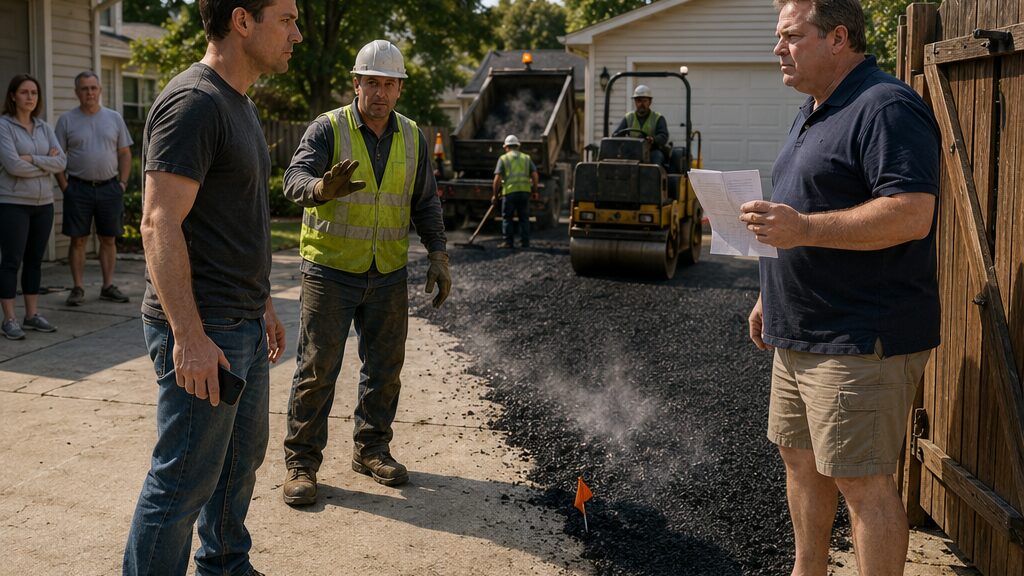
Behind it, men in reflective vests were spreading black asphalt toward Frank Miller’s backyard gate.
I did not put on socks.
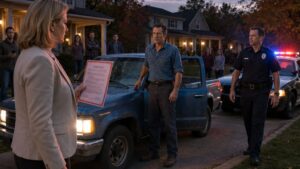
By the time I reached the side door, the air smelled of hot tar and diesel. A compact roller crawled along the edge of my old pale concrete, pressing a fresh black strip into place. Orange cones stood where my trash bins usually sat. One worker held a rake. Another guided the truck backward with one gloved hand.
The new asphalt did not stop at Frank’s property.
It curved across the narrow edge of my driveway.
“Hey.”
The word came out too quietly. Nobody heard me.
I stepped farther into the drive.
“Stop.”
The asphalt foreman looked over. The roller kept moving.
“Stop the machine.”
That got his attention. He raised a fist, and the roller operator cut the engine. The sudden silence made the whole scene feel stranger. Two nearby homeowners had already come outside. One stood near a mailbox with a coffee mug. The other pretended to inspect something in a flower bed.
The foreman walked toward me.
“You the owner here?”
“Yes.”
He glanced toward Frank’s house.
Frank appeared from behind the gate in khaki shorts and a navy polo, carrying a folded sheet of paper.
He did not look surprised to see me.
“Morning,” he said.
I stared at the fresh asphalt.
“What are you doing?”
“We’re finishing the rear access.”
“There is no rear access.”
Frank gave a short breath through his nose, almost a laugh. “We talked about this.”
“No. You left me two messages about using my driveway. I didn’t agree.”
“That’s not the same thing as saying there isn’t access.”
I looked at the foreman. “Who authorized you to pave across my property?”
He shifted his weight. “We’ve got an approved plan from the customer.”
“The customer doesn’t own this strip.”
Frank unfolded the paper.
“Joshua, this was approved.”
I did not take it.
He held it out anyway.
At the top was the name of our homeowners association. Beneath it, in the square administrative language I had seen on fence applications and roofing notices, were the words architectural approval.
The drawing showed Frank’s house, his rear gate, and a dark line running toward the street.
Through my driveway.
For a moment I felt something I hated more than anger.
Uncertainty.
Frank saw it.
“You should’ve answered Kathleen,” he said.
The foreman looked between us. “I need to know whether we’re working or not.”
“You are not paving another inch of my land.”
Frank’s face changed.
Not dramatically. That would have been easier. His mouth tightened and his shoulders settled as if he had expected resistance and was relieved to finally reach it.
“It’s been used for years.”
“Not by you.”
“Access doesn’t disappear because a house changes hands.”
“This is my driveway.”
“The HOA reviewed it.”
“The HOA does not own my driveway.”
One of the workers restarted a small engine behind us.
I turned so sharply the foreman waved him off.
Then I saw the orange flag.
It stood less than ten feet from the roller, a thin wire marker with a faded plastic square at the top. A surveyor had placed it years earlier when my father replaced part of the drainage edge. I remembered because he had warned me not to pull it up.
The fresh asphalt was moving toward it.
I took out my phone.
“Don’t touch that flag.”
The foreman followed my gaze. “We’re matching the approved line.”
“That flag is the line.”
Frank stepped closer. “You don’t know that.”
“I watched the surveyor put it there.”
“You watched it years ago.”
The roller started again before I could answer.
The operator eased forward.
I raised my phone and began recording.
“Stop the machine.”
Nobody did.
The steel drum rolled over loose black aggregate. The asphalt compressed, dark and smooth, until the orange flag bent beneath the edge.
For one second the plastic square remained visible.
Then it disappeared.
Something inside me went completely still.
I photographed the place where it had vanished. Then I photographed the truck, the workers, the gate, the seam between old concrete and new blacktop.
The foreman came beside me.
“Sir, I’m not looking for trouble.”
“Then tell me who gave you the authorization.”
He pointed toward Frank.
“Who told you the route was legally available?”
He looked at the paper in Frank’s hand.
“The customer provided HOA approval.”
“Did you see a deed?”
“No.”
“Survey?”
“No.”
“Easement?”
Frank cut in. “Enough.”
I turned to him.
“You buried a boundary marker.”
“I paved an approved access.”
“You can call it approved.” I heard how calm my voice had become. “You cannot call it yours.”
Nobody spoke.
Even the neighbor with the coffee mug had stopped pretending not to listen.
Frank folded the approval letter once, sharply.
“You think I hired a crew on a guess?”
“I think you hired a crew before I agreed.”
“You don’t get to veto an established access because you inherited the house.”
The word inherited hit harder than it should have.
My father had been dead three years. I had spent most of the first year after his death refusing to change anything in the house. His work gloves had remained on a shelf in the detached garage until the leather dried stiff. I told myself I was busy. I told myself the property required attention.
What I did not tell anyone was that I had missed too much of his final year, and every permanent change to the house felt like losing one more thing I had failed to protect while he was alive.
Frank knew none of that.
He only knew I had not returned his calls.
I looked again at the asphalt.
“Shut it down.”
The foreman rubbed his jaw.
Frank said, “Keep going.”
The foreman did not move.
“Frank,” I said, “I am telling you directly that I dispute your right to cross this property.”
“And I’m telling you I have approval.”
“From an HOA.”
“Yes.”
“Not from me.”
Frank’s eyes hardened. “You’re not the only person with rights here.”
That sentence nearly broke my control.
Instead, I walked back toward my house.
Behind me, Frank called, “Where are you going?”
“To find out exactly what you bought.”
Inside, I spread my deed folder across the kitchen table. The paper smelled faintly dusty. My father had kept everything: tax statements, survey copies, repair invoices, even a receipt for gravel delivered in 2008.
The lot description was there.
The county plat was there.
The long drive was shown along my parcel.
I found no easement.
I called the HOA office. Saturday meant voicemail.
Then I remembered Kathleen Green’s emergency number from a winter pipe break in the clubhouse.
She answered on the fifth ring.
“Joshua?”
“Are you aware Frank Miller is paving into my driveway?”
Silence.
Not surprise.
A pause of calculation.
“Joshua, the board approved the rear-access improvement.”
I sat down slowly.
“You approved construction on my property?”
“That is not how the application was represented.”
“There is black asphalt over my boundary marker.”
Another pause.
“Send me photographs.”
“Did you approve it or not?”
Kathleen lowered her voice.
“The project was approved based on the site plan in the association file.”
I looked through the kitchen window at the black strip cutting across the pale concrete outside.
“What site plan?”
“I’ll email it to you.”
“No. Tell me what you thought you were approving.”
This time, when she answered, every trace of casual reassurance was gone.
“We approved improvement of an existing rear access.”
Chapter 2: The Map in the HOA File Did Not Match the Deed
Kathleen’s email arrived at 7:14 that evening with the subject line SITE PLAN REFERENCE.
I opened it standing at the kitchen counter.
The attachment was a scanned map so old the paper background had yellowed into gray. Property outlines ran across it in thin black lines. House footprints were blocky and imprecise. Near Frank’s rear gate, someone had added two handwritten words:
rear access.
A faint line continued from those words toward the street.
Across my driveway.
I enlarged the image until the pixels blurred.
Then I opened my deed.
The two documents did not agree.
The old HOA sketch treated the drive like a corridor between the houses. My recorded parcel description placed the entire paved width, including the edge Frank had crossed, inside my lot.
I set both pages on the table and stared at them until the kitchen lights reflected off my laptop screen.
Outside, the unfinished asphalt had cooled into a dull black strip.
Frank’s crew had left after the foreman finally decided he was not willing to continue while ownership was openly disputed. They had completed enough work to create the problem, though. The asphalt curved from Frank’s gate and stopped halfway across the edge of my drive, a permanent-looking gesture interrupted in mid-sentence.
I clicked through the photographs on my phone.
Truck.
Crew.
Frank holding the approval.
The seam.
Then the last photograph before the flag disappeared.
I zoomed in.
The orange marker stood almost exactly where the new black surface crossed the old concrete.
At eight the next morning, Kathleen called.
“I reviewed what you sent.”
“And?”
“The board’s approval was based on the documents available to us.”
“That isn’t an answer.”
“It is an answer, Joshua. You may not like it.”
I leaned against the counter.
“Did anyone verify ownership?”
“The architectural committee does not adjudicate title.”
“Then why did you approve access?”
“We approved an improvement.”
“Across land you didn’t verify.”
She exhaled. “You’re collapsing several issues into one.”
“I’m looking at asphalt on my driveway.”
“And I’m trying to prevent this from becoming more adversarial than necessary.”
I almost laughed.
“Frank brought a paving crew before I agreed to anything.”
“He believed the access was established.”
“Because of your map?”
“Because of the map, historic use, and his application materials.”
I stopped.
“What historic use?”
Kathleen hesitated just long enough for me to notice.
“You should come in Monday.”
The HOA office occupied two rooms beside the clubhouse gym. Monday morning, the place smelled of printer toner and artificial lemon cleaner. Kathleen had already placed a folder on the conference table.
She was in her fifties, composed in the way people become after years of explaining unpopular fees without raising their voices. She had known my father. Not closely, but long enough to send a card when he died.
I put my deed on the table.
She put the old site sketch beside it.
“These are not the same.”
“I can see that.”
“Then withdraw the approval.”
“The board cannot simply declare a neighbor’s claimed access invalid.”
“You had no trouble declaring his paving valid.”
Her expression tightened.
“The approval specifically says all work remains subject to property rights and applicable law.”
“Did Frank’s copy say that?”
“Yes.”
“Did you tell the contractor?”
“That is not our role.”
There it was. Not corruption. Not conspiracy. Something more ordinary and, in that moment, more infuriating.
Everyone had approved only their own narrow piece.
Frank applied.
The HOA reviewed appearance.
The contractor paved.
And the land beneath it became somebody else’s problem.
I slid my photograph across the table.
Kathleen looked at the orange flag disappearing beneath the asphalt.
For the first time, she did not answer immediately.
“That marker was there before the work began,” I said.
“I see it.”
“Your approved plan covered it.”
“I see that too.”
Her confidence had changed. Only slightly, but enough.
She opened the folder.
“The association sketch predates your father’s last survey.”
“How old is it?”
“We’re determining that.”
“Who wrote rear access?”
“We’re determining that too.”
“Convenient.”
“Joshua.”
“No. You told me Saturday that the project was approved. Like that settled something.”
“I told you the truth.”
“You told me the part that protected the association.”
Kathleen’s hands flattened on the folder.
“And you ignored three emails asking you to discuss the application.”
That landed.
I looked away.
“I never received an application.”
“You received notice that an adjacent owner had requested approval affecting the side access area.”
“Side access area is not my driveway.”
“You could have answered.”
“I shouldn’t have to answer an email to keep someone from paving my land.”
“No,” she said. “You shouldn’t. But you also knew Frank was asking questions.”
I did know.
His first voicemail had been polite. He said he wanted to “coordinate rear access.” I had deleted it without responding.
The second was less polite.
I had decided that silence was clearer than negotiation.
Sitting across from Kathleen, I understood for the first time that silence had left an empty space, and other people had filled it with their own assumptions.
That did not make the asphalt legal.
But it made the path to it less simple.
Back home, I spent the afternoon on the county records portal. Parcel maps came with disclaimers. Tax boundaries were not surveys. Scanned instruments used unfamiliar abbreviations. I called the county office and, after two transfers, reached a clerk who explained how to search recorded easements by parcel.
Nothing obvious appeared.
No shared driveway agreement.
No recorded right-of-way benefiting Frank’s lot.
No permanent access easement crossing mine.
The parcel image supported my line, at least generally. The long driveway sat inside the Allen property.
For five minutes I felt vindicated.
Then Kathleen called again.
“I found an older board packet.”
I sat back.
“What does it say?”
“Not enough.”
“That sounds promising.”
“There are references to neighbor use of the drive going back years.”
“What kind of use?”
“Rear access.”
“That phrase again.”
“Joshua, I’m not saying Frank owns a right. I’m saying the record is not as clean as you think.”
I looked toward the side window.
Across the unfinished black strip, Frank stood on his porch.
Before the dispute, we had waved. Not because we were friends. Because that was what people did when they lived forty feet apart and saw each other taking out trash.
He looked at me now.
Then turned away.
Kathleen continued.
“There may have been an arrangement with the former owner.”
“Of Frank’s house?”
“Yes.”
“Show me.”
“I’m still reviewing the file.”
“Then don’t call it historic access.”
“I didn’t.”
“You just did.”
She was quiet.
Then she said, “Joshua, how much do you actually know about what your father allowed?”
I gripped the phone.
“My father owned this property.”
“That wasn’t my question.”
Chapter 3: My Father’s Name Was Written Beside the Word Permission
I found my father’s name the next morning in a folder I had not opened since his funeral.
ALLEN — SIDE DRIVE, written in black marker.
The folder sat in the bottom drawer of his metal filing cabinet in the detached garage, beneath mower manuals and receipts for lumber. Dust had collected along the tab.
I opened it expecting surveys.
The first page was a handwritten note.
At the top was a date from twelve years earlier. Below it, in my father’s compact block handwriting:
Permission for temporary passage to rear gate.
I read the line twice.
Then a third time.
The garage seemed to contract around me.
On the workbench behind me sat the vise he had taught me to use when I was eleven. Above it hung a row of tools outlined in dust where he had removed and replaced them for decades. I had preserved the room so carefully that it had stopped being useful.
Now his handwriting had reached out of a drawer and contradicted the version of him I had been defending.
The note referred to the former owner next door. It allowed occasional passage along the side drive for yard work, deliveries too large for the front entrance, and emergency access to the rear.
At the bottom, beside an initialed correction, my father had written one word:
permission.
Not easement.
Not shared.
Permission.
Relief came first.
Then shame.
I had told Kathleen there was no arrangement.
I had told myself Frank’s entire claim was invented.
I photographed every page before touching anything else.
Behind the note was a rough sketch showing my driveway, the neighboring gate, and arrows indicating a path. There were no legal descriptions. No notarization. Nothing that looked remotely like a recorded property instrument.
But there was history.
Real history.
I called Amanda Lewis.
Her office was twenty minutes away in a low brick building near the county complex. By noon, the folder lay open between us.
Amanda read the note once without speaking.
Then she looked at me.
“You didn’t mention this.”
“I didn’t know it existed.”
“Did you know they used the drive?”
“Not like this.”
“That isn’t what I asked.”
I leaned back.
Amanda had the unnerving habit of leaving silence exactly where most people rushed to soften it.
“When I was younger,” I said, “I saw trucks go down there sometimes.”
“How often?”
“I don’t know.”
“Weekly?”
“No.”
“Monthly?”
“I said I don’t know.”
Her eyebrows lifted.
I looked toward the window.
“Landscapers. Maybe a tree crew once. The former owner had a trailer.”
“And your father allowed it?”
“Apparently.”
“Joshua.”
“Yes.”
She folded her hands.
“This note helps you in one way and complicates you in another.”
“It says permission.”
“I can read.”
“Permission means it wasn’t a right.”
“It may support that argument. But the other side is going to say there was longstanding visible use, a gate aligned to the drive, HOA documents identifying rear access, and conduct consistent with continued access.”
“There’s no recorded easement.”
“That matters. It does not make every other fact disappear.”
I felt heat rise into my face.
“So Frank can pave my property because my father once let somebody move a trailer?”
“No.”
“Then why are we talking like he might?”
“Because courts do not reward clients for pretending inconvenient facts don’t exist.”
The sentence was clean and professional.
It still felt personal.
I stood and walked to the credenza where Amanda had placed my photographs.
The asphalt seam looked brutal in print. Pale concrete on one side. Fresh black surface on the other.
“I stopped the crew.”
“You did.”
“I documented the marker.”
“Yes.”
“I told Frank I objected.”
“Yes.”
“And there is no recorded easement.”
“So far, correct.”
I turned.
“Then get an order.”
“I intend to seek emergency relief.”
“Today.”
“Joshua, sit down.”
I did not.
She opened the folder again.
“When did your father die?”
“Three years ago.”
“When did you inherit?”
“Same year.”
“After that, did you ever tell the prior neighbor that permission was revoked?”
“No.”
“Did you put up a barrier?”
“No.”
“Post signs?”
“No.”
“Send a letter?”
“No.”
“Did use continue?”
I hated the question because I did not know.
The neighboring house had been vacant for nearly two years before Frank and Deborah bought it. Before that, the former owner kept mostly to himself. I worked long hours as an operations supervisor and came home after dark more often than I admitted.
My father had still been alive during part of that period.
Sick, then sicker.
I had spent too much time telling myself he preferred independence.
Amanda closed the folder.
“I can seek a temporary order based on immediate alteration of disputed property. That is different from promising you the entire history is irrelevant.”
I finally sat down.
“What do you need?”
“Everything. Not just the good documents.”
That afternoon, I went to the county office in person.
The records clerk helped me trace instruments tied to both parcels. We found mortgages, releases, deeds, old plats, association references.
No recorded easement appeared.
That was the small piece of solid ground I carried back to my car.
Then my phone rang.
Amanda.
“Frank retained counsel.”
“Fast.”
“He has money in fresh asphalt.”
“What do they want?”
“They sent a preservation notice and a summary of their position.”
I closed the car door.
“What position?”
“Decades of visible use. Reliance. HOA approval. Purchase representations.”
“Purchase representations from who?”
“Still unclear.”
I looked at the folder on the passenger seat.
“My father’s note says temporary passage.”
“Yes.”
“That has to matter.”
“It does.”
Her tone made me wait.
“What?”
“His attorney is asking whether the permission was ever revoked.”
The parking lot seemed suddenly too bright.
“It didn’t have to be. The house was vacant.”
“That is not necessarily the end of the analysis.”
“It was my father’s property.”
“I know.”
“No. Everyone keeps saying they know, and then acting like a neighbor using something long enough can transform it into theirs.”
Amanda’s voice sharpened.
“Stop.”
I did.
“You are angry at Frank. Fine. You may have excellent reasons. But right now you are also angry at your father for leaving facts you didn’t know, and you’re trying to make the law clean that up for you.”
I could not answer.
She continued more quietly.
“I need you to search the garage again. Every box. Every note. If your father granted permission, I need to know its terms.”
I drove home without music.
At dusk, I returned to the detached garage.
Near the driveway edge, just outside the door, old stains darkened the concrete. I had always thought they came from sealant. Now I saw them differently: narrow marks where tires might once have tracked residue toward the neighboring gate.
Inside, I searched until the light above the workbench began to buzz.
I found invoices.
A Christmas card.
A photograph of my father standing beside the old neighbor.
No formal revocation.
At nine thirty, Amanda called again.
“Joshua.”
“What now?”
“I’ve reviewed the first letter from Frank’s attorney.”
“And?”
“They’re not backing down.”
I sat on my father’s stool.
“They still claim an easement?”
“They claim a history of use sufficient to require full review. They’re also arguing reliance on the HOA records.”
“But the HOA can’t give away my land.”
“No.”
That single word steadied me.
Then Amanda added, “But I need to ask you one more time.”
I stared at the handwritten page on the bench.
“Ask.”
“After your father gave permission, did he ever revoke it in writing?”
The garage was silent except for the buzzing light.
I looked through every paper I had found.
“No.”
Amanda did not speak.
And for the first time since the asphalt truck arrived, I understood that proving Frank had no deeded right might not answer the harder question at all.
Chapter 4: The Emergency Order Stopped the Crew but Not the Argument
The process server arrived ten minutes before the paving crew.
I was standing at the kitchen window when a gray sedan stopped at the curb and a man in a plain jacket stepped out with a large envelope. Across the property line, Frank’s side gate was open. Orange cones had already been stacked near the curb.
The same dump truck turned onto our street as the process server walked up Frank’s steps.
For one strange moment, both men moved toward the house from opposite directions: one carrying legal papers, the other carrying asphalt.
Frank opened the door.
I could not hear the first words, but I saw his face change.
The process server handed him the envelope.
Behind them, the truck’s reversing alarm began.
Amanda called me almost immediately.
“It was served?”
“I’m watching him read it.”
“Good. Do not go over there.”
“I wasn’t planning to.”
“Joshua.”
“I said I wasn’t.”
The temporary order was narrow. Amanda had warned me not to turn it into something larger in my head. It did not decide ownership forever. It did not settle historic use. It did not declare Frank dishonest.
It stopped further alteration of the disputed strip until the court could review the conflict.
That was enough for the morning.
Frank came down his porch steps with the papers clenched in one hand. The foreman met him beside the truck. They spoke for less than a minute.
Then the foreman looked toward my house.
Frank did too.
I stayed behind the glass.
The truck shut off.
One by one, the workers began loading tools they had not used.
I should have felt triumph.
Instead, I watched the half-finished asphalt ending at the pale concrete seam and thought about my father’s note.
Permission for temporary passage.
The crew drove away.
Frank remained in the street long after they were gone.
That afternoon, Amanda met me at the courthouse records office. She had three folders under one arm and none of the satisfaction I expected.
“We have a pause,” she said.
“A court-ordered pause.”
“Yes.”
“You say that like it’s temporary.”
“It is temporary.”
I followed her through the hallway.
“You found something.”
“I found no recorded easement benefiting the Miller parcel across your driveway.”
I stopped walking.
Amanda took two more steps before turning.
“Say that again.”
“No recorded easement. No recorded shared driveway agreement. No right-of-way instrument I can identify in the title chain we reviewed.”
For the first time in days, my shoulders loosened.
“So that’s it.”
“No.”
The word landed with almost physical force.
“You just said there’s no easement.”
“I said there is no recorded easement. Frank’s attorney is not limiting his argument to one recorded instrument.”
“What else is there?”
“Historic use. Reliance. Seller representations. The HOA’s map. The physical gate. Your father’s permission.”
“Permission proves ownership stayed with us.”
“It may support that. It also proves the use was real.”
We stood beneath fluorescent lights while people moved around us carrying files and coffee.
I lowered my voice.
“He knew I objected before he paved.”
“That matters too.”
“More than an old note should.”
“Maybe. But you keep asking for one fact that erases all the others.”
I looked away.
Amanda did not press.
By the time we left, I had a certified copy of the parcel deed and a list of recorded instruments. Solid paper. Stamped paper.
Still not the clean ending I wanted.
Three nights later, the HOA board held an emergency meeting.
Kathleen sat at one end of the clubhouse conference room with the old site sketch in front of her. The HOA board president sat beside her, already looking tired.
Frank and Deborah were across from me.
It was the first time I had seen Deborah up close since they moved in. She kept both hands around a paper cup she never drank from.
Kathleen began carefully.
“The purpose tonight is not to determine private title rights.”
I almost smiled.
Frank did not.
“Then maybe you should have remembered that before approving the project,” he said.
Kathleen’s jaw tightened.
“Our approval expressly remained subject to private rights.”
“You gave me a signed approval.”
“For an architectural improvement.”
“You approved the route.”
“We approved the design submitted.”
“And now you’re saying the design might have been on somebody else’s land.”
The board president raised a hand.
“Let’s keep this constructive.”
Frank turned toward him.
“I hired a crew because your association told me the project was approved.”
I said, “You hired a crew because I wouldn’t agree to give you access.”
Frank’s eyes moved to me.
“You wouldn’t even discuss it.”
“I didn’t have to.”
“There. That’s exactly it.”
Amanda had warned me not to attend without restraint. I heard her voice in my head and said nothing.
Kathleen opened a binder.
“We have now confirmed the reference sketch used during review was not a current boundary survey.”
The room changed.
Not loudly.
The two nearby homeowners sitting against the wall looked at each other.
The board president leaned toward Kathleen.
“You said it was a site plan.”
“It is a site plan.”
“Current?”
“No.”
“How old?”
“We have not conclusively determined the creation date.”
Frank gave a short, humorless laugh.
“So nobody knows.”
Kathleen continued.
“The association is reviewing its archival procedures.”
“That’s not an answer either,” I said.
Her eyes met mine.
“No. It isn’t.”
For the first time since this began, she sounded less defensive than tired.
The board president turned a page in front of him.
“What exactly is our exposure?”
Nobody answered immediately.
That was the moment the meeting stopped being about neighborly misunderstanding and became something the association could no longer treat as a private quarrel.
Kathleen spoke first.
“If the approval was reasonably interpreted as authorization for work beyond the applicant’s parcel, there may be issues.”
Frank leaned back.
“May be.”
His attorney, seated beside him, finally spoke.
“My client relied on association records and written approval. That reliance did not begin on the day of construction.”
Amanda looked up.
“What does that mean?”
Frank’s attorney placed a thin packet on the table.
“It means the property was marketed with rear access.”
I turned to Frank.
He had gone still.
The attorney continued.
“My client purchased the home believing the existing access arrangement was part of the property’s practical use.”
Amanda said, “Believing based on what?”
Frank answered this time.
“The listing.”
Deborah looked down at her cup.
I said, “A real-estate listing doesn’t create rights over my land.”
“No,” Frank said. “But it explains why I’m not making this up.”
The anger I had been holding shifted.
Not gone.
Changed.
Frank reached into the packet and pulled out a glossy page.
A photograph showed his house before he bought it. Fresh landscaping. Open rear gate. A trailer visible in the backyard.
Below the photograph, a bullet point read:
Convenient rear access for equipment and recreational storage.
My eyes stayed on the words.
Amanda asked, “Do you have the full listing packet?”
Frank’s attorney slid the packet across the table.
I did not touch it.
Frank did.
He opened to a page with a property sketch.
A narrow line ran beside my house toward his gate.
Not a legal survey.
Not a deed.
But there it was again.
Rear access.
Frank looked at me.
“I didn’t invent the driveway, Joshua.”
I stared at the page.
For the first time, I believed him.
Chapter 5: The Neighbor Was Wrong, but He Had Not Invented Everything
Frank offered me a permanent easement on a Thursday morning as if he were offering to split the cost of a fence.
He was standing on his porch with an envelope in one hand.
I had gone outside to move my trash bin. Since the emergency order, the unfinished black strip remained between our properties like a scar nobody was allowed to touch.
“Joshua.”
I stopped.
Frank came down two steps but no farther.
“My attorney drafted something.”
“I have an attorney.”
“I know.”
“Then send it to her.”
“I will.”
He held up the envelope.
“But I wanted you to hear it from me first.”
I waited.
“A permanent easement. Defined width. Defined route. I cover documentation.”
“No.”
His face tightened.
“You haven’t heard the terms.”
“I heard permanent.”
“You’d be compensated.”
“No.”
“Joshua.”
I rolled the bin toward the garage.
Frank came off the porch.
“This is exactly what I mean.”
I stopped at the seam between old concrete and unfinished asphalt.
“What do you mean?”
“You decided no before you knew what I was asking.”
“You paved first.”
“I had approval.”
“You had a design approval.”
“I had a listing, a gate that had been used for years, an HOA map, and a written approval.”
“And you had me telling you no.”
His mouth closed.
For a second neither of us moved.
Then he said, “You think this is free for me?”
I almost answered that none of it was free for me either.
Instead, I said, “Send it to Amanda.”
The offer reached her office that afternoon.
The number attached to it was not insulting.
That made it worse.
Amanda watched me read.
“Do not react to the amount.”
“I’m reacting to the word permanent.”
“Yes.”
“He wants me to legalize what he tried to take.”
“He wants certainty.”
“At my expense.”
“He is offering money.”
“For something I don’t want to sell.”
Amanda leaned back.
“Then don’t sell it.”
I looked up.
“That’s it?”
“That’s it.”
“You’re not going to tell me to be reasonable?”
“You are allowed to refuse an easement.”
I folded the paper.
She continued.
“But we still need to understand his reliance argument.”
“There’s no recorded right.”
“No. And that is important.”
“Then why does every sentence end with but?”
“Because facts are rude.”
Two days later, Kathleen allowed us to review the older HOA records.
The records room was barely a room at all, just metal shelving behind the administrative office. Boxes were labeled by year. The old sketch that had started the problem was clipped inside a binder with drainage plans, fence diagrams, and handwritten maintenance notes.
Amanda turned pages slowly.
Frank’s attorney stood across from us.
Kathleen remained near the door.
We found references to “side access” and “rear access,” but nothing resembling a legal grant. One note mentioned a large tree removal years earlier. Another approved temporary contractor passage.
Amanda tapped the page.
“This supports use.”
Frank’s attorney said, “Correct.”
“Not permanence.”
“We disagree about the significance.”
Kathleen rubbed one temple.
“This is why the association should never have been maintaining informal property notations.”
I looked at her.
“That realization arrived late.”
“Yes,” she said. “It did.”
No defense.
No careful euphemism.
Just the truth.
It took some of the pleasure out of being angry with her.
Near the bottom of one box, we found a printed copy of the real-estate listing for Frank’s house.
The language matched the packet from the meeting.
Convenient rear access.
I stared at the phrase.
A buyer could read that and imagine exactly what Frank had imagined.
Not ownership, perhaps.
But use.
Expected use.
The kind of thing people treat as part of a house once they have paid for it.
Outside the office, Deborah was waiting.
Frank had not come.
She sat on a bench with her purse beside her.
When she saw the listing page in my hand, she closed her eyes briefly.
“You found it.”
I sat at the other end of the bench.
“You knew?”
“Of course I knew about the listing.”
“How much did it matter?”
She looked toward the parking lot.
“We paid more because of the property layout.”
“How much more?”
She gave me a tired look.
“Enough.”
I waited.
Deborah pressed her palms together.
“Frank has a boat trailer. We have equipment. The backyard gate was one of the reasons we chose the house.”
“That doesn’t make my driveway yours.”
“I know.”
The answer came so quickly that I turned toward her.
She continued.
“I know now.”
Something in her voice stripped the argument down.
“You thought it was included.”
“We thought it was established.”
“Because of the listing.”
“The listing. The gate. The seller’s agent. The HOA sketch.”
“And the old use.”
“Yes.”
I looked at the asphalt.
From where we sat, I could see only a narrow black edge beyond the shrubs.
For the first time, Frank’s certainty looked less like pure arrogance and more like a man trying to force reality back into the shape he had paid for.
That did not excuse the paving.
But I understood the trap.
At Amanda’s office later, I said, “I might consider a temporary license.”
She looked up sharply.
“For vehicles?”
“I didn’t say that.”
“What are you considering?”
“I don’t know yet.”
“That is an acceptable answer.”
“I could allow something limited. Written. Revocable.”
Amanda studied me.
“Are you doing this because you think you owe him?”
“No.”
“Because your father did it?”
“I said I don’t know.”
She let that sit.
The following week, mediation began badly.
Frank rejected the idea before Amanda finished describing it.
“A temporary license is worthless.”
“It gives you defined use without altering title,” Amanda said.
“For how long?”
“Negotiable.”
“Revocable?”
“Yes.”
Frank looked at me.
“So I get to ask permission forever.”
“You are using my land.”
“That’s not a solution.”
“It’s more than you have now.”
His attorney touched his sleeve, but Frank pulled away.
“I’m not paying for a house where my access depends on whether Joshua wakes up angry.”
My chair moved before I realized I had stood.
Amanda said my name once.
I stopped.
Frank’s face had gone red.
I sat again.
“Then we’re done,” I said.
Deborah had been quiet through most of the session.
Now she looked at Frank.
“You said you verified it.”
The room changed.
Frank did not answer.
Deborah’s voice remained low.
“You told me before closing that it had been verified.”
Frank looked toward his attorney.
“Not here.”
Her face tightened.
“Where, then?”
No one spoke.
The mediator called for a break.
I walked into the hall.
A minute later Deborah came out alone.
She stood beside me without looking at me.
“I need to tell you something.”
I waited.
Her hands were shaking slightly.
“Before the paving,” she said, “Frank knew they had not found a recorded easement.”
I turned toward her.
She finally met my eyes.
“He knew it was unverified.”
Chapter 6: He Had One Chance to Stop the Paving and Chose Pride
“April seventeenth.”
Deborah said the date without hesitation.
We were sitting at her kitchen table three days after mediation. Frank was not home. Amanda knew I was there and had told me twice not to discuss settlement terms.
I had promised.
The promise felt thin now.
“What happened April seventeenth?” I asked.
Deborah looked at the untouched coffee between us.
“Frank got an email from the title company.”
“What did it say?”
“That they could not confirm a recorded easement.”
The room was quiet.
Through the window, I could see my detached garage and the black strip ending at the old concrete seam.
“When was the paving?”
“April twenty-seventh.”
Ten days.
I leaned back.
“He had ten days.”
“Yes.”
“Did he tell the HOA?”
“I don’t know.”
“Did he tell the contractor?”
“I don’t know.”
“Did he tell you?”
Her mouth moved once before she answered.
“No.”
There it was.
Not a secret deed.
Not a forged map.
A husband who had been too ashamed to say he might have made a costly mistake.
Deborah folded her arms tightly.
“I found the email after the emergency order.”
“Why didn’t you say anything?”
“I wanted him to explain it.”
“Did he?”
“He said the title company was being cautious.”
I looked at her.
“And you believed him.”
“I wanted to.”
The honesty of it stopped me.
She stared down at the table.
“We sold our last house quickly. We stretched for this one. Frank kept saying the backyard access made it worth it.”
I said nothing.
“He had already bought the trailer. He had plans. He told everyone the layout was perfect.”
Her voice broke slightly, then steadied.
“When that email came, he didn’t tell me because telling me meant admitting he didn’t know.”
I looked again toward the window.
Frank had still relied on bad information.
The listing was real.
The gate was real.
The HOA sketch was real.
My father’s permission was real.
But ten days before the paving, uncertainty had become explicit.
And he had chosen machinery.
At mediation two days later, Frank looked older.
His attorney did most of the talking until Amanda placed a copy of the April seventeenth email on the table.
Frank’s eyes went to Deborah.
She did not look away.
Amanda said, “You received this before construction.”
“Yes.”
“You understood no recorded easement had been confirmed.”
“I understood the title company wouldn’t insure one.”
“That is not the same answer.”
Frank’s attorney intervened.
“My client continued to believe historic rights existed.”
Amanda nodded.
“He may testify to that.”
Frank leaned forward.
“You think I was supposed to throw away everything because one company wouldn’t put it in writing?”
I said, “You could have stopped.”
He looked at me.
“I had a crew scheduled.”
“You could have stopped.”
“I had paid a deposit.”
“You could have stopped.”
His hand hit the table once.
Not hard.
Enough.
“You know what it costs to admit you bought the wrong house?”
The room went silent.
Frank’s attorney closed his eyes briefly.
Frank stared at me.
“I told Deborah this place solved everything. Storage. Trailer. Yard. I told her I checked.”
Deborah sat rigid beside him.
“I had the listing. The map. The gate. Years of use. Then you wouldn’t even answer a phone call.”
“So you paved.”
“I thought you were forcing me to beg for something already there.”
“You knew it might not be.”
His face tightened.
“Yes.”
The word was quiet.
That was the first moment I understood him completely.
Not forgave him.
Understood him.
He had mistaken humiliation for danger.
And once he did, every new fact became something to defeat rather than hear.
The mediation ended without agreement.
Back home, I went to the garage and began cleaning.
Not because it needed cleaning.
Because I could not sit in the house with Frank’s admission repeating in my head.
You know what it costs to admit you bought the wrong house?
Black asphalt dust had collected along the threshold from the half-finished work. I wiped it from my father’s old workbench with a damp rag.
The dust smeared gray across the wood.
Under a stack of warped cabinet plans, I found a folded piece of paper.
Same handwriting.
Same block letters.
I unfolded it carefully.
The note was shorter than the first.
It referred to the former neighbor and the side drive. It listed conditions.
Temporary use only.
Ask before heavy vehicles.
No parking.
No paving.
No transfer without new permission.
I sat down.
For several seconds I could hear nothing but the small buzz of the overhead light.
My father had not been careless.
He had not confused kindness with ownership.
He had drawn a boundary and then chosen, case by case, when to open it.
At the bottom of the note was one final sentence.
Help when it is needed. Stop when it becomes assumed.
I read it again.
A memory surfaced with painful clarity.
My father standing at this same workbench while I complained about a neighbor borrowing tools.
“People get strange about things,” I had said.
He had shrugged.
“Then be clear.”
I had forgotten the rest.
Or perhaps I had refused to remember it.
That evening, Amanda came to the house.
I gave her the note.
She read it in silence.
“This is important.”
“Legally?”
“Yes.”
I waited.
“And otherwise,” she added.
I looked toward the side window.
Frank’s porch was empty.
“What happens if I win everything?”
Amanda closed the folder.
“Define everything.”
“Removal. Costs. No access. Nothing.”
“That is one possible outcome.”
“I could demand it.”
“You could.”
The answer should have satisfied me.
It did not.
“Would you?”
Amanda’s expression changed.
“I’m your lawyer.”
“That’s not what I asked.”
“No.”
She looked down at my father’s note.
“I don’t know what I would do.”
For once, the uncertainty helped.
At the next mediation session, the permanent easement proposal remained on the table.
So did full removal.
So did my right to say no.
I sat across from Frank and looked at the man who had ignored a warning because admitting doubt cost him more, in his own mind, than trespassing on mine.
Then I thought of myself deleting his messages because discussion felt too much like surrender.
Different choices.
Different harm.
But not entirely different fear.
Amanda leaned toward me.
“What do you want me to propose?”
I looked at the final line in my father’s note.
Help when it is needed. Stop when it becomes assumed.
For the first time since the truck woke me, I knew the court could protect my property and still leave the hardest boundary for me to choose.
Chapter 7: The Court Could Remove the Asphalt but Not Choose My Boundary
Frank’s attorney slid the proposed easement across the conference table before anyone had taken off their coats.
“One signature,” he said, “and this ends.”
The document stopped in front of me.
Permanent Access Easement.
I did not touch it.
Amanda sat to my right. Across from us, Frank looked exhausted rather than angry. Deborah had not come. Kathleen sat near the far end of the room with the HOA board president and a folder thick enough to suggest the association had finally learned the cost of vague records.
The settlement conference was being held in a courthouse meeting room with beige walls and a clock that ticked too loudly.
Frank’s attorney tapped the document.
“Defined width. Restricted purpose. My client handles drafting costs and contributes to maintenance.”
Amanda asked, “Vehicle access?”
“Yes.”
“Running with the land?”
“Yes.”
I looked at Frank.
“So not temporary.”
“No,” he said.
“Not personal to you.”
“No.”
“If you sell, the next owner gets it.”
“That’s the point.”
I leaned back.
For months, I had imagined this moment as simple. Someone would finally place the choice in front of me and I would say no.
Now the word sat in my throat with more weight than before.
I thought of my father’s note.
Temporary use only.
Ask before heavy vehicles.
No paving.
No transfer without new permission.
Frank’s attorney said, “Joshua, the court can decide parts of this. It cannot make the neighbor relationship functional.”
“That relationship stopped being functional when he ordered a crew to continue after I objected.”
Frank looked down.
His attorney continued.
“My client has acknowledged mistakes.”
“Has he?”
Frank’s head came up.
“Yes.”
The room went quiet.
I waited.
He rubbed one hand over his face.
“I should have stopped the crew.”
It was the first apology-shaped sentence I had heard from him.
Not an apology.
But close enough to change the air.
I asked, “Why didn’t you?”
He looked at the easement document.
“You already know.”
“I know what you said in mediation.”
“Then you know.”
“No. I know you were embarrassed.”
His jaw tightened.
“You want me to say it again?”
“I want you to understand why I’m not signing that.”
Frank stared at me.
“You think I don’t?”
“I don’t know what you understand.”
Amanda touched the edge of my folder, a quiet warning not to turn the conference into a personal trial.
I opened it instead.
Inside was the survey evidence.
The updated surveyor’s line followed the pale concrete edge and cut directly beneath the black asphalt Frank had installed. My father’s handwritten note sat behind it.
Amanda placed the survey on the table.
“The current evidence supports Joshua’s ownership of the disputed strip.”
Frank’s attorney nodded reluctantly.
“We have reviewed it.”
“There is no recorded easement.”
“We know.”
“The HOA approval did not create one.”
Kathleen spoke before anyone else could.
“That is correct.”
Every head turned toward her.
She opened her folder.
“The association is prepared to issue a formal clarification. Architectural approval does not establish, transfer, or confirm private property rights. The Miller approval should not have been treated as evidence of access rights.”
Frank gave a short laugh.
“Now you say that.”
Kathleen accepted it without flinching.
“Yes.”
The board president shifted uncomfortably.
She continued.
“We also should not have relied on the outdated site sketch without clearly labeling it as non-survey reference material.”
I looked at her.
“Will that be in writing?”
“Yes.”
“Sent to the board?”
“Yes.”
“And future applicants?”
“We are revising the procedure.”
It was less satisfying than I had once imagined.
No public humiliation.
No dramatic admission.
Just an institution correcting language after damage had already been done.
Still, something in me eased.
Amanda turned to me.
“The question is no longer whether the HOA can authorize the route.”
I knew what she meant.
The choice had come back to me.
Frank’s attorney said, “My client is still prepared to compensate.”
I closed the permanent easement proposal.
“No.”
Frank’s face hardened.
Then I added, “But I’m not asking for everything I could ask for either.”
Amanda looked at me carefully.
This was the part we had discussed and redrafted three times.
I placed another document on the table.
Frank did not reach for it.
“What is that?”
“A limited accommodation.”
His attorney pulled it closer.
Amanda said, “Personal, revocable, nontransferable.”
Frank’s eyes narrowed.
“For what?”
“Emergency pedestrian passage,” I said. “And limited access by prior written permission when there’s a genuine need.”
He laughed once.
“So I still ask.”
“Yes.”
“For my own backyard.”
“For my land.”
The old anger flashed between us.
I let it pass.
“No vehicles as a standing right. No paving. No parking. No commercial use. Nothing transfers to another owner.”
Frank pushed the paper away.
“That’s charity.”
The word hit me harder than I expected.
“No,” I said. “It’s a boundary.”
He shook his head.
“You get everything.”
“I get my driveway.”
“And I get permission when you feel generous.”
I almost snapped back.
Then I remembered the note.
Help when it is needed. Stop when it becomes assumed.
“My father let the former owner use the drive,” I said.
Frank stopped moving.
“He wrote it down.”
Amanda placed a copy of the note beside the survey.
Frank read silently.
His attorney read over his shoulder.
I watched his expression change at the final conditions.
No transfer without new permission.
For the first time, Frank looked at the history without being able to turn it into permanence.
“My father was clear,” I said. “Clearer than I was.”
Frank looked at me.
“I called you.”
“I know.”
“You ignored me.”
“I know.”
The admission felt worse than I had expected.
I continued.
“I thought answering meant opening a negotiation I didn’t owe you. I thought silence protected the property.”
Frank said nothing.
“It didn’t cause you to pave,” I said. “That choice is yours. But my silence made the situation worse.”
Amanda looked at me, then away.
Frank stared at the old note.
“You’re saying your father would have let me use it.”
“I’m saying he might have listened.”
“That’s convenient now.”
“Yes,” I said. “It is.”
He looked almost surprised.
I pushed the permanent easement back toward his attorney.
“I will not sign away a permanent right because you bought a house based on a bad assumption. And I will not pretend the history was fake just because that makes me feel cleaner.”
The room remained silent.
Frank’s attorney finally asked, “Is removal still required?”
“Yes.”
“All new asphalt?”
“Everything crossing my parcel, with restoration.”
Frank closed his eyes.
I added, “I’m not seeking punitive restoration beyond the actual work. I don’t want decorative upgrades. I want the surface returned to its prior condition.”
Amanda nodded.
That had been the other choice.
I could have demanded more aggressive terms, more costs, more leverage.
I had wanted that once.
Now I wanted the seam corrected.
Nothing more.
Nothing less.
The final hearing was brief compared with the months leading to it.
The updated survey, title review, HOA clarification, father’s permission note, and April seventeenth email did not produce a cinematic courtroom revelation. They produced something quieter: a record.
The judge approved the resolution preserving my ownership, requiring removal of the encroaching asphalt, and allocating restoration costs.
The limited accommodation remained separate.
Voluntary.
Mine to grant.
Frank did not sign it that day.
When we left the courthouse, he walked ahead without looking back.
Amanda stood beside me on the steps.
“You okay?”
“No.”
“Good answer.”
I almost smiled.
Two days later, the removal order was formally entered.
That afternoon, the paving company called.
The foreman sounded uncomfortable when he recognized my name.
“We’ve been scheduled for restoration.”
“When?”
“Next Thursday.”
I looked out the window at the unfinished black strip.
“The same crew?”
A pause.
“Some of them.”
I thought of the orange flag vanishing beneath the roller.
“Bring jackhammers,” I said.
Chapter 8: When the Jackhammers Stopped, the Driveway Was Mine in a Different Way
The first jackhammer struck the asphalt at 8:03 on Thursday morning.
The sound was sharper than the reversing alarm that had woken me months earlier.
I stood near the garage while the worker drove the steel bit into the black surface. Cracks spread outward in thin gray lines. Another worker wedged a bar beneath the broken edge.
Across the property line, Frank watched from his porch.
He did not wave.
The foreman approached me with a clipboard.
“We’re removing to the surveyed line, then restoring the edge.”
I looked down.
Fresh orange markers stood along the boundary again.
This time, nobody was covering them.
“Keep the photos,” I said.
He nodded.
“I remember.”
I could not tell whether he meant the dispute or the morning I had asked him who authorized the work.
Maybe both.
The jackhammer started again.
Chunk by chunk, the black asphalt came apart.
I had imagined satisfaction.
For months, that image had carried me through legal calls, records searches, mediation, sleepless nights, and the humiliation of discovering that I had been wrong about parts of my own family history.
I had pictured Frank watching.
I had pictured the truck leaving.
I had pictured victory.
The reality was louder and sadder.
The asphalt broke into heavy slabs. Workers lifted them into a loader. The machine carried them to a waiting truck, where each piece landed with a dull impact.
Frank remained on the porch.
Deborah came outside once. She stood beside him briefly, then went back in.
At midmorning, the crew reached the place where the old orange flag had disappeared.
The foreman stopped the machine.
A worker crouched and pulled something from the broken edge.
A twisted piece of wire.
At the end of it hung a dirty orange square.
He handed it to me.
“This yours?”
I turned it over in my palm.
The plastic was scraped and blackened.
“Yes.”
I put it on my father’s workbench.
Not as evidence.
We had enough evidence.
Because some things deserved to be kept after they stopped being useful.
By noon, the truck was nearly full.
The black curve toward Frank’s gate had vanished. What remained was ugly but honest: exposed base material, broken edges, pale older concrete waiting for repair.
Frank finally came down from his porch.
He stopped several feet away.
“You got what you wanted.”
Months earlier, I would have answered immediately.
Now I looked at the removal crew.
“No.”
His mouth tightened.
“The asphalt is gone.”
“That part, yes.”
He stared toward the truck.
“I’m paying for it.”
“I know.”
“You could’ve signed the easement.”
“You could’ve stopped the crew.”
His face hardened.
For a second I thought we were going to repeat every argument we had ever had.
Then Frank looked at the old gate.
“I still think I was sold something that wasn’t real.”
“You probably were.”
He turned toward me.
“That’s it?”
“What do you want me to say?”
“I don’t know.”
Neither did I.
The loader dumped another broken slab into the truck.
Frank said, “Deborah wants me to accept your accommodation.”
I waited.
“I told her no.”
“Okay.”
“That doesn’t bother you?”
“It’s voluntary.”
He studied me.
“You really mean that.”
“Yes.”
He looked almost offended by the answer.
“I don’t want permission.”
“I know.”
“Then why offer it?”
I thought of my father.
Not the version I had built after his death.
The actual man.
A man who labeled permission because he understood that generosity without clarity could become resentment.
“Because sometimes people need access,” I said.
Frank gave a bitter smile.
“And sometimes it becomes assumed.”
I looked at him.
He had read the note closely.
“Yes.”
We stood there while the crew worked.
Finally he said, “I’m not signing.”
“You don’t have to.”
He returned to his porch.
The restoration took another week.
The new edge was not identical to the old one. Anyone who looked carefully could see where repairs had been made. The pale concrete had a slightly different texture where the blacktop had crossed.
I liked that more than I expected.
A perfect restoration would have pretended nothing happened.
This one showed a boundary that had been tested and repaired.
Kathleen sent the HOA clarification in writing.
It acknowledged that the association’s approval could not create private access rights and that future applications affecting uncertain boundaries would require clearer documentation.
There was no dramatic apology.
But her name was at the bottom.
Frank paid the ordered restoration costs.
The real-estate dispute over what he had been promised became his problem with other people. I heard fragments but asked no questions.
My part was finished.
Almost.
A month later, Amanda sent me the final version of the limited accommodation.
Personal to Frank and Deborah.
Revocable.
No vehicle easement.
No transfer.
No paving.
Emergency pedestrian use permitted.
Other passage only by prior agreement.
I signed it.
Frank refused.
For six weeks, nothing changed.
Then one evening I heard someone knocking on the side door.
Deborah stood outside.
Her face was pale.
“Frank fell in the backyard.”
I was already moving.
“Can he walk?”
“I don’t know.”
The front route around their house was obstructed by a landscaping delivery. The gate beside my driveway was the fastest way in.
I opened it.
No discussion.
No paper.
No lecture.
The emergency crew used the route on foot with equipment. Frank’s injury turned out to be less severe than it first appeared, but he left for the hospital in an ambulance.
The next afternoon, Deborah came to my porch.
She held the accommodation document.
“Frank signed it.”
I looked at the signature.
“You don’t owe me anything for yesterday.”
“I know.”
She folded the paper once.
“I think that’s why he signed.”
After she left, I carried the document to the garage.
My father’s old note was still in the folder.
I placed the new agreement behind it.
Not the same terms.
Not the same people.
The same distinction.
Help when it is needed.
Stop when it becomes assumed.
Months passed.
The repaired driveway faded under sun and tires. The seam remained visible if I looked for it, pale concrete meeting a slightly newer edge where black asphalt had once tried to become permanent.
Frank and I did not become friends.
That would have been false.
We did not share beers. We did not laugh about the dispute. Some things cost too much to become funny.
For a long time, he stopped waving entirely.
Then one evening, I carried the trash bin toward the curb and saw him on his porch.
He had one hand on the railing.
I looked up.
Frank looked at me.
No smile.
No apology.
He gave one small nod.
I stood beside the restored driveway, with the old boundary clear beneath my feet.
Then I nodded back.
The story has ended.