The HOA Demanded $7,800 Until One Boundary Line Exposed What Everyone Had Ignored
Chapter 1: The Final Notice Inside the Black Mailbox
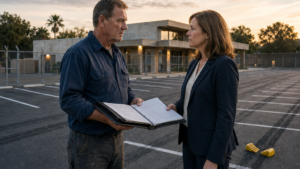
The envelope caught on the lip of the mailbox as Stephen Harris pulled it free.
It was heavier than the grocery circulars beneath it, bright white with a red border and the words FINAL NOTICE visible through the plastic window. His name was printed correctly. So was the address.
Maple Ridge Lane.
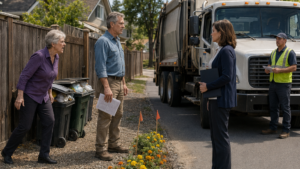
Stephen stood beside the black curbside mailbox while a delivery truck rolled past the entrance to the subdivision. The driver lifted two fingers from the wheel. Stephen did not respond.
He opened the envelope with his thumbnail.
AMOUNT DUE: $7,800.
Below the figure, smaller type warned that the Maple Ridge Homeowners Association had referred the account for lien review. Payment was required within ten business days to avoid additional legal and collection costs.
Stephen read the first paragraph twice.
Then he turned the page over as though the real explanation might be printed on the back.
It was blank.
“Something interesting?”
Michelle’s voice came from the driveway. She had parked behind his truck and was carrying a paper cup and a canvas bookkeeping bag. She still kept a key to the house because half of it belonged to her, though she had not lived there since their father died.
Stephen folded the notice once.
“No.”
“That looks like a final notice.”
“It’s a mistake.”
She stopped beside him. “What kind?”
He handed it over because refusing would make the paper seem more important.
Her eyes found the number almost immediately. “Seven thousand eight hundred dollars?”
“They don’t have jurisdiction here.”
Michelle read farther down. “It says unpaid assessments, late charges, administrative fees and collection costs.”
“They can call it whatever they want.”
“They’re talking about a lien.”
“They can’t place one.”
Her face tightened. Michelle had always distrusted sentences that began with can’t when they came from someone who had not made a phone call.
“Did you know about this?”
“No.”
The answer came too quickly.
She looked at him over the top edge of the notice. “Stephen.”
“I knew they had our address in their mailing system. Everybody near the entrance gets newsletters.”
“This isn’t a newsletter.”
“Our parcel predates the association.”
“Then call them and tell them.”
He took the notice back. “I’ll handle it.”
Michelle gave a short, humorless laugh. “That means you’ll put it somewhere.”
He started toward the house.
Behind him, the mailbox door remained open.
The kitchen table still bore faint scratches from their father’s habit of spreading tools across it. Stephen laid the final notice between a salt shaker and a stack of unopened utility mail. Michelle set down her coffee but kept her bag over one shoulder.
“Call now,” she said.
“It’s seven-thirty.”
“There’s a number.”
“It’ll be an answering service.”
“Then leave a message.”
Stephen opened a drawer near the refrigerator and removed a folder of old tax statements. “I want the parcel number first.”
Michelle watched him sort through the pages. “You work with maps all day. Are you absolutely sure the house is outside?”
“Yes.”
“Because the street sign says Maple Ridge. The entrance sign says Maple Ridge. Their landscaping crew trims the median twenty yards from our mailbox.”
“The street name doesn’t define jurisdiction.”
“I didn’t say it did.”
He found the property tax statement and set it beside the notice. The parcel number on the assessment began 18-04-7. The number on the HOA ledger began 18-04-9.
Stephen tapped both with his index finger.
“There.”
Michelle leaned closer. “One digit?”
“A different tract.”
“Or a typing error.”
“A typing error that creates a seven-thousand-eight-hundred-dollar debt.”
“That’s why you call.”
Stephen carried both papers into the small room their father had used as an office. After the funeral, he had moved in a drafting table from work and stacked the old files by year. He opened the lowest cabinet and searched behind deed copies, insurance policies and a brittle envelope of photographs.
A folded sketch lay inside an unlabeled sleeve.
He opened it on the drafting table.
The page showed Maple Ridge Lane before the newer homes had been built. A heavy pencil line curved along the road and stopped at the neighboring parcel. Their lot sat beyond it, narrow and irregular, with a drainage easement drawn along the rear.
Michelle entered behind him.
“What is that?”
“An old boundary sketch.”
“Official?”
“No.”
“Then it proves nothing.”
“It shows what I remember.”
She reached past him and lifted the folder from the cabinet. Two unopened envelopes slid onto the floor.
Both carried the same red border as the notice in the kitchen.
Stephen stared at them.
Michelle crouched and picked one up. The postmark was four months old.
“You said you didn’t know.”
“I said I didn’t know about the final notice.”
She held the envelope between them. “That’s not what I asked.”
He bent to retrieve the second one, but she moved it out of reach.
“Did you open either of these?”
“No.”
“Why?”
“Because they don’t govern this property.”
“They were demanding money from a house I own too.”
“They were sending bad information.”
“And you decided bad information disappears if you don’t read it?”
Stephen took the envelopes from her and placed them on the drafting table. He could feel the heat rising beneath his collar, though Michelle had not raised her voice.
“I was going to verify the records.”
“When?”
He said nothing.
She looked toward the old sketch. “Before or after the lien?”
The phone number on the notice led to the HOA’s management company. Stephen made the call from the kitchen with the speaker off. Michelle sat across from him, arms folded, forcing him to remain at the table.
A representative answered after nine minutes of recorded instructions.
Stephen gave the account number and explained that the property was outside the recorded association boundary.
The representative typed for several seconds.
“Our database shows the address as an active member parcel,” she said.
“Your database is wrong.”
“I can submit a dispute request.”
“Do that.”
“There is already a lien-review appointment on the account.”
His hand tightened around the phone. “With whom?”
“The association’s collection counsel. The review is scheduled for next Monday.”
“That needs to be stopped.”
“I can note the account as disputed. I cannot suspend board-authorized action.”
“What document did you use to classify the parcel?”
“I don’t have access to annexation records.”
“Then who does?”
“The association board or its attorney.”
Stephen looked at Michelle. She had heard enough from his expression.
“When is the next board meeting?” he asked.
“Thursday at six-thirty.”
After the call, the kitchen seemed too quiet. The refrigerator motor clicked off. Outside, a car slowed at the mailbox and moved on.
Michelle pulled her laptop from the canvas bag.
“What are you doing?”
“Finding the meeting agenda.”
“I can send them the tax parcel.”
“You already tried doing this privately.”
“I made one call.”
“You ignored two letters.”
Stephen folded the final notice along the crease he had made outside. “I don’t need a room full of neighbors discussing Dad’s property.”
“Our property.”
He looked up.
Michelle’s eyes were wet, but her voice remained controlled. “You don’t get to turn embarrassment into a decision for both of us.”
She found the association website, downloaded the meeting packet and began typing an email to the management address.
Stephen watched the blinking cursor.
“There may be older records,” he said.
“What kind?”
“Nothing that changes the recorded boundary.”
“That wasn’t my question.”
He gathered the tax statement, the notice and the old sketch. The papers did not align neatly in his hands. For the first time that morning, he wished the problem were only a wrong parcel number.
Michelle clicked Send.
“We’re on the agenda,” she said. “Thursday. Owner dispute under open session.”
Stephen looked toward the office, where the two unopened envelopes still rested on his drafting table.
Michelle closed the laptop.
“And this time,” she said, “you’re going to tell me what you think they might find.”
Chapter 2: The Boundary Line Stops Before His Home
Janet Clark placed the $7,800 ledger directly in front of Stephen before the meeting had officially begun.
The conference room was bright with fluorescent light and colder than the evening outside. Folding chairs lined the back wall. At the long table, two board members arranged binders while Gary Miller adjusted a pair of reading glasses over a printed agenda.
Janet remained standing.
“The association has carried this unpaid account for nearly three years,” she said. “Before we begin, I want the amount understood.”
Stephen did not touch the ledger.
Michelle sat beside him with the final notice, the tax statement and copies of the parcel records in a neat stack. She had worn a white jacket that made her look more formal than anyone else in the room, though her grip on the folder betrayed her.
Several homeowners had come to watch. Tyler Scott sat in the second row with his arms folded. He gave Stephen a brief nod that felt less like support than anticipation.
Janet called the meeting to order, moved through two routine items, then announced the owner dispute.
“Mr. Harris contends his property is not subject to Maple Ridge assessments,” she said. “The association’s management records show otherwise.”
Stephen leaned toward the microphone placed at the center of the table.
“The county parcel record and the recorded subdivision plat show otherwise.”
Janet’s expression did not change. “Your home uses Maple Ridge Lane.”
“So does the county school bus.”
A few people shifted in their chairs.
Janet placed one hand on the ledger. “Your property benefits from the landscaped entrance, neighborhood patrol agreement and road-maintenance coordination. Every other homeowner contributes to those services.”
“The entrance is on a public road.”
“The community still pays to maintain it.”
“That doesn’t create membership.”
Janet looked past him toward the residents. “And that is the difficulty. People want the advantages of a managed neighborhood while treating contribution as optional.”
Michelle inhaled sharply. Stephen touched the edge of her folder without looking at her.
“Can we verify the parcel first?” he asked.
Gary cleared his throat. “We should.”
Janet hesitated only a second. “The management report identifies the property as 1148 Maple Ridge Lane.”
“Correct,” Stephen said.
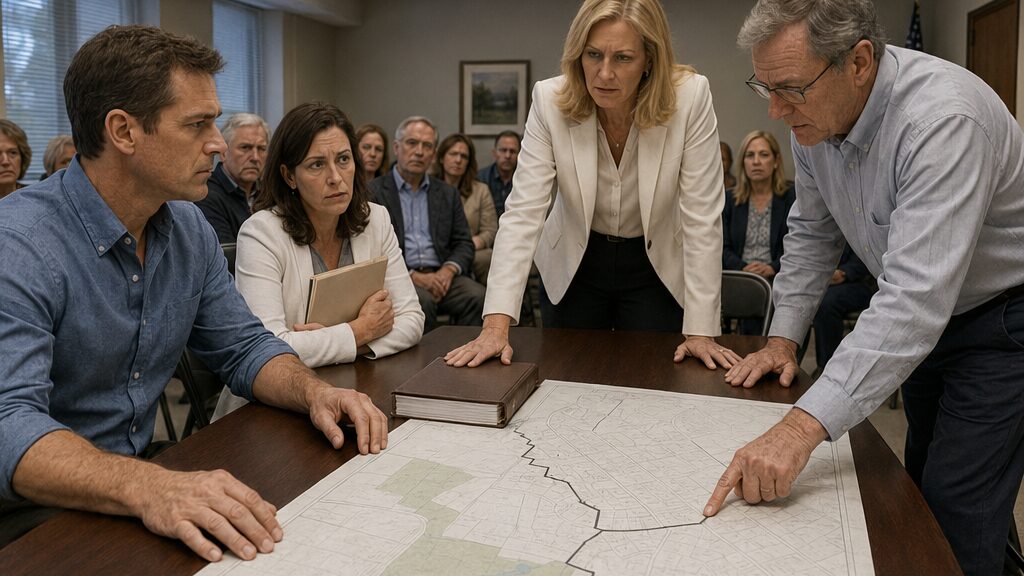
Gary opened a large printed map that had been clipped beneath his binder. He unfolded one panel, then another, until the paper covered much of the table.
The room quieted.
Stephen recognized the map at once. It was a reproduction of the recorded subdivision plat, enlarged and marked with lot numbers, street names and a heavy boundary line. He had spent his working life reading plans like it. Lines intended to look obscure to most people felt plain to him.
Gary traced Maple Ridge Lane from the entrance.
“Your address is 1148?”
“Yes.”
Gary followed the numbered parcels. His finger moved past 1142, then 1146.
At 1148, he stopped.
Not on the line.
Beyond it.
For several seconds, nobody spoke.
Stephen rotated the map slightly toward himself.
“Plat reference?” he asked.
Gary checked the lower corner. “Book forty-two, page one-eighty-seven.”
“And the association boundary description?”
Gary read the notation beside the heavy line. His voice became slower as he reached the final call.
“Along the eastern edge of Lot Seventy-Three, then north to the county right-of-way.”
Stephen pointed to his parcel. “This is Lot Seventy-Four.”
Gary looked at him, then back at the map.
“Yes.”
Janet sat down.
A woman at the rear whispered, “That’s outside.”
Tyler unfolded his arms. “I’ve been saying the edge parcels weren’t all included.”
Janet turned toward him. “Public comment comes later.”
Gary kept one finger on the map. “The recorded boundary stops one lot before the Harris property.”
The sentence altered the room more completely than any raised voice could have.
Michelle released the breath she had been holding. Her hand moved toward Stephen’s beneath the table but stopped before touching him.
Janet opened the management packet and flipped through several pages.
“There may have been a later annexation,” she said.
“Then it should be recorded,” Stephen replied.
“Not every administrative document appears on the face of the original plat.”
“An annexation changing association jurisdiction would.”
One of the board members leaned toward Gary. “Do we have an amendment?”
Gary did not answer immediately.
His pause lasted just long enough for Stephen to notice.
“You’ve looked at this before,” Stephen said.
Gary removed his glasses. “A parcel discrepancy was raised during the management conversion.”
“When?”
“Earlier this year.”
Michelle turned toward Janet. “Then why did we receive a final notice?”
Janet closed the packet. “Because the account history predates the current management system.”
“That doesn’t answer her,” Stephen said.
Janet’s jaw tightened. “The board was reviewing several inconsistent records. Your property was not singled out.”
“It was singled out for collection.”
The association attorney was not present, but the empty chair near Janet had a legal pad placed before it as though authority could be reserved by furniture.
Gary folded one corner of the map inward, then stopped.
“I move that active collection on the Harris account be suspended pending verification of annexation records,” he said.
A board member seconded.
Janet looked from the ledger to the residents behind Stephen. She seemed to calculate the cost of resisting in public.
“All in favor?”
Three hands rose, including Gary’s.
Janet raised hers last.
“The motion carries,” she said. “Collection is suspended.”
Michelle leaned closer to Stephen. “Suspended, not canceled.”
“I heard.”
Janet drew a line through the collection item on her agenda. “The current invoice will be withdrawn pending review.”
A murmur passed through the room. Tyler smiled without warmth, as though a prediction had been confirmed.
For one brief moment, relief moved through Stephen’s body. The threat had become paper again—still official-looking, still unpleasant, but stripped of immediate force.
Then Janet removed a yellowed index sheet from the back of the management packet.
“There is an additional reference,” she said.
Gary’s eyes moved to the sheet.
“What reference?” Michelle asked.
Janet read from a handwritten notation. “Petition for voluntary annexation. Harris parcel. Submitted by property owner.”
Stephen felt the room recede from him.
Michelle turned slowly.
“Which property owner?”
Janet checked the date.
“The submission was made fourteen years ago.” She looked directly at Stephen. “The petitioner was your father.”
Michelle’s voice dropped. “You knew he talked to them?”
Stephen kept his eyes on the index sheet. He had not expected the board to have that reference. He had expected incomplete records, careless billing, perhaps an old mailing list. He had not expected his father’s name to be waiting in Janet’s folder.
“A petition isn’t an annexation,” he said.
“No,” Janet replied. “But it may explain why the property was entered into the association system.”
Gary reached for the sheet. Janet did not give it to him.
Stephen glanced at the printed map. The heavy boundary line still stopped before his home. The fact had not changed. Yet the line no longer felt like an answer. It felt like the edge of something he had avoided measuring.
Janet addressed the board.
“I propose a special jurisdiction hearing after counsel reviews the petition, service records and account history.”
“How long?” Michelle asked.
“One week.”
“And the lien?”
“Suspended until the hearing.”
Stephen finally looked at Michelle. Her expression held no relief now, only the recognition that his certainty had contained an omission.
Janet gathered the ledger and the index sheet into the same folder.
“If the annexation was completed,” she said, “the assessments may be reinstated.”
The map remained open on the table after the meeting adjourned.
Stephen stood over it while chairs scraped behind him. Gary began folding the outer panels, but Stephen placed a hand on the section showing Lot Seventy-Four.
“What exactly did my father submit?” he asked.
Gary looked toward Janet, who was speaking with a board member near the door.
“I don’t know,” he said.
Stephen studied his face.
Gary lowered his voice. “But I think you do.”
Chapter 3: The Folder Stephen Refused to Open
The space on the bottom shelf was exactly wide enough for the missing property folder.
Michelle knelt in front of the office cabinet Friday morning, staring at the clean strip of wood between two dusty binders. One was labeled INSURANCE. The other held their father’s tax records. The space between them had been protected from dust by something recently removed.
Behind her, Stephen stood at the drafting table pretending to compare photocopies.
“Where is it?” she asked.
“What?”
“The folder that was here.”
“I moved several files.”
“Which one?”
He aligned the edge of the tax statement with the copied plat. “I don’t remember.”
Michelle rose. “You remember parcel numbers from fourteen years ago.”
“I remember the property.”
“Then remember the folder.”
He looked tired rather than angry, which only sharpened her frustration. Since leaving the HOA meeting, he had answered every question with a narrow technical distinction.
A petition was not an annexation.
A database entry was not jurisdiction.
A suspended lien was not an active lien.
Each sentence might have been true. None explained why their father’s name had drained the color from Stephen’s face.
“I’m going to the county records office,” she said.
“I already requested the plat.”
“I’m not looking for the plat.”
“You won’t find HOA correspondence there.”
“I’m looking for any recorded amendment, easement or annexation attached to the parcel.”
“There isn’t one.”
She picked up her bag. “Then you should be pleased when a clerk confirms it.”
The county records building occupied a low brick structure beside the courthouse parking lot. Michelle arrived before lunch and waited beneath fluorescent lights while a planning clerk searched the parcel number.
The clerk pulled up the tax map first, then the subdivision filing.
“Lot Seventy-Four is outside the original declaration,” she said.
“Could it have been added later?”
“Yes, through a supplemental declaration or annexation instrument.”
“Do you have one?”
The clerk searched by address, owner name and legal description. Each time, the results showed the same deed transfers and drainage easement, but no association amendment.
“Nothing recorded,” she said.
Michelle rested both hands on the counter. “What about a petition?”
“A petition by itself wouldn’t amend the declaration.”
“So signing one wouldn’t make the property part of the HOA?”
“Not without completion of whatever approval process the documents require, and typically a recorded instrument.”
It was the answer Michelle had hoped for. It should have brought relief.
Instead, it made Stephen’s concealment harder to understand.
The clerk printed a certification showing no recorded HOA annexation against the parcel. As Michelle waited for the printer, she noticed a reference in the easement index.
TEMPORARY ACCESS AND DRAINAGE COORDINATION.
The date matched the year of their father’s petition.
“What is this?”
The clerk opened the scanned page. It allowed temporary access across the rear edge of the property for drainage work performed jointly by the county, the HOA and adjacent owners. The agreement expired after twelve months.
“Does this create membership?” Michelle asked.
“No. It appears limited to construction access.”
Their father’s signature appeared at the bottom.
So did another name: Anna Baker.
Michelle remembered Anna as a small, sharp-eyed woman who had owned the narrow rear parcel before selling part of it to their father. Anna had attended the funeral but left before the reception.
Michelle photographed the record reference and drove home with the certified search in her bag.
Stephen’s truck was gone.
The office cabinet remained open.
She checked the garage.
Their father’s workbench stood along the back wall beneath pegboard hooks and empty outlines where tools had once hung. Stephen had moved several rolled plans there after taking over the office. A steel cabinet beside the bench was unlocked.
Inside were municipal drafting manuals, spare tracing paper and an old rain jacket.
No property folder.
Michelle closed the cabinet and noticed gray dust disturbed beneath the lowest shelf. She crouched and ran her fingers along the floor.
Something had been dragged toward the drafting tube rack.
She pulled out the tubes one by one. Behind them, wrapped in a plastic grocery bag, was a thick brown folder.
HARRIS PROPERTY—MAPLE RIDGE was written across the tab in their father’s block printing.
Michelle sat on the concrete floor before opening it.
The first page was a voluntary annexation petition bearing their father’s signature. At the top, the HOA’s name had been typed beside a blank space for a recording number.
No number had been added.
A handwritten condition appeared beneath the signature:
Subject to completion of permanent rear drainage correction and execution of adjoining access easement.
Behind the petition lay meeting notes, estimates and a hand-marked neighborhood map. Their father had drawn a dotted extension around Lot Seventy-Four, but the dotted line stopped at the rear boundary where Anna Baker’s easement was required.
A final page had been folded inward.
Stephen had written on it, not their father.
The handwriting was harder, pressed deep into the paper.
You don’t fix a broken promise by surrendering the house.
Michelle read the sentence twice.
A date had been written in the corner. It was three days before their father’s stroke.
The garage door rose behind her.
Stephen stepped inside carrying a paper bag from the hardware store. He stopped when he saw the folder open across her knees.
For a moment, neither of them moved.
“You went through my drafting equipment,” he said.
“Our property records.”
“I was going to show you.”
“When?”
He set the hardware bag on the workbench. A box of screws tipped sideways inside it.
Michelle held up the petition. “Dad signed this.”
“With conditions.”
“You knew.”
“I knew he considered it.”
“You hid the entire file.”
“I removed it because Janet would use the signature without the rest.”
“You removed it before I could see it.”
Stephen’s gaze shifted to the page with his handwriting.
Michelle followed his eyes.
“What happened three days later?”
His face closed.
“Stephen.”
“He had the stroke.”
“And this was your last argument?”
He picked up the hardware bag, then put it down again without moving it anywhere.
“He thought joining would force them to repair the drainage,” he said. “I told him once they had the signature, they’d stop negotiating.”
“Were you right?”
“I don’t know.”
“The annexation wasn’t recorded.”
“That doesn’t tell us what happened.”
Michelle stood, holding the folder against her chest. “It tells me you had evidence that could help us and evidence that could hurt us, and you decided I wasn’t entitled to either.”
“I was trying to keep them from twisting it.”
“No. You were trying to keep anyone from asking what you said to Dad.”
The accusation landed between them with more force because she had spoken quietly.
Stephen looked toward the open garage door. Across the street, a landscaping truck moved slowly past the HOA homes and continued without turning into their driveway.
“The petition alone doesn’t transfer jurisdiction,” he said.
Michelle almost laughed.
“You’re doing it again.”
“What?”
“Hiding inside the narrowest true sentence you can find.”
She opened the folder to the hand-marked map. Beneath it was a copy of the temporary drainage agreement with Anna Baker’s signature.
“I went to the county,” she said. “There’s no recorded annexation. But there was a temporary access agreement, and Anna signed it.”
Stephen stared at the name.
“She may know why the permanent easement never happened.”
“She’s in assisted living near Westfield.”
“You knew that too?”
“I send her a Christmas card.”
Michelle placed the certified county search inside the folder.
“The HOA attorney will find the petition,” she said. “Janet already has the index reference. We cannot pretend this page doesn’t exist.”
“I’m not pretending.”
“You wrapped it in a grocery bag and hid it behind drafting tubes.”
He flinched, almost imperceptibly.
Michelle closed the folder.
“I’m keeping this.”
“No.”
“I’m a co-owner.”
“It contains private notes.”
“It contains the history of a debt being asserted against my house.”
Stephen stepped between her and the door. He did not touch the folder, but his body blocked the easiest path out.
“What are you planning to do?”
“Make copies.”
“For Janet?”
“For us. For the attorney if necessary. And I’m calling Anna.”
“She may not remember.”
“Then we ask.”
“Michelle.”
She waited.
His resistance changed shape. The anger left his shoulders, revealing something less defensible.
“I told him he was giving away the only thing Mom had left him,” Stephen said. “He said I cared more about lines on paper than the people living inside them.”
Michelle’s grip loosened on the folder.
“What did you say?”
“That lines were the only reason people couldn’t take what belonged to you.”
The garage seemed to contract around the old workbench, the maps and the outlines of missing tools.
Stephen looked at the handwritten sentence.
“He never spoke to me again.”
Michelle wanted to tell him the silence had not been a verdict. Their father had been sedated after the stroke, then unable to form more than fragments. But she understood that Stephen had built a verdict anyway and lived inside it for years.
She moved past him.
At the door, she stopped.
“I’m not giving this to Janet without telling you,” she said. “But I won’t help you hide it.”
Stephen remained beside the workbench.
Michelle carried the folder into the house and placed it on the kitchen table, beside the final notice.
The map inside was older than the HOA’s database, older than the debt, older than the argument that had divided the family. Its dotted boundary line reached toward their home and stopped before closing.
For the first time, Michelle understood that the missing piece might not be in the county records at all.
It might be with the woman whose signature appeared beside their father’s—an
Chapter 4: A Promise Missing From the Official Record
Anna Baker recognized the folded map before Stephen had finished removing it from the brown folder.
“That line still isn’t closed,” she said.
Stephen stood beside her small table in the assisted-living residence, holding the paper by its corners. Anna had been sorting cards into piles when he arrived. Her hands were thinner than he remembered, but they stopped moving the moment she saw his father’s dotted boundary.
Michelle remained near the window with the county records in her lap.
“You remember this?” Stephen asked.
“I drew the first version on butcher paper because your father refused to believe the drainage ditch crossed three parcels.” Anna pointed to the chair opposite her. “Sit down. You’re making it look like a summons.”
Stephen lowered himself into the chair.
Anna studied him for a moment. “You have his expression when you expect facts to protect you from a conversation.”
Michelle looked down, hiding a reaction.
Stephen unfolded the map across the table. The original subdivision boundary ended before Lot Seventy-Four. His father’s dotted extension curved around the house but stopped at the rear property line.
“We need to know why the annexation wasn’t completed,” he said.
Anna touched the unfinished line with one finger.
“Because they didn’t keep their promise.”
“Which promise?”
“The permanent drainage correction.”
She said it as though the answer should have remained obvious for fourteen years.
Anna had once owned the narrow strip behind the Harris property. Water from the upper section of Maple Ridge crossed that land before reaching a county culvert. After several homes were built, runoff began cutting through the rear yards. Stephen remembered flooded grass and sandbags, but he had been working long hours then and had treated the problem as one more argument between his father and the association.
“The HOA offered to repair it if Dad joined,” he said.
“They offered to coordinate the repair,” Anna corrected. “Your father agreed to annex his lot if they installed a permanent channel and restored my access lane afterward. They also needed my easement to reach the culvert.”
Michelle opened the folder. “We found the temporary agreement.”
“That was for one year.”
“What work did they complete?” Stephen asked.
Anna leaned back. “They dug a shallow trench, laid loose stone and told us the next budget would fund the permanent section.”
“Did it?”
“The next budget funded the entrance monument.”
Stephen remembered the stone columns and decorative lamps near the subdivision entrance. His father had complained about them for months. Stephen had assumed the complaint was about taste.
Anna moved her finger along the map.
“The first heavy rain washed half the stone into my garden. Your father asked them to finish the job before recording anything. I refused to sign the permanent easement until they did.”
“So the annexation stopped.”
“It should have.”
The word should settled uneasily between them.
Michelle placed the county certification beside the map. “Nothing was recorded.”
Anna nodded. “Then legally it stopped.”
“But the HOA entered the property into its system,” Stephen said.
“Your father received newsletters for a while. Maybe a couple of notices. He sent them back.”
Stephen looked at her. “Assessments?”
“I don’t remember amounts. He said he wasn’t paying for a promise they had already broken.”
That sounded like his father—practical, stubborn and unwilling to separate money from principle. It also sounded uncomfortably like Stephen.
“Did he still want to join?” Michelle asked.
Anna considered the question.
“He wanted the drainage fixed. He wanted peace with the neighbors. I don’t know whether he cared about belonging to the association after that.”
Stephen stared at his father’s dotted line. “He told me joining was the only way to make them responsible.”
“And what did you tell him?”
Michelle shifted in her chair, but Stephen answered.
“I told him they would take his signature and forget the conditions.”
Anna’s eyes stayed on the map. “You weren’t entirely wrong.”
The words offered no comfort.
“He had the stroke three days later,” Stephen said.
“I know.”
“He never told me the agreement failed.”
“He may have thought you already understood.”
“I didn’t.”
Anna folded her hands. “Did you ask?”
Stephen looked toward the hallway. A cart rattled past the open door, followed by a burst of laughter from another room.
“No.”
“Then neither of you finished the conversation.”
The simple division of responsibility hurt more than absolution would have.
Michelle slid a copy of the petition toward Anna. “This condition is handwritten beneath his signature. Is that how the board received it?”
“Yes. He refused to sign a clean copy.”
“Who attended the last negotiation?”
Anna named two former board members whose names meant nothing to Stephen. Then she tapped the petition.
“And Janet Clark.”
Stephen looked up. “Janet was there?”
“She wasn’t president yet. She chaired the property committee.”
“Did she know you refused the easement?”
“She watched me cross my name off it.”
Michelle leaned forward. “Did you give anyone a written refusal?”
Anna’s confidence faltered for the first time.
“I wrote one.”
“Was it recorded?”
“No.”
“Mailed to the county?”
Anna shook her head.
“Why not?” Stephen asked.
“Because I thought refusing to sign was enough.”
The room seemed to sharpen around that sentence.
Anna looked irritated with herself, but not surprised by the consequence. “The board had the unsigned easement. Your father had the conditional petition. There was nothing to record.”
“Unless someone later treated the petition as complete,” Michelle said.
Anna’s mouth tightened. “That would have been dishonest.”
“Or careless,” Stephen said.
“Carelessness becomes a choice when someone benefits from not checking.”
Stephen heard his own judgment in her voice and felt its weight return to him.
They left after Anna agreed to sign a statement describing the drainage conditions and failed negotiation. Before Stephen folded the map, she took a blue pen from the card table.
“What are you doing?” he asked.
“Finishing what I should have marked years ago.”
She drew a line along the rear edge of Lot Seventy-Four, then stopped at the point where her permanent easement would have connected to the drainage corridor. Beside it she wrote: NOT EXECUTED.
The letters trembled slightly but remained clear.
In the parking lot, Michelle placed the map inside a protective sleeve.
“We have enough to challenge the petition,” she said.
“Enough to show it was conditional.”
“That matters.”
Stephen looked back at the building. “It also shows Dad wanted in.”
“For a reason.”
“They’ll say the reason doesn’t matter.”
“Then we explain why it does.”
He did not answer.
On Monday afternoon they walked the rear property line. The temporary stone channel was still visible beneath weeds and silt. It widened near Anna’s former parcel, then dissolved into bare earth before reaching the culvert.
Stephen crouched and lifted a loose stone. Moss darkened one side.
For fourteen years, the failed repair had remained behind the house as physical proof. He had mowed near it, cleared branches from it and complained when water pooled beside it. He had never followed the line to its unfinished end.
Michelle stood on the higher bank. “The HOA attorney sent document requests.”
“For what?”
“Any annexation records in our possession. Any service agreements. Any evidence that Dad objected.”
Stephen replaced the stone.
“Are you sending the folder?”
“I’m sending copies of the complete folder.”
He rose. “Not my note.”
“The note isn’t relevant to membership.”
“Then leave it out.”
She studied him. “I will. But you need to stop deciding that every painful fact is legally irrelevant just because you don’t want it spoken aloud.”
He brushed dirt from his hands.
“Anna said Janet had the unsigned easement,” Michelle continued. “That means this is no longer just a database mistake.”
“Unless Janet forgot.”
“Did she look surprised when the map excluded us?”
Stephen remembered Janet reaching for the yellowed index sheet almost immediately. She had not searched for it. She had known where it was.
“No,” he said.
That evening, he called Anna again to confirm the date of the final meeting.
She answered after several rings.
“One more thing,” she said before he could ask his question. “Janet took the original easement packet when the meeting ended. Your father asked for it back. She said the association needed to retain it with the pending annexation file.”
“Pending?”
“That was her word.”
“Did she ever return it?”
“Not to me.”
Stephen looked across the kitchen at Michelle, who was scanning the county documents.
Anna lowered her voice.
“If Janet still has that paper, she has known all along that the line was never finished.”
Chapter 5: The Board Member Who Already Knew
Gary Miller opened his front door holding the same map he had unfolded at the HOA meeting.
He had not invited Stephen inside yet. He stood beneath the porch light with the plat rolled loosely in both hands, as though he had been expecting either a confession or an accusation.
“I assume this is why you’re here,” Gary said.
Stephen looked past him toward a dining room table covered with folders.
“You told me you didn’t know what my father submitted.”
“I said I didn’t know exactly.”
“That distinction sounds familiar.”
Gary absorbed the remark without protest. Then he stepped aside.
The dining room looked less like a home than a temporary records annex. Association binders were stacked on two chairs. A laptop displayed a spreadsheet of parcel numbers. On the table lay a second map—newer, smaller and marked in red ink.
Stephen placed Anna’s statement and the copy of the unsigned easement beside it.
Gary read the first page standing up.
“Where did you get this?”
“Anna Baker.”
“She’s still alive?”
“Yes.”
Gary lowered himself into a chair.
Stephen pointed to the map from the meeting. “When did you first notice our parcel was outside?”
Gary removed his glasses and cleaned them with the hem of his shirt. “During the management-company conversion.”
“That was six months ago.”
“About that.”
“And you raised it?”
“I asked Janet for the annexation instrument.”
“What did she give you?”
“A petition index and an account history.”
“Not an instrument.”
“No.”
“Yet the final notice went out.”
Gary replaced his glasses. “The notice cycle was automated.”
“The board authorized collection.”
“We authorized delinquent accounts as a group.”
“My parcel was in the group because nobody removed it.”
Gary’s eyes hardened slightly. “You want me to say Janet sat at a desk and deliberately manufactured your debt. I can’t say that.”
“I didn’t ask you to.”
“You came here because you think I know more than I said publicly.”
“You do.”
The older man looked down at Anna’s statement.
“Yes.”
Outside, a garage door closed somewhere along the street.
Gary unrolled the second map. Red lines extended the association boundary around several parcels along Maple Ridge Lane. Stephen immediately saw that the markings were not part of the recorded plat.
“What is this?”
“A working map used by the management company.”
“Based on what?”
“Account status.”
Stephen stared at him. “They drew the boundary from the billing database?”
“That appears to be what happened.”
The circular error was so clean it almost seemed intentional: the property was billed because the database said it belonged, and the map showed it belonged because it was billed.
“How many parcels?” Stephen asked.
“Five questionable ones, including yours.”
“Questionable how?”
“No recorded annexation found in the initial search.”
“And Janet knows?”
Gary folded his hands. “I gave the board a memo.”
“When?”
“Before your final notice.”
Stephen pushed back from the table.
Gary lifted one palm. “There was a reserve-study meeting the same week. The association is facing major road and drainage costs. Janet believed removing accounts before counsel reviewed them would create panic.”
“Panic for whom?”
“Homeowners already angry about a proposed dues increase.”
“So she left the accounts active.”
“She argued that some edge properties had received services and may have entered through older procedures.”
“Without recorded instruments.”
“That was my objection.”
“But you voted to postpone the review.”
Gary looked at the folders beside him.
“Yes.”
The admission did not arrive with an excuse. That made it more difficult to dismiss.
“Why?” Stephen asked.
“Because I had been secretary for nine years. Because Janet said counsel would sort it out. Because I didn’t want to be the person who opened five old disputes before the reserve vote.”
“You were a county records clerk.”
“I know.”
“You knew what the missing documents meant.”
“I knew what they might mean.”
Stephen leaned toward him. “That’s another narrow true sentence.”
Gary’s face changed. Shame passed across it, followed by irritation at being seen.
“I also knew your property had used an association road-repair program,” he said.
Stephen paused.
“What program?”
Gary opened an account file and removed a work order. Fourteen years earlier, during the proposed annexation, the HOA had coordinated asphalt patching along the public-road shoulder in front of the Harris property. Stephen’s father had signed the completion form.
“The county wouldn’t repair the shoulder that year,” Gary said. “The association contractor did.”
“That wasn’t membership.”
“No. But it complicated the review.”
“It was done while the annexation was pending.”
“Probably.”
“Probably?”
“I wasn’t on the board then.”
Stephen read his father’s signature. The work order was not a covenant, but Janet would use it to argue that the family had accepted benefits.
Gary tapped Anna’s statement. “This helps establish the conditions. The unsigned easement helps more.”
“Will you say when you warned Janet?”
Gary looked toward the hallway, where framed photographs of grandchildren stood on a shelf.
“At the hearing?”
“Yes.”
“That would mean admitting I voted to delay correction.”
“You did.”
Gary’s mouth tightened.
Stephen waited. He had spent years assuming that if facts were placed in the correct order, people would follow them. Now he watched Gary confront the space between knowing a fact and accepting its cost.
Finally Gary nodded.
“I’ll speak.”
Stephen rolled the recorded map. “And the other parcels?”
“I’m still reviewing them.”
“That isn’t good enough.”
“It’s what I can prove tonight.”
Stephen nearly answered with the anger he had carried to the door. Then he saw the open binders, the handwritten parcel list and the untouched dinner plate on a sideboard.
Gary had begun working. Late, and under pressure, but not merely because Stephen had caught him.
“What changed?” Stephen asked.
Gary looked at the map from the meeting. “My finger stopped before your house in front of thirty people. I realized I had spent months pretending the line was less clear when nobody was watching.”
Stephen understood too well.
Gary walked him to the door with copies of the memo and the road-repair work order. Before Stephen stepped outside, Gary spoke again.
“There’s something else.”
Stephen turned.
“Your sister sent the family petition to the association attorney this afternoon.”
“She told me she was sending the complete record.”
“She sent the petition, the conditional note, the temporary agreement and Anna’s statement.”
“That’s complete.”
“Yes. But counsel responded quickly.”
Gary handed him a printed email.
The attorney argued that the petition, the road-repair work order and years of association communications could establish what the email called equitable membership, even without a recorded annexation.
Stephen read the phrase twice.
“That isn’t a recorded property interest.”
“No,” Gary said. “But it gives Janet an argument that you accepted benefits while avoiding obligations.”
“My father signed one work order during negotiations.”
“And you ignored assessment notices rather than formally disputing membership.”
Stephen folded the email.
The decision he had treated as restraint now appeared in the attorney’s reasoning as evidence of implied consent. His silence had left no clear objection in the record.
When he reached home, Michelle was at the kitchen table arranging copies for the hearing.
“You sent everything,” he said.
She looked at the email in his hand. “Everything relevant.”
“You gave them the petition before we had Gary’s memo.”
“They already knew about the petition.”
“You strengthened their case.”
“I prevented them from claiming we concealed it.”
Stephen placed the road-repair work order before her.
She read it and went still.
“Did you know about this?” he asked.
“No.”
“Dad accepted an HOA contractor’s work.”
“During the drainage negotiation.”
“That’s how we understand it. They’ll describe it differently.”
Michelle met his eyes. “Would you rather I had hidden the folder?”
The question ended the argument before he could begin it.
He sat opposite her and unfolded Gary’s memo. The document showed that uncertainty over the parcel had been formally raised before the final collection notice.
Michelle read it slowly.
“He’ll testify?”
“Yes.”
“Then we have the truth on both sides.”
Stephen looked at the attorney’s email. “Truth doesn’t prevent someone from arranging it against you.”
“No. But hiding pieces lets them decide why you hid them.”
A chime sounded from Michelle’s laptop.
A new message had arrived from the HOA attorney. Attached was a formal hearing statement.
At the top, in bold type, were the words BASIS FOR EQUITABLE MEMBERSHIP.
The document claimed the Harris property had accepted association-funded services, received community communications and failed to object for years. It requested reinstatement of all assessments if the board found an implied obligation.
Michelle read the first page, then slid the laptop toward Stephen.
“They’re no longer arguing that the boundary includes us,” she said.
Stephen looked at the phrase equitable membership.
“No,” he replied. “They’re arguing the boundary doesn’t matter.”
Chapter 6: The Hearing Where Silence Became Evidence
Janet began the special hearing by projecting Stephen’s father’s signature onto the wall.
The image was enlarged until every hesitation in the pen stroke became visible. Beneath it appeared the title VOLUNTARY ANNEXATION PETITION.
No condition was shown.
Stephen sat beside Michelle at the end of the conference table. In front of him were three document sleeves: the recorded plat, the conditional petition and the unsigned easement. He had arranged them in that order because sequence mattered.
Janet addressed the crowded room.
“The Harris property requested membership, accepted association-coordinated improvements and remained integrated with Maple Ridge for fourteen years. The question is whether a technical recording defect erases those obligations.”
Stephen watched Gary shift in his chair.
The association attorney sat beside Janet this time. The attorney’s argument was careful. No one claimed the recorded boundary included Lot Seventy-Four. Instead, counsel described reliance, fairness and services received.
“The association spent funds based on the property owner’s expressed intention to join,” the attorney said. “The current owners cannot accept the benefits while rejecting every corresponding responsibility.”
Janet advanced the projection to the road-repair work order.
Stephen’s father’s signature appeared again.
A murmur moved through the residents.
Tyler Scott sat in the front row. He shook his head openly, but Stephen could see how easily the documents might persuade someone unfamiliar with the missing steps.
Janet looked toward him.
“Mr. Harris, do you dispute that your father signed these documents?”
“No.”
Michelle turned slightly. They had agreed that Stephen would not begin with denial.
“Do you dispute that the association contractor repaired the road shoulder in front of your property?”
“No.”
“Do you dispute receiving association communications?”
“No.”
Janet paused, letting the admissions accumulate.
“Then what exactly are you disputing?”
Stephen stood.
“That intention became membership.”
He carried the first sleeve to the center of the table and removed the recorded plat.
“This is the governing boundary on file with the county. Lot Seventy-Four is outside it.”
He placed the conditional petition over the map, aligning the parcel sketch.
“This is the petition my father signed. The version on the wall omits the condition written beneath his signature.”
Michelle handed copies to the board. Gary read the condition aloud: permanent drainage correction and execution of the adjoining access easement.
Stephen added the third document.
“This is that easement. It was never executed.”
Through the clear sleeves, the three pages overlapped. The original boundary ended before the house. The proposed dotted line curved around it. The unsigned easement left the final connection open.
A single incomplete shape now occupied the table.
The attorney leaned forward. “The association’s position is that the conditions were substantially performed.”
Stephen placed photographs of the failed drainage channel beside the documents.
“They laid temporary stone under a one-year access agreement. The permanent channel was never completed.”
“That does not negate the road work your property received.”
“No. It means the road work occurred during a pending negotiation.”
Janet folded her hands. “Your father benefited from association funds.”
“He also allowed access across his property for work benefiting homes uphill.”
The room quieted again.
Stephen had nearly excluded that fact from his presentation because it made the transaction less clean. Instead, he placed the temporary agreement beside the work order.
“The arrangement was mutual,” he said. “It was not completed membership.”
The attorney pointed toward the petition. “Yet your family retained these documents and never submitted a formal withdrawal.”
Stephen felt Michelle’s attention on him.
This was the point he had wanted to avoid from the first notice onward. He could continue speaking only about recording statutes and conditional documents. He could let the board’s negligence carry the full moral burden.
Or he could explain why the record contained years of unanswered mail.
“I found earlier notices,” he said. “I did not open them.”
Janet’s expression sharpened.
Stephen continued before she could use the admission for him.
“I knew my father had discussed annexation. I also knew the process had caused our last argument. After he died, I removed the folder from the property cabinet. When notices came, I assumed they were wrong and chose not to answer.”
Michelle’s hand tightened around her pen.
“I told myself the recorded boundary was enough,” Stephen said. “Legally, it should have been. Practically, my silence allowed a bad account entry to remain unchallenged. That was my mistake.”
Janet looked toward the residents. “And during that silence, the association reasonably relied on its records.”
“No,” Gary said.
The word came from the board side of the table.
Gary opened his binder and removed the memo he had given Stephen.
“The association was formally warned that the records were unreliable six months before the final notice.”
Janet’s face hardened. “We were conducting a review.”
“We postponed it.”
“At counsel’s recommendation.”
“Counsel had not yet reviewed the parcel files when we voted.”
One board member looked from Gary to Janet. “Was the Harris account specifically identified?”
Gary nodded.
“And you authorized collection anyway?”
“I voted with the board to continue processing existing accounts.”
The admission brought no satisfaction to Stephen. Gary looked smaller after making it.
Janet spoke with controlled precision. “We faced a reserve deficit and five disputed edge properties. Removing accounts without full review would have shifted costs onto confirmed members.”
Tyler rose from his chair.
“So you billed people who might not owe anything because your budget was short?”
“Sit down,” Janet said.
“You should resign.”
Several residents spoke at once.
Tyler turned toward them, raising his voice. “This is bigger than one invoice. She knew the map was wrong.”
Stephen stepped away from the table.
“Tyler.”
Tyler looked at him. “This is your chance.”
“For what?”
“To force accountability.”
“I am forcing it.”
“Then ask for her removal.”
Stephen glanced at Janet. Her fear was visible now, though she held herself still. She had protected the association’s finances, her own authority and a procedure she knew was incomplete. None excused the final notice. But turning the hearing into a public punishment would allow everyone else to treat her as the only failure.
“This hearing is about the parcel records,” Stephen said.
“It’s about her.”
“No. That would be easier.”
Tyler stared at him, then sat reluctantly.
Stephen returned to the table.
“Janet had evidence the annexation was incomplete,” he said. “Gary had evidence the map conflicted with the database. I had evidence explaining the history and refused to answer. Different responsibilities do not cancel each other.”
Michelle looked at him then—not with forgiveness, but with the first understanding he had seen since the mailbox.
The attorney conferred quietly with Janet. After a moment, Janet asked Anna’s signed statement to be entered into the record.
Gary read the passage describing the failed permanent repair and her refusal to execute the easement.
The attorney removed his glasses.
“Without a recorded annexation, and given the express unfulfilled conditions, counsel cannot recommend enforcing covenants or assessments against Lot Seventy-Four.”
Janet’s eyes remained on the documents.
“The chair will entertain a motion,” she said.
A board member moved to withdraw the Harris debt permanently, cancel all fees and confirm that no lien would be filed.
Gary seconded.
The vote passed unanimously.
No one applauded. The decision was too complicated for celebration.
Michelle exhaled and closed the final-notice folder.
Janet began gathering the documents, but Stephen left the three aligned sleeves on the table.
“What about the other parcels?” he asked.
“Their circumstances may differ,” Janet said.
“Then they should be reviewed individually.”
“The association cannot resolve unrelated accounts tonight.”
Gary opened his parcel spreadsheet.
“I move that the board order an independent audit of every edge parcel, suspend collection on any account lacking a recorded membership instrument and provide the results to affected owners.”
Janet looked at him. “That motion is not on the agenda.”
“The jurisdiction review is.”
“The financial consequences could be substantial.”
“So were the consequences of the Harris notice,” Gary said.
One board member whispered to the attorney, who answered quietly.
Janet glanced toward the residents. Every face was turned toward the table. The strategy of postponement no longer had the protection of private procedure.
Gary repeated the motion.
A board member seconded it.
Janet’s hand remained flat beside her binder.
Stephen looked at the map beneath the transparent sleeves. For years, he had believed a boundary line worked because it was fixed, recorded and impersonal. But the line had protected nothing until people chose to acknowledge what it required of them.
“All in favor?” Gary asked.
One hand rose.
Then a second.
Gary raised his own.
Janet was now the only board member who had not voted.
Chapter 7: The Mailbox After the Boundary Was Corrected
Three weeks later, another certified envelope waited inside the black mailbox.
Stephen saw the red delivery label before he touched it. For one suspended second, the old reaction returned: the tightening beneath his ribs, the urge to close the metal door and leave the paper where it was.
The envelope bore the Maple Ridge Homeowners Association’s return address.
He removed it and shut the mailbox.
Michelle was standing on the porch with two mugs. She did not ask what the letter contained. She only watched him walk up the driveway carrying it in plain view.
“That didn’t take long,” she said.
“The audit report was due yesterday.”
“Open it.”
Stephen slipped a finger beneath the flap.
The first page was not a demand. It was a formal confirmation that the Harris account had been permanently closed and that all collection activity had been withdrawn. A check was attached beneath it.
Michelle set down both mugs.
“How much?”
“Four hundred eighty-six dollars.”
“For what?”
“Reimbursement for certified-record fees, copying costs and the county search.”
She took the letter and read the explanation. “They included our actual expenses.”
“Gary asked us to submit them.”
“I didn’t think the board would approve it.”
“Neither did I.”
Beneath the reimbursement notice was a reduced copy of the neighborhood map. The heavy association boundary ended at Lot Seventy-Three, exactly as it had on the conference-room table. Lot Seventy-Four was shaded separately and labeled NON-MEMBER PARCEL.
A note at the bottom stated that the corrected map had been distributed to the management company, collection counsel and all affected property owners.
Michelle ran her thumb along the printed boundary.
“They finally closed the line in the right place,” she said.
Stephen looked past her toward the rear yard, where the failed drainage channel remained hidden behind the house.
“No,” he said. “They finally stopped pretending it closed somewhere else.”
The reform meeting that evening drew more residents than the special hearing had. Folding chairs extended into the hallway, and the association attorney occupied a seat near the back rather than beside the board.
Gary sat at the conference table with a stack of audit summaries. Janet’s chair at the center remained empty until two minutes before the meeting began.
When she entered, conversations softened but did not stop.
She wore a navy jacket instead of the white suit she had worn at the first dispute. She placed a single binder on the table and called the meeting to order without looking toward Stephen.
Gary presented the audit.
Five edge parcels had lacked complete recorded membership instruments. The Harris account was the oldest. Two properties had received notices but never paid. Three others had paid assessments for varying periods.
One of the affected homeowners stood near the back wall.
“Are we getting that money back?”
The association attorney answered carefully. “The proposed resolution authorizes reimbursement of assessments collected without verified membership, subject to review of each account.”
“Subject to what?”
“To confirmed payment history and any separate written agreements.”
The homeowner remained standing. “You had no authority to bill us.”
Janet folded her hands. “The board acknowledges that the records were insufficient.”
“That isn’t the same as saying you were wrong.”
A murmur followed.
Stephen looked at Tyler, who sat in the aisle seat. Tyler leaned toward him.
“She’s still avoiding it,” he whispered. “Say something.”
Stephen shook his head.
“You made them open the audit.”
“Gary made the motion.”
“Because you forced the issue.”
Stephen kept his voice low. “This isn’t my meeting to take over.”
Tyler sat back, dissatisfied.
Gary continued. The proposed reforms required an independent title review before adding any parcel to the association database, a recorded instrument before assessments could begin, and board-level verification before any lien referral. Disputed accounts would be suspended automatically rather than left active during review.
The measures sounded obvious when read aloud. That was what unsettled Stephen most. None required unusual courage or expertise. They required only that someone pause before converting uncertainty into authority.
One board member moved to adopt the reforms.
Another seconded.
Before the vote, Janet opened her binder.
“I have a statement,” she said.
The room quieted.
She did not read from the page immediately.
“The association has operated for years with incomplete historical records,” she began. “During the recent management conversion, discrepancies were identified. I believed maintaining existing account classifications until legal review was the least disruptive course.”
A resident near the door said, “Least disruptive for the board.”
Janet’s fingers tightened around the paper.
“Yes,” she said. “In part.”
The admission changed the room more than a denial would have.
“We were facing a reserve shortfall,” she continued. “Correcting several accounts at once would have required either delayed maintenance or higher assessments for confirmed members. I treated that financial pressure as a reason to postpone questions that should have been answered before collection continued.”
She looked toward Gary.
“The secretary advised a broader review. I supported delaying it.”
Gary did not nod or look away.
Janet turned one page.
“I am resigning as president effective tonight. I will remain available to assist with the records transfer.”
Tyler leaned toward Stephen again. “There it is.”
But there was no triumph in Janet’s face. Only fatigue and the guarded dignity of someone willing to name a procedural failure without surrendering every justification she had once believed.
After the vote passed, Stephen found her gathering papers alone.
“The reimbursement arrived,” he said.
“I signed the checks yesterday.”
“Thank you.”
Janet closed the binder. “The association owed it.”
He waited, unsure whether either of them expected more.
She glanced toward the corrected map mounted on the wall.
“Your father did want the property included.”
“Under conditions.”
“Yes.”
“And the conditions failed.”
“Yes.”
Her answers remained precise.
Stephen said, “You had Anna’s unsigned easement.”
“I had a copy in an old property file. I did not connect it to the account until after the first meeting.”
“Gary’s memo should have made you check.”
“It should have.”
The apology did not come.
He realized he had been waiting for it anyway.
Janet lifted the binder. “You believe I used the uncertainty because the association needed the money.”
“I believe you decided the risk to us was easier to tolerate than the risk to the board.”
She met his eyes.
“That is fair.”
It was not remorse. It was not reconciliation. But it was more honest than the final notice had been.
Gary announced his resignation as secretary before the meeting adjourned. He would remain through the audit corrections, then leave the board.
“I confused neutrality with not disrupting the process,” he told the room. “The process was already doing harm.”
Outside, Tyler caught up with Stephen and Michelle.
“You could run for the board,” he said.
“I’m not a member.”
“The reform committee doesn’t require membership.”
Stephen smiled faintly. “You want someone who agrees with you.”
“I want someone who reads the documents.”
“Those aren’t the same thing.”
Tyler accepted the answer with a reluctant shrug. “Think about it.”
At home, Michelle spread the corrected map on the kitchen table. Beside it lay their father’s petition, Anna’s marked copy and Stephen’s handwritten note from fourteen years earlier.
You don’t fix a broken promise by surrendering the house.
He reached for the note.
Michelle placed her hand over it.
“Don’t hide it again.”
“I wasn’t going to.”
“You were folding it.”
Stephen looked down. His fingers had already found the old crease.
Michelle removed her hand. “Put the corrected map with Dad’s papers. All of it together.”
“The petition too?”
“Yes.”
“It makes him look uncertain.”
“He was uncertain.”
Stephen considered the open property folder.
For years, he had treated the incomplete annexation as proof that his father had nearly made a mistake. Anna’s account had changed that. His father had not been surrendering the house. He had been bargaining with the only leverage he possessed, trying to force a promise into something permanent.
Stephen slid the recorded plat into the folder. Then the conditional petition. Then the unsigned easement, Anna’s statement and the corrected audit map.
Finally, he added his own note.
Michelle watched him close the cover.
“I’m sorry,” he said.
“For the notices?”
“For deciding silence was something I was entitled to impose on you.”
She looked toward the folder.
“I believe you.”
It was not the same as saying everything between them was repaired. Stephen did not ask for more.
The next morning, he wrote a response to the reform committee’s invitation. He agreed to review the new parcel-verification procedure for technical clarity, provided another member handled owner communications.
Before leaving for work, he placed the signed letter in an envelope and walked it to the curb.
The black mailbox opened with its familiar metal scrape.
For years, it had been a place where other people’s decisions arrived sealed and official, demanding reaction while offering no conversation. Stephen placed his own envelope inside and raised the red flag.
Then he closed the door, not to postpone what waited behind it, but because he had answered.
The story has ended.