The HOA Ordered Him to Tear Down an Eleven-Year-Old Wall—Then His Records Request Changed the Entire Board
Chapter 1: The Fine Arrived Eleven Years Late
The yellow violation notice was taped to Jonathan Miller’s retaining wall at eye level, as if whoever placed it there wanted him to see the accusation before he saw anything else.
He stood beside it with his coffee cooling in one hand.
Four hundred dollars.
The amount was printed near the top of the page. Below it were phrases about unauthorized construction, interference with common-area drainage, and failure to obtain architectural approval. Near the bottom, one sentence instructed him to remove the offending structure or provide evidence of compliance.
Jonathan looked past the paper at the wall itself.
It ran forty-two feet along the side slope of his property, tan block weathered to nearly the same color as the desert soil around it. Eleven summers had faded it. Eleven monsoon seasons had thrown water against it. Small deposits of dust had settled into the mortar joints.
He had built it before two of the houses across the street existed.
His wife came through the side gate carrying pruning shears.
“What is that?”
Jonathan held the paper out.
She read the first few lines, then looked at the wall.
“They mean this wall?”
“That’s what it says.”
“For four hundred dollars?”
“That’s what it says.”
Her eyes narrowed. “Didn’t they approve it?”
Jonathan took another drink of coffee, though it had gone lukewarm.
“They knew about it.”
“That wasn’t my question.”
He looked back at the notice.
Eleven years earlier, runoff had been cutting into the slope between the house and the lower side yard. The first heavy summer storm had exposed part of the footing near the rear corner of the foundation. Jonathan had spent most of his working life around grading plans, drainage calculations, concrete crews, utility trenches, and retaining structures. He knew what water did when someone assumed it would behave politely.
He had drawn the wall, checked the slope, called the association office, submitted a sketch, and spoken with a member of the architectural committee.
At least, that was how he remembered it.
He peeled the notice from the block.
The tape left four clean rectangles against eleven years of dust.
By eight-thirty he was in his garage office with an old plastic storage box open on the desk.
Jonathan kept records in the way contractors often did: obsessively until the job was finished, then in whatever container happened to be nearby. The box held receipts, permits, plot plans, invoices, copies of old emails, and a folded survey with a coffee stain in one corner.
He found the survey first.
He opened it across the workbench and smoothed the creases with his palms.
The property line ran exactly where he remembered.
The wall did not touch it.
Jonathan took a steel ruler from a drawer and traced the measurements, though he already knew what they showed. At the narrowest point, the retaining wall sat a little more than three feet inside his parcel.
Not on the line.
Not over the line.
Inside it.
He felt the first hard click of satisfaction.
There.
That should end it.
He photographed the survey, scanned the relevant page, and emailed the HOA management address before ten.
Attached is the recorded survey for my property. The retaining wall referenced in the violation notice is entirely within my parcel. Please confirm that the $400 fine has been withdrawn.
He deliberately kept the message short.
Jonathan had lived in the community long enough to know what happened when residents wrote six-paragraph emails to the board. Someone answered the least important sentence, everyone became offended, and suddenly an argument about a hedge became a three-month correspondence.
He wanted no part of that.
At eleven-fifteen, another email arrived.
Not from management.
From Stephen Clark.
Jonathan had known Stephen casually for several years. They had spoken at mailbox clusters, at one annual meeting, once while both were waiting for a landscape crew to clear branches after a storm. Stephen had become board president the previous year.
The message was concise.
The survey did not resolve the violation because the issue involved both architectural approval and possible interference with association drainage obligations. The fine remained.
Jonathan reread it.
Possible interference.
He opened the violation notice again.
There it was. Beneath the four-hundred-dollar assessment, another paragraph he had skimmed that morning.
If the violation was not corrected, the association could impose additional penalties of fifty dollars per week.
He sat back.
The original fine irritated him.
The weekly fines changed the shape of the problem.
Fifty dollars was not enough to ruin him. That almost made it worse. It was the kind of amount designed to grind a person down until surrender became cheaper than principle.
His wife appeared at the garage doorway.
“Well?”
Jonathan turned the monitor toward her.
She read Stephen’s email.
“So the property line doesn’t matter?”
“Apparently it matters less than whatever else they’ve decided this is about.”
“Can they make you tear it down?”
Jonathan glanced toward the wall through the open garage.
“I don’t know.”
It bothered him to say that.
His entire professional life had been built around not guessing. If a trench was two inches too shallow, he measured it. If a retaining wall leaned, he checked it. If a drainage pipe failed, he followed the water.
He went back through the storage box.
A supplier invoice.
A concrete delivery ticket.
A sketch with elevations.
A county permit copy.
An email printout about construction access.
Then a sheet of paper with the old association letterhead.
Jonathan lifted it quickly.
For a moment he thought he had found what he needed.
The page referenced his address and described the proposed retaining wall. A handwritten note in the margin read, Reviewed—no objection to concept, verify drainage at completion.
Jonathan stared at the words.
No objection to concept.
He turned the paper over.
Nothing.
He searched the box again.
Then a second time.
Then he moved everything onto the floor and sorted the papers by year.
No final approval.
No signed architectural form.
No letter stating the project had passed inspection.
Nothing that said complete.
His wife sat on the edge of a filing cabinet.
“You always said they approved it.”
“They did.”
“Do you have it?”
Jonathan did not answer immediately.
He remembered standing beside the half-built wall eleven years earlier, talking to someone from the architectural committee while a crew finished the base course. He remembered being told the alignment looked fine. He remembered being told not to block the drainage path.
What he did not remember was following up after the work was finished.
At the time, the slope had been his concern. The foundation had been his concern. The wall had worked. The rain came, and the soil stayed where it belonged.
The paperwork had stopped mattering to him.
Until Monday.
He looked again at the violation notice, now lying beside the old survey.
The wall was inside his property.
That was still true.
But the folder in front of him had a hole in it.
By late afternoon Jonathan sent Stephen the survey again, along with the old architectural note.
Stephen responded just before six.
The documentation confirms only preliminary review. It does not establish final approval. The current violation and fine remain active pending board review.
Jonathan read the message twice.
Then he looked through the garage door toward the wall, the same wall that had quietly done its job for eleven years without a single letter from the association.
For the first time that day, he stopped asking why they believed the wall crossed the property line.
He started wondering what rule Stephen thought gave him the right to keep fining Jonathan even after the line itself had been proven.
Chapter 2: Three Feet Inside the Line
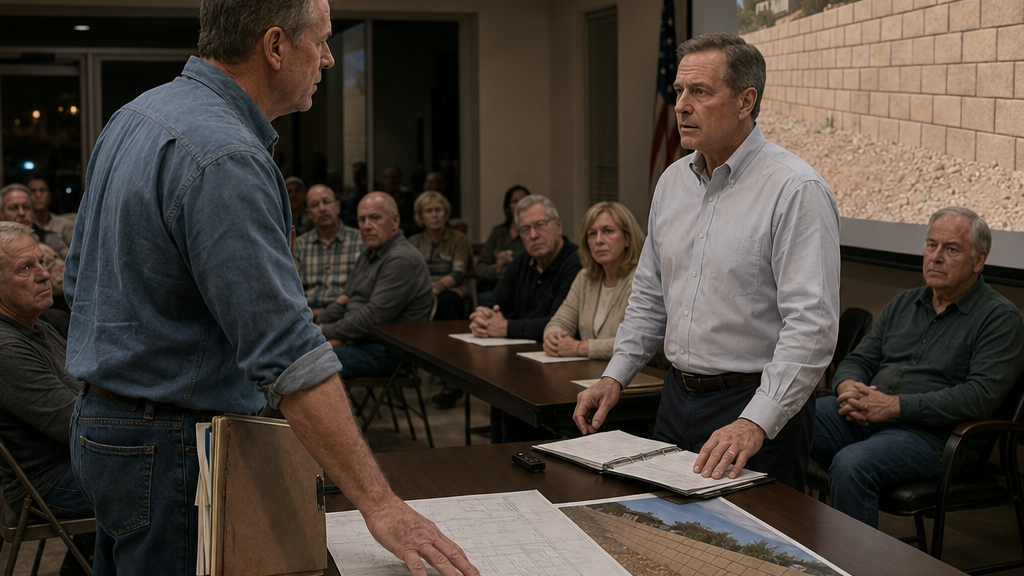
Stephen Clark put a photograph of Jonathan’s wall on the clubhouse screen before Jonathan had even taken his seat.
The image was large enough that every crack, stain, and shadow in the tan blockwork seemed exaggerated.
“Item four,” Stephen said. “Unapproved retaining structure affecting an association drainage area.”
Jonathan stopped halfway into a folding chair.
He had expected a discussion.
He had not expected to walk into the room and find his property being used as the evening’s example.
Around twenty residents sat in rows facing the board table. Most were people Jonathan recognized well enough to wave to but not well enough to call. A few turned when he entered.
Stephen did not.
Jonathan sat at the end of the second row with a flat document envelope across his knees.
One of the board directors asked whether the wall was new.
“No,” Stephen said. “That isn’t the issue.”
“How old is it?”
“Approximately eleven years.”
A low murmur moved through the room.
Stephen clicked to another photograph, this one showing the wall from farther back.
“The association recently conducted a review of drainage-related improvements after concerns were raised regarding liability. This structure does not have complete approval records.”
Jonathan watched him carefully.
Not complete approval records.
That was different from what the notice had said.
The notice called it an unauthorized structure interfering with common-area drainage. Stephen was already narrowing the claim.
Jonathan waited.
Stephen summarized the $400 fine and the possibility of weekly penalties. He spoke in an even tone, without anger, which made the process sound settled.
One resident raised a hand.
“Is the wall actually in the common area?”
Stephen glanced toward the management representative sitting beside him.
“The association’s concern is the drainage corridor and the absence of final approval.”
“That wasn’t the question,” Jonathan said.
Several people turned.
Stephen finally looked at him.
“You’ll have an opportunity to speak.”
“I’m asking because you just described it as affecting association property.”
Stephen set down his pen.
“We have a process, Jonathan.”
Jonathan almost laughed.
That sentence, more than the fine, irritated him.
He waited until homeowner comments.
When Stephen called his name, Jonathan carried the document envelope to the front table.
He did not bring a speech.
He brought the survey.
He unfolded it once, then again, and laid it beside a printed photograph of the wall.
“This is the recorded survey,” he said.
Stephen glanced at it. “We’ve received a copy.”
Jonathan pointed to the boundary mark.
“This is the property line.”
No one spoke.
He moved his finger to the wall location.
“This is the closest point of the wall. Three feet and two inches inside my parcel.”
Stephen folded his hands.
“As I’ve said, the issue isn’t limited to ownership.”
Jonathan looked at the projected photograph.
“Then show me the encroachment.”
Stephen’s expression changed slightly.
“Excuse me?”
“You called this an interference with common-area drainage. Show me the point where my wall crosses onto association property.”
The room went still.
Jonathan did not raise his voice.
That helped.
He had spent decades in job trailers where people tried to solve engineering disagreements by becoming louder. Usually the person with the tape measure won.
Stephen leaned toward the survey.
“The drainage obligation can extend beyond the precise ownership line.”
“It can,” Jonathan said. “If there’s an easement.”
He tapped the document.
“Show me the easement.”
One of the directors shifted in his seat.
Stephen’s jaw tightened.
“The board is not conducting a survey analysis in open session.”
“You already conducted enough of one to fine me.”
A woman in the back whispered something to her neighbor.
Jonathan wished she had not.
He did not want a crowd on his side. He wanted an answer.
Stephen turned to the management representative.
“Do we have the architectural file?”
A folder was passed across the table.
Stephen opened it.
Jonathan knew what was coming before Stephen removed the paper.
The old preliminary note.
“Your own records show that the project received a conceptual review,” Stephen said. “They do not show final architectural approval.”
Jonathan felt some of the room shift back toward the board.
There it was: the problem he could not measure away.
“I’m not disputing that the final paper isn’t in my folder,” Jonathan said.
Stephen looked up quickly, as if surprised by the concession.
Jonathan continued.
“I’m disputing your claim that the wall is on common property.”
“We have multiple compliance concerns.”
“Then separate them.”
Stephen paused.
The request was simple enough that refusing it would sound unreasonable.
One director leaned toward the microphone.
“That seems fair.”
Stephen looked at him.
The director continued. “If the survey is valid, maybe the notice should distinguish between an approval issue and an encroachment issue.”
Stephen’s hand tightened around his pen.
Jonathan saw it.
It was the first visible sign that the room was no longer moving exactly where Stephen wanted.
The board spent the next fifteen minutes arguing over wording.
No one identified a surveyed point where Jonathan’s wall crossed the property line.
That was the small victory.
It lasted until Stephen read aloud from the architectural guidelines.
Exterior structures requiring review were supposed to receive written final approval.
Jonathan had no such letter.
Stephen proposed that the association perform another compliance review and maintain the existing enforcement status until the documentation issue was resolved.
Jonathan stood again.
“Are the weekly fines still running?”
Stephen hesitated.
“Yes.”
“So you cannot show that I’m on association land, but you’re continuing the penalties anyway.”
“The structure is not currently documented as approved.”
“Then say that. Don’t say I built on common property.”
Stephen’s expression went flat.
“The board will correct any language it determines needs correction.”
It was not an apology.
It was not a withdrawal.
But Jonathan noticed that the projected photograph had disappeared from the screen.
The meeting moved to the next agenda item.
He sat back down, but he did not feel finished.
Afterward, a few residents lingered near the folding chairs.
One man said, “Three feet is pretty clear.”
Jonathan gave a small shrug.
“The missing approval isn’t.”
The man seemed disappointed by that answer.
Outside, Stephen caught up with Jonathan near the clubhouse walkway.
“You made your point.”
Jonathan turned.
“I asked a question.”
“You knew this wasn’t only about the property line.”
“The violation notice didn’t.”
Stephen lowered his voice.
“We have a drainage responsibility. There have been issues.”
“With my wall?”
“With structures that were never properly reviewed.”
“That’s not the same thing.”
“No,” Stephen said. “It isn’t.”
For a second, Jonathan thought the admission might lead somewhere.
Then Stephen added, “But until we know exactly what was approved, the fine stays.”
Jonathan looked at him.
“You’ve had eleven years to ask.”
Stephen’s face hardened.
“We’re asking now.”
Jonathan walked away before he said something he would regret.
At home, he placed the survey back in the old construction folder.
The board had not proved an encroachment.
That should have felt like vindication.
Instead, the absence of one piece of paper now mattered more than ever.
He opened the folder again and stared at the handwritten preliminary note.
If the final approval did not exist in his files, there was only one question worth answering next.
Had it ever existed at all?
Chapter 3: The File That Was Never Finished
Jonathan found the handwritten note at seven-fifteen the next morning and hated it more the longer he looked at it.
Reviewed—no objection to concept, verify drainage at completion.
For eleven years, that sentence had lived in his memory as approval.
On paper, it was nothing of the kind.
He sat at the workbench with the old construction folder open beneath the garage light.
His wife stood behind him reading over his shoulder.
“You thought that was the final letter?”
“I thought there was another one.”
“Was there?”
“I don’t know.”
That answer had become increasingly common.
Jonathan drove to the county records office before lunch.
The technician at the counter pulled the parcel map, the recorded survey, and archived permit information. Jonathan watched the documents appear one by one on the screen.
The wall alignment matched what he had already shown the board.
Inside the lot.
No recorded drainage easement crossed the wall.
The county permit file contained the structural information he remembered submitting.
But county approval was not HOA approval.
The technician pointed to the screen.
“From our side, the wall is shown within the parcel.”
Jonathan nodded.
“That’s what I needed.”
On the drive home, the satisfaction lasted less than ten minutes.
He had proven the part he already believed.
The harder question was why the HOA had suddenly decided the wall created a drainage problem.
He took the longer route into the subdivision and stopped near the lower slope behind a row of homes.
A neighbor was standing beside a washed-out strip of gravel where runoff had carved a narrow channel through the landscaping.
Jonathan got out.
“You lose all this in the last storm?”
The neighbor looked over.
“Most of it.”
Jonathan crouched near the edge.
Water had carried soil toward the side yard, leaving stones piled against the fence.
The neighbor said, “Board’s been looking at drainage everywhere since the claim.”
Jonathan looked up.
“What claim?”
The neighbor seemed surprised.
“You didn’t hear?”
“No.”
“House farther down. Water got into the rear room after that July storm. Insurance got involved. Everybody started blaming everybody.”
Jonathan stood.
“The HOA?”
“Drainage path behind the lots. At least that’s what I heard.”
There it was.
Not proof that Stephen was right.
But proof that he was not inventing the subject from nothing.
Jonathan walked the lower slope slowly.
He knew enough about drainage to recognize the pattern. Water did not care where the HOA boundary ended. A structure entirely inside one lot could still alter runoff somewhere else if it was designed badly.
His wall had been built to hold soil and redirect surface flow toward an existing drainage path.
He knew that.
But he had not looked at the entire system in years.
Back home, he took a level, measuring tape, and old construction sketch to the wall.
The block face was straight.
The drainage outlet remained open.
No obvious erosion showed on the downhill side.
He should have felt relieved.
Instead, he kept thinking about the neighbor’s washed-out gravel.
That evening he spread the old papers across the dining table.
His wife sat opposite him.
“You’re doing the thing,” she said.
“What thing?”
“The thing where you decide being right about one part means everybody else is wrong about all of it.”
Jonathan looked at her.
“That’s not what I’m doing.”
She raised an eyebrow.
He looked back at the papers.
It was exactly what he had been doing.
He had treated Stephen’s bad encroachment claim as proof that the entire enforcement action was nonsense.
But if the HOA had a genuine drainage concern, then Jonathan’s own incomplete file mattered.
He picked up the handwritten note again.
Eleven years earlier, he had been in a hurry. The first erosion cut had appeared only a few feet from the foundation. He had contractors available, materials ordered, and a forecast showing another series of summer storms.
He remembered someone from the committee saying the concept looked fine.
He also remembered thinking, I’ll send the completion photos later.
Had he?
He searched his old email archive.
Nothing.
He checked external drives.
Nothing.
The next morning, he contacted the HOA management office and requested the historical architectural file for his address.
The response arrived that afternoon.
The association possessed the same preliminary review note he already had.
No final inspection.
No signed completion approval.
Jonathan stared at the screen.
For the first time since the fine appeared, he felt embarrassment rather than anger.
He had spent days demanding procedural precision from people whose missing record matched his own.
That did not justify calling his wall an encroachment.
It did mean the argument was no longer clean.
He printed the management response and slid it into the folder.
As he did, another document caught his attention.
It was not from the wall construction.
It was from the previous year’s HOA budget packet.
Jonathan had saved it because the board had announced a drainage-maintenance program after a particularly heavy monsoon season.
He read the line again.
Drainage corridor maintenance—reserve allocation.
He remembered seeing crews along the lower wash that spring.
Or thought he did.
Jonathan pulled the current reserve summary from the HOA website.
The categories did not line up the way he expected.
One year showed drainage work under reserves.
Another showed general landscape maintenance.
A third listed a larger transfer but no obvious corresponding project description.
Jonathan was not an accountant, and he knew better than to pretend otherwise.
But he understood project costs.
If someone told him thirty thousand dollars had been spent moving soil, repairing channels, or rebuilding drainage features, there should be evidence somewhere—scope, bids, invoices, quantities, something.
He opened the board meeting minutes.
Several references to drainage appeared.
One mentioned emergency maintenance.
Another authorized a vendor extension.
No amount.
No bid comparison.
No project detail.
Jonathan leaned back.
This could be nothing.
Bad minutes.
Accounting categories.
Routine maintenance folded into broader contracts.
He told himself that twice.
Then he remembered Stephen at the clubhouse saying, We have a drainage responsibility.
If drainage was important enough to threaten the removal of an eleven-year-old wall, Jonathan wanted to know how carefully the association handled its own drainage obligations.
He began making a list.
Reserve reports.
Vendor contracts.
Drainage expenditures.
Board approvals.
Bids.
Not because he had found wrongdoing.
Because he had found a question.
His wife came into the garage and saw the papers spreading across the desk.
“I thought you were trying to find your approval.”
“I was.”
“And now?”
Jonathan held up the reserve summary.
“They keep telling me this is about drainage.”
She waited.
Jonathan looked toward the retaining wall outside.
For eleven years it had been a piece of construction he barely thought about.
Now it had become a measure of something else.
His paperwork had been incomplete.
The HOA’s might be, too.
He pointed to three years of reserve entries.
“If drainage is the reason they can keep fining me,” he said, “I want to know where the drainage money went.”
Chapter 4: He Asked for the Books Instead
Jonathan did not file another appeal.
On Monday morning, instead of drafting a third argument about the wall, he opened the association’s governing documents and searched for the section on records inspection.
By nine-thirty he had sent a written request for reserve reports, drainage-related expenditures, vendor contracts, invoices, board approvals, and bid records covering the previous four years.
His wife read the list over his shoulder.
“That’s not a wall appeal.”
“No.”
“What is it?”
Jonathan clicked Send.
“A different question.”
The first response came from the HOA management representative before lunch.
The association would provide records reasonably related to his stated concern. Some documents, however, might contain confidential information or fall outside the scope of homeowner inspection. The request would need clarification.
Jonathan read the email once, then again.
He had asked for six categories.
They had answered none.
He wrote back with narrower dates, specific reserve-account references, and the meeting-minute entries that mentioned drainage maintenance.
Two days passed.
Then another email arrived.
The association would produce available financial summaries and approved minutes, but vendor material would require additional review.
Jonathan printed it and added it to the construction folder.
The folder no longer looked like a wall file.
The faded survey and old preliminary approval note still sat near the front, but behind them were budget pages, reserve summaries, board minutes, and printed emails with dates written across the top in pencil.
His wife found him clipping a photograph of the retaining wall to the folder cover.
“Why the picture?”
“So I remember what started this.”
“You’re enjoying this now.”
Jonathan looked up.
“No.”
She gave him a look that said he was lying to both of them.
He had to admit there was a part of him that wanted Stephen to regret the fine.
That bothered him more than he expected.
For most of his life, Jonathan had trusted physical facts because they did not care who won. Grade was grade. Concrete cured or it did not. Water moved downhill whether a board voted on it or not.
Records were different.
Records could be missing, mislabeled, delayed, or interpreted.
He did not want to become the kind of man who saw a crooked number and immediately imagined a conspiracy behind it.
That was why he called Amanda Garcia.
Her office occupied the second floor of a low commercial building twenty minutes from the subdivision. She listened to Jonathan for nearly ten minutes without interrupting.
When he finished, she looked at the folder.
“What do you want me to find?”
“The truth.”
Amanda did not smile.
“That’s usually what people say when they already know what they want me to find.”
Jonathan leaned back.
“Fine. I want to know whether the drainage spending makes sense.”
“That I can work with.”
She flipped through the reserve summaries.
“You understand that bad bookkeeping is not the same as theft?”
“Yes.”
“And a related vendor is not automatically improper?”
“Yes.”
“And if I tell you the HOA did nothing illegal, you’re still paying me?”
Jonathan paused.
“Yes.”
“Good.”
That was the first time he trusted her.
The association produced the first batch of records four days later.
It was incomplete.
Jonathan could see that before Amanda said a word.
There were general ledgers, reserve summaries, a handful of invoices, and several vendor agreements. But the documents did not map cleanly to the categories in the budgets.
Amanda worked quietly, writing codes in the margins.
Jonathan watched her circle one entry.
“What?”
“Nothing yet.”
She turned another page.
Then another.
“This account says reserve drainage restoration.”
Jonathan nodded.
“Thirty-eight hundred.”
“Right.”
“The invoice underneath it is landscape labor.”
“So?”
“So maybe the landscaper did drainage work. Or maybe this was coded incorrectly.”
She kept going.
Another entry had been paid from reserves but described as routine maintenance.
Another appeared under common-area repairs without a project description.
By the end of the first afternoon, Amanda had marked nearly twenty transactions.
Jonathan stared at the stack.
“How much?”
“I’m not totaling it yet.”
“You’ve marked enough.”
“I’ve marked questions.”
The distinction irritated him.
Amanda noticed.
“If you want someone to tell you what you already believe, hire someone else.”
Jonathan looked away.
She tapped the ledger.
“This is where people get themselves in trouble. They see a number in the wrong place and decide it means somebody stole it.”
“I didn’t say stolen.”
“You were thinking it.”
He was.
That night Jonathan sat in the garage with the folder open and a legal pad beside it.
The wall photograph on the cover seemed almost absurd now.
A four-hundred-dollar fine had pushed him into years of HOA finances.
He wondered whether that was reasonable.
Then another weekly penalty notice arrived.
Fifty dollars.
The amount was small enough to feel insulting.
He added it to the folder.
The next week, more records came.
Amanda called him back to her office.
She had arranged several spreadsheets across the conference table.
“I have about thirty-four thousand dollars in transactions that need explanation.”
Jonathan stared at her.
“Thirty-four thousand?”
“Need explanation,” she repeated.
“Over how long?”
“About four years.”
He felt the old rush of certainty.
“There it is.”
Amanda shook her head.
“No. There is what?”
“Thirty-four thousand dollars.”
“Yes.”
“In reserve money.”
“Yes.”
“That doesn’t reconcile.”
“Some of it doesn’t.”
Jonathan leaned forward.
“What am I missing?”
Amanda slid three invoices toward him.
“These looked bad at first.”
One showed drainage-channel clearing. Another described erosion-control labor. A third involved hauling debris from a common slope.
“I checked the dates against board minutes and maintenance logs. The work appears to have happened.”
Jonathan sat back.
“So some of it is real.”
“Probably.”
The word disappointed him.
He disliked himself for that.
Amanda continued.
“The problem is that the bookkeeping is inconsistent. Some routine work was paid from reserves. Some reserve work was categorized as landscape maintenance. Some contracts were extended without clear documentation.”
“Bids?”
“For several, I don’t have any.”
“Approvals?”
“Not complete.”
Jonathan looked at the numbers again.
Not theft.
Not clean, either.
The shape of the problem was changing.
Amanda pulled another contract from the stack.
“This one bothers me.”
It was a maintenance agreement renewed for a second year.
Jonathan scanned it.
“What about it?”
“I asked for the competitive bids referenced in the minutes.”
“And?”
“Nothing was produced.”
“Maybe they lost them.”
“Maybe.”
She slid a vendor information sheet beside it.
“The mailing address is residential.”
Jonathan looked at the address.
It meant nothing to him.
Amanda turned her laptop and showed him a public property record.
Jonathan read the owner name.
Then read it again.
The surname belonged to the spouse of one of the board members.
For several seconds neither of them spoke.
Jonathan finally said, “That’s not nothing.”
“No,” Amanda said. “But it’s not everything either.”
He looked at the wall photograph clipped to the front of his folder.
For the first time, the fine seemed almost incidental.
The question was no longer whether Stephen had overreached.
It was whether the board had been enforcing precision against homeowners while tolerating something very different inside its own records.
Chapter 5: The Suspicious Address Was Only Half the Truth
Jonathan entered Amanda’s office expecting an accusation.
Instead, she pushed the contract back across the table and said, “You need to slow down.”
He remained standing.
“The vendor address is tied to a board member’s spouse.”
“Yes.”
“There were no bids.”
“None produced.”
“And reserve money went through the contract.”
“Yes.”
Jonathan spread his hands.
“What exactly am I supposed to slow down about?”
“The part where you decide you already know why.”
Amanda opened a second file.
She had requested work orders, check images, insurance certificates, and maintenance photographs connected to the vendor.
Several had been provided.
The contractor had existed.
The work crews had appeared.
The invoices matched at least some visible projects.
Jonathan flipped through photographs of cleared drainage channels, repaired slope fabric, replaced gravel, and trimmed vegetation around storm paths.
“So the work happened.”
“Some of it.”
“And the relationship?”
“Still a problem if it wasn’t disclosed properly.”
Jonathan sat.
The disappointment came again, and this time he recognized it immediately.
He had wanted something cleaner.
A false invoice. A fake company. A payment for work that never happened.
Something that would let him point at Stephen and say, There. That is what you are.
Instead, Amanda had handed him something worse in a quieter way.
A system that blurred lines because people found it convenient.
“There are still procurement issues,” she said. “There are still reserve-classification questions. There may be conflict-of-interest disclosure problems. But I’m not calling this embezzlement based on what we have.”
“I didn’t use that word.”
“You were about to.”
Jonathan closed his mouth.
Amanda leaned back.
“Your wall file taught you something.”
He looked at her.
“What?”
“Incomplete records can make an innocent situation look worse than it is.”
That landed harder than he wanted.
The preliminary wall note sat inside the folder beside him.
No objection to concept.
Not final approval.
He had spent eleven years treating the missing step as unimportant because he knew what had happened on the ground.
Now he was tempted to deny the board the same distinction.
“So what do we actually have?” he asked.
“Repeated shortcuts. Poor documentation. Weak procurement controls. Possible related-party issues. Reserve spending that may not match the association’s own categories. That’s enough to ask serious questions.”
“But not enough to say they stole thirty-four thousand dollars.”
“Correct.”
Jonathan nodded slowly.
The anger did not disappear.
It became harder to use.
That afternoon Debra Scott asked to meet him privately.
She chose a corner table in the clubhouse rather than his house or hers.
When Jonathan arrived, she already had a paper cup of coffee in front of her and both hands wrapped around it.
“You’ve been asking for a lot of records,” she said.
“I have.”
“Amanda Garcia?”
Jonathan paused.
“Yes.”
Debra looked down.
“I figured.”
“How?”
“She’s thorough.”
There was something in Debra’s voice that made him sit differently.
“You know her?”
“No. I know what she asks for.”
Jonathan waited.
Debra had been treasurer long enough to appear on every financial packet he had reviewed. Until now, he had thought of her mostly as part of Stephen’s board.
She rubbed one thumb against the cup seam.
“You think the board has been stealing money.”
“I think the records are a mess.”
“That’s not what people are saying.”
“I haven’t told people anything.”
“People know you’re requesting documents. They fill in the rest.”
Jonathan leaned forward.
“What do you want?”
Debra exhaled.
“To tell you why some of it looks the way it does.”
She described years of dues increases that the board had postponed.
Homeowners complained every time assessments rose. Maintenance costs climbed anyway. Drainage work, landscape repairs, and emergency slope projects kept arriving. The reserve fund became the easiest place to move expenses when operating accounts were tight.
“Was that allowed?” Jonathan asked.
“Sometimes.”
“And when it wasn’t?”
Debra looked at him.
“We told ourselves it was temporary.”
The answer was plain enough that he believed it.
“What about the contracts?”
“The landscaping company was cheap.”
“That’s not a procurement policy.”
“I know.”
“Did the board member disclose the family connection?”
Debra hesitated.
“Not formally the way we should have documented it.”
“Did you know?”
“Yes.”
“And you voted anyway?”
“I didn’t vote on every renewal.”
“That’s not what I asked.”
Her face tightened.
“Yes.”
Jonathan sat back.
He had expected defensiveness.
What he saw instead was fatigue.
Debra looked toward the clubhouse windows.
“You know what happens if dues go up twenty percent?”
“People get angry.”
“Some people can afford angry. Some can’t afford the increase.”
Jonathan said nothing.
“We have retired couples here watching every bill. Families already stretched thin. Every year we delayed a major increase, we told ourselves we were helping them.”
“And the shortcuts?”
“We told ourselves the work still got done.”
Jonathan thought of Amanda’s photographs.
It had.
At least some of it.
Debra continued.
“Stephen came in after years of this. He looked at the records and panicked.”
“That doesn’t explain my wall.”
“It does more than you think.”
She lowered her voice.
“The architectural files are bad.”
“How bad?”
“Not yours. All of them.”
Jonathan stared at her.
Debra gave a tired laugh with no humor in it.
“Additions, paint approvals, walls, sheds, drainage changes. Different management companies. Different committees. Some final letters are missing. Some applications were never scanned. Some approvals were verbal.”
Jonathan thought immediately of his handwritten note.
“So Stephen knew.”
“He knew there were gaps.”
“And he still stood there in front of twenty people and acted like my missing letter proved I built without approval.”
Debra looked down.
“He believes if the board starts accepting old incomplete files as approval, they lose control of everything.”
“That’s not control. That’s pretending.”
“I didn’t say I agreed with him.”
Jonathan watched her.
“Why are you telling me this?”
For the first time, Debra’s composure cracked.
“Because at the last executive session, he suggested we stop producing additional vendor records until counsel reviewed every request.”
Jonathan’s jaw tightened.
“Why?”
“He said you were looking for leverage.”
“I am looking for answers.”
“I know.”
The words came quietly.
That was the first moment Jonathan understood that Debra had crossed some internal line before she ever sat down with him.
Not to his side.
Away from Stephen’s.
She pulled a folded sheet from her purse.
It was not confidential financial information. It was a copy of an internal tracking list for open architectural violations.
Jonathan found his address.
Beside it was a note.
Property line uncertain. Approval incomplete. Continue enforcement pending board direction.
Jonathan read it twice.
“Who wrote this?”
“Stephen.”
Jonathan looked up.
“When?”
“Before the public meeting.”
The room seemed to narrow around the paper.
Before Stephen had displayed Jonathan’s wall on the screen.
Before he had described it as affecting common-area drainage.
Before Jonathan had put the survey on the table.
Stephen had already written that the property-line issue was uncertain.
Jonathan folded the page carefully.
“So he knew the encroachment claim might not hold.”
Debra nodded.
“He knew it wasn’t established.”
“Then why keep the fine?”
She stared at her coffee.
“I asked him that.”
Jonathan waited.
“What did he say?”
Debra lifted her eyes.
“He said if he backed down on your wall, every incomplete file in the neighborhood would come through the door behind it.”
Chapter 6: What Stephen Was Actually Afraid Of
Stephen was standing beside the retaining wall when Jonathan came through the side gate.
For weeks, Stephen had discussed the structure in emails, meeting packets, violation notices, and executive sessions.
This was the first time Jonathan had seen him actually touch it.
Stephen rested one hand on the top course and looked along the forty-two feet of tan block.
“It’s straighter than it looks in the photographs.”
Jonathan stopped a few yards away.
“That’s what you asked me here to tell me?”
Stephen removed his hand.
“No.”
They had agreed to meet alone.
Jonathan almost declined. After Debra’s revelation, he had little interest in another private conversation with a man who had publicly treated uncertainty as fact.
But Stephen had asked to meet at the wall.
That mattered.
“What do you want?” Jonathan said.
Stephen glanced toward the lower slope.
“We had a claim in July.”
“I know.”
“Water intrusion. Rear room. Mold remediation. Insurance got involved.”
“I know that too.”
“Do you know what the carrier asked?”
Jonathan waited.
“How many unreviewed retaining structures affect community drainage?”
Jonathan looked at him.
Stephen continued.
“We couldn’t answer.”
The admission came without drama.
“That’s the part nobody wants to hear,” he said. “They want to hear that the board knows what was approved, what wasn’t, where every drainage easement is, and who signed every file.”
“But you don’t.”
“No.”
A quail moved through the gravel near the fence and disappeared beneath a shrub.
Stephen looked back at the wall.
“When I became president, I found architectural records in three systems. Paper files. Old management software. Scanned folders named by address. Some had final approvals. Some had applications only. Some had nothing but emails.”
Jonathan thought of Debra’s words.
Every incomplete file in the neighborhood.
“You knew mine might have been approved.”
Stephen did not answer immediately.
Jonathan stepped closer.
“You wrote that the property line was uncertain before the public meeting.”
“Yes.”
“You knew there was no established encroachment.”
“Yes.”
The answer landed harder because Stephen gave it so plainly.
Jonathan felt anger rise in him, hot and immediate.
“You stood in front of the neighborhood and called it common-area interference.”
“I said it affected drainage.”
“You let everybody believe I built over association property.”
Stephen’s jaw tightened.
“I should have separated those issues.”
“You think?”
“I said I should have.”
Jonathan looked away before his temper made the next sentence worse.
The wall stood between them, solid and mute.
Stephen spoke again.
“What I knew was that your final approval wasn’t in the file.”
“And you needed a test case.”
Stephen frowned.
“That’s not how I saw it.”
“That’s exactly what it was.”
“No. I needed a place to start.”
“With somebody else’s property.”
“With a structure the carrier could see.”
Jonathan gave a short laugh.
“There it is.”
Stephen looked at him.
“You think this was about winning?”
“I think you were scared.”
That silenced him.
Jonathan had not expected the words until they were out.
Stephen looked down the slope.
“Yes.”
The answer changed something.
Not enough.
But something.
Stephen explained that the insurance renewal had come with questions the board could not answer. An attorney had warned them that inconsistent enforcement could become a problem if drainage claims multiplied. The association could not afford a major uninsured loss, and it could not easily fund a full engineering review of every old structure.
“So you decided to enforce hard,” Jonathan said.
“I decided we needed documentation.”
“You decided fines would create documentation.”
“They create action.”
“They create surrender.”
Stephen did not disagree.
Jonathan studied him.
For weeks he had imagined Stephen’s motive as arrogance. Some of it was. Stephen liked control. He liked being the person with the agenda packet and the microphone.
But beneath that was something less satisfying.
Fear of being the president when years of neglect finally became expensive.
Jonathan understood that fear more than he wanted to.
He had built the wall eleven years earlier because he had seen erosion approaching his foundation and refused to wait for a committee to move at the speed of rain.
He had solved the physical problem first.
Paperwork second.
Then never finished the second part.
“You know what bothers me?” Jonathan said.
Stephen looked at him.
“You and I made the same kind of mistake.”
Stephen’s expression hardened.
“No.”
“Yes. I decided the wall worked, so the unfinished paperwork didn’t matter. You decided the HOA had a real drainage problem, so the weak evidence against me didn’t matter.”
“That’s not the same.”
“It’s close enough.”
Stephen turned toward the blockwork.
For a moment, neither spoke.
Then Stephen said, “You hired an accountant.”
“A CPA.”
“I know who she is.”
Jonathan did not ask how.
Stephen rubbed his forehead.
“What did she find?”
“You’ll see what I submit.”
Stephen looked sharply at him.
“Submit where?”
“Independent review.”
“Jonathan.”
There was no authority in his voice now.
Only warning.
“We can fix this internally.”
Jonathan almost smiled.
“Now you want process.”
“I want proportion.”
“So do I.”
“If you send half-understood financial records to a regulator, you could create a mess that costs every homeowner money.”
“Amanda is not sending half-understood records.”
Stephen’s eyes narrowed.
“What are you alleging?”
“Procurement problems. Reserve classification problems. Related-party disclosure issues. Incomplete board approvals.”
“That’s not fraud.”
“I didn’t say it was.”
Stephen seemed caught off guard.
Jonathan saw it clearly.
Stephen had expected revenge.
Perhaps Jonathan had expected it too.
“You think I want to destroy the board,” Jonathan said.
“You’ve spent weeks digging through four years of records because of a four-hundred-dollar fine.”
“No. I started because of a four-hundred-dollar fine.”
He pointed toward the wall.
“I kept going because you demanded paperwork from me while your own house was full of missing pages.”
Stephen said nothing.
Jonathan continued.
“If the contracts are legitimate, an independent review can say that. If the classifications are wrong, fix them. If disclosures were missed, document them.”
“And if people decide every board member is corrupt?”
“Then tell them what the records actually prove.”
Stephen looked tired.
For the first time since the dispute began, he looked less like the president and more like a homeowner who had agreed to volunteer for something that had grown past him.
“I can get the board to suspend your fines,” he said.
Jonathan stared at him.
“In exchange for what?”
“Not in exchange.”
“Then do it.”
Stephen hesitated.
There it was.
The condition he did not want to name.
“Give us thirty days,” he said. “Don’t send the report outside the association. Let us clean up the records first.”
Jonathan’s anger returned, but colder now.
“You want to repair the file before anyone sees how it looked.”
“I want a chance to correct mistakes without turning this place into a public accusation.”
“You had that chance before you fined me.”
“Jonathan—”
“No.”
The word came quietly.
Stephen stopped.
Jonathan looked along the wall.
He thought of the unfinished approval note in his own folder. He thought of Amanda refusing to call sloppy accounting theft. He thought of Debra admitting that shortcuts had been justified one practical decision at a time.
If Jonathan exaggerated what he had found, he would become another person using uncertainty as a weapon.
If he buried it for a private settlement, he would become part of the same habit.
“I’m not accusing you of stealing,” he said. “I’m not accusing anybody of something Amanda can’t support.”
Stephen watched him.
“But I’m not trading silence for my fine.”
Stephen’s shoulders lowered slightly.
“What are you going to do?”
“Submit exactly what we can prove.”
That evening Jonathan sat at the dining table with the report, supporting records, and his own wall file.
He removed several pages he had once thought looked suspicious but Amanda had since reconciled to legitimate work.
He kept the missing bids.
The inconsistent reserve classifications.
The related-party disclosure question.
The incomplete approvals.
He added the violation notice and the survey, not as evidence of financial wrongdoing but as an example of how the association’s procedural gaps affected enforcement.
His wife stood beside him while he sealed the packet.
“You sure?”
“No.”
“Good.”
Jonathan looked at her.
She touched the envelope.
“You’d worry me if you were.”
The next morning he carried the packet into the appropriate state and association-review offices and submitted the same factual materials to each.
No accusations beyond the evidence.
No demand that Stephen be removed.
No claim that thirty-four thousand dollars had been stolen.
Only documents, dates, questions, and Amanda’s limited findings.
When Jonathan returned home, the retaining wall was catching the late-morning sun.
His phone buzzed before he reached the garage.
An email notification.
The subject line read: Emergency Board Meeting.
Jonathan opened it beside the wall.
For the first time since the yellow violation notice appeared, the meeting was not being called to discuss only what he had failed to document.
The board would now have to explain what it had failed to document too.
Chapter 7: The Wall Stayed, but the Rules Changed
The emergency meeting agenda put Jonathan’s retaining wall and the HOA’s financial controls on the same page.
He noticed it before he reached the clubhouse doors.
Someone had taped a copy of the agenda beside the entrance, and halfway down the sheet were two items that would have seemed unrelated a month earlier:
Architectural Enforcement—Miller Property.
Financial Controls and Independent Review.
Jonathan stood there long enough for two neighbors to walk around him.
His wife touched his arm.
“You coming in?”
He nodded.
Inside, almost every folding chair was occupied.
There were more residents than at the meeting where Stephen had projected the photograph of Jonathan’s wall across the screen. That night, Jonathan had felt as if the entire room were looking at him.
Tonight, people were looking at the board.
Stephen sat at the center of the table.
Debra was two seats away, a thick binder in front of her. The other directors kept their eyes mostly on their papers.
Jonathan took a chair near the aisle.
He had received the preliminary findings from the independent review the previous afternoon.
They were less dramatic than neighborhood gossip had become.
No conclusion that thirty-four thousand dollars had been stolen.
No finding that every vendor payment was fraudulent.
No sweeping declaration that the board had been corrupt for years.
Instead, the review confirmed what Amanda had warned him the records actually supported: reserve expenses had been classified inconsistently, competitive-bid documentation was missing for multiple renewals, related-party disclosures had not been handled properly, approval records were incomplete, and enforcement procedures had sometimes relied on assumptions the files did not establish.
Messy.
Serious.
Fixable.
Stephen called the meeting to order.
He did not begin with Jonathan’s wall.
He began with the financial review.
“The preliminary findings identify deficiencies in our procurement, record retention, reserve-account classification, and conflict-disclosure procedures.”
A resident interrupted.
“So somebody took the money?”
Stephen looked toward the association attorney.
“No finding says that.”
Another voice came from the back.
“Then what was the thirty-four thousand?”
Jonathan felt several heads turn toward him.
He stayed seated.
Stephen answered.
“Transactions requiring explanation or reclassification. Some were supported by completed work. Others lacked documentation required by current policy or good governance practices.”
The room became restless.
People wanted a simpler story.
Jonathan understood the temptation.
A thief was easier to understand than a board that had spent years making small shortcuts because each one seemed cheaper than fixing the underlying system.
Stephen glanced toward Jonathan.
For the first time, Jonathan saw something almost like expectation in his face.
Perhaps Stephen expected him to stand and accuse.
Jonathan did not.
Debra spoke instead.
“We made decisions because we were trying to control costs.”
Her voice was quiet, but the room settled.
“That doesn’t excuse how we documented them. I voted for renewals that should have had clearer bidding records. I accepted reserve classifications I should have questioned. I thought keeping dues down justified more flexibility than it did.”
A resident near the front asked, “Did you know about the family connection with the contractor?”
Debra held the edge of the binder.
“Yes.”
The room stirred again.
“Was it disclosed?”
“Not adequately.”
That answer cost her something.
Jonathan could see it.
Debra did not hide behind the board.
She did not claim ignorance.
She simply let the mistake belong to her.
Stephen cleared his throat.
“The review recommends an independent procurement policy, annual conflict disclosures, clearer reserve classifications, and a reconstruction of incomplete architectural files.”
He paused.
“And I support those recommendations.”
Jonathan watched him.
Stephen’s voice remained controlled, but his usual certainty was gone.
Then he closed the folder in front of him.
“I also informed the board this afternoon that I am resigning as president, effective at the end of this meeting.”
A murmur moved through the clubhouse.
Jonathan felt no surge of victory.
Stephen continued before anyone could respond.
“I’m not resigning because every decision this board made was wrong, and I won’t say that to make this easier. We dealt with real drainage problems, real insurance concerns, and real budget pressure.”
He looked briefly toward Jonathan.
“But those pressures did not justify presenting uncertain facts as established ones.”
The room became very still.
Jonathan remembered the photograph of his wall on the screen.
Stephen went on.
“In the Miller matter, I knew the property-line question had not been resolved before enforcement continued. I believed stronger enforcement would force old documentation problems to be corrected. That was the wrong way to handle it.”
No applause followed.
Jonathan was glad.
An apology did not restore records.
A resignation did not repair policy.
The meeting continued.
The board voted to suspend all penalties connected to Jonathan’s wall while an independent drainage inspection was completed.
Then the management representative addressed the original $400 assessment.
“It will be refunded.”
Jonathan’s wife leaned toward him.
He kept his eyes on the table.
“And the weekly penalties?”
“Voided.”
That was the moment he had imagined for weeks.
He expected satisfaction to feel larger.
Instead, what he felt was relief.
Simple and almost physical.
The money had never been the real burden.
It was the steady insistence that he surrender before anyone proved what he had done wrong.
Then came the part Jonathan had not been certain he would agree to.
The association attorney explained that the wall could receive formal written recognition if Jonathan allowed a drainage and structural review and completed a current architectural record.
Stephen looked at him.
Jonathan stood.
“I’ll do it.”
A few residents shifted as if surprised.
One of them said, “Why should you have to? They already admitted the fine was wrong.”
Jonathan turned slightly.
“Because my final approval file is incomplete.”
The room quieted again.
He could have stopped there.
Instead he added, “Their bad process doesn’t make mine complete.”
Stephen looked down at the table.
Jonathan sat.
A week later, the inspector met him beside the retaining wall.
The same survey was unfolded across the hood of Jonathan’s truck.
The inspector checked the line, the drainage outlet, the wall face, and the slope below it. Jonathan followed with a tape measure but did not interfere.
Three feet and two inches at the narrowest point.
Exactly where Jonathan had said.
The inspector crouched near the lower end.
“The outlet’s clear.”
Jonathan nodded.
“Always has been.”
“Any movement?”
“None I’ve seen.”
The inspector made a note.
“You’ll need this added to the association file with the current drainage condition.”
Jonathan almost said that the wall had stood eleven years without needing another piece of paper.
The sentence reached the back of his teeth.
He swallowed it.
“Tell me what you need.”
Several days later the written determination arrived.
The wall could remain.
It was within Jonathan’s property, showed no current drainage obstruction, and would be recognized in the association’s reconstructed architectural records.
Jonathan placed the new letter inside the old construction folder.
He left the handwritten note where it was.
Reviewed—no objection to concept, verify drainage at completion.
For years, he had treated that unfinished sentence as sufficient.
Now the final approval sat behind it.
Not because Stephen had won.
Not because Jonathan had surrendered.
Because the record was finally true.
The board adopted new purchasing rules the following month. Contracts above a defined amount required documented competitive review. Related-party relationships had to be disclosed in writing. Reserve expenditures had to match approved categories or receive formal explanation. Old architectural files would be reconstructed when disputes arose instead of treated automatically as homeowner violations.
Debra remained treasurer long enough to help implement the changes.
Stephen stayed in the neighborhood but no longer sat at the center of the clubhouse table.
Jonathan saw him once near the mailbox cluster.
They nodded.
Neither stopped.
That was enough.
One evening Jonathan walked along the side yard after checking an irrigation line.
The retaining wall caught the last light across its top edge.
Near the place where the yellow violation notice had once been taped, a small inspection marker now sat against the block.
Jonathan ran his thumb across the clean patch left by the old tape.
The wall looked exactly as it had before any of this began.
That was the strange part.
Nothing about the concrete had changed.
The property line had not moved.
The slope still fell toward the same drainage path.
But the wall no longer meant only that Jonathan had been right about where he built it.
It also reminded him that he had been wrong about something harder.
Facts did not become less important when process was inconvenient.
Neither did process become legitimate merely because an institution invoked it.
Both sides had tried, in different ways, to live with missing pages.
Jonathan had finally completed his.
And the HOA had been forced to begin completing theirs.
He closed the side gate and walked back toward the house, leaving the wall where it had stood for eleven years.
The violation notice was gone.
The inspection marker remained.
The story has ended.