The HOA Built a Community Dock Across His Private Shoreline—Then the Records Changed Who Had to Tear It Down
Chapter 1: The Dock Was Already in the Water
Raymond Torres heard the power saw before he saw the lake.
He stopped halfway down the path behind his house, one hand still wrapped around the handle of the duffel bag he had carried in from his truck. The saw whined again from below the tree line, followed by the hollow thud of a mallet striking lumber.
No one should have been working on his shoreline.
Raymond set the bag down beside the path and kept walking.
Through the trees, flashes of bright safety vests moved near the water. A small utility trailer sat on the grass. Fresh gravel had been spread over the narrow slope leading toward the lake, flattening a strip where weeds and pine needles had been two days earlier.
Then he saw the dock.
Four new pilings stood in the water.
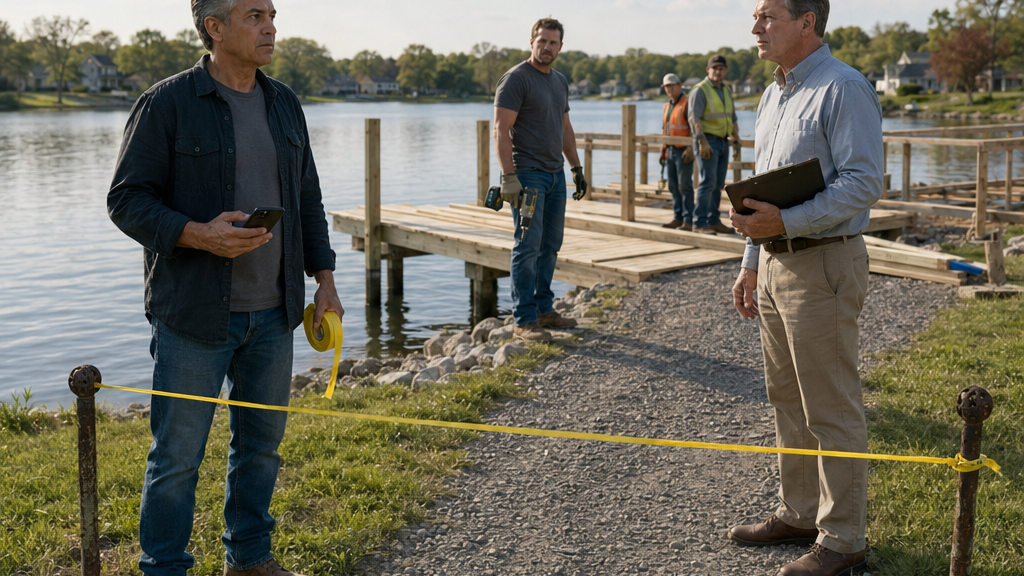
Fresh pressure-treated boards stretched from the shoreline toward a partially completed platform. Two men were fastening deck boards while another held a level. A woman carried hardware from the trailer. Someone had propped a temporary sign beside the path.
COMMUNITY LAKE ACCESS.
Raymond stared at it long enough to read it twice.
“Morning, Ray.”
Donald Martin stood near the shoreline with a clipboard tucked under one arm.
Raymond looked from Donald to the workers.
“What is this?”
Donald’s expression tightened only slightly. “The access project.”
“What access project?”
“The one we’ve been discussing for months.”
Raymond stepped closer to the edge of the gravel.
“You’re on my lot.”
One of the volunteers stopped drilling.
Donald glanced toward him, then back at Raymond. “We’re within the association access corridor.”
“No.”
“Raymond—”
“No.”
Raymond did not raise his voice. That seemed to make several people pay more attention.
He walked past Donald, stopping where the gravel met the grass. He knew this part of the property well. Years earlier, when he had replaced a retaining edge near the water, he had found one of the old iron markers at the base of a maple.
He crouched beside it now.
The top of the marker was still there beneath leaves and dirt.
Raymond brushed it clean.
Then he crossed toward the other side of the shoreline and found the second one near a cedar post.
Donald followed him.
“What are you doing?”
Raymond went into the storage shed and returned with a roll of yellow survey ribbon. He tied one end loosely around the first iron marker and walked it across the property toward the second.
The ribbon passed directly across the new gravel approach.
Then across two of the pilings.
Conversation stopped.
Jason Green, standing on the unfinished platform with a drill in his hand, looked down at the ribbon.
“That can’t be right,” he said.
Raymond pulled it taut.
“It’s been right for twenty years.”
Donald gave a short sigh. “You’re showing a parcel line. That doesn’t eliminate an easement.”
“What easement?”
“The original subdivision lake-access easement.”
Raymond looked at him.
“I’ve never signed an easement over this shoreline.”
“You didn’t have to. It predates your ownership.”
That was the first thing Donald had said that Raymond could not dismiss immediately.
Raymond knew there were utility easements along the road. Drainage easements too. The subdivision was old enough to contain language carried forward through several plats.
But he had never seen one crossing this part of his lot.
He looked toward the unfinished dock.
“How far does this supposed easement run?”
Donald shifted the clipboard against his side. “The association has the right to maintain community access to the lake.”
“That wasn’t my question.”
A volunteer placed a board down slowly.
Raymond pointed at the pilings.
“Show me the document authorizing those.”
Donald’s jaw tightened.
“The board approved the project.”
“Show me my consent.”
“The association doesn’t require individual consent to improve an established easement.”
Raymond held Donald’s eyes for several seconds.
Then he took out his phone.
He photographed the first iron marker.
The ribbon.
The gravel.
Each piling.
The boards.
The temporary sign.
Donald said, “You don’t need to turn this into something.”
Raymond kept taking pictures.
“I came home and found a dock being built on my property.”
“It’s not your dock.”
“That’s exactly the problem.”
Jason climbed off the platform.
“Raymond, I thought this was already worked out.”
“With who?”
Jason looked toward Donald.
Donald said, “There were notices.”
“Notices aren’t permission.”
“We emailed you.”
Raymond remembered deleting several association emails without reading past the subject line. Most were meeting notices, landscaping reminders, budget discussions. He had stopped attending HOA meetings years ago unless a vote directly affected his property.
He disliked the way Donald was looking at him now, as though silence had become agreement.
Raymond walked toward the temporary sign.
“When did construction start?”
“Yesterday,” Jason said.
Donald answered at almost the same moment. “The prep started Friday.”
“And nobody thought to knock on my door?”
Donald spread one hand. “You weren’t home.”
Raymond stared at him.
“That was your solution?”
“No. The board believed authority was already established.”
“Then show me where.”
Donald tapped the clipboard.
“The documents are in the association records.”
“Bring them.”
“We’re not stopping a scheduled volunteer build because you suddenly object to something that was circulated for months.”
A few volunteers looked away.
Raymond felt anger move through him, clean and hot, but he had spent thirty-seven years estimating utility projects where bad assumptions became expensive holes in the ground. The fastest way to lose control was to argue before knowing where every line actually ran.
He rolled the survey ribbon back onto itself, leaving a short section tied between the markers.
Then he stepped onto the gravel and photographed the nearest piling again.
Donald watched him.
“What are you planning to do?”
“Find the easement.”
“And then?”
Raymond slipped the phone into his pocket.
“Then we’ll know whether you built a community dock or put lumber on somebody else’s land.”
He turned toward the house.
Behind him, the drill remained silent for several seconds.
Then Donald’s voice carried across the shoreline.
“All right. Let’s finish the platform.”
The drill started again.
Chapter 2: The Easement Ended Before the Shore
The county records clerk found the easement before Raymond found the deed he wanted.
“There,” she said, tapping a scanned plat on the monitor. “Lake access.”
Raymond leaned closer.
The document was dated decades before he had bought the house.
A narrow strip had been marked from the subdivision road toward the rear of several lots. The faded notation was difficult to read on the screen, but the words access easement were clear enough.
For the first time since Saturday morning, Raymond felt something colder than anger.
“Can you enlarge that?”
The clerk zoomed in.
The line continued between two lots, crossed a narrow common strip, then stopped.
Raymond pointed at the screen.
“Where’s the water?”
“Farther south on this plat.”
“So this doesn’t reach the lake.”
“Not on this page.”
She opened the next recorded sheet.
Raymond waited.
The easement continued another short distance, then ended at a small parcel designated as common open space.
The shoreline beyond it belonged to what was now Raymond’s lot.
He took his glasses off and cleaned them.
“Could there be another easement attached to my deed?”
“There could be. We’d have to trace the chain.”
For the next hour, they worked through recorded instruments.
There were utility rights.
A drainage strip.
Restrictions inherited from the original development.
Nothing Raymond saw allowed the association to cross his waterfront parcel for a dock.
Still, he refused to leave with only the pages that favored him.
“Print everything connected to that access corridor.”
The clerk looked at him. “Everything?”
“Everything.”
By the time Raymond left, his folder had grown thick.
At home, he spread the records across the kitchen table beside the photographs from Saturday.
The images made the problem look simpler than the documents did.
One photograph showed the yellow ribbon passing cleanly through the gravel approach. Another showed a piling sitting several feet lakeward of the line Raymond believed marked his boundary.
But the plats contained enough old language to keep him cautious.
Raymond took a ruler and began tracing dimensions.
That was when he found the first thing he wished he had not.
An email printout.
He had almost thrown it away months earlier, but he kept paper copies of anything involving property changes. The subject line read LAKE ACCESS CONCEPT.
He had opened it, skimmed the first paragraph, and filed it without answering.
A second email from three weeks later asked owners near the proposed access route to respond with questions.
He had not responded.
The third said the board planned to “move forward with site evaluation.”
Raymond leaned back.
None of those messages requested permission.
None described a dock crossing his parcel.
But Donald had not invented Raymond’s silence.
Raymond had seen the emails and chosen not to engage.
He could hear his late brother’s voice in that old argument about inherited property: If you answer them once, they’ll keep coming back.
That dispute had lasted years. By the end, two people who had once spent every Thanksgiving together communicated through certified mail.
Raymond had learned the wrong lesson from it, perhaps.
He had decided that distance prevented escalation.
On Saturday, distance had produced four pilings.
His phone rang.
Katherine Lewis.
Raymond had spoken to the property manager only a handful of times.
“Mr. Torres?”
“Yes.”
“I received your email with the photographs.”
“Good.”
“I need to clarify a few things.”
“So do I.”
She paused.
“Donald says the project is being built under an existing association easement.”
“That easement ends before my shoreline.”
“You’ve confirmed that?”
“I’m looking at the recorded plat.”
Katherine’s tone changed slightly. “Which plat number?”
Raymond read it to her.
He heard keyboard taps.
“I have that one.”
“And?”
“Give me a second.”
More typing.
Then silence.
Raymond looked across the table at the photograph of the unfinished dock.
Katherine said, “I’m not seeing a continuation across your parcel.”
“Neither am I.”
“There may be another recorded instrument.”
“There may be.”
“You’re having a survey done?”
“I’m calling one this afternoon.”
“That’s appropriate.”
Raymond almost laughed.
“Was a survey done before construction?”
Katherine did not answer immediately.
“I requested one.”
“When?”
“Before the project was scheduled.”
“And did you get one?”
“No.”
Raymond sat forward.
“Then why did construction start?”
“I was under the impression the board had resolved the boundary issue internally.”
“With what?”
“I don’t know yet.”
Raymond looked at the dates on his unanswered emails.
“You manage the association.”
“I manage the association’s operations. The board authorizes projects.”
“Did you approve this one?”
“No.”
The answer came quickly.
That mattered.
Katherine continued. “I processed an approved project expense based on the board’s authorization. I did not independently approve the location.”
“How much?”
“I’m not discussing association financials until I review the file.”
“I’m an association member.”
“And you can request the records. I’m telling you I need to confirm what happened first.”
Raymond rubbed his thumb along the edge of the parcel folder.
“What happens now?”
“I’ve asked Donald not to expand the work until we have documentation.”
“Asked?”
“He’s the board president. I’m the manager.”
“And the dock is still on my property.”
“If the survey confirms that, we’ll deal with it.”
Raymond disliked the phrase. It sounded like a promise postponed into procedure.
Still, Katherine had given him something Donald had not.
Uncertainty.
Not authority. Not confidence. Uncertainty.
Raymond called a surveyor.
The earliest site visit was Thursday.
He booked it.
Then he went outside.
From the top of the slope, he could see that the platform was now fully decked.
Fresh boards caught the afternoon sun in straight pale lines.
Someone had installed a simple handrail on one side.
Raymond stood there for a long moment.
He had spent the morning proving where the easement ended.
Someone else had spent the weekend acting as though it did not.
His phone buzzed with a message from Katherine.
I checked the management file. No survey was provided to us before construction.
A second message followed.
Board meeting Tuesday. You should attend.
Raymond stared at those words.
For years he had avoided that room because he believed documents mattered more than arguments.
Now the most important document appeared to be the one nobody had ever produced.
Chapter 3: What the Board Never Actually Approved
The first person Raymond met at the clubhouse said, “I thought you’d already signed off on it.”
Raymond had not even reached the meeting-room door.
The neighbor speaking to him looked embarrassed as soon as Raymond stopped.
“Signed off on what?”
“The lake-access thing.”
“No.”
“Oh.”
The neighbor glanced toward the room. “That’s not how it was explained.”
Inside, almost every folding chair had been taken.
Raymond usually saw six or seven people at HOA meetings. There were more than thirty now.
Donald sat at the front beside Katherine Lewis and Rebecca Jones, the treasurer. A projector displayed photographs of the dock under construction. In one image, volunteers stood smiling beside stacks of fresh boards.
Raymond recognized Jason Green near the center.
The meeting began badly.
Donald did not accuse Raymond directly. That would have been easier.
Instead, he spoke about “balancing private concerns with longstanding community rights.”
Several people nodded.
Donald explained that the subdivision had been designed with lake access in mind, that interior-lot owners had raised fairness concerns for years, and that the board had finally acted on an existing easement.
Then he said, “We had circulated the concept repeatedly without receiving an objection from the adjacent owner.”
Raymond knew exactly what he meant.
He waited until Donald finished.
Then he raised his hand.
Donald looked irritated by the formality.
“Yes, Raymond.”
“Did the board have my written permission to build on my parcel?”
Donald leaned back.
“The board’s position is that permission was not necessary.”
“That wasn’t my question.”
A few heads turned.
“No,” Donald said. “We did not have a separate consent agreement.”
“Did the board have a survey showing the dock was inside the easement?”
Donald’s expression hardened.
“The historical plats establish access.”
“Did you have a survey?”
“No final survey was necessary for preliminary work.”
“The platform is finished.”
“That’s not the point.”
“It’s sitting in the lake.”
Katherine lifted a hand. “One at a time.”
Raymond opened his parcel folder.
He removed the county plat and placed copies on the table nearest the front row.
“I’m not asking anyone here to take my word for it. This is the recorded access easement I found yesterday. It ends before my shoreline.”
Donald shook his head.
“That’s one document.”
“Yes.”
“There are supplemental subdivision records.”
“I asked for those too.”
Donald’s eyes moved toward Katherine.
Katherine said, “Management is still reviewing the complete file.”
A woman in the second row asked, “So do we know whether the dock is on his property or not?”
“We’ll know after the survey,” Katherine said.
Someone behind Raymond muttered, “Then why did we build it?”
That changed the room.
Only slightly.
But enough.
Jason stood near the back wall with his arms folded.
Raymond looked at him.
“You helped build it.”
Jason nodded.
“I did.”
“What were you told?”
Donald said, “Jason doesn’t need to be put on the spot.”
Jason looked toward him.
“It’s fine.”
Then he faced Raymond.
“I was told the access issue had been worked out.”
“By who?”
“Donald.”
The room went quiet.
Donald sat forward. “That is not what I said.”
Jason frowned. “You said Raymond had been contacted, that he hadn’t objected, and that the association had the right to proceed.”
“That’s different from saying he signed something.”
“I didn’t say he signed anything.”
Raymond felt something unpleasant settle in his stomach.
“What exactly did you think my silence meant?”
Jason hesitated.
“That you were okay with it.”
Raymond glanced at the folder in his hands.
That answer angered him because part of it was unfair.
It also angered him because part of it was predictable.
He had received the emails.
He had chosen not to answer.
Donald seized on the opening.
“That’s the context everyone is missing. Raymond had multiple opportunities to raise concerns before volunteers committed time and the association spent money.”
Raymond looked at him.
“You never asked permission.”
“We sent project notices.”
“You described a site evaluation.”
“The project evolved.”
“Onto my land.”
“We believed the easement covered it.”
“Based on what?”
Donald tapped the table once with a finger.
“The original development plan.”
“Show it.”
Rebecca Jones shifted in her seat.
It was the first time Raymond had seen her react.
Donald looked toward her.
“Rebecca?”
She opened a binder.
“We have the board minutes.”
“Good,” Raymond said. “Which vote approved building on my parcel?”
Rebecca flipped several pages.
Donald interrupted. “The vote approved the lake-access project.”
Rebecca kept reading.
Finally she said, “The motion approved funding for evaluation, materials, and construction subject to final site confirmation.”
Raymond looked at Donald.
“Final site confirmation.”
Donald’s voice cooled. “The board considered the site confirmed.”
“Where is that recorded?”
Rebecca answered before he could.
“It isn’t.”
The silence that followed felt different from the earlier one.
Not dramatic.
Worse.
Practical.
People began looking at one another rather than at Raymond.
Katherine leaned toward the microphone.
“For clarity, management did not receive a survey or signed property-owner consent before construction.”
Donald turned toward her.
“You knew the board’s interpretation.”
“I knew the board believed there was an easement.”
“There is an easement.”
“The question is where it ends.”
Donald exhaled sharply.
“You’re making this sound reckless.”
Rebecca closed the binder.
“It was unresolved.”
Donald looked at her.
She did not look away.
Raymond noticed the expression on Jason’s face. Not anger. Recognition.
A man near the aisle asked whether association funds had been used for the lumber. Katherine said yes, but financial discussion would come after the site issue was established.
Donald tried to return to the broader purpose.
“People without waterfront lots have been asking for access for years. That matters too.”
Raymond believed him.
That was what complicated everything.
The interior-lot owners paid the same annual dues. Many had bought into a neighborhood marketed around a lake they could see but rarely touch. Parents wanted somewhere to launch kayaks. Older residents wanted a place to fish without climbing down an eroded bank.
The need was real.
That did not move Raymond’s property line.
He gathered his papers.
Donald said, “So what do you want, Raymond? Tear it out before the survey is even done?”
“I want everyone to stop pretending the answer was settled before anyone checked.”
No one responded.
Raymond turned toward Rebecca.
“You said the site was unresolved.”
Rebecca’s hands remained on the binder.
“Yes.”
“When?”
Donald said, “We’re not doing an interrogation.”
Raymond ignored him.
Rebecca looked briefly at Katherine, then back at Raymond.
“Before materials were ordered.”
The room changed again.
Raymond did not move.
“You told the board?”
“Yes.”
“Told Donald?”
Rebecca’s pause lasted only a second.
“Yes.”
Donald stared at her.
Rebecca continued, quieter now.
“I said we should not authorize construction until the survey question was closed.”
Raymond looked toward the projected photograph of the dock.
Fresh boards.
Smiling volunteers.
A completed platform built after the warning had already been given.
For the first time, the question was no longer whether Donald had been mistaken.
It was why he had decided the mistake was worth making anyway.
Chapter 4: The Promise Donald Could Not Withdraw
Katherine Lewis called Raymond before eight the next morning.
“We already paid the contractor.”
Raymond stood at his kitchen counter with the phone against his ear and the county plat open beside his coffee.
“How much?”
“Enough that this is no longer just about lumber.”
“That doesn’t answer me.”
“I know.”
Her voice had the clipped restraint of someone trying not to say more than she could defend later.
“The excavation, gravel delivery, pilings, and equipment rental were paid from association reserves. Some of the deck material was volunteer-supplied, but the site work wasn’t.”
Raymond looked through the window toward the lake.
From the house, the dock almost looked finished enough to belong there.
That bothered him more than the unfinished version had.
“How did reserve money get released if the site wasn’t confirmed?”
“The board approved the expenditure.”
“Subject to confirmation.”
“Yes.”
“And there wasn’t any.”
“No final survey.”
Raymond closed the folder.
“What aren’t you telling me?”
Katherine was quiet.
Then she said, “The insurance carrier wants a written account of how the project was authorized.”
That got his attention.
“Why?”
“Because if the association knowingly performed work on disputed private property, coverage may be limited.”
“May be?”
“I’m not giving you an insurance opinion.”
“But somebody asked the question.”
“Yes.”
Raymond rubbed his forehead.
He had wanted a clean answer: his line, their mistake, their removal.
Instead, every new fact spread the damage farther.
“Is Donald there?”
“He’s coming in.”
“I’ll be there in twenty minutes.”
The HOA office occupied two rooms beside the clubhouse. By the time Raymond arrived, Katherine had documents arranged across the conference table. Rebecca Jones sat at one end with her binder open.
Donald stood by the window.
He did not greet Raymond.
Katherine pushed a payment ledger across the table.
“These are the project expenditures.”
Raymond scanned the page.
Site clearing.
Gravel.
Equipment.
Piling installation.
Hardware.
The numbers were not catastrophic for a neighborhood the size of theirs, but they were large enough to become personal once divided into annual dues.
Raymond looked up.
“Who signed the contractor authorization?”
Donald answered.
“I did.”
Rebecca’s eyes stayed on the binder.
“On behalf of the board?”
“Yes.”
“After she warned you about the survey?”
Donald’s jaw tightened.
“After the board reviewed the original development plan.”
Rebecca said, “We did not resolve the property question.”
Donald turned toward her.
“We resolved the practical question.”
“No,” Rebecca said. “You decided the easement was broad enough.”
Katherine intervened before either could continue.
“The carrier is asking whether there was documented notice of a boundary dispute before work began.”
Donald gave a short laugh without humor.
“Of course they are. They’re looking for a reason not to pay.”
Raymond watched him.
For the first time, Donald did not look like a man defending principle.
He looked tired.
Not defeated. Cornered.
Katherine slid another page forward.
“There’s also the reserve issue.”
Donald said, “The access project was budgeted.”
“Site evaluation was budgeted. Full construction was not separately listed at this amount.”
“We had authority within the improvement allocation.”
Rebecca said, “Barely.”
Donald pushed away from the window.
“You all know why this happened.”
Nobody answered.
He looked at Raymond.
“For three years, people on the interior lots have been asking why they pay the same dues and have nowhere reasonable to reach the lake.”
“That doesn’t make my shoreline common property.”
“I know what you’re going to say.”
“Then save us both the time.”
Donald ignored that.
“We had families carrying kayaks down an eroded bank. Older residents standing on rocks because there wasn’t a safe place to fish. Every meeting, same complaint. Every election, same complaint.”
Raymond studied him.
“This was about an election?”
Donald’s expression shifted.
Rebecca looked down.
Katherine said nothing.
Donald finally said, “I said I would solve it.”
There it was.
Not corruption.
Not some secret deal.
A promise.
Donald had made himself responsible for giving people something the neighborhood wanted, then kept narrowing the uncertainty until he could call it permission.
“When?” Raymond asked.
“Last fall.”
“Before you knew where the easement ended?”
“We had the original subdivision plan.”
“You had hope.”
Donald’s face hardened.
“I had language showing lake access.”
“You had language showing an access corridor.”
“To common shoreline.”
“Not mine.”
“That’s what the survey will determine.”
Raymond almost answered sharply, but he stopped.
Donald believed what he was saying now because he needed it to remain true for another two days.
That did not excuse Saturday.
It explained it.
Later that afternoon, Raymond walked the nearby common area with Katherine.
The association-owned strip ended at a steep section of bank cluttered with exposed roots and stone. Farther along, the grade softened, but the parcel line narrowed.
Katherine pointed toward the water.
“This is why the board didn’t like this site.”
“Too much work.”
“More expensive. Less convenient.”
“So they moved sideways.”
She looked at him.
“They believed the easement gave them room.”
“Donald believed it.”
“Yes.”
Raymond crouched near the bank.
Someone had stacked unused dock boards beneath a tarp near the maintenance shed. Pale treated lumber, straight and clean.
Money already spent.
Neighbors already divided.
A structure already built.
Katherine said, “If the survey goes your way, removal may be the easy part.”
Raymond stood.
“What’s the hard part?”
“Who pays for it.”
That evening Donald came to Raymond’s house alone.
He did not carry a binder or clipboard.
Raymond met him on the back deck.
Donald looked down toward the water.
“Nice view.”
“You didn’t come here for the view.”
“No.”
He rested both hands on the deck railing.
“I’m willing to make this go away.”
Raymond said nothing.
Donald continued.
“Permanent shared access. Limited hours. No motorized launches. HOA maintains the dock and carries liability. We compensate you for the easement.”
“You want me to grant the right after you built it.”
“I want to solve the problem.”
“You already solved it for yourself.”
Donald looked at him.
“You think tearing it out fixes everything?”
“It fixes what’s on my property.”
“And every homeowner pays for the mistake.”
“Your mistake.”
“My mistake made trying to give people something they’ve been asking for.”
Raymond felt the old instinct rise in him—the instinct to end the conversation by closing the door.
Instead he stayed.
Donald said, “You didn’t answer the notices.”
“No.”
“You never came to the meetings.”
“No.”
“You knew access was being discussed.”
“I knew a concept was being discussed. Nobody sent me a plan showing a dock across my shoreline.”
“You could have asked.”
“You could have waited.”
That stopped them both.
Donald looked toward the lake again.
After a moment he said, “If the survey says I was wrong, I’ll deal with it.”
Raymond shook his head.
“You were warned before you built.”
Donald’s mouth tightened.
“And you were silent before I did.”
“That doesn’t give you my land.”
“No. But it made it easier to believe you didn’t care.”
Raymond absorbed that without accepting it.
Donald pushed away from the railing.
“So that’s a no?”
“Yes.”
“To shared access?”
“Yes.”
Donald nodded once.
Then he walked toward the side gate.
Raymond watched him leave.
Below, the pale dock boards caught the last light over the lake.
For days Raymond had imagined seeing them removed.
Now he understood that when they came out, somebody would still have to absorb the cost.
And most of those people had never known they were building on disputed ground.
Chapter 5: Ten Days to Remove What They Built
The surveyor drove the first bright stake directly through the middle of the gravel path.
Raymond stood three feet away.
Donald stood on the other side.
Neither spoke.
The surveyor checked the instrument again, walked toward the shoreline, and placed another stake near the upper edge of the dock approach.
Then a third.
The line they formed was almost exactly where Raymond’s yellow ribbon had crossed the construction on Saturday.
Almost.
The official line was worse.
One corner of the gravel path extended farther into Raymond’s parcel than he had estimated, and two pilings sat completely beyond the recorded easement.
The surveyor lowered his equipment.
“That’s the boundary based on the recorded monuments and current measurements.”
Donald looked toward the old iron marker.
“You’re certain?”
“I can show you the calculations.”
“I’m asking if you’re certain.”
“Yes.”
Katherine exhaled through her nose.
Rebecca stood farther up the slope holding a folder against her chest.
Raymond looked at the finished dock.
For the first time since coming home, there was nothing left to interpret.
The association’s access right existed.
It simply did not reach far enough.
A civil enforcement officer arrived shortly after noon because Katherine had already forwarded the survey and property records for review.
He walked the line, checked the documents, photographed the pilings, and asked Raymond several questions about consent.
“Did you authorize construction?”
“No.”
“Verbal permission?”
“No.”
“Any agreement granting temporary access?”
“No.”
Donald stood close enough to hear every answer.
When the officer turned to him, Donald’s responses became more careful.
“The board relied on an existing access easement.”
“Did you have a survey establishing this location within it?”
“We believed the recorded plan was sufficient.”
“That isn’t what I asked.”
Donald looked toward Katherine.
“No.”
By midafternoon, the issue had changed from argument to deadline.
The formal notice required removal of the encroaching structure and restoration of the affected portion of Raymond’s property within ten calendar days, subject to whatever additional civil remedies followed.
Donald read it twice.
“This treats the entire project like trespass.”
The officer said, “I’m documenting an encroachment on private property.”
“It’s an HOA easement dispute.”
“Then resolve whatever remains through the appropriate process. The structure still crosses the confirmed boundary.”
Raymond expected satisfaction.
He felt some.
But watching Donald fold the notice and put it into his pocket produced less pleasure than he had imagined.
Later, at the HOA office, Katherine joined a call with the association’s insurance representative.
Raymond sat in because his restoration claim was part of the discussion.
Donald kept one hand flat on the table.
The voice on the speakerphone was professional and maddeningly cautious.
Coverage depended on facts.
Authorization mattered.
Prior notice mattered.
Whether officers knew the location was disputed mattered.
When Rebecca’s email warning was mentioned, Donald’s hand lifted from the table.
“What exactly are you saying?”
The insurance representative repeated that no determination had been made.
Katherine muted the phone.
“She’s saying the association may not be reimbursed for everything.”
Donald stared at her.
“So homeowners eat the cost.”
“Possibly.”
“And if the carrier decides the board acted outside approved authority?”
Rebecca said, “Then it gets more complicated.”
Donald looked at Raymond as though the answer might somehow be there.
Raymond did not offer one.
The meeting ended without resolution.
Outside, Jason Green was waiting beside Raymond’s truck.
“You got a minute?”
Raymond stopped.
Jason shoved both hands into his pockets.
“I saw the survey stakes.”
“So did everybody else.”
“Yeah.”
He looked toward the clubhouse.
“I wanted to tell you something before people start pointing fingers.”
Raymond waited.
Jason said, “Most of us thought this was cleared.”
“I know what you said at the meeting.”
“No. I mean really cleared. Donald told us the board had authority and you’d basically agreed by not objecting.”
Raymond’s mouth tightened at the phrase.
“Basically agreed.”
“That’s how he put it.”
“And you believed him.”
“Yes.”
Jason looked embarrassed.
“My daughter’s been asking for somewhere to fish since we moved in. I volunteered because I thought we were building something useful. I didn’t come down there to take your property.”
Raymond believed him.
That was inconvenient.
It would have been easier if every person holding a drill on Saturday had known exactly what they were doing.
Jason glanced at the truck.
“Are you going after the volunteers?”
“For what?”
“I don’t know. Trespass. Damages. Whatever your lawyer says.”
“I don’t have a lawyer involved yet.”
Jason nodded.
“People are scared.”
“They should be asking Donald questions.”
“They are.”
Raymond unlocked his truck, then stopped.
Jason had not moved.
“What do you want from me?”
“Don’t make the volunteers pay for something we were told was approved.”
Raymond looked at him.
“The shoreline still has to be restored.”
“I know.”
“And somebody has to do the work.”
“I’ll do it.”
Jason said it immediately.
“So will some of the others.”
Raymond studied him.
“You built it.”
“Then let us take it out.”
That evening Katherine called again.
Donald had not agreed to the restoration plan.
“He says the board needs legal review first.”
“He has ten days.”
“I reminded him.”
“What happens if he waits?”
“The association’s exposure increases.”
Raymond opened his parcel folder on the kitchen table.
For weeks it had been his shield: lines, dates, notices, copies.
Now another document sat beside it—his preliminary restoration claim.
He could demand replacement landscaping, bank repair, contractor removal, inspection costs, and compensation for temporary loss of use.
He was entitled to ask.
He also knew who would ultimately fund much of it.
The same neighbors who had been told the dock was approved.
He crossed out nothing.
Not yet.
The next morning, Raymond met Katherine at the shoreline.
“I’ll make one concession,” he said.
She looked at him.
“What concession?”
“If the volunteers remove the structure under proper supervision and the bank is restored correctly, I’ll waive the separate loss-of-use claim.”
“That could be significant.”
“I know.”
“What do you want in return?”
Raymond looked toward the dock.
“I want the board to state publicly that the construction started without confirmed authority.”
Katherine was silent.
“And,” he continued, “written-owner consent for future work outside clearly surveyed common property.”
“That would require a policy vote.”
“Then vote.”
She watched him for a moment.
“Donald won’t like the public part.”
“This isn’t about whether Donald likes it.”
“No,” Katherine said. “I suppose we’ve established that.”
Raymond almost smiled.
Almost.
He pointed toward the survey stakes.
“I’m not trading my boundary for an apology.”
“What are you trading?”
“Part of my claim for a process that makes sure nobody else wakes up to this.”
Katherine nodded slowly.
“I’ll take it to the board.”
Raymond looked at the dock one more time.
The problem was no longer proving that it had been built in the wrong place.
That question had been answered.
Now the question was whether Donald would accept responsibility before the ten-day clock made the decision for him.
Chapter 6: The Neighbors Came Back With Pry Bars
On the sixth morning, Raymond woke to the same metallic pounding that had brought him down the hill the week before.
For half a second, his body reacted before his mind did.
Then he heard the difference.
No saw.
No drill driving screws.
A pry bar scraping under wood.
Raymond pulled on his boots and walked outside.
Eight people were at the shoreline.
Jason Green stood on the dock with a flat bar in one hand. Two volunteers worked beside him, lifting deck boards one at a time. Another carried the removed boards uphill and stacked them neatly beside the gravel path.
The temporary COMMUNITY LAKE ACCESS sign was gone.
Jason saw Raymond and raised a hand.
“We started at seven. Katherine said that was okay.”
Raymond nodded.
“Watch the bank near the second stake. It’s soft.”
“We marked it.”
Raymond walked closer.
The dock looked strange with the first six boards removed, open ribs exposed beneath where people had stood days earlier.
Jason pushed the pry bar beneath another board.
It groaned loose.
A volunteer beside him caught it before it dropped.
Nobody was talking much.
That suited Raymond.
He had expected the removal to feel triumphant.
Instead it felt like watching people correct a mistake in real time.
Each board came up with the marks of its brief life still visible: screw holes, muddy footprints, pencil lines where someone had measured twice before cutting.
Care had gone into building the wrong thing.
That fact stayed with him.
By midmorning, the first section of railing lay on the grass.
A contractor handled the heavier structural work near the water while the volunteers removed decking and carried lumber.
Raymond photographed the process, but not faces.
Jason noticed.
“You documenting us?”
“The work.”
“Fair.”
He drove the pry bar under another board.
After a few minutes he said, “Donald told us you’d come around.”
Raymond looked at him.
“Before construction?”
“Yeah.”
“What exactly did he say?”
Jason paused.
“That you were private. Didn’t like meetings. But that you’d never formally opposed lake access.”
“That was true.”
“He said the old easement meant the board didn’t technically need permission anyway.”
“That wasn’t.”
“I know that now.”
Jason worked the board loose.
“I should’ve asked you.”
Raymond shrugged slightly.
“I should’ve answered the first email.”
Jason looked surprised.
“That doesn’t make this your fault.”
“I didn’t say it did.”
Raymond watched another volunteer carry the board uphill.
“But silence leaves room for people to tell themselves what it means.”
Jason nodded.
They worked without speaking for several minutes.
The first piling came out shortly before noon.
The contractor attached a chain and hydraulic puller, then raised it slowly from the lakebed. Mud-dark wood emerged inch by inch.
Everyone stopped to watch.
When it finally came free, water streamed down its length.
The contractor swung it onto the shore.
The place where it had stood became only ripples.
Raymond felt something loosen in his chest.
Not victory.
Space.
Donald arrived twenty minutes later.
He parked near the clubhouse path and walked down alone.
Nobody stopped working.
That was different too.
On construction day, Donald had moved between volunteers giving directions, checking measurements, answering questions.
Now Jason nodded to him once and went back to removing boards.
Donald stood beside Raymond.
“They’re making good time.”
“They are.”
“The contractor says they can have the platform out tomorrow.”
Raymond looked at him.
“You approved the restoration?”
“The board did.”
“Unanimously?”
“No.”
Raymond did not ask who had voted against it.
Donald watched the volunteers.
“I’m probably done after this term.”
Raymond said nothing.
“Maybe sooner.”
Still nothing.
Donald glanced at him.
“You enjoy that?”
“No.”
Donald gave a tired laugh.
“You could at least pretend.”
“I wanted my shoreline back. I didn’t ask for your job.”
“Some people think you did.”
“Some people thought I approved a dock too.”
That landed.
Donald looked away.
After a while he said, “I thought the easement was enough.”
“Rebecca warned you.”
“I know.”
“You kept going.”
“Yes.”
Raymond waited.
Donald rubbed one thumb against the edge of his phone.
“If I stopped the project again, I was going to have to stand in front of everybody and say I’d spent another year promising something I couldn’t deliver.”
“So you decided the risk belonged to me.”
Donald did not answer immediately.
Then he said, “That’s what it became.”
It was the closest thing to an admission Raymond had heard from him.
No excuse.
No polished board language.
Just a sentence.
Raymond looked toward the lake.
“Why didn’t you call me directly?”
Donald’s mouth tightened.
“You never answer.”
“I would’ve answered if you said you planned to build on my parcel.”
“Maybe.”
“Try me next time.”
Donald almost smiled, but did not.
He walked uphill before lunch.
He never once told anyone where to put a board.
By late afternoon, the removed lumber had become a long, orderly stack beside the path.
Jason stood over it with his hands on his hips.
“Shame to trash all this.”
Raymond looked at the boards.
“Who said anything about trashing it?”
Jason glanced at him.
“Can’t put it back here.”
“No.”
“We could sell it.”
“Maybe.”
Jason nudged one board with his boot.
“Or reuse it.”
Raymond followed his gaze toward the water.
Then, beyond the trees, toward the association’s common strip.
He thought about the steep bank Katherine had shown him.
Not all of it was usable.
But one section farther south widened before reaching the lake. The old plat had shown common ownership there, narrow but continuous.
Raymond had spent enough years reading construction plans to know that inconvenient did not mean impossible.
He walked uphill to his house and retrieved the parcel folder.
When he returned, Jason was still stacking lumber.
Raymond opened the plat across the hood of the contractor’s truck.
Jason leaned over it.
“What?”
Raymond traced the common parcel with one finger.
“This belongs to the association.”
“Yeah.”
“The bank here is too steep.”
Jason nodded.
Raymond moved his finger farther south.
“But here it widens.”
Jason studied the drawing.
“You think there’s room?”
“For this dock? No.”
“For something smaller?”
Raymond did not answer immediately.
He looked at the stack of boards behind them.
The same lumber that had arrived on his shoreline as an assumption.
Now stripped of screws, stacked and waiting, it was only material again.
“I think,” Raymond said, “somebody should survey it before anyone promises anything.”
Jason laughed.
It was the first easy sound Raymond had heard at the shoreline since returning home.
Then Jason looked at the plat again.
“So you’d help?”
Raymond closed the folder halfway.
“I said survey it.”
“That’s not a no.”
“No,” Raymond said. “It isn’t.”
By sunset, most of the decking was gone.
The lake showed through the bare frame where the platform had been.
Raymond stood beside the stacked boards and looked south toward the unused strip of common shoreline.
For the first time since the power tools had started on his property, the question ahead was not what he intended to stop.
It was whether he was willing to help build something that belonged where it was put.
Chapter 7: The Boards Went Back Into the Lake
The salvaged lumber was stacked across the front of the clubhouse like evidence.
Raymond Torres stopped just inside the meeting-room door and looked at it.
Twelve long deck boards rested on padded sawhorses beside a new survey drawing mounted to foam board. The old screw holes were still visible. A few boards carried shallow pry marks from the morning Jason Green and the others had dismantled the dock on Raymond’s shoreline.
Now those same boards sat beside a completely different set of property lines.
Jason was already there, leaning over the new plan.
“You were right about the south strip,” he said.
Raymond walked closer.
The surveyor had marked the association-owned parcel in heavy lines. The common shoreline widened near the southern edge just enough for a narrow walkway and a small platform.
Not the oversized dock Donald had promised.
Not enough room for several families to spread out at once.
But enough for two kayaks to be launched safely and a few people to stand near the water without trespassing across anybody’s lot.
Raymond traced the boundary with one finger.
“And this is entirely common property?”
Katherine Lewis stood behind him.
“Entirely.”
“Drainage?”
“Cleared.”
“Utility conflicts?”
“None identified.”
“Permits?”
“Not submitted yet.”
Raymond looked at her.
Katherine almost smiled.
“We learned something.”
People began filling the folding chairs.
The crowd was nearly as large as it had been the night the board’s missing authorization first came apart in public, but the room felt different. Fewer crossed arms. Less whispering.
Donald Martin entered last.
He did not sit in the president’s chair immediately.
For several seconds he stood beside the stacked boards, looking at them.
Then he took his place.
Rebecca Jones called the meeting to order because Donald had asked her to handle the procedural items.
The first motion concerned restoration of Raymond’s shoreline.
Katherine reported that the pilings had been removed, disturbed soil stabilized, gravel pulled back to the confirmed association boundary, and the affected bank repaired. Raymond had inspected the work and agreed that no further physical restoration was required.
Then Rebecca read the amount of Raymond’s remaining claim.
It was lower than several people expected.
A man in the second row raised his hand.
“That’s everything?”
Raymond answered before Katherine could.
“It’s what I’m still asking for.”
The man looked confused.
“I thought there was a loss-of-use claim.”
“There was.”
“What happened to it?”
“I withdrew it.”
A murmur moved through the room.
Donald looked at Raymond but said nothing.
Raymond continued.
“I didn’t withdraw the costs associated with restoring my property. I’m not paying for that. But I’m not interested in making volunteers personally responsible for work they were told was authorized.”
Jason lowered his eyes.
A woman near the aisle asked, “So nobody’s being sued?”
Raymond said, “I didn’t say nobody could ever be responsible for anything. I said I’m not pursuing the volunteers.”
The distinction mattered to him.
He had not forgiven the process by pretending it had done no harm.
Rebecca moved to the next item.
The new policy proposal required a current survey before any association improvement within a specified distance of a private boundary. Work touching private property would require written owner consent. Property management would have to possess copies before contractors or volunteers were scheduled.
Donald listened without interruption.
Then Rebecca reached the section requiring board certification that all location conditions had been satisfied before spending reserve money on construction.
Donald finally lifted his hand.
“I want to say something before we vote.”
The room went still.
He stood.
There was no microphone in front of him this time.
“I’ve spent the last couple of weeks thinking about what I could say that would make what happened sound more reasonable.”
Raymond watched him.
Donald looked toward the residents.
“There are reasons we wanted access. Those reasons are still valid. Interior-lot owners have asked for it for years. The old access language is confusing. Raymond did not respond to the early project emails.”
Raymond felt several eyes move toward him.
Donald continued.
“All of that is true.”
He paused.
“And none of it changes the part that matters.”
Rebecca sat very still.
Donald placed one hand on the table.
“Construction started before we had confirmed authority for that location.”
No one moved.
“I knew the survey question was open. Rebecca told me it was open. Katherine had asked for documentation that I did not have.”
His voice tightened slightly.
“I believed the old easement would support the project. More than that, I wanted it to.”
That was the first sentence Raymond had not expected.
Donald looked at the drawing beside the stacked lumber.
“I had told people I was going to solve lake access. I had defended the expense. Volunteers had signed up. Materials were arriving. Stopping would have meant admitting I had moved too fast.”
He looked toward Raymond.
“So I didn’t stop.”
Raymond held his gaze.
Donald did not apologize theatrically.
He did not ask for understanding.
He simply sat down.
The silence afterward lasted longer than applause would have.
Rebecca called for the policy vote.
It passed.
The next motion concerned the proposed common-property access point.
That produced more disagreement.
Some residents thought the smaller platform was inadequate. Others wanted the association to abandon lake access entirely rather than spend more money after the first failure. One homeowner asked why anyone should trust another project.
Katherine answered that no construction would begin until permitting, survey certification, insurance review, and written board approval were complete.
Then Jason stood.
“We already have most of the lumber.”
He pointed toward the boards.
“That doesn’t mean we have to use it,” someone said.
“No,” Jason replied. “But throwing it away doesn’t make the first mistake disappear either.”
Raymond looked at the boards.
A week earlier, he had watched those same pieces come off his dock one by one.
At the time, every board had felt like something being returned to him.
Now they were just wood.
Reusable wood.
Donald turned toward Raymond.
“You’ve been quiet.”
Raymond almost laughed.
“That was part of the problem last time.”
A few people shifted in their chairs.
He stood.
“I don’t want a community dock on my shoreline.”
Nobody reacted.
They already knew that.
“I also don’t think the answer is pretending people without lakefront lots don’t have a legitimate problem.”
Donald watched him carefully.
Raymond pointed toward the new survey.
“That site is common property. The survey confirms it. If permits allow a smaller structure there, and the association follows the process it just adopted, I don’t object.”
A woman near the back asked, “Would you vote for it?”
Raymond looked at the plan.
Months earlier, perhaps even weeks earlier, he would have answered that it was not his problem.
That had always seemed like the safest kind of answer.
He thought about the emails sitting unanswered in his folder.
About Jason standing on a dock he honestly believed Raymond had accepted.
About Donald turning uncertainty into permission because nobody forced the question into the open early enough.
“Yes,” Raymond said.
“I would.”
The motion passed, though not unanimously.
That felt right.
Weeks later, Raymond stood at the edge of the actual common parcel while Jason carried one of the salvaged boards down the new path.
There was no temporary sign.
No volunteer crew waiting for permission that had never been given.
The permits had been posted at the clubhouse. The boundary stakes were still visible. Katherine had copies of every approval in the management file.
Even Donald was there, though he worked quietly and carried lumber instead of a clipboard.
Jason set the board across the frame.
“Funny,” he said. “Same wood.”
Raymond looked toward the lake.
“Different line.”
Jason nodded.
He drove the first screw.
The board settled into place.
Raymond could see his own shoreline farther north through the trees, empty now except for restored grass and the old iron markers near the water.
Nothing stood across them.
Nothing needed to.
A second board went down beside the first.
Then another.
Raymond stayed until the small platform began taking shape entirely inside the surveyed common boundary.
The boards had gone back into the lake.
This time, they belonged there.
The story has ended.