The HOA Put a Meter on His Private Well—Then He Found the Four Paragraphs They Never Read
Chapter 1: The Meter Was Already Bolted On
The first thing Raymond Hall noticed was the stainless-steel band around the old galvanized pipe.
The second was the digital meter bolted into it.
He stopped halfway across the side yard, coffee still in his hand.
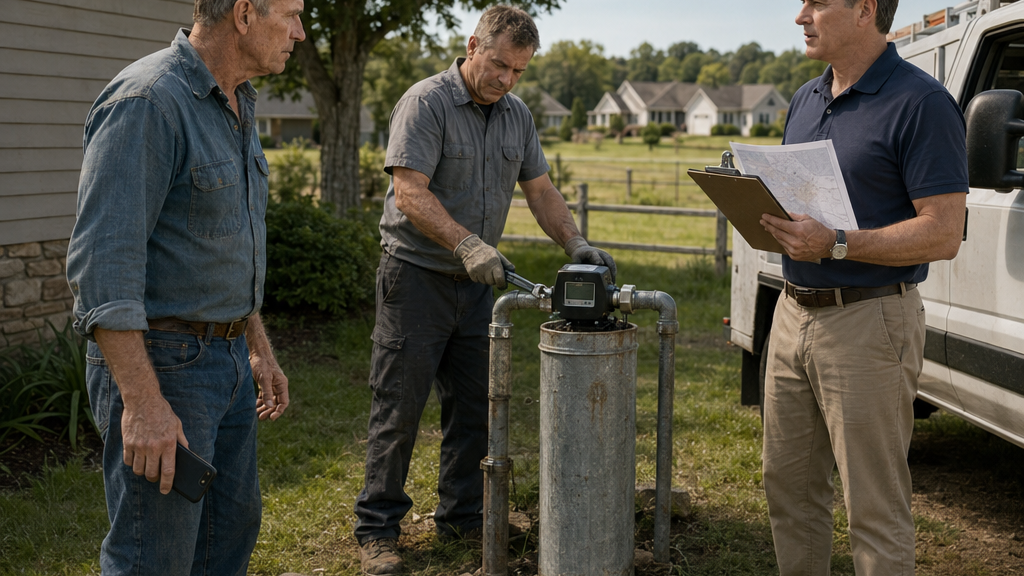
Two men stood beside the well casing. One wore a contractor’s shirt and was tightening a fitting with a wrench. The other was Jonathan Davis, president of the homeowners association, holding a clipboard against his chest.
Raymond set his coffee on the porch rail.
“What are you doing?”
The contractor stopped.
Jonathan did not.
“We’re finishing the water-monitoring installation.”
Raymond walked closer.
The well had stood in that patch of ground since 1987. The casing was faded gray, scratched from decades of weather and maintenance. Raymond knew every fitting on it because he had replaced most of them himself.
The digital meter was new.
So were the compression fittings.
So were the two holes drilled into the mounting bracket.
He crouched without touching anything.
“Who authorized you to cut into this line?”
Jonathan shifted the clipboard under one arm. “The association did.”
“That wasn’t my question.”
The contractor lowered his wrench.
Raymond had spent thirty-four years as a pipefitter. He knew what a rushed installation looked like and what a professional one looked like. This one was professional enough. Whoever had done the work had isolated the line correctly and installed the meter downstream from the pressure tank.
That made Raymond angrier, not calmer.
It meant this had been planned.
He took out his phone and photographed the meter from three angles.
Jonathan said, “Raymond, nobody is shutting off your water.”
“I didn’t say they were.”
“This is monitoring equipment.”
“I know what it is.”
The contractor glanced between them.
Jonathan’s face tightened slightly.
The neighborhood had spent most of the summer under voluntary conservation measures that had gradually hardened into HOA restrictions on landscape watering. Municipal rates had climbed. Brown lawns had become common. Arguments about sprinkler schedules had filled two board meetings.
Raymond had ignored most of it.
His house sat on an older parcel at the outer edge of the subdivision, where the lots opened toward fields instead of backing onto another row of houses. His water for the lawn came from the well. His indoor plumbing had been connected to the municipal line years ago, but the old well still handled irrigation.
That distinction seemed obvious to him.
Apparently it had not been obvious to everyone else.
Jonathan held out a sheet.
“The board approved measurement of nonmunicipal sources used for exterior irrigation.”
Raymond did not take it.
“Measurement by whom?”
“The association.”
“On whose equipment?”
Jonathan paused.
“The policy applies community-wide.”
“That isn’t an answer.”
The contractor cleared his throat. “I’ve got the work authorization if you want to see it.”
Raymond looked at him. “I do.”
The man went to his truck and returned with a carbon copy on a clipboard. Raymond read the address first, then the scope of work.
INSTALL FLOW MONITORING DEVICE.
The work order listed the HOA as customer.
There was no homeowner signature.
Raymond pointed to the blank line.
“Who gave permission to enter the property?”
The contractor looked toward Jonathan.
Jonathan said, “The association has utility access rights through this portion of the parcel.”
Raymond felt the anger rise then, sharp and familiar. Twenty years earlier he might have pulled the wrench from the contractor’s hand and told both men to leave.
Instead, he stood.
“Show me.”
Jonathan blinked. “Show you what?”
“The recorded instrument that gives the HOA the right to attach equipment to this well.”
“It’s part of the subdivision documents.”
“Which document?”
“The utility provisions.”
“Book and page?”
Jonathan’s confidence flickered.
“I don’t carry recording references around in my head.”
“Then maybe you shouldn’t be drilling holes in things you don’t own.”
The contractor looked down.
Jonathan’s jaw shifted.
“This isn’t personal, Raymond.”
Raymond picked up the worn pipe wrench that had been sitting beside the well shed. He did not raise it. He simply held it by the handle while studying the new meter.
“It became personal when somebody installed this without calling me.”
Jonathan exhaled.
“We have residents paying hundreds of dollars more in summer water bills. We have restrictions everybody is expected to follow. And we have properties using other sources that nobody can verify.”
“Verify for what?”
“Fair enforcement.”
Raymond looked at him.
“You’re telling me fairness gives you ownership?”
“I’m telling you the HOA has an obligation to enforce its rules consistently.”
“And I’m asking you where those rules give you access to my well.”
For several seconds the only sound was the faint hum of the contractor’s truck.
Jonathan finally opened the folder beneath his clipboard.
He took out a photocopied parcel map.
“I expected you might ask.”
That annoyed Raymond more than anything else.
Jonathan flattened the sheet against the hood of the truck.
A heavy shaded strip crossed the lower side of Raymond’s parcel. It ran from the road toward the rear property line.
The legend identified it as a utility-management easement.
Jonathan tapped the strip.
“Your well sits inside this area.”
Raymond stared at the map.
The line did, in fact, appear to cross exactly where they were standing.
“When was this recorded?”
“With the subdivision documents.”
“That wasn’t here when the well was drilled.”
“The neighborhood changed.”
“Property rights don’t change because somebody redraws a map.”
“No,” Jonathan said. “But recorded easements can.”
Raymond studied him.
For the first time that morning, he felt something colder than anger.
Uncertainty.
He knew pipe. He knew fittings. He knew the well had been permitted long before the subdivision association existed.
He did not know what had happened to the parcel records during the years when surrounding farmland had been divided, roads cut, and declarations recorded.
Raymond folded the copy once.
Jonathan said, “Keep it.”
“I intend to.”
He looked again at the meter.
“Does this thing transmit?”
“Not yet,” Jonathan said. “The collection period begins after the board’s compliance notice.”
“When?”
“Soon.”
Raymond picked up his coffee. It had gone cold.
Behind Jonathan, the contractor packed away his tools.
Raymond looked down at the shaded strip crossing the parcel map.
For the first time, the question was no longer whether the HOA had crossed a line.
It was whether somebody, years earlier, had given them one.
Chapter 2: The Green Lawn Everyone Had Noticed
Raymond found his address on the agenda before he found an empty chair.
PRIVATE WELL—COMPLIANCE MONITORING REVIEW.
The printout sat beside a stack of drought notices at the entrance to the clubhouse.
He read the line twice.
Then he carried the agenda into the meeting room.
Jonathan was already at the front table with the property manager and two other board members. About twenty residents occupied the folding chairs. More than Raymond had expected.
Donna Mitchell sat near the aisle.
She looked at him, then quickly looked away.
That told him more than the agenda did.
Jonathan called the meeting to order.
The first items were ordinary: landscaping contracts, gate repairs, a complaint about trash cans. Raymond waited with his arms folded until Jonathan reached the water-policy section.
“We’ve received repeated questions,” Jonathan said, “about whether exterior water restrictions are being applied equally.”
A man in the second row said, “Some lawns don’t look restricted.”
Several people shifted.
Raymond felt eyes turn toward him.
Jonathan continued carefully.
“The board adopted monitoring procedures for private or supplemental water sources used within association boundaries.”
Raymond raised his hand.
Jonathan nodded.
Raymond said, “Before we call it monitoring procedure, can we establish whether the association has authority to put equipment on privately owned infrastructure?”
Someone behind him whispered something.
Jonathan replied, “That question is being reviewed.”
“You already installed the meter.”
“And we provided you the recorded exhibit.”
“You provided me a map.”
“The map establishes the access corridor.”
“That’s not the same as control of the well.”
Donna spoke before Jonathan could answer.
“Then what do you suggest everybody else think?”
Raymond turned.
Donna’s expression was not hostile. That somehow made the question harder.
“About what?”
“Your yard.”
A few heads turned toward the windows.
Raymond’s property was not visible from the clubhouse, but everyone knew what she meant.
Donna said, “Half the neighborhood has been cutting irrigation. People are replacing grass. Some of us are paying water bills we can barely justify. Your lawn stays green.”
“My lawn is my concern.”
Donna gave a short, disbelieving laugh.
“That right there is the problem.”
Raymond felt his shoulders stiffen.
She continued, “Nobody knew you had a separate source.”
“Some people did.”
“Not the people getting notices for watering on the wrong day.”
Jonathan leaned forward.
“This is exactly why the board created the reporting requirement.”
Raymond looked at him.
“So complaints came first.”
Jonathan did not answer immediately.
Donna did.
“Yes.”
The room became quiet.
She glanced down at the agenda, then back at Raymond.
“I was one of them.”
Raymond had known Donna for years. Not closely. They exchanged waves, borrowed tools once or twice, spoke across property lines about storms and roadwork.
He had not expected her name anywhere near this.
“You complained about me?”
“I asked why one house could stay green while everybody else was being told to cut back.”
“You could have asked me.”
Donna’s mouth tightened.
“You’re not exactly famous for explaining yourself.”
That landed harder than Raymond wanted it to.
He remembered a conversation earlier in the summer when Donna had asked whether he was worried about the water restrictions.
He had said, “Not particularly.”
She had looked at him strangely.
He had gone back to repairing a sprinkler head.
At the time, he had considered the matter finished.
Now he understood what she had heard.
Jonathan slid a document forward.
“The board isn’t accusing you of stealing municipal water. We’re trying to verify usage standards.”
Raymond picked up the page.
It referenced exterior watering, conservation expectations, and disclosure of alternate sources.
Attached behind it was the same parcel exhibit Jonathan had shown him Tuesday.
The shaded utility strip looked official.
That was the trouble.
Official-looking paper had a way of making assumptions feel settled.
Raymond said, “You still haven’t shown me where the HOA gets authority over the well itself.”
Jonathan replied, “And you still haven’t shown us why the recorded easement doesn’t apply.”
That silenced Raymond.
Not because Jonathan had won the argument.
Because he was right about one thing.
Raymond had brought nothing.
He had come expecting the age of the well to be enough. He had expected everyone to recognize the obvious distinction between municipal water and a private well drilled before most of their houses existed.
Instead, he had walked into a room where the association had a map and he had a memory.
Donna spoke more quietly.
“If it’s really separate, Raymond, then show that.”
He looked at her.
“You think I owe the neighborhood my property records?”
“No. I think when everybody is being told the rules apply equally, silence looks like you think they don’t apply to you.”
He almost answered sharply.
Then stopped.
The meeting moved on, but Raymond barely heard the next item.
When he got home, the meter was still fixed to the well casing.
Its small dark display remained blank.
He stood beside it for a moment before going into the garage.
Against the back wall sat a dented metal file cabinet his wife had wanted him to clean out for years. He pulled open the bottom drawer.
Tax bills.
Old surveys.
Receipts for fencing.
A folder marked WELL.
Raymond carried it to his workbench.
Inside were invoices browned at the edges, pump-service records, and a folded county form.
He opened it carefully.
At the top was the year.
His father-in-law’s signature appeared near the bottom.
Raymond ran one finger over the faded ink.
Then he noticed a typed line beneath the permit description.
It contained a recording reference he did not recognize.
Book number.
Page number.
And three words that made him pull the shop light closer.
SEE RECORDED COVENANT.
Chapter 3: Four Paragraphs Beneath the Old Permit
Raymond read the recording reference six times before he admitted he had no idea what it meant.
The permit itself was straightforward. Well depth. Casing diameter. Setback measurements. Parcel description.
Then, beneath those technical details, the reference pointed somewhere else.
SEE RECORDED COVENANT.
He spread Jonathan’s HOA map beside the permit.
The papers looked as though they belonged to different worlds.
One was an old county form filled out on a typewriter.
The other was a clean subdivision exhibit with computer-drawn property lines.
Yet both described the same ground.
Saturday morning, Raymond drove to the county recorder’s office carrying copies in a manila folder.
The clerk behind the counter examined the reference.
“That’s an older book,” the clerk said.
“Still accessible?”
“Yes.”
Raymond waited while the clerk entered the number into the system, then disappeared into a back room.
He had expected a thick packet.
What came back was four pages.
“That’s it?”
The clerk looked at the cover sheet.
“That’s what the reference points to.”
Raymond carried the pages to a side table.
The language was formal but not impossible to understand.
The covenant had been recorded when the well was permitted as part of an arrangement governing access around the parcel. It granted limited rights for utility maintenance across a defined strip.
For several minutes, Raymond thought Jonathan had been right.
There it was.
Access.
The same concept shown on the HOA map.
Then he reached the third paragraph.
He read it once.
Then again.
No third party could install metering, extraction-monitoring, or control equipment on the permitted well without the property owner’s written consent.
Raymond sat back.
Four paragraphs.
Thirty-some years of recordings, subdivision paperwork, declarations, maps, amendments—and the restriction that mattered fit on four pages, with the operative language buried in one paragraph.
He photographed it.
Then he called Amanda Roberts.
She answered on the fourth ring.
“You working today?” Raymond asked.
“I was hoping not to.”
“I found something.”
“That sentence usually ruins Saturdays.”
He told her about the meter, the HOA map, and the covenant.
Amanda became quiet.
“Send me everything.”
Ten minutes later, she called back.
“This helps.”
Raymond leaned against his truck outside the recorder’s office.
“Helps?”
“It says they can’t meter the well without consent.”
“That sounds better than helps.”
“It would, if this were the last recorded document affecting the parcel.”
Raymond stared through the windshield.
“They showed me a later easement map.”
“I know. That’s why I said helps.”
“You think the later map overrides it?”
“I think I need to know what the later map actually does.”
Raymond’s certainty thinned.
He had already imagined driving home, setting the four pages in front of Jonathan, and watching the whole thing collapse.
Amanda continued.
“A later recorded instrument can modify earlier rights. Sometimes intentionally. Sometimes by incorporation. Sometimes not at all. We don’t guess.”
“I’m not guessing. It says no metering.”
“And Jonathan’s document appears to show an access strip over the same ground.”
“So one of them is wrong.”
“Not necessarily.”
Raymond frowned.
“How can they both be right?”
“That,” Amanda said, “is what we have to find out.”
By Monday afternoon, Raymond sat across from her desk.
Amanda had printed the covenant, the HOA exhibit, and several pages from the subdivision declaration.
She placed the 1987 document on the left.
“This gives limited utility access and explicitly reserves control of the well to the property owner.”
Then she placed the later exhibit on the right.
“This was recorded when the surrounding development was assembled.”
“And?”
“And the access strip is real.”
Raymond felt irritation return.
“So Jonathan was right.”
“About the strip existing.”
“Which is what he’s using to justify the meter.”
Amanda tapped the map.
“This picture doesn’t tell us the scope of the right.”
Raymond looked at the shaded band crossing his lot.
“It says utility management.”
“Yes.”
“That sounds pretty broad.”
“It sounds broad because it’s a label.”
She turned to the declaration.
“What matters is what instrument created or continued the right.”
Raymond leaned back.
For years he had trusted drawings. Pipe runs, mechanical plans, elevations. A line on paper usually meant something specific.
Now Amanda was telling him the most convincing piece of paper in Jonathan’s folder might be accurate and incomplete at the same time.
She pointed to a recording reference in the subdivision declaration.
“This exhibit appears to carry forward existing utility corridors rather than create new rights over your well.”
“Appears?”
“I haven’t finished the chain.”
Raymond disliked that word.
Chain.
It suggested every answer depended on another page.
Amanda looked at him.
“You need to understand something. The 1987 covenant is strong. But if you walk into the HOA office waving it like the argument is finished, and there’s a later modification we haven’t found, you make their lawyer’s job easier.”
Raymond said nothing.
She had described exactly what he had intended to do.
On the drive home, he stopped beside the well.
The meter was still there.
He rested one hand against the old casing.
His father-in-law had once shown him how to pull the pump without damaging the drop pipe. Raymond had been younger then, impatient and certain that mechanical problems always surrendered to enough knowledge and the right wrench.
Property records were different.
The steel in front of him had a history he could touch.
The paper history ran through offices, books, exhibits, and people who had never stood beside the well.
That evening Amanda called.
“I found another reference.”
Raymond lowered the television.
“What kind?”
“The subdivision filing incorporates the older access corridor.”
He closed his eyes briefly.
“So they win.”
“I didn’t say that.”
“You said it incorporates it.”
“The corridor, yes.”
“And the covenant?”
There was a pause.
“That’s the question.”
Raymond stood and walked into the garage.
The 1987 permit lay on his workbench beneath the fluorescent light. Beside it sat Jonathan’s clean parcel map.
Amanda said, “I want to pull the complete recording sequence tomorrow.”
“Why?”
“Because the HOA exhibit may be perfectly valid.”
Raymond looked at the two documents.
“And the restriction?”
“That may be perfectly valid too.”
He stared at the shaded strip crossing his land.
For the first time since finding the four paragraphs, Raymond understood that discovering the right words was not the same as understanding what had happened to them.
Amanda’s voice came through the phone.
“Don’t remove the meter.”
“I wasn’t going to.”
“And don’t tell Jonathan we’ve solved it.”
“Have we?”
“No.”
Raymond looked toward the garage window, where the old well casing was just visible in the fading light.
Amanda said, “Right now, both documents may be telling the truth.”
Chapter 4: The Map Was Right but Incomplete
Amanda had both documents waiting when Raymond arrived Tuesday morning.
She had placed them side by side on the conference table: the 1987 covenant on the left, the HOA subdivision exhibit on the right.
No yellow legal pad. No coffee. No reassuring smile.
Raymond took the chair across from her.
“You found it.”
“I found enough to tell you Jonathan wasn’t inventing the easement.”
Raymond looked at the clean black lines on the newer map.
“That’s not the sentence I was hoping for.”
“It’s also not the sentence he’s hoping for.”
Amanda slid the old covenant toward him.
“The access strip was carried forward when the subdivision was recorded. That part is legitimate.”
Raymond leaned over the documents.
“So they can come onto the property.”
“For certain utility purposes.”
“And install whatever they want?”
“No.”
She tapped the third paragraph of the older covenant.
“This limitation was never released.”
Raymond read the familiar language again.
No third-party metering. No extraction-monitoring equipment. No control device without written consent of the property owner.
He looked back at the subdivision exhibit.
“Then why isn’t any of that on this?”
“Because this is an exhibit.”
Amanda turned the map sideways.
“It shows where the corridor is. It doesn’t reproduce every condition attached to that corridor.”
Raymond frowned.
“That seems like a pretty important condition to leave out.”
“It is. But leaving it off a drawing doesn’t erase it.”
She opened another folder.
Inside were copies of recording stamps, declaration pages, amendment references, and a sequence of parcel descriptions.
Amanda pointed down the chain one document at a time.
“Here. The developer incorporates existing recorded utility corridors.”
Then another page.
“Here, the HOA takes maintenance responsibilities subject to existing recorded limitations.”
Another.
“And here, years later, somebody creates this simplified exhibit for association use.”
“The one Jonathan has.”
“Yes.”
Raymond studied the progression.
Nothing had been forged.
Nothing had been secretly altered.
The mistake was almost more ordinary than that.
A limitation had disappeared because people kept copying the picture while forgetting the words behind it.
“So the map is right.”
Amanda nodded.
“And incomplete.”
“Yes.”
Raymond sat back.
For four days he had wanted proof that Jonathan was simply wrong.
What he had found was more dangerous.
Jonathan had a document that looked authoritative because part of it was authoritative.
Amanda said, “That’s why I didn’t want you marching into the clubhouse with the covenant alone.”
“You figured I would?”
“I’ve met you.”
Raymond almost smiled.
Almost.
“What happens now?”
“I send the association a demand to suspend use of the meter and remove it voluntarily.”
“Today?”
“Yes.”
“And if they don’t?”
“Then we consider court.”
Raymond looked through the office window toward the parking lot.
“I don’t want to spend six months arguing over a piece of equipment that shouldn’t be there.”
“Neither do I.”
Amanda gathered the pages.
“But there’s another question.”
“What?”
“What result do you actually want?”
“The meter gone.”
“That’s the immediate result.”
“It’s the only one I care about.”
Amanda watched him.
“Is it?”
Raymond did not answer.
She continued.
“If the association removes it quietly but keeps the same interpretation in its files, the next board can do this again.”
That thought stayed with him through the drive home.
At three that afternoon, Jonathan called.
“I received the attorney letter.”
Raymond stood beside his garage workbench with the phone against his ear.
“And?”
“I sent it to board counsel.”
“Good.”
“There’s no reason for this to become hostile.”
Raymond looked through the open garage door at the well.
The meter caught a sharp square of sunlight.
“You came onto my property and attached equipment to my well.”
“Based on a recorded easement.”
“Based on half of one.”
“That’s your attorney’s interpretation.”
“No. The map is your interpretation. The recording is the recording.”
Jonathan went quiet.
Then he said, “We have residents demanding consistent enforcement.”
“That doesn’t expand an easement.”
“You keep separating those things like they have nothing to do with each other.”
“They don’t.”
“They do from where I’m sitting.”
Raymond pressed his fingers against the workbench.
“Then maybe you’re sitting in the wrong place.”
Jonathan exhaled.
“I’m trying to keep a neighborhood from tearing itself apart over water.”
“And I’m trying to keep you from pretending my well belongs to the neighborhood.”
Neither spoke for several seconds.
Jonathan finally said, “Board counsel wants time.”
“How much?”
“Through the end of the week.”
Raymond looked toward the meter again.
“Disable it.”
“We haven’t activated data collection.”
“Then leave it that way.”
“I can’t promise anything until counsel reviews the documents.”
Raymond’s voice hardened.
“You authorized installation without counsel reviewing them.”
“I authorized installation based on the records the association has relied on for years.”
“That’s exactly the problem.”
Jonathan did not respond.
Raymond ended the call before he said more.
Wednesday passed.
Then Thursday morning.
At noon, Amanda forwarded an email from the HOA property manager.
BOARD COUNSEL REVIEW PENDING.
The meter would remain in place.
No admission of error.
No removal date.
That evening, Raymond saw Jonathan’s car slow near the edge of his property.
It did not stop.
Friday morning, Amanda called.
“I have the recording sequence finished.”
Raymond sat down at the kitchen table.
“Tell me.”
“The restriction was never modified, released, or superseded. The access corridor survived. The limitation survived with it.”
Raymond closed his eyes.
“So they don’t have the right.”
“Not to meter the well without your written consent.”
A clean answer at last.
It felt less satisfying than he expected.
“What does their lawyer say?”
“Nothing yet.”
Raymond rubbed one hand across his jaw.
Amanda said, “I’m sending them the full chain.”
“Send Jonathan too.”
“I planned to.”
An hour later Jonathan called.
His voice was flatter.
“I’ve seen the documents.”
“Then have the meter removed.”
“Board counsel is reviewing remedy.”
“Remedy?”
“How we proceed.”
“You hire the contractor who put it on. You tell him to take it off.”
“It isn’t that simple.”
“It was simple enough when you installed it.”
Jonathan’s patience cracked slightly.
“We have a board. We have insurance. We have legal advice. I can’t make unilateral decisions because you want this resolved today.”
“You made one when you put it there.”
Silence.
Raymond regretted the line as soon as he said it, not because it was untrue, but because it turned the conversation into the kind of contest he claimed he did not want.
Jonathan’s voice became careful.
“I’ll contact you after the board speaks with counsel.”
The call ended.
That afternoon, Raymond received another HOA notice by email.
He expected a meeting date.
Instead, the subject line read:
NONMUNICIPAL WATER MONITORING—IMPLEMENTATION.
He opened it.
Beginning at eight the next morning, the association would commence data collection from installed monitoring equipment under the drought-management policy while legal review continued.
Raymond read the sentence twice.
Then he called Amanda.
“They’re turning it on tomorrow.”
“I just saw it.”
“What do we do?”
There was no hesitation this time.
“Now we stop asking them to wait.”
Chapter 5: Why the Neighbors Wanted Numbers
Donna Mitchell was standing at the edge of Raymond’s driveway when he came outside with Amanda’s latest draft in his hand.
She did not say hello.
“Why didn’t you ever tell anybody?”
Raymond stopped.
“Tell anybody what?”
“That your lawn isn’t on city water.”
The meter sat twenty yards behind him beside the well casing, silent for one more night.
Raymond folded the paper.
“I didn’t know I was required to give tours of my plumbing.”
Donna shook her head.
“That’s what I mean.”
“What?”
“You answer everything like someone is trying to take something from you.”
“They did.”
“I’m talking about before the meter.”
Raymond looked toward her house.
Her front lawn was pale in patches. One section near the curb had gone completely brown.
Donna pointed at it.
“You know what my July water bill was?”
“No.”
“Four hundred and twelve dollars.”
“That’s too high.”
“Yes, Raymond. It is.”
Her voice was not angry now. Just tired.
“I cut the irrigation days. I let half the yard go. People down the street did the same thing. Then every morning we drive past your place and yours looks fine.”
“I have a well.”
“I know that now.”
“I’ve had it longer than the HOA has existed.”
“I know that now too.”
Raymond felt the answer forming—Then you should have asked—but Donna got there first.
“I should have asked you.”
That stopped him.
She crossed her arms.
“But you could have said something too.”
“Why was it anybody’s business?”
“Because the association kept sending notices saying we were all making the same sacrifice.”
Raymond glanced down at the folded demand letter.
Donna continued.
“People assumed you were watering on restricted days from the same system we were paying for.”
“I wasn’t.”
“I know.”
“I wasn’t hiding anything.”
“You weren’t explaining anything either.”
The distinction bothered him because it was true.
He remembered the summer questions.
A neighbor asking how his grass still looked decent.
Donna asking whether restrictions affected him.
Jonathan once mentioning private-source reporting after a meeting.
Raymond had treated each inquiry as intrusion.
Not one of them had received more than a few words.
Donna said, “I was the one who brought your yard up at the board meeting before all this started.”
“I figured.”
“I didn’t say they should put equipment on your property.”
“You wanted numbers.”
“Yes.”
“Numbers from my well.”
“I wanted proof the rules weren’t being ignored.”
Raymond looked at her.
“Do you hear the difference now?”
Donna glanced toward the meter.
“Yes.”
He waited.
She added, “But I also think you’re making it too easy to pretend the fairness problem was imaginary.”
Raymond stiffened.
“They broke the rules, Donna.”
“I know.”
“Then what fairness problem are we discussing?”
“The one where everybody thought you were getting special treatment because nobody understood why your house looked different.”
“That doesn’t give the HOA rights it doesn’t have.”
“No.”
Her answer came immediately.
“But if you keep acting like that means nobody had a reasonable question, you’re doing the same thing Jonathan did.”
Raymond stared at her.
“How?”
“He thought a reasonable goal gave him authority he didn’t have.”
She nodded toward the garage.
“You think being right about the property means you never had to explain anything.”
Raymond said nothing.
Donna seemed almost surprised she had gone that far.
Then she stepped back from the driveway.
“For what it’s worth, I told Jonathan today I don’t support turning that thing on.”
Raymond looked at her.
“Why?”
“Because I wanted fairness. Not surveillance.”
The word hung between them.
Donna walked back toward her house.
Raymond remained in the driveway with Amanda’s draft in his hand.
For the first time, the meter seemed to represent two mistakes instead of one.
Jonathan’s was visible.
His own was smaller, harder to admit, and impossible to photograph.
He went inside and called Amanda.
“I want to change the letter.”
She sounded surprised.
“In what direction?”
“Bigger.”
“That usually costs more.”
“I don’t mean money.”
“What do you mean?”
Raymond sat at the kitchen table.
“The draft asks them to remove the meter and confirm they won’t monitor the well.”
“Yes.”
“That’s not enough.”
Amanda paused.
“You’ve changed your mind.”
“If they remove it and keep the same map in the board file, somebody does this again in five years.”
“That’s possible.”
“I want the record corrected.”
“The county record?”
“No. That’s not wrong. Their internal property exhibit. Their policy. Whatever they’re using to tell future boards what they can do.”
Amanda became quiet.
Raymond continued.
“I want them to acknowledge the utility corridor doesn’t give them metering rights.”
“That’s more than emergency relief.”
“I know.”
“And potentially more than we can force through a narrow injunction.”
“I know that too.”
“So why now?”
Raymond looked toward the window.
Across the street, a sprinkler system came on for one short cycle, misting a strip of tired grass.
“Because taking the meter off fixes my problem.”
“And?”
“It doesn’t fix how they got there.”
Amanda did not answer for a moment.
Then she said, “That sounds less like the man who called me Saturday.”
“He was pretty irritated.”
“He also wanted four paragraphs to solve everything.”
Raymond looked at the old permit lying near his elbow.
“They don’t.”
“No.”
“They solve the authority question.”
“Yes.”
“But not why anybody thought this was necessary.”
“That part isn’t legal.”
“No.”
He thought of Donna’s brown yard.
“That doesn’t mean it isn’t part of the problem.”
Amanda said, “I can revise the demand. Removal. No data collection. Restoration of any physical damage. Written acknowledgment of the limitation. Correction of association guidance.”
“And the water policy?”
“That’s a board matter.”
“Put in that we want them to distinguish municipal restrictions from privately permitted wells.”
“You understand they can still regulate nuisance conditions and some exterior conduct depending on the declaration.”
“I’m not asking for a blank check.”
“That will help.”
Raymond almost laughed.
“When did I become reasonable?”
“I’ll let you know when it happens.”
After they hung up, he walked back outside.
The meter’s display remained dark.
Tomorrow morning, according to the notice, that would change.
Jonathan drove up just before sunset.
He stayed in his car at first, then opened the door.
“I heard Donna talked to you.”
Raymond said nothing.
Jonathan approached the driveway but stopped before crossing onto it.
A small gesture.
Raymond noticed.
Jonathan held several papers.
“Board counsel agrees there’s an issue with the old covenant.”
“An issue?”
“They agree the metering limitation appears to remain in effect.”
“Then cancel tomorrow.”
“I’m asking the board to.”
“You’re the president.”
“I’m one vote.”
Raymond studied him.
Jonathan’s usual clipboard was gone.
He looked older without it.
“We’re trying to manage a real problem,” Jonathan said. “Residents think rules mean nothing if they can see exceptions and nobody explains them.”
“Private property isn’t an exception.”
“I understand that better than I did a week ago.”
“That’s not the same as fixing it.”
“No.”
Jonathan glanced toward the well.
“I should have had counsel verify the scope before approving installation.”
It was not an apology.
But it was the first thing Raymond had heard from him that sounded like responsibility.
Jonathan looked back at him.
“I can probably get the meter removed.”
“Probably?”
“Yes.”
“And then what?”
Jonathan frowned.
“What do you mean?”
“The policy. The map. The next board.”
Jonathan’s expression changed.
“You want more than removal.”
“I want the mistake corrected.”
“That could require a formal vote.”
“Then vote.”
“There are residents who will see that as giving you special treatment.”
Raymond thought of Donna.
“Then explain the difference.”
Jonathan gave him a long look.
“That’s rich coming from you.”
Raymond almost snapped back.
Instead he nodded once.
“Fair.”
Jonathan seemed caught off guard.
Raymond unfolded Amanda’s revised draft.
“She’s sending this tonight.”
Jonathan took it.
He scanned the first page, then the second.
His mouth tightened at the policy language.
“You’re asking the board to admit the association exceeded its authority.”
“Yes.”
“You know what that does?”
“It makes the record accurate.”
“It also exposes the association.”
“You exposed the association when you installed the meter.”
Jonathan lowered the document.
Neither man moved.
Finally Jonathan said, “If the board won’t agree?”
Raymond looked at the dark display on the well.
“Then tomorrow morning we stop talking at the driveway.”
Chapter 6: The Order Jonathan Could Not Ignore
Jonathan’s offer arrived at 7:12 the next morning.
The association would disable the meter immediately.
It would remain attached to the well until the board completed its legal review.
Raymond read the email once, then forwarded it to Amanda.
Her reply came almost at once.
This is movement.
Raymond called her.
“It’s not enough.”
“I assumed you’d say that.”
“They want to leave their hardware on my well.”
“Disabled hardware.”
“Still their hardware.”
Amanda was silent.
Raymond stood beside the casing.
The digital screen was dark. A small tamper seal hung from the side.
“It’s like putting a lock on somebody’s gate and promising not to close it.”
“That analogy is not legally perfect.”
“It’s perfect enough.”
Amanda sighed.
“The narrowest court request is to prevent collection of data and unauthorized control.”
“I want it removed.”
“I know.”
“They had no right to install it.”
“I know.”
“And leaving it there makes it look like they still do.”
That was the point he could not move past.
A disabled meter still occupied the line. Still carried the association’s equipment number. Still suggested that Raymond’s well was part of a system the HOA had authority to supervise.
Amanda said, “Then we ask for removal as part of temporary relief. I can’t promise the judge grants every piece.”
“Ask.”
By afternoon they were at county civil court.
Nothing about the room looked dramatic.
No crowded gallery.
No television arguments.
Just fluorescent lights, paper files, a clerk moving between desks, and two attorneys speaking in measured tones before a judge who had clearly heard too many property disputes to be impressed by anyone’s outrage.
Raymond sat behind Amanda.
Across the aisle sat Jonathan with the HOA’s counsel.
Jonathan did not look at him.
Amanda kept the argument narrow.
The 1987 covenant.
The continuing restriction.
The association’s later exhibit.
The installation.
The planned data collection.
She did not accuse Jonathan of bad faith.
Raymond noticed that.
Board counsel acknowledged that the original limitation appeared never to have been extinguished.
That sentence changed the room.
The judge looked over the papers.
“So the association’s position is what?”
Counsel stood.
“That the recorded utility corridor gave the board a reasonable basis to believe monitoring access was permitted, but upon review, we acknowledge the more specific restriction presents a substantial issue.”
Raymond felt Amanda’s hand touch the edge of her folder, a silent warning not to react.
The judge asked, “Is the meter active?”
“No.”
“Will the association agree not to activate it?”
“Yes.”
“Will it agree to remove it?”
Counsel glanced toward Jonathan.
“Not at this stage.”
The judge looked down at the photographs Amanda had submitted.
“Why not?”
Counsel spoke about preserving the status quo pending review.
Raymond nearly laughed.
The status quo, before the HOA entered his yard, had been a well without a meter.
Amanda made exactly that point.
The judge was quiet for several seconds.
Then came the order.
No data collection.
No activation.
No further physical interference.
And because the device itself had been installed under authority now substantially disputed by the HOA’s own counsel, removal by a licensed contractor pending final resolution.
Not the entire case.
Not damages.
Not the policy correction.
But the meter had to come off.
Outside the courtroom, Jonathan approached Raymond near the steps.
“You got what you wanted.”
Raymond looked at him.
“No.”
Jonathan’s expression hardened.
“The meter comes off.”
“That’s one thing I wanted.”
“What else is left?”
“You know what’s left.”
“Raymond, we just spent association money in court.”
“You spent association money when you put the meter in.”
Jonathan looked away.
That line no longer gave Raymond satisfaction.
He said more quietly, “I’m not trying to punish the neighborhood.”
“It won’t feel that way when they see the legal bill.”
“Then tell them what happened.”
“You make that sound easy.”
“It’s easier than doing it again.”
Two days later, the same contractor returned to Raymond’s property.
This time he waited at the driveway until Raymond came outside.
“I have the removal order.”
Raymond nodded.
“Come on.”
Jonathan arrived ten minutes later.
He stayed near the road at first.
The contractor shut down the irrigation line, relieved the pressure, and began loosening the fittings.
Raymond stood a few feet away.
The worn pipe wrench rested on the grass where he had placed it.
The same wrench that had been beside him the morning the meter appeared.
The contractor turned one coupling.
Metal squeaked.
Another fitting loosened.
Then the meter came free.
It looked smaller in the contractor’s hands than it had bolted to the pipe.
Just a box of stainless steel, plastic, wires, and assumptions.
The contractor set it into a padded case.
Raymond examined the line.
“Mounting holes?”
“Two in the support bracket,” the contractor said. “Nothing structural in the casing itself.”
“You’ll replace the bracket?”
“Yes.”
“Association paying?”
Jonathan answered from behind them.
“Yes.”
Raymond turned.
Jonathan had walked closer.
“All restoration costs,” he added.
“That from counsel?”
“From the board.”
The contractor installed the replacement section and tested the irrigation line.
Water moved through the pipe without leaking.
The old well pump cycled once, steady and familiar.
Raymond watched the pressure gauge settle.
For the first time in more than a week, there was nothing attached to the line that did not belong there.
Amanda later estimated the removal, replacement fittings, labor, and restoration at a little over two thousand dollars.
The HOA agreed to pay it.
That afternoon, Raymond received another email.
Board counsel had completed its review.
The recorded limitation, the message said, had never been superseded.
The association would not claim a right to meter the Hall well without consent.
Raymond read that sentence carefully.
Then read the next.
The board was still considering whether to revise its broader drought policy and internal property guidance.
He called Jonathan.
“You’re halfway there.”
Jonathan sounded exhausted.
“I figured you’d say that.”
“When’s the vote?”
“Next Thursday.”
“And the written acknowledgment?”
“We can do one specific to your parcel.”
“I want the map note corrected too.”
“That requires board approval.”
“Then put it on the agenda.”
Jonathan was quiet.
“You really won’t let this go.”
Raymond looked through the garage toward the bare section of pipe where the meter had been.
“No.”
Jonathan said, “I used to think that was your worst quality.”
Raymond waited.
“I’m not sure anymore.”
That was as close to warmth as either man seemed capable of that week.
Then Jonathan added, “Come to the meeting.”
“Why?”
“Because if we change the policy, people are going to ask why.”
“You have the records.”
“I know.”
“That should be enough.”
Jonathan did not answer immediately.
Then he said, “You told me to explain the difference.”
Raymond looked down at the old permit on the workbench.
“Yes.”
“I think you should help me.”
Raymond’s first instinct was refusal.
The property record was clear now.
The meter was gone.
The contractor had restored the line.
He could close the garage door and leave the association to sort out the rest.
Then he thought of Donna standing at the driveway.
You weren’t explaining anything either.
Jonathan said, “Thursday. Seven o’clock.”
Raymond looked at the two small empty holes left in the old support bracket before the contractor replaced it.
The hardware was gone.
The argument that had put it there was not.
“I’ll be there.”
Chapter 7: What Stayed After the Meter Came Off
Jonathan Davis began the meeting by reading the sentence Raymond had spent two weeks trying to force into existence.
“The association acknowledges that the recorded utility corridor crossing the Hall parcel does not grant authority to install, operate, or maintain metering equipment on the privately permitted well without the owner’s written consent.”
No one clapped.
Raymond was glad.
He sat in the same folding chair he had used at the earlier meeting, with the same beige walls around him and the same long board table at the front. The difference was that this time his address was not listed beneath the word COMPLIANCE.
A new agenda item had replaced it.
WATER POLICY REVISION AND PROPERTY RECORD CORRECTION.
Jonathan lowered the page.
“The meter has been removed. Restoration costs have been paid by the association. Our internal parcel guidance has been amended to reflect the limitation.”
A man near the back raised his hand.
“So does that mean Raymond doesn’t have to follow the water restrictions?”
There it was.
The question beneath the question.
Jonathan looked toward Raymond before answering.
“The restrictions were written around municipal water use and exterior conditions. They were not written to give the HOA ownership or control over private wells.”
“That’s not what I asked.”
“No,” Jonathan said. “It isn’t.”
The property manager distributed copies of the proposed revision.
Raymond read along although Amanda had already shown him a draft.
Municipal watering schedules would remain in place where applicable.
Privately permitted wells would not be subjected to HOA extraction monitoring unless the owner voluntarily agreed or some future recorded right clearly authorized it.
The association could still enforce nuisance provisions, runoff rules, damaged landscaping standards, and any conservation requirements that legally applied regardless of water source.
It was not an exemption.
It was a distinction.
Raymond had come to understand how much trouble could fit between those two words.
A woman across the aisle said, “So someone with a private well can have a green yard while mine dies?”
Jonathan rested both hands on the table.
“Possibly.”
The room shifted.
“That doesn’t sound fair.”
Raymond felt the old answer rise in him.
Not my problem.
He could almost hear himself saying it.
Instead, he stayed quiet until Jonathan looked toward him.
“You wanted me here,” Raymond said.
Jonathan nodded.
Raymond stood.
He had not prepared remarks.
Amanda had offered to help him write something. He had refused. That had seemed like one more thing he ought to handle himself.
Now twenty people were waiting.
Raymond put both hands in his pockets.
“My well was drilled in 1987.”
Someone in the back said, “We know.”
Raymond nodded.
“You know now.”
The room went still.
He continued.
“I spent most of this summer assuming that because I knew where my water came from, everybody else did too.”
Donna Mitchell sat near the aisle again.
She watched him without expression.
Raymond said, “When people asked me about my lawn, I figured it wasn’t their business. When the board asked about the well, I figured the records were clear enough that I didn’t owe anybody an explanation.”
Jonathan looked down at the table.
Raymond glanced at him.
“I was right about one part.”
A few people shifted.
“The HOA did not have the right to put a meter on that well.”
Jonathan nodded once.
Raymond continued.
“But being right about that doesn’t mean I handled everything right before it happened.”
Donna’s expression changed slightly.
Raymond looked around the room.
“If you were cutting water use and paying high bills and driving past my place, I can understand why it looked like I was ignoring something everybody else was dealing with.”
The man in the back folded his arms.
“So were you?”
“No.”
“What were you doing?”
“Using a privately permitted irrigation well.”
“Whenever you wanted?”
Raymond considered the question.
“Within what the system could support and without creating runoff or bothering anybody else.”
“That still sounds like an advantage.”
“It is.”
The word surprised the room.
Raymond let it sit there.
Then he said, “Owning a well is an advantage in a dry summer. So is having mature shade trees. So is buying a house with better insulation. Not every difference between properties is something an HOA can erase.”
Nobody answered immediately.
Donna raised her hand.
Jonathan nodded to her.
She said, “I was one of the people who pushed the board to do something.”
Raymond looked at her.
Donna turned slightly so the rest of the room could hear.
“I thought Raymond was using municipal water while the rest of us were restricting ours.”
A neighbor asked, “Because he told you that?”
“No.”
Donna shook her head.
“Because I assumed it.”
She looked at Raymond.
“And because when I asked him about it, he gave me about six words.”
A few people laughed quietly.
Raymond almost did too.
Donna continued.
“I still think the board had a legitimate fairness problem. People were angry because they didn’t understand what they were seeing.”
Jonathan said, “That was my view.”
Donna turned toward him.
“But installing the meter wasn’t the answer.”
Jonathan took that without defending himself.
“No,” he said. “It wasn’t.”
The simple admission carried more weight than any formal statement Raymond had heard from him.
Jonathan looked down at his notes.
“I believed the utility corridor gave the association broader authority than it did. I approved the installation before confirming the scope with counsel.”
One of the board members beside him shifted.
Jonathan continued anyway.
“That was my decision.”
Raymond watched him.
There were easier versions of this meeting Jonathan could have arranged.
He could have blamed old records.
He could have blamed the property manager.
He could have blamed counsel for not reviewing the map sooner.
Instead, he left the responsibility where it belonged.
A neighbor asked, “How much did all this cost?”
The property manager gave a figure covering the contractor work, restoration, and legal expenses.
Several people muttered.
Jonathan did not hide from that either.
“The association will absorb those costs within the existing legal and maintenance budget.”
The man at the back shook his head.
“So we all pay because of one old document.”
Raymond felt his patience tighten.
Jonathan answered before he could.
“No. We pay because the association acted before verifying what that document allowed.”
The room quieted again.
That was the real correction.
Not the map.
Not the meter.
The assumption underneath both.
The board moved to the policy vote.
One member asked to add language requiring owners of private irrigation wells to register only the existence of the alternate source, not usage data, so future enforcement officers would not mistake a green lawn for municipal overuse.
Raymond disliked the idea immediately.
He could feel himself closing.
Then Donna looked over.
Not accusing.
Waiting.
Raymond read the proposed wording.
No extraction numbers.
No meter.
No access right.
Only a voluntary disclosure form indicating that exterior irrigation came from a separately permitted source.
Jonathan asked, “Would that solve the communication problem without creating the control problem?”
Raymond looked at the page.
Two weeks earlier he would have said no on principle.
Now he thought of the blank faces at the first meeting.
The assumptions.
The brown lawns.
His own six-word answers.
“It might,” he said.
Donna smiled faintly.
The amendment was narrowed further before the vote. Disclosure would remain voluntary, but residents using a private source could file documentation to prevent automated municipal-use compliance notices.
That was enough.
The policy passed.
Not unanimously.
Two residents voted against it through their board representatives’ comments, still convinced that equal-looking yards should require equal-looking restrictions.
Raymond understood the frustration better now.
He simply did not confuse it with authority anymore.
After the meeting, Donna caught him outside.
“You did better than six words.”
“Barely.”
“You still looked miserable.”
“I was in an HOA meeting.”
“That’s fair.”
They stood beside their cars.
Donna said, “For what it’s worth, I’m sorry I assumed.”
Raymond looked at her.
“I’m sorry I made it easy.”
“That sounded painful.”
“It was.”
She laughed once.
Then she pointed toward his property down the street.
“So what happens now?”
“With what?”
“The well.”
Raymond shrugged.
“Same thing it did before everybody got interested in it.”
Two days later, the association’s written acknowledgment arrived by mail.
Not an email.
Not meeting minutes.
A signed document on association letterhead identifying the Hall parcel, the recorded covenant, the limitation, and the board’s corrected interpretation.
Jonathan’s signature was at the bottom.
Raymond carried it into the garage.
The 1987 permit was still lying in the metal file folder on his workbench.
He placed the two documents side by side.
One had been typed decades earlier when his father-in-law had arranged for the well to be drilled.
The other existed because Raymond had finally learned that records did not always speak unless somebody made people listen.
He found an old frame in the cabinet, cleaned the glass, and placed copies of both documents inside.
He hung them above the workbench.
Not like trophies.
More like instructions.
Outside, the well pump kicked on.
Raymond walked through the open garage door and crossed the side yard.
The contractor had replaced the temporary support bracket. The pipe was clean again.
Where the meter had been, there was nothing now except an ordinary run of plumbing.
That absence pleased him more than the framed acknowledgment.
He opened the irrigation valve.
The pump settled into its familiar rhythm.
Water moved through the line with the low mechanical hum Raymond had known for years.
He checked the pressure gauge, then the flow.
Steady.
About what it had always been.
Across the property line, Donna was dragging a hose toward a newly planted patch near her porch.
She looked over.
Raymond raised one hand.
This time, before she could ask anything, he called across the yard.
“Private well.”
Donna laughed.
“I know, Raymond.”
He looked back at the old casing.
For years he had thought guarding a boundary meant saying as little as possible about it.
Now he understood something his father-in-law probably would have considered obvious.
A boundary could remain private and still be explained.
The well belonged to him.
The neighborhood did not.
But neither existed entirely alone.
Raymond closed the valve halfway and listened as the pump adjusted.
Nothing measured him.
Nothing monitored him.
Nothing on the pipe claimed authority that did not belong there.
The well simply ran.
The story has ended.