The Day They Evicted a Family for Teaching Children and Televised Their Own Downfall
Chapter 1: The Meeting Everyone Feared Attending
The eviction notice was taped to Joseph Carter’s front door before sunrise.
Not slipped under the door. Not mailed.
Taped.
A sheet of white paper stretched across the dark wood like a public accusation.
Joseph stood motionless in the hallway of the luxury condominium tower, coffee cooling in his hand. Residents passed on their way to the elevators. Most looked away immediately.
One woman glanced at the notice, recognized his face, then hurried off without speaking.
That silence bothered him more than the paper itself.
He peeled the notice from the door.
EMERGENCY HOA HEARING.
VIOLATION OF COMMUNITY STANDARDS.
PENDING EVICTION REVIEW.
The words were familiar.
For three years, the HOA had found new reasons to target him.
Noise complaints when children studied quietly around his dining room table.
Unauthorized gatherings when parents dropped off homework.
Improper use of residential space when he held free tutoring sessions twice a week.
Every accusation had been answered.
Every complaint had been disproven.
Yet the complaints never stopped.
A door opened nearby.
Nancy Robinson stepped into the hallway carrying grocery bags.
She froze when she saw the notice in Joseph’s hand.
For a moment, neither spoke.
Then Nancy lowered her voice.
“They finally did it.”
Joseph folded the paper.
“Looks that way.”
Nancy glanced toward the security camera at the end of the hallway.
Even now.
Even here.
People checked cameras before speaking.
That was what the building had become.
“I shouldn’t say anything,” she whispered.
Joseph managed a tired smile.
“You never have to.”
Nancy looked guilty.
That expression had become common around the condominium.
Not hostility.
Not approval.
Guilt.
The guilt of people who knew something was wrong but felt powerless to stop it.
She shifted her grocery bags.
“They’ve been talking about this for weeks.”
Joseph’s smile disappeared.
“Who?”
“The board.”
Nancy swallowed.
“Especially Stephanie.”
The name alone explained much.
Stephanie Wilson had become HOA president four years earlier.
At first she seemed energetic.
Organized.
Determined to improve the community.
Then something changed.
Or perhaps people simply saw who she had always been.
Rules multiplied.
Warnings increased.
Public meetings became performances.
Residents who questioned decisions found themselves facing inspections, fines, and endless scrutiny.
Nobody could prove retaliation.
Yet everyone noticed it.
“They already made their decision,” Nancy said quietly.
Joseph studied her.
“What decision?”
She looked away.
“The hearing is just for show.”
Before Joseph could respond, the elevator opened.
Nancy immediately fell silent.
An elderly resident stepped out.
Nancy gave a nervous smile and walked away.
The conversation ended as abruptly as it had begun.
Joseph watched her disappear down the corridor.
The hearing is just for show.
The words followed him into his apartment.
Children arrived that afternoon.
They always did.
Some lived in the building.
Others lived nearby.
A few came from families that couldn’t afford private tutoring.
Math books covered the dining table.
Laptops hummed.
Pencils scratched.
For two hours, the apartment became exactly what Stephanie hated.
A place people gathered without her permission.
A place that created loyalty she couldn’t control.
One of the younger students noticed the notice sitting beside Joseph’s laptop.
“What is that?”
The room quieted.
Joseph considered hiding it.
Instead he told the truth.
“The HOA wants to have a meeting.”
The children exchanged worried looks.
A teenage girl frowned.
“Because of tutoring?”
Joseph nodded.
“That’s stupid.”
Several students immediately agreed.
Another boy spoke up.
“You help everybody.”
“My mom says they just don’t like you.”
Laughter spread through the room.
Joseph couldn’t help smiling.
Children had a way of saying what adults avoided.
For a few minutes, the tension lifted.
Then someone knocked on the door.
The room fell silent.
Joseph opened it.
A uniformed security officer stood outside.
“Mr. Carter.”
The man handed over an envelope.
No greeting.
No explanation.
Just procedure.
When Joseph opened it, he found official hearing documents.
The date sat at the top.
Seven days away.
A full board review.
Attendance mandatory.
Failure to appear could result in immediate enforcement.
The children watched him read.
The security officer left.
The door closed.
The room suddenly felt smaller.
One of the students looked frightened.
“Are they really going to make you leave?”
Joseph looked around the table.
At the textbooks.
The notebooks.
The children.
The future Stephanie apparently considered a violation.
“I don’t know,” he admitted.
That answer hurt more than pretending.
The students returned to work, but concentration had vanished.
Questions lingered in the air.
Fear lingered too.
After the session ended and the apartment emptied, Joseph sat alone at the dining table.
Stacks of folders occupied one corner.
Three years of records.
Emails.
Complaints.
Inspection notices.
Violation reports.
Every interaction with the HOA.
He had always believed evidence would matter.
Facts mattered.
Documentation mattered.
If enough proof existed, eventually someone would listen.
Yet every year the situation grew worse.
A soft knock interrupted his thoughts.
Nancy stood outside when he opened the door.
This time she looked even more nervous.
“I shouldn’t be here.”
Joseph waited.
She held out a thin folder.
“What is it?”
“I found it in a copy room months ago.”
Joseph accepted it.
Nancy glanced down the hallway.
“If they find out I kept it…”
She didn’t finish.
“You don’t have to tell me anything.”
“I know.”
Her eyes met his.
“For whatever it’s worth, some of us know what’s happening.”
Then she left.
Joseph closed the door and opened the folder.
Inside were HOA violation summaries.
Dozens of them.
Residents hosting parties.
Private fitness classes.
Business meetings.
Large gatherings.
No penalties.
No hearings.
No eviction threats.
His hands tightened around the pages.
The rules weren’t being enforced equally.
They were being used selectively.
And somehow, his name appeared again and again while others escaped consequences.
For the first time, the question shifted.
Not whether the HOA wanted him gone.
Why.
Joseph stared at the evidence spread across his table.
Outside his window, the luxury condominium glowed with expensive lights and polished perfection.
Inside, a different picture was beginning to emerge.
And someone had worked very hard to keep it hidden.
Chapter 2: Rules That Apply Only to Some People
The envelope appeared under Joseph’s door two days later.
No name.
No note.
Just a thick stack of photocopied records.
His pulse quickened before he even opened it.
Anonymous documents rarely arrived without a reason.
He spread the papers across his dining table.
Addresses.
Violation reports.
Meeting notes.
Fine assessments.
The pattern emerged quickly.
Residents who supported HOA leadership received warnings.
Residents who challenged HOA leadership received penalties.
Sometimes severe penalties.
Joseph reached for a marker.
By noon, red circles covered half the pages.
Every resident who had publicly disagreed with Stephanie eventually became the target of inspections, citations, or enforcement actions.
Every one.
The realization left him staring at the documents in disbelief.
This wasn’t random.
It wasn’t overzealous management.
It was systematic.
A knock interrupted his thoughts.
A middle-aged resident stood outside.
The man kept glancing toward the hallway camera.
“I only have a minute.”
Joseph stepped aside.
The resident refused to enter.
“What happened to you isn’t new.”
Joseph waited.
The man lowered his voice.
“I complained about landscaping contracts two years ago.”
“What happened?”
“Inspection every month for six months.”
The man laughed bitterly.
“They measured the height of flowers.”
Joseph said nothing.
The resident continued.
“They wanted me exhausted.”
“Did it work?”
The man hesitated.
“Eventually.”
That answer felt heavier than anger.
Exhaustion.
Not defeat.
Not agreement.
Exhaustion.
The man pointed toward the documents.
“You’re not the first.”
Then he left.
Throughout the next two days, Joseph spoke quietly with residents willing to talk.
Most refused.
Some closed doors immediately.
Others claimed ignorance.
A few listened but never committed.
Fear had become habit.
Yet small pieces emerged.
Stories.
Incidents.
Patterns.
Nothing explosive.
Nothing dramatic.
Just enough to suggest the problem ran deeper than his eviction.
Then came the setback.
A woman who had agreed to provide a written statement called him late that evening.
Her voice shook.
“I can’t do it.”
Joseph closed his eyes.
“What happened?”
“They visited me today.”
“Who?”
“You know who.”
Silence followed.
“They said the board was reviewing parking permits.”
Joseph understood immediately.
No direct threat.
No obvious retaliation.
Just a reminder.
A warning hidden inside procedure.
“I’m sorry,” she whispered.
“You don’t need to apologize.”
But she hung up anyway.
Joseph stared at his phone.
Another witness gone.
Another voice withdrawn.
Another example of how the system protected itself.
That night he reviewed his evidence again.
Pages filled the dining room.
Yet everything remained frustratingly incomplete.
Patterns existed.
Suspicions existed.
Stories existed.
Proof remained elusive.
The next afternoon Nancy arrived unexpectedly.
She closed the apartment door behind her.
“You need to see this.”
She handed him a printed spreadsheet.
Joseph scanned the document.
Vendor payments.
Maintenance contracts.
Consulting fees.
Most seemed ordinary.
Then he noticed something strange.
Several payments had been approved without full board review.
The amounts weren’t enormous.
But they repeated.
Again and again.
To the same small group of vendors.
“Where did you get this?”
Nancy looked uncomfortable.
“I shouldn’t say.”
“Are you sure about these?”
She nodded.
“I checked twice.”
Joseph stared at the numbers.
Financial misconduct wasn’t proven.
But another question had appeared.
Who benefited from those payments?
The tutoring program suddenly felt less important.
Perhaps it had never been the real issue.
Nancy watched him think.
“You see it now, don’t you?”
“What?”
“They’re not afraid of tutoring.”
Joseph looked up.
Nancy’s expression was grim.
“They’re afraid of people paying attention.”
The words lingered long after she left.
That evening Joseph sat alone with stacks of documents surrounding him.
For years he had believed enough evidence would solve everything.
Gather proof.
File complaints.
Wait.
The process would work.
Now he wasn’t so sure.
Evidence sat everywhere.
Nothing changed.
Stephanie continued gaining influence.
Residents continued staying silent.
The machine continued operating.
His phone vibrated.
An unfamiliar number appeared.
Joseph answered cautiously.
“Hello?”
A woman’s voice responded.
“My name is Angela Nelson.”
He sat upright.
“I’ve heard you’re having problems with your HOA.”
Joseph glanced at the documents covering his table.
“That’s one way to describe it.”
A brief pause followed.
Then Angela spoke again.
“I’d like to hear the whole story.”
Chapter 3: The Story Nobody Wanted Published
Angela Nelson arrived carrying skepticism instead of sympathy.
Joseph noticed it immediately.
She entered his apartment, accepted coffee, and spent the first ten minutes questioning everything.
Not aggressively.
Professionally.
“How do you know the enforcement is selective?”
“What proof connects the board to retaliation?”
“Could residents simply be remembering events differently?”
Each question chipped away at assumptions.
By the end of the conversation, Joseph felt less certain than before.
Angela closed her notebook.
“You have concerns.”
Joseph frowned.
“That’s it?”
“You have concerns and patterns.”
“Patterns matter.”
“They do.”
Angela leaned back.
“But patterns aren’t proof.”
The answer irritated him more than he expected.
For years people had ignored evidence.
Now even a journalist seemed unconvinced.
Angela studied him carefully.
“You expected me to immediately agree.”
“I expected someone to notice what’s happening.”
“I do notice.”
She tapped the table.
“I just don’t publish suspicions.”
The distinction mattered.
Even if Joseph didn’t like it.
Over the next several days, Angela returned repeatedly.
She interviewed residents.
Reviewed records.
Asked uncomfortable questions.
Most people refused to speak.
Others minimized their experiences.
Fear remained stronger than outrage.
Then Angela met Nancy.
That conversation changed something.
Afterward Angela sat silently in Joseph’s apartment reviewing notes.
“What is it?” Joseph asked.
Angela looked up.
“Everyone tells the same story.”
“That’s good, isn’t it?”
“Not necessarily.”
She folded her arms.
“It’s strange.”
“How?”
“The details differ.”
“The fear doesn’t.”
Joseph said nothing.
Angela continued.
“People aren’t protecting Stephanie.”
“No.”
“They’re protecting themselves.”
That observation struck harder than any accusation.
Because it was true.
The next breakthrough arrived unexpectedly.
A maintenance employee contacted Angela anonymously.
The meeting occurred in a crowded café away from the condominium.
The employee refused cameras.
Refused recordings.
Refused names.
But he brought documents.
Angela spread copies across the table afterward.
Budget reports.
Vendor approvals.
Contract amendments.
Joseph examined them carefully.
One line item caught his attention.
Repeated consulting payments.
Different descriptions.
Same destination.
“What am I looking at?”
Angela pointed.
“Money moving through multiple vendors.”
“Illegal?”
“I don’t know yet.”
Her honesty frustrated him.
Everything remained uncertain.
Every answer produced another question.
Still, something had changed.
For the first time, an outsider was looking.
A real outsider.
Someone who couldn’t be intimidated by inspections or fines.
Late that evening Angela called.
“Turn on your television.”
Joseph did.
Stephanie appeared on a local community livestream.
Smiling.
Confident.
Speaking directly into a camera.
“Our association remains committed to maintaining exceptional standards.”
Thousands of followers watched.
Comments flooded the screen.
Praise.
Support.
Admiration.
Stephanie knew how to perform.
That was part of her power.
She transformed enforcement into leadership.
Control into professionalism.
Fear into order.
Angela watched remotely through the call.
“See what she’s doing?”
“Building support.”
“No.”
Angela’s voice sharpened.
“Building a narrative.”
Joseph understood.
If conflict became public, Stephanie already had an audience prepared to believe her.
The realization felt dangerous.
Because suddenly the eviction hearing wasn’t merely an HOA matter.
It was becoming a public event.
The following afternoon Angela arrived carrying another document.
This time her expression had changed.
Less skeptical.
More focused.
She placed the paper on the table.
An internal HOA communication.
Short.
Simple.
Damaging.
A board member questioned whether eviction was excessive.
Stephanie’s response appeared underneath.
Make an example now or lose control later.
Joseph read the sentence twice.
Then a third time.
For the first time, anger eclipsed frustration.
The tutoring program had never been the issue.
Control was.
Angela nodded slowly.
“Now we’re getting somewhere.”
Before Joseph could respond, his phone buzzed.
An email notification appeared.
Emergency HOA Assembly.
Attendance required.
Eviction review moved forward immediately.
Date: three days away.
Angela read over his shoulder.
Neither spoke for several seconds.
Finally Joseph looked up.
“They’re accelerating.”
Angela’s eyes narrowed.
“Which means they know something.”
The question that had haunted him from the beginning returned with new force.
Why now?
And for the first time, he wasn’t sure the answer would be found before the meeting itself.
Chapter 4: The Livestream of Shame
Two security guards stood beside the entrance to the condominium lobby as though they were protecting a courthouse.
Residents passed through metal barriers that had never existed before.
Joseph stopped several feet from the doors.
The emergency assembly was beginning.
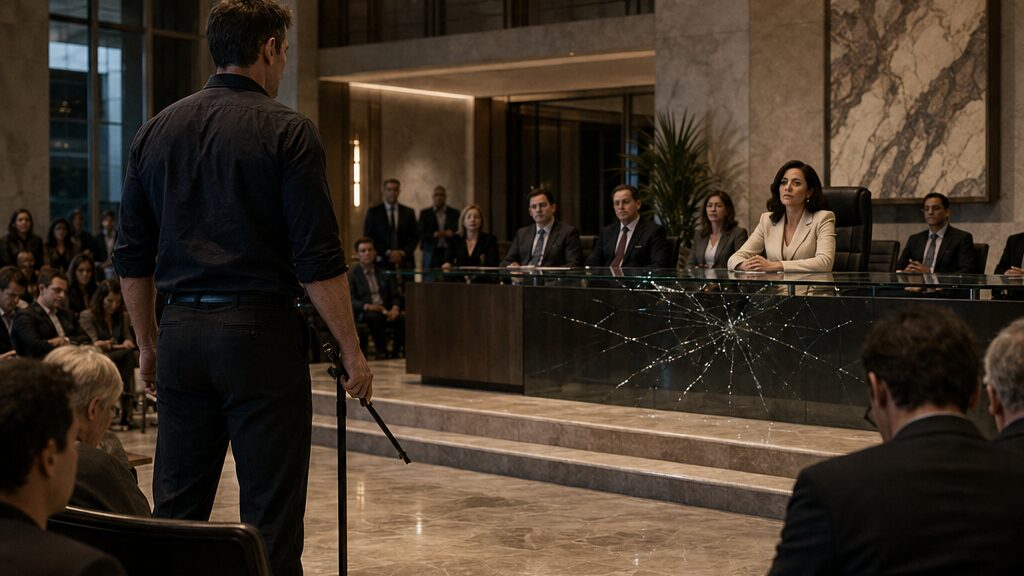
Inside, rows of chairs filled the grand lobby. Crystal fixtures reflected light across polished marble floors. At the far end of the room sat an elevated dais where the HOA board waited behind a long glass table.
Stephanie Wilson occupied the center seat.
A camera tripod stood beside her.
The livestream had already started.
Joseph could see comments scrolling across a large monitor.
Hundreds of viewers were watching.
Maybe thousands.
Angela stood near the rear entrance pretending to review messages on her phone.
She did not approach him.
They had agreed on that.
For now.
Security checked Joseph’s identification before allowing him inside.
Several residents watched silently.
No one smiled.
No one waved.
The room felt less like a community meeting than a public trial.
Nancy sat near the middle rows.
When their eyes met, she looked nervous.
Then she gave a small nod.
It wasn’t much.
But it was more support than most people dared show.
Joseph took a seat near the front.
The microphone mounted at the center of the room caught his attention immediately.
Large.
Polished.
Visible from every angle.
Stephanie liked microphones.
Liked controlling who could use them.
Liked deciding whose voice mattered.
The meeting began exactly on time.
Stephanie smiled into the livestream camera.
“Good evening, everyone.”
Her voice echoed through the speakers.
“We appreciate the strong attendance.”
She sounded warm.
Professional.
Reasonable.
People unfamiliar with her would have trusted her immediately.
That was part of the problem.
She knew how to perform.
She reviewed budgets.
Maintenance projects.
Upcoming events.
Fifteen minutes passed before she finally turned toward Joseph.
The shift felt deliberate.
Like a hunter deciding it was time.
“And now,” she said smoothly, “we will address a serious violation of community standards.”
The monitor displayed Joseph’s name.
Murmurs spread through the room.
Stephanie continued.
“Mr. Joseph Carter has repeatedly operated unauthorized educational activities from his residence.”
The phrasing was careful.
Designed to sound official.
Designed to sound dangerous.
She displayed photographs.
Children carrying backpacks.
Parents entering the building.
Study sessions around a dining table.
Ordinary moments transformed into evidence.
“The board has received numerous complaints.”
Joseph recognized several documents.
Most had been submitted anonymously.
Some had originated from board members themselves.
Stephanie never mentioned that part.
“We must ensure consistency,” she continued.
“Rules exist for everyone.”
The irony landed heavily.
Joseph watched residents shift uncomfortably.
Some stared at the floor.
Others avoided looking at him.
Nobody challenged her.
Not yet.
Stephanie’s smile widened slightly.
She interpreted silence as agreement.
The presentation continued.
Slide after slide.
Violation after violation.
Every piece carefully selected.
Every context removed.
Eventually she looked directly at Joseph.
“Would you like an opportunity to respond?”
A microphone stood several feet away.
Joseph rose from his chair.
The moment he approached it, a board member leaned toward Stephanie.
She nodded.
The microphone suddenly emitted a sharp burst of static.
Then silence.
Joseph tapped it once.
Nothing.
Stephanie tilted her head.
“Oh dear.”
A few nervous laughs emerged from the audience.
She shrugged.
“Technical issues.”
Joseph looked at the disconnected cable beneath the podium.
The cord had been unplugged.
Deliberately.
The room saw it too.
Nobody said anything.
Stephanie folded her hands.
“Without a functioning microphone, perhaps we should proceed.”
The humiliation was almost elegant.
Public.
Visible.
Plausibly deniable.
Joseph returned to his seat.
Anger flickered through him.
Not because of the microphone itself.
Because he had allowed this pattern to continue for years.
Document.
Wait.
Document again.
Trust the process.
Every time the board crossed a line, he convinced himself evidence would eventually matter.
Meanwhile Stephanie kept escalating.
The meeting moved toward its conclusion.
A board member read the recommendation.
Eviction proceedings.
Enforcement action.
Removal timeline.
The words sounded unreal.
Several residents exchanged uneasy looks.
Nancy’s face had gone pale.
Stephanie turned back toward the livestream.
“These decisions are never easy.”
The comment section filled with praise.
Strong leadership.
Protecting standards.
Maintaining quality.
Joseph wondered how many viewers knew children were being targeted.
Probably very few.
That was the advantage of controlling the narrative.
You chose which facts existed.
Then Stephanie delivered the final blow.
She looked directly at him and smiled.
“Mr. Carter, do you have any final comments before the vote?”
The dead microphone stood nearby.
Everyone saw it.
Everyone understood.
A few residents lowered their eyes.
The board members smiled politely.
The vote began.
One by one.
Approval.
Approval.
Approval.
The outcome had indeed been decided before the meeting started.
Nancy closed her eyes.
Joseph sat perfectly still.
When the final vote was cast, applause scattered across the livestream monitor.
Not inside the room.
Only online.
People in the room understood something was wrong.
They simply lacked the courage to say it.
Stephanie leaned back.
Satisfied.
Victorious.
The eviction was now official.
For several seconds nothing happened.
Then Joseph slowly stood.
His chair scraped across the marble floor.
The sound echoed through the room.
Conversation stopped.
Stephanie’s smile faded slightly.
Joseph began walking toward the dais.
One step at a time.
No hurry.
No visible emotion.
Security exchanged uncertain glances.
Residents turned in their seats.
The microphone remained silent.
The room remained silent.
Yet somehow every eye followed him.
When he reached the front row, he stopped.
The glass table reflected the bright lobby lights.
Stephanie stared at him.
For the first time all evening, she seemed unsure.
Joseph placed both hands at his sides.
Then he looked directly at her.
And continued forward.
Chapter 5: The Sound That Ended Their Power
The first crack sounded like a gunshot.
Joseph’s fist slammed into the glass table before anyone understood what was happening.
The surface exploded into a web of fractures.
Sharp lines raced across the entire length of the table.
Gasps erupted from the audience.
Someone screamed.
Board members jerked backward.
The livestream camera shook.
For one impossible second, nobody moved.
Joseph remained standing.
Blood ran from his knuckles.
Red drops slid across shattered glass.
His expression never changed.
Not anger.
Not panic.
Just cold certainty.
Silence flooded the room.
The same room that had spent years silencing others.
Now nobody could find a voice.
Stephanie stared at the damaged table.
Then at Joseph.
For the first time, her confidence vanished completely.
“Security—”
Her voice cracked.
One guard stepped forward.
Then stopped.
The hesitation was subtle.
But everyone noticed.
Because Joseph wasn’t attacking anyone.
He wasn’t threatening anyone.
He had shattered the symbol of their authority.
Nothing more.
Nothing less.
The board suddenly looked smaller behind the fractured glass.
Much smaller.
Joseph lifted his bleeding hand.
The microphone stood beside him.
Still disconnected.
Still silent.
Still controlled.
He grabbed the metal stand.
Several board members flinched.
With a violent pull, he ripped it from its base.
The speaker system exploded with deafening feedback.
A screech tore through the lobby.
People covered their ears.
The sound bounced off marble walls and crystal fixtures.
Then the speakers died.
Silence returned.
A deeper silence this time.
The kind that follows a storm.
Joseph dropped the twisted microphone stand onto the shattered table.
The metal clattered loudly.
Nobody spoke.
Stephanie glanced toward the livestream monitor.
Thousands of viewers were still watching.
The comments were changing.
What is happening?
Why was his microphone disconnected?
Why are security guards standing there?
Questions had begun.
Questions she couldn’t mute.
Joseph finally spoke.
His voice carried naturally through the room.
No microphone needed.
“You wanted everyone to watch.”
Stephanie said nothing.
Blood dripped onto the glass.
“You wanted everyone to see what happens when someone disagrees with you.”
Still nothing.
Joseph slowly turned toward the audience.
Faces stared back.
Frightened.
Curious.
Hopeful.
Nancy sat frozen in her chair.
“You all knew this wasn’t about tutoring.”
The statement hung in the air.
A few people looked away.
Others nodded almost imperceptibly.
Because they had known.
Maybe not every detail.
But enough.
Joseph looked back at Stephanie.
“You thought nobody would ever say it.”
The room remained silent.
Yet the silence felt different now.
No longer obedience.
Anticipation.
Stephanie suddenly stood.
“We are ending this meeting.”
Her voice sounded desperate.
“This behavior is unacceptable.”
Joseph almost laughed.
After years of intimidation, selective enforcement, and public humiliation, property damage was apparently where she drew the line.
She pointed toward security.
“Remove him.”
Neither guard moved.
Stephanie blinked.
“Did you hear me?”
One of the guards looked uncomfortable.
The other stared at the shattered table.
Neither advanced.
Authority depended on certainty.
The room was losing faith in hers.
Stephanie realized it too.
Fear flashed across her face.
Not fear of Joseph.
Fear of losing control.
She grabbed her phone.
The livestream continued.
Millions of polished words had built her reputation.
Now reality was dismantling it.
Joseph reached into his jacket.
Several board members stiffened.
He withdrew nothing threatening.
Only a key card.
Small.
Ordinary.
He held it up briefly.
Then turned toward a side door near the rear of the dais.
Confusion spread through the room.
Stephanie frowned.
“What are you doing?”
Joseph didn’t answer.
Instead he walked toward the door.
Every eye followed him.
Nancy leaned forward.
Even the security guards watched.
Joseph inserted the key card.
The lock clicked.
Stephanie took a step forward.
For the first time all evening, panic showed openly.
“Joseph.”
He ignored her.
The door handle turned.
The room held its breath.
Joseph pulled the door open.
And stepped aside.
Chapter 6: Keep Livestreaming
The first person through the doorway carried a camera.
The second carried another.
A third rolled in lighting equipment.
The entire room froze.
Then Angela Nelson entered behind them.
Recognition spread quickly.
Several residents knew her face immediately.
Others recognized the logo on the cameras.
National media.
Not local.
Not community coverage.
National.
Stephanie’s expression collapsed.
“What is this?”
Angela ignored her.
The camera crew moved with practiced efficiency.
Within seconds lenses pointed directly at the HOA board.
The livestream continued.
Now broadcasting their reaction in real time.
Joseph stood beside the open door.
Blood still marked his hand.
Angela looked at him briefly.
No words were necessary.
Then she faced the room.
“My name is Angela Nelson.”
Silence answered her.
“We have been investigating allegations involving this HOA for several weeks.”
Stephanie immediately stepped forward.
“This meeting is private.”
Angela raised an eyebrow.
“You livestreamed it.”
A few residents laughed nervously.
The sound surprised even them.
Stephanie opened her mouth.
Nothing came out.
The shift had begun.
For years she had controlled the room through confidence.
Now confidence belonged elsewhere.
Angela held up a folder.
“We have interviewed residents.”
Another folder.
“We reviewed enforcement records.”
A third.
“We examined financial documents.”
Every sentence tightened the atmosphere.
Board members exchanged worried glances.
Joseph watched the audience instead.
Something was happening there.
Not outrage.
Not yet.
Permission.
People were realizing they were no longer alone.
Angela turned toward the crowd.
“If anyone wishes to speak on camera, now is the time.”
The invitation lingered.
Nobody moved.
Old habits die slowly.
Fear remained powerful.
For several seconds, the room stayed motionless.
Then Nancy Robinson stood.
The movement seemed almost accidental.
As though she had surprised herself.
Angela nodded.
Nancy swallowed hard.
Her voice shook.
“I was fined for questioning landscaping contracts.”
The statement sounded small.
Ordinary.
Yet it shattered something invisible.
Because she said it publicly.
On camera.
Without permission.
Another resident stood.
Then another.
Stories emerged.
Inspections.
Warnings.
Threats.
Retaliation.
Not dramatic stories.
Human stories.
Small abuses repeated until they became normal.
Stephanie attempted to interrupt.
Angela simply gestured toward a camera.
“Please continue.”
The residents did.
One after another.
The microphone motif had completed its transformation.
The board no longer controlled who spoke.
The community did.
A board member suddenly rose from his chair.
“I need to leave.”
Another followed.
Then another.
Angela’s crew immediately recorded them.
The attempted escape only made them appear guiltier.
Stephanie remained seated.
Cornered.
Angry.
Terrified.
“You don’t understand,” she said.
Nobody was sure whether she spoke to Angela, Joseph, or herself.
“We were protecting this community.”
There it was.
The justification.
The belief beneath everything.
Order.
Control.
Prestige.
Property values.
She had convinced herself those goals excused almost anything.
Joseph looked at her quietly.
“You stopped protecting people a long time ago.”
The words landed harder than shouting ever could.
Stephanie looked away.
A commotion erupted near the entrance.
Several uniformed officials entered the lobby.
Not police.
Not yet.
Investigators.
Regulatory authorities.
People carrying folders and credentials.
The room fell silent once more.
But this silence felt entirely different from the one at the beginning of the meeting.
That silence had belonged to fear.
This one belonged to consequences.
An investigator approached the board.
“We’ll need access to all records immediately.”
Nobody argued.
Nobody protested.
The cameras recorded everything.
Angela lowered her notebook.
Residents watched the officials move toward the dais.
Toward the shattered glass.
Toward the fallen microphone stand.
Toward the place where authority had broken apart.
For years the community had believed resistance was impossible.
Now they watched the first crack spread through the entire structure.
And nobody knew how far it would go next.
Chapter 7: The Morning After the Broadcast
Every television in the condominium lobby showed the same image.
Stephanie Wilson sat frozen behind a shattered glass table while cameras surrounded her.
The footage played on repeat.
By eight o’clock the next morning, it had spread far beyond the building.
National news channels carried segments.
Online commentators analyzed clips.
Former residents posted stories.
Investigative reporters published timelines.
The scandal had escaped containment.
Joseph watched part of the coverage from his apartment before turning the television off.
The noise felt overwhelming.
For years nobody had listened.
Now everyone wanted to.
His phone buzzed constantly.
Messages from parents.
Messages from neighbors.
Messages from strangers.
One mother sent a photograph of her son holding a math workbook.
Thank you for not giving up.
Joseph stared at the image for a long moment.
Then set the phone aside.
The tutoring room looked exactly as it always had.
Books.
Pencils.
Study guides.
Nothing had changed.
Yet everything had.
A knock interrupted his thoughts.
Nancy stood outside.
This time she wasn’t nervous.
Not entirely.
But the fear that had once defined every conversation was fading.
“You should see the lobby.”
Joseph followed her downstairs.
The atmosphere felt unfamiliar.
Residents gathered in small groups.
Speaking openly.
Not whispering.
Not checking cameras.
Speaking.
The change was subtle yet enormous.
For years conversations had happened behind closed doors.
Now people stood in public discussing the investigation.
A resident who had avoided Joseph for months approached him directly.
“I should have spoken sooner.”
Another resident nodded.
“So should I.”
Joseph wasn’t interested in apologies.
What mattered was that they were speaking now.
Near the entrance, workers removed damaged furniture from the assembly area.
The shattered table had disappeared.
Only faint scratches remained on the marble floor.
The throne of authority was gone.
Nancy watched the cleanup crews.
“I never thought I’d see this.”
Joseph understood.
Neither had he.
A large television mounted near the reception desk switched to breaking news.
The lobby quieted.
A reporter appeared on screen.
“Federal and state investigators have expanded their review of financial activities connected to the condominium association.”
Images followed.
Documents.
Board members leaving offices.
Residents giving interviews.
Then Stephanie appeared again.
This time she wasn’t speaking.
She was being escorted into a government building.
The silence surrounding her looked strangely familiar.
For years she had controlled microphones.
Now others controlled the questions.
The report ended.
Conversation resumed immediately.
But something else caught Joseph’s attention.
Children were arriving.
Several students entered the lobby carrying backpacks.
One recognized him and waved.
Others followed.
Soon parents approached as well.
They wanted tutoring sessions to continue.
Not someday.
Today.
The request surprised him.
“So soon?” he asked.
A parent smiled.
“Especially now.”
The answer lingered.
Especially now.
Because the tutoring had never merely been about schoolwork.
It had been about community.
A thing people suddenly realized they wanted back.
By afternoon, national coverage intensified.
Angela called while Joseph prepared lesson materials.
“You should sit down.”
“I’m already sitting.”
“Good.”
Her laugh sounded exhausted.
Then she became serious.
“More residents are coming forward.”
“How many?”
“Enough.”
That single word carried weight.
Enough witnesses.
Enough records.
Enough scrutiny.
Enough truth.
Angela continued.
“The financial review is getting bigger.”
Joseph leaned back.
“How big?”
“Big enough that several attorneys are discussing restitution.”
The possibility hadn’t fully occurred to him.
Investigations were one thing.
Consequences were another.
Residents had paid fines.
Fees.
Assessments.
Some had moved away entirely.
The damage extended beyond reputation.
Angela lowered her voice.
“The story isn’t about one meeting anymore.”
Joseph looked toward the dining table where children would soon sit.
“No.”
“It isn’t.”
After ending the call, he stood near the apartment window.
Below, residents crossed the courtyard.
Talking.
Laughing.
Existing without visible fear.
The transformation felt almost fragile.
As if silence might return if nobody protected the change.
That realization brought an uncomfortable truth.
For years Joseph had hidden behind documentation.
Gathering proof.
Collecting records.
Waiting for someone else to act.
Angela had been right.
Evidence alone changed nothing.
Evidence needed a voice.
Needed action.
Needed risk.
The lesson cost him nearly everything.
But he finally understood it.
Late that evening another news segment aired.
This one featured resident interviews.
Nancy appeared briefly.
Joseph almost laughed.
The woman who once checked hallways before speaking now addressed a national audience.
“I thought staying quiet would keep me safe,” she said.
“It didn’t. It only protected the people causing the harm.”
The clip ended.
Joseph sat silently.
That was the deepest truth of the entire story.
Not corruption.
Not money.
Not retaliation.
Silence.
The system had survived because decent people believed resistance was pointless.
Once enough people stopped believing that, everything changed.
The next week brought formal announcements.
Several board members resigned.
Investigations expanded.
Financial audits uncovered improper spending.
Restitution claims began moving forward.
The condominium association appointed temporary oversight.
The headlines continued.
The consequences continued.
And still the tutoring sessions continued too.
One afternoon Joseph looked around the dining table.
Students worked through equations.
Parents chatted quietly nearby.
The room felt alive.
A place for learning.
A place for voices.
A place nobody needed permission to enter.
One of the children raised a hand.
“Mr. Carter?”
“Yes?”
The student grinned.
“Are they still talking about you on TV?”
Laughter spread around the room.
Joseph shook his head.
“Let’s focus on math.”
The child groaned dramatically.
Everyone laughed harder.
Outside the apartment, cameras and reporters still chased the aftermath.
Inside, ordinary life moved forward.
That felt like the real victory.
Not the investigations.
Not the headlines.
Not even the downfall of those who had abused power.
The real victory was simpler.
The room still existed.
The children still learned.
The community still gathered.
And nobody was afraid to speak.
The story has ended.