They Blocked Him At The Estate Dinner After Rewriting Her Will Without His Name
Chapter 1: The Hand That Stopped Them At The Door
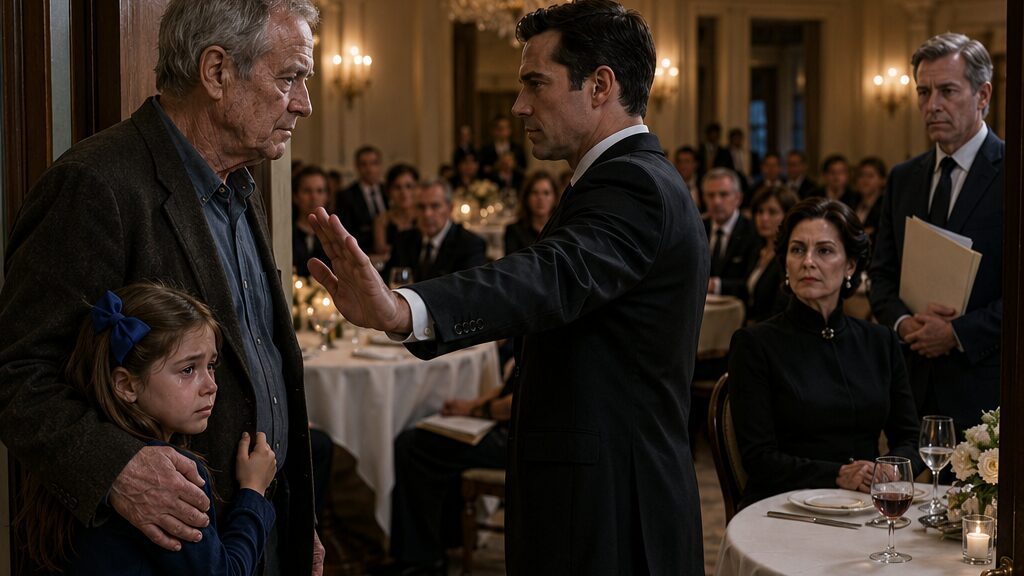
Mark Davis’s hand rose before Jerry White could step across the carpet.
It was not raised high enough to look violent. That was what made it worse. It hovered at chest level, palm outward, polished cuff showing beneath a black suit sleeve, the gesture of someone stopping a delivery man at a service entrance.
Jerry stopped so suddenly that Amy bumped into his side.
The banquet room behind Mark glowed with chandeliers and folded white napkins. Silverware caught the light. A long table had been set beneath framed photographs of Virginia White smiling through different seasons of her life: Virginia in a garden hat, Virginia beside a Christmas tree, Virginia with one hand lifted in the shy half-wave she always gave when someone pointed a camera at her.
At the nearest table, people turned.
Jerry felt them before he counted them. Faces lifting. Forks pausing. A woman in pearls leaning toward another guest. A man in a dark jacket glancing from Jerry’s worn blazer to Amy’s navy dress.
Amy’s blue bow sat crooked in her hair from the ride over. She had insisted on wearing it because Virginia had liked blue on her.
“Mark,” Jerry said quietly.
Mark did not lower his hand.
“I’m sorry,” Mark said, not sounding sorry. “This portion of the reception is private.”
Jerry looked beyond him. Sharon Martin sat halfway down the main table in a black dress with a high collar, her hands folded beside a water glass. She watched him without surprise. She had known he would come. Or she had known he would try.
“We were invited to the memorial,” Jerry said.
“The memorial was at the church.” Mark’s voice stayed low, smooth enough for the room to pretend this was not a scene. “This dinner is for listed beneficiaries and immediate family.”
Amy looked up at Jerry. Her fingers found the side seam of his jacket.
“Grandpa,” she whispered, “are we late?”
Jerry kept his left arm around her shoulders. He had done it in the parking lot when she started shivering, though the evening was warm. He had done it in the church when Sharon walked past them without touching his sleeve. He did it now because if he let go, Amy would feel the whole room at once.
“We’re not late,” he said.
Mark’s eyes flicked down to Amy and then back to Jerry, as though she were part of the difficulty he had been sent to manage.
“Please don’t make this uncomfortable.”
A sound moved through the room, not quite a whisper and not quite silence. Jerry saw Michael Thomas near the sideboard, a thin stack of papers tucked under one arm. The estate attorney had removed his suit jacket and looked warmer than everyone else, as if he had expected the reading of Virginia’s paperwork to remain a calm matter of signatures and initials.
“Michael,” Jerry said.
The attorney’s expression tightened.
Sharon stood before Michael could answer.
She did not rush. She smoothed the front of her dress, came around the table, and walked toward the doorway with the grave patience of someone approaching a spill before it stained the carpet.
“Jerry,” she said, “not here.”
Amy pressed closer to him.
Jerry had heard those two words from Sharon before. Not here, when Virginia wanted to talk about Amy’s college account at Thanksgiving. Not now, when Jerry asked why Sharon had changed the schedule for the hospice nurse. Don’t upset her, when he came to the bedroom door and heard Virginia speaking softly on the other side.
He had stepped back each time.
He had told himself peace was a form of love.
Now Mark’s hand remained between him and the room where Virginia’s photographs had been placed like decorations.
“I came because Amy wanted to see the pictures,” Jerry said.
Sharon’s mouth softened for one second, but the softness did not reach her eyes. “Amy can see them later.”
“Why not now?”
A guest near the table looked down quickly.
Mark shifted, angling his body so Jerry could not see the papers in Michael’s hand. That small movement, that practiced blocking, opened something cold inside Jerry.
“What did you mean by listed beneficiaries?” Jerry asked.
Sharon inhaled through her nose. “This is not the place.”
“You made it the place when you stopped us at the door.”
Mark’s jaw tightened. “Jerry, the updated estate plan is very clear. Tonight is for the beneficiaries named in Virginia’s final documents. My mother is trying to avoid confusion.”
“Confusion,” Jerry repeated.
Amy lifted her face. “What’s a benefish—”
“Beneficiary,” Mark said before Jerry could stop him, with the impatience of a man correcting a child he did not think belonged in the room. “Someone named in the will.”
Amy looked at the tables, at the people sitting under Virginia’s photographs, then back at Jerry.
“Grandma didn’t name us?”
The words were small enough that they should have fallen only between them. They did not. The room heard. Jerry saw it land in the faces: the quick pity, the discomfort, the relief that the hurt belonged to someone else.
Amy’s lower lip trembled. She reached up and touched the blue bow as if it had suddenly become a mistake.
Jerry bent slightly toward her. “You didn’t do anything wrong.”
“But did she forget me?”
Sharon’s composure cracked just enough for Jerry to see anger underneath. Not at Amy crying. At Amy crying where others could see.
“No one forgot anyone,” Sharon said. “Mother made decisions at the end. Difficult decisions. Adult decisions.”
“She was my wife,” Jerry said.
“And she was my mother.”
There it was, the old line Sharon had never spoken so plainly while Virginia lived. My mother. As if Jerry had borrowed Virginia for fourteen years and now the rightful owner had come to collect what remained.
Michael stepped forward at last.
“Perhaps,” he said carefully, “we can schedule a proper meeting tomorrow.”
Jerry looked at the papers under his arm. “Is that it?”
Michael glanced at Sharon.
“Is that the will?”
“It’s a beneficiary summary,” Michael said. “Not the full instrument.”
“Let me see it.”
Mark’s hand dropped half an inch, then rose again. “That’s not necessary.”
Jerry looked at him until Mark’s fingers curled slightly.
“I didn’t ask you.”
The room went quiet in a new way.
Michael hesitated, then pulled the top page free. “Jerry, I need to be clear. This is a summary only.”
He held it out.
Jerry took the paper with his free hand. Amy leaned into his ribs, crying silently now, her breath catching every few seconds. The page was neat. Virginia White Revocable Trust. Final Amendment. Primary distribution: Sharon Martin. Personal residence: Sharon Martin. Financial accounts: per beneficiary designation. Specific bequests: listed separately.
Jerry scanned once. Then again.
His name was nowhere.
Amy’s name was nowhere.
Not even the education account Virginia had called “the blue-bow promise” after Amy’s birthday dinner two years earlier, when Amy had fallen asleep with the bow still clipped to her hair and Virginia whispered to Jerry that the girl should never have to wonder if she had been wanted.
Jerry’s thumb moved down the page.
Date executed: April 16.
For a moment the chandeliers blurred.
April 16.
He was back in the hallway outside Virginia’s bedroom, holding a paper cup of soup he had warmed twice. Sharon standing in the doorway, saying Virginia was resting. Sharon’s hand on the doorknob. The nurse’s bag on the floor. Virginia’s voice inside, faint and confused, asking whether it was morning.
Jerry had not pushed past Sharon. He had gone home.
He had told himself dignity meant waiting.
Now Amy’s tears dotted the sleeve of his jacket.
“Jerry,” Sharon said, “don’t do this in front of everyone.”
He looked up.
Michael had not moved. Mark’s hand was still there, useless now, blocking an old man who no longer wanted to enter the room.
Jerry folded the beneficiary summary once, not hard enough to crease it fully.
Then he looked at Michael Thomas.
“What date did she sign that?”
Chapter 2: The Date Nobody Wanted To Explain
Michael Thomas had the will open before Jerry sat down.
The page faced outward on the polished desk, angled just enough that Jerry saw the blank space where his name should have been. Not erased. Not crossed out. Worse than that. Never present at all.
Michael had placed a yellow tab beside Virginia’s signature.
Jerry remained standing for a moment, his hat in both hands. The office smelled faintly of coffee and copier toner. A framed certificate hung behind Michael’s chair. Beneath it sat a silver pen stand, two legal pads, and a square clock that ticked too loudly for a room built to keep secrets quiet.
“You can sit,” Michael said.
Jerry did, though his knees did not want to bend.
Michael closed the office door. Through the glass wall, a paralegal moved past with a folder, careful not to look in.
“I want to begin by saying I understand yesterday was difficult.”
Jerry looked at the open page. “For who?”
Michael’s face tightened, but he took the question without protest. “For you. For Amy. For everyone.”
“Everyone ate dinner.”
Michael folded his hands. “Jerry.”
“No,” Jerry said, softer than he expected. “Don’t smooth it. Not here.”
The attorney sat back.
Jerry placed the beneficiary summary from the banquet on the desk. He had folded and unfolded it enough times that the paper had gone soft at the creases.
“April 16,” Jerry said. “That’s the date.”
“Yes.”
“You were there?”
“I met with Virginia that day, yes.”
“At the house?”
“At first. Then at my office for execution of the amendment.”
Jerry stared at him. “She left the house?”
Michael’s hesitation was brief, but Jerry saw it.
“Sharon transported her.”
Jerry looked toward the window. Cars moved through the downtown street below, ordinary and clean and unconcerned.
On April 16, Jerry had stood outside Virginia’s bedroom door with soup. Sharon had told him Virginia was too exhausted to see anyone. He had believed the word exhausted because it hurt less than suspecting anything else.
“What time?” Jerry asked.
“I’d have to check the appointment record.”
“Check it.”
Michael did not move. “I can request the file.”
“It’s your file.”
“It’s the estate’s file.”
Jerry leaned back slowly. “And I’m not part of the estate.”
Michael looked down at the will. “That is the issue.”
There was no cruelty in the man’s voice. That almost made it harder. Mark had blocked him with his palm; Sharon had blocked him with grief sharpened into authority. Michael blocked him with nouns. Instrument. Execution. Capacity. Beneficiary. Estate.
“I cared for her for three years,” Jerry said.
“I know you did.”
“Do you?”
Michael’s eyes lifted.
Jerry heard the sharpness in his own voice and hated it. He had spent years teaching children to hold a violin bow without crushing it. Pressure mattered. Too much pressure ruined the sound.
He forced his hands open on his knees.
Michael turned a page. “The documents are legal. The signatures are verified. There were witnesses. Virginia answered the required questions.”
“When exactly were they signed?”
“April 16.”
“What time?”
“Jerry—”
“What time?”
Michael exhaled. “Late afternoon, according to the notarization.”
Jerry nodded once. “Late afternoon.”
That was when Sharon had called him in the driveway and said Virginia had finally fallen asleep.
He remembered because Amy had been in the back seat, holding the library books Virginia had asked for the week before. Jerry had told her Grandma needed rest. Amy had drawn a blue flower on the receipt from the pharmacy and asked him to give it to Virginia later.
He had not.
He had left the receipt in the cup holder.
Michael’s voice lowered. “I understand you’re upset by the timing.”
“Upset is when a waiter forgets coffee.”
“I didn’t mean—”
“She couldn’t finish a sentence that week,” Jerry said. “Verified by whom, on a day she couldn’t finish a sentence?”
Michael’s expression changed. Not guilt. Something more defensive, more professional.
“Capacity is not the same as perfect memory. A person can be ill and still understand the nature of a document, the extent of their property, and the natural objects of their bounty.”
Jerry stared at him.
“That’s the language?”
“Yes.”
“Natural objects of her bounty.” Jerry almost laughed, but Amy’s face at the banquet stopped it in his throat. “She asked me three times that week if her mother was coming to visit. Her mother had been gone thirty years.”
“I wasn’t present for that.”
“No. Sharon was.”
Michael looked down.
There. A pause.
Jerry touched it carefully. “Who called you?”
“Sharon contacted my office.”
“When?”
“I don’t have that in front of me.”
“Was Virginia with her when she called?”
“I don’t know.”
“Did Virginia ask for a new will?”
“She confirmed her wishes in my presence.”
“That wasn’t my question.”
Michael removed his glasses and rubbed the bridge of his nose. “Jerry, I’m not your attorney. I need to be careful here.”
“I’m not asking you to be mine. I’m asking you to be honest.”
For the first time, Michael looked tired.
“There was an earlier estate plan,” he said. “Different distributions. That much I can say because Sharon has already referenced it.”
Jerry felt his fingers tighten around his hat.
“How different?”
“I can’t release prior instruments to you without the proper request or court authority.”
“My name was in it.”
Michael did not answer.
“Amy’s name was in it.”
Still nothing.
Jerry stood.
Michael’s eyes lifted quickly, as if he thought Jerry might knock the papers from the desk. Jerry did not touch them. He only reached into his jacket pocket and removed a small envelope. Inside was a folded drawing Amy had made for Virginia, the blue flower on the pharmacy receipt. He had found it that morning under the passenger seat while looking for his church program.
He placed it on the desk beside the will.
“April 16,” he said. “I brought Amy to see her. Sharon told me Virginia couldn’t stay awake.”
Michael looked at the drawing but did not pick it up.
“Did Sharon tell you I’d come by?”
“No.”
“Did she tell you I had stepped away from Virginia’s care?”
Michael’s silence answered before he did.
“She said the family situation had changed.”
Jerry swallowed. “Changed how?”
“That you were having difficulty managing Virginia’s decline. That Sharon had taken on the primary responsibility for appointments and decisions.”
Jerry picked up the receipt again because his hand needed something before it became a fist.
He had let Sharon schedule the appointments. He had let her speak to the pharmacy because she had a louder voice and knew what questions to ask. He had let her stand in doorways because Virginia seemed less agitated when no one argued.
He had mistaken quiet for kindness.
“What do I need to file?” Jerry asked.
“For what?”
“The earlier will. Appointment records. Anything with dates.”
Michael opened a drawer, took out a card, and wrote on the back of it. “You need independent counsel. A probate clerk can tell you what has been filed, but they cannot advise you. You can also request medical records if you had authorization.”
“I did.”
“Then start there.”
Jerry took the card.
Michael hesitated again. “There was a home-care aide present during that period.”
Jerry looked up.
“She wasn’t part of the signing,” Michael said quickly. “Not a witness. Not involved in the documents.”
“What was her name?”
“I shouldn’t—”
“What was her name, Michael?”
The attorney closed the will, leaving Jerry’s absence hidden between pages.
“Jennifer Moore,” he said. “But Jerry, if she saw anything, she never told me.”
Chapter 3: The Woman Who Remembered The Blue Bow
Jennifer Moore saw Jerry beside the grocery carts and turned around as if she had forgotten something inside the store.
“Please,” Jerry said.
She stopped with one hand on her car door and a paper bag pressed against her hip. A loaf of bread stuck out of the top. Her hair was pulled back tightly, and there were half-moons of fatigue under her eyes that makeup had not hidden.
“I can’t talk to you,” she said.
“You know who I am?”
Her mouth moved once before sound came. “Everyone knew who you were.”
That answer struck him harder than if she had said no. Everyone knew who he was, but somehow Michael’s file said Sharon had taken over because Jerry had stepped away.
Jerry kept both hands visible at his sides. “I’m not here to make trouble for you.”
Jennifer gave a short, nervous laugh. “That’s what people say before trouble starts.”
A car rolled past them, the driver slowing to look at the old man in the worn jacket and the woman trapped by her own open door. Jennifer noticed too. She lowered her voice.
“Sharon told me this might happen.”
“When?”
“After the funeral.”
Jerry felt the parking lot tilt slightly beneath his feet.
“She came to you after the funeral?”
Jennifer looked toward the store windows. “She said if anybody contacted me about Virginia’s state of mind, I should remember I was paid to provide care, not opinions.”
“That sounds like Sharon.”
“No,” Jennifer said, and her eyes sharpened with old fear. “That was the polite part.”
Jerry waited.
Jennifer shifted the bag to her other arm. “She said people like me get accused when money goes missing. She said if I let anyone twist my words, I could lose work. Maybe worse.”
Jerry looked down at the asphalt. A crushed receipt trembled in the wind near his shoe.
“I’m sorry,” he said.
That made Jennifer stare at him.
“I didn’t know she did that,” he said. “I should have.”
The anger she had been holding ready for him loosened, but it did not disappear.
“I have a job now,” she said. “I need it.”
“I won’t ask you to sign anything. I won’t ask you to say what you didn’t see.” He took the blue flower receipt from his pocket. “I only need to understand April 16.”
At the date, Jennifer’s face changed.
Not dramatically. She did not gasp. She did not clutch the car door. But her eyes moved to the receipt, then to Jerry, then away.
“What about it?”
“That’s the day Virginia signed the amendment.”
Jennifer closed her eyes for one second.
“You knew there was paperwork?” Jerry asked.
“I knew Sharon had folders.”
“Did Virginia know?”
Jennifer looked at him then, and he saw the answer was not simple enough to say in a parking lot.
“Come by the house,” Jerry said. “Just coffee. Amy’s at school. No one else.”
“I shouldn’t.”
“No,” Jerry said. “Maybe not.”
That seemed to surprise her more than pressure would have.
He wrote his address on the back of Michael’s card and held it out. “If you decide not to, I won’t come looking again.”
Jennifer stared at the card for a long moment before taking it.
Two hours later, she sat at Jerry’s kitchen table with both hands wrapped around a mug she had not drunk from.
Virginia’s chair remained where it had always been, angled slightly toward the window. Jerry had not moved it after the hospice bed came and went. The cushion still held the flattened shape of use. Jennifer glanced at it once and then looked away.
“She liked that chair,” Jennifer said.
“She said it got the morning light right.”
“She’d ask me to put the little photo on the sill.”
Jerry turned from the counter. “What little photo?”
Jennifer frowned as if searching shelves inside her mind. “The girl. Amy. Blue bow, birthday cake. Virginia in a cream sweater.”
Jerry felt his throat tighten. “That picture was in her sewing room.”
“No,” Jennifer said. “Not always. During the last weeks, she wanted it near the bed.”
Jerry sat across from her.
Jennifer looked into the mug. “Some days she was clear. I want to be fair about that. She knew people. She knew her house. She knew Amy’s name.” Her fingers tightened. “Other days, after the medication changed, she would ask if she had missed church when it was Tuesday evening. Or she’d call Sharon by her sister’s name.”
“Did Michael know that?”
“I don’t know.”
“Did Sharon?”
Jennifer gave him a look.
Jerry nodded. Of course Sharon knew. Sharon had been there every week, sometimes every day, moving through the house with bags of groceries and folders and the brisk authority of someone who had decided efficiency was the same thing as love.
“On April 16,” Jerry said.
Jennifer set the mug down.
“She was tired that morning,” she said. “Not just sleepy. Foggy. She kept asking why her hands looked old. Sharon said not to upset her by correcting everything.”
“That sounds kind.”
“It did,” Jennifer said. “At first.”
Jerry waited.
“Then Sharon asked me to take an early lunch. When I came back, there was a folder on the kitchen table and Virginia was dressed.”
“Dressed to leave?”
Jennifer nodded. “Blouse, cardigan, the pearl earrings. Sharon said they had an appointment. I asked if Virginia was up to it.”
“What did Sharon say?”
“She said, ‘My mother can make her own decisions.’”
Jerry stared at the table.
He could see Virginia’s pearl earrings. She wore them when she wanted to feel steady. He had fastened them for her on bad days because her fingers shook.
“Did Virginia say anything?”
“She said…” Jennifer pressed her thumb against the mug handle. “She asked if Amy was coming.”
Jerry’s breath caught.
“Sharon said no. She said, ‘This is grown-up business.’ Virginia got quiet after that.”
The kitchen clock hummed. Outside, a truck passed, rattling the old window above the sink.
“I came that day,” Jerry said. “With soup. Amy was in the car.”
Jennifer’s head lifted slowly.
“Sharon told me Virginia was resting.”
Jennifer’s mouth parted.
“What?” Jerry asked.
“That was later,” she said. “After the appointment. You came after.”
“I never saw Virginia.”
“I know.” Jennifer looked sick now. “I was in the back hallway. Sharon told me to stay out of sight because visitors made Virginia emotional.”
Jerry remembered the closed bedroom door. The soup cooling in his hand. Sharon’s body filling the frame.
“I should have pushed past her,” he said.
Jennifer shook her head. “She would’ve made it worse.”
“I let her keep me from my wife.”
“You were trying not to fight in front of a sick woman.”
“That’s what I told myself.”
Jennifer did not answer.
Jerry stood and went to the counter, not because he needed anything, but because grief had started to move through him in a way that made sitting impossible.
“Did you hear them talk about the will?” he asked.
“No.”
He turned back.
“I need to be honest,” Jennifer said. “I never heard Virginia say, ‘Change my will.’ I never heard Sharon tell her what to sign. If someone asks me under oath, I can’t say that.”
Jerry nodded slowly. The truth had opened and closed at the same time.
“But,” Jennifer said, “I can say Sharon controlled who saw her. I can say Virginia was confused after the medication change. I can say she asked for Amy’s picture. And I can say Sharon warned me not to talk to you about paperwork.”
Jerry returned to the table.
Jennifer reached into her purse and took out a folded piece of paper. “I wrote down my shifts. Not official. Just for myself. I had another client then, and the agency schedule kept changing.”
She smoothed the paper between them. Dates, hours, notes in tight handwriting.
Her finger stopped halfway down.
“April 16,” she said. “Sharon sent me to lunch at eleven. They left around one. You came at four-ten. I remember because I had to start dinner by four-thirty.”
Jerry stared at the line until the ink seemed to darken.
Jennifer’s finger moved to the margin.
There, beside the date, she had written three words: Jerry sent away.
Chapter 4: The Letter Hidden Behind The Birthday Photograph
Amy found the photograph because the frame would not sit straight.
It leaned on the shelf in Virginia’s sewing room, crooked no matter how many times Amy nudged it with one careful finger. Jerry stood in the doorway, holding a cardboard box against his hip, telling himself they were only looking for old school programs and the missing sewing scissors Virginia had kept in a blue tin.
“Grandpa,” Amy said, “this one’s broken.”
Jerry almost told her to leave it. The room already felt too full of Virginia’s hands. Fabric folded by color. Thread spools lined in a drawer. A pincushion shaped like a tomato with one needle still pushed halfway through, waiting for someone who would not come back.
But Amy had lifted the frame.
A small sound came from behind it.
Not glass breaking. Paper shifting.
Jerry set the box down.
“Careful,” he said.
Amy turned the frame over on the sewing table. It was the birthday photograph Jennifer had described: Amy in her navy dress, younger by two years, blue bow centered perfectly in her hair, cheeks rounded by a smile she had not yet learned to hide. Virginia sat beside her in a cream sweater, one hand near the cake, the other resting lightly on Amy’s shoulder.
The backing had loosened at one corner.
Amy slid a fingernail under the cardboard. “There’s something inside.”
Jerry’s first instinct was to stop her.
It came from the same place that had kept him outside Virginia’s bedroom on April 16. The same old habit: don’t disturb, don’t pry, don’t force a door open when someone else says wait.
Then Amy looked up at him with the frame in both hands.
“Was Grandma hiding it?”
Jerry swallowed. “Let’s see.”
He eased the backing away. A folded sheet of stationery slipped onto the table.
Virginia’s handwriting faced upward.
Jerry knew it before he read a word. The slant had changed in the last year, grown less even, but the capital A still rose higher than the rest, and she still crossed her t’s long enough to touch the next letter. He had teased her once that her handwriting held hands with itself.
Amy touched the edge of the paper. “Is it from her?”
Jerry opened it.
My dearest Jerry,
The first line blurred before he could stop it.
He sat in Virginia’s sewing chair. The cushion sighed under him. Amy came close but did not climb into his lap, as if she sensed the letter was fragile in a way paper was not.
Jerry read silently at first.
Virginia had written about the birthday dinner. About Amy falling asleep in the car with the blue bow still clipped in her hair. About Jerry carrying her into the house and refusing to wake her even when his back hurt the next day. The first page was warm, almost ordinary.
Then the words changed.
I know Sharon thinks I have forgotten what I promised. I have not. Amy’s school money stays Amy’s. Whatever else happens, whatever papers have to be cleaned up, do not let anyone tell you I changed my heart about that child.
Jerry pressed his thumb to the page so hard the paper bent.
“What does it say?” Amy asked.
He looked at her. The blue bow she had worn to the memorial lay now in the pocket of her cardigan, one loop poking out like a small flag.
“She remembered you,” he said.
Amy’s face changed, but not into happiness. More like a child stepping onto ground she thought had disappeared.
“She did?”
“Yes.”
“Then why did they say I wasn’t listed?”
Jerry looked back at the page.
Because a letter was not a will. Because love written in a sewing room did not carry the same weight as a signature witnessed in an office. Because Virginia had written do not let anyone tell you, and Jerry had let too many people tell him too many things.
He turned to the second page.
Sharon has been angry for years. I understand more of it than she thinks. I was not always fair to her when she was young. I wanted peace so badly that sometimes I let silence do damage. If she ever says I chose—
The sentence stopped there.
Not ended. Stopped.
The ink dragged down slightly, as if Virginia’s hand had slipped or someone had interrupted her. Below it, the page was blank except for a faint mark near the bottom where the pen had touched and lifted.
Jerry turned the paper over. Nothing.
Amy leaned over his arm. “Why did she stop?”
“I don’t know.”
He hated how often that answer had become the only honest one.
A drawer in the sewing table stood slightly open. Jerry remembered closing it after the funeral when Sharon had come through the house making lists of “estate items,” her black dress whispering against boxes. She had not wanted the sewing room touched until documents were reviewed. Jerry had agreed because he was tired and because agreeing had been easier than making Virginia’s things into another argument.
Now he pulled the drawer open.
Inside were fabric scraps, measuring tape, two thimbles, and a stack of envelopes tied with a loose thread. Birthday cards from Amy. Receipts for alterations Virginia had done for church friends. An old grocery list with coffee, pears, blue ribbon written in Virginia’s hand.
Jerry opened each envelope carefully. Nothing legal. Nothing dated near April.
Amy had lifted the photograph from the frame and was staring at it.
“I remember this cake,” she said. “Grandma said the frosting was too sweet.”
“She ate two slices.”
Amy smiled for half a second. Then the smile faded. “Can I keep it?”
Jerry almost said yes immediately. Then he looked at the loose frame, the hidden letter, the stopped sentence. Something in him resisted dividing evidence from memory, as if one might betray the other.
“You can keep it with me for now,” he said. “Until we know what we need.”
Amy nodded, but her fingers tightened around the photo.
Jerry saw it and felt ashamed. Even now, he was speaking like Michael, like documents were hungry things that had first claim on what they touched.
He reached for the photo. “Let me make a copy. The real one is yours.”
Amy’s shoulders loosened.
He checked the frame backing before setting it down. A narrow paper sleeve had been taped along the inside edge, almost invisible under the brown cardboard. It had not fallen with the letter because one end remained stuck.
Jerry worked it loose with the flat edge of Virginia’s seam ripper.
A bank envelope slid out.
It was not thick. Just one folded page inside, printed on plain white paper. The top showed the name of the bank and a confirmation number. Jerry read it once, then again, the way he had read the beneficiary summary at the banquet.
Beneficiary change request received.
Date: April 16.
Time: 3:42 p.m.
Primary beneficiary updated: Sharon Martin.
Jerry sat so still that Amy touched his sleeve.
“Grandpa?”
He placed the bank page beside Virginia’s unfinished letter.
The will had not been the only thing changed that day.
Chapter 5: You Are Tearing This Family Apart
Sharon opened the door wearing the same black dress.
For one strange second, Jerry thought he had stepped backward in time to the country club doorway: Sharon’s high collar, her controlled mouth, her body held in that polished stillness that made every room seem to arrange itself around her.
Then he saw she was barefoot.
The black dress was wrinkled at the waist. Her hair, so exact at the memorial dinner, was pinned loosely now, silver showing near one temple. Behind her, the house smelled of coffee left too long on a warmer.
Her eyes moved to the folder in Jerry’s hand.
“No,” she said.
“I haven’t asked anything yet.”
“You didn’t come here to ask.”
Jerry stood on the porch with the folder tucked beneath his arm. He had not brought Amy. He had almost brought the blue-bow photograph, then decided against it. He did not want Sharon looking at it as if it were an exhibit.
“I came to talk about April 16.”
Sharon’s face closed.
“You need to leave.”
“I went to Michael. I spoke to Jennifer Moore.”
At Jennifer’s name, Sharon’s grip tightened on the door edge.
“You had no right to bother that woman.”
“You warned her not to talk.”
“I warned her not to get dragged into your grief.”
“My grief didn’t change a bank beneficiary twelve minutes after an appointment.”
Sharon stared at him. For the first time since Virginia died, Jerry saw something like fear move across her face. It passed quickly, covered by anger.
“You’re standing on my porch accusing me of stealing from my mother.”
“I’m asking why everything changed on the day you told me Virginia was asleep.”
Sharon laughed once, sharp and airless. “There it is. Poor Jerry, locked out of the sickroom. You want everyone to forget who was actually there doing the hard things.”
“I was there.”
“You were there when it was sweet.” Her voice rose, then dropped when she looked past him toward the neighboring houses. “You were there for tea and music and little birthday bows. I was there when she screamed because she didn’t know why her hands hurt. I was there when she refused pills. I was there when she asked where my father was, as if my whole childhood hadn’t happened without him.”
Jerry said nothing.
That was the old trap. Sharon’s pain was real enough to make his anger feel rude.
She stepped onto the porch. “Mom changed her mind. That was her right.”
Jerry opened the folder and removed a copy of Jennifer’s handwritten shift note. He held it flat between them.
“She changed it on the day you told me she couldn’t see me.”
Sharon’s eyes dropped to the paper.
“She was tired,” Sharon said.
“She was dressed in pearls and taken to an attorney.”
“She wanted dignity.”
“She asked if Amy was coming.”
A flush rose in Sharon’s cheeks. “Jennifer had no business repeating private things.”
“Virginia kept Amy’s photograph by the bed.”
“Because you made sure that child was everywhere.”
Jerry absorbed the words slowly.
Not because he did not understand them. Because he finally did.
Amy had not merely been forgotten in the revised will. She had been resented into absence.
“She was a child,” Jerry said.
“She was your child,” Sharon snapped. “Your family. Your chance to start over with Mom playing grandmother while the rest of us pretended nothing came before you.”
The front door opened wider behind her.
Mark stepped out, phone in hand, shirt sleeves rolled to the forearms. He looked from Sharon to Jerry and then immediately at the folder.
“This conversation is over,” he said.
Jerry did not move.
Mark came down one step. “You need to stop showing up with papers.”
“Then give me the appointment log.”
“What appointment log?”
“The one from Michael’s office. The transport time. Who was present. Who called. Who filled out the bank form.”
Sharon’s mouth tightened. “You’re not entitled to rummage through everything because you’re disappointed.”
“Disappointed is when something expected doesn’t happen. This is different.”
Mark gave a small shake of his head, as if Jerry were embarrassing himself. “You are tearing this family apart over money.”
Jerry looked at him.
Mark had said it cleanly, almost gently, the way he had said the dinner was private. He had a talent for turning cruelty into procedure.
“I’m not doing this over money,” Jerry said. “I’m doing this because she didn’t sign that alone.”
Sharon flinched.
Mark saw it and stepped between them. His hand lifted, palm outward, the same gesture from the banquet room. Stop. Enough. You do not pass.
Jerry looked at the hand.
He had dreamed of it once since the dinner. Not Mark’s face. Not Sharon’s black dress. Just the hand, floating between him and a room where Virginia’s pictures hung above plates of untouched salad.
“Move your hand,” Jerry said.
Mark’s eyes narrowed.
“Or what?”
Jerry did not raise his voice. “Or I will remember this conversation exactly as it happened.”
For a moment, Mark seemed uncertain what to do with an old man who would not be managed.
Then he reached into his back pocket and pulled out a folded check.
“My mother expected this might happen.” He held it toward Jerry. “This is not an admission of anything. It’s a goodwill payment. Enough to cover some expenses, and she’ll release personal photographs that don’t affect the estate.”
Jerry looked at the check.
Five thousand dollars.
A number chosen by someone who had measured his pride, his grief, and Amy’s tears, then guessed what they were worth.
Sharon looked away.
That hurt more than if she had smiled.
“You knew about this?” Jerry asked her.
Her jaw worked once. “I knew you might need help.”
“No,” Jerry said. “You knew I might need silence.”
Mark pushed the check closer. “Take it, Jerry. Don’t turn your last years into filings and hearings. You won’t win what you think you’ll win.”
Jerry folded Jennifer’s note and put it back in the folder. His hand shook, and for once he let it. He wanted them to see that the shaking did not mean surrender.
He touched the edge of the check but did not take it.
“Do you know what Amy asked me after the dinner?”
Sharon’s eyes flicked back.
“She asked if Virginia forgot her.”
Sharon’s face changed. Just slightly. Just enough.
Jerry let the words remain there between them.
Then he lowered his hand from the check.
“I want the appointment log.”
Mark’s mouth hardened.
Jerry stepped back from the porch before Mark could block him again.
“I want the appointment log,” he repeated, “and I want the bank record that goes with it.”
Chapter 6: The Record That Proved Less Than He Needed
“The account change was submitted twelve minutes after the appointment ended.”
The bank representative said it as if twelve minutes were only a measurement. Like inches on a ruler. Like nothing human could fit inside that narrow a space.
Jerry sat across from her with the bank envelope on his lap and felt the number move through him like a door clicking shut.
Twelve minutes.
The representative had kind eyes and careful hands. She had already told him twice that she could not give legal advice. A small sign on her desk advertised retirement planning, the smiling couple in the picture walking along a beach with no folders, no signatures, no daughters standing in doorways.
“The confirmation number matches a beneficiary update request,” she said. “It was processed online after in-person identity verification earlier that day.”
“Whose identity?”
“I can confirm the account owner’s identity was verified.”
“Virginia’s.”
“Yes.”
“Could someone else have filled out the form?”
The representative paused. “The online request would have required access credentials.”
“Sharon had those?”
“I can’t say who used them.”
Jerry leaned back. The chair creaked.
The representative softened her voice. “I can print a confirmation of the date and time. Anything beyond that would likely require an attorney’s request.”
Everyone kept handing him paper that proved less than he needed.
Still, he took the confirmation.
From the bank, he drove to the hospice records office, where a clerk gave him copies of Virginia’s medication notes because his authorization still sat in the file from before she died. He read them in the parking lot with the engine off.
April 14: dosage increased.
April 15: intermittent confusion noted.
April 16: family transport arranged. Contact: Sharon Martin.
No line said Virginia could not understand a will. No line said Sharon pressured her. No line said Jerry had stood in a driveway with soup while his wife was taken elsewhere to sign away the life they had discussed in whispers after midnight.
But the dates sat together now.
Medication. Confusion. Transport. Signature. Bank change. Blocked visit.
A pattern did not have to shout to be heard.
By late afternoon, Jerry was back in Michael Thomas’s office. He placed the bank confirmation, the hospice notes, Jennifer’s shift record, and the copy of Virginia’s unfinished letter on the desk in a careful row.
Michael did not touch them at first.
He read each one where it lay.
When he reached Jennifer’s note, his face tightened. “Where did you get this?”
“From Jennifer.”
“Is she willing to sign a statement?”
“I don’t know.”
“That matters.”
“I know.”
Michael looked up, perhaps surprised Jerry had not argued.
Jerry pointed to the hospice note. “You met Virginia once?”
“For the amendment, yes.”
“Only once.”
“Yes.”
“And Sharon told you I had stepped away from Virginia’s care.”
Michael’s eyes dropped.
“You wrote that down?” Jerry asked.
“In my intake notes.”
“Did you ask me?”
“No.”
“Did you call the house when Sharon wasn’t standing there?”
“No.”
Michael’s jaw shifted. “Jerry, attorneys often rely on information provided by family members to arrange meetings. I still spoke directly with Virginia.”
“For how long?”
“Long enough to ask the required questions.”
“Did she mention Amy?”
Michael looked back at the documents, then shook his head. “Not that I recall.”
“Did you ask about her?”
“She was not a natural heir in the same way a spouse or child—”
“She was in the prior plan.”
Michael stopped.
There it was again: the blank space around something true.
Jerry leaned forward. “Wasn’t she?”
Michael took off his glasses. “There was a provision in a prior version for an education fund.”
Jerry closed his eyes briefly.
It was not victory. It was only confirmation that he had not invented Virginia’s promise to comfort a crying child.
“Why didn’t you say that yesterday?”
“Because prior documents are not controlling after a valid amendment.”
“Valid,” Jerry said.
Michael’s voice became quieter. “Still valid unless challenged.”
“And if challenged?”
“It could be expensive. Slow. Uncertain. The estate could spend more defending and contesting than Amy would ever see from the education provision.”
The words sat heavily in the room.
Jerry had known this might be true. Knowing did not make it less cruel. The law could make a wound too costly to clean.
Michael glanced again at Virginia’s unfinished letter. “This helps morally. It may help in negotiation. It does not, by itself, invalidate the amendment.”
“She wrote that Amy’s school money stayed Amy’s.”
“She did. But it’s undated and unsigned.”
“She stopped mid-sentence.”
“That may raise questions. It won’t answer them.”
Jerry folded his hands to keep from reaching for the letter.
“What would answer them?”
“A medical opinion on capacity. Witness statements. Evidence of undue influence. Proof Sharon controlled access or misrepresented facts during the drafting process.”
“I have some of that.”
“You have pieces.”
Pieces.
Jerry looked at the papers in their row. Each one had felt heavy when he found it. Together, Michael made them sound like crumbs.
The office phone buzzed. Michael glanced at it, then silenced it.
“There’s something else,” he said.
Jerry waited.
“I spoke with Sharon’s counsel this morning.”
“Her counsel.”
“Yes. She has retained separate representation.”
Jerry was not surprised, but the formality of it still landed cold.
“They know you’ve been asking questions. They’re willing to discuss a resolution.”
“What kind?”
Michael’s expression told him before the words came.
“A confidentiality agreement. Limited payment. Return of certain personal items. No admission of wrongdoing.”
Jerry looked at Virginia’s letter. The stopped sentence seemed louder than Michael.
If she ever says I chose—
Chose what? Chose Sharon over Amy? Chose quiet over truth? Chose the document placed in front of her when Jerry was told to go home?
“What about Amy’s education fund?”
“Not currently included.”
“Then it’s not a resolution.”
“Jerry,” Michael said carefully, “a formal challenge could take months. Longer. It will cost money. It will put Jennifer under pressure. It will put Amy’s name in a family dispute she may not understand.”
Jerry stood and gathered the papers. Not angrily. Anger would have been easier. He stacked the bank record beneath Jennifer’s note, the hospice pages beneath the unfinished letter, aligning the corners the way Virginia used to align quilt squares.
“Tell Sharon I’ll meet.”
Michael seemed relieved. “I’ll arrange it.”
“But not to sign that.”
The relief faded.
Jerry placed the documents back in the folder.
“I’ll meet to hear what she is willing to say out loud.”
That evening, Michael called while Jerry was washing Amy’s dinner plate.
Jerry let it ring twice before answering.
“Sharon will meet,” Michael said. “One month from the dinner. My conference room.”
Jerry looked toward the living room, where Amy sat on the floor drawing a blue flower in the corner of a sheet of notebook paper.
“There are conditions,” Michael said.
Jerry closed his eyes.
“She does not want Amy present. And she will only discuss settlement if you sign confidentiality before any terms are exchanged.”
Jerry opened his eyes and watched Amy color each petal carefully inside the lines.
Chapter 7: The Name She Tried To Leave Behind
Mark slid the settlement across the table before Jerry had even taken off his coat.
The folder stopped near the edge, its top page clipped neatly, a black pen placed at a perfect diagonal across the signature line. Mark’s hand remained on it for half a second longer than necessary, as if the paper were a door he could still hold closed.
Jerry stood behind the chair in Michael Thomas’s conference room.
Sharon sat on the opposite side of the table in a dark gray suit, not black this time. Her face looked thinner than it had at the estate dinner. She did not look at the folder. She looked at Jerry’s empty hands.
“You didn’t bring Amy,” she said.
“No.”
“That was wise.”
Jerry set his coat over the back of the chair. “It was kind.”
Mark’s mouth tightened.
Michael sat at the head of the table with a legal pad in front of him, but no pen in his hand. A second attorney sat beside Sharon, quiet and unreadable. Jerry had chosen not to bring one. Not because Michael had suggested it. Not because it was wise. Because the question he had come to ask did not need translating.
Mark tapped the folder. “Standard confidentiality. Once that’s signed, we can discuss the offer.”
Jerry pulled out the chair but did not sit.
“I won’t sign first.”
“Then there’s nothing to discuss.”
Jerry took the blue-bow photograph from inside his coat and placed it on the table.
The room changed.
It was not dramatic. No one gasped. No chair scraped back. But Sharon’s eyes moved to the photograph and stayed there.
Amy in her navy dress. Virginia beside her, cream sweater bright under the birthday candles, her hand resting on the child’s shoulder as if she were keeping a promise through touch.
Jerry placed Virginia’s unfinished letter beside it.
Then he sat down.
“I’m not signing anything that calls this confusion,” he said.
Mark leaned back. “No one used that word.”
“Your offer does.”
“You haven’t read it.”
“I read enough papers this month to know what silence looks like when it’s dressed up.”
Michael looked down at his legal pad.
Sharon’s attorney opened the folder and turned one page. “The proposed language states that all parties acknowledge Virginia White’s final documents were validly executed and reflect her considered estate planning intentions.”
Jerry looked at Sharon. “Then say it.”
She blinked.
“Say Amy was left out because Virginia wanted her left out.”
Mark shifted. “Jerry—”
“No.” Jerry lifted one hand, palm outward, not high, not sharp. Just enough.
Mark stopped.
Jerry looked at his own hand and almost lowered it from habit. Instead, he left it there for one breath longer, then set it on the table.
“I listened when you stopped me at the banquet door,” he said to Mark. “I listened when Sharon told me Virginia was resting. I listened when Michael said verified signatures. Today you can listen.”
The quiet held.
Sharon’s fingers moved toward the photograph but stopped before touching it.
“She loved that child,” Jerry said. “You know she did.”
Sharon’s mouth pressed flat. “Love and estate planning are not the same thing.”
“No. That’s how this happened.”
Her eyes flashed. “You think you’re the only one who lost something?”
Jerry did not answer quickly. That would have been easier. He made himself sit with the question until Sharon’s anger had nowhere to hide.
“No,” he said. “I think you lost your mother long before she died, and you wanted the papers to prove she came back to you at the end.”
Sharon’s face changed as if he had reached across the table and touched a bruise.
Mark leaned forward. “This is exactly why we needed confidentiality.”
Jerry looked at him. “Confidentiality for what? The bank record? The appointment time? Jennifer’s note? Or the sentence Sharon gave Michael?”
Michael’s head lifted.
Sharon’s attorney turned toward her.
Jerry opened his folder and removed one photocopied page from Michael’s intake notes. Michael had provided it only after Sharon’s counsel agreed to exchange limited documents for settlement discussion. Most of it was bland. One line was not.
Family reports spouse has withdrawn from day-to-day caregiving; daughter managing medical and financial appointments.
Jerry laid it between the photograph and the letter.
“I want to know who said that.”
No one spoke.
Jerry kept his eyes on Sharon.
“You told him I withdrew.”
Sharon’s chin lifted. “You were overwhelmed.”
“That’s not what I asked.”
“You were exhausted. You were making mistakes. You forgot medication times. You let Amy come in when Mother was too tired.”
“I brought soup. I brought library books. I brought the child Virginia asked for.”
“You brought a child into a sickroom because you wanted to make Mom happy for five minutes.” Sharon’s voice cracked, and she hated it. Jerry saw the hatred cross her face. “Then you left me with the rest of it.”
Jerry absorbed that.
There was truth in it. Not the truth Sharon wanted, but a piece of it. He had brought brightness when he could. Sharon had handled forms, pharmacy calls, insurance questions, the uglier machinery of dying. He had let her, partly because she was good at it, partly because he was afraid of failing in front of Virginia.
“I should have done more of the hard things,” he said.
Sharon looked startled.
Jerry touched the intake note. “But you knew I had not withdrawn.”
Her eyes shone now, though no tears fell.
“You let me stand outside her door,” Jerry said. “You told me she was resting after you had already taken her to sign away what she promised. You let Amy think Virginia forgot her.”
Sharon looked at the photograph again.
“She was my mother,” she said, but this time the words did not sound like a claim. They sounded like a wound.
“Yes,” Jerry said. “And she was my wife. And she was Amy’s grandmother in every way that mattered to Amy.”
Sharon’s attorney murmured something to her. Sharon did not seem to hear.
“I didn’t make her sign,” Sharon said.
Jerry waited.
“I didn’t.” She looked at Michael then, almost accusing him. “You were there. She answered.”
Michael’s voice was careful. “She answered the questions asked.”
Sharon turned back to Jerry. “She knew me.”
“I believe that.”
“She knew she wanted me taken care of.”
“I believe that too.”
Mark exhaled sharply, impatient with any sentence that did not help his mother win.
Jerry slid Virginia’s unfinished letter closer to Sharon.
“But she did not want Amy erased.”
Sharon stared at the line Virginia had never finished.
If she ever says I chose—
Her hand trembled once, then closed.
“I thought,” Sharon said, and stopped.
Jerry did not rescue her from the silence.
Sharon swallowed. “I thought if I didn’t make it clean, everything would become another argument. You. Amy. The house. The accounts. Mom would look at me like I was the one being cruel. She always did that when I asked for something directly.”
“So you made it clean after she was too weak to argue.”
Sharon flinched, but she did not deny it.
Mark stood halfway. “Mom, don’t answer that.”
Sharon looked at him. “Sit down.”
He froze.
It was the first time Jerry had heard her speak to Mark without leaning on him.
Mark sat.
Sharon’s attorney closed the settlement folder. “We may need a recess.”
“No,” Sharon said.
She touched the edge of the photograph. “I won’t reopen the estate distribution.”
Jerry’s chest tightened, though he had known.
“The house stays as written,” she said. “The primary accounts stay as written. I’m not giving you something Mom signed away.”
Jerry looked at her, and for a moment old anger rose again, hot and useless.
Then Sharon added, “But the education account can be restored from my share.”
Mark turned. “Mom.”
“And the personal things,” Sharon said, still looking at the photograph. “The sewing room items. The birthday picture. Any letters that mention Amy. He can have those.”
Jerry said nothing.
Sharon’s attorney began to object, but Sharon lifted her own hand. Not like Mark at the door. Not to block. To stop the room from managing her.
“And the agreement,” Jerry said, “will not say Virginia intended to erase Amy.”
Sharon closed her eyes.
When she opened them, she looked older.
“What will it say?”
“That the final documents did not reflect all of Virginia’s expressed personal wishes regarding Amy.”
Michael wrote it down.
Mark stared at the table.
Sharon’s attorney said, “That is not an admission of undue influence.”
Jerry did not look away from Sharon. “It is an admission that the document wasn’t the whole truth.”
Sharon’s lips parted, then closed. At last, she nodded once.
Not apology. Not forgiveness. Something thinner and harder-earned.
Jerry left Michael’s office with no check in his pocket and no victory large enough for anyone to clap about. The estate would not return to what Virginia had once planned. The house would not become his. Sharon would keep more than Jerry believed she should.
But Amy’s fund would be restored.
Virginia’s sewing room box would come home.
And the agreement would not call the promise confusion.
That evening, Amy sat beside him at the kitchen table while he slid the birthday photograph into a new frame. The blue bow in the picture matched the one lying beside her elbow, flattened now from being carried in a pocket too many days.
“Did Grandma remember me?” Amy asked.
Jerry turned the frame toward her.
In the photograph, Virginia’s hand rested gently on Amy’s shoulder.
“She did,” he said. “They just wrote it down wrong.”
Amy studied the picture, then touched the corner of the frame with one finger.
“Can I keep this one in my room?”
Jerry thought of documents, copies, proof, signatures, and all the ways paper could be used to take something living and make it smaller.
Then he pushed the frame toward her.
“Yes,” he said. “That one is yours.”
The story has ended.