My Neighbor Kept Using My Driveway—Then the HOA Tried to Make His Shortcut Permanent
Chapter 1: The Shortcut Kevin Never Meant to Give Away
Jonathan Moore’s SUV crossed Kevin Miller’s driveway before Kevin had taken his third sip of coffee.
Kevin stood at the kitchen window with the mug halfway to his mouth and watched the dark SUV roll past the edge of his lawn, angle across the concrete, reverse slightly, then swing back toward the street. The whole maneuver took maybe eight seconds.
Jonathan did not stop.
He did not wave.
He simply used the driveway as if it were the rounded end of a public road.
Kevin lowered the mug.
There was a pale crescent on the concrete where tires had swept through dust and spring pollen. He could see it from the window because the driveway ran long and straight beside the house, wider than most in the neighborhood. Three years earlier, Kevin had paid just under four thousand dollars to have the cracked surface ground, patched, and resurfaced after years of neglect by the previous owner.
He remembered standing with the contractor when the work was finished, looking at a clean gray slab with sharp edges and thinking that one part of the property finally looked cared for.
Now Jonathan used it every morning because turning there was easier than driving another hundred yards.
Kevin told himself it was small.
Neighbors did small irritating things. Trash cans stayed out too long. Sprinklers sprayed across sidewalks. Dogs barked behind fences. You did not turn every annoyance into a confrontation.
So Kevin said nothing.
The next morning Jonathan did it again.
By Friday, Kevin had begun noticing the timing. Usually between seven fifteen and seven thirty. Jonathan would leave, drive toward the subdivision entrance, then sometimes return a few minutes later and make the same turn when he realized he had forgotten something.
Once Kevin watched him do it twice before eight.
That bothered him more than it should have.
Or maybe, Kevin thought, it bothered him exactly as much as it should.
The old pickup sat along the side of Kevin’s house behind a short privacy screen, a faded truck he kept registered and insured because he still used it for mulch, lumber, and the occasional dump run. He had owned newer vehicles since, but never sold the pickup. It started every time. It owed him nothing.
One morning, as Jonathan’s SUV curved across the driveway again, Kevin looked from the pale tire arc to the old truck.
The thought came quickly.
He could park it there.
Not halfway into the street. Not on Jonathan’s property. Just squarely on his own driveway.
The thought gave him a small, guilty satisfaction.
He dismissed it.
For another week, he continued doing what he had always done: noticing, disliking, and saying nothing.
Then the delivery van came.
Kevin was in the garage tightening a loose handle on a garden tool when he heard tires roll across the concrete. He stepped out expecting Jonathan.
Instead, a plain delivery van had backed partly into the driveway, turned sharply, and pulled away.
The driver never got out.
Kevin stood beside the garage and watched the van disappear around the bend.
That was different.
Jonathan’s habit had been irritating. The van made it feel established.
Later that afternoon Kevin walked the driveway slowly. Near the street, faint arcs crossed one another at slightly different angles. Some were darker than others. He could no longer tell which belonged to Jonathan.
He crouched and rubbed one with the sole of his shoe.
The mark did not matter by itself. It was only rubber and dust.
What bothered him was what it meant.
Someone besides Jonathan had looked at Kevin’s property and concluded the same thing Jonathan had concluded: this was available.
Kevin thought back over the past year.
A landscaping truck had once backed in during common-area maintenance.
A contractor hauling fencing had turned there one afternoon.
He had noticed both.
He had said nothing then, too.
That realization landed harder than he expected.
He had spent months thinking Jonathan was taking something Kevin had never given. But perhaps from the outside it looked different. Perhaps silence, repeated often enough, resembled permission.
On Monday morning Jonathan crossed again.
This time Kevin stepped onto the front walk before the SUV reached the street.
Jonathan saw him through the windshield.
For a second Kevin thought he might stop.
Instead Jonathan lifted two fingers from the steering wheel in a casual greeting and kept going.
Kevin stood there after the vehicle disappeared.
That little wave bothered him more than the turn.
Not because it was rude.
Because it was familiar.
It said Jonathan knew Kevin had seen him.
It said this had become ordinary.
That afternoon Kevin took a garden hose and washed the driveway near the entrance. The rubber arcs lightened but did not disappear entirely. When the concrete dried, one broad curve was still visible under the right angle of sunlight.
The next morning another vehicle approached.
Kevin heard it before he saw it—a heavier engine, slower than Jonathan’s SUV.
He went to the window.
A landscape contractor’s pickup came down the street carrying bags of mulch and long-handled tools. It slowed beside Jonathan’s house, hesitated, then rolled toward Kevin’s driveway.
Kevin leaned closer to the glass.
Jonathan was standing near his mailbox.
He raised one arm.
For one hopeful second, Kevin thought Jonathan was warning the driver away.
Then Jonathan pointed directly toward Kevin’s driveway and made a circling motion with his hand.
The contractor turned in.
Kevin set his coffee down.
He watched the truck roll across the same clean concrete Jonathan had been crossing for months.
And for the first time, the question was no longer why Jonathan kept doing it.
The question was how many people Jonathan had told they could.
Chapter 2: A Polite Request Turns Into a Claim
“It’s never been a problem before.”
Jonathan said it with such easy certainty that Kevin almost looked behind him to see if someone else had asked the question.
They stood on Jonathan’s front porch three days after the contractor had turned across Kevin’s driveway. Kevin had waited until late afternoon, when both men were home and neither seemed rushed.
He had rehearsed nothing elaborate.
“I just want you to stop using my driveway to turn around,” Kevin said.
Jonathan leaned one shoulder against the doorframe.
His expression did not harden. If anything, that made the conversation stranger. He looked mildly puzzled, as if Kevin had asked him to stop walking on a public sidewalk.
“I’ve been doing that for years.”
“I know.”
“And nobody’s said anything.”
“I’m saying something now.”
Jonathan gave a brief smile.
Not mocking exactly.
More like patient disbelief.
“Kevin, it’s a driveway. I’m on it for five seconds.”
Kevin kept his hands loose at his sides.
“There’s a cul-de-sac right there.”
He pointed down the street.
From Jonathan’s porch, the rounded end of the road was partly visible beyond a row of mailboxes and two ornamental trees. It was not far. Kevin had walked the distance enough times to know exactly how little inconvenience was involved.
Jonathan followed his gesture, then looked back.
“For me to go all the way down there, turn, and come back?”
“Yes.”
“That’s ridiculous.”
Kevin felt something tighten under his ribs.
He had spent several days trying to make sure he did not sound angry. Now Jonathan’s tone made calmness feel like work.
“It’s my property.”
Jonathan’s smile faded slightly.
“I’m not damaging anything.”
“That’s not really the point.”
“What is the point?”
Kevin almost answered too quickly.
The point was the resurfacing bill. The point was the contractor. The delivery van. The wave at the mailbox. The broad gray slab he had paid to restore after the last owner let it crack into pieces.
Instead he said, “The point is I’m asking you not to use it.”
Jonathan looked past him toward the street.
“You know HOA contractors use that turnaround too.”
Kevin paused.
“What?”
“The landscaping guys. Maintenance. Delivery trucks sometimes if they’re working for the association.”
“Why?”
Jonathan shrugged.
“Because it’s easier.”
The same phrase, Kevin thought.
Different people. Same reason.
Jonathan continued, “Big vehicles don’t always like making that cul-de-sac turn if cars are parked down there.”
“So they use my driveway.”
“It’s been done forever.”
“Who told them they could?”
Jonathan frowned now.
“I don’t know. The board, probably.”
Kevin stared at him.
This was no longer the conversation he had expected.
He had come over prepared for one neighbor to say yes or no.
He had not expected an institution to appear in the middle of it.
Jonathan must have seen the change in Kevin’s face because he straightened.
“Look, I’m not trying to make this into something.”
“Neither am I.”
“But if you start putting something across there or blocking it, you might want to check what you’re allowed to do.”
Kevin let a second pass.
“What I’m allowed to do on my driveway?”
Jonathan lifted both hands.
“I’m just saying. There are rules about parking. There are rules about access.”
“Access to what?”
“You’d have to ask the board.”
Kevin looked down the street again.
The cul-de-sac sat in plain view.
Empty.
Public.
Built for exactly the maneuver Jonathan preferred to perform on Kevin’s property.
“That turnaround down there works,” Kevin said.
Jonathan exhaled through his nose.
“For a car, sure.”
“You drive a car.”
“You know what I mean.”
Kevin did know.
And that made it worse.
Jonathan was no longer defending only his own convenience. He was defending a custom.
“Do you actually think the HOA has a right to use my driveway?” Kevin asked.
“I think if something’s been used a certain way for years, you don’t just wake up one morning and decide nobody can use it.”
Kevin felt the sentence settle between them.
There it was.
Not ownership.
Not permission.
Duration.
Jonathan believed repetition itself had created legitimacy.
Kevin nodded once.
“All right.”
Jonathan seemed surprised.
“That’s it?”
“That’s it.”
Kevin walked home without saying anything more.
Halfway down his own driveway, he stopped beside the faint tire arc still visible near the street.
He looked toward the side yard.
The old pickup sat behind the screen, dull paint under a film of dust.
For the first time, parking it across the driveway did not feel like a petty fantasy.
It felt like a test.
That evening Kevin opened the HOA documents he had saved from closing. Covenants. Architectural standards. Parking rules. Landscaping restrictions. Pages of definitions about sheds, fences, boats, trailers, exterior colors.
He searched for “driveway.”
Then “easement.”
Then “access.”
There were provisions about utility easements and common-area maintenance. Nothing he found mentioned private driveways serving as neighborhood turnarounds.
But Kevin knew enough not to mistake absence in one folder for proof.
He checked the county parcel map online.
His lot line ran exactly where he expected.
The driveway sat inside it.
Still, Jonathan’s warning had introduced doubt.
Maybe there was an old plat note.
Maybe a recorded easement existed separately.
Maybe the association had some authority buried in documents Kevin had never read carefully because, until now, he had never needed to.
The next morning Jonathan did not use the driveway.
Kevin noticed immediately.
He almost laughed at himself for the relief.
At seven thirty-five, Jonathan drove past and continued to the cul-de-sac.
He turned there.
The whole maneuver took perhaps twenty seconds longer.
Kevin watched from the kitchen.
So it worked.
That afternoon, though, a maintenance pickup used Kevin’s driveway.
The driver backed in, turned, and headed toward the subdivision entrance.
Kevin went outside too late to stop him.
He stood on the concrete while the truck disappeared.
Jonathan’s words returned.
The board, probably.
Kevin did not want to assume.
He wanted to know.
That evening his phone chimed while he was cleaning dishes.
The subject line of the email was brief:
Access Concern – Miller Property.
Kevin dried his hands and opened it.
The message came from Rebecca Allen, the property manager.
She wrote that the association had received a question regarding “changes affecting a historically used turnaround/access area” near Kevin’s lot. She asked whether Kevin had recently objected to vehicle use of his driveway and whether he planned to place any vehicle or obstruction in a manner that could interfere with established neighborhood access.
Kevin read the paragraph twice.
Established neighborhood access.
Not Jonathan’s shortcut.
Not a misunderstanding.
Access.
He looked through the kitchen window toward the old pickup.
For months, Kevin had believed he was avoiding a quarrel with one man.
Now the HOA was asking whether he planned to interfere with something that apparently belonged to everybody.
Chapter 3: Four Tires Inside the Line
Jonathan knocked on Kevin’s door at 8:12 Saturday morning.
Kevin knew the time because he had just set the parking brake.
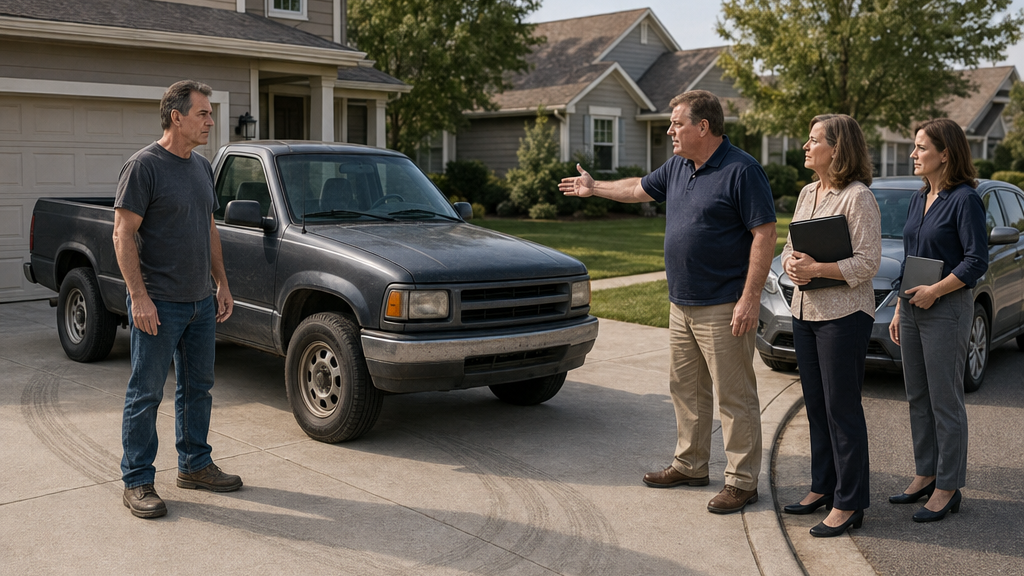
The old pickup sat broadside near the street end of the driveway, positioned neatly enough that Kevin could still walk around it, but far enough across the concrete that no SUV could sweep through the usual arc.
All four tires were on Kevin’s property.
He had checked twice.
Jonathan knocked again.
Kevin wiped his hands on a shop towel and opened the door.
“What are you doing?”
Jonathan stood on the porch in a navy polo, looking past Kevin toward the truck.
“Parking.”
“You know exactly what I mean.”
Kevin folded the towel once.
“Yes.”
Jonathan stepped down from the porch and pointed.
“That blocks the whole turnaround.”
“My driveway.”
“That’s not the point.”
Kevin almost smiled at hearing his own words returned to him.
He did not.
“You told me to check what I’m allowed to do.”
“And?”
“It’s registered. Insured. Fully on my property.”
Jonathan stared at him.
“So you did this just to make a point.”
Kevin glanced at the truck.
That accusation landed closer to the truth than he wanted.
“I did it because I asked you to stop.”
“You could have handled this like an adult.”
“I came to your door.”
Jonathan’s jaw moved.
For a moment neither spoke.
Then Jonathan said, “I already contacted the HOA.”
“I know.”
“They’re coming over.”
Kevin looked at him.
“Today?”
“They want to see it.”
That was the first thing that unsettled him.
He had expected a complaint.
He had not expected an inspection.
Less than forty minutes later, a white compact SUV pulled up at the curb. Sharon Roberts got out from the passenger side with a folder tucked under one arm. Rebecca Allen stepped from the driver’s side carrying a tablet.
Jonathan had remained outside.
Kevin suspected that was intentional.
The four of them gathered near the street, with the old pickup between them and the house.
Sharon looked first at the truck, then at the driveway entrance.
“Kevin, thanks for meeting us.”
“I didn’t know we had a meeting.”
Her mouth tightened slightly.
“Jonathan raised an access issue.”
“He raised a parking issue because he can’t use my driveway anymore.”
Sharon held up one hand.
“I’d rather not frame it that way.”
“How would you frame it?”
“As a change to an established access pattern.”
Kevin looked at Rebecca.
The property manager’s expression was neutral, though not relaxed.
“What exactly is an established access pattern?” Kevin asked.
Sharon gestured toward the concrete.
“This area has been used for vehicle turnaround for a long time. Residents, service providers, association contractors.”
“My driveway has been used.”
“Yes.”
“Used by permission?”
Sharon paused.
“It has been customary.”
“That wasn’t my question.”
Jonathan shifted beside them.
“Kevin, come on.”
Kevin turned toward him.
“No. I asked you to stop. Then I got an email describing my driveway as neighborhood access.”
Rebecca spoke for the first time.
“We’re trying to determine what documentation exists.”
“Good,” Kevin said. “Because I’d like to see it.”
Sharon opened the folder.
“There are practical concerns here. Larger trucks have had difficulty at the cul-de-sac when vehicles are parked along the curb. The association has historically routed some vendors through this area.”
Kevin felt his irritation sharpen.
“Historically routed them through my property?”
“That appears to have happened.”
“Under what easement?”
Sharon looked down at the folder.
Kevin waited.
The only sound was the faint ticking of the pickup’s cooling engine.
Finally Sharon said, “I don’t have the recorded document with me.”
“Is there one?”
“We’re reviewing the files.”
“Then what are you asking me to do?”
She looked at the truck.
“Move it while we sort this out.”
Jonathan nodded immediately.
Kevin noticed.
“So the driveway can keep being used.”
“So we don’t create a larger access problem while the board determines the facts.”
Kevin looked at the truck too.
Its paint was faded along the hood. One headlight had a slight haze. It was hardly a symbol of power.
But sitting there, it had done something months of silence had not.
It had forced everyone to define what they thought Kevin owed them.
He turned back to Sharon.
“If you show me a recorded easement, or a covenant provision giving the HOA access across this driveway, I’ll read it.”
“That isn’t the only issue.”
“What’s the other one?”
“Vehicle placement.”
Rebecca’s eyes moved toward the truck.
Kevin noticed that too.
Sharon continued. “The association has restrictions on long-term vehicle storage and placement visible from the street.”
“This truck isn’t stored. I drove it here this morning.”
“Intent matters less than compliance.”
Kevin almost answered sharply.
He stopped himself.
That sentence had a different weight.
Parking restrictions actually existed. He had seen them.
He did not remember the exact wording.
Rebecca tapped her tablet.
“We’ll verify the section before anything formal is issued.”
Sharon glanced at her.
“That’s fine.”
Kevin heard the small disagreement in those two words.
Jonathan stepped closer to the driveway.
“This is getting ridiculous. Nobody is claiming they own your property. We’re talking about letting people turn around.”
Kevin looked at him.
“That’s exactly the problem. You keep describing permission as if it’s too small to require permission.”
Jonathan’s face reddened.
“For five seconds.”
“Five seconds every morning. Contractors. Delivery vehicles.”
“Because nobody cared.”
“I cared.”
“You never said anything.”
There it was.
The part Kevin could not dismiss.
He had cared.
He had simply expected other people to somehow know.
Kevin looked down at the concrete.
The faint tire arc curved out from beneath the pickup.
“I should have said something sooner,” he said.
Jonathan seemed caught off guard.
Kevin raised his eyes.
“But I’m saying it now.”
Nobody answered immediately.
Rebecca broke the silence.
“I think the right next step is document review. We need the recorded plat, any easement language, board minutes if this was ever formally approved, and the vehicle restriction.”
Sharon nodded, though reluctantly.
“And in the meantime?”
Kevin asked.
She looked at the truck.
“I would recommend moving it.”
“Recommendation or requirement?”
Sharon’s gaze held his.
“For now, recommendation.”
“Then for now, it stays.”
Jonathan made a sound under his breath.
Sharon closed the folder.
“All right. But I’m going to open a compliance review regarding the vehicle placement.”
Kevin felt the first real drop in his stomach.
Not because he believed she had proved any access right.
Because she might not need one to make the truck a problem.
Rebecca glanced at him as if she had read the same thought.
“We’ll send the applicable section,” she said.
After they left, Jonathan stayed near the curb.
“You happy?”
Kevin looked at the pickup.
“No.”
That answer seemed to irritate Jonathan more than anger would have.
He walked back toward his house.
Kevin remained beside the truck.
For the first time since parking it, the sight of all four tires inside his property line did not feel completely reassuring.
By noon, the email arrived.
Kevin opened the attachment at his kitchen table.
The notice cited a vehicle-placement rule requiring certain vehicles kept in visible driveway positions beyond a defined period to be relocated or screened.
He read it twice.
Then a third time.
The rule looked real.
What the notice did not cite was just as important.
No easement.
No access covenant.
No recorded turnaround.
Nothing anywhere saying Jonathan, the HOA, or its contractors had a right to cross Kevin’s driveway.
The association had answered his boundary with a parking rule instead.
Kevin stared through the window at the old pickup.
The truck had forced the question into the open.
Now he had to find out whether it had also trapped him.
Chapter 4: The Rule Was Real, the Right Was Not
“The parking rule applies.”
Rebecca Allen said it without satisfaction.
Kevin sat across from her in the small HOA office Tuesday morning, the printed compliance notice lying between them beside a copy of the covenants. Sharon Roberts sat at the end of the table with a yellow legal pad. Samuel Torres had taken the chair nearest the filing cabinets.
Kevin had expected an argument about his driveway.
Instead Rebecca had placed her finger on a paragraph about vehicles left in prominent driveway positions for extended periods.
Kevin read it again.
The language was irritatingly clear.
The association could regulate visible vehicle storage. His pickup was registered, insured, and operable, but if he kept it stationed there as a permanent barrier, the HOA could eventually require him to move it.
“So the truck is a violation,” Kevin said.
“Not today,” Rebecca replied. “There’s a time threshold. But if it stays where it is long enough, yes.”
Sharon leaned back.
“That’s what I was trying to explain Saturday.”
Kevin looked at her.
“No. Saturday you asked me to move it because it blocked an established access pattern.”
Sharon’s expression tightened.
“The issues overlap.”
“They’re separate.”
Rebecca glanced at Sharon, then back at Kevin.
“They are legally separate questions.”
That quiet correction changed the room.
Kevin folded the covenant copy closed.
“All right. Then let’s deal with the other question.”
Samuel shifted in his chair.
Kevin had seen him at annual meetings but never spoken to him for more than a minute at a time. He was in his sixties, careful with his words, the kind of man who seemed uncomfortable being the first person to speak.
Rebecca opened another folder.
“We’ve checked the current governing documents. We have not found a provision establishing association access across your driveway.”
Kevin looked at Sharon.
She did not react.
Rebecca continued, “We’re still reviewing older records.”
“Recorded easement?”
“Nothing in the association files so far.”
“What about the county?”
“We don’t maintain county records.”
“I’m checking those myself.”
Samuel cleared his throat.
“There wasn’t a vote.”
Sharon turned toward him.
“Samuel.”
He lifted one hand.
“He asked.”
Kevin looked at him.
“What vote?”
Samuel stared at the tabletop for a moment.
“About using that driveway for contractors.”
Sharon said, “That doesn’t mean there was never authorization.”
“No,” Samuel replied. “But I don’t remember one.”
“How far back do you remember?”
“Far enough.”
The room went quiet.
Samuel explained that years earlier, larger maintenance vehicles had trouble turning near the cul-de-sac when residents parked along both curbs. A landscaping crew had once backed up half the street after failing to clear the turn.
Someone on the board suggested telling vendors they could use the wide driveway near Jonathan’s house.
Kevin’s driveway.
“Who asked the owner?” Kevin said.
Samuel rubbed his thumb against the edge of the table.
“I don’t know.”
“That means nobody did.”
“It means I don’t know.”
Kevin felt anger rise, but something in Samuel’s expression kept him from pushing harder.
Samuel did not look defensive.
He looked embarrassed.
“At the time,” Samuel said, “it seemed temporary. A practical thing. Nobody was trying to claim anybody’s land.”
“But you kept doing it.”
“Apparently.”
Sharon interjected.
“And that history matters. Established practices matter when communities operate around them.”
Kevin turned to her.
“Not enough to create an easement.”
“I didn’t say they did.”
“You asked me to remove my truck so the practice could continue.”
Sharon tapped her pen once.
“Because abruptly stopping something people rely on creates another problem.”
Kevin almost answered that their reliance was not his responsibility.
Then he thought of the contractor Jonathan had waved through.
The delivery van.
The years he himself had watched without objection.
He disliked what that added to the picture.
He had not granted permission.
But he had helped create ambiguity.
Rebecca slid the parking covenant toward him.
“You have until the end of the permitted period before the truck becomes a separate compliance issue.”
“How long?”
She told him.
Kevin nodded.
He could fight the wrong question and lose.
Or he could move the truck before the rule applied and force the HOA to address the actual boundary.
That afternoon he drove to the county records office.
The clerk pulled the recorded plat and the property instruments connected to Kevin’s parcel. Kevin spent nearly an hour reviewing documents under fluorescent lights.
Utility easements crossed parts of the neighborhood.
Drainage easements appeared behind several lots.
Nothing crossed his driveway.
He asked the clerk to check again for anything tied to access, ingress, egress, or shared use.
She did.
Nothing.
Kevin left with copies.
For the first time in days, he felt something close to relief.
The HOA had a real parking rule.
But it did not have the right Sharon had implied.
That distinction mattered.
It also forced Kevin to admit something he had resisted since Saturday.
The truck had been satisfying because it made Jonathan angry.
That was not the same as saying it had been wise.
On the last evening before the vehicle-placement window expired, Kevin stood beside the pickup with the keys in his hand.
The faded hood caught the porch light.
For several days the truck had felt like proof.
Now it felt more like a dare he had issued while already angry.
He climbed in and started the engine.
The old motor settled into its familiar uneven idle.
Kevin backed the pickup away from the street end of the driveway and returned it to the side area where he normally kept it.
The concrete was open again.
He stood there afterward, looking at the empty space.
He had complied with a rule that actually existed.
That should have felt like progress.
At 9:17 that night, headlights swept across his living-room wall.
Kevin went to the window.
Jonathan’s SUV slowed at the curb.
For half a second Kevin thought he would continue toward the cul-de-sac.
Instead the front wheels turned.
The SUV crossed Kevin’s property, swept through the newly opened driveway, and returned to the street.
Jonathan never looked toward the house.
Kevin watched the taillights disappear.
Moving the truck had proven he was willing to follow a legitimate rule.
Jonathan had just proven that a legitimate rule alone would not protect the boundary.
Chapter 5: What Everyone Had Been Calling Permission
Rebecca found the email on a Wednesday morning.
She called Kevin before sending it.
“I think you should read this in context,” she said.
Twenty minutes later, Kevin sat at his kitchen table with his laptop open to a scanned message written years before he had bought the house.
The subject concerned landscape access near the cul-de-sac.
The message was short.
A former board member had told a maintenance contractor that if turning at the end of the street was difficult, the driver could “use the wide drive two lots up to swing around.”
No owner approval was attached.
No board vote.
No easement.
No follow-up.
Kevin read the sentence again.
One casual instruction.
That was all it had taken.
Another email three months later referred to the same place as “the usual turnaround.”
By the following year, a vendor schedule simply called it “turn point near Moore residence.”
Kevin leaned back.
A habit had acquired a name.
Then the name had begun to sound official.
Rebecca stayed on the phone.
“There’s more.”
“What kind of more?”
“Not what Sharon was hoping for.”
Kevin heard papers moving.
“We found a message from the previous owner of your house.”
Kevin sat forward.
“What did he say?”
“He complained.”
The email was older, written after a contractor left mud across the driveway. The previous owner asked the association to stop directing work trucks onto his property.
The response apologized for the mess and promised crews would be reminded to be careful.
Not to stop using the driveway.
To be careful.
Kevin felt a strange frustration that was not entirely aimed at the HOA.
“Did he follow up?”
“Not that we’ve found.”
“So they ignored him.”
“I wouldn’t phrase it that strongly.”
“They kept sending trucks.”
“Yes.”
“And he stopped complaining.”
“Yes.”
Kevin rubbed his forehead.
Another person had reached the same point he had.
Annoyed enough to speak once.
Not willing enough to force the issue.
The association interpreted the silence afterward as resolution.
The next document made the pattern even clearer. A later maintenance memo referred to the driveway as an “accepted turnaround location.”
Accepted by whom was never stated.
That afternoon Kevin walked the street rather than sitting with the emails.
At the cul-de-sac, two cars were parked near the curve. A delivery truck entered slowly, made a careful three-point maneuver, and left without touching anyone’s lawn.
It was less convenient than using Kevin’s driveway.
It was not impossible.
He walked back toward his house.
The pale tire arcs were still visible across the concrete where repeated turns had polished a slightly different path through the dust.
For weeks he had looked at those marks as proof of Jonathan’s disregard.
Now they meant something broader.
People had used the driveway because others before them had used it.
Each person inherited the assumption instead of checking the permission.
And Kevin, for months, had contributed his own silence to the chain.
Rebecca came by that evening with a folder.
“I wanted you to see Sharon’s proposal before the board circulates it.”
Kevin opened it.
The first page described a voluntary access license.
The HOA would pay a modest annual amount toward driveway maintenance. Kevin would allow specified association contractors to use a defined portion of the driveway for turnaround purposes.
Jonathan’s personal use was not explicitly included.
Kevin read the compensation figure.
It was not insulting.
That almost made the proposal harder.
“They’re offering to pay.”
Rebecca nodded.
“Sharon thinks that resolves the practical issue.”
“It also makes permanent what they never had.”
“Yes.”
Kevin looked at her.
“You agree with me?”
“I agree that we haven’t found an existing access right.”
“That’s not what I asked.”
Rebecca closed her tablet case.
“My job is to manage the association, not choose sides between homeowners.”
“Convenient.”
She accepted that without flinching.
“Probably.”
Kevin looked again at the proposed license.
“What does Sharon think happens if I say no?”
“She’ll probably ask the board to consider whether negotiating access is in the association’s interest.”
“Negotiating is fine.”
“She believes you may reconsider if there’s compensation.”
Kevin pushed the paper away.
The money bothered him because it translated the dispute into the wrong language.
He had not spent weeks asking what his driveway was worth per year.
He had asked whether he was allowed to say no.
Rebecca stood.
Before leaving, she paused at the door.
“There’s something else.”
Kevin waited.
“One of the records mentions Jonathan.”
“What about him?”
“A contractor note from last month. Driver asked whether the cul-de-sac route was usable because the Miller driveway had become disputed.”
Kevin frowned.
“And?”
“Jonathan told him he had tried the cul-de-sac himself.”
Kevin stared at her.
“When?”
“Apparently after you first spoke to him.”
“So he knows it works.”
Rebecca nodded.
“The note says he demonstrated the turn for the driver.”
Kevin almost laughed.
Not because anything was funny.
Because the entire argument suddenly shifted.
Jonathan had told him the cul-de-sac was ridiculous.
He had warned that blocking the driveway would create access problems.
Then he had gone down there and proved the alternate route worked.
After Rebecca left, Kevin stood in the driveway.
The old pickup was back beside the house.
Nothing physically blocked the concrete anymore.
The tire marks remained.
For days Kevin had believed the deeper question was whether the HOA had mistaken custom for authority.
Now he knew it had.
But Jonathan’s behavior no longer fit even that explanation.
Jonathan knew another route worked.
He kept fighting anyway.
Which meant the shortcut itself was no longer the thing Kevin needed to understand.
Chapter 6: The Route He Could Have Used All Along
Jonathan turned at the cul-de-sac cleanly on Saturday morning.
Kevin watched from halfway down the sidewalk.
There were two vehicles parked along the curb, exactly the condition Jonathan had described as the reason the public turnaround was impractical.
His SUV slowed.
He eased forward, reversed once, turned the wheel, and came back out.
No grass crossed.
No mailbox threatened.
No driveway borrowed.
When he saw Kevin standing near the corner, his expression changed.
Not surprise.
Recognition.
Kevin waited until Jonathan parked at his own house.
Then he walked over.
Jonathan shut the SUV door harder than necessary.
“You following me now?”
“No.”
“Could’ve fooled me.”
Kevin stopped several feet away.
“I wanted to see the turn.”
Jonathan glanced back toward the cul-de-sac.
“You saw it.”
“It works.”
Jonathan gave a short laugh.
“Congratulations.”
Kevin had spent most of the week imagining how this conversation might go. In nearly every version he had begun with the documents.
No easement.
No board vote.
Old emails.
The previous owner’s complaint.
Standing there now, none of those felt like the right first question.
“Why are you still doing this?”
Jonathan’s face tightened.
“Doing what?”
“Using my driveway.”
“We’ve been through this.”
“No. We’ve been through whether you can. I’m asking why.”
Jonathan looked toward his house.
Kevin waited.
Finally Jonathan said, “Because this whole thing is ridiculous.”
“That’s not an answer.”
“It’s a five-second turn.”
“Then the twenty-second one down there shouldn’t matter.”
Jonathan’s jaw flexed.
Kevin could see the argument forming and failing.
“You told a contractor the cul-de-sac works,” Kevin said.
Jonathan stared at him.
“So Rebecca’s sharing notes now?”
“She told me you demonstrated the route.”
“I was helping the guy.”
“And then you kept using my driveway.”
Jonathan walked two steps toward his garage, then stopped.
“You really want to know?”
“Yes.”
“You made me look like some jerk who’s been trespassing on you for years.”
Kevin had not expected that sentence.
Jonathan turned back.
“You come over one day and suddenly it’s ‘my property, my driveway, stop using it,’ like I’ve been sneaking through your yard at night.”
“You were using my property.”
“Everybody used it.”
“That doesn’t make it yours.”
“I know that.”
The admission arrived so plainly Kevin almost missed it.
Jonathan looked away.
“I know it’s yours.”
Kevin said nothing.
Jonathan continued, more quietly now.
“The people before you never made a thing out of it. Contractors used it. I used it. Nobody cared. Then suddenly I’m the guy being told I need permission to do something I’ve done for years.”
“You did need permission.”
“I know.”
Again.
No argument.
No legal theory.
Just resistance.
Kevin felt some of his certainty rearrange itself.
Jonathan had not spent weeks believing the HOA owned the driveway.
He had spent weeks resisting what the boundary said about him once someone finally stated it aloud.
“It stopped being about convenience,” Kevin said.
Jonathan gave him a tired look.
“Probably.”
“Then what is it about?”
Jonathan shoved his hands into his pockets.
“You don’t like being corrected either, Kevin.”
The words hit cleanly.
Kevin thought about the truck.
The satisfaction of placing it exactly where Jonathan could not pass.
The way he had checked all four tires twice.
The part of him that had enjoyed knowing Jonathan would see it and understand the message.
“No,” Kevin said. “I don’t.”
Jonathan nodded once.
“There you go.”
“That doesn’t mean you were right.”
“I didn’t say I was.”
Kevin looked at the open stretch of driveway between the two houses.
“I should have said something months ago.”
Jonathan’s eyebrows lifted slightly.
Kevin continued.
“I kept getting mad and saying nothing. Then by the time I said it, I was already angry enough to park a truck across there just to prove I could.”
Jonathan almost smiled.
“You did enjoy that.”
“A little.”
That small admission loosened something without fixing it.
Jonathan looked toward the cul-de-sac again.
“I’ll stop using it.”
Kevin studied him.
“Because the HOA told you to?”
“They haven’t.”
“Then why?”
Jonathan shrugged.
“Because I know where the line is now.”
Kevin could have thanked him.
He did not.
The situation did not need gratitude for a boundary being respected.
Instead he said, “All right.”
Jonathan started toward his garage.
“Jonathan.”
He turned.
“The board is considering making the access permanent.”
“I heard.”
“Will you tell them the alternate route works?”
Jonathan’s expression closed again.
“No.”
Kevin waited.
Jonathan shook his head.
“I said I’ll stop using your driveway. I’m not getting up in a meeting and making myself the example.”
“So you’ll do the right thing privately but not say it publicly.”
“You can call it whatever you want.”
Kevin almost pressed harder.
Then he saw the point at which the conversation would become another contest.
He let it go.
“Fine.”
Jonathan went inside.
Kevin walked home.
The driveway looked strangely large without the pickup stationed near the entrance. The empty concrete had once made him feel exposed. Now, for the first time, it felt simply like his driveway again.
He understood something he had not understood when he first moved the truck.
A boundary did not become stronger because the other person was embarrassed.
It became stronger because it was clear.
That afternoon Kevin emailed Rebecca declining the proposed access license.
He kept the message short.
He did not accuse anyone of trespass.
He did not threaten legal action.
He wrote that he would not grant routine access across the property and was willing to review alternatives for service vehicles that did not depend on private driveway use.
Then he closed the laptop.
At six that evening, another email arrived.
This one came from Sharon.
Attached was the agenda packet for the monthly board meeting.
Kevin opened it.
Near the bottom was a proposed resolution authorizing the association to negotiate and establish designated turnaround access across privately owned lots where necessary for service operations.
His lot was identified as the preferred location.
Kevin read the paragraph twice.
Jonathan had agreed to stop.
The old practice had no recorded right.
The alternate route worked.
And still the board was preparing to turn the shortcut into policy.
The fight was no longer about what people had assumed in the past.
It was about whether Kevin would allow that assumption to become permanent.
Chapter 7: The Boundary That No Longer Needed a Truck
The board agenda used Kevin’s lot number instead of his name.
That made it look cleaner than it was.
Item 8B: Proposed Designated Turnaround Access Agreement—Lot 47.
Kevin read the line from the folding chair at the back of the HOA meeting room while residents settled around him. On the front table, Sharon Roberts arranged papers into a precise stack. Rebecca Allen connected her laptop to the small wall display. Samuel Torres sat two seats down from Sharon with a binder open in front of him.
Kevin had brought his own folder.
Inside were the county plat, the email that had started the contractor-routing practice, the previous owner’s complaint, photographs of the cul-de-sac, and a single sheet on which he had drawn an alternate service route through the subdivision.
He had almost left that last page at home.
For weeks, his instinct had been to prove what the HOA could not do.
Tonight he needed to show what could be done instead.
When Item 8B came up, Sharon did not look at Kevin immediately.
“The board has been reviewing a recurring vehicle-access concern,” she said. “Historically, certain contractors have used a privately owned driveway near the cul-de-sac as a turnaround point. We now understand that no recorded easement has been identified.”
A few heads turned toward Kevin.
Sharon continued.
“The question before us is whether the association should pursue a voluntary access agreement with the affected owner to preserve operational convenience.”
Kevin heard the word again.
Convenience.
Weeks earlier it would have made him angry.
Tonight it simply clarified the choice.
Sharon summarized the proposed agreement. The HOA would contribute toward maintenance. Access would be limited to approved service vehicles. The arrangement would be documented rather than informal.
When she finished, she finally looked at Kevin.
“You asked to speak.”
Kevin stood.
He carried his folder to the front table but did not open it immediately.
“I’m not signing the access agreement.”
Sharon’s expression barely moved.
“All right.”
“But I’m also not asking the association to pretend there isn’t a vehicle-routing problem.”
That drew Samuel’s eyes up from his binder.
Kevin placed the route sheet on the table.
“I spent part of this week watching service vehicles use the cul-de-sac.”
Rebecca leaned forward.
Kevin continued.
“A normal passenger vehicle can turn there easily. Larger pickups and most delivery trucks can make it with one reverse if the curb isn’t completely blocked. For larger contractor vehicles, there’s another route through the next street that brings them back to the entrance without using any private driveway.”
He slid the sheet toward Sharon.
“It adds a few minutes.”
Sharon studied it.
“A few minutes every trip.”
“Yes.”
“And if vehicles are parked badly at the cul-de-sac?”
“Then the driver uses the alternate route.”
“That shifts inconvenience onto vendors and association operations.”
Kevin nodded.
“It does.”
Sharon looked almost surprised by the answer.
Kevin rested one hand on the back of the empty chair beside him.
“I’m not saying the alternative is equally convenient. If it were, nobody would have started using my driveway in the first place.”
A board member asked, “What about large landscape trailers?”
Kevin opened the folder and removed photographs taken over several days.
“I watched one use the alternate route Tuesday. It cleared.”
Rebecca examined the photographs.
“So you tested this with actual traffic conditions?”
“I observed it. I didn’t direct anybody.”
Sharon looked through the pages.
“This doesn’t guarantee there will never be a problem.”
“No route does.”
Kevin could feel the old temptation returning—the desire to turn the moment into a verdict. He had documents proving there was no easement. He could have laid them down one by one and made Sharon defend every assumption.
Instead he said, “I think we’ve been asking the wrong question.”
Sharon looked at him.
“The question shouldn’t be how much the HOA needs to pay me so it can keep using my driveway. The question should be whether the association needs my property at all.”
He tapped the route sheet.
“It doesn’t.”
The room stayed quiet.
Then Samuel closed his binder.
“I agree.”
Sharon turned toward him.
Samuel looked uncomfortable, but he did not withdraw the words.
“We made this harder than it needed to be.”
He glanced toward Kevin.
“The old board used the driveway because it was easy. Then vendors got used to it. Residents saw vendors doing it and assumed it was normal.”
He paused.
“I was on the board for some of that.”
Nobody interrupted.
“We should have fixed the routing years ago instead of treating somebody’s lack of objection like paperwork.”
Kevin felt the sentence settle differently because Samuel included himself in it.
Sharon removed her glasses.
“The association was trying to maintain efficient service.”
“I know,” Samuel said. “That doesn’t make the access ours.”
For the first time since the dispute began, Sharon looked less like the president defending a position and more like a homeowner calculating the cost of admitting one had been wrong.
Rebecca turned her laptop so the board could see the document on screen.
“If the board chooses not to pursue the access license, management can issue a written routing instruction to all association vendors. We can specify the cul-de-sac for standard vehicles and the alternate street route for oversized vehicles.”
“Enforcement?” Sharon asked.
“We can include it in vendor instructions and contracts.”
“What about residents?”
Rebecca hesitated.
“We can state that private driveways are not designated association turnaround areas.”
Kevin noticed the distinction.
Not his driveway.
Private driveways.
A rule that would apply even after nobody remembered the argument.
Sharon looked at Kevin.
“And if there’s an unusual circumstance? Emergency access, blocked roadway?”
Kevin answered carefully.
“Emergency services already have whatever lawful authority they need. If there’s a one-time situation and someone asks me, I can make a decision.”
“A decision every time?”
“Yes.”
She held his gaze.
“That could be inconvenient.”
Kevin almost smiled.
“Yes.”
This time no one argued with the word.
The discussion lasted another twenty minutes.
One board member worried about vendor complaints. Another asked whether the HOA attorney should review the new routing policy. Rebecca said yes. Samuel proposed withdrawing the access-license resolution and replacing it with a written policy prohibiting management from directing routine traffic across privately owned lots without documented authority or owner consent.
Sharon did not immediately support him.
Kevin watched her thumb the edge of the proposed agreement.
He understood what she was deciding.
If she pushed forward, she could still argue that formalizing access was prudent management.
If she withdrew it, she would be admitting that weeks of institutional pressure had been built on a practice nobody had properly questioned.
Finally Sharon placed the agreement face down.
“I’ll support Samuel’s motion, subject to legal review of the routing language.”
Samuel nodded.
Rebecca began typing.
The vote was not dramatic.
No applause followed.
There were no speeches.
The motion passed.
The proposed access agreement died on the table.
Two weeks later, Kevin received the final policy by email.
The association’s vendors were instructed not to use privately owned driveways as routine turnarounds without explicit permission or documented legal authority. The cul-de-sac remained the standard turn point for ordinary vehicles, with the alternate street route listed for larger trucks.
Kevin printed one copy and put it with his property records.
Then he went outside.
The old pickup sat beside the house where it belonged.
He had used it twice that week—once for bags of soil, once for lumber. It was a truck again, not a barricade.
The driveway remained open.
That had worried him at first.
For months, open concrete had looked like an invitation other people believed they could accept.
Now days passed without a single tire crossing the boundary.
One Saturday morning Kevin brought out the pressure washer.
The faint arcs were still visible near the entrance.
He worked slowly, moving the wand back and forth until the darker sweeps of rubber and road dust faded into the surrounding concrete.
Jonathan came outside while Kevin was finishing.
They saw each other.
Neither waved.
That was all right.
Their relationship had not transformed into friendship.
Kevin did not need it to.
A few minutes later, a visiting SUV slowed near Jonathan’s house.
The driver began turning toward Kevin’s driveway.
Kevin shut off the pressure washer.
Before he could move, Jonathan stepped toward the curb.
He raised one arm.
For an instant the gesture looked exactly like the one Kevin remembered from weeks earlier, when Jonathan had waved a landscape contractor into the driveway.
This time Jonathan pointed past Kevin’s house.
Toward the cul-de-sac.
The driver straightened the wheel and continued down the street.
Jonathan glanced across at Kevin.
Kevin gave a small nod.
Jonathan returned it.
Nothing more.
Kevin looked at the driveway.
Clean concrete stretched from the garage to the street, completely unobstructed.
For months he had believed the truck was what made the boundary real.
It had never been the truck.
The truck had only forced everyone—including Kevin—to finally say where the line was.
The story has ended.