They Fined His Porch Rail at Dinner Before Learning Why He Needed It to Come Home
Chapter 1: The Envelope Beside the White Dinner Plate
Robert Bennett had known, the moment he saw the brown envelope beside his plate, that dinner was not going to be dinner.
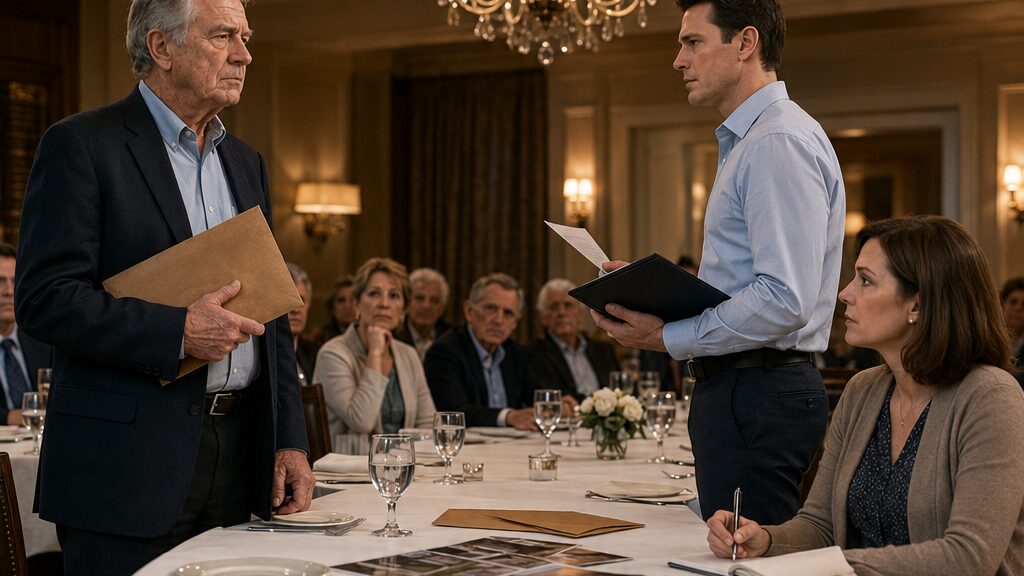
The clubhouse dining room had been arranged to look friendlier than it felt. White cloths covered the long tables. Glass water pitchers caught the light from the low chandeliers. Folded napkins stood upright like little tents beside the salad plates, and someone had set a small vase of silk flowers at each table, as if plastic roses could soften the room’s polished silence.
Robert stood near the end of the table and kept one hand on the back of his chair.
He had lived in Meadow Glen for thirty-four years. Long enough to remember when the clubhouse had smelled like coffee, sunscreen, and wet umbrellas instead of lemon polish and committee money. Long enough to remember board meetings held with folding chairs and store-bought cookies. Long enough to know when a room full of neighbors was pretending not to watch him.
John Harris stood two places away with a dark folder tucked beneath his arm.
John was not shouting. That almost made it worse. He had the neat, careful voice of a man who believed public embarrassment could be made polite if every word was measured.
“Robert,” he said, “we wanted to handle this before it became more serious.”
Robert looked at the envelope.
His name had been typed on a white label, centered and exact. Robert Bennett. Lot 18. Exterior Compliance.
He had not touched it yet.
Around the table, forks paused. The server near the kitchen doors suddenly found interest in the coffee urn. Rebecca Miller, the board secretary, sat with her pen in hand and her eyes lowered toward a yellow legal pad. Ashley, Robert’s daughter, was not there. He was grateful for that, then ashamed of being grateful.
“What became serious?” Robert asked.
John gave a small look toward the property manager, who stood near the wall with a tablet pressed to her chest. “The unauthorized construction on your front porch.”
“It isn’t construction.”
“We have photographs.”
John opened the folder and drew out three glossy sheets. He laid them on the white tablecloth between the bread basket and the butter dish.
Robert did not need to lean closer. He knew the images before he saw them. His porch. His front steps. The pale raw wood of the new rail Paul Cooper had bolted to the left post but not finished sanding. Blue painter’s tape still marked the height where Robert’s hand naturally reached. A temporary brace stood under the bottom step, square and plain, no paint, no trim.
In the photo, it looked uglier than it had felt under his hand.
John tapped the first image with two fingers. “This is visible from the street.”
“So is my front door,” Robert said.
A few chairs shifted. Someone drew in a breath that might have been a laugh if the room had been safer.
John’s mouth tightened, but he kept his tone smooth. “The issue is not your front door. The issue is that all exterior modifications require prior written approval. The board has no record of approval for this rail, this step support, or the materials stored on the porch.”
“The materials are boards.”
“They are visible materials.”
“They’re there because the work isn’t finished.”
“The work is not authorized.”
Robert felt the old heat rise behind his ribs, the kind that had once made him say too much too quickly. He pressed his thumb into the carved edge of the chair back and counted the tiny ridges worn smooth by years of hands.
The dining room seemed too bright. White plates. Silver forks. The little brown envelope waiting like a verdict.
Rebecca finally looked up. Her expression was careful, not cruel. That, too, made something tighten in him. People could do harm with careful faces. They could record it accurately, initial every page, and call it procedure.
John slid the envelope closer to Robert’s plate. “Inside is a notice of violation and a temporary compliance agreement. If you sign tonight, the fine schedule will be delayed while removal is arranged.”
Robert looked at him. “Removal.”
“Yes.”
“Of the rail.”
“And the step brace. You can submit an application for a compliant design afterward.”
“Afterward,” Robert repeated.
John folded his hands. “That is the process.”
Robert turned slightly toward the table, then toward the glossy photographs. He could almost hear Katherine’s voice from years ago, amused and dry: They can make anything sound reasonable if they put it in a folder.
His late wife had hated this room after the remodel. She had said the new chandeliers made everyone look like they were trying to sell each other something. Robert had laughed then. Now the light settled on John’s folder, the envelope, the photographs of his porch taken by someone who had stood in his yard without knocking.
He reached for the brown envelope.
Every eye in the dining room seemed to follow his hand.
The paper was stiff under his fingers. He lifted it, opened the flap, and drew out the top sheet. Violation Notice. Unauthorized Exterior Alteration. Potential Hazard. Community Standards. He read enough to know the rest.
John said, “We’re not trying to be unreasonable.”
Robert slid the notice back into the envelope.
“No,” he said quietly. “You’re trying to be neat.”
John blinked. “Excuse me?”
“You want the neighborhood neat. The photographs neat. The file neat. You want the problem folded up before dessert.”
The property manager shifted against the wall. Rebecca’s pen stopped moving.
John’s voice lost a degree of polish. “Robert, that rail is not approved. It may not even be safe.”
Robert looked at the enlarged photograph of his own porch. The raw wood. The tape. The brace. The place where his right foot had missed the edge of the old step three weeks ago because the morning light had hit the porch boards flat and made depth disappear.
He did not say any of that.
He only placed the envelope against his chest and looked at John.
“That board is the only reason I can get through my front door without somebody’s arm under mine.”
A heavier silence moved through the dining room.
John glanced toward the other board members as if the sentence had arrived without the proper form. “If there is a medical issue, there are approved channels for that.”
Robert almost smiled.
Approved channels. As if his front steps had waited for a channel before loosening under his shoe.
“I sent an application,” Robert said.
“We have not approved it.”
“I know.”
“Then you understand.”
Robert nodded once. “I understand more than you think.”
John picked up the compliance agreement and held it toward him. “Then sign this, and we can avoid immediate penalties.”
Robert looked at the paper. John’s hand was steady. Younger hands often were, until life gave them something they could not file.
“No.”
The word was not loud, but it carried.
John lowered the agreement. “Robert—”
“No,” Robert said again, softer this time.
He turned from the table. His chair remained untouched. His salad sat beneath a cold shine of dressing. He heard someone whisper his name. He did not look to see who.
At the doorway, he paused because his left knee stiffened and because the envelope had begun to tremble slightly in his grip. He closed his fingers around it until the shaking stopped.
Behind him, John’s voice came sharper than before.
“If that repair is still there Monday morning, the board will move forward without your signature.”
Robert looked back.
The whole room had become a picture: the long white table, the glossy photographs, John standing with the agreement in his hand, Rebecca watching with her pen hovering, neighbors pretending they had not chosen sides simply by staying silent.
Robert held the envelope at his side.
“Then don’t lose those photographs,” he said.
He stepped through the doorway before his face could give away more than his words had.
Chapter 2: The Porch Route He Refused to Explain
Saturday morning came in gray and damp, the kind of light that flattened everything outside Robert’s front window.
He stood in the living room with one palm against the wall and looked toward the front door as if the house itself had asked him a question.
For thirty-four years, he had left through that door without thinking. Work boots first, then dress shoes for church, then slippers when Katherine was sick and he was only going as far as the mailbox. His hand knew the old brass knob in the dark. His feet knew the distance to the first step. His shoulder knew the slight push needed when summer humidity made the door stick.
A house became part of the body after enough years.
That was the part nobody at the clubhouse understood. They thought a porch rail was a thing added to a structure. Robert knew better. A rail was where a hand went when the body no longer trusted open air.
The brown envelope lay on the small table by the door. He had placed it there the night before and then moved it twice, first to the kitchen, then back again. The violation notice was inside. So was the copy of the application Paul had helped him fill out. Beneath those, folded twice, were the hospital discharge instructions Ashley thought he had thrown away.
He had not thrown them away.
He had only hidden them where she would not look unless she was already frightened.
Robert opened the door and let the cool morning air into the hallway.
The porch waited.
Paul’s unfinished rail ran along the left side of the steps, pale against the darker old posts. It was not pretty yet. Robert could admit that. The raw wood had not been stained. The lower bracket needed its second bolt. Blue painter’s tape marked two points where Paul had promised to return with a level and finish the angle. The temporary brace under the bottom step looked like exactly what it was: a piece of emergency sense.
Robert stepped onto the porch.
The first step down had always been the tricky one since the boards settled. Years ago, he would have fixed it himself before breakfast. He could still see the repair in his mind: pull the warped board, check the stringer, cut clean, fasten tight, sand, paint. He had built half the shelves in the house with scraps better than what some men bought new.
But knowing what to do was not the same as being able to kneel long enough to do it.
He reached for the unfinished rail.
His fingers closed around the raw wood. A splinter lifted against his palm, not deep enough to draw blood. He kept hold anyway.
One step.
His right foot went down.
The porch shifted in the ordinary way old porches did, a small complaint under weight. His knee answered with its own complaint. He tightened his grip on the rail and waited for the house, the porch, and his body to agree on balance.
They did.
Barely.
He let out a breath through his nose.
Three weeks ago, he had not had the rail.
Three weeks ago, the newspaper had been lying at the bottom of the steps where the delivery driver always tossed it, and Robert had stepped down with one hand holding the doorframe and the other reaching for nothing. His foot had found the softened edge wrong. The morning had tipped. The porch ceiling, the wet walkway, the railing that was not yet there—everything had gone sideways.
He remembered the sound more than the pain. The flat crack of his shoulder hitting the step. The small stupid flutter of newspaper pages in the breeze. His own voice, surprised and angry, saying Katherine’s name although she had been gone four years.
The neighbor had found him seven minutes later.
Seven minutes was not long unless you were lying where your own house could see you and do nothing.
Robert reached the walkway and turned slowly.
The front door stood open behind him. The blue tape moved in the breeze.
He could call Ashley. She would answer before the second ring. She would ask if he had eaten. She would ask if he had taken the pill in the yellow bottle. She would ask whether he had reconsidered coming to stay with her “just for a little while,” which had started to sound less like a visit every time she said it.
He loved his daughter.
That did not make him ready to wake up in her guest room, listening to her dishwasher and pretending the framed prints on her walls were enough to replace the marks on his own doorframe where she had grown year by year under Katherine’s pencil.
Robert climbed back up.
The first step up was worse than the first step down. He leaned too hard on the rail, and the unfinished bracket gave a faint metallic tick.
He froze.
The sound passed through him like a warning.
For one second, his balance loosened. His right hand shot toward the doorframe, but there was air where he expected wood. His shoulder pitched. He caught himself with both hands around the rail, breath locked, heart suddenly too loud in his ears.
The raw wood held.
Robert stood there, bent forward, gripping the rail like a man holding a secret closed.
When the shaking in his legs eased, he straightened. Slowly. Carefully. Anger came after the fear, as it often did now. Anger at the porch. At John Harris. At his own body for becoming a committee other people felt entitled to discuss.
He went inside and shut the door.
The living room smelled faintly of coffee grounds and old furniture polish. On the mantel, Katherine smiled from a photograph taken at Ashley’s college graduation, one hand raised to keep the wind from ruining her hair. Robert looked at the picture longer than he meant to.
“I’m handling it,” he said.
The room, kindly, did not answer.
He picked up the brown envelope and removed the discharge papers.
Use handrail when entering and exiting home. Avoid unsupervised steps until cleared. Install stable support at primary entry.
Primary entry. The phrase looked so clean on paper.
A vehicle door closed outside.
Robert folded the discharge instructions quickly and slipped them back behind the violation notice. Through the front window, he saw Paul Cooper’s pickup at the curb, a ladder rack on top and two long boards strapped in place.
Paul stepped out wearing work gloves and a faded cap, then paused at the edge of the walkway.
Robert opened the door before the man could knock.
“Morning,” Paul called. “I brought the better cedar. Figured we’d finish before the rain.”
Robert looked past him.
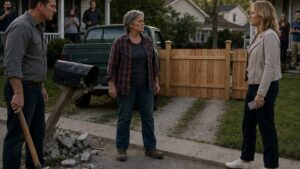
A bright red tag hung from the porch post, taped at eye level. It had not been there ten minutes ago.
STOP WORK ORDER.
The words were black and blocky and official enough to make the unfinished rail look guilty.
Paul came closer and read it. His jaw tightened.
Robert stood behind the screen door with the brown envelope under his arm.
The rail waited between them, half-built and suddenly accused.
Chapter 3: The Stop-Work Tag on the New Rail
Paul Cooper did not touch the red tag at first.
He stood at the bottom of the steps with his hands on his hips and read every line as if patience might change the words. Robert watched him through the open screen door, one shoulder braced against the frame.
The tag lifted and slapped softly against the porch post in the wind.
“That was not here when I left yesterday,” Paul said.
“No,” Robert answered.
“Did anybody knock?”
Robert looked at the empty street. Saturday mornings in Meadow Glen had a particular silence, made of trimmed lawns, closed garage doors, and people watching from windows without moving curtains.
“No.”
Paul climbed the steps, careful to avoid putting weight on the braced corner. He leaned in just enough to read the smaller print. “By authority of Meadow Glen Homeowners Association. Unauthorized exterior modification. Contractor activity must cease pending board review.”
He gave a short humorless laugh. “Board review. I sent them the sketch.”
“I know.”
“You signed the application.”
“I know.”
“They cashed the review fee.”
Robert’s eyes moved to him.
Paul looked back, then reached into his back pocket and drew out his phone. “I’ve got the receipt.”
Before Robert could answer, a white compact SUV turned into the street and slowed in front of the house. It stopped not at the curb but slightly angled, as if the driver expected to leave quickly after doing something unpleasant.
The property manager stepped out with her tablet. John Harris came from the passenger side.
Paul muttered something under his breath and pulled off one glove.
Robert opened the screen door.
“Leave it,” Paul said quietly. “Let me talk to them.”
Robert looked at him.
Paul lowered his voice. “You’re paying me to handle the work.”
“I’m not paying you to stand in front of my own porch.”
He stepped out before Paul could argue.
John approached with the measured stride of a man entering a situation he had already described in an email. He wore a pressed shirt, no tie, and sunglasses he removed only after he reached the walkway. The property manager stayed half a step behind him, tablet already awake.
“Mr. Bennett,” John said. “I was hoping we wouldn’t need to do this.”
Robert looked at the red tag. “You already did it.”
John glanced at Paul. “Mr. Cooper, you have been notified that work must stop immediately.”
Paul held up his phone. “You got the plans. You got the fee. You got the emergency note.”
“We received an incomplete submission,” John said.
“It had measurements, material list, photographs, and the doctor’s note he allowed me to include.”
Robert’s jaw tightened.
John’s eyes flicked toward Robert, then back to Paul. “Any medical accommodation must go through the proper review channel.”
“That’s what the application was.”
“The board has not approved it.”
Paul pointed toward the rail. “The bottom step was moving. I braced it so he didn’t break his neck waiting for your channel.”
The property manager lifted the tablet and took a photograph.
The shutter sound, small and artificial, cut through Robert more sharply than John’s words.
“Don’t photograph him,” Robert said.
The property manager lowered the tablet slightly. “I’m documenting the site.”
“I’m standing on the site.”
John inhaled through his nose. “Robert, nobody is trying to embarrass you.”
“You came to my house with a camera and a stop-work tag before breakfast.”
“We came because the work continued after notice.”
“The notice went up before the work continued.”
Paul looked between them. “I haven’t picked up a tool today.”
John’s expression hardened. “The board’s concern is liability. An unfinished rail may create a hazard. If someone uses it and falls—”
“I used it,” Robert said.
John paused.
The wind moved the blue tape. Somewhere down the street, a garage door opened and stopped halfway.
Robert felt Paul looking at him. He regretted the words as soon as they left his mouth, not because they were untrue, but because truth had a way of making people rearrange your life without asking.
John softened his voice. That was worse than when he sharpened it.
“That is exactly why this needs to be handled properly.”
Robert took one step forward, close enough that his hand rested on the unfinished rail. “Properly would have been answering the application when it was sent.”
“The board meets on a schedule.”
“My porch didn’t loosen on your schedule.”
The property manager’s tablet came up again.
Paul moved slightly between the camera and Robert. “That’s enough pictures.”
John looked at him. “Do not obstruct documentation.”
Robert’s fingers curled around the rail.
“Mr. Cooper,” John continued, “you are not authorized to proceed. Any additional work may result in fines assessed to Mr. Bennett and a complaint against your business.”
Paul’s face flushed. He was a practical man, not dramatic, but there were limits to what a man could hear while standing beside unfinished safety work he had been hired to complete.
“You want me to leave a bad step and half a rail because the stain color wasn’t approved?”
“The design was not approved.”
“The design keeps his hand where his hand goes.”
John glanced toward Robert again. “There are compliant alternatives.”
Robert gave a small, dry sound. “You haven’t asked where my hand goes.”
For a moment, nobody spoke.
That was the first time John looked uncertain. Not ashamed. Not yet. Only uncertain, as if Robert had introduced a measurement not printed on any form.
The property manager recovered first. “The temporary brace and loose materials must also be removed from public view.”
“They’re not public,” Robert said. “They’re on my porch.”
“They are visible from common roadway.”
“They are holding up the step.”
John put his sunglasses back on, though the sky was still gray. “Robert, if you need assistance, perhaps your family should be involved.”
There it was. Quiet, clean, and cruel because it was almost kind.
Robert felt the porch beneath his feet. Felt the rail under his palm. Felt the old house behind him, with Katherine’s photograph on the mantel and Ashley’s childhood height marks still inside the pantry door.
“My family does not own this threshold,” he said.
John’s face closed. “No one said they did.”
“You almost did.”
Paul looked down, hiding the quick approval in his expression.
The property manager tapped something into the tablet. “Refusal to remove will be noted.”
Robert turned, opened the screen door, and reached inside for the brown envelope waiting on the little table. He pulled out the copy of the application, folded but clean, and held it toward John.
“Dated three weeks ago,” Robert said. “Received by your office. Fee paid.”
John did not take it.
Rebecca Miller’s car slowed near the curb then, a dark sedan with a Meadow Glen parking decal on the windshield. She had not been part of the arrival, Robert could tell by the way she stopped too far back and looked first at the red tag, then at the people on the porch.
John noticed her too.
“Rebecca,” he called, too quickly. “We’re handling an enforcement issue.”
She stepped out with a canvas tote over her shoulder. “I can see that.”
Robert kept the paper extended.
John finally took it, but only by the corner, as if accepting it did not mean accepting what it proved.
Paul spoke, his voice controlled now. “Do you want the step brace removed?”
John hesitated. “The unauthorized materials need to be removed.”
Paul pointed to the bottom step. “That brace comes out, the step moves.”
“That is not my instruction,” John said.
“It is what your tag says.”
The argument had drawn faces to windows now. A neighbor across the street stood behind a screen door. Another paused with a small dog at the corner, pretending to check a phone.
Robert saw it all and felt the old dining-room silence repeat itself outside in daylight.
Rebecca came closer but did not climb the steps. Her eyes moved to the rail, to the brace, to Robert’s hand still resting on the raw wood. She said nothing.
John handed the application copy to the property manager. “The board will review the matter Monday.”
“And until then?” Robert asked.
“No work continues.”
Robert nodded slowly. “Then leave the brace.”
John’s answer came too quickly. “The visible materials must be removed.”
Robert stepped down one stair.
Paul shifted, ready to catch him without making it obvious. Robert saw the movement and hated needing it, but he did not stop.
He kept his hand on the rail and looked at John.
“You can fine me for the boards,” he said. “You can photograph the tape. You can put red paper on every post I own. But if anyone takes out the piece holding that step steady before your meeting, they had better be ready to carry me through that door themselves.”
The property manager looked away first.
John’s jaw worked once. “No one is carrying you anywhere.”
“That,” Robert said, “is the first sensible thing you’ve said.”
The silence after it was not victory. The rail was still unfinished. The tag was still there. Paul still could not lift a tool without risking Robert’s fines and his own business. John still stood on the walkway with the power to make a delay sound like order.
Then a familiar car turned the corner too fast.
Ashley Bennett pulled to the curb behind Rebecca’s sedan, her face already pale behind the windshield.
Robert knew, before she opened the door, what she saw: the red tag, the strangers on the lawn, Paul standing idle, John with the application in hand, and her father on the steps gripping an unfinished rail like it was the only solid thing left.
Ashley got out and looked straight at him.
“Dad,” she said, her voice tight. “What didn’t you tell me?”
Chapter 4: The Daughter Who Heard Only the Fall
Ashley reached him before John could say another word.
She did not run. She was too controlled for that, too much her mother’s daughter in the way she held herself together when fear had already gotten ahead of her. But Robert saw the strain in her mouth and the quick inventory her eyes made of him: face, hands, feet, rail, step, red tag.
“What happened?” she asked.
“Nothing that needed you driving like that.”
Her eyes flashed. “Don’t start with my driving.”
John took half a step forward. “Ashley, I’m glad you’re here. There are some safety concerns—”
Robert turned his head toward him. “You don’t get to use her first.”
The words landed harder than he intended. John stopped. Ashley looked from one man to the other, and in that look Robert saw exactly how this would go if he let the porch become a courtroom: John with rules, Paul with tools, Ashley with fear, and Robert standing in the middle like a problem no one trusted him to define.
Paul cleared his throat. “I’m going to put the cedar back in the truck before it rains.”
“No,” Robert said.
Paul paused.
Robert looked at the red tag, then at the boards strapped to the truck. “Leave them there for now.”
Paul understood. He gave a small nod and stepped away without taking the old brace or the loose boards. Rebecca lingered by her car, watching more than speaking. The property manager typed something into the tablet. John seemed to decide that the scene had grown too visible for further argument.
“The matter will be reviewed Monday,” he said. “Until then, no work.”
Robert did not answer.
John and the property manager returned to the SUV. Rebecca remained a moment longer, eyes on the stop-work tag. Then she said quietly, “I’ll check the records.”
John heard her. His shoulders stiffened, but he got into the car.
Ashley waited until the SUV had turned the corner before she faced Robert again.
“What records?”
“Board records.”
“About the rail?”
“Yes.”
“About the rail you didn’t tell me was this serious?”
Robert stepped back toward the door. His knee protested halfway up. Ashley moved as if to help, and he lifted one hand before she touched him.
“I can manage the step.”
“That’s the whole point, Dad. You barely can.”
He opened the screen door and went inside, not because he had won the argument but because he needed walls around it. Ashley followed him into the living room, carrying the smell of damp air and worry.
The brown envelope was under his arm. He placed it on the kitchen table with more care than the papers deserved.
Ashley stood across from him, arms folded tight. She had Katherine’s habit of tucking one strand of hair behind her ear when she was trying not to cry. It used to undo him when she was young. It still did.
“Tell me the truth,” she said.
“I sent in an application.”
“That is not the truth I’m asking for.”
Robert looked toward the window above the sink. From there he could see the porch rail through the glass, pale wood cut into pieces by the frame. The red tag swung slightly, bright and accusing.
“I slipped,” he said.
Ashley closed her eyes.
“Three weeks ago,” he added.
“Slipped where?”
“Front step.”
“Were you alone?”
“For a while.”
“How long is a while?”
“Not long.”
“Dad.”
He hated that single word. Not because it was disrespectful. Because it carried every year of her life in it, from the little girl calling through a fever to the woman standing now in his kitchen, afraid he had made her small again by hiding what mattered.
“Seven minutes,” he said.
Ashley put one hand over her mouth, then lowered it quickly, as if she did not want him to see it tremble. “You told me you bruised your shoulder carrying groceries.”
“I did have groceries.”
“That is not the same thing.”
“No.”
“Hospital?”
“Urgent care first.”
“Then?”
He did not answer fast enough.
Ashley turned and pressed both palms on the back of the kitchen chair. “You went to the hospital and didn’t call me.”
“I called you after.”
“You said it was nothing.”
“It became less nothing after they took pictures.”
She stared at him. “Pictures?”
“X-rays, Ashley. Not board pictures.”
The small, tired joke failed before it reached her. She shook her head once and sat down slowly. For a moment she looked not angry but emptied out.
Robert wished, suddenly and painfully, that Katherine were there to handle this part. Katherine had known how to let Ashley be frightened without surrendering the whole house to it. Robert had never learned the balance. He had raised his daughter with lunches packed, tuition paid, tires checked, porch lights left on. He knew how to do. He did not know how to be watched failing.
Ashley reached for the envelope.
Robert’s hand came down over it.
“Don’t,” he said.
Her face changed. “What is in there?”
“Papers.”
“What papers?”
“Mine.”
She sat back. “You’re acting like I’m John Harris.”
“No. I’m acting like everyone wants a piece of that porch except the man who has to walk over it.”
“That’s not fair.”
“I know.”
The admission surprised them both.
Robert pulled out the chair and sat across from her. The movement cost him. He kept his face still and hoped she would not see.
Ashley saw anyway.
Her voice softened. “Come stay with me until the repair is done.”
“No.”
“Just until it’s done.”
“No.”
“Dad, there is a stop-work order taped to the post. The contractor can’t finish. The step is unsafe. You fell once already. What am I supposed to say?”
“You’re supposed to ask me what I need, not decide where I belong.”
“I am asking.”
“You’re asking after you’ve already packed the guest room in your head.”
She looked away.
That told him he was right, and being right gave him no satisfaction.
The refrigerator hummed between them. Rain began to tick lightly against the kitchen window. On the porch, the red tag darkened where drops touched it.
Ashley reached again, more slowly this time, not for the envelope itself but for the corner where a folded paper had slipped loose.
Robert should have stopped her. He did not know why he didn’t. Maybe because he was tired. Maybe because some part of him wanted the envelope to stop belonging only to him.
Ashley drew out a narrow, yellowed scrap of graph paper.
It was not the violation notice. It was not the discharge instructions. It was older, softened at the folds, with pencil marks that had faded but not disappeared.
Ashley stared at it.
Robert knew every line without looking.
Three steps. Left rail higher. Your hand reaches here. Do not argue with me, Robert.
Katherine’s handwriting had always leaned slightly forward, as if even her letters were walking somewhere.
Ashley’s thumb moved over the words.
“Mom wrote this?”
Robert looked at the rain on the glass.
“After her second treatment,” he said.
Ashley’s face shifted. The anger did not vanish, but something beneath it loosened.
“She measured the porch?”
“She sat in that chair by the door and told me where to put my hand. I told her I didn’t need a rail then.”
A faint, broken breath came from Ashley. “Of course you did.”
“She said I would someday.”
He reached for the paper, but Ashley did not give it back immediately.
“Is that why it has to be that side?”
Robert nodded.
Ashley looked toward the front of the house, as if she could see through the wall to the porch and the blue tape and the place where Katherine’s pencil had become raw cedar.
“Why didn’t you tell me?”
Robert’s answer took longer than he wanted.
“Because once people know you fell,” he said, “they stop hearing the rest.”
Ashley lowered the scrap of paper onto the table beside the brown envelope. She did not apologize. Not yet. She did not offer to fix it. That, more than anything, let him breathe.
Outside, a car slowed in front of the house.
Robert looked through the rain-streaked window and saw Rebecca Miller’s sedan pause at the curb. She did not get out. She only sat there, looking at the porch, then down at something in her lap.
When she drove away, the red tag was still swinging.
Chapter 5: The Photo They Put on the Meeting Screen
By Monday evening, Robert had learned that a photograph could lie without being altered.
The picture projected onto the HOA meeting room screen showed his porch in cold daylight. The unfinished rail stood at a harsh angle. The temporary brace under the step looked crude and blocky. The blue painter’s tape appeared almost childish, strips of bright color on bare wood. The red stop-work tag hung from the post like a warning label on spoiled meat.
It was all true.
It was not honest.
Robert sat in the second row with the brown envelope across his knees. Ashley sat beside him, quiet but close enough that he knew she had made a decision not to rescue him unless asked. That had been her compromise after two days of hard silence and one careful Sunday breakfast where neither of them said the word hospital.
At the front table, John Harris clicked to the next slide.
Another photo. Closer. The brace. The loose boards. The raw end of the rail.
“Lot 18,” John said, “remains in violation as of this afternoon.”
The meeting room did not have the clubhouse dining room’s chandeliers, but it had the same practiced order. Rows of chairs. A coffee station. A screen. A table for the board. Rebecca sat at one end with her laptop open, her legal pad beside it. She had not looked at Robert since he entered.
The property manager read from a prepared sheet. “Unauthorized exterior alteration. Visible construction materials. Incomplete safety feature. Potential liability exposure to the association.”
Robert heard a neighbor behind him whisper, “Incomplete safety feature,” as if the phrase explained everything.
John set down the remote. “We are sympathetic to residents’ changing needs. But there is a process. Without it, the board cannot maintain community standards or protect residents from unsafe modifications.”
Robert looked at the screen.
Protect residents.
He could still feel the porch under his shoulder from three weeks before. He could still remember the sky tilting and the foolish, humiliating rage of being unable to get up quickly. He had not told Ashley that part. He had not told her he had lain still at first because he was not sure which pain belonged to injury and which belonged to fear.
John continued. “Mr. Bennett was given an opportunity Friday evening to sign a temporary compliance agreement delaying fines while removal could be arranged. He declined.”
Several heads turned.
Robert did not move.
Ashley’s fingers tightened around the strap of her purse. He saw it from the corner of his eye.
John looked toward him. “Mr. Bennett, would you like to address the board?”
There was a tone inside the offer. Polite. Public. Narrow.
Robert stood with the envelope in one hand.
His knee ached from the chairs. He took his time stepping into the aisle. The room watched the way rooms always watched an old man standing: with some concern, some impatience, and a hidden measurement of how much effort it took.
He stopped beneath the projected image of his own porch.
“I applied,” he said.
John folded his hands. “The application was incomplete.”
Robert opened the envelope and removed the copy Paul had printed. “It had measurements. Material list. Photos. Contractor license. Review fee.”
“The medical accommodation portion was not submitted on the correct form.”
Robert looked at him. “The form wasn’t sent to me until after the stop-work tag.”
Rebecca’s pen paused.
John said, “The office sent a standard packet.”
“When?”
The room shifted slightly. Questions about dates were less emotional than questions about dignity, and therefore more dangerous.
John looked toward the property manager. She tapped the tablet.
Rebecca spoke before the manager could. “The emergency modification packet was emailed Saturday afternoon.”
John turned to her.
Rebecca kept her eyes on her notes. “After the stop-work order.”
A small silence opened.
John recovered. “That does not change the fact that no approval was granted.”
“No,” Robert said. “It changes what you call the delay.”
The property manager said, “Mr. Bennett, the board cannot approve a safety structure without review.”
Robert lifted the application. “Then review it.”
“That is why we are here,” John said.
“No. We are here because you put my porch on a screen and called the thing holding me up a violation.”
The neighbor whispering behind him stopped.
Ashley looked down at her lap.
John’s face tightened. “The association has a responsibility to all homeowners.”
“So do I,” Robert said. “To the one who lives in my house.”
He heard his own voice and knew he was close to saying too much. He slid the application back into the envelope before his hand could shake.
John clicked the remote again. A new slide appeared, this one a diagram of an approved temporary rail system. White metal. Narrow. Freestanding. Weighted base. No permanent alteration. The kind of device that could be ordered from a catalog and removed when no longer needed.
“The board has discussed a potential compromise,” John said. “A temporary compliant rail can be placed beside the steps for thirty days while Mr. Bennett submits a complete application. It would avoid drilling into existing structures and preserve exterior uniformity.”
On the screen, the rail looked clean.
It also stood on the wrong side.
Robert stared at the diagram.
Ashley leaned toward him. “Dad?”
He did not answer.
John seemed encouraged by the silence. “This would address immediate safety concerns while preserving the process.”
Robert walked closer to the screen. His shadow crossed the diagram.
“Who chose the side?”
John glanced at the image. “The example is not exact.”
“Who chose the side?”
The property manager said, “The right side leaves the original porch posts unobstructed and is less visible from the road.”
Robert almost laughed. Less visible. There it was again. The holy word of Meadow Glen.
“My right hand doesn’t reach there,” he said.
“Then you could adjust your route temporarily,” John replied.
Ashley stood. “He shouldn’t have to relearn his front steps because the rail photographs better on the other side.”
Robert looked back at her. She sat down again, but her face remained flushed.
John’s patience thinned. “We are trying to offer an option.”
Robert studied the diagram. The temporary rail was neat, compliant, and wrong. It would force his weight toward the unsettled edge of the step. It would make him turn before descending. It would satisfy the photograph and fail the body.
“No,” he said.
John’s lips pressed together. “Mr. Bennett, rejecting every solution does not help your case.”
Robert turned from the screen.
“I’m not rejecting every solution. I’m rejecting the one that helps the picture more than the person.”
That one landed. He saw it in Rebecca’s face. Saw it in the way the property manager stopped typing.
John clicked off the screen. The room dimmed back into itself.
“The board will take the matter under advisement,” he said. “In the meantime, the stop-work order remains, and fines may begin if visible violations are not corrected.”
Robert nodded once, as if he had expected nothing else.
He returned to his seat. Ashley touched his sleeve but did not speak. He placed the envelope across his knees again and felt, through the paper, the uneven shape of Katherine’s folded note behind the invoice.
At the front table, Rebecca turned a page on her legal pad.
Robert saw what she had written at the top.
Application received before stop-work order?
She underlined the question twice.
Chapter 6: The Rail That Looked Safer on Paper
The temporary rail arrived Tuesday morning in a cardboard box with a picture of a smiling gray-haired couple on the side.
Robert stood in the driveway while the delivery driver lowered it from the truck with a handcart. The box was long, clean, and impersonal. Its printed label promised stability, independence, easy assembly, no tools required.
No tools required had always sounded to Robert like a warning.
He signed for it because refusing delivery would give John Harris another clean fact to use against him. Then he watched the driver leave the box beside the garage, exactly where it would be visible from the road.
Paul arrived twenty minutes later, coffee in hand and suspicion already on his face.
“That it?”
“That’s it.”
Paul walked around the box once. “Looks like hospital furniture.”
“Hospital furniture is usually on the correct side of the bed.”
Paul looked at him, then smiled despite himself. “You want to open it?”
“No.”
Paul waited.
Robert sighed. “Yes.”
They cut the tape and laid the pieces on the driveway. White metal rails. Black rubber feet. A weighted base. Plastic knobs meant to tighten without tools. It had the cleanliness of something designed by people who expected floors to be level and bodies to be cooperative.
Paul assembled it while Robert watched.
Neither of them spoke much. The morning had the brittle quiet that came after too many conversations about the same thing. A neighbor walked by with a dog and slowed until Paul looked up. The neighbor moved on.
When the rail was assembled, Paul carried it to the steps and set it on the right side, where the board diagram had placed it.
Robert stared.
The old porch posts cast thin shadows across the steps. The unfinished cedar rail on the left waited under the red tag. The temporary white rail stood opposite it, too bright and too light, like a visitor pretending to be useful.
Paul adjusted the feet. “Try it?”
Robert stepped forward.
“Don’t hover.”
“I’m not hovering.”
“You’re standing like you’re about to catch a piano.”
Paul backed off two inches.
Robert reached for the temporary rail with his right hand. It was lower than his natural reach. He had to angle his shoulder forward. His foot came down on the first step, but the movement pulled him toward the weaker edge instead of the center. To use the rail, he had to change the sequence his body knew: turn first, step second, grip low, shift weight.
By the second step, his hip had tightened.
By the third, his anger had become clear enough to be useful.
He let go and stood at the walkway.
Paul’s face had gone flat.
“Well?” Robert asked.
“That’s a bad idea.”
“It’s compliant.”
“It’s a compliant bad idea.”
Robert looked up at the porch. The left rail, unfinished and tagged, stood exactly where his body had reached without being told. Katherine had known that from a chair by the door years ago. Paul had known it after watching Robert climb the steps once. The board had not known it from three photographs and a diagram.
Robert climbed back up using the temporary rail. Halfway, it shifted a fraction under his grip.
Paul stepped forward before he could stop himself.
Robert froze, then finished the climb.
At the top, he said, “Don’t.”
Paul stopped.
“I know,” Robert said, softer.
The contractor looked away toward the street. “I wasn’t trying to make a point.”
“You were trying to keep me from falling.”
“Those can be the same thing.”
Robert rested one hand on the left rail, the unfinished cedar warm under his palm despite the gray morning. He still knew wood. He could feel when a piece had been cut right, when a bolt had bitten deep enough, when a brace was temporary but honest. He knew the difference between unfinished and unsafe.
The white rail was finished.
It was not safe for him.
He went inside and returned with a tape measure from the drawer by the back door. It was old, metal, and dented near the hook. Katherine used to complain that he kept three tape measures and could never find one when she needed it.
He extended it across the porch opening.
Paul watched without interrupting.
“Thirty-six inches from doorframe to first reach,” Robert said.
Paul pulled a pencil from behind his ear and wrote the number on a scrap board.
“Drop is seven and a half at the first step,” Robert continued. “Eight if you count the settling.”
“I measured eight.”
“You measured from the wrong corner.”
Paul checked, then nodded. “You’re right.”
Robert took the pencil from him and marked the porch board near the blue tape. His hand was steadier when it held a tool. That comforted and saddened him.
“The rail turns here,” he said. “Not there. If it turns there, I have to shift before my foot finds the second step.”
Paul squinted along the line. “We can draw this clean.”
“We already did.”
“We can draw it cleaner.”
Robert looked toward the red tag. “Cleaner for them?”
“Cleaner for the record.”
That was sensible, and because it was sensible, Robert accepted it.
They worked for nearly an hour without building anything. Paul measured. Robert corrected. Paul sketched a revised angle with bracing hidden behind the post and a stain color that matched the old trim closely enough to satisfy anyone who cared more about finish than function. Robert wrote notes in the margin in block letters, not because his handwriting was poor but because he wanted no one later claiming they could not read what mattered.
At noon, Rebecca Miller’s sedan pulled up.
Paul muttered, “Company.”
Rebecca stepped out with a folder held close to her side. She looked tired in a way Robert recognized from people who had spent a morning finding something they wished they had not found.
“I’m not here officially,” she said.
Robert stood at the top of the porch. “That’s usually when people say official things.”
A faint smile touched her face and disappeared.
She looked at the temporary white rail, then at the cedar rail, then at the measuring marks. “May I?”
Robert nodded.
She climbed the steps carefully, choosing the center. At the top, she looked back down, as if trying to see the route from his height, his angle. It was the first time he had seen anyone from the board do that.
“I checked the intake log,” she said.
Paul stopped writing.
Robert waited.
“Your application came in twenty-three days ago,” Rebecca said. “It was entered as exterior improvement, not emergency access modification. The review fee posted the same day.”
Robert said nothing.
Rebecca held out a photocopy. “There’s no board vote recorded. No denial. No request for correction until Saturday.”
“After the tag,” Paul said.
“Yes.”
Robert took the photocopy but did not look at it right away. He watched Rebecca instead.
“Why are you telling me?”
She glanced toward the porch post where the red tag still hung. “Because minutes are supposed to describe what happened. Not what would have been convenient to have happened.”
Paul gave a low whistle under his breath.
Rebecca looked at the revised sketch on the board. “Is that the actual route you use?”
Robert nodded.
“And the temporary rail shifts you away from it.”
“Yes.”
She touched the back of the nearest chair Paul had brought from the porch to hold the drawings flat. “You should bring this Thursday.”
“There’s another meeting?”
“John called a compliance review.”
Robert folded the photocopy once and slid it into the brown envelope.
Rebecca hesitated. “Mr. Bennett, I can confirm dates. I can’t make the board understand the rest.”
“No,” Robert said. “That part is mine.”
After she left, Paul returned to the sketch. The white temporary rail stood unused on the wrong side of the steps, bright and useless in the noon light.
Robert picked up the pencil again and darkened the line where his hand belonged.
Chapter 7: The Note Folded Behind the Invoice
Robert did not sleep much Tuesday night.
The house made its usual sounds around him: the refrigerator’s low start and stop, the settling tick in the hallway, the soft scrape of a branch against the gutter whenever the wind shifted. For years those sounds had comforted him. They meant the house was still speaking in its own language, still occupied, still known.
That night, each sound seemed to ask what he was willing to say aloud to keep it.
He sat at the kitchen table with the brown envelope open in front of him. The revised sketch Paul had drawn lay beside the old application copy. Rebecca’s photocopy of the intake log sat on top of the violation notice. The hospital discharge instructions were folded once, then folded again, as if making them smaller could make them less true.
Katherine’s note lay separate from everything.
He had placed it near the saltshaker, away from the coffee ring on the table, away from the damp edge where Ashley’s glass had stood on Saturday. The paper had come from one of his old graph pads. He remembered giving it to Katherine after she complained that regular notebook lines were useless for measuring anything. She had been sitting in the chair by the front window, wrapped in the blue sweater she wore even in summer after treatments made her cold.
“Stand there,” she had said.
“Where?”
“At the door. Don’t be difficult before breakfast.”
He had stood at the threshold, younger then, though he had not known it. Stronger, though he had already begun pretending his knees were only stiff in the morning. Katherine had watched the way his hand moved when he stepped down to bring in the paper.
“You reach left first,” she had said.
“I reach wherever the door is.”
“You reach left first.”
He had laughed.
She had not.
Later, he found the note tucked under a stack of bills. Three steps. Left rail higher. Your hand reaches here. Do not argue with me, Robert.
At the time, he had kissed the top of her head and told her she was designing a porch for an old man.
“You are an old man,” she had said.
“I am seasoned.”
“You are stubborn.”
“That too.”
He had kept the note because it was Katherine, and because he kept scraps. He kept screws in coffee cans and bent nails for no good reason. He kept receipts for tools he no longer used. He kept the tiny brass hook she had asked him to remove from the pantry door and then changed her mind about. Keeping the note had not felt important until the morning he fell and reached for a rail that did not exist.
Robert lifted the paper now.
The pencil marks were simple. The hand behind them was gone.
He heard Ashley’s key in the side door at eight the next morning.
She had started using the key again after Saturday, though she knocked first out of respect or guilt or both. Robert did not object. He was learning that some forms of help felt less like surrender if no one announced them.
“I brought coffee,” she called.
“I have coffee.”
“You have brown water in a pot.”
He looked at his mug. She was not entirely wrong.
Ashley entered the kitchen with two paper cups and a bag from the bakery near the highway. Her gaze went first to him, then to the papers.
“You’re up early,” she said.
“I didn’t go far.”
She set a cup beside him and sat without removing her coat. “Thursday is still on?”
“Rebecca said John called it a compliance review.”
“That sounds friendly.”
“It sounds like a meeting where people already picked the chairs.”
Ashley took Katherine’s note gently, as if she had earned the right only by being careful. “Are you going to show them this?”
Robert looked toward the front hall.
“I don’t know.”
“Dad.”
“It isn’t evidence.”
“No. It’s reason.”
“That’s worse.”
Ashley’s eyes softened, but she did not rush in. “Why?”
“Because once you hand people a reason like that, they think they own it. They nod differently. They lower their voices. They act like grief is a form you fill out so they can approve your feelings.”
Ashley folded her hands around her cup. “You don’t have to give them Mom.”
“I know.”
“But maybe you can give them the part she saw.”
He looked at her.
“The route,” Ashley said. “The side. The height. The reason that rail can’t just go wherever it looks better from the road.”
Robert said nothing.
Ashley drew the revised sketch closer and turned it so she could read Paul’s notes. “This is good.”
“He draws better than he talks.”
“So did you.”
“I talked fine.”
She gave him a look, and for one second Katherine’s face appeared so clearly in hers that Robert had to look away.
Ashley reached into her purse and took out the discharge instructions. He frowned.
“You took those?”
“I copied them,” she said. “The originals are still in the envelope.”
“You had no right.”
“I know.”
The answer disarmed him because she did not defend herself.
“I’m sorry,” she said. “I was scared and I did what I keep accusing everyone else of doing. I decided before asking.”
Robert looked at the copied pages. Use handrail when entering and exiting home. Install stable support at primary entry.
“I don’t want to live in your guest room,” he said.
“I know.”
“I don’t want you calling every morning like I’m on parole.”
Her mouth twitched, then steadied. “I know.”
“I may need you to drive me Thursday.”
“I can do that.”
“That doesn’t mean I’m moving.”
“I heard you.”
He did not thank her. It would have made the moment too formal and too fragile.
That afternoon, Robert took the envelope to the HOA office.
He wore the dark blazer from Friday’s dinner, not because the office deserved formality, but because he had learned long ago that people listened differently to a pressed collar. The clubhouse smelled of carpet cleaner and old coffee. A bulletin board near the hallway advertised pool hours, landscaping updates, and a reminder that trash bins could not be visible from the street after 8 p.m.
The office door was open.
Rebecca sat behind the desk with a stack of files to her left and her laptop open. She looked up when Robert knocked on the doorframe.
“I thought you might come,” she said.
“That worries me.”
“It should only worry you if I say John thought so too.”
Robert stepped inside. “Did he?”
“No.”
She gestured to the chair. Robert remained standing.
“I want to be on the agenda first,” he said.
Rebecca took a breath. “I can request it.”
“No. I am requesting it. Put that in the minutes.”
A small change came into her face, not amusement exactly, but recognition.
“I can do that.”
Robert placed the brown envelope on the edge of her desk but did not let go of it. “I have the revised drawing, the original application, the intake log you gave me, and the discharge instruction.”
Rebecca looked at the envelope. “And the note?”
His fingers tightened.
She lowered her voice. “Ashley mentioned there was something from Katherine.”
Robert’s eyes sharpened.
“She didn’t show me,” Rebecca added quickly. “She only said the rail location had history.”
Robert lifted the envelope back an inch.
Rebecca nodded as if accepting the correction. “You don’t owe the board your marriage, Mr. Bennett.”
He had not expected that from her.
“No,” he said. “I don’t.”
“But if there’s a measurement in that note, you can use the measurement without making it a memorial.”
Robert looked at the papers on her desk. Her handwriting from Monday was visible on a yellow pad: Application received before stop-work order? Below it she had written: Emergency process unclear.
“You believe me now?” he asked.
Rebecca sat back. “I believe the record was handled badly.”
“That isn’t what I asked.”
She looked toward the window, where the parking lot shimmered in the afternoon heat. “Friday night, I thought you were angry because the board embarrassed you.”
“I was.”
“I didn’t understand that we embarrassed you for needing the thing we were stopping.”
Robert absorbed that in silence.
Rebecca closed the folder in front of her. “John is going to push the temporary rail. It lets the board say they offered an immediate solution.”
“It is not a solution.”
“Then you need to show why without making it sound like pride.”
He almost resented the advice. Then he realized it was good.
“I can confirm dates,” she said. “I can confirm no vote was recorded. I can confirm the packet went out after the stop-work order. But the route, the need, the refusal of that rail—that has to come from you.”
Robert slipped the envelope under his arm.
“It will,” he said.
When he left the office, he did not go straight home. He drove slowly through Meadow Glen, past houses with matching mailbox posts and approved paint colors, past hedges cut flat as tabletops, past porches no one had photographed because no one using them had yet become inconvenient.
At his own house, he parked in the driveway and sat behind the wheel for a while.
The red stop-work tag was still on the porch. The white temporary rail stood on the wrong side like a polite insult. The unfinished cedar rail waited on the left, marked in blue tape and pencil.
Robert took Katherine’s note from the envelope.
He read it once, then folded it along the old creases.
Inside the house, he placed it behind Paul’s revised sketch, not hidden this time, but not exposed either. A reason where a reason belonged.
Then he called Ashley.
“I need a ride Thursday,” he said when she answered.
“I’ll be there.”
“And bring that bakery coffee.”
There was a pause. He could hear her smile, small and careful.
“I can do that too,” she said.
Chapter 8: The Door He Entered Without Asking Permission
The second time Robert walked into the clubhouse meeting room, he did not sit in the second row.
Ashley held the door for him, then let it go before it looked like she was guiding him. He noticed. He gave her a glance that said so, and she answered with one raised eyebrow that belonged entirely to Katherine.
The brown envelope was in Robert’s left hand.
At the front table, John Harris arranged papers into a stack so straight it seemed less like preparation than defense. The property manager sat beside him with her tablet. Rebecca had taken her place at the end, laptop open, pen ready. Two other board members murmured together until Robert walked past the rows of chairs and stopped at the small table set aside for homeowners.
He remained standing.
John looked up. “Mr. Bennett, you may want to take a seat until your item is called.”
“I asked to speak first.”
John’s expression flickered toward Rebecca.
Rebecca did not look away from her laptop. “The request was received and entered.”
A few neighbors had come. Not many, but enough. The whispering neighbor from Monday sat near the back. Paul Cooper stood against the side wall in a clean work shirt, cap in hand. Ashley sat in the front row, close but not beside Robert.
John cleared his throat. “Very well. We are here for a compliance review regarding Lot 18. Mr. Bennett, you may make a brief statement.”
Brief. Robert almost admired the word. It was a fence disguised as courtesy.
He opened the brown envelope.
The sound of paper sliding against paper filled the small room.
“I am not here to ask permission to be old,” he said.
No one moved.
Robert placed the violation notice on the table first. “This was handed to me Friday night at dinner.”
Then the stop-work order. “This was placed on my porch before the contractor lifted a tool Saturday morning.”
Then the original application copy. “This was received by the office twenty-three days before that.”
John leaned toward his microphone though he did not need it. “The application was incomplete.”
Robert placed Rebecca’s photocopy of the intake log beside it. “It was entered as the wrong kind of request.”
Rebecca spoke evenly. “The log does show exterior improvement, not emergency access modification.”
John’s jaw tightened. “That may be an administrative classification issue, but—”
Robert placed the discharge instruction on the table.
John stopped.
Robert did not look at Ashley. If he did, he might soften too much or harden too much, and neither would help.
“This says stable support at primary entry,” Robert said. “Not the prettier side. Not the side less visible from the road. The side I can reach before I step down.”
The property manager looked at the page but did not touch it.
John folded his hands. “The board offered a temporary compliant rail.”
Robert nodded. “You did.”
He lifted Paul’s revised drawing and set it upright against a water glass so the board could see. The sketch was plain, precise, and marked with measurements. Not pretty, but honest.
“The temporary rail shifts my weight toward the weak edge of the step,” Robert said. “It requires me to turn before my foot lands. It solves your photograph. It does not solve my door.”
Paul looked down at the floor, hiding the small movement of his mouth.
John’s voice stayed controlled. “The board cannot be expected to customize every exterior feature without proper review.”
“You had proper review in your office for three weeks.”
“That is not established as intentional delay.”
“I did not say intentional.”
The room quieted around that.
Robert placed one more paper on the table.
Katherine’s note.
He did not unfold it at first. His fingers rested on it, feeling the old creases. For a moment, the clubhouse meeting room slipped away, and he was back in the front room with Katherine wrapped in blue, telling him not to argue before he had even begun.
He unfolded only the top half, enough to show the drawn steps and the left-side mark, not the sentence at the bottom.
“My wife measured that porch from the chair by the front window when she was sick,” Robert said. “Not because she cared about your standards. Because she watched the way bodies learn a house. She saw where my hand went before I did.”
Ashley looked down.
Robert kept his voice even.
“I did not ask Paul Cooper to build me a monument. I asked him to finish the repair in the place my hand already reaches. I am willing to stain it to match the trim. I am willing to submit the revised drawing. I am willing to let the board inspect the finished work. I am not willing to remove the brace from a weak step, and I am not willing to use a rail that is safer on paper than it is under my hand.”
John looked at the note, then at the sketch, then at Rebecca.
Rebecca turned her laptop slightly. “For the record, the emergency accommodation procedure does not specify a response deadline. It also does not explain how temporary safety work should be handled while review is pending.”
“That is a policy issue,” John said.
“Yes,” Rebecca replied. “And this is what it looks like when the policy issue reaches someone’s steps.”
The words did not accuse loudly. That made them harder to dismiss.
One of the other board members leaned toward John and whispered. John listened with a stiff face. The property manager scrolled through her tablet, then stopped, lips pressed thin.
Robert waited.
Waiting was different when he had already said what he came to say. It no longer felt like begging. It felt like standing beside a door and refusing to move until someone admitted it was a door.
John finally looked at him.
“The board is prepared,” he said slowly, “to suspend fines pending completion of a revised application and inspection.”
Ashley’s fingers curled around the edge of her chair.
Robert said nothing.
John continued. “The temporary brace may remain until permanent repairs are completed. Mr. Cooper may resume work once the revised drawing is filed with the office.”
Paul lifted his head.
“The rail must be stained to match approved trim,” John added. “And final inspection will be required.”
Robert looked at the white temporary rail diagram still sitting in John’s folder.
“No right-side rail,” he said.
John inhaled. “No right-side rail.”
Rebecca typed.
Robert gathered the papers, but left the violation notice on the table.
John noticed. “You can take that.”
“You can withdraw it.”
The board member beside John shifted. The property manager glanced at John.
John picked up the notice, looked at it for one second too long, and drew a line through the top page with his pen.
“Withdrawn pending revised approval,” he said.
“No,” Robert said.
John looked up.
“Withdrawn because it was issued before the board reviewed the emergency request.”
Rebecca’s fingers stilled over the keyboard.
John’s face showed a flash of irritation, then something tired beneath it. He was not a villain in that moment. He was a man being asked to say the part that made the file less neat.
He looked at the notice again.
“Withdrawn,” he said, each word measured, “because the emergency request was not properly reviewed before enforcement action was taken.”
Rebecca typed it exactly.
Robert slipped Katherine’s note back into the envelope.
He did not feel triumphant. Triumph would have been too simple for a room where his wife’s handwriting had been placed under fluorescent lights and his fall had become part of a record. What he felt was steadier than triumph and more costly.
At the door, John spoke again.
“Robert.”
He turned.
John stood behind the table, one hand on the withdrawn notice. “The board will review the emergency procedure next month.”
Robert nodded. “Do it before someone else needs it.”
He left before anyone could turn the moment into applause.
The next morning, Paul arrived at eight with cedar boards, stain samples, and a paper bag of biscuits Ashley had insisted on bringing though no one had asked. The red stop-work tag came down first. Paul handed it to Robert without a joke.
Robert folded it once and put it in the brown envelope behind the withdrawn notice.
Work sounded different when it was allowed. The drill bit biting into wood. Paul’s pencil scratching a mark. Ashley carrying coffee to the porch and pretending not to watch every step Robert took. Rebecca stopped by just long enough to collect the revised drawing and leave without ceremony.
By noon, the rail was finished.
It did not call attention to itself. That was the beauty of it. The cedar had been sanded smooth and stained close to the old trim. The brackets sat firm but not showy. The brace beneath the step had become part of a proper repair, no longer an embarrassment or a warning, only support where support belonged.
Paul packed his tools.
Ashley stood on the walkway with the bakery coffee in one hand. “Try it?”
Robert looked at her.
She corrected herself. “Do you want to try it?”
That small change reached him more deeply than she knew.
“Yes,” he said.
He stepped onto the porch. The afternoon light had warmed the boards. He placed his left hand on the rail.
His hand found the height without searching.
One step down. Weight held. Second step. Balance steady. Third step. Walkway beneath both feet.
He stood there a moment, looking back at the house.
Ashley did not clap. Paul did not speak. The neighborhood did not transform itself into something kinder all at once. Across the street, a curtain moved and stilled. Somewhere down the block, a mower started.
Robert turned and climbed back up.
The rail met his hand at the exact place Katherine had marked years before. He reached the porch, opened his front door, and stepped into his house without anyone’s arm under his.
Inside, the hallway smelled faintly of sawdust and coffee.
He left the brown envelope on the table by the door. Not hidden. Not displayed. Just there, holding what had happened.
Then he turned back, touched the finished rail once more, and closed the door gently behind him.
The story has ended.