The HOA Fined Him for His Flag—Then the Rule They Ignored Split the Board
Chapter 1: The Fine Beneath the Flag
The envelope was taped to Scott Hill’s front door, but the number was what stopped him.
$250.
He read it once, then again, standing in the morning light with his coffee cooling in one hand. Above the roofline, the American flag shifted lazily on the aluminum pole he had installed eleven years earlier.
The notice called the pole an unauthorized exterior structure.
It gave him thirty days to remove it or bring the property into compliance. Additional fines could follow.
Scott looked from the paper to the pole.
For eleven years, board members had driven past it. Neighbors had stood beneath it at cookouts. Previous HOA presidents had waved to him while he lowered the flag before storms.
Now it was worth two hundred fifty dollars.
He carried the notice toward the driveway and saw a dark pickup slowing at the curb.
Richard Johnson stepped out holding a folder.
Scott knew him well enough to exchange greetings at mailbox clusters and annual meetings Scott rarely attended. Richard had become HOA president that spring after campaigning on what he called consistent enforcement.
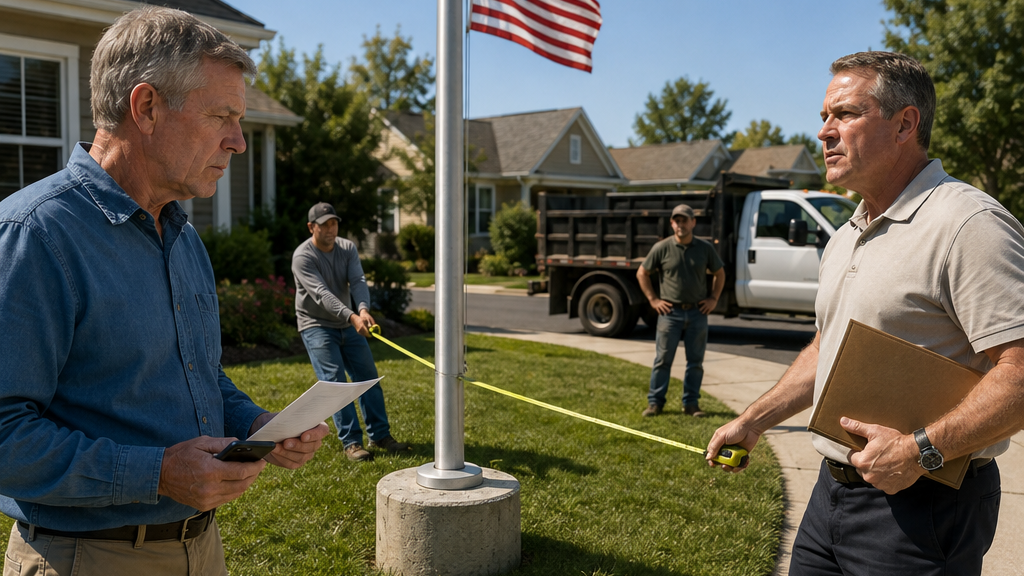
Two men in work shirts stood near a landscaping truck farther down the street.
Richard approached with a yellow measuring tape in his hand.
“That get delivered?” he asked.
Scott lifted the notice. “Apparently.”
Richard glanced at the flagpole. “I figured it was better to come by so there wasn’t confusion.”
Scott noticed one of the workers walking toward the lawn.
“What are they doing?”
“Just getting measurements.”
“For what?”
“The pole location. Height. Setback. If removal becomes necessary, we’ll already have what we need.”
The worker pulled the measuring tape toward the concrete collar around the pole.
Scott stepped between him and the lawn.
“Don’t come onto my property.”
The worker stopped immediately and looked at Richard.
Richard’s mouth tightened. “Nobody’s trying to cause a scene.”
“I’m not causing one.”
Scott took out his phone and photographed the notice, then the tape stretched along the grass.
Richard opened his folder.
“Section Four covers exterior structures visible from the street. Anything requiring architectural approval has to have approval on file.”
“That pole’s been there since 2013.”
“That doesn’t make it approved.”
“Did the board vote on this?”
Richard hesitated.
It was brief, but Scott saw it.
“The board adopted a stricter enforcement position,” Richard said.
“That wasn’t my question.”
Richard closed the folder halfway.
Scott kept his voice level. He had spent years watching homeowners turn meetings into shouting contests over trash cans and fence stain. He had always considered walking away a kind of discipline.
Now he asked, “Which meeting did the board vote to fine me?”
“I don’t carry meeting minutes around in my truck.”
“Then send me the date.”
Richard looked past Scott toward the pole.
“The rule exists whether you attended the meeting or not.”
That landed harder than Scott expected because it was true in one uncomfortable sense: he had not attended.
Not the last annual meeting. Not the budget meeting before that. He usually deleted association emails after checking for anything involving dues.
He had told himself that people who spent their evenings arguing about shrubs had too much time.
Richard pointed toward the notice.
“You have an appeal process. Use it. But until something changes, the violation stands.”
“And the crew?”
“They were only measuring.”
“They’re done measuring.”
Richard gave a small nod to the workers.
As they walked back toward the truck, Donald Lewis appeared at the edge of the neighboring driveway with a garden hose in his hand. He looked toward Scott, then deliberately back toward his flower bed.
Scott hated that more than if Donald had stared.
Richard tucked the measuring tape into his folder.
“For what it’s worth, Scott, this isn’t about the flag.”
Scott looked up at it.
“That seems like a difficult distinction from where I’m standing.”
“It’s about the pole. Standards. Approvals. We’ve let too many things slide.”
“We?”
“The association.”
Scott almost said, You mean you.
Instead, he folded the notice once.
“Send me the vote.”
Richard walked back to his truck without answering.
Inside, Scott put the paper on the kitchen table and opened the association portal on his laptop. The violation showed as an outstanding balance: $250.
Below it sat a warning that unresolved violations could accrue additional charges under the governing documents.
He searched eleven years of old email.
Flag.
Pole.
Architectural.
Approval.
Nothing obvious appeared.
That bothered him more than Richard’s visit.
Scott had installed the pole himself after moving into the house. He remembered measuring from the sidewalk, calling the utility-marking service, mixing the concrete in a wheelbarrow.
He remembered paperwork too—or thought he did.
There had been a form.
Maybe.
He opened a drawer where old warranties and tax receipts were stacked in folders. No approval.
Another drawer. Nothing.
At noon he called the management company.
The representative was polite and careful.
“I can request archived architectural records.”
“How long?”
“Older records may take several business days.”
“Can you tell me when the board approved this enforcement action?”
“That would be reflected in meeting minutes if a formal vote occurred.”
“If?”
A pause.
“I’m saying that’s where such a vote would ordinarily be documented.”
Scott wrote the sentence down.
By late afternoon, the first shock had become something colder.
He still did not know whether his pole technically violated anything.
But Richard had come prepared to measure for removal and unprepared to name the meeting that authorized the fine.
Scott refreshed his email.
A notification from the postal service appeared.
Certified mail from the Ridgecrest Homeowners Association had entered the local distribution center.
Delivery expected Saturday.
Scott stared at the tracking number.
The first notice was already sitting on his table.
Whatever was coming next had been mailed before he had even been given a chance to appeal.
Chapter 2: Eleven Quiet Years Become Evidence
The photograph had been taken at Christmas in 2013, and the flagpole was standing in the background.
Scott enlarged the image until the pixels softened.
There it was beside the front walk, silver against a bare December maple, the same concrete base Richard’s crew had tried to measure the day before.
Scott opened another folder.
Summer 2014. Flagpole.
A neighborhood cookout in 2016. Flagpole.
A photograph after a hailstorm in 2018. Flagpole.
He began arranging the images by year on the kitchen table.
The certified envelope arrived before noon.
It contained a formal demand repeating the violation, the $250 assessment, and the thirty-day deadline. It also warned that additional enforcement costs could be assessed if the matter continued.
Scott placed it beside the photographs.
Eleven years on one side.
Thirty days on the other.
He walked outside with three printed pictures.
Donald was rinsing dirt from a shovel next door.
“You got a minute?”
Donald shut off the hose.
Scott held out the oldest photograph.
“That pole was up in 2013.”
Donald studied it. “I know.”
“Then why is everybody acting like I put it up Thursday?”
“Nobody said you did.”
“Richard’s acting like it.”
Donald handed the photograph back.
“He’s dealing with a lot of stuff.”
“So am I.”
“I mean the whole neighborhood.”
Scott waited.
Donald leaned the shovel against his garage.
“People have been complaining for years. Fences that got approved for one house and denied for another. Sheds nobody applied for. Basketball goals left in the street. Somebody built a pergola almost against the property line.”
“And that makes my flagpole illegal?”
“I didn’t say that.”
“You said he’s dealing with a lot.”
Donald sighed.
“The new board told people they were going to stop making exceptions.”
Scott looked toward his pole.
“So mine’s the demonstration model.”
“I don’t know.”
The answer was too quick.
Scott remembered Richard’s phrase: We’ve let too many things slide.
Not I.
We.
For the first time, Scott wondered how many neighbors had actually wanted this.
That afternoon he walked the subdivision with his phone.
He did not photograph people. He photographed structures visible from the street.
A wooden privacy fence with lattice at the top.
A storage shed painted to match a house.
A freestanding basketball hoop.
A stone mailbox surround.
None proved anything by itself. Scott knew that. Some might have approvals. Some might predate the current covenants.
But the neighborhood looked nothing like a place where every exterior detail had been rigidly controlled.
Back home, he searched old association newsletters.
One from 2015 included a photograph of volunteers planting flowers at the entrance. Scott was visible in the background carrying mulch.
So was his flagpole.
Another newsletter from 2019 showed a Fourth of July yard-decorating contest. His house appeared at the edge of a photograph.
The pole was plainly visible.
Scott felt the first clean pulse of confidence since receiving the fine.
The association itself had published photographs containing the thing it now described as an unacceptable violation.
He printed them.
By evening the kitchen table had disappeared beneath years of paper.
Then he found something that stopped him.
A 2013 email with the subject line Architectural Request Received.
Scott opened it.
The message thanked him for submitting an exterior-modification application and said the committee would respond after review.
He sat straighter.
There it was.
Proof that he had applied.
He searched for the response.
Nothing.
He tried the sender’s name.
Nothing.
He searched approval, approved, flagpole, exterior modification, committee.
Still nothing.
The confidence drained away.
Receiving an application was not approving it.
He went back to the paper files in the hall closet. He found the utility-locate ticket from before digging. The receipt for the pole. A handwritten sheet with setback measurements.
No approval.
His phone rang.
Donald.
Scott answered without greeting.
“You find anything?” Donald asked.
“How’d you know I was looking?”
“You’ve been walking around with a phone like a building inspector.”
Scott almost laughed.
“Found proof I applied.”
“That sounds good.”
“Not proof they approved it.”
Donald was quiet.
Then he said, “You know, Scott, this is why Richard’s got some people behind him.”
“What is?”
“Records are a mess. Half the neighborhood thinks if something’s been there long enough, that means it’s fine. The other half thinks they’re the only ones who ever bothered asking permission.”
Scott leaned against the kitchen counter.
“I did ask.”
“I believe you.”
“But I can’t prove the answer.”
“No.”
Donald’s tone was not triumphant. That made the word worse.
Scott looked through the window.
The flag had wrapped itself once around the pole in the weakening wind.
He had spent a day proving something important: the pole was not new, hidden, or unnoticed. Previous boards had seen it for years.
But he had also discovered the gap Richard could use.
Long tolerance was not the same thing as formal approval.
That night Scott put every 2013 document into a single folder and checked once more behind the oldest property-tax records.
Nothing.
At the bottom of the file box, there was an empty hanging folder labeled HOUSE—HOA.
He remembered cleaning it out years earlier.
Most of what had been inside had seemed useless.
Annual meeting packets. Landscaping reminders. Election ballots he had never returned.
Scott sat on the floor with the empty folder in his hands.
For the first time, the question was no longer why the HOA had waited eleven years.
It was whether his own habit of throwing away anything that seemed unimportant had just erased the one piece of paper he needed.
Chapter 3: The Law Helps, But Not Enough
Nicole Garcia read the violation notice twice before looking up.
“If you came here expecting me to tell you the HOA can’t touch this because there’s an American flag involved, I can’t tell you that.”
Scott had been in her office for seven minutes.
“That’s not what I expected.”
Nicole raised an eyebrow.
He reconsidered.
“It’s partly what I expected.”
“That’s usually why people bring me this statute.”
She turned her monitor so he could see it.
The Freedom to Display the American Flag Act was open on the screen.
Scott had already read summaries online. Some made it sound absolute. An HOA could not stop a homeowner from displaying the flag.
Nicole pointed to the part he had skimmed too quickly.
“The flag itself has protection. But associations can still impose certain reasonable restrictions tied to legitimate interests. Time, place, manner, safety, property interests—facts matter.”
“So Richard can make me take it down?”
“I didn’t say that.”
“The pole?”
“I didn’t say that either.”
Scott leaned back.
Nicole tapped the notice.
“What I’m saying is that ‘federal law’ is not a magic phrase that makes every other question disappear.”
She asked when the pole had been installed.
“2013.”
“Any complaints before now?”
“None.”
“Approval?”
“I applied.”
“Approved?”
“I can’t find it.”
Nicole nodded slowly.
“That matters.”
Scott slid the photographs across her desk: the Christmas picture, the newsletter, the Fourth of July image.
She examined each one.
“This matters too.”
“How?”
“Notice. History. Consistency. Depending on the documents and state law, maybe other arguments. But none of those photographs is a stamped approval.”
Scott looked toward the bookcase behind her.
He had spent the weekend imagining this meeting as the point where the pressure reversed. Nicole would cite federal law, send a letter, and Richard would discover he had picked the wrong homeowner.
Instead, Scott had bought himself more questions.
Nicole opened the HOA declaration and architectural guidelines he had emailed ahead.
“Here’s something I like better than the internet summaries.”
She pointed to the enforcement provision.
Scott read it.
Violations could be assessed after notice and in accordance with procedures adopted by the board.
“Procedures adopted by the board,” Nicole said.
“Richard says the board adopted stricter enforcement.”
“Maybe it did.”
“He couldn’t tell me when.”
“That doesn’t mean it didn’t happen.”
“No.”
“But his notice has another problem.”
She showed him the page.
The letter cited Section Four for exterior structures but did not identify the specific design standard the pole allegedly violated. It demanded removal or compliance without explaining whether compliance meant relocation, replacement, retroactive application, or something else.
“You can’t meaningfully cure something if they won’t tell you what cure means,” Nicole said.
Scott read the letter again.
For two days, he had stared at the $250 number.
Now the vagueness around it seemed more important.
Nicole continued.
“I can send a response. We raise the federal statute. We raise the long history. We request the basis for the fine, the architectural record, and the board authorization.”
“And tell them it’s unlawful?”
“I’ll tell them what I can support.”
Scott looked at her.
“You’re very careful with words.”
“That is approximately what you’re paying me for.”
Despite himself, he smiled.
Then she said, “There’s another possibility you should be ready for.”
“What?”
“They back away from the flag issue and say this is purely about an unapproved structure.”
“The pole.”
“Yes.”
“That’s what Richard already says.”
“Then assume he’ll keep saying it.”
Scott’s smile disappeared.
Nicole folded her hands.
“If their position becomes, ‘We are not restricting your right to display a flag; we are regulating the size or location of a freestanding pole,’ the argument gets more fact-specific.”
“After eleven years.”
“That helps you. It does not erase every rule.”
“After they printed it in their own newsletter.”
“Helpful. Still not the same as approval.”
Scott heard Donald’s voice from Saturday.
I believe you.
But you can’t prove the answer.
Nicole seemed to read his expression.
“You wanted one fact to end this.”
“Yes.”
“There may not be one.”
That irritated him because it was true.
For years Scott had avoided HOA meetings because every dispute seemed inflated by people who could not distinguish irritation from principle.
Now he had spent an entire weekend assembling photographs of a pole.
Nicole pulled a yellow legal pad toward herself.
“The strongest cases are sometimes the ones where several smaller things point in the same direction. Don’t fall in love with one argument.”
She wrote four lines.
Federal protection.
Notice and opportunity to cure.
Past treatment.
Board authority.
Scott focused on the last one.
“You think Richard acted without a vote?”
“I think I haven’t seen evidence of one.”
“What if there isn’t one?”
“Then the conversation changes.”
“How much?”
“That depends on what your governing documents require.”
Nicole drafted the response while Scott sat across from her. She did not threaten anyone. She did not mention lawsuits in bold letters.
She requested suspension of the fine while the appeal was pending. She cited the federal flag-display protections carefully. She asked the association to identify the exact restriction allegedly violated and any reasonable alternative it proposed.
Then she asked for something Richard had avoided giving Scott on Friday.
The date and minutes of the board action authorizing the enforcement policy and assessment.
Scott read the final draft.
It was less dramatic than the letter he had imagined.
It was also harder to dismiss.
Nicole sent it by email and prepared a certified copy.
As Scott stood to leave, she said, “One more thing.”
He stopped.
“You said Richard called this a board enforcement position.”
“That’s what he said.”
“Then don’t spend tonight searching flag law.”
“What should I search?”
“Nothing.”
She turned her monitor back toward herself.
“Get the meeting minutes.”
Scott drove home with the certified-mail receipt on the passenger seat.
At his kitchen table, he opened the association portal and submitted a formal records request for board minutes covering the months before his fine.
Before clicking send, he looked through the window at the pole.
For the first time, he understood that the dispute might not turn on what was flying above his yard.
It might turn on what had—or had not—happened in a meeting room he had never bothered to enter.
Chapter 4: The Meeting That Never Happened
The minutes from the supposed enforcement meeting were three pages long.
Scott read them twice.
There was a vote on landscaping contracts. A discussion about late dues. A motion concerning pool access cards. Richard Johnson had given what the secretary called an “architectural compliance update.”
There was no vote authorizing a new enforcement campaign.
There was no motion concerning Scott’s flagpole.
There was no vote approving the $250 fine.
Scott sat at his kitchen table with the pages spread beside Nicole Garcia’s letter.
He checked the meeting before that.
Nothing.
Then the meeting before that.
Nothing.
By Tuesday afternoon, the management company had provided six months of minutes and a packet labeled Compliance Procedures. The procedures were older than Scott expected, and nothing in them described the “stricter enforcement position” Richard had cited in Scott’s driveway.
Scott called the management office.
“I’m looking for the vote that adopted the current enforcement directive.”
The representative paused.
“What directive are you referring to?”
“The one Richard Johnson said the board adopted.”
“I have a compliance memo.”
“I have that too.”
“The president submitted it to management.”
“That isn’t a board vote.”
Another pause.
“No.”
Scott pressed two fingers against his forehead.
“So where was it approved?”
“I would need to ask the board.”
“Please do.”
When the call ended, Scott stared out at the flagpole.
The flag was hanging almost still.
For days, he had thought the argument was about whether the pole had been approved eleven years earlier.
Now another possibility had opened.
Maybe Richard had skipped an approval too.
That evening, Scott forwarded the documents to Nicole.
Her answer arrived within twenty minutes.
Do not assume this ends anything. Ask who authorized the assessments and under what board action.
Scott read the sentence three times.
It sounded like Nicole.
Never celebrate a question before you had the answer.
The next morning, an email arrived from Lisa Martinez.
Scott knew her by sight. Treasurer. Quiet at annual meetings. Usually seated at the far end of the board table with a calculator and a stack of financial reports.
Her message contained only two lines.
Could you send me the compliance memo you received from management?
I would like to compare it with my records.
Scott attached the document.
An hour later, his phone rang.
“Scott Hill?”
“Yes.”
“This is Lisa Martinez.”
Her voice was controlled, but he could hear paper moving rapidly on the other end.
“You got this memo directly from management?”
“Yes.”
“And you didn’t alter it?”
“No.”
“I’m not accusing you. I’m asking because my name is on it.”
Scott looked again.
At the bottom, beneath a list of enforcement priorities, were three names.
Richard Johnson, President.
Lisa Martinez, Treasurer.
And another board member.
“You didn’t know?”
“I knew Richard wanted management to start clearing old violations.”
“That sounds like the memo.”
“It is not the same thing as approving this.”
“What did you approve?”
“We discussed having management generate a list.”
“A list.”
“Yes.”
“Of existing possible violations?”
“Yes.”
“Did you vote to fine them?”
Lisa was silent.
“No.”
Scott felt his pulse change.
“Did you vote to authorize Richard to do it?”
“No.”
There was less hesitation that time.
He looked at Nicole’s letter beside him.
“Then why is your name on the memo?”
“I don’t know yet.”
The answer did not sound defensive.
It sounded angry.
Not at Scott.
At the document.
Lisa lowered her voice.
“I need to check something before I say more.”
“What?”
“Whether this went to the rest of the board before management treated it as policy.”
The call ended before Scott could ask another question.
By noon, the problem had moved beyond his yard.
Nicole called after reading Lisa’s email.
“That’s useful.”
“Useful?”
“Don’t get excited.”
“I wasn’t.”
“You sound excited.”
Scott rubbed his jaw.
“She says she never approved it.”
“Then we need records showing who did.”
“She’s the treasurer.”
“She’s one vote.”
“So Richard just made policy?”
“We do not know that.”
Scott exhaled.
“You really don’t let anybody enjoy anything.”
“That is also approximately what you’re paying me for.”
She told him to preserve the memo, Lisa’s email, and the certified notices.
“Those envelopes matter now,” Nicole said.
“How?”
“If the assessments were issued as part of an informal directive rather than an authorized board action, the sequence matters. Dates matter.”
Scott glanced toward the two envelopes lying on the counter.
The first had arrived before he had spoken to anyone.
The second had been mailed before his appeal period had even begun.
Authority had arrived at his door in certified envelopes.
Now those same envelopes were becoming evidence of how quickly Richard had moved.
At four that afternoon, Richard called.
Scott almost let it go to voicemail.
Then he answered.
“Scott.”
“Richard.”
“I think this has gotten more complicated than it needs to be.”
Scott leaned against the counter.
“Which part?”
“The flagpole.”
“You fined me.”
“And I’m trying to resolve it.”
“How?”
Richard hesitated.
“If you reduce the pole height and submit a retroactive architectural form, I’m willing to recommend that the fine be waived.”
Scott said nothing.
Richard continued.
“You’d keep the flag. The association gets documentation. Everybody moves on.”
A week earlier, Scott might have accepted before Richard finished speaking.
No attorney bill.
No meeting.
No neighborhood argument.
No becoming one of those people.
“What happens to the violation?” Scott asked.
“Closed.”
“And the $250?”
“Waived.”
“And the enforcement memo?”
Richard’s voice hardened slightly.
“That’s separate.”
“Is it?”
“Yes.”
Scott looked at the compliance memo.
“Did the board vote on it?”
“The board has discussed enforcement repeatedly.”
“That isn’t what I asked.”
“You’re getting hung up on procedure.”
Scott almost laughed.
The sentence was so close to what he used to think about HOA meetings.
Procedure.
The boring part.
The part other people could worry about.
Richard said, “Look, Scott, we inherited a mess. People complain if we enforce rules. They complain if we don’t. You want your flagpole. I’m giving you a way to keep it.”
“By changing it.”
“By bringing it into compliance.”
“With a policy the board didn’t vote on?”
Richard went quiet.
Then, carefully, he said, “You should talk to your attorney before making assumptions.”
“I will.”
“This offer may not stay open.”
Scott looked through the window.
The pole rose exactly where it had for eleven years.
The easy answer was sitting in front of him.
Shorten it.
Fill out the form.
Let Richard erase the fine.
Scott thought about how quickly relief tempted a person to stop asking who had authority in the first place.
“No,” he said.
Richard was silent.
Scott continued.
“I’m not taking a private waiver.”
“You understand what you’re risking?”
“I’m starting to.”
When the call ended, Scott wrote down the time and Richard’s offer.
Then he sent it to Nicole.
For the first time since the notice appeared on his door, Scott had been offered exactly what he originally wanted.
The fine could disappear.
The pole could stay.
All he had to do was stop asking why the rule had been enforced the way it was.
He had refused.
Chapter 5: The Neighbor Who Asked for Tougher Rules
“I told Richard somebody had to start saying no.”
Donald Lewis stood on his porch with both hands around a glass of iced tea.
Scott stopped halfway up the driveway.
“What?”
Donald looked toward the street rather than at him.
“Last winter. Before the election.”
Scott had come over intending to ask whether Donald had heard anything about the emergency board meeting Lisa said was being discussed.
Instead, Donald had opened the door and confessed before Scott could ask.
“You told him to start fining people?”
“I told him the board had become useless.”
“That’s different?”
“At the time, I thought so.”
Donald set the glass on the porch rail.
A truck passed slowly at the end of the street.
“Three years ago, I applied to replace my back fence with six-foot privacy panels. They denied it because the rules said four feet along that section.”
Scott nodded.
He remembered the old chain-link fence Donald still had.
“Then two houses over, somebody put up six-foot panels.”
“Approved?”
“Never found out.”
“And you complained.”
“For almost a year.”
Donald gave a short, embarrassed laugh.
“Management told me every case had different facts. The board told me to submit another application. I got tired of hearing it.”
“So you backed Richard.”
“Yes.”
Scott felt irritation rise again, then stall.
Donald was not enjoying the admission.
He looked tired.
“At the candidate meeting,” Donald said, “Richard said either rules meant something or they didn’t. That sounded pretty good to people who’d spent years watching different answers come out of the same office.”
Scott leaned against the porch post.
“And now?”
“Now your flagpole is apparently the hill everybody picked.”
Scott looked back toward his own yard.
From Donald’s porch, the pole was visible between two maple trees.
“So this isn’t about the flag.”
“Not entirely.”
“That’s what Richard said.”
“He’s not lying about everything, Scott.”
The sentence annoyed him.
Maybe because he knew it was true.
Donald continued.
“There’s a shed on the north side that was approved without the right setback. A family near the entrance got denied a similar one. A basketball goal got cited three times, but somebody else left one up for five years. People remember that stuff.”
“And the answer is to fine me for something that’s been there eleven years?”
“No.”
“Then what are you saying?”
“I’m saying Richard walked into a neighborhood that had spent years asking for consistency.”
Donald picked up his tea.
“And some of us told him being nice about it was the problem.”
Scott thought about the compliance memo.
The names at the bottom.
Lisa saying she had approved a list, not an enforcement campaign.
“Did Richard ever tell you he could issue fines without a board vote?”
Donald shook his head.
“No. I never asked.”
Neither had Scott.
That was the uncomfortable part.
He had watched the association drift for years and congratulated himself for staying above it.
He had thrown away ballots.
Skipped meetings.
Ignored policy emails.
When neighbors complained about selective enforcement, he had thought they were too invested in trivial things.
Now a trivial thing belonged to him.
A pole.
A form.
A fine.
Donald looked at him.
“You know what the worst part is?”
“What?”
“I still think we needed tougher enforcement.”
Scott studied him.
“Even now?”
“Not like this.”
Donald gestured toward Scott’s house.
“I think if you tell one person no, you should be able to explain why you told the next person yes. I think people should apply before they build things. I think rules should mean something.”
He paused.
“But I don’t think Richard gets to become the rule.”
That landed harder than anything Nicole had put in writing.
Scott looked down at the porch boards.
For days, he had reduced Richard to a familiar type: HOA president discovers authority and likes it too much.
It was easy.
Maybe too easy.
Richard had been given a real problem.
Residents wanted consistency.
Records were poor.
Previous boards had avoided difficult decisions.
Richard had chosen the fastest way to show that things had changed.
Visible enforcement.
Letters.
Fines.
Scott’s flagpole made a perfect test because everyone could see it.
That did not excuse the choice.
It explained why the choice had been tempting.
Donald said, “Lisa called me.”
Scott looked up.
“Why?”
“She’s asking a few homeowners about old enforcement complaints.”
“What did you tell her?”
“The truth.”
“Which version?”
Donald accepted that.
“The one where I pushed Richard to get tougher.”
Scott walked back down the porch steps.
Donald called after him.
“Scott.”
He turned.
“If they offer to drop yours, take it.”
Scott frowned.
“You just said Richard doesn’t get to become the rule.”
“I know.”
“Then why should I take it?”
“Because I’ve seen these fights turn neighbors into enemies over things nobody cared about six months earlier.”
Donald’s voice softened.
“You keep saying you don’t want to be that guy.”
Scott did not ask how Donald knew.
Probably because he had said it often enough over the years.
The man at the meeting shouting about garbage cans.
The woman sending six-page emails about decorative stone.
The neighbor who photographed everybody else’s yard.
Scott had always defined himself partly by not being them.
But that evening, standing between Donald’s porch and his own flagpole, he saw the flaw in that distinction.
Avoiding every fight did not make a person reasonable.
Sometimes it just meant someone else made the rules.
His phone buzzed.
An email from the management company.
Emergency Board Meeting.
Thursday, 7:00 p.m.
Agenda: Enforcement procedures and pending architectural violations.
Scott read it once.
Donald stepped down from the porch.
“You going?”
Scott had never willingly attended an emergency HOA meeting in his life.
“Yeah.”
“To listen?”
Scott looked at the agenda again.
“No.”
The answer surprised both of them.
“I’m going to speak.”
Chapter 6: The Board Hears the Whole Case
Richard offered Scott the deal again before the meeting officially started.
The clubhouse smelled faintly of coffee and floor cleaner. Folding chairs had been arranged in rows facing two plastic tables pushed together for the board.
Scott was laying out his documents when Richard approached.
“Last chance to keep this simple.”
Scott looked up.
Richard lowered his voice.
“Retroactive application. Reduced pole height. Fine waived.”
Scott placed the $250 notice beside a photograph from 2013.
“Is that offer from the board?”
Richard’s jaw shifted.
“It’s a practical resolution.”
“That wasn’t my question.”
Several residents were entering the room now. Donald took a seat near the back. Lisa Martinez sat at the board table with a binder open in front of her.
Richard glanced toward them.
“You’re turning your own case into something larger.”
“No,” Scott said. “I think you did that.”
Richard walked away.
Scott almost called him back.
The private offer was still tempting.
That was what bothered him.
He could leave tonight with certainty.
Instead, he sat in the second row and waited for a room full of neighbors to discuss his front yard.
At seven, Richard called the meeting to order.
He did not sound nervous.
He sounded prepared.
“For several years,” he began, “Ridgecrest has received repeated complaints about inconsistent enforcement of architectural standards.”
Scott watched Donald lower his eyes.
Richard continued.
“Residents have asked this board to address unapproved structures, fencing, exterior modifications, and other violations that prior boards either failed to resolve or handled inconsistently.”
There were nods around the room.
Not many.
Enough.
Richard was not inventing the frustration.
That mattered.
“If we simply abandon enforcement every time someone objects,” he said, “we return to the exact problem homeowners elected this board to correct.”
Scott felt several people look toward him.
Richard had done something skillful.
He had made Scott’s flagpole secondary.
The question was now whether the HOA would enforce anything at all.
One board member asked management to summarize the pending cases.
There were nine.
Scott’s flagpole was one.
A fence.
Two sheds.
A driveway extension.
An exterior light fixture.
Three other architectural issues.
Nine certified envelopes.
Nine households.
Scott looked at the notice in his lap differently.
Lisa spoke next.
“I need to clarify something before we discuss individual cases.”
Richard turned toward her.
She opened the binder.
“The board did discuss compiling unresolved architectural matters. We did not, according to the minutes I reviewed, vote to authorize the enforcement directive management received.”
The room changed.
Not dramatically.
No gasps.
Just chairs shifting.
Pens stopping.
Richard said, “We discussed enforcement at multiple meetings.”
“Yes,” Lisa replied.
“And the board agreed that we needed consistency.”
“Yes.”
“Then I’m not sure what distinction you’re making.”
“The distinction between discussing a problem and authorizing assessments.”
Richard leaned back.
“We gave management direction.”
Lisa looked at him.
“You gave management a memo.”
Scott saw the irritation cross Richard’s face.
“We all knew what the objective was.”
“My name is on that memo.”
“Yes.”
“I did not approve the version management received.”
Silence settled across the room.
Scott thought about how much he had wanted someone else to say exactly this.
Lisa had said it.
And still the problem was not solved.
Richard folded his hands.
“If the board wants to criticize my process, fine. But that doesn’t make the underlying violations disappear.”
Nicole’s warning returned to Scott.
Do not fall in love with one argument.
The board chair recognized Scott.
He stood.
His mouth had gone dry.
He had brought notes but left them on the chair.
He placed two items on the table.
The $250 notice.
The 2013 photograph.
“My flagpole is in that picture,” he said.
Nobody needed him to point it out.
“It’s been in the yard eleven years. Previous boards saw it. The association published photographs with it in the background. I also found proof that I submitted an architectural request when I installed it.”
Richard said, “But no approval.”
Scott looked at him.
“No approval I can find.”
A murmur moved through the room.
Scott let it.
“That’s part of the problem.”
Richard seemed surprised.
Scott continued.
“I can stand here and say you should leave mine alone because it’s been there eleven years. Or because it’s an American flag. Or because federal law protects displaying the flag.”
He touched the photograph.
“But my attorney explained something I didn’t want to hear. The law doesn’t mean every possible restriction on every pole is automatically invalid.”
Richard’s posture changed slightly.
This was not the argument he had expected.
Scott looked toward the board.
“So I’m not asking you to pretend the architectural rules don’t exist.”
He picked up the fine.
“I’m asking who decided I owed this.”
Nobody answered.
“If there was a vote, show me the vote.”
He looked at Lisa.
“If there wasn’t, then decide whether one person should be able to turn a discussion into policy and policy into fines.”
Richard leaned toward his microphone.
“That is an unfair characterization.”
Scott nodded once.
“Then correct it.”
Richard’s expression tightened.
Scott had promised himself he would not make a speech.
So he stopped.
The silence forced Richard to respond.
“You were offered a resolution,” Richard said.
Scott saw several heads turn.
There it was.
The private offer becoming public.
Richard continued.
“You could submit a retroactive application, reduce the height, and the fine would be waived.”
Scott could feel Donald watching him.
This was the moment he had feared most—not losing, but appearing unreasonable when a compromise was available.
Scott looked down at the $250 notice.
Then back at Richard.
“No.”
A woman in the back shifted loudly.
Richard said, “Then what exactly do you want?”
“I want the board to decide.”
“It is deciding.”
“Not just mine.”
Richard stared at him.
Scott continued.
“If you waive my fine privately and keep the other eight cases moving under the same process, then I didn’t prove the process was fair. I just got myself out of it.”
Lisa sat very still.
One of the other board members asked, “Are you saying you don’t want the fine waived?”
“I want it reviewed.”
“That may result in the fine remaining.”
“I understand.”
Scott heard his own voice and realized he meant it.
A week earlier, $250 had seemed like the whole story.
Now paying it would almost be easier than accepting an exception nobody else received.
Richard pushed a folder forward.
“This is exactly why enforcement became impossible before. Every case turns into a referendum.”
“No,” Lisa said.
Richard turned.
She tapped the binder.
“This is a referendum because we didn’t authorize the process properly.”
He stared at her.
Lisa continued.
“And because if we rescind Scott’s case, we need to determine what that means for the others.”
That was the complication nobody in the room wanted.
The treasurer explained it plainly.
Some residents had already paid fines.
Some had incurred management fees.
One homeowner had altered a structure after receiving a notice.
If the board concluded that the enforcement directive itself had not been properly authorized, correcting Scott’s case might require reviewing all nine.
Richard’s face lost some color.
“Which could cost the association money,” he said.
“Yes,” Lisa replied.
“And set enforcement back months.”
“Yes.”
“And tell everybody that rules are optional.”
“No.”
Lisa closed the binder.
“It tells everybody that we have to follow ours too.”
Donald exhaled somewhere behind Scott.
Richard looked around the table.
For the first time, Scott saw the pressure Richard had been carrying.
The complaints.
The bad records.
The promise to make standards mean something.
The fear that one retreat would make the entire effort collapse.
Scott understood it.
He still did not excuse what Richard had done.
One board member proposed rescinding Scott’s fine immediately.
Another objected.
“That isolates one case before we understand the others.”
Richard seized on that.
“Exactly.”
Scott felt the meeting sliding toward delay.
Then Lisa proposed a different motion.
Suspend collection and enforcement on all nine disputed cases.
Review whether each action had proper authorization.
Compare each alleged violation against similar properties and prior approvals.
No additional fines until the review was completed.
Richard shook his head.
“You’ll freeze the entire compliance effort.”
“For these cases,” Lisa said.
“It sends the wrong message.”
Scott spoke from his chair.
“Maybe the message is that enforcement has to be slower than a certified letter.”
Richard looked at him.
Scott almost wished he had stayed silent.
Almost.
The motion was seconded.
The board debated it for another twenty minutes.
Richard argued that standards without enforcement became suggestions.
Lisa argued that enforcement without authorization became arbitrary.
One board member worried about legal expense.
Another worried about homeowners who had already complied.
No one clapped.
No one shouted.
The room became what Scott had always assumed HOA meetings were: tedious, procedural, full of distinctions that seemed small until money and property sat on top of them.
He began to understand why those distinctions mattered.
Finally, the vote was called.
Three in favor.
One opposed.
Richard abstained after a long pause.
The nine disputed cases were suspended pending review.
Scott looked at the $250 notice.
It had not been canceled.
His flagpole had not been declared compliant.
Richard was still president.
Nothing had ended cleanly.
Yet for the first time, the certified envelopes had stopped moving outward.
The board would now have to look backward.
At its minutes.
At its approvals.
At who had paid.
At who had been told no.
At who had been allowed yes.
Richard gathered his papers.
As residents began standing, he looked across the room at Scott.
“You realize what this review could cost.”
Scott folded the old photograph and slipped it back into his folder.
“Yes.”
“And you still think this was worth expanding?”
Scott looked toward Donald, then Lisa, then the stack of nine cases on the board table.
A week earlier, he would have answered in terms of his yard.
His pole.
His fine.
Now he said, “I think it was already bigger. I just hadn’t been paying attention.”
Richard said nothing.
The board members stayed behind after the residents began leaving.
On the table, beside Scott’s $250 notice, Lisa placed the nine enforcement files into a single stack.
The suspension was temporary.
The real question was whether the board would spend the money, time, and pride required to admit what had gone wrong.
Chapter 7: The Check Does Not End It
The envelope looked almost identical to the ones that had started the fight.
Same association logo.
Same return address.
Same stiff white paper.
Scott stood at the mailbox for a moment before opening it.
Inside was a check for $250.
He read the amount twice, then turned the check over as if there might be a condition printed on the back.
There was none.
A short letter accompanied it. The board had completed an initial review and rescinded his assessment. The removal demand was withdrawn pending updated architectural procedures.
Scott carried the envelope up the driveway.
The flag moved above him in a light afternoon breeze.
For a few seconds, he let himself enjoy the simplicity of the number.
Two hundred fifty dollars taken.
Two hundred fifty dollars returned.
Then his phone rang.
Lisa Martinez.
“Did you get it?”
“I’m holding it.”
“Good.”
Scott looked at the pole.
“That sounded less celebratory than I expected.”
“We’re not finished.”
Of course they weren’t.
Lisa told him the review had expanded beyond the nine suspended cases. Once the board began comparing files, they found older enforcement decisions with missing approvals, inconsistent setback measurements, and different outcomes for similar structures.
Some homeowners had paid.
Some had altered their property.
Some had been allowed to keep nearly identical changes.
“What happens now?” Scott asked.
“We review them.”
“All of them?”
“The ones we can reasonably reconstruct.”
Scott heard the fatigue in her voice.
“And Richard?”
“He’s still president.”
Scott stopped walking.
“I thought the board might remove him.”
“We’re not there.”
“Why not?”
“Because being wrong isn’t automatically the same as acting in bad faith.”
Scott said nothing.
Lisa continued.
“He pushed too far. He used authority the board hadn’t actually given him. That has consequences.”
“What consequences?”
“Effective immediately, no major architectural fine can go out under the president’s authority alone. Management needs documented board approval.”
That was more significant than removing a title.
Scott knew it.
Still, part of him had imagined Richard simply disappearing from the process.
Lisa seemed to hear the silence.
“You wanted accountability.”
“I do.”
“This is accountability.”
Scott looked at the check again.
“Does Richard think so?”
“I haven’t asked him whether he enjoys it.”
That made Scott laugh despite himself.
Two days later, he attended a short board work session to collect a copy of the revised interim procedure.
Richard was there.
He did not apologize.
He did not glare either.
When Scott entered, Richard gave him a small nod.
Scott returned it.
The exchange felt stranger than hostility would have.
On the table were folders from the disputed cases.
Scott recognized his own.
The certified envelopes had been clipped to the front.
Lisa handed him the written suspension notice.
“Your case is closed as to the fine.”
“As to the fine?”
“The board still intends to create a process for unresolved old architectural records.”
Scott’s shoulders tightened.
“So we’re back to the pole.”
“No removal order.”
“But?”
“If approval cannot be found, the new procedure may require a retroactive record.”
Scott looked across the table at Richard.
Richard said, “That’s what I offered from the beginning.”
Scott felt the old irritation return.
Lisa cut in.
“No. You offered a private adjustment tied to your own enforcement action. This would be a uniform record process for everyone with missing files.”
Richard sat back.
The distinction was tedious.
Small.
Exactly the sort of thing Scott once would have dismissed.
Now he understood why it mattered.
A private favor depended on whoever held power.
A procedure belonged to everyone.
Lisa closed Scott’s folder.
“There’s something else.”
Scott waited.
“We’re forming a temporary standards committee.”
“No.”
Lisa blinked.
“I haven’t asked yet.”
“I’m helping you save time.”
One of the unnamed board members smiled.
Lisa did not.
“We need homeowners who aren’t on the board.”
“I’m not interested.”
“That’s exactly why I think you should do it.”
Scott gave her a look.
“I spent years avoiding these meetings for a reason.”
“Yes.”
“And this experience did not convince me they’re enjoyable.”
“No one said enjoyable.”
Richard looked down at his papers.
Scott wondered if he was hiding a smile.
Lisa said, “One term. Temporary. Review the procedures, not individual grudges.”
“You have other residents.”
“We do.”
“Use them.”
“We will.”
She leaned forward.
“But you made a point in the emergency meeting that nobody else made.”
“What point?”
“That getting yourself exempted wouldn’t fix the process.”
Scott wished he had not said that.
Lisa continued.
“If you meant it, help us build the process.”
That was unfair in a way no fine had been.
Scott could not argue with it without arguing against himself.
He picked up his $250 check.
“I’ll think about it.”
Outside, Donald was standing near the curb.
He noticed the check in Scott’s hand.
“They paid you?”
Scott nodded.
“Full amount?”
“Full amount.”
Donald grinned.
“Then you won.”
Scott looked back through the clubhouse window at the folders on the table.
“Not exactly.”
Donald followed his gaze.
“Don’t tell me you’re going to keep fighting after they refunded you.”
“They want me on a committee.”
Donald laughed hard enough to cough.
“That’s what you get.”
“For what?”
“For caring.”
Scott folded the check carefully and put it into the envelope.
He looked at the flagpole visible down the street.
A month earlier, he would have accepted the refund and considered the story finished.
Go home.
Raise the flag.
Ignore the emails.
Let somebody else worry about minutes, approvals, comparisons, procedures.
He knew exactly where that road led now.
The next morning, Scott emailed Lisa.
One limited term.
No extension.
No officer position.
No guarantee that I will agree with you.
Lisa replied three minutes later.
Perfect.
Chapter 8: The Rule That Stayed After the Fight
Three months later, Scott was handed a draft violation notice for a backyard structure he personally thought was ugly.
He read it once.
Then he asked, “What are we comparing it to?”
The committee went quiet.
Lisa pulled up the property records.
The new procedure required three things before a major fine could be issued: documented board authorization, the exact standard allegedly violated, and a comparison with similar approved or tolerated properties.
The structure in question was oversized.
It was also nearly identical to one the board had approved four years earlier.
Richard sat at the far end of the table.
He looked at the two photographs side by side.
“So we don’t send this?”
Scott disliked the structure.
He disliked the color.
He disliked where it sat against the fence.
None of that answered the question.
“Not until we can explain why this one is different.”
Richard looked at him for a moment.
Then he nodded.
The notice went back into the draft folder instead of into a certified envelope.
After the meeting, Scott walked home.
His flagpole stood in the same place it had since 2013.
The board had completed the retroactive records process. His original approval had never been found, but the pole was formally entered into the architectural record under the same procedure applied to other long-standing structures with incomplete files.
No special waiver.
No private favor.
No victory plaque.
Just a record that could be found the next time somebody asked.
Scott stopped beneath the pole and looked up.
He had once thought defending it meant proving that nobody had the right to tell him what to do with his own yard.
That had been too simple.
Ownership mattered.
So did rules.
What mattered just as much was who made them, how they were applied, and whether the person enforcing them was willing to follow the same process demanded of everyone else.
His phone buzzed with an HOA email.
Months earlier, he would have deleted it after reading the subject line.
Scott opened it.
The committee had scheduled one final vote on the permanent enforcement procedure.
At the meeting that evening, the motion passed.
Recorded board approval.
Written comparison.
Clear notice of the exact violation.
A real appeal before escalating fines.
Scott voted yes.
Richard did too.
Neither man looked at the other afterward.
There was no applause.
There did not need to be.
When Scott returned home, the flag was still moving above the yard, no more dramatic than it had been eleven years before.
The difference was that Scott no longer mistook staying out of the room for keeping his hands clean.
The story has ended.