The HOA Moved His Property Stakes Three Feet—Then the Survey Changed Their Entire Townhouse Expansion
Chapter 1: Three Feet Appeared Overnight Beside Kevin’s Fence
The orange survey stake had not been there Sunday night.
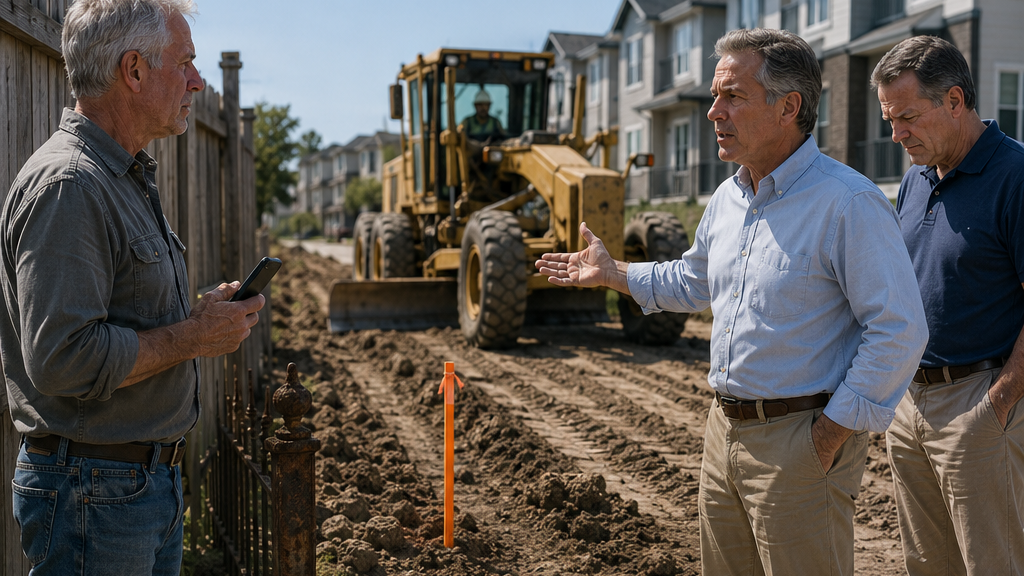
Kevin Lewis knew because he had spent twenty minutes along that fence line before dinner, cutting back honeysuckle that had begun reaching through the old wire. The new stake stood in bare soil now, bright enough to catch his eye from the kitchen window, and it was nowhere near where Kevin believed the property line belonged.
He carried his coffee outside without putting on a jacket.
Three measured paces separated the stake from the line he had lived beside for years.
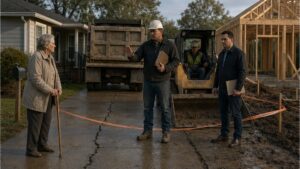
Beyond it, the HOA construction site was already awake. A diesel engine idled behind the temporary barrier. Fresh earth rose in low ridges where the townhouse expansion was being graded, and a yellow machine sat near the edge of Kevin’s side parcel.
Kevin crouched beside the stake.
Its soil was loose.
Not weather-softened. Freshly broken.
He pressed two fingers against the dirt, then looked toward the old fence corner. For years, a rust-darkened iron monument had sat almost flush with the ground there. Most people would never notice it. Kevin had found it not long after buying the property and had treated it as a reference point ever since.
The orange stake was inside that point.
Not by inches.
By feet.
A pickup rolled along the construction entrance. Jeffrey Green stepped out wearing khakis, a button-down shirt and work boots that looked cleaner than anything around him.
Jeffrey had been HOA president for nearly three years. He spoke in the patient tone of a man accustomed to believing patience and agreement were the same thing.
“Morning, Kevin.”
Kevin pointed at the stake.
“When was that set?”
Jeffrey glanced at it. “Survey crew was here late last week.”
“This wasn’t here yesterday.”
“They may have marked additional limits.”
“Whose limits?”
Jeffrey paused.
“The project limits.”
Kevin set the coffee on a fence post.
“That isn’t what I asked.”
Jeffrey looked toward the machine, then back to Kevin. “The engineer laid out the work area according to the approved site plan.”
Kevin walked to the iron monument and scraped away leaves with his boot. The rounded metal top appeared beneath the dirt.
He looked from that point to the orange stake.
“You’re three feet inside.”
Jeffrey gave a small sigh. “Inside what?”
“My property.”
“That’s what the engineer’s plan resolves.”
“No. A plan shows what somebody intends to build. It doesn’t decide who owns my ground.”
The idling machine behind Jeffrey changed pitch.
Kevin’s attention shifted past him.
Deep tire impressions ran through the damp soil.
They did not stop at the orange stake.
The tracks continued several feet farther onto Kevin’s side, cutting through a strip where grass had stood the previous week. A shallow blade mark crossed the surface, exposing raw earth.
His irritation hardened.
“When did they grade that?”
Jeffrey turned.
“They’ve been shaping the drainage edge.”
“That isn’t drainage edge. That’s my yard.”
“It’s part of the improvement corridor.”
Kevin stared at him.
Jeffrey seemed to realize the phrase had landed badly.
“I mean according to the current plan.”
Kevin took out his phone.
He photographed the orange stake, the iron monument, and the tire marks. Then he stepped back far enough to put all three in one frame.
Jeffrey watched him.
“You really think somebody intentionally moved your boundary?”
“I think somebody put a stake where my boundary has never been.”
“That isn’t necessarily the same thing.”
Kevin looked at the fresh soil around the wood.
“No. It isn’t.”
That answer made Jeffrey visibly relax.
Kevin noticed.
He had no proof that anyone had moved an existing marker. The stake could have been new. It could represent landscaping, grading limits, drainage, or something else. He knew enough about property disputes to understand how quickly certainty turned into embarrassment when measurements replaced memory.
So he did not accuse Jeffrey.
He walked the line instead.
At the far end, another patch of disturbed soil showed where a shrub had been scraped away. A second machine track angled toward the townhouse side. The grading was not merely approaching his property. Something had already happened along the edge.
“What exactly are you building here?” Kevin asked.
Jeffrey followed several steps behind.
“Drainage improvements, landscaping, sidewalk connection, revised common area.”
“On whose land?”
“We’ve been through engineering.”
“That still isn’t an answer.”
Jeffrey folded his arms. “Kevin, this project has been discussed for months.”
“Not my line.”
“You were sent the planning notices.”
Kevin felt the first uncomfortable jab of truth.
He had received them.
One envelope had stayed on his kitchen counter for days before he threw it away. He remembered language about drainage improvements and townhouse landscaping and a board meeting he had no interest in attending.
He had assumed that nothing discussed inside an HOA meeting could change the deed in his filing cabinet.
“I received a notice,” he said. “I didn’t receive anything asking permission to use my property.”
Jeffrey shook his head. “Nobody is trying to take your property.”
“Then moving three feet back shouldn’t be a problem.”
“The work is based on the plan.”
There it was again.
The plan.
Kevin had heard people use that word as if lines printed on large paper carried the same weight as recorded ownership.
He picked up his coffee, now cooling, and went inside.
In the hall closet, beneath tax records and old insurance folders, he found the long brown envelope containing his closing documents. He carried it to the dining table and removed the recorded plat.
The paper had been folded so long that the creases had whitened.
He flattened it carefully.
His parcel predated the latest townhouse phase. The eastern line ran between two recorded monument points. He found the notation near the fence corner, then compared the distances against measurements he remembered from the original purchase survey.
Kevin retrieved a tape measure and went back outside.
Jeffrey was gone.
The machine remained.
Kevin hooked the tape near the iron monument and pulled it toward the orange stake.
The number confirmed what his eyes had already told him.
The HOA’s new line was several feet inside.
But another notation on the plat bothered him more.
The recorded line did not merely correspond approximately with the old iron monument.
It appeared to run almost directly through it.
Kevin stood with the plat in one hand and the tape in the other while the machine idled on the far side of the disturbed soil.
For the first time that morning, he stopped wondering whether the stake was misplaced.
He began wondering what the HOA had already built its plan around.
Chapter 2: The Grader Would Not Stop for a Boundary Dispute
The grader was turning toward Kevin’s property when he reached the fence the next morning.
Its blade hung low over the churned earth. The operator eased forward in a slow arc, lining the machine up with the orange stakes that now formed a visible path along the edge.
Kevin stepped through his gate and raised one hand.
He did not stand in front of the machine.
He stayed well to the side where the operator could see him.
The grader stopped.
A moment later, Jeffrey Green came down from the construction entrance with George Jackson beside him.
George lived two streets into the development and served on the HOA board. Kevin knew him mostly from mailbox conversations and the occasional neighborhood cleanup. George had always been friendly enough, but this morning his mouth was set tightly.
“What’s happening?” Jeffrey asked.
Kevin held up his phone.
“I’m giving notice that I dispute this boundary.”
Jeffrey glanced at the grader. “We talked about this yesterday.”
“We talked. You didn’t stop the work.”
“Because we don’t have evidence the engineering line is wrong.”
Kevin pointed toward the exposed iron monument.
“You have notice that I’m saying it is.”
George looked between the old monument and the orange stake.
“Kevin, is this really about three feet?”
Kevin turned to him.
“No. It’s about whose three feet.”
George shifted his weight. “You know what I mean. We’ve got drainage problems behind those units every hard rain. People have water standing against patios. The project is supposed to fix that.”
“I’m not stopping you from fixing drainage.”
“You’re stopping the grader.”
“I’m stopping it from grading ground I believe I own.”
Jeffrey’s patience thinned.
“The engineer’s coordinates show this as part of the project area.”
Kevin opened the photograph of his recorded plat on his phone.
“And the county plat shows my eastern boundary here.”
Jeffrey barely looked at the screen.
“Those old plats aren’t always precise enough for construction.”
“Then you should have had the property line established before construction.”
“We had layout done.”
“You had stakes put in.”
“By the project team.”
“That isn’t the same thing.”
The operator remained inside the grader, hands resting on the controls.
Kevin walked to the new orange stake and crouched.
Beside it, the fresh tire impressions from yesterday had been joined by narrower tracks leading toward a shallow trench.
“What’s the trench for?”
Jeffrey hesitated.
“Drainage tie-in.”
Kevin stood.
“Where does it run?”
George answered before Jeffrey could.
“Along the landscaped edge behind the new section.”
“Show me.”
Jeffrey’s jaw tightened.
“This isn’t a job-site meeting.”
“You’re digging beside my yard. It is for me.”
After a moment, Jeffrey motioned toward a rolled plan on the hood of a contractor’s pickup.
He spread it out.
Kevin recognized the familiar townhouse outlines immediately. The disputed strip looked insignificant on paper: a narrow band running beside the development. But the drainage line followed it. So did part of a landscaped buffer and a planned pedestrian connection.
Kevin placed one finger near the boundary.
“This line here. That’s what you’re using?”
“Yes.”
“And if that line moves three feet east?”
Jeffrey looked at the page.
“Then we adjust some landscaping.”
Kevin traced farther.
“And this?”
“The drainage run may need modification.”
“And the walkway?”
Jeffrey rolled the plan back up.
“We are not redesigning an approved improvement over an unverified claim.”
The word claim changed something in Kevin.
Until that moment he had still been treating Jeffrey as a neighbor who happened to be chairing a complicated project.
Jeffrey was treating Kevin’s ownership as an obstacle awaiting validation.
Kevin raised his phone and began recording—not secretly, but openly.
He aimed first at the orange stake, then the iron monument, then the grader.
“My name is Kevin Lewis. I am the owner of the adjoining parcel. I am formally disputing the boundary being used for this work.”
Jeffrey stared at him.
“Come on, Kevin.”
Kevin kept his voice even.
“I’m documenting notice.”
“You’re making this bigger than it needs to be.”
“Then stop work here until the line is established.”
“It’s a few feet.”
Kevin lowered the phone and looked directly at him.
“Do you want the crew continuing after I’ve told you on camera that the line is disputed?”
For several seconds, nobody spoke.
The grader operator shut off the engine.
The sudden silence was larger than the machine had been.
George looked at Jeffrey.
“That seems reasonable,” he said quietly.
Jeffrey’s face reddened slightly.
“We cannot suspend an entire project every time a homeowner disagrees with a stake.”
“I didn’t ask you to suspend the entire project,” Kevin said. “I asked you not to cross this strip.”
Jeffrey turned toward the grading contractor, who had approached from the pickup.
“Can you work the west side today?”
The contractor nodded. “Yes.”
“There. Problem solved.”
Kevin did not share Jeffrey’s relief.
“Until when?”
“Until this gets sorted.”
“By who?”
Jeffrey looked at him.
“You’re the one challenging the line.”
That told Kevin exactly what would happen if he waited.
The HOA would continue everywhere it could. The disputed edge would remain an administrative nuisance attached to his name. Eventually somebody would describe the project as nearly complete and ask why three feet should hold up the final connection.
Kevin ended the recording.
“I’ll have it surveyed.”
George frowned. “Again?”
“Professionally. Boundary reestablishment.”
Jeffrey spread his hands. “Fine. Bring us something stamped.”
Kevin almost answered sharply.
Instead he looked at the orange stake.
Yesterday it had seemed insulting.
Today it looked like a deadline.
He spent the next hour calling survey firms. Two said they could not schedule him for weeks. One receptionist told him boundary disputes were backed up all summer.
The fourth call reached Patricia White.
She listened without interruption while Kevin described the recorded plat, the iron monument, new construction stakes and active grading.
“When was your original survey?” she asked.
“Sixteen years ago.”
“Do you have a sealed copy?”
“I have the recorded plat. Maybe the closing survey too.”
“Don’t move anything.”
“I haven’t.”
“Don’t pull their stakes either.”
“I wasn’t planning to.”
“Good. People make expensive mistakes when they start trying to correct a survey before there’s been a survey.”
Kevin looked through the window at the construction site.
“When can you come?”
There was a pause as Patricia checked something.
“Thursday morning.”
Two days.
Kevin had wanted someone immediately. Yet when he looked back at the disturbed strip, two days suddenly felt less like waiting than preparation.
“I’ll be here.”
“Have every document you can find ready.”
After they hung up, Kevin returned outside.
The grader was operating on the far side of the site now, exactly as Jeffrey had promised.
But farther down the disputed edge, beyond where the machine had stopped that morning, Kevin noticed something he had missed.
The shallow grading cut widened near the rear corner.
Three feet might have been where the new stake stood.
The disturbed ground went much farther.
Chapter 3: The Old Monument Was Not Where Their Plan Said
Patricia White’s first sentence Thursday morning removed the one thing Kevin had been relying on most.
“Your fence doesn’t prove where your property line is.”
Kevin looked at the wire fence, then at her.
“I know that.”
“You’d be surprised how many people tell me they know that and then spend two hours explaining where their grandfather put a fence.”
She set a tripod beside her truck and opened a hard case containing surveying equipment.
Kevin had placed his documents on a folding table in the garage: recorded plat, closing papers, an older survey, tax map printouts and photographs of the new stakes.
Patricia examined them before walking the property.
She never told him he was right.
Kevin found that reassuring and irritating at the same time.
“This monument has been here since I bought the place,” he said when they reached the fence corner.
Patricia knelt beside the exposed iron cap.
“That makes it evidence.”
“Good evidence?”
“Evidence.”
She brushed soil away and inspected it.
“We’ll see what agrees with what.”
For nearly two hours she worked without giving Kevin the conclusion he wanted. She checked the old monument, moved equipment, took readings, referenced the plat, and searched farther along the line.
At one point she crossed into the HOA side with permission from the grading contractor and stood near another construction stake.
Jeffrey arrived midway through the work.
He did not come onto Kevin’s property.
He remained beyond the temporary construction barrier with George.
“Any answer yet?” Jeffrey called.
Patricia looked through her instrument.
“No.”
Jeffrey waited.
Patricia did not elaborate.
Kevin almost smiled.
Later, near the rear corner, she used a detector over a patch of compacted soil.
The tone changed.
She stopped.
“Bring me that shovel.”
Kevin handed it over.
Patricia dug carefully, removing thin layers rather than stabbing downward. Several inches below grade, metal appeared.
Another monument.
Kevin’s chest tightened.
Patricia cleaned the top, took another reading and checked her notes.
“Well?” Kevin asked.
She glanced at him.
“You want the answer fast or correct?”
“Correct.”
“Then give me another ten minutes.”
He walked away.
That was harder than arguing with Jeffrey.
Kevin had spent two days telling himself he wanted facts, regardless of the result. Standing twenty yards from Patricia while she compared measurements made him realize how conditional that courage had been.
If the HOA line turned out to be correct, he would have to live with more than lost ground. He would have to face Jeffrey, George and the construction crew after stopping work over a boundary he had misunderstood.
He would have to admit that sixteen years of familiarity had become certainty without proof.
Patricia finally called him over.
She had the recorded plat open on the hood of her truck.
“The two recovered monuments are consistent with the record calls.”
Kevin waited.
“The working construction stakes are not.”
He exhaled.
“How far off?”
“It varies.”
“Three feet?”
“Here, approximately.”
She pointed toward the first orange stake.
“Farther down, the grading itself crosses more.”
“How much more?”
“I’m not giving you a final number until I finish the calculations and prepare the report.”
“But it crossed.”
“Yes.”
One word.
No celebration.
No dramatic declaration.
Still, the entire argument changed inside that single answer.
Jeffrey approached after Patricia allowed him to see the preliminary layout.
“So Kevin’s right?”
Patricia shook her head slightly.
“I’m saying my measurements presently support the recorded boundary represented by these recovered monuments. I will issue a sealed survey after I complete the work.”
Jeffrey looked at Kevin.
“That’s what I meant.”
Patricia continued.
“The construction working line does not match it.”
Jeffrey’s expression tightened.
“Could the monuments have shifted?”
“Both?”
“I’m asking.”
“I’ll address monument evidence in the report.”
George stepped closer to the plan.
“What about the grading?”
Patricia pointed toward the rear section.
“Based on what I have now, it appears the disturbance extends across the recorded line.”
Jeffrey rubbed one hand over his mouth.
“How far?”
Again Patricia refused the temptation of an easy answer.
“Enough that you should not treat this as a three-foot landscaping disagreement.”
The contractor, who had been listening nearby, swore softly under his breath.
Jeffrey heard him.
“What?”
The contractor looked at the orange stakes.
“Those were set from the project coordinates we were given.”
“By who?”
“Our layout crew.”
Jeffrey’s eyes narrowed. “You moved existing markers?”
“No.”
“Kevin says stakes were moved.”
“We reset temporary construction stakes. We did not pull property monuments.”
Kevin looked from one man to the other.
That distinction mattered.
For two days he had imagined somebody deliberately shifting his boundary markers in the dark, trying to steal a few feet by changing what was visible on the ground.
The explanation was less sinister.
And in some ways more troubling.
No one needed to sneak onto his property.
A bad line had simply entered a project file, become coordinates, become stakes, and then become instructions for a machine.
“What coordinates?” Kevin asked.
The contractor looked toward Jeffrey.
“The engineering layout.”
Jeffrey’s confidence faltered for the first time.
Patricia finished her fieldwork that afternoon.
The next morning Kevin met her at the county records office, where she compared older subdivision documents with the recorded plat. A clerk retrieved an archived map showing the earlier parcel configuration before the townhouse phase expanded.
The old boundary remained consistent.
By late afternoon Patricia emailed Kevin a preliminary PDF and told him the sealed copy would follow.
The document was restrained in language and devastating in effect.
The boundary used by the HOA project did not conform to the recorded parcel line.
Kevin’s old monument was consistent with the record.
A second recovered monument supported it.
And in the rear portion, the actual grading disturbance extended well beyond the three-foot discrepancy that had started the argument.
Kevin read that paragraph twice.
He had expected relief.
Instead he felt anger settle into him, heavier because it now had measurements.
He called Amy Taylor, the HOA property manager.
Unlike Jeffrey, Amy did not begin by defending the project.
“Send me the survey,” she said.
“I just did.”
“I’m opening it now.”
Kevin waited.
He could hear keyboard clicks.
“This line here,” Amy said finally. “Is this the same boundary shown on your deed?”
“It’s the boundary Patricia reestablished from the recorded plat.”
Another pause.
“I need to check the association file.”
“For what?”
“Any easement, boundary agreement, license, access agreement—anything that would explain why the project was designed this way.”
Kevin leaned against the garage workbench.
“There isn’t one.”
“I’m not saying there is.”
“I never signed one.”
“I understand.”
Her voice had changed. Less managerial. More cautious.
“I’ll call you back.”
She did, forty minutes later.
Kevin answered on the first ring.
Amy did not waste time.
“I found the engineering plans. I found the board approvals. I found the contractor authorization.”
Kevin waited.
“What I have not found is a signed boundary agreement from you.”
Kevin looked through the garage door toward the orange stake glowing in the late-afternoon light.
“So why did the board approve work there?”
Amy was silent for a moment.
“That,” she said, “is what I need someone to explain to me.”
Chapter 4: The Wrong Line Had Already Entered the Budget
Amy Taylor laid Patricia White’s survey over the HOA site plan, and for several seconds nobody in the room spoke.
The two boundary lines did not merely disagree.
They separated.
Near Kevin’s fence corner the difference was narrow, roughly the three feet that had first caught his attention. Farther toward the rear of the property, the space between Patricia’s verified line and the project line widened enough to swallow part of the proposed drainage corridor.
Amy pressed one finger against the translucent overlay.
“This is the recorded boundary?”
Kevin nodded. “According to Patricia’s survey.”
“And this darker line is ours,” George Jackson said.
“The project line,” Amy corrected.
Jeffrey Green sat at the end of the conference table with his hands clasped. Two other board members were beside him. The civil engineer had joined by speakerphone, and a rolled set of construction drawings occupied the center of the table.
Kevin had imagined this meeting differently.
For two days he had pictured placing the survey in front of the board and watching the argument collapse. He had proof. The HOA had the wrong line. Surely that ended the matter.
Instead Amy lifted another plan.
“The problem is that this boundary was used throughout the approved design.”
She pointed first to a narrow landscaped strip, then to a drainage run behind the townhouse units.
“The plantings can move. That’s annoying but manageable. The drainage alignment is harder.”
“How much harder?” one board member asked.
The engineer answered through the speaker.
“If the verified property line governs, we lose some working width. We’d have to revisit the swale, probably move one inlet, and check the pedestrian connection.”
Jeffrey leaned forward. “Cost?”
“I don’t have a number yet.”
“Schedule?”
“Also don’t have one yet.”
Kevin watched Jeffrey’s jaw tighten.
George looked at Kevin.
“So this whole thing comes down to a few feet.”
Kevin felt the old anger return.
“No. It comes down to the plan using land the HOA doesn’t own.”
“That’s not what I meant.”
“It’s exactly what keeps getting meant.”
George leaned back. “Residents have been complaining about water behind those buildings for two years. The board finally approves a fix, and now we may be reopening engineering.”
“Because the engineering crossed my property.”
“You were notified about the project.”
The room went still.
Kevin looked at him.
George continued more carefully. “There were meetings. Planning notices. I remember seeing your address on the mailing list.”
Kevin could have deflected.
He could have said a meeting notice was not permission. That was true.
He could have said the board had an independent responsibility to verify ownership before construction. Also true.
But he remembered the envelope on his kitchen counter. The one he had read just far enough to see the words drainage improvements before tossing it.
“I got the notice,” he said.
Jeffrey’s eyes lifted.
“And?”
“And I didn’t attend.”
George made a small motion with his hand, as though that settled something.
Kevin stopped him.
“That was my mistake. It doesn’t move my deed.”
“No one said it did.”
“You were about to.”
George’s face colored.
Kevin looked around the table.
“I should have gone. I assumed if anything touched my property, somebody would contact me directly. That assumption was wrong. But I never signed away three feet, fourteen feet, or fourteen inches.”
Amy nodded once.
“That’s an important distinction.”
Jeffrey spoke for the first time in several minutes.
“What we need right now is to establish how the construction line got there.”
The grading contractor had been waiting in the hallway. Amy called him in.
He carried a tablet and wore a dust-covered work shirt. Kevin recognized him from the site.
Amy placed the two plans in front of him.
“These orange stakes along the Lewis boundary. Your crew set them?”
“Our layout subcontractor did.”
“Were any existing property monuments removed?”
“Not by us.”
“Were temporary stakes relocated?”
“Yes. We reset construction stakes more than once as the site changed.”
Kevin leaned forward.
“According to what?”
The contractor turned his tablet around.
“Coordinates in the project control file.”
“From the surveyor?”
“From the civil package we received.”
The engineer’s voice came through the speaker.
“That package was based on the design base map.”
Amy looked toward the phone.
“Was the Lewis boundary independently verified before design?”
Silence.
Then the engineer said, “We relied on the subdivision mapping supplied for the project.”
“That isn’t what she asked,” Kevin said.
Jeffrey gave him a warning look, but Amy did not.
“No,” the engineer said finally. “Not with a separate boundary reestablishment survey.”
Kevin looked at the orange line on the plan.
There was no man creeping through his yard at night, pulling markers out of the dirt.
The truth was duller.
Someone had taken an assumed line from a base map.
Someone else had designed against it.
A board had approved that design.
A contractor had converted it into coordinates.
Then wood stakes appeared in the ground, and a machine followed them.
A mistake had passed through enough hands that it had begun to look official.
That realization did not make Kevin less angry.
It made the anger harder to direct.
“So nobody checked,” he said.
Jeffrey’s expression stiffened. “That’s not fair.”
“Was the boundary checked?”
“The project went through professional engineering.”
“That wasn’t my question.”
Jeffrey pushed his chair back slightly.
“We had no reason to believe the mapping was wrong.”
Kevin tapped Patricia’s survey.
“You had a property owner standing there telling you it was.”
“After construction started.”
The words came quickly.
Too quickly.
Kevin noticed Amy glance at Jeffrey.
George noticed too.
Kevin sat back.
“What does that mean?”
Jeffrey shook his head. “It means we’re mixing two issues. Design approval and what happened after you raised the concern.”
Amy gathered the plans.
“Then we should separate them.”
She turned toward Kevin.
“There’s another question we need to address. The board packet references community outreach before final approval.”
Kevin already knew what was coming.
George folded his arms.
“You didn’t show up.”
“No.”
“If you had, this could have been caught months ago.”
Kevin felt his instinct to retreat rise immediately. He disliked rooms like this for exactly this reason. Five people around a table could transform silence into guilt simply because they had minutes proving everyone else had spoken.
He looked at the survey stake visible through the conference-room window in the distance.
Maybe his absence had mattered.
That did not mean they got to redefine what it meant.
“I should have attended,” Kevin said. “I’ll own that.”
George’s eyebrows lifted.
“But my failure to sit in this room did not give this room permission to use my property.”
Amy looked down at her notes.
“That’s correct.”
Jeffrey said nothing.
The meeting moved toward procedure. Amy asked for the project correspondence. The contractor promised to identify when each control file had been issued. The engineer agreed to prepare a preliminary redesign assessment.
Kevin should have felt vindicated.
Instead he left with the uncomfortable knowledge that the story was no longer as simple as an HOA moving his stakes.
He had allowed his dislike of board politics to become disengagement. He had assumed the legal line would protect itself because it existed on paper.
Someone else had filled the empty space with a plan.
That evening Amy called.
“I found something.”
Kevin put down the dish towel in his hand.
“What?”
“Your email.”
He frowned. “Which email?”
“The one you sent the property-management address before the grading started.”
Kevin remembered.
Three weeks earlier, he had seen fluorescent paint near the fence and sent a short message asking whether any planned work crossed his eastern property line. He had received an automated acknowledgment and nothing more.
“I’d forgotten about that.”
“It was forwarded internally.”
“To who?”
Amy hesitated.
Kevin felt the answer before she gave it.
“Jeffrey.”
He gripped the edge of the kitchen counter.
“When?”
“Before the crew returned to that side of the site.”
Kevin stared out through the dark window toward where the orange stake would be standing beyond the yard.
The question was no longer whether the HOA had known the line was wrong when it designed the project.
It was whether Jeffrey had known the line was disputed when he sent the machines back.
Chapter 5: Jeffrey Had Read the Email Before the Machines Returned
“I read it.”
Jeffrey Green did not deny the email.
He did not claim Amy had misunderstood the forwarding record or that the message had gone to spam. At the executive meeting Monday morning, he sat across from Kevin and said the two words before anyone had finished arranging their papers.
“I read it.”
George turned sharply toward him.
“When?”
“The afternoon it was forwarded.”
Kevin placed both palms flat on the table.
“That was before the grading along my fence.”
Jeffrey nodded.
“Yes.”
The admission was so clean that Kevin had nowhere to push.
He had spent the weekend preparing for excuses.
Instead Jeffrey gave him the fact.
Amy sat between two board members with the email chain open on her laptop. The HOA attorney had joined the meeting this time, his legal pad untouched.
George stared at Jeffrey.
“You told us Kevin raised the boundary issue after construction started.”
“He raised a concern by email before that section was graded.”
“That isn’t what you said.”
Jeffrey’s face tightened.
“I said the formal dispute came after work started.”
Kevin almost laughed.
“Formal according to who?”
Jeffrey looked at him. “According to when you came out and said you were disputing the boundary.”
“My email asked whether your work crossed my recorded property line.”
“It asked for clarification.”
“Because nobody answered.”
Jeffrey rubbed his forehead.
“I should have answered.”
The room quieted.
Kevin had expected anger to become simpler once Jeffrey admitted knowing.
It did not.
“Then why did you let them continue?”
Jeffrey looked at the site plan rather than Kevin.
“Because stopping the work was not a neutral decision.”
Kevin waited.
Jeffrey drew a breath.
“The drainage contract had mobilization charges. The contractor had equipment on site. We had a narrow sequence before utility work started. If I froze the whole eastern side over an email asking about a boundary, we would have had delay costs immediately.”
“I didn’t ask you to freeze the whole project.”
“You didn’t specify three feet in the email.”
“I asked if you were crossing my property.”
“And at the time, everything I had said we weren’t.”
Kevin looked at Amy.
She did not defend Jeffrey.
Neither did she interrupt.
Jeffrey continued.
“The engineering plans showed the project inside the HOA-controlled area. I thought your concern came from the old fence not matching the current layout.”
“You never asked me.”
“No.”
The word came more quietly.
George leaned forward.
“And the assessment?”
Jeffrey looked at him.
“What about it?”
“You keep talking around money. What were you worried about?”
Jeffrey’s mouth hardened.
“If the project slipped far enough, we were going back to the owners.”
One of the other board members shifted.
George stared at him. “For another assessment?”
“Potentially.”
“How much?”
“We didn’t know.”
“That means yes.”
Jeffrey pushed a folder toward the center of the table.
“The drainage reserve was already short. We had complaints from the rear units every heavy rain. We had a contractor warning that pricing would not hold indefinitely. If we stopped and redesigned before we knew there was an actual boundary problem, I believed we would be charging residents for a delay we might not need.”
Kevin studied him.
There it was.
Not greed.
Not a secret land grab.
Fear.
Jeffrey had feared being the HOA president who told dozens of homeowners that a project already over budget needed more money because one neighbor questioned a line.
He had chosen to gamble that Kevin was wrong.
Understanding it made Kevin angrier in a different way.
“You made me carry the risk instead.”
Jeffrey looked up.
Kevin tapped the survey.
“You protected the project schedule by betting with property that wasn’t yours.”
“I believed the design was correct.”
“But you knew I questioned it.”
“Yes.”
“And you didn’t stop that section.”
“No.”
George leaned back slowly.
“You didn’t tell the board.”
Jeffrey did not answer.
George repeated it.
“You didn’t tell us.”
“I did not consider an unanswered property-owner email a formal title dispute.”
“That wasn’t your choice to make alone.”
Jeffrey’s face changed then. Not into guilt exactly. Something closer to exhaustion.
“You want to know what I thought? I thought if I brought every uncertain issue to the board, we would never finish anything. Every meeting turns into two hours of people asking whether dues are going up. Every delayed invoice becomes my fault. Every flooded patio becomes my fault. Every contractor change becomes my fault.”
“No,” George said. “This one became your fault when you kept it from us.”
Jeffrey looked at him.
Nobody raised a voice.
That made the sentence land harder.
The HOA attorney finally spoke.
“Regardless of motive, the association now has a licensed survey identifying an encroachment and documentation showing prior notice of a boundary concern.”
Jeffrey turned toward him.
“What do you recommend?”
“Stop all work within the disputed area immediately.”
“Even while we review Patricia’s survey?”
“Yes.”
“Can we commission another?”
“You can. That does not make continued encroachment advisable.”
Jeffrey leaned back.
Kevin watched the fight leave his shoulders by degrees.
The attorney continued.
“You also need to preserve all project correspondence and determine whether any permanent improvements have already crossed the line.”
Amy closed her laptop.
“I’ll send the stop-work instruction.”
For weeks Kevin had imagined hearing those words.
He had expected satisfaction.
Instead he looked at the people around the table and saw the cost spreading outward. George had been worried about an assessment. Amy was now responsible for untangling approvals she had assumed were complete. Even Jeffrey looked less like the man who had dismissed three feet as trivial and more like someone realizing what that sentence had purchased.
Kevin could still insist on the hardest possible response.
He could demand removal of everything that touched his property. He could have an attorney send letters. He could turn Jeffrey’s email decision into a personal campaign.
The temptation was real.
After the meeting, Kevin walked toward the boundary before going home.
The disputed orange stake remained where it had been.
Patricia’s newer marker stood several feet away.
Jeffrey came out of the clubhouse and stopped near the construction barrier.
For a moment neither man spoke.
Then Jeffrey said, “I was wrong to let them continue.”
Kevin looked at him.
“That sounds different from saying the plan was wrong.”
“It is.”
“Why?”
“Because I still think I had reason to trust the plan.”
Kevin nodded toward the two markers.
“And I had reason to trust my deed.”
“I know that now.”
“You knew enough to stop.”
Jeffrey did not argue.
“Yes.”
Kevin expected an apology to feel better.
It did not.
“People keep telling me three feet,” Kevin said. “Like the number makes the decision smaller.”
Jeffrey looked at the disturbed ground.
“I was thinking about the whole project.”
“That was the problem.”
Jeffrey nodded once.
Kevin started toward his house.
Behind him, the construction site was quieter than it had been in weeks.
By late afternoon the civil engineer arrived with revised drawings and met with Amy, Jeffrey and the contractor near the site trailer. Kevin did not join them until Amy called.
The engineer spread a preliminary plan across the hood of a pickup.
“I’ve checked the verified line against the current design.”
Kevin looked at the red marks.
Several elements had already been shifted on paper.
“How bad?” Jeffrey asked.
The engineer pointed first to the planting buffer.
“This moves easily.”
Then the drainage alignment.
“This does not.”
He traced a line farther south.
“The pedestrian connection loses width here. The retaining condition changes here. And if Patricia’s line is adopted without an easement from Mr. Lewis, we need to revise the rear layout.”
George, who had joined them, frowned.
“Revise how?”
The engineer looked at Jeffrey before answering.
“Meaningfully.”
Kevin looked at the red pencil marks crossing what had once been clean black lines.
The survey had stopped the machines.
Now it was about to change what they were allowed to build.
Chapter 6: Correcting the Line Meant Redrawing More Than Landscaping
Six red X marks appeared on the revised plan.
Kevin noticed them before he noticed anything else.
The civil engineer had spread the newest layout across the HOA planning-room table one week after the stop-work order. The original design hung on the wall behind him, still showing the confident straight edge that had treated Kevin’s property as available space.
The new drawing bent around Patricia’s verified boundary.
And where that bend tightened the development footprint, planned features disappeared.
George pointed at the X marks.
“What exactly are those?”
“Elements we can no longer fit as originally designed.”
“Townhouse units?”
“Some capacity is affected, yes.”
Jeffrey stood near the window, arms folded.
“How many?”
The engineer hesitated.
“The current concept reduces the proposed phase from twenty-two units to sixteen unless we recover width elsewhere.”
The room changed.
One board member whispered, “Six?”
The engineer nodded.
Kevin had understood that the drainage and landscaping needed redesign. He had not expected the boundary to reach that far into the development economics.
George looked at him as though Kevin had personally crossed six boxes off the page.
Kevin met his eyes.
“I didn’t draw the property line.”
George looked away.
The engineer continued.
“The lost width changes setbacks, drainage geometry, pedestrian access and usable building pads. None of those items alone causes the reduction. Together they do.”
Jeffrey asked, “What if we obtain an easement?”
Every face turned toward Kevin.
He had expected the question eventually.
Amy slid a document across the table.
“This is a discussion draft only.”
Kevin did not touch it.
“What kind?”
“Permanent easement along the affected strip,” Jeffrey said. “The association would compensate you. It would allow drainage, landscaping, maintenance access and whatever limited improvements engineering identifies.”
“Whatever limited improvements?”
“The final language would be negotiated.”
Kevin looked at the site plan.
Three feet at one end. Wider farther back.
Permanent rights.
He imagined selling a narrow promise today and having some future board point to it twenty years from now as permission for something nobody in this room had intended.
“No.”
Jeffrey’s expression tightened.
“You haven’t seen the number.”
“I don’t need the number.”
“Kevin, hear it first.”
“No.”
George exhaled sharply.
“This is exactly what I was worried about.”
Kevin turned to him.
“What?”
“You say this isn’t about stopping the project, but we offer to pay for access and you won’t even discuss it.”
“A permanent easement is not access. It stays with the property.”
“That’s the point.”
“Yes. That’s why I’m saying no.”
Jeffrey stepped closer to the table.
“We could define it narrowly.”
“You defined the project boundary narrowly too.”
The words hit harder than Kevin intended.
Jeffrey’s face closed.
Amy intervened.
“Let’s distinguish between refusing this proposal and refusing every possible accommodation.”
Kevin looked at her.
She had been the first person inside the HOA structure to treat the survey as something more than an inconvenience.
“What accommodation?”
“The association has damaged part of your strip,” she said. “Restoration crews will need access whether we redesign or not. There may also be a way to reroute drainage entirely inside HOA property but require temporary entry from your side during reconstruction.”
“That would be temporary?”
“Yes.”
“No permanent utility rights?”
“Not if engineering can make the alternate design work.”
The engineer nodded.
“It’s possible. Less convenient. More expensive.”
George gave a short laugh without humor.
“There’s that word again.”
Kevin studied the plan.
For days he had thought of every concession as erosion.
First a meeting. Then a discussion. Then an easement. Once he moved, the line moved with him.
But the line was not moving now.
Patricia had fixed it in coordinates and monuments.
Maybe negotiation did not have to mean uncertainty.
“How temporary?” Kevin asked.
Amy looked at the engineer.
He considered.
“For restoration and drainage reconstruction? Several weeks of intermittent access, depending on weather and contractor scheduling.”
Kevin finally picked up the easement draft.
He turned it over and pushed it back.
“Not this.”
Jeffrey sighed.
Kevin continued.
“I would consider a temporary license for defined repair work. Specific dates. Specific area. No permanent drainage facilities on my property. No expansion of rights. It ends when restoration is accepted.”
The room stayed quiet.
Amy began taking notes.
George frowned. “And what do you want for it?”
“My ground restored.”
“That’s it?”
“And the association pays for Patricia’s survey.”
Jeffrey looked surprised.
“You’re not asking for compensation?”
“For temporary repair access? No.”
George stared at him.
Kevin felt something inside himself loosen, though he did not entirely like it.
He had spent years treating HOA participation as a trap. He had believed the safest answer was absence: no meetings, no committees, no negotiations, no openings for someone to claim he had agreed.
That absence had not protected him.
It had only ensured that other people talked about his boundary while he was not in the room.
“I’m not giving you the strip,” Kevin said. “I’m giving you a way to fix what happened without using the mistake as an excuse to keep it.”
The engineer pulled the revised plan closer.
“If we stay completely east of the verified line permanently, I can make the drainage work. We’ll need a retaining adjustment and a different pedestrian connection.”
“And the six units?” Jeffrey asked.
“I’m still looking for alternatives. But I would not assume all six come back.”
The number landed heavily.
George rubbed his face.
“That’s revenue gone.”
“It’s capacity that was designed using space you didn’t have,” Kevin said.
George started to respond, then stopped.
Jeffrey remained at the window.
For most of the dispute, Kevin had watched him defend momentum as though stopping were failure.
Now Jeffrey looked at the old plan on the wall and the corrected one on the table.
“What happens if we challenge Patricia’s survey?” he asked the HOA attorney.
The attorney had joined quietly near the back of the room.
“You can commission another survey. If it materially disagrees, you may have a legitimate boundary dispute to resolve. If it confirms hers, you add cost and delay without changing the outcome.”
“And if we reject Kevin’s temporary-license proposal?”
“You restore the property without entering it, if physically possible, or negotiate another lawful method.”
Jeffrey looked toward Kevin.
“And if we fight?”
The attorney paused.
“Then you are fighting after receiving professional evidence of the boundary and after stopping work because of it. That is a different posture from the one you had two weeks ago.”
Jeffrey looked down.
Kevin realized the decision had reached the place where Jeffrey could no longer hide behind the original engineering plan.
Whatever happened next would be chosen with the correct line visible.
George pushed away from the table.
“I don’t like losing six units.”
“No one does,” Amy said.
“I don’t like paying redesign costs either.”
“No one does.”
George looked at Kevin.
“But the association shouldn’t have been designing on his parcel.”
It was the first time George had said it that plainly.
Kevin gave a small nod.
Not gratitude.
Recognition.
The meeting adjourned with Amy instructed to draft the temporary repair license and the engineer authorized to complete the redesign entirely within the verified boundary.
Kevin stayed behind long enough to roll Patricia’s survey into its protective tube.
Jeffrey remained too.
“You gave us more than you had to,” Jeffrey said.
Kevin looked at him.
“I gave you access to repair damage.”
“I know.”
“That’s not the same as giving you the land.”
“I know that too.”
Kevin tucked the survey under his arm.
Jeffrey looked toward the revised plan.
“If I recommend adopting Patricia’s line, people are going to say I wasted money.”
Kevin waited.
“They may be right.”
“That’s between you and them.”
Jeffrey nodded.
“I’m recommending it anyway.”
For the first time, Kevin saw no argument forming behind the words.
At the full board meeting the following week, Jeffrey would have to tell homeowners that the project had been designed against the wrong boundary, that work had continued after Kevin raised a concern, and that the corrected line would cost the association real money.
Kevin would have to sit in the room too.
This time, he had no intention of throwing the notice away.
Chapter 7: The Permanent Stake Changed How Both Sides Used the Line
Kevin took a seat in the second row and saw his property line projected across the meeting-room wall.
On the left was the original HOA construction plan: a clean dark boundary, straight enough to look unquestionable.
On the right was Patricia White’s survey.
The two lines separated near Kevin’s fence and widened toward the rear of the development. The difference was obvious even from twenty feet away.
Jeffrey Green stood beside the screen.
For once, he did not begin by describing the project.
He began with the mistake.
“The association approved work using a project boundary that was not independently verified against Mr. Lewis’s recorded parcel line.”
The room was fuller than Kevin had ever seen it.
Townhouse owners occupied nearly every chair. Several stood along the back wall. A few held copies of the meeting packet Amy Taylor had distributed, including the revised construction plan and a short explanation of the boundary dispute.
Jeffrey continued.
“After Mr. Lewis raised a concern, work along that edge should have been suspended sooner than it was.”
A voice from the back called, “Who made that decision?”
Jeffrey did not look toward Kevin.
“I did.”
The room shifted.
No applause. No dramatic outrage.
Just chairs creaking and paper moving as people absorbed an answer they had not expected to hear so plainly.
Kevin watched George Jackson sitting at the board table. Two weeks earlier George had spoken as though Kevin’s refusal to yield a few feet threatened the entire community.
Tonight, when another resident asked whether the survey was being challenged, George answered before Jeffrey could.
“No. The board has reviewed it with counsel and engineering. The revised plan uses the verified property line.”
Kevin looked down at his hands.
That sentence mattered more than he had expected.
Not because George had taken his side.
Because there were no sides left in the sentence.
Only a line.
Amy moved to the next slide.
It showed the redesigned eastern edge. The drainage system had been pulled fully inside HOA property. The pedestrian connection had changed shape. Landscaping had been compressed and shifted. Several planned units no longer appeared.
A resident near the aisle raised her hand.
“How much is this costing us?”
Amy gave the current estimate.
A murmur moved through the room.
Another homeowner asked, “Are we getting another special assessment?”
“Not under the current revised budget,” Amy said. “We are using contingency funds and deferring part of the landscaping package.”
“Because one neighbor wouldn’t grant an easement?”
Kevin felt every muscle in his back tighten.
Before he could decide whether to speak, George leaned toward his microphone.
“That’s not an accurate description.”
The room quieted.
“The association designed work across property it did not own. Mr. Lewis offered temporary access so we could repair the damaged area. He did not agree to give the HOA permanent rights to his parcel.”
The homeowner frowned.
“So we lose units?”
“The original layout used space that was not available to us.”
George looked briefly at Kevin.
A small thing.
But Kevin understood what had changed.
George no longer saw the boundary as a technicality Kevin was using.
He saw the project as something that had been built around an assumption.
Jeffrey advanced to the proposed board resolutions.
The first formally adopted Patricia’s reestablished boundary as the controlling line for the project.
The second authorized restoration of Kevin’s damaged strip and reimbursement of his surveying costs.
The third required an independently verified boundary survey before future HOA projects could be approved within a defined distance of adjoining private parcels.
Amy read the language carefully.
Kevin had insisted on that third provision when she sent him the draft.
Not because he wanted his own dispute commemorated in HOA rules.
Because he did not want some future homeowner standing beside another orange stake while a board president explained that the approved plan must be correct.
The chair called for discussion.
That was when a man in the back row stood.
Kevin recognized him only as one of the townhouse residents affected by the redesigned phase.
“If the president knew there was a boundary question and kept construction moving, why is he still president?”
Jeffrey remained still.
Someone else said, “He should resign.”
A third voice agreed.
The demand spread faster than anything else had that evening.
Kevin watched Jeffrey’s face.
There was no defiance in it.
Only the exhausted expression Kevin had first seen when the reason for continuing the work came out: drainage complaints, contract timing, fear of another assessment, fear of being blamed for stopping.
None of it excused the choice.
But Kevin knew something the angry residents did not.
Punishing Jeffrey would be easy now.
So easy that Kevin felt wary of wanting it.
The chair asked whether anyone else wished to speak.
Kevin stood.
A few heads turned.
He had avoided this room for years because he disliked the feeling of being watched while speaking about something personal. Even now he would rather have returned home and trusted the documents to finish the work for him.
But that was how part of this had started.
“I do.”
He walked to the microphone.
Jeffrey looked at him but said nothing.
Kevin kept his eyes on the board.
“I think Jeffrey made a serious mistake.”
The room became very quiet.
“He had my email. He knew I was questioning the line, and he let work continue before anybody verified it.”
Jeffrey lowered his gaze.
Kevin continued.
“I also think whether he stays president is a separate question from fixing what happened to my property.”
A voice behind him said, “How is that separate?”
Kevin turned slightly.
“Because I didn’t come here to choose your board for you.”
He faced forward again.
“I wanted the work off my land. I wanted the damage repaired. I wanted the correct line used. Those things are happening.”
The resident who had first demanded Jeffrey’s resignation shook his head.
“So he just gets away with it?”
Kevin considered the question.
“No.”
He pointed toward the projected plans.
“The project has been redesigned. The association is paying for the mistake. The board is changing its approval process. And Jeffrey has had to tell this room exactly what he did.”
He paused.
“That’s accountability. Whether you trust him to remain president is something you decide when you vote for your board.”
Jeffrey looked up.
Their eyes met for only a moment.
Kevin did not smile.
Neither did Jeffrey.
The chair moved the meeting forward.
The resolutions passed one by one.
The verified boundary was adopted.
The restoration costs were approved.
The survey-verification rule passed unanimously.
When the final vote was recorded, Kevin expected some physical sensation of victory.
Instead there was only a strange quiet inside him.
For weeks he had thought resolution would arrive as one decisive moment: Patricia finding the monument, Amy finding the email, Jeffrey admitting he had read it.
None had been enough by itself.
The line had become real again only after people changed what they were willing to do around it.
Several weeks later, the temporary fencing came down.
Kevin stood near the repaired side parcel while a contractor spread the last layer of topsoil over the area the grader had cut.
The drainage line now curved completely inside HOA property.
The pedestrian path bent with it.
The revised townhouse edge looked different from the old plan, but not broken.
Just narrower.
Amy walked the restored strip with Kevin under the terms of the temporary access license. When the contractor finished, she handed Kevin the completion form.
“Anything you want corrected before we close this out?”
Kevin looked along the ground.
New grass had begun to show through the straw. The fence corner had been repaired. The grading scar was gone.
Near the edge stood Patricia’s permanent monument.
A bright temporary ribbon was still tied above it.
Kevin crouched and checked the ground around the marker.
“Looks right.”
Amy signed the form.
“So the temporary license ends today.”
“That was the deal.”
She smiled faintly.
“I’ve learned not to use that word casually around you.”
“Which word?”
“Temporary.”
Kevin almost smiled.
“Good.”
She left him there.
A few minutes later Jeffrey approached from the HOA side of the boundary.
He stopped before crossing it.
Kevin noticed.
That, more than anything Jeffrey could have said, was the apology he trusted most.
“The landscapers finished?” Jeffrey asked.
“Yes.”
Jeffrey looked down the corrected edge.
“The revised phase got final approval.”
Kevin nodded.
“How many units?”
“Sixteen.”
There it was.
The number from the planning-room table had become permanent.
Six units lost from the original twenty-two-unit concept.
Not because Kevin had taken anything from the HOA.
Because the HOA finally had to design within what it already owned.
Jeffrey put his hands in his pockets.
“I keep thinking about that first morning.”
Kevin looked at him.
“When I said it was a few feet.”
“I remember.”
“I thought I was asking you to be reasonable.”
“You were asking me to absorb the uncertainty so you didn’t have to.”
Jeffrey nodded slowly.
“Yes.”
They stood with the monument between them.
After a while Jeffrey said, “You could have made this much worse for me.”
Kevin shook his head.
“You did enough of that yourself.”
Jeffrey gave a short, rueful laugh.
“Fair.”
Kevin looked toward the clubhouse.
“You staying on the board?”
“Until the next election. After that, residents can decide.”
Kevin nodded.
“That sounds about right.”
Jeffrey turned to leave, then stopped.
“For what it’s worth, the new boundary-review policy already caught another project issue.”
Kevin raised an eyebrow.
“Where?”
“Opposite end of the development. Nothing dramatic. Fence replacement was drawn too close to a utility easement.”
“And they stopped?”
“Before anyone dug.”
Kevin looked at the permanent monument again.
“Then maybe something useful came out of this.”
Jeffrey left without crossing the line.
Kevin stayed a few minutes longer.
The temporary orange construction stakes were gone now. So were the flags Patricia had used during the reestablishment survey.
Only the permanent monument remained.
A length of bright ribbon was still tied to the thin marker above it, fluttering enough to make the boundary visible from the house.
Kevin reached down and untied it.
For weeks he had wanted the line marked so clearly that nobody could pretend not to see it.
Now the measurements were recorded. The plans had been corrected. The HOA had formally adopted the boundary. Future work required verification.
He folded the ribbon once in his hand.
Then he carried it back toward the house.
Behind him, nothing bright marked the property line anymore.
Nothing needed to.
The story has ended.