The Collapsed Tent By The River And The Director’s Whistle
CHAPTER 1: THE TRAMPLED SANCTUARY
The late afternoon autumn sun slanted through the towering boughs of ancient western red cedars and lodgepole pines along the North Fork of the Flathead River, painting the forest floor in rich, golden amber. The air inside Glacier National Park was crisp, sharp, and chilled by the glaciers perched along the Livingston Range, carrying the clean scent of wet pine needles, sub-alpine river spray, and woodsmoke from a small, disciplined fire. The river itself was a marvel of glacial geology—crystalline, turquoise-green, and rushing violently over polished granite boulders toward the Flathead Valley.
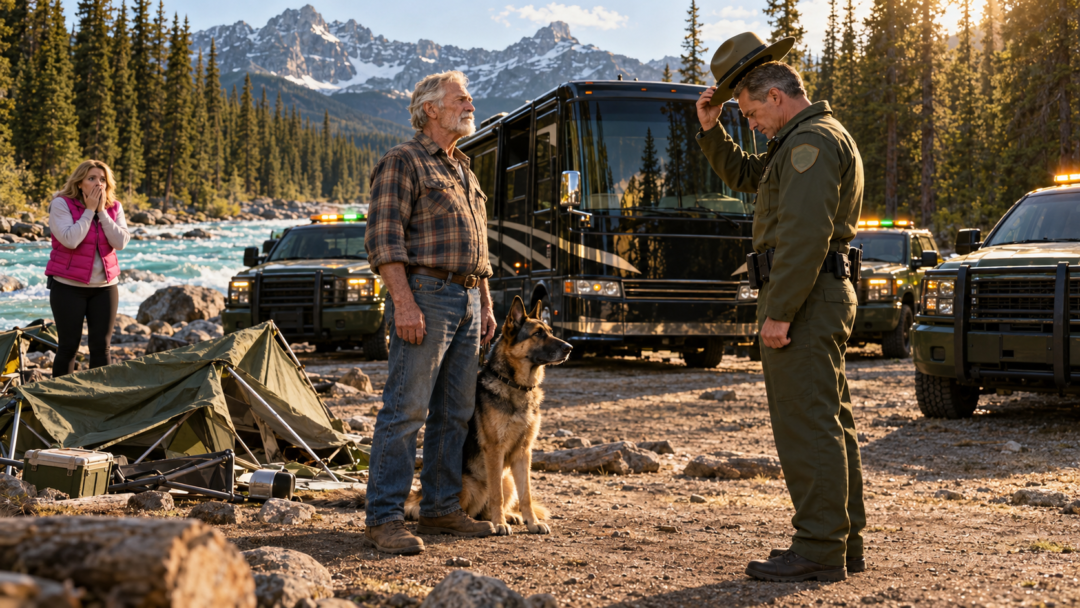
Arthur Thorne sat quietly on a low canvas camp stool at Site 14, watching a blue-winged teal dip its bill into an eddy twenty feet away. He was seventy-two years old, built like a weathered timber spar, with broad shoulders, iron-grey hair, and a face lined with the deep, quiet dignity of a man who had spent his life under open skies. He wore a faded flannel work shirt, heavy canvas trousers tucked into oiled leather logging boots, and a worn wool watch cap. At his feet lay Major, an eight-year-old rescue German Shepherd with a silver muzzle, resting his chin on Arthur’s boot with ears twitching peacefully. Beside them, staked with meticulous military symmetry, stood a vintage olive-green canvas wall tent, its guy lines taut, its smoke flap open to vent a small cast-iron camp stove.
The violent crunch of crushing underbrush and the ear-splitting roar of a commercial diesel engine shattered the wilderness quiet like a falling tree.
Crashing straight through the rustic wooden campsite boundary post—splintering the routed pine sign that read RESERVED – WILDERNESS PERMIT ONLY—a massive, forty-five-foot midnight-black Prevost luxury motorhome rumbled onto the fragile moss of the riverbank. The forty-ton vehicle lurched forward on triple axles, its pneumatic suspension groaning as its heavy radial tires tore deep, six-inch muddy ruts through the alpine turf, crushing a bed of native wild huckleberry bushes. Twin polished chrome exhaust stacks belched a cloud of foul diesel soot across the clear mountain air.
The pneumatic passenger door of the motorhome swung open with a loud acoustic hiss.
“Pack your trash and clear out of here, old man! We reserved the executive riverfront lot!”
Gretchen Sterling descended the illuminated electric steps with aggressive, manic momentum. She was forty-six years old, slender and athletic, wearing a bright bubblegum-pink quilted puffer vest, designer sunglasses perched on her bleached-blonde hair, cashmere leggings, and insulated designer snow boots. In her hand, she held a crystal tumbler of white wine, which she sloshed carelessly onto the forest floor as she pointed an accusatory finger toward Arthur’s camp. Behind her in the motorhome cab, her husband, Richard Sterling, sat behind the wheel with a cold, impatient scowl, revving the diesel engine in aggressive, rhythmic surges.
Arthur did not rise immediately. He rested a gentle, calming hand on Major’s neck, keeping the dog seated in a disciplined freeze. He looked at the splintered wooden sign lying under the RV’s front bumper, then up at Gretchen with the deep, sorrowful patience of an old park guardian.
“Ma’am,” Arthur said, his voice a low, gravelly baritone that carried clearly over the sound of the river. “This is Site 14. It is a non-motorized walk-in backcountry campsite designated under federal wilderness regulations. Motorized vehicles over twenty feet are prohibited past the river bridge. You are currently trespassing on protected national park ground.”
Gretchen let out a shrill, mocking laugh that sent a flock of Clark’s nutcrackers scattering from the high pine canopy. “Non-motorized? Do you have any idea how much money we pay in federal income taxes every year, you old bum? We pay half a million dollars to the IRS! We own this dirt! My husband didn’t buy a million-dollar luxury rig to park behind the dumpsters at the commercial RV park in West Glacier! Move your raggedy tent right now or we’ll push it into the water!”
Gretchen didn’t wait for an answer. She marched straight across the camp clearing in her designer boots. With deliberate, vindictive malice, she stomped her heel onto the front guy line of Arthur’s canvas tent. The braided cord snapped with a loud twang. She kicked the two aluminum support poles, sending the entire heavy canvas structure collapsing into the dirt and pine needles in a cloud of dust.
Major let out a low, warning rumble in his chest, but Arthur held his hand firm against the dog’s collar. “Easy, Major. Steady.”
Gretchen turned toward the stone fire pit. On the iron grate sat Arthur’s seasoned cast-iron skillet—a heavy Griswold skillet that had belonged to his grandfather—filled with freshly grilled river trout. With a cruel, mocking sneer, Gretchen drew back her boot and kicked the skillet with all her might.
The heavy iron pan tumbled off the rocks, cartwheeling twenty feet down the steep embankment before plunging into the rushing turquoise water of the Flathead River with a loud, hollow metallic splash, disappearing into an eight-foot pool.
Gretchen laughed aloud, clapping her hands with gloated triumph. “There! Now your garbage is where it belongs! Call the park rangers, hobo! I dare you! Let’s see whose side they take when my husband calls the regional director!”
Arthur Thorne stood up slowly. He brushed two dry pine needles from his faded flannel shirt, his posture rising to its full, imposing six-foot-two height. He looked down at the ruined tent, then at the river where the ripples from his grandfather’s skillet were fading into the foam. There was no anger in his eyes—only the terrifying, unshakeable calm of a mountain facing the wind.
He reached into his left flannel pocket and withdrew a small, tarnished sterling-silver whistle attached to a braided olive-drab parachute cord—an official vintage 1974 National Park Service Chief Ranger whistle.
Arthur brought the silver mouthpiece to his lips and blew a single, piercing, continuous blast.
The high-pitched acoustic frequency cut through the roar of the river, reverberating off the granite bluffs of the Livingston Range like an eagle’s shriek.
Gretchen smirked, crossing her arms over her pink vest. “What’s that supposed to do, blow for your hunting buddies? You’re pathetic—”
The deep, synchronized roar of three heavy V8 diesel engines erupted from the tree line.
Crashing up the gravel access trail at fifty miles per hour, three olive-green Ford F-250 tactical patrol trucks bearing the gold arrowheads of the United States Forest Service and the National Park Service slid to a halt across the clearing, their tires throwing arcs of gravel. Roof-mounted green-and-amber emergency light bars exploded into blinding strobe flashes, casting brilliant, pulsing patterns across the tall trunks of the lodgepole pines.
The patrol doors flew open simultaneously. Six armed federal park rangers wearing tactical plate carriers and wide-brimmed Stetson hats stepped into the clearing, their hands resting on their duty belts as they surrounded the forty-five-foot luxury RV.
Stepping out from the lead patrol truck was Chief Law Enforcement Ranger Thomas Miller, his face carved from dark Montana granite, his silver badge gleaming under the strobe lights. He walked straight past Gretchen Sterling, stopped three feet before Arthur Thorne, removed his Stetson hat, and snapped to rigid, trembling military attention, delivering a crisp, heartfelt salute that froze the autumn air.
“Director Thorne, sir!” Chief Miller’s voice boomed across the riverbank. “Chief Ranger Miller reporting with tactical unit four. We heard your signal from the bridge!”