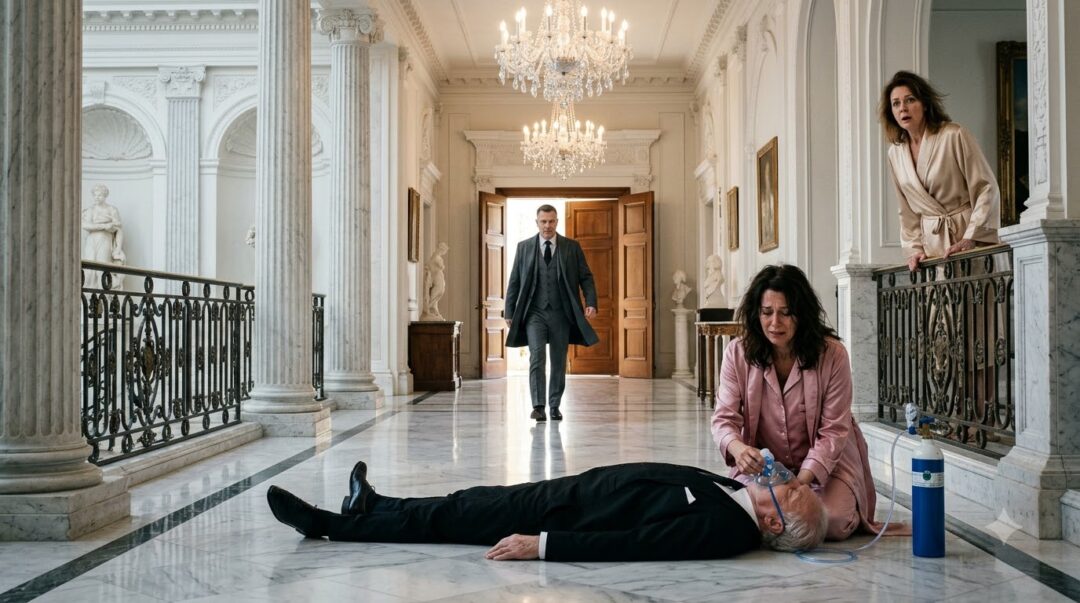
The grand foyer of the Sterling mansion on Mount Vernon Street, atop the cobblestone crest of Beacon Hill, was a monument to Federal-era architectural perfection. Thirty-foot ceilings rose above twin colonnades of fluted Carrara marble, illuminated by three monumental crystal chandeliers that refracted the pale morning sunlight into thousands of dancing silver prisms. The air was sterile, cold, and scented with antique English polish, fresh white orchids, and the faint, unmistakable tang of medical-grade oxygen.
Chapter 1: The Oxygen Mask on Carrara Marble
Outside, the ancient brick rowhouses of Mount Vernon Street slept in the crisp morning autumn air, their gas lamps casting long, gilded shadows over the wet cobblestones. The neighborhood was home to five generations of Boston’s political and financial dynasties—families whose names were chiseled into hospital wings, university libraries, and maritime docks. But behind the iron security gates and double-glazed transoms, ruthless greed was as lethal as any alley in South Boston.
Then came the heavy, sickening thud of a human body striking stone.
Dr. Arthur Sterling lay sprawled on his back across the polished white marble floor, sixty feet from the grand mahogany staircase.
He was sixty-eight years old, a legendary cardiothoracic surgeon whose hands had repaired ten thousand human hearts. But now, dressed in his tailored charcoal three-piece suit, his hands clawed desperately at his throat. His face was suffused with a terrifying, purplish-blue cyanosis, his lips gray, his breath tearing from his chest in wet, agonized rattles. The portable medical oxygen cylinder he carried had tumbled four feet away across the marble, its brass pressure gauge reading empty.
Thirty feet above, standing on the polished marble mezzanine balcony in a flowing champagne silk bathrobe, stood Beatrice Sterling.
At thirty-two, Arthur’s second wife was breathtakingly beautiful, her auburn hair falling over bare shoulders. But her face was frozen in a mask of breathless, calculated stillness. Her manicured hand hovered an inch above her lips, her knuckles white, her dark eyes watching her elderly husband suffocate on the floor with absolute, chilling detachment. She did not scream. She did not reach for the emergency intercom on the wall. She did not move a single step.
From the arched library doorway twenty yards away, a seven-year-old girl burst into the foyer.
Lily Sterling was dressed in pale pink flannel pajamas, clutching a worn white plush rabbit in her left arm. But the instant her hazel eyes took in the collapsed patriarch, the child didn’t freeze or weep. Having lived with a chronically ill pulmonology patient since her parents’ death, muscle memory and medical instinct took command.
She dropped the toy, sprinted across the slick marble floor in her bare feet, and dropped to her knees beside Arthur’s trembling chest.
“Uncle Arthur! Look at me!” Lily commanded, her small voice piercing and fierce.
She grabbed the blue silicone pediatric emergency oxygen mask attached to the primary bedside manifold tubing running from the wall alcove. With two small, steady hands, she fitted the clear plastic cone firmly over Arthur’s nose and mouth, hooking the elastic strap behind his ears. She reached back and slammed the green bypass valve open with the heel of her hand.
A high-pressure hiss of pure, cool oxygen flooded into the mask.
Arthur’s chest heaved upward in a violent, gasping spasm. The rich gas forced its way into his starved alveoli, his fingers digging into the hem of Lily’s pajamas as his eyelids fluttered open.
“Who… who are you…” Arthur gasped through the misted plastic, his consciousness wavering, his vision clouded by near-fatal hypoxia.
“It’s Lily, Uncle Arthur! Breathe! Just breathe!” the girl cried, tears finally breaking across her cheeks as she pressed the mask tight against his gray face.
On the balcony above, Beatrice gasped—a sharp, involuntary intake of breath that betrayed her utter horror that the old man was still drawing air.
Before Beatrice could retreat into the master bedroom, the towering double entrance doors of the mansion swung wide open with an authoritative, concussive crash.
Flooded in the bright, blinding backlight of the morning sun, a man strode into the grand foyer.
He stood six feet two inches tall, wearing an immaculate three-piece charcoal flannel suit, a crisp white spread-collar shirt, and a silk tie. In his left hand, he carried a heavy black leather federal dispatch case. His face was sharp, chiseled, and weathered by intense investigative focus, with cold gray eyes that took in the entire foyer in three-tenths of a second.
It was Thomas Vance—Senior Special Agent with the Federal Department of Health and Human Services Office of Inspector General, and formerly Arthur Sterling’s most brilliant surgical fellow at Harvard Medical School.
Vance did not look up at the balcony. He moved directly to Arthur’s side, kneeling beside Lily, his fingers instantly locking onto the older man’s carotid pulse.
“Strong and regular, 92 beats per minute,” Vance said calmly, his voice steadying the weeping child. “Good girl, Lily. You saved his life.”
Vance reached out with his right hand, picking up the discarded portable oxygen cylinder that had failed Arthur minutes earlier.
He inspected the brass dual-stage pressure regulator.
Under the bright glare of the crystal chandeliers, Vance’s sharp eyes caught a minute, abnormal glint along the rubber seal of the primary pressure-relief diaphragm.
There was no crack or tear from pressure fatigue.
Puncturing the center of the reinforced silicone diaphragm, leaving a microscopic circular aperture that had silently vented fifty liters of compressed medical oxygen into the bedroom closet overnight, was a clean puncture mark created by an 18-gauge hypodermic surgical needle.
Chapter 2: The Whispering Mezzanine
Thomas Vance rose smoothly from the Carrara marble floor, his gray eyes turning upward toward the second-floor mezzanine like twin laser sights.
Beatrice Sterling was still standing against the fluted balustrade, her manicured fingers clutching the champagne silk of her robe tightly across her throat. The color had drained from her face, leaving her skin looking like powdered chalk against the dark mahogany wainscoting behind her.
“Thomas,” Beatrice called down, her voice trembling with an exquisite, practiced tremor of high-society grief. “Thank God you arrived. Arthur’s pulmonary fibrosis… his breathing has been deteriorating all week. I was upstairs reaching for the emergency physician’s line when he collapsed.”
Vance didn’t answer. He pulled a pair of black nitrile surgical gloves from his coat pocket, snapping them over his fingers with a sharp, clinical slap.
He stepped over to the house communications console recessed into the marble column, tapped the emergency override switch, and sealed the estate’s electronically controlled wrought-iron exterior gates.
“The Boston Police Department and the Massachusetts General Hospital Advanced Life Support team will be here in four minutes,” Vance said, his voice quiet, flat, and carrying the terrifying weight of an unsealed federal warrant. “Until they arrive, Mrs. Sterling, nobody enters this foyer. And nobody leaves the second floor.”
Beatrice took a slow step backward into the shadow of the gallery arch. “Thomas, you are behaving like a madman. I am Arthur’s wife. I hold his legal medical proxy. You are a guest in our home.”
Vance didn’t look at her. He knelt beside Lily, gently patting the girl’s shoulder. “Lily, go into the library and sit on the green sofa. Keep the door cracked two inches so you can hear my voice. Do not come out until I call your name.”
The little girl nodded, wiping her tear-stained cheeks with the sleeve of her pajamas, giving Arthur’s hand one final squeeze before slipping into the adjacent room.
Vance turned back to the collapsed surgeon. Arthur was breathing steadily now, the pure oxygen misting the inside of the silicone mask, his dark eyes fixed on his former student with a piercing, lucid intensity.
Arthur raised a trembling hand, catching the cuff of Vance’s charcoal suit.
“Thomas…” Arthur whispered through the mask, his voice a hoarse rasp. “The study… top drawer of the roll-top desk… the blue leather binder…”
“I know, Dr. Sterling,” Vance murmured softly, leaning in close. “I’ve been monitoring the patent filings in Washington for two weeks. Rest your lungs. Let the paramedics do their work.”
Heavy footsteps echoed down the grand staircase. Beatrice was descending, having hastily buttoned her silk robe, her posture rigid, her chin tilted high with dynastic arrogance.
“If you are implying that Arthur’s attack was anything other than a tragic progression of his terminal illness, Thomas, my attorneys will have your federal credentials revoked before the market opens,” Beatrice said, her heels clicking across the marble toward the front doors.
The grandfather clock in the reception gallery ticked with rhythmic, hollow finality, each second measuring the boundary between a life-saving intervention and an unsolved corporate assassination. The scent of spilled Earl Grey tea and bruised orchids hung in the cold foyer, mingling with the synthetic tang of the plastic mask Arthur was clutching to his chest.
Vance stepped directly into her path.
At six feet two inches, his frame completely eclipsed the morning light from the doorway, forcing Beatrice to come to an abrupt halt three feet away.
“You’re not leaving the foyer, Mrs. Sterling,” Vance said.
“Get out of my way!” she hissed, her aristocratic veneer shattering into sharp shards of venom.
Vance reached out with gloved fingers, catching the deep satin pocket of her champagne dressing gown before she could pull away. He turned the pocket inside out with a single, clinical flick of his wrist.
A heavy object slipped from the silk folds, tumbling into Vance’s open palm.
It was an amber glass ampoule, sealed with a gray rubber septum, holding ten milliliters of a crystal-clear, odorless liquid.
The pharmaceutical label was printed with the distinctive red-and-black typography of an institutional hospital formulary:
PANCURONIUM BROMIDE INJECTION — 2MG/ML.
WARNING: POTENT NEUROMUSCULAR PARALYTIC AGENT. INDUCES IMMEDIATE RESPIRATORY ARREST. FOR USE ONLY BY TRAINED ANESTHESIOLOGISTS.
Beatrice gasped, taking two stumbling steps backward until the back of her legs hit the mahogany entry table.
Vance held the amber ampoule up to the light of the Baccarat chandelier, his eyes narrowing into cold gray ice.
“Pancuronium bromide,” Vance whispered, each syllable cutting like a scalpel. “It paralyzes the intercostal muscles and the diaphragm within three minutes, leaving the patient completely conscious while they suffocate in silence. And in a man with advanced pulmonary fibrosis, the medical examiner would rule the death an ordinary cardiopulmonary arrest.”
Vance looked at her, his voice dropping into a lethal, unyielding frequency.
“Where did you get this ampoule, Beatrice? Because this lot number belongs to the restricted surgical reserve at Harvard Medical School.
Chapter 3: The Sterile Chamber at Harvard
The specialized cardiac intensive care unit on the ninth floor of Massachusetts General Hospital was a silent, hermetically sealed fortress of polished vinyl floors, stainless steel, and rhythmic digital monitors. The only sound in Room 914 was the soft, mechanical hum of the advanced variable-flow ventilator and the steady, eighty-beat-per-minute chime of the arterial pulse line.
Dr. Arthur Sterling sat propped up in the high-tech hospital bed, wearing a white cotton hospital gown, a high-flow nasal cannula delivering sixty percent warmed oxygen to his lungs. The cyanotic purple hue had completely faded from his face, replaced by the pale, weathered dignity of an elder statesman of American medicine.
Beside the bed stood Thomas Vance, holding a sealed thermal folder containing forensic laboratory extractions.
Sitting in an oversized vinyl recliner in the corner of the room, wrapped in a fleece hospital blanket, was Lily. She was holding a cup of apple juice, her hazel eyes watching the vital signs monitor with the calm, analytical understanding of a surgeon’s apprentice.
Through the high, reinforced glass windows of the ICU, the silver ribbon of the Charles River was visible below, winding between the brick spires of Cambridge and the soaring towers of downtown Boston. Heavy rowboats from the Harvard crew team cut through the morning mist, gliding across the water in silent rhythm, completely separated from the high-stakes battle for survival being fought nine floors above the pavement.
A chime sounded at the pneumatic glass door. Special Agent Marcus Holloway of the HHS-OIG Boston Field Office entered the room, holding a secure encrypted tablet.
“The toxicological workup from the Massachusetts State Police crime lab just cleared,” Holloway said, his voice low and solemn as he stepped to the foot of the bed. “Gas chromatography and mass spectrometry confirmed five hundred micrograms of pancuronium bromide in Dr. Sterling’s venous blood sample taken forty-five minutes after the collapse. It was administered orally—most likely dissolved in a hot liquid that masked the bitter quaternary ammonium salt taste.”
Arthur closed his eyes slowly, letting out a long, ragged exhale. “The chamomile tea,” he whispered, his voice hoarse from the trauma. “Beatrice brought it to my study at 06:15. She watched me drink the entire cup while smiling about our summer trip to Martha’s Vineyard.”
“She didn’t act alone, Dr. Sterling,” Vance said, opening the thermal folder on the bedside table. “Pancuronium is a Schedule II hospital paralytic requiring biometric two-factor authentication to withdraw from automated dispensing cabinets. Beatrice couldn’t have walked into Harvard surgical stores and taken that ampoule off the shelf.”
Vance swiped a finger across Holloway’s tablet, displaying an institutional access log from Harvard Medical School’s surgical research wing.
“Last night at 23:42,” Vance continued, “the restricted narcotics locker in Surgical Research Lab 4 was accessed using the administrative badge of Dr. Victor Sterling—Arthur’s cousin and the Vice Chairman of the Harvard Department of Surgery.”
Arthur’s eyes snapped open, a flash of profound sorrow and righteous anger igniting behind his gray pupils. “Victor? My own cousin?”
“Victor has eight million dollars in offshore trading debts with an investment syndicate in Zurich,” Vance explained. “And he is the co-signatory on the secondary patent filings for your cellular cardiac repair therapy.”
Vance leaned closer to the bed, his voice hardening into steel.
“Dr. Sterling, when your brother David died fifteen years ago, the official inquest called it an accidental nitrogen asphyxiation in the Harvard cryogenic facility. But I pulled the archived digital logs from the university archives twenty minutes ago. The original server backup for October 12, 2011, has been deliberately overwritten.”
“David found the fraudulent clinical trials,” Arthur whispered, a tear escaping his eyelid, rolling down the deep lines of his cheek. “David came to my house the night before he died. He told me that Victor and Beatrice—who was working as a regional clinical trial manager for Novartis at the time—were falsifying Phase II trial data to rush the synthetic cellular therapy to market. I didn’t believe him. I told David he was paranoid. Forty-eight hours later, my brother was dead in the freezer room.”
Arthur turned his head toward Lily, reaching out to take the little girl’s small hand.
“When David died, I swore on his grave I would protect his daughter,” Arthur said, his voice shaking with raw, profound emotion. “Three weeks ago, I amended the corporate trust for Sterling Biomedical. I stripped Beatrice and Victor of all executive authority. I placed ninety-eight percent of the patent equity into an irrevocable sovereign trust in Lily’s name.”
“And that was your death warrant,” Vance said. “Beatrice discovered the amended trust. She knew that if you died before the amendments were formally filed with the Massachusetts probate court on Monday morning, the 2022 marital agreement would award her fifty percent of the patent portfolio.”
Suddenly, the red emergency alarm on Room 914’s central monitor flashed bright crimson.
The oxygen flow rate from the wall conduit dropped from forty liters per minute to zero with a loud, sucking gasp.
Across the room, the primary ventilator display flared:
CRITICAL WARNING: CENTRAL HOSPITAL OXYGEN SUPPLY LINE DISRUPTED ON FLOOR NINE. SWITCHING TO EMERGENCY BATTERY AND BACKUP COMPRESSED AIR.
In the hallway outside, screams of panic erupted as nursing staff scrambled toward the telemetry station.
Chapter 4: The Archive Beneath the Basin
The central oxygen manifold failure on Floor 9 was not a mechanical malfunction; it was an act of deliberate sabotage designed to finish what Beatrice’s paralytic ampoule had started.
Thomas Vance reacted with the speed of an operator under fire. He reached beneath Arthur’s hospital bed, pulled the independent twelve-liter steel emergency oxygen cylinder from its transport cradle, and connected the regulator line directly to Arthur’s nasal cannula. In four seconds, pure oxygen was flowing again, stabilizing the older man’s oxygen saturation at ninety-six percent.
“Agent Holloway, lock this door from the inside,” Vance commanded, pulling his customized Sig Sauer from beneath his charcoal jacket. “Draw your sidearm. Nobody enters this room without my voice confirmation. If anyone touches that door handle, put a round through the glass.”
Holloway drew his Glock 19, positioning himself behind the steel medical cart, his eyes fixed on the corridor door. “Where are you going, Thomas?”
“To the archives,” Vance said, checking the magazine of his pistol. “Victor Sterling didn’t just sabotage the oxygen line. He’s going after David’s original research binders before federal marshals can execute the search warrant.”
Ten minutes later, Vance’s black sedan pulled up along the granite seawall of the Charles River Esplanade, directly beneath the massive stone arches of the Longfellow Bridge.
Ahead loomed the monolithic brick facade of the Harvard Medical Historical Archive—an 1890s Romanesque Revival building constructed directly against the riverbank, its subterranean storage vaults extending two levels below the water line of the Charles River Basin. The building was closed for the weekend, its heavy wrought-iron security gates padlocked, its arched windows dark against the gray Boston sky.
Vance used a heavy titanium bypass tool to pop the lock on the river-level service entrance, slipping into the subterranean dark.
The air inside the lower archives was bone-chilling, smelling heavily of damp red brick, acidic paper binding glue, and river water. Hundreds of floor-to-ceiling rolling steel shelving units stretched into the gloom beneath low vaulted brick arches, holding two centuries of hand-written clinical journals, anatomical wax models, and glass photographic plates.
Vance clicked on his tactical penlight, setting the beam to low infrared, navigating down Aisle 14 toward the restricted special collections vault.
Fifty yards ahead, in the deep shadow of the rare manuscript annex, the beam of a high-intensity flashlight flickered across the shelves.
Vance pressed his back against a brick support pillar, stepping forward in complete silence, his boots making zero sound on the damp concrete.
Standing before the open steel cabinet of the 2011 Surgical Research Collection was Dr. Victor Sterling.
The fifty-eight-year-old surgical executive had discarded his white laboratory coat, wearing a dark cashmere turtleneck and black leather gloves. In his right hand, he held an industrial gasoline-powered micro-torch; in his left hand, he clutched three thick, leather-bound laboratory notebooks stamped with the name Dr. David Sterling — Cellular Regeneration Project.
“You’re fifteen years too late to burn those books, Victor,” Vance’s voice cut through the dark, cold and immovable as granite.
Victor spun around, his flashlight beam catching the matte-black frame of Vance’s Sig Sauer leveled at his eye.
The surgeon’s face contorted into a sneer of arrogant, cornered desperation. “Vance! The brilliant surgical fellow who traded his scalpel for a badge. You have no idea what you’re interfering with! This research represents eleven billion dollars in international pharmaceutical licensing! Do you think a hospital ethics committee is going to stop the future of global medicine?”
“David Sterling wasn’t an ethics committee, Victor,” Vance said, taking two slow, deliberate steps forward down the narrow aisle. “He was your cousin. And you locked him in a cryo-chamber with twenty liters of boiling liquid nitrogen.”
“David was a self-righteous fool who wanted to give the patent away to a public university trust!” Victor screamed, his hand trembling as he brought the flaming micro-torch within inches of the leather notebooks. “If I burn these originals, there is no proof that the cellular formula was stolen! The patents belong to me and Beatrice!”
From the shadows of the adjacent aisle, the sharp, suppressed spit of a 9mm round tore through the silence.
The high-velocity bullet shattered the brick column inches from Vance’s shoulder, showering his jacket in terracotta dust.
Two private security contractors in black tactical gear emerged from behind the rolling shelves, their submachine guns raised.
Vance didn’t retreat. He pivoted on his heel, dropped to one knee, and double-tapped the lead shooter through the center of his chest armor. The concussive impact threw the contractor backward into a shelving rack, sending a hundred years of leather-bound medical journals crashing down in a suffocating avalanche of dust.
The second contractor fired a spray of suppressed rounds that chewed into the concrete floor. Vance lunged forward, closing the distance in a fraction of a second, driving his steel-toed boot into the man’s knee joint before delivering a crushing palm-heel strike to his throat.
The contractor dropped like an axed tree.
Victor Sterling turned in blind panic, dropping the notebooks and running toward the river-level escape hatch that opened directly onto the floating docks of the Charles River Basin.
Vance broke into a sprint, clearing the aisle in three massive strides. He caught Victor by the collar of his cashmere turtleneck just as the surgeon’s boots hit the wooden pier, slamming him face-down onto the wet cedar planks.
Vance wrenched Victor’s arms behind his back, ratcheting heavy steel handcuffs onto his wrists with a brutal, metallic click.
“The notebooks stay, Victor,” Vance whispered into the bleeding man’s ear. “And you are going to tell me where Beatrice put the detonator.
Chapter 5: The Balcony Confrontation
By 16:00, a freezing maritime fog had crept in from Boston Harbor, shrouding the gas streetlamps of Beacon Hill in a swirling amber halo.
The grand neoclassical foyer of the Sterling mansion was dead silent, the Carrara marble floor still marked by the scuffs of the morning’s violent struggle.
On the second-floor mezzanine, Beatrice Sterling stood before the floor-to-ceiling windows of Arthur’s private library, holding an antique gold Dunhill lighter, methodically burning financial transfer slips over a bronze wastebasket. Her diamond rings glittered in the flames, but her breathing was ragged, her eyes wild with mounting paranoia. On the mahogany desk behind her rested two packed leather suitcases and an open passport case holding tickets for a midnight flight to Geneva.
The smell of burning bond paper and synthetic leather filled the upper gallery, a sharp, suffocating stench of destroyed evidence. Outside the French doors leading to the private balcony, the gray Atlantic fog rolled over the slate rooftops of Beacon Hill, blotting out the golden dome of the Massachusetts State House in a damp, chilly whiteout. Every phone line in the estate was dead, severed by federal telecommunications intercept protocols.
The heavy library doors clicked open.
Thomas Vance stepped into the room.
His charcoal suit was torn at the elbow, powdered with brick dust from the archive shootout, but his posture was that of an unyielding executioner. In his left hand, he held the three scorched leather research journals belonging to David Sterling; in his right hand, he held an unsealed federal wiretap transcript.
Beatrice dropped the lighter into the bronze basket, spinning around, her silk robe billowing around her bare ankles.
“How did you get in here?” she demanded, her voice cracking. “The private security guards at the gate—”
“Your private security guards are currently lying face-down on the cobblestones of Mount Vernon Street with federal marshals standing on their necks,” Vance replied, his voice chillingly calm.
He tossed the wiretap transcript onto the mahogany desk. It landed with a heavy slap.
“Victor gave you up, Beatrice,” Vance continued, stepping smoothly into the center of the library. “He lasted four minutes in the back of a federal transport van before he signed a full confession naming you as the primary architect of David Sterling’s murder in 2011.”
Beatrice’s jaw tightened, a venomous, mocking smile curling her lips. “Victor is a spineless coward who broke under the weight of his own gambling debts. His confession is hearsay. No jury in the Commonwealth of Massachusetts will convict a grieving widow on the word of a degenerate embezzler.”
“You aren’t a grieving widow, Beatrice,” Vance said, leaning forward, resting his hands upon the leather journals. “Because Arthur is alive.”
The smile vanished from her lips as if struck by a physical blow. Her face went pale as milk. “What… what did you say?”
“Arthur survived the hypoxia,” Vance said, each word driving into her like a steel spike. “The paralytic has cleared his system. Right now, he is in the federal witness protection suite at Massachusetts General Hospital, surrounded by eight armed United States Marshals. And twenty minutes ago, he personally signed the formal affidavit charging you with attempted first-degree murder.”
Beatrice backed slowly toward the edge of the mezzanine balustrade, her hands trembling violently. “No… that’s impossible… he was blue… he was brain-dead…”
“Lily saved him,” Vance said softly. “The little girl whose father you murdered fifteen years ago walked into that foyer, put the mask on his face, and broke your nine-billion-dollar empire into dust.”
Beatrice let out a sharp, hysterical laugh that sounded like tearing silk.
She reached into the sleeve of her silk robe, her hand emerging with a sleek, rectangular carbon-fiber radio transmitter fitted with a digital countdown display and a single red rocker switch.
“You think you’ve won, Thomas?” Beatrice shrieked, her eyes burning with pure, psychotic madness. “You think you’re going to parade me through a federal courtroom like a common criminal?”
She held the transmitter high, her thumb resting on the red toggle.
“Before I left Massachusetts General Hospital this morning,” Beatrice whispered, a ghastly smile spreading across her lips, “Victor’s biomedical technician placed a pressurized pneumatic demolition canister inside the central oxygen distribution manifold on Floor Nine. If I flip this toggle, twenty pounds of thermite will ignite inside the hospital’s main oxygen line. The entire ninth floor will erupt into an inferno in three seconds. Arthur, your federal marshals, and fifty intensive care patients will burn alive.”
Vance’s eyes narrowed, his body coiling like a steel spring. “Drop the transmitter, Beatrice.”
“Step away from the door and give me the journals!” she screamed, her finger tightening on the toggle. “Give me the books and let me walk out of this house, or I incinerate that hospital right now!
Chapter 6: Code Blue on Floor Nine
The ticking of the timer seemed to expand, filling the room with the mechanical certainty of impending slaughter. The air grew thick with ozone and panic. Below in the city, sirens were beginning to wail as the Boston Fire Department’s hazardous materials division scrambled toward Cambridge Street, but Vance knew that emergency response times on the congested hill would never beat the three-minute countdown.
The silence in the library lasted for half a heartbeat.
Vance did not reach for his sidearm. A gunshot would cause a sympathetic neuromuscular reflex, depressing the radio toggle before the signal could be interrupted.
He used what was on the desk.
Vance seized the heavy bronze wastebasket—filled with smoldering papers and hot ash—and hurled it with terrifying kinetic force directly into Beatrice’s face.
The heavy bronze cylinder struck her collarbone, scattering burning embers and ash into her eyes. Beatrice screamed in blinding pain, stumbling backward against the marble balustrade. The carbon-fiber transmitter slipped from her scorched fingers, tumbling over the railing toward the Carrara marble floor thirty feet below.
Vance vaulted the mahogany desk, lunged across the mezzanine, and caught the descending transmitter in mid-air with his left hand, his boots slamming down onto the first landing of the grand staircase.
He landed in a low tactical roll, came to his feet, and inspected the digital display.
The screen was flashing red:
DETONATION SEQUENCE ARMED. TIME TO THERMITE IGNITION: 03:00.
The fall had engaged an internal mercury tilt-switch. The timer was counting down: 02:59… 02:58…
Vance pulled his cellular phone from his coat, hitting the direct emergency line to Special Agent Marcus Holloway at the hospital.
“Holloway!” Vance barked as he sprinted out through the shattered front doors into the fog. “There is a thermite explosive clamped to the central oxygen manifold in the utility chase behind Room 914! You have two minutes to evacuate Arthur and isolate the main shutoff valve!”
Vance leaped into the driver’s seat of his black sedan, slammed the transmission into gear, and stomped the accelerator to the floor.
The heavy sedan roared down Mount Vernon Street, its tires shrieking against the wet cobblestones, throwing sparks as the chassis bottomed out across the historic brick gutters. Vance switched on the hidden federal siren and red-and-blue grille strobes, tearing through the evening traffic on Charles Street like a thunderbolt.
Across the Longfellow Bridge, the clock on his dashboard showed 01:15.
At Massachusetts General Hospital, the sirens were already screaming through the cold night air. The ninth floor was engulfed in a frantic Code Blue evacuation as federal marshals and medical staff wheeled intensive care patients down the emergency fire ramps.
Inside Room 914, Holloway had disconnected Arthur’s bed monitors, rolling the surgeon’s gurney toward the heavy steel fire doors, with Lily running alongside holding her uncle’s hand.
At the end of the corridor, stepping out from the utility access hatch with a mechanical wrench in his hand, stood Dr. Victor Sterling’s chief surgical fellow—the inside technician who had planted the charge.
The technician drew a suppressed automatic from beneath his lab coat, aiming directly at Arthur’s gurney.
“Leave the bed!” the technician screamed. “Nobody leaves this floor!”
Holloway reached for his sidearm, but the technician was already tightening his trigger finger.
The heavy double fire doors at the stairwell entrance exploded open.
Thomas Vance charged through the opening like an enraged freight train. He didn’t slow down to draw his weapon; he lowered his right shoulder and drove his entire two-hundred-pound frame directly into the technician’s chest.
The impact sounded like a sledgehammer hitting concrete. The technician was lifted off his feet, his body crashing violently into the steel medicine dispensing cabinet, shattering the glass doors in a cascade of flying ampoules. The pistol clattered across the linoleum floor.
Vance didn’t pause. He kicked the technician’s head against the steel wall, rendering him instantly unconscious, then lunged into the open utility chase behind the wall.
The timer on the carbon-fiber charge clamped to the primary copper oxygen line read: 00:14… 00:13…
Vance wedged his tactical knife blade between the high-pressure thermite canister and the copper pipe. With a vicious, adrenaline-fueled heave, he sheared the mounting bracket, ripped the explosive charge from the manifold, threw it into a heavy steel biohazard disposal container, and slammed the four-inch-thick lead lid shut.
Three seconds later, a muffled crump sounded from inside the container. The heavy lead box jumped six inches off the floor, glowing dull red around the seams as the thermite burned itself out in the oxygen-deprived container, venting harmless gray smoke into the concrete chase.
The central oxygen lines remained intact.
Vance stepped out of the utility room, wiping sweat and soot from his forehead, breathing heavily.
In the hallway, Arthur Sterling looked up from his gurney, his eyes filled with profound gratitude and awe.
Beside him, little Lily looked at Vance, a radiant, tearful smile spreading across her face.
“You stopped it,” she whispered.
Vance dropped to one knee on the linoleum floor, gently taking her small hand in his. “We both did, Lily. We both did.
Chapter 7: Dawn Over the Common
Six months later, the golden light of an early May morning bathed the ancient elm trees and emerald lawns of the Boston Public Garden in glorious, warm sunlight.
The sweet fragrance of blooming tulips and fresh ocean air drifted across the lagoon, where the famous swan boats glided peacefully across the tranquil water, their paddles churning gentle silver ripples in the morning calm. Families walked along the paved paths, children laughed as they fed bread crumbs to the ducks, and the bustling city of Boston hummed quietly in the distance.
The city had shed its winter coat, bursting into life with the arrival of the maritime spring. Tourists from across the world strolled beneath the lush canopy of weeping willows, admiring the Victorian flower beds and taking photographs against the backdrop of historic brownstones. For sixty years, Arthur Sterling had walked these very gravel avenues as a student, as an intern, and as a celebrated chief of surgery. But never had the air tasted as sweet or the light felt as clean as it did on this bright May morning.
Walking slowly along the gravel path near the equestrian statue of George Washington were Dr. Arthur Sterling and seven-year-old Lily.
Arthur walked with the aid of a hand-carved cherry cane, but his step was firm, his posture upright, his breathing steady and clean. The high-flow nasal cannula was gone; his lungs, treated with his own revolutionary cellular cardiac and pulmonary repair therapy, had recovered forty percent of their functional capacity. He wore an elegant tweed sport coat over a cream knit sweater, smiling warmly as Lily skipped along the grass beside him.
Lily wore a bright yellow cotton sundress and white canvas sneakers, her chestnut curls dancing in the gentle harbor breeze, holding a small sketchpad under her arm.
Approaching from the direction of Beacon Street was Thomas Vance.
He wore a tailored navy blazer and open-collared shirt, carrying a rolled-up edition of the Boston Globe under his arm.
“Thomas!” Lily cried, running down the path and throwing her small arms around his waist in a joyful hug.
Vance smiled, lifting her up with effortless affection before setting her back onto the grass. “Good morning, Dr. Sterling. Good morning, Lily.”
“Good morning, my boy,” Arthur said, reaching out to shake Vance’s hand with an iron grip. “You’re late. Lily has been waiting to show you her new watercolor of the lagoon.”
Lily proudly held up her sketchpad, displaying a vibrant painting of the swan boats beneath the blooming cherry trees.
“That belongs in a museum, Lily,” Vance said with genuine admiration, tapping the canvas.
Arthur leaned on his cane, looking at Vance with quiet, solemn intensity. “I assume you have news from the federal courthouse?”
Vance unrolled the morning newspaper, handing it to Arthur.
The front-page headline screamed in bold, black type:
BEATRICE STERLING AND DR. VICTOR STERLING CONVICTED ON ALL COUNTS
Federal Jury Hands Down Life Sentences for 2011 Murder and Attempted Hospital Mass Casualty Attack.
Arthur looked at the photographs of his disgraced former wife and cousin being led away in federal transport restraints, their heads bowed in total defeat. He felt no lingering hatred, no thirst for further vengeance. The poison that had threatened to destroy his family had been drawn out, and the truth had been vindicated before the world.
He folded the paper and handed it back to Vance. “May God have mercy on their souls. The law certainly did not.”
Arthur turned his gaze toward the historic brownstones of Beacon Hill visible above the treetops.
“Yesterday afternoon,” Arthur continued softly, “the Harvard Board of Overseers formally ratified the establishment of the Dr. David Sterling Center for Pediatric Regenerative Medicine. All patents, all clinical royalties, and ninety million dollars in sovereign endowment capital have been transferred to the institute under Lily’s permanent guardianship.”
Arthur looked down at the little girl, his eyes shining with unshakeable pride. “Her father’s dream is alive, Thomas. It will heal thousands of children long after I am gone.”
Lily looked up at both men, her hazel eyes bright with hope and boundless innocence. “Can we ride the swan boats now, Uncle Arthur? The big white one is waiting at the dock!”
Arthur laughed—a rich, deep, joyful sound that echoed through the sunlit gardens.
“We certainly can, my dear,” Arthur said, extending his hand to hers. “Lead the way, Captain Lily.”
Together, the legendary surgeon, the young orphan girl, and the federal investigator walked down the sun-drenched path toward the water.
The shadows of Beacon Hill had lifted forever. The cold marble had given way to blooming life. And here, beneath the endless blue sky of Boston, a family had finally found their way home.