The Man Everyone Laughed At
The Man Everyone Laughed At
Part I — The Wrong Customer
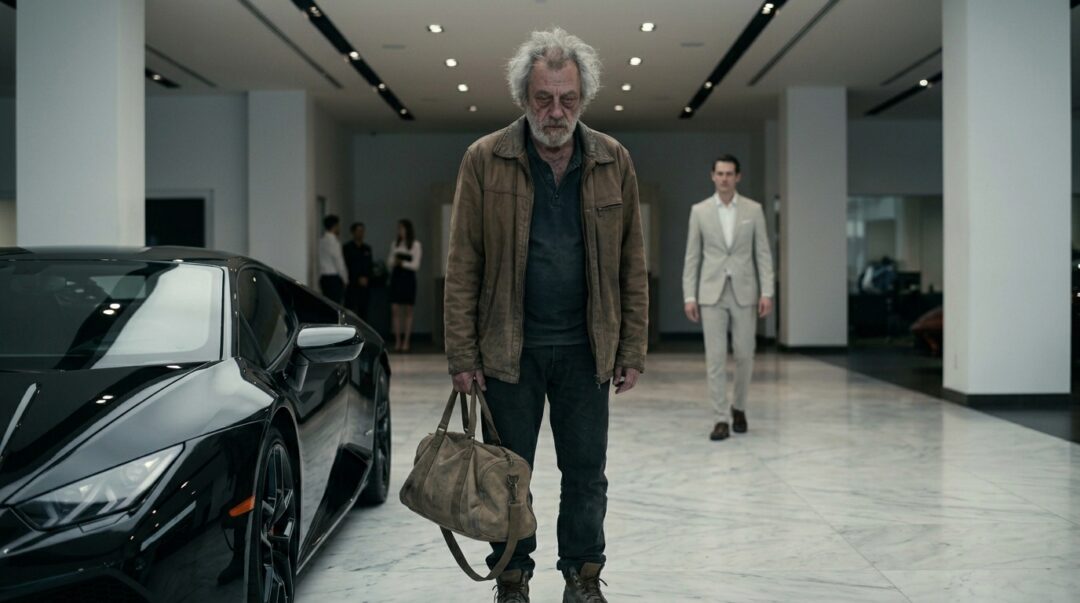
By the time anyone noticed him, he was already standing beside the black Lamborghini.
Not touching it. Not leaning too close. Just standing there with a battered canvas duffel hanging from one hand, his old jacket hanging loose from his shoulders, and the kind of tired stillness that made him look as if he had wandered in by mistake and forgotten how to leave.
The showroom was all glass, polish, and reflected light. Marble floors gleamed beneath the cars. Chrome flashed under white ceiling panels. Every surface seemed designed to remind people how much money belonged there.
The old man did not.
His boots were dirty, his beard uneven, his gray hair wild from wind or neglect. He looked like someone who had slept in bus stations, under awnings, or wherever the weather had been kind enough not to kill him. He looked worn thin by years. Invisible in the way poor people often became to those who moved through expensive places too easily.
But he was looking at the Lamborghini with a quiet concentration that did not match the rest of him.
That was what first drew the salesman’s attention.
“Sir,” the young salesman called, already smiling before he got close enough to be polite. “You can’t just stand there all day pretending.”
The man turned his head slowly.
The salesman was handsome in the practiced, showroom way. Dark hair cut just right. Pale tailored suit. Perfect shoes. The kind of smile that always seemed half a second away from contempt.
Up close, the difference between them was almost absurd. One looked assembled by hunger and weather. The other looked polished by commission checks and good lighting.
The old man said nothing.
The salesman gave a soft laugh and glanced toward the sales desk as if inviting someone else to enjoy the joke.
“This isn’t a museum,” he said. “And it definitely isn’t a shelter.”
A couple of heads turned.
At the far desk, a blonde sales coordinator looked up from her screen. Another employee near the office partition paused with a folder in his hand. Nobody intervened. Nobody looked comfortable, either. But discomfort was not the same as courage.
The old man shifted the duffel higher in his hand.
His voice, when it came, was calm and rough with age.
“How much is that one?”
The salesman actually laughed this time.
Not a polite chuckle. Not the kind of laugh used to smooth over awkwardness. It was open, amused, and a little theatrical, the sort of laughter meant to make everyone in the room understand who mattered and who did not.
“That one?” he repeated. “More than your whole life, probably.”
The line landed the way he wanted. Sharp. Public. Humiliating.
But the old man did not flinch.
He looked once at the Lamborghini, once at the salesman, then walked past him toward the main desk as if the conversation had already ended.
That was the first crack in the scene.
Not because what he did was dramatic, but because it was not. He did not protest. He did not beg. He did not get angry. He moved with the slow certainty of someone who had no need to perform.
The salesman followed him, still smiling, though the expression had changed slightly. It had become tighter, more defensive. Mockery always worked best when the other person reacted.
The old man set the duffel down on the spotless desk.
The blonde woman behind it straightened in her chair. “Sir?”
“Count it,” the old man said.
For a second, nobody understood.
Then he reached into the bag.
Part II — What Was in the Bag
The first bundle of cash hit the polished desk with a thick, flat sound that seemed louder than it should have been.
The blonde woman froze.
The salesman stopped breathing long enough for the smile to fall from his face.
The old man pulled out another bundle. Then another. Thick stacks wrapped tight, worn at the edges but unmistakable. Real money. More of it than anyone in the room could explain away as a stunt.
For the first time since he had opened his mouth, the salesman said nothing.
The old man kept going.
He did not fling the money out in anger. He did not dramatize the reveal. That was what made it worse. Every movement was measured. Controlled. He placed the bundles down with the calm, deliberate rhythm of someone settling a bill.
The sales coordinator looked from the cash to the old man, then to the salesman.
“Sir,” she said faintly, “is this… all cash?”
“Every dollar,” the old man replied.
Two employees had drifted closer now, pretending they had business nearby. A customer near the front doors slowed to a stop. The entire emotional direction of the room had changed so completely, so fast, that nobody seemed sure how to stand inside it.
The salesman stepped nearer to the desk. He looked like he wanted to speak but had not yet found a version of the moment that could save him.
“There has to be some misunderstanding,” he said at last, though he no longer sounded amused. He sounded thin. “Sir, I didn’t know—”
The old man set down another bundle.
The salesman’s gaze dropped to the money as if it might disappear if he looked hard enough.
Everything about him had altered. The careless posture was gone. So were the open gestures, the easy smirk, the lazy confidence of a man who believed the room belonged to him. He stood stiff and uncertain now, his hands useless at his sides, his face beginning to register the true size of what he had done.
Because this was no longer only about money.
If the old man had been wealthy all along, then the salesman had not just misjudged a customer. He had exposed something mean and ugly in himself in front of everyone.
That was the real reversal.
The old man zipped the duffel halfway closed and rested one weathered hand on top of it. He looked not triumphant, not angry, but tired in a way that made the room feel suddenly smaller.
“I asked for the price,” he said. “You laughed.”
No one moved.
No one defended the salesman.
The blonde woman swallowed and began pulling paperwork toward her with trembling fingers. The older man was, unmistakably, a buyer. The sale was real. The car was no longer a fantasy or a joke or an impossible object being admired by the wrong man. It had become his decision.
The salesman took a step closer.
His face had gone pale.
“Sir,” he said, and this time the word sounded entirely different. “I’m sorry.”
The old man looked at him without expression.
The salesman’s voice dropped lower. “I made a mistake.”
That, too, was not enough. Everyone in the room knew it.
The cruelty had been public. So had the laughter. A private apology would not fit the shape of the damage.
And perhaps the salesman knew that, because a second later he did something that made the entire room go still.
He bent.
Then he dropped to his knees beside the desk.
The blonde woman’s hands stopped over the paperwork.
The old man did not move.
The salesman looked up from below now, all his shine stripped away, his carefully built composure collapsed into naked desperation.
“Please forgive me,” he said.
The old man’s face did not soften.
For several seconds, the only sound in the showroom was the quiet hum of climate control and the faint traffic noise coming through the glass front.
Then the old man lifted the duffel again, turned to the sales coordinator, and said, “Finish it.”
He did not look at the kneeling man again.
That was the cruelest part, and also the cleanest. He did not need revenge. He did not need a speech. He did not need to humiliate anyone back.
The truth had already done the work.
Part III — The Price of a Smile
The paperwork took less than an hour.
The salesman disappeared for part of it and returned looking worse. His tie had loosened. His face had lost all color. Once or twice he tried to step in, to make himself useful, to salvage some fraction of professional dignity. Each time, the old man ignored him.
The sales coordinator handled the purchase with a strained focus, careful and efficient, her earlier shock replaced by the rigid calm of someone trying not to make a second mistake.
The old man gave only the answers required.
Name. Signature. Confirmation.
Nothing in his voice suggested satisfaction, but nothing in it suggested mercy, either.
The staff around the showroom kept stealing glances. The older man, who had first seemed like an inconvenience to remove, had become the gravitational center of the space. Not because he raised his voice. Not because he demanded attention. Because everyone had been forced to recalculate him all at once, and they were still catching up.
At one point, while the final documents were being prepared, the old man looked back through the glass toward the Lamborghini.
His expression changed—not much, but enough.
The hard restraint in his face loosened for a second into something quieter. Older. More private. Not joy exactly. Something close to relief, maybe, or completion. As if the car meant more to him than anyone in the room had considered.
The salesman noticed it too.
He stood a few feet away, unable to stop hovering, unable to disappear, trapped inside the consequences of his own behavior.
“I really am sorry,” he said again, softer now.
The old man did not answer for a long time.
When he did, he kept his eyes on the car.
“Men like you always are,” he said. “After.”
The words were not loud, but they cut more deeply than any public anger could have.
The salesman looked as if he had been struck.
There was no reply to that. No script. No polished recovery. No line good enough to conceal the fact that he had looked at another human being and mistaken worn clothes for worthlessness.
The last signatures were completed in silence.
Then the coordinator rose, held out the key fob with both hands, and said, “Congratulations, sir.”
The old man took it carefully.
It was a small motion. But in that moment it seemed to rearrange the entire room.
The salesman lowered his head.
The old man picked up the duffel, now lighter, and walked toward the exit.
This time nobody tried to stop him.
The glass doors opened, and bright afternoon light spilled across the floor in front of him. Outside, the black Lamborghini waited at the curb line, newly prepared, immaculate, impossible-looking against the faded fabric of his jacket and the dust on his boots.
He paused only once before getting in.
Not to admire the car. Not to savor the victory.
To look back.
Everyone was there behind the glass now. The blonde coordinator. The silent employees. The salesman, standing a little apart from the others, as if shame had created a border around him.
For a second, the old man’s eyes rested on him.
Not cruelly. Not kindly.
Just long enough to make sure he remembered.
Then he opened the driver’s door and slid into the seat.
Part IV — The Way He Left
The engine started with a low, expensive growl that rolled across the dealership front like a final answer.
Several people outside instinctively turned toward the sound even though they already knew what it meant.
The old man sat behind the wheel with an ease that transformed him more than the money had. Not because he suddenly looked rich. He did not. His jacket was still old. His hands were still rough. His beard was still untamed. But the car fit him in a way that forced everyone watching to confront how little they had understood.
He had never been begging for permission.
He had come to claim something.
The salesman stepped out through the front doors at last, perhaps driven by guilt, perhaps by panic, perhaps by the hopeless human urge to repair a thing after it has broken publicly.
“Sir!”
The old man glanced toward him.
The salesman stopped short of the car, careful now, all his former certainty burned away. Out in the sunlight, stripped of the protective glamour of the showroom, he looked much younger. Smaller.
“I’m sorry,” he said one last time. “Please.”
The old man studied him through the open window.
There was no drama in his face. No hunger for revenge. No theatrical wisdom. Only an exhaustion so deep it seemed older than the salesman himself.
“You laughed because you thought nobody would care,” he said.
The salesman’s mouth parted, but no words came.
The old man looked ahead again, toward the road.
“That’s the kind of poor that matters.”
Then he eased the Lamborghini forward.
The salesman stood frozen as the car rolled past him.
Behind him, the dealership staff remained near the entrance, silent and still, the whole shining building suddenly reduced to a backdrop for the one thing it had failed to understand.
The old man did not accelerate hard. He did not peel away like someone trying to prove a point. He drove off smoothly, almost gently, the black car gliding into traffic as if it had always belonged under his hands.
Inside the cabin, with the city passing in reflections of glass and steel, he let out a breath he seemed to have been holding for years.
The faintest smile touched his mouth.
Not because he had humiliated anyone.
Not because he had won.
Because for one brief and private moment, beyond the showroom, beyond the laughter, beyond the kneeling apology and the stunned faces behind the glass, he had carried his dignity all the way through the insult without letting anyone take it from him.
That was the real possession.
Not the money. Not the car. Not the look on the salesman’s face.
Just that.
The road opened ahead.
And the man everyone had laughed at drove into it alone, leaving behind a room full of people who would never again be quite as certain about what poverty looked like.