The Plate She Was Asked to Keep Washing Until Sunday Changed Everything
Part I — The Table by the Window
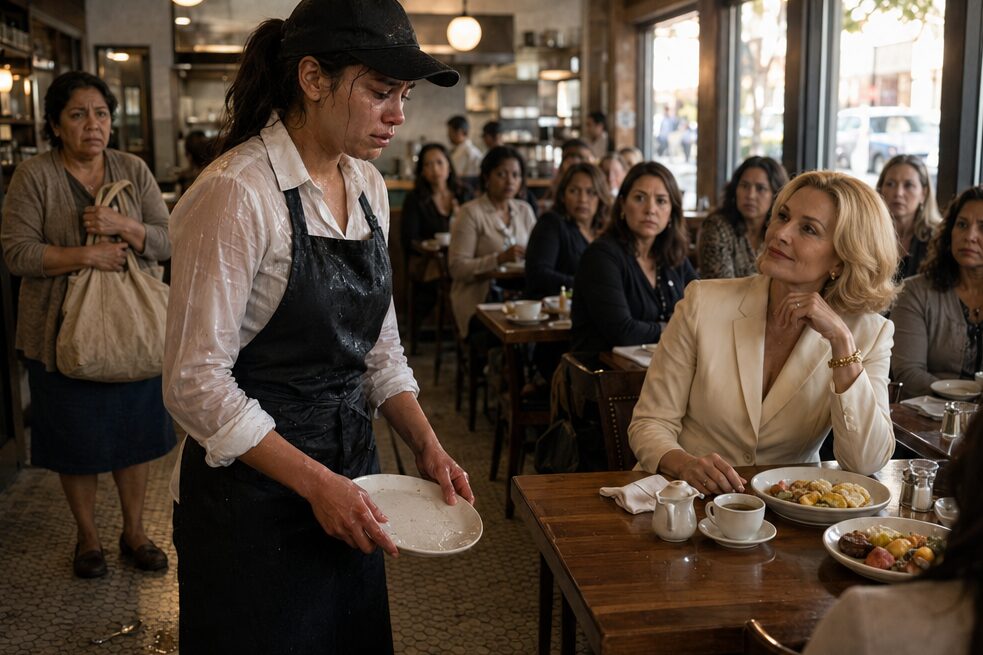
Jessica was crying into the dish sink when the women at table seven started laughing again.
She kept her head down, because looking up would make it worse. Hot water ran over her wrists. Egg yolk slid in yellow streaks across the white plate in her hands. Someone had left a perfect crescent of lipstick on the rim of a coffee cup, the kind of pink that cost more than Jessica made in an hour.
Through the pass-through window, she could see the dining room of Willow & Rye packed tight with Sunday brunch people: polished boots, clean children, phones faceup beside mimosas, folded napkins no one had unfolded themselves.
Above the register hung a banner made by the middle school art club.
HELP SEND OUR KIDS TO WASHINGTON, D.C.
The word OUR was painted in blue glitter.
Jessica scrubbed harder.
“Table seven says this has a water spot,” Scott called from the server station.
He set a plate on the edge of the dish pit like it was evidence.
Jessica stared at it.
It was clean.
Not café clean. Not rushed-brunch clean. Clean clean. White porcelain, dry rim, no food, no grease. Just one faint mark where a drop had dried before she could stack it.
Scott gave her an apologetic look. “Sorry.”
“Who sent it back?”
He didn’t answer fast enough.
Jessica already knew.
She looked through the pass-through again.
Christine was sitting by the front window in a cream blazer, her blonde hair curled under her chin, gold bracelet flashing whenever she lifted her glass. Three women sat with her, all from the neighborhood association, all wearing soft colors and patient smiles.
Christine looked toward the kitchen and raised her fingers in a small wave.
Not a greeting.
A reminder.
Jessica took the plate from Scott and ran it under the faucet.
“She said she knows you,” he added, quieter.
Jessica’s throat tightened.
“She said, ‘Isn’t that Maria’s daughter?’”
Of course she had.
Jessica dried the plate with a towel already damp from the rush. Her hands were red from soap and heat. Her cuffs clung to her wrists.
From table seven, Christine’s voice lifted above the restaurant noise, bright and sweet enough to frost a cake.
“It’s good to see young people working,” she said. “Honestly. There’s dignity in honest work.”
One of the women murmured agreement.
Christine went on, a little louder. “Better than sitting around waiting for people to take care of you.”
The women laughed the way women laughed when they wanted to stay invited.
Jessica put the plate back on the shelf.
She did not throw it.
She did not speak.
She picked up the next dirty dish and washed someone else’s breakfast away.
That was what she did. That was what she had done for eleven months, three Sundays a month, four double shifts whenever rent was late. She washed off syrup and hollandaise and half-eaten avocado toast. She swallowed comments. She counted tips she did not get. She smiled when customers called her sweetheart and looked through her when they were done.
She was twenty-two years old, but at Willow & Rye she was mostly hands.
Hands that scraped.
Hands that rinsed.
Hands that disappeared.
The women at table seven laughed again.
Jessica blinked hard, but one tear slipped anyway and fell onto the plate in her hands.
She rinsed that off too.
Part II — The Envelope
The back door opened at eleven twenty-three, letting in a strip of cold March air and the smell of wet pavement.
Jessica didn’t turn until she heard her mother say, “Jess?”
Her whole body went stiff.
Maria stood just inside the kitchen door wearing her grocery-store cardigan over a faded blue uniform shirt. Her hair was pulled back with one of those black elastics that always seemed one snap away from giving up. In one hand she held a canvas tote. In the other, a white envelope folded twice.
“I’m sorry,” Maria whispered. “Jack forgot this.”
Jessica crossed the kitchen fast. “Mom, you can’t come in here.”
“I know. I know.” Maria glanced toward the dining room, already apologizing to walls and strangers. “He called me from the school table. He was near tears. It’s the permission form and the deposit slip.”
Jessica saw Jack’s handwriting on the envelope. Blocky, careful letters.
D.C. TRIP FUND
Her little brother had written it like the envelope itself might decide whether he was allowed to go.
Jessica wiped her hands on her apron before taking it. “I’ll bring it out.”
“I can do it.”
“No,” Jessica said too quickly.
Maria understood before Jessica could soften it.
Her mother’s face changed in that small way Jessica hated most. Not offended. Not surprised. Just tired from knowing exactly why her own daughter didn’t want her seen.
Then Christine saw them.
“Maria?” Christine’s voice floated across the dining room like a ribbon tossed over a fence. “Oh my goodness, Maria!”
Every head between the kitchen and the front window turned.
Maria smiled because women like her had been trained to smile before they knew whether they were safe.
Christine lifted her mimosa. “Come say hello! Girls, this is Maria. I told you about the meal train last fall.”
Jessica closed her eyes.
Not long. Just long enough to feel the floor drop.
Maria stepped halfway toward the pass-through. “Hi, Christine. I don’t want to interrupt.”
“Don’t be silly.” Christine pressed a hand to her chest. “We were just talking about the fundraiser. And look at you, running around for Jack. Such a devoted mom.”
The compliment landed wrong.
Maria held up the envelope. “He left something at home.”
“That child is so bright.” Christine turned to the table. “We all pitched in when Maria’s hours got cut, remember? Groceries, casseroles, those gas cards. Our community really showed up.”
Our community.
Jessica watched her mother nod.
“Yes,” Maria said. “People were very kind.”
Christine smiled, satisfied. “That’s what neighbors are for.”
One of the other women said, “That must have been such a hard season.”
Maria’s hand tightened around the tote strap. “We’re doing better.”
Jessica wanted to step between them. She wanted to pull her mother back into the kitchen and shut the door. She wanted to say, Stop making her stand there and perform gratitude for your brunch table.
Instead, she held the envelope.
Christine’s eyes slid to Jessica. “And Jessica’s working here now. Isn’t that wonderful? Full circle, really.”
Jessica didn’t know what circle Christine meant. Hunger to dish sink. Donation box to dirty plate. Neighborly concern to public ownership.
Scott leaned past her and whispered, “Can you run bus for ten? Angela called out.”
Jessica almost laughed.
“Now?”
He winced. “Stephen said now.”
Stephen, the owner, was at the espresso machine pretending not to hear any of this. He was good at that. His café had reclaimed wood shelves, local honey for sale, and a sign near the register that said KINDNESS SERVED DAILY.
Jessica took the envelope from her mother.
“I’ll get it to Jack,” she said.
Maria leaned in close enough that only Jessica could hear. “Please just get through today.”
Jessica looked at her.
Maria did not say Christine’s name. She did not need to.
“She’s on the committee,” Maria whispered. “For trip scholarships. Just today, Jess. Please.”
There it was.
The real plate Jessica had to keep carrying.
Not the porcelain one.
The invisible one.
Maria touched her wrist, then left through the back door before Christine could call her again.
Jessica stood still for one second too long.
Then Stephen said, “Table seven needs clearing when you get a chance.”
When you get a chance meant now.
It always did.
Part III — Dignity in Honest Work
Jack was at the school table beside the donation jar, wearing the same gray hoodie he wore three days a week because it still fit and had no obvious stains.
He saw Jessica coming with the envelope and tried to stand up straighter.
“Mom brought it?” he asked.
“Yeah.”
“Was she mad?”
“No.”
He took the envelope with both hands. “Thanks.”
Behind him, a poster board showed photos of monuments the students would visit if they raised enough money. The Capitol. The Lincoln Memorial. The Smithsonian. Places Jack had only seen on screens borrowed from school.
Jessica looked at the donation jar.
It was half full of folded ones and fives. Near the top was a check with Christine’s name on it.
Jack followed her gaze and said, “Mrs. Christine said she might talk to the committee about me.”
Jessica tried not to react.
“She said I had ‘promise.’” He made air quotes because he had heard an adult do it once and still wasn’t sure how to make it look casual. “That’s good, right?”
“Promise is good,” Jessica said.
He searched her face. He had always been too good at that.
“Did she say something?”
“No.”
“Jess.”
She tugged the hood of his sweatshirt lightly. “Sell your raffle tickets.”
His eyes dropped. “I don’t like asking.”
“I know.”
“It feels weird.”
“Lots of things feel weird and still have to get done.”
The line came out sharper than she meant it to. Jack nodded like he had been corrected in class.
Jessica hated herself for it.
Before she could fix it, Stephen called her name from behind the counter.
Table seven had finished their first round of drinks.
Christine lifted one finger when Jessica approached, not rude exactly. Worse. Familiar.
“Could we get more napkins, honey?”
Jessica picked up empty glasses. “Of course.”
“And maybe wipe this side of the table? It’s sticky.”
There was a drop of syrup near the bread plate.
Jessica wiped it.
Christine watched her work. “You must be learning a lot here.”
Jessica kept her eyes on the table. “Yes, ma’am.”
“Oh, please, Christine is fine. I know your family.”
That was the problem.
One of the women, Debra, leaned in. “How old are you, sweetheart?”
“Twenty-two.”
“College?” Debra asked.
Jessica felt Christine’s attention sharpen.
“Not right now.”
Christine gave a soft sigh, the kind designed to sound compassionate. “Not everyone’s path looks the same.”
Jessica stacked plates. Egg. Toast crust. A wedge of orange no one had touched.
Angela, the absent server, would have gotten tipped for this table. Jessica would get wet sleeves and Stephen telling her she was lucky to have steady hours.
“Honestly,” Christine said, “there is no shame in work.”
Jessica carried the stack away before her face could answer.
At the dish sink, she scraped breakfast into the trash. Her arms shook, but not enough for anyone to notice.
No shame in work.
People said that when they needed to remind you where they stood above it.
She washed the plates and listened as table seven moved from school gossip to neighborhood lawns to whose son had gotten into honors math. Their voices rose and fell. Christine’s laugh kept finding Jessica like a finger pressing a bruise.
At noon, the café grew louder.
Toddlers dropped crayons. Fathers asked for extra bacon. Someone complained that the coffee was lukewarm. Stephen told Jessica to run clean forks. Scott mouthed sorry every time he passed her.
Jessica did not want sorry.
Sorry still left her at the sink.
When she returned to table seven with forks, Christine touched her sleeve.
Jessica flinched before she could stop herself.
Christine noticed.
Her smile cooled at the edges. “Oh, I’m sorry. I didn’t mean to startle you.”
“It’s fine.”
“You’re very tense, dear.”
“I’m working.”
“Yes,” Christine said. “We can see that.”
The women laughed, smaller this time.
Not because it was funny.
Because Christine had placed something on the table and they knew they were supposed to pick it up.
Jessica set the forks down one by one.
Then Christine said, “Your mother has such pride. I’ve always admired that. Even when it makes things harder than they need to be.”
Jessica’s hand stopped over the last fork.
Debra looked into her mimosa.
Another woman checked her phone.
Christine’s voice softened. “I only mean, sometimes accepting help graciously is its own kind of strength.”
Jessica put the fork down.
Metal clicked against wood.
“I’ll get your coffee,” she said.
She walked away slowly, because running would have given them something else.
At the counter, Scott leaned in. “You okay?”
“No.”
He blinked.
The truth surprised them both.
Jessica grabbed the coffee pot and went back.
Part IV — The Word Graciously
The worst things Christine said were never loud enough for everyone to blame her.
That was her gift.
She could slide a knife under a door and call it light.
Jessica learned that over the next hour.
When she refilled the waters, Christine told her friends how “some families are so private you practically have to force them to let the community love them.”
When Jessica cleared the salad plates, Christine mentioned the gas cards again.
When Jack stopped by the table with raffle tickets, Christine bought five dollars’ worth, then looked at the other women until they did too.
“See?” Christine told him. “People are happy to help when they see effort.”
Jack’s ears went red.
He thanked her twice.
Jessica watched from the coffee station, the pot burning her palm through the thin towel wrapped around its handle.
Jack came back to the school table and sat down smaller than before.
That was when anger changed shape inside Jessica.
It was no longer hot.
It became precise.
She could have endured Christine talking about Maria. Adults did that. They folded other adults into stories and called it concern.
But Jack was twelve.
He still folded his permission slips carefully. He still believed a committee could look at him and see a boy who liked museums, not a bill his family couldn’t pay.
At one o’clock, Maria returned.
She did not come inside this time. She stood at the back door and waited until Jessica saw her.
Jessica stepped out into the narrow alley behind the café. The air was cold enough to make her wet sleeves sting.
“What happened?” Maria asked.
“Nothing.”
“Don’t lie to me.”
Jessica looked at the brick wall across from them. Someone had propped empty milk crates beside the trash bins. A cigarette butt floated in a puddle.
“She keeps talking about us.”
Maria closed her eyes. “Jess.”
“She brought up the groceries. The meal train. The gas cards.”
“She helped.”
“She tells people she helped.”
“That doesn’t make it not help.”
Jessica turned to her. “Are those the same thing to you?”
Maria’s face tightened.
For a moment, Jessica saw not her mother, but a woman who had spent months calculating which bill could wait without becoming a disaster. A woman who had accepted casseroles in dishes she washed and returned with thank-you notes. A woman who had smiled through the slow violence of being pitied in public.
“No,” Maria said quietly. “They’re not the same.”
“Then why are you asking me to stand there?”
“Because Jack wants that trip.”
“He wants to disappear every time she says his name.”
“He also wants to go.”
Jessica said nothing.
Maria lowered her voice. “I know what she is.”
That stopped Jessica.
Maria’s eyes were wet now, but she would not let the tears fall. “I know, Jess. You think I don’t? You think I don’t hear the way she says things? You think I don’t go home and remember every person who has seen my pantry, my bills, my kitchen table?”
“Then why—”
“Because pride doesn’t pay deposits.”
There it was.
The sentence Christine would later steal and sharpen.
Jessica stepped back as if her mother had slapped her.
Maria saw it and reached for her, but Jessica moved away.
“I didn’t mean—”
“No. You did.”
“Jessica.”
“I have to work.”
She went back inside before Maria could say anything else.
For the next twenty minutes, Jessica did not cry.
She cleared plates.
She wiped tables.
She rinsed forks.
She carried the coffee pot.
She moved like a person carefully setting objects on shelves inside herself, one by one, because if anything tipped, the whole room would hear it.
Then she passed table seven with a bus tub full of glasses and heard Christine say her mother’s sentence in another voice.
“I just think Maria needs to stop pretending pride pays bills.”
Jessica stopped behind the half wall.
No one saw her.
Christine stirred her coffee. Her bracelet clicked against the cup. “And Jack is sweet, of course. Very sweet. But with scholarships you have to be careful. Some families get used to being rescued.”
Debra gave a nervous little laugh. “Christine.”
“What? I’m not being unkind.” Christine smiled. “I’m saying help should encourage responsibility.”
Jessica stood so still the glasses in the tub stopped clinking.
There were sentences that bruised.
And then there were sentences that tried to rename you.
Her family was not irresponsible.
Her mother worked until her ankles swelled. Jack saved quarters in a jar shaped like a bear. Jessica had not bought new shoes in two years because the electric bill did not care what her feet looked like.
They were not a lesson.
They were not a warning.
They were not Christine’s proof of goodness.
Scott came around the corner and almost bumped into her.
“You okay?”
Jessica looked at him, and he stopped asking.
Because her face had answered.
Part V — The Spoon
Stephen told Jessica to clear table seven personally because Christine had asked for her.
“She said you’ve been so attentive,” he said, not meeting Jessica’s eyes.
“She said that?”
“She’s a regular.”
“So am I,” Jessica said.
Stephen looked up.
The words hung between them, ridiculous and true.
He softened for half a second, then became the owner again. “Just finish the table.”
Jessica carried the gray bus tub to table seven.
Christine was signing the check, pen moving in smooth loops. Her cream blazer was still perfect. Her lipstick still perfect. Her hair still perfect. She looked like a woman who had never had to scrub anything out of her own cuffs.
“Jessica,” she said warmly. “There you are.”
Jessica began stacking plates.
“Your brother is a darling boy.”
Jessica said nothing.
“I do hope he gets to go. Those trips can really change a child’s perspective.”
Jessica placed a plate in the tub.
Christine added, “Sometimes seeing the wider world helps children understand what’s possible when they make good choices.”
A fork slipped from Jessica’s fingers and clattered onto the table.
She picked it up.
Christine tilted her head. “Careful.”
Jessica breathed in through her nose.
She reached for the bread plate.
That was when Christine let her spoon fall.
It hit the tile near Jessica’s shoes with a clean, ringing sound.
Everyone at the table looked down.
Christine gave a tiny laugh. “Oh, how clumsy of me.”
Jessica stared at the spoon.
It lay silver and bright against the floor, halfway under Christine’s chair.
For one second, nobody moved.
Then Jessica crouched.
Her knees bent. Her wet cuffs touched the tile. She reached for the spoon.
Above her, Christine spoke softly.
Not whispering.
Never whispering.
Just soft enough to make denial possible.
“Your mother always was too proud to kneel, too.”
The table went quiet.
Then one of the women laughed because silence would have been an accusation.
Another joined, uneasy.
Christine did not laugh right away. She watched Jessica.
That was the worst of it.
She wanted to see where the sentence landed.
Jessica picked up the spoon.
She stood.
Her hand was shaking so hard the spoon tapped against the side of the tub.
Christine’s smile was small now. Almost private.
“Thank you, dear.”
Jessica looked toward the back of the café.
Maria stood near the rear hallway, one hand against the doorframe. She must have heard enough. Maybe not the words. Maybe only the shape they left in the room.
Her face begged.
Not for herself.
For Jack.
For rent.
For the committee.
For all the things poor families are asked to consider before they are allowed to be angry.
Jessica placed the spoon in the tub.
She carried everything back to the dish pit.
At the sink, she turned the hot water on high.
Steam rose.
Her hands moved without her permission. Plate. Rinse. Scrub. Stack. Plate. Rinse. Scrub. Stack.
Christine’s plate came last.
There was a smear of hollandaise near the rim and three coffee drops near the center. Jessica held it under the stream until everything loosened. Her thumb moved over the porcelain in circles.
In the plate, under the water, she saw her own face stretched and broken.
A dark ponytail under a cap.
Eyes red.
Mouth pressed shut.
Behind that reflection, in the pass-through, Christine laughed again.
Jessica turned off the faucet.
The sudden silence around her was enormous.
Water ran from the plate onto her wrist.
She dried nothing.
She picked it up wet.
And turned toward the dining room.
Part VI — What the Room Heard
No one noticed at first.
People rarely noticed dishwashers moving through rooms unless something was late, missing, or wrong.
Jessica walked past the server station.
Scott saw the plate in her hand and went still.
“Jess,” he said.
She kept walking.
Stephen looked up from the register. “Jessica?”
The café noise thinned, not all at once, but table by table, as if people could feel the shape of an approaching mistake.
Christine saw her coming and smiled.
It was the smile that did it.
Not the comments.
Not the spoon.
Not even Jack’s red ears or Maria’s face in the doorway.
The smile.
Christine believed Jessica was coming to apologize.
She believed the room would hold Jessica down for her.
Jessica stopped beside table seven.
The plate was slick in her hand. Water slipped down her fingers and dropped onto the wood floor.
Christine leaned back slightly. “Yes?”
Jessica set the plate in front of her.
Not gently.
The porcelain hit the table hard. Water and pale sauce jumped from the surface, splashing across Christine’s blazer, her blouse, her chin. Christine gasped and jerked back.
The plate skidded off the table edge.
For half a second, it seemed like it might right itself.
Then it cracked against the chair and broke on the tile.
The sound went through the café like a bell.
Christine covered her face with both hands. “Oh my God.”
Nobody moved.
A drop of sauce clung to her bracelet.
Her cream blazer bloomed with wet patches.
The women at her table stared at Jessica as if seeing her for the first time.
Jessica’s heart slammed against her ribs. The shock of what she had done arrived after the act, too late to stop it, too large to swallow.
Stephen started toward her.
Maria stood frozen near the back.
Jack had risen halfway from the school table, one hand still on the donation jar.
Jessica looked at Christine.
Her voice came out lower than she expected.
“You don’t get to call it kindness after you’ve used it to laugh at us.”
The room stayed silent.
Not approving.
Not condemning.
Just caught.
For one clean second, Christine had no language ready.
No gentle correction.
No generous smile.
No committee voice.
Only wet fabric, a reddening face, and everyone looking.
Then she found herself again.
“This is unacceptable,” Christine said, but her voice shook.
Jessica nodded once. “Yes.”
Stephen reached her then. “In the back. Now.”
Jessica did not argue.
She stepped around the broken plate carefully, because some habits did not break just because porcelain did.
As she passed the school table, Jack looked at her.
His eyes were wide, scared, and something else.
Not proud.
Not exactly.
Seen.
That was worse.
And better.
In the kitchen, Stephen fired her with phrases he had probably learned from a handbook.
Unprofessional conduct.
Unsafe environment.
No choice.
Very unfortunate.
Jessica untied her apron while he spoke. Her hands had finally stopped shaking.
Scott stood by the walk-in cooler, silent and pale.
Stephen lowered his voice. “I understand she may have said something.”
Jessica looked at him.
He looked away.
That was answer enough.
She put the apron on the prep table.
The fabric landed wet and heavy.
“I’ll pick up my check tomorrow,” she said.
Stephen opened his mouth, then closed it.
Outside, Maria was waiting by the back door.
For a moment, mother and daughter only looked at each other.
Then Maria said, “What have you done?”
Jessica’s throat tightened.
There were a hundred answers.
Cost us help.
Lost my job.
Made us gossip.
Told the truth badly.
Finally.
She said none of them.
Maria pressed both hands to her face, then dropped them. “Jack’s trip, Jess. Your hours. Rent.”
“I know.”
“You know?” Maria’s voice cracked. “Do you? Because knowing doesn’t put money back.”
“I know.”
“Then why?”
Jessica looked through the narrow kitchen window at Christine dabbing her blazer with a napkin while Debra hovered beside her. Already, Christine’s posture had changed. Already, she was becoming the injured party.
Because that was another thing money could buy.
A faster recovery.
Jessica turned back to her mother.
“She made you a story,” she said. “I couldn’t keep washing it.”
Maria flinched.
The anger went out of her face so quickly it left only exhaustion.
For a moment, Jessica thought her mother would slap her. Or hug her. Or walk away.
Instead, Maria reached down and picked up Jessica’s wet apron from the prep table.
She folded it once.
Then again.
The fold was not neat.
Her hands were trembling.
Part VII — Clean Dishes
By Monday morning, three versions of the story had already made it around the neighborhood.
In the first, Jessica had thrown a plate at Christine for no reason.
In the second, Christine had insulted her mother and Jessica had “lost control.”
In the third, which traveled quietly between servers and grocery clerks and parents who had ever accepted help with their teeth clenched, Christine had finally said one thing too many.
No version paid rent.
Jessica spent Monday filling out applications on her phone at the kitchen table while Maria worked a late shift at the store. Jack came home and put his backpack down softly, as if noise cost money.
“Did people say stuff?” Jessica asked.
He shrugged.
That meant yes.
She waited.
He unzipped his backpack and pulled out a paper plate.
For one terrible second, Jessica thought it was a joke someone had made.
Then she saw the drawing.
It was their house, or Jack’s version of it: blue door, square windows, crooked chimney they did not have. Three stick figures stood in front. One had a ponytail. One wore a grocery-store name tag. One was smaller, with a backpack almost as big as his body.
Across the top, in Jack’s careful block letters, he had written:
WE’RE NOT CHARITY.
Jessica sat very still.
Jack placed it on the table.
“I made it at the fundraiser craft station,” he said. “Before everything.”
Before everything.
As if everything had not been happening for months.
Jessica touched the edge of the paper plate.
“Did Christine see it?”
“No.”
“Good.”
“I kind of wanted her to.”
Jessica looked up.
Jack’s mouth twisted, trying not to cry and trying not to be twelve.
“They said I can still apply for the trip help,” he said. “Mrs. Debra told the counselor I should.”
Jessica blinked.
“Debra?”
He nodded. “She said the committee should look at applications, not grown-up arguments.”
It was not victory.
It was not justice.
It was one woman at one table deciding silence had gone too far.
Sometimes that was how rooms changed. Not all at once. Not cleanly. Just one person refusing to laugh next time.
Maria came home after seven carrying two empty casserole dishes.
Jessica recognized them immediately. One was white ceramic with blue flowers. The other had a red lid and a piece of tape still stuck to the bottom where someone had written Christine’s last name.
Maria set them in the sink.
Neither woman spoke.
Then Maria took off her cardigan and rolled up her sleeves.
“I washed them at work,” she said. “But I want them cleaner.”
Jessica stood beside her.
Together, they filled the sink.
Hot water fogged the window over the kitchen table. Soap gathered around the dishes in white clouds.
Maria scrubbed the blue flowers first.
“I’m still angry,” she said.
“I know.”
“I’m not angry because you were wrong.”
Jessica looked at her.
Maria kept her eyes on the dish. “I’m angry because now I have to figure out how to be grateful for things I don’t want anymore.”
That sentence hurt more than shouting would have.
Jessica picked up the red lid and washed it slowly.
“I’m sorry about the job.”
Maria nodded.
“I’m sorry about Jack.”
“He was already carrying it,” Maria said. “We just didn’t want to see.”
They washed in silence for a while.
Then Maria reached for a clean towel.
“I’m returning these tomorrow,” she said.
“To Christine?”
“To whoever they belong to.”
“And what are you going to say?”
Maria dried the blue-flowered dish until it shone.
“Thank you,” she said. “And nothing else.”
Jessica almost smiled.
Not because it was funny.
Because it was a boundary so small it could fit in both hands.
Later that night, Jessica taped Jack’s paper plate to the refrigerator.
It looked fragile there, above the overdue electric notice and beside a grocery list written around what they could afford.
A paper plate was not much.
It could bend.
It could tear.
It could not hold a whole dinner unless you were careful.
But it held their little blue house.
It held all three of them standing upright.
It held the words Jack had needed someone to say before he knew he was allowed to say them.
Maria came into the kitchen, saw it, and stopped.
For a second, Jessica thought she would take it down.
Instead, her mother touched the edge of the plate with two fingers.
Then she opened the cabinet, took out the clean red-lidded dish, and set it by the door to return in the morning.
No speech.
No apology.
No promise that things would be easier now.
Only a clean dish waiting beside the door.
Only a paper plate on the fridge.
Only the quiet sound of three people learning which kinds of help they could live with, and which kinds they would no longer carry.