The Porch Light Stayed On Long After She Tried To Leave
Part I — The Driveway at Dusk
Emma was halfway down the driveway before her mother finally said her name.
Not loudly. Not angrily.
Just once.
“Emma.”
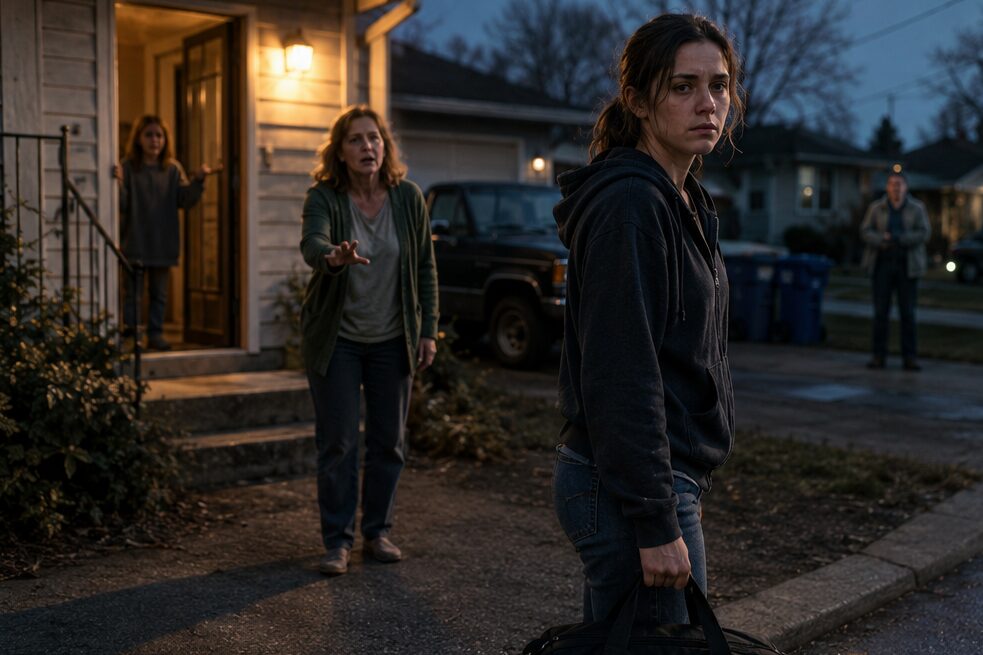
The porch light behind Linda turned her into a soft yellow shape against the darkening street. The screen door hung open beside her. Kathleen stood behind it in an oversized gray sweatshirt, one hand gripping the frame like she thought the house might split apart if she let go.
Emma kept walking.
The duffel bag banged against her thigh with every step. She hadn’t packed much. Two hoodies. Jeans. Her charger. The envelope with the cash from the grocery store. Enough to leave for one night. Maybe longer if she slept in her car.
Across the street, Mrs. Donnelly was dragging recycling bins toward her garage. Emma saw the woman pause.
Of course she paused.
Nothing stayed private on Maple Lane.
“Emma, please,” Linda said.
That word again. Please.
It had been please for years.
Please understand.
Please be patient.
Please don’t make this harder.
Emma tightened her grip on the duffel strap and kept moving toward the sidewalk.
Behind her, Kathleen whispered, “Mom…”
Emma closed her eyes for one second.
That was the problem with leaving. Kathleen’s voice followed her everywhere.
Three hours earlier, Emma had come home from her shift at Lawson’s Grocery and found her father carrying boxes into the garage apartment behind the house.
Not visiting.
Moving in.
She still remembered the sound the tape gun made when he sealed one of the boxes. Sharp. Final.
Linda had stood beside him wringing her hands in that faded green cardigan she wore whenever she was nervous.
“It’s temporary,” she’d said too quickly.
Emma had laughed because the alternative was screaming.
Temporary was how her father always arrived.
Temporary loans.
Temporary jobs.
Temporary drinking.
Temporary promises.
Then one day he would disappear again and leave everybody else cleaning up the quiet.
Now the garage light glowed behind the house while his truck sat crooked near the curb like an old apology nobody asked for.
Emma reached the sidewalk.
The air smelled like damp leaves and charcoal from somebody’s backyard grill.
“Are you really doing this?” Linda asked.
Emma turned for the first time.
“You already did it,” she said.
The words landed harder than she expected.
Linda flinched.
For a second nobody moved. Kathleen stared between them, terrified of choosing where to look.
Then Linda stepped off the porch.
Not running yet.
Not desperate yet.
Just walking toward her daughter like maybe there was still time to speak carefully.
“You don’t have to leave.”
Emma almost laughed again.
That was the thing nobody in the house understood.
She’d been leaving for years.
Tonight was just the first time she picked up a bag.
Earlier that afternoon, the neighborhood had been full of folding tables and paper lanterns from the annual block party cleanup.
Everyone on Maple Lane helped because Linda organized it every year. Linda organized everything. Potlucks. Fundraisers. Meal trains for sick neighbors. Coat drives in winter.
People loved her for it.
Emma used to love her for it too.
When she pulled into the driveway after work, she saw her father first.
Christopher.
Bent over beside the garage apartment carrying a box marked KITCHEN.
Older now. Grayer around the beard. Thinner in the shoulders.
But still somehow familiar enough to make Emma’s stomach tighten instantly.
He looked up when he heard her car.
For half a second, his face lit up with relief.
That made it worse.
“Hey, Em,” he said softly.
Nobody called her that anymore except him.
Emma looked past him toward her mother.
Linda came out carrying clean towels like this was normal.
Like daughters came home from work every day to discover their fathers moving into the backyard.
“You said he wasn’t coming back,” Emma said.
Linda glanced toward the neighbors setting up tables across the street.
“Can we not do this out here?”
There it was immediately. The performance.
Christopher shifted awkwardly beside the boxes.
“I just need somewhere for a little while.”
Emma ignored him.
“You promised.”
Linda lowered her voice. “He lost his apartment.”
“And?”
“Emma.”
“No, seriously. And?”
Kathleen appeared behind the screen door then, eyes huge.
Christopher rubbed the back of his neck. “I can help around here. Fix things up.”
Emma looked at the garage apartment.
Fresh curtains.
The old welcome mat from storage.
Linda had planned this.
“You already moved him in before telling us.”
“It happened quickly.”
“You mean you knew I’d say no.”
Linda’s expression hardened just slightly.
“This isn’t only your house.”
Emma stared at her.
That sentence stayed lodged in her chest all evening like a splinter.
Because maybe it wasn’t her house.
But she’d spent years acting like it was her responsibility.
That night Christopher fixed the broken porch light without being asked.
Emma watched from the kitchen sink while he stood on the ladder tightening the fixture.
Kathleen hovered nearby holding the flashlight for him like they were already rebuilding something.
Linda smiled for the first time all day.
The light flickered once and then glowed warm against the dusk.
“There,” Christopher said quietly.
Nobody noticed Emma stop washing the same plate three times.
Part II — Things That Looked Like Help
Christopher stayed quiet the first few days.
That almost made it harder.
Emma kept waiting for the old version of him to return. The loud version. The defensive version. The one who turned every problem into someone else’s misunderstanding.
Instead he moved through the house carefully, like a guest terrified of breaking something expensive.
He fixed the loose cabinet hinge.
Repaired the fence gate.
Patched the leak under the kitchen sink.
Every improvement irritated Emma more than the last.
Because the house actually needed those things.
And Linda looked relieved every time he quietly handled one.
“You don’t have to keep doing that,” Emma muttered one evening when she found him changing the lightbulb over the stove.
Christopher climbed down from the chair slowly.
“I know.”
“Then why are you?”
He thought about it before answering.
“Feels better than standing around apologizing.”
That should’ve annoyed her.
Instead it just made her tired.
The worst part wasn’t Christopher.
It was watching her mother relax.
Linda started humming while cooking again.
She stopped triple-checking the mail pile like every bill might destroy them.
Once, Emma came downstairs late at night and found Linda asleep on the couch while Christopher quietly folded laundry nearby.
Not romantic.
Not dramatic.
Just familiar.
That scared Emma more than anything.
People slipped back into old lives faster than they noticed.
At school, Kathleen talked about their father constantly.
“Dad says he might come to my awards banquet.”
“Dad fixed Mrs. Harper’s mailbox.”
“Dad makes grilled cheese better than Mom.”
Each sentence hit Emma like a small betrayal even though Kathleen sounded hopeful, not cruel.
Eleven-year-olds could mistake temporary comfort for stability.
Adults weren’t supposed to.
One afternoon Emma picked Kathleen up from choir practice and found her chatting with Mrs. Donnelly outside the church hall.
Mrs. Donnelly smiled brightly.
“Your mother’s such a good woman,” she said. “Not everyone would open their home like that.”
Emma forced a nod.
Kathleen beamed with pride.
That was the problem.
The neighborhood saw generosity.
Emma saw history repeating itself with better lighting.
Three days later, Emma overheard Linda talking to a neighbor near the mailbox.
“Families don’t give up on each other,” Linda said softly.
Emma stopped on the front steps.
The neighbor squeezed Linda’s arm sympathetically.
“You’re doing the right thing.”
Right thing.
Emma suddenly felt seventeen and forty at the same time.
Because nobody knew who stayed up balancing grocery receipts with utility bills when Christopher disappeared years ago.
Nobody knew Emma had filled out Kathleen’s field trip forms because Linda was too emotionally wrecked to remember.
Nobody knew Emma had learned how to calm panic attacks before learning how to drive.
Inside the house, Kathleen was practicing clarinet badly.
Christopher was fixing the warped drawer in the hallway table.
And Linda was outside collecting praise for surviving them all.
Emma walked past her mother without speaking.
“Emma?” Linda called.
But Emma kept going.
That night she found the bank envelope by accident.
Linda had left it half-hidden beneath a stack of church flyers on the kitchen counter.
SUMMER ACADEMIC FUND.
Kathleen’s program money.
Emma opened it automatically.
Nearly half was gone.
At first she thought maybe Linda had moved the cash somewhere safer.
Then she saw the receipt underneath.
WIRE TRANSFER.
Christopher’s overdue rent debt.
Emma stood perfectly still.
The refrigerator hummed behind her.
Outside, Christopher laughed softly at something Kathleen said on the porch.
Linda came into the kitchen carrying folded towels.
Her face changed immediately.
“Emma—”
“You used Kathleen’s money?”
Linda set the towels down too carefully.
“I was going to replace it.”
“When?”
“It was an emergency.”
Emma laughed once under her breath.
“There’s always an emergency with him.”
Linda’s exhaustion hardened into defensiveness.
“You don’t understand what it’s like watching someone have nowhere to go.”
Emma stared at her.
“You think I don’t know what that feels like?”
Silence.
And suddenly Emma understood something she’d spent years trying not to understand.
Her mother didn’t lean on Christopher.
She leaned on Emma.
Christopher disappeared when things got hard.
Linda stayed.
But Emma had been the person carrying the emotional weight between them.
The responsible one.
The calm one.
The understanding one.
The child who became useful too early.
Linda stepped closer carefully.
“We’re a family.”
“No,” Emma said quietly. “You just need someone willing to drown with you.”
Linda recoiled like she’d been slapped.
From the porch, Kathleen called happily, “Mom, Dad fixed the swing light!”
Nobody answered her.
Part III — The Shape of Silence
After the money fight, the house changed shape.
Not visibly.
Nobody smashed plates. Nobody screamed through doors.
But silence started appearing everywhere.
At breakfast.
In the hallway.
During television commercials.
Emma began staying late at work just to avoid dinner.
Christopher noticed.
One night he found her sitting alone on the back steps after midnight.
The neighborhood was quiet except for sprinklers ticking somewhere down the block.
He sat two steps below her.
Not close enough to touch.
“You should hate me,” he said.
Emma folded her arms tighter.
“I’m working on it.”
A small smile flickered across his face and disappeared.
“I never asked her for the school money.”
“That doesn’t matter.”
“No,” he admitted. “I guess it doesn’t.”
For a while they just listened to the sprinkler rhythm.
Then Christopher said quietly, “Your mom thinks keeping people is the same thing as saving them.”
Emma looked at him sharply.
It was the first honest thing anyone had said in days.
“She did it with me,” he continued. “Now she’s doing it with you.”
Emma swallowed hard.
“You could leave.”
“I probably should.”
“But you won’t.”
Christopher rubbed his tired hands together.
“I spent a long time being the kind of person who waited for someone else to decide things for him.”
That line stayed with her.
Because it sounded less like an excuse and more like surrender.
For the first time, Emma saw something beneath all the unfinished promises.
Shame.
Not dramatic shame.
Quiet shame.
The kind people carried so long it became part of their posture.
A few days later, Kathleen climbed into Emma’s room carrying a flyer for her school awards banquet.
“You’re still coming, right?”
Emma looked up from her homework.
“Of course.”
Kathleen hesitated.
“Can Dad come too?”
Emma exhaled slowly.
“We’ll see.”
Kathleen sat on the edge of the bed twisting the flyer.
“I like having everybody here.”
Emma’s chest tightened instantly.
Because Kathleen wasn’t stupid.
She knew things were wrong.
But she also knew the house felt fuller now. Warmer sometimes. Less fragile.
“I know,” Emma said softly.
Kathleen stared at the carpet.
“I used to hear Mom crying at night after he left.”
Emma looked away.
Kathleen continued quietly, “I don’t hear that anymore.”
There it was.
The impossible thing.
Christopher’s presence hurt Emma.
Christopher’s absence hurt Kathleen.
And Linda kept choosing whichever pain looked most survivable in the moment.
The cookout happened on Saturday evening.
Maple Lane loved excuses to gather outside. Folding chairs appeared. Somebody dragged speakers onto a lawn. Children ran through sprinklers while adults balanced paper plates and neighborhood gossip.
Emma already wanted to leave before she got there.
Christopher stood beside the grill helping Mr. Donnelly flip burgers. Linda moved through the crowd refilling drinks and laughing too brightly.
The performance was fully operational tonight.
At one point Mrs. Harper cornered Emma near the lemonade table.
“Your father seems better,” she said kindly.
Emma almost asked which version she meant.
Instead she shrugged.
Across the yard, Linda caught Emma’s eye.
A warning look.
Please behave.
Always that.
Later, while people gathered around the picnic tables, Linda brought up the awards banquet.
“We should all go together,” she said carefully.
Christopher immediately looked uncomfortable.
Kathleen brightened hopefully.
Emma set down her soda.
“No.”
The table quieted.
Linda forced a smile. “Emma—”
“He doesn’t need to come.”
Kathleen’s face fell.
Christopher looked down at his plate.
Linda’s voice sharpened. “Can we not do this here?”
“Where else do we do it?” Emma asked. “Every conversation in this family gets hidden until it explodes.”
Several neighbors suddenly became fascinated by their food.
Linda lowered her voice. “You’re punishing everyone for the past.”
Emma laughed once.
“There it is.”
“What is?”
“You always make endurance sound noble.”
Linda flushed.
“I am trying to keep this family together.”
“With Kathleen’s money?”
Silence.
Absolute silence.
Emma heard a paper plate slide off someone’s lap onto the grass.
Linda’s face drained of color.
“Emma,” she whispered.
But it was too late.
Mrs. Donnelly looked horrified.
Christopher stared at Linda slowly.
Kathleen blinked hard. “What money?”
Emma immediately regretted the timing.
Not the truth.
Just Kathleen hearing it this way.
Linda stood abruptly. “That was private.”
“No,” Emma snapped. “Kathleen’s future was supposed to be private.”
Christopher pushed back from the table.
“You used her school money?”
Linda looked cornered now, truly cornered.
“I was replacing it.”
“When?” Emma asked.
Kathleen’s eyes filled instantly.
“You said my program was safe.”
The neighborhood noise had gone thin and strange around them.
Nobody knew where to look.
Christopher stood there for one horrible second before quietly saying, “I’m gonna head back.”
And the humiliation on his face hurt almost as much as Linda’s.
Because suddenly everyone looked exhausted instead of guilty.
Christopher walked away first.
Kathleen burst into tears next.
Linda turned toward Emma with disbelief and fury tangled together.
“You didn’t have to do that publicly.”
Emma’s hands shook.
“You made me carry this privately.”
Part IV — The Rooms Between Them
Christopher started packing the next morning.
Not dramatically.
No slammed drawers. No accusations.
Emma heard boxes shifting inside the garage apartment while rain tapped softly against the windows.
Linda pretended not to notice.
That was somehow worse.
At breakfast, Kathleen sat silently picking apart toast while Linda drank cold coffee without looking at anyone.
The house felt embarrassed.
Emma realized families could embarrass houses.
Every room held leftover tension now.
The kitchen where Kathleen cried.
The driveway where neighbors stared.
The porch where Linda kept standing at night like she was waiting for something to come back.
By Monday, Christopher barely entered the main house.
He fixed the loose railing outside Kathleen’s window.
Changed the oil in Linda’s car.
Then disappeared quietly back into the garage apartment.
Acts of service instead of conversation.
Emma almost wished he’d yell.
Silence made everybody look sadder.
That evening Kathleen knocked softly on Emma’s bedroom door.
“Are you leaving?”
Emma froze.
“Why would you ask that?”
Kathleen stared at the floor.
“Because you keep packing little things.”
Emma looked toward the half-open closet where the duffel bag sat on a chair.
Kathleen’s voice turned small.
“If you leave too, this place is gonna feel fake.”
Emma closed her eyes.
Children always found the sentence adults were avoiding.
She crossed the room and sat beside her sister.
“I’m just tired.”
Kathleen nodded like she understood more than she should.
“You always look tired.”
That hurt worst of all because it was true.
Later that night Linda finally knocked on Emma’s door.
Neither of them spoke for several seconds.
Linda looked smaller lately. Not weaker. Just worn thin.
“You embarrassed me,” she said quietly.
Emma almost laughed from disbelief.
“That’s your concern?”
“No.” Linda swallowed hard. “But yes. A little.”
At least it was honest.
Emma leaned against the desk.
“You cared more about people thinking we were okay than whether we actually were.”
“That’s not fair.”
“No? You kept asking me to understand him. To help. To stay calm. To make things easier.”
Linda rubbed her forehead.
“I was trying to survive.”
“So was I.”
The words hung there.
Heavy. Undeniable.
Linda’s eyes filled suddenly, which startled Emma more than yelling would have.
“You think I don’t know how much you do?”
“I don’t think you wanted to know.”
That landed.
Linda looked away first.
And in that moment Emma realized something frightening.
Her mother wasn’t manipulative.
She was dependent.
Dependent on being needed.
Dependent on being the person who held everyone together.
Dependent on Emma helping her do it.
Which meant Emma leaving would feel less like rebellion and more like collapse.
That realization should’ve softened her.
Instead it made her feel trapped.
Christopher knocked on Emma’s car window the next afternoon while she sat outside Lawson’s Grocery before her shift.
He held out a folded envelope.
“What’s this?”
“Cash.”
Emma frowned.
“I don’t want your money.”
“It’s Kathleen’s.”
Emma stared at him.
“I sold my tools this morning.”
“What?”
“I wasn’t using them much anymore.”
She opened the envelope slowly.
Not enough to replace everything. But enough to hurt.
Christopher looked exhausted.
“I should’ve left earlier,” he said.
Emma didn’t answer.
“You know the worst part?” he continued quietly. “Your mom really believes love means never letting go of anybody.”
Emma looked out through the windshield.
“She thinks leaving is the worst thing you can do.”
Christopher nodded once.
“That’s why she keeps asking people to stay long after they should.”
Then he walked away before she could answer.
Part V — The Porch Light
By the time Emma came home that evening, the porch light was already on.
Warm yellow against the cold blue dusk.
The same light Christopher had fixed.
The same light Linda kept leaving on lately even before anyone got home.
Emma stood in the driveway for a long moment.
Inside the house she could see Kathleen setting the table slowly while Linda moved around the kitchen.
Normal motions.
Fragile normal motions.
Emma suddenly knew she couldn’t stay there tonight.
Not because she hated them.
Because she couldn’t hear herself think inside that house anymore.
She went upstairs and packed the duffel bag carefully.
Not dramatically.
Phone charger.
Toothbrush.
Two hoodies.
Cash envelope.
The essentials for pretending departure was temporary.
Kathleen saw the bag first.
Her face crumpled immediately.
“You’re really leaving.”
Emma crouched beside her.
“I just need space.”
Kathleen whispered, “That’s what Dad always said.”
The sentence sliced clean through her.
Downstairs, Linda appeared at the bottom of the staircase.
Nobody moved.
Then Emma walked past her.
Out the front door.
Into the cold evening air.
And now here they were again.
Driveway.
Porch light.
Neighbors pretending not to look.
Linda stood halfway between the porch and the sidewalk.
“Please don’t go like this.”
Emma gripped the duffel tighter.
“How else do I go?”
Linda opened her mouth and closed it again.
For once, she didn’t have a better answer ready.
Emma turned toward the street.
Behind her, Kathleen started crying softly.
Linda stayed still another terrible second.
Then panic finally overtook pride.
She hurried forward and grabbed Emma’s arm.
Not violent.
Desperate.
“Emma, wait.”
Emma jerked instinctively.
“Mom—”
“I know I keep messing this up.”
Her voice cracked apart.
The sound shocked them both.
Cars passed slowly at the end of the block.
Somewhere nearby, a dog barked once.
Linda’s grip loosened but didn’t disappear.
“I don’t know how to stop trying to save people,” she whispered.
Emma felt something inside her break open then.
Not anger.
Something sadder.
Because her mother meant it.
Linda truly believed love meant carrying everyone until her own arms gave out.
And she’d taught Emma to do the same thing.
Emma looked back at the glowing house.
Kathleen stood inside the doorway crying silently.
Christopher’s truck was still parked near the garage apartment.
The whole family held together by exhaustion and habit and people being too afraid to leave first.
Emma swallowed hard.
“You never noticed,” she said quietly, “that I was the one carrying this family.”
Linda’s face changed.
Not defensive.
Not angry.
Worse.
Recognizing.
Emma kept talking before she lost courage.
“You asked me to understand everything. Him leaving. Bills. Kathleen. Your stress. Your feelings. Everybody always needed something from me.”
Tears slid down Linda’s face silently.
“And every time I got tired,” Emma whispered, “you called me selfish.”
“I never meant—”
“I know.”
That was the tragedy of it.
Linda never meant most of the damage she caused.
The porch light buzzed softly above them.
Neither woman noticed the cold anymore.
Finally Linda let go of Emma’s arm.
Not because she wanted to.
Because for the first time, she understood holding tighter might break something permanently.
Behind the screen door, Kathleen wiped her face with her sleeve.
Emma looked at her sister for a long moment.
Then back at her mother.
“I’m not disappearing,” she said. “I just can’t keep being the adult in this house.”
Linda covered her mouth with shaking fingers.
Emma picked up the duffel bag again.
This time, when she walked toward the sidewalk, nobody stopped her.
But the porch light stayed on behind her the entire way down the street.
Part VI — What Stayed
Christopher was gone before sunrise.
No note.
Just the empty garage apartment and the faint smell of coffee near the sink.
Linda found the cash envelope on the kitchen table beside Kathleen’s school forms.
Emma heard her crying softly downstairs but didn’t go in.
Some grief needed privacy.
Emma came back midmorning after sleeping in her car outside the twenty-four-hour pharmacy across town.
Not because everything was fixed.
Because she was seventeen and tired and still loved them.
The house looked smaller in daylight.
Kathleen sat on the front steps wrapped in a blanket.
When she saw Emma, she didn’t smile immediately.
She just exhaled like she’d been holding her breath all night.
Emma sat beside her.
Neither spoke for a while.
The porch light was still on even though the sun was up.
Linda must’ve forgotten to turn it off.
Or maybe she hadn’t forgotten.
Kathleen leaned against Emma carefully.
“Are you staying?”
Emma stared out at the quiet street.
“I don’t know yet.”
It was the most honest answer she had.
The front door opened behind them.
Linda stood there holding a mug of untouched coffee.
Her eyes were swollen. Her cardigan hung loose around her shoulders.
But she didn’t ask Emma to come inside.
Didn’t apologize dramatically.
Didn’t defend herself.
Didn’t beg.
For once, she let silence exist without trying to manage it.
Emma looked at her mother.
Linda looked back.
And something subtle shifted between them.
Not forgiveness.
Recognition.
The kind that arrives late and hurts anyway.
Inside the house, dishes waited in the sink.
Bills still sat unopened near the microwave.
Kathleen’s summer program still needed saving.
Nothing was solved.
But for the first time in years, the performance had cracked.
And strangely, that made the house feel more honest than whole.
The porch light glowed softly beside them long after nobody needed it anymore.