The HOA Fenced Off the Only Road to His Property—Then the Old Survey Line Crossed Their New Entrance
Chapter 1: The Fence Across the Only Road
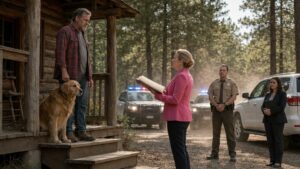
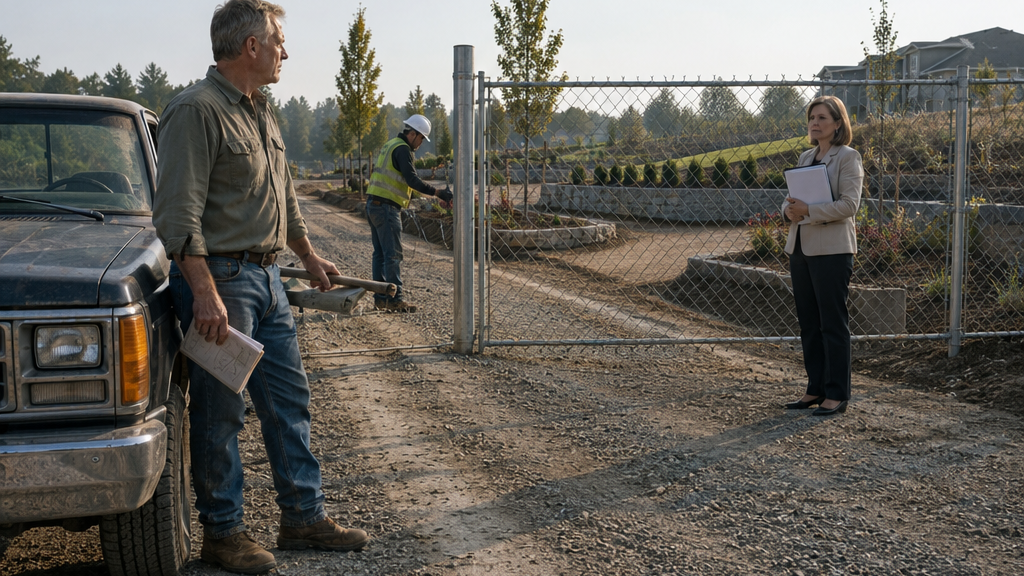
The first steel post was already sunk into the middle of James Mitchell’s gravel lane when he came around the bend in his pickup.
He stopped so hard that a coffee cup rolled off the passenger seat and struck the floor.
Two workers in reflective vests stood beside a portable auger. Between them lay a roll of chain-link fencing. Another post had been marked in orange paint on the opposite shoulder, exactly where the lane narrowed between a drainage ditch and the landscaped stone wall marking the entrance to Cedar Ridge.
James lowered his window.
“What are you doing?”
One worker shut off the auger. The sudden silence made the scene stranger.
“Closing this access,” he said. “HOA authorization.”
“This is my road.”
The worker looked toward a white SUV parked near the stone wall.
Katherine Roberts stepped out.
James had known Katherine by sight for six years, mostly from annual notices and the occasional board meeting he attended when Cedar Ridge planned work near his property. She wore dark slacks and a light jacket despite the construction dust. A folder was tucked beneath her arm.
“James,” she said. “We sent notice.”
“You sent me a notice about the entrance project.”
“The access closure was included.”
“No. It wasn’t.”
Katherine’s expression tightened, not with anger but impatience.
“The association’s counsel reviewed the title work. This lane crosses association property. There is no recorded easement benefiting your parcel.”
James looked past her.
The gravel lane continued another four hundred yards behind the new development landscaping, then curved toward the two-acre rear parcel he had inherited from his grandfather. His storage shed sat there, along with a compact loader, utility trailer, and three pieces of equipment belonging to customers who paid him modest monthly storage fees.
There was no second road.
There never had been.
“You know I’ve used this lane since before Cedar Ridge existed.”
“Use doesn’t establish ownership.”
“I didn’t say ownership.”
Katherine opened the folder.
“The board’s position is that any historical access was permissive. The new entrance and emergency loop have already been approved. We can’t leave an uncontrolled vehicle crossing through the construction zone.”
James stared at her.
“Uncontrolled.”
“I’m not trying to make this personal.”
Behind her, the worker restarted the auger.
James felt the vibration through the soles of his boots.
He wanted to walk over and pull the machine away. He wanted to tell the workers they were trespassing into a right his family had used since before half the houses behind Katherine had foundations.
Instead, he turned toward his truck.
Katherine seemed surprised.
James opened the passenger door and took out the envelope he had received from the HOA the week before. He unfolded the site-plan sheet across his hood.
“Show me where it says you can close the lane.”
Katherine came closer.
She pointed to a shaded section labeled as part of the association’s entrance parcel, then to a paragraph summarizing outside counsel’s title review.
James read it twice.
No easement of record was identified as appurtenant to his current parcel.
That sentence bothered him.
Not because he understood every word, but because of what it did not say.
His eyes moved lower.
A footnote referenced an older deed number and stated that it related to “historical access language associated with prior adjoining ownership.”
James tapped it.
“What’s this?”
Katherine looked down.
For the first time that morning, she did not answer immediately.
“It’s an old reference.”
“To what?”
“An adjacent parcel.”
“Did your attorney pull it?”
“The title review was comprehensive.”
“That’s not what I asked.”
Katherine closed the folder halfway.
“It doesn’t establish an easement to your parcel.”
James watched her face.
She had recognized the number.
Before he could press further, his phone rang.
A customer was waiting at the highway with a trailer.
“I’m turning in now,” the man said. “Where do you want me to meet you?”
James looked at the half-installed fence.
“You can’t get in.”
A pause.
“What?”
“They’re closing the lane.”
“I need the trencher today.”
“I know.”
The customer had a crew scheduled at noon. James could hear traffic behind him.
“If I can’t pick it up, I’ll have to rent one.”
James said nothing for a second.
“I’ll cover your first day.”
“You don’t have to—”
“I said I’ll cover it.”
When the call ended, the second post went into the ground.
Katherine lowered her voice.
“We’re not trying to interfere with your business.”
“You’re putting a fence across the only road to it.”
“The board has obligations too.”
“So do I.”
The workers pulled the chain-link mesh upright.
James stood with both hands resting on the hood. The anger had changed shape. It no longer felt useful to argue about what everyone remembered. Katherine had paperwork. The board had lawyers. The contractors had a written authorization.
His memory of the road was not going to stop any of them.
He folded the HOA plan carefully.
“Let me see that deed number again.”
Katherine hesitated, then held the page where he could read it.
James wrote the number on the back of an old fuel receipt.
“You’re wasting your time,” she said. “Counsel already checked.”
“Maybe.”
The workers stretched the fence from post to post.
By ten-thirty, a metal gate section stood across the lane. A new padlock hung from the latch.
James did not touch it.
He photographed the posts, the ditch, the gravel surface, the gate, and the edge of the HOA landscaping. Then he drove home by the public street that served his house but not the rear parcel.
His grandfather’s papers were in a dented green file box on the top shelf of a hall closet.
James had not opened it in years.
There were tax receipts, handwritten equipment notes, old insurance cards, folded plats, and deeds in brittle envelopes. His grandfather had believed in keeping everything, though not always in any order another person could understand.
James sat at the kitchen table and sorted until the afternoon light moved across the floor.
He almost missed it.
A yellowed envelope contained a photocopy of an older deed. In the upper corner, his grandfather had written a short note in pencil.
James compared the recording number to the fuel receipt in his hand.
They matched.
The deed Katherine had called irrelevant had been important enough for his grandfather to keep separate for nearly forty years.
And clipped behind it was a narrow strip of paper with three words in his grandfather’s handwriting:
ACCESS — EAST PARCEL.
James read them twice.
Then he looked toward the window, in the direction of the locked gravel lane.
Chapter 2: The Deed Filed Under Another Property
James’s current deed did not contain the sentence he expected to find.
He read it at six-thirty Wednesday morning, then again after coffee, then a third time with a legal pad beside him.
The rear parcel was described by metes and bounds. The transfer from his grandfather’s estate was clear. The acreage was clear.
The access was not.
By eight-fifteen he was at the county records office with the green file box on the seat beside him.
The clerk behind the counter listened while he explained the deed number.
“You’re searching the wrong parcel if you use your current address,” she said.
“That’s what the HOA says.”
“I didn’t say they were right. I said this number is indexed somewhere else.”
She turned her monitor slightly.
The older deed was tied to a tract immediately east of James’s rear parcel.
James frowned.
“My grandfather didn’t own that.”
“Not when you inherited.”
“He never talked about owning it.”
The clerk traced an ownership entry backward.
Then she stopped.
“For about eighteen months, he did.”
James leaned closer.
The adjoining parcel had once been co-owned by his grandfather and another man whose name meant nothing to him. The transfer occurred decades before Cedar Ridge existed, when the area was mostly fields and scattered houses.
James felt the first crack in his certainty.
He had spent a day thinking the HOA had simply failed to find something obvious.
Nothing here was obvious.
The clerk retrieved a scanned deed, then followed a reference from that deed into a separate instrument index.
“There,” she said.
A document number appeared beside a description that included the words ingress and egress.
James stared.
“That’s the road?”
“It may describe a right-of-way. I can print the document. I can’t tell you what legal effect it has now.”
The copy came out warm.
James carried it to a side table and spread it beside a modern parcel map.
The instrument was older than the house he lived in.
Its language was dense, but one part was unmistakable: a strip twenty-two feet in width providing access from the public road to the rear tract, running along the edge of the property his grandfather had briefly co-owned.
It was not permission to use a neighbor’s driveway.
It was a measured corridor.
James felt a flash of vindication so strong he nearly laughed.
Katherine had been wrong.
The HOA lawyers had been wrong.
Then he reached the legal description.
The corridor began at a fence corner that no longer existed, ran toward a cottonwood that had probably been gone for thirty years, and followed bearings across property lines that had since been subdivided.
He folded his arms.
“So where is it now?”
The clerk gave him a sympathetic look.
“That’s surveyor territory.”
By ten, James was sitting across from Nicole Rivera.
She read the document without reacting for several minutes.
James disliked that.
“Well?”
“It looks promising.”
“Promising?”
“You want me to say the HOA has to remove the fence this afternoon.”
“They blocked the only access to my property.”
“I understand.”
“And this says twenty-two feet.”
“It does.”
“Then what’s the problem?”
Nicole placed the old instrument beside his current deed.
“This document was created while your grandfather had an ownership interest in that adjoining parcel. The important question is whether the right attached to the rear land and continued through later transfers.”
James pointed at a paragraph.
“It says successors.”
“It does. That helps.”
“So it’s valid.”
“I think there is a strong argument that it is.”
“That’s lawyer language.”
“Yes.”
James leaned back.
Nicole ignored the comment and opened the county map.
“What concerns me is not whether the document existed. It clearly did. What concerns me is why the chain became so difficult to see.”
“Because the county indexed it wrong.”
“Maybe. Or because nobody cleaned up the record after the ownership changed.”
James’s jaw tightened.
“My grandfather used that road the rest of his life.”
“That’s not the same thing as updating the legal description.”
She saw his expression and softened slightly.
“I’m not saying he did anything wrong. I’m saying modern title searches are parcel-based. If an easement is buried under a prior adjoining ownership and never restated after subdivision, someone can miss it.”
“Someone did miss it.”
“Yes.”
That was enough for the moment.
Nicole called a surveyor she had worked with before. He could meet them Thursday morning.
James returned home with copies of the old instrument, the parcel maps, and a yellow folder Nicole had assembled.
At the kitchen table he laid the old map over the new one.
The gravel lane still seemed obvious to him.
It began where it had always begun.
It curved where it had always curved.
His grandfather had driven a faded blue pickup down it with James sitting beside him as a boy. Later James had hauled lumber, mower parts, and eventually his own equipment along the same route.
The road had always looked like proof.
Now he understood why it wasn’t enough.
That afternoon he drove as close as he could to the locked gate and looked through the chain-link.
Beyond it, the HOA’s grading contractor had stripped soil from a broad crescent near the entrance. Stakes marked a new loop intended to connect the main drive with an emergency route.
If the old twenty-two-foot description followed the lane exactly, it would clip the edge of the project.
If it followed a different bearing, it might miss entirely.
His phone buzzed.
Nicole.
“I found something else in the old file,” she said.
James straightened.
“Good something?”
“Depends.”
“What is it?”
“A later draft. Looks like someone tried to restate the easement after the adjoining parcel was sold.”
“That sounds good.”
“It was never recorded.”
James said nothing.
Nicole continued.
“There’s no signature page in the county record. I want to know whether your grandfather kept a copy.”
James looked back toward the house.
The green file box was still open on the kitchen table.
“I’ll check.”
“And James?”
“What?”
“If he started cleaning this up and didn’t finish, we need to understand why.”
James looked through the fence at the road he had spent most of his life treating as settled.
For the first time, he wondered whether the HOA had found a weakness because his family had left one there.
Chapter 3: What His Grandfather Never Finished
Nicole slid the unsigned document across James’s kitchen table.
“This is what I was talking about.”
The heading referred to a clarification of access rights. Beneath it was a newer legal description—still old by present standards, but far clearer than the original instrument.
At the bottom, the signature lines were blank.
James recognized the paper.
Not the exact pages, but the format.
His grandfather had kept similar drafts in the green file box, usually folded around notes or tax bills as if paperwork became less official once it entered the house.
“Where did you get this?”
“A reference copy from the attorney file associated with the adjoining sale.”
“So somebody prepared it.”
“Yes.”
“But nobody signed it.”
“Apparently.”
James sat back.
Nicole studied him.
“You remember something.”
“No.”
“You do.”
He looked toward the old file box.
“My grandfather hated having lawyers rewrite things he thought already worked.”
“That sounds familiar.”
James ignored the remark.
Nicole turned the document around.
“This would have put the access directly into the later chain of title. If it had been recorded, the HOA’s title search probably would have picked it up immediately.”
“You’re saying this is his fault.”
“I’m saying this is part of the record.”
“He had a valid easement.”
“I believe he did.”
“Then why should he have had to buy another stack of paper proving the same thing?”
Nicole exhaled.
“That question may be emotionally satisfying. It doesn’t help us explain why a modern title report missed it.”
James got up and carried his coffee to the sink.
He remembered another envelope.
Not from his grandfather.
From eight years earlier, after James had inherited the rear parcel.
A title company had contacted him while Cedar Ridge was still expanding. They wanted him to sign a boundary-and-access acknowledgment so the subdivision records could be updated.
James had read two pages, seen language allowing maintenance coordination, and decided he did not need strangers redefining his grandfather’s road.
He had put the letter aside.
Then ignored the follow-up.
He had told himself silence meant he had refused to give anything away.
Now that decision returned with embarrassing clarity.
Nicole was watching him.
“What?”
James opened a drawer, pushed aside batteries and old manuals, then pulled out a thick envelope.
The title-company logo was faded.
Nicole read the first page.
“You received this?”
“Years ago.”
“And did you respond?”
“No.”
“Why?”
“Because they wanted to change the easement.”
“They wanted to restate it.”
“Same difference.”
“No, James. Not necessarily.”
His face warmed.
He disliked being corrected in his own kitchen, particularly about land he had known longer than Nicole had known him.
“They were building houses on property that used to be pasture,” he said. “Every month somebody wanted another signature. Utility crossing. Drainage. Temporary construction access. I got tired of it.”
Nicole nodded once.
“That I understand.”
“I wasn’t going to sign something just because a developer told me it was cleaner.”
“That I also understand.”
She tapped the envelope.
“But you could have had someone review it.”
James said nothing.
That was harder to argue with.
By noon he drove to the rear parcel on foot, using the narrow pedestrian gap beside the fence because the gate remained locked.
His equipment shed stood quiet.
A customer’s trailer that should have been gone was still parked beside the building. The compact loader sat beneath the overhang with dust on its tires.
He walked the gravel lane back toward Cedar Ridge.
As a child, he had never thought of it as an easement.
It was simply the road.
His grandfather drove it with one hand on the wheel, sometimes stopping to clear a fallen limb or shovel gravel into a rut. No committees. No diagrams. No maintenance schedule.
James had mistaken that simplicity for permanence.
Halfway back, engines started beyond the fence.
The grading contractor had returned.
A machine rolled onto the stripped section beside the lane.
James called Katherine.
“You’re continuing work?”
“We’re continuing work outside the area our counsel currently recognizes as disputed.”
“You haven’t even seen the survey.”
“Neither have you.”
“It’s tomorrow morning.”
“And until then, the board cannot suspend an approved project because you located an old document.”
James stopped walking.
“You knew there was an old document.”
“I knew there was a reference. That isn’t the same thing.”
“What happens if your new road is inside the easement?”
“We’ll address verified facts when we have them.”
Her tone irritated him because it sounded so much like Nicole’s.
Precise. Limited. Unwilling to give him the clean moral answer he wanted.
“Katherine, you locked me out before you had verified facts.”
A silence followed.
Then she said, “The project has deadlines you don’t have to carry.”
“And that makes the fence okay?”
“No. It means there are more people affected here than you.”
The line went quiet after they disconnected.
James stood alone on the gravel.
For the first time, he considered that Katherine might believe every word she had said.
That did not make the gate less locked.
It did not make her decision right.
But it made the coming fight more complicated than he wanted.
The surveyor arrived just after seven the next morning.
He carried a tripod, receiver, old legal description, and modern parcel data.
James met him at the fence.
The man spent nearly an hour establishing control points before saying much.
Then he walked the gravel lane, stopping repeatedly to compare the historic bearings with the visible roadbed.
Near the HOA entrance he stood still for a long time.
James waited.
Finally, the surveyor lowered his equipment.
“This is going to be interesting.”
“That’s not what I want to hear.”
The surveyor pointed toward the freshly graded crescent beyond the chain-link fence.
“If I’m reading the old description correctly, the easement isn’t just beside their project.”
James followed his finger.
“Where is it?”
The surveyor looked from the gravel lane to the broad strip of newly graded soil.
“Right through it.”
Chapter 4: Twenty-Two Feet Through Their New Entrance
The first pink survey flag went into the ground three feet inside the HOA’s freshly graded entrance.
James watched the surveyor press it down until the wire disappeared into the loose brown soil.
Behind them, an excavator idled beside a stack of drainage pipe. Its operator had stopped working the moment the survey equipment appeared. On the other side of the chain-link gate, the old gravel lane still ran toward James’s rear parcel as if none of the machinery around it mattered.
The surveyor checked his receiver.
Then he walked twelve paces farther into the construction area.
Another pink flag.
James looked at the line forming between them.
“That’s the center?”
“Close to it.”
“You’re sure?”
“I’m sure enough not to guess.”
The surveyor moved again.
A third flag landed near the inside edge of the broad curve Cedar Ridge had graded for its new entrance loop.
James had imagined this moment differently.
For two days, he had pictured a clean vindication: a straight line on the ground proving the HOA had been wrong and proving he had been right.
Instead, as the flags multiplied, he felt something heavier.
The road was becoming real in a way memory had never made it.
The twenty-two feet was no longer his grandfather’s routine, or a phrase in an old instrument, or a stubborn belief James had carried for years. It was measurable ground.
And that measurable ground was cutting through work people had already paid for.
The grading contractor approached.
“You folks going to be long?”
The surveyor did not look up.
“As long as it takes.”
The contractor glanced at James.
“Are we shut down?”
“I don’t know.”
“That your easement?”
“That’s what we’re determining.”
The man looked at the flags, then at the excavator.
“Well, somebody needs to determine it pretty quick.”
James almost answered sharply. Then he saw the worker in the cab waiting with both hands resting on his knees.
This was not Katherine.
This was not the board.
It was a man getting paid to run a machine.
“Talk to your project manager,” James said.
By nine-thirty, the pink flags stretched in a visible line from the old gravel surface across the graded loop.
Katherine arrived ten minutes later.
She parked beside the stone entrance wall and walked directly toward the surveyor.
“Who authorized you to enter association property?”
The surveyor held up a hand.
“I’m working from the boundary and recorded description. I’ll coordinate anything else through the owners.”
Katherine turned to James.
“You could have told me this was happening.”
“You could have told me you were fencing the road.”
“I did.”
“You sent a project notice.”
“And you received it.”
James pointed to the flags.
“You want to talk about what we received, let’s start with twenty-two feet.”
Katherine’s gaze followed the line.
For a moment she said nothing.
That silence gave James more satisfaction than he wanted it to.
She recovered quickly.
“A private survey doesn’t decide the legal question.”
“No.”
“Good.”
“But it tells us where the question is.”
The surveyor approached with a tablet displaying the current parcel overlay.
“The historic description is imperfect,” he said, “but when I resolve it against the surviving monuments and later recorded boundaries, the corridor tracks the existing gravel lane for most of its length.”
Katherine folded her arms.
“And here?”
“Here it crosses the planned loop.”
“How much?”
He enlarged the image.
“Enough that I wouldn’t build over it until somebody with authority decides what rights attach.”
James watched Katherine study the screen.
Her face did not collapse. She did not apologize. She did not accuse him of fabricating anything.
She simply began calculating.
“How confident are you?”
“In the physical location? High.”
“In the legal status?”
“I’m a surveyor.”
Katherine looked at James.
“So we are back where we started.”
“No,” James said. “Yesterday you said there was nothing here.”
“I said counsel found no enforceable easement benefiting your current parcel.”
“And now there’s a recorded twenty-two-foot corridor sitting under your entrance.”
“That still has to be interpreted.”
James looked at the fence.
“My gate stayed locked while you waited for interpretation.”
Her mouth tightened.
Before she could answer, a dark county vehicle pulled into the temporary construction area.
A planning official stepped out with a clipboard.
The grading contractor muttered something and walked toward him.
Katherine looked at James.
“Did you call the county?”
“Nicole sent them the survey notice.”
Katherine closed her eyes briefly.
“Of course she did.”
The planning official walked the flags with the surveyor, asked several questions, then requested the approved entrance plan from the contractor.
Twenty minutes later, all three stood beside the excavator.
The official pointed toward the ground.
“I’m not making a property-rights determination,” he said. “But this is enough of a discrepancy that grading in the affected area should pause until we know whether the approved plan conflicts with a recorded access right.”
Katherine stepped forward.
“The entrance project has a compliance deadline.”
“I understand.”
“A work stoppage puts the entire schedule at risk.”
“I said affected area.”
“The affected area is the connection point.”
The official glanced again at the flags.
“Then you should resolve it quickly.”
The excavator engine shut down.
The silence that followed felt far louder than the machine had.
James looked at the pink flags moving slightly in the breeze.
Two days earlier, a steel fence had made him feel like the only person on the property without authority.
Now one thin line of survey wire had stopped a machine weighing several tons.
He did not feel triumphant.
He felt the weight of leverage.
Katherine walked away to make a phone call.
James could hear only pieces.
“…title counsel…”
“…not what the summary said…”
“…yes, today.”
When she returned, her expression had changed.
Not softened.
Narrowed.
“You realize what this does if the project slips?”
James nodded toward the locked gate.
“You realize what that does if I need my equipment?”
“You have pedestrian access.”
“To an equipment-storage parcel.”
“I’m aware.”
“Then stop talking like this is theoretical.”
For a second, Katherine looked exhausted rather than angry.
“The county gave us until the end of the quarter to finish the emergency connection. We already lost six weeks to drainage revisions.”
James had not known that.
She continued before he could respond.
“If this misses the window, the board may have to rebid part of the work.”
“That still doesn’t give you my road.”
“No.”
It was the first time she had said it that plainly.
Then she turned away.
By late afternoon, the grading equipment remained parked.
The surveyor packed his tripod and handed James a preliminary sketch.
The twenty-two-foot corridor was shaded across the modern plan.
James folded the sheet carefully.
As he reached his truck, his phone rang.
Michael Nelson.
The property manager had spoken to James only twice since the fence went up, both times in the language of notices and board authorization.
His voice was different now.
“James, I need to talk to you.”
“About what?”
“Not over the phone.”
James looked toward Katherine’s SUV.
“Does she know you’re calling?”
A pause.
“No.”
Michael lowered his voice.
“Can you meet me tomorrow morning before the board session?”
James looked at the pink flags crossing the unfinished entrance.
“What did you find?”
Another pause.
“Something I should have paid more attention to the first time.”
Chapter 5: The Warning Buried in the Board Packet
Michael had already placed the page face down when James entered the property-management office Friday morning.
That bothered James more than if it had been hidden.
Michael closed the door behind him.
“I want to be careful about what I’m showing you.”
“Then why show me anything?”
“Because you’re going to see it eventually.”
James remained standing.
Michael turned the page over.
It was an email attached to an older title-review packet. Most of the wording was ordinary enough that James had to read it twice before he saw the sentence Michael had underlined.
Historical access reference associated with prior adjoining ownership remains unresolved and should be clarified before permanent obstruction or construction within the apparent corridor.
James read it again.
Then he looked at Michael.
“When was this sent?”
“Five months ago.”
“To you?”
“And Katherine. And the treasurer.”
James pushed the paper away.
“You knew.”
“I knew there was a title exception.”
“You sent me a notice saying counsel found no easement.”
“The later summary said no easement was identified as appurtenant to your current parcel.”
“That is not the same thing.”
“No.”
The word landed between them.
James had expected excuses.
Michael’s agreement irritated him more.
“So why wasn’t this in the notice?”
“The board summary condensed the title report.”
“Condensed.”
“Yes.”
“Who condensed it?”
Michael rubbed his forehead.
“Katherine drafted the homeowner version. I reviewed it.”
“And you let that sentence disappear.”
“I did.”
James looked toward the closed door.
“Why?”
Michael took a long breath.
“Because I thought the lawyer’s later wording settled it. I saw ‘no easement identified’ and treated the earlier warning as obsolete.”
“But it wasn’t.”
“No.”
“And Katherine?”
Michael hesitated.
“She understood there was still ambiguity.”
James’s anger sharpened.
“Then she put up the fence anyway.”
“She believed the risk was manageable.”
“For who?”
Michael did not answer.
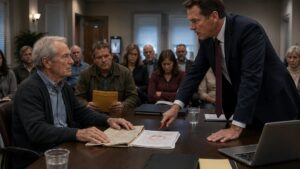
The board meeting began that afternoon in the Cedar Ridge clubhouse.
James sat near the end of a folding conference table with Nicole beside him. The survey sketch lay in front of them. Across the room, Katherine had the entrance plan open beside the treasurer.
There were no crowds. No shouting homeowners packed against the walls.
Only the people who had to deal with what the pink flags had made visible.
Katherine called the meeting to order.
For ten minutes they discussed contractor schedules, permit conditions, and the county’s request to pause grading in the disputed area.
Then Nicole slid the old email across the table.
“We should address this before discussing remedies.”
Katherine read the underlined sentence.
Her eyes flicked toward Michael.
He did not look away.
James waited.
Finally, Katherine said, “I knew counsel had raised the issue.”
The treasurer shifted in his chair.
“You said title was clear.”
“I said the later report did not identify a current easement tied to Mr. Mitchell’s parcel.”
“That’s not what you told us in executive session.”
Katherine’s jaw tightened.
James could see the moment she realized denial would make everything worse.
So she stopped denying.
“We had a project already delayed by drainage revisions,” she said. “The emergency connection was tied to county approval. We had contractors mobilized. We had material ordered. And we had an access claim that had never been cleanly recorded into the current parcel chain.”
James leaned forward.
“So you decided to close it first and ask questions later.”
“I decided not to halt a six-figure project over a reference nobody had established was enforceable.”
“You locked my only vehicle access.”
“Yes.”
The room became very still.
Katherine continued.
“And I believed we were legally entitled to do it.”
“Even with that warning?”
“I believed the later title summary gave us enough basis.”
Nicole spoke.
“Enough basis to investigate, perhaps. Not necessarily enough to permanently obstruct a potentially recorded easement.”
Katherine looked at her.
“I understand your position.”
“No,” James said. “You understand it now.”
Katherine turned toward him.
Something in her expression had changed from defensiveness to fatigue.
“You want to know why I pushed it?”
James said nothing.
She opened a financial sheet.
“If this project misses the county window, we rebid part of the entrance work. The contractor has already warned us about remobilization costs. We also lose the bundled pricing on the drainage section.”
The treasurer added quietly, “Reserve funding won’t cover the upper estimate.”
James understood before anyone said the words.
“Special assessment.”
Katherine nodded.
“Potentially.”
“How much?”
“We don’t know yet.”
“That means enough to scare people.”
“Yes.”
James leaned back.
For the first time, he saw what Katherine had been looking at when she looked at the lane.
Not his grandfather.
Not his business.
Not even the gravel.
She saw eighty-plus households receiving a letter saying the board needed more money because the entrance project had failed to stay on schedule.
Her reason did not excuse the fence.
But it was a reason.
Katherine folded her hands.
“I made a decision under pressure.”
“You made it with my property.”
“Yes.”
Again, no excuse.
James found that harder to enjoy than an argument.
Nicole placed another document in front of him.
It was a draft request for temporary injunctive relief.
“If necessary,” she said, “we can seek a broader stop until the easement issue is resolved.”
The treasurer looked up sharply.
“How broad?”
“Potentially any work dependent on the disputed connection.”
Katherine’s face went pale.
Michael spoke for the first time.
“That could affect more than the entrance.”
James looked around the table.
Three days earlier, he would have wanted exactly that.
Stop everything.
Make them understand what it felt like to have someone else close the only path forward.
Now he pictured the excavator operator sitting idle. Contractors remobilizing. Homeowners opening assessment notices. None of them had put the padlock on his gate.
Katherine had.
Michael had helped.
But punishment spread differently than responsibility.
The meeting adjourned without agreement.
Outside, James and Nicole stood beside his pickup.
Across the property, the chain-link gate remained locked.
James stared at it.
Nicole tucked the injunction draft into her folder.
“We have leverage now.”
“I know.”
“More than we had Tuesday.”
“I know.”
She studied him.
“If the county pause isn’t enough, we can ask for more.”
James looked toward Cedar Ridge.
A homeowner was pulling groceries from the back of an SUV. A child rolled a bicycle down a driveway. Ordinary Friday afternoon movement continued beyond the unfinished entrance.
“Could we stop the whole thing?”
“We could ask.”
“That wasn’t my question.”
Nicole waited.
James looked back at the fence.
“Yes,” she said. “There is a path where this gets much more painful for them.”
James nodded slowly.
Nicole closed her folder.
“So before we walk down that path, decide what you actually want.”
“My road.”
“That’s the easy answer.”
He frowned.
She pointed toward the gate.
“Do you want leverage, James?”
Then she pointed beyond it, down the gravel lane.
“Or do you want a road you never have to fight over again?”
Chapter 6: The Choice That Could Stop Everything
Nicole put two folders on James’s kitchen table Saturday morning.
One was thin.
The other was not.
“The thin one is a settlement framework,” she said.
“And the thick one?”
“Escalation.”
James touched neither.
“What does escalation get me?”
“A request for broader injunctive relief, preservation of the corridor, expedited title determination, and potentially damages tied to loss of access.”
“And the other?”
“A redesigned entrance, recorded easement, expense reimbursement, and defined maintenance obligations.”
James looked up.
“Maintenance obligations.”
“Yes.”
“So after they fence my road, I get to pay for it.”
Nicole did not react.
“You use it.”
“I’ve maintained it for years.”
“Informally.”
“There’s that word again.”
“There’s the problem again.”
James pushed his chair back.
He spent most of Sunday at the rear parcel.
The pedestrian gap beside the fence was still open, so he walked in carrying a thermos and the revised site plan.
Pink flags remained along the corridor.
He followed them from the gate toward the storage building.
The gravel changed under his boots where old repairs had been made: coarse gray stone near the ditch, smoother packed material near the bend, a patch of reddish aggregate his grandfather had spread after a spring washout.
For decades, maintenance had meant whoever noticed the rut first fixed it.
That had worked because the number of people involved could fit inside one pickup.
Now the lane touched an HOA entrance, county requirements, emergency access, contractors, insurance, and properties that had changed hands multiple times.
James stopped beside one of the pink flags.
His grandfather had not been wrong to trust a handshake and a recorded instrument in the world he knew.
James had been wrong to assume the world would never become more complicated.
Monday’s board session began with Katherine placing a proposal on the table.
“The association will remove the gate,” she said, “recognize continued vehicle access along the existing lane, and grant Mr. Mitchell permanent access by board resolution.”
James looked at Nicole.
She said nothing.
He turned back to Katherine.
“By board resolution.”
“Yes.”
“And a future board?”
“The resolution would remain in the records.”
“That wasn’t my question.”
Katherine’s expression tightened.
James slid the proposal back.
“No.”
The treasurer leaned forward.
“We’re offering the access you requested.”
“You’re offering permission.”
“We’re recognizing use.”
“Until somebody decides the board that came before them was wrong.”
Katherine shook her head.
“That isn’t our intent.”
“Your intent changed my access in one morning.”
Silence.
James placed the old instrument beside the proposal.
“I’m not doing this again.”
Nicole spoke calmly.
“A recordable easement solves that.”
Katherine glanced toward the treasurer.
“That creates title complications for association property.”
“So did the fence,” James said.
For nearly an hour, they moved through possible routes.
One option shifted the emergency loop too far into landscaping.
Another interfered with drainage.
A third preserved the twenty-two-foot corridor but narrowed a turning radius the county would not approve.
Then the grading contractor, attending by phone, suggested moving the interior connection several yards and altering the curb geometry rather than relocating the whole loop.
The room quieted while Michael marked the change on a plan.
Nicole measured the separation.
Katherine stared at it.
“That might work.”
The treasurer asked, “Cost?”
“Less than remobilizing after a full shutdown,” Michael said.
That was the first real opening.
By midafternoon, the board had a framework.
The HOA would redesign the connection around the recorded corridor.
The fence would be removed.
James’s documented survey and reasonable legal expenses would be reimbursed.
A modern easement would be recorded against the relevant parcels so the access survived future ownership.
Then Katherine reached the maintenance section.
“The association wants defined responsibility.”
James leaned back.
“For what?”
“Surface maintenance within the easement.”
“I’ve done it for thirty years.”
“Then putting it in writing shouldn’t be a problem.”
He recognized the trap immediately—not a legal trap, but his own.
Everything in him wanted to say no because Katherine wanted him to say yes.
Nicole glanced at him.
James looked down at the language.
Routine gravel maintenance would be shared according to use. Damage caused by HOA construction would be the HOA’s responsibility. Damage caused by James’s equipment or commercial traffic beyond ordinary use would be his.
Snow clearing would remain with whichever party needed access first, unless both agreed otherwise.
It was annoyingly reasonable.
James tapped the page.
“If your contractor breaks the edge with a dump truck?”
“Association.”
“If one of my customers tears it up with a trailer?”
“You.”
“If drainage from your entrance washes gravel out?”
“Association.”
James looked at Katherine.
“And if some future board decides the easement is inconvenient?”
Nicole answered instead.
“They cannot revoke a properly recorded property right by board vote.”
That was the sentence James had been waiting for since Tuesday.
Not an apology.
Not a victory.
Something stronger.
Durability.
The county planning official met them late that afternoon at the site.
They walked the proposed redesign with the survey map.
The pink flags still cut across the graded earth, but the revised entrance curved away before reaching them.
James stood in the center of the gravel lane.
Katherine came to stand a few feet away.
“You could have stopped more of the project,” she said.
“Yes.”
“Why didn’t you?”
James looked at the unfinished entrance.
“Because I wanted you off my road.”
A faint, tired smile touched her face.
“That simple?”
“No.”
He looked toward the houses.
“I also didn’t want eighty families paying for a mistake they didn’t make.”
Katherine nodded.
“I did.”
James turned toward her.
“What?”
“When I made the decision. I told myself I was protecting them from the cost.”
“And me?”
“You were the cost.”
The honesty landed harder than an apology would have.
Katherine looked down at the gravel.
“That was the mistake.”
James let the silence stand.
At the board table that evening, the final agreement was placed in front of him.
He read every page.
Years earlier, he would have signed nothing simply because someone wanted his signature.
This time he marked two phrases, asked Nicole to change one definition, and insisted that the agreement state plainly that the easement ran with the land and bound successor owners.
Katherine agreed.
Michael revised the document.
The treasurer initialed the board authorization.
James held the pen but did not sign yet.
“One more thing.”
Katherine waited.
“The fence comes down before construction resumes inside the entrance area.”
She nodded.
“Agreed.”
“And the recorded document gets submitted, not put in somebody’s file for later.”
“Agreed.”
James looked at Nicole.
She gave the smallest nod.
He signed.
Katherine signed after him.
For a moment, nobody spoke.
The paper did not look important enough to carry the weight James felt in his chest.
Just signatures.
Legal description.
Maintenance terms.
Successors and assigns.
Words his grandfather had once considered unnecessary additions to something everybody already understood.
James closed the folder.
Outside, the locked gate was still standing.
The agreement said it would come down.
The county had accepted the revised concept.
The board had voted.
But James had learned too much that week to mistake intention for completion.
He looked at Katherine.
“When is the recorder getting this?”
“Tomorrow morning.”
“And the fence?”
She glanced at Michael.
He checked his phone.
“The contractor can be there tomorrow afternoon.”
James rose from the table.
He had finally signed the paper he once would have called surrender.
Now there was only one question left.
Whether everyone else would do what they had just put in writing.
Chapter 7: The Road That Finally Had a Record
The same contractor who had driven the first steel post into James Mitchell’s gravel lane returned two weeks later with a socket wrench and a flatbed truck.
James stood beside his pickup and watched the man loosen the final bracket holding the chain-link gate to its post.
Nobody had called it a ceremony.
Nobody from Cedar Ridge had gathered to watch.
The excavators were back at work farther inside the development, operating along the revised entrance alignment. The pink survey flags still marked the twenty-two-foot corridor, though several had begun to lean after rain and construction traffic.
The contractor removed the padlock first.
It made a small metallic sound when he dropped it into a plastic bucket.
James remembered standing on the opposite side of that same lock, listening to Katherine tell him the board’s lawyers had already settled the matter.
The contractor glanced at him.
“You want the gate?”
James almost laughed.
“No.”
“Association said haul everything off.”
“Then haul it off.”
The worker nodded and returned to the bolts.
James had imagined the removal more than once during the past two weeks. In some versions, he thought he would feel satisfaction the moment the fence opened.
Instead, he noticed practical things.
The post hole would need filling.
A strip of gravel had been pushed aside during installation.
One tire rut near the ditch was deeper than it had been before.
The gate tilted as the contractor freed the last hinge.
Then two workers lifted it onto the flatbed.
For the first time since Tuesday morning two weeks earlier, there was nothing across the lane.
James stood where the barrier had been.
The opening looked ordinary.
That surprised him most.
There was no visible line in the air marking restored rights. No sign announced that the HOA had been wrong. The gravel simply continued forward.
He got into his pickup.
For a moment he kept his foot on the brake.
Then he drove through.
The tires made the same crunching sound they had made for years.
Past the entrance wall.
Past the pink flags.
Past the place where the new HOA loop now curved away from the easement instead of crossing it.
James drove slowly all the way to the rear parcel.
He stopped beside the equipment shed and shut off the engine.
The silence lasted only a few seconds before his phone rang.
Michael.
“It recorded.”
James leaned against the truck.
“You have the number?”
“I’m emailing the stamped copy now.”
James looked toward the lane.
“Not a draft?”
“No.”
“Not waiting on anybody?”
“No. Recorded this morning.”
James closed his eyes briefly.
“All right.”
Michael hesitated.
“The board also approved payment of the survey and legal invoices Nicole submitted. You should receive it next week.”
“Fine.”
“And the maintenance schedule starts next quarter.”
James opened his eyes.
There it was.
The part he once would have resisted.
The agreement did not simply give him something. It required him to do something too.
“Send me the schedule.”
“I will.”
When they disconnected, James stood beside the shed for another minute before driving back toward Cedar Ridge.
Katherine was waiting near the entrance.
She held a large white envelope.
James parked.
“I thought Michael emailed it.”
“He did.”
Katherine held out the envelope.
“This is the certified copy.”
James took it.
She did not offer her hand.
He was glad.
A handshake would have felt staged.
The contractor’s truck was still parked nearby while the workers loaded the final post.
Katherine looked toward the empty gap.
“I should have stopped the fence order when counsel raised the unresolved reference.”
James said nothing.
“I didn’t.”
“No.”
“I convinced myself the later summary was enough.”
“You wanted it to be enough.”
“Yes.”
That answer sounded more truthful.
James opened the envelope.
The recording stamp was visible at the top of the first page.
Below it was the modern legal description of the easement.
Twenty-two feet.
Successors and assigns.
Maintenance responsibility.
Drainage obligations.
The language was dry, repetitive, and far more durable than memory.
Katherine nodded toward the document.
“Your grandfather probably would have hated all those pages.”
James looked at her.
“You’re probably right.”
“And you?”
James folded the copy once, then stopped himself and slid it back into the envelope instead.
“Two weeks ago?”
“Yes.”
“I would’ve hated them too.”
Katherine gave a small smile.
“What changed?”
James looked at the gravel.
“My grandfather knew everybody who mattered when that road was created.”
Katherine followed his gaze.
“I don’t.”
The new entrance curved through fresh soil several yards away. Beyond it stood houses his grandfather had never seen, owned by people James barely knew. Contractors changed. Boards changed. Management companies changed. Property owners moved away.
James tapped the envelope against his palm.
“Turns out a road can outlive everybody’s understanding of why it’s there.”
Katherine nodded.
“That’s probably true of more things than roads.”
Neither of them said anything for a moment.
A dump truck approached the redesigned entrance and slowed.
The driver followed the new curve, well outside the pink flags.
James watched it pass.
That simple movement gave him more satisfaction than seeing the fence removed.
The revised plan worked.
No one needed to lose the whole project.
No one needed to pretend the easement was optional.
The road and the entrance could exist beside each other because both had finally been drawn as if the other mattered.
Katherine looked toward the houses.
“The special assessment is off the table.”
James raised an eyebrow.
“The redesign cost less?”
“Less than rebidding. More than getting it right the first time.”
“That sounds about right.”
“The board won’t enjoy explaining that.”
“You should explain it anyway.”
“I will.”
He believed she meant it.
That did not mean he trusted her the way he had before.
Trust, he had learned, was not something a recorded document could manufacture.
But neither was mistrust a reason to keep every conflict alive after the practical problem had been fixed.
Katherine started toward her SUV, then stopped.
“James.”
He looked over.
“I am sorry about the gate.”
The apology was quiet enough that he almost wished she had not said it.
It would have been easier to keep her in the role he had assigned her.
He looked at the empty space between the posts.
“I believe you.”
She nodded and left.
That afternoon, James brought a load of fresh gravel from the pile behind his shed.
He filled the two depressions where the gate posts had stood and raked the surface level.
Under the new maintenance agreement, the HOA could have handled half of it.
James did not call them.
Not because he wanted the old informal system back.
He simply already had the gravel.
The following week, the first customer trailer came down the lane.
James stood near the shed while the driver backed toward the stored equipment.
“No more fence?”
“No more fence.”
“What happened?”
James looked toward the distant entrance.
“Paperwork.”
The driver laughed.
“That good or bad?”
James considered the question.
“Both.”
After the trailer left, James returned to the house with the certified easement copy under his arm.
The green file box was still on the kitchen table.
He emptied it carefully.
His grandfather’s old deed lay near the bottom.
Behind it was the unfinished clarification document Nicole had found.
Blank signature lines.
An attempt to make something clearer that had never been completed.
For years, James would have looked at those pages and seen evidence that his grandfather had refused to let somebody rewrite what was already his.
Now he saw something else.
An unfinished job.
Not a betrayal.
Not a failure.
Just something left for the next person.
James placed the unsigned draft back into its envelope.
Then he put the newly recorded agreement directly behind it.
The old paper and the new paper did not match.
Different typefaces.
Different legal descriptions.
Different worlds.
But they described the same narrow stretch of ground.
James closed the folder and wrote the recording number on the front.
He paused before putting the file box away.
Outside the kitchen window, he could see only the beginning of the gravel lane before it disappeared behind trees.
For most of his life, that had been enough.
He had known where it went.
His grandfather had known.
Now the county knew.
The HOA knew.
Any future owner could know without asking James, Katherine, or anybody else to remember correctly.
He put the file box back on the shelf.
The next morning, James drove down the lane before starting work.
At the Cedar Ridge entrance, most of the pink survey flags had been removed.
One remained near the edge of the gravel.
He stopped, stepped out, and pressed it upright.
Then he left it there.
Not as a warning.
Not as a boundary someone needed to fight over.
Just as a small marker of where uncertainty had once become visible.
James climbed back into the pickup and continued through the open entrance.
Behind him, the gravel settled again beneath the tires.
Ahead, the road remained exactly where it had always been.
The difference was that now nobody had to take his word for it.
The story has ended.