The Engineer Behind the Chain Barrier Refused to Let Armed Authority Cross Without a Warrant
Chapter 1: The Pistol Beyond the Chain Barrier
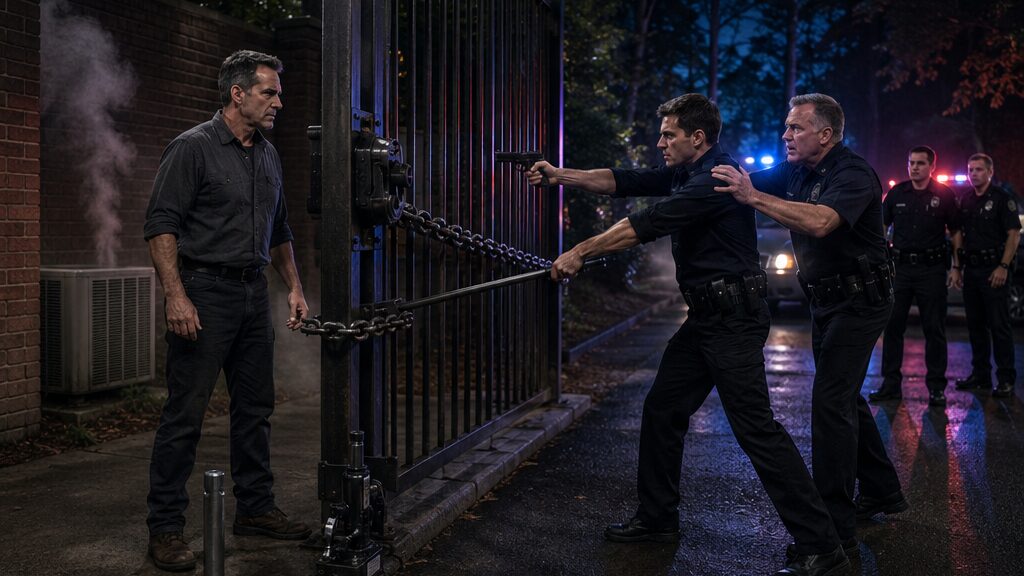
The pistol appeared between two links of the moving chain before the barrier had fully closed.
“Open it,” the officer shouted. “Open it now, or I’m coming over.”
Robert Harris kept both hands visible.
The chain slid through its steel guide with a low mechanical growl, drawing the gap shut between Robert’s driveway and the wooded cul-de-sac. Red and blue light flickered across the brick wall, the trunks of the oaks, and the officer’s rigid face. The muzzle followed Robert as he stepped backward.
“You’re aiming through an automated gate,” Robert said. “Move the weapon before the chain catches your wrist.”
The young officer pulled his arm back, but not the pistol.
The barrier reached its locking post and stopped with a heavy metallic clunk.
Robert stood ten feet inside his property, wearing a gray work shirt and dark trousers. He had no phone in his hands, no tool, no weapon. Behind him, white vapor drifted from a bank of broad vents built into the rear service structure. It curled upward in the late-afternoon heat and vanished over the brick wall.
The officer planted himself directly outside the chain.
“Ryan Walker,” he said, as if his name carried the force of an order. “Police department. We received multiple reports of a toxic release from this property.”
“I heard you the first time.”
“Then open the gate.”
“Do you have a warrant?”
Ryan’s jaw tightened. “This is an emergency inspection.”
“Your emergency is based on a report. You haven’t measured anything.”
“You don’t decide what counts as an emergency.”
“No,” Robert said. “Instruments do. Evidence does. And if you intend to enter without either, a judge will decide.”
Ryan lifted the pistol again, not quite aiming now, but keeping it high enough to make the point.
Robert looked past him. One patrol car blocked half the narrow street. Its driver’s door stood open. A woman in gardening gloves had come out from the house across the cul-de-sac and was holding her phone upright. Two other neighbors watched from behind a parked sport utility vehicle.
Barbara White lowered her phone just enough to speak.
“That’s the man,” she called. “He’s been venting that stuff all afternoon.”
Robert turned his head toward her. “It happens every afternoon when the load rises.”
“You never told anybody what it was.”
“You never asked me. You filed complaints.”
Barbara raised the phone again. “Because you built an industrial plant in a neighborhood.”
“It is a permitted equipment structure.”
Ryan struck the chain with the side of his hand.
“Stop talking to her. You’re talking to me.”
Robert’s eyes returned to him.
A second cruiser turned into the cul-de-sac, lights flashing but siren off. Ryan glanced toward it and seemed to stand taller.
“What’s in the building?” he asked.
“Equipment.”
“What kind?”
“Equipment you are not authorized to inspect.”
Ryan gave a short laugh with no humor in it. “That answer is not helping you.”
“It is not meant to help me. It is meant to answer only what you are legally entitled to ask.”
The second cruiser stopped behind the first. Two officers got out, both looking first at Ryan’s drawn weapon and then at Robert. One rested a hand near his holster.
Robert felt the situation narrow.
For thirty years, he had designed systems around failures: failed pumps, failed relays, failed cooling loops, failed human assumptions. A failure could be tolerated if it was isolated early. Once it spread across connected systems, every correction became more dangerous.
Ryan was connecting people to his assumption faster than anyone was testing it.
Robert raised his voice enough for all three officers to hear.
“There are no toxic materials being released from this property. The white discharge is condensation from a closed cooling system. I will cooperate with external testing. Nothing crosses the surveyed property line without a warrant or named federal authorization.”
Ryan looked toward the arriving officers.
“You hear that?” he said. “He’s setting conditions.”
“I’m stating conditions already set by law.”
Ryan touched the radio clipped to his shoulder. “Request additional units. Possible hazardous-material release. Noncompliant property owner refusing emergency access.”
Robert’s face remained still, but something old shifted behind his ribs.
Noncompliant.
The word had been used years earlier in a corridor with white floors and locked server cabinets. The inspection leader had said Robert was making a routine review unnecessarily difficult. Robert had yielded because refusing armed officials had seemed more dangerous than letting them pass.
He had opened the door.
By morning, years of work had been gone.
Ryan released the radio button. “Last chance.”
“No.”
Barbara stepped closer to the first cruiser, still filming. “Show them the video,” one of the neighbors told her.
“I already sent it to dispatch.”
“Show me,” Ryan said.
Barbara hurried forward. The screen showed a tight view of Robert’s rear wall. Dense white vapor rolled over the top in waves, thick enough in the cropped frame to obscure the trees behind it.
Ryan watched twice.
“When was this taken?”
“About forty minutes ago.”
Robert knew the exact cooling cycle. Forty minutes earlier, the secondary loop had entered a purge phase after a humidity spike. The vapor looked dramatic because Barbara had filmed against the dark trees and cut away before it dissipated.
“Play the beginning,” Robert said.
Barbara pulled the phone toward her chest. “You don’t tell me what to do.”
“The first three seconds show the vent.”
Ryan glanced at her. “Does it?”
“It’s the same video.”
“That wasn’t my question.”
Her pause lasted only a moment, but Robert saw it.
Then the vapor pulsed again behind him. One of the officers took a step backward.
Ryan pointed through the chain. “Shut that system down.”
“I cannot.”
“You mean you won’t.”
“I mean an uncontrolled shutdown can damage what it cools.”
Ryan’s expression changed.
Not fear. Recognition of an opening.
“What exactly would be damaged?”
Robert said nothing.
Ryan stepped nearer to the chain. “Evidence?”
“No.”
“Chemicals?”
“No.”
“Then tell me.”
“I will explain the cooling system to a qualified hazard specialist. I will not describe protected equipment to armed officers in an open street.”
Barbara made a small sound of disbelief for her audience.
Ryan keyed his radio again. “Subject admits he cannot shut down the active system and refuses to identify what it supports.”
“That is not what I said.”
“It’s on camera,” Ryan replied.
“So is what I actually said.”
Robert reached toward a weatherproof control box mounted on the inside gatepost. Every officer shifted.
He stopped with his hand six inches from it.
“I’m activating the boundary display,” he said. “Nothing else.”
Ryan did not lower the pistol.
Robert pressed the lower button with one finger.
A rectangular screen lit beside the chain. A survey map appeared, overlaid with a red line following the inner face of the brick wall and crossing the driveway just beyond the barrier. Five camera icons blinked green. Beneath them, a time code advanced by the second.
Robert pointed to the screen.
“The property line is sensor-mapped. Every object that crosses it is recorded from three angles and synchronized to an independent clock.”
Ryan stared at the display.
“You expect me to believe that?”
“I don’t require your belief.”
A third cruiser entered the cul-de-sac. Then a fourth.
The quiet street filled with engines, radios, open doors, and pulsing color. Officers began moving neighbors farther back, but Barbara remained near the front because Ryan had not ordered her away.
One of the newly arrived officers approached him.
“Fire is en route,” the officer said. “Supervisor too.”
Ryan nodded without looking away from Robert.
“Good.”
Robert heard the word for what it was. Not relief that trained personnel were coming. Reinforcement.
Ryan lifted his radio.
“Update,” he said. “Homeowner has fortified access, refuses shutdown, refuses to identify interior equipment, and may be concealing an ongoing chemical release.”
The report moved outward through the department before Robert could answer it.
At both ends of the cul-de-sac, patrol cars turned sideways and sealed the road.
Chapter 2: Clean Readings Nobody Wanted to Hear
Nicole Green walked directly into the white vapor with a detector held at chest height.
Ryan told her to stop.
She ignored him.
The plume drifted over the rear corner of Robert’s brick wall, crossed the strip of grass outside the property, and wrapped around her dark protective jacket. Her handheld instrument remained silent. She turned slowly, watching the readings.
“No alarm,” she said.
Ryan stood beside the chain barrier with two officers behind him. His pistol was finally holstered, though his hand stayed close to it.
“Could be intermittent,” he said.
Nicole looked at the vapor passing across her face shield. “It is happening now.”
“Could be something the meter doesn’t detect.”
“It detects the substances named in the calls.”
Barbara spoke from behind the police line. “Nobody knew what kind of poison it was.”
Nicole turned toward her. “Then why did three callers use the phrase chlorine gas?”
Barbara hesitated. “That’s what it smelled like.”
Nicole lifted her face shield.
“I don’t smell chlorine.”
“It comes and goes.”
Robert watched from inside the chain. More than an hour had passed since Ryan’s arrival. The sun had dropped behind the trees, leaving the cul-de-sac in alternating bands of shadow and emergency light.
Nicole moved along the wall, testing at three heights. A second instrument measured oxygen and combustible gases. She checked the storm drain, the gaps at the base of the bricks, and the air beside the vents.
“What is the discharge temperature?” she called to Robert.
“Three degrees below ambient at the outlet. It warms almost immediately.”
“Water source?”
“Closed-loop heat exchange. Atmospheric moisture condenses during purge cycles.”
“What refrigerant?”
Robert gave her the commercial designation.
She nodded once. “Toxic at these levels?”
“There is no refrigerant in the exterior discharge.”
“That wasn’t the question.”
“No. The refrigerant is contained in the sealed loop.”
Ryan stepped between them. “You said you wouldn’t discuss the system.”
“I said I would discuss it with a qualified specialist.”
Nicole looked at Ryan. “Let him answer.”
Ryan’s mouth tightened.
She finished the perimeter check and returned to the command vehicle parked near the entrance to the street. A broad-shouldered supervisor had arrived ten minutes earlier and introduced himself as Patrick Moore. He had listened more than he had spoken, which Robert considered the first useful development of the evening.
Nicole removed one glove and entered figures on a tablet.
“Exterior atmosphere is normal,” she said. “Oxygen normal. No chlorine, ammonia, hydrogen sulfide, volatile organic spike, or combustible concentration. Surface temperature on the wall is consistent with heat rejection equipment. The white material is water vapor.”
Patrick looked at the rear wall. “Can you rule out something contained inside?”
“I can rule out an exterior release detectable from every accessible side.”
Ryan folded his arms. “So you can’t rule out an interior hazard.”
Nicole’s eyes moved to him. “An interior hazard was not reported. A poison cloud was.”
“The owner could have reduced output before we arrived.”
Robert spoke from behind the chain. “The system logs every cycle. I will provide those logs under an appropriate request.”
Ryan turned. “Not after you’ve had time to edit them.”
“They are write-protected.”
“So you say.”
Patrick raised one hand. “Enough.”
He looked toward Robert.
“Mr. Harris, nobody wants to damage your property. We have multiple emergency calls, visible discharge, and a structure nobody here understands. Give us a path to verify there is no danger.”
“You have one,” Robert said. “External measurements.”
“I’m asking for more than that.”
“And I’m asking for lawful authority.”
Patrick’s expression showed fatigue rather than anger. “Do you have something in writing?”
“Yes.”
Robert walked toward the gatepost. Ryan moved at once, blocking Patrick’s direct path to the chain.
“Stay back,” Ryan told him.
Patrick frowned. “I’m not crossing the gate.”
“He may be trying to pass something.”
“A document,” Robert said.
Ryan looked at him. “Hold it up.”
Robert took a clear protective sleeve from the control box. Inside was a certified copy bearing a federal seal and a case number. He held it against the chain, facing outward.
Patrick stepped closer.
Ryan extended an arm across his chest.
“Sir, he’s controlling the distance. We don’t know if the gate is energized.”
“It is not energized,” Robert said.
Ryan ignored him. “Have him slide it underneath.”
“No,” Robert said.
Patrick looked through the links, trying to read the first page from six feet away.
“Why not?”
“Because passing the original copy beyond my boundary gives Officer Walker an opportunity to seize it, damage it, or claim I transferred something else. You may photograph it where it is.”
Ryan gave a disbelieving laugh. “Listen to yourself.”
Robert kept the sleeve steady. “I have been listening carefully to all of you.”
Nicole came beside Patrick, but Ryan shifted again, limiting their view.
Patrick’s voice hardened.
“Walker. Step aside.”
For the first time, Ryan did not obey immediately.
Then he moved half a pace.
Patrick photographed the first page through the chain. Robert turned it to the second, then the signature page. The order prohibited local search, seizure, disconnection, interruption, or entry without a warrant or authorization from named federal authorities, except in the presence of a measurable and immediate threat to life.
Patrick read the exception twice.
Nicole held out her tablet. “There is no measurable exterior threat.”
Ryan leaned close to Patrick and spoke quietly, though Robert’s gate microphone caught every word.
“He said shutting down would damage what’s inside. That sounds like destruction of evidence.”
Robert’s grip tightened on the document sleeve.
Patrick looked at Ryan. “He said an uncontrolled shutdown could damage equipment.”
“He won’t say what equipment.”
“That does not make it evidence.”
“It makes it concealed.”
Robert watched Patrick absorb the distinction and then resist what it required. The supervisor had inherited Ryan’s scene. To withdraw now, with half the neighborhood watching and cruisers blocking the road, would mean announcing that the deployment had been built on a mistake.
Patrick faced the officers.
“Lower long guns. Sidearms remain holstered unless circumstances change.”
Two officers relaxed visibly. Ryan did not.
Patrick continued. “No one crosses the barrier. No one touches the wall. We verify the order and wait for legal guidance.”
Barbara’s voice rose behind the line.
“You’re just going to trust him? My granddaughter lives in that house.”
Nicole turned. “Your granddaughter’s house has clean air.”
“For now.”
Ryan looked toward Barbara, then back at Patrick. “If we leave and someone gets hurt—”
“We are not leaving,” Patrick said.
The words restored something in Ryan’s posture.
Robert saw it and understood that partial restraint would not be enough. Patrick had reduced the visible threat but preserved the assumption beneath it: that Robert’s property remained a problem requiring police control.
Nicole came closer to the chain.
“Can you increase the discharge on command?” she asked.
“Yes.”
“Don’t,” Ryan said.
Nicole ignored him again. “Can you show the relationship between equipment load and visible vapor?”
Robert considered the question.
“Yes, but I would need to access the internal controls.”
Ryan spoke immediately. “Meaning he leaves our sight.”
“My control room is thirty yards from this gate.”
“And what happens while you’re in there?”
“The system continues operating.”
Patrick stepped in. “Not yet. Let dispatch verify the injunction first.”
He returned to the command vehicle and gave the case number over the radio. The answer took longer than it should have. Robert remained beside the chain, the document still held against it.
Behind him, vapor rose in a thin ribbon and disappeared.
Ryan stared at it as if waiting for it to become dangerous.
Nicole finished her written report and sent it to Patrick’s tablet. “Time-stamp that,” she said. “My finding is no detectable exterior hazard.”
Ryan heard her.
He turned away and keyed his shoulder radio.
“Scene remains active pending verification,” he said. “Possible concealed source. Exterior readings inconclusive as to interior conditions.”
Nicole’s head snapped toward him.
“That is not my finding.”
Ryan released the button. “I said they don’t establish interior conditions.”
“You left out the part where every reported substance tested negative.”
“I summarized.”
“You changed the meaning.”
Patrick emerged from the command vehicle before the argument could sharpen.
“Dispatch has the federal clerk’s office,” he said. “The injunction number is valid.”
Robert lowered the sleeve slightly.
Ryan’s face gave away nothing.
Patrick looked from the photographed order to the brick wall and then to Robert.
“There’s a problem,” he said.
“What problem?” Nicole asked.
“The protected subject is sealed. Dispatch can confirm the restrictions, but not what they cover.”
The cul-de-sac seemed to contract around the barrier.
A valid federal order protected something inside Robert’s property, and nobody on the street was authorized to know what it was.
Chapter 3: The Order With the Missing Purpose
The dispatcher’s warning came through Patrick’s speaker loud enough for everyone near the command vehicle to hear.
“Supervisor, federal clerk advises unauthorized entry may trigger immediate judicial review. Protected subject remains sealed. No further details available to local agencies.”
Ryan looked at Robert as if the sealed information itself were evidence of wrongdoing.
Patrick switched off the speaker and walked to the chain.
“Mr. Harris, I need enough context to make a safe decision.”
“You have the order.”
“I have restrictions around something I cannot identify.”
“That is the purpose of sealed protection.”
Patrick stopped several feet from the barrier. “I’m not asking you to announce classified details to the neighborhood. I’m asking whether there is any substance, device, process, or material inside that could threaten people outside this wall.”
“No.”
“Could interference with the system create such a threat?”
“No.”
“Could shutting it down?”
“It could cause damage inside.”
“To what?”
Robert did not answer.
Ryan made a small gesture toward Patrick, as if the silence proved his case.
Patrick’s patience thinned. “You cannot ask me to assume there is no danger while refusing to describe the consequence of failure.”
“I am not asking you to assume. Specialist Green measured the air. The order defines the exception. Neither supports entry.”
“The order also assumes cooperation.”
“No. It defines authority.”
Nicole stood beside the command vehicle, arms folded. She was watching Robert now with the same skepticism she had directed at Ryan.
Patrick lowered his voice.
“Give me one sentence I can use.”
Robert looked past him at Barbara’s phone, the officers’ body cameras, the open police radios, and the neighbors pressing against the far line.
“One sentence becomes a question,” he said. “The answer becomes another question. In five minutes, protected information is being discussed on an open street because an officer decided my refusal was suspicious.”
Ryan stepped forward. “Your refusal is suspicious.”
Robert held the injunction against the chain again, the federal seal catching flashes of blue light.
“My refusal is anticipated by this order.”
Ryan pointed toward the document. “Then slide it out.”
“No.”
“Why? Afraid we’ll read the part you’re hiding?”
Patrick turned sharply. “Walker.”
Robert placed the sleeve flat against the links, not beyond them.
“You may photograph every page,” he said. “The document remains on my side.”
For a moment, the physical arrangement was exact: Robert’s hand, the clear sleeve, the steel chain, Patrick’s camera. Nothing crossed. Nothing needed to.
Patrick photographed the remaining paragraphs.
Ryan paced away.
A shrill alarm sounded behind Robert.
It came from the service building: three rising tones, a pause, then three more.
Every officer moved.
Ryan’s hand went to his weapon.
“What is that?” Patrick demanded.
Robert turned toward the property. A yellow beacon had begun flashing above the equipment-room door.
“Cooling restriction.”
“Cause?”
Robert looked beyond the wall toward the street entrance. Two police sport utility vehicles had been parked nose-to-tail beside the eastern brick section.
“Your vehicles are blocking the auxiliary exhaust path.”
Ryan drew his pistol. “Stay where you are.”
“If I stay here, the system will increase purge output.”
“Then shut it down.”
“That would be worse.”
Robert stepped backward.
Ryan raised the pistol to chest level. “Do not move.”
Nicole checked the vapor now rolling more heavily above the wall.
“He may be right,” she said. “Blocked airflow would raise back pressure.”
Ryan did not look at her. “He is not leaving our sight during an active investigation.”
Patrick hesitated.
The alarm sounded again.
Robert heard the secondary fans change pitch. He could picture the load graph without seeing it: exhaust pressure climbing, automatic compensation beginning, moisture condensing faster across the outdoor coils.
“You have two options,” Robert said. “Move the vehicles, or let me reroute through the north bank.”
Patrick turned toward an officer. “Move them.”
Ryan shook his head. “That opens the east approach.”
“It is already blocked by patrol units farther down.”
“Sir, he may be creating a distraction.”
Robert’s voice became colder. “The distraction is your equipment obstructing mine.”
Patrick pointed. “Move the vehicles now.”
As engines started, Robert walked quickly toward the control room.
“Robert!” Ryan shouted.
It was the first time he had used Robert’s name.
Robert did not stop.
The pistol remained aimed at his back until the angle of the service building hid him from view.
Inside the control room, the air was cool and dry. Rows of monitors showed pressure, temperature, power draw, and camera feeds. On one screen, Ryan was speaking rapidly to Patrick. On another, Barbara held her phone above an officer’s shoulder to film the closed chain.
Robert sat at the central console and rerouted the auxiliary airflow through the northern cooling bank. The change had to be staged. Too fast, and the pressure differential could trip the older valves.
He opened the north dampers to twenty percent.
The vapor above the rear wall thickened.
Outside, Ryan pointed at it.
Robert increased the northern draw, reduced the east fans, then waited for the pressure line to flatten.
The yellow alarm changed to green.
He saved the event log in a protected file and sent a copy to the injunction archive. Then he switched the gate display to a live cooling diagram stripped of protected labels.
When he returned outside, the vapor was already thinning.
Ryan stood at the chain.
“What did you do in there?”
“Corrected the obstruction.”
“What else?”
“Nothing relevant to you.”
Ryan turned toward Patrick. “He had unrestricted access to the interior after we warned him not to alter anything.”
Patrick looked at the green status light above the service door. “The alarm stopped.”
“Which proves he changed the system.”
Robert touched the gate display. A simple graph appeared, showing exhaust pressure rising at the time the police vehicles parked beside the wall, then falling after they moved and airflow was rerouted.
“The heavier vapor was a protective response,” Robert said. “When cooling efficiency drops, the system increases circulation. More circulation produces more visible condensation.”
Nicole approached the display.
She studied the graph and compared its timestamps with her tablet.
“That matches the vehicle movement,” she said.
Patrick exhaled through his nose. “So the larger plume was caused by our parking.”
“Partly,” Robert said.
Barbara called from behind the line. “He could make that screen say anything.”
Robert looked at her. “Your video captured the same sequence. Full version, not the crop.”
Her phone lowered by an inch.
Ryan saw it.
“What crop?” he asked.
Barbara’s eyes moved toward him. “I shortened the video. That doesn’t change what was coming out.”
“What did you remove?”
“Nothing important.”
Nicole spoke before Robert could. “The vent source, probably. And the dissipation.”
Barbara lifted her chin. “People were scared.”
Ryan stared at her for a moment, then turned back toward Robert as though choosing the more useful conflict.
“He still hasn’t shown us what’s inside.”
Patrick rubbed a hand over his mouth.
Robert could see that the supervisor now understood several facts: the vapor was harmless, the order was valid, the police vehicles had worsened the visible discharge, and Barbara’s evidence had been edited. None of those facts had yet given him a graceful way to end the operation.
That was Robert’s mistake, and he knew it.
He had protected every secret so tightly that even the reasonable questions had nowhere to go. Ryan had filled the empty space with suspicion, and Patrick had allowed him to.
Patrick walked toward the command vehicle, then stopped.
“We need a visual inspection of the exterior equipment,” he said. “Nothing enters the property. Nothing touches the structure.”
Robert’s gaze fixed on him. “From where?”
“Over the wall. Pole camera only.”
“No.”
Patrick’s face hardened. “I am trying to create the least intrusive option available.”
“You are describing surveillance across a protected boundary.”
“I’m describing a camera looking at vents already visible from neighboring property.”
“Then look from neighboring property.”
“The angle is obstructed.”
“That does not create authority.”
Ryan came up beside Patrick. His voice was calmer now, which made Robert trust it less.
“A camera over the wall settles this,” he said. “If it shows ordinary cooling equipment, we leave.”
Robert looked at him.
“No, you won’t.”
Ryan’s expression sharpened. “You don’t know that.”
“You have ignored clean readings, a valid injunction, an altered complaint video, and the cause of the increased vapor. A camera will not satisfy you. It will give you another image you do not understand.”
Patrick looked between them.
Then he spoke without meeting Robert’s eyes.
“One camera. Exterior view only. No entry, no contact, no attempt to manipulate anything.”
Ryan nodded immediately.
Robert heard the agreement for what it was: not a compromise, but permission waiting for misuse.
Patrick raised his radio and authorized the pole camera.
Ryan turned toward the equipment vehicle.
“Bring the hook assembly,” he called.
Chapter 4: The Hook That Changed the Line
The steel hook dropped out of the dark and struck the yard less than a foot from a yellow marker labeled COOLING CONTROL CONDUIT.
Robert moved before it could settle.
The hook bounced once on the gravel, its rope scraping across the top of the brick wall. A camera pole tilted above it, swaying against the emergency lights. From outside came the sharp commands of officers trying to steady both tools at once.
“Hold it there,” Ryan called. “Lower the camera another two feet.”
Robert stopped beside the conduit marker.
“That is beyond the authorized exterior view.”
No one answered him.
The camera head descended past the wall’s inner edge. Its lens turned toward the service building rather than the exposed vents.
Robert looked at the fixed security camera mounted beneath the roofline. Its green indicator remained steady. The gate display would already be marking the pole’s coordinates against the surveyed boundary.
“Patrick,” Robert called. “Your officer is directing the camera into the property.”
Patrick’s voice came from the street. “Walker, keep it on the vent housing.”
“That is what I’m doing.”
“No,” Robert said. “You are aiming it at a secured doorway.”
The pole shifted abruptly. The hook dragged across the gravel toward the buried conduit.
Robert stepped on the rope.
Outside, it snapped taut.
“Release police equipment!” Ryan shouted.
“Stop pulling. The hook is beside a control cable.”
“You put it there.”
“You threw it over my wall.”
Robert crouched without touching the hook. Its point had landed inside the painted clearance zone around the buried line. Another hard pull could drive it beneath the protective grate.
“Slack the rope,” he said.
“Back away from it.”
“Slack it.”
Patrick’s voice cut through the argument. “Walker, ease off.”
The tension disappeared.
Robert lifted the hook carefully by its shank, keeping the points turned away from his body. He carried it toward the barrier while the camera pole remained above the wall.
Ryan appeared through the chain links.
“Set it down and step back.”
Robert placed the hook on the pavement inside the property, close enough to the barrier for every camera to see it but well behind the red survey line.
“It crossed above the wall at eight fourteen and thirty-seven seconds,” he said. “It landed inside the conduit clearance zone. I removed it to prevent damage. It remains available for retrieval under lawful conditions.”
Ryan gripped the links. “You seized department property.”
“I prevented your department from tearing through a control cable.”
“You don’t get to decide what we retrieve.”
“You do not get to retrieve it by entering.”
Barbara’s voice rose behind the police line.
“He took it. I have the whole thing live.”
Robert could see her phone held above one shoulder. The screen showed comments climbing too quickly to read. She angled herself so the hook was visible through the chain, then turned the camera toward her face.
“He grabbed their equipment and dragged it behind the gate,” she said. “They’re trying to protect all of us, and he’s stealing from them.”
“You omitted the part where it landed inside his property,” Nicole said.
Barbara swung the phone toward her. “You said there was no gas. What if you’re wrong?”
“I said every test is clean.”
“Tests miss things.”
“Sometimes,” Nicole replied. “That does not make every fear evidence.”
Ryan walked away from the gate and toward Patrick. Robert could not hear the first words, but the security microphone near the wall caught them as they came closer.
“He is interfering with an authorized inspection.”
Patrick held Nicole’s tablet in one hand. “The inspection was exterior only.”
“The camera never touched the ground.”
“The hook did.”
“That was stabilization.”
Patrick looked down at the report. “Why does your radio summary say the readings were inconclusive?”
“They were inconclusive about the interior.”
Nicole stepped between them.
“My report says no exterior hazard and no evidence supporting the substances named by callers. You left out both findings.”
Ryan’s face flushed beneath the cruiser lights. “I summarized an active scene.”
“You changed a negative finding into uncertainty.”
“I did not tell you how to write your report.”
“No. You only told everyone else something different from what it said.”
Patrick read the tablet more closely.
Robert watched the supervisor’s expression change. Not shock. Recognition followed by the slower discomfort of realizing that the contradiction had been present for nearly an hour.
“Walker,” Patrick said, “did dispatch receive the full findings?”
“They received what was operationally relevant.”
“That was not my question.”
Ryan glanced toward the officers, the neighbors, and Barbara’s raised phone.
“I reported that no exterior reading confirmed a release.”
“You reported that the readings were inconclusive.”
“Because they were.”
Nicole pointed toward the white vapor thinning above the wall. “Not about that.”
For several seconds, Ryan said nothing.
Robert saw the decision form before Ryan made it. He could accept correction and lose control of the scene, or he could turn the correction into another reason to force an ending.
He chose the second.
Ryan looked toward the barrier.
“The owner has withheld the purpose of the facility, altered equipment after police arrival, obstructed an authorized camera inspection, and taken department property. We cannot leave without securing the gate.”
Patrick’s head came up. “We are not securing anything.”
“Then we’re abandoning a possible hazard because he has paperwork we cannot verify beyond a sealed number.”
“We verified the restrictions.”
“We did not verify the emergency exception does not apply inside.”
Nicole let out a short breath. “You cannot invent an interior emergency because the exterior emergency disappeared.”
Ryan ignored her.
Barbara continued filming. Her comments were feeding him an audience even when no one spoke.
Patrick turned toward Robert.
“Return the hook.”
“I will place it in the gate exchange box if Officer Walker steps away and the retrieval is documented.”
“There is no need for conditions.”
“There has been a need for conditions since his pistol entered the chain.”
Patrick looked at the weapon on Ryan’s belt, then at the hook.
“Use the exchange box.”
Robert opened a narrow steel compartment built into the gatepost. He placed the hook inside, closed the interior door, and pressed the transfer control. A light changed from red to green on the street side.
An officer retrieved it without crossing the line.
The small exchange should have lowered the temperature of the scene. Instead, Barbara spoke into her phone.
“They forced him to give it back.”
Robert turned away from her.
Patrick pointed at the equipment vehicle. “Pack up the pole camera.”
Ryan did not move.
“Walker.”
“We still need access to the mechanism.”
“No.”
“He locked the gate during an emergency call.”
“It is his gate.”
“He could trap responders outside if conditions worsen.”
Patrick stepped nearer. “The exterior readings are clean. The injunction is valid. The camera operation exceeded what I authorized. We are done escalating.”
The words were clear enough that several officers began lowering equipment.
Ryan looked at them and saw command slipping away.
Then the cooling system released another brief plume. White condensation rolled over the brick wall, brilliant beneath the lights.
Barbara gasped for her viewers.
Ryan turned toward the equipment vehicle, opened a side compartment, and pulled out a Halligan bar.
The tool was dark steel, forked at one end and pointed at the other. He carried it toward the gate with both hands.
Patrick blocked his path.
“What are you doing?”
“Testing whether the mechanism can be opened manually.”
“I told you to stand down.”
“I can force only the gate latch. We do not enter the building. We create emergency access and hold the threshold.”
Robert approached the inner side of the barrier.
“The latch is inside my property.”
Ryan stared through the chain.
“The chain is in the street.”
“The surveyed line is displayed beside you.”
Ryan glanced at the red line on the screen and then back at Robert.
“I’m not interested in your private map.”
“It is the county-recorded boundary.”
Patrick reached for the Halligan bar. Ryan shifted it away.
“Give me the tool,” Patrick said.
“With respect, sir, if something happens after we leave, every camera here will show that we had access and refused to act.”
The argument was no longer about gas. Robert could hear that plainly. It was about what the cameras might say about Ryan.
Patrick looked around at the phones, cruisers, and officers waiting for him to choose.
Ryan lowered the forked end of the Halligan bar toward the narrow gap beside the gatepost.
“I can force only the mechanism,” he said again. “No one crosses.”
Robert placed one hand on the inside control housing.
“Anything you insert through that gap crosses.”
Ryan’s eyes fixed on Robert’s hand.
Then he slid the steel tool forward.
Chapter 5: What Robert Had Failed to Stop Before
“Have they crossed the recorded line yet?”
Laura Adams’s voice came through the secure terminal before her image resolved.
Robert stood inside the control room, one hand braced on the console. On the camera wall behind him, Ryan held the Halligan bar near the gate while Patrick argued with him beneath the flashing lights.
“The hook crossed,” Robert said. “It was removed and returned. The pole camera crossed above the wall.”
“And now?”
“The Halligan has not crossed yet.”
Laura’s face sharpened into focus. She sat in a dim office, glasses low on her nose, a stack of files behind one shoulder. The call indicator showed that the connection was encrypted and being archived.
“The injunction alert included a cooling event and attempted perimeter access,” she said. “Explain the cooling event.”
“Police vehicles blocked the east exhaust route. I rerouted airflow.”
“Any damage?”
“No.”
“Any threat to life?”
“No.”
“Any measurable hazardous discharge?”
“Every exterior test is negative.”
Laura looked away from him, reading information arriving on another screen.
“Then the emergency exception has not been established.”
Robert watched Ryan advance the bar toward the narrow space beside the locking post.
“Tell them that.”
“I can tell them what the order says. I cannot supervise a local scene through your monitor without admissible evidence of a current violation.”
“They have ignored the order.”
“They have argued around it. That is not the same thing.”
Robert’s jaw set.
“The camera crossed.”
“Did it enter a protected structure?”
“No.”
“Did it make contact?”
“Not that I can prove.”
“Then preserve the footage. Do not dramatize what the evidence cannot yet carry.”
He looked at her.
“You think I’m dramatizing this?”
“I think you waited until an officer was holding a breaching tool at your gate before giving me a complete account.”
“I followed the notification protocol.”
“You triggered an automated alert. That is not the same as communicating.”
Outside, Patrick pointed toward the equipment vehicle, ordering Ryan back. Ryan shook his head.
Robert switched one monitor to the gate microphone.
Patrick’s voice filled the control room.
“Put the Halligan down. That is a direct order.”
Ryan answered, “Sir, he just reached for the gate controls. He may be preparing to alter or destroy the interior system.”
Laura heard it.
“What did you reach for?”
“The manual release.”
“Why?”
Robert looked toward the control-room door.
He had touched the release without consciously deciding to. The red handle hung in the equipment corridor between him and the gate, designed to disengage the motor during fire or power failure. For one second, his hand had rested on it.
Not to open the barrier.
To feel whether he still could.
Years earlier, another handle had been cold beneath his palm.
The inspection team had arrived without the written authorization Robert had requested. They had badges, agency jackets, and a schedule they claimed could not move. The lead inspector had called the delay a routine compliance concern.
Robert’s colleague had stood beside the server-room door and whispered, “Do not open it until legal calls back.”
Robert had opened it.
The inspectors had ordered an immediate power isolation after misreading a heat alarm. Robert had warned them that the recovery array required a staged shutdown. They had threatened removal if he interfered.
He had stepped aside.
The array had collapsed across three dependent systems. Protected recovery images had corrupted. Months of reconstruction failed. His colleague had been blamed for insufficient redundancy and had never worked in the field again.
Robert had kept his position.
That had been the hardest part to forgive.
“Robert?” Laura said.
He returned his attention to the screen.
“I was checking the manual release.”
“To open the gate?”
“No.”
“Then why touch it?”
He looked at the red handle on the corridor wall.
“Because the last time officials demanded entry, I opened the door.”
Laura became still.
“You never included that in your security review.”
“It was in the incident record.”
“The technical failure was. Not this.”
“There was no reason.”
“There is a reason now.”
Outside, Ryan struck the Halligan bar lightly against the gatepost, testing the gap.
Robert’s hands curled at his sides.
“The predecessor facility held a recovery system,” he said. “They ordered an uncontrolled isolation. I knew the shutdown sequence. I let them override me.”
“Under threat.”
“I opened the door.”
“And you built this site so no one could put you in that position again.”
Robert said nothing.
Laura removed her glasses.
“The facility behind you is not a private experiment. It is a protected offline recovery installation. Its arrays hold reconstruction data for systems that cannot remain connected to public networks. A forced power interruption could corrupt active indexing and compromise years of work.”
“I know what it is.”
“You know the machinery. I am talking about your obligation.”
“My obligation is to keep them out.”
“Your obligation is to protect the system. Sometimes that requires refusing entry. Sometimes it requires giving enough lawful information to stop frightened people from creating a worse emergency.”
“They had the order.”
“They had a sealed order and a resident who would not explain whether a shutdown could endanger the neighborhood.”
“It cannot.”
“You told me that in five seconds. You could have told the supervisor the same thing an hour ago.”
Robert looked at Patrick on the monitor. The supervisor was now reading something from Nicole’s tablet while Ryan stood apart, the Halligan still in his hands.
“I should not have to explain protected work to justify a warrant.”
“No,” Laura said. “But you should understand the difference between surrendering a right and preventing a misunderstanding from becoming armed.”
The words landed harder because they were not entirely against him.
Robert had treated every question as the first pressure against a locked door. Ryan had exploited that rigidity, but Robert had supplied the silence.
“Can you stop them?” he asked.
“If the tool crosses the surveyed boundary after authorization is withdrawn, yes. If they breach or attempt to seize protected equipment, yes. Until then, I can contact command counsel and warn them.”
“That may take too long.”
“Then make the evidence exact.”
Outside, Patrick faced Ryan.
“Your authorization is revoked,” he said. “Step away from the gate.”
Ryan raised his voice for the officers and cameras.
“I observed the homeowner reach for the control mechanism immediately after being told not to alter the system. I believe evidence is at imminent risk.”
“You are not the scene commander.”
“I am the officer who made contact. If we leave and he purges whatever is inside—”
Nicole interrupted. “Nothing in my readings supports that.”
Ryan pointed the Halligan toward the wall. “Your readings do not tell us what he is doing now.”
Patrick stepped closer.
“Put it down.”
Robert left the control room.
In the equipment corridor, he stopped beside the manual release. His fingers touched the red handle again.
A turn and a downward pull would disengage the chain. The barrier would open under gravity control. Police would call it cooperation. Ryan would enter. Perhaps Patrick would keep him from reaching the building. Perhaps Nicole would insist on limits.
Perhaps Robert would again stand beside an open door while officials decided his expertise was obstruction.
He withdrew his hand.
At the workbench, he opened a lower cabinet and removed a heavy iron pin, a compact hydraulic jack, and two steel bearing plates. The tools were used for gate maintenance, not defense. Their weights steadied him.
He carried them toward the driveway.
The chain barrier remained closed. Ryan stood at the gap beside the locking post, angling the forked end of the Halligan toward the internal latch.
Patrick saw Robert approach.
“Mr. Harris, step away from the gate.”
Robert set the jack and plates on the pavement in full view.
“I am not opening it.”
Ryan’s eyes moved to the tools. “He’s preparing something.”
“I am protecting the mechanism.”
“Drop the pin.”
Robert held it vertically beside his leg.
“It is on my property.”
Patrick turned on Ryan. “This ends now. Stand down and return the Halligan.”
Ryan looked at the officers around him.
No one moved to assist him.
For one second, Robert thought the order might hold.
Then Ryan pointed through the links.
“He reached for the release. He admits the system can destroy what’s inside if mishandled. I have reasonable grounds to secure access.”
“You have been ordered to stop,” Patrick said.
Ryan drove the forked end of the Halligan bar into the narrow gate gap.
Steel scraped against steel.
The barrier’s sensor emitted a single clear tone.
On the display, a red coordinate flashed beyond the surveyed line.
The hooked end of the bar had entered Robert’s property.
Chapter 6: The Tool Bent on the Wrong Side
The Halligan bar scraped toward Robert’s hands as Ryan shouted for two officers to drive it deeper.
Neither officer obeyed at first.
Ryan braced the shaft against his hip and shoved alone. The forked end slid six inches past the gatepost, crossed the red line on the pavement, and struck the inner latch housing.
Robert stepped aside from its path.
“Withdraw the tool.”
“Back away from the gate,” Ryan said.
Patrick seized the outer shaft. “Walker, release it.”
Ryan pulled against him.
The bar twisted in the gap, its metal edge gouging paint from the locking post.
Robert set the iron pin upright through a maintenance sleeve in the pavement. The sleeve had been installed to hold the barrier during motor repairs. The pin dropped with a deep ring and rose beside the Halligan’s forked end.
Ryan saw what he was doing.
“Do not touch department equipment.”
“The portion beyond the property line is obstructing my gate.”
“You damage that tool, you are under arrest.”
Robert slid the first bearing plate between the Halligan bar and the base of the pin.
“I am giving you a clear opportunity to withdraw it.”
Ryan pushed again.
The bar moved another inch inward.
Patrick let go and stepped back, his face tight with anger. “All officers, do not assist. Walker, authorization is revoked. Remove the tool now.”
The gate microphone captured every word.
Robert looked toward the nearest security camera.
“First warning,” he said. “The breaching tool has crossed the recorded property line after authorization was revoked. Withdraw it.”
Ryan glanced at the camera and then at Barbara’s phone beyond the police line.
“He is setting up a performance,” he said.
“No,” Nicole answered from near Patrick. “He is building a timeline.”
Ryan’s breathing had become audible. “You think a private camera decides what is legal?”
“The survey decides where the tool is,” Robert said.
He touched the gate display.
A live overhead image appeared. The surveyed boundary glowed red. The Halligan bar was shown as a dark line entering from the street, its forked end extending twenty-three inches inside Robert’s property. Time, camera identifiers, and sensor readings advanced beside it.
Patrick stared at the display.
“Walker,” he said, quieter now. “You cannot claim you do not know where the line is.”
Ryan pointed at the mechanism. “The latch serves the barrier. The barrier blocks a public response.”
“The latch is beyond the boundary,” Patrick said. “Pull it out.”
Robert placed the compact hydraulic jack against the bearing plate, keeping its piston retracted. The second plate went between the jack and the reinforced base of the gatepost. The arrangement formed a controlled press around the section of Halligan bar on his side.
He made every movement slowly.
“Second warning,” he said. “Remove the tool. No force has been applied.”
Ryan’s eyes fixed on the jack.
Behind him, one officer stepped away from the shaft. Another lowered his hands.
Nicole moved into the open where her body camera faced both Ryan and the gate.
“For the record,” she said, “all exterior atmospheric readings remain normal. There is no measurable hazardous release requiring forced entry.”
Patrick turned his body camera toward the gate display.
“For the record, I revoked authorization before the tool crossed. Officer Walker has been ordered multiple times to withdraw it.”
Ryan looked at him as if the statement were betrayal.
“You’re taking his side.”
“I am stating what happened.”
“If there is poison inside and somebody dies, this will be on you.”
Patrick’s voice hardened. “There is no evidence of poison.”
“There is no evidence there isn’t.”
Nicole shook her head. “That is not how evidence works.”
Ryan pulled hard on the Halligan. The forked end caught behind the iron pin. The bar flexed but did not come free.
Robert had not trapped it by force. Ryan had driven it into the space himself.
“Release the pin,” Ryan ordered.
“No.”
“You’ve detained police equipment.”
“You may withdraw it along the path you inserted it. Lift the outer end two inches and pull straight.”
Ryan tried. The angle was wrong because the shaft remained wedged against the gatepost.
“Open the gate.”
“No.”
“Then move the pin.”
“No.”
Ryan drew his pistol.
Several officers reacted at once.
“Weapon!” someone called.
Patrick stepped toward him. “Holster it.”
Ryan aimed through the chain at Robert’s chest.
Robert’s body went cold, but his hands remained on the jack’s folded handle.
The muzzle was ten feet away. The chain divided Ryan’s face into narrow pieces.
“Move away from the tool,” Ryan said.
Robert did not.
“Robert,” Patrick called, “step back. Let me handle him.”
Robert looked at Patrick but did not release the handle.
The last time he had stepped back, other men had put their hands on controls they did not understand.
This time, the evidence was complete. The line was visible. The warnings had been spoken. The supervisor had revoked authorization. Nicole had stated the absence of danger. The weapon now aimed at Robert because he had refused to surrender equipment Ryan had placed beyond the boundary.
Documentation had done everything except stop the steel.
“Third warning,” Robert said. “Withdraw the Halligan bar. If it remains across the line, I will neutralize the portion obstructing my property. I will not direct force toward any person.”
Ryan’s pistol remained steady.
“You pump that jack, I will treat it as an assault.”
Robert looked at the geometry.
The jack’s piston would press laterally against the bearing plate. The iron pin would resist at the fork. The gatepost base would absorb the opposite load. The bend would occur entirely inside the property, low to the pavement. No cutting. No fragments. No released spring force if he stopped after the first deformation.
He had calculated the arrangement because machines did not care who held authority. They answered load, distance, and material strength.
But the choice was not mechanical.
He could step away and allow Ryan to turn the bar against the latch. Or he could act while a pistol was pointed at him and trust that everyone watching understood restraint when they saw it.
Laura’s voice came faintly from the tablet clipped at his belt.
“Robert, the feed is live. Do not exceed what is necessary to secure the system.”
Ryan heard her.
“Who is that?”
Robert removed the tablet and set it on the pavement beside the gate display, screen facing outward. Laura’s image was visible but too low for Ryan to see clearly.
“She is witnessing the breach.”
“Another camera won’t save you.”
Robert inserted the handle into the jack.
Patrick moved between Ryan and the nearest officers, careful not to block the body cameras.
“Holster the weapon,” he ordered. “That is a direct command.”
Ryan did not lower it.
Robert pressed the jack handle down just far enough to seat the piston against the plate.
Hydraulic fluid hissed.
The Halligan bar tightened against the iron pin.
Ryan flinched and shoved the pistol farther through the chain.
“Stop!”
Robert paused.
“No force beyond seating pressure,” he said.
The gate display showed the tool still crossing the line.
“Withdraw it.”
Ryan’s face had lost its earlier certainty. What remained was the fear of retreating in front of everyone who had watched him advance.
“You forced this,” he said.
Robert understood then that Ryan was not speaking about the tool.
He was speaking about the entire evening.
The reports, the weapon, the cruisers, the edited video, the clean readings, the injunction, the camera, the hook—each decision had narrowed until admitting the first mistake felt more impossible than making the next one.
Robert tightened his grip.
“So did you,” he said.
He pumped once.
The jack piston advanced.
For a fraction of a second, nothing happened. Then the hardened bar bowed against the pin. A metallic groan rose through the gate, followed by a violent crack as the shaft folded inward nearly to a right angle.
Ryan stumbled backward, still holding the outer end. The tool remained pinned, bent entirely on Robert’s side of the boundary.
No fragment flew. No one was struck.
Silence replaced the radio chatter.
Robert removed the jack handle and set it down.
Ryan stared at the ruined Halligan bar. Then his pistol rose again.
Robert picked up the tablet, slid it flat beneath the chain, and pushed it across the pavement until the screen emerged on the street side.
Laura Adams looked up from it.
Her voice carried through the sudden quiet.
“Officer Ryan Walker, lower your weapon and stand down immediately.”
Ryan froze.
Laura leaned closer to the camera.
“The injunction protecting that installation is active. Your supervisor revoked authorization before the recorded breach. Every officer present will preserve all video, audio, dispatch traffic, and equipment exactly as it now stands.”
Patrick stepped toward Ryan.
Laura’s expression did not change.
“Lower the weapon,” she said, “or I will begin feder
Chapter 7: The Callers Behind the Poison Story
“Supervisor Moore,” Laura said from the tablet on the pavement, “state whether any active sensor showed poison at the moment Officer Walker forced the tool across the boundary.”
Patrick stood between Ryan and the gate.
Ryan’s pistol was still raised, but the muzzle had begun to dip.
Patrick looked toward Nicole.
“No,” he said.
Laura’s voice remained level.
“State it clearly.”
“No active sensor showed poison. All exterior readings were normal before the breach.”
The words carried through the cul-de-sac.
Ryan’s arm lowered another inch.
Patrick stepped close enough to take the weapon if necessary. “Holster it.”
Ryan looked at the bent Halligan bar, then at Robert behind the chain. His face had gone pale beneath the alternating lights.
“He destroyed police property,” he said.
“You inserted it after I revoked authorization.”
“He trapped it.”
“After it crossed.”
“He could have stepped away.”
Robert remained beside the jack, his hands empty and visible.
Laura spoke again.
“Officer Walker, holster your weapon. This is not a debate.”
Ryan’s eyes moved toward the officers around him.
No one supported him.
He returned the pistol to its holster.
Patrick immediately held out his hand. “Your weapon.”
Ryan stared at him.
“Now.”
Ryan unclipped the holster and passed it over.
Patrick gave it to another officer, then removed Ryan’s radio.
“You are no longer acting in a field capacity,” Patrick said. “Stand beside the command vehicle. Do not speak to witnesses. Do not touch any recording device.”
Ryan’s jaw worked as if he were swallowing an answer.
He walked away from the gate.
No one handcuffed him. No one made a show of it. The absence of spectacle made the removal more final.
Laura turned her attention to Patrick.
“You will preserve every body-camera file, vehicle recording, dispatch transmission, hazard report, and item of equipment from this scene. The Halligan bar stays exactly where it is until photographed and measured.”
Patrick nodded toward the tablet. “Understood.”
“Your department counsel will contact the clerk’s office tonight.”
Ryan spoke from beside the command vehicle. “Judge Adams, he assaulted officers with a hydraulic device.”
Laura looked at him through the screen.
“Did the device touch an officer?”
“No, but—”
“Did any fragment strike an officer?”
“No.”
“Did Mr. Harris provide warnings?”
Ryan said nothing.
Patrick answered for him. “Three warnings are recorded.”
Laura’s gaze shifted back to Patrick. “Then do not summarize the event before reviewing it.”
The correction struck both men.
Robert bent and retrieved the tablet, keeping it on his side of the chain. The bent bar remained trapped against the iron pin, its fold low over the pavement. Its outer shaft extended through the gap to the street, a straight line broken precisely where it had crossed onto Robert’s property.
Nicole approached the gate.
“I need your cooling logs from the first call onward,” she said.
“I will provide the nonprotected environmental records.”
“I also need the vehicle obstruction event.”
“You’ll have it.”
She studied him for a moment. “And the system description you refused earlier.”
Robert looked toward Laura’s image.
Laura did not rescue him from the request.
“Enough to explain the exterior risk,” Robert said. “Not the protected architecture.”
“That would have helped two hours ago.”
“Yes.”
The admission seemed to surprise Nicole more than an argument would have.
Behind the police line, Barbara lowered her phone and began tapping the screen rapidly.
Another neighbor moved away from her.
Patrick noticed.
“Ma’am,” he called. “Keep your phone visible.”
Barbara looked up. “Why?”
“Because your original recording and messages may be evidence.”
“I already gave you the video.”
“The edited video.”
“I shortened it.”
“Do not delete anything.”
She turned the screen toward her chest.
Patrick signaled to an officer.
Barbara backed away. “You cannot take my phone because I reported a danger.”
“No one said we were taking it yet. Keep your hands where we can see them.”
“I was trying to protect this street.”
A man standing several houses down stepped into the open with his own phone in hand.
“I have the group messages,” he said.
Barbara turned sharply. “Stay out of this.”
He stopped near the police line and looked at Patrick. “She told us what words to use when we called.”
The cul-de-sac went quiet again.
Patrick approached him. “Show me.”
The neighbor unlocked the phone and opened a message thread. Patrick read silently, then handed it to Nicole.
Robert could not see the screen, but he watched Barbara’s expression.
Fear replaced indignation.
Patrick read one message aloud.
“‘Do not say nuisance vapor. They ignored that. Say poison gas and mention children.’”
Barbara’s face tightened. “That was after weeks of nobody listening.”
Nicole scrolled farther. “Here is another. ‘The HVAC man said condensation, but he works for people like Robert. Keep calling until they are forced inside.’”
Robert looked across the chain at Barbara.
She had known.
Not everything, perhaps. Not what the building held or why the injunction existed. But she had known the ordinary explanation and chosen the alarming one because it produced a response.
Barbara lifted her chin, though her voice had changed.
“The technician looked from the road. He never went inside.”
“You told dispatch you smelled chlorine,” Nicole said.
“I smelled something.”
“There is no chlorine source.”
“You don’t know what he has in there.”
Robert almost answered with the same refusal he had given all evening.
Instead, he said, “You knew the vapor had been identified as condensation.”
“I knew one man said that.”
“And you decided poison would bring more officers.”
Her eyes flashed. “You built a wall. You installed industrial vents. Trucks came at night. You refused the neighborhood inspection request. What were we supposed to think?”
“You were supposed to tell the truth.”
“We tried ordinary complaints. Nothing happened.”
Patrick handed the phone to an officer for preservation.
Barbara took one step toward the gate.
“You act as if none of this affects us. The noise, the vapor, the walls, the cameras. You know every time someone walks past your property, but we know nothing about what you put beside our homes.”
Robert felt the immediate answer rise: permits, easements, decibel limits, property rights.
Every answer would be accurate.
None would answer what she had said.
Laura’s voice came from the tablet.
“Mr. Harris, the protected installation is secure?”
“Yes.”
“Then this matter does not end privately.”
Robert looked down at her image.
“I did not ask for publicity.”
“I did not mention publicity. I said review.”
“The system was not compromised.”
“Your emergency communication process was.”
He stiffened.
Laura continued. “You waited until local officers were physically breaching the barrier before disclosing the facility’s federal function to the supervising authority. The injunction protected you from unlawful entry. It did not excuse preventable ambiguity during a genuine emergency inquiry.”
Ryan gave a bitter laugh from beside the command vehicle. “So he did contribute.”
Patrick turned on him. “Do not speak.”
Robert ignored Ryan.
“You are saying the injunction is conditional.”
“I am saying protection carries duties in both directions. The facility will undergo a security review. You will participate.”
After everything that had happened, the order felt like another hand reaching for his door.
But Laura was not demanding entry at gunpoint. She was naming the flaw he had built into the system: every alarm went inward, every explanation stayed sealed, and everyone outside was expected to trust a line they could not see.
Robert looked toward the vapor rising behind him.
It was harmless. It had always been harmless.
From the street, it had looked like something else.
Two officers approached Barbara and asked her to step toward a patrol car while they documented the messages and her calls. Another neighbor was separated for questioning. No handcuffs clicked yet. No instant punishment arrived.
Patrick returned to the gate.
“Mr. Harris, I need a statement.”
“You will receive one through counsel.”
Patrick nodded once. “Fair.”
Then he looked at the bent Halligan bar.
“I also need to say that I should have stopped him earlier.”
Robert said nothing.
Patrick did not ask for an answer.
Barbara was led past the chain toward the command vehicle. As she came level with Robert, she stopped.
An officer touched her elbow, but she pulled away just enough to speak.
“I did not want anyone shot,” she said.
“Your report brought guns.”
“I wanted them to make you explain.”
Robert looked at her through the steel links.
“You could have asked.”
“I did. You sent me a permit number.”
Because a permit number had been sufficient in Robert’s mind. It proved compliance. It closed the question.
Barbara’s eyes moved toward the vents.
“I thought that machinery had already made our homes unsafe,” she said. “And you acted like our fear was none of your business.”
The officer guided her onward.
Robert remained behind the chain with the valid order, the clean readings, and the bent tool proving where the violation had occurred.
None of them answered what fear became when it was left outside a locked gate long enough.
Chapter 8: Dawn on Both Sides of the Barrier
For the first time since the siege began, Robert placed his hand on the barrier’s open control.
The cul-de-sac had thinned to a few official vehicles. Most emergency lights were off. In the early gray light, the brick wall looked ordinary again, and the vapor above it rose in soft white ribbons instead of warning clouds.
The bent Halligan bar still rested against the iron pin.
On the street side stood Nicole, Patrick, and a federal engineer whose credentials Robert had verified twice through separate channels. The engineer carried a sealed equipment case and a written authorization naming the site, purpose, limits, and duration of the inspection.
Robert read the final line once more.
Then he pressed the control.
The chain disengaged with a heavy clunk.
It began to move.
Patrick watched the widening gap but did not step forward.
No one did.
Robert opened the barrier only far enough for two people to pass.
“The authorized inspection includes the cooling corridor, exterior control panel, and environmental logs,” he said. “It does not include the protected array room.”
The federal engineer nodded. “Agreed.”
“Specialist Green may accompany you.”
Nicole lifted her equipment case.
Patrick remained outside.
Robert looked at him. “You are not listed.”
“I know.”
There was no resentment in the answer.
Robert let Nicole and the engineer enter, then stopped the barrier before it fully opened. The gap remained visible behind them, wide enough for lawful passage, narrow enough to remind everyone that access still had terms.
Inside the control room, the protected systems had remained stable. No array had dropped offline. The cooling graphs showed the earlier obstruction, the compensating purge, and the return to normal load.
Robert gave Nicole the complete exterior cooling diagram.
She studied it.
“You could install permanent test ports here and here,” she said, pointing to two locations outside the wall. “Air sampling, refrigerant detection, exhaust temperature.”
“They would need tamper protection.”
“Of course.”
The federal engineer added, “And a public-facing status light. Green for normal discharge. Amber for maintenance. Red only for an actual containment fault.”
Robert disliked the idea immediately.
A public light meant exposing system state to people without clearance. It meant accepting that the neighborhood had a legitimate interest in something beyond his permit number.
He looked through the window toward the wall.
Barbara’s house stood across the cul-de-sac, curtains drawn.
“A limited environmental indicator,” he said. “No operational load data.”
“That is enough,” Nicole replied.
They completed the inspection in under forty minutes. The protected array room remained sealed. The federal engineer signed the record confirming there had been no hazardous release, no evidence destruction, and no system damage from Robert’s actions.
When they returned to the gate, Patrick was waiting alone.
Ryan had been taken back to the department and suspended pending civil-rights and internal reviews. Barbara and another caller had been processed for knowingly filing false emergency reports and misusing public resources. Their final charges would depend on the preserved messages, call recordings, and the prosecutor’s review.
Nothing had ended as cleanly as the night’s first accusations promised.
Patrick held his cap in both hands.
“I delayed,” he said.
Robert waited.
“I knew Walker’s summary did not match Specialist Green’s report. I knew the order was valid. I kept looking for a way to support him without admitting he had lost the scene.”
“You authorized the camera.”
“Yes.”
“And it crossed.”
“Yes.”
Patrick looked at the Halligan bar.
“His misconduct became ours because I let the operation continue after the reason for it collapsed.”
Robert had expected an apology shaped to protect the department. Something about confusion, pressure, rapidly evolving conditions.
Patrick offered none.
“I am not asking you to forgive it,” he said. “I am documenting that I understand my part.”
Robert nodded once.
“That matters.”
Patrick put his cap back on.
“It does not repair the gate.”
“No.”
“The department will preserve the tool until federal investigators release it.”
“The bent section is on my side.”
Patrick almost smiled, but did not.
“I noticed.”
They photographed it from both directions. Measurements confirmed that the deformation began six inches inside the surveyed boundary and remained entirely beyond the line.
When documentation was complete, Robert removed the hydraulic jack and lifted the iron pin.
The Halligan bar dropped against the pavement with a dull clang.
Patrick dragged the outer shaft backward. The bent end caught once in the gap, then cleared the barrier.
For several seconds, the place where it had been looked strangely empty.
Laura called through the secure tablet as the sun reached the tops of the trees.
“The injunction remains active,” she said. “But the review team is recommending revised emergency duties.”
Robert stood beside the open control.
“What duties?”
“Immediate disclosure to a supervising officer that the site contains a protected federal installation. Confirmation that no materials inside pose an off-site chemical hazard. Direct contact with the federal duty officer within five minutes of any emergency response.”
“No architectural details.”
“None beyond what is necessary to prevent danger.”
“No local entry without the existing authority.”
“The order does not change.”
Robert looked at the new exterior test-port locations marked on Nicole’s diagram.
“And the environmental indicator?”
“Your choice, provided the review team approves the design.”
Laura’s eyes narrowed slightly.
“This is not surrender, Robert.”
“I know.”
“Do you?”
He thought of the earlier facility door, the cold handle, and the years he had spent building a system that could never be opened by pressure.
Then he looked at the barrier standing partly open because he had chosen the conditions, verified the authority, and remained present while others entered.
“Yes,” he said. “I do now.”
After the call, Nicole and the federal engineer left with signed copies of the inspection record.
Patrick stepped back into the street.
Robert pressed the control again.
The chain began to close.
It moved steadily across the driveway, link after link passing through the guide. The gap narrowed, but the motion no longer felt like retreat.
Behind the wall, the cooling system entered another purge cycle. White condensation rose into the morning air. Nicole’s detectors remained silent beside the new marked test locations.
The barrier reached its post and locked.
Robert rested his hand on the control box for a moment.
The line remained.
So did the gate.
The story has ended.