The Master Locksmith Who Defied The Stolen Patent Conspiracy
CHAPTER 1: THE ANTIQUE KEY ON THE MAHOGANY STOOL
A relentless freezing sleet swept off Lake Michigan, glazing the black asphalt of South Michigan Avenue in a treacherous veneer of ice and rattling against the towering arched windows of the Auditorium Theatre. Completed in 1889 by the legendary architectural partnership of Dankmar Adler and Louis Sullivan, the building was an acoustic marvel of massive rough-hewn granite, soaring barrel vaults, and intricate gold-leaf stenciling that celebrated the triumph of modern mechanical engineering. Yet inside the cavernous four-thousand-seat auditorium, only the first ten rows of the orchestra stalls were illuminated. Two hundred patrons—a mixture of curious theater enthusiasts, city engineers, and off-duty transit workers—sat bundled in damp wool overcoats, their breaths rising in faint white plumes into the cold, vaulted shadows where the scent of aged mahogany, radiator steam, and machine grease hung thick in the air.
Sitting dead center in the fourth row, her posture rigid and her jaw locked tight, was Beatrix Lorne.
Beatrix was forty-four years old, a senior forensic metallurgical investigator for the National Transportation Safety Board. She wore a tailored charcoal trench coat over a high-necked wool sweater, her dark hair streaked with silver and pulled back into a severe clip at the nape of her neck. Behind her tortoiseshell spectacles, her dark eyes were cold, sharp, and exhausted. For ten years, Beatrix had carried an unbearable secret that had poisoned her career and fractured her conscience. A decade earlier, following the catastrophic freight derailment at the Roosevelt Road rail yards that claimed three lives, she had been coerced by transit magnate Richard Harwood into burying her metallurgical report. Harwood’s private security detail had made the stakes brutally clear: certify the derailment as operator error, or watch her younger sister’s medical clinic burn to the ground.
She had complied, signing her name to a falsified document that placed the blame on the train’s dead brake designer, Julian Rook. She had lived with the bitter bile of that cowardice every single day since.
The auditorium lights suddenly died.
The amber glow from the ceiling coves faded into absolute blackness, leaving only the distant, rhythmic rumble of an electric commuter train vibrating through the theater’s massive limestone foundation pilings.
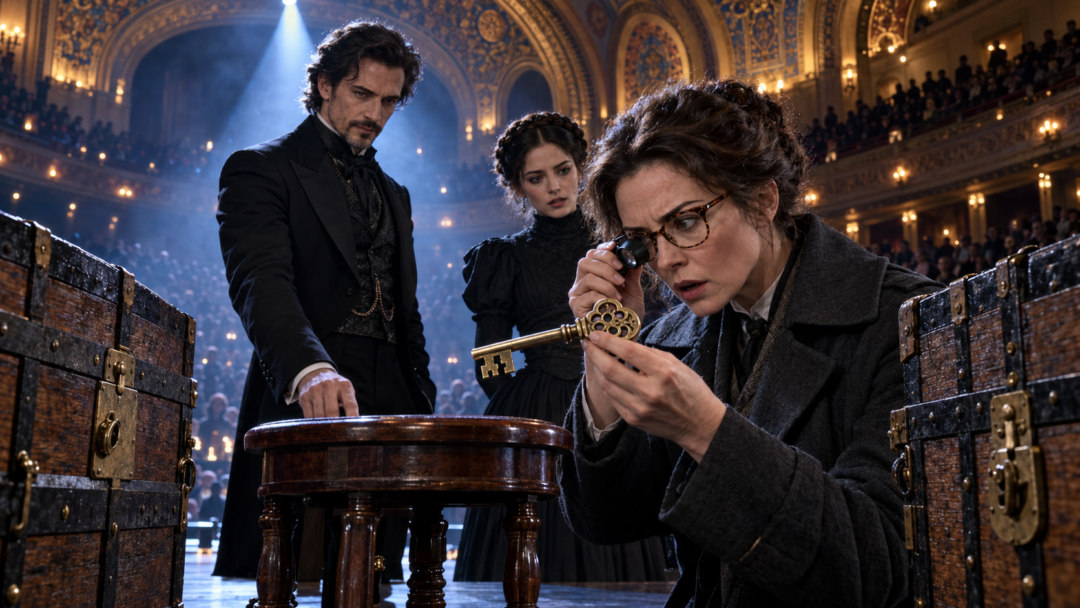
From the projection booth high in the upper gallery, a single arc-light follow spotlight ignited with a sharp, electrical crackle. The beam was pure surgical white, cutting through a drifting blue theatrical haze to illuminate an empty expanse of tongue-and-groove pine stage boards. In the dead center of the light rested a circular, three-legged mahogany stool. Positioned six feet behind it were two towering wardrobe trunks constructed from heavy quarter-sawn American oak, bound in blackened hoop iron and fitted with massive brass deadbolt housings.
Walking out of the stage left wings with slow, hypnotic precision was Dorian Vale.
Dorian was forty-one years old, tall, lean, and moving with an eerie, unnerving economy of physical motion. He wore an immaculate bespoke black three-piece suit without a necktie, his white shirt open at the collar, revealing the sharp hollows of his collarbones. His dark hair was combed straight back, emphasizing ascetic cheekbones and eyes the color of winter slate. He held no magician’s wand, offered no stage bow, and flashed no showman’s smile. He walked straight to the stool, extended his right arm, and set a single antique brass skeleton key onto the polished wood.
The key was nearly five inches long, cast from heavy naval brass, its shank machined with intricate double-fluted splines and its circular bow engraved with a geometric interlocking star.
“Two containers,” Dorian said, his deep, resonant baritone reverberating through Adler’s flawless acoustics without the aid of a microphone. “Solid oak planks, reinforced with ballistic-grade tool-steel backing. Secured by four-inch dual-cylinder deadbolts. In an era of automated lies, physical mechanisms do not fabricate the truth. Therefore, I will not touch the locks.”
His gaze swept over the darkened rows with frightening accuracy, locking onto Beatrix Lorne.
“The federal inspector in the fourth row. Miss Lorne. Come to the stage, please.”
A low murmur stirred among the patrons. Beatrix’s spine stiffened. She had not given her name at the box office. She had purchased her ticket in cash thirty minutes before curtain. Yet Dorian Vale was looking directly at her, his expression demanding and utterly without doubt.
Beatrix stood, her fingers tightening around her leather handbag, and walked down the carpeted center aisle. She climbed the access stairs, her boot heels sounding loud and sharp on the hollow risers. The intense heat of the follow spot bore down on her shoulders as she reached the stool.
“You spent your career testing the tensile limits of cold-rolled steel, Miss Lorne,” Dorian murmured, his voice dropping so only she could hear. “You know when metal has been forced to lie.”
“I am an investigator, Mr. Vale,” Beatrix replied, keeping her voice level despite the adrenaline coursing through her veins. “I don’t participate in carnival games.”
“This is no game,” Dorian said softly. “Pick up the key.”
Beatrix reached down and picked up the heavy brass instrument. The moment her bare fingers touched the metal, she felt a strange, cold tingling against her skin. She pulled a jeweler’s loupe from her coat pocket, flipping the magnifying lens down over her right eye to examine the metal grain under the harsh arc light.
The brass had a distinct micro-crystalline striation, but embedded in the base of the shank was a faint greenish luminescent dye mark—a radioactive isotope tracer used exclusively by the federal government’s metallurgy laboratories in 2014 to tag structural evidence from the Roosevelt Road rail disaster.
It was the master key to the locomotive’s encrypted event recorder—the missing artifact she had logged in her initial evidence locker before Harwood’s men had seized the room.
CHAPTER 2: THE METALLURGIST’S MEASURE OF IRON AND OAK
Beatrix’s hand tightened around the brass key until the metal ridges pressed deep into her flesh. She lowered the jeweler’s loupe, looking up into Dorian Vale’s unblinking gray eyes. The illusionist’s face remained an impenetrable mask of granite, but in the depth of his pupils, there was a terrible, burning clarity that seemed to strip away her defenses. The air between them tasted faintly of charged ionization and the cold, damp dust of Chicago’s limestone underworld.
“Where did you get this?” Beatrix whispered, her voice tight with fury and terror. “This artifact was tagged as confidential federal evidence in October of 2014. It was signed into a secured vault at the Dirksen Federal Building before the chain of custody was illegally broken.”
“Inspect the enclosures, Miss Lorne,” Dorian said, refusing to answer her question. “The audience is watching. Test the materials with whatever instruments your training dictates. We have five minutes before the current changes in the lake lines.”
Beatrix turned her back on him, forcing her racing mind back into the familiar, cold sanctuary of forensic engineering. She approached the stage right trunk. It stood nearly six feet tall, three feet wide, and two feet deep, built like a high-explosive munitions locker from the late industrial era. The quarter-sawn white oak planks were three inches thick, bound together by blackened hoop-iron angle brackets that were secured with hand-peened flush rivets every two inches. She knelt on the cold pine floorboards, running her gloved fingers along the base where the timber met the iron frame. There were no concealed hinges, no spring-loaded panels, and no hairline fractures in the grain.
She reached into her handbag and drew out a pocket-sized magnetic eddy-current tester—a diagnostic device used to detect microscopic stress fractures and concealed hollow voids in structural steel. She activated the unit, pressing the rounded ferrite sensor against the iron banding. The analog needle swung across the calibrated scale, settling dead on forty-five Rockwell C hardness: solid, hardened carbon-steel armor plate backing every square inch of the interior timber.
She stepped inside the open trunk. The interior smelled of raw linseed oil, cold steel, and old wool. She struck the back panel with the heel of her hand; the entire six-foot structure resisted with unyielding, dense mass. She tapped the ceiling and pushed against the sidewalls. Nothing yielded. She knelt again, shining her penlight beneath the trunk. The box rested on four heavy cast-iron casters that raised the floor exactly two and a half inches above the stage boards. The space beneath was completely open, bathed in the white spill of the arc light. A child could not have slipped a hand through that void without casting a stark shadow across the front row.
She stepped out and turned toward the second trunk on stage left.
As she approached, a woman stepped silently into the circle of arc light from behind the heavy velvet tormentor curtain in the wings.
She was Ivy Rook, twenty-nine years old, lean, broad-shouldered, and possessed of a gymnast’s razor-sharp posture. She wore a high-necked, sleeveless dress of heavy black cotton canvas that fell straight to her ankles, her feet bare against the cold floorboards. Her dark hair was woven into a tight, intricate crown braid that accentuated the severe, proud angle of her jaw and high cheekbones. Her features bore an uncanny, heartbreaking resemblance to Julian Rook—the same deep-set, uncompromising brown eyes that had looked across an NTSB inquest table at Beatrix a decade ago, pleading for an objective metallurgical analysis before the syndicate silenced him.
“Miss Lorne,” Ivy said, her voice quiet and melodic, yet carrying an edge of tempered steel that cut through the drafty silence of the auditorium. “The second trunk is identical to the first. My father built them both in his machine shop on Canal Street three weeks before the Roosevelt derailment. He designed them to demonstrate the resilience of his interlocking mechanical joins.”
Beatrix felt a constriction in her chest that made drawing breath an ordeal. “Your father built these?”
“He built them to show that true structural integrity cannot be compromised by external force,” Ivy said, stepping smoothly into the left trunk and resting her shoulders against the rear steel-backed plank. “Tonight, they will demonstrate whether his work can survive the men who killed him and stole his patents.”
Dorian stepped into the right trunk, his tall frame disappearing into the shadow of the oak enclosure until only his pale, angular face remained framed by the timber.
“Lower the lids, Miss Lorne,” Dorian instructed from within, his baritone sounding muffled and hollow inside the heavy wood. “Close the hasps. Turn the key in both deadbolts. Keep the key in your hand.”
Beatrix took hold of the heavy lid of the right trunk. It swung downward on heavy phosphor-bronze hinges, closing with a deep, echoing thump that reverberated through the hollow stage risers. She slid the heavy iron hasp over the staple, inserted the antique brass key into the mortise cylinder, and turned it.
Two heavy, mechanical clacks sounded within the mechanism as the hardened steel deadbolt threw into the strike plate. It was an unmistakable, solid lock.
She moved to the left trunk where Ivy stood motionless, her arms crossed calmly across her chest.
“He never blamed you, Miss Lorne,” Ivy whispered just before the oak lid descended. “He knew what Harwood threatened to do to your sister’s clinic. He knew the pressure you were under.”
Beatrix’s hands shook as the lid closed flush. The guilt she had harbored for ten years flared into an acute physical ache. She jammed the key into the second lock, turning the cylinder with aggressive force. Click. Clack.
Both trunks were sealed. Solid, impenetrable vaults of timber and steel standing six feet apart in the center of the Adler-Sullivan stage.
Beatrix backed away toward the footlights, the heavy brass key clutched in her fist. But as she reached the center of the apron, her eyes dropped to the interior edge of the lock hasp where the spotlight struck the polished iron.
Etched cleanly into the steel by a diamond scriber was a line of text that had not been there in 2014:
NTSB CASE 402 – ARCHIVED TELEMETRY INSIDE – EXPOSE HARWOOD.
CHAPTER 3: THE VANISHING IN THE ARC LIGHT
The breath went out of Beatrix’s lungs in a silent, suffocating gasp. Archived telemetry inside. The words seemed to burn against her retinas with the searing heat of a cutting torch. The original event recorder from Locomotive 4402—the solid-state black box that recorded brake line air pressure, throttle position, hydraulic governor status, and emergency valve actuation—had never been lost in the post-crash fire. Julian Rook had salvaged it from the twisted wreckage before Harwood’s private wrecking crews could destroy the evidence, and Dorian Vale had embedded its forensic recovery into the physical staging of this very performance before two hundred living witnesses.
“Step to the wings, Miss Lorne,” a voice seemed to drift from nowhere, carrying that strange, unnerving resonance that Dankmar Adler’s parabolic ceiling was world-famous for. It sounded as though Dorian were speaking directly into her ear, despite being locked inside three inches of solid oak.
Before Beatrix could take two steps toward the proscenium arch, the great arc-light follow spot abruptly died.
The extinction was instantaneous and total. It was not a gentle fading of tungsten filaments, but the violent severance of an electrical circuit that plunged the four-thousand-seat hall into an ocean of pitch-black void. In the sudden dark, the silence was suffocating and immediate. Two hundred spectators stopped breathing. The cavernous ceiling vaults swallowed every trace of ambient light from South Michigan Avenue outside. The temperature on the stage seemed to plummet, chilled by the subterranean currents rising from the city’s underbelly.
Beatrix stood motionless on the stage apron, her forensic training instantly taking over as she counted the passing seconds, her pulse throbbing in her throat.
One.
A deep, mechanical rumble shuddered through the floorboards—the unmistakable, visceral vibration of the theater’s original 1889 hydraulic stage lifts. Adler and Sullivan had engineered giant counterbalanced hydraulic rams beneath the stage floor, connected directly to the city’s high-pressure water mains beneath Congress Parkway. The floor beneath her feet shifted by less than an eighth of an inch—a microscopic displacement that only a trained metallurgical engineer with her sensitivity to structural vibrations could register. She felt the subtle displacement of air as heavy counterweights descended into the dark depths of the basement.
Two.
A sharp, pungent reek of burning sulfur and fresh diesel exhaust hit her nostrils, accompanied by the swift, terrifying rustle of heavy wool cutting through the air inches from her face. A cold draft swept up from the substage shafts, carrying the damp, metallic stench of the underground freight tunnels and the oily residue of century-old industrial grease. In the absolute blackness, there was no sound of footsteps, no creak of floorboards, no telltale snap of spring latches.
Three.
The white arc light blasted back to life with a concussive crackle of heated carbon rods.
The entire audience erupted into an involuntary, collective shout of utter disbelief and shock.
Dorian Vale was standing outside the trunks.
He stood in the exact center of the stage, right where the mahogany stool had been, his hands resting easily at his sides, his bespoke black suit immaculate and free of dust, his silver cufflinks gleaming under the intense white beam. Behind him, both oak wardrobe trunks remained closed, their blackened iron corner brackets gleaming under the white light, their heavy brass deadbolts locked securely under the iron hasps, undisturbed and intact.
Beatrix stared, her mind spinning through three-dimensional vectors, kinetic friction, and physical load equations. She had been standing less than twelve feet away on the apron. The hydraulic stage lifts took at least eight seconds to complete a full mechanical cycle. A human body could not traverse forty feet of stage space in three seconds without tripping the seismic sensors in her eddy-current tester or disturbing the hanging haze in the air.
“Miss Lorne,” Dorian said calmly, turning his gray eyes toward her. “The key, if you please.”
Beatrix’s boots felt leaden as she crossed the stage boards. Her fingers were slick with cold sweat as she approached the left trunk—the container where Ivy Rook had been locked less than forty seconds earlier. The brass key felt extraordinarily heavy in her hand, as if freighted with the truth of a decade.
“Unlock it,” Dorian commanded softly.
Beatrix inserted the brass skeleton key into the cylinder. She rotated the bow counter-clockwise. The dual tumblers retracted with a heavy metallic snap that echoed off the gilded ceiling. She caught the recessed iron handle and pulled the sixty-pound lid upward, bracing her feet against the stage boards.
The trunk was completely vacant.
The bare oak interior reflected the harsh white beam with stark, unyielding simplicity. There was no false wall, no mirror, no velvet drape, no seam in the steel backing plate. The wood was cold, dry, and empty.
“The second trunk, please,” Dorian said.
Beatrix moved to the right trunk—the one Dorian had entered before the entire audience. She inserted the key, turned the deadbolt, and hauled the heavy lid back against its iron chain stops.
Sitting inside, her knees drawn to her chest and her braided crown of hair perfectly intact, was Ivy Rook.
In her hands, resting across her lap like a sacred relic of modern tragedy, Ivy held a heavy rectangular box of black anodized aluminum, its chassis scarred by high-temperature scorch marks and sealed with yellow federal evidence tape. Stenciled in white industrial paint across the front plate were the words: FLIGHT DATA RECORDER – MODEL L-94 – PROPERTY OF NTSB.
It was the missing NTSB event recorder from Locomotive 4402.
The audience, unable to comprehend the political drama unfolding before them, saw only the impossible perfection of the stage illusion. Two hundred people rose as one, cheering, whistling, and hammering their palms together in a thunderous standing ovation that rattled the gold-leaf stencils of the Auditorium ceiling.
Ivy stepped out of the trunk, setting the heavy aluminum box on the wooden stool beside Dorian.
As she did, Beatrix looked up at the mezzanine tier.
Sitting in the shadows of Box 3, his face illuminated by the spill of the arc light, was Richard Harwood. The rail tycoon was on his feet, his jaw working in silent rage, his hand pressed against an earpiece as two heavily built men in dark overcoats slipped out of the box and headed toward the backstage access stairs.
CHAPTER 4: THE BLACK BOX IN THE SUBSTAGE VAULT
“Take the recorder, Miss Lorne,” Dorian said, his baritone cutting through the roar of the cheering crowd with urgent, clinical clarity. “The stage wings are no longer secure. Harwood’s men have already bypassed the stage door monitor, and their radios are transmitting on the transit security frequency.”
Beatrix did not hesitate. She lunged forward, gathering the heavy aluminum flight recorder into her arms. The metal was freezing, smelling of engine carbon, damp limestone, and diesel fuel. It weighed nearly thirty-five pounds—the solid weight of crash-hardened titanium and silicone potting compound designed to survive a two-hundred-mile-per-hour impact and intense hydraulic pressure. Dorian caught her by the elbow, while Ivy took her other side, ushering her through the heavy maroon velvet stage curtains into the cavernous darkness of the stage right wings.
The instant they crossed the threshold, the warmth of the auditorium was replaced by the drafty chill of the backstage machinery. Towering fly lofts rose seventy feet into the gloom, laced with hemp rigging, iron counterweight arbors, and the massive hydraulic cylinders that powered Sullivan’s historic stage elevators. The smells here were ancient and heavy: lubricating lard, dry wood dust, sulfur, and the cold, damp exhalation of the limestone tunnels beneath.
“Harwood’s men are coming down the east spiral stair,” Ivy said, pointing toward an iron fire door at the back of the masonry wall. “They have suppressed pistols and building master keys. They’ve already killed the backstage security guard.”
“Down,” Dorian said, leading them toward a narrow service hatch in the wooden floorboards behind the pin-rails. “Into the pneumatic dispatch cellar. The walls there are four feet of solid bonded brick.”
They dropped through the hatch onto an iron spiral staircase that wound forty feet down into the Auditorium’s forgotten lower levels. Here, beneath the street level of Congress Parkway, was the original Victorian mechanical room: giant steam boilers now cold and dead, high-pressure hydraulic accumulators, and the polished brass delivery tubes of the city’s historic pneumatic message network that had once connected the theater to the Board of Trade and the city’s major rail hubs.
Dorian pulled them into the shelter of an arched brick alcove beneath a massive granite foundation pier.
“Why was the flight recorder here, Dorian?” Beatrix demanded, setting the black box onto a wooden cable spool. Her hands were trembling with cold and fury, but her analytical mind was firing with razor precision. “Harwood swore under federal oath before the Senate committee that the recorder was incinerated in the post-crash diesel fire at Roosevelt Road. He produced a blackened casing that weighed forty pounds.”
“Harwood lied under oath because he paid the local fire marshal fifty thousand dollars to swap the unit with a burnt auxiliary generator shell,” Dorian replied, producing a specialized micro-screwdriver from his waistcoat pocket. He began removing the tamper-resistant Torx screws from the recorder’s side housing with practiced ease. “Julian Rook intercepted the real recorder before Harwood’s men could crush it in the rail yard press. Julian knew he was marked for assassination. He brought the unit here, to the Auditorium Theatre, where he and I were refurbishing the hydraulic stage lifts for the 2014 season.”
“And the metamorphosis trunks?” Beatrix asked, looking from Dorian to Ivy. “How were they tied to this?”
“The trunks were the delivery mechanism and the failsafe,” Ivy said, her dark eyes shining with quiet tears in the gloom. “My father designed the lock cylinders so that only an investigator holding the original federal tracer key could open the internal telemetry vault without wiping the memory chips. If anyone else forced the lock with a pry bar or drill, an internal pyrotechnic charge would have melted the NAND flash memory into slag. He built it to protect the truth until an investigator with your credentials could authenticate it.”
With a soft, pneumatic click, the aluminum side plate detached.
Inside lay the uncorrupted solid-state circuit board, its green substrate untouched by fire or water, sealed within a transparent block of silicone elastomer. Dorian removed a high-capacity solid-state drive and slid it into a ruggedized military laptop resting on an adjacent workbench.
He tapped three keystrokes.
A high-definition audio playback interface illuminated the dark brick vault with a cool blue glare. The waveform spiked, and the unmistakable, arrogant voice of Richard Harwood crackled through the small laptop speakers with terrifying fidelity:
Audio Log: October 14, 2014 – 23:42 HRS:
“…I don’t give a damn about Rook’s safety interlocks. The retrofit costs twenty-two million across the fleet. Tell the dispatch foreman to bypass the pneumatic governor on the Roosevelt line. If the brakes fail, we blame Rook’s design and collect thirty million in reinsurance. And Lorne’s sister? Find out where her clinic gets its municipal permits. Put the pressure on her. She’ll sign whatever report we put in front of her.”
Beatrix felt a cold, murderous rage settle into her bones. Ten years of guilt, ten years of looking at her sister and wondering if she had betrayed everything she believed in—all of it laid out on a digital audio track in Harwood’s own cultured, dismissive voice. Every detail of the cover-up was documented: the bribes paid to inspectors, the altered signal logs, the deliberate decision to endanger three hundred rail passengers for a corporate bonus.
“Can we broadcast this?” Beatrix asked, her voice steady, hard, and lethal.
“Not from down here,” Dorian said, shutting the laptop and securing it in his leather satchel. “The brick walls are four feet thick, and the steel conduits block all cellular and radio signals. But the theater’s main projection booth has a direct microwave uplink to the PBS affiliate on Wacker Drive. If we reach the booth, we put this audio into fifty thousand homes before Harwood can leave the Loop.”
Suddenly, the heavy iron door at the top of the spiral stairs shuddered under a tremendous, concussive blow.
A volley of suppressed gunfire chewed through the sheet metal of the upper landing, sending a rain of hot sparks and screaming lead ricochets down the narrow brick shaft.
CHAPTER 5: THE SABOTEUR ON THE ROOSEVELT TRESTLE
“They’re on the upper catwalk,” Ivy hissed, her hand immediately finding the heavy iron release valve of an ancient high-pressure hydraulic accumulator mounted to the brick pier. Her knuckles were white, her bare feet planted firmly against the damp concrete floor.
“Don’t release it yet,” Dorian ordered, catching her wrist with decisive speed. “We need them committed to the stairs. If we release the accumulator too early, the pressure drops before the seal breaks, and they will simply take cover behind the iron riser plates.”
Above them, heavy tactical boots clattered down the cast-iron steps of the spiral staircase. Two men in charcoal suits and tactical vests descended with their weapons drawn, sweeping the damp brick cellar with high-intensity weapon lights that cut through the darkness like white sabers. The beams reflected off pools of oily standing water and illuminated the rusted pipes lining the ceiling.
“Vale!” one of the gunmen called out, his voice flat, professional, and completely devoid of hesitation. “Mr. Harwood wants the drive. Hand it over, and the woman walks out the alley door unharmed. Refuse, and both of you get buried under fifty tons of wet limestone in the old coal sump.”
“The woman is an accredited senior forensic inspector of the United States government,” Dorian replied from behind the granite pier, his voice echoing off the vaulted masonry with deceptive acoustic direction that made him sound like he was speaking from fifty feet to their left. “Killing an NTSB inspector carries a mandatory federal capital charge. There is no statute of limitations on capital murder, and there are no corporate settlements in a federal penitentiary.”
“Nobody finds bodies forty feet below Michigan Avenue, Vale,” the gunman sneered, rounding the middle landing and aiming his weapon toward the cable spool where the black box still rested. “This whole block is getting redeveloped into luxury condominiums next spring. The foundation is being filled with three thousand yards of slurry. You’re just scrap timber to the city.”
“Now, Ivy,” Dorian whispered.
Ivy hauled down on the four-foot iron lever with her entire body weight, locking her boots against the granite foundation footing.
With a deafening, earth-shaking roar that shook decades of soot from the overhead ceiling vaults, three thousand pounds per square inch of pressurized river water erupted from the accumulator’s relief nozzle. The jet blasted a solid column of freezing, mineral-heavy water directly into the center of the spiral staircase. The concussive hydraulic force sheared through the rusted iron brackets of the middle landing with a shriek of tearing metal that sounded like an artillery explosion.
The two gunmen were violently swept off the staircase, their weapons torn from their hands as the iron steps collapsed in an avalanche of twisted metal, tumbling into the drainage sump fifteen feet below with a massive, churning splash.
“Move!” Dorian shouted, leading Beatrix and Ivy toward an unpainted wooden service door at the far end of the cellar.
They sprinted through the doorway into a narrow, vertical maintenance shaft containing an antique counterweighted service elevator—a wooden platform suspended by four thick wire ropes, used in the nineteenth century to hoist stage machinery from the basement to the fly lofts seventy feet above. The shaft smelled of dry rot, hemp grease, and ancient pine pitch.
Dorian pulled Beatrix and Ivy onto the platform and severed the counterweight brake line with a heavy steel pry bar.
The platform surged upward into the vertical shaft, accelerating rapidly through the darkness as the lead counterweights plummeted past them. Floors flashed by in a blur of brick, mortar, and timber: basement, stage level, mezzanine, first balcony, second balcony. The cold air rushed past Beatrix’s ears, deafening and wild, but she held the leather satchel with the laptop and hard drive tight against her ribs. The cables groaned under the strain, but the counterweight system, balanced by Dankmar Adler’s original engineers over a century ago, held true.
Just as the platform neared the ceiling truss seventy feet above the auditorium floor, Dorian threw the emergency manual dog-brake. The steel jaws bit into the vertical oak guide rails with a shower of screaming friction sparks, bringing the elevator to a shuddering halt directly opposite the steel fire door of the main projection booth.
They scrambled through the fire door into the booth.
Inside, the warm air smelled of heated ozone, xenon arc lamps, and projector carbon. Through the narrow observation ports, Beatrix could see the vast auditorium below. The house lights had been turned back on, and the two hundred patrons were slowly filing toward the exits, chatting and laughing, completely oblivious to the war that had just played out beneath their feet.
Standing near the center exit doors in the lobby was Richard Harwood, surrounded by four uniformed private rail security guards, his camel-hair coat draped over his shoulders as he checked his gold pocket watch with growing impatience.
Dorian moved to the booth’s master control console, setting down the ruggedized laptop and connecting it to the building’s primary broadcast patch bay.
“The microwave feed is live,” Dorian said, watching the signal indicators climb into the green on the master modulation meters. “We have the audio, the NTSB crash telemetry, and the forged sign-off sheets. But to broadcast it over the public address system and the external feed, someone has to manually hold the relay switch on the stage proscenium panel. The remote solenoid was burned out twenty minutes ago.”
“I’ll do it,” Beatrix said, stepping toward the observation window.
“Beatrix, Harwood’s guards are in the lobby,” Ivy warned, grabbing her arm, her eyes filled with protective concern. “If you go down to the stage apron, you are completely exposed. They have clear sightlines from every aisle, and Harwood will not hesitate to order a massacre.”
“For ten years, I hid behind my silence while Julian Rook’s name was dragged through the mud and my sister lived under Harwood’s shadow,” Beatrix said, her hazel eyes blazing with an unyielding, righteous light. “I am the one who signed the lie. I will be the one who speaks the truth.”
CHAPTER 6: THE FEDERAL INQUEST AT THE PROSCENIUM
Beatrix did not wait for an answer. She grabbed the heavy brass master key from the console, slipped the NTSB badge from her pocket, and pinned it to the lapel of her charcoal trench coat. She slipped through the projection booth’s private access stair, descending the narrow spiral staircase that led directly to the stage left wings. Her boots made no sound against the rubberized stair treads as she moved with the single-minded focus of an investigator who had finally found her purpose.
Behind her in the booth, Dorian Vale sat at the console, his fingers flying across the laptop keyboard as he queued the digital transmission to the federal servers, the Chicago media pool, and the regional headquarters of the Department of Justice. Beside him, Ivy was already monitoring the audio feed, ready to route the signal through the building’s massive public address amplifiers.
Beatrix reached the stage wings, took a deep breath of the dust-scented air, and stepped out from behind the heavy maroon velvet curtain into the center of the Adler-Sullivan stage.
Her boot heels sounded like pistol shots against the hollow white-oak floorboards.
In the lobby below, the two hundred patrons paused, turning back toward the stage in surprise. Standing near the brass exit doors, Richard Harwood froze, his head snapping toward the stage, his aristocratic features darkening with sudden, venomous fury. He recognized her instantly. The woman he had broken ten years ago was standing under the full glare of the stage lights, looking down at him with an expression of cold, unvarnished contempt.
Beatrix walked to the edge of the proscenium apron, reached into the small brass alcove beside the prompt corner, and threw the master audio override switch.
A high-pitched acoustic squeal resonated through the forty-four ceiling speakers, silencing the chatter in the lobby instantly and commanding the attention of every person in the hall.
Beatrix took the handheld stage microphone from its bronze clip.
“Attention, patrons and transit workers of Chicago,” Beatrix’s voice boomed through the auditorium, carrying an authority so fierce that the exiting crowd halted in their tracks, turning back toward the proscenium in dead silence. “My name is Beatrix Lorne. I am a senior metallurgical inspector for the National Transportation Safety Board. Ten years ago, on October 14, 2014, three men died when Locomotive 4402 derailed at the Roosevelt Road rail yards.”
Harwood pushed through the crowd in the lobby, his face livid with rage, his guards drawing their concealed weapons as they rushed down the carpeted orchestra aisles.
“Turn that microphone off!” Harwood roared, his voice echoing off the granite arches. “Security, take her off that stage! She is a disgraced, unstable trespasser!”
“Stand where you are, Mr. Harwood!” Beatrix shouted, holding the gleaming antique brass key high above her head where the spotlight struck the polished metal like a flare. “Ten years ago, you threatened my family with violence and forced me to bury the truth! You claimed master engineer Julian Rook sabotaged the braking systems to cover up your own criminal negligence! But tonight, Julian’s daughter Ivy and master locksmith Dorian Vale retrieved the uncorrupted flight recorder from the foundation of this very theater!”
Above the stage, the massive motorized projection screen descended from the fly loft with a low, majestic mechanical hum.
Dorian Vale struck the master transmit key in the booth seventy feet above.
Instantly, the giant screen blazed to life with the high-definition telemetry curves of Locomotive 4402, showing the exact millisecond Harwood’s dispatch office remotely disabled the pneumatic fail-safes. The digital graph showed the red line of hydraulic pressure plummeting to zero while the train was traveling at seventy-two miles per hour into the freight switch. And then, filling the four-thousand-seat auditorium with bone-chilling clarity, came Richard Harwood’s own voice:
“…Tell the dispatch foreman to bypass the pneumatic governor on the Roosevelt line… If the brakes fail, we blame Rook’s design and collect thirty million in reinsurance… And Lorne’s sister? Find out where her clinic gets its municipal permits. Put the pressure on her. She’ll sign whatever report we put in front of her…”
The lobby patrons erupted into screams of outrage and shock. Several off-duty transit workers in the rear rows immediately surged forward, blocking Harwood’s armed security guards and pinning them against the heavy bronze doors with righteous fury. The transit workers knew the men who had died in that cab; they had carried their coffins.
Harwood, realizing his empire was disintegrating before his eyes, drew a small snub-nosed revolver from his overcoat pocket and aimed it directly at Beatrix on the stage apron.
“You miserable bitch,” Harwood snarled, stepping into the center aisle, his eyes wild with desperation. “I gave you a career! I gave you your sister’s life!”
Before his finger could tighten on the trigger, a shadow dropped from the iron catwalk sixty feet above.
It was Ivy Rook.
Suspended by a high-tensile theatrical counterweight line, Ivy swung across the auditorium like a pendulum of retribution. Her bare feet struck Harwood squarely in the chest with concussive force, driving the tycoon flat onto his back on the carpeted aisle and sending the revolver skittering harmlessly across the brass heating grates into the orchestra pit.
Before Harwood could scramble to his feet, the theater’s massive front doors burst open with a crash.
A tactical strike team of twenty federal marshals and Illinois State Police officers poured into the auditorium, their assault rifles raised, their tactical flashlights cutting through the gloom.
“FEDERAL AGENTS! DROP TO THE FLOOR! HARWOOD, DON’T MOVE!”
Leading the charge was Special Agent Marcus Vance of the Department of Transportation, his badge flashing in the light as he knelt on Harwood’s spine, wrenching the magnate’s arms behind his back and snapping cold steel handcuffs around his wrists.
CHAPTER 7: THE FINAL SIGNAL ON THE MICHIGAN LINE
The pale, silver light of an autumn dawn broke over the choppy waters of Lake Michigan, illuminating the magnificent rough-hewn granite facade of the Auditorium Theatre. The sleet had finally ceased, replaced by a crisp, biting morning breeze that carried the clean scent of the lake and the distant tang of woodsmoke across the wet pavements of South Michigan Avenue. Outside the theater, the street was packed bumper-to-bumper with news vans, police cruisers, federal transport vehicles, and a growing crowd of hundreds of transit workers who had gathered in the cold to witness the final reckoning of the man who had endangered their lives for a decade.
Richard Harwood was led out through the theater’s central bronze doors in handcuffs, his expensive camel-hair coat stained with floor grease and water from the flooded cellar, his head ducked low against the barrage of flashing camera strobes and the furious, deafening jeers of his former employees. The federal marshals escorted him into the rear of an armored transport van, slamming the reinforced doors shut with a finality that echoed down the avenue.
Standing on the broad limestone steps of the entrance portico, wrapped in heavy wool blankets and holding paper cups of steaming black coffee, were Beatrix Lorne and Ivy Rook.
Beatrix watched the transport van pull away into the morning traffic, its siren silent against the roar of the city. For the first time in ten years, the unbearable weight that had crushed her chest and haunted her dreams had lifted. She took a deep, shuddering breath of the cold lake air, feeling tears of pure relief warm her cheeks. Beside her, Ivy was looking up at Louis Sullivan’s soaring stone arches, her dark eyes shining with quiet, triumphant pride. The stain on her family’s honor had been washed clean in the public light of day.
“The federal prosecutor just called from the Dirksen building,” Beatrix said, turning to Ivy. “The grand jury has already returned an unsealed twenty-six-count indictment for three counts of corporate manslaughter, federal wire fraud, perjury, and witness tampering. And the NTSB has officially reopened Julian’s case. By noon today, your father’s name will be completely cleared on the congressional record. The Department of Transportation is introducing new legislation tomorrow to mandate his interlocking pneumatic braking system on every commercial locomotive in North America. His patents will be transferred to a public trust in your name.”
Ivy closed her eyes for a long moment, letting the tears fall freely down her cheeks as she rested her head against Beatrix’s shoulder. “Thank you, Beatrix. For not running away when it mattered most. For facing him on that stage.”
“I should have stood ten years ago,” Beatrix replied softly, placing an arm around Ivy’s shoulders. “Your father was a genius, Ivy. And he raised a daughter who is braver than any soldier I’ve ever met. He would be so proud of what you did tonight.”
From the shadow of the portico archway, Dorian Vale stepped forward. He had changed into a dry, tailored dark wool overcoat, his hands resting in his pockets, his posture as calm, quiet, and unnerving as it had been on the stage. He looked like an architect who had just completed the final inspection of a bridge designed to last a century.
He held the antique brass master key out to Beatrix.
“This belongs to you, Miss Lorne,” Dorian said, his baritone low and steady. “The federal evidence locker will need the original physical instrument to authenticate the serial markings for the trial.”
Beatrix looked down at the gleaming key in his open palm. She reached out, her fingers brushing the cold metal, but then she gently pushed his hand back.
“No, Dorian,” Beatrix said with a faint, genuine smile. “I certified the digital cryptographic hash on the event recorder in front of Special Agent Vance. The federal court has everything it needs to convict Harwood ten times over. That key was forged by Julian Rook to protect his daughter and his work. It belongs with you two.”
Dorian looked down at the key in his palm, the ghost of an approving nod acknowledging her words. He closed his long fingers around the metal and slipped it into his inner waistcoat pocket, resting it against his chest.
“What will you do now, Mr. Vale?” Beatrix asked, looking up at the historic facade. “The Auditorium management will want a dozen more performances after the front pages hit the stands tomorrow.”
Dorian turned his gaze toward the south, where the rhythmic horn of a passenger train sounded across the Roosevelt trestle, carrying hundreds of morning commuters safely into the heart of the waking city. The rails gleamed like silver ribbons in the sunrise.
“Julian’s work was never about applause or box office receipts, Miss Lorne,” Dorian said quietly. “It was about making sure that the hidden machinery of the world functions with justice, truth, and precision. There are other tracks. Other syndicates. Other locks that need opening.”
He dipped his head to Beatrix, offered his arm to Ivy, and the two illusionists walked down the granite steps into the bustling Chicago morning, disappearing into the golden light of the new day.