The HOA Board Member Took Over His Empty Garage Until One Locked Door Exposed Them Both
Chapter 1: The Car That Appeared Behind His Open Garage Door
The white sedan was already inside Paul Miller’s garage when he lifted the kitchen blind.
For several seconds, he stood with one hand against the window frame, waiting for the image to arrange itself into something reasonable. The detached garage sat at the end of his driveway, twenty yards from the house. Its door was open. A thick black charging cable crossed the concrete floor from the wall outlet to the rear quarter panel of the sedan.
Beside the car, someone had unfolded a lavender lawn chair.
Paul set down his coffee.
He had left the side gate latched the night before. The garage door had been down. He was certain of both because he checked them each evening, the way he checked the stove and the back lock. Since retiring from the municipal records office, routines had become the quiet beams holding his days upright.
He walked outside in slippers and a buttoned flannel shirt.
Margaret Clark emerged from behind the car carrying a stainless-steel tumbler. Her gray-blond hair was clipped back, and oversized sunglasses covered half her face.
“Morning,” she said.
Paul stopped at the garage threshold. “What is this?”
“My charger’s out.”
She said it as if he had asked why she carried an umbrella.
Paul looked at the cable. The outlet had been installed for his late wife’s pottery kiln, though the kiln itself had never moved from the basement. The garage had been intended as a workshop after she died, then as a rental space, then as something he would decide about later. Two years had passed beneath those intentions.
“You can’t park in here,” he said.
Margaret took a drink. “I won’t be long.”
“This is private property.”
“I know whose garage it is, Paul.”
Her tone made the fact sound irrelevant.
He stepped around the charging cable carefully. “How did you open the door?”
“The side latch doesn’t catch unless you pull it hard.”
Paul stared at her.
Margaret seemed to hear the answer in his silence. “You should have that fixed. It’s a security issue.”
She sat in the lawn chair.
For one absurd moment, Paul felt like the trespasser.
“You need to move the car.”
“My home circuit was flagged during the electrical inspection. Eric knows about it.”
“Eric knows you’re in my garage?”
“The association knows I need temporary charging access.”
“That wasn’t my question.”
Margaret tilted her face toward him. “You don’t use the space.”
A rectangular FOR RENT sign leaned against the interior wall. Paul had never put it at the curb. He had ordered it eleven months earlier, carried it to the garage, and stopped there.
“I still own it,” he said.
“No one said you didn’t.”
She closed her eyes behind the sunglasses.
Paul stood listening to the faint mechanical hum from the sedan. The sound seemed louder because the rest of the garage was empty.
He could have unplugged it. He could have called Eric Johnson, the property manager, while Margaret sat there. He could have demanded the key or remote she had used.
Instead, he said, “Please move it when it’s charged.”
Margaret lifted one hand without opening her eyes. “Of course.”
By noon, the sedan was gone. The chair was gone too. Only a dark curve from one tire remained on the concrete.
Paul checked the outlet, then the side latch. Margaret had been right about it. If the gate was closed gently, the metal tongue rested against the strike plate without entering it.
He tightened the screws and tested it four times.
The next Monday, the sedan returned.
This time Margaret had backed in. The charging cable lay across the threshold where Paul could not lower the garage door without pinching it. Her chair stood in the same place, angled toward the driveway.
Paul found her reading a folder marked COMMUNITY STANDARDS.
“You said temporary.”
“It is temporary.”
“It’s been a week.”
“My electrician can’t come until the end of the month.”
“Then use a public charger.”
“Those rates are unreasonable.”
“So you’re using my electricity.”
Margaret removed her sunglasses. Her eyes were pale and tired. “Are you planning to invoice me for eight dollars?”
Paul felt heat rise into his face. “That isn’t the point.”
“No, the point is that an unused outlet can solve a neighbor’s problem, and you would rather make this difficult.”
The accusation was delivered calmly. That made it worse.
Paul went back inside and called Eric.
The property-management office placed him on hold beneath cheerful instrumental music. When Eric answered, he sounded distracted.
“Margaret says the association knows she’s using my garage.”
There was a pause.
“I know there have been charging-access issues since the electrical inspections,” Eric said.
“That’s not what I asked.”
“I have not issued anyone permission to use privately owned structures.”
“Did someone else?”
“No one in management has that authority.”
Paul looked through the kitchen window. Margaret was standing beside the sedan, speaking to a passing neighbor as if she were hosting an open house.
“Then tell her to stop.”
“I can remind both parties that private arrangements require owner consent.”
“Both parties?”
“I’m trying to keep this from becoming adversarial.”
“It’s already adversarial. Her car is in my garage.”
Eric exhaled softly. “Send me the dates in writing.”
Paul opened a notebook and wrote them down.
Monday the seventh. Monday the fourteenth. The first visit had lasted three hours. Today’s had already lasted forty minutes. He added the outlet location, the side gate, the sedan’s plate number, then stopped.
The page looked severe. Official.
His wife used to tease him about his lists. According to you, grief probably needs a filing code, she had once said during her final year, smiling from the couch beneath a blanket.
Paul closed the notebook.
He did not email Eric.
Instead, he wrote Margaret a note in careful block letters.
Margaret,
I have not given permission for parking, charging, storage, or access to my garage. Please remove your vehicle today and do not use the garage again.
Paul Miller
He placed the note under her windshield wiper.
That afternoon, he heard the garage door rattling and went outside.
Margaret stood beside the sedan with the note unfolded between both hands.
“What is this?” she asked.
“A written request.”
“You could have spoken to me.”
“I did.”
She looked toward the neighboring houses. One curtain moved, then became still.
“Eric said the association was seeking temporary solutions.”
“He said no one authorized you to use my garage.”
Margaret’s mouth tightened. “Did he put that in writing?”
Paul hesitated.
She saw it.
With two quick movements, she tore the note down the center, then tore the halves again. The pieces fluttered against his shirt and fell between them.
“You spent thirty years pushing paper around City Hall,” she said. “Write me up yourself.”
Then she unplugged the cable, tossed it onto his concrete floor, and drove away.
Paul remained beside the torn pieces until the sound of the sedan disappeared beyond the entrance monument.
He bent down and gathered every scrap.
Chapter 2: Friday Morning Left a Scratch and a Witnessless Accusation
Margaret was waiting beside her sedan before Paul opened his front door Friday morning.
The garage door stood fully raised. Her car was inside, connected to the outlet, and the charging cable stretched across the floor like a boundary drawn by someone else.
Paul stopped on the porch.
Margaret wore the same sunglasses and a lavender jacket zipped to her throat. Her folding chair was open beside the driver’s door, but she was not sitting.
“You said Friday,” she called.
“I said the car had to be gone by Friday.”
“You said by Friday. It is Friday.”
Paul descended the porch steps. “Move it now.”
“After it finishes charging.”
“No.”
Margaret folded her arms. “You really do enjoy pretending every conversation is a hearing.”
He kept walking. “I asked you twice. I gave you a written notice.”
“You left litter on my windshield.”
“You tore it up.”
“It wasn’t an official notice.”
Paul reached the garage and looked at the charging display. Fifty-eight percent.
“You have no written authorization,” he said.
“I spoke to management.”
“Eric says he didn’t approve this.”
“Eric says whatever reduces his paperwork.”
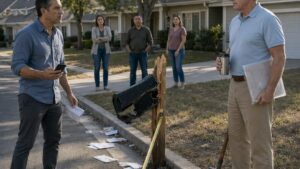
A recycling truck turned onto the street. Paul’s blue bins stood near the curb, lids raised after the morning pickup. Margaret glanced toward them.
“You want everything exactly where you put it,” she said. “Your garage empty. Your lawn untouched. Your neighbors quiet.”
“This has nothing to do with my lawn.”
“Doesn’t it?”
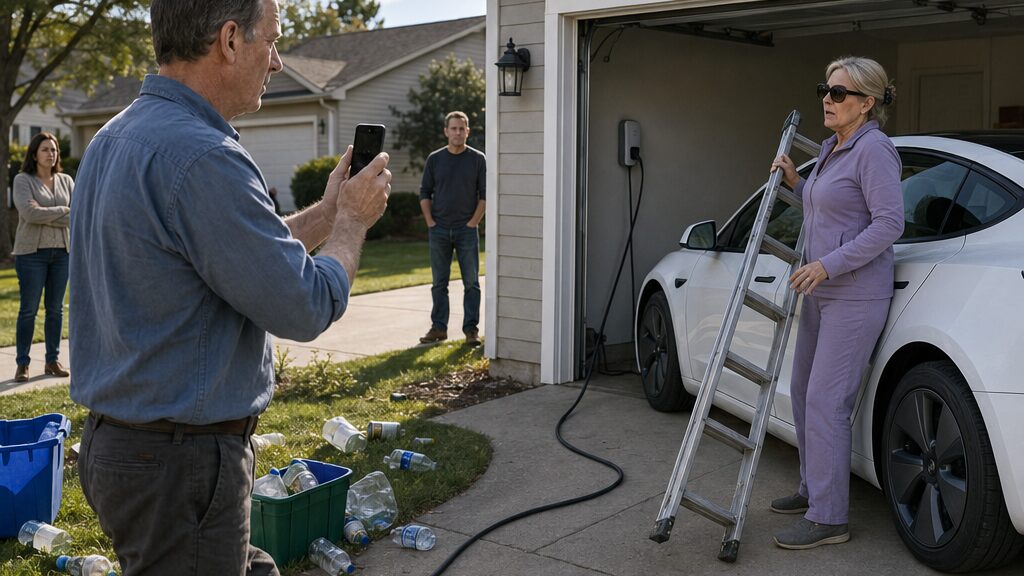
She walked to the nearest bin, grabbed its rim, and pulled it backward. A few bottles and flattened boxes that the collectors had missed spilled onto the grass.
Paul stared at her. “What are you doing?”
“Showing you what an actual violation looks like.”
She tipped the second bin. Plastic containers scattered across the lawn and one rolled beneath the sedan.
A neighboring garage door began to rise across the street.
Paul reached for his phone.
Margaret saw the movement. “Go ahead. Take pictures. That’s what you people do when you don’t know how to speak to anyone.”
“You people?”
“Clerks. Inspectors. Men who think a file is the same thing as a life.”
She turned sharply and caught the edge of a ladder leaning against the garage wall.
The ladder had been there since Paul cleaned the gutters the previous weekend. Its feet shifted on the concrete. Margaret grabbed one side, perhaps to steady it, perhaps to move it out of her way. The top swung outward.
“Leave it,” Paul said.
She pulled harder.
The ladder slipped.
Its aluminum rail struck the rear passenger door of the sedan with a metallic crack.
Everything stopped.
The charging hum continued.
Margaret looked at the shallow diagonal scratch, then at Paul. Her face changed before she spoke—not into surprise, but decision.
“You did that.”
Paul felt the words land more sharply than the ladder had.
“I didn’t touch it.”
“You left the ladder unsecured beside my vehicle.”
“Your vehicle is inside my garage.”
“You knew I was parking here.”
“No. I told you not to.”
The neighbor across the street stepped halfway into his driveway. Another homeowner appeared near a mailbox farther down.
Margaret raised her voice. “You shoved it toward my car.”
Paul looked at the ladder. It rested against the sedan exactly where it had fallen. Margaret’s right hand was still wrapped around one rung.
He lifted his phone.
Margaret released the ladder. “Don’t point that at me.”
Paul did not answer.
He photographed the entire garage from the driveway. Then the charging cable. Then the point where it crossed the threshold. He moved closer and photographed Margaret’s handprint in the thin dust on the ladder rail. He photographed the scratch, the ladder feet, the scattered recycling, the wall where the ladder had stood, and the car’s position relative to it.
Margaret followed him with words.
“You’re harassing a board member.”
Click.
“You damaged my car.”
Click.
“I have witnesses.”
Paul turned toward the neighbor across the street. “Did you see the ladder fall?”
The neighbor shifted his weight. “I heard shouting. Then the noise.”
“Did you see me touch it?”
“No.”
Margaret pointed at him. “You saw him out here.”
“I saw both of you.”
“That’s not what I asked.”
The neighbor retreated a step. “I didn’t see the impact.”
Margaret’s mouth flattened.
Paul opened the utility panel beside the outlet and photographed the meter reading. He took a second image with the time visible on his phone screen.
“What are you doing?” she demanded.
“Creating a record.”
Something in his tone finally unsettled her.
For years at the records office, Paul had watched arguments dissolve under dates, signatures, and sequence. People remembered what protected them. Paper remembered order.
He crouched and photographed the torn scraps of his note, which he had placed in a clear plastic sleeve on the workbench. Then he photographed the envelope containing a copy.
Margaret stared through the open garage.
“You kept it?”
“Yes.”
“That proves nothing.”
“It proves I told you to stop.”
She stepped toward him. “Move the ladder.”
“No.”
“It’s touching my car.”
“I’m not changing the scene until I finish documenting it.”
“This is not a crime scene.”
“No. It’s my garage.”
The words came out colder than he intended.
Margaret pulled off her sunglasses. Without them, she looked older, the skin beneath her eyes bruised with exhaustion.
“My electrician canceled again,” she said. “I have a board inspection tonight and a medical appointment across town tomorrow. I need the car.”
For a moment, the reason sounded ordinary enough to break the shape of their conflict.
Paul almost said she could finish charging.
Then she added, “You are not going to embarrass me over an empty room.”
The opening closed.
“Move it by noon,” he said.
“And the damage?”
“You caused it.”
“You’ll pay for it.”
“No.”
Margaret took out her phone. “Then I’ll report the property hazard and the electrical access issue.”
“You entered through my gate without permission.”
“The latch was defective.”
“It isn’t now.”
She looked toward the repaired gate, then back at him. “You think locks make you right.”
Paul said nothing.
At eleven forty-seven, Margaret unplugged the sedan. She left the ladder where it had fallen and drove away without collecting the chair.
Paul waited until the street was quiet.
Then he cleaned the recycling from the lawn, replaced the ladder against the wall, and carried Margaret’s chair into the garage. He did not fold it. He set it beside the outlet exactly as she had.
Inside the house, he opened the folder where he kept his travel documents. His flight to Barcelona departed the following evening. Amy had arranged the trip months ago, insisting he could not continue refusing every invitation because her mother would not be there to share it.
Paul placed the photographs in chronological order and typed a written account.
At the bottom, he added one sentence:
Future entry onto the property will be treated as trespass.
He printed three copies.
One went into an envelope for Margaret. One went into his travel folder. The third he drove to the property-management office.
Eric was not there, so Paul left it with the receptionist and asked her to stamp his copy with the date and time.
Back home, he stood at the kitchen table staring at the purple stamp.
RECEIVED — 3:42 P.M.
It should have made him feel protected.
Instead, he opened the airline app and confirmed his flight.
Chapter 3: The Garage Door Closed Before Paul Left the Country
The garage door descended over Margaret’s white sedan at four seventeen Friday afternoon.
Paul watched the segmented panels lower until the sunlight narrowed to a bright strip across the concrete, then disappeared.
Before pressing the remote, he had photographed the car from all four corners. He had photographed the existing scratch, the license plate, the odometer visible through the windshield, the charging display, the meter reading, and the chair beside the driver’s door.
He had unplugged the charging cable, examined it for damage, and taken a photograph of the detached connector.
Then, after a minute of thought, he plugged it back in.
He told himself the decision was practical. Margaret had complained about needing the car charged. Leaving it connected would prevent her from accusing him of draining or damaging the battery.
But when the green indicator returned and the machine resumed drawing power from his wall, Paul felt something else: a calm sense that every element was now under his control.
The feeling troubled him less than it should have.
He locked the side door, checked the deadbolt, then secured the repaired gate with a new padlock. Margaret had entered twice since he fixed the latch. He did not know whether she had copied a remote or simply used the exterior release when the side door was open.
On the gate, he attached a laminated notice:
PRIVATE PROPERTY. ENTRY REQUIRES OWNER CONSENT. CONTACT PROPERTY MANAGEMENT REGARDING ACCESS.
He avoided the word trespass. The formal notice had already been filed.
At the management office, Eric Johnson read Paul’s stamped copy while standing behind the reception counter.
“You delivered this after the car was already inside?” Eric asked.
“The car returned after I told her not to use the garage.”
“That isn’t what I asked.”
Paul recognized the tone. He had used it himself across municipal counters.
“Yes,” he said. “It was inside.”
“And now?”
“The garage is secured.”
Eric lowered the paper. “With the vehicle in it?”
“Yes.”
“You should arrange removal.”
“I’m leaving town.”
“Paul.”
“I documented everything.”
“That does not answer the access question.”
“She has no permission to enter.”
“I agree.”
Paul waited.
Eric placed the notice on the counter. “I did not authorize her to use your garage. No one from this office did.”
The words brought a clean, immediate satisfaction.
“Then we’re clear.”
“We’re clear about entry,” Eric said. “We are not necessarily clear about you keeping her property inaccessible.”
“I’m not keeping it. She abandoned it after notice.”
“Did you give her a time to retrieve it?”
“No.”
“Did you tell her you were closing the garage?”
“She knew she wasn’t allowed there.”
Eric rubbed the bridge of his nose. “Send me the photographs. Do not authorize anyone to break the lock. If she contacts us, I’ll tell her the matter is disputed and that she needs to coordinate with you.”
“My flight leaves tomorrow.”
“Then coordinate by phone.”
Paul collected his copy.
As he reached the door, Eric said, “There was a community email about temporary charging access. I’ll look for it.”
Paul turned. “What email?”
“After the electrical inspections. We asked whether any owners with unused outlets might volunteer.”
“I never volunteered.”
“I didn’t say you did.”
The distinction followed Paul home.
He searched his inbox that evening but found nothing under Margaret’s name. Nothing under garage or charging. He did not search the association’s general address. The suitcase lay open on his bed, one half packed.
At nine twelve, the first text arrived.
OPEN THE GARAGE.
A second followed before he could decide whether to respond.
YOU HAVE NO RIGHT TO HOLD MY CAR.
Paul typed: You have no right to store it on my property.
He deleted the sentence.
Instead, he wrote: Contact Eric Johnson. I am unavailable tonight.
Margaret replied immediately.
YOU PLANNED THIS.
Paul set the phone face down.
The next morning, he left for the airport.
At the security line, his phone vibrated three times. He ignored it until he reached the gate.
Margaret had sent a photograph of the locked side gate, another of his laminated notice, and a final message.
OPEN IT NOW OR I AM CALLING THE POLICE.
Paul looked through the terminal windows at a baggage cart moving beneath the wing of an aircraft.
He replied: You may contact them.
The response felt measured. Almost elegant.
On the flight, he slept better than he had in months.
Barcelona greeted him with traffic, stone balconies, and the disorienting fact that no one knew about the garage. Amy had booked him into a small hotel near a narrow plaza. She joined him the following afternoon at an outdoor café, arriving from a work conference with her laptop bag still over one shoulder.
“You actually came,” she said, kissing his cheek.
“You bought the ticket.”
“I’ve bought tickets before.”
Paul chose not to answer.
They ordered coffee. His phone rested beside the saucer, screen down.
Amy noticed it vibrating. “Are you expecting something?”
“No.”
It vibrated again.
She waited.
Paul turned it over. Six missed calls. Three from Margaret, two from Eric, one from an unfamiliar local number.
Amy read his face. “What happened?”
“Neighbor issue.”
“What kind?”
He explained the garage, beginning with the unauthorized car and ending with the padlock. He gave her the sequence as if reading from a report. Dates. Requests. Photographs. Notice.
Amy listened without interrupting.
When he finished, she asked, “Her car is still locked inside?”
“Yes.”
“And you left the country.”
“I filed notice before I left.”
“That’s not the same thing as giving her access to retrieve it.”
“She had three weeks.”
“Dad.”
“She damaged her own car and accused me.”
“I’m not defending her.”
“It sounds like you are.”
Amy leaned back. “I’m asking whether you wanted the trespass to stop or whether you wanted her to feel trapped.”
Paul looked toward the plaza. A server carried a tray between tables. Somewhere behind them, a cup broke and people briefly turned.
“She deserved to understand that she couldn’t take what wasn’t hers,” he said.
“That wasn’t my question.”
The sentence struck because it belonged to him.
His phone vibrated again.
A voicemail appeared from the unfamiliar number. Paul pressed play and held the phone near his ear.
“This is the responding officer regarding a vehicle-access dispute at your property. Please contact me as soon as possible. At this point, no forced entry has been authorized, but the vehicle owner is alleging unlawful deprivation of property. We need to discuss arrangements for access.”
Paul listened twice.
When he lowered the phone, Amy was watching him.
“You enjoyed it,” she said quietly.
“What?”
“When she realized the car was locked in.”
He could have denied it. The photographs were accurate. The notice was stamped. Margaret had lied and trespassed and threatened him.
But the image that returned was not the torn note or the fallen ladder.
It was the garage door descending while the sedan remained under his roof.
“Yes,” Paul said.
The admission left a bitter taste beneath the coffee.
Before he could say anything else, a new email appeared from Eric.
Subject: TEMPORARY EV CHARGING — ORIGINAL COMMUNITY REQUEST.
Attached beneath it was a message Paul had never answered.
Chapter 4: The Email Nobody Answered Changed the Meaning of Everything
Eric’s forwarded email was dated six weeks earlier.
Paul opened it on the café table while Amy watched from across their cooling coffee.
The subject line read: TEMPORARY EV CHARGING SUPPORT REQUEST.
Beneath it, Eric had written to all homeowners that several garage charging circuits had been disabled after a safety inspection. Residents with unused outlets or detached garage space were invited to volunteer temporary access while repairs were scheduled. Any arrangement, the message said, required written consent between owners.
Paul read the last sentence twice.
Then he searched the recipient list and found his own address.
“I don’t remember seeing this,” he said.
Amy leaned forward. “Did you answer it?”
“No.”
“That’s not what I asked.”
He scrolled farther down.
The email thread contained three replies. One homeowner declined because of insurance concerns. Another offered daytime driveway access. The third was from Margaret.
Paul’s garage is usually empty and has a suitable outlet. I believe that option may be available if management coordinates it.
Paul felt the muscles in his neck tighten.
Below Margaret’s message, Eric had replied:
I cannot designate private property. Please contact the owner directly and obtain written permission before using the space.
There it was. Clear enough to fit inside one breath.
No authorization.
No ambiguity.
And yet Paul’s relief did not return.
Amy read over his shoulder. “She named your garage before she spoke to you.”
“She knew it was empty.”
“She also knew Eric hadn’t approved it.”
Paul tapped the screen. “Exactly.”
“But you received the original request.”
“I receive association emails about mulch colors and holiday decorations. I don’t read every one.”
“You left the garage listed for rent.”
“The sign was inside.”
“I’m not saying she had permission.”
“It sounds like you are.”
Amy sat back. “You keep doing that.”
“Doing what?”
“Treating any fact that makes this less simple as an attack on you.”
The plaza seemed suddenly crowded. Chairs scraped the pavement. A delivery scooter rattled over the stones.
Paul closed the email.
His phone rang before he could respond. The local number belonged to the police officer who had left the voicemail.
Paul answered and moved several steps from the table.
The officer’s voice was patient and impersonal. He confirmed that no one had forced entry. Margaret had shown him the locked gate, the management notice, and photographs of her car inside the garage.
“She says you are refusing access,” the officer said.
“She entered without permission after written notice.”
“That may support a trespass complaint.”
“It does.”
“It does not automatically resolve the vehicle issue.”
Paul looked toward Amy. She was pretending not to listen.
“The car is on my property.”
“Yes.”
“So she cannot demand that I open my property whenever she chooses.”
“She may have a civil claim if you intentionally prevent retrieval after demanding removal.”
“I’m in another country.”
“That complicates coordination. It doesn’t eliminate the issue.”
Paul gripped the phone harder. “Are you saying I committed a crime?”
“I’m saying I’m not making a criminal determination over the phone. At present, this appears to involve competing property claims. I strongly recommend arranging supervised access when you return.”
“And if she breaks in?”
“Call local law enforcement. Do not instruct a locksmith to enter. Do not tow the vehicle under false information. Document all communication.”
Paul almost said he had already documented everything.
The words stopped before leaving his mouth.
The officer continued. “Mrs. Clark also alleges you caused damage to the vehicle.”
“I have photographs proving otherwise.”
“Provide them to management and preserve the originals.”
“I will.”
When the call ended, Paul remained standing beside the café rail.
From there, he could see Amy’s reflection in the darkened window behind her. She was looking down at her hands.
“The officer thinks she has a case,” Paul said when he returned.
“The officer thinks both of you created a problem.”
“She trespassed.”
“And you locked the car in.”
“I secured my garage.”
Amy’s expression did not change. “You keep changing the verb.”
Paul pushed the untouched coffee away.
For the rest of the afternoon, he answered Eric’s messages from the hotel. He sent the photographs in sequence and included the stamped trespass notice. Eric acknowledged receipt, then called.
“I’ve reviewed everything,” Eric said. “Margaret did not have permission.”
“Then tell her to withdraw the complaint.”
“She filed it with the HOA board, not with me.”
“She sits on the board.”
“She has recused herself from the initial review.”
Paul looked out the hotel window at laundry moving on a balcony across the narrow street.
“What does she want?”
“Immediate vehicle access, reimbursement for the scratch, and compensation for alternative transportation.”
“She caused the scratch.”
“I have your photos.”
“And the neighbor heard the ladder fall.”
“He did not see who moved it.”
Paul closed his eyes.
Eric lowered his voice. “There is something else. Margaret says she contacted you about the charging request before using the garage.”
“She did not.”
“She says she left a message.”
“I have no message.”
“She may mean she spoke to you at the mailbox.”
Paul remembered a conversation three weeks earlier. Margaret had asked whether the garage was still empty. He had said he was deciding what to do with it. She had mentioned electrical inspections, but he had been carrying groceries and had ended the exchange with, “Talk to Eric.”
At the time, it had felt like dismissal.
Now he heard how it might have sounded like referral.
“I never said yes,” Paul said.
“I believe you.”
The words should have helped.
Eric continued. “But the board is going to ask whether you knew she needed charging access and whether you took reasonable steps to resolve the vehicle issue before leaving.”
“She knew I wanted it gone.”
“I know.”
“Then why am I being questioned?”
“Because rights and remedies are not always the same thing.”
Paul disliked the sentence immediately.
It sounded like something he might once have said across a municipal counter to someone whose permit was technically correct and practically useless.
“When is the board meeting?” he asked.
“Wednesday, after you return.”
“I return Tuesday night.”
“I know.”
“And until then?”
“The vehicle stays where it is unless you authorize access.”
Paul looked at the email thread still open on his laptop.
Margaret had not received permission.
But she had asked for help in the only place she trusted: the institution that gave her authority. When that failed, she had converted possibility into entitlement.
Paul understood the mechanism because he had done something related.
He had converted evidence into permission.
Tuesday morning, as he prepared to leave Barcelona, another email arrived. This one came from the HOA secretary.
NOTICE OF FORMAL COMPLAINT.
Margaret Clark alleged unlawful detention of personal property, intentional interference with access, negligent storage, and retaliatory conduct by a homeowner.
A hearing had been scheduled for Wednesday at six.
Paul read the notice standing beside his packed suitcase.
For the first time since lowering the garage door, he was no longer sure whether he would enter that room as the injured owner, the accused neighbor, or both.
Chapter 5: Margaret’s Real Emergency Did Not Excuse the Lie
The red safety tag was still attached to Margaret’s home charger when Paul walked past her driveway on Wednesday evening.
The cable hung in a tight black coil from the wall of her garage, useless beneath a printed warning that said the circuit could not be energized until repairs were completed.
Margaret stood inside the open garage speaking to an electrician. She wore no sunglasses. A portable lamp illuminated the unfinished panel behind her.
Paul slowed without meaning to.
The electrician pointed at a damaged conduit and shook his head. Margaret pressed two fingers to her temple.
Her need had been real.
The realization did not erase the torn note, the dumped recycling, or the accusation. It merely removed the comfort of believing she had invented everything.
Margaret noticed him.
For a second, neither spoke.
Then she said, “Enjoy your trip?”
Paul looked at the red tag. “The repair still isn’t done.”
“The association’s preferred contractor canceled twice.”
“That doesn’t make my garage yours.”
“No,” she said. “Apparently nothing does.”
He continued toward the clubhouse.
The HOA meeting room smelled faintly of carpet cleaner and old coffee. Eric sat at one end of a folding table with the HOA secretary beside him. Two board members occupied the opposite side. Margaret took a chair near the wall, separated from them to mark her recusal.
Paul placed a folder in front of him.
The empty chair beside Margaret remained folded.
Eric began with the chronology. Electrical inspections. Temporary-access email. Margaret’s reply identifying Paul’s garage. His own written instruction that private consent was required. Paul’s unanswered email. The first unauthorized entry. The verbal requests. The torn notice. The Friday confrontation. The stamped trespass filing. The locked garage.
Each fact sounded smaller when read aloud.
Together they formed something neither side could comfortably control.
One board member turned to Margaret. “Did Paul ever give you written permission?”
“No.”
“Did he give verbal permission?”
Margaret looked directly at Paul. “He told me to speak to management.”
“That is not permission.”
“I understood it as willingness to participate if management coordinated.”
Eric spoke before Paul could. “I told you I could not coordinate access without his written consent.”
“You told me you were trying to find solutions.”
“I also told you not to use private property without approval.”
Margaret’s jaw tightened. “You knew my charger was unsafe. You knew public charging would interfere with my medical appointments and board obligations. You sent a general email and then stepped away.”
Eric’s face reddened. “I did not step away.”
“You never followed up.”
The accusation landed because it was partly true.
Eric shuffled his papers. “That does not authorize entry.”
“No,” Margaret said. “It just explains why I stopped expecting help.”
The room went quiet.
Paul heard the faint hum of the overhead lights and thought of the charging cable running across his floor.
A board member asked, “Why Paul’s garage?”
Margaret hesitated.
“Because it was empty,” she said. “Because it had the correct outlet. Because he had told people he might rent it but never did. And because I believed he would object less than other owners.”
Paul looked up. “Why?”
Margaret’s eyes moved to him. “Because you avoid conflict.”
The answer was too accurate to dismiss.
“You barely speak at meetings,” she continued. “You never answer community requests. You let issues pass until someone else handles them. I thought if the arrangement worked, you would accept it.”
“So you counted on me not saying no.”
“I counted on you not caring.”
“You tore up my note.”
Her voice hardened. “Because by then you were making an example of me.”
“You were in my garage.”
“I was trying to keep my car usable.”
“You could have asked me directly.”
“I did.”
“No. You told me.”
Margaret leaned forward. “Do you know what happens when I ask the board for exceptions now? Every request becomes a referendum on whether I’m still fit to serve. They’ve been waiting for me to make another mistake.”
One board member shifted but said nothing.
Margaret saw it and gave a humorless smile.
“My last enforcement vote split the board,” she said. “Two residents accused me of targeting them. Eric told me to be less visible for a while. Then my charger failed, and the next thing I was supposed to do was ask those same people for help.”
“That explains why you wanted to avoid another refusal,” Paul said. “It doesn’t explain why you lied.”
Margaret’s face went still.
Paul opened his folder and laid out the photographs from Friday.
The first showed the ladder upright against the wall. The next showed Margaret’s hand on the rung. The third showed the ladder against the sedan. Time stamps separated the images by less than a minute.
“I did not damage your car,” he said.
Margaret studied the photographs.
The room waited.
Finally, she said, “I was angry.”
“That isn’t a withdrawal.”
Her eyes lifted. “I withdraw the vandalism allegation.”
The small victory brought Paul no pleasure.
Perhaps because she said it quietly. Perhaps because the red safety tag remained fresh in his mind. Or perhaps because the next question belonged to him.
A board member turned toward Paul. “Did you intend to prevent Mrs. Clark from retrieving the vehicle after you secured the garage?”
“I intended to prevent further entry.”
“That is not the same question.”
Paul looked at Margaret.
For three weeks, she had occupied his space because she believed he would endure it. For two days, he had let her panic because he wanted her to understand what powerlessness felt like.
“I knew she could not retrieve it while I was away,” he said.
Margaret’s expression sharpened.
“Did you provide a retrieval time before leaving?”
“No.”
“Did management instruct you to confine the vehicle?”
“No.”
Eric folded his hands.
Paul continued before anyone else could speak. “But I had told her to remove it. Repeatedly. She had no permission to be there. She damaged her own car and blamed me. I did not believe another conversation was safe.”
“That concern is supported by your documentation,” the board member said. “Your chosen remedy may still be excessive.”
Margaret leaned back. “There. Finally.”
Paul turned toward her. “Your need was real. Your authorization was not.”
She looked away.
The board recessed for ten minutes.
Paul waited in the hallway beside a vending machine. Margaret came out but remained several feet away.
“My appointment was for a cardiac test,” she said.
He did not ask whether the test had gone well.
“I used a rideshare,” she continued. “It cost more than the public charger would have.”
“You could have told me.”
“I did not want you deciding whether my reason was good enough.”
“That is what permission is.”
Margaret’s mouth tightened. “And you did not want me deciding whether your garage mattered if you left it empty.”
They stood with the symmetry between them, neither willing to call it equality.
When the meeting resumed, Eric read the interim decision.
Margaret’s vandalism claim was removed. Her use of the garage was recorded as unauthorized. The board would review her conduct and her communications with management separately.
Paul was directed to provide a lawful release proposal within twenty-four hours. The proposal could include supervised access, documented electricity reimbursement, and reasonable cleanup or damage costs. It could not impose punitive or invented fees.
Margaret’s vehicle would remain secured until the arrangement was accepted or further legal guidance obtained.
Paul signed the acknowledgment.
Outside, Margaret walked toward her driveway without waiting for him.
The unusable cable still hung beneath the red tag.
Paul had until six the next evening to decide whether opening his garage would restore his boundary or surrender it.
Chapter 6: Paul Refused the Storage Fee That Would Have Made Him Her Mirror
“Did she rent the space from you?” the tow-yard dispatcher asked.
Paul stood inside the garage with his phone pressed to his ear. Margaret’s sedan remained where it had been since Friday, a thin layer of dust visible across the rear glass.
“No.”
“Did she agree to storage charges?”
“No.”
“Did you notify her in writing that daily fees would begin?”
“I notified her that she was trespassing.”
“That isn’t the same thing.”
Paul looked at the folding lawn chair beside the car.
The dispatcher continued. “We can remove an unauthorized vehicle if the property and signage meet local requirements, but backdated storage is different. If you want us to invoice twenty-three days, you’ll need to sign that the vehicle was stored under an agreement or after proper fee notice.”
“There was no agreement.”
“Then I wouldn’t advise signing that.”
Paul had already seen the estimate: towing, administrative handling, twenty-three days of storage, after-hours release. The total approached two thousand dollars.
For one hour that morning, the number had felt like justice.
Now it looked like a price attached to a statement he knew was false.
“What can I lawfully recover?” he asked.
“Talk to an attorney. We handle vehicles, not neighborhood disputes.”
The call ended.
Paul stood in the quiet garage.
The charging indicator glowed green. The car had reached full capacity days earlier, yet it remained connected, drawing small maintenance pulses from the outlet.
He unplugged it.
This time there was no photograph first.
He wrapped the cable around his forearm, then stopped when the loops twisted. His wife had hated tangled cords. She would take them from his hands, shake them loose, and wind them slowly from elbow to palm.
Not tighter, she used to say. Neater.
Paul unwound the cable and began again.
When he finished, he secured it with a fabric strap and placed it on the workbench.
Amy called while he was still in the garage.
“What are you proposing?” she asked.
“Electricity reimbursement. Lawn cleanup. Replacement of the damaged recycling-bin wheel.”
“And storage?”
“No.”
A pause.
“Because the board told you not to?”
“Because she didn’t agree to it.”
Amy’s voice softened. “That sounds more like you.”
Paul looked at the car. “You don’t know what I’m like.”
“I know what you become when you wait too long to say no.”
He sat in Margaret’s folding chair.
The canvas sagged beneath him.
“I liked having the leverage,” he said.
“I know.”
“I wanted her to see the gate and understand she could not get through.”
“I know that too.”
He closed his eyes. “Your mother would have told me to open it the first day.”
“No. Mom would have made Margaret move the car the first day.”
Paul laughed once despite himself.
“That’s the difference,” Amy said. “She didn’t wait until anger had to do the job.”
At noon, Paul emailed Eric a proposed release agreement.
Margaret would reimburse the documented electricity usage based on meter readings, pay for lawn cleanup and the replacement bin wheel, withdraw all vehicle-damage claims, and acknowledge that she had no continuing right to enter or use the garage. Paul would waive towing, storage, and transportation demands. The car would be released during a supervised opening at five thirty.
Margaret replied twelve minutes later.
I will reimburse electricity and cleanup. I will not sign language suggesting I abandoned the vehicle.
Paul read the line twice, then revised the document.
Unauthorized placement replaced abandonment.
She replied again.
I want the board present when you open the garage.
Eric called immediately afterward.
“She says she does not feel safe meeting you alone.”
Paul looked around the garage. The ladder had been moved to the back wall. The recycling was gone. Nothing remained of Friday except the scratch on the car and the chair.
“She accused me of damaging her vehicle.”
“I know.”
“And now she says she’s afraid of me.”
“She may be afraid of losing control of the scene.”
“That is not the same thing.”
“No,” Eric said. “But supervised access protects you too.”
Paul agreed.
At five twenty, two board members, Eric, and the HOA secretary gathered in the driveway. Margaret arrived on foot from her house carrying the signed agreement in a clear folder.
She stopped at the gate.
Paul stood on the other side with the key.
For a moment, the padlock between them seemed larger than it was.
Eric checked both signatures. “Once the garage opens, Mrs. Clark will inspect the vehicle without moving objects. Mr. Miller will document the release. Then she will remove the car directly from the property.”
Margaret looked at Paul. “I want the existing scratch noted before the door moves.”
“It is already in the photographs.”
“I want it noted now.”
The secretary wrote it down.
Paul unlocked the gate.
No one spoke as they walked toward the garage.
He pressed the remote.
The motor engaged, and the door began to rise.
Sunlight spread across the concrete in widening bands. First the sedan’s tires appeared, then the lower doors, then the diagonal scratch.
Margaret stepped forward but stopped when the entire interior became visible.
Her folding lawn chair remained beside the driver’s door exactly where she had left it.
Paul had not folded it, moved it, or used it again after the morning call.
Margaret stared at the chair.
Something in her face loosened. Not gratitude. Not apology. Recognition, perhaps, that Paul could have turned her belongings into evidence of disrespect and had chosen instead to preserve them.
“You left it there,” she said.
“Yes.”
“Why?”
“It was yours.”
The answer seemed to unsettle her more than accusation would have.
She inspected the sedan while the secretary noted its condition. The battery showed a full charge. No new damage appeared beyond the original scratch.
Margaret placed her folder on the hood and signed the release line.
Then she disconnected nothing, because Paul already had.
She looked toward the coiled cable on the workbench.
“You unplugged it.”
“This morning.”
“You could have done that days ago.”
“Yes.”
Paul did not add an excuse.
Margaret folded the chair and placed it in the trunk.
Before entering the car, she said, “I still believe management failed me.”
“They did.”
Her eyes narrowed, as though she had expected argument.
Paul continued. “That did not give you my garage.”
“No.”
The word was quiet but complete.
She backed the sedan out under the observation of the board. At the driveway’s end, she lowered the window.
“The hearing is in two weeks,” she said.
“I know.”
“If you tell them I was the only person acting out of anger, I will correct you.”
Paul held her gaze. “You should.”
Margaret drove away.
The garage stood open behind him, empty except for the workbench, the coiled charging cable, and a pale rectangle on the floor where the sedan had blocked the dust.
Eric began gathering the signed forms.
Paul remained at the threshold.
He had recovered the space without taking the fee, without forcing an apology, and without pretending the lock had been only about safety.
In two weeks, he and Margaret would have to say that aloud where neither could control the record alone.
Chapter 7: The Empty Garage Finally Stopped Belonging to Their Anger
“The garage lock was not only about protecting my property,” Paul said.
The sentence changed the room before anyone moved.
Two weeks had passed since Margaret drove her sedan out of his garage. The HOA hearing room was fuller now. The board members sat behind a row of nameplates. Eric occupied a side table with a binder of printed emails and release documents. Several homeowners had taken seats along the back wall, though no one had been invited to speak.
Margaret sat across the aisle from Paul.
She wore a dark blue jacket instead of lavender. Her sunglasses were absent. In front of her lay a legal pad with three lines written across the top, each crossed out so heavily the paper had begun to tear.
Paul kept his hands flat on his prepared statement.
“I had valid reasons to secure the garage,” he continued. “Mrs. Clark entered after being told not to. She used my electricity, damaged property, and accused me of causing damage I did not cause.”
Margaret’s pen stopped moving.
“But I also knew she could not retrieve the vehicle while I was away. I knew the locked gate would frighten her. At the time, part of me wanted that.”
A faint rustle passed through the chairs behind him.
Paul did not turn.
“I waited too long to set a formal boundary,” he said. “Then I used a lock to express anger I had refused to express directly.”
One board member leaned toward the microphone. “Are you withdrawing your trespass complaint?”
“No.”
Margaret looked up.
Paul met her gaze. “Her conduct was still unauthorized. My conduct afterward does not change that.”
The board member nodded once and made a note.
The hearing proceeded through the record in order. Eric confirmed that Margaret’s home charging circuit had been disabled after a legitimate safety inspection. He confirmed that the association had requested volunteers and that Paul had not responded.
Then he opened a separate folder.
“There are communications relevant to Mrs. Clark’s board conduct,” he said.
Margaret’s shoulders stiffened.
Eric distributed copies of two emails and a printed text-message log. Paul received his last.
The first email had been sent by Margaret after Eric told her written owner consent was required.
Paul does not object to reasonable community use. Please do not turn this into a formal approval issue unless he raises one.
The second came three days later.
I am handling the Miller arrangement directly. Additional documentation will only create unnecessary conflict.
Paul read both twice.
Across the aisle, Margaret did not touch her copies.
A board member asked, “Did Mr. Miller tell you he did not want documentation?”
“No,” Margaret said.
“Did he tell you that you had permission?”
“No.”
“Then why did you instruct management to avoid creating a written record?”
Margaret’s fingers closed around the pen.
“Because I believed Paul would refuse if the request became formal.”
“That is generally why consent is requested.”
“I knew he wasn’t using the space.”
The board member waited.
Margaret looked toward the back row, where two homeowners watched without expression. When she spoke again, her voice was lower.
“I had just lost two enforcement votes. Residents were challenging every notice I issued. The board had asked me to reduce direct contact until complaints settled down. If I went back and said I could not even arrange temporary charging for myself, I believed I would lose the last authority I had.”
“So you used that authority to discourage management from documenting your arrangement.”
“Yes.”
The admission entered the record without drama.
Margaret set down the pen.
“I told myself the garage was wasted,” she said. “I told myself Paul would complain if it mattered. When he did complain, I decided he was embarrassing me rather than setting a boundary.”
Paul remembered her tearing the note, each piece floating toward the concrete.
“Did you damage your own vehicle?” another board member asked.
“I moved the ladder. It slipped.”
“Did Mr. Miller push it?”
“No.”
“Why did you accuse him?”
Margaret’s face tightened. “Because people had come outside. Because I was angry. Because for a few seconds, blaming him felt easier than admitting I had created the entire scene.”
No one in the room reacted.
The absence of reaction seemed more serious than outrage.
The board recessed to deliberate.
Paul stepped into the hallway and found Amy waiting beside the drinking fountain. She had driven in that morning, saying only that she did not want him walking back into the garage alone afterward.
“You said it,” she told him.
“Yes.”
“How did it feel?”
“Expensive.”
Amy smiled faintly. “Truth usually is.”
At the opposite end of the hall, Margaret stood alone near the exit. Eric approached her with a cup of water. She accepted it but did not drink.
Paul considered remaining where he was.
Then Margaret looked at him.
“I was not wrong to need help,” she said.
“No.”
“I am sorry I lied about permission.”
Paul waited.
“And about the ladder,” she added. “And your note.”
It was not an apology shaped for comfort. There was no request that he understand her, no promise that they would become friendly.
“I accept that you said it,” Paul replied.
Margaret gave a tired nod. “That may be all I’m entitled to.”
The board called them back inside.
The decision was read in measured language.
Margaret would be removed from enforcement duties immediately and would resign her board seat at the end of the month. The association would record her garage use as unauthorized and require reimbursement of Paul’s documented electricity charges, lawn cleanup, and damaged bin wheel.
Paul’s claim for storage fees remained waived under the signed release.
The association would also adopt a written temporary-access policy requiring owner consent, defined start and end times, reimbursement terms, and emergency retrieval procedures. Eric would submit a revised management protocol within thirty days.
No one applauded.
The decision sounded like what it was: correction after preventable failure.
When the meeting ended, Margaret gathered her papers slowly.
At the door, she stopped beside Paul.
“My charger was repaired yesterday,” she said.
“I saw the electrician.”
“It cost more than the public stations would have.”
Paul almost smiled. “That seems to be a pattern.”
Margaret considered the remark, then gave a short breath that was not quite laughter.
“I won’t use your garage again.”
“I know.”
They left through separate doors.
Amy followed Paul home.
The detached garage stood open. Afternoon light reached the back wall now that no sedan blocked it. The pale rectangle in the dust remained, along with four faint marks where Margaret’s folding chair had rested.
A prospective tenant was waiting near the driveway, holding a printed copy of Paul’s advertisement. He was interested in using half the space for restoring old furniture and asked whether the electrical outlet was reliable.
Paul looked at the coiled charging cable on the workbench.
“It is,” he said. “But access terms go in writing.”
The tenant nodded. “That’s what I prefer.”
They arranged a second visit.
After he left, Amy carried the folding chair toward the curb.
“You’re throwing it away?” she asked.
“It isn’t mine.”
“Margaret left it?”
Paul examined the lavender fabric. One hinge had begun to rust. The chair had once looked like a flag planted inside his property. Now it seemed too small to have held so much meaning.
“Put it by her mailbox,” he said.
Together, they cleared the remaining space. Amy moved the old FOR RENT sign to the front window. Paul opened boxes he had avoided for two years: clamps, sanding blocks, his wife’s unused pottery tools, and a metal work light still wrapped in its original cord.
Amy held up the light. “You bought this before Mom got sick.”
“I know.”
“You kept the receipt.”
“I keep receipts.”
She handed it to him.
Paul mounted the light over the workbench. When he reached for the outlet, the charging cable was still beside it, neatly coiled and labeled with Margaret’s name.
He carried the cable across the street.
Margaret’s repaired charger showed a steady green indicator inside her garage. He placed the cable beside the folded chair near her mailbox, where she would find both without needing to cross his property.
Back in his own garage, Paul plugged in the work light.
The bulb flickered once, then filled the empty space with a clean white glow. The workbench, the old tools, and the unmarked concrete floor came into view—not preserved, not occupied, simply ready.
Amy stood at the threshold.
Paul pressed the wall control.
The garage door lowered with nothing trapped behind it.
The story has ended.