They Dumped a Construction Site Behind Her Fence Until She Opened the HOA’s Old Survey File
Chapter 1: The Truck Lifted Before Anyone Asked Permission
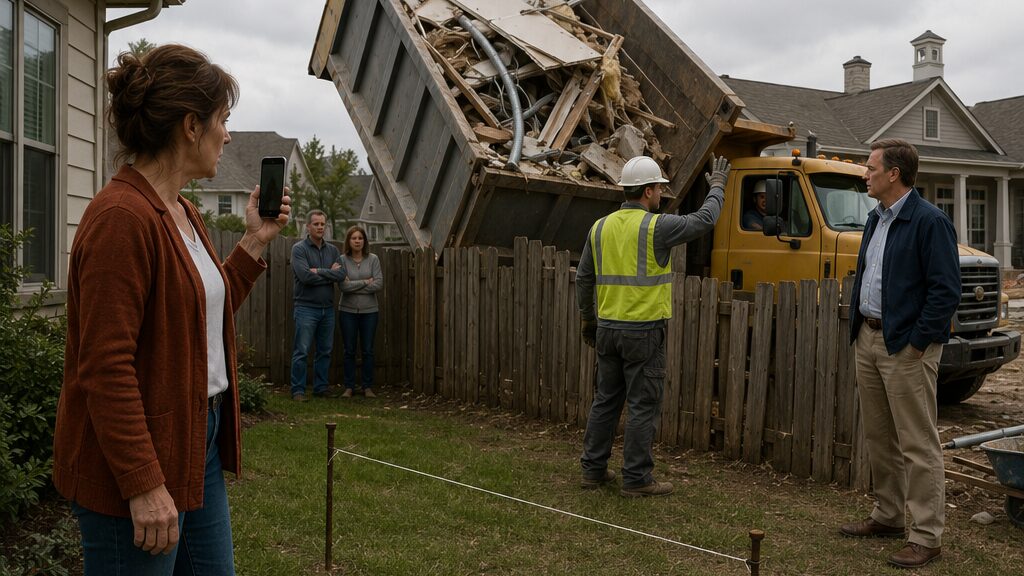
The dump truck’s bed was already rising when Katherine Lewis reached the back door.
Its yellow steel gate hung above her fence like an open jaw. Broken drywall, splintered lumber, insulation, and lengths of bent conduit shifted inside the bed with a grinding roar.
“Stop!” she shouted.
The driver either did not hear her or pretended not to. The hydraulic lift continued whining.
Katherine ran across the damp grass in slippers, one hand still holding the phone she had snatched from the kitchen counter. Beyond the fence, the clubhouse renovation site filled the narrow greenway with machinery, orange barriers, and men in fluorescent vests. The truck had backed up until its rear tires nearly touched the wooden boards separating the work zone from her yard.
A white string stretched low across the grass on Katherine’s side, tied between two rusted survey pins she had uncovered before sunrise.
She reached the fence as Michael Hall raised one gloved hand toward the driver.
“Hold it,” he called.
The truck bed stopped halfway up. Debris settled with a heavy internal slide.
Michael looked at Katherine through the dust. He wore a white hard hat and an expression of strained patience, as if she had interrupted a scheduled delivery rather than caught him preparing to bury part of her property.
“You can’t dump that here,” Katherine said.
Michael glanced toward the narrow strip behind her fence. “This is the designated laydown area.”
“This is my yard.”
“It’s temporary.”
“That doesn’t change whose yard it is.”
A second man stepped around a stack of plywood. Eric Walker wore clean work boots, pressed khakis, and the navy windbreaker with the small silver crest the homeowners’ association used on official events. He had been HOA president for three years. Before the renovation began, he had still waved when he passed Katherine’s mailbox.
Now he checked his watch.
“Katherine,” he said, “we sent notices about construction access.”
“You sent a schedule. You did not ask to use my land.”
Eric’s eyes moved past her to the white string. “What is that?”
“My property line.”
Michael gave a short breath that might have been a laugh. “That’s not where the access easement runs.”
Katherine lifted her phone and began recording. The red timer appeared on the screen.
“It is Monday, April eighth, at eight twelve in the morning,” she said. “Truck number four-six-seven is positioned to unload construction debris across my rear boundary. I am stating that I do not consent.”
Michael’s face hardened.
“Come on,” he said. “You don’t need to turn this into a production.”
“I need you to move the truck.”
Eric stepped closer to the fence. “The association has a service easement along this side of the clubhouse property. The contractor is operating under our authorization.”
“Then show me the recorded easement.”
“We can provide documentation.”
“Before you dump.”
A worker near the truck looked away. The driver leaned through his open window, waiting.
For one moment, Katherine thought Eric might stop the delivery. She had known him long enough to recognize the small signs of calculation: his lips flattening, his thumb rubbing the edge of his phone case. He did not enjoy disorder. He did not like scenes in which other people controlled the pace.
Then a reversing alarm began beeping on another vehicle farther down the lane. Michael checked his clipboard.
“We’re already behind,” he said.
Eric looked at the half-raised truck bed, then at Katherine.
“This project serves a hundred and fourteen homes,” he said. “We cannot suspend work every time one owner disputes an established access route.”
“Established where?”
“You’ll receive the file.”
“That is not an answer.”
“It is the answer I have right now.”
Katherine lowered her gaze to the white string. It ran straight beneath the fence through a gap where one board had warped, then continued toward the second survey pin near her Japanese maple. She had spent forty minutes that morning clearing soil from the metal caps. The old county measurements in her closing documents had placed both points exactly where she found them.
She angled the phone so the truck, string, and pin appeared together.
“Michael,” Eric said.
Michael turned to the driver and made a downward chopping motion.
The hydraulic system screamed.
The bed rose.
Katherine’s chest tightened, but she did not step backward. She kept recording as the first broken boards slid toward the open gate.
“You can see the boundary marker,” she said, her voice less steady than she wanted. “You can see the string.”
Eric did not answer.
The load came down in a violent wave.
Drywall sheets shattered against the fence. Gray dust burst upward. Insulation rolled across the top boards like dirty snow. A length of metal ducting struck the ground, bounced, and crossed the white string. Then the heavier material followed—lumber, buckets, torn plastic, chunks of concrete board—pushing through the weak section of fence and collapsing into Katherine’s yard.
The white line disappeared beneath it.
The sound drove every other sound away.
Katherine tasted grit. A piece of drywall landed three feet from her slippers. The fence leaned inward, one post groaning under the weight.
“Stop the truck!” she shouted.
Michael signaled the driver only after most of the load had fallen.
The bed remained raised. A few scraps slid loose and dropped with soft thuds.
Katherine walked toward the debris, filming the buried string. Dust coated her cardigan sleeves. One of the survey pins was gone beneath the pile.
Eric came through the temporary opening between the properties. “You need to stay clear of the equipment.”
She turned the phone toward him. “Did you authorize that load?”
He saw the camera.
His shoulders shifted. “The association authorized the contractor to use the service corridor.”
“Did you authorize this truck to unload after I told you the material would cross my marked boundary?”
“Katherine, legal distinctions about a temporary staging area are not going to be resolved in your backyard.”
“Did you authorize it?”
Michael muttered something to the driver. The truck’s bed began lowering.
Eric stared at Katherine for several seconds.
“Yes,” he said finally. “I authorized work to continue under the easement granted to the association.”
The words were quiet and precise.
Katherine saved the recording.
A familiar pressure gathered behind her ribs—the old urge to over-explain, to make herself reasonable enough that no one could accuse her of being difficult. Four years earlier, she had challenged a roofing surcharge after discovering the board had counted garage units incorrectly. She had been right. The board had revised the calculation. Dues had still risen, and for months neighbors had looked at her as if the increase had come from her kitchen.
She had learned to keep her head down after that.
Eric appeared to be counting on it.
“When will the debris be removed?” she asked.
“Once the hauling phase begins.”
“When?”
“Near the end of demolition.”
“That could be weeks.”
Michael answered. “Two, maybe three.”
“No.”
He shrugged. “That’s the schedule.”
Katherine looked at the broken fence, the insulation snagged in her shrubs, and the mound covering the pin. She wanted to order them off her land. She wanted to call the police, the county, anyone who could arrive with authority larger than her own voice.
Instead, she took photographs.
The truck number.
The tire tracks.
The buckled fence post.
The point where the white string vanished beneath the debris.
The HOA crest on Eric’s jacket as he stood beside the pile.
Michael watched her move methodically around the yard.
“You planning to sue the whole neighborhood?” he asked.
Katherine looked up.
“No,” she said. “I’m planning to remember exactly what happened.”
His smile faded first.
The truck pulled away, leaving a strip of pale dust across the service lane. Workers resumed moving lumber as though the interruption had ended cleanly. Eric stayed behind.
He reached inside his windbreaker and removed a folded sheet of paper.
“I was going to have management email this,” he said. “But since you insist on formalities.”
He held it across the damaged fence.
Katherine took it by one corner. The page was a photocopy of a faded drawing. A shaded band ran behind several properties, including hers. At the top, in block lettering, were the words SERVICE EASEMENT—CLUBHOUSE ACCESS.
There was no county stamp on the visible side. No recording number. At the bottom, a signature line had been blurred by copying.
Eric tapped the shaded strip.
“This has been in the association file for years.”
“That doesn’t make it recorded.”
“It makes your claim less simple than you think.”
He turned back toward the construction site.
Katherine unfolded the page fully. Near the lower margin, almost lost under a dark copy line, was a date from fourteen years earlier—five years before she bought the house.
The white string remained hidden beneath the debris, but the photocopied line cut straight through her yard.
Chapter 2: Sixteen Loads and One Dark Stain
The reversing alarm began at six forty-three the next morning.
Katherine opened her eyes before the second beep. Through the bedroom window, amber lights flashed against the fence.
She reached the yard wearing jeans, shoes, and the same rust-colored cardigan before the truck finished backing into place. The first pile still pressed against the damaged boards. Overnight moisture had darkened the drywall and flattened the insulation into gray clumps.
Michael stood beside a second truck.
“You cannot add to that pile,” Katherine said.
He glanced at her phone. “Morning.”
“I sent written notice to the association, the management company, and your office.”
“I don’t handle homeowner correspondence.”
“You handle the trucks.”
“I handle the site plan.”
“And the site plan shows my property as a dump?”
“It shows an access corridor.”
Katherine began recording.
The second load fell fifteen minutes later.
By Thursday, there were five timestamped videos.
By the following Monday, there were nine.
Katherine built a spreadsheet between medical billing audits. Each row contained the date, arrival time, truck number, visible contents, weather, and destination of the load. She saved photographs in folders labeled by day and printed the clearest image from each delivery.
The pile changed character as it grew.
At first it had looked like ordinary demolition waste—wood, gypsum board, wiring, torn vapor barrier. Then came split bags of hardened concrete, greasy metal brackets, sections of old pipe, and black roofing membrane that gave off a hot chemical smell when the sun reached it.
The fence disappeared board by board.
On the tenth day, Katherine found a dark stain spreading beneath a snapped length of pipe near the maple. It had soaked into the soil in an irregular oval. The surface shone faintly, even in shade.
She crouched without touching it.
The smell was sharp, oily, and wrong.
She photographed the stain with a ruler beside it, then marked its position on a printed image of the yard. The buried property line passed directly beneath the darkest section.
That afternoon she called the contractor’s site office again.
A woman answered after four transfers.
“I have an active contamination concern on private residential property,” Katherine said. “I need the name of the person who authorized disposal there.”
“Our field team is operating under client direction.”
“Who is the client contact?”
“The homeowners’ association.”
“Your trucks are carrying your company name.”
“And the approved staging plan came from the association.”
“Did your company verify the easement?”
A pause followed.
“That would be a contractual matter.”
“Who approved each load?”
“The loads are part of scheduled demolition.”
“Who approved placing them on my parcel after I objected in writing?”
The woman’s voice cooled. “Ma’am, if you have a property dispute, you need to resolve it with your association.”
Katherine wrote the sentence into her log.
That evening, she arranged the first twelve printed truck photographs across her kitchen table. The white borders formed a rough calendar. In the earliest image, the string was visible. In the next, only six feet remained. By the seventh load, the line had vanished completely and the pile stood higher than Katherine’s shoulders.
She drew a thin pencil mark across each photograph where the boundary should have been.
The sequence made the harm clearer than any single image. The debris had not drifted. It had not spilled accidentally from one careless unloading. Every truck had backed into the same position. Every load had crossed the same line.
She should have called county enforcement after the first one.
The thought came every time she added a row to the spreadsheet.
Instead, she had waited because she wanted proof no one could dismiss. She told herself a complete pattern would be stronger than an angry complaint. Beneath that reasoning was something less flattering: she could not bear another public fight in which neighbors called her dramatic before the facts were known.
So she kept collecting facts.
On day thirteen, two neighbors stopped beside her mailbox.
One held a cloth over her nose. “Do you smell that from inside?”
“Yes.”
“My grandson’s room faces this way.”
“I’ve requested removal.”
The other neighbor crossed her arms. “Eric said the delay is because you challenged the access agreement.”
“The debris is on my land.”
“He said the contractor can’t haul it until the boundary issue is resolved.”
“They had no problem bringing it in.”
“That’s not what he told us.”
Katherine looked toward the clubhouse roofline, where exposed beams stood against the sky. “What did he tell you?”
“That you threatened litigation and stopped the removal plan.”
“I have not stopped removal. I have demanded it.”
The first neighbor lowered the cloth. “We just need this handled. The lender inspection is coming up.”
Katherine felt the old pattern closing around her. Not facts, but inconvenience. Not who had crossed the line, but who was making everyone look at it.
“I’ll send you copies of my notices,” she said.
“We don’t need to be pulled into legal stuff,” the second neighbor replied.
They walked away before Katherine could answer.
On the sixteenth morning, the final demolition truck arrived carrying wet insulation, twisted ductwork, and two dented metal drums with their labels peeled away.
Katherine stood in full view and recorded it.
Michael approached the fence but did not joke this time.
“You’ve got enough pictures,” he said.
“That depends on whether you’re finished.”
“Demolition phase is finished.”
“When does removal begin?”
He looked toward the construction trailer. “That’s being discussed.”
“With whom?”
“The association and the carrier.”
“What carrier?”
He seemed to realize he had said too much.
“Ask Eric.”
The load dropped. One drum rolled halfway down the mound before lodging against a broken fence rail. A thin brown line appeared beneath its rim.
Katherine called the county.
The compliance office asked whether she had confirmed the property boundary. She said she had closing documents and the survey-pin locations, but not a certified current copy of the recorded plat.
“You’ll need records,” the clerk told her. “And if you’re alleging contamination, photographs alone won’t establish the substance.”
“What happens while I get those?”
“You can submit an online complaint.”
“How long for inspection?”
“Current estimate is ten business days.”
Katherine stared through the kitchen window at the mound pressing into her yard.
“Ten days?”
“Possibly sooner if there’s an immediate hazard.”
“There is liquid leaking into residential soil.”
“Then document it and avoid contact.”
After the call, Katherine printed the sixteenth photograph and placed it at the end of the row. Her kitchen table was no longer large enough. The pictures continued onto two chairs and the counter.
Sixteen loads. Sixteen dates. Sixteen chances for someone to stop.
She picked up Eric’s photocopied easement. The shaded strip looked authoritative at first glance. The page used survey language, bearings, parcel references, and a scale. But the longer she studied it, the more absences she saw.
No recording stamp.
No instrument number.
No legible owner signature.
She drove to the county records office the next morning with the photocopy sealed in a clear folder.
The clerk behind the counter examined it under a desk lamp.
“Do you know the grantor’s name?” the clerk asked.
“The former owner of my property, I assume.”
“You assume?”
“The HOA gave me this and said it established access rights.”
The clerk searched by parcel number, subdivision, association name, and the date printed near the bottom. She tried variations while Katherine sat beneath a sign asking visitors to silence their phones.
At last the clerk turned the monitor slightly away and looked again at the paper.
“I can find the subdivision plat,” she said. “I can find utility easements and the drainage reservation. I can’t find this.”
“Could it be filed somewhere else?”
“Not if it burdens this parcel.”
Katherine’s fingers tightened around the folder.
“What does that mean?”
“It means this copy has no recording number because I don’t see evidence it was ever recorded.”
Chapter 3: The Map Showed Eleven Feet of Silence
The clerk returned carrying a wide sheet of paper that would not lie flat.
She set two metal weights on its corners. Katherine’s parcel number appeared near the bottom in small black type. The lines around it were crisp, measured, and stamped by the county recorder.
“This is the recorded subdivision plat,” the clerk said. “There have been no later boundary adjustments filed against your lot.”
Katherine leaned over the counter.
Her house was reduced to a rectangle. The rear yard was a measured polygon bordered by bearings and distances. Behind it sat the clubhouse parcel. A drainage easement crossed one corner, but the broad service corridor shown on Eric’s photocopy was absent.
“Can you mark where the fence is?” the clerk asked.
Katherine opened a photograph on her phone and pointed to the survey pins.
The clerk used a ruler to compare the recorded dimensions. “Assuming those are the original monuments, the rear line should run here.”
She traced the edge of Katherine’s lot.
Katherine placed Eric’s photocopy beside the plat. The shaded strip on his page extended deep into her parcel.
“How far?” she asked.
The clerk measured twice.
“Approximately eleven feet at the widest point.”
Eleven feet.
Katherine pictured the yard before the construction started: the maple, the narrow bed of hostas, the strip of grass where she rolled out a canvas chair in autumn. Eleven feet was not a technical sliver. It was the entire width of a small room.
“Could the association still have rights that aren’t shown here?”
“Recorded rights should appear in the title chain. I can’t give legal advice. You’d need an attorney to determine what this document is.”
The clerk nodded toward Eric’s photocopy.
Katherine ordered certified copies of the plat, her deed, and every recorded easement associated with the parcel. The embossed seal on the first page left a raised circle beneath her thumb.
For the first time since the truck arrived, she felt something close to relief.
It lasted until the clerk said, “A boundary record will help with trespass. It won’t identify whatever is leaking into your soil.”
Katherine called Rachel Martinez from the parking lot.
Rachel had handled zoning matters for a small municipal office before opening her own practice. Her voice on the phone was brisk and unpromising.
“Bring the recorded documents, the HOA copy, every written notice, and a sample of your photographs,” she said. “Do not bring loose debris into my office.”
“I wasn’t planning to.”
“You’d be surprised.”
Rachel’s office occupied a converted brick house near the courthouse. By three that afternoon, the conference table held Katherine’s folders in squared stacks.
Rachel examined the recorded plat first. She checked the legal description in Katherine’s deed, then compared it with the subdivision dimensions. Next she studied Eric’s photocopy under a magnifying lamp.
“Where did you get this?”
“Eric handed it to me after the first load.”
“He called it an easement?”
“A service easement.”
Rachel turned the page over. “This is a proposed exhibit.”
Katherine waited.
“It has a project title and a legal description, but I don’t see an executed grant. No notarized signatures. No acceptance language. No recorder’s stamp. It may have been drafted for negotiation, but this page alone does not create a property right.”
“So it’s worthless?”
“I didn’t say that.”
Katherine’s relief contracted again.
Rachel aligned the two maps. “It may be evidence of what somebody intended. It may explain why the association believes the corridor exists. It may also prove they relied on a document without checking whether it was completed.”
She took out a red pencil and drew a line across a copy of the official plat.
“There is your recorded boundary.”
Then she measured eleven feet into Katherine’s parcel and shaded the affected area.
The red line passed through the photographed debris field, the broken fence, the buried survey pin, and the dark stain.
Rachel looked at the sixteen-image sequence.
“These are useful.”
“I recorded every load.”
“I can see that.”
“And Eric authorized the first after I objected.”
“You have that on video?”
“Yes.”
“That helps establish notice. It does not remove the material.”
Katherine sat back. “What will?”
“Possibly a demand backed by a trespass claim, zoning enforcement, the contractor’s insurer, or an emergency order if the substance presents a hazard.”
“Possibly?”
“You want certainty. Property disputes rarely offer it on the first afternoon.”
Rachel separated the photographs into groups. “Why did you wait sixteen loads before going to the county?”
“I didn’t wait to object.”
“That isn’t what I asked.”
Katherine looked at the red line.
“I wanted a pattern they couldn’t call accidental.”
“You had that after the second truck.”
“I wanted complete records.”
“You also wanted to avoid another neighborhood fight.”
Katherine’s eyes rose.
Rachel had found the old roofing dispute in the HOA correspondence Katherine brought. The meeting minutes described Katherine’s objections in dry language, followed by several homeowner comments about increased dues.
“I was right then,” Katherine said.
“I’m not questioning that.”
“They still blamed me.”
“And now?”
“Now they’re saying the construction delay is my fault.”
Rachel capped the pencil. “Your evidence is strong. Your delay may still matter if the leak worsened while you were documenting. The other side will use anything available.”
Katherine felt irritation sharpen through her. “Are you saying I caused this?”
“I’m saying the contractor caused the dumping, the association may have authorized it, and you made a human decision under social pressure. Those facts can coexist.”
Katherine looked again at the photographs. She had treated them as armor. Rachel had turned them into a timeline that included her choices as well as everyone else’s.
“What happens next?” she asked.
Rachel drafted a preservation notice to the contractor and HOA, demanding that they retain hauling records, site plans, communications, insurance information, and all versions of the alleged easement. She prepared a formal cease-and-desist letter and attached the certified plat.
Then she called county compliance.
The inspector accepted the boundary materials but would not issue a full remediation order without environmental testing.
“We can direct them to stop adding material based on the zoning and encroachment evidence,” the inspector said over speakerphone. “But we need laboratory results before ordering contaminated-soil removal.”
“How soon can someone test?” Katherine asked.
“Private testing will be faster.”
“How much faster?”
“Days instead of weeks.”
“And until then?”
“No additional dumping. No disturbance of the suspected area.”
It was a partial victory. The trucks would stop. The mound would remain.
Rachel ended the call and slid a list of certified environmental firms across the table.
Katherine’s phone vibrated before she could choose one.
The email subject read: EMERGENCY MEMBERSHIP MEETING—PROJECT DELAY AND COST EXPOSURE.
She opened it.
The message, signed by Eric, stated that a homeowner’s challenge to the clubhouse access corridor had forced suspension of demolition operations. It warned that missed financing and inspection deadlines could result in additional legal expenses and a special assessment to all owners.
The meeting was scheduled for Friday evening.
Attached was a proposed board resolution authorizing the association to recover delay costs from the owner responsible for obstructing established access.
Katherine read the final line twice.
The board would also consider charging its legal expenses directly to her account.
Rachel held out her hand for the phone. She read the notice without changing expression.
“He moved quickly,” Katherine said.
“He had this language ready.”
“You think he expected me to challenge it?”
“I think he expected somebody might.”
Katherine gathered the certified plat and the red-lined copy. Eleven feet of her property had been treated as silence because silence was convenient.
Now Eric intended to put her address on a screen and ask the neighborhood to decide what those eleven feet were worth.
Chapter 4: The Meeting Where Her Evidence Became the Offense
Katherine entered the clubhouse beneath a projected image of her own address.
The numbers filled the wall behind the board table in white letters. Below them, a red caption read PROJECT ACCESS DISPUTE. Someone had used one of her photographs—the first dump truck, its bed raised above the fence—but cropped out the white property-line string.
Nearly every folding chair was occupied.
People Katherine had waved to for years sat with printed agendas on their laps. Some looked away when she entered. Others watched her openly. The chemical odor from her yard did not reach the clubhouse, but she felt as if it had followed her inside.
Rachel sat in the second row with a slim folder against her knees.
“You don’t have to answer every accusation,” she said quietly as Katherine took the chair beside her.
“I know.”
“You say that like someone who intends to answer all of them.”
At the front, Eric arranged papers beside a laptop. He wore a gray suit instead of the HOA windbreaker. His tie was slightly crooked, the only visible sign that the week had cost him anything.
Michael stood near the rear door with his arms folded.
At seven sharp, Eric called the emergency meeting to order.
He began with financing.
The clubhouse renovation had been approved eighteen months earlier after water damage, structural rot, and rising insurance premiums made delay more expensive than repair. The association had secured a fixed-rate construction loan contingent on staged inspections. Missing the next inspection window could trigger extension fees. A long delay might require new underwriting.
Numbers appeared on the screen.
Legal costs.
Equipment standby charges.
Possible lender penalties.
A projected special assessment ranging from nine hundred to sixteen hundred dollars per home.
A murmur moved through the room.
Katherine understood the choice Eric was building before he said her name. Her eleven feet of yard would be placed on one side of a scale. A hundred and fourteen household budgets would sit on the other.
“The work stoppage followed an objection by the owner of the adjacent parcel,” Eric said. “The association has historically relied upon a service-access easement shown in its property records.”
He displayed the photocopied document.
The shaded corridor looked official from thirty feet away.
A neighbor near the aisle raised her hand. “Was this brought up before construction started?”
“The contractor was given the association’s site materials,” Eric said.
“That wasn’t my question.”
Eric’s gaze moved briefly toward Katherine. “No formal challenge was submitted until work began.”
The sentence landed exactly where he intended.
Katherine felt several people turn toward her.
She raised her hand.
Eric hesitated, then recognized her. “Katherine.”
“I objected before the first load was released.”
“You objected verbally at the site.”
“I stated on video that the truck was crossing my marked boundary. You authorized it to continue.”
A few heads shifted toward Michael.
Eric kept his hands flat on the table. “The association believed, and still has reason to believe, that it possessed access rights.”
“Is the document on that screen recorded with the county?”
Silence came before his answer.
“The association’s records contain the easement exhibit.”
“That is not what I asked.”
Rachel’s hand touched Katherine’s wrist, a light warning against turning the exchange into cross-examination.
Katherine looked at the room instead of Eric.
“The county found no recorded service easement burdening my parcel,” she said. “The plat and deed show the debris area is inside my property. At its widest point, the claimed corridor crosses my boundary by approximately eleven feet.”
A man in the third row lifted his agenda. “Then why does the association have that map?”
“I am trying to determine that.”
Eric clicked to the next slide.
A photograph of the debris pile appeared. Again, the string was absent.
“The immediate question tonight is not final title interpretation,” he said. “It is how the community manages costs created by the suspension.”
Katherine stood.
“The suspension was ordered because the contractor dumped sixteen loads onto residential land.”
“You waited until sixteen loads had accumulated before obtaining county intervention.”
The room quieted.
The words struck harder because they were true in the narrowest possible sense.
“I objected to every load,” she said.
“But you did not contact compliance until the end of the demolition phase.”
“I documented what was happening.”
“You allowed a condition to develop while preparing a case.”
Rachel rose halfway from her chair. “That characterization ignores repeated written demands for removal.”
Eric looked at her. “Counsel will have an opportunity during the legal review. This is a membership meeting.”
Katherine wanted to answer with dates, email headers, truck numbers. Facts lined up in her mind with the comforting order of spreadsheet columns.
Instead, she saw the neighbor who had held a cloth over her nose. A retired couple in the front row whispered over the proposed assessment. Near the wall, a woman held an envelope marked PAST DUE.
The cost Eric described was not invented simply because he was using it against her.
A man near the back spoke without raising his hand. “Can’t they just finish through the disputed strip and sort out damages later?”
Several people nodded.
“It’s already torn up,” someone else said.
Another voice added, “If the work stops for months, all of us pay.”
Katherine turned toward them. “It is not just torn grass. There is unidentified liquid in the soil.”
“The county hasn’t confirmed contamination,” Eric said.
“Because testing has not been completed.”
“So we should stop a million-dollar project based on a stain?”
Michael shifted near the door, but said nothing.
Katherine faced Eric. “Would you allow an unidentified drum to leak eleven feet inside your property?”
“That is not the question before the membership.”
“It is the only reason there is a question before the membership.”
Eric’s control slipped just enough for fatigue to appear.
“You think I wanted this?” he asked. “The previous board deferred repairs for six years. The roof failed. The insurer threatened nonrenewal. We negotiated financing when rates were lower, and every deadline matters. If this project collapses, people who had no role in your boundary dispute will pay for it.”
“My boundary is not a dispute because it is inconvenient.”
“And the association cannot be managed as if one parcel exists alone.”
There it was—not greed, not personal hatred, but a calculation. Eric had looked at Katherine’s strip of ground and decided it was the cheapest place to put the risk.
The recognition did not soften what he had done. It made the choice clearer.
Katherine carried the certified plat to the front.
Eric’s projected easement remained on the screen. She laid the recorded document beneath it.
“Then show everyone the full page,” she said.
“This is the full exhibit.”
“Show the signature block.”
Eric did not move.
A board member beside him leaned toward the laptop. “Eric?”
Katherine opened her copy of the alleged easement and held it up.
“The version you are projecting cuts off the bottom margin. There is no county stamp. There is no instrument number. The owner signature is blank.”
The murmur returned, sharper now.
Eric’s jaw tightened. “It is part of the association’s historical file.”
“Was it recorded?”
He looked at the board members, then at the residents.
“No,” he said. “Not that we have been able to confirm.”
The answer gave Katherine a small, immediate victory. It also changed nothing about the numbers on the previous slide.
The board moved to the proposed resolution.
Rachel whispered, “They cannot decide title here.”
“They can decide what story the neighborhood believes.”
The resolution authorized legal expenses to defend the claimed access rights and permitted the association to assess delay-related costs against Katherine’s account if counsel determined her actions had obstructed an established community easement.
Three board members voted yes.
One abstained.
One voted no.
The measure passed.
A woman in the front row began crying quietly—not because of Katherine, perhaps, but because sixteen hundred dollars was more than a number on a screen.
Katherine gathered her folders. The certified plat suddenly felt heavier than when the clerk had handed it to her.
Near the exit, Eric approached.
“I did not want to put your address up there,” he said.
“But you did.”
“I need the project moving.”
“You had other choices.”
“Every choice costs someone.”
“You chose the person you thought would stay quiet.”
He did not deny it.
Katherine stepped into the corridor. Behind her, residents clustered around the assessment chart. Rachel remained inside speaking with a board member.
Edward Brown stood alone beside the drinking fountain.
He lived next door to Katherine and had served as HOA treasurer years before Eric joined the board. During the meeting, he had not spoken once.
Now his face looked gray.
“Katherine,” he said.
She stopped.
Edward glanced toward the open meeting-room door, then lowered his voice.
“I know who wrote that draft.”
Chapter 5: The Man Who Helped Draw the Wrong Line
Edward unlocked the metal box with a key he wore on his watch chain.
They sat at his dining table less than an hour after the meeting. The room smelled faintly of furniture polish and old paper. A lamp with a green glass shade cast a narrow pool of light over the box.
Edward lifted out three ledger books, a bundle of meeting minutes, and a rolled survey exhibit held by a cracked rubber band.
Katherine remained standing.
“You said you knew who wrote it.”
Edward removed the rubber band carefully. “I helped.”
The rolled paper opened across the table.
It was a cleaner version of the document Eric had projected. The same shaded corridor crossed the rear portions of several lots, including Katherine’s. Pencil notes filled the margins. Beside one bearing, someone had written CHECK OWNER APPROVAL.
Edward sat down.
“Fourteen years ago, the clubhouse needed a new sewer connection,” he said. “The contractor wanted a straight route from the service lane. The original subdivision layout didn’t provide enough room for equipment.”
“So the board proposed an easement.”
“Yes.”
“Across private lots.”
“Across narrow rear strips. We thought owners might agree because the association would restore the landscaping and reduce the project cost.”
Katherine touched the penciled note. “Did they?”
“Most did.”
“Did the owner of my house?”
Edward’s eyes remained on the paper.
“No.”
The answer was quiet enough to be mistaken for shame.
“He refused?”
“He objected to the width. He said eleven feet was not narrow and that temporary construction rights had a way of becoming permanent convenience. He proposed a smaller route from the parking side.”
“What happened?”
“The board decided the alternate route cost too much. Negotiations stopped. The sewer project was redesigned.”
“And this?”
“The engineer had already prepared the exhibit. I kept a copy in the association file because I thought it might be useful if the issue came back.”
“You labeled it as an easement?”
“I filed it under proposed easements.”
“The copy Eric gave me does not say proposed.”
Edward rubbed both hands over his face. “The folder was reorganized years later. Pages were separated. I should have destroyed the draft or marked every sheet.”
“You should have recorded that it was rejected.”
“Yes.”
Katherine’s first sensation was not triumph. It was anger so clean that it left no room for confusion.
“You sat through that meeting while he put my address on the wall.”
Edward flinched.
“I wanted to speak.”
“You did not.”
“I needed to be certain it was the same document.”
“You made notes on it.”
“I’m seventy-six years old, Katherine. I have seen three management companies lose records and two boards rewrite minutes. I did not trust my memory enough to accuse the president in a full room.”
“But you trusted it enough to let them vote.”
Edward looked toward the box. “That is fair.”
The lack of defense unsettled her more than an argument would have.
He opened the oldest ledger and turned to a page marked with a blue tab. A payment entry listed engineering work for ACCESS EXHIBIT—UNEXECUTED.
Katherine photographed it.
“Will you say this publicly?”
Edward’s fingers stopped on the page.
“I’ll provide the records.”
“That is not what I asked.”
He closed the ledger.
“My wife and I are on a fixed income. If the association’s insurer denies coverage because the board knowingly trespassed, the special assessment could be worse than what Eric showed tonight. People will say I caused it by creating the document.”
“You helped create it.”
“I prepared the financial file. The engineer drew it.”
“And you kept it without the rejection.”
“I know.”
“Then why should everyone else carry the truth while you stay in your dining room?”
Edward stood abruptly. The chair legs scraped the floor.
“Because I have spent fourteen years knowing one careless folder could someday hurt someone, and now it has. You think fear becomes smaller because it deserves no sympathy?”
Katherine stared at him.
His hands trembled against the back of the chair.
“I am not asking for sympathy,” he said. “I am asking for time.”
“The debris has been in my yard for more than two weeks.”
“And you waited too.”
The words struck with Rachel’s precision, but Edward’s voice held no professional distance.
Katherine’s face warmed. “I documented it.”
“You documented sixteen loads.”
“I objected from the first.”
“You did not call the county from the first.”
“That does not make this my fault.”
“No. It makes you frightened in a way that caused harm, just as I was frightened tonight.”
Katherine looked toward the curtained window. Beyond it, the top of the debris mound was visible under the streetlight.
Edward sat again.
“I heard about the roofing dispute,” he said. “I heard what people said about you. I understood why you wanted proof before you went public. But if you ask me to stand in front of the neighborhood and admit what I did, you must not stand there pretending your silence had no cost.”
She wanted to leave.
Instead, she looked down at the original draft.
“Did Eric know it was never completed?”
Edward did not answer immediately.
He reached into the box and removed a printed email.
The date was three weeks before construction began. Edward had written to Eric after hearing that the renovation staging plan used the rear corridor.
The message read: The attached exhibit was proposed during the old sewer project but was not executed by the Lewis parcel’s prior owner. Please verify title before relying upon it for access.
Below it was Eric’s reply.
Thank you. Current project counsel and management are reviewing all available association rights. We cannot reopen every historical file before mobilization.
Katherine read the second sentence twice.
“He was warned.”
“Yes.”
“Did you follow up?”
“I spoke to him in the parking lot.”
“What did he say?”
“That the contractor’s delay penalties were already running and management believed long historical use might support access.”
“Was there long historical use?”
“Occasional landscaping crews crossed the corner. No dumping. No heavy equipment. Nothing like this.”
Katherine placed the email beside the ledger.
The trespass was no longer an innocent mistake built from a misleading file. Eric had known enough to stop and verify. He had chosen the deadline instead.
“Give these to Rachel,” she said.
Edward nodded.
“And come to the hearing when one is scheduled.”
His expression closed.
“I said I would provide records.”
“Records did not sit silent in that meeting. You did.”
“I cannot promise.”
Katherine gathered her photographs.
Edward placed one hand over the email before she could lift it. “I will release this if you tell Rachel the full timeline. Including when you first noticed the stain.”
“What does that have to do with your warning?”
“Nothing legally, perhaps. Everything morally.”
“You do not get to bargain with my honesty.”
“No. But I will not help build a story in which everyone failed you and you failed no one.”
Katherine left without the email.
The next morning, an environmental testing technician arrived wearing disposable boot covers and carrying a metal case. Rachel stood near the patio while the technician photographed the debris field and established sampling points.
Katherine showed him where the white line had run.
He pushed a narrow probe into the soil beyond the broken fence. At the dark stain, the instrument gave a sharp electronic chirp.
“What does that mean?” Katherine asked.
“It means I select this location for a laboratory sample.”
He filled two glass jars, sealed them, and labeled each with date, time, and coordinates. Then he scraped soil from beneath the dented drum.
The smell intensified when the surface opened.
Rachel stepped back. “Petroleum?”
“Likely,” the technician said. “Possibly hydraulic fluid or equipment oil. The lab will identify the range.”
A county compliance inspector arrived before noon and ordered the area fenced off. No debris could be moved until sampling was complete. No construction vehicle could use the disputed corridor.
Michael watched from the other side of the barrier tape.
“This could have come from old soil,” he said.
The technician glanced at the wet black line running from the drum.
“It could have,” he replied. “The laboratory will tell us more.”
Katherine’s phone buzzed.
Edward had forwarded the warning email to Rachel, copying Katherine.
There was no message in the body.
Rachel read it and looked across the barrier toward Eric, who had just entered the construction site.
“He knew before mobilization,” she said.
Katherine watched Eric stop beside Michael. Neither man approached the tape.
The technician sealed the final sample in a cooler.
Two days later, the preliminary report arrived.
The soil contained petroleum-range hydrocarbons consistent with fresh equipment or construction waste.
Rachel read the finding aloud, then set the page down.
“The insurer now has to decide whether this was an accident,” she said, “or whether continuing after notice changes what they are willing to cover.”
Chapter 6: The Offer That Would Leave the Lie Standing
The cleanup proposal arrived with a permanent easement attached.
Katherine found both documents in Rachel’s conference room, clipped together as if one naturally followed the other. The first promised removal of the debris, replacement of contaminated soil, repair of the fence, and reimbursement for environmental testing.
The second granted the HOA an eleven-foot service corridor across Katherine’s property forever.
She turned to the final page.
A confidentiality clause prohibited her from discussing the dispute, the contamination, the settlement amount, or the circumstances under which the debris had been placed.
“This is not cleanup,” she said. “It is a purchase agreement disguised as cleanup.”
Across the table, the insurance adjuster folded his hands. “It is a global resolution.”
Eric sat beside the HOA management-company representative. He looked thinner than he had at the emergency meeting. Michael and the contractor’s attorney joined by video from a screen at the end of the room.
Rachel tapped the remediation section. “Your carrier accepts that the contractor’s materials caused the petroleum contamination?”
“We are prepared to fund remediation without an admission of legal liability.”
“The laboratory identified fresh petroleum-range hydrocarbons beneath a container delivered by the contractor.”
“The settlement avoids extended disputes about source allocation.”
Katherine looked at Eric. “Did you ask them to include the easement?”
Eric met her gaze. “The project still requires access.”
“Not through my yard.”
“The alternate route requires removing part of the parking lot, relocating drainage controls, and modifying the lender-approved site plan.”
“That sounds expensive.”
“It is.”
“More expensive than using land you do not own.”
The adjuster intervened. “Mrs. Lewis, the proposal restores your property promptly. Work could begin within five business days.”
“And if I refuse?”
“Remediation remains subject to coverage review and allocation among the association, contractor, and potentially other parties.”
The careful language meant delay.
Rachel had warned her before the meeting. Without agreement, the insurer could investigate for weeks. The county could prohibit disturbance but might not have funds to perform cleanup itself. Litigation could take months, possibly longer.
Katherine imagined another summer with barrier tape across the yard and oil beneath the soil.
The settlement map lay open before her. A bold line cut across the same route where her white string had been buried. The line was wider, cleaner, and permanent.
“What happens to the board’s assessment against me?” she asked.
Eric answered. “It would be withdrawn.”
“And the historical file?”
“The executed easement would replace the disputed exhibit.”
“So the document you relied on becomes true after the fact.”
“It creates certainty going forward.”
“For whom?”
“For everyone.”
Katherine turned to Rachel. “What do you recommend?”
Rachel did not answer immediately.
“The immediate environmental priority is removal,” she said. “This agreement achieves that. The reimbursement is reasonable. The assessment disappears.”
“And the easement?”
“Permanent. Broadly drafted. It permits construction, maintenance, utility work, vehicle access, and temporary storage.”
“Temporary storage,” Katherine repeated.
The adjuster said, “Subject to notice requirements.”
Katherine looked at the photograph Rachel had brought from the first morning. The string was visible beneath the raised truck bed. Eric stood to one side. Michael’s arm was lifted toward the driver.
A photograph had frozen the moment before the line vanished. The settlement would restore the soil and erase the meaning.
Rachel lowered her voice. “Refusing may leave the area exposed for months. I need you to understand that.”
“I do.”
“Your maple may not survive excavation either way.”
“I understand.”
“You are not weak if you choose immediate repair.”
Katherine appreciated the sentence because it did not tell her what to do.
The adjuster slid a pen across the table. “We can hold the offer open until Monday.”
Eric leaned forward. “The lender deadline is next Thursday. If we submit a revised access plan before then, we may preserve most of the financing terms.”
“And if I sign?”
“Work resumes.”
“Through my property.”
“For limited phases.”
“Forever, whenever the board decides the language permits it.”
His restraint thinned. “What outcome are you seeking, Katherine? The debris removed? Yes. The soil replaced? Yes. Your costs paid? Yes. The assessment withdrawn? Yes. At some point, resolution requires each side to give something.”
“I already gave sixteen loads.”
“That is not a serious answer.”
“It is the only answer you refused to hear before this became expensive.”
The management representative shifted uncomfortably.
Eric pushed his chair back an inch. “You think this is about defeating me.”
“No. I think that is what you need it to be, because then you never have to admit you made my property the solution to a problem you could not afford.”
His expression changed.
For the first time, he looked less angry than cornered.
“The association was weeks from losing the loan,” he said. “The insurer had already raised questions about unfinished structural work. If we paused to redesign before mobilization, the project might have collapsed.”
“You had Edward’s warning.”
“I had one retired treasurer’s recollection against a document in the official file.”
“You had enough doubt to verify.”
“We requested review.”
“After the trucks arrived?”
Eric looked away.
The answer was there.
Katherine felt no triumph. Only the weight of how ordinary the decision had been. No secret payment. No elaborate scheme. Just a man with a deadline choosing not to ask a question because the answer might cost too much.
Rachel opened another document. “There is also correspondence showing management asked whether title verification could be deferred until after the demolition phase.”
The management representative stiffened. “That email is privileged.”
“It was produced by the contractor’s carrier.”
Katherine read the printed line Rachel indicated.
Eric had written: Proceed under existing association records. We will address owner objections if and when raised.
“If and when,” Katherine said.
Eric’s face reddened. “We had no reason to expect a challenge.”
“You expected me not to make one.”
The adjuster called for a break.
Katherine stepped outside with Rachel. The parking lot had been partly excavated for drainage work, leaving a temporary route of steel plates and orange cones. Residents slowed as they drove past the clubhouse. Some recognized Katherine. Few waved.
“What happens if I reject it?” she asked.
“We demand an open corrective hearing before the county and continue pursuing remediation. The insurer may improve the offer or harden its position.”
“The HOA could face more fees.”
“Yes.”
“The neighbors could be assessed.”
“Yes.”
“And the soil stays.”
“For now.”
Katherine leaned against the brick wall.
She had once believed the right document would remove uncertainty. The recorded plat had proved the line. The laboratory report had proved the contamination. Edward’s email had proved warning.
None of them could decide what she was willing to cost other people in order to prevent the lie from becoming permanent.
“I waited too long to call the county,” she said.
Rachel watched her.
“I told myself I needed a pattern. I also did not want the neighborhood blaming me again.”
“That will matter when the other side argues mitigation.”
“I’m not talking about the case.”
Rachel closed the folder.
“No,” she said. “You’re not.”
Katherine looked through the clubhouse windows. Eric remained at the table, staring at the unsigned agreement.
“If I accept, they clean my yard and keep the corridor.”
“Yes.”
“If I refuse, I may protect the boundary and leave everyone paying more.”
“Yes.”
“Those are both punishments.”
“Most real settlements are choices between losses.”
Katherine returned to the conference room.
She sat, uncapped the pen, and drew one line through the signature block.
The adjuster frowned. “Is that your response?”
“My response is that I will not grant a permanent property right in exchange for cleanup of damage caused by people who had no property right.”
Eric exhaled sharply. “Then what are you proposing?”
“An open corrective hearing. Full disclosure of the unrecorded draft, the warning email, the contamination report, and the project costs. The board’s assessment against me is suspended until the hearing. The contractor begins protective measures now, even if final soil removal waits.”
“That will become public record,” the management representative said.
“Yes.”
“It could affect coverage.”
“Yes.”
“It could affect resale disclosures for the association.”
“Yes.”
Eric stared at her. “And you are willing to do that to your neighbors?”
Katherine placed the pen on the crossed-out signature.
“I am willing to tell them what happened, including that I delayed calling enforcement because I was afraid of being blamed. Then they can decide with the whole truth in front of them.”
The room went still.
Rachel slid a written request across the table.
It asked the county compliance board to schedule an open corrective hearing and preserve all interim restrictions on the contaminated area.
Katherine signed that document instead.
Chapter 7: The Line They Had to Restore Together
The county attorney placed a settlement form beside Katherine’s hand three minutes before the hearing began.
“If you sign now,” he said, “the remediation order can be entered by agreement. No testimony. No findings about prior notice.”
Katherine read the first page without sitting down.
The cleanup terms were better than the insurer’s earlier offer. The debris would be removed under environmental supervision. Contaminated soil would be excavated and replaced. Her fence and damaged landscaping would be restored. The assessment against her would be suspended pending a separate board review.
There was no permanent easement.
But the agreement described the dumping as a “good-faith boundary misunderstanding.”
Katherine set it back on the table.
“That sentence stays in the public record?”
“Yes.”
“And the warning email does not?”
“The parties would avoid litigating intent.”
Behind her, chairs scraped as residents entered the county hearing room. Rachel stood near the aisle with two document boxes. Eric sat at the opposite table beside the HOA’s attorney and management representative. Michael occupied the end seat, separated from them by the insurance adjuster.
Edward had not arrived.
Rachel came forward. “You can still accept remediation without agreeing to that characterization.”
“The carrier won’t separate them,” the county attorney said.
Katherine looked through the glass doors into the corridor.
Edward had promised nothing. Since forwarding the email, he had answered Rachel’s questions in writing but had refused to confirm whether he would testify. His absence left the warning as a document that Eric could call incomplete, mistaken, or misunderstood.
The hearing officer entered.
The settlement form remained unsigned.
Katherine took her seat.
The county presented the violation first. Large photographs appeared on two monitors: the raised truck bed, the broken fence, the sixteen loads, the dented drum, the dark soil. Then came the recorded plat.
Rachel stood and placed a clear overlay on the enlarged map. A white line marked Katherine’s legal boundary. The debris field extended across it in a broad uneven wedge.
“Eleven feet at the widest point,” Rachel said.
The hearing officer studied the overlay. “Does the association dispute the recorded boundary?”
The HOA attorney rose. “We do not dispute the current plat. We contend the association reasonably relied upon a historical access exhibit and past use.”
“An exhibit that was never recorded?”
“It was maintained in the association’s official files.”
Katherine watched Eric. He kept his eyes on the table.
The county inspector testified that the site was residentially zoned and that construction waste could not be stored there without authorization. The environmental technician explained the petroleum findings and traced the likely source to fluids released from the delivered construction material.
Michael’s attorney asked whether old contamination could have existed in the yard.
“It could have,” the technician said. “But the concentration pattern began beneath the delivered container and diminished outward. The surface material was recent.”
Michael shifted in his chair.
When Katherine was called, Rachel asked her to describe the first morning.
Katherine did not begin with the plat.
She described the white string stretched between the survey pins. She described Eric seeing it, Michael seeing it, and the driver waiting with the truck bed halfway raised. She played the recording of her formal objection.
Her own voice filled the room.
It is Monday, April eighth, at eight twelve in the morning.
Then Eric’s recorded answer:
Yes. I authorized work to continue under the easement granted to the association.
Several residents turned toward him.
Rachel asked, “When did you contact county enforcement?”
“After the sixteenth load.”
“Why did you wait?”
The HOA attorney glanced up, perhaps surprised that Rachel had asked the question herself.
Katherine held the edge of the witness table.
“I told myself I was building evidence,” she said. “That was partly true. I had objected in writing and believed a full record would prevent anyone from calling the first load an accident.”
“What was the other part?”
Katherine saw the room from the emergency meeting: her address on the wall, neighbors measuring her yard against their own bills.
“I had challenged an HOA calculation years earlier. The correction still increased dues, and people blamed me. This time I wanted proof so complete that no one could turn the problem into my personality.”
“Did waiting make the contamination worse?”
“I don’t know. It gave them time to add more material. I should have called the county sooner.”
A silence followed that did not feel like defeat.
The HOA attorney approached.
“You watched trucks continue to unload while you took photographs?”
“Yes.”
“You could have requested emergency intervention earlier?”
“Yes.”
“And you are asking the association to bear costs that might have been reduced by faster action?”
“I am asking each party to bear the cost of its choices. That includes me.”
He paused.
“What cost are you offering to bear?”
Katherine looked toward the residents.
“My landscaping reimbursement does not need to include the plants lost after the first week. I will absorb that portion. But my delay did not create an easement, authorize the trucks, or put petroleum in the soil.”
The attorney returned to his seat without another question.
Eric testified next.
He described the clubhouse roof failure, the threatened insurance nonrenewal, and the financing deadline. His voice remained controlled until the county attorney asked about the draft easement.
“I believed it reflected established association rights,” he said.
“Were you warned that the prior owner had rejected it?”
“I received an email from a former treasurer expressing uncertainty.”
“Did you stop mobilization to investigate?”
“No.”
“Why?”
Eric looked at the homeowners behind him.
“Because stopping then could have lost the loan. We had families already struggling with dues. Retirees. Owners behind on payments. Every redesign estimate made the project less survivable.”
“So you proceeded despite uncertainty?”
“I proceeded based on the records available to the association.”
The hearing-room door opened.
Edward entered carrying the metal file box against his chest.
He walked slowly down the aisle and stopped beside Rachel.
“I need to correct that,” he said.
The hearing officer called a recess long enough for the attorneys to confer. When the hearing resumed, Edward took the witness chair.
His hands trembled as he opened the ledger.
“I prepared the financial file for the proposed easement fourteen years ago,” he said. “The engineer created the drawing. The owner of the Lewis parcel rejected the eleven-foot corridor. It was never granted.”
He identified the entry marked UNEXECUTED. Then Rachel displayed his warning email to Eric.
“Did Mr. Walker know before construction that the document might not be valid?” she asked.
“Yes.”
Eric’s attorney objected to the word valid.
Edward corrected himself.
“He knew it had not been executed by the prior owner. I told him directly in the parking lot.”
“What did he say?”
“He said the deadlines were already running and management would address objections if they arose.”
Eric closed his eyes briefly.
Rachel asked, “Why did you not disclose this at the emergency HOA meeting?”
Edward looked at Katherine before answering.
“Because I was ashamed. I had kept the draft without marking every page clearly. I thought if I spoke, the neighborhood would blame me for the project costs.”
“And now?”
“Now I understand that silence did not protect anyone. It only decided who would be harmed first.”
No one applauded.
The hearing officer issued findings that afternoon.
The association possessed no recorded access right across Katherine’s parcel. The contractor had continued after direct notice of a disputed boundary. The association had received enough warning before mobilization to require title verification. The debris and contaminated soil had to be removed under an approved remediation plan.
The board’s assessment against Katherine was voided.
Her requested reimbursement was reduced by the landscaping amount she had offered to absorb. The association and contractor would share the remaining costs according to insurance allocation. The HOA was ordered to correct its property files and adopt a rule requiring recorded title verification before future work entered private lots.
The ruling did not save the community from every expense.
The alternate construction route required part of the parking lot to be reopened. The lender granted an extension but imposed a fee. Residents would face a smaller special assessment than Eric had projected, but there would still be one.
Outside the hearing room, a neighbor approached Katherine.
“I can’t pretend I’m happy about the assessment,” she said.
“I know.”
“But I saw the email.”
Katherine waited.
The neighbor nodded once and walked away.
Eric emerged last. He carried no folders.
“The board will remove me from the project committee tonight,” he said.
Katherine did not answer.
“I thought I was choosing the least damaging option.”
“You chose damage you believed you could contain.”
“Yes.”
His admission was almost too quiet to hear.
“I am sorry,” he said.
Katherine looked at him for a long moment. “The cleanup matters more than the apology.”
He accepted that without asking for anything else.
Three weeks later, the mound was gone.
Under the cleanup crew foreman’s direction, workers removed the debris in measured sections. The contaminated soil was loaded into lined containers. Fresh soil arrived only after laboratory tests cleared the excavation.
Michael’s company performed the physical work. He spoke to Katherine once, on the first morning.
“We found something near the maple.”
The foreman opened his gloved hand.
The missing survey pin lay across his palm, rusted and caked with black soil.
Katherine took it carefully.
The crew reset the pin under a surveyor’s supervision. At the far end of the yard, the second marker remained where Katherine had uncovered it before the first truck arrived.
She tied a fresh white string to the recovered pin.
Edward stood on his side of the fence holding the spool. He did not ask whether she forgave him. She did not offer.
“Pull it tighter,” she said.
He stepped back until the line rose straight above the new soil.
Eric watched from the clubhouse parking lot while workers rebuilt the fence several feet inside the construction barriers. He no longer wore the HOA jacket.
The foreman spread the first layer of clean topsoil along the string.
For weeks, the line had been treated as an inconvenience, then buried as if not seeing it could make it disappear. Now it guided every shovel, every fence post, and every measurement of what had to be put back.
Katherine pressed the recovered pin with the toe of her shoe. It held.
The yard was not restored to what it had been. The maple would probably survive, though one side had lost branches. The hostas were gone. The new fence boards did not match the weathered sections beside them.
The community would still pay something.
Edward would still have to speak at the next membership meeting.
Eric’s apology would not become forgiveness simply because it had been offered.
But the soil beneath Katherine’s feet was clean, the association’s false map had been removed from its files, and the white string no longer marked a line she was afraid to defend alone.
She tightened the knot, handed the spool back to Edward, and watched the workers lay clean earth up to the boundary—no farther.
The story has ended.