The HOA Fined Him for Using the Gravel Lane—Then Learned Why Their Own Trucks Needed His Permission
Chapter 1: The Fine on the Mailbox Changed the Road Overnight
Donald Miller saw the white envelope before he saw the woman holding it.
Jennifer Adams stood beside his mailbox with a clipboard tucked against one hip, watching his pickup idle halfway down the gravel lane. The truck’s tires rested in the pale ruts Donald had followed hundreds of times since buying the house.
He shut off the engine.
“What’s wrong?”
Jennifer held out the envelope. “I need to give you this directly.”
Donald looked at her, then at the paper.
Across the top was the association’s name. Below it, in bold type, was a number that made his jaw tighten.
$500.
“Five hundred dollars for what?”
“Unauthorized vehicle use of restricted community access.”
Donald glanced toward the gravel beneath his boots.
“You mean this road?”
“Access lane.”
“I’ve driven it for nine years.”
Jennifer adjusted her glasses. She was dressed for an office even though they were standing beside weeds, drainage stone, and Donald’s dust-coated pickup.
“The rule isn’t based on how long someone has been doing it.”
Donald read the notice twice.
The lane ran along the east side of his property, beginning near the county road and curving behind several homes before reaching a rear common area. He used it because it was the simplest way to bring his truck around to the detached garage. Delivery drivers occasionally used it. Landscaping crews used it constantly.
Nobody had ever stopped him.
“Since when is my truck unauthorized?”
Jennifer opened the clipboard.
“The lane is classified as restricted community infrastructure. Resident vehicles need a registered access authorization.”
Donald almost laughed.
“A what?”
“An access authorization.”
“You mean a pass?”
“In practical terms, yes.”
“Where do I get one?”
“There’s an application process.”
He held up the violation notice. “Apparently there’s also a five-hundred-dollar process.”
Jennifer’s expression barely changed.
Donald knew the look. He had worn a version of it himself during thirty-five years working utility maintenance: the face of someone delivering a rule they did not intend to debate in a driveway.
That irritated him more than anger would have.
“Show me where this rule is.”
“It’s in the governing materials.”
“Which materials?”
“The access provisions distributed to residents.”
Donald folded the paper once.
“I’ve got the bylaws. I’ve got the covenants. I don’t remember any access-pass provision.”
“It was also included in your welcome packet.”
Donald stopped folding.
“My what?”
“Your welcome packet. Owners receive one when they take possession.”
“I never got one.”
Jennifer paused.
It was brief, but Donald saw it.
Then her professional tone returned.
“The association records indicate the materials are distributed to new owners.”
“That isn’t the same as saying I received them.”
“No.”
“So if I didn’t receive this packet, how exactly was I supposed to know I needed permission to drive down a lane I’d already been using?”
Jennifer looked toward his pickup.
“I understand why that would be frustrating.”
Donald disliked the sentence immediately.
“But?”
“But the violation concerns use of the lane. The disclosure issue doesn’t change whether the use occurred.”
“So the fine stands.”
“At this point, yes.”
A neighbor slowed while driving past on the county road. Donald watched the car for a second too long.
He suddenly felt exposed standing beside his own mailbox while someone from the HOA explained why his normal routine had become punishable.
“When did this enforcement start?”
Jennifer consulted the clipboard.
“The board directed management to standardize access controls after concerns were raised about vehicle traffic.”
“What concerns?”
“Liability. Maintenance. Inconsistent use.”
“And somebody looked at my truck and decided I was the problem?”
“I didn’t say that.”
“You didn’t have to.”
Jennifer closed the clipboard.
“You can appeal the violation.”
“With the same people who approved it?”
“There’s a hearing procedure.”
Donald gave her the notice back.
She did not take it.
“That copy is yours.”
He stared at it, then slid it into his shirt pocket.
“Good.”
Jennifer’s eyes narrowed slightly.
“Why good?”
“Because if I’m paying five hundred dollars for using a road, I’d like to know who owns it.”
“The association controls it.”
“That wasn’t what I asked.”
For the first time, Jennifer looked annoyed.
“The lane is designated as community-controlled access in the association map.”
“Then I’ll look at the map.”
Donald climbed back into his truck.
Jennifer stepped away from the lane.
“Donald.”
He looked through the open window.
“Filing an appeal doesn’t suspend the access restriction.”
He let the engine turn over.
“So I’m not supposed to use the lane.”
“Not without authorization.”
Donald looked down the gravel toward his garage.
Then he backed slowly onto the county road and took the longer paved route around the subdivision.
By the time he reached home from the opposite direction, his anger had cooled into something more useful.
Suspicion.
That evening he spread the association documents across his kitchen table.
He found the map Jennifer had mentioned in an online packet. A thick shaded line marked the gravel route beside his parcel. A legend identified it as community access.
Donald stared at it.
Then he walked to the hall closet and pulled down the heavy closing folder he had not opened in years.
The deed was where he remembered it. So was the survey.
He unfolded the recorded plat across the HOA map.
At first the difference looked minor.
Then Donald lined up the parcel corners.
On the HOA map, the lane appeared to sit outside his property boundary.
On the recorded plat, the same gravel strip ran along—and in places inside—the eastern edge of his parcel.
Donald lowered himself into a chair.
Two maps described the same piece of ground.
And they could not both be right.
Chapter 2: Two Maps Could Not Both Be Right
Donald taped the corners of both maps to the kitchen table so they would stop curling over each other.
The disagreement did not disappear.
If anything, it became worse.
The association map showed the gravel lane as a clean strip belonging to the subdivision’s circulation system. Donald’s closing plat showed something messier: property lines, utility notes, a narrow access marking, and references to documents he had never bothered to read because nothing about the lane had ever caused trouble.
Until now.
He found a ruler and traced the eastern boundary of his lot.
The line crossed beneath the gravel in two places.
Donald sat back.
For years he had assumed the lane was some mixture of old private road and subdivision access. He had never cared enough to determine exactly which.
That bothered him now.
Jennifer had spoken as if there were nothing to determine.
He opened his deed next.
Legal descriptions had never intimidated him. Decades of utility work had taught him patience with documents written by people who seemed determined to make ordinary ground sound theoretical.
He followed bearings and references until he reached a sentence mentioning prior easements.
There were recording numbers.
Donald copied them onto a yellow pad.
By nine the next morning, he was standing at the county records counter.
The clerk accepted the numbers and typed them into a terminal.
“You looking for ownership or easement history?”
“Both.”
“That usually means somebody’s arguing about a driveway.”
“Close enough.”
The clerk smiled faintly.
A few minutes later, Donald had copies of old plats, deed transfers, and recorded instruments spread across a public worktable.
He started with the simplest question.
Who owned the lane?
Not who maintained it.
Not who used it.
Not what the HOA called it.
Who owned the dirt underneath it?
He followed the chain of title backward.
The developer had once owned most of the surrounding acreage. Parcels had been divided, transferred, and later incorporated into the subdivision.
But Donald could find no deed transferring the disputed strip to the HOA.
He checked again.
Then he asked the clerk to search the association’s name.
Nothing showed a conveyance of the lane.
“What about public dedication?” Donald asked.
The clerk searched again.
“You mean county road dedication?”
“Yes.”
The clerk shook their head.
“I’m not finding one.”
Donald leaned on the counter.
“So it isn’t a county road.”
“Not according to what I’m seeing.”
“And there’s no deed to the HOA.”
“I can tell you what’s recorded. I can’t give you a legal conclusion.”
“I understand.”
But Donald felt the first small release of pressure since Jennifer had handed him the fine.
The association had fined him for unauthorized use of something it apparently did not own.
He almost called Jennifer from the parking lot.
His phone was already in his hand when he stopped.
That was the old habit.
Find the weak spot. Push immediately.
He put the phone away.
He had spent enough years fixing underground systems to know the difference between finding one broken valve and understanding the whole line.
Back inside, he returned to the recording numbers referenced in his deed.
One document dated back decades.
Its title was plain enough:
Access Easement Agreement.
Donald read the first page.
Then the second.
His satisfaction faded.
The agreement described a private access route across portions of what had once been larger tracts. It referred to benefiting parcels, maintenance obligations, successors in title, and rights that would continue with the land.
Donald’s parcel appeared in the descriptions.
So did property that had later become part of the subdivision.
He read it again more slowly.
This was not an HOA road.
But neither was it simply Donald’s private driveway.
The distinction mattered.
He photocopied everything.
At home, he placed the easement beside the $500 notice.
For several minutes he looked from one to the other.
The violation said he had used restricted community access without authorization.
The county record suggested something almost opposite: the association’s modern subdivision had been built around an older private access arrangement that predated the HOA itself.
Donald called Jennifer.
She answered after three rings.
“Association management, Jennifer speaking.”
“It’s Donald.”
A pause.
“Hello, Donald.”
“I’ve been at the recorder’s office.”
Another pause, slightly longer.
“I see.”
“Do you?”
“What did you find?”
“No deed transferring the gravel lane to the association.”
Jennifer did not answer immediately.
“And no public-road dedication.”
“Donald, property records can be complicated.”
“They can. That’s why I’m asking a simple question. What document says the HOA owns the lane?”
“I would need to review the file.”
“You already fined me for using it.”
“The violation is based on the governing documents and established access policy.”
“That isn’t ownership.”
“No.”
The answer surprised him.
Donald straightened.
“So you agree.”
“I agree those are different questions.”
“Did you know they were different questions Monday?”
Jennifer exhaled softly.
“I’m not going to interpret title records over the phone.”
“That’s convenient.”
“And I’m not going to tell you something I haven’t verified.”
Donald nearly replied that she had been willing to do exactly that when five hundred dollars was coming from him.
He stopped himself.
“What about the old access easement?”
This time the silence was unmistakable.
“You found an easement?”
“It’s in my chain of title.”
“I’ll need the recording reference.”
Donald gave it to her.
He heard a pen moving.
“Does that change the fine?”
“I can’t answer that yet.”
“Then I’ll find somebody who can.”
He ended the call before his temper got ahead of him.
By noon, Donald had made an appointment with Christopher Baker, a real-estate attorney whose office was fifteen minutes from the county courthouse.
Before leaving, Donald read the easement one more time.
A paragraph near the middle listed rights benefiting several parcels.
Donald traced the old legal descriptions against a newer subdivision map.
Two of them seemed to correspond to land now containing homes farther along the lane.
He had spent twenty-four hours believing the county records had handed him a clean victory.
Now the same records had given him a more uncomfortable possibility.
The HOA might not own the road at all.
But people besides Donald might still have a legal right to use it.
Chapter 3: The Gate Made Everybody Read the Fine Print
“Not theirs does not automatically mean only yours.”
Christopher Baker said it before Donald had finished explaining why he thought the $500 fine should disappear.
Donald sat across from the attorney’s desk with the violation notice, county plat, deed, and easement arranged in careful stacks.
“I understand that.”
Christopher looked at him over the top of the easement.
“Do you?”
Donald leaned back.
“The HOA says it controls the lane. The county records say it doesn’t own it.”
“That may be true.”
“May be?”
“I’m being paid to tell you where certainty ends.”
Donald disliked him almost immediately, which was usually a sign the man was doing useful work.
Christopher tapped the old easement.
“This establishes rights connected to specific parcels. It also contains maintenance language that isn’t especially elegant. Then we have decades of actual use. Some of that may be authorized by the recorded easement. Some may be permissive. Some may have developed under assumptions nobody tested.”
“The HOA fined me for driving there.”
“Yes.”
“Can they do that?”
Christopher looked at the notice.
“I think they have a serious problem describing the lane as association-controlled infrastructure if they cannot establish the underlying authority. That does not mean I’m telling you to block every person who uses it.”
Donald folded his arms.
“What can I block?”
Christopher smiled without amusement.
“That’s the question you wanted to skip.”
For the next hour, they separated categories.
Recorded rights.
Possible successor rights.
Association policy.
Maintenance access.
Longstanding permissive use.
Christopher explained that ownership, easement rights, and the power to regulate access were related but not interchangeable.
By the end, Donald’s head hurt.
But one fact remained satisfying.
Jennifer’s five-hundred-dollar certainty was not supported by anything Christopher could find.
“What about the landscaping trucks?” Donald asked.
“Do you know under what right they use the lane?”
“No.”
“Then neither do I.”
“They’ve been running through there for years.”
“That establishes history. It doesn’t write the missing document for us.”
Christopher prepared a formal notice disputing the HOA’s ownership and regulatory claim and reserving Donald’s rights concerning uses not established by recorded easement.
It was cautious.
Donald wanted stronger.
Christopher refused.
“If you want somebody to write a letter saying everyone but you is trespassing, hire somebody willing to guess.”
Donald signed the cautious version.
On Thursday afternoon, he did something Christopher had not told him to do.
He installed the gate.
The posts already existed from an older fence line. Donald fitted a steel farm-style gate between them, added a keyed lock, and stood back.
For the first time in years, the gravel lane no longer looked like an ordinary extension of the neighborhood.
It looked controlled.
Donald slid the key into his pocket.
The feeling was immediate.
Relief first.
Then satisfaction.
For three days the HOA had told him he needed permission.
Now permission had a key.
Friday morning, the landscaping truck arrived at 7:18.
Donald heard the diesel engine before he saw it.
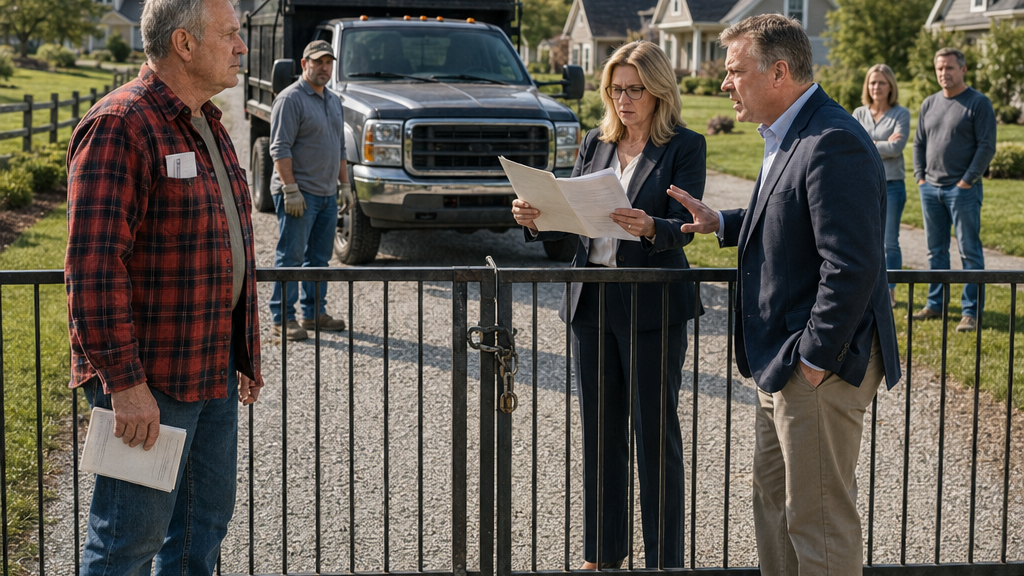
The truck stopped at the gate.
The contractor climbed out, walked to the lock, then looked toward Donald’s house.
Five minutes later Jennifer’s car appeared.
Gary Lewis arrived behind her.
Donald walked down the lane with copies of the recorded documents tucked under his arm. The original violation notice remained folded in his shirt pocket.
Gary spoke first.
“Open the gate.”
“No.”
“This is community access.”
Donald looked at Jennifer.
“You still calling it that?”
Jennifer’s jaw tightened.
“Donald, we received your attorney’s letter. That does not authorize you to obstruct access.”
“Show me what authorizes you.”
Gary stepped forward.
“We’ve used this road for years.”
“I know.”
“We maintain it.”
“Sometimes.”
“We have contractors scheduled.”
The landscaping contractor stood beside the truck, clearly wishing to be somewhere else.
Two neighbors had come out to watch from farther up the road.
Donald took the county plat from his stack and handed it to Jennifer.
“Show me the part where the HOA owns this lane.”
Gary said, “This isn’t a courtroom.”
“No. It’s my property line. That’s why I’m asking here.”
Jennifer studied the plat.
Donald handed her the easement next.
“And show me the clause giving the association unrestricted access for whatever vehicles it decides to send through.”
Jennifer read without answering.
Gary looked at her.
“Jennifer?”
“I’m reading.”
“The board map is clear.”
“The board map isn’t a recorded deed,” Donald said.
Gary’s face reddened.
“This gate needs to come open.”
Donald touched the key through his pocket.
For a few seconds, the satisfaction returned.
Then one of the neighbors called from beyond the truck.
“Can they still get to the drainage pumps?”
Donald turned.
The neighbor pointed down the lane.
“My backyard flooded two summers ago when those pumps went down. The maintenance crew uses this route.”
Donald looked at the landscaping truck.
He had been so focused on the board that he had not considered what was behind the truck.
The contractor spoke carefully.
“I’m supposed to do the rear common strip today. Pump station check is another crew, but they use the same access.”
Gary seized on it.
“Exactly.”
Donald’s temper rose again.
“Don’t use your maintenance schedule as proof you own my land.”
“I didn’t say we own your land.”
“You fined me as if you did.”
Jennifer lowered the easement.
“Donald.”
“What?”
“There are parcel rights in this document that need review.”
“I know.”
“Then you know this isn’t as simple as locking the gate.”
He stared at her.
The words irritated him because Christopher had said almost the same thing.
Jennifer handed back the papers.
“We’re having counsel review this today.”
Gary turned toward her.
“Today?”
“Yes.”
“You told me management had authority.”
“I said our policy treats this as controlled access.”
Gary’s expression changed.
It was the first visible crack between them.
Donald noticed.
So did Jennifer.
She looked at him and lowered her voice.
“I’m not telling you the fine was correct.”
Gary snapped, “Jennifer.”
She ignored him.
“I’m telling you there are more rights involved here than either side should pretend not to see.”
Donald looked past the gate.
The landscaping truck sat motionless in the lane. The neighbor who had mentioned the pumps had gone quiet.
Donald could unlock it.
He could also leave it closed.
The second option still felt deserved.
That was what bothered him.
He had spent his career resenting people who treated temporary convenience like permanent entitlement. Once you let a crew cross somewhere informally, somebody eventually drew it on a map. Once you made an exception, somebody remembered only the benefit and forgot the favor.
He had promised himself he would never be the man who surrendered a boundary because enforcing it was inconvenient.
But he had not expected enforcing one to inconvenience people who had never fined him.
Gary pointed at the lock.
“If you leave this closed, the association will respond.”
Donald looked at him.
“It already did.”
Jennifer stepped closer before Gary could answer.
Her voice dropped so only Donald could hear.
“Our lawyer is going to ask the same question yours did.”
Donald frowned.
“Which question?”
Jennifer glanced at the papers in his hand.
“Who actually has which rights here.”
Then she looked back toward Gary.
“And I’m not sure he’s going to like every answer.”
Donald felt the folded $500 notice against his chest.
The gate was still locked.
But for the first time since installing it, he was no longer certain the lock represented a victory.
Chapter 4: Eleven Years of Convenience Had Become a Policy
The maintenance worker stopped at the locked gate, looked at the equipment cart behind him, and said nothing for several seconds.
Donald watched from halfway down the lane.
The man had a long-handled tool over one shoulder and a plastic case in his other hand. A small utility vehicle sat behind him, loaded with pump-check equipment that normally traveled straight through the gravel lane to the common drainage area.
Now it could go no farther.
The worker looked toward Donald.
“Morning.”
“Morning.”
“You know if this is opening today?”
Donald glanced at the lock.
“Not for association traffic.”
The worker nodded once, without arguing.
“All right.”
He turned the utility vehicle around as far as the narrow shoulder allowed, then began unloading the equipment.
Donald frowned.
“You’re carrying all that?”
“Other entrance is about half a mile around.”
“You can drive most of it.”
“Not all of it.”
The worker slung the case into his other hand.
“This part gets muddy.”
Donald had expected board members. Attorneys. Maybe another argument with Gary.
He had not expected a man carrying forty pounds of equipment because Donald had put a padlock on a gate.
The worker started away.
Donald called after him.
“Your crew use this lane every time?”
“Pretty much.”
“How long?”
The worker shrugged.
“Longer than I’ve been here.”
That answer stayed with Donald after the man disappeared around the bend.
The gravel lane had always shown its history if you knew how to look. There were deep tire marks from heavier trucks, shallow ones from pickups, twin grooves where landscaping trailers tracked through after rain. Donald had seen them for years without assigning meaning to them.
Now every track looked like evidence of somebody relying on something nobody had bothered to define.
By noon, Jennifer had sent him an email acknowledging receipt of Christopher’s letter and stating that the association was reviewing “historic access practices and recorded rights.”
Donald read that sentence three times.
Historic access practices.
Three days earlier, she had called it restricted community infrastructure.
The change was small.
It was also the first sign the association’s certainty was beginning to retreat.
That afternoon Sandra Perez called him.
Donald knew her only by sight. She had served as treasurer for several years and had once asked him about replacing a failed culvert near the entrance because she remembered he had worked utility maintenance.
“I’m reviewing some old expense files,” she said.
“About the lane?”
“Yes.”
“What did you find?”
“I’d rather not characterize anything before the board sees it.”
Donald almost laughed.
“You all take a class in saying things without saying them?”
Sandra did not react.
“I found maintenance invoices.”
“For the road?”
“For several things. Gravel. Drainage access. Landscaping routes. Some contractor notes.”
“How far back?”
“I’m at eleven years.”
Donald straightened.
“And?”
“And none of the budgets I’ve checked separates ownership from access.”
Donald went quiet.
Sandra continued.
“They treat the lane like infrastructure we’ve always had the use of. Not necessarily something we own.”
“That’s a big difference.”
“I know.”
“Did anybody else?”
“That’s what I’m trying to determine.”
Donald leaned against his kitchen counter.
“So Jennifer didn’t make this up.”
“No.”
Sandra’s answer came quickly.
“She enforced what the association had been treating as policy.”
“Policy based on what?”
“Practice, mostly.”
Donald looked through the window toward the gravel lane.
“How does eleven years of convenience turn into a five-hundred-dollar fine?”
Sandra sighed.
“Probably by nobody asking that question early enough.”
The board met that evening.
Donald was not invited, but he heard enough afterward.
Gary wanted the gate challenged immediately.
Jennifer wanted outside counsel to review title documents first.
Sandra wanted a complete history of maintenance spending and access usage before anyone sent another notice.
Gary apparently called that unnecessary delay.
Donald learned this from Jennifer the following morning when she phoned him.
“Gary believes the association should demand immediate restoration of access.”
“Of course he does.”
“He’s concerned about maintenance interruptions.”
“So am I.”
“That’s not how he sees your position.”
Donald looked toward the gate.
“What does he think my position is?”
“That you’re using an ownership dispute to interfere with association operations.”
Donald’s voice hardened.
“You mean the operations that relied on my land while the association fined me for driving over it?”
“I’m telling you what he believes.”
“And what do you believe?”
Jennifer hesitated.
“I believe we need cleaner facts.”
That answer irritated Donald less than it would have two days earlier.
“What happens if Gary gets his way?”
“Outside counsel.”
“Court?”
“Possibly. I don’t know.”
Donald thought of the maintenance worker carrying equipment around the long route.
“Would Gary spend association money on a lawsuit before proving the association owns the lane?”
Jennifer was silent for a moment.
“He believes long-standing use and governing authority are enough to justify action.”
“That isn’t what I asked.”
“No.”
Donald recognized something in her voice.
Fatigue.
Not fear.
Not guilt.
Pressure.
For the first time, he considered that Jennifer might be trapped between a bad policy and a board that wanted certainty more than accuracy.
That did not erase the fine.
It did make the situation less convenient emotionally.
Saturday morning, Donald walked the lane with a cup of coffee.
He stopped where the landscaping truck had waited the day before.
The gravel was darker there, compacted by years of tires.
One pair of ruts curved toward the common drainage area. Another continued behind the rear lots.
He had always thought of the lane as the edge of his property.
The HOA had apparently thought of it as part of the neighborhood’s machinery.
Both assumptions had existed peacefully because nobody had tested them.
A vehicle slowed at the gate.
Gary stepped out.
He carried no clipboard this time.
“We’re going to have counsel review enforcement options.”
Donald nodded.
“That your decision or the board’s?”
“The association cannot function with owners unilaterally closing access routes.”
“Then maybe the association should have made sure it had the rights before building operations around them.”
Gary’s mouth tightened.
“You think this is about ego.”
“I think you fined me before anybody checked.”
Gary glanced toward the lane.
“You want to know why I pushed for enforcement?”
Donald waited.
“Our insurer asked for a list of controlled access points. We had residents using service routes however they wanted. Delivery vehicles. Contractors. People cutting through. If somebody got hurt, we needed a consistent policy.”
“So you picked mine.”
“We picked every route listed on the association map.”
Donald folded his arms.
“And nobody checked whether the map was right.”
Gary looked at him directly.
“We trusted the map.”
The answer was not good enough.
But it was believable.
That disturbed Donald more than a lie would have.
Gary drove away.
An hour later Donald’s phone rang.
Jennifer.
“I need to talk to you Monday.”
“You can talk now.”
“No. Not over the phone.”
“Why?”
“Because I’ve finished reviewing something I should have finished before the violation went out.”
Donald straightened.
“Gary coming?”
“No.”
“Sandra?”
“No.”
“Then who?”
“Just you and me.”
Donald stared through the window toward the gate.
“Why without Gary?”
Jennifer answered carefully.
“Because I need to tell you what was in the file before the board decides what it wants the file to mean.”
Chapter 5: Jennifer Knew the File Was Incomplete
Jennifer was already sitting in the empty conference room when Donald arrived Monday morning.
There was no coffee. No board packet. No row of chairs occupied by committee members.
Only a thin file folder in front of her.
Donald sat across the table.
Jennifer did not ease into the conversation.
“The association file does not contain a deed showing ownership of the lane.”
Donald leaned back.
“You knew that Friday.”
“I suspected it Friday.”
“When did you first suspect it?”
Jennifer looked at the folder.
“Before your violation was finalized.”
Donald said nothing.
The room seemed suddenly smaller.
“How long before?”
“Several days.”
“You fined me anyway.”
“Yes.”
The word landed harder than an excuse would have.
Donald pulled the folded violation notice from his shirt pocket. He had begun carrying it almost without thinking.
He placed it on the table between them.
“Five hundred dollars.”
“I know what it says.”
“Apparently I didn’t know what it meant.”
Jennifer met his eyes.
“I’m not asking you to excuse it.”
“That’s good.”
“I’m explaining what happened.”
Donald waited.
Jennifer opened the folder.
“A few weeks ago, the board started preparing information for an insurance review. We had inconsistent descriptions of service roads, emergency access, utility routes, and private drives. Gary wanted enforcement standardized before the review.”
“So he told you to fine people.”
“He told management to enforce the maps and current policies consistently.”
“Same thing.”
“No. Not exactly.”
Donald gave her a look.
Jennifer continued.
“When I pulled the lane file, I noticed there was no deed in it. There were maps. Maintenance records. Old board minutes referring to association access. Contractor instructions. But no recorded ownership document.”
“And you said what?”
“That title status needed confirmation.”
Donald tapped the violation notice.
“Yet here we are.”
“Gary believed the policy question was separate. His position was that the association had regulated access for years, and inconsistent enforcement was a bigger immediate risk than waiting on historical records.”
“Did you agree?”
Jennifer took longer to answer this time.
“I agreed that inconsistent enforcement was a problem.”
“That wasn’t my question.”
“No.”
Donald looked at her.
“Did you agree the fine should go out?”
“I authorized it.”
“That still isn’t an answer.”
Jennifer closed the folder.
“No.”
Donald’s hand stopped on the table.
“No what?”
“No, I was not comfortable issuing it before the title question was resolved.”
There it was.
Not corruption.
Not conspiracy.
Something smaller and, in its way, more familiar.
A person knowing a process was wrong and proceeding because admitting uncertainty was harder.
Donald had seen it in utility departments. A supervisor found a questionable valve map but sent the crew anyway because rescheduling would require explaining the problem upward. Sometimes nothing happened.
Sometimes somebody dug into a line that was not supposed to be there.
“You could have delayed it,” Donald said.
“Yes.”
“You could have called me.”
“Yes.”
“You didn’t.”
“No.”
“Why?”
Jennifer looked down at the file.
“Because I had already told the board management could enforce the access policy. If I stopped your violation after Gary pressed the issue, I would have had to admit I wasn’t certain the map supported what I had said.”
Donald gave a short, humorless laugh.
“So you didn’t want to look unsure.”
“That’s part of it.”
“And the other part?”
“I thought the records would confirm the policy.”
“But they didn’t.”
“No.”
Donald pushed the notice toward her.
“Then withdraw it.”
“I recommended that this morning.”
His anger paused.
“Recommended?”
“I can suspend collection administratively. Formal withdrawal requires the board process because you already appealed.”
Donald stared at her.
“You’re still making me wait.”
“I’m telling you the procedure.”
“That’s exactly what got us here.”
Jennifer did not argue.
Instead, she pulled two recorded documents from the folder.
“There’s something else.”
Donald’s irritation sharpened.
“What?”
“These are successor parcel records tied to the old easement.”
He recognized the recording format immediately.
“Christopher mentioned there could be others.”
“There are.”
“How many?”
“At least two that matter directly to your gate.”
Jennifer rotated the first document toward him.
Donald followed the legal description.
One benefited parcel lay beyond the eastern bend of the gravel lane.
The second corresponded to a lot closer to the rear common area.
“Those are houses.”
“Yes.”
“They have access rights?”
“That appears to be what outside counsel thinks. Specific rights, not unlimited association control.”
Donald read the clauses twice.
“So they can cross.”
“Likely, yes.”
“And I can’t stop them.”
“Your attorney should answer that.”
“Don’t do that.”
“Do what?”
“Hide behind my attorney because the answer is uncomfortable.”
Jennifer’s expression stiffened.
“I’m trying not to make the same mistake twice.”
That stopped him.
Donald looked back at the papers.
For days he had told himself the gate was simple.
His land.
Their mistake.
His key.
But if these documents said what they appeared to say, the gate did not only stop the HOA.
It stopped people with rights recorded decades before Donald ever bought the property.
Jennifer touched the violation notice.
“You were right about the fine.”
Donald looked up.
“It should not have been issued on the basis we used.”
He had wanted to hear that sentence since Monday.
Now that he had it, the satisfaction was strangely thin.
Jennifer continued.
“But if you keep the gate closed to everyone while you know these rights may exist, you’re doing something uncomfortably close to what we did.”
Donald’s face hardened.
“You don’t get to compare us.”
“I’m not comparing motives.”
“Good.”
“I’m comparing certainty.”
Silence stretched between them.
Donald looked again at the old easement.
Jennifer had assumed the association’s map meant more than it proved.
Donald had assumed the county’s ownership record meant more than it proved.
The difference was that she had sent him a fine.
The similarity was that he had installed a lock.
“What does Gary know?” he asked.
“That the ownership claim is weak.”
“About these parcels?”
“Yes.”
“What does he want?”
“Immediate reopening while counsel sorts out the details.”
Donald shook his head.
“No.”
“Why?”
“Because the second I open that gate without terms, everybody goes back to acting like nothing happened.”
“That may be true.”
“So you want me to surrender the only leverage I have.”
“I didn’t say that.”
“What are you saying?”
Jennifer gathered the documents but left the violation notice where it was.
“I’m saying use the leverage for the thing you actually wanted.”
Donald looked at her.
“Which is?”
“A correct boundary.”
She stood.
“Not revenge.”
Donald remained seated after she left.
The $500 notice sat alone at the center of the table.
He had thought it represented the HOA’s arrogance.
Now it represented something worse because it was more ordinary: a person asserting authority before verifying it.
Donald folded the notice and returned it to his pocket.
Then he looked at the two easement copies Jennifer had left for him.
If he knowingly kept lawful users locked out because the gate gave him power, the documents would no longer tell a story only about what Jennifer and Gary had done.
They would begin telling one about him.
Chapter 6: Winning the Argument Was Not the Same as Solving It
Gary placed a one-page demand on the boardroom table.
Donald placed the county plat beside it.
Neither man sat down.
Jennifer occupied one side of the table with Sandra. A phone in the center connected outside association counsel to the meeting.
Christopher sat beside Donald, silent.
Gary tapped his document.
“We need unrestricted operational access restored immediately.”
Donald tapped the plat.
“Then show me unrestricted operational rights.”
Gary’s jaw tightened.
“We’ve been through this.”
“No. We’ve been around it.”
The speakerphone crackled.
Outside counsel interrupted before Gary could respond.
“For clarity, the association should stop describing the lane as association-owned. We have not located recorded support for that description.”
Donald watched Gary.
Gary’s expression barely changed, but his hand moved away from the demand.
Outside counsel continued.
“There are recorded access rights benefiting specific successor parcels. There may also be limited maintenance-related rights that require additional interpretation. Historic use by association contractors does not, by itself, answer every question.”
Sandra opened a spreadsheet.
“And historic use has been built into our operating costs for eleven years.”
Gary looked at her.
“We know.”
“No,” Sandra said. “We knew the crews used it. We did not price what happens if the route is unavailable.”
Donald glanced at the figures.
Longer contractor routes meant additional labor. Equipment access to the rear drainage area required awkward alternatives. Gravel upkeep had been paid partly by the HOA, but without any agreement explaining whether those payments reflected ownership, obligation, or simple convenience.
Eleven years of habit had become a budget assumption.
Then a map label.
Then a policy.
Then Donald’s fine.
Gary sat down.
“What does Miller want?”
Donald disliked being spoken about while standing six feet away.
“I want the fine withdrawn.”
“Counsel already recommended that.”
“I want the association map corrected.”
Gary nodded impatiently.
“And?”
“I want the lane access written down properly. Who can use it. For what. Who pays for maintenance. What happens when heavy equipment damages it.”
Gary leaned back.
“So now you want a contract.”
“I wanted you not to fine me for driving on my own side of a road you don’t own.”
Jennifer looked down.
Gary did not.
“You closed a route that serves this community.”
“And you built your community operations around rights nobody documented.”
“We didn’t build them. We inherited them.”
“So did I.”
That silenced the room.
Donald had not planned the sentence.
But once he heard it, he realized it was the first fully accurate thing either side had said.
They had all inherited the same mess.
Gary inherited a budget that assumed access.
Jennifer inherited maps that overstated control.
Donald inherited a deed containing rights he had never bothered to understand.
Nobody had created the original confusion.
All of them had made choices after discovering it.
Christopher finally spoke.
“There’s a practical option.”
Gary looked at him.
“Temporary written access while permanent terms are negotiated.”
Donald turned.
They had discussed it privately, but hearing it aloud changed its weight.
Gary said, “Unrestricted?”
“No.”
“Then what’s the point?”
Christopher ignored the tone.
“Scheduled association contractors. Emergency maintenance. Express recognition that temporary access does not concede ownership or broader regulatory authority. Existing parcel rights remain unaffected pending final review.”
Gary looked at Donald.
“You’re willing to open it?”
Donald felt the key in his pocket.
He had imagined this meeting differently.
In his version, the HOA withdrew the fine first. Gary admitted they were wrong. Jennifer corrected the records. Then Donald decided how generous to be.
Instead, the maintenance worker’s long walk kept returning to him.
So did Jennifer’s sentence.
Use the leverage for the thing you actually wanted.
Donald pulled out the key and set it beside the county plat.
“For scheduled maintenance under written temporary terms.”
Gary frowned.
“Before the board vote?”
“Yes.”
Jennifer looked at Donald.
It was the first time since this began that she seemed genuinely surprised.
Gary said, “Why?”
Donald almost answered because I’m not you.
He caught himself.
That would have been satisfying.
It also would have missed the point.
“Because there are people using that lane who didn’t write my fine.”
Nobody spoke for several seconds.
Sandra closed her spreadsheet.
“If we’re negotiating permanent terms, we also need to address maintenance cost.”
Gary turned toward her.
“We already maintain it.”
“Partially. Informally. That’s the problem.”
She pointed to several figures.
“The association has been paying for gravel when contractors complain and treating it as a routine maintenance expense. Donald has done grading himself at least twice that I can document.”
Donald looked at her.
“How’d you know that?”
“Invoices. There aren’t any for those years.”
He almost smiled.
Sandra continued.
“If access benefits the association operationally, we should pay a defined share.”
Gary rubbed his forehead.
“So this mistake is going to cost everybody more money.”
“No,” Sandra said. “The access already costs money. We’ve just been pretending the arrangement was free.”
That landed.
Outside counsel recommended formal correction of the association map, withdrawal of Donald’s violation, and negotiation of a recorded maintenance and access agreement.
Gary resisted the map language.
“If we remove ‘community-controlled,’ residents will think anybody can drive there.”
Jennifer spoke before Donald could.
“Then we write an accurate restriction.”
Gary looked at her.
“You’re taking his side now?”
“No.”
Jennifer’s voice stayed level.
“I’m taking the records’ side.”
Donald glanced at her.
For the first time, their conflict no longer felt like two people standing on opposite sides of a notice.
Gary looked toward outside counsel.
“And you agree?”
“Yes.”
Gary leaned back.
“Fine.”
It was not an apology.
Donald noticed that he no longer needed it quite as badly.
That afternoon they met at the gate.
Jennifer brought the temporary access sheet. Sandra had added a maintenance log requirement. Christopher had reviewed the language.
Donald read it once more before signing.
The landscaping contractor waited fifty feet away.
Donald put the key into the lock.
For a moment his hand remained still.
The last time he had stood there, opening the gate would have felt like surrender.
Now the paper in Jennifer’s hand said the opposite.
Temporary access.
No admission of HOA ownership.
Specific purposes.
Recorded rights preserved.
Donald turned the key.
The lock released.
He swung the gate inward.
The landscaping truck rolled slowly through.
The contractor lifted two fingers from the steering wheel in acknowledgment.
Donald stepped aside.
Jennifer remained near the post.
“You know Gary thinks you won.”
Donald watched the truck disappear around the bend.
“He thinks somebody has to.”
“And you?”
Donald looked down at the gravel.
Fresh tire tracks crossed old ones.
“I think that’s how we got here.”
The following evening, the board reconvened.
Gary was quieter.
Outside counsel had circulated draft language formally withdrawing the $500 violation and revising the map legend. Sandra presented a cost-sharing framework for gravel, drainage damage, and contractor wear.
One board member objected to putting anything in writing that might reduce future flexibility.
Donald nearly laughed.
That was the exact problem they were fixing.
Gary finally raised his hand.
“If we approve this, the map correction becomes part of the official association records.”
“Yes,” Jennifer said.
“And the violation withdrawal?”
“Recorded in the minutes and Donald’s account.”
Gary looked at Donald.
“You’ll keep temporary access open while the permanent agreement is drafted?”
“Under the terms already signed.”
Gary glanced toward the other board members.
Then he nodded.
“Put both items on the formal vote.”
Donald felt no surge of triumph.
No desire to say I told you so.
He simply looked at the county plat lying on the table between them.
For the first time since Jennifer had appeared beside his mailbox, everyone in the room was treating that piece of paper not as a weapon, but as a boundary they all had to live with.
The formal vote was scheduled.
And now the association would have to decide, on the record, whether it was willing to admit that eleven years of convenience had never been the same thing as ownership.
Chapter 7: The Lane Stayed Gravel, but the Rules Finally Changed
The envelope in Donald’s mailbox looked almost exactly like the one Jennifer had handed him six weeks earlier.
Same association logo.
Same white paper.
Same heavy fold.
Donald stood beside the road with one hand on the mailbox door and stared at it longer than he needed to.
The first envelope had changed a lane he had barely thought about into a boundary dispute. It had put a price on a routine he had followed for nine years and told him, in effect, that somebody else understood his property better than he did.
This envelope felt heavier before he even opened it.
He carried it inside.
The letter began without apology.
The board had voted.
Donald read the first paragraph once, then again.
The $500 violation was formally withdrawn.
No balance would remain on his account. No enforcement history would be attached to the incident. The association’s access map would be revised to remove the description of the gravel lane as “community-controlled infrastructure.”
Donald stopped there.
For weeks, he had imagined that sentence.
He had pictured satisfaction.
Instead, he felt mostly quiet.
The paper did not undo the morning Jennifer had stood beside his mailbox. It did not erase Gary’s demand at the gate or Donald’s own decision to lock people out before understanding every right involved.
But the record was being corrected.
That mattered.
He continued reading.
The second half concerned the permanent agreement.
The association requested his signature on the negotiated maintenance and access terms. Specific successor parcels retained their recorded rights. Association contractors could use the lane for scheduled maintenance and emergencies within defined limits. Heavy equipment damage would be documented and repaired. Gravel and drainage upkeep would be divided according to the use formula Sandra had developed.
Most important to Donald, the agreement stated plainly that association use did not create ownership.
He read that line three times.
Then he drove to Christopher’s office.
Christopher had already reviewed the final version.
“Anything hiding in it?” Donald asked.
“Nothing I’d call hiding.”
“That isn’t the same as nothing.”
Christopher smiled.
“You’ve learned something.”
Donald sat down.
Christopher turned the agreement toward him.
“The permanent terms are close to what we negotiated. Your ownership isn’t conceded away. Existing easement rights are recognized. Association use is defined instead of assumed. Maintenance obligations are finally assigned.”
“And the gate?”
“You keep it.”
Donald looked up.
“The HOA has keys for authorized use under the agreement. Benefited owners get access appropriate to their rights. You maintain control of the physical gate subject to those terms.”
Donald nodded.
“So nobody wins everything.”
“That tends to be what durable agreements look like.”
Donald picked up the pen.
He hesitated.
Christopher noticed.
“What?”
Donald looked at the signature line.
“Six weeks ago I would’ve wanted language making them ask me every single time.”
“And now?”
“Now that sounds exhausting.”
Christopher laughed once.
Donald signed.
The association meeting that evening drew more residents than usual.
There was no crowd waiting to applaud him.
Donald was glad.
Some owners were irritated about the increased maintenance allocation. One questioned why association money should go toward a lane the HOA did not own.
Sandra answered without defensiveness.
“Because association contractors use it, and because pretending that use costs nothing is part of how we created this problem.”
Another homeowner asked why the map had been wrong for so long.
Jennifer answered that one.
“Because later documents copied language from earlier documents without anyone returning to the recorded property instruments.”
Gary sat at the end of the board table.
Donald watched him.
Six weeks earlier, Gary would have interrupted.
This time he let Jennifer finish.
Then he spoke.
“The board relied on established practice and an inaccurate description of that practice. We should have verified the distinction before enforcement.”
It was not a personal apology.
Donald understood that Gary probably could not make himself give one.
But it was on the record.
That mattered too.
A resident in the second row raised a hand.
“So was Donald allowed to close the gate or not?”
A few heads turned toward him.
Donald felt the old reflex rise.
He could have answered sharply.
He could have said that if the HOA had not fined him, nobody would ever have opened the old records.
Both were true.
Neither was the whole truth.
Christopher was not there to answer for him.
Donald cleared his throat.
“I had a right to challenge what the association was claiming.”
He paused.
“I also closed the gate before I understood everybody else’s rights.”
The room stayed quiet.
“So,” he added, “we both got ahead of what the documents actually said.”
Jennifer looked at him.
Gary looked down at the table.
The resident nodded as if the answer were less entertaining than expected but more useful.
The board approved the final agreement.
There was no dramatic vote.
Hands went up.
Sandra recorded the result.
Jennifer closed the file.
And just like that, the argument that had occupied six weeks of Donald’s life became a set of obligations everybody could read.
Two days later, a gravel truck arrived.
Donald stood near the lane while fresh stone was spread over the worst ruts.
For the first time, the invoice would be divided according to written terms instead of habit.
The road itself looked almost unchanged afterward.
That pleased him.
It was still narrow.
Still gray.
Still uneven along the edge where grass pushed through.
No new pavement appeared. No association sign went up. Nothing about it suddenly announced who had been right.
Only the records had changed.
And the way people used it.
Late that afternoon, Donald walked to the gate after hearing a maintenance truck approach.
The same landscaping contractor who had been stopped six weeks earlier slowed at the entrance.
Donald had already received the scheduled-access notice.
He put his key into the lock.
The metal clicked.
He swung the gate open.
The contractor rolled down his window.
“We good?”
Donald looked at the truck, then down the gravel lane.
“Scheduled until four.”
The contractor nodded.
“That’s what I’ve got.”
“Then we’re good.”
The truck moved through.
No argument.
No demand.
No assumption.
Just an agreed use of a road whose meaning was finally narrower and clearer than anyone’s old map had made it.
Jennifer arrived a few minutes later to inspect the completed gravel work.
She stopped beside Donald.
“Looks better.”
“It does.”
“Sandra will be happy. She finally has an invoice she knows where to put.”
Donald smiled slightly.
Jennifer glanced at the open gate.
“You keeping it open?”
“Until the truck comes back out.”
She nodded.
For a moment neither of them said anything.
Then Jennifer said, “I should have stopped the violation.”
Donald looked at her.
“You already said that.”
“I know.”
She studied the gravel beneath them.
“I’m saying it without a conference table this time.”
Donald let the silence sit.
“You should have.”
Jennifer nodded.
“And I should have called before I put the lock on.”
She looked at him, surprised.
Donald shrugged.
“Seems we’re correcting records.”
A faint smile crossed her face.
“Apparently.”
She walked back toward her car.
Donald remained beside the gate.
The landscaping truck eventually returned, leaving a fresh pair of tracks in the new gravel.
Donald waited until it reached the county road.
Then he started to close the gate.
His hand brushed something in his shirt pocket.
Paper.
He pulled it out.
The original $500 notice.
The folds had softened from weeks of being carried around. The corners were bent. One crease was beginning to tear through the association logo.
Donald unfolded it.
For a moment he considered dropping it into the trash bin beside the garage.
Instead, he folded it again.
Not because he wanted to stay angry.
Because it reminded him how easily certainty could outrun facts.
Jennifer’s certainty had cost him six weeks.
His own had nearly turned a legitimate boundary into a punishment for people who had never crossed him.
Donald slipped the notice back into his pocket.
He looked at the gate.
The maintenance schedule showed another authorized truck the next morning.
He left the gate open.
Then he walked toward the house while the fresh gravel settled beneath the last fading tracks of the day.
The story has ended.