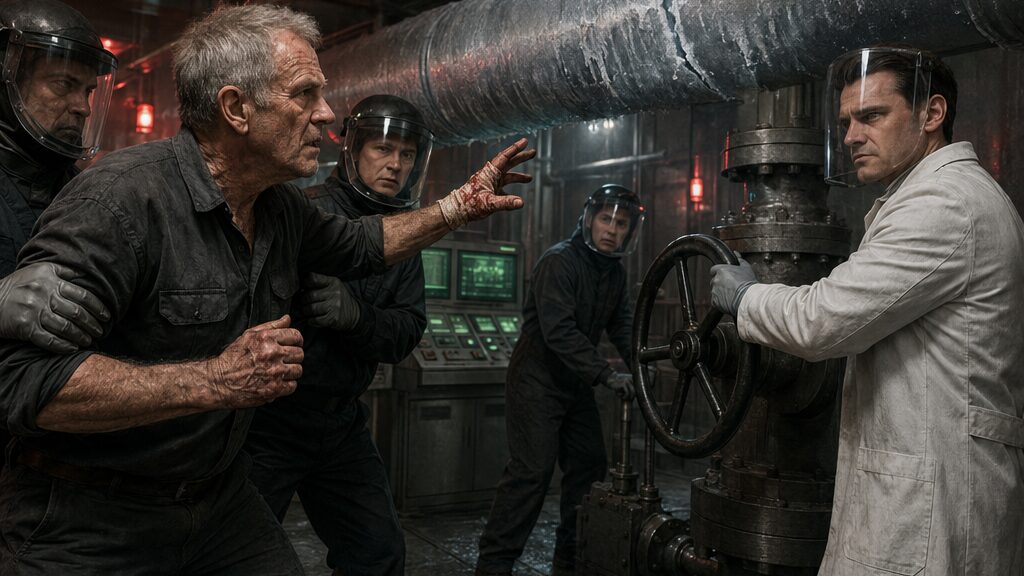
They Mocked the Old Mechanic Until His Bloodied Hands Sealed the Biolab
Chapter 1: The Frost Was Moving the Wrong Way
The containment light flashed red once above the inner decontamination door, then returned to green before anyone else looked up.
Anthony Harris had already stopped walking.
He stood in the mechanical corridor with a wrench hanging loose at his side, listening past the steady hiss of filtered air. The sound beneath it was faint—a low shudder traveling through the wall-mounted pipe supports at intervals too regular to be random.
Three seconds of vibration.
Two seconds of silence.
Then another shudder.
The control station at the end of the corridor showed an unbroken field of green. Pressure stable. Dampers synchronized. Airflow inward.
Anthony pressed two scarred fingers to the thick filtration pipe.
Cold bit into his fingertips.
A thin white line of frost had formed beside the lower coupling. He watched it creep—not toward the negative-pressure chamber, where expanding cold air should have drawn it, but away from it, toward the building’s main ventilation trunk.
“Michael.”
The filtration technician glanced over from the control station. “What?”
“Come look at this.”
Michael King remained beside the monitor. He was young enough to trust a clean screen and experienced enough to resent being told he did. “The diagnostics are cycling.”
“So is the pipe.”
Michael looked at the dashboard again. “No mechanical fault.”
Anthony scraped frost away with his thumbnail. It returned almost immediately, whitening the steel in the same wrong direction.
“Air doesn’t read diagnostics,” Anthony said.
Jonathan Nelson heard him from across the station.
The technology representative wore a white protective coat without a crease in it and thin gray gloves meant for touchscreens, not machinery. Behind him, a polished display carried the logo-free interface of the new automated containment package. Animated arrows flowed neatly inward through a digital model of the laboratory.
Jonathan turned with the controlled patience of a man interrupted by someone beneath his schedule.
“Is there a maintenance request?”
“There’s a pressure inversion.”
Jonathan glanced at the display. “There isn’t.”
Anthony pointed to the pipe. “Frost is walking toward the trunk.”
“That line is insulated.”
“Not at the coupling.”
“The system shows negative pressure in every controlled zone.”
“The system is wrong.”
Michael winced slightly, as if Anthony had struck the console.
Jonathan approached the pipe but stopped an arm’s length away. “The platform reconciles six independent sensors every two hundred milliseconds.”
Anthony crouched and placed his palm against the lower bracket. The tremor came again, rattling the bolt beneath his hand.
“Then it’s reconciling six lies.”
The corridor intercom clicked.
“Control, this is Garcia in Suite Four.”
Ashley Garcia’s voice carried through a layer of static. She and her virology team were sealed beyond two pressure doors, finishing a transfer inside the BSL-4 workspace.
Jonathan touched the intercom panel. “Go ahead.”
“We saw the containment light pulse.”
“No recorded alarm,” he said. “Likely a lamp test.”
Anthony stood. “Ask her about airflow.”
Jonathan ignored him. “Any internal fault indicators?”
“No. But we have something strange in the service vestibule.”
“What kind of strange?”
A pause followed. In the background, someone spoke too softly to understand.
Ashley said, “Sterile wrappers near the disposal cart are lifting toward the exit grille.”
Michael’s eyes left the monitor.
Jonathan’s did not. “Could be local turbulence from the pass-through cycle.”
“The pass-through is closed.”
Anthony stepped toward the intercom. “Ashley, are they fluttering or holding steady?”
Jonathan raised a hand between him and the panel. “She is reporting to control.”
Ashley answered anyway. “Holding steady. Edges lifting toward the outer door.”
Anthony looked at Michael. “That room is pushing.”
Michael studied the digital map. All arrows still moved inward.
Jonathan muted the intercom. “A wrapper is not a calibrated instrument.”
“No,” Anthony said. “It’s lighter and more honest.”
The physical gauge mounted near the pipe gave a tiny metallic tick.
Anthony turned toward it.
“Watch the needle.”
Michael followed his gaze.
Jonathan sighed. “We are not delaying a scheduled recalibration because of condensation and loose packaging.”
“Three,” Anthony said.
The gauge needle trembled.
“Two.”
It dipped, then snapped upward.
“One.”
The needle jumped six marks and settled again.
Michael stepped away from the console.
Jonathan’s expression tightened, but only for a moment. “Transient compensation.”
“You didn’t see it on the screen,” Michael said.
“The local gauge lacks digital smoothing.”
Anthony gave him a hard look. “Pressure doesn’t need smoothing inside a containment wall.”
The intercom light began blinking again.
Ashley’s voice came sharper this time. “Control, the outer service door is resisting closure.”
Jonathan unmuted the channel. “Do not force it. Maintain suite isolation.”
“That door should be pulled shut by the pressure differential.”
“I understand how the room works.”
Anthony looked at him. “Do you?”
Jonathan’s jaw shifted.
A group of company observers waited behind the viewing glass outside the secure corridor, their figures blurred by layered safety panels. The morning’s automated valve demonstration had been planned for weeks. Jonathan had mentioned it twice before Anthony finished his first inspection round, each time with the casual importance of a man expecting praise.
Jonathan addressed Michael. “Confirm the demonstration sequence remains active.”
Michael did not move at first.
“Michael.”
He returned to the console and opened the scheduling window. “Automated recalibration begins in eleven minutes.”
“Good.”
Anthony walked to the negative-pressure lock assembly. A yellow safety cover shielded the manual wheel, and beneath it sat the lock valve that controlled the isolation line between Suite Four and the main filtration system.
He leaned close enough to hear the metal.
A faint clicking moved inside the housing, too fast for the damper’s position.
“Cancel it,” he said.
Jonathan gave a quiet laugh. “On what authority?”
“On the authority of not opening a contaminated room into the rest of the building.”
“You are assigned to pipe inspection.”
“And the pipe is telling you the software has the direction backward.”
Jonathan stepped to the main display and enlarged the airflow diagram. “The program has executed this sequence in twelve facilities.”
“Not on this lock.”
“The hardware profile was validated.”
“By people who never heard it move.”
Jonathan’s clean gloved hand traced a path across the green animation. “At recalibration, the isolation valve opens three degrees to equalize the sensor cluster. The exhaust damper then increases draw.”
Anthony crossed the station and looked at the command stack.
The first instruction opened the isolation valve.
The second reduced the exhaust fan for four seconds.
The third trusted the software to recognize which sensor represented the contaminated side.
Anthony read the sequence twice.
His stomach tightened.
Michael saw his face. “What?”
Anthony pointed at the second line. “That command doesn’t increase draw.”
“It stages the fan.”
“It kills the pull while the lock is open.”
Jonathan folded his arms. “For four seconds.”
“Four seconds is enough.”
“The pressure buffer prevents outward movement.”
“There is no buffer. Not if the sensor map is inverted.”
Jonathan’s voice cooled. “The map is not inverted.”
The pipe shuddered again.
This time Michael heard it clearly.
Anthony looked toward the sealed laboratory door, where Ashley and her team waited behind the glass and steel.
Then he looked back at the scheduled command.
“When that test starts,” he said, “your system won’t seal Suite Four.”
The green arrows continued their perfect inward flow across the screen.
Anthony pointed at them with his scarred hand.
“It will open it.”
Chapter 2: The Mechanic Without a License
“Escort him beyond the decontamination boundary.”
Jonathan issued the order without raising his voice.
The two security officers outside the control station exchanged a glance before entering. Neither reached for Anthony immediately. They had heard the pressure gauge jump. They could see the frost returning across the coupling.
Lisa Mitchell arrived before they acted.
The safety inspector came through the outer lock carrying a certification tablet against her chest. Her dark hair was pinned close beneath her protective hood, and every movement had the clipped precision of someone who believed delay could become disaster.
“Why is an extraction order active?” she asked.
Jonathan answered first. “Maintenance personnel are interfering with a validated containment test.”
Anthony pointed at the pipe. “The airflow map is reversed.”
Lisa looked from him to Jonathan, then at the green control screen. “What evidence?”
“Frost movement. Bracket vibration. Local pressure spike. Suite Four’s service door is pushing outward.”
Jonathan said, “All of which have noncritical explanations.”
Lisa approached the local gauge. “Was the spike recorded?”
“Not digitally,” Michael said.
“That means it may have been mechanical chatter.”
Anthony laughed once, without humor. “A needle doesn’t jump six marks because it’s nervous.”
Lisa’s eyes settled on his hands. Grease darkened the lines around his fingernails. Old scar tissue crossed both palms, thick and pale. One knuckle had split during the morning inspection, leaving a rusty stain on the side of his work shirt.
Then she looked at Jonathan’s tablet, where six green certifications glowed beneath the test authorization.
Her decision showed before she spoke.
“Anthony, step away from the lock assembly.”
“No.”
The officers moved closer.
Lisa’s expression hardened. “This is a BSL-4 corridor. Refusal is not an option.”
“Neither is pulling that valve.”
“You do not have command authority.”
“I have eyes.”
“You also have a revoked engineering license.”
Silence passed through the station.
Michael looked sharply at Anthony.
Jonathan tilted his tablet so the officers could see the personnel record already displayed. “Revoked nine years ago following an unauthorized intervention during a containment automation test.”
Anthony kept his attention on Lisa. “Open the manual cover.”
“Why?”
“Because the local lock marker will show you the valve is loading against the software command.”
“You can see that without opening it?”
“I installed the marker.”
Jonathan’s gaze flicked toward him and away too quickly.
Lisa caught it.
“So you worked on this system?” she asked.
Anthony’s mouth tightened. “I worked on enough of it.”
“That is not an answer.”
“It’s the one you have time for.”
Her posture changed by a fraction. Not trust—irritation sharpened by uncertainty.
“Open the cover,” she told Michael.
Jonathan stepped between Michael and the assembly. “The manual interface is sealed during validation.”
Lisa did not look at him. “I am authorizing visual inspection only.”
Michael removed a key from his belt and crossed to the yellow cover. Anthony watched his hands.
“Don’t touch the wheel,” Anthony said. “Look through the lower cutout. The lock tongue should be sitting at fourteen degrees.”
Michael crouched.
The panel had not opened more than an inch when he stopped.
“There’s a number scratched inside.”
Jonathan’s face became still.
“What number?” Lisa asked.
“Point eight-seven over one point one-three.”
Anthony said nothing.
Michael looked back at him. “That’s the old differential ratio.”
Lisa turned. “How do you know?”
Anthony’s gaze remained on the panel.
Michael reached farther inside and rubbed dirt from the metal with one finger. Beneath the ratio were two engraved letters and a surname.
A. HARRIS.
Michael stood slowly.
Jonathan closed the cover himself. “Historic maintenance markings are not current authority.”
“No,” Anthony said. “But the valve still obeys them.”
Lisa took one step closer to him. “What happened nine years ago?”
“Not this.”
“The report says a technician suffered severe exposure after you bypassed an automated shutdown.”
“The report says what they paid it to say.”
“Was someone injured?”
Anthony’s anger vanished so completely that Michael noticed.
The old mechanic looked down at his hands.
The security officers waited.
Lisa asked again, quieter. “Was someone injured because of you?”
A muscle moved in Anthony’s jaw.
“Yes.”
Jonathan let the word settle.
Then he opened the archived report on his tablet. “The incident review found that Mr. Harris ignored the approved sequence, manually closed a damper, and caused a pressure surge that ruptured a service connector.”
Anthony looked at him. “Read the next page.”
Jonathan did not.
“Read the part where the automated shutdown opened the wrong side first.”
“The final finding assigned responsibility for unauthorized action.”
“The final finding protected your software.”
Lisa took the tablet from Jonathan and scrolled. “The next page is restricted.”
“Of course it is.”
She returned the device. “You could have challenged the finding.”
Anthony’s laugh was low and bitter. “You think I didn’t?”
“I think you signed the settlement.”
That struck deeper than the accusation.
He looked toward Suite Four. Behind the inner glass, only red reflections and blurred movement were visible.
Michael watched the frost line lengthen another inch.
“Anthony,” he said, “what position is the lock tongue in?”
“Twenty-one degrees.”
Michael checked through the lower cutout again.
His face drained.
“Twenty-one.”
Lisa turned immediately. “Jonathan?”
“The actuator performs preload before recalibration.”
Anthony shook his head. “Preload goes to sixteen.”
“The updated profile uses adaptive positioning.”
“Then show us the physical revision.”
Jonathan’s voice sharpened. “We are not allowing a disgruntled former engineer to dictate procedure through undocumented folklore.”
Anthony stepped toward him, and the officers caught his arms.
His wrench struck the floor.
The sound rang down the corridor.
Jonathan did not retreat, but his grip tightened around the tablet.
Anthony looked at Lisa. “Make him open the archived pressure map. Compare the contaminated-side sensor assignment to the local labels.”
“That would require suspending the validation cycle,” Jonathan said.
“Then suspend it.”
“The observers are already present, and the suite team cannot remain in transfer posture indefinitely.”
Ashley’s voice came through the intercom. “Control, we can hold.”
Jonathan touched the panel. “Remain silent unless reporting an alarm.”
Lisa stared at him.
For the first time, his certainty looked less like competence and more like control.
“Seven minutes,” he announced. “We proceed as authorized.”
Anthony pulled against the officers. “Lisa, look at the frost.”
She did.
The white line was now unmistakable, creeping toward the main ventilation trunk.
Her fingers tightened around her own tablet.
But she did not countermand the test.
Jonathan stepped close enough for Anthony to see his clean gloves reflected in the black screen between them.
“Don’t use your garbage folk-science to lecture us academics,” he said.
Then he tapped the schedule.
A countdown appeared above the green airflow map.
VALVE RECALIBRATION: 07:00.
The officers began dragging Anthony toward the outer lock.
He stopped fighting them.
That frightened Michael more than the shouting had.
Anthony stared through the glass at the negative-pressure assembly and said, almost to himself, “That’s how it started last time.”
Chapter 3: The Name Beneath the Access Plate
Michael waited until Lisa followed the security officers toward the outer lock.
Then he opened the yellow access cover again.
A. HARRIS remained visible beneath the scratched pressure ratio, the letters cut deep enough to survive twenty-two years of cleaning, paint, and replacement seals. They were not the hurried marks of a repair technician. They sat beside the original installation stamp.
Michael photographed them with his work terminal.
“Close that panel.”
Jonathan’s voice came from behind him.
Michael straightened. “Why was his name inside the original housing?”
“Because he worked here.”
“As maintenance?”
“As several things.”
“That’s not what you told Lisa.”
Jonathan stepped to the control console and checked the countdown.
Five minutes, forty-two seconds.
“I told her his license was revoked. That is accurate.”
Michael opened the archived maintenance index. “Then there should be a design record.”
“The current documentation is on the certified server.”
“The current documentation says the local lock marker doesn’t exist.”
Jonathan looked at him. “Be careful.”
Michael searched the old system by installation date. Most files had been migrated into the new software package, but a handful of scanned schematics remained under inactive equipment references.
One loaded slowly.
It showed the filtration corridor before the current screens, when the system had depended on physical gauges and paired manual dampers. Blue arrows had been drawn over the mechanical lines in thick marker. Beside the isolation assembly appeared a block of text:
FOUNDATION PRESSURE LOGIC: A. HARRIS.
Michael enlarged it.
Another name had been removed by damage to the scan, but Anthony’s remained clear.
“He designed the lock sequence,” Michael said.
Jonathan crossed the station and minimized the document.
“He contributed to an obsolete mechanical architecture.”
“You called him a maintenance worker.”
“He is a maintenance worker.”
“Now.”
Jonathan leaned closer. “Do you know why companies remove individuals from active design authority? Because systems must become bigger than the people who built them. You cannot run a containment facility on one man’s memory.”
“No. But you can listen when his memory matches the pipe.”
The intercom clicked hard enough to make them both turn.
Ashley spoke without waiting for acknowledgment. “We have an odor in the service vestibule.”
Lisa, returning from the lock, reached the panel first. “Describe it.”
“Sharp. Chemical. Not strong, but it should not be there.”
“Any suit alarms?”
“No.”
“Any visible aerosol?”
“No.”
Jonathan said, “Likely residue from the sterilization cycle.”
Ashley’s answer came flat. “That cycle ended six hours ago.”
Lisa looked at the countdown.
Four minutes, fifty seconds.
“Hold the test,” Michael said.
Jonathan touched his commander tablet. “Continue sequence.”
Lisa faced him. “I want a local sensor comparison.”
“We have six live sensors.”
“I want one disconnected from your interface and read at source.”
Jonathan’s expression hardened. “Breaking the digital chain during validation creates ambiguity.”
“We already have ambiguity.”
Anthony stood beyond the outer glass between the two officers. He could not hear every word, but he saw Lisa point toward the local gauge. He raised one hand and tapped two fingers against his wrist, then pointed to the lower sensor housing.
Michael understood.
“Sensor Two,” he said. “Contaminated-side reference.”
Jonathan glanced toward Anthony. “He cannot direct operations from outside the secure boundary.”
Lisa ignored him. “Read it locally.”
Michael opened the sensor port and connected a handheld meter directly to the transmitter.
The reading appeared.
Minus thirty-eight pascals.
He checked the main display.
Minus twelve.
“That’s not smoothing,” he said.
Jonathan came closer. “The dashboard shows the reconciled zone value, not the raw transmitter.”
Michael opened the sensor assignment table.
Sensor Two was labeled EXHAUST PLENUM.
The physical tag on the pipe read SUITE FOUR REFERENCE.
His throat tightened.
“The mapping is wrong.”
Lisa stepped beside him. “Show me.”
He held up the handheld meter, then pointed at the screen.
For several seconds, nobody spoke.
Anthony watched through the glass.
A small vindication passed over his face, but it died when Lisa looked toward him.
“What happened in the old test?” she asked through the intercom.
The officers released one of Anthony’s arms so he could approach the wall panel.
He pressed the talk switch.
“The mapping inverted during a sensor disagreement.”
“Exactly like this?”
“Close enough.”
“Did you document it?”
“Yes.”
“Where?”
Anthony’s eyes shifted away.
Jonathan answered for him. “His submitted notes were incomplete and contradicted by the incident reconstruction.”
Lisa kept watching Anthony. “Do you still have the original notes?”
A pause.
“Yes.”
Michael stared at him.
“Where are they?” Lisa asked.
“Not here.”
“Why not?”
“Because nobody wanted them when they mattered.”
Lisa’s uncertainty turned into anger. “People are sealed inside that suite, and you chose now to tell us you withheld technical records?”
“I gave the company everything once.”
“You gave them enough to revoke your license, apparently.”
Anthony’s hand fell from the intercom.
Jonathan seized the opening. “This is precisely why personal recollection cannot override certified systems. He provides fragments, refuses context, and expects us to treat suspicion as proof.”
Michael looked again at the local sensor.
“It is proof the map is wrong.”
“It proves one assignment is inconsistent,” Jonathan said. “Not that the corrective sequence is unsafe.”
Anthony struck the glass with the flat of his palm.
Everyone turned.
He pointed at the hand-drawn arrows on Michael’s archived schematic, then dragged his finger outward across the glass toward the main trunk.
Michael reopened the file.
The original airflow logic used the Suite Four reference sensor to determine which side of the lock closed first. If the software believed that sensor belonged to the exhaust plenum, it would interpret a falling contaminated-side pressure as reduced exhaust demand.
It would slow the fan.
Then open the lock.
Michael felt cold gather beneath his collar.
“He’s right,” he said.
Jonathan moved back to the console. “The updated algorithm compensates through the secondary cluster.”
“Then why is Sensor Two mislabeled?”
“A migration artifact.”
“That artifact controls the sequence.”
“It informs the sequence.”
Lisa stepped between them. “Suspend validation.”
Jonathan’s face lost all warmth. “You do not have contract authority over the command layer.”
“I have site safety authority.”
“Local safety authority.”
He tapped his tablet.
A warning appeared across the manual control panel.
REMOTE ADMINISTRATIVE LOCK ENGAGED.
Michael tried the yellow cover. The latch would not move.
Jonathan entered a second command.
COMMAND PRIORITY TRANSFERRED: NELSON, J.
The countdown continued.
Three minutes, twelve seconds.
Lisa stared at the locked panel. “Release manual access.”
“After recalibration.”
“You are protecting a demonstration.”
“I am protecting the people in Suite Four from an improvised shutdown based on a disgraced man’s undocumented theory.”
Beyond the glass, Anthony slowly lowered his scarred hand.
His gaze moved from Jonathan’s tablet to the locked valve cover, then to the frost now extending across the pipe toward the main trunk.
For the first time that morning, Lisa looked afraid.
Jonathan alone held the valve authority.
Chapter 4: What Anthony Signed Away in Silence
Lisa held the old incident statement against the glass so Anthony could see his signature.
The black mark at the bottom looked smaller than he remembered.
Above it, the words ACCEPTANCE OF RESPONSIBILITY had been printed in capital letters. Beneath them, the report described an unauthorized manual intervention, a ruptured service connector, and one exposed technician.
“You signed this,” Lisa said through the intercom.
The countdown above Jonathan’s console showed 02:57.
Anthony stood outside the secure boundary with one officer still gripping his sleeve. “I signed what they put in front of me.”
“That is your name.”
“I know my name.”
“You accepted responsibility for overriding an automated shutdown.”
“I closed a damper.”
“And someone was injured.”
“Someone lived.”
The corridor fell quiet except for the uneven tremor inside the filtration pipe.
Jonathan remained at the central console. Green light from the screen shone across his gloves.
“The incident review did not reach that conclusion,” he said.
Anthony looked at him through the glass. “Because your company wrote the conclusion before the technician left intensive care.”
Lisa scrolled through the report. Whole sections were missing behind restricted-access symbols. “Why would you sign away your right to challenge it?”
Anthony did not answer.
The frost on the pipe advanced past the next mounting bracket.
Michael noticed first. He opened the archived maintenance terminal again and searched the date of the old accident. The public incident file matched Lisa’s copy, but a faded service reference appeared below it.
DELETED MAINTENANCE NOTE—RECOVERY STATUS UNKNOWN.
He selected it.
The terminal asked for a legacy equipment code.
Michael looked at the pressure ratio scratched inside the access panel.
He entered 087113.
A fragment of text appeared.
MANUAL DAMPER CLOSURE PREVENTED FULL ZONE REVERSAL.
Michael read it twice.
“Lisa.”
She crossed to him.
He turned the screen toward her.
A second line had survived the deletion.
TECHNICIAN EXPOSURE WOULD HAVE BEEN FATAL UNDER AUTOMATED SHUTDOWN SEQUENCE.
Jonathan stepped forward. “That is an unverified draft.”
“It was attached to the incident,” Michael said.
“It was removed because the reconstruction disproved it.”
“Then why restrict the next page?”
Jonathan’s mouth tightened. “Because internal medical information is protected.”
Anthony struck the intercom switch with the heel of his hand. “Ask him who ordered the removal.”
Jonathan did not look toward him.
Lisa enlarged the maintenance note. “Did you close the damper before or after the connector ruptured?”
“Before.”
“Then your action caused the pressure surge.”
“It caused a surge on the safe side.”
“A surge still broke the connector.”
“The other choice filled the technician’s suit line.”
Lisa stared at him.
Anthony lifted his hands to the glass.
The scars crossing his palms were not smooth. They formed pale ridges beneath the grease, thickest where the manual wheel had torn skin away years earlier.
“These came from that damper,” he said. “The motor fought me all the way shut.”
Michael looked from the hands to the old schematic.
Jonathan spoke more quietly now. “He bypassed a validated safety response because he believed his judgment was superior to the system. A man was exposed. That is what happened.”
Anthony’s gaze stayed on Lisa. “The technician saw the local gauge falling. He called it in. Control told him the software was stable. I told him to get behind the service wall.”
“Did he follow you?” Lisa asked.
“Yes.”
“And then?”
“I closed the damper.”
“The connector ruptured.”
“Yes.”
“He was injured.”
“Yes.”
Each answer seemed to cost him more than the last.
Lisa lowered the tablet. “Why did you not testify to this?”
Anthony’s eyes moved toward the inner laboratory doors.
“The company said he had violated isolation protocol by leaving his marked position. If I fought the report, they would put the failure on him. They would terminate him for disobedience.”
“That would not erase the software defect.”
“No. But it would erase his medical coverage.”
Michael stopped typing.
Even Jonathan looked away.
Anthony continued. “He had damaged lungs. A family. No savings. They offered treatment, disability support, and silence. Mine.”
Lisa’s expression changed, though not into sympathy.
“You accepted a settlement.”
“I accepted his care.”
“And surrendered your license.”
“Yes.”
“You also surrendered the defect record.”
Anthony’s jaw tightened.
“That was not part of protecting him,” she said.
“I gave them my notes.”
“Not the originals.”
He said nothing.
Lisa came closer to the glass. “You kept them.”
“Yes.”
“And for nine years, this command logic stayed active.”
“I warned them.”
“Once?”
His stare hardened. “Enough times to lose everything.”
“That is not what I asked.”
The accusation landed because it was true.
Anthony had repeated the warning until hearings became meetings, meetings became legal calls, and legal calls became silence. Then he had folded the original notebook into a steel toolbox beneath his workbench and decided the people who chose the lie could live with it.
He had not imagined Ashley behind an inner door.
He had not imagined Michael reading the same wrong numbers.
The countdown showed 01:46.
Jonathan stepped beside Lisa. “This is exactly why he cannot be trusted now. He has withheld technical material, concealed active access knowledge, and entered a controlled facility carrying a personal grievance.”
Anthony leaned toward the intercom. “Personal grievance doesn’t move frost uphill.”
“No,” Jonathan said. “But it makes every irregularity look like vindication.”
Lisa’s eyes stayed on the local sensor. “The assignment is wrong.”
“One assignment label is wrong.”
“The physical pressure is falling.”
“The adaptive sequence will compensate.”
“How?”
Jonathan turned to the dashboard and enlarged the process model. “The secondary cluster identifies net zone behavior after the isolation valve enters preload.”
Anthony shook his head. “After it opens.”
“Three degrees.”
“Enough to connect Suite Four to the trunk while your fan slows.”
“The fan stages.”
“The fan dies.”
Jonathan’s voice rose for the first time. “You do not know the revised control logic.”
“I know the machine it is trying to control.”
The intercom snapped on from inside Suite Four.
Ashley’s breathing was audible through her suit microphone.
“The outer service door just moved.”
Lisa touched the channel. “Opened?”
“Less than an inch. Then pulled back.”
“Pulled which way?”
“Toward the corridor.”
Anthony closed his eyes once.
Lisa faced Jonathan. “Terminate the sequence.”
“The cycle is already committed to prevalidation.”
“Then abort it.”
“An abort at this point returns control to the same disputed sensor cluster.”
“Use the manual lock.”
Jonathan glanced at the sealed yellow cover. “The manual interface is deprecated.”
Anthony hit the glass. “It is not deprecated. You locked it.”
Lisa reached for her tablet.
Jonathan entered a command first.
The countdown changed color.
00:59.
AUTOMATED RECALIBRATION ARMED.
“Jonathan,” Lisa said, “I am issuing a site safety suspension.”
“Your suspension must be logged through the command layer.”
“I am giving it to you now.”
“And I am telling you an unsequenced interruption could strand the inner team without exhaust.”
Ashley cut in. “We are already losing directional flow.”
Jonathan muted her channel.
Michael took a step toward him. “You cannot mute the occupied suite.”
“I can remove conflicting input during an active containment action.”
The local valve housing clicked.
Every head turned.
Behind the yellow cover, the small mechanical indicator began to rotate.
On the main screen, the animated valve moved clockwise toward closed.
The physical indicator turned counterclockwise.
Toward open.
Anthony tore his sleeve from the officer’s grip and slammed both hands against the glass.
“It’s reversed!”
Lisa stared from the screen to the valve.
The countdown reached 00:42.
Jonathan’s commander account remained the only authority the system would accept.
Chapter 5: The Fatal Command Behind the Green Screen
Every physical gauge dropped at once.
The needles struck their lower stops with a row of metallic taps, but Jonathan’s dashboard remained green.
For one second, nobody moved.
Then the corridor filled with alarms.
Not the clean electronic tone from the control station. These came from the local equipment—old pressure switches, mechanical buzzers, devices installed before software had been trusted to decide which warning mattered.
Anthony shoved the outer lock release.
It stayed red.
“Open this door!”
Lisa entered her safety suspension code. The panel rejected it.
COMMAND PRIORITY CONFLICT.
Jonathan stood at the central console, moving through menus with both gloved hands. “The system is transitioning. Do not interfere.”
“The gauges are empty,” Michael said.
“They are reading the staged fan reduction.”
“They are reading no draw.”
Jonathan enlarged the secondary sensor cluster. Green numbers pulsed across the display.
Anthony pointed through the glass. “Those are calculated values. Make him show the raw channels.”
Lisa did not ask. She reached across Jonathan and selected the diagnostic tab.
He caught her wrist.
“That will interrupt the demonstration feed.”
She looked at his hand until he released her.
The raw channels opened.
Four sensors were falling.
Two showed stable negative pressure.
One of the stable readings carried a small gray flag beside it.
MANUAL CLASSIFICATION: DISPLAY ANOMALY.
Lisa selected the flag.
An internal note appeared.
POTENTIAL SENSOR-MAPPING CONFLICT UNDER MIXED LEGACY HARDWARE. DEFER CORRECTION TO POST-VALIDATION PATCH.
The authorizing account belonged to Jonathan.
Michael read it aloud.
Jonathan closed the note. “The conflict was limited to visualization.”
“You knew,” Lisa said.
“I knew a display label required correction.”
“You classified the exact fault he warned us about.”
“No. His claim concerns command direction. The note concerns interface mapping.”
Anthony struck the release again. “The interface is commanding the valve.”
The intercom from Suite Four activated automatically.
Ashley’s voice came through with a roar of moving air behind it.
“The inner doors are pulling outward.”
Lisa unmuted the channel. “Confirm.”
“Both hinges are loading toward the corridor. We have personnel bracing the first door.”
Jonathan said, “Do not touch the doors. The sequence is equalizing.”
“We are not supposed to equalize with the corridor.”
“It is temporary.”
Ashley’s reply was immediate. “Temporary exposure is still exposure.”
Lisa entered her suspension command again, this time under emergency site authority.
The screen accepted it for half a second.
Then another message covered it.
OVERRIDE DENIED—COMMANDER ACCOUNT ACTIVE.
She turned to Jonathan. “Release your account.”
“If I surrender command during transition, the software defaults to automatic completion.”
“Then abort it yourself.”
“The abort model predicts collapse of exhaust support inside Suite Four.”
Anthony shouted through the glass, “He is lying to you.”
Jonathan looked toward him. “The predicted risk is on the screen.”
“The screen thinks the contaminated sensor is in the exhaust plenum.”
“That discrepancy is already being reconciled.”
“By opening the lock.”
The outer door finally released under Lisa’s mechanical emergency key.
Anthony entered before the security officers could stop him. He crossed the corridor toward the yellow valve cover.
Jonathan moved between him and the assembly.
“You have no authority here.”
Anthony reached for the manual wheel.
The electronic lock held.
He braced one boot against the wall and pulled. The cover did not open. The sharp edge sliced across his palm.
Blood welled instantly, dark against the yellow metal.
Michael stepped toward him. “Let me get a tool.”
“No time.”
Anthony wrapped his bleeding hand around the latch again.
Lisa faced the security officers. “Release him from the removal order.”
Jonathan turned. “He assaulted a secured control panel.”
“He is now acting under my emergency direction.”
“You no longer have command priority.”
“I still control site security.”
The officers backed away from Anthony.
Jonathan gave a disbelieving laugh. “You are authorizing an unlicensed mechanic to interfere with a BSL-4 containment sequence.”
Lisa looked at the frost, the fallen needles, and the internal warning bearing Jonathan’s account.
“I am authorizing the only person who predicted each failure before it occurred.”
Anthony tore the edge of his work shirt and wrapped it around his palm. “Michael, secondary lever behind the lower housing. Not the red handle. The steel one.”
Michael crouched beside the valve.
Jonathan blocked him. “Touch that lever and you could isolate the inner team from exhaust.”
Ashley heard him over the open channel.
“We have no exhaust now,” she said. “The wrappers are against the outer grille.”
Michael shoved past Jonathan and reached behind the housing. His hand found the lever but could not move it.
“It’s braced.”
“Because the main lock is opening,” Anthony said.
The countdown vanished from the screen.
VALVE RECALIBRATION IN PROGRESS.
A low motor engaged inside the wall.
The negative-pressure lock began to turn.
“Stop the drive,” Lisa ordered.
Jonathan stared at the changing flow model. “If we stop now, Suite Four may remain connected between zones.”
“It already is.”
“The software can still correct.”
Anthony stepped close to him. “You are not protecting those people.”
Jonathan’s face tightened.
“You are protecting the moment before everyone learns you do not understand this room.”
For an instant, the insult stripped away Jonathan’s polish. Fear showed beneath it—not fear of the virus, but of the observers behind the glass, the contract tied to his demonstration, and the authority draining from his voice.
Then the screen flashed a red advisory.
MANUAL ABORT MAY CAUSE OCCUPIED-ZONE ISOLATION.
Jonathan seized it.
“There. You see? If we abort, Ashley’s team could be trapped without airflow.”
Anthony looked at the local gauges. “They will be alive long enough to restore it.”
“You cannot guarantee that.”
“I can guarantee what happens if you finish.”
The valve motor groaned.
Michael strained against the secondary lever. It moved a fraction, then snapped back.
A sharp crack traveled through the pipe.
Everyone froze.
It came again, louder.
Anthony looked toward the coupling where the frost had first appeared. A dark line had formed along the seam.
“Pressure is loading the wrong side.”
Lisa reached for Jonathan’s commander tablet.
He pulled it away.
“Give me the account.”
“No.”
“That is a direct safety order.”
“You are reacting to panic.”
“I am reacting to a pipe splitting beside us.”
Jonathan glanced through the viewing glass at the company observers. Their faces were no longer calm. One of them held a phone against the glass, trying to reach someone outside.
Jonathan’s career, contract, and certainty seemed to stand on the other side of that window.
He made his choice.
He ran toward the negative-pressure lock.
Anthony followed.
Jonathan reached the physical valve and pulled the emergency handle down, trying to force completion before Lisa could revoke him through another channel.
The handle moved.
Inside the wall, metal screamed.
Anthony caught Jonathan’s shoulder, but security tape and equipment rails narrowed the passage. Jonathan drove an elbow backward and kept pulling.
“You stop halfway, you kill them!” he shouted.
“You finish, you open the building!”
The dark line along the pipe widened.
A hiss cut through the alarms.
Yellow vapor curled from the seam.
Jonathan pulled harder.
The pipe began to split.
Chapter 6: The Shoulder Against the Broken Pipe
The filtration pipe burst before Jonathan completed the pull.
The seam opened with a violent metallic snap. A jet of yellow vapor struck the opposite wall and rolled across the corridor in a boiling cloud.
Jonathan recoiled but did not release the valve.
His gloved hand remained locked around the emergency handle, dragging it toward the final open position.
Anthony saw three things at once: the valve marker passing twenty-eight degrees, Michael trapped on the wrong side of the vapor, and a loose two-by-four lying beneath the temporary maintenance platform.
He grabbed the board.
“Let go.”
Jonathan looked over his shoulder, eyes wide behind his face shield. “It has to complete.”
Anthony swung.
The board struck Jonathan’s forearm just below the elbow.
The sound was hard and flat.
Jonathan screamed. His grip opened. He collapsed against the wall, clutching an arm that bent at the wrong angle beneath his sleeve.
The valve handle stopped inches before the final notch.
Anthony dropped the board.
There was no time to look at Jonathan again.
“Michael! Secondary lever!”
Michael covered his mask with one hand and crawled beneath the vapor stream. “Which direction?”
“Toward the blue mark.”
“There is no blue mark.”
“Under the paint.”
Michael scraped the lever housing with the edge of his tool. A faded blue line appeared beneath layers of white coating.
Jonathan dragged himself away from the valve. “Security! He broke my arm. Arrest him!”
No one moved toward Anthony.
Lisa had backed to the control station, trying to isolate the corridor vents. Every digital command returned the same message.
AUTOMATED SEQUENCE IN CONTROL.
“Remote shutdown is blocked,” she said.
“It will stay blocked until the lock seats,” Anthony replied.
“The lock cannot seat with the pressure falling.”
“I know.”
He seized the manual wheel with both hands.
The cut in his palm reopened. Blood soaked through the cloth and smeared the metal.
He turned clockwise.
The wheel resisted, then kicked backward so violently it nearly tore free of his grip.
The motor was fighting him.
The same sensation traveled through his wrists that he had felt nine years earlier: machine torque insisting that the screen knew more than the man touching the valve.
He tightened his hands.
“Michael, pull now.”
Michael threw his weight against the steel lever. It moved to the blue mark.
A mechanical clunk sounded behind the wall.
One of the local gauges lifted from its stop.
“Again,” Anthony said.
Michael pulled farther.
The lever shuddered in his hands. “It won’t hold.”
“Brace it.”
“With what?”
“Anything solid.”
Michael looked around, then saw the broken two-by-four beside Jonathan. He kicked it across the floor, wedged one end under the lever, and drove the other against the base of the housing.
The lever held.
The vapor continued pouring from the cracked pipe.
Ashley’s voice came through the intercom, broken by static. “Control, airflow changed for two seconds. Then reversed again.”
Anthony studied the split.
The crack lay along the old service connector, a curved opening three inches wide. The line could not rebuild pressure while gas escaped through it. Without pressure, the original manual lock sequence would not recognize that the secondary lever had reached its position.
He looked at the faint hand-drawn markings beneath the wheel.
Two short lines.
One long.
He had put them there when the corridor was still bare concrete and the filtration system had never carried contaminated air.
Michael saw him looking. “What do they mean?”
“Founder override.”
Lisa heard him. “Can you activate it?”
“Not electronically.”
“How?”
Anthony pressed the wheel through the first short line, released it half a turn, then forced it toward the second.
A hidden switch clicked.
The control screen changed.
PHYSICAL AUTHORIZATION DETECTED.
Jonathan stared from the floor. Pain had drained the color from his face, but fear sharpened his voice.
“That function was removed.”
“No,” Anthony said. “You removed it from the manual.”
He turned the wheel toward the long mark.
The system waited.
OVERRIDE PRESSURE CONDITION NOT MET.
Lisa read the message. “What condition?”
“The line has to hold.”
“It cannot. The pipe is open.”
Anthony looked at the yellow vapor burning a wet path across the wall coating.
Michael understood before Lisa did.
“No,” he said.
Anthony pulled the torn cloth tighter around his palm.
“Get behind me.”
“You cannot seal that with your body.”
“I do not need to seal all of it.”
The crack ran along the side of the pipe at shoulder height. Anthony stepped toward it.
Heat and chemical sting reached him through his work shirt before he touched the metal.
Lisa left the console. “There must be another patch.”
“Emergency collars are in the outer bay.”
“I’ll send someone.”
“By the time they suit and cycle through, the lock will pass the last notch.”
Jonathan tried to stand. “Do not listen to him. The gas may be contaminated.”
Anthony looked at him. “That is why it cannot leave this corridor.”
He planted one boot against the base of the wall.
Then he drove his shoulder into the crack.
Pain came white and immediate.
The vapor burned through his shirt, then across his skin. He smelled scorched fabric and something sharp enough to seize the back of his throat.
The leak changed from a roar to a shrill whistle.
The local gauge rose.
“Michael,” Anthony said through clenched teeth. “Wheel.”
Michael moved beside him and gripped it.
“First short mark. Back half. Second short. Then long.”
“I saw you.”
“Do it.”
Michael turned.
The motor kicked against him.
Anthony pressed harder into the pipe. The edge of the split bit through fabric. His shoulder felt as if a heated blade were being drawn slowly under the skin.
The gauge climbed another mark.
Lisa returned to the control panel.
“Pressure condition approaching minimum.”
Jonathan crawled toward his commander tablet.
One of the security officers stepped on it before he could reach it.
“You cannot hold that line,” Jonathan said.
Anthony did not answer.
His bandaged palm slipped against the pipe. Blood ran across the coupling and streaked down his wrist. He braced the wheel with one hand while keeping his shoulder over the crack.
The system chimed.
OVERRIDE PRESSURE CONDITION MET.
“Now,” Anthony said.
Michael forced the wheel to the long line.
Nothing happened.
For one terrible second, the valve remained still.
Then a deep mechanical latch engaged inside the wall.
The lock marker began moving backward.
Twenty-seven degrees.
Twenty-four.
Twenty-one.
Ashley’s voice broke through the intercom. “The outer door is pulling inward.”
Michael kept turning.
The board bracing the secondary lever cracked.
He caught it with his boot.
“Hold the blue mark,” Anthony said.
“I have it.”
The pressure gauge rose into the safe band.
The vapor stream weakened, but Anthony did not move. The pipe still shuddered against his shoulder, every pulse sending fresh pain across his chest.
Lisa watched the diagnostic screen populate line by line.
PHYSICAL LOCK SEQUENCE ACCEPTED.
CONTAINMENT DIRECTION RESTORED.
MAIN VENTILATION TRUNK ISOLATED.
Jonathan leaned against the wall, cradling his broken arm. “The software recovered.”
Lisa looked at him with something colder than anger.
“No,” she said. “He did.”
The green indicators spread across the dashboard one zone at a time.
Suite Four.
Service vestibule.
Mechanical corridor.
Main trunk.
When the final alarm stopped, the sudden silence felt heavier than the noise.
Anthony’s knees began to bend.
Michael pressed both hands against his back, holding him against the pipe.
“Stay with me.”
“Valve first.”
“It is seated.”
“Check the tongue.”
Michael looked through the lower cutout.
“Fourteen degrees.”
Only then did Anthony let his weight shift away from the crack.
The remaining vapor hissed into the sealed corridor, thin enough for the emergency scrubbers to catch. His shirt clung blackened and wet to his shoulder. When Lisa reached him, he tried to push her hand away.
“Do not touch the burn.”
“I know.”
“No.” His breath caught. “You know the procedure. That is not the same thing.”
She stopped.
The overhead speaker activated.
A calm automated voice filled the corridor.
“Fatal command by Commander account detected.”
Jonathan looked up.
The voice continued.
“System saved by authorized physical override from System Founder.”
Every monitor displayed the same record.
FATAL COMMAND: NELSON, J.
PHYSICAL OVERRIDE: HARRIS, A.
Anthony sagged into Michael’s grip as the last red light turned green.
Chapter 7: No Clean Hands After Containment
“Did you authorize the control architecture that nearly opened Suite Four?”
The investigator’s question entered the medical observation corridor before Anthony had finished sitting upright.
His burned shoulder was wrapped beneath layers of sterile dressing. Both hands were bandaged from wrist to fingertips, leaving only the ends of his thumbs exposed. Beyond the glass wall, the sealed investigation bay remained under green containment lights. Lisa knelt inside it with an evidence tray, collecting fragments from the shattered valve housing one piece at a time.
Anthony looked at the recorder on the table.
“Yes.”
The company official beside the investigator shifted in his chair. “To be precise, Mr. Harris contributed to the original mechanical system. The software architecture involved in today’s anomaly was developed years after his departure.”
Anthony kept his eyes on the investigator. “I authorized the part that let it take command of the lock.”
The official leaned forward. “That statement could be misunderstood.”
“It should be understood exactly.”
A medic stood near the door, watching the monitor attached to Anthony’s arm. The pulse line climbed whenever he moved, then settled with visible reluctance.
The investigator opened a diagnostic report. “The system log identifies Jonathan Nelson’s commander account as the source of the fatal valve instruction.”
“His hand gave the command,” Anthony said. “The system gave him permission.”
“And your physical override reversed it.”
“After I helped leave that permission in place.”
The company official closed his folder. “This interview should pause until counsel is present.”
“No,” Anthony said.
The word came out quietly, but nobody mistook it for uncertainty.
Through the glass, Lisa lifted a blackened section of the cracked connector. Her gloves had been removed at the evidence station. Bare fingers turned the metal beneath the inspection lamp, exposing the frost line that had formed under the paint.
Workers stood behind her, not mocking, not smiling. They watched her catalogue the pieces she had once ordered them not to touch.
The investigator set another document beside the recorder.
It was Anthony’s old settlement.
“Your signature prevented the earlier incident findings from entering the permanent safety database,” she said.
The company official spoke quickly. “The agreement concerned employment liability and medical support. It did not suppress a verified defect.”
Anthony looked at the signature.
For nine years, he had told himself the same thing in different words. He had protected an injured technician. He had traded a license for someone else’s treatment. He had warned the company, then watched them bury what they did not want to hear.
All of it was true.
None of it was enough.
“I signed because they threatened his coverage,” Anthony said. “But I also signed because I was tired.”
The official’s expression tightened.
Anthony continued. “I told myself I had done my part. I kept the original notes, walked away, and let them call the system safe.”
The investigator studied him. “Are you saying you share responsibility for today’s failure?”
“Yes.”
The medic glanced at the monitor again.
The company official stood. “Mr. Harris is under medication and describing moral feelings, not technical liability.”
Anthony turned his bandaged hands palms upward.
“These are technical liability.”
The room went still.
A door opened at the far end of the corridor. Ashley emerged from the decontamination review room wearing clean hospital scrubs. Fatigue had hollowed the skin beneath her eyes, but her voice was steady.
“My team’s suit data has been verified.”
The investigator motioned her inside.
Ashley remained standing. “The airflow reversed toward the service vestibule for eleven seconds. After the physical override began, direction changed before contaminated air crossed the inner boundary.”
The company official said, “Which supports classification as a contained software anomaly.”
“No,” Ashley replied. “It supports classification as a human command that opened containment and a mechanical intervention that closed it.”
She looked through the glass toward the evidence bay.
“Do not reduce what happened to a screen error.”
The official gathered his papers. “Language will be determined after full review.”
“The air did not wait for full review,” she said.
He left without answering.
The investigator paused the recorder. “There is another issue. Full disclosure of your old settlement and today’s unauthorized intervention will likely eliminate any path to restoring your engineering license.”
Anthony almost smiled.
For years, he had imagined the license returned in some quiet office, his name corrected on a record no one else would see. The hope had survived beneath his anger like a pilot light.
Now it felt very small.
“Put everything in,” he said.
“Everything?”
“The notes. The first accident. The settlement. The command design. The fact that I kept the originals at home because I did not trust them with the company.”
The investigator restarted the recorder.
“And the fact that you struck Jonathan Nelson?”
Anthony looked at his hands again.
“Yes.”
“You believe that action was necessary?”
“I believe stopping his arm was necessary.”
“That is not the same answer.”
“No.” He met her eyes. “It is the honest one.”
Across the glass, Lisa rose slowly from the floor. Her knees had left pale marks in the dust. She carried the evidence tray toward the corridor door.
When she entered, she placed it on the table rather than handing it to a worker.
The final fragment lay in the center: a curved piece of the yellow housing with dried blood along one edge.
Lisa looked at Anthony.
“I saw the physical readings,” she said. “I still ordered security to restrain you.”
“You trusted procedure.”
“I trusted authority wearing the right clothes.”
Anthony said nothing.
She glanced down at the tray. “That was my choice.”
There was no apology shaped for comfort. No request that he forgive her before the consequences arrived. Only the fact, placed between them without protection.
Anthony respected that more than remorse performed for witnesses.
Michael waited outside the corridor until the investigator finished. When he entered, he carried Anthony’s dented steel toolbox against his chest.
“They brought this from your workshop,” he said.
Anthony looked at it for a long moment.
The latch was rusted on one side. Michael set the box on the table and opened it.
Beneath old wrenches and folded cloth lay a black notebook swollen from years of damp air and oil. Its cover bore the faint imprint of Anthony’s thumb where he had opened it hundreds of times, then stopped.
Michael lifted it carefully.
“Is this the original?”
Anthony nodded.
Hand-drawn pressure arrows filled the pages. Valve positions. Failure ratios. Corrections never added to the digital manual. On one page, the frost pattern was drawn exactly as it had appeared that morning, traveling the wrong way along the filtration pipe.
Michael turned to that page.
“I saw this,” he said.
“You saw it and waited.”
Shame passed over his face. “Yes.”
“So did I. Nine years.”
Anthony extended his bandaged hands, then stopped. He could not hold the notebook without damaging the dressings.
“Give it here,” he said.
Michael placed it across his knees.
Anthony looked down at the marks made by hands that had once been steadier and less scarred. He had kept the book because it proved he had been right. That had seemed important when no one else believed him.
Proof had nearly become another form of silence.
He pushed the notebook back toward Michael.
“Take it.”
Michael did not move. “It belongs to you.”
“It belongs near the pipes.”
“What do you want me to do with it?”
Anthony looked through the observation glass. Green light washed over the repaired corridor. Beyond it, workers were reinstalling a temporary pressure gauge beside the failed digital sensor.
“Teach every technician how to read the local instruments.”
Michael held the notebook with both hands.
“Even after the software is patched?”
“Especially then.”
Michael nodded.
Anthony leaned back against the medical chair, pain pulling at the dressing beneath his shirt.
“When a screen says one thing and the pipe says another,” he said, “do not wait for permission to find out which one is lying.”
Michael closed the notebook.
Outside, the filtration system settled into a steady inward breath.
The story has ended.