The Brass Key Left In The Snow Knew His Buried Name
CHAPTER 1: THE FROST ON THE CEDAR SILL
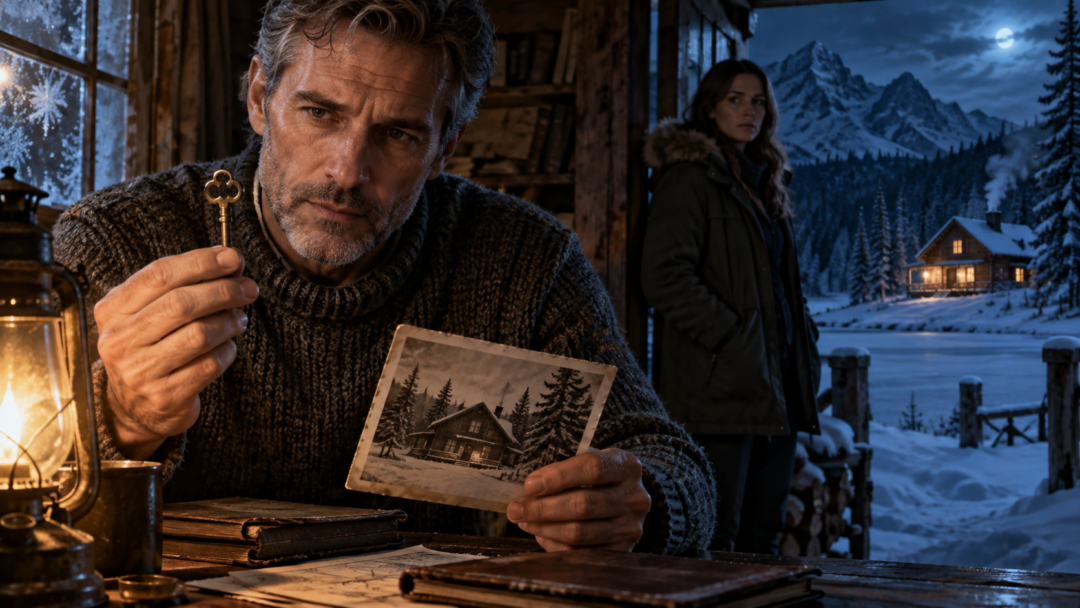
The subzero gale howling down from the Bitterroot crest screamed through the mountain pass like tearing canvas. Outside the hand-hewn cedar cabin, snowdrifts were piled four feet deep against the logs, sealing the perimeter in a blinding, white-out expanse of sub-Arctic frost. Inside, the only illumination was the soft, amber halo of a solitary brass kerosene lantern sitting in the center of the scrubbed pine kitchen table, and the dull, cherry-red glow of the cast-iron Jotul woodstove radiating pine heat into the twenty-foot room.
Jonah Avery stood motionless by the kitchen counter, his calloused hands resting flat on the butcher-block wood. He was sixty-one years old, his broad, weather-beaten shoulders wrapped in a thick, hand-knit grey wool sweater that smelled of cedar smoke and spruce tea. His silver beard was cropped close to a hard, angular jawline, and his deep-set grey eyes were hooded by heavy brows that had spent decades squinting over ancient diplomatic manuscripts, treaty transcripts, and Cyrillic cipher texts.
For three years, Jonah had lived in total isolation in Grey Pines, speaking to no one except the monthly supply courier. He had built this silence like a fortress.
Between his thumb and forefinger, Jonah lifted a heavy, tarnished brass mortise key from the center of the pine table.
It was an antique five-inch bit key, forged from solid naval brass, its collar stamped with an intricate double-reed pattern, its flag notched with three rectangular wards. It was ice-cold to the touch, carrying the distinct metallic tang of salt air and maritime fog—a smell that did not belong in the Rocky Mountains.
Jonah had not put it there. When he went to sleep at ten o’clock, the table had been completely bare. The heavy crossbar oak deadbolt on the cabin’s front door was still dropped in its iron cradles; the rear woodshed latch remained padlocked from the inside.
“This isn’t mine,” Jonah murmured into the empty room. His voice was low, gravelly, and rusty from disuse.
He turned the key over in his palm. He walked across the pine planks to the heavy front timber door, lifted the iron crossbar, and tried the key in the rim lock. The brass ward was too wide; it did not enter the keyway. He crossed to the rear woodshed door. Nothing. The key did not fit a single lock in the cabin.
A sudden, rhythmic thrumming sound vibrated through the floorboards.
Outside, the low, mechanical drone of a two-stroke snowmobile engine cut through the roar of the wind. Yellow halogen beams swept across the frosted double-pane kitchen windows, illuminating the intricate ferns of ice clinging to the glass.
The engine idled, coughed twice, and died.
A moment later, heavy mukluks crunched up the snowbank onto the porch. Three sharp, deliberate raps struck the center timber of the door.
Jonah dropped the brass key into his sweater pocket, slid the iron deadbolt back, and pulled the door open against the freezing draft.
Standing on the threshold in a swirling vortex of powdery snow was Vera Lang.
She was fifty-five, a woman carved from granite and mountain pine, wearing an oilskin canvas snowsuit, heavy fur-lined mittens, and a rabbit-skin trapper hat with the earflaps tied under her chin. Her cheeks were flushed bright red from the wind, her breath billowing in white clouds across the doorway. In her arms, she held a wooden crate of dry provisions: steel-cut oats, dried pinto beans, paraffin candles, and canned kerosene.
“You’re up early, Jonah,” Vera said, stepping into the warmth and stamping the snow from her boots onto the braided rag rug. “Blizzard is closing the lower switchbacks by noon. Brought your rations early.”
Jonah closed the door, threw the iron bar into place, and took the wooden crate from her hands, setting it on the counter. “I appreciate the run, Vera. You shouldn’t have driven the ridge in this wind.”
“Ranchers don’t stay in bed because the wind blows,” she said with a dry, clipped chuckle. She pulled off her heavy mittens, blowing into her cupped palms before moving toward the heat of the Jotul stove.
Jonah stood on the other side of the pine table. He reached into his sweater pocket, pulled out the cold brass mortise key, and placed it squarely on the center of the table beneath the yellow lamp light.
“It was on my table this morning,” Jonah said, watching her face with the surgical stillness of an inquisitor.
Vera stopped mid-stride. Her hands remained suspended two inches above the iron stoveplate.
Her eyes dropped to the key.
For a full three seconds, the cabin was dead silent, save for the crackle of burning tamarack in the firebox. Vera’s pupils contracted. Her lower lip tightened, and her left hand—a hand that had rope-burned calves and split cordwood for thirty years—trembled visibly against the wool of her sleeve.
“You sure you didn’t leave it there yourself?” Vera asked, her voice dropping an octave, losing its hearty mountain cadence.
“I haven’t seen a key like that in thirty years,” Jonah said softly. “You know where it belongs, don’t you, Vera?”
Vera pulled her hands back, shoving them deep into the fleece-lined pockets of her snowsuit. She took two steps backward toward the door, her eyes darting toward the frosted windows as if measuring the distance to the tree line.
“I have to check the radiator on the snowmobile,” she said, her tone suddenly bright, brittle, and artificial. “I’ll bring more firewood up from the lower shed next week. If the storm lets up.”
“Vera,” Jonah stepped around the table.
She didn’t look at him. She grabbed the iron door handle, yanked the door open, and stepped out into the howling blizzard without another word. The heavy door slammed shut behind her, the latch rattling in its keeper.
Jonah stood in the center of the silent room, the freezing draft eddying across his wool socks.
He picked up the brass key. He walked into his cramped sleeping alcove behind the stove, knelt on the floorboards, and pulled out an antique, iron-strapped cedar sea chest that had sat buried beneath three wool blankets for three years.
He opened the brass hasps.
Inside lay no clothes or tools. There were only five leather-bound translation dictionaries, a pair of wire-rimmed reading spectacles, and a faded five-by-seven silver-gelatin photograph mounted on black cardboard.
Jonah brought the photograph beneath the kitchen lamp.
The print showed a three-story Victorian brick manor standing on a windswept granite bluff overlooking the stormy Atlantic waters of Portsmouth, Maine. In the lower left corner, embossed in silver ink, was a dated tax registry stamp: HALE RESIDENCE — OCTOBER 1994.
Jonah held the brass key against the photograph.
The key matched the front door lock of that house down to the millimeter. He knew it because he had carried that key every day of his life until the night of the car bomb thirty years ago.
“I changed my name to forget that house,” Jonah whispered, his chest tightening with an old, suffocating pain. “I buried Daniel Hale in the salt water.”
He held the photograph two inches beneath the flame of the kerosene lamp, his thumb tracing the brick facade up to the third-floor attic window beneath the gables.
His breath stopped.
Standing behind the lace curtains of the third-floor window was the pale, unmistakable silhouette of a woman in a white silk blouse, her dark hair pinned behind her ear, staring directly into the camera lens with wide, terrified eyes.
It was Elena Cross.
The woman he had loved. The senior State Department translator who was supposed to have burned to ashes in an embassy limousine thirty years ago.
“Elena…” Jonah choked out, his vision blurring. “Who’s in the window—”
Suddenly, the glass pane of the kitchen window cracked with a high, sharp ping.
A brilliant, needle-thin beam of emerald green laser light stabbed through the frosted glass, slicing through the darkness of the cabin and painting a vibrating green dot directly onto the center of Jonah’s chest.
CHAPTER 2: THE CELLAR UNDER THE PINE
The laser beam burned against the grey wool of Jonah’s sweater like an emerald spark.
In a fraction of a second, three decades of buried military intelligence training took command of Jonah’s body. He did not freeze; he dropped.
He collapsed his knees, hurling himself laterally across the pine planks toward the cast-iron Jotul stove. An instant later, a high-velocity 7.62mm rifle round punched through the double-paned window with a sharp, concussive snap, showering the room with pulverized glass and subzero wind. The heavy bullet slammed into the brick chimney behind the stove, blowing a crater of mortar and clay dust into the air.
Jonah rolled behind the iron shield of the stove, reached up with his left hand, and swept the brass kerosene lantern off the table.
The glass mantle shattered on the floorboards, the kerosene soaking into the pine, the flame extinguishing instantly. Darkness swallowed the cabin, save for the dull red glow pulsing through the draft vents of the woodstove.
A second round punched through the cedar wall six inches above his head, splintering the hand-hewn logs.
Outside, above the howling gale, came the distinct, rhythmic chop of a suppressed semi-automatic rifle firing from the pine ridge seventy yards out. The hunters were using thermal optics; they were waiting for him to move against the heat signature of the stove.
Jonah pressed his back flat against the floor. He slid his fingers along the edge of the braided rag rug near the kitchen sink until they caught the recessed iron ring of the root cellar trapdoor.
He lifted the hatch two inches.
From the dark, earthen void beneath the floorboards came the smell of damp clay, stored winter potatoes, and old lime. He slipped through the opening like an eel, pulling the heavy cedar hatch shut behind him until the iron dog clicked into place.
The cellar was four feet deep, dug into the glacial till of the mountain slope. Jonah crawled on his belly along the dry irrigation trench toward the rear foundation wall.
There, where the stone footing met the timber sill beneath the rear woodshed, was the old gravity coal chute—a three-foot square opening covered by a rusted sheet of galvanized iron.
The iron sheet had been pried loose from the masonry. Fresh powdery snow had blown into the chute, and on the frozen earth lay the unmistakable, deep tread of a tactical combat boot.
The intruder had not entered through the front door. Someone had breached the coal chute during the storm, climbed through the floorboards while he slept, placed the key on the table, and slipped out into the blizzard.
A floorboard creaked directly above his head.
Jonah held his breath, drawing a six-inch high-carbon steel skinning knife from the leather sheath on his belt. He pressed his back against the stone wall, waiting for the trapdoor to open.
The cedar hatch lifted with a slow, agonizing groan.
A flashlight beam cut through the dust, sweeping over the potato bins. Behind the light, a silhouette dropped into the cellar with practiced, athletic silence.
The figure wore a snowsuit and carried an M4 carbine with a carbon-fiber suppressor.
Jonah struck from the shadows.
He lunged forward, wrapping his left arm around the intruder’s neck in a textbook rear naked choke, his right hand driving the flat of the skinning knife hard against the carotid artery.
“Drop the carbine,” Jonah rasped into the ear flap. “Or you bleed into the dirt.”
“Jonah… stop! It’s me!”
The voice was a desperate, choking wheeze.
Jonah froze. His grip loosened half an inch. He reached down with his right hand, ripped the snow goggles and neoprene face mask away from the intruder’s face.
It was Vera Lang.
Her face was pale and slick with cold sweat, her grey hair matted to her forehead. She let the carbine hang on its tactical sling, raising both hands in surrender.
“You’re Daniel Hale,” Vera gasped, rubbing her throat as she slumped against the stone foundation. “I knew it was you the day you walked into the post office three years ago. You have Elena’s eyes.”
Jonah stared at her, his knife still drawn, his mind reeling. “How do you know Elena Cross?”
“Elena was my older sister, Daniel,” Vera whispered, her hazel eyes glistening with raw, thirty-year-old grief. “I was twenty-four when she went into the car in Portsmouth. I spent three decades looking for the man she was trying to save.”
Jonah’s chest heaved. “Elena died in that car, Vera. I saw the explosion from the embassy gate. I saw the flames.”
“Elena wasn’t in that car,” Vera said, reaching inside her snowsuit to pull out a heavy, Kevlar-wrapped tactical data packet. “Silas Vance’s contractors pulled her out of the vehicle ten minutes before the bomb went off. They held her in a black site in the Idaho panhandle for two years, trying to get the cypher codes for the Portsmouth treaty safe.”
“Where is she now?” Jonah’s voice cracked, the agony of thirty years breaking through his stone facade.
“She died of pneumonia in the mountains in ninety-six,” Vera said softly, her tears freezing on her cheeks. “She escaped the facility, but her lungs were ruined. She reached my cabin in Spokane before she passed. She gave me that brass key, Daniel. She told me that one day, when the political heat died down, Silas Vance would come to finish the job. She told me to find Daniel Hale and give him the key.”
Above them, the cabin’s front door was blown off its hinges with a deafening C4 breaching charge.
The timber floorboards rattled, showering the cellar with cedar splinters. Heavy combat boots stomped across the kitchen above, moving in tactical formation.
“Clear the main room!” an amplified, metallic voice barked through a radio headset above. “Thermal showed one target near the stove! Find the trapdoor!”
Vera unclipped the M4 carbine and handed it to Jonah. “Silas Vance’s private strike team tracked my snowmobile. They’ve got two snowcats on the lower ridge and four men on the perimeter. We have five minutes before they drop incendiary grenades through the floor.”
Jonah took the carbine, checked the chamber with a crisp mechanical snap, and looked at Vera with eyes that had completely shed the quiet shell of Jonah Avery.
Daniel Hale had returned.
“Take the coal chute,” Daniel ordered. “We’re going to the old timber flume.”
CHAPTER 3: THE BLIZZARD ON BITTERROOT RIDGE
The subzero gale hit Daniel and Vera like an iron fist as they crawled out of the coal chute into the lee of the cabin’s snow-covered firewood rick. The blizzard was a screaming wall of white needles, reducing visibility to less than fifteen feet.
Behind them, through the cabin’s broken windows, two brilliant flashes of orange light illuminated the falling snow, followed by the muffled thump-thump of thermite grenades. Thick black smoke poured from the eaves as the hand-hewn cedar logs ignited in an uncontrollable furnace.
“Move!” Daniel shouted over the gale.
He led Vera low along the contour of the granite ridge, using the towering ponderosa pines as cover against the open slopes. In his hands, the M4 carbine was kept tucked beneath his woolen sweater to prevent the bolt assembly from freezing in the minus-twenty-degree air.
A hundred yards below them on the switchback trail, twin sets of heavy rubber tracks ground through the snowdrifts.
Two enclosed Hägglunds BV206 all-terrain snowcats—armored, articulated military transports painted matte alpine white—were grinding up the steep gradient. High-intensity infrared searchlights mounted on their roofs swept back and forth across the tree line, scanning for thermal signatures against the frozen snowpack.
“They’re cutting off the logging road!” Vera panted, her boots sinking knee-deep into the drifts. “The valley pass is four miles south. We’ll never outrun those tracks on foot!”
“We’re not running to the pass,” Daniel yelled back, pointing up the steep eastern slope toward the razorback shoulder of Bitterroot Ridge. “Look at the windward face! The gale has been loading a six-foot wind slab on the upper avalanche chute all night!”
Vera looked up through her snow goggles, her eyes widening in realization. “The Deadwood Chute. It drops straight onto the old bridge.”
“Silas Vance’s men know how to use night vision,” Daniel said, his jaw set like iron. “They don’t know Rocky Mountain snow mechanics. Follow my track. Step exactly where I step.”
They scrambled up the forty-degree rocky scree, clawing through crusty snow and stunted alpine juniper. The wind tore at their clothes, threatening to rip them off the cliffside, but Daniel moved with the tireless, rhythmic endurance of a man who had climbed these ridges every morning for three years.
They reached the granite outcrop at the crown of Deadwood Chute—a sheer, six-hundred-foot funnel of packed powder hanging directly above the narrow logging bridge where the switchback crossed the canyon.
Down on the trail below, the lead snowcat ground to a halt fifty yards before the bridge. Two men in white winter camouflage stepped out of the rear troop cabin, holding thermal-scoped assault rifles, pointing toward the ridge.
Daniel unslung the carbine. He flipped the selector switch from safe to semi-automatic, knelt behind the granite shelf, and sighted down the barrel.
He did not aim at the soldiers.
He aimed four hundred yards across the cirque at the massive, overhanging cornices of wind-packed snow suspended over the headwall of the chute.
He took a slow, deep breath, centered his crosshairs on the fracture line beneath the primary snow bridge, and squeezed the trigger three times.
Crack! Crack! Crack!
The supersonic rounds slammed into the compressed ice face.
For two seconds, nothing happened. The wind screamed through the crags.
Then, a low, subterranean sound—like an artillery train derailing inside a tunnel—shook the bedrock beneath their boots.
A hairline fracture cracked across the white face of the headwall, expanding fifty yards in both directions in the blink of an eye. With a terrifying, concussive whoosh, ten thousand tons of snow, ice, and sheared pine trees detached from the mountain face in a massive, rolling tidal wave of white fury.
The avalanche roared down Deadwood Chute, gathering speed until it was traveling at eighty miles an hour, pushing a five-hundred-foot wall of airborne powder before it.
Down on the switchback, the contractors screamed frantic warnings over their radios, scrambling to get back into the armored cabin.
They were two seconds too late.
The roaring white tsunami engulfed the lead snowcat. The immense hydraulic force of the snow sheared the five-ton vehicle from the trail, rolling it three times down the embankment before crushing it into the frozen creek bed below. The second snowcat was buried to its roof hatches, its tracks spinning uselessly against an impenetrable wall of compressed ice.
“Down the back ridge!” Daniel shouted, grabbing Vera’s arm. “Before the dust settles!”
They scrambled down the leeward slope of the mountain, slipping through the dense timber toward the abandoned 1940s logging flume that ran along the floor of the southern canyon.
Ten minutes later, sliding through knee-deep drifts near the crushed wreckage of the second snowcat’s trailing cargo sled, Daniel spotted a heavy military-grade Pelican case thrown clear of the snow.
He ripped the latches open with his knife.
Inside sat an encrypted tactical satellite tablet, its screen glowing in the grey blizzard dawn. Displayed on the monitor was a live thermal drone reconnaissance feed, centered squarely on an old wooden logging depot two miles down the canyon.
Beneath the feed was an intercepted radio transcript from an air-traffic transponder: Aegis Command / Silas Vance inbound via Bell 412 helicopter. Landing at Upper Flume Pad in 25 minutes. Primary Directive: Liquidate all assets and recover the Portsmouth cipher tapes.
Daniel picked up the tablet, his silver beard flecked with ice. “Silas Vance is here himself. He’s landing at the logging flume.”
“The flume is where you hid the archive,” Vera said, looking at him with dread.
“Yes,” Daniel said, his eyes blazing with thirty years of righteous fury. “And that’s where this thirty-year war ends.”
CHAPTER 4: THE OLD FLUME IN THE TIMBER
The abandoned logging flume of Grey Pines was an enormous, decaying monument to Montana’s early twentieth-century timber barons. Built of heavy, twelve-inch fir beams and iron trestles, the dry wooden flume stretched for two miles along the sheer granite wall of the canyon, carrying melted mountain runoff and timber down to the old rail spur.
Daniel and Vera slipped into the sheltered maintenance tunnel beneath the upper trestle as the blizzard began to thin into a cold, biting grey mist. The wind moaned through the gaps in the timber like a pipe organ.
Vera leaned against a creosote-treated piling, her chest heaving, clutching her frozen fingers to her face. “How did you get the Portsmouth treaty files all the way to Montana thirty years ago, Daniel?”
Daniel knelt beside an antique, iron-riveted cast-iron water gate set into the bedrock. His breath billowed white against the dark timber.
“In ninety-four, Silas Vance wasn’t just a private defense contractor,” Daniel explained, his voice low and mechanical. “He was the chief of procurement for the joint tactical missile defense initiative. Elena and I were assigned to translate the unredacted Russian telemetry logs from the secret Geneva protocols. What we discovered was that Vance’s company, Aegis Global, had falsified the missile guidance failure rates to secure a four-billion-dollar congressional appropriation.”
“And Elena refused to sign the sanitized translation,” Vera murmured.
“Elena told Vance she was taking the original audiotapes to the Senate Foreign Relations Committee,” Daniel said, his hands clenching into fists. “Forty-eight hours later, her car went up in flames outside the diplomatic gate in Portsmouth. I was three cars behind her. I saw the fire. I knew Vance would come for me next. So I took the master microcassette recordings, stole the backup treaty binders, and drove straight into the Rocky Mountains. I lived in abandoned forest service fire towers for ten years before I built the cabin.”
“Where are the tapes now?”
Daniel reached into his sweater and pulled out the antique brass mortise key Vera had left on his table.
He walked five paces down the tunnel to a recessed alcove carved into the granite rock face. Bolted to the stone was an antique, heavy naval brass ship’s barometer, three feet in diameter, salvaged from an old coastal freighter. Its thick glass face was intact, the needle pointing to stormy low pressure.
Beneath the brass dial sat an ornamental escutcheon keyhole stamped with the initials D.H. 1994.
Daniel aligned the brass key, slid it into the tumblers, and turned it firmly clockwise.
Clack.
The heavy brass bezel swung open on precision hinges, revealing a hollowed-out internal cavity behind the aneroid mechanism. Inside, wrapped in oilskin parchment and sealed with green wax, lay an aluminum microcassette case containing three pristine magnetic tapes.
“The unredacted Geneva recordings,” Daniel said, lifting the aluminum case. “Silas Vance’s voice, Senator Douglas Sterling’s voice, and Elena’s voice translating every illegal wire transfer.”
“Step away from the barometer, Daniel.”
The voice echoed from the mouth of the maintenance tunnel, sharp, flat, and chillingly familiar.
Daniel and Vera froze.
Standing at the entrance of the timber trestle, backlit by the pale winter morning light, stood Sheriff Wade Cooper.
Cooper was forty-eight years old, wearing a sheepskin-lined canvas county coat, his sheriff’s badge pinned to his chest, his service Stetson pulled low over his forehead. In his right hand, he held his standard-issue .45 caliber Glock service pistol, leveled dead center at Daniel’s chest.
“Sheriff Cooper,” Vera said, stepping between the gun and Daniel. “What are you doing here?”
“Doing my job, Vera,” Cooper said, his voice flat, exhausted, and burdened by a heavy, miserable shame. “Mr. Vance called my office two hours ago from his private aircraft. He told me an escaped federal fugitive named Daniel Hale was holding you hostage in the canyon.”
“He lied to you, Wade!” Vera yelled, her eyes flashing with fury. “Vance sent a death squad to burn Jonah’s cabin! They blew up the bridge! Look at the snowcat burning in the creek!”
“I saw the wreckage,” Cooper said, not lowering the weapon. “And I know who Silas Vance is. Vance’s security trust funds sixty percent of this county’s search-and-rescue budget. He built our hospital wing. He pays for our patrol vehicles. If I let you walk out of this flume with those tapes, Vance pulls his capital out of Grey Pines. This whole valley starves.”
Daniel stepped past Vera, holding the aluminum cassette case openly in his left hand, his grey eyes locking onto the sheriff’s trembling pupils.
“Your father was Sheriff Tom Cooper,” Daniel said softly, taking a slow step toward the barrel of the gun. “He was the man who patrolled these roads in ninety-eight when a young forest worker named Jim Vance disappeared at the sawmill. Do you remember what happened to your father, Wade?”
Cooper’s jaw twitched. A bead of cold sweat rolled down his weathered temple. “My father died of a heart attack.”
“Your father was poisoned with potassium cyanide in his coffee thermos two days before he was scheduled to testify before the state grand jury about Silas Vance’s illegal timber laundering,” Daniel said, each word landing like an anvil. “I was translating the offshore bank records for the federal prosecutor when the autopsy report arrived. Silas Vance signed the requisition check for the private security firm that delivered that thermos. Your father didn’t die of a heart attack, Wade. He was murdered by the man who just bought you your patrol cruisers.”
Cooper’s fingers shook violently on the grip of the Glock. His breath hitched in his throat, his face draining of color. “You’re lying…”
“Look at the case number on this tape,” Daniel said, holding the aluminum box two feet from Cooper’s face. “Grand Jury Docket 98-44: State of Montana v. Aegis Holdings. The third voice on this tape is your father’s final deposition.”
Before Cooper could answer, the deafening, concussive whir of heavy helicopter blades tore the morning sky apart.
A twin-engine Bell 412 helicopter, painted midnight black with tinted glass, dropped out of the grey clouds over the flume trestle, kicking up a blinding maelstrom of snow and ice.
The side cargo door slid open with a heavy mechanical clatter.
Four tactical contractors in black armor jumped onto the wooden catwalk, leveling suppressed carbines, followed by an older man in a heavy charcoal cashmere overcoat, holding a gold-headed walking cane.
It was Silas Vance.
CHAPTER 5: THE ICE IN THE FLUME
The downdraft from the Bell 412’s massive twin rotors lashed the timber catwalk with hurricane force, hurling stinging granules of granular snow through the gaps in the flume beams. The deafening turbine roar drowned out all speech, turning the world into a vibrating theater of steel, timber, and ice.
Silas Vance stood on the catwalk twenty paces away, his gold-headed cane planted firmly between his polished alligator boots. He was sixty-five, with a mane of swept-back, lion-like white hair, aristocratic cheekbones, and pale, reptilian green eyes that swept over the tunnel with absolute, despotic ownership.
Flanking him were four heavily armed private security operatives, their tactical assault rifles trained with hair-trigger precision on Daniel, Vera, and Sheriff Cooper.
Vance raised his left hand. The helicopter pilot reduced rotor pitch, letting the turbine whine settle into a throbbing, rhythmic idle that allowed his voice to carry down the wooden flume.
“Thirty years, Daniel,” Vance said, his voice cultured, resonant, and dripping with patronizing amusement. “Thirty years living like a badger in a root cellar. Look at you. The brilliant State Department prodigy… reduced to splitting logs and wearing rags.”
Daniel did not flinch. He stood tall, his broad shoulders squared against the storm, holding the aluminum cassette box firmly against his ribcage. “You haven’t changed, Silas. You still bring an army of paid cowards to do what you can’t do yourself.”
Vance smiled—a cold, humorless baring of porcelain veneers. “Survival isn’t about cowardice, Daniel. It’s about arithmetic. For thirty years, Aegis Global has built the defense infrastructure of the free world. We control satellite relays, missile telemetry, and border security contracts from Warsaw to Taipei. Did you really think three magnetic tapes from a defunct treaty could derail an empire?”
“If they couldn’t,” Daniel replied, “you wouldn’t have spent ten million dollars and sent a helicopter to a Montana logging ditch to get them back.”
Vance’s smile vanished, replaced by the naked, icy venom of a cornered predator. He looked past Daniel to Sheriff Wade Cooper, whose service weapon was still drawn, hanging trembling at his side.
“Sheriff Cooper,” Vance commanded, his tone shifting into the cold authority of a master addressing a delinquent servant. “Take the aluminum case from the fugitive. Put two rounds through his forehead, and take the woman into the timber. When you’re done, your department receives a five-hundred-thousand-dollar annual endowment in perpetuity.”
Wade Cooper stood frozen on the icy floor of the flume. He looked at Silas Vance’s pristine alligator boots, then down at the tarnished brass star pinned to his own chest, and finally into Daniel Hale’s clear, unflinching eyes.
“Sheriff,” Daniel said softly under the turbine roar. “Remember your father.”
Cooper’s jaw hardened into stone. The trembling in his hands vanished.
He slowly raised the .45 caliber Glock.
He didn’t point it at Daniel.
He turned ninety degrees, brought the heavy front post of the sight directly onto the chest of Vance’s lead contractor, and pulled the trigger twice.
BANG! BANG!
The heavy .45 rounds tore through the contractor’s tactical vest, knocking him off the catwalk into the icy gorge below.
“Get down!” Cooper bellowed, diving behind a massive twelve-inch creosote timber support.
The remaining three contractors opened fire in full automatic fury.
A hail of 5.56mm armor-piercing rounds chewed into the flume walls, tearing away huge chunks of splintered fir and shattering the century-old iron braces. Plaster dust, sawdust, and pulverized ice filled the tunnel in a choking, blinding fog.
Daniel grabbed Vera by the jacket, hauling her backward into the granite alcove behind the ancient water gate. “Stay behind the stone!”
Daniel unslung the captured M4 carbine. He leaned around the granite footing, firing short, controlled two-round bursts.
His first burst struck the second contractor in the knee, spinning him over the handrail. His second burst shattered the heavy plexiglass windscreen of the idling Bell 412, forcing the pilot to pull back on the cyclic stick in hysterical panic.
The helicopter lurched violently into the air, its tail rotor swinging wide, slicing through the upper crossbeams of the wooden flume trestle.
Massive twelve-foot timber beams sheared in half with deafening, explosive cracks.
A three-ton section of the flume roof collapsed outward in a roaring avalanche of splintered lumber, snow, and severed iron bolts, crashing directly onto the catwalk between Silas Vance and the tunnel mouth.
The helicopter pilot, terrified of losing rotor control, banked hard into the canyon mist, abandoning Vance on the precarious, swaying wooden platform.
Through the clouds of dust and flying snow, Daniel stepped out from behind the granite gate, his carbine leveled at the wreckage.
The two remaining contractors lay crushed beneath the fallen timber, disarmed and groaning in the debris.
Silas Vance stood alone on the fractured catwalk, his expensive overcoat ripped, his cane lost in the gorge, clutching his dislocated shoulder as the wooden trestle groaned beneath his boots, threatening to give way into the two-hundred-foot canyon below.
“Daniel… wait!” Vance shrieked, backing toward the broken railing, his arrogance completely shattered. “We can settle this! Five million dollars! Wire transfer to any bank in Switzerland! Just give me the tapes!”
Daniel walked across the creaking, ice-covered planks until he stood five paces from the billionaire.
“The tapes don’t belong to me, Silas,” Daniel said, his voice ringing through the canyon with absolute, unyielding authority. “They belong to Elena Cross. And they belong to the American people.”
CHAPTER 6: THE BAROMETER IN THE STORM
The wind howled through the ruined skeleton of the flume trestle, sweeping the smoke and dust out over the vast, white expanse of the Bitterroot canyon.
Silas Vance slumped against a cracked fir support beam, his face grey with exhaustion, his breathing ragged and shallow. The illusion of untouchable corporate power had been stripped away, leaving only an aging, terrified criminal cornered in the frozen timber.
Sheriff Wade Cooper stepped up behind Daniel, a fresh magazine clicked into his Glock, his face set with grim, unyielding purpose. He reached into his coat pocket, pulled out a pair of heavy steel handcuffs, and snapped them onto Vance’s wrists with a sharp, echoing click.
“Silas Vance,” Cooper said, his voice steady as bedrock, “you are under arrest for the attempted murder of three people, conspiracy to commit treason, and the historic homicide of Sheriff Thomas Cooper.”
Vance glared at the sheriff through swollen, venomous eyes, his lip curling in a pathetic sneer. “You fool, Cooper. You think a county sheriff can hold me? My lawyers will have me out of your two-bit jail before lunch! I have friends in the Justice Department who can erase your entire department with a single phone call!”
“They won’t be taking your calls, Vance,” a voice rang out from the end of the tunnel.
Vera Lang stepped onto the catwalk, holding the encrypted satellite tablet she had retrieved from the contractor’s sled. The screen was flashing with an active green transponder signal.
“Ten minutes ago,” Vera said, holding up the screen, “I patched the audio feed from this tunnel directly into the Federal Bureau of Investigation tactical command center in Salt Lake City, and to the Inspector General of the Department of Defense. Every word Vance spoke—every threat, every bribe, every admission—was recorded on an open federal wire.”
Vance’s knees buckled. He would have collapsed onto the snow-covered planks if Cooper hadn’t hauled him upright by his collar.
“That’s not all,” Daniel added, stepping forward with the aluminum case. He popped the latches, revealing the three microcassette tapes resting safely in their oiled foam beds. “The unredacted Geneva recordings are going straight to the United States Senate Armed Services Committee. The thirty-year cover-up is over.”
From the southern horizon, above the snow-covered peaks, came the deep, thrumming roar of four heavy turbine engines.
Two Sikorsky UH-60 Black Hawk helicopters, bearing the distinctive green and gold insignia of the Federal Bureau of Investigation Hostage Rescue Team, swept over the ridge, their searchlights illuminating the flume in brilliant white beams.
One Black Hawk hovered over the open logging clearing, deploying four tactical agents down fast-ropes into the snow, while the second helicopter touched down on the frozen creek bed.
Federal agents in winter tactical gear sprinted up the embankment, their carbines ready, led by Special Agent in Charge Marcus Thorne.
Thorne ran onto the catwalk, taking in the scene: the disarmed contractors, Sheriff Cooper holding Silas Vance in handcuffs, and the two weathered figures standing calmly beside the ancient brass barometer.
“Sheriff Cooper?” Thorne called out, showing his gold credentials. “Federal tactical unit. We have the perimeter secured.”
Cooper pushed Silas Vance forward into Thorne’s custody. “Take him, Agent Thorne. He’s all yours. And make sure the door stays locked.”
Thorne nodded to his agents, who secured Vance and escorted him toward the waiting Black Hawk. The billionaire walked with his head bowed against the wind, his empire crumbling around him with every step through the snow.
Agent Thorne turned to Daniel Hale. He looked at the weathered face, the silver beard, and the steady, intelligent grey eyes that had spent thirty years hiding in the wilderness.
Thorne slowly reached up to the brim of his tactical cap, snapping a crisp, formal salute.
“Daniel Hale,” Thorne said, his voice laced with profound professional reverence. “For thirty years, the United States State Department has carried your name as missing in action. It is an honor to finally meet you, sir.”
Daniel looked at the federal badge, then down at the aluminum case in his hands. A profound, bone-deep tiredness washed over him—the exhaustion of three decades of vigilance, paranoia, and solitary silence. But beneath the tiredness was a soaring, untainted peace.
Daniel handed the aluminum case to Agent Thorne.
“The evidence is intact, Agent,” Daniel said. “Elena Cross protected this truth with her life. Ensure it is delivered to the Senate floor.”
“You have my word on my badge, Mr. Hale,” Thorne promised, securing the case in an official diplomatic courier pouch. “The Director has authorized an immediate transport flight to Washington, D.C. A congressional committee is convening an emergency session tomorrow morning. They are waiting for your testimony.”
Daniel turned to Vera Lang.
Vera stood beside him, the cold wind whipping her grey hair, her eyes shining with tears of relief and vindication. She reached out and took his calloused hand, squeezing it with the fierce, unbreakable bond of two survivors who had finally reached the shore.
“We did it, Daniel,” Vera whispered, her voice choking with emotion. “Elena can finally rest.”
Daniel looked out over the vast, snow-covered ridges of Grey Pines, where the morning sun was finally burning through the storm clouds, painting the Bitterroot peaks in long, brilliant banners of gold and rose.
“Yes,” Daniel said, his voice rich and full of life. “She can.”
CHAPTER 7: THE TRUE NAME IN THE SUNLIGHT
Forty-eight hours later, the winter sun shone bright and cold over the limestone facade of the Russell Senate Office Building on Capitol Hill in Washington, D.C.
Inside the packed, marble-columned chamber of the Senate Armed Services Committee, three hundred journalists, television cameras, federal prosecutors, and foreign diplomats sat in breathless, pin-drop silence.
At the witness table, dressed in a sharp charcoal wool suit, sat Daniel Hale.
His silver beard was neatly trimmed, his spectacles rested on the bridge of his nose, and before him sat a heavy binder containing the certified, unredacted transcripts of the Geneva non-proliferation protocols. Beside him sat Vera Lang, wearing a simple navy dress with a single silver pin—Elena Cross’s State Department service medal.
At the central podium, Committee Chairman Senator Robert Bradley banged his wooden gavel down with three resounding strikes.
“The record will reflect,” Senator Bradley announced, his voice echoing through the vaulted chamber, “that by unanimous resolution of the United States Senate and an executive decree from the Department of State, all historic allegations, sanctions, and records of treason against Diplomatic Translator Elena Cross and Chief Translator Daniel Hale are hereby formally, permanently expunged.”
A roaring standing ovation erupted from the gallery. Senators on both sides of the aisle rose to their feet, applauding with thunderous reverence.
In the front row of the press gallery, television monitors were broadcasting the morning headlines: AEGIS GLOBAL DEFENSE CONTRACTS TERMINATED… SILAS VANCE INDICTED ON 42 COUNTS OF TREASON AND CONSPIRACY… HISTORIC COLD CASE SOLVED BY WHISTLEBLOWER DANIEL HALE.
Daniel did not smile for the cameras. He sat with his hands folded on the oak table, his eyes lifted toward the sunlight streaming through the high arched windows, carrying the memory of the woman who had made this day possible.
When the hearing concluded, Daniel and Vera walked down the grand marble steps into the crisp, clean winter afternoon.
A throng of fifty reporters pressed forward, thrusting microphones and cameras toward them, shouting questions into the cold air.
“Mr. Hale! Mr. Hale! Are you returning to the State Department?”
“Mr. Hale, how does it feel to have your name back after thirty years?”
Daniel stopped on the second landing of the stone staircase, looking out over the Capitol plaza. He raised one hand, and the reporters fell silent, waiting for his words.
“For thirty years,” Daniel said, his gravelly voice carrying clearly across the plaza, “I lived in a cabin in the mountains under a borrowed name. I thought silence was the price of survival. But the truth is not a fragile thing that needs to hide in the dark. It is an enduring fire. It waits under the snow until people with courage decide to dig it out.”
He looked at Vera, who smiled through unshed tears, and then back to the press.
“My name is Daniel Hale,” he said, the words clear, proud, and free. “And today, I am going home.”
Two weeks later, the snow in Grey Pines had begun to soften under the warm chinook winds of late winter.
Along the ridge, the mountain water was trickling down through the rock flumes, and the scent of damp pine needles and thawing earth filled the valley air.
Daniel stood on the porch of the newly rebuilt timber cabin. The Jotul stove was humming inside, the scent of fresh cedar logs rich and clean.
Down the gravel road, Vera’s pickup truck pulled into the clearing, bringing supplies for the spring planting. She stepped out into the sunshine, waving a hand in greeting.
Daniel walked down the wooden steps to meet her. In his pocket rested the old brass mortise key—no longer a symbol of exile or fear, but an antique keepsake honoring a promise kept to the end of the world.
He smiled into the warm mountain breeze, took the crate of provisions from Vera’s hands, and walked up the steps into the bright, unshadowed light of a new life.