The Second Silver Key In The Drawer Unlocked His Past
CHAPTER 1: THE SILVER KEY ON THE RING
The autumn storm rolled off the cold granite crags of the Cascade Range, dumping heavy sheets of grey rain across the cedar-shake roofs of Osprey Lake. Mara Ellison stood in the narrow entryway of their 1920s craftsman bungalow, the brass latch of the front door clicking shut behind her with a muffled thud. Water dripped in steady, rhythmic taps from the hem of her grey wool coat onto the slate floor tiles. Outside, the wind howled through the towering Douglas firs that crowded the rocky shoreline, bending their dark boughs against the dark windowpanes.
Mara reached into her coat pocket, pulled out her heavy brass keyring, and held it beneath the warm yellow glow of the hallway sconce.
Her thumb moved slowly across the familiar set of keys: the square deadbolt key for the front door, the small bronze key for the lakeside woodshed, the serrated brass key for her restoration studio in town.
Then her fingertips stopped.
Between the studio key and the post office key hung a slender, antique silver mortise key. Its shaft was worn smooth by decades of handling, its teeth cut in intricate, notched wards, its bow stamped with a faint, faded monogram.
Mara stared at it, her brow furrowing in the quiet house.
“When did I get this?” she whispered to herself. The only sound in reply was the muffled drumming of rain against the cedar shingles and the faint, rhythmic hum of the basement water heater.
She stepped to the oval mirror mounted above the coat rack. Her reflection looked back at her—thirty-four years old, high cheekbones, dark hair pulled into a sensible knot at the nape of her neck, dark eyes vigilant and exhausted from six hours spent surveying rotten joists at the town library. She pocketed the keyring, took off her damp boots, and stepped onto the fir floorboards.
Down the long hallway, at the far end of the house, the door to Daniel’s private study stood slightly ajar.
A warm slice of amber light spilled across the hallway runner. The faint scent of roasted coffee beans and drying pine varnish drifted on the warm air.
Mara walked down the runner, her woolen socks silent against the wood. As she reached the kitchen archway, Daniel emerged from the pantry, holding a damp linen tea towel in both hands, drying a ceramic mug.
He was thirty-seven, tall and broad-shouldered beneath a heavy charcoal wool crewneck sweater. His dark hair was slightly tousled, his jaw carrying two days of neat dark stubble, his face wearing that easy, unhurried warmth that had drawn Mara to him three years ago when she first moved to the lake.
“You’re early,” Daniel said, offering his customary gentle smile. He leaned against the butcher-block island, tossing the tea towel over his left shoulder. “The squall came in fast over North Spit. I put the kettle on.”
Mara stopped three paces away. She did not smile back. She reached into her pocket, brought out the keyring, and singled out the slender silver key between her index finger and thumb.
“Whose key is this, Daniel?”
Daniel’s fingers paused mid-motion on the handle of the ceramic mug. The micro-hesitation lasted less than half a second—barely a skipped breath—but to Mara’s trained eye, it was as loud as a gunshot in an empty room.
Daniel recovered instantly, setting the mug down on the counter with a quiet clink. His eyes flicked down the hall toward the closed secretary desk in the bedroom, then snapped back to Mara’s face with smooth, practiced calm.
“Yours,” Daniel said, his voice level and soothing. “Always has been. It’s the spare for the rear patio French doors at the garden center. You must have picked it up from the counter last week when we were loading mulch.”
Mara looked down at the key. “The patio doors at the garden center use modern Schlage brass cylinders, Daniel. This is a nineteenth-century solid nickel-silver bit key. No. It hasn’t always been mine.”
Daniel didn’t argue. He picked up the towel again, his knuckles whitening slightly beneath the rough cotton. “You’re tired, Mara. Put the kettle on. We’ll sort through the keys after dinner.”
Mara turned without another word and walked down the hallway directly into their bedroom.
In the corner between the double windows stood a towering 1880s mahogany roll-top secretary desk—an antique Daniel had brought with him when they moved in together. For three years, the deep center drawer beneath the pigeonholes had remained locked with an ornamental escutcheon. Daniel had told her he had lost the key years ago during his move from Seattle.
Mara walked to the desk. Her hand was steady. She aligned the silver key with the keyhole, slid it into the cold metal slot, and gently turned it clockwise.
Click.
The brass tumbler released with a clean, well-oiled mechanical snap.
Mara pulled the drawer open.
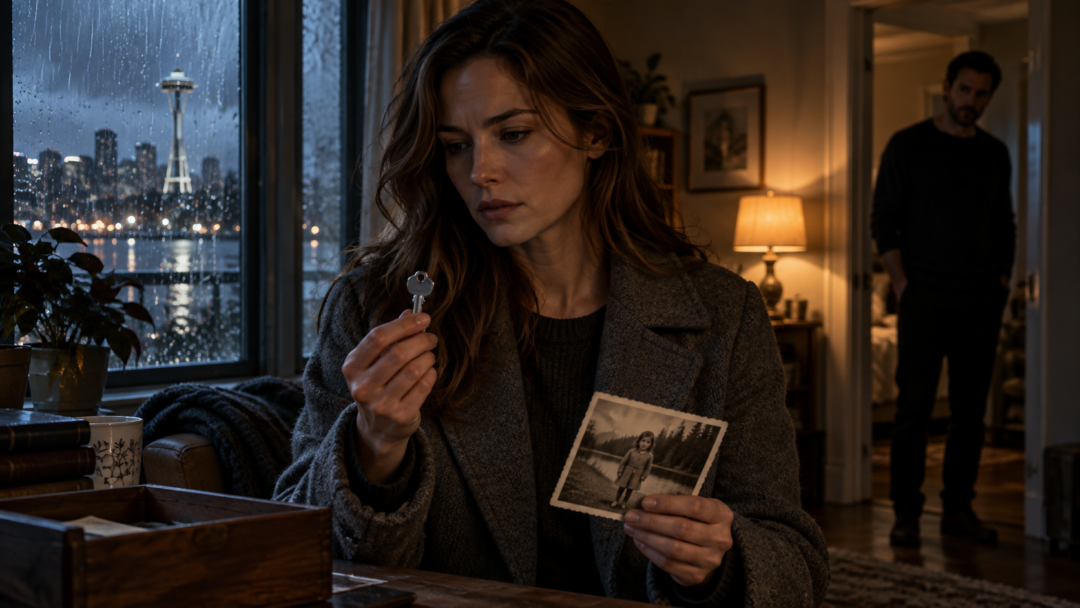
Inside, resting on clean green baize lining, was no stack of bills or garden receipts. There was only a single, heavy silver-gelatin photograph, face-up.
Mara leaned down, picking up the print by its borders.
The photograph showed Daniel ten years younger, standing on the deck of a wooden sailing sloop against the misty granite bluffs of Osprey Lake. His arm was wrapped tightly around a woman Mara had never seen in her life—a woman with striking fair hair, luminous hazel eyes, wearing a heavy navy cable-knit sweater and a silver pendant set with a raw sapphire.
Mara turned the photograph over. On the back, in Daniel’s unmistakable, sloping left-handed cursive, were written seven words and a date:
Celia. The water remembers everything. October 14, 2016.
Mara’s hand trembled once, a cold pit dropping through her stomach.
“Who is she?” she whispered into the empty room.
Behind her, at the far end of the hallway, the heavy front door swung open. A draft of freezing rain rushed through the house, rattling the glass panes in the secretary desk.
Wet, heavy bootsteps sounded on the hallway floorboards—slow, unhurried, dripping water onto the runner.
Mara did not turn around. Her jaw tightened as she slipped the photograph into the inner pocket of her wool coat.
A voice called out from the dark entryway, low, raspy, and entirely unfamiliar:
“You found it, didn’t you, Mrs. Ward? But you don’t know who put that key in your pocket.”
CHAPTER 2: THE NAME BEHIND THE VARNISH
Mara spun around, pressing her back against the mahogany desk, her fingers slipping into her coat pocket around the heavy iron paperweight she kept on the blotter.
In the bedroom doorway stood not Daniel, but an older man wrapped in a waterlogged, ankle-length oilskin duster. He took off a broad-brimmed felt hat, letting rainwater cascade onto the bedroom threshold. He was in his early sixties, thickset with a bull neck, iron-grey hair cropped close to a scarred scalp, and pale, rheumy blue eyes that swept over the open desk drawer with predatory satisfaction.
Pinned to the inside flap of his duster was a tarnished bronze shield: Osprey County Sheriff’s Office — Retired Undersheriff.
“Arthur Briggs,” Mara said, her voice dropping into cold, lethal composure. She recognized him from town council meetings. “You broke into my house.”
“Door was unlocked, Mrs. Ward,” Briggs rasped, taking one slow, deliberate step into the bedroom. His right hand remained deep inside the duster’s slash pocket. “Just like it was unlocked ten years ago when Celia Vance walked down to the water and never came back.”
Daniel appeared behind Briggs in the hallway. His face was chalk-white, his chest heaving, his fists clenched at his sides.
“Get out of my house, Arthur,” Daniel said through gritted teeth. His voice shook with an explosive mixture of fury and terror. “I paid you your five thousand on the first of the month. We had an agreement.”
Mara looked from Daniel to Briggs, her mind processing the words with surgical rapidity. Five thousand on the first. An agreement.
“You paid me to keep the coroner’s inquest from being reopened, Danny boy,” Briggs said without turning around. He kept his eyes locked on Mara. “That was before your pretty new wife filed restoration permits for the old Vance lumber manor on North Spit. You see, when the county tax assessor inspects that manor next week, they’re going to find out that the deed was transferred using a forged power of attorney dated two weeks after Celia drowned.”
“She didn’t drown!” Daniel shouted, stepping into the room. “You know damn well she didn’t drown in that storm! You ran her off the road at the timber flume! You took the bonds from her car and told me if I ever spoke a word to the state patrol, you’d find Clara and make sure she ended up at the bottom of the gravel pit!”
Briggs chuckled—a dry, grating rattle that smelled of cheap menthol tobacco. “Nobody cares about old stories, Daniel. What matters is the paper. And right now, the paper says you’re an accessory to murder.”
Briggs turned his cold gaze back to Mara. “Give me the key, Mrs. Ward. And give me the picture.”
“You put the key on my ring,” Mara said, taking a half-step forward, refusing to cower. “This morning at the farmers’ market. You bumped into my basket near the honey stall.”
“Smart girl,” Briggs murmured. “I knew Daniel wouldn’t open that drawer for me. But I knew if you found that key, you wouldn’t be able to resist. You’re an archivist. You like poking around in old rot. Now hand it over, or this quiet domestic tragedy gets very loud.”
Before Mara could move, a violent concussion shattered the night.
A fist-sized river stone wrapped in heavy electrical tape smashed through the double-pane bedroom window, showering the bed and floor with razor-sharp glass. Tied to the stone was a small, cylindrical metal tube with a flashing red LED light, emitting a high-pitched, warbling electronic chirp.
Briggs cursed, diving backward into the hallway runner. “You idiot! Who did you talk to?”
“I didn’t talk to anyone!” Daniel yelled.
“That’s a marine transponder beacon!” Briggs snarled, scrambling to his feet. “My boy outside just triggered the signal. That means the timber trust enforcers from Seattle just crossed the narrows bridge. They aren’t here to talk, Danny. They’re here to wipe the slate clean.”
Briggs turned and bolted down the front hallway, his heavy boots pounding toward the kitchen door.
Daniel lunged to the window, peering through the shattered blinds into the rainy darkness. Down the winding gravel driveway, twin high-beam halogen headlights pierced the trees, moving fast toward the bungalow.
Daniel grabbed Mara’s arm. “We have to leave. Now.”
Mara pulled her arm free with violent force. “Don’t touch me! Who was Celia Vance, Daniel? And why did you lie to me for three years?”
Daniel looked at her, his eyes wild with grief, shame, and desperation. “Celia was my wife, Mara. And if we stay in this house for another two minutes, they will kill us both before I can tell you the rest.”
CHAPTER 3: THE SHADOW ON THE SHORELINE
The freezing gale lashed Mara’s face as Daniel pulled her through the rear storm cellar doors into the dripping undergrowth behind the bungalow. Behind them, the roar of a heavy diesel engine shook the fir trees, followed by the concussive slam of three truck doors and the splintering crash of their front door being kicked off its brass hinges.
“Keep low,” Daniel whispered, ducking beneath the sweeping branches of an ancient western red cedar. “There’s an old skid road that runs along the water pipe down to the municipal archive.”
Mara ran beside him, her boots slipping on wet fir needles and mossy granite boulders. Her lungs burned with the cold night air, but her anger kept her mind razor-sharp. “Arthur Briggs said you forged a power of attorney for the Vance timber manor.”
“I didn’t forge it,” Daniel panted, jumping across a rushing creek swollen with mountain runoff. “Celia signed it herself three days before she disappeared. Her family owned the Osprey Timber Trust—five thousand acres of old-growth cedar and the deep-water log booms. Her uncle, Harlan Vance, was liquidating the trust to pay off gambling debts to a private equity syndicate in Seattle. Celia was transferring the land into a conservation land trust to save it.”
“Then why did Briggs say she drowned?” Mara demanded, holding her coat closed against the rain.
“Because Harlan Vance bought Arthur Briggs ten years ago,” Daniel said, his voice choking with bitter fury. “The night Celia tried to drive the signed conservation trust documents to the state capital in Olympia, Briggs intercepted her at the timber flume. He forced her station wagon into the lake. But Celia was a competitive swimmer. She climbed out the rear tailgate before the car submerged in forty feet of black water. She reached my workshop half-frozen at two in the morning.”
“Where is she now?” Mara stopped dead in the middle of the trail, forcing Daniel to turn and face her in the gloom. The lights of the lake village flickered below them through the trees.
Daniel’s jaw tightened. “She fled across the border to British Columbia. She changed her name. She had to. If Harlan Vance knew she was alive, he would have had her killed, and he would have hunted down her younger sister Clara. I stayed behind to keep Briggs quiet. I paid him half my earnings every month for ten years so he wouldn’t reopen the investigation and issue a fugitive warrant.”
“And the locked drawer?” Mara pressed, her eyes boring into him. “The key you claimed didn’t exist?”
“The drawer belongs to Celia,” Daniel said softly. “The silver key was her personal safe key. I thought she took it to Vancouver with her. When you held it up in the kitchen… I thought she had come back.”
“She didn’t come back,” Mara said, touching the pocket containing the photograph. “Briggs had the key. And Briggs gave it to me.”
They reached the gravel perimeter of the Osprey Municipal Archive—a squat, limestone-and-brick building erected in 1912 as the town’s original waterworks. Mara held the master brass key to the archive basement in her hand. She led Daniel down the exterior stone well, unlocked the heavy iron fire door, and ushered him into the subterranean vaults.
The archive was dry and silent, smelling of aged rag paper, leather binding glue, and floor wax. Long rows of industrial steel shelving stretched beneath vaulted brick ceilings, housing a century of county land deeds, timber surveys, and municipal records.
Mara flipped on the single green-shaded banker’s lamp on the central catalog table.
She moved directly to Row 14: Osprey County Coroner & Sheriffs’ Records, 2010–2020.
She pulled the heavy buckram-bound box labeled 2016: Suspicious Deaths & Water Casualties.
She laid the file on the table, flipping through the yellowed carbons until she found the red tag: VANCE, CELIA M. — OCTOBER 14, 2016.
Mara’s fingers froze on the third page.
“Daniel, look at this,” she whispered.
Daniel leaned over her shoulder.
The official dispatch log showed that the 911 call reporting Celia’s submerged vehicle was logged at 11:42 PM on October 14. But the county dive rescue team’s deployment log, signed by Undersheriff Arthur Briggs, was stamped: Search concluded and scene cleared: 7:30 PM.
“The search was terminated four hours before the car was ever reported in the water,” Mara said, her voice trembling with cold discovery. “Briggs didn’t investigate a drowning. He staged the entire timeline before the car even touched the lake.”
“Looking for this, Mara?”
A quiet, trembling voice echoed from behind the tall metal filing shelves.
Mara and Daniel spun around.
Stepping into the pool of green light was a young woman in her mid-twenties, wearing a faded olive canvas field jacket and mud-stained wading boots. Her honey-blonde hair was pulled into a braid identical to the woman in the photograph, and in her right hand, she held an unfiled, blue-ribbon legal folder.
It was Clara Vance.
“Clara,” Daniel breathed, taking a half-step forward. “What are you doing here?”
“Waiting for you,” Clara said, her hazel eyes glistening with unshed tears. “Because I found the original coroner’s report under my uncle’s floorboards this morning. And Arthur Briggs’s truck has been parked outside my cabin all afternoon.”
CHAPTER 4: THE MILL TOWN LEDGER
Clara Vance stood in the pool of emerald light, her hands trembling as she held out the blue-ribbon folder. She was twenty-four, with the sharp, determined jawline of the Vance family, but her face was gaunt, darkened by shadows of exhaustion.
“You knew, didn’t you, Daniel?” Clara whispered, her voice cracking with the strain of ten years of isolation. “You knew Celia was alive when she went over the border. You let me believe my sister was rotting in forty feet of silt while you stayed in that warm house with your wood carvings.”
“Clara, stop,” Daniel pleaded, raising both palms, his eyes filled with genuine anguish. “I swore an oath on Celia’s life. Harlan Vance told me that if Clara ever tried to claim the trust, you’d disappear just like your parents did. The only way to keep you alive was to let the town believe the family line was extinct.”
Mara stepped between them, her voice calm, commanding, and rooted in undeniable reality. “Arguments don’t stop bullets, Clara. Daniel didn’t stage that crash. Arthur Briggs did. Show me what’s in that folder.”
Clara hesitated, then placed the folder on the oak table.
Mara opened the heavy cardstock cover. Inside lay an unredacted financial audit of the Osprey Timber Trust, conducted by an independent accounting firm from Portland two weeks prior to Celia’s disappearance. Attached to the back was a series of cashier’s checks totaling $400,000, drawn from the trust’s operating reserves and made out directly to Briggs Security & Investigations LLC.
“Harlan Vance wasn’t just paying Briggs a bribe,” Mara analyzed, her finger tracing the account numbers. “Briggs was the minority partner. Briggs owned forty percent of the shell company that was formed to purchase the North Spit timber tracts once the trust was liquidated. But the trust couldn’t be liquidated without the signatures of both Vance heirs—Celia and Clara.”
“When Celia refused to sign,” Daniel said, “Harlan told Briggs to eliminate her. When she survived the crash, Briggs realized he couldn’t sell the land without Clara’s signature once she turned eighteen. So Briggs kept Clara under constant surveillance at the fish hatchery, waiting for the ten-year statute of limitations on the missing persons presumption of death to expire.”
“The ten-year mark is midnight tonight,” Clara said, looking up at the high basement clock. The hands read 1:15 AM. “October 14 was yesterday. Today is October 15. The probate court in Seattle is scheduled to declare Celia legally dead at 9:00 AM.”
“And once she’s declared dead,” Mara realized, “Harlan and Briggs can force a partition sale of the entire five thousand acres, bulldoze the timber, and pocket eighty million dollars.”
“Not if we present the living trust documents to the district judge,” Clara said. “Celia left the original signed trust deed in an iron strongbox inside our family’s old boathouse on North Spit. She told me the box could only be opened with the silver monogrammed key she gave Daniel.”
Mara reached into her coat pocket, pulled out the slender silver key, and laid it beside the blue-ribbon folder. The metal gleamed softly under the green lamp.
“The key is here,” Mara said.
Suddenly, the heavy iron fire door at the end of the archive hallway groaned.
A low, mechanical click echoed through the stone vaults. The overhead halogen lights in the main corridor flickered once and died, plunging the archive into ink-black darkness, save for the single battery-operated banker’s lamp on their table.
From the hallway came the slow, rhythmic crunch of broken glass under heavy tactical boots.
“Daniel Ward,” a voice boomed through the stacks—deep, amplified, and dripping with mocking cruelty. It was not Briggs. It was a younger, heavier man. “Clara Vance. Come out into the hall with your hands on your heads. Mr. Briggs has authorized a final settlement.”
“That’s Vince Miller,” Clara whispered in pure terror, shrinking behind the metal shelves. “He’s Briggs’s chief enforcer. He carries a silenced nine-millimeter.”
Mara reached under the catalog desk and switched off the banker’s lamp. Darkness swallowed them whole.
“Daniel,” Mara whispered, her lips touching his ear. “Does the archive still have the old waterworks gravity chute that opens to the timber flume?”
“Yes,” Daniel whispered back. “Behind the map cases in Section 4. It leads straight down to the shoreline.”
“Take Clara and go,” Mara ordered.
“I’m not leaving you, Mara!” Daniel hissed.
“You are taking Clara to the boathouse,” Mara said, her tone leaving zero room for debate. “Get the strongbox. I know this archive better than anyone in this county. I’ll lead Miller through the lower stacks and meet you at North Spit in twenty minutes.”
“Mara—”
“Go!”
Mara didn’t wait. She grabbed a heavy three-cell brass flashlight from the desk drawer, stepped out from behind the table, and hurled a heavy volume of the 1954 County Survey down the metal aisle.
The ten-pound book struck the steel shelving with a deafening, echoing crash.
An instant later, three muffled gunshots tore through the dark. Concrete chipped off the brick archway, filling the air with the smell of pulverized lime and cordite.
“I see you, sweetheart!” Miller’s voice taunted from fifty feet away.
Mara smiled in the dark, slipped her boots off to move in total silence, and melted into the labyrinth of shadows.
CHAPTER 5: THE DOCKS AT NORTH SPIT
The lower stacks of the municipal archive were a maze of floor-to-ceiling iron grates and narrow rolling ladders installed during the Taft administration. Mara moved along the outer perimeter wall like a phantom, her wool socks making zero sound against the cold concrete.
Behind her, Vince Miller was advancing down Aisle 3, the narrow beam of his weapon-mounted tactical light sweeping across the leather-bound ledgers. He was thirty-five, thick-necked, wearing a black nylon tactical vest over a grey thermal shirt. In his right hand, he held a customized Glock with a six-inch sound suppressor.
“You’re making this hard on yourself, Mrs. Ward,” Miller called out, his voice echoing off the brick vaults. “Briggs just wants the paperwork. Give up the key, and you get to walk away.”
Mara was already positioned above him.
She had climbed the rolling library ladder at the end of Aisle 2, perching lightly on the reinforced iron catwalk twelve feet above the floor. In her hands, she held an eighteen-pound cast-iron fire damper counterweight she had unhooked from the ventilation shaft.
She waited.
Miller stepped beneath the catwalk, his flashlight beam pointing down the empty corridor.
Mara dropped the iron weight.
The heavy cylinder struck Miller squarely across his right shoulder and collarbone. The impact broke bone with a sickening crack. Miller roared in agony, his pistol discharging into the floorboards before tumbling from his numb fingers into the darkness.
Before Miller could recover, Mara swung down from the catwalk handrail, dropping feet-first onto his chest.
The force of her momentum drove Miller hard onto the concrete. As he gasped for air, Mara seized his weapon, kicked his tactical light across the room, and jammed the cold barrel of the suppressed pistol against the underside of his jaw.
“Where is Arthur Briggs?” Mara demanded, her voice like honed steel.
Miller groaned, clutching his shattered collarbone, his face bathed in sweat. “He’s… he’s at the boathouse… on North Spit. He brought the gasoline cans. He’s going to torch the slip.”
“And the transponder on my house?”
“Briggs hired a crew from Spokane… to burn your bungalow. It’s already in ashes, lady. You’ve got nowhere to go.”
Mara brought the butt of the pistol down across Miller’s temple, knocking him unconscious. She stripped the extra magazine from his vest, grabbed his waterproof tactical jacket, and sprinted through the emergency flood doors toward the lakeside docks.
Outside, the storm was at its violent peak. Waves three feet high were battering the wooden piers of North Spit, churning the dark water of Osprey Lake into a foaming cauldron of white spray.
Mara commandeered an aluminum municipal patrol skiff tied to the archive slip, primed the fifty-horsepower outboard motor, and pulled the starter cord. The engine roared to life with a sharp, sputtering whine.
She threw the throttle forward, steering the boat through the pitching black waves toward the dark promontory of North Spit two miles across the bay.
Through the sheets of torrential rain, a solitary structure loomed against the jagged pine cliffs: the historic Vance Boathouse. Built of massive hand-hewn cedar logs on stone pilings, the two-story boat pavilion had stood over the lake for nearly a century.
As Mara approached the slip, she killed the engine, letting the skiff glide into the flooded lower boat bay.
Inside the cavernous, timber-framed structure, the water lapped against the walkways. Resting in the dry cradle of the central slip was an antique thirty-foot mahogany lake cruiser—the very boat Celia had piloted a decade ago.
Up on the mezzanine walkway, illuminated by the harsh white glare of two Coleman gas lanterns, stood Arthur Briggs.
He had already soaked the wooden railings in fuel. In his left hand, he held an opened red plastic jerrycan, pouring diesel fuel across the cedar planks. At the far end of the walkway, backed against the railing with their hands raised, were Daniel and Clara.
At Clara’s feet sat an antique cast-iron strongbox, its lid sealed with a heavy nickel-silver padlock.
“Throw the key up here, Danny boy,” Briggs shouted over the wind. “Or I drop the lantern and we all go up together.”
Mara climbed onto the lower dock, leveling Miller’s pistol two-handed through the gloom.
“Step away from the lantern, Briggs!” Mara shouted.
Briggs spun around, his face illuminated by the hissing white flame. He saw the pistol in her hands, but instead of fear, an ugly, yellow-toothed grin spread across his scarred face.
“You made it, Mrs. Ward,” Briggs laughed. “Right on time for the grand finale.”
From the shadows of the upper rafters, a second figure stepped forward, holding a twelve-gauge pump shotgun aimed straight at Mara’s head.
It was Harlan Vance—Celia and Clara’s uncle, seventy years old, wrapped in a pristine cashmere overcoat, his eyes dead and cold as winter river ice.
“Lower the weapon, young woman,” Harlan Vance ordered, his voice cultured, aristocratic, and completely devoid of human warmth. “You are trespassing on private family property. And family business is concluded tonight.”
CHAPTER 6: THE FLAMES ON THE WATER
The smell of diesel fuel was suffocating inside the cavernous cedar boathouse. The hissing Coleman lanterns threw harsh, dancing white shadows across the massive timber trusses, illuminating the dark water churning three feet below the walkways.
Mara did not lower the pistol. Her arms remained locked, the iron sights aligned dead center on Arthur Briggs’s chest.
“You’re out of time, Harlan,” Mara said, projecting her voice over the roar of the lake against the stone pilings. “The county dispatch records were photographed an hour ago. The State Fire Marshal and the Washington State Patrol have the altered dive logs. Vince Miller is in handcuffs at the municipal archive. If one shot is fired in this boathouse, you will spend the rest of your life in Walla Walla state penitentiary.”
Harlan Vance let out a dry, patrician chuckle, cocking the twelve-gauge shotgun with a heavy clack-clack. “You overestimate the reach of country marshals, my dear. When this boathouse burns, the county will find four bodies in the ashes: Daniel Ward, who murdered his former sister-in-law Clara in a fit of greed, and his unfortunate wife Mara, who tried to intervene. Arthur and I will be in Seattle by breakfast to execute the timber sale.”
“Uncle Harlan, please,” Clara cried, her voice cracking as she stepped in front of Daniel. “You raised me after mother died. How could you do this to your own blood?”
“Because your mother was a sentimental fool, Clara!” Harlan snapped, his aristocratic veneer cracking to reveal the raw, desperate rot beneath. “She thought trees were sacred! She thought this valley belonged to the public! Do you have any idea how much debt the Vance estate owes? Forty million dollars to creditors in Vancouver and Tokyo! The only thing that saves this family from bankruptcy is clear-cutting North Spit!”
“Celia knew that,” Daniel said, his voice ringing with fierce conviction. “That’s why she signed the conservation trust. She took the power away from you, Harlan. And you can’t touch that land without the original deed inside that strongbox.”
“Which is why Arthur is going to open it right now,” Harlan commanded.
Briggs set the fuel can down, drew a heavy, snub-nosed .357 magnum from his duster, and pointed it at Clara’s head. “The key, Daniel. Drop it, or Clara takes a hollow-point through the ear.”
Daniel reached into his pocket. His eyes met Mara’s across the flooded boat slip. In his gaze was an unspoken plea, an apology, and a desperate resolve.
Daniel pulled out the slender silver key and tossed it underhand toward Briggs.
The key cartwheeled through the air, glinting beneath the lantern light, and landed on the wooden planks at Briggs’s feet.
Briggs bent down, his gun still trained on Clara, and scooped up the key. He stepped to the cast-iron strongbox, jammed the key into the antique padlock, and turned it.
Click.
The heavy iron hasp popped open.
Briggs threw back the lid. Inside lay two thick parcels wrapped in waterproof green canvas, tied with hemp twine and sealed with the red wax crest of the Vance Timber Trust.
“Got it,” Briggs grinned, reaching for the deeds.
“You don’t have anything, Arthur,” Mara said.
Briggs paused, frowning. “What?”
Mara raised her left hand, revealing a small, black cylindrical device with a bright blue LED light blinking on its face. It was the remote detonator module she had stripped from Vince Miller’s tactical vest.
“Miller didn’t just carry a gun, Briggs,” Mara said, her voice dropping into cold, merciless command. “He carried the frequency trip for the emergency fire suppression foam on the municipal patrol boat docked right behind you.”
Before Briggs or Harlan could react, Mara pressed the black toggle switch.
An ear-splitting air horn shrieked across the boathouse.
From the stern of the municipal patrol skiff, the automated high-pressure brass water cannon unleashed a deafening, twelve-hundred-gallon-per-minute torrent of pressurized lake water and dense chemical fire-retardant foam.
The massive hydraulic jet struck Arthur Briggs squarely in the chest.
The impact blew the retired undersheriff off his feet like a ragdoll. He flew backward ten feet, smashing through the wooden railing of the mezzanine and plunging into the churning, icy waters of the boat slip with an enormous splash. The iron strongbox slipped from the walkway, tumbling into the open cockpit of the mahogany lake cruiser below.
Harlan Vance swung the twelve-gauge toward Mara in hysterical panic, screaming an incoherent curse.
Daniel lunged.
Putting all his weight behind a desperate tackle, Daniel drove his shoulder into Harlan’s midsection. Both men crashed hard against the timber wall. The shotgun discharged straight up into the cedar ceiling, blowing a hole through the roof shingles and showering the mezzanine with wood splinters and rain.
Daniel wrenched the shotgun from Harlan’s hands and hurled it over the railing into the deep water.
Down on the lower dock, Arthur Briggs broke the surface of the lake, gasping and spitting foam, his face bleeding from a gash on his temple. He clawed his way onto the wooden boarding ladder, pulling his .357 magnum from his waterlogged holster.
“I’ll kill you all!” Briggs shrieked, leveling the revolver at Clara.
Mara stepped to the edge of the dock, aligned her sights, and fired twice.
The suppressed rounds struck Briggs’s right shoulder and wrist. The magnum dropped from his shattered grip, sinking to the sandy bottom of the lake. Briggs slumped back against the ladder, groaning in total defeat, unable to lift his arms.
Above them, Daniel held Harlan Vance pinned against the logs by his throat. The old man was weeping, his pristine coat soaked in foam, his arrogance completely extinguished.
“It’s over, Harlan,” Daniel panted, his chest heaving. “It’s finally over.”
Through the shattered roof of the boathouse, the blue and red flashing lights of four Washington State Patrol cruisers and two Sheriff’s Department patrol boats illuminated the storm, their sirens echoing across the dark waters of Osprey Lake.
CHAPTER 7: THE CLEAR WATER OF OSPREY LAKE
The dawn broke over the Cascade Mountains in a breathtaking expanse of pale gold, violet, and crystal-blue sky. The storm had blown itself out toward the eastern plains, leaving the air over Osprey Lake sharp, crisp, and fragrant with the clean scent of wet cedar and pine resin.
Outside the Osprey County Courthouse, four State Patrol cruisers and an unmarked federal transport van were parked along the circular drive, their emergency flashers still pulsing softly in the morning mist.
Mara stood on the wide granite steps of the courthouse, holding a warm paper cup of black coffee. She had changed into a dry wool sweater and denim jacket provided by the Red Cross disaster unit. Beside her stood Daniel, his hands bandaged where he had cut them on the broken glass, his face quiet with a profound, unburdened peace.
Down on the driveway, handcuffed and flanked by two state troopers, Arthur Briggs was being escorted into the back of the transport van. His arm was secured in a medical sling, his head bowed, refusing to look at the crowd of local townspeople who had gathered on the lawn in stunned silence.
A moment later, Harlan Vance was led down the steps by federal postal inspectors, charged with sixteen counts of wire fraud, grand larceny, conspiracy to commit murder, and interstate racketeering. The old patriarch looked small, frail, and utterly ruined in the clean morning sunlight.
Detective Sarah Lindqvist of the Washington State Patrol walked down the steps, carrying the open iron strongbox. She stopped before Mara, Daniel, and Clara Vance.
“The forensic team in Seattle just verified the signatures,” Detective Lindqvist said, her voice warm with respect. “The conservation deed signed by Celia Vance in 2016 is one hundred percent authentic and legally binding. By executive order of the probate court, the temporary liquidation of the Osprey Timber Trust has been permanently vacated.”
Clara took a shuddering breath, a brilliant, tearful smile spreading across her face. “The forest is safe?”
“All five thousand acres,” Lindqvist confirmed, nodding. “The land has been officially transferred into the North Spit Conservation Trust, with Clara Vance named as sole managing trustee.”
The detective turned to Daniel, extending her hand. “Mr. Ward, the county prosecutor has reviewed the extortion records recovered from Arthur Briggs’s safe. All threats of charges against you have been dismissed with prejudice. You’re a free citizen.”
Daniel shook the detective’s hand, his voice thick with emotion. “Thank you, Detective.”
“There’s one more thing,” Lindqvist added, pulling a sealed satellite telephone from her evidence folder and handing it to Daniel. “We made contact with the Royal Canadian Mounted Police in Vancouver thirty minutes ago. There is someone waiting on line two who wants to speak with you and Clara.”
Clara gasped, pressing her hands to her mouth. Daniel’s eyes welled with tears as he took the phone. He reached out with his left arm, pulling Clara tight against his shoulder, and pressed the receiver to his ear.
“Celia?” Daniel choked out.
From the small speaker, clear and vibrant across two hundred miles of mountain wire, a woman’s voice laughed through joyful tears: “Daniel. Clara. I’m coming home.”
Mara stepped back quietly, giving the family their sacred moment of reunion. She walked down the granite steps to the edge of the courthouse lawn, looking out across the sparkling expanse of Osprey Lake. The water was as clear as polished glass, reflecting the snow-capped peaks of the Cascades like a mirror.
Footsteps crunched softly on the gravel behind her.
Daniel walked up beside her. He had handed the phone to Clara, who was laughing and crying into the receiver as she walked along the terrace.
Daniel looked at Mara, his eyes humble, vulnerable, and completely open.
“You saved my life, Mara,” Daniel said softly. “You saved Clara. You saved everything.”
Mara looked down at her coffee cup, then turned to meet his gaze. The suspicion and fear that had choked her for the past twenty-four hours were gone, replaced by a quiet, grounded clarity.
“You should have trusted me with the truth, Daniel,” she said, her voice steady. “Secrets don’t protect the people you love. They just give the shadows a place to hide.”
“I know,” Daniel said, reaching out to gently touch her hand. “I lived in fear for ten years. But standing in that boathouse with you… watching you fight for the truth… I realized what a real partnership is. If you’ll let me, Mara, I want to spend the rest of my life earning back your trust. No more locked drawers. No more secrets.”
Mara looked at his bandaged hand, then looked into his eyes. She saw no evasion, no polished excuses—only the honest remorse of a man who had finally stepped out of the dark.
She reached into her coat pocket, pulled out the slender silver key, and held it up between them in the golden sunlight.
“The drawer is open, Daniel,” Mara said, a faint, genuine smile touching her lips. “Now let’s go home and build something that lasts.”