The Rain In The Alley Whispered Her Mentor’s Final Defeat
CHAPTER 1: THE WET SLAP IN THE NEON ALLEY
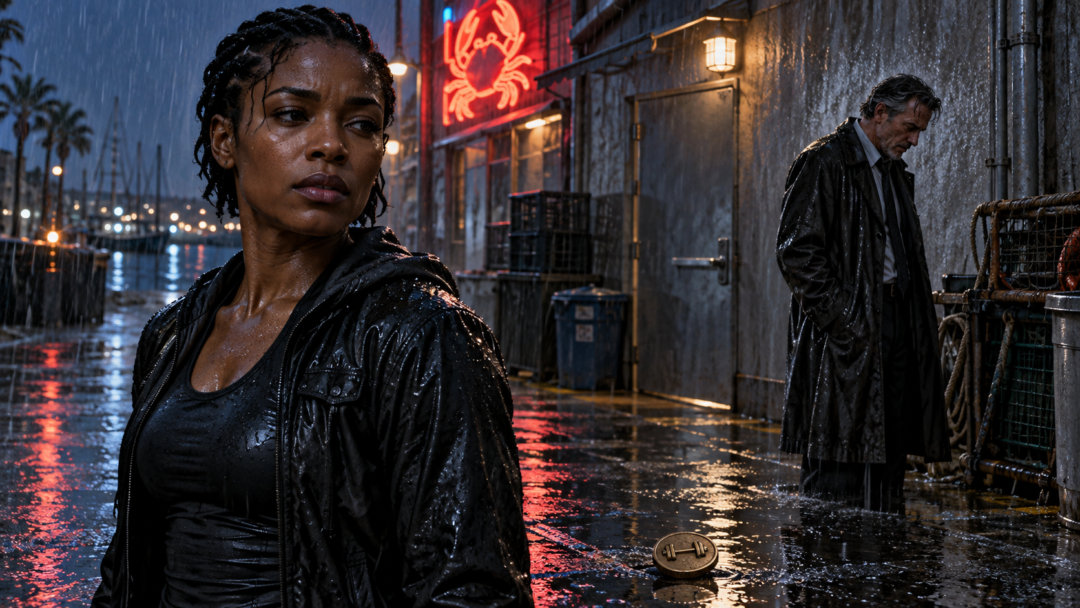
The storm blowing in off the Louisiana marsh slammed against the brick walls of Blackwater with the dull roar of a continuous freight train. Along the alleyway behind The Rusty Pelican, water poured from cracked cast-iron downspouts, churning grease, diesel residue, and discarded oyster shells into a black slick across the asphalt. Overhead, a battered neon crab flickered in violent pulses of electric blue and poison green, buzzing like a jar full of hornets in the wet Gulf air.
Lila Crane stood dead center in the run-off stream, her combat boots planted shoulder-width apart in three inches of dirty rainwater. She was twenty-eight, built of wiry corded muscle earned through ten thousand hours of calisthenics, sparring, and double shifts behind restaurant counters. Her black hair was pulled tight against her skull in braided cornrows that channeled the deluge down the back of her soaked sleeveless canvas vest. Water ran in steady rivulets down her temples and along the hard line of her jaw, but her hands rested loose at her sides, thumbs lightly touching the seams of her cargo pants. She did not blink. She did not shift her weight.
Ten paces ahead, blocking the mouth of the alley where it opened toward the salt wharves, stood Vance Corrigan.
He was fifty-five years old, his broad six-foot frame wrapped in a sodden, dark charcoal trench coat that smelled of wet wool and cheap sour bourbon. Silver stubble shadowed his heavy jowls, and his eyes—small, yellowed around the whites, inflamed by thirty years of scotch and bitter grudges—glared at her with theatrical malice. Around his thick neck, the collar of his coat was turned up against the squall, but the rain had already plastered his thinning grey hair flat against his temples.
In his right hand, Vance gripped a heavy, brass-knuckled leather trainer’s strap. He slapped it rhythmically against his left thigh, splashing muddy foam across his knees. He threw his head back and laughed—a wet, hacking cough of pure contempt that cut through the sound of the thunder.
“Look at you, Lila,” Vance yelled, spreading his thick arms wide under the neon glare. “Still running around in the dark. Still pretending you matter in this town. Five years scraping plates at the diner, and you still walk like you’re heading into the state finals. I heard you tell people you were a fighter. But look at you now. You dress like a busboy and you fight like one too.”
Lila did not answer. The wind caught the frayed edge of her collar, whipping wet canvas against her throat.
Vance took three heavy, splashing strides forward, closing the distance until his scuffed oxfords kicked a wave of brackish water straight at her shins. Lila didn’t flinch. Her dark eyes remained locked on the hollow at the base of his throat.
“I took you out of the parish foster home when you were fourteen,” Vance snarled, stepping into her personal space until the reek of stale tobacco and peppermints hit her face. “I gave you a locker. I gave your idiot brother Mason a mop and a cot in the boiler room. I put a gi on your back and taught you how to chamber a kick. And the second I tell you to do business with the promoter in Shreveport, you grow a conscience. You walk out. Well, look where your holy conscience got you, girl. Mason’s one court date away from Angola state pen, and you’re washing grease traps for nine dollars an hour.”
Vance leaned in until his nose was an inch from hers, his voice dropping to a vicious, poisoned rasp. “You were never the real thing, Lila. You were just a placeholder until I found somebody with blood in their veins.”
Lila lowered her chin half an inch, her voice flat, cold, and quiet beneath the thunder. “You talk too much, Vance.”
Vance’s face darkened with blood. “I’ll teach you what happens when you turn your back on the man who made you.”
He threw a lunging overhand right, putting all two hundred and twenty pounds of his weight behind a fist aimed straight at her cheekbone.
Lila did not step back.
The instant his shoulder dipped, she dropped her center of gravity like water slipping through fingers. She twisted her hips, dropped both palms to the flooded asphalt, and snapped her right leg out in a low, sweeping half-moon arc across the stones.
Her boot heel caught Vance’s lead ankle dead center.
The impact tore Vance’s footing out from under him with an explosive splash. He went airborne for a fraction of a second, his heavy coat billowing, before crashing flat on his back into the gutter. Water geysered three feet into the air. Before he could draw breath, Lila coiled her core, drove both hands off the wet concrete, and snapped upright into a balanced cat stance, water flying from her braids like a halo.
“You missed,” she said.
Vance roared, coughing out muddy water, and scrambled to his feet with feral desperation. He lunged forward with a wild, clumsy left hook. Lila leaned backward from the waist—a razor-close capoeira esquiva that let his knuckles whistle through empty air—and uncoiled her right leg in a devastating spinning heel kick directly into his sternum.
The concussive blow drove Vance backward through the darkness. His spine smashed into a five-foot stack of weathered pine pallets leaning against the brickwork. The soaked lumber gave way with a deafening crack like splintering oars, burying Vance in splintered slats and rotted wood.
“Still lucky,” Vance wheezed from the wreckage, spitting a mouthful of red foam into the mud.
He clawed his way out of the broken pine, grabbed the rusted galvanized steel lid off a fifty-five-gallon trash bin, and swung it two-handed at her neck like an axe.
Lila ducked under the whistling metal rim, spun counter-clockwise inside his reach, and uncorked a lightning hook kick that sheared the lid straight from his grip. The metal disc ricocheted off the third-story iron fire escape with an ear-splitting clang that echoed down the block. Without pausing her momentum, she pivoted on the ball of her left foot and swept his back knee.
Vance slammed into the flooded cobblestones a second time, clutching his cracked ribs with both hands.
“Try harder,” she said.
Desperation turned to terror. Vance rolled over, tried to tackle her around the knees, but Lila planted one palm on his broad back, launched herself into a crisp, airborne cartwheel over his shoulders, and drove a downward elbow strike between his shoulder blades as she landed behind him.
Vance crashed headfirst into an iron grease bin. The container toppled over, dumping black lard and restaurant sludge across his shoulders. He slumped against the damp brick wall, gasping for air like a landed carp, his fancy trench coat ruined, his teeth chattering in the freezing Gulf gale.
Lila stepped through the puddles until she stood directly over him. Vance looked up at her through swollen, bloodshot eyes, his mouth trembling, the arrogance completely ripped from his soul.
“Lila… wait…” he choked out, raising one shaking, filth-stained palm. “You can’t do this… I built you…”
Lila looked down at him with eyes as cold and unforgiving as the deep bayou.
“You taught me everything, Vance,” she whispered. “Except humility. I learned that myself.”
She turned on her heel to walk out of the alleyway.
As she stepped past Vance’s waterlogged trench coat, the wind tore open the flap of his inner pocket. A thick white envelope fell from the lining into the churning puddle at her feet. It was sealed with red wax, bearing the official embossed gold seal of the Blackwater Parish District Court.
Lila crouched and picked up the sodden document. Across the front, stamped in indelible purple ink, were the words: EMERGENCY SUBPOENA — CAUSE NO. 4481: ARSON OF NORTH DOCK ATHLETIC CLUB. WITNESS TO BE ARRESTED: MASON CRANE.
Lila’s blood turned to ice. Mason hadn’t set that fire five years ago. And Vance was holding the warrant.
CHAPTER 2: THE RUBY IN THE MASON JAR
Lila ran through the sheets of tropical rain, cutting through the labyrinth of narrow, waterlogged alleys that bordered the Blackwater rail yards. Her lungs burned with the cold damp air, but her mind worked with the mechanical calm of a fighter studying an opponent’s rhythm between rounds. The court document remained pressed inside her canvas vest, the purple ink bleeding slightly against the waterproof parchment.
At the corner of St. Jude and Vermilion, she vaulted a rusted chain-link gate and took the exterior wooden stairs down into the sunken cellar apartment beneath an old clapboard boarding house. Water was already pooling six inches deep at the foot of the stairs, threatening the weather-stripping along the sill.
Lila shoved the door open and stepped inside, locking the two iron deadbolts behind her.
The apartment was forty feet square, smelling of damp cedar shavings, camphor liniment, and the sweet herbal scent of eucalyptus steam. In the far corner, beside an antique cast-iron radiator that hissed and clanked against the storm, sat Mason Crane.
Mason was twenty-two years old, built with the long, lean frame that their father had passed down, but his shoulders were slightly hunched. Across his neck and the left side of his collarbone, the pale, shiny scars of third-degree burns stretched like spiderwebs—souvenirs of the night five years ago when the North Dock Boxing Club had burned to the waterline. A plastic medical nebulizer sat on the wooden crate beside his narrow cot, humming softly as he held the mask to his face, breathing in medication to soothe his scarred bronchial tubes.
When the lock clicked, Mason dropped the plastic mouthpiece, his pale grey eyes widening in panic.
“Lila?” he coughed, his voice husky and thin. “What happened to your vest? You’re covered in grease.”
Lila unzipped her vest and tossed the soaked legal envelope onto the oilcloth-covered kitchen table. “Vance ambushed me behind the Pelican. He was waiting for me after my shift.”
Mason went rigid. The color drained from his sunken cheeks until his burn scars stood out like raw chalk. “Vance? Why is he coming after you? We haven’t spoken to him since the magistrate gave me three years deferred probation.”
“Because of this,” Lila said, pulling a wooden chair up to the table. She smoothed out the wrinkled court papers. “The parish grand jury is reconvening on Monday morning. Vance didn’t come to talk about old times, Mason. He was carrying an emergency arrest warrant made out in your name. They’re charging you with first-degree commercial arson and grand larceny.”
Mason stood up so fast his chair screeched against the bare pine planks. “I was seventeen! I was trapped in the laundry room when the ceiling collapsed! You dragged me out through the coal chute while Vance stood on the dock with his gym bag full of cash!”
“Sit down,” Lila said, her voice dropping into the low, steady cadence she used when cornering an opponent on the canvas. “Panic doesn’t stop an indictment, Mason. Tell me what happened yesterday when you went to the parish clerk to file your probation release papers.”
Mason gripped the edge of the kitchen table until his knuckles turned ivory. He swallowed hard, his throat clicking. “The clerk told me the file wasn’t in the archive. She said Commissioner Donald Cross came down from the municipal zoning office on Thursday afternoon and pulled the entire North Dock case file. He told the clerk there was new evidence of an accelerant.”
“Donald Cross is Vance’s third cousin,” Lila said coldly. “Cross approved the zoning variance for the waterfront development project last month. If Vance rebuilds on the old gym footprint, the land is worth two million dollars to the offshore barge syndicates. But Vance can’t sell the deed if the insurance investigation remains an open arson probe.”
“Unless somebody takes the fall,” Mason whispered. A shudder ran through his thin frame. “He’s going to send me to prison so he can clear the title and collect the rest of the commercial casualty payout.”
Lila stood up, walked across the small room, and reached behind the cast-iron radiator. There, wedged inside the wall cavity behind a loose pine baseboard, was a five-pound steel ammo canister. She pulled it free, carried it to the table, and popped the heavy spring latches.
Inside, wrapped in oiled cheesecloth, sat an antique eight-ounce glass Mason jar.
Lila unscrewed the rusted zinc lid. She tipped the jar upside down over the table. Out rolled a single, deep crimson stone—an oval-cut star ruby the size of a thumbnail, its edges charred with black soot, one side sheared off where it had been pried violently from a gold setting.
“You’ve kept this hidden for five years,” Lila said, staring at the ruby.
“I found it jammed into the melted copper pipe above the boiler lintel,” Mason said, his voice trembling with quiet fury. “The night the fire started, Vance told me to stay in the basement and polish the kettlebells. Ten minutes before the explosion, I heard heavy boots on the boiler stairs. I saw the flash of Vance’s ring when he turned the petcock on the diesel intake line. When he yanked his hand back from the ignition spark, the ring caught on the iron valve. The ruby popped out and fell behind the pipe. I found it when I crawled back in to find my inhaler.”
“Vance wore an eight-carat star ruby on his right ring finger for twenty years,” Lila murmured, picking up the stone with two fingers. “Every fighter in Louisiana knew that ring. He claimed he lost the stone in the wreckage while trying to rescue the gym trophies.”
“It’s his,” Mason said. “It proves he was standing at the valve when the diesel caught fire.”
“A loose ruby in an ammo can isn’t enough to stop Donald Cross,” Lila said, wrapping the stone back in its cheesecloth. “Cross will claim you stole it from Vance’s locker before the fire. We need the physical paper trail. We need the original casualty inspection report signed by the state fire marshal before Cross burns it.”
Before Mason could reply, the sound of squealing tires echoed from the street above.
A sharp, violent crack shattered the cellar’s street-level window. A heavy red construction brick wrapped in thick brown parcel paper crashed through the double pane, showering the floor with glittering glass shards and rain. It bounced off the radiator and came to rest near Mason’s cot.
From the street above, the throaty rumble of two modified V8 engines reverberated through the floorboards, idling with rhythmic, predatory thrums.
Lila sprang across the room, blowing out the single kerosene lamp. Darkness swallowed the apartment, save for the wet yellow beams of twin headlights shining through the broken window.
She crouched beside the radiator, picked up the brick, and tore away the parcel paper. Scrawled across the paper in thick black carpenter’s crayon was a single sentence: MASON DIES IN AN OIL TANK TONIGHT IF YOU ARE NOT AT THE HIGHWAY BY MIDNIGHT.
“Lila,” Mason whispered, his voice hitching in his chest. “There are three men getting out of the sedan. They’re carrying crowbars.”
Lila reached into her pocket, felt the hard steel of her brass door key, and locked eyes with her brother in the dark. “Take the fire escape behind the coal chute. Do not stop until you reach Earl Broussard’s bait shop at the salt docks. I’ll take the stairs.”
CHAPTER 3: THE BROKEN GLASS OF THE NORTH DOCK
The freezing rain poured through the shattered cellar window, turning the floor into a mire of wet plaster and glass. Outside, heavy bootsteps splashed down the exterior wooden stairs, moving with deliberate, heavy confidence.
Lila stepped silently to the hinge side of the door, her back pressed flat against the damp cypress wall. She held her breath, tuning her senses to the vibrations through the floorboards. She counted three distinct sets of footsteps. One man had paused at the foot of the stairs to work a crowbar into the seam between the door and the frame. The other two were lingering on the landing above, watching the alley.
The iron crowbar bit into the wood with a sharp groan.
Snap.
The top deadbolt tore free from the rotten pine jamb. The bottom lock gave way an instant later. The heavy door swung inward with a violent kick, slamming against the interior wall.
A broad-shouldered man in a yellow waterproof oilskin slicker stepped across the threshold, holding a thirty-inch iron wrecking bar in both hands. Behind him, the headlights of the idling sedan cut through the gloom, illuminating his scarred chin and the broken bridge of his nose. It was Pete Alvarez—one of Vance’s former heavyweight sparring partners who now ran muscle for the waterfront loan syndicates.
“Come on out, little Crane,” Alvarez grunted, stepping into the dark room. “Vance wants your brother in the trunk, and he wants you in the canal.”
He took another step, raising the iron bar.
Lila struck.
She didn’t use power; she used alignment and velocity. Sliding her lead foot along the wet floorboards, she drove the open heel of her left palm upward into the hinge of Alvarez’s jaw with the concussive force of an air piston.
Alvarez’s head snapped back. His teeth clicked together like river stones. Before his brain could register the shock, Lila dropped her weight, pivoted on her right heel, and drove an explosive side kick into the outside of his left knee.
The knee joint buckled inward with a sickening pop. Alvarez screamed, dropping the iron crowbar as his massive frame toppled sideways like a felled cypress, splashing into the puddle near the door.
Lila didn’t wait for him to recover. She scooped up the heavy iron wrecking bar, stepped over his writhing body, and vaulted up the exterior stairs into the alleyway.
The two lookouts on the landing—young street brawlers wearing hooded track jackets—spun around in shock. One reached behind his back for a snub-nosed revolver tucked into his waistband.
Lila closed the four paces between them in two fluid strides. She thrust the flat end of the iron bar forward like a spear, catching the armed man squarely in the solar plexus. The air exploded from his lungs in a ragged gasp. As he doubled over, she swept his ankle with her heel, driving him face-first into the cast-iron banister. The revolver tumbled from his nerveless fingers, clattering through the metal grating into the flooded storm drain below.
The third man turned to run toward the idling sedan, but Lila flung the wrecking bar with surgical precision. The thirty-inch steel shaft cartwheeled through the rain, striking the runner across the back of the calves. He crashed onto the hood of the sedan, cracking the windshield with his forehead before slumping into the mud.
Lila walked to the driver’s side of the idling car. She reached through the open window, killed the ignition, and pulled the keys.
On the passenger seat, illuminated by the dashboard radio light, lay an opened leather binder stamped with the insignia of the Blackwater Municipal Building Authority. Beside it sat a heavy Motorola two-way radio, crackling with intermittent static.
Lila grabbed the binder and flipped open the brass clasps.
Inside was a carbon copy of an emergency municipal requisition order signed three hours earlier by Building Commissioner Donald Cross. The document authorized the immediate, off-hours destruction of all architectural and casualty records pertaining to the North Dock Athletic Club fire of five years ago. Attached to the order was a cash receipt for $10,000, endorsed on the back in Donald Cross’s sweeping, arrogant scrawl: Payment received in full for disposal of archive carton 114-B.
Lila felt a cold spark of rage ignite in her gut. Carton 114-B contained the state fire marshal’s original chemical forensics report—the only paper document that proved the fire was ignited by an industrial petrochemical, not an electrical short in the boiler room.
Suddenly, the two-way radio on the console hissed.
A voice rasped through the speaker—hoarse, hurried, and muffled by the sound of rain against a tin roof. It was Commissioner Donald Cross.
“Pete? Pete, answer the damn radio. The shredder truck is at the levee archive right now. Vance is getting nervous. He says the girl got away from him behind the Pelican. If you haven’t got the boy yet, leave him and get down here to the levee. We need three men to load the fire marshal’s boxes into the furnace before midnight.”
Lila picked up the handset, pressed the transmit button, and spoke with deadly, measured poise.
“Pete is taking a nap in the gutter, Commissioner.”
A suffocating silence fell over the radio channel. On the other end, Cross’s breathing turned ragged and sharp.
“Who… who is this?” Cross sputtered.
“This is Lila Crane,” she said, her voice cutting through the static like an iron razor. “Leave the boxes where they are. If one page goes into that furnace, I won’t just bring the fire marshal. I’ll bring every federal investigator between New Orleans and Baton Rouge.”
Cross let out a desperate, wheezing laugh. “You’re too late, girl. Carton 114-B is already on the iron chute. By the time you run two miles through this storm, there won’t be enough ash left to fill an urn.”
The channel clicked dead.
Lila dropped the radio, pocketed the keys to the sedan, and checked the fuel gauge. The tank was full. She slammed the door, threw the car into reverse, and tore down Vermilion Street toward the levee archive, the wiper blades screaming against the fury of the midnight storm.
CHAPTER 4: THE ARCHIVE UNDER THE LEVEE
The municipal records depository of Blackwater Parish was housed inside a monolithic concrete bunker constructed during the 1930s, built directly into the landward slope of the Mississippi River levee. Its walls were three feet of reinforced aggregate, stained black by eighty years of damp river seepage and river mold. At midnight, with the storm whipping the crest of the levee into a frenzy of brown water and flying willow branches, the building looked like a forgotten tomb.
Lila killed the sedan’s headlights three blocks away, coasting the car onto the muddy shoulder behind an abandoned shrimp cannery. She stepped out into the gale, her boots sinking ankle-deep into the silt, and sprinted through the shadows toward the rear loading bay.
The steel rolling door was cracked three feet off the wet concrete apron. A thick industrial exhaust hose snaked out from the darkness beneath the door, venting dense, oily grey smoke that smelled sharply of scorched paper, sulfur, and burning paraffin.
Inside, the roar of an oil-fired industrial refuse furnace echoed off the low ceiling vaults.
Lila dropped to her belly, slid under the steel rolling door, and rose into a crouch behind a row of ten-foot steel filing racks. The air inside the archive was suffocatingly hot and thick with ash. Overhead, naked hundred-watt bulbs hung from yellow cords, swaying in the draft and casting long, violent shadows across the concrete floor.
Thirty paces away, standing before the glowing iron hatch of the incinerator, was Commissioner Donald Cross.
He was fifty-eight years old, his portly belly straining the buttons of a bespoke grey three-piece wool suit now drenched in sweat and soot. His silver hair was disheveled, and his wire-rimmed spectacles sat crooked on his fleshy nose. In his left hand, he held a clipboard; in his right, a pair of long steel furnace tongs.
Stacked on a wooden pallet beside him were six corrugated cardboard archive boxes, each stenciled in red stencil ink: PARISH CASUALTY RECORDS — 5-YEAR RETENTION.
Beside Cross stood an armed security guard in a dark rain slicker, leaning on an iron handcart and feeding manila folders into the roaring fire.
“Hurry up, damn it!” Cross shouted over the furnace roar. “Toss the chemical analysis binders first! If the grand jury gets a look at the benzene markers, we’re all indicted by sunrise!”
“You should have worn gloves, Commissioner,” a voice rang out from the shadows.
Cross froze. The steel tongs dropped from his hand, clattering against the concrete floor.
The security guard spun around, drawing an expandable steel baton from his utility belt. He took two aggressive steps forward, raising the baton to strike.
Lila moved without a sound. She closed the distance before the guard could bring the weapon down, ducked under his shoulder, and drove a vicious palm-heel strike under his armpit, dislocating the shoulder with a crisp pop. As the guard gasped in agony, she hooked his lead ankle, turned his momentum against him, and drove him face-down onto the concrete. She kicked the baton into the darkness and stood over him.
Cross backed up until his spine slammed into the scalding iron frame of the incinerator. His face was the color of curdled milk.
“Lila… now listen to me,” Cross stammered, raising both hands, his fingers trembling like dry leaves. “You don’t understand the pressures involved here. Vance… Vance didn’t act alone. The offshore development group has already put down six million dollars for the deep-water slip. If that arson charge isn’t resolved with a guilty plea from your brother, the whole bond issue collapses!”
Lila stepped past the fallen guard and rested one hand on the stack of boxes. The top carton was marked: CARTON 114-B: NORTH DOCK GYM INCIDENT.
She flipped open the cardboard flaps. Inside lay the original, blue-ribbon certified report from the State Fire Marshal’s Office. She pulled out the third folder and opened it under the swaying bulb.
There, stamped across page four in red letters, was the forensic lab finding: Accelerant detected: High-octane commercial diesel containing red marker dye #4. Fuel source matched exclusively to the storage tanks of Corrigan Marine Logistics.
“Vance didn’t just light the match,” Lila said, her eyes boring into Cross’s shaking pupils. “He used the fuel from his own family’s boat yard.”
“It doesn’t matter!” Cross cried, his voice breaking into a terrified screech. “You think having that paper saves your brother? Vance doesn’t even have the money anymore, Lila! He lost the insurance payout three years ago! He pledged the land deed to Hector Vane at the salt wharves to cover his gambling markers! Right now, Hector Vane has four men at the high-tide slip! They’ve got Earl Broussard tied to an anchor chain! If you don’t trade those papers for Broussard before one o’clock, the old man goes into the deep water!”
Lila checked her wristwatch under the dim light. It was 12:22 AM.
“Where is Vance?” she demanded, grabbing Cross by the lapels of his expensive suit and hauling him forward until his toes barely touched the floor.
“He went to the gym!” Cross wept. “He went back to Blackwater Gym to get his personal ledger from the wall before the marshals arrive! Don’t let Vane drown Earl, Lila! Earl’s got the security tape from the night of the fire! If that tape hits the water, everything dies with him!”
Lila shoved Cross into an empty steel shelving unit, gathered Carton 114-B under her left arm, and sprinted for the exit into the roaring teeth of the storm.
CHAPTER 5: THE BOAT SLIP AT HIGH TIDE
The salt wharves of Blackwater stretched out into the black expanse of the bayou like rotting wooden fingers. The storm had pushed the tide four feet above normal, submerging the lower pilings and sending freezing, salt-laced waves crashing across the weathered cypress deckboards.
Lila left the car behind the levee wall and approached on foot, her boots splashing through knee-deep tide pools. The rain came down in blinding sheets, whipped by fifty-mile-an-hour gusts that rattled the rusted sheet-metal roofs of the fish houses.
At the far end of Pier 9, illuminated by the single amber work lamp of an industrial crane, a thirty-foot wooden oyster lugger rocked violently against its mooring lines.
On the stern deck of the lugger stood three men in heavy vinyl sea bibs, surrounding an old wooden fish crate. Tied to the crate with half-inch nylon hawser rope was Earl Broussard.
Earl was sixty-eight years old, his weathered, leathery face bruised and bleeding from a cut above his left eyebrow. His hands were bound behind his back, and around his frail ankles, two heavy iron mooring rings were secured with logging chains. Standing directly over him, holding a heavy wooden deck club, was Hector Vane—the kingpin of the parish loan syndicates, a squat, barrel-chested man with a gold tooth and a scar across his throat.
“Last chance, Earl,” Hector Vane shouted over the howling wind. “Where is the safety deposit box key? Where did you put the cassette from the dock camera?”
Earl spat a mouthful of blood onto the wet deckboards and glared up at Vane with defiant, rheumy eyes. “You tell Vance Corrigan he can burn every gym in Louisiana, but he can’t burn what the camera saw. The truth is in iron, Vane. You’re all going to federal prison.”
Vane raised the heavy club. “Tip him over the rail.”
The two deckhands stepped forward, gripping the chains on Earl’s ankles to slide him toward the churning black water.
“Hey!”
Lila’s voice cracked through the storm like a pistol shot.
Hector Vane spun around, squinting into the driving rain. Lila stood at the foot of the boat’s boarding gangplank, her braided hair plastered to her skull, her eyes burning with lethal focus. She carried no weapon, but her posture was the terrifying, coiled stillness of an apex predator.
“Well, well,” Vane sneered, lowering the club. “Vance said you might come sniffing around. Come aboard, little bird. We’ve got plenty of iron chain for both of you.”
He gestured to the two deckhands. The men drew heavy bait knives from their leather sheaths and charged down the narrow wooden gangplank, their rubber boots slipping on the slick wood.
Lila didn’t retreat an inch.
She waited until the first deckhand lunged with a clumsy, overhead knife strike. In one seamless explosion of movement, she pivoted inside his guard, seized his wrist with both hands, and executed a brutal, twisting capoeira arm-drag that redirected his full momentum straight into the second man behind him.
Both men collided with bone-shattering force.
Before they could untangle themselves, Lila jumped, caught the overhead crane cable with one hand, and swung her boots forward in a double airborne drop-kick.
Her boot soles struck the first man’s chest and the second man’s jaw simultaneously. The impact blew both men off the gangplank. They crashed into the dark, churning bayou water ten feet below with loud, thrashing splashes, swept away by the roaring rip tide.
Hector Vane panicked. He dropped his deck club, reached inside his sea jacket, and pulled an antique nickel-plated .38 revolver.
Lila dropped from the cable, sprinted up the gangplank, and vaulted onto the deck.
Vane pulled the hammer back, aiming dead center at her forehead.
Lila dropped her head, twisted her torso to the outside of the barrel, and delivered an explosive spinning hook kick straight to the cylinder of the gun. The steel barrel sheared out of Vane’s grip, spinning into the dark waves.
Her follow-through did not stop. Continuing the rotation of her hips, she brought her left elbow across in a savage horizontal arc that cracked against Vane’s jaw.
The loan shark spun on his heels, stumbled backward over an iron cleat, and crashed hard onto the deck, unconscious.
Lila knelt beside Earl Broussard, drew a serrated rigging knife from the gunwale rack, and sliced through the nylon hawsers binding his wrists and ankles.
Earl gasped, clutching his bruised chest, but a triumphant smile broke across his bloodied lips. “I knew you’d come, Lila. You fight just like your old man.”
“Can you walk, Earl?” she asked, helping him to his feet as the lugger pitched violently against the dock.
“I can walk,” Earl rasped. He reached inside his rain slicker, pulled out a tarnished brass key suspended from a length of parachute cord around his neck, and pressed it into her hand. “Under the fish cleaning sink inside my bait shop… there’s an iron floor safe. The video cassette is inside. It shows Vance walking into the gym boiler room carrying two red cans of diesel fuel twenty minutes before the roof blew off. Take it, Lila. Finish him.”
Lila gripped the brass key. “Where is Mason?”
“Mason is safe,” Earl said, pointing toward the dockmaster’s office. “He’s inside the radio shack with the parish constable. But you have to hurry. Vance knows the net is closing. He’s tearing up the walls at Blackwater Gym right now. If he destroys his personal accounts ledger, you’ll never prove the insurance fraud.”
Lila looked back toward the dark heart of the town, where the storm clouds churned purple against the night sky. “He won’t destroy it. I’m going to make him swallow every page.”
CHAPTER 6: THE HEAVY BAG IN THE DARK
The Blackwater Community Martial Arts Academy stood in the derelict warehouse district on the north side of the rail spurs—a two-story red-brick building with arched factory windows, half of them boarded up with warped plywood. It was 2:45 AM. The storm had reached its peak, hurling sheets of grey rain against the glass with deafening violence.
Lila approached the rear fire door on foot, having secured Earl’s VHS cassette inside the water-resistant carton beneath her vest. The brass key from Earl’s safe hung heavy in her pocket beside the star ruby.
The gym’s back door was unlocked, hanging open by an inch. Inside, the vast main floor was shrouded in darkness, smelling of mildew, rotting sweat mats, leather oil, and fresh sheetrock dust.
Lila slipped through the door, her boots making zero sound on the rubber floor tiles.
In the center of the training floor, illuminated only by the intermittent flashes of lightning through the high skylights, hung eight heavy leather punching bags, suspended by rusted ceiling chains. Beyond them, against the north brick wall, a flashlight beam bobbed frantically up and down.
Vance Corrigan was on his knees before the third heavy bag station.
He had stripped off his ruined trench coat. His grey dress shirt was soaked with sweat and plaster dust, plastered to his broad, straining back. In his right hand, he held a heavy claw hammer. He was violently smashing through the interior drywall behind the heavy bag anchor mount, tearing away chunks of gypsum board and fiberglass insulation.
From inside the exposed wall cavity, Vance hauled out an eighteen-inch fireproof steel cash box.
“Come on… come on, you bastard…” Vance muttered through clenched teeth, fumbling with a brass key on a ring.
“Looking for your retirement fund, Vance?”
The voice echoed through the cavernous gym, calm, resonant, and chillingly steady.
Vance jumped as if struck by lightning. He dropped the hammer, spun around on his knees, and shone the heavy flashlight beam across the training floor.
Lila stood twenty paces away, framed beneath the rusted ceiling beams. Her arms hung relaxed at her sides, her eyes catching the reflection of the flashlight with the cold brilliance of river glass.
Vance slowly pushed himself up against the brick wall, coughing a wet, rattling wheeze. His face was a mask of exhausted, cornered desperation, his grey hair matted with white plaster dust.
“You don’t stop, do you?” Vance panted, resting one hand on the heavy steel box. “You just keep coming. You’re like a ghost.”
“Ghosts only haunt people who have graves to hide,” Lila said, taking three slow, rhythmic steps forward. “I have the State Fire Marshal’s forensic analysis from Carton 114-B. I have the video tape Earl Broussard recorded from the dock camera. And Mason has the star ruby you dropped on the boiler valve.”
Vance’s face twitched. He looked down at his bare right hand, where the empty gold signet setting sat like a hollow eye. A bitter, venomous smirk curled the corner of his lip.
“You think you’re clever, don’t you?” Vance sneered. “You think you understand the world. You think a few pieces of paper and a grainy videotape can bring me down? I built this town’s athletic program. I coached the district attorney’s sons! I played golf with the circuit judges! They know who I am!”
“They know you’re a thief who burned down his own club for an insurance check,” Lila answered. “They know you tried to send a twenty-two-year-old boy to prison to cover your gambling debts. And by sunrise, the whole state will know it.”
Vance reached behind the heavy bag mount.
When his hand emerged, he wasn’t holding a key. He was holding an industrial Orion maritime flare gun, its bright orange barrel loaded with a heavy magnesium phosphorus shell.
He leveled the flare gun directly at Lila’s chest.
“You want the truth, Lila?” Vance snarled, his thumb pulling back the heavy external hammer with a loud clack. “Here’s the truth: the world doesn’t belong to the fighters. It belongs to the men who own the contracts. And tonight, I’m burning your contract for good.”
Behind her, the front doors of the gym burst open.
Two armed private security officers in black tactical vests stepped onto the training floor, their shotguns raised, flashlight beams crisscrossing the dark room.
“Down on the floor!” one officer shouted, his voice echoing off the brickwork. “Parish Security! Nobody move!”
Vance grinned—a terrifying, feral flash of yellow teeth in the flashlight beams. “Shoot her! She’s breaking and entering! Shoot the Crane girl now!”
The officer took a step forward, leveling his shotgun directly at Lila’s back. “Hands behind your head! Now!”
Lila did not raise her hands. Instead, she locked eyes with Vance across the twenty feet of open rubber mats. In the corner of her vision, through the high glass windows of the gym’s main entrance, the red and blue emergency flashers of four parish sheriff cruisers lit up the rain-slick street outside like a wall of fire.
The sirens wailed in the night. The clock had run out.
CHAPTER 7: THE FINAL BELL AT CITY HALL
The standoff inside Blackwater Gym lasted less than three seconds.
The moment the security guard touched the trigger of his shotgun, Lila dropped. She didn’t drop in fear—she dropped into the explosive spring of a capoeira rasteira sweep.
Her left leg lashed out across the rubber floor tiles, catching the lead guard behind the ankle. The guard’s feet shot out from beneath him, his shotgun discharging harmlessly into the wooden rafters above, showering the floor with sparks and splintered timber. As the second guard tried to adjust his aim, Lila planted both palms, swung her body in an inverted vertical spin, and drove both boot heels straight into his sternum.
The impact lifted the second guard off his feet and sent him crashing into a rack of cast-iron kettlebells with a deafening metallic roar.
Vance screamed in pure panic and pulled the trigger of the maritime flare gun.
A screaming, brilliant white fireball of burning magnesium erupted from the orange barrel, illuminating the cavernous gym with the blinding glare of noon.
Lila was already moving. She dropped beneath the trajectory of the flare, rolling across the canvas sparring mat as the phosphorus projectile streaked two inches over her braids, embedding itself in the heavy leather bag behind her. The bag ignited instantly, thick white smoke billowing toward the ceiling.
Lila came out of the roll on her feet, three paces from Vance.
Vance dropped the empty flare gun, roared with hysterical rage, and swung his claw hammer two-handed at her skull.
Lila stepped inside the arc of the swing. Her left forearm parried his wrist, deflecting the iron hammer into the wall, while her right palm drove upward into Vance’s solar plexus with every ounce of momentum she possessed.
The blow drove the air from Vance’s lungs in a violent explosion of sound.
Before he could collapse, Lila seized his lapels, pivoted on her left heel, and hurled him over her hip with a textbook judo throw. Vance flew six feet through the air, crashing spine-first through his own mahogany and glass trophy case.
Trophies, brass plaques, and championship belts shattered into a thousand glittering pieces around him. Vance lay pinned amidst the wreckage of his own fraudulent past, bleeding from superficial cuts, weeping openly in the smoke, completely broken.
Lila stepped over the shattered glass, picked up the steel cash box from the wall cavity, and pried open the lid with the claw hammer.
Inside lay the complete financial ledger of Corrigan Marine Logistics: bank statements, wire transfers, and a personal check for $180,000 from Pelican Marine Mutual deposited straight into Vance’s personal Cayman account three days after the North Dock fire.
Footsteps pounded through the front entrance.
A dozen parish sheriff’s deputies poured into the gym, their service weapons drawn, led by Sheriff Thomas Landry and District Attorney Rebecca Vance—a woman renowned for her ruthless prosecution of public corruption.
Beside them walked Mason Crane, breathing steadily through his inhaler, his chin held high, flanked by old Earl Broussard holding the dock security video cassette.
“Hold your fire!” Sheriff Landry bellowed, taking in the scene: the smoldering heavy bag, the disarmed guards, and Vance Corrigan groveling in the ruins of his trophy case. “We have the warrants!”
Lila walked across the rubber floorboards, Carton 114-B under one arm and the open financial ledger in her hands. She stopped before District Attorney Rebecca Vance and placed both items on the official evidence table.
“Here is the forensic report proving Vance used his own diesel fuel to ignite the North Dock Club,” Lila said, her voice clear, resonant, and unwavering. “Here is the surveillance tape from Pier 9 showing him entering with the fuel cans. And here is his personal ledger showing every dollar of the insurance payout.”
Mason stepped forward, his eyes shining with tears, and placed the charred star ruby beside the ledger. “And here is the stone that tore out of his ring when he opened the boiler valve.”
District Attorney Vance picked up the ruby, turned it over in the harsh light, and looked down at Vance Corrigan with icy revulsion.
“Vance Corrigan,” the District Attorney said, “you are under arrest for first-degree arson, grand larceny, insurance fraud, and witness tampering. And Commissioner Donald Cross is already in custody at parish headquarters.”
Deputies hauled Vance to his feet, slapping heavy steel handcuffs onto his wrists. Vance tried to look Lila in the eyes, but he couldn’t hold her gaze. He bowed his head in complete, humiliating defeat as they dragged him out into the flashing blue light of the storm.
Sheriff Landry turned to Mason, placing a heavy, reassuring hand on the young man’s shoulder. “Mason Crane, by order of the Parish Grand Jury, all charges and probation restrictions against you are permanently expunged. You’re a free man, son.”
Mason broke into a quiet sob, throwing his arms around Lila’s neck. Lila held her brother tight, burying her face in his shoulder as five years of suffocating shame and fear dissolved into the clean night air.
At dawn, the storm had finally passed over the Gulf.
The morning sun broke through the grey clouds in long, golden shafts of amber light, illuminating the clean-washed streets of Blackwater. Outside the municipal courthouse, a crowd of two hundred community members, youth boxers, and dock workers had gathered on the limestone steps to watch the indictments read.
Lila and Mason stood on the upper terrace, the fresh sea breeze catching Lila’s braids. Behind them, Earl Broussard held the keys to the old North Dock building—now officially returned to the community trust under an executive order from the parish council.
“What do we do now, Lila?” Mason asked, a genuine smile lighting up his face for the first time in five years.
Lila looked out over the sparkling blue waters of the bayou, where the morning fishing fleet was setting sail into the dawn.
“We unlock the doors,” she said, her voice rich with hard-won peace. “We sweep the floor. And we teach the next generation how to stand their ground.”