The Orange Stakes Were Still Standing When the HOA Tore Through His Mailbox
Chapter 1: The Backhoe Crossed the Orange Line
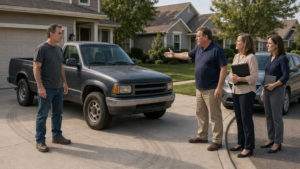
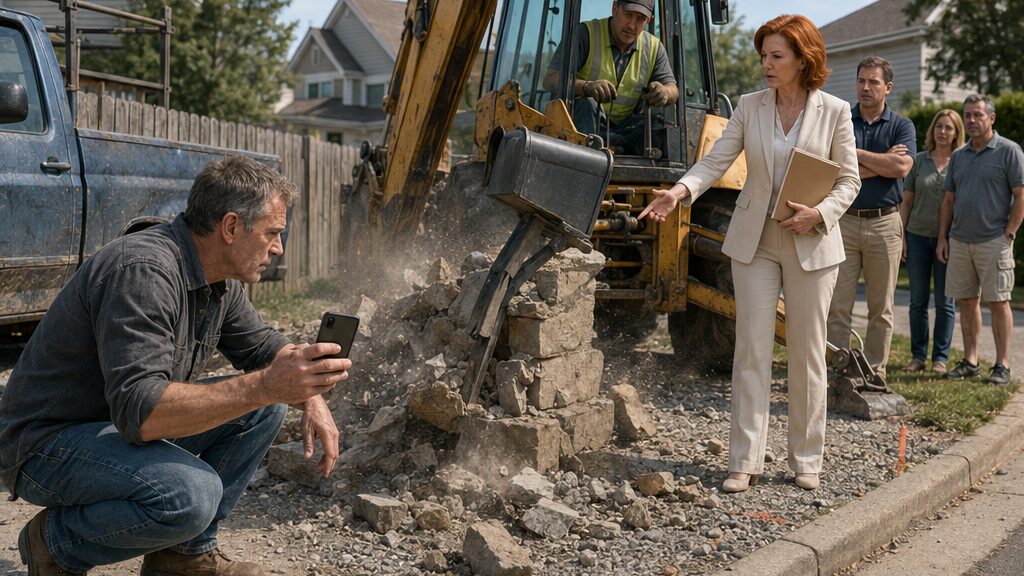
The backhoe bucket struck the mailbox base before Mark Davis reached the end of his driveway.
Stone cracked with a sound like a dropped cinder block. The black metal box pitched sideways, its red flag shivering as broken mortar spilled across the gravel. The yellow bucket lifted again, carrying half of the low stone surround that Mark and his father had built fifteen years earlier.
“Stop.”
His voice vanished beneath the engine.
Mark stepped off the concrete and raised one hand toward the operator. The man inside the cab looked down but did not move the controls. Beside the machine stood Stephanie Taylor in a cream jacket and white slacks, one hand pressed against a folder at her hip.
“Tear the rest out,” she called.
The bucket began to descend.
Mark moved no closer. Heavy equipment had killed a man at the maintenance plant where he worked, and he had spent twenty-seven years teaching younger employees never to challenge a moving machine with their bodies. He took out his phone instead.
“Property line dispute,” he shouted toward the cab. “You’ve been notified.”
The operator stopped the bucket six inches above the rubble.
Stephanie turned sharply. “There is no dispute. The board voted.”
“That doesn’t establish ownership.”
“It establishes enforcement.”
Three neighbors had gathered near the curb. Ryan Hall stood at the edge of his lawn with his arms folded. Another man held a coffee cup. A woman watched from behind a trimmed hedge as though the branches gave her privacy.
Mark photographed the machine, the damaged mailbox and the deep tread marks pressed into the gravel. His old blue work truck sat behind the fence, its hood faded almost gray in places. A violation notice had been tucked beneath its windshield wiper the previous week. He had thrown the notice on his workbench without answering it.
Stephanie followed his glance.
“This could have been avoided,” she said. “We gave you multiple opportunities to remove that truck and stop using common property as private parking.”
“This strip is on my deed.”
“That strip has been maintained by the association for years.”
“So have the trees along the road. You don’t own everybody’s front yard.”
Her jaw tightened. “Your fence is the boundary, Mark.”
He looked at the cedar fence running beside the gravel area. Its boards had weathered silver. His father had installed it when the development was still new, placing it farther from the road than most of the other fences. Mark had never asked why. At the time, he had been busy working double shifts and helping his parents move into the house.
Stephanie pointed toward the truck.
“Residents have complained for months. It lowers the appearance of the entire street. The board cannot keep allowing one owner to ignore the rules.”
Ryan shifted his weight but did not look away.
Mark felt the old urge to say nothing. People who had already decided what kind of man he was rarely listened to explanations. The truck ran. Its brakes needed work, and one fender was still off because Mark had promised his father he would restore it properly, not cover the rust and sell it to someone who wanted decoration.
None of that was Stephanie’s business.
But his silence had given her a simpler story.
She opened the folder. “The association has filed for an expedited order. You’ll receive the documents today.”
“You filed before verifying the boundary?”
“We verified the association’s maintenance history.”
“That wasn’t my question.”
“We are not conducting a deposition at the curb.”
The operator leaned out of the cab. “Ma’am, I need to know whether I’m clear to proceed.”
“You are,” Stephanie said.
Mark lowered his phone toward the gravel. Something bright showed beneath the backhoe’s left tread—an orange sliver, scratched and dirty, no wider than his thumb.
He stepped sideways and crouched.
It was the top of a survey stake.
The wooden marker had been pushed almost flat, but orange paint remained on one edge. The backhoe track crossed directly over it.
Mark took three photographs from different angles. Then he brushed loose gravel away with his fingertips, exposing more of the stake without moving it.
“What are you doing?” Stephanie asked.
“Documenting the monument your contractor crossed.”
“That could be anything.”
“It’s painted survey orange.”
“People put markers in yards all the time.”
“This one has been here longer than your board.”
The operator climbed halfway down from the cab. He stayed on the step, looking at the stake and then at Mark.
“You said this was association property,” he told Stephanie.
“It is.”
“You got a survey?”
“We have the plat and board authorization.”
“Do you have a field mark showing the line?”
Stephanie’s face changed only slightly, but Mark saw it. Her confidence had not disappeared. It had narrowed.
“The fence is visible,” she said.
The operator looked toward the fence, then down at the orange stake outside it.
“I’m not moving until somebody clears that up.”
Stephanie shut the folder. “Fine. We’ll suspend for today.”
“You already broke the mailbox.”
“The association will address restoration after the hearing.”
“The mail carrier comes this afternoon.”
“You can arrange temporary delivery.”
Mark stood. “You ordered demolition without confirming who owned the ground.”
“I ordered removal of an unauthorized improvement from common property. If you disagree, bring your evidence Thursday.”
The word Thursday landed harder than her raised voice had.
She removed a white envelope from the folder and held it toward him. He did not take it until she placed it on the hood of the blue truck.
The top page carried the county court seal. Beneath it, in formal black type, the association requested an order barring Mark from parking on, altering or obstructing the disputed strip. The filing described the land as an HOA-maintained common access area.
The hearing was scheduled for Thursday at nine.
“You’ll need a lawyer,” Stephanie said.
Mark folded the pages once and put them in his back pocket.
“No,” he said. “I’ll need my records.”
She gave a short breath that was not quite a laugh. “That attitude is why we’re here.”
When the backhoe finally reversed, its tires pressed more rubble into the gravel. Stephanie walked beside it toward the corner, talking on her phone. The neighbors drifted away without speaking to Mark.
Ryan remained longest.
“I didn’t know they were bringing equipment,” he said.
Mark looked at the broken mailbox.
“But you complained.”
“The truck has been sitting there a long time.”
“It’s behind my fence.”
“It’s visible from the road.”
Mark waited.
Ryan rubbed one hand over the back of his neck. “People were asking why the rules didn’t apply to you.”
“And you took a picture.”
Ryan’s eyes moved toward the orange stake. “I took a picture of the whole area.”
“From where?”
“My porch.”
“That show the property line?”
“I thought the fence was the line.”
“So did Stephanie.”
Ryan left without answering.
Mark spent the next hour photographing every piece of disturbed ground. He placed a ruler beside the exposed stake but did not pull it upright. He photographed the mailbox from the road, the driveway and the fence. Then he walked the fence line slowly, looking for another trace of orange.
Near the rear corner, weeds had grown around a shallow depression outside the fence. He knelt and cleared the dead stems.
A second orange stake stood there, faded but upright.
Mark stared from the stake to the fence.
The gap between them was nearly two feet.
Chapter 2: The Fence Was Never the Boundary
The tape measure clicked against the second stake at twenty-three and three-quarter inches.
Mark held the metal blade level and looked at where it touched the cedar fence. Nearly two feet of ground lay outside the boards—ground Stephanie had called common property, ground the association had entered with a backhoe.
He measured again.
The number did not change.
By noon, he had found three orange markers along the same line. One stood beside the broken mailbox. Another was half buried beneath gravel. The third remained upright near the rear corner. Each sat roughly the same distance beyond the fence.
Mark wrote the measurements in a spiral notebook, adding the date and time. At work, incomplete maintenance logs created arguments. Complete ones ended them.
Inside the garage, the smell of dust, oil and old cardboard closed around him. The blue truck took up most of the center bay. Its grille leaned against the wall beside labeled coffee cans of bolts. Mark moved past it to a steel filing cabinet.
House records filled the bottom drawer: tax assessments, insurance policies, appliance receipts and a thick envelope from the original purchase. He carried everything to the kitchen table.
The deed gave a legal description that meant little without the subdivision map. He found the plat folded inside a brittle paper sleeve. Lot lines, utility easements and road curves covered the page in precise black strokes.
His lot narrowed toward the street. The fence was not marked.
The deed referred to a boundary survey completed six years earlier, when Mark had refinanced the house. He remembered the surveyor placing orange flags and tapping wooden stakes into the soil. Mark had needed the report because the lender had questioned whether the gravel strip crossed into an easement.
The survey had resolved it.
He read the deed reference twice.
Survey number. Date. Company seal.
The certified copy should have been in the same cabinet.
It was not.
Mark checked the other drawers, then the desk in the spare room. He opened storage boxes in the hall closet and searched an old briefcase beneath the bed. The more orderly his papers appeared, the more the missing folder bothered him. He did not lose property documents.
At three, the mail carrier stopped at the broken post and sounded the horn.
Mark went outside.
“I can’t leave mail in that,” the carrier said through the open window.
“I know.”
“You can pick it up at the station until it’s repaired. Bring identification.”
Mark looked at the bent box resting among the stones. “Did anyone contact you before they tore it out?”
“Not me.”
The carrier glanced toward Stephanie’s house, then lowered his voice.
“That box was serviceable this morning.”
Mark photographed the truck before it left.
Back inside, he spread the subdivision plat beneath a lamp and placed a sheet of tracing paper over it. Using the dimensions printed along the lot edges, he followed the line from the rear pin toward the road. The line passed outside the fence, through the gravel strip and just beyond the mailbox base.
He took the tracing outdoors and aligned it as closely as he could with the visible corners of the lot. It was not a professional field survey, but the relationship was clear. The fence had never defined the boundary.
He remembered his father setting the first posts.
Mark had been thirty-two and impatient to finish. His father had stood with a string line in one hand and waved Mark away from the roadside corner.
“Bring it in,” he had said.
“How far?”
“Couple feet.”
“Why?”
“So it sits right.”
Mark had assumed his father wanted distance from the utility easement. He had not asked again.
That memory now felt less like an answer than another missing document.
Near dusk, Mark went outside with the tape measure and a can of temporary marking chalk. He did not draw a legal line. He marked only the measured distances from each orange stake to the fence, then photographed them.
Ryan watched from his driveway.
“You planning to move the truck?” he called.
“No.”
“The hearing’s in two days.”
“I’m aware.”
Ryan came closer but stopped before the gravel. “Stephanie says they’ll rebuild the mailbox if you cooperate.”
“Cooperate how?”
“Remove the truck. Sign something saying the strip stays open.”
“Did she show you the something?”
“No.”
Mark reeled in the tape measure. “Then you don’t know what she’s asking me to sign.”
Ryan looked at the marked distances. “That stake really two feet out?”
“Twenty-three and three-quarter inches here.”
“Could be old.”
“Old doesn’t mean false.”
“Could have been moved.”
“It could have. That’s why people verify before bringing machinery.”
Ryan’s mouth tightened. “You always make it sound like everybody else is stupid.”
Mark felt the answer rise. He could have told Ryan that he had spent his life repairing machines after people guessed instead of measuring. He could have explained that certainty without proof was expensive. Instead, he bent to collect the chalk.
Ryan gave a tired shake of his head. “That’s what I mean.”
After Ryan left, Mark stood alone beside the fence. Saying nothing had once felt like refusing to perform for other people. Lately, it had begun to resemble letting them write his part.
At the kitchen table, he searched his email for the survey company’s name. The company had closed four years earlier. A county database entry showed that some of its records had been transferred, but not all scanned copies were available online.
He printed the record index and circled the survey number.
Then he searched the cabinet again.
This time he emptied every folder onto the floor. His father’s estate papers were there. A warranty for the fence posts. A handwritten diagram showing drainage tile. A field sketch with three small orange marks along the road-facing side of the property.
The orange marks matched the stakes.
Across the top, in his father’s block handwriting, were four words:
FENCE INSIDE PROPERTY LINE.
Mark sat back on his heels.
The sketch confirmed the setback had been deliberate. It did not explain why.
He checked the truck’s glove compartment, the locked toolbox in the bed and the manual drawer under the workbench. No certified survey.
At nine seventeen, his computer chimed.
An email from Stephanie Taylor had arrived with the subject line: PROPOSED RESOLUTION BEFORE HEARING.
Mark opened the attachment.
The association offered to replace the mailbox and waive its enforcement costs if he removed the blue truck within ten days. In exchange, he would acknowledge the gravel strip as an “HOA-maintained common access area” and agree not to obstruct, improve or claim exclusive use of it.
The final paragraph required the agreement to bind future owners of his lot.
Mark read it twice.
They were offering to repair what they had broken if he signed away the land beneath it.
Chapter 3: The Compromise That Took His Land
The proposed agreement called the disputed strip “HOA-maintained common area” seven times.
It did not use the word ownership once.
Mark marked each occurrence with a yellow highlighter before driving to the clubhouse Tuesday morning. He carried the agreement, the deed, the subdivision plat and photographs of the orange stakes in a plain accordion folder.
Stephanie was already seated at the end of the conference table. Lisa Campbell sat beside her with a laptop open. Two board members occupied the opposite side. Ryan stood near the coffee station, apparently invited as the complaining resident.
Stephanie gestured to the empty chair across from her.
“This is an informal settlement discussion,” she said. “Nothing said here alters Thursday’s filing unless we execute an agreement.”
Mark remained standing long enough to place the plat flat on the table.
“Where is your survey?”
Stephanie folded her hands. “We’re not going to repeat the curbside argument.”
“It’s the only argument that matters.”
“The issue is longstanding association maintenance and your obstruction of access.”
“My truck is behind the fence.”
“The gravel apron extends beyond it.”
“So does my deeded lot.”
One board member leaned toward the plat. Stephanie rested two fingers on its edge before he could pull it closer.
“This map does not establish current field conditions,” she said.
“No. A survey would.”
Lisa looked down at her laptop.
Mark placed a photograph beside the plat. It showed the backhoe tread crossing the flattened orange stake.
“Your contractor drove over a monument after I told you the boundary was disputed.”
Stephanie’s voice stayed even. “A piece of painted wood is not conclusive.”
“Neither is a fence.”
Ryan cleared his throat. “The fence is what everybody has always treated as the edge.”
Mark looked at him. “Show me the orange stakes in your picture.”
Ryan’s face tightened.
Lisa opened a digital file and turned the laptop toward Mark. The photograph had been taken from Ryan’s porch. It showed the blue truck, fence, mailbox and gravel area beneath flat afternoon light. The truck dominated the frame. The nearest stake was hidden by the mailbox base; the second disappeared into shadow along the fence.
There was no visible line except the fence.
“It looked like you were parking on the common shoulder,” Ryan said.
“You photographed a truck.”
“I photographed the whole problem.”
“You photographed what you believed.”
Stephanie intervened. “The distinction doesn’t change the maintenance history.”
Mark opened the proposed agreement. “This does. You want me to sign something that follows the property after I’m gone.”
“It preserves access.”
“It creates your claim.”
“It documents what has been the practical arrangement for years.”
Mark turned to Lisa. “Was a professional survey presented before the board voted?”
Lisa’s hands stopped above the keyboard.
Stephanie answered first. “The board reviewed available evidence.”
“That wasn’t my question.”
Lisa glanced at Stephanie, then at the two other members.
“No professional field survey was presented,” she said.
The room went still.
Stephanie’s eyes hardened. “Because no survey was necessary to enforce the maintenance and parking provisions.”
“You sent a backhoe onto land you didn’t survey,” Mark said.
“We acted based on the best information available and years of uncontested use.”
Mark heard the phrase: uncontested use.
It landed differently than her other claims.
“What use?”
Lisa looked at her notes. “Landscaping crews have spread gravel and controlled weeds there. Utility workers have accessed the roadside box from that direction. Residents have used the apron to turn around when vehicles block the cul-de-sac.”
“With whose permission?”
“The board understood it to be common.”
“That’s not what I asked.”
Lisa hesitated. “There are emails from prior years indicating you allowed crews onto the strip.”
Mark remembered opening the gate for the landscaping foreman. He remembered telling utility workers they could pull onto the gravel instead of blocking the street. He had never written conditions because none had seemed necessary.
Permission had been easier than argument.
Stephanie leaned back. “You see the problem.”
“I see people confusing permission with title.”
“I see a homeowner who allowed association maintenance for years, ignored violation letters and only claimed a precise boundary when enforcement affected his truck.”
Mark closed the agreement.
For a moment, the story sounded plausible even to him.
He had ignored the letters. He had allowed the gravel to blend with the roadside shoulder. When Ryan asked whether the truck would ever move, Mark had said, “When I’m finished,” and left him standing there. He had treated every question as an intrusion.
That did not transfer ownership. But it had helped create certainty where there should have been questions.
“I’m not signing this,” he said.
Stephanie gathered her copy. “Then the offer expires.”
“I’ll respond in court.”
“You should understand that litigation may cost more than the mailbox.”
“So might authorizing demolition without verifying the line.”
Stephanie stood. “Thursday, then.”
Lisa remained seated as Mark collected his papers. When he reached the door, she spoke.
“The county records office may have the survey index even if the image isn’t online.”
Stephanie turned toward her. “Lisa.”
“He is entitled to public records.”
Mark looked back. Lisa’s expression held no apology.
“You voted for this?” he asked.
“Yes.”
“Why?”
“Because the area had been treated as common for years, and because the board was being accused of refusing to enforce anything.” She closed the laptop. “Recording concerns is not the same as resolving them.”
“No,” Mark said. “It isn’t.”
At the county office, a clerk directed him to a public terminal. He entered the survey number from his deed and found the archived index entry. The original company’s file image was unavailable, but the record included a book and page reference tied to the subdivision plat.
The clerk printed a certified copy of the plat and stamped the lower corner.
“Field conditions would require a licensed surveyor,” she said. “This only shows what was recorded.”
“It’s more than the HOA brought.”
“That’s not a standard we use here.”
Mark almost smiled.
He paid the fee and carried the copy to a counter beneath fluorescent lights. The recorded dimensions placed the boundary beyond the fence exactly as his tracing had suggested.
The first piece of official evidence was now in his hands.
It did not yet prove the current stakes had remained undisturbed. It did not explain his father’s setback. It did not erase years of informal access.
But it established that Stephanie’s fence-line assumption was not supported by the recorded plat.
As Mark walked toward the exit, his phone vibrated.
An email from Lisa had arrived from the HOA records account. The subject line read: APPROVED MINUTES—SPECIAL ENFORCEMENT SESSION.
The attached minutes documented the board’s discussion from the previous Thursday. Ryan’s photograph had been reviewed. Residents had complained about inconsistent enforcement. Stephanie had argued that visible action was necessary before the next annual meeting.
Then Mark reached a sentence in the motion summary.
President Taylor noted that ownership of the gravel strip remained unconfirmed but recommended immediate removal of the unauthorized mailbox surround and parking improvements pending later verification.
Mark stopped beside the glass doors.
Stephanie had not merely failed to ask whether the land was theirs.
She had put the uncertainty into the record—and ordered the backhoe anyway.
Chapter 4: The Vote Recorded What No One Said
The sentence in the minutes had been approved without correction.
President Taylor noted that ownership of the gravel strip remained unconfirmed but recommended immediate removal of the unauthorized mailbox surround and parking improvements pending later verification.
Mark read it a third time at his kitchen table, then opened the photographs from Monday morning. In one image, Stephanie stood beside the backhoe with the white folder tucked against her hip. In another, the machine’s tread pressed the first orange stake into the gravel.
She had known there was a question.
She had simply decided the answer could wait until after the damage.
An email arrived from the HOA attorney before midnight. The subject line identified the Thursday hearing by case number. The message argued that Mark’s “longstanding acquiescence to association maintenance and community access” supported the board’s position, regardless of the recorded lot dimensions.
Mark printed it and laid it beside the minutes.
Acquiescence.
It was a polished word for all the times he had stepped aside.
He found old landscaping invoices in the HOA records portal. Most listed common-area mowing and roadside weed control without individual parcel numbers. Two invoices mentioned gravel replenishment near the cul-de-sac mailboxes. A third described vegetation treatment “along Davis fence line.”
None said the HOA owned the ground.
But Mark remembered the crews.
One summer, he had opened the side gate so they could drag a hose across the strip. Another year, he had told a foreman to spread leftover gravel where rain had cut a rut near the mailbox. When a utility crew asked whether they could park there for an afternoon, Mark had waved them in.
He had thought permission was obvious because the land was his to permit.
Apparently, nobody else had heard the same sentence.
At seven Wednesday morning, he drove to the county offices with the certified plat, his deed, the photographs and the survey index number. The public counter had just opened. A woman wearing a county badge called him forward.
“Carol Harris,” she said. “What are you trying to establish?”
Mark placed the plat beneath the glass divider. “Whether these stakes correspond to the recorded survey.”
Carol studied his photographs without touching them.
“I can explain records,” she said. “I can’t certify field conditions from pictures.”
“I understand.”
“Do you?”
Her tone was not unkind. It was practiced.
Mark nodded. “The judge will need more than a faded stake.”
“The judge may need a licensed surveyor. Depends on what’s disputed.”
“The HOA says the fence is the boundary.”
Carol looked at the plat again. “The fence isn’t shown here.”
“That’s what I told them.”
“This plat tells you the recorded geometry of the lot. It doesn’t tell me whether somebody moved a monument, whether later work disturbed it, or whether your tape measurements are correct.”
She entered the survey reference number into her computer. A scanned index page appeared. Carol enlarged a column of notes.
“The surveyor referenced three wooden witness stakes set beside existing iron pins,” she said. “Orange paint. Road-facing line.”
Mark slid his phone beneath the opening in the glass and showed her the three markers.
“The positions appear consistent with the record description,” she said. “That is not a certification.”
“I know.”
“You keep saying that.”
“Because I need to hear what you can say, not what I want you to say.”
Carol looked at him for the first time rather than at the documents.
“That will help you Thursday.”
She printed the index page and circled the notation for the monuments. Then she gave him the names of two licensed surveyors who sometimes accepted urgent verification work.
The first could not come until the following week. The second offered to review the recorded documents that afternoon but would not promise a field report before court.
Mark thanked Carol and gathered the papers.
“One more thing,” she said. “People assume a maintained edge is an ownership line. Fences, hedges, gravel, mowing patterns. They’re visible. Legal descriptions aren’t.”
“That doesn’t make the visible thing true.”
“No. But it explains why people believe it.”
Outside, Mark sat in the truck he used for work and stared through the windshield at the courthouse across the parking lot.
That was the part he did not want to carry into the hearing.
Stephanie had acted recklessly. The record said so. But the belief that the strip was common had not appeared from nothing. It had grown through years of open access, association maintenance and Mark’s refusal to correct anyone because correcting them had seemed petty.
By noon, the surveyor had reviewed the plat, deed and index page. His written preliminary opinion stated that the visible orange markers were consistent with the recorded survey monuments, though a complete field verification would require an on-site visit.
It was useful.
It was not final.
Mark returned home and spread the papers across the hood of the blue truck. The garage door stood open. Sunlight caught the bare metal where he had removed the rust from one fender. He searched the cab again, moving slowly this time.
The glove compartment contained registration papers, a flashlight and a cracked plastic case holding the original owner’s manual. Mark lifted it and heard paper slide beneath the booklet.
A folded envelope had been flattened against the bottom.
The survey company’s name was printed in the corner.
Inside was the certified survey he had paid for six years earlier, complete with the embossed seal, measurements and field notes. A hand-drawn line marked the fence nearly two feet inside the property boundary.
Mark gripped the edge of the truck’s seat.
His father had kept maintenance records in the manual case. Oil changes, tire rotations, part numbers, dates. After his death, Mark had stored the truck papers together without checking every page.
The certified survey had been within reach the entire time.
Tucked behind it was an older sheet with a building department stamp. At first, Mark thought it was another survey page. Then he saw the heading.
FENCE SETBACK REQUEST.
The applicant’s signature was his father’s.
The sketch showed the fence deliberately moved inward from the recorded property line. The approval date was eighteen years earlier, shortly before construction began.
Mark read the signature twice.
His father had not guessed at the boundary.
He had known exactly where it was and chosen not to build on it.
Chapter 5: What His Father Left Outside the Fence
A note in the truck manual explained the missing two feet in seven words.
Room for people, not ownership. Keep open.
Mark found it written beside the fence measurements in his father’s square block lettering. Below it was a list: mailbox access, utility crew, turnaround, snow.
He sat behind the blue truck’s steering wheel with the manual open across his knees.
The cab still held the faint smell of old vinyl and machine oil. His father had driven the truck through three decades of small emergencies—broken water heaters, dead batteries, fallen branches, flooded basements. He rarely announced that he was helping. He arrived with tools, solved the immediate problem and went home.
Mark had inherited more than the truck.
He had inherited the same belief that useful actions should not require explanation.
Outside, the broken mailbox leaned against a temporary wooden post Mark had installed before sunrise. He carried the survey, setback request and manual note to the gravel strip.
The orange stakes were dusty from the backhoe. Mark filled a bucket with water and cleaned each one with a rag, exposing the faded paint. He did not straighten the flattened marker. Its position and condition belonged in the evidence.
Ryan appeared on his porch.
“You expecting somebody?” he asked.
“A surveyor this afternoon.”
Ryan walked down the steps. When he reached the road, he stopped short of the gravel.
Mark noticed the hesitation.
“You can stand there,” he said.
Ryan crossed onto the strip. “I wasn’t sure.”
“That’s new.”
Ryan accepted the remark without protest. He looked toward the blue truck in the open garage.
“My wife remembers that truck.”
Mark folded the wet rag over the bucket handle.
“She said your dad pulled her car out of the drainage ditch before we were married. Snowstorm. Tow company wouldn’t come.”
“He did that for a lot of people.”
“I didn’t know it was his.”
“You never asked.”
Ryan’s face tightened. “You never said.”
Mark almost answered that it was not Ryan’s business. The words reached his mouth and stopped there.
“No,” he said. “I didn’t.”
Ryan nudged a loose piece of stone with his shoe. “When we moved in, the gravel was already here. Landscaping crews treated it like the rest of the roadside. People turned around on it. Your dad never objected.”
“He wanted them to use it.”
“Then why is Stephanie wrong?”
“Because use isn’t ownership.”
“Looks the same after enough years.”
“That’s why records exist.”
Ryan glanced at the orange stakes. “And if the board had asked?”
“I’d have shown them.”
“Would you?”
Mark looked at him.
Ryan continued before Mark could answer. “You ignored every notice. You wouldn’t come to the meeting. When I asked about the truck, you walked away.”
“The notices were about paint and parking.”
“They were also invitations to respond.”
“They had already decided what the truck meant.”
“Maybe. But you made it easy.”
The remark struck more cleanly because it was true.
Mark rested one hand on the temporary mailbox post. “My father left the fence inside the line so people could reach the boxes and turn around without asking every time.”
Ryan looked from the fence to the road. “That sounds like common access.”
“Voluntary access.”
“To you.”
“To the owner.”
“And the next owner?”
“That’s a fair question.”
Ryan seemed surprised by the answer.
Mark showed him the note in the manual. Ryan read it, then looked toward the truck again.
“You keeping it because it was his?”
“I told him I’d restore it.”
“How long ago?”
“Four years.”
Ryan let out a slow breath. “The hood’s been off twice.”
“Three times.”
“You planning to finish?”
“Yes.”
“That’s what you always say.”
Mark closed the manual. “I know.”
The surveyor arrived at two in an unmarked pickup. He located the recorded iron pins beneath the soil, checked the witness stakes and measured the road-facing boundary. His equipment confirmed the line outside the fence and through the gravel strip.
He would provide a signed field report later that evening.
It was the clearest proof Mark had received.
It did not erase Ryan’s question.
While the surveyor worked, Stephanie drove past without stopping. Her eyes moved from the tripod to Mark and then back to the road.
At four, Ryan returned with a folded copy of his complaint.
“I’m not withdrawing it,” he said.
Mark felt his shoulders harden. “After all this?”
“The ownership claim is different from the vehicle violation.”
“The truck is behind my fence.”
“It’s still visible. The covenant doesn’t require it to be outside the property.”
Mark stared at him.
Ryan held the complaint at his side. “I was wrong about the land. That doesn’t mean every rule is wrong.”
“You think the backhoe was enforcement?”
“No. I think it was reckless.”
“But you’ll keep the complaint alive.”
“Yes.”
Mark could have dismissed him then. The old response stood ready: a closed face, a turned shoulder, silence sharp enough to end the exchange.
Instead, he asked, “Why does the truck bother you that much?”
Ryan looked toward his own house.
“Because we spent everything getting here. The last neighborhood went downhill one exception at a time. Dead car in one yard. Construction debris in another. Nobody wanted to be the difficult neighbor, so nobody said anything until buyers stopped coming.”
“This truck runs.”
“I didn’t know that.”
“You didn’t ask.”
Ryan gave him a tired look. “Neither of us asks much.”
He placed the complaint copy on the temporary mailbox post and walked home.
The surveyor’s signed report arrived by email at six eleven. It confirmed the boundary and the monuments. Mark added it to the court folder.
At six forty-three, another message appeared.
This one came from Stephanie.
Due to continued unauthorized use of disputed common access property, the association would seek an emergency order Thursday barring Mark from entering, parking upon or altering the gravel strip until the ownership claim was resolved.
Mark read the sentence beneath the open garage light.
If the judge granted the request, he could be ordered off his own land before the full case was heard.
On the workbench, his father’s note lay beside the certified survey.
Room for people, not ownership.
For the first time, Mark understood that defending the second half might require him to explain the first.
Chapter 6: The Hearing Was About More Than Dirt
The HOA attorney used Mark’s silence as evidence before Mark had spoken a single word.
“For years,” the attorney told the judge, “Mr. Davis allowed the association to maintain this area, permitted residents to use it, accepted the fence as the visible boundary and raised no ownership objection until enforcement affected his vehicle.”
Mark sat at the opposite table with his folder closed beneath one hand.
Stephanie sat beside the attorney in a navy suit. Lisa occupied the row behind them. Ryan had taken a seat near the aisle. No one looked comfortable, but only Mark had arrived without counsel.
The judge turned toward him. “Mr. Davis, are you representing yourself?”
“Yes, Your Honor.”
“You understand the association is requesting temporary restrictions today, not a final trial on every possible property claim?”
“Yes.”
“And you have evidence concerning the boundary?”
“I do.”
The attorney placed Ryan’s photograph on an easel. From across the courtroom, the fence appeared to divide private yard from common roadside space. The blue truck dominated the image.
“The association relied on this visible configuration,” the attorney said, “together with years of maintenance records and unrestricted community use.”
The judge examined the photograph. “Where is the surveyed line?”
“It is not visible in the image.”
“Was one obtained before excavation?”
The attorney paused. “The association believed a professional survey was unnecessary for removal of unauthorized improvements from land it had historically maintained.”
“That was not my question.”
Stephanie looked down at the folder in front of her.
“No,” the attorney said. “A field survey was not obtained beforehand.”
Mark presented the certified plat, the older certified survey and the report completed Wednesday. The judge compared the dimensions, then studied the photographs of the three orange stakes.
One enlarged image showed the flattened marker beneath the backhoe tread.
“When was this taken?” the judge asked.
“Monday morning, while the equipment was still on the property.”
“Did you alter the stake?”
“No. I brushed loose gravel away and photographed it where it was.”
The attorney rose. “We do not dispute that markers were present. We dispute whether private ownership remained exclusive after prolonged association maintenance and public use.”
The judge looked at Mark. “How was the strip used?”
“Neighbors turned around there. Utility crews parked there. Landscaping crews spread gravel and treated weeds.”
“Did you object?”
“No.”
“Did you give permission?”
“Sometimes directly. Other times I saw it happening and let it continue.”
“Why?”
Mark felt the room narrow.
He could answer with the survey. He could say permission did not transfer title and leave the rest buried where he preferred it.
The attorney had built the HOA’s case around that burial.
“My father set the fence inside the property line,” Mark said. “He wanted enough room for people to reach the mailboxes, access the utility equipment and turn around without damaging lawns.”
The judge glanced at the setback request. “Your father owned the property then?”
“Yes.”
“And you continued that arrangement?”
“Yes.”
“Did you tell the association the strip remained private?”
“No.”
The attorney leaned forward. “So the association’s understanding was reasonable.”
Mark looked at Stephanie.
“The misunderstanding may have been reasonable,” he said. “Sending a backhoe after recording that ownership was unconfirmed was not.”
A small movement passed through the benches behind him.
The judge raised one hand before anyone spoke. “Continue, Mr. Davis.”
“I ignored notices about the truck. I did not attend the board meeting. I assumed the deed was enough and that I shouldn’t have to explain why I used my own property.”
“Was that assumption wise?”
“No.”
Stephanie looked up.
Mark opened the truck manual and placed his father’s note beside the survey.
“I treated questions as accusations. That helped turn permission into an assumption. But I never gave the land away. My father didn’t either.”
The judge read the note without comment.
The HOA attorney stood again. “Your Honor, we have a signed maintenance authorization from the prior owner.”
Stephanie removed a document from her folder. The attorney approached the bench and handed it to the clerk.
Mark had not seen it in the records Lisa provided.
The document bore his father’s signature and authorized the association to maintain gravel, vegetation and mailbox access along the roadside strip. It was dated seventeen years earlier.
The attorney returned to the table.
“This formalizes the common arrangement,” he said. “It demonstrates that association control was not merely casual.”
Mark read the copy provided to him. The first paragraph granted maintenance access. The second permitted reasonable use by residents and service vehicles. The final line disappeared beneath a dark photocopy shadow near the bottom edge.
“What’s below this?” Mark asked.
“That is the copy in the association file,” the attorney said.
“The page is cut off.”
“The relevant authorization is visible.”
“The signature is above the missing section?”
“Yes.”
The judge examined the document. “Do you have the original?”
Stephanie whispered to the attorney.
“No, Your Honor. This copy was retained in archived association records.”
Mark looked at the building department stamp on his father’s setback request. Same month. Same project.
He opened the envelope from the truck manual case. Behind the certified survey was a carbon copy he had assumed was part of the fence paperwork.
The heading matched the HOA document.
He unfolded it and found the missing bottom section.
Mark handed it to the clerk.
The judge aligned the two copies. On Mark’s page, the final paragraph was clear:
Maintenance and access permission shall not convey title, create a permanent easement, or limit the owner’s right to revoke or modify such permission.
The judge looked toward the HOA table. “Counsel?”
The attorney read the paragraph, then spoke quietly to Stephanie. Her lips pressed into a straight line.
“This changes the characterization of the authorization,” he said.
“It seems to define it,” the judge replied.
The HOA’s ownership argument weakened, but the judge did not immediately rule. She questioned Stephanie about the vote, the equipment and the urgency.
Stephanie answered carefully at first. Complaints had accumulated. Residents were frustrated. Previous boards had postponed enforcement until violations became harder to correct. The annual meeting was approaching, and members had accused the current board of repeating the same pattern.
“Did you believe visible action was necessary to maintain confidence in the board?” the judge asked.
“Yes.”
“Even before ownership was verified?”
Stephanie’s eyes moved briefly toward Lisa.
“I believed the maintenance history and physical boundary were sufficient.”
“The minutes say ownership remained unconfirmed.”
“They do.”
“Then why not delay excavation?”
Stephanie took a breath. “Because every delay was being interpreted as weakness. I believed we could correct the physical issue and resolve technical objections afterward.”
There it was—not a legal theory, but the truth beneath it.
She had used Mark’s mailbox to demonstrate control.
The judge turned to Mark. “Did you hear the equipment arrive before work began?”
“No. The mailbox base was already being struck when I came outside.”
“Were you given an opportunity to object that morning?”
“I objected while the machine was operating.”
“And after you identified a boundary dispute?”
“The operator paused. Ms. Taylor instructed him to continue. He refused until the boundary was clarified.”
The operator’s written statement confirmed the exchange. The judge read it, then closed the file.
“The association has not established a likelihood that it owns this strip,” she said. “The recorded documents and current field report favor Mr. Davis. Historical use was permissive, and the maintenance authorization expressly retained private title.”
Stephanie sat completely still.
“The request to bar Mr. Davis from entering or using the strip is denied. The association is also restrained from further excavation or alteration pending final disposition.”
Mark released a breath through his nose.
It was not over.
The judge continued. “The vehicle covenant remains a separate enforcement issue and is not resolved today. Nor have I determined full damages for the mailbox and stonework.”
Ryan looked down at his hands.
The judge arranged the documents into a neat stack.
“Mr. Davis, the association’s claim has caused physical damage. You have also acknowledged that your conduct contributed to years of ambiguity. The law can determine title. It cannot design a workable relationship for this cul-de-sac unless the parties decide what they actually need.”
She looked directly at Mark.
“You may seek restoration, costs, damages and exclusive control. You may also propose a narrower remedy that preserves voluntary access while protecting ownership.”
The courtroom remained silent.
“What exactly do you want me to order, Mr. Davis?”
Chapter 7: The Boundary He Chose to Keep Open
“I want the mailbox restored,” Mark said. “I want the stonework rebuilt, the survey costs reimbursed and the association’s ownership claim withdrawn from every record where it appears.”
The judge waited.
Mark looked at his father’s note on the evidence table. Room for people, not ownership.
“I also want the right to keep the strip available for mailbox access, utility work and turning vehicles,” he continued, “but only by recorded permission that says the land remains private.”
The HOA attorney glanced at Stephanie.
“You are proposing an access license?” the judge asked.
“Yes, Your Honor. Revocable for misuse. Transferable only if a future owner agrees.”
“And you are not asking the court to prohibit all community use?”
“No.”
“Why not?”
Mark could feel Ryan watching him from the benches.
“Because the use was never the problem,” he said. “Assuming permission meant ownership was the problem.”
The judge leaned back slightly. “What about the vehicle dispute?”
“I’ll respond through the covenant process. Separately.”
Stephanie’s expression changed at that. She had expected him to use the boundary ruling as a weapon against every other complaint. Mark understood why. A week earlier, he might have tried.
The judge directed both sides to meet with the court clerk and reduce the proposed remedy to writing. Until then, the temporary order preventing further HOA work would remain in effect.
As Mark gathered his documents, Lisa stepped into the aisle.
“The full authorization should have been in our file,” she said.
“It was in mine.”
“That isn’t what I meant.”
Mark closed the accordion folder. “Did you know the copy was cut off?”
“No. I knew the ownership concern was unresolved.” She looked toward Stephanie. “I told myself putting it in the minutes was enough.”
“You still voted yes.”
“Yes.”
There was no defense in the word. Only fact.
The settlement conference lasted most of the afternoon. The association agreed to withdraw its claim of ownership, pay for a replacement mailbox and matching stone base, reimburse the emergency survey expense and cover the filing costs tied to its failed request.
The HOA attorney objected to language stating that the excavation had been unauthorized. Mark accepted “conducted without verified ownership” instead. It was not the strongest phrase available, but it would remain in the written order.
The access license took longer.
Stephanie wanted the HOA to control maintenance. Mark refused.
Mark wanted written notice before any nonemergency work. The attorney called that impractical.
They settled on forty-eight hours’ notice for routine maintenance, immediate access for utility emergencies and no right to alter stonework, fencing, drainage or parking surfaces without Mark’s written approval. The document expressly retained private title and barred the association from treating access as evidence of ownership.
When the clerk placed the final draft before them, Stephanie read every page.
“You are creating an administrative burden over two feet of gravel,” she said.
“You brought a backhoe over two feet of gravel.”
Her eyes lifted to his.
The room held still for a moment.
Then Stephanie signed.
The judge entered the order before the courthouse closed. She did not give either side a speech. She simply confirmed that title followed the recorded survey, the association’s temporary request was denied and the agreed corrective measures would become enforceable.
Outside, Ryan waited near the steps.
“You got what you wanted,” he said.
“Not all of it.”
Ryan looked surprised. “What didn’t you get?”
Mark adjusted the folder under his arm. “Monday morning back.”
Ryan nodded once.
They stood there without pretending the answer solved anything.
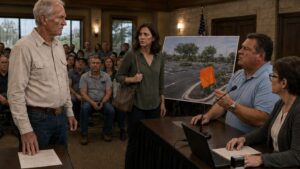
The following Tuesday, the HOA clubhouse filled beyond its usual attendance. Residents who had ignored years of budget meetings now occupied folding chairs along the walls. The backhoe photographs had circulated through private messages, though no one admitted who sent them first.
Stephanie called the meeting to order.
Her voice remained controlled as Lisa read the proposed policy amendment: no destructive enforcement, removal of improvements or alteration of disputed land could occur until the association obtained a professional boundary verification or written owner consent.
One board member objected to the expense.
“A survey could cost more than correcting the violation,” he said.
Lisa looked up from the page. “The correction in this case cost more because we skipped it.”
A murmur moved through the room.
Stephanie tapped her pen against the table. “We already have legal review procedures.”
“You had legal review after the excavation,” Ryan said from the second row.
Several faces turned toward him.
He continued, less comfortably, “I submitted the photograph. It looked clear to me. It wasn’t clear. A picture of a fence and a truck didn’t show ownership.”
Stephanie’s posture stiffened. “No single photograph controlled the decision.”
“The minutes say ownership wasn’t confirmed.”
Lisa closed the policy packet.
“I wrote that sentence,” she said. “I also voted to proceed.”
The room quieted.
“I believed documenting the risk protected the association,” she continued. “It did not protect Mr. Davis’s property. It did not protect the contractor. It did not protect us from liability. Recording an objection is not the same as acting on it.”
Mark sat near the back. He had not planned to speak. The proposed rule was already stronger than anything the board had used before.
Then a resident near the aisle turned around.
“Why didn’t you just tell them the strip was yours?” she asked him.
The question carried less accusation than he expected.
Mark stood.
“I thought the deed should speak for itself,” he said. “I also ignored meetings and notices because I assumed no one asking about the truck wanted an honest answer.”
He glanced through the clubhouse window. From there, the open garage at his house was barely visible beyond two roofs.
“My father placed the fence inside the line so people could reach the mailboxes and turn around. I kept allowing that. I never explained it. That helped create confusion, but it didn’t authorize what happened.”
“What about the truck?” another resident asked.
Mark could have answered with the covenant language. Instead, he said, “It was my father’s. I promised him I would restore it. I’ve taken too long.”
No one applauded.
A few people looked down. One neighbor whispered something to her husband. The absence of spectacle felt cleaner than approval.
The policy passed by a wide vote.
Stephanie did not vote.
Afterward, she placed a sealed envelope on the table before Lisa.
“My resignation,” she said.
Lisa stared at it. “You could stay and help implement the rule.”
“I will not remain as a symbol of one decision.”
“It was your decision.”
Stephanie’s face tightened, but she did not argue.
She approached Mark near the door.
“The mailbox contractor will begin Thursday,” she said.
“I received the schedule.”
“The replacement will match the original stone.”
“Good.”
She looked as if another sentence had brought her across the room, but whatever it was remained behind her teeth.
“I was trying to stop the neighborhood from sliding backward,” she said finally.
Mark nodded. “I believe you.”
“That doesn’t mean you agree.”
“No.”
She waited.
Mark did not rescue her from the silence. He also did not sharpen it.
Stephanie left without apologizing.
The new mailbox took two days to build. Ryan arrived on the second morning wearing work gloves and carrying a level.
“The contractor said he could use another set of hands,” he said.
“You work for him now?”
“No.”
“Then ask before you step onto the strip.”
Ryan looked down at his boots. One rested inches from the gravel.
“May I?”
Mark moved aside. “Yes.”
They rebuilt the low stone surround behind the surveyed line. The new box stood straight, its black finish unmarked. Mark asked the contractor to leave the orange stakes visible rather than covering them with fresh gravel.
“They’re not pretty,” the contractor said.
“They’re not decoration.”
A week later, the recorded access license arrived from the county. Mark placed a copy in the house file, another in the truck manual case and a third inside a weatherproof sleeve in the garage.
He began working on the blue truck every evening after dinner. The replacement fender fit poorly at first. Ryan helped him adjust it, though they argued twice about the alignment.
The vehicle complaint did not disappear. Mark submitted a restoration schedule to the board and agreed to keep the truck covered when he was not working on it. The compromise irritated him less than he expected. It treated the vehicle as a real issue rather than proof that he did not belong.
Three weeks after the hearing, Mark heard tires crunch lightly at the edge of the gravel.
Ryan’s car had stopped beside the strip, leaving room for the mail carrier. Ryan lowered his window.
“My brother’s bringing a trailer,” he said. “Can I park here for an hour?”
Mark looked at the orange stakes, the restored mailbox and the open space his father had chosen not to fence.
“Yes,” he said. “For an hour.”
Ryan parked carefully behind the line Mark indicated.
The orange stakes remained where they had always been—small, weathered and impossible to mistake once people had learned to look.
The story has ended.