The Woman Who Mocked the Blue Rock Hunt Ended Up Saving the Neighborhood
Chapter 1: The Note Taped to Catherine’s Mailbox
The note was taped crookedly across Catherine Miller’s mailbox door, blocking the brass handle as if whoever had placed it there wanted to make certain she could not collect her mail without touching it.
FIND THE HIDDEN BLUE ROCK. WIN A SURPRISE.
Beneath the words was a lopsided drawing of an oval stone painted blue.
Catherine stood at the curb with one hand on the mailbox post and read the message twice. The second reading did not improve it.
Across the street, a child in red sneakers ran from one hedge to another while his older sister called, “It could be anywhere!”
Their mother, Jennifer Adams, followed at a slower pace, laughing as she checked beneath a cluster of ornamental grasses. Two houses down, Andrew Clark had already put on a fluorescent safety vest, though the sun was barely above the roofs and there was no traffic except a delivery van turning at the entrance.
“Morning, Catherine,” Andrew called. “You joining us?”
Catherine peeled the tape from the mailbox. It left a tacky strip across the black paint.
“No.”
“You don’t even know the prize.”
“That improves my odds of surviving the disappointment.”
Andrew grinned as though she had made a joke with him rather than at the whole event. He held a clipboard against his chest. Someone had written SEARCH ZONES across the top in thick marker, but Catherine could not see any actual zones listed beneath it.
Patrick Hill emerged from the common green carrying a cardboard box of bright vests. As HOA president, he had developed a habit of arriving with objects that made informal decisions look official.
“Everybody gets one clue at noon,” he announced. “Until then, use your instincts.”
“Whose instincts?” Catherine asked.
Patrick slowed. His smile remained, but it became managerial. “Good morning to you too.”
“Where are people allowed to search?”
“Common areas. Visible spaces. Nothing intrusive.”
“That isn’t a rule. That’s a collection of adjectives.”
A few residents glanced over. Patrick lowered the box.
“It’s a neighborhood activity, Catherine.”
“Then issue neighborhood instructions.”
“We’re trying to have some fun.”
Catherine looked past him toward the nearest landscaped island. A man was kneeling in the mulch with both hands under a dwarf holly. A child was poking a stick through the liriope. Neither plant belonged to an individual homeowner, but Catherine had spent enough volunteer hours repairing careless enthusiasm to know what came next.
Patrick shifted the box to his other arm. “The board approved it.”
“Did the board approve people searching private lots?”
“No one has told them to do that.”
“That wasn’t my question.”
Jennifer approached, brushing dry grass from her palms. “The kids have been talking about this all week. It’s harmless.”
Catherine folded the note once, then again. “Harmless is a conclusion, not an instruction.”
Jennifer’s smile weakened. The children had stopped running and were listening.
Catherine regretted that immediately, not because the words were wrong, but because Jennifer had not earned the sharpest version of them.
Patrick stepped between the moment and its consequences. “We’ll remind everyone to stay in the common areas.”
“Put it in writing.”
He exhaled through his nose. “Of course.”
Catherine carried the note toward her driveway. Behind her, Andrew called for volunteers to begin near the mailbox row.
She had almost reached her front walk when Jennifer’s son shouted, “Blue!”
The word pulled half the street toward Catherine’s garden.
The boy crouched beside the low stone border that separated Catherine’s front bed from the sidewalk. On one rock was a smear of vivid blue paint, no larger than a thumbnail.
Andrew arrived first. “That could be a clue.”
“It could be marking paint,” Catherine said.
“Same shade as the drawing.”
“It is blue. That is the full extent of the evidence.”
The boy looked from Andrew to Catherine. “Can we check?”
“From the sidewalk.”
Andrew bent closer to the border. “Maybe the rock is under one of these.”
“No.”
“I’m not saying we move all of them.”
“You’re not moving any of them.”
The small crowd quieted. Catherine heard a sprinkler ticking in a yard behind them and the dry rattle of oak leaves along the gutter.
Patrick appeared beside Andrew. “Let’s give Catherine some space.”
The phrase irritated her more than an argument would have. It made her sound fragile, unreasonable, or both.
“This isn’t about space,” she said. “It’s about property.”
Patrick’s eyes flicked toward the onlookers. “Understood.”
“Do you?”
He did not answer.
Andrew stood and clapped his hands once. “All right. False lead. Let’s check the green.”
The residents moved away in a loose stream. The children recovered first, racing toward the next cluster of shrubs. Adults followed more slowly, calling suggestions and laughing whenever someone lifted a blue bottle cap or a faded plastic toy from the grass.
For several minutes the street felt different. Doors opened. People who normally waved from cars stood together in driveways. A teenager came outside without being called. George White, who usually walked alone before breakfast, joined a group near the storm inlet and used the end of his cane to move leaves aside.
Catherine watched from her front step.
The activity was foolish. It was also, against her wishes, effective.
That did not make Patrick right.
She went inside, set the folded note on the kitchen counter, and opened the HOA website on her laptop. There was an announcement for the hunt, but no rules, no search boundaries, no statement about liability, and no explanation of the promised surprise. The board minutes from the previous month mentioned a “resident engagement activity” under new business. The vote was recorded as unanimous among the four members present.
Nothing about a blue rock.
Nothing about entering landscaped areas.
Nothing about Patrick’s use of an old-fashioned handwritten note instead of the official email system he insisted upon for everything else.
Catherine returned to the kitchen and unfolded the paper.
The block letters were unfamiliar. The wording was not.
Find the hidden blue rock. Win a surprise.
A pressure gathered beneath her ribs, small and exact.
She crossed the hall to a narrow cabinet where she kept old committee binders she had never managed to throw away. The first held planting schedules. The second held irrigation maps. The third was labeled COMMUNITY DAYS in her own handwriting.
She did not open it.
Outside, someone shouted that they had found something. Cheers rose, then collapsed into laughter when the object proved to be a blue dog toy.
Catherine looked again at the note.
Years earlier, before the budget hearing and the accusation and the final meeting she had walked out of without collecting her papers, she had written those exact words across twelve mailbox cards.
Find the hidden blue rock. Win a surprise.
The surprise had been nothing more than bragging rights and lemonade on the common green.
No one currently serving on the board should have known that.
Chapter 2: Three Days of Searching Everywhere
At six twelve the next morning, flashlight beams moved through Catherine’s hedges.
She came out in slippers and a robe, carrying her phone with the camera already recording.
Andrew Clark straightened so quickly that his safety vest caught on a branch. Beside him, two residents stood ankle-deep in the narrow bed beneath Catherine’s dining-room windows.
“What are you doing?”
Andrew freed himself from the hedge. “Morning. We thought the clue might be easier to see before sunrise.”
“What clue?”
“The blue paint.”
“The blue paint on my border stone?”
He gestured toward the common sidewalk. “We were being careful.”
One of the residents stepped backward and crushed a young coral bell under his heel.
Catherine lowered the phone just enough to look directly at him.
He looked down. “I’m sorry.”
“Everyone out.”
Andrew raised both palms. “We’ll replace anything damaged.”
“You will leave first.”
They climbed from the bed without argument. Mud marked the stone edge where their shoes had crossed.
By eight, Patrick had emailed a reminder asking participants to “respect personal landscaping and exercise good judgment.” Catherine read it twice. It still did not define where common property ended or acknowledge that residents had already crossed the line.
She began a log.
Saturday, 8:20 a.m.: mulch displaced near mailbox island.
Saturday, 10:05 a.m.: sprinkler head uncovered by children near west green.
Saturday, 2:40 p.m.: resident moved three edging stones along walking path.
Sunday, 6:12 a.m.: three adults entered private planting bed at Miller residence.
She added photographs.
The hunt expanded anyway. Blue objects appeared everywhere and nowhere: a scrap of ribbon beneath a bench, a bottle cap in a drain, a faded chalk mark on a curb. Each discovery produced a small rush, followed by groans and laughter.
By Sunday afternoon, residents had begun wearing the bright vests as badges. Andrew organized teams. Jennifer brought bottled water. Children carried plastic buckets filled with false clues.
Catherine remained on the edges, recording what others disturbed.
Near the southern walkway, George White called her name.
He was crouched beside a storm inlet, one knee braced against the curb. A pile of wet leaves and black mulch lay beside him.
“This isn’t from the hunt,” Catherine said.
“No,” George replied. “The hunt just made me look.”
Water stood several inches below the grate despite three dry days. Fine roots and compacted soil blocked the channel leading toward the retention basin.
George tapped the concrete with his cane. “That line’s holding water. Next hard storm, it’ll back up across the path.”
Catherine crouched beside him. The concrete edge had shifted outward, leaving a narrow gap.
“Was this reported?”
“Last fall.”
“To whom?”
“Property manager. I got a thank-you email.”
“That usually means no.”
George gave a tired half smile. “Usually.”
Andrew approached with three children behind him. “Anything blue?”
“A drainage obstruction,” Catherine said.
His expression changed. “That sounds less fun.”
“It may become expensive enough to entertain everyone.”
George pointed farther down the corridor. “There’s another low spot by the maples. We should look.”
Catherine stood. “The contractor should look.”
“The contractor should have looked,” George said.
Andrew turned toward the maples. “We’re already out here.”
“That does not make residents an inspection crew.”
“No,” he said, “but it means somebody noticed.”
The answer irritated her because it was true.
By Monday morning, the hunt had uncovered a leaking irrigation valve, loose metal edging beside the playground path, and a section of washed-out soil behind the clubhouse. Patrick praised the “great observations” in a neighborhood email but continued presenting them as incidental discoveries.
Catherine added each one to her log.
At noon, raised voices drew her outside.
Jennifer’s daughter stood beside Catherine’s flower bed, crying silently. One of the skeptical board members was pointing at the flattened coral bell.
“She was right here yesterday,” the board member said. “I saw the kids searching.”
“I didn’t step on it,” the girl whispered.
Jennifer came quickly up the sidewalk. “What happened?”
“This plant was damaged,” the board member said. “Somebody has to take responsibility.”
Catherine looked at the crushed leaves. The adult resident from Sunday morning had done it. She had his apology on video.
The girl wiped her face with both hands.
Catherine could have played the recording for everyone. She could have turned the moment into proof that her warnings had been justified.
Instead she said, “She didn’t do it.”
The board member frowned. “How do you know?”
“Because I watched the person who did.”
Jennifer looked at Catherine, surprised.
“Who was it?” Andrew asked.
“It has been handled.”
The resident responsible stood several yards away. His face reddened. Catherine met his eyes until he understood that silence was not absolution.
He stepped forward. “It was me. I told Catherine I’d replace it.”
The child’s shoulders loosened.
Jennifer placed a hand lightly against her daughter’s back. “Thank you for saying so.”
The board member muttered something about confusion and walked away.
Later, Jennifer came to Catherine’s porch with a replacement plant from the garden center. “You didn’t have to protect her.”
“I didn’t protect her. I corrected a false accusation.”
“That still matters.”
Catherine accepted the pot. “Tell the children to stay out of private beds.”
“I will.”
Jennifer hesitated. “You used to like these events, didn’t you?”
Catherine looked toward the common green, where Andrew was examining a blue plastic spoon as though it might hold a coded message.
“A long time ago.”
That evening, Catherine finally opened the COMMUNITY DAYS binder.
Inside were old sign-up sheets, handwritten clues, and photographs printed on glossy paper. Neighbors looked younger. Trees were shorter. Patrick still had dark hair. Catherine herself stood in the center of one picture with a paper cup in one hand and a palm-sized blue stone in the other.
On the back, in her own writing, were the words: First Blue Rock Hunt—winner gets bragging rights.
She turned the photograph over again.
The rock had a chip along one edge where it had struck the clubhouse steps during the first hunt. Catherine had painted over the chip but never hidden it completely.
After the landscaping dispute, she had placed the rock and the event materials in a labeled storage bin at the clubhouse. She had returned her committee key. She had not entered the storage room since.
Catherine took a photograph of the photograph.
Then she called the HOA office voicemail.
“I need to know who accessed the old community-event storage bins,” she said. “And I want the access log before the hunt ends.”
She paused, staring at the blue stone in her younger hand.
“Patrick should not answer this request himself.”
Chapter 3: The Skeptic Finds the Prize
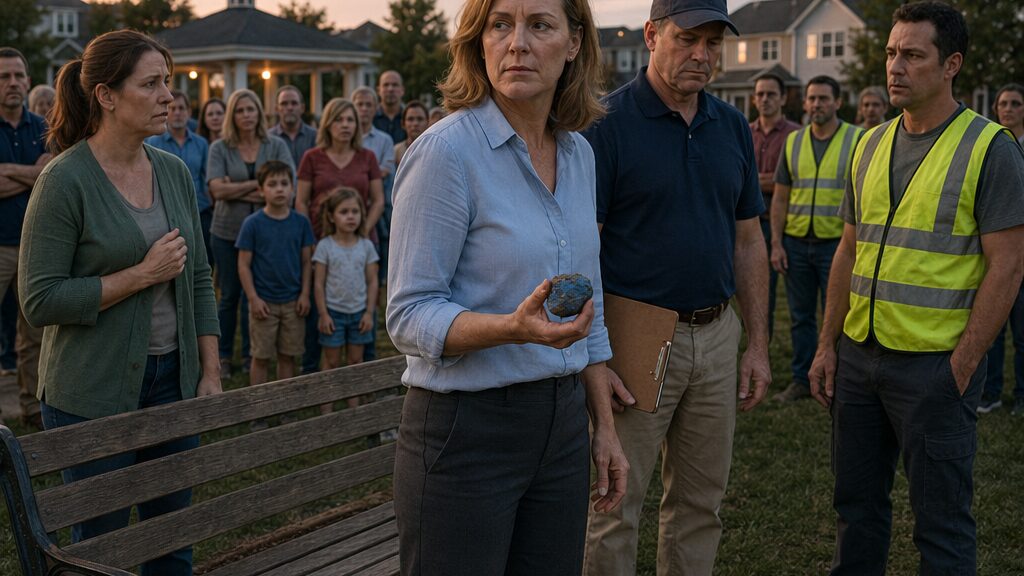
The blue beneath the park bench was too dull to be plastic and too deliberate to be natural.
Catherine stopped on the walkway.
Monday evening had drawn nearly everyone toward the common green for what Patrick had called the final search hour. Children moved through the grass in widening circles. Adults checked behind trees and beneath the benches they had already checked twice.
Catherine had come only because George wanted her opinion on the loose edging near the path.
Now, beneath the far end of the bench, half covered by dry soil, was a curved blue surface with a narrow pale chip along one side.
Her pulse changed.
She looked toward Patrick. He stood near the clubhouse with his clipboard, speaking to Andrew.
No one was watching her.
Catherine could have walked away. She could have photographed the rock and left it for someone else. She could have waited until the access log arrived and confronted Patrick privately.
Instead she stepped off the path.
The grass was damp beneath her shoes. She lowered herself beside the bench and reached under the wooden slat. Her fingers touched cool stone.
The rock came free with a soft scrape.
It fit her palm exactly.
For a moment, the voices across the green receded. The years between the first hunt and this one collapsed into the weight of a chipped stone she had once painted at her kitchen table.
A child saw it first.
“She found it!”
The shout traveled faster than Catherine could stand.
Residents converged from every direction. Andrew blew a plastic whistle he had apparently been carrying for this exact possibility. Jennifer’s children jumped up and down. Someone began clapping, and others joined until the common green sounded as though Catherine had accomplished something far greater than bending beneath a bench.
Patrick approached with the clipboard tucked under his arm.
His face revealed recognition before he arranged it into a smile.
“Well,” he said. “Of all people.”
Catherine brushed soil from the rock with her thumb.
Andrew laughed. “The one person who said the whole thing was ridiculous.”
“It remains ridiculous.”
“But you found it.”
“That does not improve it.”
The residents laughed, and for one brief second Catherine felt the old rhythm of these gatherings—the easy teasing, the harmless exaggeration, the pleasure of being known well enough to be contradicted.
Patrick lifted one hand. “Everybody, we have a winner.”
More applause followed.
Catherine held the rock between two fingers. “Before this becomes any more ceremonial, what exactly did I win?”
Patrick paused just long enough to sharpen the question.
“Bragging rights.”
The answer struck her with such perfect familiarity that a laugh escaped before she could stop it.
It began as one disbelieving sound. Then another followed. She pressed her lips together, but the absurdity widened: three days of flashlights, safety vests, damaged plants, blocked drains, and neighborhood suspicion, all ending with the same worthless prize she had invented years earlier.
Catherine laughed until she had to look down.
The crowd joined her. Andrew bent forward with his hands on his knees. Jennifer covered her mouth. Even George, standing near the path, shook with silent laughter.
For several seconds, the neighborhood was united by the joke.
Then Jennifer said, “You knew.”
The laughter thinned.
Catherine raised her head.
Jennifer’s expression was not hostile, but it had changed. “That’s why you found it so fast.”
“I saw blue beneath the bench.”
“You also said you used to do these events.”
Andrew looked from Jennifer to the rock. “Wait. Was this your game?”
Patrick stepped forward. “Let’s not turn this into—”
Catherine turned the stone over.
Near the flatter underside, beneath scratches and dirt, were two faded white letters.
C.M.
The people closest leaned in.
“I painted those initials,” Catherine said. “I painted the entire rock.”
Andrew’s smile disappeared. “So you did know what it looked like.”
“I knew what it looked like eight years ago. I did not know where Patrick hid it.”
A resident near the back said, “How do we know that?”
The question was quiet, but the semicircle tightened around it.
Catherine felt the old meeting room return around her—the same careful faces, the same hunger for a simple person to blame. Her first instinct was to place the rock in Patrick’s hand and leave.
Instead she looked at him.
“Tell them where you got it.”
Patrick’s jaw shifted. “From the clubhouse storage room.”
“Which bin?”
“The old community-events bin.”
“Who authorized you to use it?”
“I’m HOA president.”
“That does not answer the question.”
A skeptical board member folded his arms. “Catherine, did you know the hunt was based on your old event?”
“No.”
“But you recognized the wording.”
“Yesterday.”
“And you didn’t tell anyone?”
Catherine closed her fingers around the rock.
There it was: the part she could not dismiss as another person’s failure.
“I wanted to know who had taken it before I said anything.”
Jennifer glanced at the initials again. “You could have hidden it yourself to make Patrick look bad.”
Patrick said, “Jennifer.”
“No, it’s a fair question.”
Catherine’s face warmed. The cheering from minutes earlier now felt like something performed by strangers.
She held the rock out toward Jennifer. “The dirt is packed into the chip. The underside is stained. If I had taken this from storage and hidden it three days ago, it would not look as though it had been outside for months.”
George stepped closer but did not rescue her. “Could have been placed earlier.”
“Yes,” Catherine said. “It could have.”
Andrew looked at Patrick. “When did you hide it?”
Patrick removed his cap and rubbed the back of his head. “Last week.”
“Where?”
He pointed toward the bench.
“Under there?”
“Near there.”
Catherine watched him. “Near where?”
Patrick put the cap back on. “This is getting out of proportion.”
“You organized half the neighborhood to search for an object you took from storage without telling the person who created the event. Proportion left on Saturday.”
A murmur moved through the group.
Patrick lowered his voice. “Can we speak privately?”
“No.”
The refusal came cleanly. Catherine surprised herself with it.
The rock sat in her palm, no longer playful. It was proof of authorship, but not innocence. She had recognized the phrase and kept silent. She had watched residents cross boundaries while she collected evidence rather than sharing what she knew.
Still, Patrick’s unease was about more than an old game.
Catherine remembered George’s blocked drain, the leaking valve, the loose edging, and Patrick’s cheerful emails praising “observations.”
She looked at Andrew’s clipboard. Under the search-zone heading were handwritten notes about standing water, broken emitters, and eroded soil.
“This wasn’t only a scavenger hunt,” she said.
Patrick’s face went still.
Andrew followed her gaze to the clipboard. “What does that mean?”
Catherine stepped closer to Patrick. “You kept directing people toward common landscaping problems.”
“I encouraged them to look around.”
“You used residents to inspect the property.”
“That is not what happened.”
“Then say what happened.”
The remaining laughter had vanished. Children shifted beside their parents. Somewhere behind the clubhouse, an irrigation line hissed on.
Patrick looked at the crowd, then at Catherine.
“Not here,” he said.
“Why?”
“Because I don’t have all the information.”
“You had enough information to send people into the landscaping.”
His voice tightened. “I was trying to get people involved.”
“In what?”
Patrick glanced toward the drainage corridor.
That glance answered more than his words had.
He came close enough that only Catherine and Andrew could hear him clearly.
“The hunt was supposed to help us see what residents noticed,” he said. “And get volunteers outside before the next board meeting.”
Catherine did not move.
“See what they noticed about what?”
Patrick looked down at the blue rock.
Then he said, “Maintenance problems we can’t afford to fix all at once.”
Chapter 4: What the Searchers Found by Accident
Patrick’s folder was already open when Catherine entered the HOA office Tuesday morning.
The blue rock sat beside it on the conference table, its chipped edge facing her like a damaged tooth.
“You kept it,” she said.
“You found it.”
“That doesn’t make it mine.”
Patrick closed the office door. The room was barely large enough for the table, four stackable chairs, and two gray filing cabinets. A framed map of the subdivision hung crookedly behind him.
He pushed the folder toward her.
Inside were photographs taken over the previous three days. Standing water beneath the southern walkway. A cracked irrigation coupling near the playground. Rusted edging lifted from the soil. Erosion behind the clubhouse, where exposed roots crossed a shallow wash.
Andrew’s handwriting appeared beneath several images.
Found during blue team search.
Possible trip hazard.
Water still present after dry weather.
Catherine turned the pages slowly.
“You made him keep notes.”
“I asked team leaders to record anything unusual.”
“You gave them safety vests and clipboards.”
“They were already walking the property.”
“Because you sent them looking for a rock.”
Patrick sat across from her. He looked older in the office than he had on the common green. Without the cap and public smile, the tired skin beneath his eyes showed plainly.
“I needed residents to see the common areas,” he said.
“You needed an inspection.”
“We had one.”
“When?”
“Last spring.”
“And?”
He tapped the folder. “It wasn’t thorough.”
Catherine opened the next section. An estimate from the landscaping contractor listed irrigation repairs, drainage clearing, edging replacement, and erosion control. Several lines were marked pending further assessment.
The total at the bottom had been circled.
“Who has seen this?”
“The board.”
“All of it?”
“Most of it.”
“That is not an answer.”
Patrick looked toward the window, though the blinds were closed. “The property manager sent the preliminary estimate two months ago. The full drainage assessment came later.”
Catherine’s finger stopped on a photograph of the southern inlet. The shifted concrete edge and packed roots were unmistakable.
She had seen that same gap before.
Not this week. Years earlier.
She pulled the photograph closer. “Where is the maintenance history for this corridor?”
“In the digital files.”
“I want the paper archive.”
Patrick frowned. “Why?”
“Because the digital files were reorganized after I resigned.”
He did not argue. He unlocked the lower drawer of the nearest cabinet and removed a thick binder.
Catherine found the drainage section within minutes. Her old inspection sheets were still clipped together, written in blue ink. On the final page, dated eight years earlier, she had noted recurring ponding near the southern walkway and recommended a camera inspection of the buried line.
Status: deferred pending reserve review.
Below it was Patrick’s signature as board treasurer.
He leaned over her shoulder. “I remember that.”
“You signed it.”
“I signed dozens of deferrals that year.”
“And this one never came back.”
“No.”
The answer was quiet enough to slow her anger.
She looked at him. “Why not?”
“Because the roof reserve was underfunded. Then the pool pump failed. Then the entrance wall needed stabilization. Every year there was something people could see.”
“And the drainage line stayed underground.”
“Yes.”
Catherine turned back to the photograph. She had expected concealment to feel simpler once she found proof. Instead the old sheet carried her own handwriting, her own recommendation, and the date of a meeting she had stopped attending before the next reserve review.
“The search found real problems,” Patrick said. “That matters.”
“It does not justify how you did it.”
“I know.”
“Do you?”
He folded his hands. “I thought if residents found the problems themselves, they would understand why we needed volunteers.”
“Volunteers cannot repair a buried drain.”
“They can clear surface debris. Photograph conditions. Flag loose edging. We could reduce contractor hours.”
“And you thought a scavenger hunt would make that easier to accept.”
“I thought a scavenger hunt might get more than six people outside.”
The bitterness in his voice was not directed at her alone.
Patrick opened another folder and slid a reserve summary across the table.
The numbers were worse than Catherine expected.
The HOA had enough unrestricted cash for ordinary operations and one modest emergency. Not enough for the full drainage work, irrigation replacement, and erosion control without delaying other projects or charging residents.
“What did the reserve study recommend?” she asked.
“A special assessment within twelve months.”
“How much?”
“We don’t have final bids.”
“Range.”
Patrick gave it to her.
Catherine leaned back.
The amount was not ruinous, but it was large enough to produce anger, campaign flyers, and crowded meetings. Large enough for residents already stretched by insurance and property taxes to accuse the board of incompetence.
“Why hasn’t this been disclosed?”
“We were waiting for confirmed estimates.”
“The shortfall is already confirmed.”
“The exact repair cost isn’t.”
“So residents know nothing.”
“They know the reserves are below target.”
“They do not know the board has a report recommending an assessment.”
Patrick’s mouth tightened. “If we announce that before we have a plan, the neighborhood tears itself apart.”
“You mean they remove you.”
“That too.”
At least he said it.
Catherine closed the reserve summary. “And the hunt was supposed to produce what? Free labor? Sympathy?”
“Participation.”
“You cannot hide a financial problem inside a game and call the result participation.”
“I was trying to get ahead of it.”
“You were trying to control the order in which people became angry.”
Patrick stared at the blue rock between them.
“Yes,” he said.
The admission left no clean target for Catherine’s outrage. He had acted deceptively. He had also inherited years of deferred repairs, some from boards on which she had served. He wanted to preserve his position, but he also feared what another fractured meeting would do.
Neither fact excused the other.
Catherine gathered the photographs into a single stack. “This goes to the full membership.”
“Not yet.”
“Thursday’s meeting.”
“We need time.”
“You had two months.”
“I need one week to verify the bids.”
“You had residents crawling through hedges without one week of verified rules.”
Patrick pushed back from the table. “Catherine, if this goes out now, they will focus on blame. No one will hear the repair options.”
“Then present both.”
“You know what those meetings become.”
“I do.”
Her answer landed harder than she intended.
Patrick looked toward the binder containing her old inspection sheet.
“The board blamed you for the landscaping overrun,” he said. “That was wrong.”
Catherine felt the room narrow.
“You were at the table.”
“I was.”
“You said nothing.”
“I thought correcting it publicly would split the board.”
“It was already split.”
“I know that now.”
She placed the old drainage sheet on top of the photographs.
“And now you want me to help you manage another truth quietly.”
“I want you to help me explain it accurately.”
“There is a difference between accuracy and timing.”
“There is also a difference between disclosure and detonation.”
Catherine picked up the blue rock. Its paint felt rough beneath her thumb.
“I will be at Thursday’s meeting,” she said. “Bring the full reserve report, the estimates, the maintenance history, and the access record for the storage room.”
Patrick’s face changed at the last item.
“You still think I took the rock to target you?”
“I think you took something that belonged to a history you never acknowledged.”
He nodded once.
As Catherine reached the door, he spoke again.
“The reserve report was presented to the board in executive preparation, not formally adopted.”
She turned.
“What does that mean?”
“It means the membership was never told the shortfall could require an assessment.”
“Because the numbers weren’t final?”
Patrick looked at the folder, then at her.
“Because I asked the board to wait.”
Chapter 5: The Meeting Where Everyone Was Partly Wrong
The motion to remove Patrick Hill was made before the minutes were approved.
A resident in the second row stood with one hand raised and said, “Given the concealed maintenance report and unauthorized use of resident volunteers, I move that the president be removed immediately.”
The clubhouse filled with overlapping voices.
Patrick sat at the center of the board table, a binder open before him. Catherine had taken a chair along the side wall, but the blue rock had been placed in the middle of the table where everyone could see it.
The skeptical board member seconded the motion.
The HOA secretary struck the table with a wooden gavel that no one had used in years. “We have not reached new business.”
“This is the business,” someone called.
Another resident demanded to know whether the assessment rumors were true. A third asked who had authorized the scavenger hunt. Jennifer sat near the front with her hands folded tightly in her lap. Andrew stood near the rear doors, no vest, no clipboard.
Patrick leaned toward the microphone.
“The board will address the maintenance concerns tonight.”
“Why not two months ago?” a resident shouted.
Patrick did not answer immediately, and the silence worked against him.
Catherine watched his fingers press against the edge of the binder. She remembered him years earlier, seated in almost the same position while residents accused her of wasting money on landscaping changes. He had stared at his notes then too.
The secretary called for order.
Patrick began with the search.
He admitted taking the original blue rock from the old events bin. He admitted using the hunt to encourage residents to inspect common areas. He admitted that the written boundaries had been inadequate and that private landscaping had been entered without permission.
“I believed,” he said, “that a community activity could rebuild participation and help us identify visible maintenance concerns.”
“You mean free inspections,” someone said.
“I mean participation.”
“You hid the real purpose.”
“Yes.”
The direct admission quieted the room more effectively than denial would have.
Patrick continued. “That was my decision. The board approved the event, but I did not explain the secondary purpose to residents.”
The skeptical board member shifted in his chair. “The board was told it was an engagement activity.”
Patrick looked at him. “That is true.”
“So you misled us too.”
“I did not give you the full reasoning.”
The room stirred again.
Catherine had expected Patrick to minimize. Instead he was placing the responsibility closer to himself than the board members wanted.
The property manager presented the maintenance photographs and preliminary estimates. The total drew a collective breath. When the reserve summary appeared on the screen, voices rose again.
Patrick explained the funding gap, the unfinished bids, and the possibility of a special assessment.
A resident near the aisle stood. “You knew all this and organized a children’s game?”
Patrick’s answer was almost lost beneath the anger. “I knew enough to be concerned. I did not know the final cost.”
“That is not the same as telling us.”
“No.”
The meeting moved toward removal again.
Then Patrick closed his binder.
“Before you vote,” he said, “there is an older issue I need to correct.”
Catherine’s back stiffened.
Patrick looked toward her, but he did not ask permission.
“Eight years ago, this association attributed a landscaping-budget overrun to Catherine Miller’s committee leadership. The surviving records do not support that conclusion.”
The room changed in a smaller, stranger way than it had during the shouting. Several longtime residents looked down. Newer homeowners glanced toward Catherine.
Patrick continued.
“The overrun resulted from emergency irrigation work approved after the committee submitted its budget. Catherine objected to combining those costs. I voted to approve the combined report anyway.”
Catherine’s hands went cold.
She had imagined this correction many times. In those private versions, the room understood immediately. Someone apologized. The record became clean, and the humiliation left her.
Instead, she felt exposed.
Jennifer turned in her chair. George, seated near the back, watched without expression.
Patrick said, “Catherine should not have been blamed for those costs. I did not correct the accusation when I should have.”
The secretary asked whether he wanted the correction entered into the minutes.
“Yes.”
A small payoff, formal and overdue, settled into the record.
It did not erase the years.
The skeptical board member tapped his pen. “This is relevant how?”
“Because the drainage warning we are discussing began during that same period,” Patrick said.
Catherine looked sharply at him.
He opened the old maintenance binder and lifted her inspection sheet.
“She identified recurring ponding and recommended further investigation.”
A resident said, “So this board ignored her twice?”
Patrick hesitated.
Catherine knew what came next before he said it.
“The recommendation was deferred,” he replied. “Catherine prepared a final follow-up before she resigned, but it was never submitted to the board.”
Every face in the room turned toward her.
The vindication lasted less than a minute.
Catherine stood.
“I drafted the warning,” she said. “That is true.”
“Why didn’t you submit it?” someone asked.
She could have blamed the hostile meeting. She could have said she had resigned and therefore no longer held responsibility. Both statements would have been accurate enough to protect her.
The blue rock sat under the fluorescent lights, its initials turned downward.
“Because I was angry,” she said.
The room became still.
“I had been accused of hiding costs I did not create. Patrick knew the report was misleading and did not correct it. Other board members repeated the accusation. I wrote the drainage warning after that meeting.”
She paused.
“I did not send it.”
Patrick looked at the table.
Catherine’s voice tightened, but she kept it level. “I told myself the board had chosen not to listen. I told myself anything that happened after I resigned belonged to them.”
A resident asked, “Did you know the drain could fail?”
“I knew it needed inspection. I did not know the current condition.”
“But you could have warned people.”
“Yes.”
The answer seemed to disappoint those who had wanted a clean victim and those who had wanted a clean villain.
Andrew spoke from the back. “That doesn’t excuse the board sitting on it for eight years.”
“No,” Catherine said. “It doesn’t.”
Patrick looked up. “And it does not excuse what I did this month.”
For the first time that evening, they stood inside the same truth without using it as a weapon.
The skeptical board member returned to the motion. “We still need accountability.”
“We do,” Catherine said.
He frowned. “Are you supporting removal?”
“I am supporting disclosure first.”
“That sounds like delay.”
“It sounds like knowing what we are deciding.”
She stepped toward the table and placed one hand beside the blue rock.
“The assessment range is preliminary. The repair priorities are mixed together. Some work requires licensed contractors. Some surface tasks do not. The board concealed the urgency. Residents also ignored common areas until a game gave them permission to look.”
Several people protested at once.
Catherine waited.
“We can remove Patrick tonight,” she continued, “and still have a blocked drain tomorrow. We can keep him and pretend an apology is a repair plan. Neither is sufficient.”
Patrick’s expression remained controlled, but something in it loosened.
Jennifer raised her hand. “What would be sufficient?”
Catherine looked at the reserve summary, the photographs, and her old unsigned warning.
She had come prepared to expose Patrick. She had not come prepared to become useful again.
That difference felt dangerous.
“An open maintenance ledger,” she said. “Every reported issue, date, status, estimate, and decision visible to residents. Clear rules for volunteer inspections. No private property without written consent. Professional review for drainage and irrigation systems. Phased priorities before any final assessment vote.”
The skeptical board member said, “Who is going to build all that?”
The question waited in front of Catherine like an open door she did not trust.
“I will outline it,” she said. “I will not run it alone.”
A few people began speaking at once, offering names, objections, and conditions. The secretary struggled to capture motions. The removal vote was postponed until after an emergency planning session.
As the meeting broke into smaller arguments, Jennifer approached Catherine.
“You could have let Patrick take all of it,” she said.
“He earned his part.”
“And yours?”
Catherine looked at the unsigned warning in Patrick’s binder.
“I earned mine too.”
She turned back toward the room.
The residents had not forgiven anyone. The drain was still blocked. The money was still missing from the reserves.
But for the first time in eight years, Catherine’s silence was no longer mistaken for innocence.
Chapter 6: Catherine Draws the Boundary Lines
Catherine arrived on the common green Saturday morning wearing a fluorescent safety vest.
Andrew stared at her from beside the folding table.
“I’m trying not to say anything,” he said.
“Continue trying.”
The vest was too large and smelled faintly of plastic. Catherine had written SITE LEAD on a strip of masking tape across the chest, then crossed out LEAD and replaced it with ADVISOR.
On the table lay printed maps, consent forms, numbered flags, and a public task ledger. The blue rock rested at the first marked station beside the southern walkway.
Residents gathered in uncertain clusters. Some had come to help. Others had come to make certain the work did not justify an assessment. Patrick stood near the clubhouse entrance with the property manager and the landscaping contractor.
Catherine lifted a clipboard.
“Common areas are outlined in green,” she said. “Private lots are white. No one crosses into white areas without the owner’s signed permission. You photograph and flag. You do not dig, remove structures, open valves, or attempt repairs.”
A resident raised his hand. “What if it’s obviously simple?”
“Then it will remain obviously simple until the contractor approves it.”
Andrew passed out flags. “Teams of three?”
“Two for inspection, one for documentation.”
“See?” he told the group. “Organized fun.”
“This is not fun.”
A child pointed to Catherine’s vest. “Then why are you dressed like us?”
A few people laughed.
Catherine looked down at the bright fabric. “Because motorists can see poor judgment more easily in fluorescent colors.”
Even Patrick laughed at that.
The groups began along the walking paths. George took the drainage corridor with Andrew. Jennifer worked at the consent table, helping residents mark whether volunteers could enter side yards to photograph common irrigation equipment.
Catherine moved from station to station, checking notes.
The structure changed the mood. Without the promise of a hidden prize, people paid closer attention. A loose paver became a numbered entry instead of a rumor. A leaking emitter received a photograph, location, and time. Residents who disagreed could point to the same line on the ledger.
Near the east boundary, Andrew waved Catherine over.
A shallow depression ran from the common green toward a homeowner’s fence. Water marks darkened the soil inside the private yard.
“The outlet might continue behind that fence,” Andrew said. “We need to see where.”
“Do we have consent?”
Jennifer checked the forms. “Not from this address.”
“The owner isn’t home,” Andrew said. “We’d only step five feet in.”
“No.”
“If the drain is blocked there, it affects the common area.”
“Then we document the visible condition and contact the owner.”
He lowered his voice. “We’re already here.”
Catherine looked at him.
The phrase was the same logic he had used when the search uncovered the first blocked inlet. It had produced useful discoveries. It had also put three adults beneath her dining-room window before sunrise.
“Being present does not create permission,” she said.
Andrew glanced at the fence. “We could lose a week.”
“We could lose trust faster.”
A few volunteers had stopped to listen.
Catherine handed him a red flag. “Place it at the property line. Note possible continuation. No entry.”
Andrew pressed the flag into the common soil.
“All right,” he said. “Boundary held.”
The words traveled farther than the moment. By noon, volunteers were asking before moving edging, checking map colors, and correcting one another without Catherine’s intervention.
Patrick approached with the contractor.
“We have an initial priority list,” he said.
Catherine reviewed it.
The irrigation leaks could be phased. Loose edging and minor surface erosion could be handled within the current operating budget if volunteer documentation reduced inspection hours. The playground path needed professional repair but not immediate closure.
The southern drain was different.
The contractor pointed to the line on the map. “Surface clearing won’t solve this. We need a camera inspection and probably excavation near the basin connection.”
“Range?” Catherine asked.
He gave one.
The number was lower than the broad preliminary estimate but still too high for reserves without delaying roof funding.
Patrick looked toward the residents working along the green. “So we still need an assessment.”
“A smaller one,” the property manager said. “Assuming there’s no additional collapse.”
Patrick rubbed his forehead. “They’re going to say the volunteer day was pointless.”
“No,” Catherine said. “They’re going to say it did not make professional work free.”
“That distinction may not survive the meeting.”
“Then write it down before the meeting.”
She took the public ledger and added a new entry.
Southern drainage line: professional camera inspection required. Volunteer work cannot substitute. Funding decision pending bids.
Patrick watched her write.
“You make bad news look very plain,” he said.
“It usually becomes worse when decorated.”
By late afternoon, the first inspection cycle was complete. The blue rock had moved from station to station as a visual marker, not a prize. Children carried it carefully and placed it beside each new team’s map.
At the final gathering, Catherine read the totals.
Thirty-two conditions documented. Eleven resolved through simple cleanup approved by the contractor. Seven scheduled within the current budget. Thirteen requiring estimates or owner coordination. One major drain requiring professional intervention.
There was no cheering. The response was quieter and more serious.
Then George began clapping once, slowly. Not for Catherine, but for the list.
Others joined.
She raised a hand. “This is information, not victory.”
George stopped first. “Information is better than what we had.”
That, Catherine could accept.
After the tables were folded and the flags collected, Jennifer found her beside the first station. The blue rock lay between them on the map.
“You should come back as committee chair,” Jennifer said.
“No.”
The answer was immediate.
Jennifer blinked. “You didn’t even think about it.”
“I thought about it eight years ago, every day for several months.”
“You’re already doing the work.”
“Today’s work. Under written limits.”
“The neighborhood trusts you.”
“Some of it does. Some of it wants someone competent enough to blame later.”
Jennifer winced. “That’s fair.”
Catherine removed the oversized vest and folded it over one arm.
“I will not rebuild a committee that depends on one person knowing everything,” she said. “And I will not be the board’s unpaid answer to a funding problem.”
Jennifer looked toward Patrick, who was loading binders into his car.
“So what will you do?”
Catherine picked up the blue rock. Its chipped edge fit beneath her thumb as if no time had passed.
“I’ll help create the process,” she said. “Then the process has to work without me.”
Jennifer nodded slowly.
Before she left, she asked, “Would you at least consider an official role? Something limited?”
Catherine looked across the common green. The red boundary flag still stood beside the private fence, exactly where Andrew had placed it.
For once, the line had held.
“I’ll consider the limits,” she said.
Chapter 7: The Real Prize Was Written Down
The new notice covered nearly the entire front of Catherine’s mailbox.
Unlike the first one, it was printed on HOA letterhead, dated, numbered, and divided into sections.
SOUTHERN DRAINAGE REPAIR PLAN.
ESTIMATED COST.
PROPOSED ASSESSMENT.
VOLUNTEER WORK LIMITS.
PROPERTY-ACCESS RULES.
PUBLIC MAINTENANCE LEDGER.
At the bottom, in smaller type, was a line directing residents to the clubhouse before Thursday’s vote.
Catherine read every word before removing it.
The proposed assessment was modest compared with the first estimate, but not painless. Volunteer documentation and phased repairs had reduced contractor costs. They had not changed the fact that buried concrete, damaged pipe, and professional labor cost money.
Across the street, a resident tore the notice down without reading past the total.
“Here we go again,” he said.
Catherine folded hers once and carried it inside.
For the next four days, the neighborhood argued in quieter ways than before. Numbers appeared in driveway conversations. Residents compared insurance bills and school expenses. Some praised the reduced cost. Others said the board should have prevented the problem years earlier.
No one was entirely wrong.
At the clubhouse Thursday evening, the blue rock sat inside a clear acrylic box beside the maintenance ledger.
The box had a typed label beneath it:
ORIGINAL BLUE ROCK HUNT, CREATED BY CATHERINE MILLER.
The wording made Catherine uncomfortable. It sounded more ceremonial than the chipped object deserved.
Patrick stood near the board table, speaking with the HOA secretary. He had agreed to remain president until the next scheduled election, but the proposed reforms would remove his authority to organize events, spend discretionary funds, or assign volunteer work without documented board approval.
When he noticed Catherine looking at the display, he came over.
“The secretary’s idea,” he said.
“The box?”
“The label.”
“It makes the rock look important.”
“It became important.”
“That is not the same as deserving a display case.”
Patrick glanced at the ledger. “Maybe the important part is what happened around it.”
Catherine did not answer.
The meeting began with the repair plan.
The property manager presented the final contractor bids. The camera inspection had confirmed a partial collapse near the basin connection, but the damage was contained. The assessment would fund the drainage repair while preserving the roof reserve at a reduced but acceptable level.
Questions came quickly.
Why had the board not sought three bids earlier?
Why should newer residents pay for deferred work?
Could the repair wait another year?
What happened if another storm came first?
This time the answers appeared on the screen beside the questions. Dates, reports, estimates, and board decisions were visible in the public ledger. No one had to accept Patrick’s memory or Catherine’s interpretation as the only record.
George stood when discussion turned to delay.
“I reported standing water last fall,” he said. “I also waited when nothing happened. That part belongs to me. But the line is failing now. Water does not care when you bought your house.”
The room quieted.
The assessment passed by a narrow margin.
No one cheered.
Catherine preferred it that way.
The second vote adopted the maintenance ledger, property-access policy, and volunteer-inspection rules. The third limited presidential authority over community events. Patrick voted in favor of all three measures.
Then the secretary opened the question of committee appointments.
Jennifer nominated Catherine as landscape and maintenance chair.
A few residents nodded. Someone near the back said, “She’s already doing it.”
Catherine stood.
“No.”
The word carried farther through the microphone than she intended.
Jennifer’s face fell slightly, though she had been warned.
Catherine continued. “I will not accept the chair position.”
A murmur moved through the room.
“I will serve for six months as a technical advisor,” she said. “The role will be limited to reviewing maintenance entries, helping establish inspection standards, and training two rotating resident coordinators. I will not approve spending. I will not supervise contractors. I will not be the only person who understands the records.”
The skeptical board member leaned toward his microphone. “Why six months?”
“Because a system that depends on one person has not been repaired.”
The answer settled over the room.
Andrew raised his hand. “I’ll serve as one of the rotating coordinators.”
Jennifer offered to manage consent records and resident notifications.
George agreed to review drainage observations once each quarter, provided no one called him for emergency repairs.
The secretary wrote the assignments into the minutes.
Patrick opened the old landscaping matter last.
He read the correction in full: the irrigation emergency had been improperly combined with Catherine’s committee budget, and the resulting public criticism of her management had been unsupported.
The correction had already appeared in draft form, but hearing it entered into the permanent record changed its weight.
Catherine felt no triumph.
She felt something smaller and more useful.
The record now told the truth.
After the meeting, Jennifer found her near the display case.
“I’m sorry,” she said.
“For the nomination?”
“For asking if you hid the rock.”
Catherine looked at the initials visible through the acrylic.
“You had reason to wonder.”
“I had reason to ask privately.”
“Yes.”
Jennifer accepted the distinction. “My daughter still talks about you stopping everyone from blaming her for the plant.”
“She didn’t damage it.”
“I know. That’s why she remembers.”
Across the room, Patrick removed his binders from the president’s place at the table. He would still sit there for several months, but the space no longer belonged to his judgment alone.
He approached Catherine carrying the old COMMUNITY DAYS folder.
“This should probably go with the display,” he said.
Catherine opened it.
Inside were the original clue cards, photographs, and the first sign-up sheet. Her younger handwriting filled the pages.
She closed the folder.
“Not all of it.”
“What do you want kept?”
“The original card. One photograph. The rules from this year.”
Patrick nodded. “The bad rules or the corrected ones?”
“Both.”
He almost smiled. “For historical accuracy?”
“For memory.”
Outside, residents gathered near the mailbox row before walking home. The repaired drainage line was still weeks away, and the assessment would appear on the next quarterly statement. Trust had not returned simply because votes had passed.
But the common green no longer looked abandoned.
The inspection flags were gone. The paths had been cleared. The new ledger was accessible online and in a binder at the clubhouse.
Jennifer’s son stood beside Catherine’s mailbox holding a small unpainted stone.
“Are we doing the hunt again next year?” he asked.
Several adults turned toward Catherine.
She looked at Patrick.
He lifted both hands. “Not my decision.”
The child rolled the stone between his palms. “Where would you hide it?”
Catherine glanced toward the hedges, the park bench, and the garden border that had started the trouble.
Then she looked at the printed notice still taped to the neighboring mailbox, with its dates, boundaries, costs, and rules visible to anyone willing to read them.
A laugh rose in her before she could stop it.
Not the bitter laugh from the common green. Not the startled laugh that had escaped when Patrick announced the worthless prize.
This one was quieter.
“We can have another hunt,” she said.
The child brightened.
“But there will be a map. Written boundaries. No private yards. No flashlights before sunrise. And no one touches a plant.”
Andrew groaned theatrically. “You’ve taken all the adventure out of it.”
“No,” Catherine said. “I’ve taken your shoes out of my flower bed.”
The adults laughed.
The child held up the plain stone. “What does the winner get?”
Catherine looked through the clubhouse window at the blue rock beside the open maintenance ledger.
“Bragging rights,” she said. “And the responsibility to put everything back where it belongs.”
The story has ended.