The Disgraced Drill Sergeant Who Broke The Arrogant Officer’s Grip
CHAPTER 1: THE SPILLED TRAY ON THE CONCRETE FLOOR
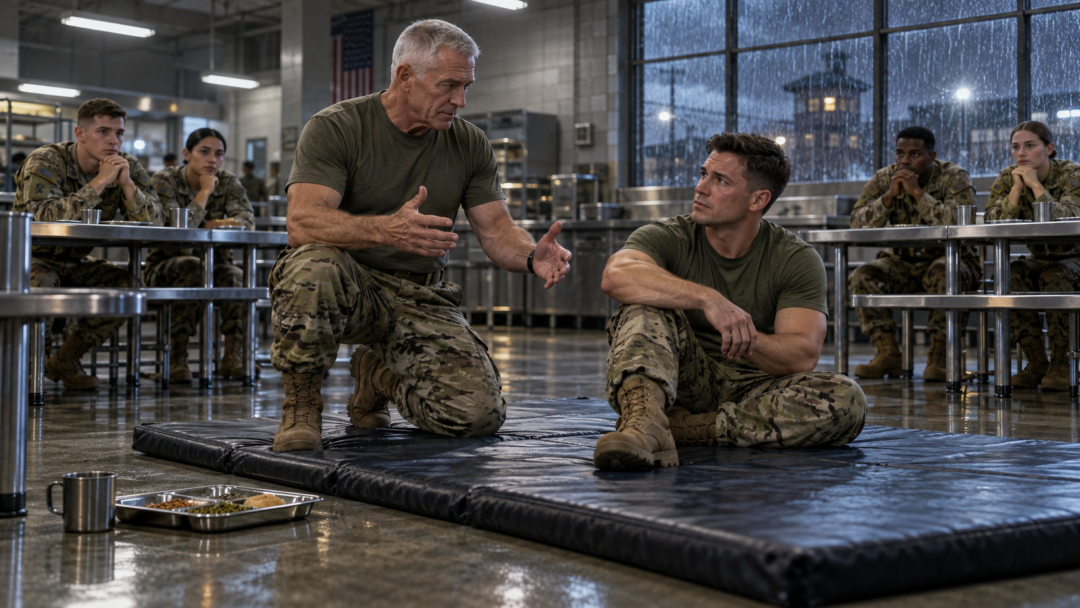
The concrete floor of Mess Hall Four at Fort Kessler was cold enough to numb the soles of a man’s boots through two layers of heavy combat wool. Built in 1952 during the height of the Korean mobilization, the cavernous dining facility was a monument to unadorned military utility, smelling perpetually of institutional pine disinfectant, boiled navy beans, bleached stainless steel, scorched grease, and damp olive-drab canvas drying over iron steam radiators. Through the high, wire-reinforced rectangular windows along the western wall, cold November rain lashed the cracked asphalt tarmac of the motor pool, running down the exterior glass in greasy, soot-streaked ribbons. Overhead, two dozen industrial fluorescent light banks hummed with an uneven, flickering sixty-cycle buzz that cast harsh blue shadows across the long, polished rows of brushed-metal tables.
Marcus Vane sat alone at the end of the center refectory table, his back straight against the hard steel bench as if he were still standing inspection on the parade grounds of Fort Benning. He was seventy-one years old, with a close-cropped silver buzz cut that showed the pale, jagged scars of mortar shrapnel across his scalp. His face was weathered like cured harness leather, carved into deep, unsmiling lines around a square jaw that had barked cadence to three generations of infantrymen. Under his faded, field-issue M-65 olive coat, his shoulders were broad, level, and solid as railroad ties, his forearms corded like thick hemp towing cables beneath rolled-up sleeves.
On the stamped aluminum tray in front of him sat a white ceramic mug of black coffee, a chipped bowl of oatmeal, and two slices of dry whole-wheat toast.
Beside the tray, Vane’s right hand rested flat on the stainless-steel tabletop. His fingers were twitching.
It was a slow, involuntary rhythmic tremor—a neurological souvenir from three brutal tours in the Central Highlands and four decades of teaching recruits how to fall on frozen clay without breaking their collarbones. The tremor tapped his calloused index finger against the metal tabletop every two seconds: tap… tap… tap. Vane didn’t look at his hand. He had learned twenty years ago that watching the tremor only made it angry. He took a slow, measured sip of the scalding black coffee, his grey eyes watching the cold rain stream down the wire-glass windows toward the motor pool gate.
Walking down the center aisle, his mirror-polished jump boots striking the polished concrete with sharp, rhythmic cracks that demanded attention, was Lieutenant Dane Corrick.
Corrick was thirty-four years old, broad-shouldered and impeccably groomed in razor-pressed tactical duty fatigues, a gold lieutenant’s bar gleaming like fresh butter on his patrol cap. His web belt was pulled parade-ground tight, and in his right hand he carried an aluminum clipboard holding the morning company duty roster. His mouth was set in a permanent, tight smirk—the expression of a man who believed rank was something you used like a blunt instrument to carve out personal status and intimidate those who couldn’t fight back through the chain of command.
Corrick came to a halt beside Vane’s table. He looked down at the old veteran with cold, ostentatious disdain, his nose wrinkling as if he had stepped into an open latrine trench.
Without warning, Corrick drew his right boot back and kicked the edge of Vane’s metal tray.
The impact was violent and deliberate. The aluminum tray flipped off the stainless-steel table, clattering across the concrete with a deafening, metallic crash that echoed off the high cinderblock walls like an exploding canister. The bowl of oatmeal shattered into three pieces, splattering hot, thick starch across the floor. The white ceramic mug cracked in two, sending scalding black coffee splashing across the toes of Vane’s scuffed field boots, while the metal spoon bounced twice and spun to a halt near the center aisle.
At the adjacent tables, four soldiers—two junior privates, a corporal, and a weathered staff sergeant—froze with their forks suspended in mid-air. The entire mess hall fell into a suffocating, dead silence, broken only by the distant hum of the exhaust fans.
Corrick stood over the mess, his hands resting on his tactical duty belt, his smirk deepening into a cruel, triumphant sneer.
“Mess hall’s for active-duty soldiers, Vane,” Corrick barked, his voice carrying clearly to every corner of the silent hall. “Not for seventy-year-old civilian fossils who can’t hold their hands steady enough to keep their oatmeal on the table. You’re cluttering my company dining space, smelling up the air with forty-year-old memories. Clear your garbage off my floor and get off this post before I have the guard house lock you up for vagrancy.”
Marcus Vane did not flinch. He did not pull his boots back from the steaming puddle of coffee.
Slowly, deliberately, Vane turned his head. His steel-grey eyes lifted, meeting Corrick’s gaze with a chilling, immovable stillness that felt like looking down the bore of an unchambered 105mm howitzer.
On the tabletop, Vane’s right hand stopped twitching. The fingers closed slowly into an iron fist, the knuckles turning pale as mountain limestone.
“You dropped my coffee, Lieutenant,” Vane said softly. His voice had the dry, grinding friction of an iron gate swinging shut on rusty hinges.
CHAPTER 2: THE SIX MOVES ON THE LINOLEUM
Lieutenant Corrick’s face flushed dark crimson, the smirk on his lips turning venomous as the insult registered in front of four junior enlisted men. He was an officer with six years of active commissioned service, a graduate of advanced tactical schools at Fort Bragg, and he was not accustomed to being addressed by a civilian contractor in a tone that lacked absolute subordination.
“What did you say to me, old man?” Corrick snarled, taking a heavy, aggressive step forward into the puddle of spilled coffee, his jump boots grinding the ceramic shards against the floor. “You speak to a commissioned officer with respect or I’ll have the provost marshal throw you in the stockade for insubordination and destruction of government property! Pick up that tray and clean this floor right now!”
Vane did not answer with words. He rose from the steel bench.
He didn’t rush. He didn’t tense his shoulders or drop into a fighting stance. He stood up with the effortless, centered equilibrium of a combat veteran who had lived seventy-one years inside his own bones, his body moving like an ancient hydraulic press. When he reached his full six-foot height, his broad chest was three inches from Corrick’s face, his eyes looking directly into the lieutenant’s pupils without a single flicker of hesitation or doubt.
Corrick felt an instinctive, visceral jolt of primal panic—the ancient, mammalian realization that he was standing inside the kill zone of an apex predator who had forgotten more about violence than Corrick would ever learn in a classroom. But vanity and institutional arrogance overrode his instinct. Corrick reached out his right hand aggressively, fingers hooking toward Vane’s field jacket lapel to shove the old man back against the table.
That was his fatal mistake.
The instant Corrick’s wrist crossed the centerline of Vane’s chest, the physical universe shifted.
Move One: Catch.
Vane’s left palm caught Corrick’s reaching wrist—not with rigid, bone-jarring force, but with a soft, wrapping capture that matched the forward velocity of the lieutenant’s arm and neutralized all forward momentum before it could generate leverage.
Move Two: Redirect.
Without a microsecond of pause, Vane’s hips shifted two inches to the left, his torso rotating in fluid harmony. He drew Corrick’s arm across the open space, blending with the officer’s forward energy and pulling him completely off his balance plane, leaving Corrick’s center of gravity hanging over empty air.
Move Three: Inside Elbow Lock.
Vane stepped inside the guard, his right forearm sliding over Corrick’s triceps with surgical precision, locking the lieutenant’s elbow joint against his own ribs. The lever was absolute and unyielding; Corrick’s shoulder groaned as his arm was pinned in an inescapable geometric vice.
Move Four: Hip Shift.
Vane dropped his center of gravity three inches, rotating his pelvis like a tank turret. Corrick’s weight was suddenly suspended over nothing, his polished jump boots scrabbling frantically for traction on the wet concrete.
Move Five: Ankle Sweep.
Vane’s right boot heel hooked behind Corrick’s lead ankle in a clean, effortless crescent sweep. Corrick’s feet left the floor with a muffled squeak of rubber soles against linoleum.
Move Six: Guided Fall and Ground Pin.
Vane did not slam the officer to the floor. He guided Corrick down in a controlled, rolling descent that landed him flat on his back on the industrial linoleum without causing concussive trauma. In the same microsecond, Vane’s left knee settled lightly across Corrick’s sternum—bearing exactly enough weight to compress the lungs without cracking a rib—while his calloused hands locked Corrick’s right wrist and elbow into an immovable submission armbar.
The entire sequence had taken exactly two point four seconds.
It had been executed with zero anger, zero wasted motion, and absolute, mathematical economy.
Corrick lay pinned to the cold floor, his eyes bulging in sheer terror, his breath wheezing in ragged gasps through clenched teeth, his cheek pressed flat against the spilled oatmeal. He couldn’t move an inch. The seventy-one-year-old hands gripping his arm were like steel vice clamps wrapped in rawhide.
At the nearby tables, the four soldiers stood up in rigid, breathless shock. Nobody spoke. Nobody reached for a sidearm.
Vane looked down at the officer pinned beneath his knee. His breath was completely steady, his pulse resting at sixty beats a minute.
“Six moves, Lieutenant,” Vane whispered, his gravelly voice cutting through Corrick’s panicked wheezing. “Basic infantry combatives, Field Manual 21-150, Chapter Four. Taught at this post since 1968. You flunked the entry, you over-extended the reach, and you left your centerline open to an old man with bad knees.”
Vane released the lock, stepped back cleanly, and stood at attention.
Corrick scrambled backward across the wet floor like a crab, his face purple with humiliation, his uniform soaked in cold coffee. He hauled himself up by the edge of the metal table, his chest heaving, his fingers trembling violently as they clawed toward his holster strap.
“You assaulted a commissioned officer!” Corrick screamed, his voice cracking with hysterical rage. “Sergeant! Call the military police! Lock down this building! I’m having this lunatic put in irons before the sun goes down!”
CHAPTER 3: THE AUDIT IN THE QUONSET HUT
Before the staff sergeant at the adjacent table could reach for his duty radio, the double swinging doors of the mess hall kitchen flew open with a sharp, pneumatic hiss of pressurized air.
Out stepped Master Sergeant Sarah Jennings, forty-two years old, the chief logistics NCO of Fort Kessler. She was a veteran of two combat tours in Ramadi and Kandahar, with sharp hazel eyes, a close-cropped brown crew cut, and three rows of campaign ribbons pinned to her clean utility uniform. In her right hand, she held an iron service ladle; in her left, an official Department of Defense ruggedized digital tablet. Her posture radiated the immovable authority of an NCO who ran the garrison’s real infrastructure while officers gave speeches.
“Stand down, Lieutenant Corrick,” Jennings’s voice cut through the hall with the sharp, crackling authority of a heavy machine gun burst on a cold range.
Corrick spun around, his hand still clawing at his holster flap. “Master Sergeant, stay out of this! This civilian laid hands on an officer! That is an immediate Article 90 court-martial offense! I am ordering you to secure this prisoner!”
“I saw the entire encounter through the kitchen observation window, Lieutenant,” Jennings said, walking down the center aisle, her boots splashing deliberately through the puddle of coffee. “And more importantly, the overhead security camera on Beam Twelve recorded you deliberately kicking Mr. Vane’s tray without provocation. Under Uniform Code of Military Justice Article 133—conduct unbecoming an officer—and Article 93—cruelty and maltreatment of subordinates—you initiated the physical altercation.”
Corrick sneered, trying to brush the wet coffee grounds from his trousers with shaking hands. “Vane is not an active-duty subordinate! He is an hourly civilian contractor whose teaching agreement expired last Friday! He has no legal standing on this post!”
“His agreement didn’t expire, Corrick,” Jennings said, stepping between the young officer and Vane. “You intercepted the renewal memo in the personnel office and shredded it.”
Corrick’s face went pale. His eyes darted to the four enlisted soldiers who were watching every word with rapt, unblinking attention.
“You’re out of line, Master Sergeant,” Corrick hissed, his voice dropping to a tense, threatening whisper. “I sit on the post resource allocation committee. I have the authority to eliminate redundant civilian advisory positions.”
“Come with me to the logistics hut, Lieutenant,” Jennings said coldly. “Colonel Vance is on his way down from headquarters. And he’s bringing the regional Inspector General’s audit team with him.”
Ten minutes later, inside the corrugated steel logistics office fifty yards from the mess hall, the cold rain pounded against the rounded metal roof like gravel thrown against a drum.
The office was crammed with olive-drab steel filing cabinets, logistics requisition binders, and computer monitors displaying supply manifests. The air smelled of ozone, damp canvas, paper dust, and scorched motor oil from the adjacent motor pool bays.
Jennings sat behind her steel desk, flipping open a blue-backed military personnel dossier stamped CONFIDENTIAL – COMMAND RETENTION.
Beside her stood Marcus Vane, his hands clasped behind his back in the classic parade rest posture, his face calm and unreadable.
“Look at this procurement log from October twenty-first, Lieutenant,” Jennings said, spinning her monitor toward Corrick, who stood shivering in the center of the room. “An emergency sole-source contract for civilian combatives instruction, awarded to Vanguard Tactical Solutions LLC, registered in Arlington, Virginia. Total award: two point four million dollars over three fiscal years.”
Corrick crossed his arms tightly, trying to stop his fingers from shaking. “Vanguard is an industry-leading private defense contractor. Their instructors use modernized combatives algorithms based on real-world special operations data. They are far superior to sixty-year-old manual drills.”
“The managing partner of Vanguard Tactical is your older brother, Nathan Corrick,” Jennings said, her voice dropping like an anvil onto the desk. “And these banking records, subpoenaed by the Army Criminal Investigation Division two hours ago, show a thirty-five-thousand-dollar electronic transfer from Vanguard’s operating account into your personal credit union in Bel Air last Wednesday.”
Corrick’s jaw dropped. The last remnants of his haughty arrogance disintegrated, leaving him staring at the glowing monitor screen in suffocating, naked terror.
“That… that was a private family loan,” Corrick stammered, his voice losing all its projection. “It had nothing to do with the training contracts… Nathan was helping me with a down payment on a house in Annapolis…”
“You took kickbacks to purge the civilian veteran instructors from this base, Corrick,” Jennings said with venomous contempt. “You manufactured safety infractions against Sergeant Major Vane, against Master Sergeant Kolt, against Sensei Tan—all the old men who gave forty years of their lives to this country—just so your brother’s shell company could milk two million dollars from the training budget.”
Before Corrick could answer, the door of the logistics hut flew open with a violent shudder.
A gust of freezing rain swirled into the room, followed by the heavy, authoritative tread of a tall, silver-haired officer wearing the silver eagles of a full colonel on his collar: Base Commander Harrison Vance.
CHAPTER 4: THE MIDNIGHT AMBUSH IN THE ARMORY BAY
Colonel Harrison Vance stepped into the Quonset hut, shaking the icy water from his service cap with a sharp snap of his wrist. Behind him stood two armed military police officers in polished helmets with white pistol lanyards, their hands resting on their holstered Berettas. The atmosphere inside the steel hut went instantly rigid, the temperature dropping ten degrees in the silence.
“Colonel Vance,” Corrick said, leaping to a rigid, trembling attention, his voice cracking with desperation. “Sir, I must report a massive breach of discipline in Mess Hall Four. Master Sergeant Jennings and civilian contractor Vane have formed an insubordinate conspiracy to undermine command authority—”
“Shut your mouth, Lieutenant,” Colonel Vance commanded. His voice was not loud, but it had the quiet, terrifying weight of thirty-five years of infantry command. He walked to the desk, picked up the audit printout, and scanned the banking manifests with cold, calculating eyes.
The colonel looked up at Corrick, his expression carved from stone.
“Your brother Nathan was detained at Baltimore-Washington International Airport forty minutes ago by federal agents,” Colonel Vance said. “He had three encrypted hard drives in his carry-on bag containing classified Fort Kessler training schedules and forged procurement authorizations bearing my forged digital signature.”
Corrick’s knees visibly buckled. He grabbed the corner of a steel filing cabinet to keep himself from collapsing onto the floorboards.
“Sir… I had no idea Nathan was doing that…” Corrick choked out, tears of panic welling in his eyes. “I only wanted to modernize the tactical curriculum…”
“You wanted to line your pockets at the expense of this garrison, Lieutenant,” Colonel Vance said. “You are relieved of all duties effective immediately. You will surrender your sidearm and your post identification badge to the provost marshal. You are confined to quarters in Building 214 pending formal charges under Articles 93, 132, and 134 of the Uniform Code of Military Justice.”
The two military police officers stepped forward, unbuttoning Corrick’s holster, removing his M9 service pistol, and unhooking his brass-plated duty belt. Corrick stood limp, staring at the floorboards, his face gray as a corpse.
“Escort him to his quarters,” the colonel ordered. “Post a guard at his door. No phone, no internet, no visitors.”
The MPs took Corrick by the elbows and marched him out into the lashing rain, the door clicking shut behind them with an authoritative latch sound.
Colonel Vance turned to Marcus Vane. The harsh, commanding line of the colonel’s face softened slightly, replaced by an expression of deep, generational reverence.
“Sergeant Major,” Colonel Vance said, offering his hand.
Vane took the colonel’s hand, their calloused palms meeting in a solid, unyielding grip.
“Colonel,” Vane said simply.
“I apologize for what happened in the mess hall, Marcus,” Vance said. “Corrick’s family has political pull in Washington. His father was a three-star general who served on the Senate Armed Services Committee. The old man tried to protect his boys by leaning on the Department of the Army to expedite the privatization waiver. But that doesn’t excuse what he did to you.”
“The boy doesn’t know what combat is, Harrison,” Vane said quietly. “He thinks uniforms make soldiers. He thinks authority is something you write down on a requisition form. When you put a boy like that in front of real pressure, he breaks.”
“The hearing before the Armed Services Board of Inquiry is set for ten hundred hours tomorrow at the Pentagon,” Colonel Vance said. “General Corrick will be there in full dress blues, demanding that this entire investigation be buried to protect his family’s reputation. I need you in that room, Marcus. I need the Board to see the man who actually built the combatives program.”
Vane looked down at his right hand. The fingers were twitching again—tap… tap… tap—against his trouser seam.
“I haven’t worn a uniform in eleven years, Harrison,” Vane murmured. “And my daughter won’t speak to me. She thinks I care more about this base than I ever did about her.”
Colonel Vance reached into his breast pocket and produced a small, silver-rimmed velvet box. He placed it gently on the steel desk beside Vane’s trembling hand. Inside the velvet rested a miniature silver paratrooper jump wing with a small ruby star mounted between the risers—the master jumper insignia Marcus had pinned to his uniform forty years ago.
“She called my office this morning, Marcus,” the colonel said softly. “She’s an associate attorney with the Department of Justice in Baltimore. She was the one who flagged Nathan Corrick’s shell company for the FBI financial crimes task force. She’s waiting for you at the post visitors’ gate right now.”
Ten minutes later, Marcus Vane walked out into the freezing November dusk, his collar turned up against the sleet. The perimeter fence of Fort Kessler stretched into the grey mist, topped with razor wire that gleamed in the glare of the sodium floodlights.
Standing beside a dark sedan under the concrete awning of the gatehouse was a slender woman in a tailored camel-hair wool coat, clutching an umbrella against the wind. Her dark eyes, framed by sharp cheekbones, were the exact mirror image of her mother’s.
Marcus stopped ten feet away. His right hand twitched against his pocket seam. For eleven years, since the day her mother had died while Marcus was running a joint training mission in Okinawa, silence had stood between them like a concrete blast wall.
“Elena,” Marcus said, his voice cracking with an emotion that no drill instructor had ever heard him express.
Elena lowered her umbrella. She looked at her father’s weathered face, taking in the grey buzz cut, the shrapnel scars, the worn coat, and the rhythmic, persistent tremor in his right fingers. Her eyes filled with tears, but her chin remained high, unbending as his own.
“I saw the security video from the mess hall, Dad,” Elena said, her voice trembling slightly before steadying into firm, quiet strength. “They thought because you were old, you were defenseless. They thought because you lived alone in the barracks, nobody had your back.”
She stepped forward, closing the distance between them, and wrapped her arms tightly around his neck. Marcus froze for half a second—the ingrained muscle memory of a man who had not been embraced in over a decade—before his broad, heavy arms came around her shoulders, holding her against his chest as the cold rain drummed on the canvas awning.
“I missed you, little bird,” Marcus whispered into her hair.
“I know, Dad,” Elena said, stepping back and wiping her eyes with a gloved finger. “Now let’s go show Washington what happens when they come after a soldier.”
CHAPTER 5: THE COMMAND REVIEW AT POST HEADQUARTERS
At nine o’clock the following morning, the third-floor executive conference suite of the Pentagon was filled with senior military leaders, defense procurement specialists, and three members of the Congressional Armed Services Subcommittee.
Through the heavy blast-resistant windows overlooking the autumn foliage along the Potomac River, the bright morning sun cast long golden beams across the forty-foot mahogany conference table. The room smelled of polished leather, expensive cologne, fresh coffee, and high-stakes institutional dread.
At the head of the table sat General Arthur Corrick, seventy-two years old, four rows of combat decorations covering the chest of his impeccably tailored dress greens, his silver hair bristling with aristocratic fury. Beside him sat two senior defense attorneys in dark charcoal three-piece suits holding thick leather folders.
Across the table sat Colonel Harrison Vance and Master Sergeant Sarah Jennings, flanked by military prosecutors from the Judge Advocate General’s Corps.
General Corrick slammed his heavy fist onto the table, rattling the crystal water carafes.
“This is an orchestrated witch hunt against my family!” General Corrick roared, his voice booming through the soundproofed chamber. “My son Dane is a decorated tactical evaluation officer with an unblemished record of service! Vanguard Tactical is a recognized industry partner that has provided security solutions across four combat theaters! To accuse my boys of procurement fraud based on the claims of a disgruntled, retired non-commissioned officer who assaulted an officer in a dining facility is an outrage!”
“The assault charges were dismissed by the staff judge advocate at dawn, General,” Colonel Vance stated calmly, opening an encrypted digital folder on his laptop and displaying the forensic timeline on the twin presentation screens mounted on the walnut wall. “The mess hall surveillance footage clearly shows Lieutenant Corrick initiating the physical confrontation by kicking Sergeant Major Vane’s food tray with malicious intent. Furthermore, the electronic forensics team from the Army Criminal Investigation Division has verified that your son Nathan was operating thirty-four separate shell bank accounts designed specifically to launder kickbacks from civilian training contracts awarded under emergency waivers.”
Master Sergeant Sarah Jennings placed a secondary stack of signed sworn depositions on the center of the table. “We also have sworn statements from twelve junior instructors across three military installations testifying that Lieutenant Corrick threatened them with dishonorable administrative discharges if they did not sign false safety evaluations condemning the civilian master instructors.”
General Corrick’s lead counsel stood up smoothly, adjusting his silk tie with practiced, icy arrogance, waving his hand as if swatting away a fly. “The surveillance footage is wholly inconclusive, Colonel, and the depositions are hearsay from junior enlisted personnel under administrative duress. Under Army Regulation 350-1, civilian contractors over the age of sixty-five are subject to mandatory physical agility evaluations to determine if their motor functions meet current combat readiness standards. Mr. Vane suffers from documented neurological tremors in his upper extremities resulting from combat injuries. Lieutenant Corrick was merely conducting an informal field assessment to determine if Mr. Vane posed an ongoing liability risk to active recruits on the close-quarters training mat.”
“An informal assessment?” Colonel Vance scoffed, his eyes blazing with fury. “Kicking an old man’s dinner tray across a floor in front of recruits is not an assessment, counselor. It is criminal battery, gross conduct unbecoming an officer, and a cowardly attempt to manufacture a pretext for contract termination.”
“The regulation is crystal clear, Colonel,” the attorney insisted, holding up a thick three-ring binder and tapping Section Nine. “If Mr. Vane cannot demonstrate certified, full-spectrum motor competence under standardized Department of the Army evaluation criteria, his teaching certification is voided by operational policy, regardless of any financial irregularity within the procurement division. The law does not permit sentimentality in combat training. We demand an immediate technical hearing on Mr. Vane’s physical competence before this committee renders any judgment on Vanguard’s commercial contract.”
The chairman of the subcommittee, Senator Robert Hayes of Virginia, leaned forward over the dais, his spectacles perched on the bridge of his nose, his grey eyebrows drawing together in deep skepticism.
“Colonel Vance,” Senator Hayes said, “the attorney raises a valid administrative point under Title 10. The Army cannot maintain civilian instructors on active combat bases who do not possess the physical capacity to safely demonstrate close-quarters techniques. Is Mr. Vane present to respond to these concerns, or does the command concede the physical disqualification?”
The heavy oak double doors at the rear of the conference room swung open with a muffled click.
Walking down the carpeted aisle, his spine straight as a surveyor’s rod, was Marcus Vane.
He did not wear an old canvas hunting jacket. He wore a crisp, tailored dark wool suit, his silver buzz cut immaculately trimmed. Pinned to his left lapel was a single miniature medal: the blue-and-white ribbon of the Distinguished Service Cross with an oak leaf cluster.
Beside him walked an attractive, sharp-featured woman of thirty-two in an elegant navy professional suit: his daughter, Assistant United States Attorney Elena Vane.
CHAPTER 6: THE CHALLENGE ON THE TRAINING MAT
General Arthur Corrick froze in his seat, his eyes locking onto the Distinguished Service Cross pinned to Vane’s lapel. The four-star general knew that ribbon; he had seen it awarded only three times in his entire forty-year military career. It was an award that required an official Act of Congress to approve—a decoration given only to soldiers who had performed acts of extraordinary heroism under heavy enemy fire.
Marcus Vane stopped at the center of the conference room, resting his knuckles lightly on the back of a leather chair. His right hand was completely calm, steady as a bedrock boulder in the mountain sun.
Elena Vane stepped to the public microphone, placing a red-bound federal dossier on the table before the committee.
“Senator Hayes,” Elena said, her voice clear, articulate, and ringing with absolute legal precision. “I represent the United States Department of Justice, Public Corruption Division. And I represent my father, Command Sergeant Major Marcus Vane.”
General Corrick shifted uncomfortably in his seat, his fingers tapping nervously on the mahogany table. “Elena… I remember you when you were a girl at Fort Bragg…”
“Then you should remember that my father doesn’t quit, General Corrick,” Elena said, her eyes boring into the general with cold, unyielding power. “We have submitted forty-eight counts of federal wire fraud, conspiracy to defraud the United States Government, and subornation of perjury against Nathan Corrick and Lieutenant Dane Corrick. But regarding the defense counsel’s frivolous argument regarding my father’s physical competence, my father has requested permission to address the committee directly.”
Senator Hayes took off his glasses. “The floor is yours, Sergeant Major.”
Marcus Vane looked across the table, his grey eyes sweeping over the assembled officers until they rested on General Corrick’s face.
“General,” Vane said, his deep, gravelly voice carrying an unforced authority that silenced every breath in the room. “In 1970, when your brother was pinned down in the A Shau Valley with half his platoon wounded, it wasn’t modern computer algorithms that dragged him out of the bunker line. It was two pairs of calloused hands, a compass, and three men who knew how to move through the dark without making a sound.”
Vane raised his right hand. The fingers were motionless, locked in absolute stillness.
“A tremor isn’t weakness, gentlemen,” Vane continued quietly. “A tremor is the engine idling. It’s the body holding forty years of explosive kinetic memory, waiting for the trigger. Your son thought that because my hair was grey and my knuckles were thick, I was a prop he could kick out of his way to make room for his private contractor friends.”
Vane stepped toward the open center of the conference room, pointing toward the heavy mahogany doors.
“Downstairs in the Pentagon basement athletic facility, there are thirty active-duty special forces instructors from the Old Guard,” Vane said. “And sitting in the lobby right now is Vanguard Tactical’s chief combatives evaluator, Major Trent Lawson. Bring Lawson onto the mat with me. One on one. Standard military combatives rules. If that man can take my balance in five minutes, I will sign the retirement papers myself and walk out of this building for good.”
A breathless silence descended upon the conference suite. Senator Hayes looked at General Corrick, whose face was pale as marble.
“The committee will recess for thirty minutes,” Senator Hayes announced, standing up. “We will reconvene in the basement gymnasium to observe the demonstration.”
Twenty minutes later, the rubber-matted floor of the Pentagon combatives room was surrounded by two dozen high-ranking officers, congressional aides, and plainclothes security agents.
In the center of the mat stood Major Trent Lawson, thirty-eight years old, two hundred and twenty pounds of lean tactical muscle, wearing black training combat pants and a compression shirt. He stretched his neck with an arrogant smirk, having won three military grappling championships.
Opposite him stood Marcus Vane, having stripped off his suit jacket to reveal his rolled-up white dress shirt, his forearms scarred and solid as iron cables.
“Combatives engagement,” the referee called out. “Begin!”
Lawson exploded forward with a lightning-fast double-leg takedown attempt, driving his massive shoulders toward Vane’s waist with professional, crushing force.
Marcus Vane didn’t back up an inch.
With fluid, deceptive softness, Vane sprawled back, his hips dropping down like an anchor. His left hand caught Lawson’s chin, pushing the head to the side, while his right forearm snaked under Lawson’s armpit in a vicious, textbook whizzer lock. In one continuous motion, Vane pivoted ninety degrees, using Lawson’s own forward velocity to execute a sweeping hip throw.
SLAM.
The two-hundred-and-twenty-pound contractor crashed onto the mats with an impact that shook the surrounding bleachers. Before Lawson could roll or shrimp out, Vane flowed across his chest in a knee-on-belly pin, trapping Lawson’s right wrist in an inescapable kimura keylock.
Total elapsed time: nine seconds.
Lawson frantically tapped his hand against the mat three times. “Tap! Tap! I yield!”
Vane released the hold instantly, stepped back, and offered a calloused hand to help the defeated contractor up. Lawson took it, his face white, his chest heaving as he stared at the seventy-one-year-old sergeant major in sheer, breathless awe.
Up in the observation gallery, General Arthur Corrick sat in frozen, humiliated silence. Senator Hayes began to clap, followed by every officer and enlisted aide in the room, until the gymnasium echoed with a thunderous ovation.
“The competency challenge is dismissed with prejudice,” Senator Hayes ruled from the rail. “This committee finds Command Sergeant Major Marcus Vane to be in peak physical condition and an indispensable national asset.”
CHAPTER 7: THE FINAL SALUTE AT FORT KESSLER
The aftermath was swift and uncompromising.
Before the week was out, the Department of the Army formally revoked Vanguard Tactical’s two-million-dollar training award with prejudice, barring the firm from bidding on any federal defense contracts for ten years. Lieutenant Dane Corrick submitted his formal resignation in lieu of a general court-martial, surrendering his commission and agreeing to three years of supervised federal probation and full financial restitution to the Fort Kessler welfare fund. Nathan Corrick pleaded guilty in federal district court to two counts of conspiracy to commit wire fraud and public corruption.
One week later, the cold November rain had cleared from the skies over Maryland, replaced by a crisp, cold autumn morning with brilliant sunshine reflecting off the wet pavement of Fort Kessler.
On the parade ground behind Mess Hall Four, two hundred soldiers from the 1st Battalion stood formed up in company ranks, their polished boots gleaming in the sunlight, their bayonets fixed to their rifles in solemn ceremonial order. The flags of the United States and the 1st Infantry Division snapped in the fresh autumn breeze, their gold tassels glittering in the clear morning air.
At the front of the formation stood Colonel Harrison Vance and Master Sergeant Sarah Jennings. Behind the ranks, over fifty civilian base workers, cafeteria staff, and local veterans stood along the grass perimeter, watching the historic muster.
At the command of the company commander, the battalion snapped into a sharp, synchronized present arms, the slap of two hundred rifle stocks echoing across the barracks quadrangle.
Walking onto the field, accompanied by his daughter Elena, was Marcus Vane.
Vane wore his formal dress blue uniform—freshly pressed, the gold sergeant major chevrons gleaming on his sleeves, his Distinguished Service Cross, Silver Star, and Bronze Star with Valor shining brilliantly across his chest. His posture was magnificent—the timeless, unbending silhouette of a master soldier who had given his blood to the soil of his country.
Colonel Vance stepped forward, unrolling a heavy parchment citation bearing the gold seal of the Department of the Army.
“By order of the Secretary of the Army and the Chief of Staff,” Colonel Vance read aloud, his voice echoing across the parade deck. “Command Sergeant Major Marcus Vane, United States Army Retired, is hereby appointed Senior Civilian Master Instructor of Combatives for the Department of Defense, with lifetime garrison tenure and direct advisory authority to the Inspector General. In recognition of fifty-two years of extraordinary devotion to the training, safety, and combat readiness of the American soldier.”
Colonel Vance brought his hand up in a razor-sharp, trembling salute.
Behind him, two hundred young soldiers held their rifles high, their eyes locked on the old master who had taught them how to survive.
Vane returned the salute with a single, crisp, flawless motion—his right hand perfectly steady, locked like iron against the visor of his service cap.
After the ceremony had ended and the formation had marched off the field with drums rattling in the distance, Vane and Elena stood together by the edge of the motor pool, looking out over the quiet hills of Maryland.
Elena reached out, taking her father’s hand. The fingers were tapping again—tap… tap… tap—the quiet, restless heartbeat of a lifetime of vigilance.
Elena smiled, wrapping her warm fingers gently around his calloused knuckles until the tremor softened into peace.
“Does it hurt, Dad?” Elena asked softly.
Marcus looked down at his daughter, his eyes softening into a rare, radiant expression of deep paternal warmth.
“Not anymore, Elena,” Marcus whispered. “Not anymore.”