The Warmth Inside the Steel
Part I — The Sound in the Casing
The scratching was so faint Thomas Vale thought at first it was only grit moving inside the metal.
The bomb casing hung over the excavation pit on a crane hook thick as a man’s arm, turning slightly in the winter wind. Mud shone black at the bottom of the trench. Engineers stood back from it with clipboards under their coats. Two soldiers smoked with their collars up. Everything about the scene belonged to steel, numbers, and cold.
Then Thomas saw the crate.
It sat near the winch platform, stenciled with an inventory code and one ordinary word in black paint: FEED.
He looked back at the casing.
There it was again. A light, hurried scuff. Then a pause. Then another.
Something living was inside the weapon.
He walked toward the crate without taking his eyes off the men around it. No one appeared embarrassed. No one looked as though a line had been crossed. A corporal signed a manifest. A civilian laborer tightened a strap. The crane groaned as the casing dipped half an inch.
“Stop,” Thomas said.
The crane operator glanced to Colonel Mercer before obeying.
Mercer stood on the lip of the trench immaculate as ever, boots barely touched by mud, moustache dry in the sleet. “Problem, Doctor?”
Thomas heard how careful his own voice sounded. “Why is there feed at a weapons test?”
Mercer did not answer immediately. He rarely did. He had a way of making silence feel like your own error.
At last he said, “Because some solutions are inelegant.”
The casing moved slightly in the wind. From inside came one small burst of frantic scraping. It was enough to turn Thomas’s stomach.
He looked around and saw Lena Pike near the paperwork table, pencil tucked behind one ear, cap pulled low against the cold. She did not meet his eyes. That told him more than any explanation would have.
“You’ve already loaded it,” he said.
“We are under schedule pressure,” Mercer replied. “And your calculations were approved yesterday.”
My calculations, Thomas thought. Heat retention curve. Internal volume. Survival interval. Venting tolerances. He had signed each sheet. He had not, even then, imagined the sound.
A truck rattled somewhere beyond the berm. The wind carried the smell of wet earth, diesel, and something else now—grain, feathers, animal heat trapped where no animal should ever be.
“Doctor,” Mercer said, with a little more iron in the word, “if you’d prefer we fail again for London on Monday, say so plainly.”
It was a clean trap. Either object and own the delay, or say nothing and watch the weapon go into the ground with life sealed inside it.
Thomas did neither. That was always his talent.
“How many?” he asked.
Lena answered before Mercer could. “Six.”
Her voice was brisk. Working voice. Inventory voice. The kind that reduced anything, even horror, to a count.
“Food and water for seven days,” she added. “As specified.”
As specified.
The words struck harder than if she had accused him.
Something in the casing beat once against the metal wall. The sound disappeared beneath the crane motor, but Thomas had already heard enough. He imagined the dark compartment behind the bulkhead. The wire partitions. The troughs fixed low so they would not tip in burial. The air slits disguised within the external housing. Every detail had come from his desk.
Mercer stepped closer. “We are not discussing abstractions anymore. We are discussing whether the device functions through deep frost. History will not care if the answer was aesthetically pleasing.”
Thomas looked down into the pit. The trench was deep enough that once the casing dropped, most of the machine would vanish into earth. The ground would close over it. The official language would do the rest.
He thought: If I protest now, it becomes a moral argument. If I stay quiet, it remains a technical procedure.
That thought should have shamed him.
Instead, it felt familiar.
“Lower it,” Mercer said.
The crane resumed.
As the casing descended, Thomas heard the scratching one final time—small, desperate, almost domestic. It belonged in a coop at dawn, in straw and weak sunlight. Not in this cold mouth of earth.
Lena stepped beside him without looking at him. “The first thermal units failed in forty-two hours,” she said. “The batteries in thirty-six. The insulated jackets trapped moisture. We were out of alternatives.”
“You say that as if alternatives absolve you.”
“No,” she said. “I say it as if winter exists whether we like it or not.”
The casing disappeared another foot into the trench.
Below them, soldiers guided the tail fins into alignment with practiced hands. One of them joked about breakfast. The other laughed. Thomas could not tell if they knew. Perhaps it was worse if they did.
At the edge of the work site stood a broad-shouldered woman in a rough coat, arms folded tight against the cold. Straw clung to one sleeve. He had seen her earlier near the truck. Miriam Bell. Poultry supply. Civilian, temporary contract. Low enough in status to be invisible. Close enough to the animals to know exactly what had been done.
She met Thomas’s gaze for a moment, and there was no confusion in hers at all.
Only recognition.
As if she had already measured him and found him wanting.
The casing settled into the earth. The sound from inside stopped.
That silence was worse.
Part II — Necessary Things
Three weeks earlier, the mine had failed for the fourth time.
The bunker room smelled of damp paper and overheated wiring. A schematic of the buried deployment layout covered one wall. Red pencil marks ringed each failure point like wounds. Thomas stood at the long table reading the temperature report while Mercer stared through him and the younger officers avoided speaking first.
“At minus twelve,” Thomas said, “control timing drift exceeds tolerance. At minus fourteen, relay response becomes unreliable. By the second night underground, the internal environment compromises the triggering sequence.”
“In plain English,” Mercer said.
“In plain English, Colonel, the device becomes untrustworthy.”
Mercer clasped his hands behind his back. “And untrustworthy weapons are what?”
“Political liabilities,” Lena Pike said quietly.
Mercer’s mouth bent the slightest amount. “Correct.”
Thomas knew Lena by reputation before he knew her face well: transport born, quartermaster trained, quick mind, no patron worth naming. She had the kind of competence senior men praised only when it was convenient. Her paperwork was always exact. Her tone was not always obedient. Thomas had once admired that from a distance.
Now she stood across from him in a damp operations room while the project bled time.
“The electrical solutions have been exhausted,” Thomas said. “To protect the innards, we require either sustained internal heat generation or a redesigned housing, and redesign would put us months behind.”
“Months do not exist,” Mercer said.
Silence settled. Rain ticked faintly at the concrete vent grates.
Lena turned a page in her manifest book. “There may be a crude answer.”
Mercer glanced at her. “Then offer it.”
She hesitated. Thomas noticed that. Not fear—calculation. The knowledge that some ideas sounded foolish until the room was desperate enough.
“In transport sheds,” she said, “when small engines fail in hard cold, old farmers will stable livestock nearby. Body warmth keeps enclosed spaces from dropping too fast. Not efficient, but reliable.”
One captain laughed before he could stop himself. Mercer cut him quiet with a look.
Thomas said, “We are not discussing an engine shed.”
“No,” Lena said. “We’re discussing thermal stability in a closed volume.”
The room changed slightly after that. Not because anyone believed her yet, but because the proposal had acquired the shape of language Thomas respected. Closed volume. Thermal stability. Not chickens. Not living bodies in a bomb.
Mercer looked to Thomas. “Would it work?”
That should have been the moment to refuse.
Instead Thomas asked, “What size livestock?”
Lena’s eyes flicked to him—quick surprise, quickly buried. “Not large. We haven’t space. Birds would be simplest.”
The captain laughed again, more nervously now. “You want hens in a warhead?”
“No,” Thomas said automatically. “In the auxiliary chamber behind the instrument partition.”
It was done the instant he said it. Everyone in the room felt it.
Lena moved at once, sensing the opening. “They would need feed. Water. Separation so they don’t crush one another.”
“Ventilation,” Thomas said. “Minimal heat loss.”
“Waste runoff,” Lena added.
Mercer watched the exchange like a man watching machinery catch.
The captain said, “This is absurd.”
Mercer turned to him. “Absurdity is not the opposite of usefulness.”
Then, to Thomas: “Numbers by morning.”
That night Thomas filled four pages.
Not pages about cruelty. Pages about occupancy, weight, heat output, survivability, condensation risk. He told himself that calculation was not endorsement. He told himself a great many things that sounded honorable under a desk lamp after midnight.
In the morning he carried the papers to the test shed.
That was where he first met Miriam Bell properly.
She stood beside a stack of crates, sleeves rolled despite the cold, checking wire cages with the brisk tenderness of someone who had spent years handling nervous creatures. She looked at Thomas’s diagrams spread on a wooden bench and then at him.
“You’re the one drawing compartments,” she said.
“They are not compartments,” Thomas said. “They’re internal partitions.”
She gave him a flat stare. “Of course they are.”
Lena arrived moments later with two corporals and a measuring rod. “We’ll need birds that don’t panic in close dark,” she said to Miriam.
“They all panic in close dark,” Miriam answered. “Some just do it quieter.”
Mercer entered the shed last, bringing cold air and authority with him. Thomas began to explain airflow. Mercer listened until the equations ended and then said the line Thomas would hear afterward in his sleep.
“Function is mercy,” the colonel said. “A device that works may prevent a larger war. A device that fails invites one.”
Miriam’s mouth tightened. “Mercy for who?”
Mercer did not bother answering.
They prepared the chamber that afternoon.
Thomas supervised the fitting of the wire partitions and the disguised vent ports. Lena checked the feed trays, water brackets, harness pins. Miriam brought the birds one by one from the crate. She handled them firmly, palms sure around fragile wings. Thomas noticed the strange tenderness in the work. She was not sentimental. She was careful.
“This one settles quicker in the dark,” she said once, almost to herself, as she passed a mottled hen into the chamber.
Thomas wished she had not said it. It was easier when the birds were a unit, a number, an aggregate heat source. Individual facts injured the abstraction.
Lena saw him flinch. “Would it help,” she asked quietly, “if you stopped looking at them?”
Thomas kept his eyes on the instrument panel. “Would it help you?”
Her mouth hardened. “I’m trying to keep my post. Some of us require that.”
There it was—the thing beneath her efficiency. Not greed. Not cruelty. Fear of being small again in rooms where men like Mercer confused pedigree with destiny.
Thomas almost apologized. Instead he said, “We are all trying to keep something.”
“Then let’s not pretend we’re keeping the same thing.”
The test chamber was sealed.
Inside the metal, the sounds began: shifting claws, feather beats, the dull peck of confusion. Then, gradually, less noise. Warmth rose on the gauges by fractions.
And the impossible, obscene answer started to work.
Part III — What Success Sounds Like
Success changed the mood of the project faster than failure ever had.
When the chamber held its internal temperature through the first hard freeze, Mercer did not smile. He became calmer. That was worse. Men grew careful around an idea once a senior officer stopped treating it as an embarrassment and began treating it as an asset.
Lena walked quicker. Her reports sharpened. Two lieutenant-engineers who had mocked the livestock trial now referred to “organic thermal support” without irony. A clerk requested a proper requisition code for poultry feed under restricted materials. Bureaucracy had a gift for making obscenity look like procedure.
Thomas spent his days in rooms that smelled of hot metal and wet wool, watching instrument lines stay where they ought not to stay. The birds survived longer than he expected. He hated that data most of all.
One afternoon he found Miriam outside the supply shed, resecuring a crate latch.
“You could refuse,” he said.
She did not look up. “Could I?”
“Formally. You’re civilian.”
“And then what? They fetch someone else who doesn’t know how to hold them right.”
Thomas had no answer.
Miriam straightened and wiped her hands on her coat. “You people always think the only choice is between pure hands and dirty hands. Most of us are only choosing whose hand does the holding.”
He wanted to tell her that was unfair.
Instead he asked, “Why do you stay?”
She looked toward the sheds, the vehicles, the fenced perimeter disappearing into white morning haze. “Because if I leave, no one in this place will hear a living thing and think it matters.”
That night they conducted the full underground trial.
Snow had crusted over the field in a hard shining skin. The access tunnel to the buried casing was narrow enough that Thomas had to angle his shoulders against damp concrete. Cables ran like black veins along the wall. Lena was ahead of him with a torch and a clipboard. Mercer followed behind without hurry. The air smelled of earth, rust, and something warmer underneath.
At the terminal hatch, Thomas checked the readings twice.
Stable.
The device had survived the coldest night yet.
Lena let out a breath she had been holding for hours. It sounded almost like relief.
“We have it,” she said.
Mercer took the clipboard from her and studied the numbers. “Yes,” he said. “We do.”
From beyond the bulkhead came a faint rustle.
Thomas froze.
There it was again. Not scratching this time. Weaker. Feathers shifting. A soft knock against metal from inside the sealed compartment.
He had spent the night following the data as if data were the whole event. The sound restored the missing half in an instant.
“When do we open it?” he asked.
Lena looked at him. Miriam, who had remained near the tunnel mouth until now, went still.
Mercer did not even glance toward the chamber. “Open what?”
“The auxiliary section.”
“There is no operational need.”
Thomas thought he had misheard. “The birds.”
Mercer lifted his eyes. “Doctor, under real deployment conditions the device would remain buried. Retrieval assumptions distort the trial.”
For a moment no one spoke. The tunnel felt smaller. The dim bulb above the hatch hummed and hummed.
Lena said carefully, “Sir, this is still a test article.”
“Yes,” Mercer said. “And we are testing realism.”
Thomas stared at him. “You never intended them to be temporary.”
Mercer’s face did not change. “Nothing inside a weapon is temporary once the weapon is used.”
The words struck like a slap precisely because they were so calm.
Miriam made a low sound in her throat—not outrage, not surprise. Recognition. As if a thing she had known without wanting confirmed had just been spoken aloud.
Thomas heard the birds again, fainter now.
He thought of the compartments he had designed. Survival interval. Water bracket positioning. Minimal movement, reduced stress. He had called the measurements humane because he had needed a word that let him go on.
Lena took the clipboard back from Mercer, though she didn’t seem to know she had done it. “The purpose of the mine,” she said, more to Thomas than to Mercer, “is deterrence. If it works, perhaps it is never used. That is the point.”
Miriam turned to her. “And if it isn’t?”
Lena’s jaw tightened. “Then there are larger questions than six birds.”
“That’s the trick, isn’t it?” Miriam said. “Keep calling something larger until whatever’s in your hand stops counting.”
Mercer’s gaze sharpened. “Enough.”
But the room had changed. Even Lena knew it. Thomas saw it in the way she looked at the hatch now, not just the numbers.
Back in the operations room, Mercer dictated a preliminary summary for London.
Adaptive thermal stabilization. Field-viable. Promising under severe winter conditions.
Thomas stood beside the map table and understood, with a coldness he had mistaken for clarity, that the true danger had never been that the idea was mad.
It was that it worked.
Part IV — The Narrow Window
Once the trial succeeded, Mercer ceased speaking of delay.
He spoke instead of presentation.
“The report must emphasize ingenuity under constraint,” he said two days later, pacing before the brazier in the command office. “No apologetic language. No novelty framing. This is an engineering response to environmental pressure.”
Thomas heard his own phrases in the draft. Internal stability. Deployment realism. Thermal persistence. The design now bore his handwriting in three places and his signature in two.
“You can still qualify it,” Lena said after the meeting, catching him in the corridor. “You can note welfare concerns, retrieval impracticalities, recommend limited use—”
“And leave the principle intact?”
She crossed her arms tightly. “If London believes the alternative is a useless mine, yes.”
There was something rawer in her now. Less certainty. He could hear it under the briskness.
“You still believe that?” he asked.
“I believed,” she said, “that ugly means might remain ugly means. I did not realize men like Mercer hear one compromise and take it for permission.”
Thomas looked at her more closely. She was tired. There were shadows under her eyes he had not seen before.
“What changed?”
She laughed once, without humor. “He asked procurement to explore whether the birds truly required a full week’s water allowance. Said durability mattered more than duration.”
The sentence landed with quiet force.
He imagined Mercer at a desk shaving margins off life with a pencil.
Lena looked away. “I thought necessity had boundaries. That was naïve.”
Miriam found Thomas that evening in the test shed.
The new batch of birds waited in stacked crates, their low shifting noises filling the dim space like troubled breathing. She lifted one hen gently, checked its feet, then settled it back.
“This one goes still if you cover the crate with sacking,” she said.
Thomas closed his eyes for a second. “Please don’t.”
“Don’t what?”
“Make them particular.”
Miriam shut the crate. “They already are.”
The words stayed between them.
After a while she said, “You know where the access seal sits. You know what keeps the chamber stable.”
He looked at her. She did not lower her voice, perhaps because there was no one near enough to hear.
“If the heat drops fast enough during certification,” she said, “the readings turn useless.”
“You’re asking me to sabotage a classified weapons trial.”
“I’m saying you built the thing. If there’s a soft place in it, you’d know.”
Thomas almost said no. Not because he believed the project should continue, but because a different kind of fear rose now—the fear of stepping from passive guilt into active consequence.
Mercer could ruin careers with a sentence. Prison was not impossible. Public disgrace was not impossible. And beneath all that was the quieter terror Thomas had spent years avoiding: choosing a side plainly enough that no technical language could hide it.
Miriam watched him and seemed to understand the calculation.
“You don’t need to be a good man,” she said. “You just need to stop being a useful one.”
It was the sharpest thing anyone had said to him in months.
Late that night Thomas studied the test diagrams alone.
The chickens’ heat worked because the auxiliary chamber remained sealed long enough to warm the internal assembly beyond critical tolerance. Break the seal at the right point, vent the warm air into the tunnel, and the numbers would drop. Not instantly. Not dramatically. Just enough to corrupt the reliability metrics during the final certification run.
A failure, not an explosion.
An embarrassment, not a martyrdom.
It suited the project. It suited the truth.
The window would be narrow. Mercer had scheduled the final run for the following evening. London’s inspection team would review the output the next morning. Once the report moved, the design would harden into precedent.
Thomas folded the diagram and put it in his coat.
The next day Mercer moved through the site with unusual ease. Success had already begun to protect him. Men stepped aside faster. Officers spoke to him with the relieved deference people reserve for power that has just been vindicated.
Lena avoided Thomas until dusk.
Then she met him in the corridor outside the tunnel entrance, where moisture darkened the walls and the electric bulbs buzzed.
“I know what Bell asked,” she said.
Thomas said nothing.
“I know because I thought it first.”
That surprised him enough to show on his face.
She looked almost angry at that. “Do stop assuming conscience belongs only to people who speak more plainly than I do.”
“I didn’t—”
“You did.”
They stood in the yellow light listening to the distant thrum of generators.
At last she said, “If you do this, do it cleanly. No theater. No speeches. If the system fails, it must fail as a system.”
“You’re offering help?”
“I’m offering accuracy.” Then, after a beat: “And perhaps a little cowardice. I can still tell myself I saved the project from bad data, not from itself.”
Thomas nodded once. It was enough.
She stepped closer. “The outer watch changes at twenty-one hundred. Mercer will attend the first ten minutes of the run in the control room before coming below. That gives you less time than you think.”
“Why are you doing this?”
Lena’s face changed then, something hard in it loosening just enough to show what sat beneath.
“Because compromise doesn’t stop where it promises,” she said. “Because men like him call every cruelty temporary until it starts working.”
Then she was gone.
Part V — The Mercy of Failure
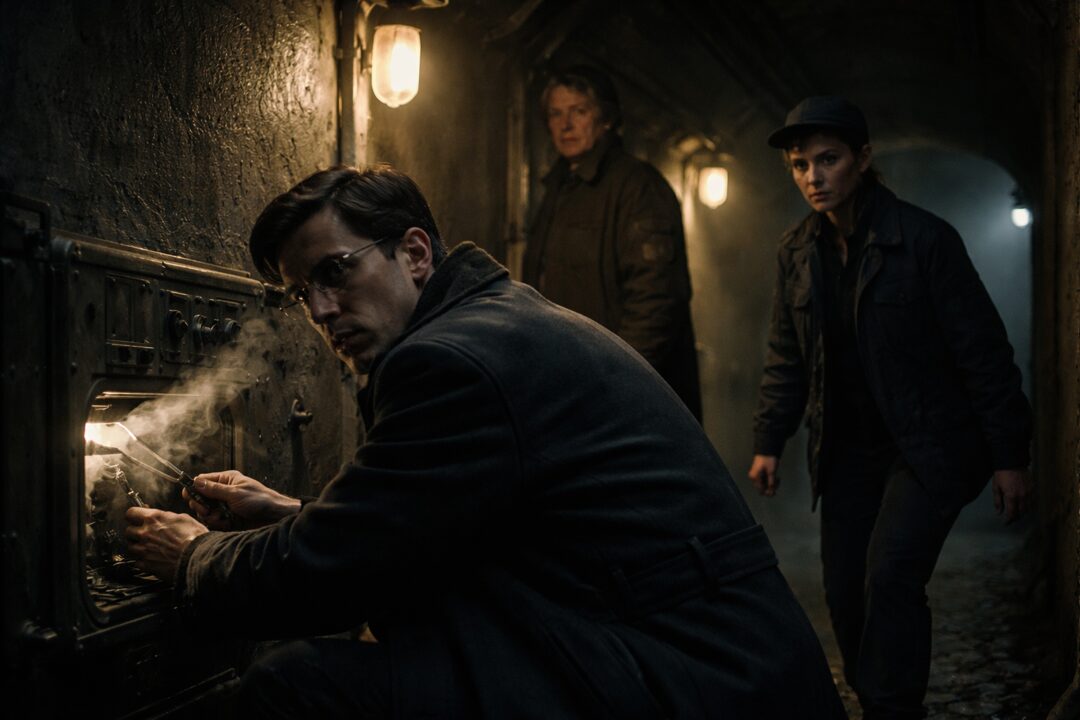
At twenty-one hundred the tunnel was colder than the field above it.
Thomas carried the calibration kit. Miriam walked beside him with a crate trolley and a civilian work pass no guard ever read closely enough. The cover story was routine: thermal verification before final seal confirmation.
The lie worked because the site had grown used to procedure.
That was the nature of the whole story, Thomas thought. People accepted what came wrapped in procedure.
They reached the hatch. Thomas knelt at the panel, hands steady because they had long practice pretending to be. Miriam stood watch at the bend in the tunnel. Somewhere beyond the walls machinery pulsed. The metal beneath his fingers held a faint residual warmth.
Inside, barely audible, came the sound.
Not frantic now. Not scratching.
Only the small, exhausted movement of living things in the dark.
Thomas opened the lower maintenance plate and reached for the secondary latch pin. His gloves made the work clumsy. He pulled them off. The steel burned with cold.
“Hurry,” Miriam said softly.
He eased the pin free. A whisper of warm air touched his wrist.
Footsteps sounded in the tunnel.
Not Mercer. Too light, too quick.
Lena came around the bend and stopped when she saw the open plate.
For one suspended second no one moved.
Then she looked at Thomas, then at Miriam, then at the panel. Her face had gone almost blank with pressure.
“If I walk back now,” she said, “you have twenty seconds before I’m asked where I’ve been.”
Thomas rose halfway. He did not plead. He did not explain. The story had gone beyond explanation.
Lena stepped forward, crouched, and held out her hand. “The vent key.”
He gave it to her.
Her fingers moved faster than his had. She unlocked the bypass slit and twisted it hard open. Warm air breathed into the tunnel in a sudden invisible rush. Somewhere within the casing a sensor clicked. Thomas watched the gauge needle begin its slow fall.
“That should do it,” she said.
It wasn’t enough.
Thomas saw at once the drop would be slight, perhaps still recoverable. Mercer would call it fluctuation. London would call it acceptable.
“No,” he said. “Not enough.”
Miriam was already moving. “The interior seal.”
Lena looked at him once more. This was the true choice, the last one. Not whether to interfere. Whether to make interference irreversible.
Thomas reached into the maintenance cavity and found the emergency release cable hidden behind the insulation wrap. It was there for catastrophic overheating. He had placed it there himself months earlier, proud of the redundancy.
“Do it,” Miriam said.
He pulled.
The inner baffle unlocked with a violent metallic crack. Warmth surged out. Feathers burst into the narrow slit like a torn pillow. Something inside thrashed once, then the tunnel filled with a sound Thomas would remember longer than any line of data: not loud, not dramatic, just the stunned, ragged commotion of life abruptly meeting air.
Alarms did not scream. This was not that kind of catastrophe.
Instead the gauges rolled downward with humiliating speed.
From the control room above came the muffled bark of voices.
Lena shut the maintenance panel and stood. “Now it fails honestly.”
Mercer appeared at the far end of the tunnel almost at once, two officers behind him. He took in the three of them, the loosened plate screws on the floor, the faint drift of feathers in the yellow light.
For the first time Thomas ever saw, Mercer’s composure cracked—not into rage, but into recognition.
He knew exactly what had happened.
He also knew what he could not say.
To accuse them plainly would require him to explain why the weapon contained living birds at all. The grotesque ingenuity that had been his private triumph would become public absurdity.
The officers behind him looked from face to face, confused by the silence.
Mercer turned to the nearest gauge repeater. The numbers were still falling.
“Seal breach,” Lena said before anyone else could speak. Her voice was clipped, professional, nearly cold. “Thermal integrity compromised during pre-certification access. Resulting data invalid.”
Thomas looked at her. She did not look back.
Mercer understood the offer in that sentence: not innocence, but cover. A version of events the institution could survive.
He held Thomas’s gaze for a long moment. “Doctor,” he said at last, “is that your assessment?”
It was the last trap.
Thomas thought of all the words he had hidden behind. Viability. Allowance. Stability. Mercy.
He said, “Yes.”
Mercer’s face turned unreadable again.
“Then the run is void,” he said.
One of the younger officers protested. Mercer cut him off with a glance. “Void means void.”
And just like that, the project began its burial. Not with a moral reckoning. With a contaminated result.
Miriam looked toward the sealed chamber. Her jaw worked once. She was listening.
The sounds inside had gone quiet.
That quiet was not relief. It was only the end of one kind of pressure.
Outside, snow had started again by the time Thomas emerged from the tunnel.
By morning the language was already changing. Unsuitable. Unstable. Impractical under field conditions. The report did not mention feed, or feathers, or the heat of living bodies trapped behind steel. It did not mention that the design had nearly succeeded.
Mercer remained at his post, though no longer with the same easy gravity. Something in the project’s sheen had gone dull. London disliked embarrassment more than it disliked cruelty. That, too, was a kind of mercy twisted wrong.
Lena’s promotion vanished without being formally denied. She was reassigned to ordinary logistics by spring. When Thomas saw her once in passing weeks later, she gave him the smallest nod, as if acknowledging a debt neither of them wanted spoken aloud.
Miriam returned to the supply farm. Thomas went to see her only once. She was carrying feed into a long wooden shed. She set the sack down and looked at him without softness.
“You stop anything?” she asked.
“This version of it.”
She nodded. “That’s usually all anyone stops.”
It was not forgiveness, but it was not dismissal either.
Thomas left the program before summer. Officially by request. Unofficially because he could no longer bear the ease with which a mind like his converted wrongness into terms.
The final morning he visited the old test field one last time.
The trench had been filled. The sheds stood half empty. Frost silvered the wire fences. Somewhere nearby, from the farm beyond the rise, came the ordinary restless sound of chickens waking—scratching straw, shifting on roosts, fussing toward light.
He stood still and listened.
Months earlier, that sound inside steel had struck him as an intrusion, something obscene because it did not belong. Now he understood that wasn’t the whole of it. What had truly unsettled him was how quickly he had learned to make it belong. How easily a living sound became a variable once it solved the right problem.
The morning was bitterly cold.
Beyond the fence, the birds kept moving in the open air, unseen but unmistakably alive.
Thomas put on his gloves and walked away before the sun was fully up.