The Name Beneath the Carbon Copy
Part I — The Line Through His Name
Ruth Vale found her father’s name because someone had tried so hard to erase it.
The paper was folded into quarters and hidden inside the back of a kitchen drawer beneath rubber bands, dead batteries, and seven government envelopes Leon had never opened. The drawer stuck halfway out. She had to yank it twice. When it came loose, the old paper slid over her knuckles and fell open on the floor.
She bent to pick it up.
At the top, in faded type, it read: Recommendation for Medal of Honor.
Halfway down the page, a line had been drawn through Staff Sergeant Leon Vale so hard it had torn the fiber. Above it, neatly typed, was another name.
Ruth stared long enough for the television to change segments.
A bright young anchor was smiling beside a photograph of a decorated war hero whose story had already been polished into something easy. Courage. Sacrifice. Country. The kind of clean national sorrow that fit between commercials.
Behind her, in the next room, Leon coughed once, then went quiet.
Ruth walked in holding the paper. “What is this?”
Her father sat in his chair near the window, a blanket over his knees though the room was warm. The apartment was narrow and careful. Every object had a place. Every surface was clean. It felt less like a home than a room someone had agreed to keep using out of habit.
Leon looked at the paper once, then at Ruth. His face did not change.
“Something old,” he said.
“They crossed out your name.”
“Yes.”
He said it like she had pointed out rain.
Ruth was thirty-nine years old and still hated how easily he could make anger feel childish. “You kept this?”
“It was mine.”
“No, it wasn’t. That’s the point.”
On the television, the anchor lowered her voice reverently. A string section swelled underneath her. Ruth switched it off.
The silence that followed was sharper than the music had been.
Leon watched her without blinking. Age had thinned him but had not made him soft. He was still elegant in a severe, almost stubborn way. His hands were precise even when resting. There was a white scar near his temple, pale as chalk. When Ruth was little, she used to trace it in the air and wait for him to tell her where it came from. He never did.
She held up the paper again. “Did they send this to you?”
“No.”
“Then how did you get it?”
“That,” he said, “is a longer story than you want.”
“You don’t know what I want.”
He looked toward the drawer she had left open. “You found the letters too.”
Ruth crossed the room, pulled the envelopes from her bag, and dropped them onto the table. Most had military seals. A few were stamped urgent. One was already yellowing at the fold.
“You didn’t open any of them.”
“No.”
“Why?”
He leaned back, as if the answer bored him. “Because unopened things still have manners.”
Ruth almost laughed. It came out harsher than that. “Do you hear yourself?”
Before he could answer, the telephone rang.
Leon did not move.
It rang again. And again.
Ruth picked it up on the fourth ring. “Hello?”
A man’s voice, careful and formal. “Ms. Vale? My name is Daniel Mercer. I’m calling from the National Archives. I was hoping to speak to Mr. Leon Vale, but I understand he may be… reluctant.”
Ruth looked at her father. Leon had turned his head toward the window.
“What do you want?” she asked.
There was a pause. Paper shifting. A man choosing every word before letting it live.
“I believe,” he said, “that your father’s military record was not merely overlooked. I believe it was altered.”
Ruth’s grip tightened.
Across the room, Leon closed his eyes.
And suddenly she understood that whatever this was, he had known it was coming.
Part II — The Things He Would Not Name
Daniel Mercer did not look like a man built for confrontation.
He was narrow-shouldered, carefully dressed, and slightly stooped, as if decades of reading over boxes had bent him by fractions. His wire-rim glasses flashed under the fluorescent lights of the records room. He carried two folders and an apology in the way he held himself.
“I appreciate you coming,” he said.
Ruth had not come out of appreciation. She had come because the line through her father’s name had kept burning behind her eyes.
Daniel led her to a table in a side room. On it lay copies of personnel records, dispatch reports, award recommendations, and witness summaries. The folders were tagged with colored slips and dates in small, exact handwriting.
“I found the inconsistency during a routine review,” he said. “Cases from the war are periodically revisited. In your father’s file, there are references to commendation language that does not match the publicly recorded outcome.”
“Speak plain.”
He nodded, accepting the rebuke. “A man was recommended for the highest honor. The surviving paperwork suggests that man was your father. But the final record honors someone else and reduces your father’s actions to supporting duty.”
Ruth stared at the first page he slid toward her. “Suggests?”
Daniel hesitated. “I prefer certainty.”
“My father lived without it. You can risk it for a sentence.”
For the first time, Daniel looked straight at her. “Yes. It was him.”
He opened the second folder.
There were pieces of Leon she had never been given. A school record showing fluency tests in French and German before he was eighteen. A handwritten note from a commanding officer in Italy calling him “the only man in the unit who can speak to civilians, prisoners, and command without losing the shape of what’s meant.” A photograph of a young Black soldier standing slightly apart from the others, chin lifted, face unreadable.
And then stranger things. Mention of a border conflict before his official service. Reference to volunteer activity in Spain. Not rumor. Not embellishment. Enough corroboration to harden into fact.
Ruth looked up. “He was telling the truth?”
Daniel frowned. “About what?”
“When I was ten, he once told me he had fought in three wars before he learned how to sit still. I thought he was being impossible on purpose.”
Daniel’s expression changed. Not surprise. More like sorrow with edges. “Your father fought young.”
“How young?”
He turned a page. “Fifteen, by our best estimate.”
Ruth let out a sound that was not quite disbelief and not quite anger.
Daniel kept going because stopping would only make it heavier. “He learned languages early too. Probably out of necessity before talent became visible. By twenty, records place him with volunteers in the Spanish Civil War. Later, in Europe, he becomes indispensable. Not just brave. Useful in ways command relied on.”
“Useful,” Ruth repeated.
Daniel heard the contempt and did not defend the word. “Yes.”
She sat back. The room felt colder. It was one thing to discover greatness. It was another to discover how long greatness had been treated like equipment.
That evening she went to Leon’s apartment without calling.
He opened the door in his shirtsleeves, looked unsurprised, and walked back inside before she had spoken. He trusted his own gravity to pull people after him.
Ruth stood in the doorway for a second before following.
“You were in Spain,” she said.
He reached for the kettle. “For a while.”
“You were in another war at fifteen.”
“For less than a while.”
“You speak five languages.”
“Five is a number people like. It sounds complete.”
She slammed Daniel’s copies onto the table. “Can you stop answering me like a crossword clue?”
Leon looked at the papers, then at her face. Something in him tightened.
“You went digging.”
“They called me. You left me to find out this way.”
“I left you out of it.”
“Don’t flatter yourself.”
The kettle began to hum. He turned off the flame before it could whistle.
Ruth stepped closer. “Why didn’t you say anything? Ever?”
“Because saying a thing and being heard are different trades.”
“That’s not good enough.”
“No,” he said. “It isn’t.”
That stopped her for a second. Not because he had softened. Because he hadn’t. He was agreeing without yielding, which somehow hurt more.
She looked around the room—the folded blanket, the sorted books, the untouched letters. “Were you ashamed?”
Leon’s mouth twitched once, with something too thin to be called a smile. “Of what? Surviving? No.”
“Then what?”
He poured hot water into two chipped cups. “You think if the country remembers you late enough, it becomes gratitude.”
Ruth did not touch the tea he slid toward her.
He looked at the papers again. “Let the dead stay buried.”
“Those aren’t the dead. Those are records.”
“That’s how institutions bury people.”
His voice stayed level. That was always the worst part. When Ruth was a child, she used to think calmness meant safety. It took her years to understand it could also mean distance so complete it made you feel foolish for needing more.
She picked up one of the letters from the drawer and held it out. “Why keep these if you were never going to open them?”
For the first time, he looked unsettled.
Not by the letter. By the question.
Then he said, “Because some doors are still doors before you touch them.”
Ruth laughed once, bitterly. “You can talk to strangers in five languages and still not say one straight thing to your daughter.”
He lowered his eyes to the table.
And because that hurt like truth, she left.
Part III — The Mission No One Wanted Attached to Him
The story Daniel reconstructed did not unfold like a biography. It unfolded like a theft.
Each week he found another page, another witness, another contradiction that made Leon larger and the institution smaller.
A field note described him crossing between units in Italy because he could interpret prisoner chatter in German, calm terrified civilians in French, argue with supply officers in clipped military English, and then switch without warning into Spanish with volunteers who still carried the old war in their mouths.
One medic wrote: Vale can make men tell the truth because he listens like he already knows where they are lying.
Another account, older, from Spain, mentioned a Black American volunteer who “did not speak much unless the speaking mattered, but when he did, it was like opening a knife.”
Ruth hated how admiration came so easily when the man himself had made tenderness feel rationed.
That was the complication Daniel could not catalog. He came to her apartment twice a week with copies and notes, and each time he seemed faintly startled by the fact that facts did not settle families.
“He sounds extraordinary,” Daniel said once, almost to himself.
“He also forgot my tenth birthday because a rainstorm made him quiet,” Ruth replied.
Daniel closed the file.
“I’m not saying that to diminish him,” she said. “I’m saying don’t make him easy.”
“I’m trying not to.”
The decisive mission took longer to surface because the official version had been shaved down until it looked administrative.
The real shape of it came from three separate sources: a damaged after-action report, a witness statement from a dead corporal, and a penciled draft in Colonel Thomas Weller’s hand that Daniel found misfiled behind logistics correspondence.
By then Ruth had begun reading with the appetite of someone who both dreads and needs the next page.
The unit had been pinned outside a small Italian village. Their lieutenant was dead. Communication had failed. Two machine-gun positions had trapped the company in exposed ground while civilians were still moving through the lower streets. Prisoners taken earlier had spoken of an artillery correction team farther uphill, but nobody could confirm the exact location fast enough.
Leon had not been in command. He was there because command needed his languages.
When the lieutenant went down, Weller’s draft noted that “Sgt. Vale assumed temporary functional authority absent formal assignment.”
Temporary. Functional. Even the pencil tried to keep him from sounding like what he was.
The corporal’s witness statement was less careful.
He stood up because nobody else could see the whole problem. He got us moving because he was the only one not waiting for permission from a dead man.
Ruth read that sentence three times.
According to the accounts, Leon crossed open ground under fire to reach two captured German soldiers being held behind a broken wall. One was wounded. One was pretending not to understand English. Leon switched languages until the man answered by reflex. From them he got the position of the artillery observers and the route around the lower ridge.
Then, instead of staying put, he took three men and moved.
The witness statement broke there for a page, then resumed in shakier script.
He knew the machine-gun line could see him. He kept moving anyway. Didn’t crawl. Didn’t hide. Moved like if he stopped, we all died stupid.
Ruth shut her eyes.
The rest came hard and fast. Leon led the flank around the ridge, took one position by surprise, forced the surrender of two enemy soldiers, and used their confusion to close on the second nest before they could reorient. Under renewed fire, he returned with the captured men and the location of the artillery team, making it possible to neutralize the strike before the trapped company was wiped out.
Dozens lived because he could think in fragments while bullets tore the air apart.
Daniel laid down the final witness page. “This is enough for the recommendation. More than enough.”
Ruth’s mouth had gone dry. “And still—”
“Yes.”
“Who got the medal?”
Daniel’s pause was answer enough before he gave the name. A white officer who had been present, brave in his own right, later politically useful, eventually celebrated in newspaper features and reunion halls.
Not a fraud. Which somehow made it uglier.
A week later Daniel called Ruth with a change in his voice.
“I found the drafts.”
She met him at the archives before work.
The room seemed smaller that morning. Daniel placed two nearly identical documents side by side. Same form. Same date. Same mission.
In the earlier version, Leon’s actions were central. Explicit. Named. Command taken. Prisoners interrogated. Gun positions captured. Lives saved.
In the revised version, Leon was reduced to assistance. Interpretation. Support under hostile conditions. The active verbs had migrated upward to the officer who would later receive the honor. Leon’s courage had been rearranged into somebody else’s story.
Ruth’s hands went cold.
“This isn’t drift,” she said.
“No.”
“This is choice.”
“Yes.”
She looked at the typewritten replacement name. Clean, straight, untouched. Then at the torn line through Leon’s.
It was not abstract anymore. It was physical. Somebody had decided exactly where to put pressure on the page.
Ruth stood up so abruptly the chair scraped.
Daniel half-rose with her. “Ms. Vale—”
“Don’t.”
She turned toward the window, then back again because standing still felt impossible. “All this time I thought maybe he was dramatic. Maybe proud. Maybe impossible just because that was easier than being honest.”
Daniel said nothing.
She put both hands on the table and leaned over the papers like she wanted to force them to confess more.
“They knew.”
“Yes.”
“And they let him live with it.”
Daniel looked down. “Yes.”
Something in Ruth hardened then. Not into forgiveness. Into purpose.
“Tell me what we do next.”
Part IV — The Wrong Man for the Right Story
The closer they came to formal review, the less Leon resembled a man waiting to be vindicated.
He became sharper, not softer.
When Ruth told him Daniel had enough for a hearing, Leon only said, “Then he has enough to waste everyone’s time properly.”
She had expected resistance. Not contempt so clean it almost looked like relief.
“You deserve the record corrected,” she said.
He sat at the kitchen table sorting old receipts into perfect squares. “Deserve is a noisy word.”
“This isn’t about deserving. It’s about truth.”
“Truth from whom?”
“Does it matter?”
He looked up then, and she saw the old steel in him so clearly that for a second she felt twelve years old again, standing in a doorway while he put on silence like a coat.
“Yes,” he said. “It matters most from them.”
She took a breath and sat across from him. “Then tell me what happened after.”
He knew what she meant. Not the mission. The quiet after the mission. The part he had left sealed.
For a long time he said nothing.
Then he reached into the drawer, past the unopened letters, past the crossed-out recommendation, and pulled out a small folded page Ruth had never seen.
It was onion-skin thin. The crease had been worried soft over the years.
“When it was over,” he said, “Colonel Weller sent for me.”
Ruth did not move.
Leon unfolded the page but did not hand it to her. “He was a careful man. The kind who thought his decency was proven by how rarely he shouted.”
His voice stayed flat. That made the memory worse.
“He thanked me for my courage. He told me I had done what few men could have done. Then he said the country needed stories it could absorb. He said timing mattered. Optics mattered. Symbolism mattered.” Leon’s mouth hardened. “He said I was the wrong man for the right story.”
The room seemed to shrink around the sentence.
Ruth whispered, “He said that to your face?”
“Yes.”
“And you did nothing?”
Leon’s eyes lifted to hers. “You think I did nothing because I didn’t beg.”
“That’s not what I said.”
“No. It’s what you have thought for years.”
He placed the page on the table. It was not Weller’s note. It was Leon’s own hand, written later in a controlled script so even the fury had been disciplined.
Wanted the action. Not the face. Wanted the result. Not the witness.
Ruth looked up.
Leon said, “By then I understood the offer. Be useful. Be brave. Be silent enough for someone else to wear the meaning.”
Her throat tightened, but not into pity. Into something more difficult.
“Why not fight it anyway?”
He gave a tired, almost private smile. “With what? Faith?”
“You could have spoken.”
“To whom? Men who needed me unnamed to admire themselves honestly?”
Ruth flinched.
Leon saw it and did not retreat. “That medal would not have come as apology. It would have come as laundering. A way to say the system worked late, and therefore worked. I had no interest in helping them say that.”
“And me?” she asked, too fast. “What about me?”
The question hung there before she could take it back.
Leon’s face changed—not much, but enough. This was the wound beneath the public wound. The one they kept circling without naming.
Ruth pushed on because stopping now would be cowardice. “You let the whole thing rot in a drawer. You let me grow up thinking you were just… difficult. Proud. Half gone. Do you know what that does to a child? To live beside a locked door and think maybe you are the reason it won’t open?”
Leon’s hands, still precise after all these years, folded once over each other.
“When you were young,” he said, “I thought if I kept certain things untouched, they could not reach you.”
She laughed, furious. “They reached me anyway.”
Yes moved through his face, though he did not say it.
That evening Daniel called with the last witness statement.
It came from Corporal Henry Pike, recorded decades earlier and forgotten in a veterans’ oral history box under the wrong unit designation. Daniel read the crucial lines aloud because paper alone could not carry the shock.
“Pike says that before Vale moved on the ridge, he heard one of the officers say, ‘If he can get close enough, let him. Easier to explain after.’”
Ruth sat down hard on her own kitchen chair.
Daniel’s voice dropped. “Your father knew they were willing to spend him.”
She closed her eyes.
That reconfigured everything.
Not just the mission. Not just the medal.
It meant Leon had crossed that ground already understanding the terms. He had not moved because he trusted the men above him. He had moved because the men beside him would die if he didn’t.
Admiration came back then, but changed. Less clean. More terrible.
Daniel cleared his throat. “The review is next Thursday. Press interest is building.”
“He won’t go.”
“Then you’ll have to decide whether the record can be corrected without him.”
Ruth opened her eyes.
“No,” she said. “He doesn’t get to vanish and let them narrate his refusal too.”
Part V — What He Would Not Let Them Call Redemption
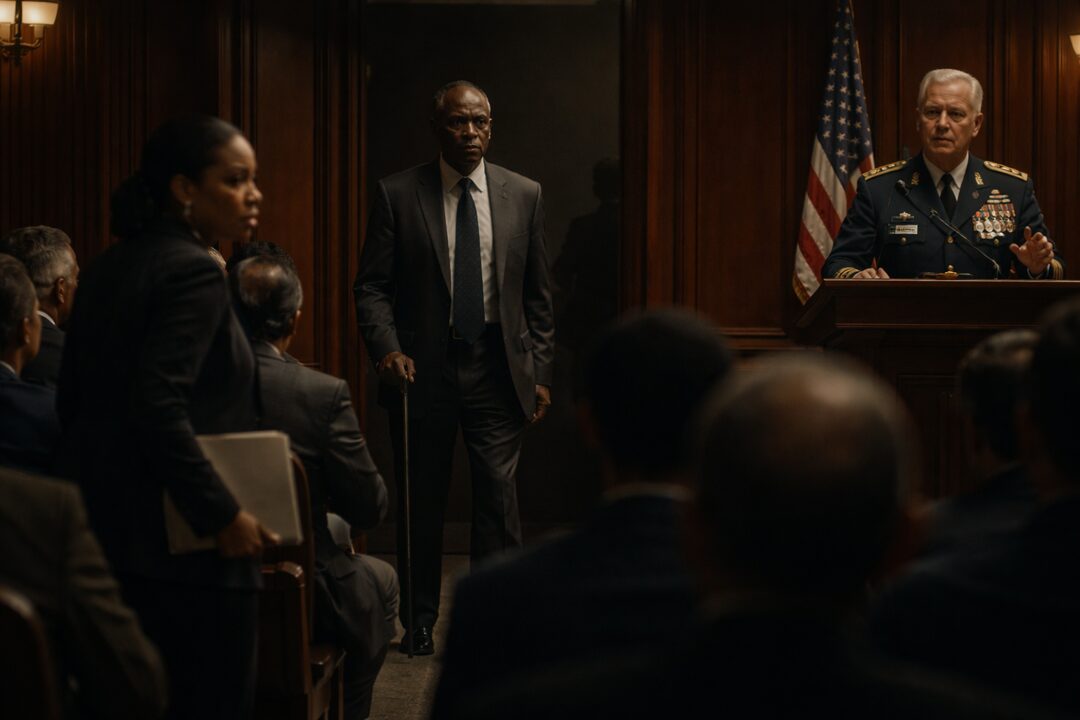
The hearing was held in a wood-paneled room designed to make authority feel solemn and unbreakable.
Flags stood in the corners. Brass shone. Reporters lined the back wall with notebooks ready. A colonel from the present day reviewed opening remarks in the low, ceremonial tone institutions use when they want history to sound healed.
Ruth sat in the second row beside Daniel Mercer.
Daniel had dressed even more carefully than usual. His folders were stacked in exact order, tabs visible, originals and copies arranged so no hand could misplace what mattered. His caution had become a weapon.
Leon’s chair was empty.
Ruth kept looking at it against her own will.
The room filled. The colonel stepped to the podium. He began with service. Sacrifice. The nation’s enduring gratitude.
Ruth felt her jaw lock.
This was exactly the language Leon had hated: broad enough to cover everything, smooth enough to cut nothing.
The colonel turned a page. “It is through honest review that institutions demonstrate their capacity for self-correction and—”
The back door opened.
Every head in the room turned.
Leon Vale entered in a plain dark suit that hung slightly loose on his lean frame. No medals. No uniform. No borrowed shine. He walked with a cane he clearly resented and moved with the same old composure that made even weakness look chosen.
Ruth rose before she knew she was doing it.
Leon did not look at the reporters. He did not look at the flags. He came straight down the aisle and stopped beside her.
For one second, neither spoke.
Then Ruth said, very quietly, “You came.”
His eyes stayed on the podium. “Don’t make it sentimental.”
And because it was him, because even now tenderness had to arrive sideways, her throat tightened anyway.
The colonel recovered first. “Mr. Vale. We are honored by your presence.”
Leon took his seat.
Daniel’s fingers tightened once on the edge of the file.
Proceedings resumed. Daniel was called to summarize the documentary record. He did it without flourish. Drafts. Witness statements. revisions. administrative substitution. corroboration. His voice never rose, which made the facts harder to escape.
Then the colonel returned to the podium and said the word Ruth had feared.
“Today,” he began, “we have the opportunity not only to recognize extraordinary bravery, but to affirm the military’s enduring commitment to justice and redemption—”
“No,” Leon said.
He did not shout.
The room froze anyway.
Leon rose slowly, one hand on the cane, then let go of it when he was steady. The colonel stared at him, startled less by interruption than by refusal without permission.
“No,” Leon repeated. “You may recognize the record. You may correct the file. But do not call delay redemption.”
A reporter’s pen stopped mid-scratch.
The colonel attempted a careful smile. “Mr. Vale, I believe we are all here in a spirit of—”
“Comfort?” Leon asked. “Closure? Institutional grace?”
His voice was low, worn, and perfectly clear.
“I crossed that ground because men were going to die if I did not. I did not cross it for a future room where strangers could praise the patience of a system that knew exactly what it was doing.”
No one moved.
Leon looked not at the colonel, but at the audience behind him—the officials, the reporters, the polished heirs of other men’s decisions.
“You have the revised recommendation,” he said. “You have the original. Put them together and call it what it was. Not oversight. Not unfortunate delay. Choice.”
His hand rested on the back of the chair. Ruth could see the tremor in it now, faint but undeniable.
He went on.
“You wanted action without consequence. Use without witness. Courage without the inconvenience of my face attached to it.” He paused, and when he spoke again his voice dropped into something so plain it cut deeper than anger. “The country has always been fond of what Black men can save. It has been less fond of what it must admit once we do.”
A sound moved through the room. Not applause. Something more unsettled.
Ruth rose then too.
Not because she had planned to. Because standing beside him had become the only honest thing left to do.
She held up the copied drafts Daniel had prepared. “The corrected file should include both versions,” she said, her voice steadier than she felt. “The original recommendation and the altered one. The honor and the theft. If you preserve only the final outcome, you erase the crime a second time.”
Daniel stood as well, papers already in hand. “That has been arranged,” he said. “Both documents, plus witness corroboration, will enter the permanent record under linked archival custody.”
The colonel looked from one of them to the other, understanding too late that the room had shifted beyond ceremony.
He tried again, softer. “Mr. Vale, the recommendation for the Medal of Honor will be restored.”
Leon nodded once.
Not grateful. Not triumphant.
“As record,” he said. “Not absolution.”
The quote would appear in newspapers the next morning. It would be repeated badly by television hosts and more honestly by veterans who had learned too late what had happened. Some would call him bitter. Some would call him brave. Most would use him for whatever language they already trusted.
But in that room, for that minute, Leon controlled the meaning.
When it was over, he sat down too quickly.
Ruth caught his arm before he slipped.
Their eyes met.
He looked tired in a way she had never let herself fully see.
“Easy,” she murmured.
It was the gentlest word she had offered him in years.
He did not thank her. He did not need to.
His weight leaned, just briefly, into her hand.
That was all.
It was enough to hurt.
Part VI — The Restored File
Leon died three months later, in late rain.
The funeral was small because he would have hated a large one. A few veterans came. Daniel came in a dark coat with water on the shoulders. Ruth stood through the service feeling less like grief was falling on her than like it had been waiting in the walls for years and had finally decided to step forward.
The medal arrived in a velvet case.
She did not open it for two days.
When she finally did, she looked at it for less than a minute before closing the lid again. It was heavy, immaculate, and much too late. She did not hate it. That would have been simpler. She only understood, now, how little metal could do against time.
A week later she went to the National Archives.
Daniel met her in the reading room with the same stooped carefulness, but there was something altered in him too. Not peace. More like a man who had finished one honest act and would have to live with how long it took.
“It’s ready,” he said.
He brought out the restored file in a gray archival box.
Ruth put on the white gloves they offered her and hated them immediately. History always wanted clean hands after the damage was done.
Inside were the pages she knew and the ones she had not yet seen together: the original recommendation naming Leon clearly; the altered draft with his name cut out; the witness statement from Henry Pike; the hearing transcript; the final corrected record.
The shape of the theft was visible now because no one had been allowed to smooth it flat.
Ruth read in silence for a long time.
Then she reached into her bag.
“I brought something,” she said.
Daniel watched as she unfolded a fragile scrap of ration paper. On the back, in Leon’s narrow disciplined hand, were columns of words: bread, river, surrender, wait, mother, fire, home. English. French. German. Spanish. Italian. Some lines were crossed out and rewritten, not because the meanings were wrong, but because the shades of them were.
Ruth smiled despite herself.
Even here, he had been arguing with precision.
“I found it tucked inside a dictionary,” she said. “He must have kept it from the war.”
Daniel did not speak.
She placed the ration slip beside the corrected citation.
For a moment the objects seemed to explain each other without help: the practiced languages, the crossed-out name, the restored record. The range of the man. The uses made of him. The life spent translating danger for others while refusing to let the final translation be done without him.
Daniel cleared his throat. “Would you like me to note it as a family contribution to the file?”
Ruth kept looking at the paper.
“Yes,” she said. “But don’t separate it.”
“No.”
“It belongs beside the drafts.”
“Yes.”
She nodded.
There was one more thing she wanted to say, but it would not come out neatly enough for speech. That was fitting. Not every truth improved when spoken.
She stood there with the file open and thought of Leon in his apartment, refusing to open letters because unopened things still had manners. She thought of the line through his name. Of the sentence that had finally broken loose into air: the wrong man for the right story.
He had been wrong about one thing.
They had not reached her anyway.
They had made her.
Ruth closed the box with both gloved hands, then rested them on top of it for a second, as if feeling for a pulse that had moved elsewhere.
When she looked up, the reading room windows were filmed with rain.
For the first time, the sound did not feel like something being sealed.
It felt like a record being made harder to burn.