The Morning They Called Dangerous
Part I — Before the Doors Opened
By five in the morning, Malik Freeman already knew which children would ask for seconds without asking.
He stood in the church basement with his sleeves rolled high and his coat hooked over the back of a folding chair, counting hard-boiled eggs into chipped bowls while steam climbed off a dented pot of grits. He worked without hurry and without waste. Three extra bananas for the Johnson twins. Half a scoop more for Leon because the boy had started looking hollow at the cheeks. Milk cups near the front for the children too young to carry full trays without spilling.
The room smelled like toast, soap, and coffee strong enough to wake the dead.
Mrs. Hester, who had been in church kitchens longer than Malik had been alive, was slicing apples with the speed of insulted pride. “You know what they’re saying uptown?” she asked.
Malik kept loading trays. “They say a lot.”
“They say feeding children before school is subversive now.” She snorted. “That’s a new one even for this country.”
He set a spoon down, reached for another, and said, “Then they must know it works.”
Mrs. Hester looked at him for one quiet second, then went back to her apples.
The church basement was not beautiful in any official way. The paint was tired. One radiator knocked like it had a grievance. The folding tables never stood quite level. But every morning Malik made the room feel orderly enough that no child had to enter it like a beggar.
That mattered to him more than the food.
He straightened the line of trays until the cups faced the same direction. He checked the fruit again. He wiped down a spot on the serving table no one else would have noticed. To some people, breakfast was breakfast. To Malik, the room itself was part of the meal. A child should be able to walk in hungry and leave without feeling accused.
At half past five, the first volunteers arrived, stomping the cold from their shoes and carrying paper sacks of bread, jars of jam, another crate of oranges from a grocer who preferred not to be thanked in public. By quarter to six, the rhythm had taken hold—plates stacked, napkins counted, spoons set, coffee poured, grits stirred, laughter kept low because the room still belonged to the dark outside.
Then a man Malik had never seen before came down the basement stairs.
Not a parent. Not a church member. Not hungry.
He wore a plain brown overcoat and the kind of fedora men used when they wanted to look ordinary and ended up looking arranged. He paused at the bottom of the steps like he was evaluating a crime scene.
“You in charge here?” he asked.
Malik did not answer right away. He put a stack of bowls in place and looked up. “Depends who’s asking.”
“Concerned citizen.”
Mrs. Hester made a sound under her breath that could have soured milk.
The man smiled without warmth. “Just wondering where the food comes from. Whether anybody’s inspected this setup. Whether the parents know who’s behind it.”
The room went very still. Even the radiator seemed to stop complaining.
Malik wiped his hands on a towel. “Parents know their children get fed.”
“That wasn’t my question.”
“No,” Malik said. “It wasn’t.”
The man took two slow steps farther in, studying the trays, the fruit, the coffee urn, the church posters on the wall. “A lot of people are concerned about outside influences,” he said. “Especially around children.”
Mrs. Hester put down her knife. “You got children of your own?”
He ignored her.
Malik stepped closer, not threatening, just present. Lean, tired-eyed, wearing a plain work shirt and a black beret he’d set back on without thinking. “You came here before dawn to ask who fed hungry kids. That tells me more about you than it does about us.”
The man’s jaw tightened. “Just making sure people are safe.”
Malik glanced at the washed fruit laid out in rows, the spoons lined like instruments, the pots scrubbed to shining metal after every use. “Then you can see they are.”
For a second the man looked like he wanted a mess and hated finding none. Then he turned toward the stairs.
On his way out, he stopped and said, “Sometimes people use charity to hide other things.”
Malik answered him without raising his voice. “Sometimes people use concern to do the same.”
The door shut behind him.
Mrs. Hester exhaled first. “That one had government in his shoes.”
Malik looked at the stairs another beat too long. “Open the doors on time.”
And they did.
Children began arriving in twos and threes, breath fogging in the cold, school shoes squeaking, voices lifting the room into morning. The Johnson twins argued over jelly packets. Leon grinned at the sight of oranges. A girl named Ruth, serious as tax law, nodded to Malik like they were coworkers on a very important job.
He nodded back.
That was how Evelyn Carter first saw him: not making a speech, not collecting gratitude, just handing a tray to a child as if the child had a right to be there.
She stayed in the doorway with her son’s hand wrapped tight in hers.
David was eight, all sharp elbows and watchful eyes, his school shirt buttoned neatly beneath a coat that had been carefully mended at one cuff. He looked at the room the way children look at places they want to trust but haven’t yet been given permission to.
Evelyn didn’t move.
Malik noticed them anyway.
He noticed everything.
He walked over, wiped his hand once more on the towel, and said, “Morning.”
She straightened a little. “We don’t want to be in the way.”
“You’re not.”
David kept staring at the trays.
Malik looked at him, not at the thinness under the boy’s coat, not at the hesitation in his mother’s face. “You like apples or oranges?”
David glanced up at Evelyn before answering. “Oranges.”
“Good,” Malik said. “You look like a boy who takes oranges seriously.”
It was the first thing that almost made David smile.
Evelyn’s shoulders loosened by a fraction. “I heard about this place,” she said. “I just—”
She didn’t finish. She didn’t need to.
Malik had heard the unfinished part before, in a dozen different voices. I just didn’t want to be seen. I just didn’t think it was for us. I just thought there’d be a catch.
He stepped aside and gestured to the tables. “You can sit where you want. Nobody’s keeping score.”
Something changed in her eyes at that line. Not trust. Not yet. But the ache of someone who had lived too long with invisible scorekeepers.
David took his tray with both hands, careful and solemn. He chose the same chair he would choose every morning afterward: third from the window, near the radiator, where he could see the serving table and the stairs at once.
Malik clocked it immediately and said nothing.
Outside, dawn finally broke across the church windows.
Inside, breakfast was served like it was the most ordinary thing in the world.
By noon, people were saying the food might be poisoned.
Part II — What Shame Costs
Rumor moved faster than hunger.
By the next morning, two mothers who had come every day that week did not show. By the morning after that, the line was shorter by six children. One father lingered on the church steps and asked whether the milk was being checked. Another said he had heard “political people” were using the breakfast to recruit.
Malik wanted to ask whether an empty stomach was less political because it arrived quietly.
He did not.
He answered every question the same way—plainly, without insult. He showed the kitchen. He named the grocers and church ladies and neighbors who donated what they could. He opened cupboards. He washed fruit in full view. He kept his temper where the children couldn’t see it.
The hardest part wasn’t the slander. It was the way slander entered the room and changed how some children held their trays.
A hungry child could be fed. A child who thought they were doing something shameful by eating was harder to reach.
On Thursday, the local grocer who had been sending oranges stopped by just long enough to avoid coming inside.
“City inspector paid me a visit,” he said from the doorway, eyes sliding away. “Talked permits. Storage. Cleanliness. Suggested I keep my distance for a while.”
“For a while,” Malik repeated.
The man spread his hands. “I got a business.”
“So do we,” Malik said.
The grocer flinched, nodded once, and left empty-handed, which somehow felt worse than if he had come to demand his crates back.
That same morning, Evelyn returned.
She came earlier than before, as if arriving under dimmer light might make her less visible. David walked close to her side, lunch tin dangling from one hand. When they stepped inside, he looked immediately toward his chair near the radiator.
It was empty.
He relaxed.
Malik noticed Evelyn notice that he had noticed.
“Morning,” he said.
She gave him a careful nod. “Morning.”
No apology for returning. No explanation for why she had nearly not come. He respected her for that.
David took his tray, then paused. “Is there still oranges?”
“One left with your name fighting for it,” Malik said.
This time David smiled for real.
Evelyn watched that smile like it had cost something to survive.
After the children sat, she stayed standing near the sink, hands clasped too tightly. Mrs. Hester gave her thirty seconds of dignity and then said, “You can either stand there looking respectable or you can help me with these cups.”
Evelyn blinked. “I didn’t come to—”
“That’s good,” Mrs. Hester said. “Nobody likes a martyr before sunrise.”
For the first time, Malik heard something close to a laugh catch in Evelyn’s throat.
She tied on an apron.
That was how it began.
Not with a declaration. Not with a sudden conversion. Just one pair of careful hands drying cups beside Mrs. Hester while David ate at his chosen seat and Malik watched the stairs a little more than before.
Across town, Thomas Bell was beginning to notice a pattern he did not want.
He was assistant principal at Booker Elementary, a man who believed in polished shoes, firm schedules, and the quiet fiction that systems mostly worked if people would simply behave properly inside them. He disliked disorder on sight. He disliked politics near schools even more. When he first heard that neighborhood organizers were running a breakfast line out of a church basement, his private opinion was that it was theater dressed as charity.
Then he started seeing what happened by third period.
Children who usually sagged over their desks were lifting their hands. The twins who had a habit of fighting before lunch had gone four mornings without incident. David Carter, who normally guarded his workbook like an apology, answered a math question in a clear voice and did not shrink when another boy laughed.
Bell began making marks in the margin of his attendance ledger.
Not official marks. Just small pencil ticks on breakfast days.
He told himself it meant nothing.
Then Friday morning, he found David in the hallway before class, peeling an orange with full concentration.
“You seem in better spirits,” Bell said.
David looked up, wary. “Yes, sir.”
“What’s changed?”
David thought about it. “I eat before I come now.”
Bell stood there a moment longer than the answer required.
He did not write that down.
When he passed the teachers’ lounge later, he heard two women talking in low tones about “those people” feeding children for attention. One said she’d heard the food came from questionable sources. The other said regardless, somebody ought to be doing something about it.
Bell kept walking.
He was a decent man, he liked to think. He simply believed in staying inside the proper lane.
The problem with that belief was how useful it remained until the moment it became shame.
By the next week, Evelyn had become part of the breakfast room without ever fully acting like she belonged to it.
She wiped tables. She stacked plates. She learned where the good towels were kept. She still arrived with her chin slightly lifted, as if daring the room to pity her. No one did.
Malik did less talking with her than with anyone else. He understood that some people trusted you more when you let silence keep its shape.
But he noticed the details.
The way she made sure David’s collar was straight before he sat down.
The way David always chose the same cup.
The way Evelyn checked the stairs every time a stranger’s footsteps sounded above them.
One morning, as she dried bowls beside him, she said without looking up, “If they’re going to keep spreading those stories, you should maybe put up a sign. About where everything comes from.”
“People who want a sign won’t believe the sign,” Malik said.
“Maybe not. But frightened people like to see something written down.”
He glanced at her. “You speaking for yourself?”
She set a bowl in the rack with more force than necessary. “I’m saying fear’s easier to inherit than to question.”
That line stayed with him all day.
By Wednesday, there was a patrol car idling across from the church.
By Thursday, a health complaint had been filed.
By Friday, Bell had enough pencil marks in his ledger to know exactly what he was seeing and not enough courage to say it out loud.
And still, every morning, the line got longer.
That was when Malik began to understand the real problem.
It was not that they were feeding children.
It was that the children kept coming back brighter.
Part III — Proof
The breakfast room changed the neighborhood in ways that did not fit on flyers.
Children began arriving early enough to help set napkins. Parents who had once slipped in with their eyes lowered now stayed an extra minute to say thank you in voices that tried not to sound grateful. Boys who usually ran the streets before school lined up without shoving. Girls who never asked for anything started asking for jam if there was enough.
The room had rules. Wash your hands. Sit down before you eat. No mocking another child for taking seconds. If you break a cup, you say so and help clean it.
Malik enforced every one of them with the same calm seriousness.
That, Bell would later realize, was part of what made the program dangerous. It wasn’t improvised mercy. It was disciplined care.
One cold morning he found himself standing across from the church before school began, pretending he had business on the block.
Children were going down the basement steps in a steady stream.
Not wild. Not disorderly. Purposeful.
He watched David Carter disappear inside, then come back into view through the basement window, sitting in his usual place with an orange and a spoon. Bell had seen that child in school enough to recognize the difference between hunger managed and hunger denied. The difference was not dramatic. It was devastatingly small. Straighter posture. Quicker answers. Less fear around the edges.
He adjusted his glasses and hated himself a little for staying outside.
Later that day, he opened his ledger in the privacy of his office and did the comparison properly.
Breakfast days. Better attendance. Better focus. Fewer disciplinary notes before noon.
He stared at the page until the pencil marks stopped looking accidental.
A knock came at the door.
Principal Harmon stepped in, broad-faced and cautious. “You keeping side notes now?”
Bell closed the ledger halfway. “Routine observations.”
“About that church breakfast operation?”
Bell was quiet just long enough to answer the question he had not been asked.
Harmon studied him. “There are people downtown who don’t want this school seen as endorsing outside agitation.”
“I’m not endorsing anything,” Bell said.
“No,” Harmon replied, “but I’d prefer you not create documents that can be misread.”
When Harmon left, Bell erased nothing.
He only stopped writing.
Across town, Malik got his own answer from a different kind of office.
A man he knew from another chapter of the work pulled him aside behind a print shop and spoke quickly, without names.
“This isn’t local irritation,” the man said. “There’s pressure coming down on these breakfast programs everywhere. You think they care about eggs? They care that parents trust you before they trust the city. They care that hungry children become visible. They care that you’re solving something publicly.”
Malik leaned against the alley wall, jaw tight. “They’re acting like we’re armed in that basement.”
The man looked at him hard. “You are.”
Malik almost laughed at the absurdity.
Then he realized the man meant the trays, the clean tables, the children arriving on time, the mothers staying to help. Proof could be a weapon if it made neglect impossible to deny.
That night he did not sleep much.
The next morning, Evelyn found him scrubbing the serving table twice.
“You missed a spot?” she asked quietly.
“No.”
She dried her hands on a towel. “Then what are you doing?”
He hesitated. He had gotten used to carrying the broader threat alone, thinking that was a kind of protection. But Evelyn had been watching from too close for too long to be put back outside the circle.
“They’re not trying to discredit the program because they think it’s failing,” he said.
She understood before he finished. He saw it in her face.
“They’re doing it because it isn’t,” she said.
He nodded.
Evelyn looked past him at the trays, the cups, the children’s names written in no ledger but his memory. “Then stopping now won’t make us safer.”
“No.”
“But going on might make us easier to hit.”
“Yes.”
They stood in that truth together while water ran in the sink behind them.
After a moment she said, “My boy has started waking up before I call him. You know that?”
Malik glanced toward the stairs.
“He lays out his shirt at night because he likes to get here early enough for the same seat.” Her voice thinned for an instant, then steadied. “Do you know how small a thing that sounds like when you say it out loud?”
“I know how large it is,” Malik said.
She met his eyes then. “I want you to keep going.”
He heard the second part before she said it.
“And I want you to stop making this big enough for them to notice.”
He gave a tired half smile. “Those are fighting instructions.”
“Yes,” she said. “That’s because I’m a mother.”
Later that week Bell came down to the basement for the first time.
Not during breakfast. After.
The children were gone. The tables were being wiped. Malik was tying off garbage bags. Bell stood awkwardly at the bottom of the stairs in a trim suit that seemed too polished for the room.
“I won’t take much time,” he said.
Malik didn’t invite him farther in. “Then don’t.”
Bell took off his glasses, cleaned them, put them back on. “I’ve observed an improvement in classroom performance among students who attend your program.”
Mrs. Hester, stacking cups behind them, muttered, “Well, praise science.”
Bell ignored her. “I’m not here officially.”
“That’s the only reason you’re here at all,” Malik said.
The shot landed. Bell’s mouth tightened.
“I thought you should know,” he said.
Malik waited.
Bell lowered his voice. “There are inquiries happening above the local level.”
“About breakfast.”
“Yes.”
“Then say what you came to say plain.”
Bell looked almost offended by the demand, then perhaps relieved by it. “You are being treated as more than a church charity.”
Malik stared at him a moment. “Because hungry children are reporting better to school?”
Bell did not answer.
That was answer enough.
When he turned to leave, Evelyn stepped out from the pantry carrying folded towels. She and Bell startled at seeing each other. Recognition flickered. Not friendship. School-office recognition. Permission slips. Late notices. The bureaucratic smallness of poor people’s lives.
Bell’s discomfort sharpened. “Mrs. Carter.”
“Mr. Bell.”
He looked at the towel stack in her hands, then at the room around her, and for the first time seemed to understand that the breakfast line was not a concept. It had names. Faces. Mothers who had to meet his gaze later in school offices while he spoke from behind a desk.
He left quickly.
Evelyn watched the stairs after he was gone. “He knows,” she said.
Malik tied the garbage bag hard. “He knew before he walked in.”
“Will he say anything?”
Malik looked at the door. “Not until silence costs him more.”
He meant Bell.
He also meant almost everyone.
Part IV — The Thing They Wanted Broken
The room began to feel hunted.
Not every minute. Not even every morning. That was part of what made it effective. Pressure arrived in doses small enough to be denied if anyone named them. A patrol car parked too long. Two men on the sidewalk pretending to read a notice board. A complaint about fire codes. A woman from the neighborhood saying she would keep her daughter home “until things settled.”
Things never settled. They only tightened.
Malik started coming earlier. Evelyn started leaving later. David, who did not know the full shape of danger, learned its weather. He stopped asking why adults lowered their voices when certain names came up. He simply watched the stairs harder.
One Friday he spilled milk, and before anyone could tell him it was nothing, he whispered, “I’m sorry, I’m sorry, I’m sorry.”
Malik crouched beside him with a towel. “David.”
The boy’s eyes were wet with panic.
“It’s milk,” Malik said. “Not a sin.”
David swallowed hard.
Malik handed him the cloth. “You help me clean it, and then you finish eating. That’s all.”
Across the room, Evelyn turned away for a moment, one hand pressed flat against her mouth.
Humiliation had entered before the raid ever did. Malik understood that now. The goal was not simply to stop the meals. It was to make the children feel contaminated by needing them.
Three days later, Evelyn found a folded note pushed beneath her apartment door.
FOR YOUR SON’S SAKE, KEEP HIM AWAY FROM THOSE PEOPLE.
No signature.
No threat more explicit than the one already made.
She burned it over the stove and said nothing to David, but the next morning she stood at the church steps too long before going down. David looked up at her.
“We going?” he asked.
She heard herself say, “Yes,” before she finished deciding.
Inside, Malik took one look at her face and knew something had changed.
“What happened?”
“Nothing useful,” she said.
That was answer enough too.
He wanted to ask more. He didn’t. He had learned that pushing frightened people to narrate fear could feel too much like the system that required them to explain every need before granting relief.
Instead he said, “Stay close today.”
Her eyes flashed. “I’m not the one you need to tell that to.”
He knew what she meant. He was still moving around the neighborhood publicly, still attending meetings, still the face people attached to the line.
He also knew what she feared. Not for herself.
By then Bell had reached the stage of moral discomfort where every choice felt like evidence.
He had been asked twice, indirectly and then less indirectly, whether he had records connecting the breakfast line to student outcomes. He had said no, because technically the pencil marks were in his private ledger. Then he had gone home and sat at his kitchen table for an hour staring at that ledger, wondering when a decent man became the sort who hid truth in a drawer and called it caution.
He put the ledger in his briefcase and took it to school with him anyway.
Not to reveal. Not yet.
To keep near.
The raid came on a Tuesday before sunrise.
It began with footsteps too heavy for volunteers.
Malik looked up from the stove just as four men came down the church stairs—two in suits, one uniformed officer, one city health inspector with a clipboard held like a shield. Behind them came the plainclothes man from the first morning, overcoat buttoned to the throat.
Everything in Malik went still.
“We have authority to inspect these premises,” the inspector announced.
“At this hour?” Mrs. Hester snapped.
The plainclothes man stepped forward. “You’ve had complaints.”
“We have breakfast,” Malik said.
Children were already arriving overhead. He could hear small feet on the front steps.
That changed the room instantly.
He moved toward the stairs, but the uniformed officer shifted to block him.
“Don’t interfere.”
The word was wrong enough to make rage taste metallic in his mouth.
“This is a church kitchen,” Malik said. “There are children coming down those stairs.”
“That depends on whether this operation remains open.”
And then they started.
Not searching carefully. Not preserving order. Not behaving like men concerned with safety.
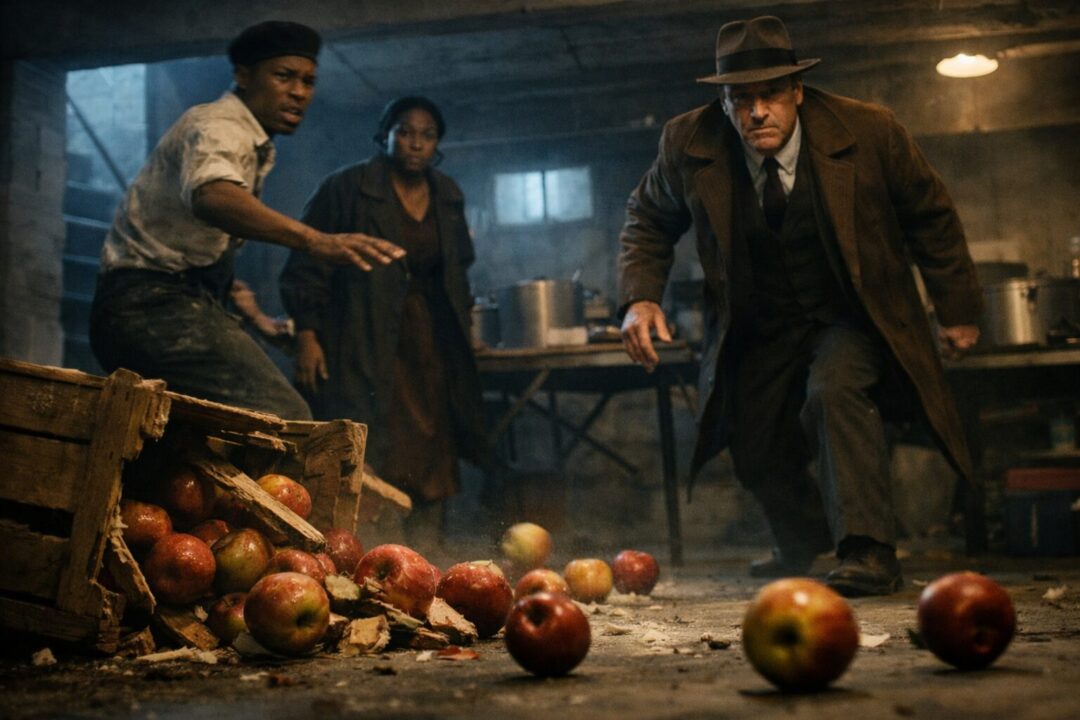
One crate of apples hit the floor first, fruit rolling across concrete. A sack of flour was split open and kicked aside. Cupboards were yanked wide. Papers were swept from a side table. The inspector barked questions nobody answered because the answers no longer mattered. The plainclothes man pulled open the pantry where Evelyn kept towels and cleaning soap, then called attention to the supplies as if cleanliness itself were suspicious.
Mrs. Hester shouted at them until the uniformed officer told her to stand back.
“Stand back from what?” she cried. “Breakfast?”
The first child came down the stairs and froze.
David.
Trayless, coat buttoned crooked in his rush, eyes landing on the apples on the floor, the white flour spread like wreckage, the men in official coats standing where volunteers should have been.
Then Evelyn’s voice rang from the stairwell behind him. “David—”
She reached him just as two more children crowded onto the stairs, trying to see.
That was the true obscenity of it. Not the overturned food. The audience.
Malik stepped forward again. “Let the children out of here.”
The officer shoved him back.
It was not a dramatic blow. It did not need to be. Malik’s leg hit a crate, he lost his balance, and went down hard on one knee amid broken fruit and split grain.
A little girl started crying.
David did not cry. He only stared at Malik on the floor with a look so nakedly shocked that something in Malik hurt more than the knee.
The plainclothes man raised his voice for the room. “This facility may be unsafe for public use pending further review.”
Unsafe.
Around them lay the damage made by the people using the word.
Evelyn pulled David behind her, but he was still watching, still seeing the one room that had felt orderly and kind turned into a place where men with badges could kick breakfast apart and call it protection.
Bell arrived in the middle of it.
He had not planned to go. He had seen an unusual city car outside the church while driving to school, felt the shape of the morning immediately, and turned the wheel before he finished deciding. He came down the basement steps in time to see an official boot crush an orange underfoot.
He stopped dead.
One of the suited men glanced at him. “Who are you?”
Bell looked around the room—the crying child, Evelyn holding David back, Malik on one knee amid spilled food, Mrs. Hester white with fury, apples rolling under tables—and heard himself answer with less control than usual.
“Someone who can tell the difference between an inspection and a staging.”
No one liked that line. Not the officials. Not Bell himself. It was too late to be brave and too public to be safe.
The inspector snapped his clipboard shut. “This area is closed.”
Malik got to his feet slowly.
He did not brush off the flour on his trousers.
He looked not at the men, but at the children. “Everybody upstairs,” he said, voice steady somehow. “Go on now. No running.”
Even then, he was trying to protect the shape of the room.
David did not move until Evelyn tugged him.
As they climbed, he looked back once and saw Malik bend down, not toward the officials, but toward the floor. Toward the ruined food.
That image would live in him longer than the men’s faces.
Part V — What It Was
Afterward, everyone wanted Malik to speak.
Not just speak. Declare. Condemn. Turn the morning into a usable weapon before the other side named it first.
Men from the chapter came by with anger already sharpened into language. A minister offered the church steps. Someone mentioned reporters. Someone else said the city needed to be exposed in terms broad enough to travel.
Malik listened and felt, beneath all of it, the wrongness waiting.
He did not want the children converted into a slogan by either side.
What happened had already been plain.
By noon the room was half cleaned and still wrecked. The flour had been swept, but it left a ghost on the concrete. Bruised apples sat in a pail by the sink. Wet grain clung to the cracks between floorboards near the pantry. The tables looked like survivors.
Donations stopped almost completely that day.
Fear was efficient.
Evelyn came back after taking David to school.
She found Malik in the kitchen alone except for Mrs. Hester at the far sink, scrubbing hard enough to punish the dishwater. He was standing over the ruined produce, staring at it with the exhausted stillness of a man who had been told to turn pain into strategy too soon.
“You’re hiding,” Evelyn said.
He looked up. “No.”
“You are. Just in a room everyone agrees you’re allowed to be angry in.”
Malik let out one breath through his nose. “People are trying to decide the best response.”
“That’s convenient for them.”
He said nothing.
Evelyn stepped closer. “My son asked me on the walk to school if he did something wrong by coming here today.”
That hit.
Harder than the shove. Harder than the raid itself, perhaps because it named the damage too exactly.
Malik’s jaw tightened. “He didn’t.”
“I know that. You know that. But he asked.”
Mrs. Hester stopped scrubbing.
Evelyn’s voice was low but unwavering. “If you disappear into meetings now, those men get to decide what this was. They get to tell the whole neighborhood they shut down something dirty. They get to make children remember this place with fear in it.”
Malik looked at the bruised fruit in the pail, at the bags split open by men who had arrived calling themselves concerned.
“What do you want me to do?” he asked.
She held his gaze. “Tell the truth in the same language they attacked.”
He frowned.
She pointed at the wreckage. “This. Not speeches. This.”
For a moment no one moved.
Then from the stairs came another voice, tight with discomfort.
“They asked me not to record anything.”
Bell had returned.
He stood at the bottom step holding his briefcase too close to his leg, as if still undecided whether he was entering or merely witnessing his own failure. He looked worse than the day before—less polished, more human, which on him read almost as damage.
Mrs. Hester gave him one cut of a glance. “You here to supervise the burial?”
Bell ignored it. Barely.
“They suggested,” he said carefully, “that any educational observations tied to this morning would be better left informal.”
Malik looked at him. “And?”
Bell swallowed. “And I am tired of calling things informal when everyone understands they are true.”
He opened the briefcase and removed the ledger.
No one spoke.
Bell held it out but did not yet cross the room with it. “I kept notes. Attendance. Classroom behavior. Attention. Not official. Not meant for anyone. But they exist.”
Evelyn stared at the book like it was some strange animal—evidence, perhaps, that a man from inside the walls could see what happened outside them and not immediately look away.
Malik said, “Why bring it now?”
Bell answered honestly enough to be believed. “Because I saw the floor.”
Silence.
Then Malik bent to the ruined pail and lifted out two crushed oranges and a double handful of grain gone wet and clotted. The food sagged in his palms, spoiled not by neglect but by force.
He turned toward the open basement doorway.
“Call whoever’s outside,” he said.
Within minutes, a few parents gathered. A deacon from upstairs. Two women from the block. A teenage volunteer. Mrs. Hester. Bell, still holding the ledger. Evelyn standing straight with her coat buttoned and her hands empty for once.
Malik did not climb on anything. He did not raise his voice.
He stood in the wrecked room and held the food where everyone could see it.
“This,” he said, “was breakfast for children.”
That was all at first.
No rhetoric. No flourish. The ruined grain dripped slowly through his fingers into the pail. One of the oranges had split open, its bright inside exposed and already turning.
The room listened in a silence so complete it felt almost holy.
Evelyn stepped forward before he could continue.
At the start of all this, she would have died rather than be seen claiming need in public. Now she stood where everyone could see her and did not lower her eyes once.
“My son used to go to school hungry,” she said. “Not every day. Just enough days to make him quiet.”
No one interrupted.
“He came here and nobody treated him like a problem to be solved. Nobody asked me what mistakes I made before they handed him a plate. He sat down, he ate, and after a week he started laying out his shirt at night because he wanted to get here early.”
Her voice thinned once, then held.
“Do you know what that means for a child? To want morning?”
The question landed harder than a speech ever could.
She pointed, not at the officials who were gone, but at the floor. “What they broke this morning wasn’t groceries. It was a place where children could eat without being made ashamed of it.”
David was not there to hear her say it.
That made it truer.
Bell looked as if he wanted one more minute to remain divided. No one gave him one.
He opened the ledger.
“I tracked student performance informally,” he said, and the word now sounded like an apology. “The children who attended this breakfast program came to school more alert. Attendance improved. Classroom focus improved. Staff saw it. Administration saw it.”
Mrs. Hester said, “Say the rest.”
Bell’s throat worked. Then he did.
“Hunger was the issue,” he said. “Everyone in authority knew hunger was the issue.”
The room changed at that line.
Not because it was surprising. Because it had finally crossed a threshold. Truth spoken from outside power could be dismissed as agitation. Spoken from inside, it became harder to flatten.
Malik looked down at the food in his hands.
He had tried all morning not to turn this into theater. But that was not what this was. The theater had been men in official coats kicking oranges apart and calling it safety. This was only naming the thing correctly before the lie dried around it.
He set the ruined fruit back in the pail.
“Children will remember what happened here,” he said quietly. “So will we.”
Nobody clapped. The moment was too bruised for that.
But people stepped closer.
That mattered more.
Part VI — A Room With Their Shape In It
The breakfast program did not recover quickly.
For a while, it barely recovered at all.
Some parents stayed away, afraid of being seen. Donations came in smaller, then unevenly. The church board held tense meetings upstairs. Mrs. Hester kept cooking when there was food to cook and cursing when there wasn’t. Malik took on the kind of tired that settled into the bones. Evelyn kept coming, even on mornings when there was only coffee, toast, and half the room’s old confidence. Bell was never entirely forgiven by anyone, perhaps not even by himself.
But stories move in two directions at once.
In one direction, the raid worked. It frightened people. It marked Malik. It taught children that order could be broken by men wearing authority.
In the other direction, it failed.
Because too many people had seen the floor.
Months later, Bell lost the quiet expectation of promotion he had once considered inevitable. No one said why. Men like him were rarely dismissed in direct language. They were only rerouted toward smaller futures. He accepted it with the stunned expression of someone finally learning that cowardice and courage both carry invoices.
Evelyn never became loud. That was not her nature. But when other mothers asked, carefully, about the breakfast room, she answered without lowering her voice. David kept going to school. He remained thin for a while. Childhood does not heal on schedule. Still, something in him had shifted permanently. He no longer mistook hunger for a private failure. He had seen adults stand in front of a broken room and say the truth out loud. That mattered.
As for Malik, he kept working.
Not because the work became easier. Because it had already told the truth about what it was.
Years later, on a gray school morning, David Carter—older now, longer in the limbs, carrying books instead of a lunch tin—walked through the cafeteria of a public school where breakfast was being served before classes without fanfare. Milk cartons lined up in rows. Fruit in metal bowls. Children eating under fluorescent lights while teachers passed by as if such a thing had always belonged there.
It was official now.
No church basement. No whispered rumors. No plainclothes men asking who was behind the food. Just the routine shape of something absorbed into the life of the school.
David paused with his tray in hand.
Across the room, a younger boy chose the same seat every day by the radiator.
For one second, the years folded.
He could almost smell soap and toast. Could almost hear Mrs. Hester snapping at someone to stack cups properly. Could almost see Malik at the serving table, tired eyes sharpening when children came through the door.
Almost.
The cafeteria worker glanced at him. “You moving, honey?”
He nodded and kept walking.
At the end of the line, he picked up an orange.
It was bright, unbruised, ordinary.
That was the strangest part. How ordinary it looked.
He carried it to his table and sat down among children too young to know what had once been called dangerous. Around him, breakfast happened without spectacle, without argument, without anyone having to defend the right of a hungry child to eat before learning.
That should have felt simple.
Instead it felt like standing inside a room built partly from memory and partly from theft.
He peeled the orange slowly.
The smell opened at once—clean, sharp, alive.
Across all the noise of trays and chairs and morning voices, one truth remained where no institution could file it down:
Some people had paid first for this ordinary thing.
And if the world had finally decided to call it policy instead of threat, that did not mean the world had been innocent when it tried to break it.
David separated the slices and ate one.
Then another.
Outside, school bells began their clean official ringing.
Inside, children kept eating.