The Wind Was Hers
Part I — The Miss
The third shot missed by less than a handspan, but the whole firing line reacted like Private Jonah Ellis had dropped his rifle and run.
Dust kicked up beyond the steel target, pale and dry against the desert berm. The circular plate swung in the distance without ringing. For one stretched second, there was only wind, heat, and the thin hiss of sand moving over sand.
Then Sergeant Cole Mercer laughed once.
Not loud. Not cruel enough to be called cruel.
Just enough for everyone to hear.
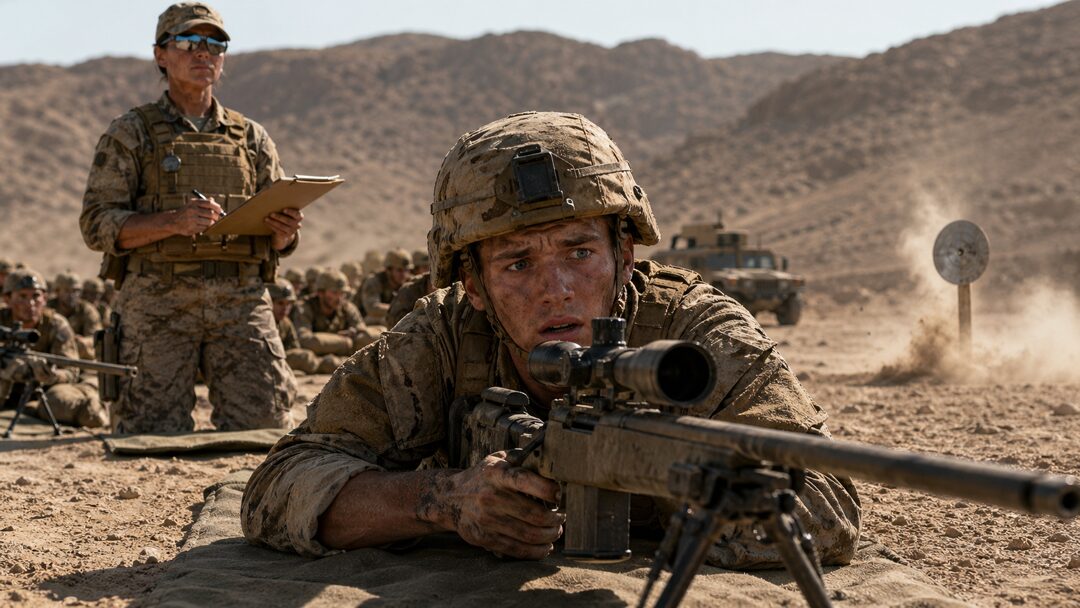
Jonah stayed pressed behind the rifle. His cheek remained on the stock, his right hand still curled near the trigger, his breathing too shallow now to be useful. He was twenty-two, narrow-faced, and covered in more dust than the rest of them, as if the desert had already decided he belonged lower than the others.
Behind the line, Captain Elias Rourke clicked his stopwatch closed.
“Third miss,” Rourke said.
The words traveled down the row of prone soldiers faster than any order.
A military vehicle idled behind them, engine ticking under the sun. Heat shimmered above its hood. A dozen rifles pointed toward the same stretch of desert, and brass glittered around the firing mats like dull gold.
Staff Sergeant Lena Voss stood beside the vehicle with a range board tucked under one arm.
To most of the platoon, she was just the woman from range control.
Sleeves rolled. Faded cap. Mirrored ballistic glasses. A scarf at her neck bleached almost white by old sun. Still as a post while men fired around her.
She made one mark on her board.
Cole saw it.
He also saw that she had not flinched when Jonah missed.
That irritated him more than if she had.
Rourke stepped closer to Jonah. He was forty-two, hard-faced, and clean in a way that made the dust look like it had failed to touch him properly. Even his watch flashed silver and sharp.
“Ellis,” he said. “You understand what this qualification means?”
“Yes, sir,” Jonah said.
His voice came out dry.
“Then explain why the plate is still quiet.”
Jonah swallowed. “Wind shifted at the break, sir.”
Cole was already standing, rifle slung, personal gloves creaking as he flexed his hands. He had a shaved head, a sun-reddened face, and the permanent squint of a man who believed the world should prove itself to him.
“The wind didn’t shift,” Cole said. “You did.”
A few soldiers looked down. One coughed to hide a laugh.
Jonah did not move.
Lena’s pen stopped against the paper.
Cole crouched beside Jonah as if he were helping. That was the shape of it. Help. Instruction. Mentorship. But his voice carried down the line.
“Sniper work isn’t for people who need permission to breathe.”
This time, the laugh from the line came easier.
Jonah’s ears went red.
Rourke did not laugh. He did not stop it either.
“Next round decides it,” Rourke said. “You miss again, Ellis, I pull your name from recon selection.”
The desert seemed to still.
Jonah lifted his head just enough for Lena to see his eyes.
Not panic exactly.
Worse.
The look of a young soldier trying to hide panic from men who were waiting to punish him for having it.
Lena touched the small cracked lens cap in her pocket with her thumb.
It had been black once. Now the edges were worn gray.
She had carried it through three countries and two surgeries and one memorial service where nobody said the right name until the end.
She let it go.
Not yet, she told herself.
Not yet.
Cole stood and looked down at Jonah.
“Get your breathing under control,” he said. “Or go find a desk.”
Lena made another mark on her board.
This time, Rourke noticed.
Part II — The Demonstration
“Mercer,” Rourke said. “Show him.”
Cole did not smile fully, but satisfaction moved through his shoulders.
He liked being asked.
He liked the line watching.
He liked the rifle more than he liked most people.
He settled behind his own weapon with the easy violence of habit. Elbows dug into the mat. Cheek crushed into the stock. Eye narrowed behind the scope. One hand pulled the rifle hard into his shoulder, as if strength could bargain with distance.
Lena watched his body before she watched the barrel.
That was where shooters told the truth.
Cole was good. That was the problem.
Bad men were easy to dismiss. Bad shots were easy to correct. Cole was neither. He had survived enough hard instruction to mistake harshness for tradition. He had been broken into usefulness and called it training.
Now he handed that damage down like a rank.
“Wind left to right,” Cole called.
Lena looked at the grassless stretch between the firing line and the target. There was no grass to read, no flags except the two limp strips near the left berm. But there was dust. There was heat. There was the faint curl of sand lifting in one place and not another.
Quartering, she thought.
Not lateral.
Jonah had seen it.
Cole had not.
Or he had seen it and refused to change because he had already spoken.
Rourke stood over the line. His jaw was fixed. The radio clipped to his vest spat static, then went quiet again.
Cole exhaled hard, held too long, and fired.
The shot cracked open the air.
Dust jumped.
The steel rang after a delay.
Low. Off-center. A hit, but barely.
The line accepted it anyway.
One soldier slapped the mat. Another muttered, “There it is.”
Cole rose as if the sound had proved everything there was to prove.
Jonah’s shoulders folded inward.
Lena made no mark this time.
Cole dusted his gloves together. “See? You stop asking the shot how it feels and you take it.”
Lena’s mouth tightened, but only slightly.
Rourke looked at Jonah. “You’ve seen the correction.”
Jonah nodded.
He had seen the wrong lesson.
The radio on Rourke’s vest crackled again.
“Rourke,” a voice said through static. “Battalion wants confirmation by fourteen hundred. Recon element green or not green for deployment evaluation. No maybes.”
Every man on the line heard it.
No maybes.
Rourke pulled the radio close. “Understood.”
When he released the button, something in his face had changed. Not much. Enough.
Pressure did that. It narrowed good men until they began using the wrong tools.
Rourke turned toward the far berm.
“Move the plate back.”
The range crew hesitated.
Cole looked at him. “Sir?”
“Back,” Rourke repeated. “If this platoon is green, it’s green past the card.”
Jonah looked up.
The target was already far enough to make honest men humble.
Two soldiers jogged out in the range vehicle to shift the circular steel farther downrange. The plate became smaller. Meaner. Less like a standard and more like a dare.
Lena finally spoke.
“Captain.”
It was one word, but it carried.
A few heads turned.
Cole glanced over his shoulder like he had forgotten she could talk.
Rourke looked at her. “Staff?”
“Moving the standard after a failed attempt compromises the evaluation.”
The line went quiet in the particular way men went quiet when a woman corrected rank in public and everyone wanted to see how badly it would go.
Cole gave a soft laugh through his nose.
“With respect, ma’am,” he said, and put just enough weight on ma’am to make it insulting, “range control usually lets the shooters handle the shooting.”
Lena did not look at him.
She looked at Rourke.
“The wind is quartering,” she said. “Not lateral. Ellis was holding it closer than Sergeant Mercer told him to. He’s being coached into fighting the rifle instead of listening to it.”
Cole’s face changed.
Not anger first.
Embarrassment.
Then anger, because embarrassment needed somewhere to go.
“When did range control start handing out sniper lessons?” he asked.
The line froze.
Rourke’s eyes moved from Cole to Lena, then back to Cole.
For the first time that morning, the captain looked almost interested.
“She’s not range control,” Rourke said.
Cole’s jaw shifted.
Rourke let the silence do its work.
“This is Staff Sergeant Lena Voss,” he said. “Advanced Marksmanship Cell. She’s here to evaluate whether this platoon’s shooters are deployable.”
The desert did not move.
No one laughed.
Jonah turned his head just enough to look at her.
Lena stood exactly as she had stood before: board under one arm, scarf at her throat, cracked lens cap in her pocket, face unreadable behind mirrored glass.
That was what seemed to bother them most.
She did not become different when they learned who she was.
They had simply been wrong.
Cole took that harder than he would have taken an insult.
“Evaluation include taking shots from the shade?” he asked.
Rourke’s head snapped toward him. “Careful, Mercer.”
But not enough to end it.
Cole heard the space he had been given and stepped into it.
Lena still did not look at him.
“Ellis,” she said. “Step off the rifle. Drink water.”
Jonah hesitated.
Cole said, “He doesn’t need water. He needs nerve.”
Lena finally turned her glasses toward him.
“Nerve is what people ask for when they’ve run out of information.”
Nobody laughed at that.
Cole’s face hardened.
Jonah rose slowly from the mat, dust stuck to his sleeves, and took the canteen another soldier handed him. His hands trembled once before he got them still.
Lena saw it.
The tremor.
The shame after it.
The effort to hide both.
Her thumb found the cracked lens cap again.
This time, she did not let go.
Part III — The Cap
Years earlier, in another desert that smelled almost the same when the wind changed, Lena had missed a shot by less than a handspan.
Her commander had called it fear.
Her spotter had called it weather.
Only one of them had been right.
His name had been Staff Sergeant Daniel Price, and he had a habit of tapping the side of his scope twice before he spoke. Tap, tap. Like knocking on a door only he could see.
“Breathe with the earth,” he had told her once, his mouth close to the dust. “Not against it.”
That was the kind of sentence people made fun of until it saved them.
Later, after the ambush, after the medevac that came too late, after the official report praised the shot Lena made when everyone was finally watching, she found Daniel’s cracked lens cap in the bottom of her kit.
She had not cried at the ceremony.
She had not corrected the colonel when he said her shot had turned the mission.
She had not told anyone that the man who taught her how to take that shot had died before the praise arrived.
Silence had kept her useful.
Silence had kept her promoted.
Silence had also taught her how long damage could sit in a room if everyone called it discipline.
Now Jonah stood in the same kind of silence.
Not the same war. Not the same stakes. Not the same grief.
But the shape was familiar.
A young soldier being told his instincts were weakness by someone louder.
A commander under pressure calling unfairness realism.
A line of men learning what would be rewarded.
Lena pulled her hand from her pocket.
The lens cap stayed there.
Not yet had become almost too late.
Rourke checked his watch.
“Ellis,” he said. “Back on the rifle.”
Jonah took one step.
Lena said, “No.”
One word again.
This one sharper.
Rourke looked at her.
The firing line held its breath.
Lena stepped away from the vehicle. Dust moved around her boots.
“The qualification standard has already been met or failed under the original conditions,” she said. “This additional shot is not evaluation. It’s theater.”
Cole barked a laugh. “That’s a clean word for pressure.”
Lena ignored him.
Rourke’s eyes narrowed. “War won’t respect the card, Staff Sergeant.”
“No,” Lena said. “But war also punishes commanders who confuse improvisation with ego.”
The whole range went dead.
Even the idling vehicle seemed quieter.
Cole’s mouth parted slightly. He expected Rourke to cut her down. Everyone did.
Rourke stared at Lena for a long moment.
The silver watch on his wrist flashed once.
His fear was there if you knew how to read men who hid fear behind standards. He was imagining battalion. Deployment packets. Names on readiness reports. A unit sent forward unready and coming back smaller.
Lena understood fear dressed as command.
She did not forgive what it did.
Rourke turned toward the target, then back to her.
“If the shot is being misread,” he said, “demonstrate it.”
Cole’s head turned.
There it was.
The trap. The dare. The open door.
He unslung his rifle and held it out to her with both hands, too polite now, too smooth.
“By all means, Staff Sergeant.”
His rifle was adjusted for his body. Longer pull. Different cheek height. Sling set wrong for her frame. A weapon could become intimate after enough hours. It could also become a room built for someone else.
Cole knew that.
He expected her to ask for time.
To adjust everything.
To reveal discomfort.
Lena took the rifle.
“Thank you,” she said.
That bothered him too.
She did not take his bait.
She took his weapon.
Jonah watched her with the expression of someone who had not yet decided whether hope was safe.
Lena looked at him once.
Not kindly. Not softly.
Clearly.
“Watch the dust past the half berm,” she said. “Not the flag.”
Jonah blinked.
Then he looked.
For the first time since the miss, his eyes stopped asking the men around him whether he was allowed to know what he knew.
He watched the dust.
And saw it.
Part IV — The Rifle
Lena lowered herself behind Cole’s rifle.
The desert noticed.
That was how it felt to Jonah, though he would never have said it that way. The line, the captain, Cole, the men pretending not to care—all of them shifted toward her. The whole range leaned in.
Cole stood behind her left shoulder with his arms crossed.
Rourke stood farther back, unreadable.
Jonah stood near the water cans, still holding his helmet under one arm. He wanted her to hit. He hated that he needed her to. He hated more that if she missed, everyone would pretend the morning had been fair.
Lena settled into the mat.
The rifle was wrong for her.
Cole saw it immediately. The stock sat a fraction too long. Her cheek weld would not come naturally. The sling pulled at an angle that wanted to drag her shoulder out of line.
His face almost softened with expectation.
Almost.
Lena adjusted less than anyone expected.
A small shift of her elbow.
A breath.
Two fingers under the sling.
She removed one glove and pressed her bare fingertips into the sand.
The heat bit her skin.
Good, she thought.
Pain could be information if you did not turn it into performance.
Through the scope, the circular steel target trembled in the shimmer. The desert between her and the plate was not empty. It was full of argument. Heat rising. Dust leaning. Air folding in ways the eye could catch only after the mind stopped insisting.
Behind her, Cole’s breath was too loud.
Rourke’s radio gave a low static cough.
No one spoke.
Lena let the rifle become unfamiliar without becoming enemy.
Daniel Price had once told her, “The shot doesn’t care who needs to be right.”
She had hated him for that during training.
She had survived because of it later.
Tap, tap.
Her thumb remembered the cracked cap in her pocket.
She did not reach for it.
Not now.
The target swam, steadied, swam again.
Lena inhaled.
Not deep.
Enough.
She let half the breath go.
The world narrowed.
Not dramatically. Not beautifully. Just practically.
Cole had fought his shot. His whole body had told the rifle, obey me.
Lena did not ask obedience.
She waited until the rifle had no argument left.
The trigger broke.
The shot cracked across the range.
Dust lifted in front of her.
Recoil moved through her shoulder.
For one horrible second, there was no sound from the target.
Jonah’s heart fell so hard he almost looked away.
Cole’s mouth began to curve.
Then the steel rang.
Clean.
Centered.
Unmistakable.
The sound came back across the desert like a verdict nobody could appeal.
No one cheered.
That made it louder.
Lena stayed behind the rifle a moment longer. Then she rose to one knee and set the weapon down carefully, as if the shot had belonged to the rifle and not to any ego around it.
Cole stared past her at the target.
Rourke’s jaw worked once.
The men on the line looked from the steel, to Lena, to Cole, and then away. Not because they were bored.
Because they did not know where respect should go when it arrived late.
Lena did not look at Cole first.
She did not look at Rourke.
She turned to Jonah.
“You were holding the wind right,” she said.
His face changed.
Just a little.
Enough.
“You let him talk you out of trusting it.”
The words hit harder than the shot.
Jonah looked down at his hands, then out at the target, then back at her.
He did not smile.
That would have been too easy.
Instead, he stood straighter, as if someone had removed a weight he had been pretending not to carry.
Cole’s voice came from behind her.
“That was a hell of a shot.”
Lena looked at him then.
“No,” she said. “It was the right correction.”
The difference sat between them.
Cole understood enough to hate it.
Rourke closed his stopwatch again, though no one had started it.
“Ellis remains on the selection list,” he said.
The line absorbed the order.
Jonah closed his eyes once.
Lena picked up her board and made a mark.
This one took longer.
Part V — The Report
The range broke slowly after that.
No one knew how to leave a moment that had not given them permission to celebrate or argue.
Soldiers cleared rifles. Brass was collected. Mats were shaken out. The target remained downrange, round and small and suddenly important in a way steel had no right to be.
Jonah moved like a man afraid that if he showed relief, someone might take it back.
Cole kept his rifle slung tight across his chest.
Rourke walked to Lena near the vehicle, dust dragging at the bottoms of his trousers.
“Staff Sergeant,” he said.
She looked up from her board.
His face had returned to command shape, but something behind it had shifted. Not broken. Not humbled completely. Checked.
“Your evaluation will be attached to the deployment packet.”
“Yes, sir.”
“I’ll expect marksmanship scores by seventeen hundred.”
“You’ll have them.”
He waited, as if hoping she would stop there.
She did not.
“My report will also include leadership climate.”
A muscle moved in his cheek.
Around them, men pretended not to listen.
Rourke’s voice dropped. “That necessary?”
Lena held his gaze behind the mirrored glasses.
“If it affects readiness, yes.”
The answer was so clean he had nowhere to put his anger.
For a moment, Lena saw the man beneath the commander. Tired. Afraid of sending boys into places where mistakes became folded flags. Afraid of softness because softness did not look useful in reports.
Then the commander returned.
“Do your job, Staff Sergeant.”
“I am.”
He walked away.
That should have satisfied her.
It did not.
Victory rarely felt like people imagined. Usually it felt like seeing the cost clearly enough that you could no longer call it clean.
Cole approached after the others had begun packing the last cases.
He stopped a few feet from Lena, close enough for conversation, far enough to preserve the option of pride.
His sun-reddened face had lost some of its heat.
“Wind call was yours,” he said.
Lena waited.
“Before it was mine,” he added.
It was not an apology.
It was more than she expected.
She took off her glasses. Her eyes were dark, tired, and steadier than he wanted them to be.
“You can shoot,” she said.
Cole gave a short laugh. “That supposed to be generous?”
“No.”
He looked toward Jonah, who was kneeling by a case, carefully cleaning sand from a magazine.
Cole’s jaw tightened.
“I came up worse than that,” he said.
Lena heard what he meant.
I survived it.
I earned this.
No one protected me.
She put the glasses in her chest pocket.
“Men who shoot well are common,” she said. “Men who make others better are rare.”
Cole looked at her as if she had struck him without moving.
For a second, his face opened. Not much. Just enough to show the place where shame lived under the armor.
Then he shut it again.
“Noted, Staff Sergeant.”
He walked away with his rifle.
Lena watched him go and did not decide whether he would change.
Some men mistook being unsettled for being attacked. Some grew around the wound. Some covered it and called it scar tissue.
The desert accepted all of them without comment.
Near the water cans, Jonah stood alone.
Lena reached into her pocket and closed her fingers around the cracked lens cap.
For years, it had been proof of something she did not know how to name. Loss. Debt. Warning. A door she knocked on without wanting it opened.
She crossed the range to Jonah.
He straightened too fast. “Staff Sergeant.”
“At ease.”
He tried. Failed.
She nodded toward the firing mat. “You still want recon?”
His answer came too quickly. “Yes.”
“Don’t answer fast. Answer true.”
That stopped him.
He looked toward the target, still hanging in the heat.
Then toward Cole.
Then at the ground.
“Yes,” he said again, quieter. “But not if I have to become him.”
Lena did not look over her shoulder.
“That’s the first useful thing you’ve said all day.”
His mouth almost moved into a smile.
Almost.
She held out the cracked lens cap.
Jonah looked at it, confused.
“What is it?”
“A reminder.”
“Of what?”
Lena placed it on the mat beside the rifle.
“To see clearly before you obey noise.”
He did not touch it.
Not yet.
That was right.
Some things had to sit beside you before they belonged to you.
Part VI — The Changed Gaze
By late afternoon, the desert light had softened without cooling.
The platoon should have been done. Most of the rifles were cased. The vehicle’s engine was off. Rourke had disappeared into the operations tent with Lena’s report tucked under one arm and a face that promised nothing.
But Jonah was back on the mat.
Lena lay beside him now, not behind the rifle, but slightly to his left, where a spotter belonged.
The cracked lens cap sat between them like a small black moon.
Cole stood near the vehicle, pretending to check a strap that needed no checking.
Two other soldiers watched openly.
Then three.
This time, the watching was different.
No smirks. No restless shifting. No hunger for failure.
Attention, Lena knew, could be another kind of apology when men did not yet have language for the real one.
“Don’t chase the plate,” she told Jonah.
He adjusted his breathing.
“Watch what the air does before it gets there.”
He nodded.
His cheek settled against the stock.
The rifle still looked too large for him, but no longer like it was swallowing him.
Lena watched his hands.
Careful hands. Honest hands.
He inhaled, then stopped himself from holding too much.
Good.
“Breathe with the earth,” she said.
The words left her before she could decide against them.
For a moment, Daniel Price was there in the heat. Not as a ghost. Not as grief. As instruction that had survived him.
Jonah did not know the weight of what he had been given.
That was mercy.
He fired.
The shot missed.
Not by much.
The steel stayed quiet.
Behind them, no one laughed.
Jonah kept looking through the scope.
“Call it,” Lena said.
He swallowed. “High right.”
“Why?”
He watched the dust. This time, he did not look back to see whether Cole agreed.
“I overcorrected.”
Lena nodded.
“Again.”
Jonah worked the rifle. Slower now. Cleaner.
Cole shifted near the vehicle.
Lena saw him watching the dust past the half berm.
Not the flag.
She said nothing.
Jonah settled again.
The range held itself open.
Rourke emerged from the tent in the distance, report no longer in his hand. He stopped when he saw them still working. For a while, he only stood there.
The sun moved lower behind him.
Jonah breathed.
Lena waited.
No one told him to muscle through.
No one told him to stop shaking.
No one mistook quiet for weakness.
This time, when he fired, the steel rang.
Not as clean as Lena’s.
Not centered.
But true enough.
Jonah lowered his head slowly until his forehead touched the stock. He stayed that way for one breath, then two.
Lena let him have it.
A small victory could still be a real one if no one tried to make it bigger than it was.
Behind them, Cole’s voice came rough and reluctant.
“Good correction.”
Jonah lifted his head.
He did not turn around.
He smiled only after the men could not see his face.
Lena picked up the cracked lens cap from the mat, brushed sand from its broken edge, and placed it beside Jonah’s elbow again.
Not giving it away.
Not taking it back.
Just letting it remain where a lesson might be needed.
The desert wind moved over the firing line, over the cooling brass, over the distant plate still trembling from the hit.
In the morning, the men had watched Lena because they thought she did not belong near the rifle.
Now they watched because she had changed what the rifle meant.
Lena lowered herself beside Jonah again and looked downrange.
“Again,” she said.
And this time, no one on the line mistook the quiet for silence.