The Snake Beneath Her Sleeve
Part I — The Hand on Her Arm
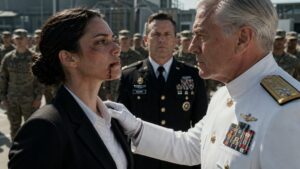
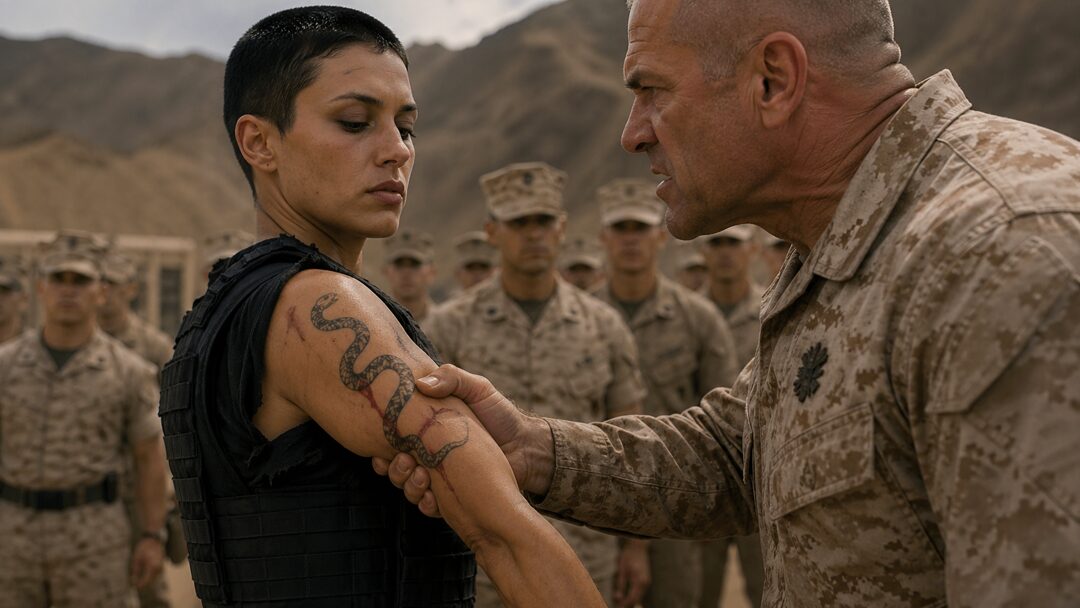
Sergeant Caleb Rusk caught Mara Vale by the torn sleeve and dragged her out of formation hard enough that the whole line heard fabric rip.
No one moved.
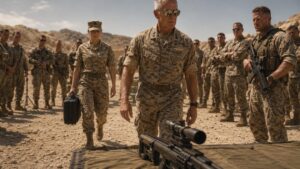
Fort Veyra sat under a noon sun that made men hate their own skin. Dust clung to teeth, lashes, weapon straps, the wet creases of necks. Thirty-seven redeployment candidates stood in two crooked rows, too tired to look proud and too afraid to look away.
Rusk twisted Mara’s arm into the light.
“What is that?”
His thumb pressed into the exposed skin above her elbow.
Mara did not flinch.
That was the first thing Private Lena Ortiz noticed. Not the torn black tactical sleeve. Not the old red scars. Not even the mark itself, dark as burned oil against Mara’s sun-browned arm.
It was the stillness.
Most people pulled away when Rusk touched them. Some stiffened. Some smiled like fools, trying to make the humiliation smaller.
Mara Vale simply stood there, gray eyes lowered, mouth closed, as if Rusk’s hand were weather.
The mark curled across her upper arm in the shape of a black snake. Its body looped around three broken chevrons. Red scar tissue slashed through it in uneven lines, like someone had tried to claw the serpent off and failed.
A murmur ran through the formation.
“Prison mark,” someone whispered.
“No,” another voice said. “Deserter brand.”
Lena swallowed. She had seen tattoos from old campaigns, unit ink, lover’s names, stupid jokes etched under drunken courage. This was not that.
This looked like a warning.
Rusk leaned closer to Mara’s face. He was broad, shaved bald, jaw tight enough to crack bone. His uniform was immaculate despite the dust, each crease a declaration that he had suffered correctly and expected others to do the same.
“You hiding unauthorized markings in my yard, Vale?”
Mara’s eyes lifted to his.
“No, Sergeant.”
Her voice was calm. Not soft. Not frightened.
Calm.
That made Rusk angrier.
“You think this is a clinic? A recovery program? A place for broken soldiers to decorate themselves and hope the army forgets why they were sent here?”
The formation went quiet in a different way.
Everyone at Fort Veyra knew what they were.
Unfit for redeployment.
The phrase followed them everywhere. It sat in their medical files, their psych evaluations, their command notes, their transfer orders. Too jumpy. Too slow. Too angry. Too injured. Too insubordinate. Too useful to discharge. Too damaged to trust.
Rusk’s job was to prove which ones could be hammered back into shape.
He enjoyed the hammer.
Mara looked past him at the hard white line of the horizon.
“Answer me,” Rusk said.
She did not.
He pulled a black field marker from his chest pocket. Lena had seen him use it to circle errors on maps, equipment tags, failed inspection marks.
Now he uncapped it with his teeth.
The smell of ink hit the air.
Rusk pressed the marker tip against the edge of the snake scar.
“I’ll document it for command since you’re too proud to explain.”
Mara moved.
It was not wild. It was not dramatic.
Her arm snapped outward in one clean motion. Rusk’s hand flew away. The marker skidded across the dust and came to rest near Lena’s boot.
For one second, the yard forgot to breathe.
Rusk stared at his empty hand.
Mara’s arm remained raised between them, the snake exposed, the red scars bright where his grip had reopened one old line.
A bead of blood slid down and stopped at the serpent’s head.
Rusk’s face changed.
Not fear.
Worse.
Humiliation.
He stepped closer until his boots nearly touched hers.
“Remove the sleeve.”
Mara lowered her arm.
“No.”
The word landed harder than shouting.
Several soldiers shifted. Lena felt the movement ripple through the formation. Everyone knew the rules. Refusal in the yard did not stay small. Rusk would not allow it to stay small.
He smiled without warmth.
“You want to wash out?”
Mara said nothing.
“You want me to stamp your file unstable and send you back to whatever hospital begged us to take you?”
Her jaw tightened.
Rusk saw it. Everyone saw it.
There it was, Lena thought. The crack.
“Remove the sleeve,” he repeated, “or leave this field in cuffs.”
For a moment, Mara’s eyes went somewhere else.
Not far. Not dreamy. Just elsewhere.
Then she reached with her free hand, gripped the torn fabric, and pulled.
The sleeve came away.
The whole mark appeared.
The black serpent circled three broken chevrons like it was guarding them from burial. Red scars crossed through the design in three violent bands.
The whispers came faster now.
“Black Adder.”
“Shut up.”
“That’s not real.”
“My brother said they killed civilians.”
“No, they abandoned them.”
“Wasn’t everyone from that unit dead?”
Lena looked at Mara’s face.
Mara heard every word.
She gave none of them the satisfaction of knowing which one hurt.
Part II — The Man Who Recognized It
Captain Havel came across the yard at a clipped pace, annoyance already set into his shoulders.
“What is this, Sergeant?”
“Unauthorized combat marking, sir,” Rusk said. “Candidate refused inspection and struck my hand.”
Mara stood with her arm exposed.
The captain turned toward her as if prepared to be bored.
Then he saw the snake.
His mouth closed.
Rusk noticed. So did everyone else.
“Sir?” Rusk said.
Havel did not answer immediately. His eyes moved from the serpent to the three broken chevrons, then to the red scars, then to Mara’s face.
“You,” he said, but not like an accusation.
Like he had stepped on a grave.
Mara looked at him.
The captain’s color changed under the sun.
“Who authorized that mark?” he asked.
“No one here,” Mara said.
Rusk barked a laugh. “Then she admits—”
“Quiet,” Havel snapped.
The word stunned the yard more than Mara knocking Rusk’s hand away.
Rusk’s neck reddened.
Havel looked toward the administration block, then back at the mark. His voice dropped.
“Get Colonel Vorn.”
The name moved through the formation like a cold current.
Lena had seen Colonel Elias Vorn only twice. Once at induction, where he had spoken for seven minutes about discipline and never wasted a syllable. Once at a memorial wall, standing alone before dawn with his hands clasped behind him.
Men lowered their voices when he passed.
Rusk seemed to recover himself by force.
“With respect, sir, this is a training discipline issue.”
“No,” Havel said.
He kept looking at Mara.
“This is not.”
The next five minutes stretched like wire.
No one dismissed the formation. No one gave water. No one told Mara to cover her arm.
She stood in the dust with her sleeve hanging from one hand and blood drying along the snake’s head.
Lena wanted to look away.
She did not.
There were women in the unit, but not many. There were veterans older than Mara, louder than Mara, angrier than Mara. None had arrived as silently. None had passed three days of Rusk’s punishment drills without complaint. She did not joke. She did not trade stories. She did not ask what corridor they might be sent to next.
But once, at night, Lena had seen her awake beside the barracks window.
Mara had been holding her right arm with her left hand, thumb pressed over the hidden mark as if keeping something inside her skin.
Now everyone could see it.
No one knew what they were seeing.
A staff vehicle stopped at the edge of the yard.
Colonel Vorn stepped out without hurry.
He was tall but slightly stooped, iron-gray hair cut close, face weathered into planes that seemed built for bad news. His uniform was clean. His ribbons sat over his heart in a neat block of color, but he wore them like a burden rather than a claim.
Rusk snapped to attention.
“Colonel.”
Vorn did not look at him.
He looked at Mara’s arm.
The entire yard felt the pause.
Mara’s eyes stayed forward, but something changed in her posture. Not fear. Not relief.
Recognition has its own weight.
Vorn came closer.
Dust crushed under his boots.
He stopped two paces from her and stared at the serpent.
His jaw moved once, as if he had almost said a name and swallowed it.
Then he looked at Mara’s face.
“Who gave you permission,” he said quietly, “to wear the dead?”
The line cut through the yard.
Lena did not understand it, but her skin tightened anyway.
Mara’s expression did not change.
“They did.”
Captain Havel looked down.
Rusk looked from Vorn to Mara, anger struggling with confusion.
Vorn’s eyes hardened, but there was something behind it. Something old and not dead.
“You should not be here,” he said.
“I know.”
“You should not be in uniform.”
“I know.”
“You should not be standing in my yard with that on your arm.”
Mara’s voice stayed level.
“Then you should have told them where you buried the file.”
No one spoke.
Even the wind seemed to stop crossing the yard.
Vorn turned his head slightly.
“Captain Havel. Dismiss the formation to water rotation. Sergeant Rusk, you will remain available.”
Rusk’s mouth tightened.
“Sir, the candidate—”
“Will walk with me.”
Mara bent, picked up the torn sleeve, and held it in her fist.
As she passed the formation, the soldiers shifted back without meaning to. Not out of respect yet.
Out of uncertainty.
Lena watched the black serpent move past her shoulder.
For one sick second, she thought the snake looked alive.
Part III — The Dead Do Not Sign Forms
Vorn took Mara to the shade behind the tactical shed, where the heat still pressed down but at least stopped shining directly into the eyes.
He did not offer her water.
She did not ask.
For a moment, they stood with a wall between them and the yard, listening to Rusk’s voice in the distance ordering soldiers into rotation harder than necessary.
Vorn looked older in shade.
“Mara Vale is not supposed to exist on an active roster.”
“That is why I used my married name.”
“You were never married.”
“No,” she said. “But the clerk did not know that.”
A muscle in Vorn’s cheek moved.
“Do you understand what happens if this becomes formal?”
“It already became formal when your sergeant put hands on me.”
“My sergeant saw an unauthorized mark.”
“Your sergeant saw a woman he thought he could break.”
Vorn held her gaze.
For the first time since Rusk grabbed her, Mara felt anger rise close enough to taste. She kept it behind her teeth. Anger had never brought anyone back. It had only made the living easier to manage.
Vorn said, “Black Adder Recon is sealed.”
“No,” Mara said. “Black Adder Recon is dead.”
The words were too plain to be dramatic.
That made them worse.
Vorn looked toward the yard. “Officially, yes.”
Mara almost smiled.
Officially.
That was the army’s cleanest knife.
Officially, the mission had failed due to communication collapse.
Officially, civilian losses resulted from insurgent misdirection.
Officially, all twelve members of the reconnaissance element were killed in action.
Officially, Warrant Officer Mara Vale had died in the northern ravine with the rest of them.
Officially, dead women did not wake in field hospitals under false numbers. Dead women did not receive visits from men like Elias Vorn, who sat beside their beds and said their survival had become inconvenient.
Dead women did not burn their own skin three times trying to remove a snake.
Vorn’s voice lowered.
“You were given a pension under sealed protection.”
“I was given silence.”
“You were given a life.”
Mara looked at him then.
“No. I was given everyone else’s death and told not to set it down.”
That landed. She saw it.
Good.
Vorn turned away first.
Beyond the shed, soldiers shouted through hydration checks. Someone laughed too loudly. Someone else told them to shut up.
Children, Mara thought.
Not because they were young. Some were older than her.
Because they still believed the people sending them forward had told them enough to survive.
She looked toward the training range.
“They’re redeploying candidates into the border corridor.”
Vorn did not answer quickly enough.
So she had been right.
Mara nodded once, more to herself than him.
“That is why I came.”
“You came because of rumors?”
“I came because your planners are using old route models.”
His eyes sharpened.
“You do not have access to route models.”
“I have memory.”
“That corridor has changed.”
“Ravines don’t change because men rename them.”
Vorn’s mouth closed.
For a moment, he looked not like a colonel, but like the man who had once stood beside Mara’s hospital bed with one hand on the rail and the other clenched around a folded casualty list.
“You think exposing the past will save them?” he asked.
“I think burying it killed us.”
Neither moved.
The sentence sat between them with the weight of twelve names.
Vorn exhaled through his nose.
“You do not know everything that happened.”
Mara’s laugh was almost silent.
“I was there.”
“You were in the ravine.”
“I crawled out of it.”
“You were one soldier inside a collapse.”
“I was the only soldier left to remember where the order came from.”
That was the first time his eyes changed.
There it was.
Not guilt. Not exactly.
Recognition of being recognized.
Mara stepped closer.
“Tell them the corridor is hungry. Tell them maps lie when command wants speed. Tell them the blind ravine is not a shortcut.”
Vorn’s voice went cold.
“And tell them what else? That Black Adder disobeyed? That civilians were abandoned? That a classified unit operated across a denied line? That a chain of officers buried the report to prevent a border crisis?”
“You can choose which lie matters most to you.”
He stared at her.
She had not meant to say it that sharply.
Or maybe she had.
Behind them, Rusk’s voice cut across the yard.
“Candidates! Live-fire simulation in twenty!”
Vorn glanced toward the sound.
Mara did too.
Something in the cadence of the order made her skin tighten.
Live-fire simulation.
At Fort Veyra, they called it training.
But soldiers always trained for someone else’s past mistake.
Vorn saw her expression.
“What?”
Mara did not answer.
She was listening now, not to the yard, but to a memory beneath it.
A canyon. Static in her ear. Heat bouncing off stone. A young corporal named Jace laughing because fear made him stupid. Three clicks on the radio. Then the order: move through the ravine. Faster route. Command confirmed.
Mara looked at Vorn.
“Which terrain model?”
His face stilled.
“Mara.”
“Which terrain model?”
He did not answer.
He did not have to.
Part IV — The Shape of an Old Mistake
By the time Mara returned to the yard, the soldiers had been issued training rifles and impact sensors. The simulation field stretched beyond the main yard into a carved section of desert: low berms, concrete ruins, wire obstacles, and dry ravines cut through pale earth.
Lena Ortiz saw Mara come back with Colonel Vorn and immediately knew something had changed.
Not outside.
Outside, Mara still looked like a woman with one sleeve torn away and a snake on her arm.
But Rusk looked at her differently now.
He had been speaking to Captain Havel near the equipment rack, face dark, hands moving in sharp gestures. When he saw Mara, he stopped.
He had found something.
Lena could tell by the way men looked when a rumor became a weapon.
Rusk strode toward her.
“So it is true.”
Mara did not slow.
Rusk raised his voice so the nearest squads could hear.
“Black Adder.”
The name did what he wanted. Heads turned.
Vorn’s eyes narrowed.
Rusk ignored him, which was brave or stupid or both.
“I asked around,” Rusk said. “Old soldiers talk when they hate classified ghosts more than paperwork. Operation Black Adder. Border villages burned. Civilians left behind. Whole unit disgraced so badly command buried the name.”
Mara stopped.
Not because he had ordered it.
Because somewhere in the formation, Lena Ortiz had gone pale.
Rusk saw his audience and leaned into it.
“You all want to know what that snake means? It means she came from a unit that ran when people needed them.”
Lena’s stomach turned.
She looked at Mara, waiting for denial.
Mara gave none.
That was the worst part.
She just stood with the serpent exposed and took the accusation the way she had taken Rusk’s grip.
Rusk’s voice lowered, almost satisfied.
“Not so quiet now because you’re noble. Quiet because you know.”
Vorn stepped forward.
“That is enough.”
“With respect, sir, my candidates have a right to know who stands in formation with them.”
“No,” Vorn said. “You have a need to be right in public. Do not confuse the two.”
Rusk’s jaw clenched.
The yard froze around the insult.
Mara turned toward the range.
“Run the exercise.”
Everyone looked at her.
Even Vorn.
Mara kept her eyes on the terrain beyond the berms.
“Run it.”
Rusk laughed once. “You don’t give orders here.”
“No,” she said. “But if you are sending them through that ravine, someone should watch who survives the lesson.”
Silence.
Lena felt the words drop into her chest.
Who survives the lesson.
Rusk pointed toward Squad Two, Lena’s squad.
“Ortiz. Brant. Keller. Hoyt. Move to start line.”
Lena’s hands went cold around her rifle.
Of course.
Rusk would send the nearest witnesses. The ones who had heard too much. The ones who would either prove Mara dramatic or prove Rusk careless.
Mara’s gaze found Lena for half a second.
It was not comforting.
It was worse.
It was precise.
Like Mara was counting her as alive and intended to keep her that way.
The exercise began with a whistle.
Lena ran.
Dust kicked under her boots. Her breath scraped. The rifle felt too light because it was not meant to kill, only to teach the body how easily it could be fooled. Impact sensors blinked green on her vest.
Rusk shouted commands from the observation line.
“Move left. Take the cut. Faster.”
The cut.
Lena saw it ahead: a narrow ravine between two pale banks, shadowed at the bottom. Wires ran along the training charges half-buried near the walls. She knew the setup. They all did. Charges fired light and sound to simulate indirect blast pressure. Painful if too close. Dangerous if timing failed.
“Ravine route!” Rusk yelled. “Now!”
Lena’s squad moved.
Behind her, Mara’s voice cut through the range.
“Stop.”
No one stopped.
Rusk turned. “Candidate Vale, stand down.”
Mara was already moving.
She crossed the observation line at a run.
Not fast like panic.
Fast like memory.
“Ortiz!” she shouted.
Lena heard her name and faltered.
“Down.”
That was an order.
Not from rank. From certainty.
Lena dropped.
The others stumbled around her.
Rusk roared, “Get up, Ortiz! Move!”
Mara reached the squad just as Brant stepped into the ravine.
She slammed into him from the side, driving him out of the cut. Keller cursed and fell back. Hoyt swung around with his rifle half-raised, confused.
A warning horn shrieked.
Too late.
The charges along the ravine wall flashed white.
The sound hit like the sky splitting.
Dust exploded upward. The blast was not lethal, not supposed to be, but the timing staggered wrong. One charge fired low, then another too close, and a sheet of broken stone spat across the cut where Brant’s chest had been a second earlier.
Lena lay with her cheek in the dirt, ears ringing, unable to breathe.
Through the ringing, she saw Mara on one knee at the ravine mouth, one arm over Brant’s helmet, her exposed snake scar streaked with dust and blood.
For a heartbeat, no one moved.
Then everyone moved at once.
Medics ran. Havel shouted for range control. Rusk barreled forward, face white with rage or shock.
Mara stood before he reached her.
“Restrain her,” Rusk yelled. “She crossed a live field. She assaulted a candidate. She compromised—”
“She saved him,” Lena said.
Her voice cracked.
No one listened.
Rusk seized Mara’s wrist.
The same arm.
The marked arm.
Mara looked down at his hand.
This time, she did not knock it away.
This time, she let the whole yard see him holding her there.
Rusk breathed hard.
“You think one lucky guess makes you command?”
Mara’s eyes were on the ravine.
“That wasn’t a guess.”
Vorn’s voice came from behind them.
“No,” he said. “It was not.”
Part V — The Salute
Colonel Vorn walked into the dust cloud with Captain Havel behind him and a range officer holding a tablet whose screen flashed red.
The range officer looked sick.
“Faulty override,” he said. “Charge timing slipped. If they had been inside the cut—”
He stopped.
No one needed the rest.
Brant sat on the ground with a medic checking his ribs, staring at the ravine as if it had personally opened its mouth at him. Lena pushed herself upright and found her hands shaking.
Rusk still had hold of Mara’s wrist.
But his grip had changed.
Less force.
More fear.
Vorn looked at his hand.
“Release her.”
Rusk let go.
The mark remained visible between them.
Black serpent. Broken chevrons. Red scars.
Only now the yard did not look at it like a crime.
They looked at it like a door they had nearly walked past without understanding what was behind it.
Vorn removed his cap.
No one moved.
The colonel’s voice carried across the range, not loud, but exact.
“Warrant Officer Mara Vale.”
Mara closed her eyes once.
Just once.
Lena felt the title strike the air. Warrant Officer. Not candidate. Not unstable transfer. Not whatever rumor had made her smaller.
Vorn continued.
“Last living member of Black Adder Recon.”
Rusk stared at her.
The soldiers stared at her.
Mara looked at the ground.
“Colonel,” she said softly.
There was warning in it.
There was pleading too, if you knew how to hear restraint as pain.
Vorn heard it.
He went on anyway.
“Operation Black Adder was sealed after a command failure in the northern border corridor. The official record names no survivors.”
His mouth tightened.
“The official record is incomplete.”
No one breathed.
Vorn turned toward the ravine.
“The route used in today’s exercise was adapted from that corridor. Warrant Officer Vale identified a risk this command failed to see.”
Rusk’s face had gone rigid.
“This command,” Vorn repeated, and the words cost him, “failed before.”
Mara looked at him then.
Not with gratitude.
With grief sharpened by fury.
Because there are truths that come too late to save anyone you loved.
Vorn faced her fully.
For a moment, he seemed unable to decide whether he was still a commander or only an old man standing before the last witness to a thing he had helped bury.
Then he removed his right glove.
Slowly.
The yard watched.
He stepped toward Mara and stopped at attention.
His eyes dropped to the snake on her arm.
The old red scars crossing it.
The three broken chevrons.
His hand rose.
Not toward her face first.
Toward the mark.
Colonel Elias Vorn saluted the dead on Mara Vale’s skin.
No one spoke.
Mara’s jaw trembled once before she locked it still.
The salute held.
Long enough for every soldier in the yard to understand that this was not praise.
It was debt.
Then Vorn lifted his gaze and saluted Mara herself.
The second salute broke something quieter.
Lena stood because she could not stay on the ground anymore. Brant tried to stand too, swore, and settled for straightening where he sat. One by one, unevenly, awkwardly, soldiers came to attention.
No one had ordered them.
That made it matter.
Rusk stood nearest to Mara, hands at his sides.
For the first time since Lena had known him, he looked smaller than his voice.
He did not salute immediately.
Maybe pride fought him.
Maybe shame did.
Maybe he was seeing, all at once, the distance between breaking a soldier and understanding one.
At last, his hand rose.
His salute was stiff. Imperfect. Late.
But honest.
Mara did not return it.
She looked at all of them with the exhausted patience of someone who had never wanted worship, only warning.
Then she reached for the torn sleeve in her fist and pulled it over the snake as far as the fabric would go.
The mark disappeared badly.
Not fully.
Never fully.
Part VI — What the Living Carry
The yard did not erupt after that.
No cheers. No speeches. No sudden cleansing of old sins under the desert sun.
Medics cleared Brant. Range control shut down the ravine. Captain Havel began taking statements with the pale focus of a man who knew paperwork could become a weapon in either direction.
The soldiers remained subdued.
That was better than respect at first.
Better than excitement.
They had stopped feeding on the mystery.
Lena found Mara near the equipment rack, wrapping gauze around the reopened scar where Rusk’s thumb had torn the skin. She did it one-handed, badly.
Lena stepped closer.
“Ma’am?”
Mara looked up.
The title had come out before Lena could stop it.
Mara seemed almost tired enough to smile.
“Don’t start that.”
Lena held out a clean strip of bandage.
Mara looked at it, then accepted.
Their fingers did not touch.
“I thought…” Lena began.
She stopped because every possible sentence was ugly.
I thought you were guilty.
I thought you were dangerous.
I thought the mark meant shame.
Mara finished the bandage herself.
“You thought what they left room for you to think.”
That hurt more than accusation.
Across the yard, Rusk stood alone near the ravine entrance. Vorn was speaking to him. Not shouting. That was worse. Rusk listened with his face turned slightly away.
After a minute, Vorn left him and walked toward Mara.
He looked at Lena first.
“Private.”
Lena stepped back.
Mara said, “She can hear.”
Vorn accepted that without argument.
That, too, was new.
He held his cap under one arm. Without it, the sun showed how old he really was.
“The files will be reviewed,” he said.
Mara’s expression did not change.
“Reviewed.”
“Reopened,” Vorn corrected.
The word sat between them.
Not enough.
Still something.
“There will be questions,” he said. “About the operation. About the route models. About who authorized their reuse.”
“Ask the dead,” Mara said.
Vorn absorbed it.
Then he nodded once.
“I am asking you.”
Mara looked toward the ravine where the dust had finally begun to settle.
For years, silence had felt like the last duty she could perform. If she spoke, men in clean rooms would turn her unit into argument. Report. Scandal. Strategy. Training lesson. A paragraph in someone’s promotion-killing inquiry.
If she stayed silent, the next soldiers would march into the same hungry place with fresh boots and incomplete maps.
The dead had not given her permission to be clean.
They had only left her alive.
“I’ll tell what keeps the next unit breathing,” Mara said.
Vorn’s eyes lowered.
“That may be enough.”
“No,” she said. “It won’t.”
He had no answer for that.
Rusk approached then.
Lena stiffened before she could help it.
Mara did not.
The sergeant stopped an arm’s length away. His gaze flicked once to the torn sleeve, then to her face. His jaw worked around words that did not fit him well.
“I was wrong,” he said.
It came out hard. Almost angry.
But it came out.
Mara studied him.
“Yes.”
Rusk’s face tightened.
For a second, Lena thought he might argue with even that.
He did not.
He stepped aside instead.
Not much. Just enough to clear the path back to formation.
It was the first time Lena had seen him give space without making someone earn it by pain.
Mara walked past him.
The unit had gathered in a loose line now, uncertain whether to stand at ease or attention. When Mara approached, no one whispered. No one stared openly at her arm.
They made room.
Not a grand gesture.
A gap in the line.
A place offered without command.
Mara paused before stepping into it.
Lena watched her hand close once around the torn sleeve, holding the hidden snake beneath the fabric.
Then Mara took her place.
The line adjusted around her.
Above them, the desert sun remained merciless. The ravine remained cut into the earth. The files were still sealed somewhere in a room with clean lights and locked drawers.
Nothing had been healed.
But something had been named.
And sometimes, after years of silence, a name was the first sound the dead got back.