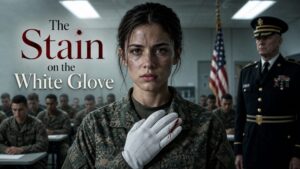
The Gate They Sealed
Part I — The Ceremony of Silence
Mara Vale tasted blood before she tasted fear.
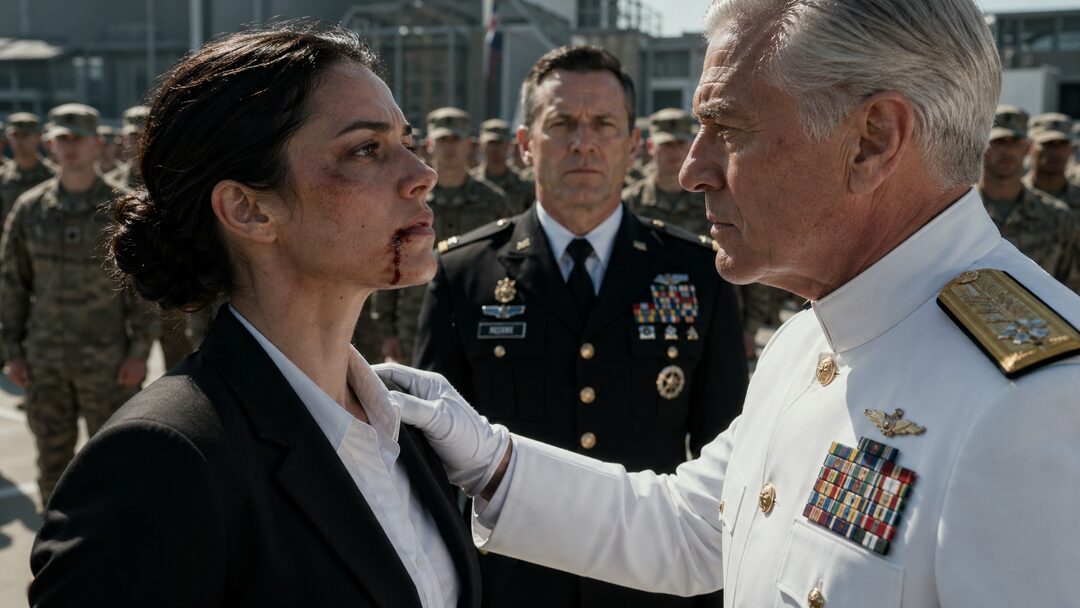
It ran warm from the split inside her lip, down the corner of her mouth, and settled in a thin red line along her chin. Three companies of soldiers stood across from her on the parade ground, their boots aligned, their faces forward, their rifles still. No one looked at the blood directly.
That was the first thing she hated.
Not the strike.
Not the pain.
The discipline.
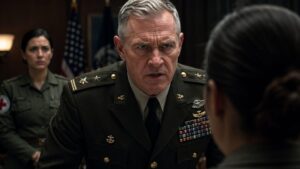
Admiral Conrad Voss kept one white-gloved hand clamped on her shoulder as if she were evidence he had already won. His ceremonial uniform was bright enough to hurt the eye under the noon sun. Medals sat on his chest in perfect rows. His expression was not angry yet. It was worse than angry.
It was patient.
Ten yards away, Sergeant Eli Vale stood in dress uniform stripped of everything that had once made it his. No ribbons. No commendations. No unit citation. The places where they had been pinned looked naked.
Her brother’s hands were held at his sides, fingers straight, as if someone had ordered even his shame into formation.
He would not look at her.
That was the second thing she hated.
Voss’s thumb pressed once into the bone above Mara’s collar. A warning. A claim.
“Let the record show,” he said, his voice carrying across the parade ground, “that Sergeant Elias Vale was offered the dignity of private separation. He refused that dignity through continued obstruction, civilian interference, and dishonorable silence.”
A microphone stood in front of him, black and thin as a weapon.
The soldiers did not move.
Mara swallowed blood.
The sky above Fort Halden was clear, brutally blue, the kind of sky people later remembered in photographs of ceremonies. Promotions. Retirements. Wreaths. Flags at half-mast.
Public things.
Clean things.
Voss had chosen this place because the parade ground made lies look official.
“On the twenty-seventh day of May,” he continued, “during Operation Lantern Bridge, Sergeant Vale abandoned his assigned post during an active evacuation, contributing directly to convoy collapse, operational retreat, and the deaths of three United States soldiers.”
Eli’s jaw tightened.
Only that.
No protest. No flinch. No breath loud enough to count as pain.
Mara stepped forward.
Voss’s hand tightened.
She stepped anyway.
“That is not what happened.”
Her voice was not loud, but the microphone caught enough of it. A current passed through the formation. Not movement. Not sound. Something smaller. A shift behind the eyes.
Voss smiled.
Of course he smiled.
He had been waiting for her to become the story he needed: the emotional sister, the civilian lawyer, the woman too soft to understand war and too loud to respect command.
“Ms. Vale,” he said, “this is a military proceeding.”
“It stopped being a proceeding when you denied the hearing.”
“This is not your courtroom.”
“No,” Mara said, wiping the blood from her lip with the back of her hand. “In court, people usually have to lie under oath.”
The silence changed.
Still quiet. Still obedient.
But sharper now.
Voss removed his hand from her shoulder slowly, almost gently, and turned his head toward the two military police standing near the edge of the formation.
“Remove her.”
The MPs moved.
Eli finally looked at her.
Just once.
His eyes were hollow, pleading, furious. Not at Voss.
At her.
Stop.
Mara felt it before he mouthed it.
Stop.
But she had watched him stop for eleven months. Stop answering calls. Stop sleeping. Stop defending himself. Stop wearing the jacket their father had pressed by hand the night Eli graduated from basic. Stop correcting neighbors when they whispered that maybe war had shown who he really was.
Mara had watched her brother become smaller inside a lie, and everyone around him had called it discipline.
So she did not stop.
She reached into the inside pocket of her black suit jacket and took out the folded copy of the extraction log.
It had been handled so many times the creases were turning white.
“Ask him about the six minutes,” she said.
Voss’s smile thinned.
The MPs paused, not because of Mara, but because of him.
She looked at the formation now. Not at all of them. Just the faces that looked too still.
“The convoy burned at 0437,” Mara said. “The retreat order was logged at 0443. Six minutes later. Six minutes after the west gate had already been sealed.”
A soldier in the second row blinked too hard.
Mara saw it.
So did Voss.
His voice lowered. The microphone no longer carried him clearly, but the officers nearest him heard every word.
“You are very close,” he said, “to destroying the last thing your father left this family.”
Mara held his gaze.
He knew about her father. Of course he did. Captain Daniel Vale, thirty-one years in uniform, dead of a stroke two winters ago with a folded flag on the mantel and a son still deployed.
Voss leaned in.
“If you continue,” he murmured, “your brother loses his pension, his medical care, and any chance of leaving this base with his name intact. Think carefully before you mistake grief for strategy.”
Mara’s lip throbbed.
“My father used to say a clean uniform could still cover dirty hands.”
For the first time, Voss’s eyes changed.
The blow was small enough for him to deny.
Fast. Controlled. Delivered with the back of his hand, not the fist. An officer’s violence. The kind meant to humiliate without leaving too much evidence.
Mara’s head snapped to the side.
Someone in formation inhaled.
No one moved.
Blood filled her mouth again, brighter this time.
Voss said, “That will be enough.”
Mara lifted her head.
Her smile was not amusement.
It was proof she was still there.
“No,” she said. “Now it’s enough for them to know what kind of ceremony this is.”
Part II — The Man Who Watched
Colonel Jonah Reed arrived as if he had been summoned by the silence itself.
He appeared at the far edge of the parade ground in a dark formal uniform, unadorned compared to Voss’s white display. He carried no folder, no visible weapon, no urgency. His hands rested behind his back. His eyes moved once over Mara’s face, paused on the blood, then continued to Eli.
Mara knew him immediately.
Not from a meeting. He had never granted her one.
From the signature at the bottom of the denial letter.
Colonel Jonah Reed, Joint Military Review Board.
One page. Three paragraphs. No hearing warranted. Insufficient evidentiary basis. Operational record affirmed.
She had read it so many times she could still see the block letters when she closed her eyes.
“You came,” she said.
Reed did not answer.
Voss turned toward him with polished irritation.
“Colonel Reed. This proceeding has already been reviewed.”
“So I understand,” Reed said.
His voice was even. Almost empty.
“Then you understand you have no role here.”
“I understand I was informed this would be a routine administrative separation.”
Mara laughed once. It hurt.
Voss’s eyes flicked to her, then back to Reed.
“This civilian interrupted a lawful ceremony.”
“She appears to be bleeding.”
“She struck an officer’s patience before anything else.”
Mara looked at Reed. “You signed the denial.”
“I did.”
“You never asked for the field recorder.”
Voss said, “Because no authenticated evidence exists.”
Mara reached into her jacket again.
This time the MPs fully stepped forward.
“Touch me,” she said, without looking away from Reed, “and every soldier here will know you’re afraid of a dead battery.”
That stopped them.
Not completely. But enough.
The thing in her hand looked pathetic in daylight. A scorched field recorder no longer than her palm, one side melted, the casing scratched, the speaker patched with tape. Eli had carried it during Lantern Bridge because their father had taught them both to record everything when command and memory might one day disagree.
Mara had found it in a sealed property bag, under two pairs of burned gloves and a cracked watch that had stopped at 4:38.
Eli stared at it now.
For the first time since she had arrived, his mask broke.
Not into hope.
Into terror.
“Mara,” he said.
His voice was raw from disuse.
She turned toward him.
He looked thinner than the last time she had seen him in civilian clothes. Not in the body—he was still hard from years of service—but around the eyes, where men became old before their rank changed.
“Don’t,” he said.
That single word hurt worse than Voss’s hand.
Voss heard the weakness in it and stepped into the gap.
“Sergeant Vale understands what you do not,” he said. “War is not repaired by civilian outrage. It is survived by order.”
Mara held up the recorder.
“Then let the order speak.”
Voss extended his hand. “That device is unauthorized.”
“Then authorize it.”
Reed took one step forward.
The air seemed to tighten around him.
“Ms. Vale,” he said, “does that recorder contain classified operational audio?”
“It contains rain, sirens, my brother begging to go back, and a senior command voice ordering the west gate sealed.”
Voss’s jaw flexed.
Reed said, “Play it.”
“Colonel,” Voss warned.
Reed did not look at him. “Play it.”
Mara pressed the small cracked button.
At first there was only static.
Then rain.
Not soft rain. Hard rain. Rain hitting metal, helmets, the roof of an armored vehicle. Beneath it, men shouting over one another. Someone coughing. A siren rising and falling. A voice yelling for a medic.
Then Eli’s voice, younger and panicked and alive in a way the man standing on the parade ground no longer was.
“Open the west gate! We have wounded at the west gate!”
Static tore through the sound.
Another voice answered, distant, distorted.
“Negative. Hold evacuation line.”
Eli again. “They’re alive! I can bring them through!”
The siren screamed.
A burst of interference swallowed the next words.
Then the senior voice returned.
Hard. Controlled.
“Leave the west gate sealed.”
A murmur passed through the formation before discipline crushed it.
Mara looked at the soldiers.
Some remained blank. Some looked confused.
But a few—only a few—changed completely.
A medic patch. A clenched jaw. A man in the rear rank staring at the ground like it had opened under him.
Voss lifted his chin.
“That proves nothing.”
The recorder hissed in Mara’s hand.
Voss’s voice grew colder. “Chaos makes poets of civilians. They hear guilt in static. They hear conspiracy in command. They do not hear the hundreds saved because men like me make decisions they cannot stomach.”
Mara stopped the recording.
The silence after it felt louder than the siren.
Eli said, “Mara. Please.”
She turned to him again.
He was not pleading with Voss.
He was pleading with her.
“Tell them,” she said.
His face closed.
“Tell them why you were at the west gate.”
His eyes moved once toward the formation, then toward the empty seats set aside for guests who had not been allowed through the base checkpoint. There should have been families there. Their mother, if she had still been alive. The parents of the dead, if Voss had wanted witnesses who were not under his command.
Eli’s throat worked.
“I said stop.”
The words landed like a slap.
Mara stared at him.
All this time, she had thought the enemy was fear.
Now she saw something worse.
Consent built out of grief.
Voss saw her understand, and his expression softened into victory.
“Your brother has accepted responsibility,” he said. “The only person dishonoring him now is you.”
Mara looked at Eli, but Eli had already gone back behind his eyes.
The brother who used to steal the crust from her toast. The boy who cried when their father missed one school play and pretended later he had only been angry. The man who enlisted at eighteen because he believed service could be a clean thing if clean people carried it.
He stood ten yards away from her and let them bury him alive.
Mara folded the extraction log slowly.
Then she put the recorder back in her pocket.
Voss relaxed.
That was his mistake.
Part III — Six Minutes
The first time Eli told Mara about Lantern Bridge, he had not used the word “dead.”
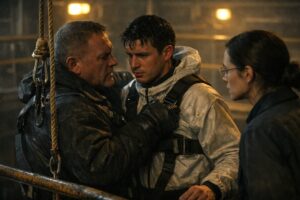
He had come home on medical hold three months after the operation with a healed fracture in his wrist, smoke scars along his left forearm, and a habit of waking before dawn with his hand around nothing.
They sat in her kitchen at 3:12 in the morning while the refrigerator hummed and rain touched the window.
“There was a gate,” he had said.
That was all.
Mara had waited.
She was good at waiting. Courtrooms taught that silence could make people either speak or reveal why they would not.
But Eli only stared at the mug between his hands until the tea went cold.
“Were you ordered to leave?” she asked.
He said, “Everyone was ordered to leave.”
“Were they alive when you left?”
His fingers tightened.
After that, he did not come back to her apartment.
Now, on the parade ground, the memory returned with the weight of a verdict.
There was a gate.
And Voss had sealed it.
Mara looked at the ranks again. “Who was at Lantern Bridge?”
No one answered.
Voss snapped, “You will not question my soldiers.”
“They’re not furniture.”
“They are under command.”
“And some of them are under the same lie.”
The white glove flashed at his side. Not raised. Not yet.
Reed watched everything.
Mara hated him for that. For watching so calmly while blood dried on her chin and Eli disappeared in front of everyone.
“You need sworn testimony,” she said to Reed. “Is that why you came? To watch whether someone breaks?”
Reed’s face gave her nothing.
“I came because you filed eleven petitions in four months,” he said.
“And ignored ten.”
“I read all eleven.”
“Carefully enough to do nothing.”
That struck. Not visibly. But his silence changed.
Voss stepped between them. “This is over.”
“It was over before I entered the gate,” Mara said. “You never intended to hold a hearing. This ceremony was your answer.”
Voss smiled again, but now the polish had scratches in it.
“My answer is discipline.”
“No,” Mara said. “Your answer is theater.”
A few soldiers’ eyes flickered.
Voss leaned close enough that she could see the faint lines of age beneath the smooth shave of his face.
“You think public pressure frightens me?” he asked softly.
“No.”
“Good.”
“I think public memory does.”
His hand moved before the words were fully gone.
This time he did not strike her. He seized her upper arm and turned her toward the formation.
“Look at them,” he said. “You come here in a black suit with a damaged toy and a legal degree, and you think you understand what held these men and women together under fire?”
Mara did look.
She saw rigid faces.
She saw shame disguised as discipline.
She saw fear wearing uniform.
Voss’s voice rose.
“You think every loss is a crime because you have never commanded anything heavier than a courtroom objection. You think mercy is telling every mother exactly how her son screamed. You think honor is a document you can wave in the sun.”
Eli flinched.
That, finally, was too much.
Mara pulled free of Voss’s grip and walked toward her brother.
The MPs moved again, but Reed lifted one hand.
They stopped.
Mara crossed the ten yards between herself and Eli. It felt longer than the years between them.
When she reached him, he did not look up.
“Eli,” she said quietly.
“Don’t say their names.”
She had not planned to.
His voice broke lower. “Don’t put their families through it.”
Mara’s anger stumbled.
There it was.
Not fear of Voss.
Not shame for himself.
The dead.
“Who promised you?” she asked.
His eyes closed.
“Who promised you they’d be buried as heroes if you took the charge?”
“Mara.”
“Who?”
His mouth trembled once. He mastered it immediately.
She knew that habit. Their father had taught him. A Vale did not shake where others could see it.
“He said operational failure would trigger a review,” Eli whispered. “The families would wait years. Benefits frozen. Honors delayed. Every report would say command negligence. Every article would use their names.”
Mara felt cold despite the heat.
“And you thought dishonoring yourself would honor them.”
“I was squad lead.”
“You were not command.”
“I carried two of them to the gate.”
The words almost did not come out.
Mara went still.
Eli kept staring over her shoulder, not seeing the parade ground anymore.
“Dawson was still talking. Keene had shrapnel in his neck but he was breathing. Ortiz kept saying he could walk if I just got his arm over me.” His voice thinned. “I got them to the west gate.”
Mara could hear the recorder again, even though it was silent in her pocket.
Open the west gate.
We have wounded at the west gate.
Eli swallowed.
“The gate stayed shut.”
Behind her, Voss said, “Enough.”
Eli’s eyes snapped open.
Not because of the command.
Because he had nearly spoken himself into truth.
He stepped back from Mara.
“You think you’re saving me,” he said. “But you’re digging up three graves with your bare hands.”
The line went through her cleanly.
Mara wanted to answer like an attorney.
Truth matters. Records matter. Men like Voss count on grief becoming silence.
But Eli was not an argument.
He was her brother.
So she said the only thing that came before strategy.
“I am trying to stop them from making you the fourth.”
His face changed.
Just for a second.
Then Voss’s voice cut across the field.
“Sergeant Vale, return to position.”
Eli returned.
That obedience hurt more now that Mara understood it.
Voss stepped back to the microphone.
“The ceremonial separation will proceed.”
Part IV — The Hand in the Air
A junior officer carried the service badge on a small black tray.
It should have been absurd, Mara thought, to make disgrace so tidy.
The badge was silver, worn at the edges, polished until it caught the sun. Eli had earned it two deployments ago after dragging a driver from a burning transport. Their father had held it in his palm once and said nothing for almost a minute.
Then he had told Eli, “Do not ever let them make you proud of the wrong thing.”
Eli had laughed then.
Young enough to think warnings were just old men’s weather.
Now the badge rested on velvet like something already dead.
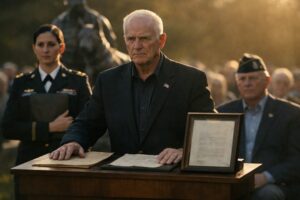
Voss spoke into the microphone.
“By authority vested in this command, Sergeant Elias Daniel Vale is hereby stripped of unit standing, service distinction, and active honor designation pending final administrative removal.”
Mara moved.
Not fast. Not dramatically.
She simply placed herself between the tray and Eli.
Voss’s face went flat.
“Ms. Vale.”
“Say the order again,” she said.
“This is your final warning.”
“Say it for them.”
Voss stepped close.
The soldiers could see his face now. Not only the medals. Not only the white uniform. The face.
That mattered.
“Remove yourself,” he said.
“No.”
The word was quiet.
It did not sound like defiance for its own sake.
It sounded like a door closing.
Voss’s hand rose.
Maybe he meant to shove her. Maybe to strike her again. Maybe he had spent so many years with people stepping back that his body moved before judgment could stop it.
Mara did not step back.
She caught his wrist in midair.
The whole parade ground saw it.
A civilian woman in a black suit, blood dried at her mouth, holding the raised hand of an admiral in white.
Not twisting it.
Not fighting.
Just stopping it.
For one naked second, Voss looked astonished.
Then pain entered his face—not from strength, but from exposure. Mara’s grip was firm enough to keep him there, trapped in the shape of his own threat.
No one breathed loudly.
No one saluted.
No one saved him from being seen.
Mara leaned close enough that only the microphone caught part of her voice.
“You are not angry because I am lying,” she said. “You are angry because I am saying it where they can hear.”
Voss’s eyes burned.
“Let go.”
“Say the order.”
“Let go.”
“Leave the west gate sealed,” Mara said. “That was it, wasn’t it?”
He jerked his wrist free.
The movement made him look less powerful than if she had released him. He knew it. Everyone did.
“Arrest her,” he snapped. “Assaulting a flag officer. Interference with military procedure. Remove her from this base.”
The MPs started forward again.
This time, Reed moved first.
He stepped between them and Mara.
Not dramatically. Not quickly.
But the line changed because he crossed it.
“Admiral Voss,” Reed said, “repeat the Lantern Bridge west gate order for the record.”
Voss stared at him.
The soldiers stared at Reed.
Mara did too.
For months, his signature had been a closed door. Now the man himself stood in front of her, holding it open by inches.
“This is not a review,” Voss said.
“It became one when you proceeded after material evidence was introduced.”
“No authenticated evidence has been introduced.”
“Then repeat the order.”
Voss’s mouth tightened.
“Operational commands from Lantern Bridge remain classified.”
Reed’s voice stayed level. “You referenced the operation publicly in your accusation against Sergeant Vale.”
“That does not permit—”
“Repeat the order.”
Voss did not.
The refusal moved across the formation faster than sound.
Mara saw understanding land in places denial had held. Not complete understanding. Not proof. But recognition.
Men like Voss loved questions only when they already controlled the answer.
A sound came from the second rank.
Small.
A boot shifting against gravel.
Every head near it turned without turning.
Corporal Anika Shaw stood with her hands clenched at her sides, a medic patch on her sleeve, her face pale beneath her cap. She was slight enough that the soldiers around her seemed built to hide her.
Her right hand trembled.
She pressed it hard against her thigh.
Voss saw her.
His expression sharpened.
“Corporal,” he said.
That single word carried warning, command, history.
Anika Shaw stepped out of formation anyway.
The movement was so small.
One pace.
Then another.
It broke the world.
Part V — The Medic’s Voice
Anika stopped halfway between the ranks and the microphone.
No one ordered her forward.
No one ordered her back.
That made it worse.
She had to choose every step herself.
Voss said, “Return to formation.”
She looked at Eli.
Not at Mara. Not at Reed.
At Eli.
“I’m sorry,” she said.
Eli’s face collapsed around the words before he rebuilt it.
Voss turned toward the formation. “Corporal Shaw is under medical review for post-deployment instability. Her participation in this disruption is neither reliable nor authorized.”
Anika flinched.
There it was. The knife he had kept ready.
Mara stepped toward her, but Reed spoke first.
“Corporal Shaw,” he said, “were you present at Operation Lantern Bridge?”
Anika nodded.
“Verbal answer.”
“Yes, sir.”
“Were you assigned to Sergeant Vale’s evacuation element?”
“Yes, sir.”
Voss snapped, “Colonel, you are inviting contaminated testimony into an administrative ceremony.”
Reed did not look at him.
“Did Sergeant Vale abandon his assigned post?”
Anika’s mouth opened.
Nothing came out.
The parade ground waited.
Mara saw the tremor in her hand spread to her wrist.
Eli said, “Shaw.”
Not warning.
Pain.
Anika’s eyes filled, but the tears did not fall.
“No, sir,” she said. “He did not desert.”
The words were soft.
They carried anyway.
Voss’s face hardened into command.
“Corporal Shaw—”
“He stayed,” she said, louder now, before fear could take the sentence back. “He stayed after the first retreat call. He carried Sergeant Dawson and Corporal Keene to the west gate. Private Ortiz was on his feet until the last thirty meters.”
Eli closed his eyes.
Anika looked at Reed because looking at Eli hurt too much.
“The west gate was supposed to open for secondary extraction. We had smoke cover. Maybe two minutes. Maybe less. But enough to pull them through.”
Reed asked, “Who sealed it?”
Anika’s lips parted.
Voss stepped toward her.
“Careful, Corporal.”
She went very still.
Mara recognized that stillness. It was not obedience. It was someone bracing for impact from a hand that had not moved yet.
Eli opened his eyes.
And finally, he spoke.
“Admiral Voss ordered it sealed.”
The sentence did not shake.
It did not come out loud.
It came out clean.
Voss turned slowly.
The ceremony he had built around Eli’s disgrace began to break around Eli’s voice.
“You will be silent,” Voss said.
Eli looked at Mara once.
Not pleading now.
Apologizing.
Then he faced Reed.
“I accepted the charge after the inquiry officer told me the official line would protect the families. Enemy pressure. Convoy collapse. Fallen during retreat. Full honors.” His throat worked. “If I disputed it, the deaths would move into command review. Benefits delayed. Honors delayed. Their parents would sit in rooms with men like him explaining how the gate stayed shut.”
Voss said, “You are admitting to making false statements.”
“I am admitting I was a coward in a way that looked like loyalty.”
The line struck the formation harder than a shout.
Anika covered her mouth.
Mara felt something in her chest loosen and break at the same time.
Voss moved toward the microphone, trying to recover the field through volume.
“This is precisely why trauma-distorted testimony cannot—”
“Enough,” Reed said.
It was the first word he had spoken with force.
The parade ground obeyed it before anyone decided to.
Reed turned to Mara. “The recorder.”
She pulled it from her pocket.
Her fingers were not as steady as she wanted them to be.
When Reed took it, his hand brushed hers. Briefly. The touch carried no comfort. Only consequence.
He connected it to the field speaker beside the microphone. A technician moved as if waking from a spell and helped him patch the line.
Static cracked across the parade ground.
Rain.
Shouting.
Sirens.
Eli’s voice, young and desperate.
“Open the west gate! We have wounded at the west gate!”
Anika whispered, “That’s Dawson. You can hear him coughing.”
The recording hissed.
“They’re alive! I can bring them through!”
Then the senior voice.
Distant. Damaged. But there.
“Leave the west gate sealed.”
This time, no one pretended it was only static.
Not after Anika had named the wounded.
Not after Eli had named the bargain.
Not after Voss had refused to repeat the order himself.
The voice on the recorder did not need to be perfect anymore.
The people who had survived it were standing in the sun.
Voss’s face had lost color beneath its discipline.
“You have no authority to relieve me on the basis of—”
“I have authority to suspend command pending review when credible evidence of falsified operational record is presented before active personnel,” Reed said.
Voss laughed once.
It was ugly because it was frightened.
“You think this protects the institution?”
Reed looked at the soldiers.
Then at Mara’s blood.
Then at Eli, standing without medals and without hiding.
“No,” Reed said. “I think it gives the institution one chance to deserve protection.”
He faced Voss fully.
“Admiral Conrad Voss, you are relieved of active command pending formal investigation by the Joint Military Review Board.”
For a moment, Voss seemed to wait for the parade ground to reject the sentence.
For the soldiers to restore him by believing him.
No one moved.
That was the final wound.
Not Reed’s order.
Their stillness.
Voss had mistaken silence for loyalty.
Now silence answered him back.
Part VI — What Grief Does Not Dishonor
When the companies were dismissed, they did not scatter.
The command to fall out traveled across the parade ground, but many soldiers remained where they were, as if their bodies had forgotten what freedom meant for a few seconds.
Voss was escorted away without handcuffs.
Men like him rarely left in metal.
He walked between two officers with his hat under one arm and his white gloves still on. His medals still shone. That seemed wrong to Mara, then painfully right. The world did not strip false honor as quickly as ceremonies stripped true men.
Anika Shaw stood near the microphone, breathing as if she had run miles.
Eli approached her first.
Mara stayed back.
That was hard.
Harder than catching Voss’s wrist. Harder than standing with blood in her mouth. There were forms of love that looked like stepping forward, and there were forms that looked like not claiming the moment.
Eli stopped in front of Anika.
For a long second, neither of them spoke.
Then he said, “You shouldn’t have had to carry it.”
Anika shook her head.
“You carried more.”
“That didn’t save them.”
“No,” she said, voice breaking. “But it saved me from thinking I’d imagined it.”
Eli looked away.
Not to escape her.
To survive the kindness.
Mara wiped her lip with her sleeve. The blood had dried stiff against her skin. Her jaw ached. Her shoulder still held the memory of Voss’s grip.
Reed came to stand beside her.
For a while, he said nothing.
Mara did not make it easy for him.
Finally, he said, “The review will be ugly.”
“I assumed.”
“Slow.”
“I assumed that too.”
“Voss has allies.”
Mara watched Eli turn the service badge over in his palm. The junior officer with the tray had given it to him without asking permission from anyone.
It was not reinstatement.
It was not absolution.
It was a small rebellion made of silver.
“The families will learn the report was false,” Reed said.
Mara’s throat tightened.
Across the parade ground, three empty chairs remained in the guest section. Someone had placed programs on them by mistake or habit. Dawson. Keene. Ortiz. Names printed in an official order of ceremony that had never intended to say what happened to them.
“Grief is not dishonor,” Mara said.
Reed looked at her then.
Maybe he had expected anger. Maybe a legal threat. Maybe triumph.
She had none of those left in a clean enough shape to offer.
He lowered his gaze.
“No,” he said. “It isn’t.”
Mara turned to him.
“You waited too long.”
He accepted that without flinching.
“Yes.”
“You let him stand up there.”
“Yes.”
“You let my brother almost disappear into your process.”
Reed’s jaw tightened once.
“Yes.”
The admissions did not heal anything.
But they were not nothing.
Mara left him there and walked toward Eli.
He saw her coming.
This time, he did not look away.
That nearly undid her.
Up close, he looked younger than twenty-seven and older than their father had at fifty. His service badge rested in his open hand. His fingers curled around it, then opened again, as if he was not sure he had the right to hold anything that shone.
Mara stopped in front of him.
For once, she did not know how to begin.
She wanted to say she was sorry. She wanted to say she had been right. She wanted to say she had been wrong about the shape of his silence. She wanted to ask why he had not trusted her with the whole grief.
Instead, she said, “You scared me.”
A faint, broken smile touched his mouth.
“You showed up bleeding.”
“You did that emotionally first.”
The smile vanished, but not because the line hurt.
Because he almost laughed.
And laughter, here, would have been a kind of collapse.
Mara lifted her hand.
She stopped before touching him.
Voss had held her shoulder like ownership. She would not put her hand on Eli as if he were something to retrieve.
So she waited.
Eli looked at her hand.
Then at her face.
Then he gave one small nod.
Mara placed her hand on his shoulder.
Not hard.
Not to steer him.
Just enough for him to know where she was.
His eyes closed.
For a moment, he was the boy who had fallen asleep in the back seat after their father’s promotion ceremony, his cheek against the window, one hand still clutching a paper flag.
For a moment, she was the sister who had promised, at thirteen, that if anyone ever tried to take him apart, she would bite first and explain later.
But he was not a boy now.
And she had not saved him whole.
The truth had opened the gate too late for the dead.
It had only opened it in time for the living.
Around them, soldiers from Eli’s old unit began to pass.
No one saluted.
That would have been too clean, too easy, too much like an ending someone could photograph.
Instead, they met his eyes.
One by one.
Some only for a second.
Some with shame.
Some with grief.
Anika Shaw stood a little straighter each time it happened.
Eli’s hand closed around the badge.
Mara felt his shoulder tremble once beneath her palm.
No one mentioned it.
Above the parade ground, the flag snapped hard in the wind. The microphone still stood where Voss had left it. The field speaker crackled once, then went silent.
Reed remained near the empty chairs, already speaking quietly into his phone, already pulling the slow machinery of accountability toward the day’s broken light.
Mara knew there would be statements. Hearings. Lawyers worse than Voss because they would smile without ever raising a hand. Families receiving calls that would wound them in the name of truth. Reports amended in language too careful for the blood it described.
Justice would not arrive clean.
Maybe it never did.
Eli looked down at the badge in his palm.
“What happens now?” he asked.
Mara kept her hand on his shoulder.
“Now,” she said, “we stop letting them call silence honor.”
He nodded once.
Not healed.
Not free.
But no longer standing alone inside the lie.
Together, they crossed the parade ground slowly, past the place where Voss had gripped her, past the microphone that had carried his accusation, past the soldiers who had watched a ceremony become a reckoning.
Mara’s lip still bled when the wind touched it.
She did not wipe it away.