Where Silence Broke
Part I — The Sentence He Wanted
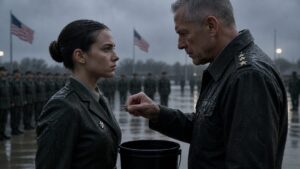
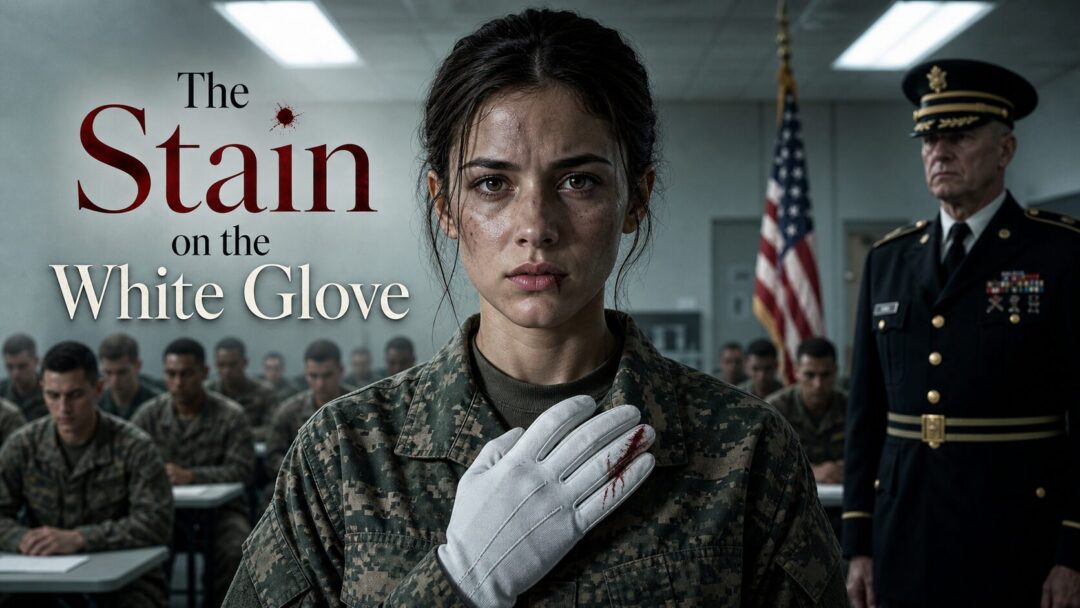
Sergeant Major Caleb Rusk struck Private Lena Ward across the mouth with a white-gloved hand, and for one second the whole training room forgot how to breathe.
The sound was small.
Not the thunderclap people imagined when they talked about violence later. Not a cinematic crack. Just leather against skin, a wet click of teeth, the sharp scrape of Lena’s boot as her body caught itself before it stumbled.
Then blood appeared at the corner of her lip.
A line of it slid down her chin and stopped at the edge of her collar.
Nobody moved.
Thirty-two recruits sat behind folding tables under fluorescent lights, all of them in camouflage, all of them looking anywhere except at the place where Rusk’s hand had landed. One soldier had a pen frozen above a notebook. Another stared at the floor so hard his jaw trembled. Someone in the back swallowed too loudly.
Rusk stood close enough that Lena could see a faint nick in the polished brass on his uniform.
His white glove was still raised.
“Again,” he said.
Lena tasted blood. Copper, salt, heat.
She did not wipe it away.
Rusk’s voice cut through the room like it owned every wall. “Convoy Six deviated from command route due to insurgent interference.”
Lena stared at him.
He waited. Everyone waited with him.
She could feel the room willing her to say it. Not because they believed it. Because if she said it, the morning could continue. The drill could resume. Their deployment certification could stay on schedule. Rusk could become Rusk again, a terrifying but predictable man in a spotless uniform.
Lena swallowed once.
“That is not what happened.”
The chair leg that scraped across the floor sounded louder than the slap.
Rusk turned his head slightly, not enough to look away from her, but enough to let the recruits see his profile. He had the face of a man who had survived too much and mistaken survival for permission. Tall, severe, iron-gray at the temples, cap brim low enough to shade his eyes.
“Private Ward,” he said, “you are standing in front of a readiness formation. You are not in a counseling session.”
“No, Sergeant Major.”
“You are not in a courtroom.”
“No, Sergeant Major.”
“You are not here to process grief in front of soldiers who still have work to do.”
Lena’s lip pulsed. Blood warmed her chin again.
Rusk stepped closer.
“Then say the sentence.”
She kept her hands flat against her sides. Not fists. Fists could be called aggression. Not trembling. Trembling could be called instability.
“There was no insurgent fire before the order changed,” she said.
The air changed.
It was almost nothing, but Lena felt it. A row of shoulders tightening. A pair of eyes lifting and dropping. A breath caught halfway in someone’s throat.
Rusk smiled without kindness.
“There it is,” he said. “The infection.”
He turned fully to the room now, making Lena part of the lesson.
“Listen carefully. This is what happens when a soldier begins to believe her feelings outrank command. She hears static and calls it truth. She loses a friend and calls it evidence. She confuses pain with moral authority.”
Lena heard Maya Bell’s laugh in the back of her mind, bright and practical.
Don’t become one of those people who confuses being right with being brave.
Rusk faced Lena again.
“You are dangerous,” he said softly, “because you make weakness sound principled.”
Lena did not answer.
He wanted argument. He wanted heat. He wanted a raised voice he could discipline, tears he could label, a shaking hand he could write into a file.
She gave him none of it.
Only the sentence again.
“There was no insurgent fire before the order changed.”
Rusk’s gloved fingers flexed.
In the second row, Specialist Noah Cruz stared at the tabletop. His hands were folded so tightly his knuckles had gone pale.
Lena saw him. Saw his silence. Marked it.
Rusk lowered his hand at last, but his voice dropped with it.
“Dismissed for ten minutes,” he said. “No one leaves the building.”
The room moved too fast, then too slowly. Chairs pushed back. Boots scraped. Recruits stood and gathered notebooks and tried not to look at Lena’s mouth.
Noah passed her without raising his eyes.
That, somehow, hurt more than the slap.
Rusk leaned close enough that only she could hear him.
“You think bleeding makes you honest,” he said.
Lena looked at the faint red smear along the seam of his glove.
“No,” she said. “But it makes a stain.”
Part II — Convoy Six
Three weeks earlier, Lena had sat inside a communications trailer that smelled of burnt coffee, dust, and hot plastic, listening to men die through a headset.
She was not supposed to be anyone’s hero.
She was good with timestamps. Good with signal breaks. Good with hearing what other people blurred into noise. Her job during the border stabilization operation was to log convoy movement, relay route updates, and keep her voice clear even when everyone else’s started to rise.
Corporal Maya Bell used to say Lena could hear guilt before people confessed it.
“You’re creepy like that,” Maya had told her, writing check fuel on the back of her wrist in blue pen. “Useful, but creepy.”
Lena had thrown a packet of powdered creamer at her.
Maya caught it against her chest and grinned. “See? Violent tendencies. I’m reporting you.”
“You can’t even remember to report your own vehicle checks.”
“That’s why I write on my wrist. It’s called adapting.”
Maya was always adapting. To heat. To bad food. To officers who said “temporary stabilization” like temporary made danger polite. She had a sun-faded cap, practical hands, and the ability to make fear feel ordinary without making it small.
Convoy Six was supposed to be routine.
Four vehicles. Medical kits. Replacement batteries. Two civilian translators. A route that had been cleared twice, then checked again because nobody trusted peace during its first month.
Lena had the route line in front of her, marked in green.
Maya’s convoy marker blinked at checkpoint three.
Then Rusk came over the command channel.
“Convoy Six, alter route to Customs Road. Repeat, alter route to Customs Road.”
Lena looked at the map.
Customs Road was a gray line running near an abandoned border station. It had not been cleared that morning. She knew because she had logged the warning herself at 0630.
She pressed her headset closer.
“Command, Ward. Customs Road not confirmed clear.”
A pause.
Not long. Long enough.
Rusk’s voice returned, calm and hard. “Acknowledged. Reroute stands.”
Lena looked across the trailer to the duty officer. He did not look up.
“Sergeant Major,” she said, “last clearance update shows Customs Road pending.”
“Ward,” Rusk said, “copy the order.”
In the background of the convoy channel, Maya laughed nervously.
“Tell Ward she worries too much.”
It was so Maya that Lena almost smiled.
Almost.
The convoy turned.
Nine minutes later, the first report came in broken by static.
Then yelling.
Then someone shouting for smoke.
Then the word translator repeated twice, like if they said it enough, the civilians in the second vehicle would become less injured.
Lena kept writing timestamps.
Her hand cramped. She kept writing.
Maya did not come back on the channel.
By night, the official version had already begun forming around the dead.
Convoy Six deviated from command route due to insurgent interference.
It appeared first in a field summary. Then in a briefing note. Then in a draft incident report Lena found on a shared terminal, the words clean and bloodless, as if language itself had been assigned to wash the road.
She went to Rusk the next morning.
He stood outside the command tent with his sleeves rolled precisely to regulation. He was not wearing the white gloves then. Those belonged to inspections, ceremonies, controlled rooms where command performed itself.
“Sergeant Major,” Lena said. “The report says they deviated due to insurgent interference.”
Rusk signed a clipboard without looking at her. “That is the operational assessment.”
“That is not the sequence.”
His pen stopped.
Lena felt the world narrow.
“I warned the route was not confirmed clear,” she said. “You acknowledged. You ordered the reroute anyway.”
Now he looked at her.
Rusk had a soldier’s face, but not the kind recruiters liked on posters. His was too worn, too carved. A man who had made decisions in burning places and survived the consequences long enough to start believing that survival had voted in his favor.
“You are twenty-four years old,” he said.
Lena said nothing.
“You sat in a trailer.”
“Yes, Sergeant Major.”
“I have carried men without legs off roads that looked empty five minutes before they opened up.”
“Yes, Sergeant Major.”
“You think a log makes you understand command?”
“I think a log makes time harder to lie about.”
The clipboard cracked against the table when he set it down.
Maya would have told her to shut up.
Not because Maya was a coward. Because Maya wanted to live. Because Maya believed survival came first and truth could file paperwork later.
Don’t make enemies for free, Ward.
But Maya was dead, and the report was alive.
That was the insult Lena could not swallow.
Two days later, Lena was called in for a review.
A captain she barely knew sat behind a desk and spoke gently, which was worse than shouting.
“Private Ward, no one is questioning your service.”
“That usually means you are.”
He folded his hands. “You experienced a traumatic event indirectly.”
“Indirectly,” she repeated.
“You monitored the channel during a casualty event involving a close peer. It is normal for memory to become attached to guilt.”
“My memory is attached to timestamps.”
He sighed like she was making this harder than necessary.
By the end of the week, her file contained the first phrase.
Stress response.
Then another.
Unstable recall.
Then, after she refused to sign the amended incident statement:
Hostility to command structure.
The words spread faster than blood.
People stopped sitting beside her in the mess. Conversations changed shape when she entered. Recruits who had admired Rusk all cycle long watched her like she carried a contagious disease.
Noah Cruz was the worst of them because he had heard enough to know better.
He had been in and out of the communications trailer that day, running backup batteries, pretending not to listen but always listening. He had heard Lena warn them. He had heard the reroute. He had heard the first broken calls after the trap.
But when Rusk drilled the official line into the platoon, Noah said nothing.
Once, near the motor pool, Lena cornered him.
“Did the road clear before they turned?”
Noah tightened the strap on a gear bag.
“Ward—”
“Did it?”
His eyes flicked toward the command building.
“That’s not how these things work.”
“No,” Lena said. “That’s exactly how these things work.”
He looked tired. Older than twenty-six. Younger than his silence.
“You think I don’t know what I heard?”
“I think you’re hoping I’ll forget what you heard.”
Noah flinched.
Good, Lena thought.
Then hated herself for needing him to.
Part III — The Room That Learned Silence
Rusk did not strike her the first time in anger.
Lena understood that by the end of the morning.
He struck her in uniform, under lights, in a room full of witnesses he had arranged into rows. He struck her after repeating the official sentence four times, after making recruits say it back, after pointing to the whiteboard where the words were written in black marker.
Convoy Six deviated from command route due to insurgent interference.
He had built the room like a machine, and Lena was the part refusing to fit.
The slap was not loss of control.
It was control making a fist.
After the ten-minute dismissal, Lena went to the restroom and rinsed blood from her chin. The split in her lip reopened when she touched it with a paper towel.
In the mirror, she looked annoyingly alive.
Maya would have said that.
You look annoyingly alive. Stop brooding and hydrate.
Lena gripped the sink.
She had kept Maya in fragments because the whole of her hurt too much.
Maya writing check fuel on her wrist.
Maya stealing hot sauce packets.
Maya saying, “If I die, do not let them put my worst ID photo on anything official.”
Maya also saying, quieter, three nights before Convoy Six, when Lena complained about sloppy route changes and officers who treated maps like suggestions:
“Don’t become one of those people who confuses being right with being brave.”
Lena had rolled her eyes. “What’s the difference?”
Maya had pointed a plastic spoon at her. “Brave gets people through the day. Right gets people punished after.”
“You sound like a coward.”
“I sound like someone planning to go home.”
Now Maya’s name was on a memorial list, and Lena’s refusal to sign a lie felt like loyalty one minute and theft the next.
What if Maya would have hated it?
What if Maya would have told her to stop turning a death into a crusade?
The restroom door opened.
Noah stepped inside, then stopped when he saw her at the sink.
“It’s the women’s restroom,” Lena said.
He glanced at the empty stalls. “I know.”
“That brave now?”
His shame crossed his face so quickly she almost missed it.
“I need to show you something.”
“If it’s a spine, keep it. You’re still using it wrong.”
He took the hit without defending himself.
That made her angrier.
“Ward,” he said, low. “Please.”
She looked at the door behind him. “If Rusk sent you—”
“He didn’t.”
Noah pulled a phone from inside his blouse pocket.
Phones were not supposed to hold operational fragments. Personal devices were not supposed to have any of it. That was the kind of rule everyone broke until the rule mattered.
Noah’s thumb hovered over the screen.
“I kept this because my brother told me to always keep proof of what scared me.”
Lena said nothing.
“Rusk saved him,” Noah continued. “Eight years ago. Roadside ambush outside Gharan. My brother’s vehicle burned. Rusk pulled him out. Took shrapnel in the neck doing it.”
Lena had heard the story. Everyone had. Rusk the legend. Rusk the hard man who kept soldiers alive. Rusk the reason Noah’s mother still had both sons in old Christmas photos.
Noah’s voice thinned.
“My family has a picture of him in our hallway.”
Lena stared at him.
“You want me to feel sorry for you because lying hurts your childhood?”
“No,” he said. “I want you to understand why I froze.”
“I understand freezing. I don’t understand staying frozen.”
He nodded once, like she had placed the sentence exactly where it belonged.
Then he pressed play.
Static filled the restroom.
Lena’s own voice came through first, clipped and young and unbearable.
“Command, Ward. Customs Road not confirmed clear.”
A pause.
Rusk: “Acknowledged. Reroute stands.”
Then, behind engine noise, Maya.
“Tell Ward she worries too much.”
The audio cut off.
Nothing after. No explosion. No screaming. No proof of the trap. No full confession wrapped in a bow and handed to justice.
Just a warning. An order. A dead woman laughing.
Lena had not known a person could miss someone harder from hearing them alive.
She reached for the sink without meaning to.
Noah locked the phone.
“It’s not enough,” he said.
“No.”
“But it’s not nothing.”
Lena looked at him then.
Really looked.
He was broad-shouldered and careful, a man who had built his life around staying useful and unremarkable. He had not saved her that morning. He had not moved when Rusk hit her. He had sat there with his hands folded, protecting a dead version of Rusk because that version had once saved someone Noah loved.
Lena wanted to hate him cleanly.
She could not.
“Why now?” she asked.
His mouth tightened.
“Because when he hit you, I looked at his glove.”
Lena waited.
“There was blood on it,” Noah said. “And he still looked clean.”
The door opened again before she could answer.
A young private froze in the doorway, eyes darting from Lena to Noah to the phone.
Noah slipped it away.
Nobody spoke.
Then the private backed out and let the door close.
The room had learned silence.
But silence, Lena thought, could learn other things too.
Part IV — The Price of Standing
By late afternoon, Rusk knew.
Lena could tell by the way the hallway cleared before she saw him. Fear moved ahead of important men. It emptied spaces, lowered voices, made soldiers suddenly remember tasks elsewhere.
He stood outside the training room in his dark dress uniform, cap under one arm, white gloves tucked through his belt.
The same gloves.
Her blood had dried along one seam. A faint brown-red mark, almost invisible unless you knew where to look.
“Private Ward,” he said.
“Sergeant Major.”
“I understand you have obtained unauthorized material from an operational channel.”
Lena did not look at Noah, who stood three yards away with two binders in his arms and the expression of a man hearing his own sentence pronounced.
“I understand the incident report is false,” Lena said.
Rusk’s jaw shifted once.
A lesser man might have shouted. Rusk did not need volume. He had trained rooms to lean toward him.
“You are very close to losing the only merciful exit left.”
“I didn’t ask for mercy.”
“No. You asked for importance.”
That landed because some hidden part of her feared it was true.
Rusk saw it. Of course he did.
He stepped nearer, lowering his voice.
“You think this is about Corporal Bell. It is not. It is about you needing her death to mean you were right.”
Lena felt heat climb under her skin.
There it was. The knife shaped exactly like her doubt.
“You never carried her,” Rusk said. “You never saw the vehicle. You never smelled the road afterward. You sat in a trailer and decided grief made you command.”
Lena’s hands stayed still.
She hated him for being cruel.
She hated him more for knowing where to place the cruelty.
“Emergency formation,” he said. “Seventeen hundred. Same room.”
Noah’s head lifted.
Rusk did not look at him.
“You will repeat the official account in front of the unit. You will surrender any unauthorized recordings. The reprimand will disappear. Your file will reflect stress response and recovery. You will be allowed to remain eligible for memorial attendance.”
Lena heard only one word.
“Eligible?”
Rusk put on the glove slowly. Finger by finger.
“The Convoy Six memorial detail is restricted to personnel in good standing.”
The hallway narrowed.
Maya’s mother would be there. Maya’s younger sister. Soldiers from the convoy. A folded flag. A photograph that, God willing, was not Maya’s worst ID picture.
Lena had imagined standing in the back if they would not let her stand near the front.
She had imagined being quiet.
She had imagined not crying because Maya would have mocked her forever from whatever place dead practical people went.
Rusk watched her absorb the threat.
“There is still a way to serve with dignity,” he said.
Lena’s voice came out rough. “Whose?”
For the first time, his face changed.
Not much. Enough.
The myth cracked and the frightened man inside looked through.
“You think command survives if every frightened specialist gets to relitigate a decision after bodies come home?” he asked.
“No,” Lena said. “I think command dies when bodies come home and the decision disappears.”
His eyes hardened again.
“Seventeen hundred.”
He walked away.
Noah exhaled behind her like he had been holding his breath since morning.
Lena turned on him.
“If you don’t use it, give it to me.”
Noah held her gaze. “If you use it alone, they’ll call it altered.”
“They’ll call me unstable either way.”
“They need more than you.”
She almost laughed. It would have hurt her lip.
“Now you know that?”
“I knew it before,” he said. “I just hated what it cost.”
She looked down the hallway where Rusk had gone.
“What changed?”
Noah’s answer was quiet.
“I got tired of making dead men carry my courage.”
Lena did not forgive him.
But she stopped asking him to leave.
At 1652, she stood alone in a supply room and opened a drawer marked ceremonial inventory. Inside were folded gloves, inspection cords, lint rollers, brass polish, all the small objects used to make authority look untouched.
She took one clean white glove.
She did not know why yet.
Only that her hands shook after she folded it and put it inside her pocket.
Part V — What the Room Heard
At 1700, the recruits were seated in the same rows.
Same fluorescent lights.
Same folding tables.
Same whiteboard with the same sentence written across it in Rusk’s hard block letters.
Convoy Six deviated from command route due to insurgent interference.
Lena stood at the front again.
Her lip had swollen. The bleeding had stopped, but the split remained dark and visible. Nobody in the room looked directly at it for long.
Noah sat in the second row.
His phone was face down on the table beneath his hand.
Rusk entered last.
The room rose.
He wore the dark uniform and the white gloves. Not the tucked pair from the hallway. A fresh pair, clean and bright beneath the lights. Lena wondered where the stained one had gone.
Then she saw it.
Folded in his left hand.
He had kept it.
Whether as evidence to destroy later, or as a private reminder, or as proof to himself that blood could dry and become manageable, she did not know.
“At ease,” Rusk said.
The room sat.
He walked to the whiteboard and tapped the sentence once.
“We will end this disruption now.”
His gaze moved over every recruit, letting each one understand the offer: silence could still save them.
Then he looked at Lena.
“Private Ward. Recite the operational account.”
Her heart beat once. Twice.
Maya’s voice rose in memory, laughing through static.
Tell Ward she worries too much.
Lena had worried too much.
Not enough.
She looked at the sentence.
“Convoy Six deviated from command route…”
The room loosened.
It was tiny, almost tender in its relief. Someone’s shoulders dropped. Someone closed their eyes. Noah’s hand tightened over his phone.
Rusk did not smile. He was too disciplined for that.
But Lena saw the victory gather in him.
She let it.
Then she finished.
“…because Sergeant Major Rusk ordered a reroute after being warned the road had not been cleared.”
The room went still in a new way.
Not afraid.
Awake.
Rusk’s hand came up before his face changed. Some reflex older than thought. Some practiced method of making a body answer for a voice.
This time Lena moved first.
She caught his wrist with both hands.
The white glove stopped inches from her mouth.
A gasp broke somewhere in the back row.
Lena did not twist. Did not strike. Did not shove.
She held him there.
His arm was stronger than hers, but surprise gave her one clean second, and one clean second was enough.
With her left hand, she pulled the folded stained glove from his grip.
Rusk’s eyes changed.
There it is, Lena thought.
Not rage.
Fear.
She turned the glove outward so the room could see the faint brown-red seam.
Her blood, dried into the white.
“You can make me repeat a lie,” she said. “You cannot make them unhear the order.”
Noah stood.
His chair scraped backward, the same ugly sound from that morning, but this time it did not sound like fear.
Rusk snapped, “Specialist Cruz, sit down.”
Noah’s face had gone pale.
He did not sit.
He pressed play.
Static filled the room.
Then Lena’s own voice, clear enough to hurt.
“Command, Ward. Customs Road not confirmed clear.”
A pause.
Rusk’s voice.
“Acknowledged. Reroute stands.”
Then Maya Bell, alive for three impossible seconds.
“Tell Ward she worries too much.”
The audio stopped.
No explosion. No screaming. No easy ending.
Just enough truth to make the lie bleed.
Rusk looked at the room as if he could still command it back into silence.
Nobody moved.
Then a recruit in the third row raised his hand halfway, like they were still in class and rules still mattered.
“I logged the route board after the update,” he said. His voice shook. “Customs Road was still marked pending.”
Rusk turned on him. “Private—”
Another voice cut in.
“I saw the amended report before it went up. The first draft said command reroute.”
A woman near the back stood without looking at anyone.
“I heard Ward call the warning. I didn’t know if I should say it.”
The words came unevenly. Not brave speeches. Not courtroom declarations. Just fragments that had been hiding inside bodies all day, all week, all month.
“I saw the timestamp changed.”
“I carried the board down after.”
“I heard Cruz ask about the audio.”
“I knew.”
That one was the worst.
A young soldier in the front row said it so quietly that it should not have reached the back wall.
“I knew.”
Rusk’s wrist was still in Lena’s hands.
Slowly, he pulled it free.
She let him.
His clean glove remained spotless. The stained one hung from Lena’s fingers.
For the first time since she had known him, Sergeant Major Caleb Rusk looked like a man in a room instead of the room’s reason for existing.
He looked at Noah.
Noah looked back, ashamed and standing.
Rusk looked at Lena.
She did not lower her eyes.
The door opened ten minutes later to two officers whose faces had already arranged themselves into institutional caution. Someone had called. Someone had panicked. Someone had finally decided that silence was no longer the safest position.
Rusk surrendered command of the room without being asked twice.
That was how Lena knew he understood.
Not defeat.
Exposure.
As he passed her, his shoulder almost brushed hers.
“You have no idea what you’ve done,” he said.
Lena held the stained glove at her side.
“Yes, Sergeant Major,” she said. “I do.”
Part VI — The Glove Set Down
Rusk was removed pending investigation before the week ended.
That was the phrase everyone used because it let them avoid better ones.
Not guilty.
Not innocent.
Not exposed.
Removed pending investigation.
Lena’s file did not become clean overnight. Stress response did not vanish. Hostility to command structure remained in language soft enough to survive review. People who had avoided her before now avoided her differently, which was not improvement so much as variety.
Some nodded at her in hallways.
Some looked through her.
Some seemed angry that she had made them decide who they were.
Noah gave his statement twice. The second time, his hands did not shake.
Lena watched from the other end of the corridor as he came out of the interview room and leaned against the wall, eyes closed. For a second, he looked like a man waiting for punishment from the dead.
She did not go to him.
Not yet.
Maya’s memorial was held on a cold morning under a flat gray sky.
Lena was allowed to attend, but not with the honor detail.
No one said barred. No one said punished. No one had to.
She stood at the back in uniform, lip healing into a small scar she could feel whenever she spoke too quickly. Maya’s photograph stood near the front, framed beside a folded flag and a row of polished boots. They had chosen a good photo. Not the worst ID picture. In it, Maya was squinting into sun, smiling like someone had just made a joke she planned to improve.
Lena almost smiled back.
Almost.
The chaplain spoke. An officer spoke. Maya’s mother stood with both hands around her younger daughter’s fingers. Nobody said Customs Road. Nobody said reroute. Nobody said Rusk.
But they did not say insurgent interference either.
Sometimes absence was not cowardice.
Sometimes it was the first shape truth made before it found a voice.
Noah stood beside Lena near the back, leaving enough space between them for everything he had not done.
Halfway through the service, he said, very quietly, “I should have stood up sooner.”
Lena kept her eyes on Maya’s photograph.
The old answer rose easily.
Yes. You should have.
She almost gave it to him. He deserved it. Maybe she did too.
But then she remembered Maya pointing a plastic spoon at her.
Brave gets people through the day. Right gets people punished after.
Lena breathed in.
“You stood up when it mattered,” she said.
Noah’s face tightened.
It was not forgiveness. They both knew that.
It was something more useful.
When the memorial ended, people drifted away in careful groups. Maya’s mother touched the frame. Her sister wiped her face with the heel of her hand. A captain collected papers. The honor detail moved with polished precision, young soldiers trying to make grief look orderly.
Lena waited until the table was almost clear.
Then she reached into her pocket.
The white glove she had taken from the supply room was clean, folded, unused.
Not Rusk’s glove. Not the one that struck her. Not the stained one now sealed in an evidence bag somewhere behind locked doors and cautious language.
This one had no blood on it.
That mattered.
Lena placed it beside Maya’s photograph.
For a moment, her hand rested on the table.
She thought of the communications trailer. The green route line. Maya’s laugh through static. Rusk’s voice saying reroute stands. Noah rising from his chair. The room beginning to speak.
She thought of all the ways the dead could be used by the living.
Then she lifted her hand away.
The glove stayed there, white against dark wood, no longer a symbol of spotless command.
Just something set down.
Outside, Noah waited by the steps but did not call her name.
Lena walked past him into the cold.
After a few steps, he fell in beside her.
Neither of them spoke.
The future had not opened cleanly. It had opened like a wound cleaned without anesthesia: necessary, ugly, not yet healed.
Lena touched the small scar at her lip with her tongue.
It hurt less than yesterday.
Not because the pain had disappeared.
Because it finally belonged to the truth.