The Pin in the Bucket
Part I — The Sound It Made
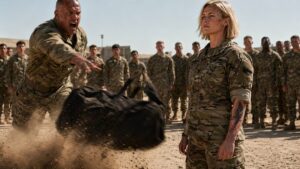
Colonel Thomas Reed stood close enough for Emily Carter to smell coffee on his breath and rain in the wool of his coat when he asked her, in front of three platoons, whether she wanted to ruin her life over one sentence in a report.
The parade ground was wet enough to reflect the flags behind him.
No one moved.
Not the cadets in formation.
Not the captain standing beside the black evidence bucket.
Not Emily, though rain had slipped beneath her collar and was crawling down her spine.
Reed’s voice was low, but the front row heard every word.
“Cadet Carter,” he said, “this is your final opportunity. Do you maintain your refusal?”
Emily kept her eyes on the brass button at the center of his jacket.
“Yes, sir.”
A muscle moved once in Reed’s jaw.
“The corrected incident report is lawful. It has been reviewed. It has been approved.”
“Yes, sir.”
“And you refuse to sign it.”
Emily felt the weight of the silver unit pin on the left side of her uniform. It was smaller than a quarter, polished bright that morning because she had polished everything. Boots. Belt. Buckles. Brass. The version of herself she had spent four years building.
“I refuse, sir.”
The rain ticked softly on caps and shoulders.
Behind Reed, two American flags snapped hard in the gray wind. Behind Emily, three platoons of cadets stared straight ahead with the disciplined blankness they had been taught to wear when witnessing another person’s consequence.
Reed stepped closer.
He had always been a tall man, but authority made him taller. His hair was cropped short and gray. His face looked carved more than aged, the skin weathered by years of sun, sleeplessness, and decisions nobody below his rank was allowed to question.
“You were ranked first in this class yesterday,” he said.
Emily did not answer.
“You were scheduled to receive your commission tomorrow.”
She could feel eighty pairs of eyes refusing to look at her.
Reed’s hand rose.
For one strange second, Emily thought he might touch her shoulder. She hated herself for wanting that. Hated the small, stupid part of her that still wanted this man to say, Enough. You passed. You did the hard thing.
Instead, his fingers closed around the silver pin on her chest.
The metal tugged against the fabric.
A sound moved through the formation, not quite a gasp. A breath several people failed to hide.
Emily held still.
Reed’s fingers worked the clasp loose with controlled care. He did not tear it away. He removed it properly, almost respectfully, and that made it worse.
The spot it left behind felt enormous.
Reed held the pin between two fingers. Silver caught the pale morning for the last time.
Then he dropped it into the black bucket.
The sound was small.
That was the cruelest part.
It did not ring like a bell. It did not crack the sky open. It hit plastic with a dull, cheap tap, the sound of something valuable being treated like trash.
Emily did not flinch.
Reed looked at her as if waiting for the thing that never came: tears, apology, anger, collapse.
She gave him none of it.
“Remove Cadet Carter from the graduating formation,” he said.
A captain took one step forward.
Then, from the edge of the parade ground, someone struck metal against concrete.
Once.
Then again.
Every cadet knew the sound before they saw her.
A cane.
Part II — The Sentence They Wanted
That morning, before the rain began, Emily had buttoned her uniform in the barracks mirror and told herself the same thing three times.
Sign nothing false.
It sounded brave when no one else was in the room.
It sounded less brave when she looked at the empty bunk across from hers.
Ashley Miller’s bed had been stripped two weeks earlier. Regulation sheets folded. Footlocker cleared. Running shoes gone from beneath the frame. Only a small square of tape remained on the wall where Ashley had kept a photo of her parents and her younger brother at a county fair, all of them sunburned and laughing into the same funnel cake.
Emily had stared at that square of tape longer than she should have.
Then she had polished her pin.
The silver unit pin had been awarded after the winter endurance course. Twenty miles in frozen rain, two river crossings, one cadet evacuated for hypothermia, and Ashley grinning at the finish line with mud on her teeth.
“Looks good on you,” Ashley had said when Emily pinned it on for the first time.
“You too.”
“Yeah, but mine looks better. I have charisma.”
Emily had laughed then. She remembered that clearly because Ashley’s laugh was not the kind of thing you expected to become evidence.
Now Ashley was in the infirmary with a brace locked around her right leg and a file that called her reckless.
Emily took the report from her desk drawer.
Corrected Incident Summary.
Corrected was doing more work than any word on the page.
The original statement had been simple: during the night navigation evaluation, lightning warnings were issued at 2117 hours; field instructors recommended suspension; the evaluation continued under command direction due to visiting observer schedule; Cadet Miller sustained injury during rapid descent on Ridge Trail in low-visibility conditions.
The corrected version said: Cadet Miller deviated from safety guidance and failed to adjust movement speed to terrain and weather conditions.
A clean sentence.
A useful sentence.
A sentence that could bury a person and leave no fingerprints.
Emily folded the report once and slid it into her breast pocket, behind the pin.
At 0730, she found Ashley in the infirmary sitting upright with her bad leg elevated and her hands clenched around a paper cup of coffee she had not drunk. Her hair had been cut shorter since the accident, jagged at the nape. She looked furious with her own body.
“You’re early,” Ashley said.
“You told me to come before rounds.”
“I also told you not to wear that face.”
“What face?”
“The face you wore before land nav finals. Like you’re about to defeat a mountain through moral superiority.”
Emily almost smiled.
Ashley did not.
“Don’t sign it,” Emily said.
Ashley’s gaze dropped to the pocket where the report sat hidden. “Good morning to you too.”
“They’re blaming you.”
“They’ve been blaming me since I hit the rocks.”
“That doesn’t make it true.”
Ashley looked toward the door. The hallway beyond it smelled like disinfectant and overcooked eggs.
“Truth doesn’t pay for physical therapy,” she said.
Emily took a breath. “If you keep your statement—”
“No.”
“Ash.”
“No, Emily.”
The sharpness of it landed harder than Emily expected.
Ashley shifted, winced, and hated being seen wincing.
“I’m getting a medical discharge,” she said. “If they process it clean, I get benefits. I get treatment. I get to go home without them putting ‘disciplinary complication’ in every conversation about my name.”
“You didn’t ignore safety guidance.”
Ashley’s mouth tightened.
Outside the infirmary window, cadets were already crossing the yard toward evaluation stations. Graduation week had made the whole academy look polished and tense, like a smile held too long.
Ashley said, “They told us to keep moving.”
Emily went still.
Ashley stared into the coffee cup.
“Who?”
“You know who.”
“Say it.”
Ashley looked up then, eyes hard. “The instructors radioed in the lightning warning. They wanted to suspend. The answer came back to continue. The general had flown in for the final evaluation. Weather delay would have pushed review into tomorrow.”
Emily felt something cold move behind her ribs.
“Was Reed on the radio?”
“No. But it came from command.”
“Did you put that in your statement?”
“I did.”
“And now?”
Ashley laughed once, empty. “Now my statement is being clarified.”
Clarified.
Corrected.
Words that came wearing clean gloves.
Emily pulled the report from her pocket. Ashley looked at it like it was a weapon.
“Don’t ask me to keep fighting,” Ashley said.
“I’m asking you not to sign away what happened.”
“I’m asking you not to lose everything because I already lost mine.”
Emily had no answer fast enough.
Ashley’s voice went lower.
“You think I don’t know you? You think I don’t know what that commission means to you?”
Emily looked down at the report.
It meant her mother crying in the bleachers tomorrow without trying to hide it. It meant the photograph of her father in his dress uniform tucked into the back of her drawer. It meant every morning she had run until her lungs burned because she was always, somehow, trying to prove she belonged in a room that had already admitted her.
“It doesn’t mean more than this,” Emily said.
Ashley’s face changed.
Not softened.
Worse.
Tired.
“You say that now because you still have it.”
Part III — The Photograph
Colonel Reed’s office was too neat for comfort.
There were no loose papers. No crooked frames. No coffee rings. His desk looked less used than occupied. A brass nameplate sat at the front edge, polished enough to reflect the white overhead light.
Emily stood at attention while Reed read the report she had refused to sign.
He did not sit behind the desk. He stood beside it, making her turn slightly to face him, making the room itself feel like formation.
“You understand the consequence,” he said.
“Yes, sir.”
“I don’t think you do.”
Emily kept her hands flat against the seams of her trousers.
Reed looked up. “You are not being asked to lie. You are being asked to sign the final reviewed account.”
“That account removes the lightning warning.”
“It removes unverified language.”
“It removes command responsibility.”
His eyes lifted fully then.
There it was.
Not anger. Not yet.
Attention.
“Be careful, Cadet.”
Emily’s throat tightened, but her voice held. “Yes, sir.”
Reed set the report down.
“Cadet Miller’s discharge will be easier without an open dispute. Your commission will proceed without delay. The academy will complete graduation without turning a training accident into a public spectacle. That is not corruption. That is containment.”
Emily said nothing.
Reed moved one finger over the page, aligning it with the edge of the desk.
“Containment saves lives,” he said.
“Does it?”
The words came out before she could stop them.
Reed’s gaze did not change, but the room did.
For the first time, Emily noticed the photograph.
It sat behind his desk, half-shadowed by a folded flag in a triangular case. In it, Reed was younger by twenty years, standing outside what looked like a base chapel. Beside him stood a teenage boy in a cadet uniform too crisp for his narrow shoulders. The boy was smiling like he had been told not to.
On his chest was the same silver unit pin Emily wore.
Her eyes rested there one second too long.
Reed noticed.
“My son,” he said.
Emily looked back at him. “Sir?”
“Daniel.”
The name entered the room quietly, but it did not belong to the room. It belonged somewhere older. Somewhere Reed kept locked.
“He was nineteen in that picture,” Reed said.
Emily waited.
Reed did not give more.
He turned the report toward her and placed a black pen beside it.
“You have been trained to mistake resistance for integrity,” he said. “That is common in high performers. You believe being first means standing apart.”
“No, sir.”
“You believe the system should bend to your private moral discomfort.”
“No, sir.”
“What do you believe, then?”
Emily looked at the report.
Then at Daniel Reed’s silver pin.
“I believe Cadet Miller did what she was ordered to do.”
Reed’s mouth pressed into a hard line.
For a moment, Emily thought he might dismiss her.
Instead, he said, “And I believe a future officer must learn which truths serve the mission and which truths fracture it.”
Emily heard Ashley’s voice in her head.
You say that now because you still have it.
Reed pushed the pen closer.
“Sign it. Graduate. Do good from inside the uniform.”
It was the gentlest thing he had said.
That made it more dangerous.
Emily wanted to pick up the pen.
The wanting shocked her.
She wanted the ceremony. The commission. The right to stand with her class and not be remembered as the cadet who made everything ugly at the end. She wanted Ashley safe. She wanted Reed to be wrong in a way that did not cost her anything.
Instead she said, “May I be dismissed, sir?”
Reed stared at her for a long time.
Then he took the pen back.
“You may.”
At the door, he spoke again.
“Cadet Carter.”
Emily stopped.
“If you force the institution to choose between its future and your version of the past, do not be surprised by what it protects.”
She did not turn around.
“No, sir.”
Part IV — The Missing Page
Emily found the missing page because Reed had removed it too cleanly.
The packet in the admin office had been copied, stamped, and clipped for review, but the radio transcript index still listed five pages. The file contained four.
Page three was gone.
She did not steal anything. That mattered to her more than it probably should have. She photographed the index with her phone while the clerk went to find another folder. Then she went to the communications log archive and asked for the weather warning record using a regulation citation she had memorized the night before.
The sergeant behind the desk looked at her for twelve seconds.
“Graduation week,” he said.
“Yes, Sergeant.”
“And you’re looking for storm logs?”
“Yes, Sergeant.”
He sighed like a man watching someone step onto thin ice and knowing he was not allowed to pull her back.
The weather log was short.
Lightning within eight miles at 2117.
Recommended suspension.
Acknowledged by field command.
Continuation authorized.
Emily read the last line three times.
Continuation authorized.
Not recommended.
Not accidental.
Authorized.
Her hands were cold when she left the archive.
Reed was waiting outside under the covered walkway.
For one second she wondered if he had been there the whole time.
“Walk with me,” he said.
It was not a request.
They moved beside the wet brick buildings while cadets hurried past in pairs, pretending not to notice them. Reed did not look at Emily. He watched the rain begin to gather in the seams of the pavement.
“You have page three,” Emily said.
He stopped walking.
No denial came.
That was worse than denial.
“I reviewed page three,” Reed said.
“And removed it.”
“I removed an incomplete radio record pending clarification.”
“You knew.”
“Careful.”
“You knew the report was false.”
Reed turned toward her slowly. “The report is survivable.”
“For who?”
“For everyone still wearing the uniform.”
Emily felt her control thin. “Ashley was wearing it when she fell.”
His face hardened, but something behind it moved.
“She fell because young officers are taught to push through discomfort.”
“She fell because someone above her decided a schedule mattered more than a storm warning.”
“Every exercise involves risk.”
“Not every risk has to be lied about after.”
Reed stepped closer. Not like the parade ground. Not for show. Closer because something in him had been touched and he needed to crush it before it got a shape.
“Truth,” he said, “is not the same thing as usefulness.”
The line struck her so cleanly she almost missed its ugliness.
Emily looked at him, and for a moment she did not see the colonel. She saw the younger man in the photograph standing beside his son, both of them pinned with the same silver crest, both of them trusting the same language.
“What happened to Daniel?” she asked.
Reed’s expression closed.
“That is not your concern.”
“Did he obey a useful lie?”
The silence after that was so sharp even the rain seemed to step back.
Reed did not raise his voice.
“Report to formation at 1600. If you have not signed by then, you will be removed from the graduating class pending review.”
Emily swallowed.
“And if I sign?”
“You graduate tomorrow.”
“Even though you know.”
His eyes held hers.
“Especially because I know.”
That was when Emily understood the most frightening thing about him.
He was not protecting a lie because he could not see it.
He was protecting it because he could.
Part V — The Girl With the Cane
Ashley withdrew her complaint at 1320.
She told Emily in the infirmary before the paperwork finished processing, which was either kindness or another kind of injury.
“I’m sorry,” Ashley said.
Emily stood beside the bed with her cap in one hand.
The room was too bright. The sheets were too white. Everything smelled clean in the way places smell clean when pain is not supposed to leave evidence.
“You said you wouldn’t sign,” Emily said.
“I didn’t sign their report. I withdrew mine.”
“Ashley.”
“I can’t be the reason you lose your commission.”
Emily laughed, but there was no humor in it. “That is exactly what they want you to think.”
“No, Emily. That’s what I think.”
Ashley’s eyes were red. She looked more angry than sorry.
“You have somewhere to go after tomorrow,” she said. “I don’t. I have a brace, a discharge packet, and parents who keep asking whether I’ll be able to run again like the answer isn’t already sitting in the room.”
Emily’s fingers tightened around her cap.
Ashley looked away first.
“I can live with them blaming me,” she said. “I can’t live with them blaming you for trying to save me.”
“You didn’t ask to be saved.”
“No. I asked you to stop.”
There it was.
Not betrayal.
Fear.
Love, maybe, twisted into the shape fear could survive in.
Emily wanted to be angry because anger would be cleaner. Anger would make Ashley an obstacle instead of a wounded person trying to protect the only future still standing between them.
But Ashley had always been brave in ways that were easy to see. This required a different courage, and she did not have it yet.
Emily set her cap under one arm.
“Do you remember what you said at the finish line in January?”
Ashley closed her eyes.
“Don’t.”
“You said the pin looked better on you.”
“Emily.”
“You were right.”
Ashley’s mouth trembled once. She hated that too.
“I’m sorry,” she said again.
Emily nodded because if she tried to speak, she would not sound like herself.
Outside the infirmary, Reed’s aide was waiting.
“Colonel Reed wants to see you.”
Of course he did.
This time Reed did not bring her to his office. He met her in the chapel courtyard, under the stone arch where the rain had not yet reached. The chapel doors were closed. A plaque beside them listed names of graduates who had died in service.
Daniel Reed’s name was third from the bottom.
Emily saw it before Reed could stop her from seeing it.
Daniel T. Reed.
Age nineteen.
Training deployment.
Her eyes moved from the plaque to him.
He did not explain. He did not have to.
“You looked him up,” he said.
“No, sir.”
That was true.
“I didn’t have to.”
Reed stood very still.
For the first time, he looked older than his rank.
“He followed an order,” Reed said.
The words were flat. Dead from being handled too many times.
Emily waited.
“The order was wrong,” he said. “The investigation said conditions changed too quickly. Equipment failure. Visibility. Terrain. Every word true enough to survive review.”
True enough.
That phrase should have broken something in him. Instead, he had built a career on it.
“Did you challenge it?” Emily asked.
Reed looked at the plaque.
“No.”
“Why?”
His answer came without drama.
“Because I still had a uniform to wear.”
Emily felt the cruelty of that. Not toward her. Toward himself. Toward the boy in the photograph. Toward every person who had been taught that endurance and silence were the same virtue.
Reed turned back to her.
“Sign the report. Graduate. Do good from inside the uniform.”
It was the same offer.
Now it sounded like a confession.
Emily said, “Is that what you wish Daniel had done?”
His eyes sharpened.
“Careful, Cadet.”
“Stayed alive by signing whatever paper they put in front of him?”
For a heartbeat, Reed looked like he might strike her.
Not with his hand.
With rank.
With a word that would end her.
Instead, he leaned close, voice cold enough to steady them both.
“At formation, you will answer one question. If you maintain your refusal, I will remove your unit pin in front of your class and recommend you unfit for commission pending investigation.”
Emily’s pulse moved in her throat.
“The institution will not protect you,” he said.
Emily looked at Daniel Reed’s name.
Then back at his father.
“No, sir,” she said. “I know.”
Part VI — What Honor Weighed
By 1555, the rain had turned the parade ground silver.
The cadets stood in three clean blocks, shoulders squared, faces forward. Their boots sank slightly into the softened earth at the edge of the concrete. No one spoke.
Emily stood at the front where honorees usually stood.
Today the space felt like a dock.
Reed walked toward her carrying the black evidence bucket in his left hand.
Everyone knew what it was.
It was used for contraband during inspections, for unauthorized patches, for revoked insignia, for the small objects that proved a person had belonged before the institution decided otherwise.
Reed placed it on the ground between them.
It looked cheap there. Plastic. Scuffed. Rain-speckled.
A thing unworthy of ceremony.
That was why it worked.
Reed stopped in front of her.
“Cadet Carter.”
“Sir.”
“Do you maintain your refusal to sign the corrected incident report?”
The question moved across the formation like weather.
Emily could feel the blank space on Ashley’s empty place in the second platoon. Could feel the report folded in her pocket, though it was no longer there. Could feel her mother somewhere on the road, driving toward a graduation that might not happen.
She could feel the pin on her chest.
For one second, she let herself want to keep it.
Not the career. Not the applause.
Just the small silver proof that she had endured long enough to earn something.
Then she heard Ashley in the infirmary.
You say that now because you still have it.
Emily lifted her chin.
“I maintain it, sir.”
Reed’s eyes changed.
Not much.
Enough.
He stepped close. The front row could hear him when he said, “You mistake defiance for courage.”
Emily did not answer.
“You mistake damage for truth.”
She did not answer.
His hand rose and closed on the pin.
The formation held its breath.
The clasp resisted once. Emily felt the tug through the fabric, a small pull over her heart.
Reed freed it cleanly.
He held the pin up between them.
Rain collected on the silver edge.
Emily saw herself in it for a fractured second: not her face, only a dark shape broken by light.
Reed turned his hand over the bucket.
Then the cane struck concrete.
Once.
The sound came from the left edge of formation.
Every head wanted to turn.
Training held most of them still.
Ashley Miller stood near the walkway, pale and furious, one hand gripping a metal cane, the other pressed hard against the brace on her leg as if she could hold herself upright by force of will alone.
A medic hovered behind her, useless and afraid to intervene.
Ashley looked at Reed.
Then at Emily.
She did not apologize. Not with words. Not in front of everyone.
She only said, “The report is false.”
The formation broke.
Not loudly. No one shouted. But silence changed texture. A shift of boots. A breath. A glance. The sound of eighty people understanding that they were no longer watching discipline.
They were watching a lie fail to stay buried.
Reed’s hand tightened around Emily’s pin.
For one suspended moment, Emily thought he would give it back.
The hope hurt before it died.
Reed dropped the pin into the bucket.
Tap.
Small.
Final.
Ashley flinched.
Emily did not.
Reed stared into the bucket. Rain gathered on his shoulders. His face seemed to lose its carved certainty, not collapsing, not softening, but cracking somewhere too deep for anyone else to see clearly.
Then his right hand moved to his own jacket.
No one understood at first.
He touched the matching unit pin on his chest.
The same crest.
The same silver.
The same promise.
His fingers found the clasp.
A captain took half a step forward. “Sir—”
Reed did not look at him.
He removed his pin.
This time his hand was not as steady.
He held it over the bucket where Emily’s had vanished.
The parade ground seemed to pull every sound into itself: rain on caps, flags snapping, Ashley’s uneven breathing, Emily’s pulse in her ears.
Reed dropped his pin beside hers.
Tap.
The second sound was no louder than the first.
It changed more.
No one cheered.
No one saluted.
No one knew what obedience required in the presence of a commander surrendering the thing he had just taken.
Reed looked at Emily then.
He did not apologize.
Maybe he could not.
Maybe apology would have been too easy, too clean, too small for what he had protected.
He only said, quietly enough that most of the formation missed it, “Dismissed.”
Emily did not move until the command was repeated by someone with a shaking voice.
Then the platoons broke formation in the rain, and no one looked directly at her because looking would require them to decide what they had just seen.
Ashley was still standing at the edge of the concrete.
Emily walked to her.
The cane trembled in Ashley’s hand.
“I didn’t know if I could,” Ashley said.
Emily looked at the brace. The wet hair stuck to Ashley’s cheek. The fear still alive in her face even after the truth had left her mouth.
“You did,” Emily said.
That was all.
It was enough.
Part VII — The Weight of a Scratched Thing
Three weeks later, the parade ground was empty again.
Rain had passed through before dawn and left the concrete dark, the grass shining, the flag ropes ticking softly against the poles.
Emily stood alone where Reed had taken her pin.
Her commission had not been revoked.
It had not been granted either.
Delayed pending review was the official phrase. Another phrase in clean gloves.
Ashley’s testimony had entered the record. Her discharge packet had been reopened. She was still angry. Still scared. Still limping through appointments where men with pens discussed percentages of damage as if a life could be measured by range of motion.
Colonel Reed resigned before anyone could remove him.
That was all Emily had been told.
Not why.
Not with what words.
Only that he had left behind a sealed statement, the missing transcript page, and a photograph of Daniel Reed in a uniform too crisp for his shoulders.
Emily did not know whether that was courage or surrender.
Maybe some acts were both.
A young clerk crossed the parade ground toward her carrying a brown evidence envelope under one arm. He looked too young to be nervous around her, but he was.
“Cadet Carter?”
“Yes.”
He held out the envelope.
“I was told to return this.”
Emily took it.
The paper had been folded at one corner. Her name was printed across the front in black ink. Inside, something small slid against the seam.
She opened it carefully.
The silver unit pin fell into her palm.
For a moment, she only stared.
It was not polished anymore.
A scratch cut across the crest where it must have struck Reed’s pin or the bottom of the bucket. One edge was dulled. A dark mark sat in the groove near the clasp.
It looked less like an award now.
More like evidence.
Emily closed her fingers around it.
The metal was cold. Then warmer. Then hers.
She thought of Ashley at the finish line in January, mud on her teeth, laughing that the pin looked better on her.
She thought of Reed’s hand removing it with such careful cruelty.
She thought of Daniel Reed smiling beside his father, wearing the same symbol before anyone had taught him what obedience could cost.
The clerk shifted his weight. “Do you need anything else?”
Emily looked toward the flagpoles.
“No.”
He hesitated, then nodded and left her alone.
Emily could have pinned it back on.
No one was there to stop her. No one was there to approve.
That was the strange part.
For years, every meaningful object had been placed on her by someone else. Rank. Award. Evaluation. Permission. Identity. She had mistaken the ceremony for the thing itself.
Now the pin rested in her bare palm, scratched and imperfect, and she understood it weighed exactly the same as before.
Only the meaning had changed.
Emily did not put it on.
Not yet.
She slipped it into her pocket, close to her heart but not displayed over it, and stood a moment longer on the wet parade ground.
The flags moved above her.
The bucket was gone.
The sound remained.