The Brightest Wound
Part I — The Image They Wanted
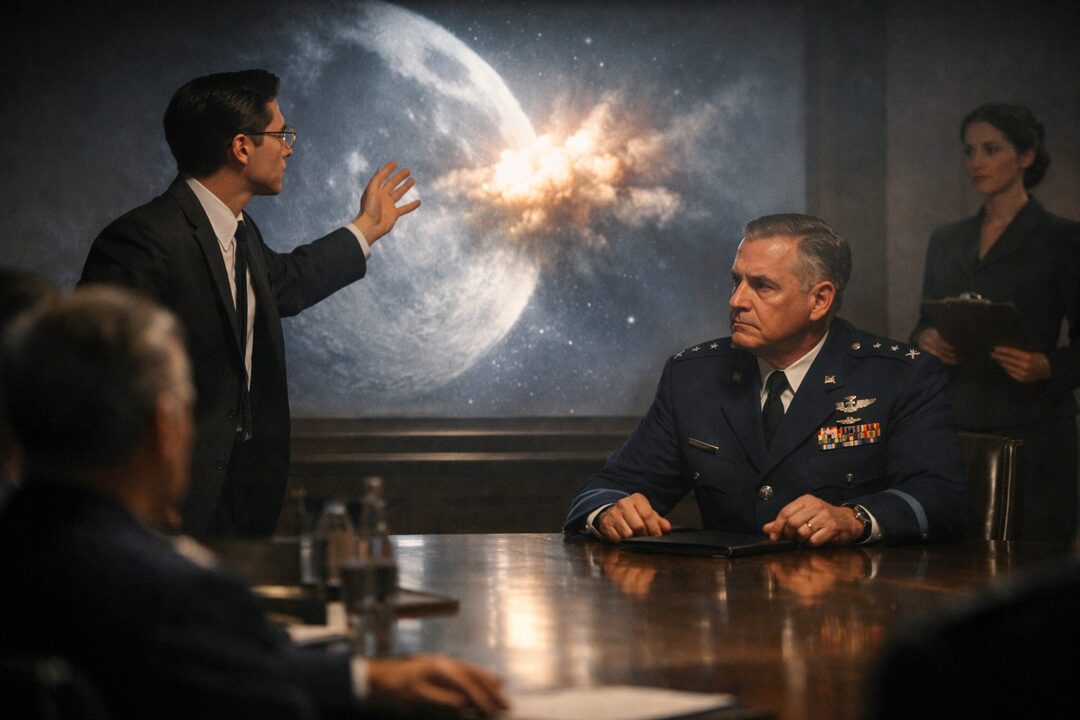
The first thing Daniel Vale saw was the Moon exploding over a neighborhood of sleeping houses.
It wasn’t real. He knew that at once. The Moon hung too low in the painted sky, too large over the black silhouettes of rooftops and television antennas. But the blast itself had been rendered with loving care: a white bloom breaking from the lunar edge, bright enough to make the windows below shine. Whoever had painted it understood spectacle. Whoever had ordered it understood something worse.
The officer beside the easel let the silence do its work.
Then he said, “Your job is to make that image real.”
Daniel looked away from the painting and back to the man speaking as if he had misheard him. The officer was broad through the shoulders, his uniform so precise it seemed ironed into the body beneath it. Silver had begun at his temples, but there was nothing soft about him. He stood with the stillness of someone used to being obeyed.
Daniel had been brought by military sedan from a conference in Chicago to an air base in New Mexico with no markings on the outer gate and no name spoken aloud after sunset. He had signed two papers without being allowed to keep copies. He had been told he was assisting a national defense study. That still sounded like equations. It did not sound like this.
“I’m sorry,” Daniel said. “You want to detonate something on the Moon?”
Colonel Thomas Voss studied him the way a physician might study a wound—professionally, with no embarrassment on either side. “A demonstration payload,” he said. “Delivered at a point of optimal visibility. The question is whether the event would be observable from Earth in a way that serves strategic morale.”
He said it so calmly that for one dangerous second Daniel felt flattered.
Not frightened. Not repulsed. Flattered.
He was twenty-four, thin, dark-haired, and still carried the pale indoor look of a graduate student who had not slept enough in years. He had written a paper the previous spring on ejecta trajectories from meteor impact across low-gravity surfaces. It had been praised in three journals and ignored by almost everyone else. Until now.
“We’re behind,” Voss said. “You know that.”
Daniel did know. Sputnik had torn across American pride like a blade. The newspapers talked about rockets, trajectories, the gap between what had been promised and what had been achieved. Men who had never cared about the upper atmosphere now spoke about orbit with the urgency of men discussing invasion.
“The Soviets have the sky,” Voss went on. “The public understands symbols before it understands systems. If you want a frightened nation to believe in itself again, you do not hand it a committee report. You give it an image.”
Daniel turned back to the painting. The white burst on the Moon was almost beautiful. That was the offense of it.
“Would it matter militarily?” he asked.
Voss’s mouth moved in what was not quite a smile. “That is not the right question.”
The room felt too warm. Daniel took off his wire-rim glasses, rubbed them with his handkerchief, and put them back on. When he looked again, the painting had not changed. The houses were still there. The bright wound in the sky was still there.
“What exactly do you need from me?”
“The dust plume,” Voss said. “The angle. The reflectivity. The window in which sunlight makes the event visible from populated regions. We have ordnance men, guidance people, delivery people. What we lack is someone who knows how the Moon behaves when struck.”
Daniel heard the phrase before he understood it: how the Moon behaves when struck.
As if it were an object waiting for instructions.
He should have said no. The cleanest version of his life was still available in that room.
Instead he asked, “How far along is this?”
Voss looked at him for a beat too long. “Far enough that we did not bring you here to debate the premise.”
A strange heat moved through Daniel’s chest. Anger, yes. But something uglier traveled with it. Usefulness. Importance. That old private hunger to be more than a clever boy in a library.
Outside the windowless briefing room, the facility hummed with unseen ventilation and distant typewriters. Inside it, the painted Moon went on burning above black American roofs.
“Will anyone else see this?” Daniel asked.
“Only those cleared for it.”
“And if I refuse?”
“Then I’ll thank you for your time,” Voss said. “And someone else will finish the work.”
That landed harder than the painting.
Because Daniel believed him.
Because part of him knew that if someone else would do it anyway, then the question changed. Not whether he was willing to stain himself—but whether he was willing to surrender the problem to someone cruder, someone less careful, someone who might not even see the stain.
It was a coward’s thought. He knew that even as it arrived.
Voss walked to a steel table and slid a folder across it. The tab bore no project name, only a date and a classification stamp. Daniel opened it. Inside were charts, launch estimates, early trajectory sketches, and one typed summary paragraph.
Proposed lunar detonation for visible terrestrial morale effect.
There it was. Cold. Ordinary. Official.
Voss said, “You were recommended because you are young enough to imagine the problem clearly and serious enough not to mistake imagination for innocence.”
Daniel looked up.
The colonel held his gaze. “Can you do it?”
No one had ever asked him that in a room like this.
No professor. No journal editor. No committee. Not with the fate of a nation being implied around the edges of the question.
Daniel hated himself a little for how much that mattered.
“I can tell you what the numbers would require,” he said.
Voss nodded once, as if something inevitable had just taken its proper place.
When the colonel opened the door, a woman was waiting in the corridor with a clipboard held low against her dark suit. She was older than Daniel by nearly a decade, perhaps more, her hair pinned with the kind of precision that made care look effortless. Her face was composed without being blank. The kind of face that knew what a room contained before anyone else did.
“This is Miss Eleanor Wren,” Voss said. “She will see that you have what you need.”
Her eyes moved briefly to the painting inside the room, then back to Daniel. No surprise. No curiosity. Only recognition so faint it almost passed for politeness.
“Come with me, Mr. Vale,” she said.
Daniel followed her down a narrow corridor lined with locked doors and pale green walls. At the far end, a radio somewhere was carrying the evening news. He caught only fragments.
Soviet launch capability.
National resolve.
American response.
Eleanor did not slow.
“You should know something,” she said at last, without looking at him. “You were not brought here because you might stop it.”
Daniel felt the folder grow heavier in his hand.
“Then why tell me that?”
“Because people think more clearly when they know what kind of room they’ve entered.”
She opened a door to a temporary office—a drafting table, a blackboard, stacks of reports, a narrow cot no one pretended was comfortable. On the desk sat a fresh slide rule, sharpened pencils, and a silver key attached to a tag with his clearance code.
He set the folder down. “Are you part of the project?”
“I manage movement,” she said.
“Of what?”
“Paper. Access. Men’s certainty.”
That almost made him smile, but her expression warned him against it.
Then she said the line that stayed with him long after the door shut behind her.
“You are here to solve a visibility problem,” she said. “Do not make the mistake of thinking that keeps your hands clean.”
Part II — The Facility Without a Name
By morning, Daniel knew three things.
The first was that the facility did not exist on any map he had seen.
The second was that everyone inside it behaved as if secrecy itself were a patriotic act.
The third was that the problem was not absurd enough to collapse under its own weight.
That last one frightened him most.
He worked through the first half of the day at the drafting table, building from rough assumptions. Escape velocity. Surface composition. Impact plume behavior under low gravity. Illumination angles. If the payload struck the terminator line—where lunar daylight met dark—the ejecta might catch sunlight long enough to be seen by amateur telescopes and, if sufficiently bright, even by the naked eye under the right conditions. Not a bloom like the painting. Not that. But something.
Something.
Each time the calculations began to cohere, he felt a tightening in his stomach that had nothing to do with fear and too much to do with satisfaction.
Near noon, an enlisted man brought him to a conference room with no windows and a smell of coffee left too long on a burner. Voss was there already. So was a captain Daniel had not met before, compact and neat, with a physician’s hands and an officer’s reserve.
“Captain Ira Mendel,” the man said, shaking Daniel’s hand. “I handle readiness assessments.”
That sounded harmless enough until Daniel noticed the blank forms laid before him.
“I’m not a pilot,” Daniel said.
“No,” Mendel said mildly. “But stress does not confine itself to flight crews.”
Voss remained standing at the far end of the room. “We assess anyone with access to full mission architecture.”
Daniel sat.
Mendel asked him where he was from, whether he slept well, how he handled extended pressure, whether his parents were living, whether he had any religious objections to classified defense work.
The questions seemed soft. The listening behind them did not.
“What would concern you most about this assignment?” Mendel asked.
Daniel looked at Voss, then back at Mendel. “That it isn’t really an assignment. That it’s a verdict wearing a question.”
Mendel wrote something down.
Voss said, “Do you object to the mission on patriotic grounds?”
The phrasing made Daniel blink. “On patriotic grounds?”
“Yes.”
Daniel thought of the painting. Of the houses under it. Of the white burst in the sky meant to comfort them.
“I don’t know what grounds would make it better,” he said.
That earned the faintest shift in Mendel’s expression—not approval exactly, but attention.
After the interview, Eleanor met him outside with a stack of fresh materials. Her movements were economical, almost severe, but nothing about her felt stiff. She seemed, Daniel thought, like someone who had once lived with spontaneity and then taught herself to survive without it.
“You lasted longer than the last consultant,” she said.
“There was another?”
“Two. One became outraged. One became eager. Neither was useful.”
Daniel walked beside her through the corridor. “Which one do you expect from me?”
“I haven’t decided.”
She led him into an archive room where metal cabinets stood in military rows. She unlocked one and handed him a file marked Public Interpretation Models.
“That sounds like propaganda,” Daniel said.
“It is propaganda,” Eleanor replied. “Just with better paper.”
He opened the file and skimmed.
Projected newspaper headlines. Public approval curves. Sermon forecasts. Predicted Soviet statements. Even estimated language for school assemblies if the event succeeded.
The room seemed to tilt.
“This is madness.”
“No,” Eleanor said. “Madness is impulsive. This is budgeted.”
He looked up at her.
She was watching him with an expression that was not cruel but contained no mercy either. As if she had seen men discover this fact before and had no interest in cushioning the blow.
“Why are you showing me this?”
“Because you’re still deciding whether you’re solving physics or serving theater.”
“And which am I doing?”
Her mouth flattened. “You already know.”
That afternoon he found the first workable line through the problem.
A narrow launch window. A specific impact angle. The event would need to occur near the lunar edge as seen from North America. The plume would not resemble the painting, but there would be brightness. Suddenness. A scar of light in the familiar face of the Moon.
He drew the figures cleanly, then stared at them until the pencil marks stopped feeling like mathematics and started feeling like consent.
When he brought the pages to the operations room, three officers stood over them before he had finished setting them down.
Voss read in silence. One major exhaled sharply through his nose. Another said, almost reverently, “Christ.”
Not at the science. At the possibility.
Voss looked up. “How confident?”
“Not enough for policy,” Daniel said. “Enough for further modeling.”
“And enough for a presidential briefing?”
Daniel hesitated. “If you want one built on optimism.”
A corner of Voss’s mouth moved. “All briefings are built on optimism.”
The men around the table gave brief, humorless laughs. Daniel did not.
Voss tapped the page. “Continue.”
No one said remarkable work. No one said what does it mean for science? No one even asked whether the Moon would bear the mark in any lasting way. They cared only that the sky might be made to say something political in a single flash.
As he gathered his notes, Eleanor entered with another folder for Voss. Her gaze flicked once to Daniel’s calculations and then to the faces around the table.
She saw what had happened in an instant.
On the walk back, she asked, “Did they look pleased?”
“Yes.”
“That’s the sound a machine makes when you feed it exactly what it wanted.”
Daniel stopped beside a bulletin board crowded with clipped newspaper headlines about Soviet rockets and American hearings. “What am I supposed to do? Fail on purpose?”
Eleanor turned. “Can you?”
He looked away.
That was answer enough.
Late that night, unable to sleep, he stepped outside the barracks annex and looked up. The desert had stripped the sky clean. The Moon hung above the base, pale and whole.
He remembered lying in a field behind his parents’ house when he was ten, his father naming constellations badly and confidently, his mother laughing from the porch that they’d both catch cold and deserve it. The Moon had seemed then like the one thing beyond ownership. Not American, not Soviet, not strategic. Simply there.
Now he knew men inside concrete rooms were discussing where best to wound it so the wound could be seen from Earth.
A voice behind him said, “You’re not sleeping.”
Daniel turned. It was Mendel, hatless, collar loosened.
“Neither are you.”
Mendel stood beside him, hands in his coat pockets. “Occupational hazard.”
They looked upward for a moment.
“Do you believe in what they’re doing?” Daniel asked.
Mendel took his time. “Belief isn’t usually the standard. Function is.”
“That’s not an answer.”
“No,” Mendel said. “It’s the answer men get when institutions want to keep them usable.”
Daniel laughed once, without humor.
Mendel glanced at him. “You’re having the wrong kind of trouble, Mr. Vale.”
“What kind is that?”
“The kind they can call instability if it becomes inconvenient.”
A wind moved over the sand. Somewhere beyond the fence line, a dog barked and then stopped.
Daniel said quietly, “I keep telling myself I’m only solving the visibility problem.”
Mendel’s eyes stayed on the Moon. “That sentence won’t save you,” he said. “Men usually discover that a little late.”
Part III — What the Dead Are Used For
By the second day, Daniel understood why the place had no name.
A thing was easier to bear if it could not be spoken in ordinary language.
He revised plume calculations, estimated brightness curves, modeled public visibility across latitudes, and watched each refinement make the project more real. Whenever he hesitated, someone appeared with a fresh request framed as technical necessity. Whenever he asked a moral question, the answer returned translated into timing, posture, command, nation.
The numbers obeyed. That was their insult.
Near evening, Eleanor brought him a stack of impact photographs from desert tests and placed them on his desk with more force than required.
“You’ve started missing meals,” she said.
“I’ve been working.”
“That’s not the same thing.”
He should have let the conversation die there. Instead he asked, “Why are you still here?”
She was halfway to the door when he said it. She stopped, one hand resting lightly against the frame.
“You really want that answer?”
“Yes.”
For a moment he thought she would refuse him. Then she came back into the room and shut the door behind her.
The office felt smaller with the latch clicked shut.
“My husband flew in Korea,” she said. “Search and extraction. The kind of mission people write clean sentences about later.”
Daniel said nothing.
“He died because command wanted one more attempt in weather that should have ended the operation six hours earlier.” Her voice did not shake. That made it worse. “They sent letters. They sent a folded flag. They sent a major to my apartment who told me Robert had died serving a cause greater than himself, and I remember thinking how strange it was that the men who used that phrase were always the ones still breathing.”
Daniel looked at his desk because looking directly at her felt like trespassing.
She continued, “A month later I saw his death summarized in a briefing note. Not grief. Not loss. Just one line item in a larger argument about resolve.” She gave a short, brittle smile. “That was when I learned what institutions do best. They don’t only bury damage. They repurpose it.”
The room had gone so quiet Daniel could hear the ventilation above them.
“So why stay?” he asked.
“Because leaving is clean and useless.” Her eyes met his. “Because once you know how these rooms work, absence becomes a luxury. I stayed because sometimes slowing a machine is the only honest thing left.”
Daniel said, “That sounds like another way to be consumed by it.”
“Yes,” she said. “It is.”
There was no drama in the answer. No plea for understanding. Just accuracy.
And because she was not asking for pity, he felt something deeper and more dangerous than pity move through him. Recognition. A pull toward her that had nothing to do with rescue and everything to do with how cleanly she refused lies.
On the desk between them lay a photo from a desert blast, the earth thrown upward in a frozen crown.
Eleanor glanced at it and said, “Do you know the ugliest thing about patriotic theater?”
Daniel shook his head.
“It works.”
That night he found the file he was not supposed to see.
He had gone to records looking for updated atmospheric assumptions, and one drawer had stuck halfway open. Inside were documents clipped together under a red tab: Projected Adverse Reactions.
He should have closed it.
Instead he read.
Allied diplomatic outrage. Scientific resignations. Religious condemnation. Soviet exploitation. Public contamination fears, irrational but potent. Questions about militarization of the heavens. Potential domestic backlash among war families if the act is interpreted as desecration rather than strength.
He read that line twice.
War families.
Someone in the building had already imagined widows watching the event.
Not accidentally. Not as an unforeseeable complication. As a modeled category.
Daniel stood very still with the paper in his hand.
The project had not slipped past its own conscience.
It had looked directly at the obscenity and continued.
The shock of that was colder than outrage. Outrage would have at least left him feeling separate from them. This left him implicated by proximity, by talent, by the humiliating fact that he had been impressed.
He returned the file exactly as he found it, but the room felt altered now, stripped of its last excuse. No one here was deluded. They were choosing.
When he stepped back into the corridor, Voss was standing at the far end as if he had always been there.
“Did you find what you needed?” the colonel asked.
Daniel’s throat tightened. “I found enough.”
Voss approached without hurry. “Good. Then perhaps you’re ready for candor.”
Daniel said nothing.
Voss stopped two feet away. “You thought this plan might collapse if enough intelligent men looked at it. That’s a common mistake among intelligent men.”
“You know exactly what this is.”
“Yes.”
The simplicity of it landed like a slap.
Voss went on. “Do you imagine I confuse this with science? Or warfare? I do not. This is theater. But don’t say that like it makes it small.” His voice remained level. “Fear is a force multiplier. Humiliation is a strategic condition. A country can lose its nerve before it loses anything measurable.”
Daniel heard himself say, “So you want to heal national anxiety by blowing a hole in the sky.”
“I want to give people one impossible image,” Voss said. “One thing that says we are not slipping, not kneeling, not waiting politely for history to choose someone else.”
“That’s not strength.”
Voss held his gaze. “No. It’s morale. Which is often the more urgent problem.”
Daniel thought of the modeled widows. The school assemblies. The sermon forecasts. The painted burst over suburban roofs.
“You know it’s grotesque.”
A flicker crossed Voss’s face. Not denial. Memory, maybe. Fatigue.
“I flew bombing runs over Germany,” he said. “I have seen grotesque. This is cleaner than panic. Cleaner than drift. Cleaner than teaching a frightened public to accept diminishment as maturity.”
Daniel stared at him.
And for the first time, he understood the most dangerous thing about Thomas Voss.
He was not in love with destruction.
He was in love with the idea that damage could be controlled if the meaning were controlled first.
That made him harder to dismiss and much worse to oppose.
“You’re asking for my signature,” Daniel said quietly.
“I’m asking for your clarity.”
“No,” Daniel said. “You’re asking for my legitimacy.”
For the first time, Voss smiled openly, though there was no warmth in it. “That too.”
Then he stepped aside and let Daniel pass.
The conversation did not feel like victory for either of them. It felt like the room in the story where excuses were no longer allowed to live.
Later, when Daniel told Eleanor what he had read, she did not look surprised.
“They always model the fallout,” she said.
“Then why hasn’t that stopped anything?”
“Because once human pain becomes paperwork, people start calling it manageable.”
She opened a drawer in her office and took out a carbon-copy packet bound with a brass clip. “This is the dissent annex for the final certification review. There’s supposed to be one attached to every major technical recommendation. Most of them stay blank.”
Daniel stared at it. “You’re showing me this now?”
“I’m showing you because by tomorrow they’ll have your feasibility section ready for signature. And because if you object privately, they’ll bury it as uncertainty. If you object precisely”—she tapped the packet—“they have to preserve it somewhere.”
“Somewhere no one will ever see.”
“Perhaps,” she said. “Or somewhere history may stumble across when the men in this building are dead.”
He took the packet.
Their fingers almost touched. Neither of them commented on it.
“Why are you helping me?” he asked.
Eleanor looked tired for the first time since he had met her.
“Because I am very tired of watching fear dress itself as duty,” she said. “And because there are only so many ways to remain a person in a place like this.”
Part IV — The Signature Line
By the morning of the review, the whole base seemed to vibrate with contained urgency.
Phones rang more often. Doors opened and shut faster. Men who had spent the week pretending the project was only a study had begun to move like participants in a living operation. The launch packet sat on Daniel’s desk when he arrived, thick as a dissertation and much easier to kill with.
His name was already typed beneath the feasibility section.
The blank line waiting beside it was so thin, so ordinary, that for a second he hated paper more than anything else in the building.
Captain Mendel found him thirty minutes before the meeting.
“You look like a man being asked to testify against himself,” he said.
“That may be the most accurate thing anyone’s said to me this week.”
Mendel closed the office door. “I’ve reviewed your assessment addendum.”
Daniel straightened. “There is no assessment addendum.”
“There is now.”
He placed a file on the desk. Inside was a brief note in Mendel’s clean hand:
Subject demonstrates moral distress consistent with reasoned objection under classified pressure. No evidence of instability, mania, or compromised cognition.
Daniel read it twice.
“If this goes badly,” he said, “you’ll be tied to it.”
Mendel’s expression barely shifted. “We’re all tied to it. I’ve just become tired of pretending that observation is neutrality.”
That line stayed with Daniel.
When Mendel left, Eleanor entered almost at once, as if the building had arranged them in sequence.
She set a duplicate packet beside the original. “This one leaves the room if the opportunity comes.”
“Through you?”
“Yes.”
“If they search you—”
“They won’t,” she said. “Men rarely search the women carrying their confidence.”
For the first time, the mask of her competence slipped enough for him to see the pulse jumping in her throat.
“Eleanor—”
“Don’t,” she said, but softly.
He understood. Anything spoken plainly now would become another thing the institution could take from them.
So he said the truest safe sentence he had.
“I’m glad you were here.”
She looked at him for a long moment, and something in her face changed—not into tenderness exactly, but into the memory of it.
“Do not let them make you eloquent in there,” she said. “Eloquence is easy to dismiss as temperament. Be exact.”
Then she left him alone with the papers.
The review took place in the same conference room where he had first met Voss, though the easel painting was gone. In its place stood a projection board with charts, sightline maps, and the final simulation prepared from Daniel’s own calculations. The Moon on the board looked clinical now. Measured. Nearly stripped of wonder.
Voss sat at the head of the table. Two generals had joined by secure line from elsewhere. Mendel was at the side wall with his folder closed. Eleanor stood near the document trays, invisible in the practiced way only the highly competent can become.
Daniel took his seat.
The meeting moved with bureaucratic grace toward danger. Delivery viability. Payload mass. Timing. Public communication contingencies. Each voice controlled. Each phrase chosen to make the unthinkable sound administrative.
At last Voss turned to Daniel.
“Mr. Vale,” he said, “please summarize your final visibility conclusions.”
Daniel stood.
His hands were steady now. That surprised him.
He spoke briefly. Impact angle. Light conditions. Estimated terrestrial observability. Confidence range. He saw the men around the table lean not toward truth but toward authorization.
Then he stepped to the projection board.
“This,” he said, “is the image we are discussing.”
He put up the simulation: the bright lunar burst above an American city.
It was cleaner than the original painting. More technical. Somehow uglier.
Several men at the table looked satisfied before they remembered not to.
Daniel clicked once.
The image remained, but text columns appeared around it—pulled directly from the internal adverse-reaction models.
Primary school patriotic assemblies
Religious condemnation of desecration
Soviet cultural retaliation broadcast scenarios
Scientific resignations
Public contamination anxiety
War-family distress responses
No one moved.
Daniel did not raise his voice. “This is also the image we are discussing.”
The secure line crackled softly. Somewhere in the building a typewriter continued, absurdly alive beyond the room.
Voss said, “What is your point, Mr. Vale?”
Daniel looked at him.
Not angry now. Not frightened. Only done with self-deception.
“My point,” he said, “is that the event has never been merely technical. The visibility case cannot be certified without certifying the civilian meaning attached to it. The mission is not a demonstration of capability. It is an attempt to manufacture reassurance through injury and call the injury symbolic.”
One of the voices on the secure line said sharply, “Are you refusing to certify?”
Daniel reached for the launch packet.
Every eye in the room followed his hand.
He opened to the feasibility section, where his name waited in type below the blank approval line. Then he turned one page further, to the dissent annex Eleanor had shown him.
He signed there.
The scratch of the pen across paper was the smallest sound in the room and somehow the loudest.
Then he took the duplicate packet from beneath the original and handed it, without looking, toward Eleanor.
She accepted it with the smoothness of a document transfer in any ordinary meeting. Only the brief contact of paper against paper marked the moment history changed shape.
Voss understood instantly. Daniel saw it in the stilling of his face.
This was not refusal as temperament. Not outrage to be managed. Not a young man having nerves.
This was a record.
A wound in the file.
Something that could not be cleanly translated into uncertainty.
For a long second, Voss did not speak.
Then he said, very quietly, “You think history rewards witness.”
Daniel met his eyes. “No. I think it needs one.”
The general on the line began speaking at once—procedure, review, postponement, alternate pathways. The room broke formation around the choice Daniel had made. Men reached for papers. Someone asked whether the dissent had been properly logged. Mendel opened his file at last and slid his own statement forward.
No one shouted.
That made it feel more final.
Voss remained seated.
The only movement in him was at the jaw, where something old and buried had tightened.
At last he said, not to the room but to Daniel, “You may have saved the Moon.”
Daniel almost laughed from exhaustion.
Instead he said, “That wasn’t the thing I was worried about.”
And for the first time, Voss looked not angered but tired enough to be human.
Part V — The Ordinary Sky
The official notice used the phrase technical insufficiency.
Daniel received it two days later, along with his removal papers and a warning that further discussion of his work on the project would constitute a breach of national security. No mention of morality. No mention of dissent. Nothing that would stain the machinery with the fact that someone inside it had looked directly at the image and said no.
He packed quickly.
A driver would take him to the train station by dusk.
Before he left, Eleanor met him in the records corridor where they had first spoken plainly to each other. The light there was thin and green, the kind that made everyone look as though they belonged to memory already.
“Did it survive?” he asked.
She knew what he meant.
“Yes,” she said. “Your annex. Mendel’s note. The duplicate. Not in the place they wanted. In another place.” A pause. “Not safe. But extant.”
Extant. A scholar’s word. It nearly undid him.
“They’ll bury your role,” she went on.
“I know.”
“They’ll say the study failed on narrower grounds.”
“I know.”
She looked at him, steady as ever, though her hands were bare and unoccupied for once, which made her seem strangely more exposed.
Daniel said, “Will you stay?”
“For a while.”
“To slow the next machine?”
“If I can.”
He wanted, with sudden painful clarity, to ask her to leave with him. To choose something warmer and smaller and human. But that was not the story either of them belonged to now. And perhaps she was right: absence was clean and useless more often than people admitted.
So he only said, “I won’t forget you were here.”
Her face changed almost imperceptibly, like light moving over metal.
“Don’t make me larger than the truth,” she said. “I stayed too long before I did anything that mattered.”
“Maybe that’s all courage is,” Daniel said. “Doing it before the room closes.”
For one suspended second she seemed close to touching his sleeve.
She did not.
Instead she said, “When people tell the story of this era later, if they tell it at all, they’ll make it sound cleaner than it was.”
“I know.”
“Don’t let them have that.”
Then she walked away before he could answer.
The train east left after sunset. Daniel sat by the window, coat folded beside him, the desert flattening into darkness outside. In the dining car, businessmen talked about rockets. A woman with a sleeping child read a newspaper whose front page carried another headline about Soviet capability and American resolve.
No one on the train knew how close a roomful of men had come to mistaking spectacle for comfort.
No one knew how ordinary the paperwork had looked.
At a stop in Kansas City, he stepped onto the platform for air. The night above the station was hazed by smoke and electric light, but the Moon still showed through, pale and intact over the roofs.
Not dramatic. Not wounded. Just there.
A boy on the platform pointed up at it while his mother adjusted his coat. “Look,” he said, with the uninjured amazement only children can produce. “It followed us.”
Daniel felt something tighten behind his ribs.
For days he had thought of the Moon as target, calculation, symbolic terrain, projected brightness, public morale effect. It had taken a child on a railway platform to return it, for one clean second, to wonder.
He stood there until the conductor called boarding.
Back in his seat, he took off his glasses and cleaned them, though they did not need cleaning. His reflection in the darkened window looked older than the week justified.
He thought of Voss, still inside those rooms, perhaps already moving on to another necessary cruelty. He thought of Mendel, who had chosen at last to write one honest sentence in a file designed to erase honest feeling. He thought of Eleanor, carrying truth through a building that preferred confidence to conscience.
And he thought of the image that had started it all: the white bloom over black rooftops, a nation comforted by a wound.
That image would never leave him.
Not because it had happened.
Because it almost had.
The train rolled on through the dark heart of the country, past towns asleep beneath televisions and church steeples and porch lights left burning. Above them all the Moon traveled untouched, indifferent to flags, forecasts, and men who wanted to use damage as proof of strength.
Daniel watched it as long as he could.
It looked ordinary.
That was the mercy.
That was the grief.
And by the time the train carried him past the last clear break in the clouds, he understood the thing no one in that facility had been willing to say aloud:
A frightened nation will call almost any light hope if it appears in the sky soon enough.
The harder task is refusing to make the light by force.
He leaned his head back against the seat and closed his eyes, not to sleep but to hold the image correctly this time.
Not the painted blast.
Not the strategic wound.
Just the Moon, whole above a country lonely enough to have wanted otherwise.