The Man Who Knew the Tunnels
Part I — The Dirt Falls Wrong
“Cut it.”
No one on the soundstage moved at first.
The actor inside the half-built tunnel was still on his knees, palms blackened with theatrical soil, mouth open in a pant that looked expensive and false. A grip held a foam support beam in place overhead. Somewhere behind the lights, a machine kept releasing soft showers of dirt through a hidden chute.
Captain Elias Voss stepped past the camera before the director could speak.
“The dirt falls wrong,” he said.
That got everyone’s attention.
He was not loud. He never needed to be. He had the kind of voice that made people stop because it sounded as if it had learned long ago that shouting wasted air.
Director Ben Harrow came down from the monitor with irritation already arranged on his face. “Elias, we’re rolling.”
“I can see that.”
“Then let me ruin my own film.”
Elias crouched at the mouth of the tunnel set and picked up a handful of loosened earth. Not dirt, really. Treated mulch, damp fabric dust, cork shavings. It stuck to his scarred fingers wrong too.
He let it run between his thumb and forefinger.
“If the roof is under strain,” he said, “it doesn’t drift down like stage snow. It spits first. Small bursts. Then one side gives a warning before the rest. Men watch the warnings. That’s what panic sounds like underground. Not screaming. Listening.”
The crew had gone silent around him.
Inside the tunnel, Daniel Vale wiped sweat from his jaw with the back of his wrist. Even in stained prison rags and grime makeup, he was too composed. Too camera-ready. He had spent three weeks learning how to crawl like a starving prisoner and still looked like a man arriving for an awards photo as a starving prisoner.
Elias hated that he noticed.
Ben folded his arms. “Show me.”
Elias looked at him for a beat. Then, with the resigned disgust of a man stepping back into a room he had spent years trying not to enter, he ducked into the tunnel.
The set was narrower than it looked on camera. Canvas-backed walls, packed dirt facing, timber ribs. Designed to feel close without actually being dangerous.
Still close enough.
He ignored the first tightening in his chest and put a hand on one of the support beams.
“When the roof starts to go,” he said, “nobody reaches up like that.” He nudged Daniel’s arm down. “You don’t waste movement. You keep your elbows tight. You make yourself smaller without thinking about it.”
Daniel watched him with unnerving focus.
Elias took a fist-sized clump from the floor and pressed it into a seam overhead. Then he slapped the beam once with the heel of his hand. The clump broke. A scatter of grit hit Daniel’s shoulder, then his neck, then one sharp spit of heavier dirt landed near his eye.
“There,” Elias said. “That’s a warning. Not drama. A warning.”
He shifted deeper in, showing them how men passed soil hand to hand in silence instead of flinging it theatrically. How knees turned outward to save space. How nobody wasted a breath on anything not needed. His body remembered all of it before he could stop it. The set, the air, the wood grain under his palm—something old and buried rose with the precision.
“Also,” he said, because the room in his chest was shrinking, “jokes sound wrong underground.”
Daniel frowned. “What?”
Elias swallowed. The tunnel smelled of wet rope and paint, but behind it another smell was already breaking through—cold dirt, old sweat, a charge in the soil before collapse.
“A joke above ground is for laughter,” he said. “A joke underground is for permission. Men tell one to hear if their own voices still work.”
Ben, outside the tunnel, said quietly, “Keep going.”
Elias meant to answer. Instead his lungs pulled once and found nothing.
The narrowing happened fast. Not pain. Not exactly. Just a brutal certainty that the air had become an object and someone else had taken hold of it.
He set his hand flat against the wall.
Daniel saw it first. “Captain?”
Elias backed up too quickly, knocked his shoulder against a beam, and then the tunnel was all wrong—too low, too close, too much wood over his head. He came out hard, palms scraping dirt, and stood bent over outside the entrance while the entire set watched him fail in public.
No one spoke.
A medic started toward him. Elias lifted one hand without looking up and the man stopped.
He drew one breath.
Then another.
When he finally straightened, his face had gone gray beneath the dust.
Ben’s irritation was gone. Daniel’s was something worse: concern sharpened by recognition. Not pity. Curiosity with a pulse in it.
Elias hated that too.
“I’m fine,” he said.
No one believed him.
Ben spoke carefully now. “We can break.”
“You’re not hearing me,” Elias said. “The scene is false.”
Ben blinked. “You can barely stand.”
“And your tunnel is still lying.”
For a moment Ben just stared. Then, against better judgment and maybe because directors are greedy in ways priests should never be, he said, “Come to playback.”
Elias should have left.
Instead he followed them to the monitor, because walking out would have felt too much like retreat, and retreat had a taste his mouth still knew.
They rolled the shot. Daniel on his knees. Dirt falling prettily. Fear performed in clean beats.
Elias watched Daniel’s face on the screen.
Technically perfect. Emotionally empty.
Ben must have seen something in Elias’s expression because he said, “He’s good.”
“He is,” Elias replied.
“But?”
Elias kept his eyes on the screen. Daniel’s character braced one hand against the tunnel wall, jaw set, noble even in terror.
“There’s no one he’s trying not to fail,” Elias said.
That landed harder than he meant it to.
Daniel looked away from the playback and toward him. Not as an actor to an advisor now. As one man hearing the edge of another man’s wound.
Ben said, softly and with far too much interest, “Then help us fix it.”
Elias should have said no.
What he said was, “You’ve built the walls too straight.”
And that was how he stayed.
By lunch, the crew treated him with a new caution. It was the caution people reserve for explosives and grief.
Elias wanted neither.
He stood alone near the back lot fence with untouched coffee cooling in his hand. The wind carried dust from the desert location they had chosen to mimic a prison camp on a border no longer on most maps. He could hear hammers from the tunnel set. Hear men rebuilding it to his specifications.
Behind him, footsteps approached over gravel.
Daniel stopped a polite distance away. Out of costume now, face scrubbed, he looked younger and somehow more dangerous for it.
“I’m sorry if that was too much,” he said.
Elias did not turn. “You were acting.”
“I wasn’t talking about me.”
That almost earned him a glance.
Daniel slipped his hands into his pockets. “Ben says you’re the reason half this film feels real.”
“Ben says whatever keeps the day moving.”
“I read your citation.”
There it was.
Elias set the coffee down on the fence post. “That was your mistake.”
Daniel did not flinch. “It says you organized a manual escape route during the Qarim border siege. Under bombardment.”
“It says many things.”
“It says you brought thirty-one men out through a collapsed service passage.”
“Thirty-one living men,” Elias said. “Citations like that count carefully.”
Daniel was quiet for a moment. Then he said, “What did it really feel like?”
Elias laughed once. It had no warmth in it.
“That’s the question actors ask when they want permission to steal.”
Daniel took that better than most men would have.
“I’m asking because the scene isn’t working,” he said. “And because I could tell, in there, that what you were showing me wasn’t technique.”
“No,” Elias said. “It was memory. Which is worse.”
He started to walk away.
Daniel spoke to his back. “Then tell me what I’m missing.”
Elias stopped without turning.
After a long moment he said, “You’re playing fear like an event. It isn’t. Underground, fear becomes manners.”
Daniel said nothing.
Elias looked over his shoulder at him.
“You don’t panic all at once,” he said. “You become very polite. You make room where there isn’t any. You pass dirt carefully. You keep your voice low so nobody hears what it costs you to keep it level. By the time anyone screams, the important part already happened.”
Daniel held his gaze.
That should have been enough. More than enough.
Then Daniel asked the wrong question.
“Did someone scream?”
Elias turned and walked away before the answer could reach his face.
Part II — How Men Borrow Truth
The tunnel changed shape over the next two days.
Not structurally. Emotionally.
Elias corrected things no one else on set could see. The angle of a man’s shoulder when the ceiling felt weak. The way prisoners should conserve movement when air was bad. The speed of passing soil down a line.
“Not like workers,” he told the actors during rehearsal. “Like men trying not to make the space angry.”
One of them laughed nervously. Elias didn’t.
Daniel watched everything.
It should have irritated Elias more than it did. There was hunger in the man, yes, but not the usual vanity. Daniel did not ask to be admired. He asked to be let closer. That was sometimes worse.
During a break, Daniel crouched beside him near the set entrance where Elias was adjusting the spacing between timber ribs with a carpenter’s pencil.
“You said a joke underground is permission,” Daniel said.
Elias kept marking wood. “Did I.”
“What kind of joke?”
“The kind nobody laughs at.”
“That’s not a joke.”
“It is if the other men answer.”
Daniel sat back on his heels. “Did you?”
Elias looked at him then.
Daniel held up both hands. “I know. Another question I don’t deserve.”
“That’s the first useful thing you’ve said to me.”
Daniel almost smiled. “People think actors love being watched. Most of us don’t. We just learn to use it.”
Elias returned to the timber. “And what do you think I learned?”
Daniel’s reply came too fast. “How to hide in public.”
Elias’s pencil stopped.
For one second he nearly told him to get off the set.
Instead he said, “When the collapse starts, don’t look brave. Look annoyed.”
Daniel frowned. “Annoyed?”
“You won’t have room for bravery. You’ll be too busy with the practical insult of dying because wood and soil made a decision.”
That line stayed with Daniel. Elias could see it.
The problem was, more and more of what he said stayed with the man.
By afternoon, Daniel had stopped performing terror like theater. He began playing it as irritation, concentration, and the sick discipline of obedience. It was better. Not finished, but better.
Ben watched the monitor with open greed.
“This is it,” he murmured. “Now there’s history.”
Elias said, “No. Now there’s less lying.”
Ben either did not hear him or chose not to.
The new pages came that evening.
Ben wanted to expand the collapse sequence. A few additional lines. More pressure. The lead tunneler calming the men around him while the tunnel narrowed and dirt came hard off the roof.
Elias read the scene once and handed it back.
“No.”
Ben stared. “No what?”
“No to the speech. No to the heroic certainty. No to the way you’ve written him like fear makes a man eloquent.”
“It’s a film.”
“And fear is still fear.”
Ben pinched the bridge of his nose. “What do you want?”
“I want you to stop making courage look clean.”
The argument would have gone further if the assistant director had not approached with someone in a charcoal coat and military posture so intact it made every civilian nearby look boneless.
“Ben,” the assistant said, “the defense liaison’s here.”
Elias turned.
So did time.
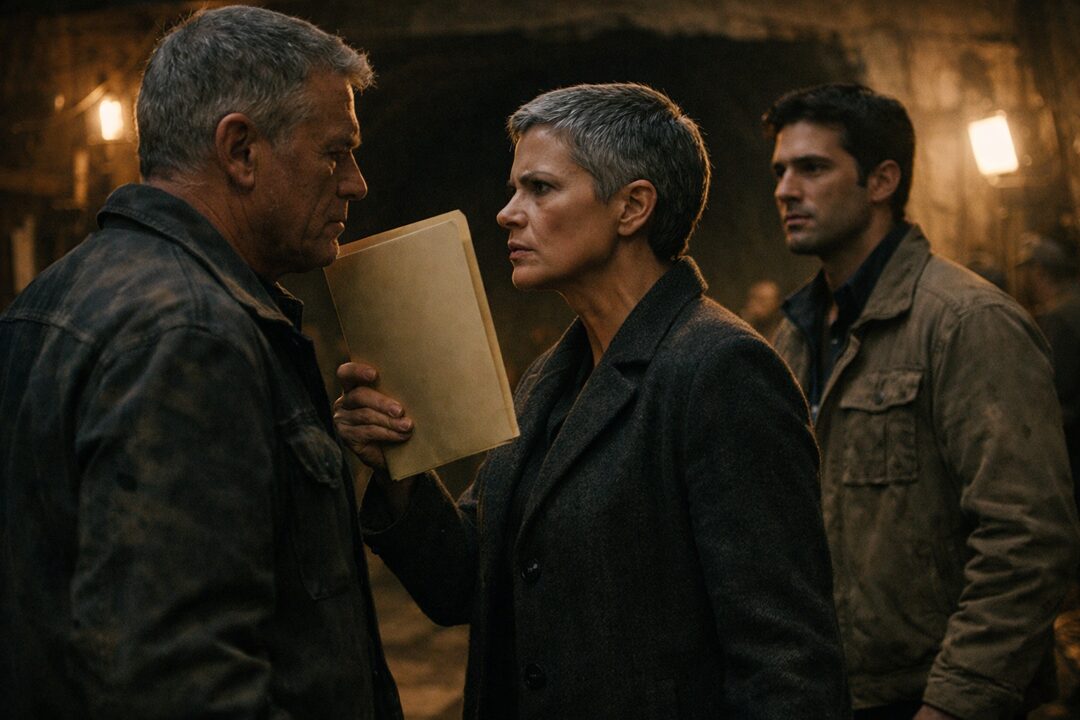
Mara Kessler stood three yards away with a clipboard in one hand and an expression that could have been carved from dry wood. Her hair was cropped short now, more silver at the temples than he expected. The years had thinned nothing essential in her face. If anything, they had sharpened it.
She looked at the set first.
Then at him.
And in that order, he understood exactly how bad the day had become.
Ben smiled too brightly. “Sergeant Kessler, glad you could—”
“Retired sergeant,” she said. Then, without taking her eyes off Elias: “Captain.”
No one on set could hear the history in that word.
Elias could.
“Mara.”
Ben glanced between them, delighted already by something he did not understand. “You know each other.”
“We served together,” Mara said.
Served. A clean word for dirty years.
Ben gestured toward the tunnel set. “Perfect timing. We’re rebuilding the collapse sequence for authenticity.”
Mara’s gaze moved at last to the false tunnel mouth. “That what we’re calling it.”
Ben laughed uncertainly.
Daniel, who had been quiet through all of this, stepped closer. “Daniel Vale.”
“I know who you are,” Mara said.
Not rude. Not warm. Merely accurate.
Ben launched into production details, permissions, security compliance, cooperation language. Mara listened with the expression of someone allowing a weather pattern to pass over her.
Elias should have left the group. Instead he stayed, feeling the old military instinct rise in him against his will: when the terrain changes, do not move first.
Mara let Ben finish. Then she said, “I’ll need to review the revised tunnel sequence. Particularly any lines drawn from real operations.”
Ben spread his hands. “This is fiction.”
Mara looked at Elias. “Is it.”
Daniel saw that look. Elias knew he saw it. That was the problem with actors. They lived by noticing what belonged to other people.
Ben, still missing half the room, said, “Captain Voss has been invaluable.”
Mara’s mouth shifted by less than a smile. “I’m sure he has.”
She walked past Elias toward the tunnel entrance.
As she did, she said under her breath, without looking at him, “You should have told them no.”
He answered just as quietly. “You should have stayed away.”
She stopped only long enough to say, “I tried.”
Then she kept walking.
Daniel watched her go. Then he looked at Elias.
“Who was she there?” he asked.
Elias didn’t answer.
Daniel tried again. “You went still the second she arrived.”
Elias turned on him with more force than the moment deserved.
“Everything doesn’t belong to your process.”
That landed.
Daniel stepped back half a pace, not from fear but to make room for the blow. “Fair enough.”
Elias regretted it immediately, which made it worse.
By evening, he found Mara alone near the revised pages, reading with one finger marking the scene.
The set lights had gone amber. Most of the crew was eating. Beyond the walls of the soundstage, desert dusk was flattening the horizon into a hard strip of bruised color.
“She shouldn’t have sent you,” Elias said.
“The ministry didn’t send me because of you.”
“No?”
“No. They sent me because war films like to borrow uniforms and call it respect.”
She looked up from the pages.
“And because someone recognized the citation in your production packet and realized this was going to happen.”
He said nothing.
Mara held the pages out. “You’re correcting details.”
“Yes.”
“You’re also feeding them.”
“I’m stopping them from turning confinement into choreography.”
“While helping them turn it into myth.”
Elias felt the old anger rise, the one built from exhaustion and hierarchy and the sick privilege of surviving longer than other people.
“You think I don’t know the difference?”
“I think you prefer partial truths when they flatter the dead less than the living.”
He took a step closer. “Careful.”
She did not move.
“That still works on younger soldiers,” she said. “Not on me.”
For a second they were back underground—not in place, but in rank. Not in danger, but in the muscle memory of it.
Mara lowered the pages.
“In there,” she said, nodding at the tunnel set, “they’ve written a man holding himself together so everyone else gets out. A clean captain. A clean sacrifice. A clean memory.”
Her eyes fixed on his.
“You know what I remember? Dirt in my teeth. Your hand shaking on the beam. Leo looking at you like he’d already decided.”
Elias’s jaw locked.
“Stop,” he said.
“The problem was never the order,” she said. “The problem was what you let the story become afterward.”
He turned and walked away before she could see how close the past had come to his throat.
Part III — The Place That Stayed Underground
Daniel found him the next morning loading his truck with gear he had no reason to be moving.
Not leaving. Elias told himself that and did not entirely believe it.
Daniel stopped a few feet away. “Ben says you’re taking me somewhere.”
“I didn’t say that.”
“He said if I want the scene, I have to stop asking on set.”
Elias shut the tailgate.
“That man would weaponize weather if he thought it would improve the third act.”
Daniel almost smiled. “So are you taking me somewhere?”
Elias should have refused.
Instead he said, “Get in.”
They drove an hour past the edge of the production zone, past flat roads and military fencing, to an old engineering site long decommissioned and mostly erased from maps. Concrete husks. Rusted signage. A training field going back to dust.
At the far end stood a low bunker entrance cut into the earth.
Daniel looked at it. “Here?”
“This isn’t a museum,” Elias said. “If you want atmosphere, go back to makeup.”
Inside, the air changed immediately—cooler, stiller, touched by mineral damp. The tunnel wasn’t deep, only long enough for training drills once. Reinforced concrete, old utility lights, side shafts bricked over years ago.
Still, the ground remembered its purpose.
Elias walked until the daylight behind them thinned and stopped at a narrow section where the corridor had been deliberately reduced for confinement drills.
Daniel paused there. “This is where you trained?”
“This is where they taught boys to call fear discipline.”
Elias rested one hand against the wall. He kept his breathing measured.
“Listen,” he said.
Daniel frowned. “To what?”
“Exactly.”
They stood in the quiet.
Then Elias stepped into the narrowed section and crouched.
“When air goes bad,” he said, “everybody starts trying to be useful. That’s how panic hides. Men get efficient. They ask very calm questions with eyes too bright. They keep passing dirt. They say, ‘I’m all right.’ That’s usually when you count who’s still obeying.”
Daniel came closer, careful now, as if entering not a tunnel but another man’s threshold.
Elias reached down, lifted a handful of old grit from the floor, and let it trickle through his fingers.
“Say your line,” he said.
Daniel blinked. “Which one?”
“The one from the collapse.”
Daniel hesitated, then gave the script version: steady voice, leader’s tone, reassuring the trapped men that the support will hold and the route is still open.
Elias shook his head.
“No one believes a man who sounds that certain underground. Try again.”
Daniel did.
Less commanding this time. More breath in it.
Elias said, “Better. Now lose the hero.”
Daniel looked irritated, which pleased Elias more than it should have.
“What does that even mean?”
“It means courage is not a performance of calm.” Elias’s voice stayed level. “It’s obedience with fear inside it.”
Daniel studied him. “You keep saying that.”
“Because you keep playing it like nobility.”
“Then tell me what happened.”
Silence.
The tunnel held it between them.
Elias looked past Daniel’s shoulder at nothing the actor could see.
“There was a collapse,” he said at last. “Border sector. Service passage under an old depot. We had bombardment above us and three bad maps below. The route narrowed. Beam cracked. One man had to go back in.”
Daniel did not speak.
“He knew what it meant?”
“Yes.”
“Did you order him?”
Elias’s hand tightened against the wall.
“Yes.”
That should have satisfied him. It was more truth than Elias had given anyone on this production.
But Daniel’s next question came softer than before.
“Did he come back out?”
Elias looked at him.
For one suspended second the old bunker vanished, and another tunnel took its place—darker, rawer, full of breath and falling earth. Leo ahead of him in bad light, broad shoulders bent. One hand on a beam. The other holding a compass at chest level because the electric guide line had gone dead and direction had become faith.
Leo glancing back with dirt across his cheek, saying in that maddeningly calm voice, If this cave-in gets any tighter, tell them I died offended by the construction standards.
Permission, not laughter.
Then the beam groaning.
Then—
Elias stepped back as if struck.
“Enough,” he said.
Daniel did not move.
“I’m sorry.”
“No,” Elias said. “You’re not. Not yet.”
They stood in the dim corridor, both breathing more carefully now.
Finally Daniel said, “I don’t want to steal it.”
“Everyone says that before they take what they need.”
Daniel absorbed that in silence.
Then, very quietly: “Maybe. But I think there’s a difference between stealing and being entrusted.”
Elias almost laughed. Not because it was naïve. Because it wasn’t.
That was what made it dangerous.
When they came back out into the hard white daylight, Elias felt wrung hollow.
Daniel shut the car door and waited.
“I won’t ask again,” he said.
Elias looked at him.
“Yes, you will.”
Daniel gave a small, honest nod. “Probably.”
And somehow that honesty bought him more ground than apology could have.
Before they left, Elias opened the glove compartment for his registration papers. Tucked in the back was an old field notebook he had not touched in years. Something thin slipped loose and fell into Daniel’s lap.
A photograph.
Black-and-white. Four soldiers caked in earth, younger than their eyes, standing at the mouth of a dugout. Leo in the middle, one hand lifted halfway as if caught between a wave and a warning. Elias beside him, jaw tight, looking not at the camera but off-frame toward some problem already forming.
Daniel picked it up carefully.
“That’s him,” he said.
Elias took the photograph back too fast.
“Yes.”
Daniel looked out the windshield for a moment. “He looks like the kind of man other people trusted before they knew why.”
Elias slid the photograph into the notebook.
“Yes,” he said again.
On the drive back, neither man spoke.
But the story had changed shape.
Now Daniel was no longer asking how fear looked.
He was asking who had carried it.
Part IV — The Story They Cleaned
Mara was waiting at the soundstage when they returned.
Not by accident. Not casually. She stood at the tunnel entrance with a folder in hand, looking like someone who had decided the time for politeness had expired.
Daniel saw her and instinctively slowed. Elias kept walking.
“You took him there,” Mara said.
It wasn’t a question.
Elias stopped in front of her. “That’s none of your business.”
“It becomes my business when you start curating which version of the dead gets passed around.”
Daniel, behind him, said quietly, “Maybe I should—”
“No,” Mara said, without looking at him. “You should hear this, if you’re going to wear any of it.”
The set around them kept moving, but with the slowed, listening rhythm of people pretending not to.
Mara opened the folder. Inside was a copy of the original citation, the one Daniel had read, along with operational summaries stripped clean for official history.
She held up the citation between two fingers.
“This is what they gave him,” she said to Daniel. “Captain Elias Voss, for exceptional leadership under artillery fire, for devising a manual escape route, for preserving unit cohesion during entrapment, for personally remaining in a compromised sector until all viable personnel had evacuated.”
Daniel did not take the paper.
Mara looked at Elias instead.
“Do you know what’s missing?”
Elias said nothing.
“I’m asking you.”
He answered without inflection. “A great deal.”
“What’s missing,” Mara said, “is that the compromised sector narrowed to one man and one beam. What’s missing is that Leo Arden took the last position. What’s missing is that he did it after he saw your hands shake.”
The world did not tilt. It narrowed.
Daniel’s face changed almost imperceptibly.
Mara kept going, not cruelly, which made it worse.
“You weren’t a fraud,” she said. “I’m tired of people making this about fraud. You got men out. You held command. You made impossible choices.”
She took one step closer.
“But you let the rest of us live inside a cleaner sentence than we earned.”
Elias felt every eye he could not see.
“That enough for you?” he said. “Or would you like blood samples with the paperwork?”
Mara’s jaw tightened. “Don’t do that.”
“Do what?”
“Turn bitterness into rank.”
Daniel looked between them, saying nothing. Smart enough, finally, to understand silence had become the only respectful thing available.
Mara lowered the citation.
“You think I came here to expose you,” she said. “I came because I’m sick of watching men become monuments they never asked to be and then defend the pedestal because stepping off it would look like weakness.”
Elias said, “And what do you call this?”
“Late loyalty.”
That hit harder than accusation would have.
For a moment none of them moved.
Then Ben emerged from behind the monitor, sensed immediately that he had arrived in the middle of a live minefield, and made the mistake of speaking anyway.
“We’re ready for the collapse rehearsal.”
Mara turned to him.
“Then maybe stop writing it like he was alone.”
Ben blinked. “Excuse me?”
Elias said, “Mara.”
But she was past stopping now.
“Your script loves the man at the front because cameras do,” she said. “But men get out of holes because someone behind them keeps the roof from choosing faster.”
Ben looked from her to Elias to Daniel, trying to calculate whether genius or disaster had just walked onto his set.
Daniel spoke before he could.
“She’s right.”
Ben stared at him. “About what?”
“About the scene.” Daniel’s voice had lost its polish. “It’s still wrong.”
Ben laughed once in disbelief. “Great. Now everyone’s a director.”
Elias felt the old instinct rise again—to end this, contain it, restore order by force of tone.
Instead he said, “Run it once.”
Ben rubbed at his forehead. “With what changes?”
Elias took the revised pages from his hand, crossed out three lines with a blunt production pencil, and handed them back.
“No speech,” he said. “No promise he can’t make. No clean nobility.”
Ben looked at the page. “Then what is he doing?”
Elias glanced at Daniel.
“Buying the others enough steadiness to move.”
Ben frowned. “That’s all?”
Mara answered before Elias could.
“That’s never all.”
The rehearsal began.
Daniel crawled into the tunnel. The others followed. Dirt spit from the roof in uneven bursts now, exactly as Elias had ordered. The beam creaked. A man behind Daniel muttered the new line Daniel had improvised after hearing Elias days earlier:
“Well. Silence sounds worse down here.”
It was not funny.
That was why it worked.
The collapse started.
Daniel did not act fearless this time. He did something much harder. He made room for fear without surrendering to it. He kept his voice low. Passed the dirt. Chose each instruction as if breathing and leadership were now competing for the same thin space.
Ben watched, transfixed.
Elias did too, and for one terrible second Daniel’s bent shoulders were not Daniel’s at all.
Leo, half-turned in darkness, compass in one hand.
Not yet, his face saying. Keep them moving.
Elias stepped back from the monitor so fast he nearly struck a light stand.
Mara caught the movement. So did Daniel, somehow, even in performance. He came out of the tunnel at the cut breathing hard, face streaked with dirt and something more human than acting.
Ben looked at the playback and whispered, “That’s the scene.”
No one answered him.
Because now the question was no longer whether the scene worked.
It was whether Elias could bear what it worked with.
Part V — The Bravest Man Underground
They were ten minutes from camera.
The tunnel set had been reset. Dirt loaded. Lights narrowed. Sound checked.
Ben wanted to roll before anyone lost nerve.
Elias stood just outside the set entrance with the feeling of a man who had mistaken surviving for settling the account.
Daniel approached in costume, grime already worked into the lines beside his mouth. He held himself differently now. Not heavier. More answerable.
“I can do it as written now,” he said.
Elias knew he meant the rewritten truth, not the old script.
Mara stood several feet away, not intruding, not leaving.
Elias looked at the tunnel mouth. Canvas and timber and false earth. Still enough.
Still too much.
Daniel said, “I won’t use anything you don’t give me.”
Elias almost told him that by now he already had.
Instead he said, “Listen carefully.”
Daniel did.
“The bravest man underground is not always the one who comes back out.”
Daniel’s expression did not change. But something in him steadied around the line, as if he understood that this was not dialogue and not confession and not permission exactly.
Just the smallest amount of truth Elias could place in another man’s hands without dropping the dead.
Behind them, Ben called, “Places!”
Elias said, “One more thing.”
Daniel waited.
“When the beam starts to go, don’t play sacrifice. Play math. Men do better with practical things.”
Daniel nodded once. “Practical things.”
He turned toward the tunnel.
Then Elias said, “Ben.”
The director jogged over, impatient, alert.
“What now?”
Elias’s mouth had gone dry.
There were easier versions of this moment. Cleaner ones. A full confession. A dramatic speech. Public absolution. He wanted none of them.
“In the end credits,” he said, “there’s a dedication card to my unit citation.”
Ben blinked. “Yes?”
“Change it.”
“To what?”
Elias looked past him to Mara.
Then back.
“Leo Arden,” he said. “No citation. Just the name.”
Ben stared, trying to read the size of the thing being handed to him.
“That’s… all right,” he said slowly. “If that’s what you want.”
It wasn’t what Elias wanted.
It was what was left.
Mara’s face did not soften, but something in it eased out of combat.
Ben hesitated. “Should I ask why?”
“No,” Elias said.
And that, finally, Ben understood.
He nodded once and walked back toward the monitors, shouting for final checks.
Daniel stood at the tunnel mouth for a second longer.
Then he said, quietly, “I’ll carry it lightly.”
Elias almost answered. Couldn’t.
Daniel ducked into the set.
The cameras rolled.
This time Elias did not go to the monitor. He stayed outside the tunnel entrance where the air was wider, where he could hear the scene without watching every inch of it.
He heard dirt hit wood.
He heard Daniel’s voice, low and strained and human.
No heroic thunder. No polished courage.
Just obedience under fear.
He heard another actor mutter the line about silence.
He heard the beam complain.
And then he heard a beat of quiet so accurate it made the hair rise on his arms, because he knew exactly what Daniel had understood: that underground, the worst moment was often the second before anyone spoke.
When Ben finally shouted, “Cut,” the set exhaled as one body.
Applause broke somewhere near the monitors. Crew relief. Professional awe. The simple gratitude of people who knew they had just captured something rare and could not name it properly.
Elias stayed where he was.
Daniel emerged from the tunnel caked in dirt, eyes red-rimmed from dust and effort. He looked toward Elias, but did not come to him immediately. That restraint did more to earn Elias’s respect than any amount of reverence could have.
Mara came instead.
For a moment Elias thought she meant to speak.
She didn’t.
She held out something small in her palm.
An old service compass, brass dulled nearly brown, one edge dented from impact long ago. Elias knew it before he touched it. Knew the weight, the scratch near the hinge, the stubbornness of the lid.
Leo’s.
The tunnel air seemed to leave the world for a second.
“I kept it,” Mara said.
Elias stared at the compass.
“I know,” he replied.
She closed his fingers around it.
“He would have hated the citation line,” she said. “Too much punctuation.”
It was the first joke either of them had allowed in years.
A bad one.
Exactly the kind that mattered.
Elias let out a breath that almost became a laugh and failed halfway.
Mara’s eyes stayed on his face. “This doesn’t fix it.”
“I know.”
“It doesn’t acquit anyone.”
“I know.”
She gave one small nod. “Good.”
Then she stepped back.
Not forgiveness. Not dismissal.
Something narrower and more honorable than both.
Across the set, Daniel was removing the mic pack from under his costume. He looked toward them, saw the compass in Elias’s hand, and looked away again.
That too was respect.
Part VI — What Stays in the Dark
They finished after sundown.
The set emptied by degrees, energy draining out of cables and bodies alike. Lights went dark one bank at a time. The tunnel mouth remained where it was, a hole built for fiction and filled, by evening, with too much truth to feel entirely false.
Elias stood alone beside it for a while.
The compass sat in his palm, heavier than its size allowed.
When he finally opened it, the needle trembled, then steadied north as if nothing had happened in the years since anyone had last trusted it underground.
That was the cruelty of objects. They survived with such composure.
He heard Daniel approach before he spoke.
“I wanted to say thank you,” Daniel said.
Elias kept his eyes on the compass. “Don’t.”
Daniel accepted that.
After a moment he said, “Then I’ll say this instead. I know the difference now. Or I know more of it.”
Elias closed the compass lid.
“No, you don’t,” he said. “But you know enough to stop performing certainty.”
Daniel stood beside him, looking at the dark set entrance.
“For what it’s worth,” he said, “I don’t think the film will belong to the wrong man anymore.”
Elias considered that.
Then he said, “No film belongs to the right man. That’s not what they do.”
Daniel let that remain unanswered.
At last he asked, “Was he funny?”
Elias looked at him.
It was an indecently gentle question.
He could have refused it. Maybe he should have. But the night had worn the edges off refusal.
“Yes,” he said. “At the worst times.”
Daniel nodded once, as if some missing piece had clicked into place. Not plot. Personhood.
“Good night, Captain.”
“Daniel.”
The actor started to leave.
Elias called after him, not loudly. “You did well.”
Daniel turned.
For a second, the younger man looked almost startled by how much the words cost to hear.
Then he gave the smallest acknowledgment and went.
Mara was the last to cross the lot.
She paused near the fence, coat folded over one arm, the desert wind flattening her shirt against the old military posture she would probably die wearing.
Elias caught up to her before she reached the gate.
“Mara.”
She turned.
He held out the citation copy she had dropped earlier in the chaos. Folded now. Softened at the edges.
“I don’t want this.”
She took it.
“Neither do I.”
They stood there with the night opening around them, both too old for spectacle, too marked for comfort.
After a while Mara said, “You know what I remember most?”
He waited.
“Not the collapse.” Her voice stayed level. “After. When we got out. You sat down in the dirt and looked offended that the sky was so wide.”
The line struck him with such strange accuracy he had no defense against it.
He looked away toward the soundstage, toward the tunnel that was not a tunnel and the story that was no longer entirely his.
“I was trying to breathe,” he said.
“I know.”
That was all.
But it was enough.
Mara nodded once and left.
Elias remained by the gate until the lot was almost empty.
Then he opened the compass again.
The needle trembled, found direction, held.
He closed his hand over it and looked back at the dark tunnel mouth one last time.
He did not smile.
He did not feel healed.
What he felt was smaller than peace and more useful: alignment. A story still shaped by his wound, yes. But no longer sealed inside it.
He turned toward the long walk to the parking lot, the brass warm now from his palm, and carried the dead with him in the only way left that did not feel like theft.