The Last Light in Hangar Seven
Part I — Work Lights
By the time Elias Voss crossed the dark edge of the base, he had already regretted coming twice.
Once when the gate guard recognized him anyway, even in a ball cap and sunglasses before dawn.
And once when he saw the light.
Hangar Seven was supposed to be dead—locked, gutted, waiting for inventory stickers and a forklift. Instead, one square of yellow glowed behind the side door, thin and stubborn in the blue military dark.
He let himself in.
The old theater smell hit him first. Dust. canvas. hot bulbs. paint that had dried twenty years ago and still lived in the wood. The stage sat ahead of him inside the converted hangar, its black floor scarred with tape marks and old screws. One line of work lights burned over it, not the proper grid, just the practical lamps they used when the performance lighting failed.
A woman stood alone center stage with a folder in one hand.
She was reading to an empty room.
Not performing. Not pretending. Just speaking plainly into the silence, as if she expected the room to answer.
Elias stopped halfway down the aisle.
She looked up at him, took in the hat, the glasses, the expensive jacket, the posture he had never managed to civilian out of himself, and said, “You’re late for strike.”
Then she went back to the page.
No startle. No smile. No actor’s awe. No mention of the films, the interviews, the face that lived on posters in subway stations and streaming thumbnails around the world. Just a man late to work.
He took off the sunglasses.
“Leah.”
Now she looked at him properly. Not like a fan. Worse. Like someone checking whether he had come intact.
Her hair was pulled back without ceremony. She wore jeans, old boots, and a gray sweater that made her look more civilian than military widow, though people on bases carried losses in their posture more than their clothes. He had last seen her at a memorial where everyone had spoken too softly and no one had said the one name that mattered enough times.
“You came,” she said.
“I said I would.”
“You say a lot of things.”
The line landed cleanly. Elias looked past her, at the stage he had helped build out of an empty maintenance hangar and stubborn donations and the kind of labor Marines always pretended not to care about until it belonged to them. The curtain was half down. Folding chairs were stacked against the wall. The place looked less abandoned than interrupted.
“I thought closure was next week,” he said.
Leah closed the folder. “It’s tonight.”
He turned back to her. “No.”
“Yes.”
“That isn’t what I was told.”
“That’s because people keep changing the nouns to make things easier. Sunset. Wind-down. Transition. Tonight, Elias.”
The hangar seemed to tilt a degree colder. “Who moved it up?”
“Someone with a spreadsheet and no ghosts.”
He stared at the lit stage.
Leah stepped down from it and passed him by, close enough that he caught the faint smell of coffee and paper. “You can stand there looking surprised,” she said, “or you can help me pull the costumes before they get dumped into storage bins with the cables.”
He almost said something defensive. Instead he set his duffel on a front-row chair and followed her backstage.
That was the first thing the building took from him: the illusion that this visit belonged to him.
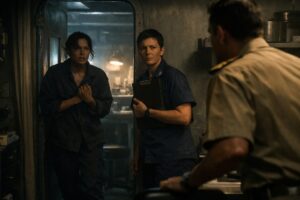
Backstage looked exactly as if everyone had left in the middle of a sentence. Costumes hung under plastic covers. A rack of fake dress uniforms leaned beside a Roman helmet, a feathered boa, and three child-size capes. A cardboard moon painted silver rested against a crate stamped PROPERTY OF U.S.M.C. in fading black letters.
Leah handed him a box cutter.
He looked at it. “You don’t want to say good morning first?”
“I did.” She pulled down a labeled bin. “You were late.”
He almost smiled. It felt wrong on his face in here.
As he cut tape, his phone buzzed in his pocket for the third time that morning. Publicist. Studio assistant. Someone from public affairs he had ignored for six months. He silenced it without looking.
Leah saw anyway. “They know you’re here?”
“They know I’m impossible to schedule.”
“That isn’t the same thing.”
“No.”
She slid a stack of playbills into a banker’s box. On top sat one from ten years ago, creased at the corners. A Midsummer Night’s Dream, cast list printed in cheap ink. At the bottom, in smaller letters: Presented for active-duty service members, veterans, and military families.
He remembered the night because a lance corporal had fallen asleep in the front row with his forehead against a support column and woken up crying at intermission, embarrassed beyond reason. One of the actors had sat on the floor with him until he could breathe again. Nobody had made a speech about it.
Leah was watching his face.
“Don’t start disappearing,” she said quietly.
“I’m right here.”
“That’s never been your problem.”
Before he could answer, footsteps sounded in the aisle outside. Crisp. Fast. Official.
Leah looked toward the stage and said, “Here comes your paperwork.”
A woman in uniform entered carrying a tablet and a coil of zip ties. Early thirties, composed in the severe way of people who had taught themselves not to waste movement. Captain’s bars. Sharp gaze. Hair pulled back so cleanly it made her seem almost airless.
She took in the scene in one sweep: the actor in civilian clothes holding a box cutter, the widow in work boots, the half-packed boxes, the lit stage.
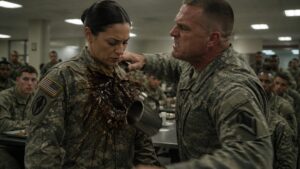
“Mr. Voss,” she said. “Captain Nora Vale. Base logistics. I’m overseeing decommission.”
“Closure,” Leah corrected.
Vale didn’t glance at her. “Decommission.”
Elias felt the old reflex in his spine, the one that answered rank even after fame had made rank theoretically irrelevant. “I was informed I had until next week.”
“You were informed of a preliminary timeline.” She tapped the tablet. “This is final.”
“What changed?”
“Funding, staffing, command appetite.” Her tone made appetite sound like a line item. “This facility is to be cleared by 1900. Records tagged. costumes boxed. personal property claimed. archival material routed for digitization or disposal.”
“Disposal?” Elias repeated.
“Items without retention value.”
Leah let out a breath that was almost a laugh and not amused at all.
Elias looked at the captain. “You’re talking about letters from deployed Marines.”
“I’m talking about unindexed paper in a condemned storage category.”
Something cold and old moved through him. “No.”
Vale met his eyes without flinching. “You can appeal through the usual channels. It will not change tonight.”
He had spent the last decade in rooms where people softened bad news before they handed it to him. This woman had not bothered. He almost respected it.
Almost.
“How long have you had this order?”
“Long enough to execute it.”
“That isn’t an answer.”
“It’s the one that matters.”
She turned the tablet toward him. Signature line. Transfer forms. Inventory release.
He didn’t take it.
“Captain,” he said, “this program served Marines, veterans, spouses, kids—”
“And tonight,” she said, “I am responsible for making sure this facility stops existing in an orderly way.”
She said it cleanly, like a fact with no blood in it.
Leah stepped beside him, not touching him, just arriving in the same line of force. “If the last thing this place hears is administration language,” she said, “that’ll be a disgrace.”
Vale looked from Leah to Elias and back again. “With respect, ma’am, disgrace is losing chain of custody on twenty years of material because people confused sentiment with procedure.”
Elias should have answered like the actor, polished and calm.
He answered like the Marine he used to be.
“Procedure is what people use,” he said, “when they don’t want to say what they’re destroying.”
Something flickered in Vale’s face. Not guilt. Recognition, maybe. Or irritation at being seen too quickly.
Then it was gone.
“1900,” she said. “You can either help me preserve what can still be preserved or continue objecting to reality.”
She handed Leah a sheet of colored tags, turned, and walked back into the aisle.
Leah watched her go. “You always did collect women who don’t embarrass themselves for you.”
Elias exhaled once through his nose.
“Did that sound like a compliment?” he asked.
Leah picked up another box. “It sounded like a work order.”
By seven in the morning, the sun had risen over the base, word had leaked, and the day stopped belonging to paperwork entirely.
Part II — Inventory of the Living
The first people arrived with the awkwardness of those who had heard a rumor and come anyway.
A retired gunnery sergeant with his granddaughter.
A civilian drama coach who had once volunteered every Thursday for six years.
A Navy wife who still used the program’s old tote bag and looked ashamed of crying before she even had a reason.
They entered the hangar quietly at first, as if not wanting to disturb a wake.
Then someone whispered Elias’s name.
Then someone else said, “I thought he’d be gone by now.”
He heard it. He kept sorting.
That was the strange mercy of military spaces. Fame had less power in them. It could get you recognized. It could not get you forgiven.
By nine, the stage was full of labeled stacks. Scripts. costumes. audio drives. binders. A stack of laminated children’s programs with fingerprints in the corners. On a table near the aisle sat press clippings Leah had pulled from a cabinet.
SCREEN STAR GIVES BACK TO TROOPS.
VOSS BRINGS THEATER TO THE FRONT LINES OF HEALING.
THE MAN BEHIND THE MASK BUILDS A HOME FOR VETERANS.
Elias turned one face down.
Leah saw. “Don’t worry. History still happened.”
“That version didn’t.”
“Most versions don’t.”
Captain Vale moved through the hangar with the ruthless neatness of a storm in uniform. She tagged bins. redirected volunteers. told a lieutenant where to find acid-free folders. She did not once ask Elias for a selfie, an autograph, or a quote. The refusal had become almost intimate.
At ten-fifteen, a hard knock of a cane hit the back door frame.
Everyone looked.
Rafe Mercer stood there like he had come prepared to leave immediately.
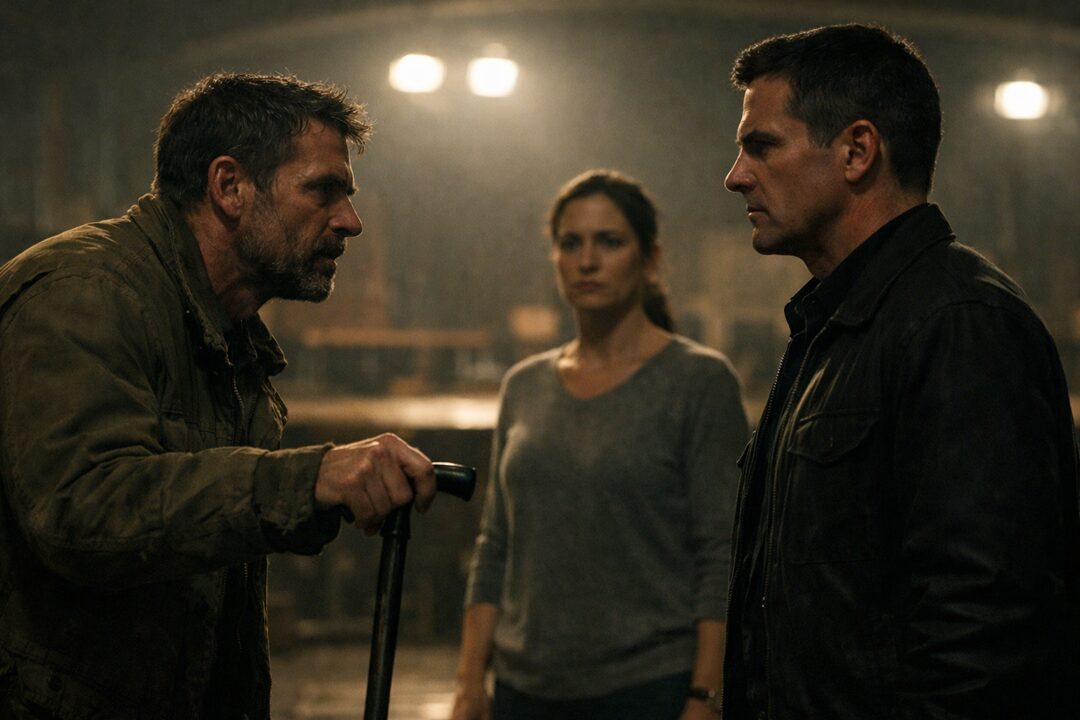
He was leaner than Elias remembered, though not from health. His face had been cut into harder angles by years that had not gone easy on him. One leg dragged half a beat behind the other, not enough to make him fragile, just enough to make every step look like a private argument. He wore an old field jacket over a thermal shirt, jaw dark with stubble, hands restless at his sides.
He saw Elias, took him in, and smiled without warmth.
“Well,” he said. “They really did drag the movie star out for the funeral.”
The room tightened by instinct.
Elias put down the box of programs in his hands. “Rafe.”
“Don’t do that voice.”
“What voice?”
“The careful one. Makes it sound like you’re handling ammunition.”
Leah didn’t intervene. Vale looked up from her tablet, assessing not celebrity, not veteran, just fracture.
Rafe walked in, using the cane only when he had to. His eyes moved over the stage, the boxes, the costumes, the people who had already begun making themselves quieter around him.
“Hell,” he muttered. “You’re actually closing it.”
“By nineteen hundred,” Vale said.
Rafe turned to her. “You military?”
“Yes.”
“Then you should know better than to say ugly things like they’re neutral.”
Vale held his stare. “You here to claim property?”
“I’m here to make sure none of you throw out the wrong ghosts.”
He walked past Elias without offering a hand.
Years earlier, Rafe had been a mechanic with a talent for fighting the wrong man at the wrong time and then looking personally offended by the consequences. Elias remembered his first night in the program: standing in the back row of a cold reading, refusing to participate, then suddenly delivering one line so cleanly the entire room had gone still. Not because it was polished. Because it sounded like a confession he had accidentally made wearing someone else’s words.
Afterward Rafe had laughed it off, then stayed for six months.
After the blast in Helmand, he had vanished for nearly two years.
Now he stood in front of a folding table full of folders and picked up a playbill with two fingers like it might burn him.
“You kept this crap?” he asked.
Leah answered. “Some of us know archives matter.”
“Some of us know hoarding with better lighting.”
But he didn’t put the playbill down.
Elias said, “There’s coffee.”
Rafe looked over at him. “That your idea of a reunion?”
“It’s what I’ve got.”
Rafe’s mouth twitched once, almost a laugh, almost disgust. “That tracks.”
The morning turned into a series of objects that refused to stay objects.
A letter from a staff sergeant in Kandahar thanking the program for mailing scripts because reading them in a guard tower had been “the only time my head shuts up in a way that doesn’t scare me.”
A DVD of a holiday pageant with a label written in a child’s blocky marker.
A crate of prop rifles that made everyone briefly, visibly tired.
A broken pair of dance shoes.
A binder filled with permission slips and emergency contacts and one drawing of a stage with the words my mom smiles here written in purple crayon.
Vale sorted by category until the categories betrayed her. She kept reading things she had no operational reason to read. A typed thank-you from a widow in North Carolina. A note from an infantryman who said he had sat through Hamlet because it was air-conditioned and stayed because “for two hours nobody asked me if I was okay.” She set it aside, then came back to it later as if annoyed with herself.
Around noon Leah opened a costume bin and found a paper crown, gold paint flaking at the edges.
She held it up. “Nativity pageant,” she said.
Elias took it carefully.
It was absurdly light. Child-sized. Bent at one point where someone had stepped on it and then fixed it with tape. He remembered a little boy in a too-large shepherd costume refusing to go onstage until Leah’s daughter—no, not daughter. Her son. Mateo. Four years old and solemn—had marched up in that crown and announced he would go first.
“Keep that out,” Leah said.
“For what?”
“For the room.”
He set it on the stage edge.
Rafe noticed. “That thing still alive?”
“It’s paper,” Leah said. “Not a command structure.”
Rafe looked at the crown for a second too long, then away.
Near the back wall sat an old military trunk painted dull green, heavier than it looked, brass corners dark with age. No label. No tag. Locked.
Vale pointed at it with her stylus. “What’s in there?”
No one answered.
She repeated, “What’s in there?”
Leah was the one who said, “That stays closed.”
Vale raised an eyebrow. “That’s not how this works.”
“It is if you want my help at all.”
“Ma’am, I need chain of custody on every sealed container in this facility.”
Rafe spoke without turning around. “Then write ‘don’t touch’ on your little clipboard and evolve.”
Vale looked at Elias. “Mr. Voss?”
He should have said something decisive. Instead he said, “Not yet.”
Her expression flattened. “I’m going to need better than that.”
“Later,” he said.
The captain’s jaw tightened. “This whole building is ‘later.’ That’s why I’m here.”
Leah rescued the moment by dropping another stack of file folders onto the nearest table. “Then be useful,” she said.
For one second Vale looked like she might order everyone out.
Instead she bent, picked up a spool of labels, and went back to work.
It was sometime after one when someone suggested a final reading.
Not public. Not promoted. Just for whoever was already here before the stage got stripped.
A terrible idea.
An inevitable one.
The volunteers lit up with immediate fragile hope. Even Vale paused. Elias felt every part of himself move toward refusal. Read what? For whom? To what end? The room didn’t need ceremony. It needed saving, and it was already too late for that.
Then Leah said, “Before they tear down the lights.”
And Rafe said, “No.”
It wasn’t loud. It didn’t need to be.
The whole hangar stilled around that single syllable.
Rafe leaned on his cane and looked at the stage like it had personally offended him. “You all want a neat little goodbye because neat is easier than true.”
“No one said neat,” Leah said.
“This place was never neat.”
Elias heard himself say, “It doesn’t have to be public.”
Rafe turned.
That was the first real look between them all day. Not greeting. Not recognition. Accounting.
“Right,” Rafe said softly. “That’s always been your talent. Make it meaningful. Make it private. Make sure you can leave before anyone thinks they get to keep you.”
The room seemed suddenly too open.
Elias kept his voice even. “If you have something to say—”
“I do.” Rafe took one dragging step forward. “You built a sanctuary you could walk out of whenever it got too human. The rest of us stayed behind in it.”
No one moved.
Even Vale stopped pretending to inventory.
Rafe’s eyes were bright now, dangerous in the way grief sometimes is when it has worn anger long enough to pass inspection.
“You gave people language,” he said. “Fine. You gave them a room. Fine. But don’t come back now and stand under the lights like this was some beautiful thing you carried all by yourself.”
Elias could have defended himself. He had language for difficult rooms. He had made a career out of standing still while other people threw feeling at him. But this was not a premiere, a press junket, or an interview designed to draw blood without making a stain.
This was worse.
Because Rafe wasn’t wrong.
“I didn’t carry it alone,” Elias said.
Rafe laughed once. “That’s your answer?”
“It’s the true one.”
“It’s the safe one.”
The line struck harder because Elias had no clean way around it.
Leah stepped in before the silence curdled completely. “Enough for now.”
Rafe looked at her, then back at Elias.
“No,” he said. “Not enough. Just not useful yet.”
He turned and limped toward the back door.
Elias took a step after him before stopping himself.
That, too, had always been his talent.
Knowing exactly when not to follow.
Part III — The Locked Trunk
The room never fully recovered its old rhythm.
People worked. Boxes filled. Tags accumulated. But every movement now carried the shape of what Rafe had said.
By three, the air in the hangar felt used up.
Leah was sorting children’s costumes into salvage and storage when she asked, without looking at Elias, “Do you know why Mateo spoke here before he spoke anywhere else?”
He was across the table with a stack of scripts in his hands. “Because he liked the lights.”
“No.”
He set the scripts down.
Leah folded a tiny cape with precise fingers. “For six months after Daniel died, he barely talked. At home, not at school, not in church, nowhere. Then one day during a rehearsal he walked onto this stage wearing that stupid crown and said, ‘I’m first.’”
Her voice remained flat. That was how she protected the sharp edges.
“The room didn’t clap,” she said. “Nobody turned it into a miracle. They just made space and let him keep talking. That’s what this place was. Not healing. I hate that word. It was room.”
Elias swallowed.
Daniel Navarro. Corpsman. Laugh too quick. Hands always busy. One of those men who could make a tent feel less temporary just by entering it. He had been dead for sixteen years. Elias had still not said his name out loud in public. Sometimes not even in private.
Leah finally looked at him. “You’re not the only one who built this,” she said. “But you are the one people turned into the story.”
Before he could answer, Captain Vale approached holding one of the press clippings.
“I found this in the feature archive,” she said. “Would you like me to preserve it?”
The clipping showed Elias in black tie at some benefit gala, smiling the controlled smile he reserved for charitable photography and funerals. The headline beneath it called the program his “passion project.”
He looked at the page, then at her. “No.”
“Discard?”
“Keep it with the lies.”
Something shifted in her face at that. Not softness. Curiosity, sharpened by discomfort.
A young corporal poked his head into the hangar. “Captain? Public affairs is asking if the founder would be available for a quick photo before sunset.”
Elias said, “No.”
Vale didn’t look at him. “I’ll handle it.”
The corporal hesitated. “They said command thinks it would honor the program.”
“Then command can honor it from a respectful distance,” Vale said.
The corporal vanished.
Elias stared at her. “Why did you do that?”
She set the clipping down. “Because a photo is not preservation.”
He said nothing.
She glanced toward the locked trunk by the back wall. “But I still need that opened.”
Leah’s hands stopped on the cape.
The hangar seemed to hear them.
“No,” Leah said.
Vale’s patience thinned audibly. “I have indulged every unofficial ritual in this building for eight hours. That container remains unlogged.”
“It isn’t a container,” Leah said.
“That is literally what it is.”
“No,” Rafe said from the doorway.
He had come back so quietly no one had heard him. He looked more exhausted than before, angrier too, as if leaving had only given the day time to catch up with him.
His gaze went to the trunk, then to Leah.
“I told you,” he said. “Not yet.”
Vale folded her arms. “I’m done with ‘not yet.’”
Rafe came in limping hard, every third step a flare of pain he refused to dignify. He stopped near the trunk and rested one hand on it, not protectively exactly, but with familiarity.
“You want your chain of custody?” he said. “Fine. Here’s custody. This is the stuff nobody knew what to do with because it wasn’t neat enough for your categories.”
“You don’t get to decide that.”
“No,” Leah said quietly. “He does.”
That made Vale look at her.
And then, finally, at Elias.
The room had been deferring to Leah all day in small invisible ways. Now it was unmistakable. Not rank. Not fame. Authority of another kind.
Vale seemed to understand that she had stepped into an old boundary without knowing it.
“What is in it?” she asked.
Leah didn’t answer her. She answered the room.
“Daniel’s things,” she said. “And the first years.”
The silence after that was so complete Elias heard the hum of the work lights over the stage.
Rafe’s hand stayed on the trunk. “You told me once,” he said, not looking at Elias, “that this place started because there had to be somewhere to put what didn’t fit inside command language.”
Elias felt every eye turn toward him.
He wanted, absurdly, to still be wearing the sunglasses.
Leah reached into her pocket and produced a ring of keys. Old brass. One key darker than the others.
She held it out to Elias.
Not to Rafe. Not to Vale.
To Elias.
For a second he didn’t move.
Then he took the key.
The lock resisted like it had earned the right. When it finally opened, the sound was small and humiliatingly loud.
Inside lay no treasure, no formal archive, no clean story. Just weathered folders tied with string. Spiral notebooks. rehearsal drafts. envelopes bent at the corners. A photo wrapped in tissue. One pair of corpsman shears gone brown at the hinge. A set of dog tags in a cloth pouch.
And on top, sealed but not addressed, a letter in Elias’s handwriting.
He knew it immediately. The shape of the E. The press of the pen. The years had not made it unfamiliar. Only unbearable.
No one spoke.
Leah said, “Read it.”
He looked at her. “No.”
“Yes.”
“Not here.”
“That is why here.”
His throat tightened. “Leah—”
“For sixteen years,” she said, very calm, “people have praised the mission and buried the reason. Not tonight.”
Rafe stood a little straighter despite the pain in his leg. Vale had gone very still.
Elias picked up the envelope with fingers he wished did not look so steady.
He opened it.
The paper inside had been folded enough times to remember the shape.
His own words met him like a witness.
He read silently at first, and the hangar waited.
Then Leah said, “Out loud.”
So he did.
“I don’t know how to speak to men after this,” he read, and even his own voice sounded borrowed. “Not with orders. Not with unit briefings. Not with the language we were given for courage, which keeps breaking in my mouth. I watched a good man die and then watched the living pretend there was a correct volume for surviving him.”
No one in the room moved.
Elias kept reading.
“Some of them joke. Some rage. Some volunteer for things that look brave because they are easier than being still. Some perform fine so convincingly I think they might disappear inside it. I don’t know how to reach them except sideways. Through other words. Borrowed words. Made words. A room where nobody has to answer the question they are already tired of lying to.”
His vision blurred once. He forced it steady.
“If this becomes anything, let it not be called charity. Let it be understood as need. Not theirs alone. Mine too.”
The page trembled then, only once, but everyone saw.
He lowered it.
Rafe exhaled hard through his nose like a man hit below armor.
Captain Vale stared at the floor.
Leah’s face did not change, but something in it unclenched.
Elias looked back into the trunk and found a smaller notebook underneath the letter. rehearsal notes from the early years. his own blunt observations in the margins. Don’t let them hide in irony. Cut the scene if it turns explanatory. Silence after line 4 mattered more than line 5.
A photograph slid loose from between the pages.
Daniel in desert utilities, grinning like the camera owed him money. One arm thrown around Elias’s shoulder. Both of them young enough to confuse stamina with permission.
Vale saw the photo.
“That’s him,” she said, not as a question.
Leah nodded.
“The corpsman?”
“My husband.”
The captain swallowed.
No speech came. Good. A speech would have ruined it.
Leah looked at Elias. “Tell her about the talent night.”
He almost laughed from the cruelty of it.
But she was right.
So in fragments, under the hum of the lights and the weight of an opened past, he did.
About the disciplinary report after he’d mouthed off to a superior officer and should have known better.
About Daniel finding him outside the rec hall, furious and half drunk on the cheaper form of military self-hatred.
About Daniel shoving a script into his hands and saying, If you’re going to be impossible, at least be interesting.
A talent night. A joke. A room full of Marines pretending not to care while one by one they stood up and sang badly or read monologues or told stories too strange to tell anywhere official.
Daniel had made him get onstage.
Afterward Daniel had said, “See? You can either let damage choose your voice for you, or you can beat it there by ten seconds.”
Leah finished the story for him.
“After Daniel died, Elias built this place because command knew how to issue condolences and deploy replacements. It did not know how to make room.”
Rafe looked at the open trunk and said, quietly now, “You still left.”
It was the most merciful accusation of the day because it no longer pretended he had done only one thing.
“Yes,” Elias said.
Rafe nodded once like a man accepting evidence he already had.
That hurt more.
Part IV — No Ceremony
At five-thirty the sun dropped low enough to turn the hangar doors into rectangles of amber.
Public affairs came anyway.
Two civilians with laminated badges, a photographer with a polite smile built for difficult talent, and a lieutenant colonel who kept using words like legacy and outreach and visibility as if saying them often enough could turn the evening into something clean.
“We just need thirty seconds onstage,” the colonel told Elias. “A few stills. Maybe one statement about impact.”
“No,” Elias said.
“Mr. Voss, this would help preserve—”
“No.”
The photographer shifted, embarrassed for everyone.
The colonel looked at Captain Vale. “Captain?”
She answered without hesitation. “Facility is in active decommission. Extra personnel interfere with chain of custody.”
The colonel blinked. “This is command-directed.”
“And I am executing command intent by preventing contamination of material under review.”
It was such perfect military language Elias almost admired it out loud.
The colonel looked between them and decided, wisely, that tonight was not worth a famous argument. They left with their polite smiles gone thin.
When the hangar door shut behind them, Leah said, “Well. Look at that. Bureaucracy finally did something human.”
Vale ignored the line, but color touched her face.
By then half the volunteers had drifted close to the stage without being told to. Nobody wanted to leave before the last thing happened, whatever shape it took. Nobody knew whether Rafe would stay. He stood near the rear aisle with his cane planted like a boundary marker, close enough to hear, far enough to refuse belonging.
The work lights still burned over the stage.
Someone asked Elias what he wanted to read.
He looked at the stacks on the table: the letters, the rehearsal pages, the notebook, the unsent letter now unfolded and impossible to return to secrecy. So much material, and most of it wrong for speeches, wrong for tribute, wrong for the kind of graceful ending people liked to package around loss.
Then he understood that grace was not the assignment.
“Not a speech,” he said.
“What then?” Leah asked.
He looked at her. “A record.”
So they built one.
Not elegantly. Urgently.
Leah selected fragments from letters—one paragraph from a Marine in Okinawa, two lines from a spouse in North Carolina, a child’s note written in green marker: thank you for making my dad laugh where i could see it.
Rafe refused to come forward.
Vale, after a silent hesitation, carried up a box of old scripts and let Elias pull pages at random. Unfinished scenes. rehearsal notes. A monologue from Ajax. A comedy bit from a Christmas show that made Leah snort despite herself.
“You’re smiling,” Elias said.
“Don’t make it important.”
It was important.
Mateo arrived just after six with a backpack over one shoulder and the long-limbed awkwardness of a boy who had become young without asking permission. Sixteen now. Taller than Leah. Face still carrying traces of Daniel when the light hit it wrong.
He saw Elias on the stage and stopped.
For a second Elias thought, absurdly, that he had no right to be seen by this child at all.
Mateo’s eyes moved to the paper crown sitting on the stage edge.
“You kept that?” he asked.
Leah said, “Apparently paper can outlive funding.”
A faint smile touched him. He came forward, picked up the crown, and turned it over in his hands.
No one told him what it meant. They didn’t need to.
At six-forty, with the building still technically under decommission and the evening nearly gone, Elias stepped to center stage.
No podium. No mic. No official audience configuration. Just folding chairs dragged into rough rows and whoever chose to remain in them. Some stood in the back. Some leaned on walls. Rafe stayed in the shadows near the rear, one hand tight on the cane.
Captain Vale walked to the lighting board, considered the switches, and then shut off the overhead performance grid entirely.
Only the work lamps remained.
The stage lost its polish. It became what it had always secretly been: a place for labor, not display.
The room understood at once.
Elias held the pages in both hands. His hat and sunglasses were gone. He looked not younger without them, not softer. Just less defended.
“For the record,” he said, and his voice carried easily in the stripped-down room, “this is not a ceremony.”
Nobody moved.
“This place was not built to make pain beautiful,” he said. “It was built because some things were already ugly, and silence was helping them win.”
That line landed and stayed.
He read from the letters first.
A line from the staff sergeant in Kandahar.
A wife writing that her husband came home from a workshop and sat at the kitchen table for an hour before saying, with visible confusion, “I think I missed being a person.”
A child thanking the volunteers for making his mother stop crying in the parking lot before they drove home.
Then a page from an unfinished script. Then a note from the margin of an early rehearsal book: When they joke right before the scene, let them. It means they are afraid and still staying.
Leah read next. Her voice was clear and unsentimental, which made it hurt more.
Mateo read a child’s note written years earlier by his own small hand and did not mention that he recognized it.
Then Elias unfolded the letter.
The room changed before he spoke a word. Not in volume. In weight.
He read the lines they had already heard, and farther.
“I thought if I made a place with enough language in it, I could keep one death from multiplying in the people left behind. That was pride. Or grief. Or both.”
He stopped once, then continued.
“I did not found this because I was generous. I founded it because I had run out of respectable ways to watch men vanish.”
No one looked away.
Somewhere in the back, Rafe shifted.
Elias found the last paragraph and knew, even before he read it, what the true cost of the night would be.
“If this room endures,” he read, “let it belong most to those who stayed after the applause nobody heard. Let it belong to the families who have had enough of brave language. Let it belong to the living more than the honored dead, because the dead are not the ones still being asked to continue.”
His hands lowered slightly.
Then he did the one thing he had not done in sixteen years.
He said the name.
“Daniel Navarro.”
Simple. Bare. Public.
Leah closed her eyes.
Mateo’s fingers tightened around the paper crown.
Elias looked out into the dim room, not above it, not through it, but into it like a man finally conceding that witness counted as a form of duty.
“Daniel Navarro kept shoving people toward the stage,” he said. “He did it because he thought performance was less dangerous than pretending. He was right more often than I wanted him to be.”
A rough sound came from the back.
Rafe.
He was still standing in the shadows, head down, one hand over his mouth for a second as if he had nearly said something he hadn’t meant to release.
Then he looked up.
“There was a line,” he said.
Nobody moved.
“A line from the first show I stayed for.” He took one step forward. Then another. Pain cut across his face and did not stop him. “You told me to say it like I wasn’t hiding in the joke.”
Elias knew before Rafe said it. He had forgotten a hundred polished speeches and remembered that line for years.
Rafe’s voice was raw, quieter than the room expected.
“‘The worst part isn’t that I broke,’” he said. “‘It’s that everyone got so relieved when I acted unbroken.’”
The room went still in a different way then. Not silence. Recognition.
Elias nodded once.
“That’s the one,” he said.
Rafe didn’t smile. But he stayed.
Mateo stepped forward with the crown and placed it carefully in the center of the stage between them, gold paint flaking under the work lights.
Not as a symbol anyone announced.
Just where it belonged.
For a long moment, no one spoke. The work lamps buzzed softly overhead. Dust moved through the light like something visible only when held at the right angle.
Then Leah said, from the front row, “That’s enough.”
Not because it had become too much.
Because it had become true.
Part V — What Remains Useful
At nineteen hundred, the hangar still closed.
No miracle arrived in the final minute. No admiral reversed the order. No donation saved the space. The sign came down with two bolts and a ladder. The lockout sheet was taped beside the door. History, like everything else on base, submitted eventually to forms.
But not completely.
Captain Vale redirected the archival boxes herself. Not to general disposal. Not to anonymous digitization without custody. She signed them over to a veteran arts network in San Diego that still ran workshops out of borrowed rooms and church basements. When a junior clerk questioned the reroute, she said, “This is the appropriate preservation path,” in a tone that made the matter sound both absolute and too boring to challenge.
The press clippings went in their own file.
The letters went with the letters.
The paper crown did not.
Mateo tucked it into his backpack without asking permission from anyone.
And the trunk—the ugly green one with the bad lock and the unbearable first years inside it—did not return to storage.
Rafe stood beside it while the last boxes moved out.
Vale approached with her tablet. “I can log this as transferred personal archive,” she said.
Rafe looked at her. “To who?”
She met his gaze. “To you. If you want it.”
He glanced toward Elias, then away again almost immediately.
“I don’t run institutions,” Rafe said.
“No,” Vale replied. “Maybe that’s why you should have it.”
For a moment Elias thought Rafe might refuse on instinct.
Instead he bent, grimaced at the leg, got one hand under the trunk handle, and nodded once.
“I’ll take the ugly parts,” he said.
It was not forgiveness.
It was better than pretending.
Outside, evening had gone blue. The base loudspeakers carried some distant announcement no one in the parking lot listened to. Volunteers left in twos and threes, hugging too briefly, carrying banker’s boxes like rescued weather.
Leah stood by her car with Mateo, one hand on the open door.
Elias came over, unsure now in a way fame had not taught him how to manage.
Leah saved him from speaking first.
“You finally said his name,” she said.
“Yes.”
“It shouldn’t have taken the building dying.”
“No,” he said. “It shouldn’t have.”
She studied him. There was no softness in it, but no punishment either. Just measurement.
“Daniel would have made fun of your hat,” she said.
Elias almost laughed. “He did, the first time.”
“I know.”
Mateo shifted the backpack on his shoulder. “The line Rafe said,” he asked, “was that from a real play?”
Elias looked at him.
“No,” he said. “We wrote it here.”
Mateo nodded as if that answered more than the question. Then he got into the car.
Leah opened her door, then stopped.
“This place mattered,” she said. “Not because it fixed people. Don’t ever let anyone write that version. It mattered because it let them be visible without having to become evidence.”
Elias felt the sentence go somewhere permanent.
“I won’t,” he said.
“You might not get to control that.”
She was right. She usually was.
Then her face eased by one degree—the closest thing to mercy he would get from her tonight.
“But now at least,” she said, “there were witnesses.”
She got in the car and drove away.
Rafe loaded the trunk into the bed of an old pickup with language that would have gotten him thrown out of a cleaner story. Captain Vale pretended not to hear. Once it was settled, he straightened and looked at Elias over the truck bed.
“You still leaving without a speech?” Rafe asked.
“Yes.”
“Good.”
He shut the tailgate.
Then, after a beat, he added, “That line you gave me back then? About hiding in the joke?”
Elias waited.
“It was a cheap line,” Rafe said.
“I know.”
“It worked anyway.”
That was all.
They stood there a second longer, not friends, not enemies, not healed, not finished.
Then Rafe got into the truck and drove off with the ugly trunk and everything in it that could no longer be archived as myth.
Captain Vale remained near the hangar door, checking the final seal.
When she finished, she turned to Elias. Under the lot lights she looked younger and more tired than she had in uniform all day.
“I read more of those letters than I was supposed to,” she said.
“I know.”
She held his gaze. “I was wrong about some things.”
He considered giving her the easy absolution. It would have been the polite celebrity move, the gracious older-man line, the thing people liked to quote later.
Instead he said, “So was I.”
Something like relief crossed her face—not because he had forgiven her, but because he had refused the theater of being above her.
She nodded toward the sealed door. “I can’t keep it open.”
“I know.”
“But I could keep some of it from vanishing.”
“That’s enough.”
“No,” she said quietly. “It isn’t. But it’s something.”
“Yes.”
She hesitated, then asked the one question nobody else had risked all day.
“Was acting part of the leaving?”
He could have answered ten ways. Could have made it elegant. Could have lied.
“Yes,” he said.
She accepted that with one small motion of her head. Not curiosity satisfied. Data incorporated.
Then she stepped aside, giving him the path to his car.
No cameras waited. No public statement followed. No one applauded him for showing up to his own unfinished business. The night gave him what military life always had when it wanted to be honest: a task completed badly, a loss not repaired, and just enough dignity left over to carry home.
He stood for one last moment facing Hangar Seven.
Dark now.
No stage visible. No work lights. Just a shut military building on a base that would continue tomorrow without consulting the people it had shaped.
He thought of the first light he had seen through the side door before dawn. Not performance lighting. Work lights. The kind that admitted what a room really was.
He thought of Daniel shoving a script into his hand and saying, If you’re going to be impossible, at least be interesting.
He thought of Leah’s voice: It was room.
He thought of Rafe taking the trunk because someone had to keep the ugly parts alive.
And for the first time in years, Elias understood legacy in a way that had nothing to do with being remembered.
It was not what strangers knew about you.
It was not what articles said.
It was not the version with flattering headlines and clean motives.
It was what remained useful after you were gone.
He got into the car, started the engine, and drove off base without looking for the cameras that weren’t there.
Behind him, the building stayed closed.
Elsewhere, carried by people rather than institution, it did not end.